Quotulatiousness

December 14, 2025

Where does all the money go for so many First Nations bands?

Filed under: Bureaucracy, Cancon, Economics, Government — Tags: , , , , , — Nicholas @ 03:00

Earlier this month, I shared a long thread highlighting some incredible findings from the audit of a single First Nations group in Saskatchewan (here). On the social media site formerly known as Twitter, @Martyupnorth discusses how the federal government has gone out of its way not to ensure that First Nations funding is transparent:

    Cory Morgan @CoryBMorgan
    The Siksika reserve got $1.3 billion a few years ago and the housing is still predominantly shit.

    It’s not lack of government funding folks.

    It’s a broken system of racial apartheid.

    This ruling won’t help a bit.

Let’s talk about transparency in First Nations reserve finances in Canada. It’s topic that’s sparked a lot of debate.

Back in 2013, the Harper government passed the First Nations Financial Transparency Act (FNFTA), which required chiefs and councils to publicly disclose their salaries, expenses, and audited financial statements. The goal? To ensure accountability for the billions in federal funding going to reserves, empowering community members to hold leaders responsible and curb potential corruption.

But the Act was controversial from the start. Critics, including many First Nations leaders (no surprise there), called it paternalistic, imposed without proper consultation, and an infringement on Indigenous sovereignty. Some argued it violated privacy by forcing the public release of sensitive financial details, like personal remuneration schedules.

Enter Justin Trudeau. During his 2015 campaign, he promised to repeal the FNFTA, saying it wasn’t “respectful” to First Nations and needed replacement with a co-developed approach. Once in power, his government didn’t formally repeal the Act, but effectively reversed it by suspending enforcement. They stopped withholding funds from non-compliant bands, halted court actions, and reinstated frozen money. Compliance rates plummeted afterward, with fewer bands disclosing info publicly.

See the screen shot below. The Siksika Nation, to whom Cory refers to, hasn’t dislosed financial data since 2013.

The Liberals’ rationale? Building “mutual accountability” through partnership rather than top-down rules, addressing privacy concerns and respecting self-governance. But a decade later, as of 2025, the Act remains on the books unenforced, while polls show most Canadians still want transparency in how reserve funds are mis-managed.

What do you think? Does ditching enforcement help or hinder real accountability?

Update: At some point, the audits have to start and the government and the courts will then have their hands full:

December 12, 2025

British Columbia’s embrace of UNDRIP entails vast unintended consequences

Filed under: Cancon, Government, History, Law, Media, Politics — Tags: , , , , , — Nicholas @ 05:00

The government of British Columbia may have downplayed or even deliberately lied about the impact of incorporating the United Nations Declaration on the Rights of Indigenous People (UNDRIP) into BC’s legal system, but I suspect even they are suddenly realizing just what a legal disaster they have unleashed on their province (and indirectly, on the rest of Canada):

A map showing the Cowichan title lands outlined in black. These lands were declared subject to Aboriginal title by the BC Supreme Court earlier this year, in accordance with the UNDRIP provisions added to BC law in 2019.

When the B.C. NDP introduced a 2019 act committing the province to the United Nations Declaration on the Rights of Indigenous People (UNDRIP), they very specifically assured critics that it would not be a “veto” over existing laws.

“The UN declaration does not contain the word veto, nor does the legislation contemplate or create a veto”, Scott Fraser, the province’s then Indigenous relations minister, told the B.C. Legislative Assembly.

Fraser explained that it was not “bestowing any new laws”, it would not “create any new rights” and it certainly wouldn’t make B.C. subservient to a UN declaration.

Fraser would even explicitly assure British Columbians that there was no conceivable future in which, say, a private landowner could suddenly see their property declared Aboriginal land.

“We are not creating a bill here that is designed to have our laws struck down,” he said.

That it only took six years for all of these scenarios to take place may explain why there is so much panic in B.C. right now.

The newly appointed head of the B.C. Conservative Party is calling for an emergency Christmas session of the legislature to excise UNDRIP from provincial law, saying it has become an anti-democratic tool.

Even B.C. Premier David Eby — a onetime champion of the legislation — has said that “clearly, amendments are needed”.

And British Columbians, whose support for the UN law was already not great, are growing restless. According to an Angus Reid Institute poll released on Wednesday, Eby ranks as one of the least popular provincial leaders in the country.

What changed was a Dec. 5 B.C. Appeals Court ruling that not only struck down a B.C. law (the Mineral Tenure Act) on the grounds that it violated UNDRIP, but effectively ruled that any law or government action could similarly be overturned if it wasn’t in line with the 32-page UN declaration.

By writing UNDRIP into B.C. law, the province had adopted the Declaration as “the interpretive lens through which B.C. laws must be viewed and the minimum standards against which they should be measured”, read the majority decision.

Although UNDRIP is mostly filled with uncontroversial declarations about languages and traditional medicine, its clauses are pretty uncompromising when it comes to issues of land use or resource development.

“Indigenous peoples have the right to the lands, territories and resources which they have traditionally owned, occupied or otherwise used or acquired”, reads a subsection of Article 26. It also states that Indigenous peoples “own, use, develop and control” any land that they’ve held traditionally.

Eby is saying that the courts took it too far, and that writing UNDRIP into B.C. law was only ever meant as a holistic decision-making guide, rather than a law superceding all others.

As Eby told reporters this week, by signing onto UNDRIP, B.C. wasn’t intending to put courts “in the driver’s seat”.

December 11, 2025

US Democrats, like Canadian Liberals, love performative gestures but ghost on delivery

Filed under: Cancon, Media, Politics, USA — Tags: , , , , , , — Nicholas @ 05:00

I’ve remarked many times that Canada’s federal Liberals love themselves some photo ops, sound bites, ribbon-cuttings, and making announcements in front of temporary stages … they can’t help themselves, they’re what happens to theatre kids who don’t have to grow up. The American Democrats seem to be falling into the same pattern of “putting on a show” rather than implementing policies that address whatever the declared problem really is:

In 2015, the City of Los Angeles announced an ambitious plan (led by the person we then referred to as Mayor Yogapants) to completely eliminate traffic deaths by 2025. It was a vision: Vision Zero, they called it. Ten years later, traffic deaths in Los Angeles have doubled. A wonderfully progressive local government announced a plan to eliminate something, so we got much more of that thing. A community group, @peoplesvisionzero, is now trying to carry out some version of the failed plan with guerilla traffic engineering, sneaking new safety infrastructure into place without city permission. Recent result:

In similar fashion, Gavin Newsom announced his ten-year plan to end California homelessness in 2008. I struggle with the math, but there’s a possibility that we’ve passed the ten-year mark since then. […]

Theater-kid governance is the empty-to-the-point-of-ruin declaration of a symbol-desire, a performance about what we want and don’t want. It doesn’t do anything; it’s a posture, not an action. To the extent that it does do any actual thing in physical reality, it creates pots of money to be looted by NGOs and metastasizing government bureaucracies.

Infamously, when California audited $24 billion in state homelessness spending last year, auditors couldn’t track where a bunch of the spending went, or figure out what it had paid for. See also the growing scandal over Somalian immigrant social services fraud in Minnesota. Facial expressions are made. Symbols are invoked. Money goes … somewhere. It’s a show, with a rich loot bucket, not an actionable set of policies that produce positive trends toward declared goals. By the way, it’s been fifteen years since the Obama administration and a Democratic-majority Congress made healthcare affordable.

California infrastructure is a persistent disaster, because the California legislature and our sociopathic idiot governor are deeply invested in signaling about warm and wonderful trans kids and standing up to Mean Orange Hitler. They don’t stoop to highways and bridges — they’re much too progressive. Related, the increasingly sharp near-term projected decline of fuel production in California is becoming a national security problem in a state that needs to gas up a lot of military traffic. The state performs constantly against Big Oil and its mean climate change agenda, and somehow keeps losing refineries. The endless symbol-gestures cause the loss of real things.

December 10, 2025

Murmurs of dissent from within Canada’s supply management cartel

At Juno News, Sylvain Charlebois shares a sign of internal dissent inside the supply management system that prioritizes protecting producers at the cost of significantly higher prices and reduced choice for Canadian consumers — not to mention getting Trump’s attention (and anger) for shutting out American competitors:

Every once in a while, someone inside a tightly protected system decides to say the quiet part out loud. That is what Joel Fox, a dairy farmer from the Trenton, Ontario area, did recently in the Ontario Farmer newspaper. In a candid open letter, Fox questioned why established dairy farmers like himself continue to receive increasingly large government payouts — even though the sector is not shrinking, but expanding. His piece, titled “We continue to privatize gains, socialize losses“, did not come from an economist or a critic of supply management. It came from someone who benefits from it. And yet his message was unmistakable: the numbers no longer add up.

Fox’s letter marks something we have not seen in years — a rare moment of internal dissent from a system that usually speaks with one voice. It is the first meaningful crack since the viral milk-dumping video by Ontario dairy farmer Jerry Huigen, who filmed himself being forced to dump thousands of litres of perfectly good milk because of quota rules. Huigen’s video exposed contradictions inside supply management, but the system quickly closed ranks. Until now. Fox has reopened a conversation that has been dormant for far too long.

In his letter, Fox admitted he would cash his latest $14,000 Dairy Direct Payment Program (DDPP) cheque, despite believing the program wastes taxpayer money. The DDPP was created to offset supposed losses from trade agreements like CETA, CPTPP, and CUSMA. These deals were expected to reduce Canada’s dairy market. But those “losses” are theoretical — based on models and assumptions about future erosion in market share. Meanwhile, domestic dairy demand has strengthened.

Which raises the obvious question: why are we compensating dairy farmers for producing less when they are, in fact, producing more?

This month, dairy farmers received another 1% quota increase, on top of several increases totalling 4% to 5% in recent years. Quota — the right to produce milk — only increases when more supply is needed. If trade deals had truly devastated the sector, quota would be falling, not rising. Instead, Canada’s population has grown by nearly six million since 2015, processors have expanded, and consumption remains stable. The market is expanding.

Understanding what quota is makes the contradiction clearer. Quota is a government-created financial asset worth $24,000 to $27,000 per kilogram of butterfat. A mid-sized dairy farm may hold $2.5 million in quota. Over the past few years, cumulative quota increases of 5% or more have automatically added $120,000 to $135,000 to the value of a typical farm’s quota — entirely free. Larger farms see even greater windfalls. Across the entire dairy system, these increases represent hundreds of millions of dollars in newly created quota value, likely exceeding $500 million in added wealth — generated not through innovation or productivity, but by regulatory decision.

December 9, 2025

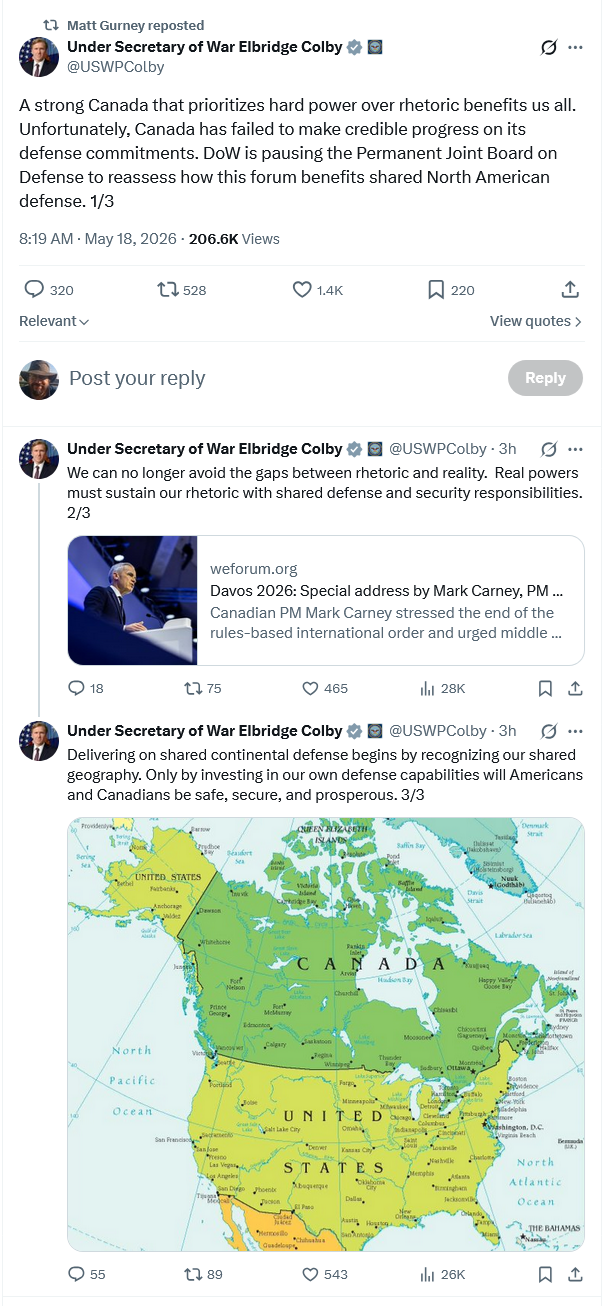
The age of Trump – “America has ‘walked away’ from its allies”

Filed under: Cancon, Government, Military, USA — Tags: , , , , , — Nicholas @ 05:00

In The Line, Matt Gurney talks about last month’s annual Halifax International Security Forum, where the biggest change from previous events was the official absence of US government representation:

Late last month, attending the Halifax International Security Forum, I was having the damndest feeling. Can you have déja vu for something that you only experienced via fiction? Because it was kind of like that.

The fiction in question was a novel by an Australian, published during the Second Iraq War. Anti-American sentiment was running rampant all over the world. The premise of the novel is out there in the realm of sci-fi — America disappears. Specifically, Americans disappear — some mysterious wave of energy scours most of North America clean of life. Virtually all of the U.S. is wiped out; most of Canada and Mexico, too. Somewhat to the surprise of the anti-Americans, this does not result in an improvement in life on Planet Earth.

Standing around at the forum, eating the delicious snacks and drinking the good coffee and chatting with friends old and new, that was what I kept thinking about. Where are the Americans? And what the hell are we going to do without them?

And, in case you’re wondering what’s up with that headline, here’s another question — what will we do if they one day try and come back?

The forum is an annual gathering of senior military officers, defence and intelligence officials from across the free world, and representatives from the media, think tanks, large companies and civil society organizations whose work relates to defence and security issues or in some way seeks to promote and preserve a healthy democratic world. Funded by NATO, the Canadian government and private-sector sponsors, the event is a major part of Canada’s “soft power” offering to our allies — we host the big party and show everybody a good time. The actual schedule is split between on-the-record panel talks or presentations, off-the-record sessions, and informal time for mingling and schmoozing. I am grateful to have been invited to participate again this year.

Especially this year. I’ve been going to the forum for years, and the event always had a strongly American flavour.

Not anymore! Yankee went home.

Like, literally. He was ordered to go home, or stay there. Secretary of Defense Pete Hegseth ordered the Pentagon to avoid a series of high-profile annual defence summits. That includes Halifax, and others in places like Munich and Singapore, and even inside the United States itself. The reason, according to the Pentagon’s press apparatus, was that, and I swear to God this is the actual quote, such events promote “the evil of globalism, disdain for our great country and hatred for the president of the United States”.

Oh. Well, then.

That’s what made the forum so fascinating this year. As I told my colleague Jen Gerson while I was in Halifax, the entire event felt a little bit like the first Thanksgiving after a divorce. It’s great to see everyone, but there’re some notable absences, is the thing.

The “Great Feminization” of western culture

In the National Post, Barbara Kay outlines the way society has been trending further away from traditional values and more and more toward the values of “empathy, safety, and cohesion” which have been predominantly feminine values in contrast to more male-oriented values of “rationality, risk, and competition”:

In September, public intellectual Helen Andrews caused a stir when she delivered a provocative 17-minute speech, titled “Overcoming the Feminization of Culture”, to the National Conservatism Conference, later published as an article for Compact, titled “The Great Feminization“.

Andrews summarized feminization as the prioritizing of feminine over masculine interests, but additionally prioritizing “empathy over rationality, safety over risk, cohesion over competition”. All these traits combine, she believes, in institutions where females are numerically dominant, to define “wokeness” and “cancel culture”.

Andrews points to Bari Weiss’ 2020 resignation letter from the New York Times where Weiss was labeled and ostracized for her social ties and cut off by perceived friends. In 2018, the newsroom there had tipped to a female majority which Andrews argues changed the work environment’s dynamics to one where cohesion is preferred, and covert undermining would replace open debate in favour of emotional harmony.

And I would argue that the more feminized society’s institutions become, the more readily extreme, empathic attitudes replace rational decision-making at policy-making levels, and the more society loses confidence in its ability to thrive.

Ironically, instead of directing empathy towards our own citizens, feminization also tends to direct empathy internationally. That is exactly what is happening at our national level, when our government earmarks funds for programs such as “Gender-Just, Low-Carbon, Rice Value Chains in Vietnam”.

This is also happening at a micro-level to the Jewish community in North America. Our spiritual leadership in non-orthodox synagogues is growing increasingly female, and, by no coincidence, is wokeness spreading, and, by no further coincidence, so is alignment with radical anti-Zionism.

[…]

Claims that Israel was guilty of genocide and apartheid, the authors write, were a constant feature of their education. Most shockingly, they write — and this at a rabbinical training institution headed by a female rabbi — that “the sexual violence Israelis experienced (on October 7) was never mentioned, even during Women’s History Month”.

What about the Christian clergy? A 2024 report on female Christian clergy found that in a 2018 sample, about 14 per cent of U.S. churches were headed by a senior female clergyperson. So, churches are not yet in danger of feminization. Good luck to them.

If there is a solution to the feminization-linked problem of anti-Zionism in the non-Orthodox rabbinate, I don’t know what it is. I only know this trend cannot end well for our community. What is essential in Jews’ spiritual homes now, more than ever in our history, is that they be spaces where “ahavat Yisrael” — love of Israel — is the prevailing norm. If we are not for ourselves, who will be?

On a more individual level, the Great Feminization has worked not to make women equal, but to increase their existing privileges and to demonize men who even notice the inequality now runs directly opposite to the narrative:

Image from Steve’s Substack

Over thirty years ago, I knew a woman who felt ecstatic joy taunting men with her nudity. She loved to flash her breasts at truckers on the highway. Thrilled at the thought that she left them frustrated, she would boast about her sexual power.

This is clear, unequivocal abuse. Imagine her taunting a village of starving Africans with BBQ’d steak. She then flees to her 5-star hotel, laughing and bragging that she had left them hungry and frustrated. This is how the West raises women. Self-obsessed, over-entitled and insufferable (insert obligatory, “not-all-women” clause here – yawn).

Feminists have gotten more sophisticated with their abuse since then. We now have transgressions that include absurd accusations like prolonged looking, mansplaining and manspreading. TikTokers go to the gym essentially nude in order to video and humiliate men who happen to notice.

We had the, “Yes means Yes” campaign that insists a man should repeatedly pester his partner with endless questions for permission during every intimate encounter. Never mind that a normal woman is likely to leave the bed after a few of these interruptions, rightly despising the insecure man who obeys that tripe. Anywhere outside of a deep feminist indoctrination camp, a woman will wonder whether your mother dropped you on your head as a child. I’ll bet that not even the most committed believer follows their own advice. This is not good communication — it denies healthy context, body language and facial expression.

And there’s nothing romantic about it; it is designed for feminist power. There is no number of reassurances that could possibly satisfy. The emphasis upon a non-stop verbal Q&A is courtroom strategy. And that’s the point: eliminate the human context, and set a trap for the man. “Did he ask permission to engage in number 17 of the 32 listed steps before sex? No, your honor, that’s where the sexual assault happened.”

Human intimacy is negotiated using mostly unspoken signals, and everybody likes it that way. Obviously there’s a need for clear communication, especially in a new relationship. I only need to include this disclaimer because the world is filled with pedantic manhating feminists eager to accuse me of denying women’s humanity. Grow up, child. Healthy women have absolutely no problem setting their own limits during intimacy. I’ve never met one who didn’t.

We cover for even the worst of women’s transgressions. When a woman murders her child, we call it infanticide and blame postpartum depression. When she murders her husband we call it battered wife syndrome, which is the title of a book by Canadian feminist law professor, Elizabeth Sheehy. Feminist lawyers even argue to eliminate female incarceration and close all women’s prisons, and for decriminalization of husband murder. This nonsense from the feminist cult for women with daddy issues protects mentally ill women who need psychological help, and/or belong in prison.

Every woman has a plethora of options, and near-infinite sympathy and support, in Western culture. Maybe that’s the problem: we don’t hold women responsible for their own behavior. Many women have not been socialized into adulthood.

At risk of making this a TLDR post, here’s Mark Steyn on the cultural side of our ever-more-feminized culture:

Welcome to another in our ongoing series of As I Said Twenty Sod-Bollocking Years Ago. Women have inherited the thrones of great powers — Elizabeth I, Catherine the Great, Victoria — and presided over massed ranks of courtiers drawn from the “pale, male and stale” (thank you, David Cameron). But America and its client states are the first in history in which every significant venue aside from ladies’ sport is now dominated by women. The west is closer than any society should be to the end of men — which is a big source of the terrible confusion in our schools that has led children to offer themselves up for bodily mutilation and irreversible infertility. Helen Andrews’ much noted “viral” essay on the phenomenon informs us inter alia that by 2024 American law schools were fifty-six per cent female and that sixty-three per cent of judges appointed by Joe Biden’s autopen are likewise on the distaff side. Elsewhere, fifty-five per cent of New York Times reporters are women (up from ten per cent half-a-century ago) and 57.3 per cent of US undergraduates are what we would once have called “coeds”.

At the same time, the principal source of immigration to the west is from a patriarchal culture even more severe (if you can believe it) than 1950s sitcom dads. If you live in London, Paris, Brussels, Stockholm, Dearborn, do you see more body-bagged crones on the streets than you did a generation back? Are you figuring on seeing more still in another twenty years? Or are you betting that the tide will have receded?

It is at the intersection of these two not entirely compatible trendlines — a feminised society with a patriarchal immigration policy — where lies the future (such as it is) of the western world. With that in mind, the annual commemoration of the 1989 Montreal massacre each December 6th has a symbolism that extends far beyond my own deranged dominion. Not just because it was an early example of the state hijacking the actual news to impose a narrative more helpful to its own needs. In the dismantling of manhood and manliness, no lie is too outrageous. As I wrote in The National Post of Canada on December 12th 2002 – twenty-three years ago:

    For women’s groups, the Montreal Massacre is an atrocity that taints all men, and for which all men must acknowledge their guilt. Marc Lépine symbolizes the murderous misogyny that lurks within us all.

    M Lépine was born Gamil Gharbi, the son of an Algerian Muslim wife-beater, whose brutalized spouse told the court at their divorce hearing that her husband “had a total disdain for women and believed they were intended only to serve men”. At eighteen, young Gamil took his mother’s maiden name. The Gazette in Montreal mentioned this in its immediate reports of the massacre. The name “Gamil Gharbi” has not sullied its pages in the thirteen years since.

The Gazette notwithstanding, that might open up many avenues of journalistic investigation, don’t you think? The potential implications of Canadian immigration policy. The misogyny in particular of Islam, and its compatibility with developed societies. But instead everyone who mattered in the Dominion’s elite decided it was all the fault of Canadian manhood in general — of Gordy and Derek’s, or Émile and Pierre’s, culture of toxic masculinity. That narrative has held for two generations. The only even slight modification has been from a sliver of academics who posit Gamil Gharbi as “the first incel“. I’m not sure “incels” — young men who are “involuntarily celibate” — existed as a mass phenomenon back in 1989: they are a consequence of the societal feminisation Ms Andrews writes about. The “incel” segment was by far the most interesting part of the Tucker/Fuentes convo, and the least remarked upon, but the notion that they’re itching to kill women bolsters the original 1989 framing, so the media are minded to entertain it.

Yet we all know, surely, that the young ladies in that Montreal classroom would have benefited from a little bit of available “masculinity” that day. Alas, the men to hand were in a certain sense far more profoundly disarmed than the wildest dreams of “gun control” advocates. From my book After America:

    To return to Gloria Steinem, when might a fish need a bicycle? The women of Montreal’s École Polytechnique could have used one when Marc Lépine walked in with a gun and told all the men to leave the room. They meekly did as ordered. He then shot all the women.

Which is the more disturbing glimpse of Canadian manhood? The guy who shoots the women? Or his fellow men who abandon them to be shot? For me, the latter has always been the darkest element of the story. From my column in Maclean’s, January 9th 2006:

    Every December 6th, our own unmanned Dominion lowers its flags to half-mast and tries to saddle Canadian manhood in general with the blame for the Montreal massacre — the fourteen women murdered by Marc Lépine, born Gamil Gharbi, the son of an Algerian Muslim wife-beater, though you wouldn’t know that from the press coverage. Yet the defining image of contemporary Canadian maleness is not M Lépine/Gharbi but the professors and the men in that classroom, who, ordered to leave by the lone gunman, obediently did so, and abandoned their female classmates to their fate — an act of abdication that would have been unthinkable in almost any other culture throughout human history. The “men” stood outside in the corridor and, even as they heard the first shots, they did nothing. And, when it was over and Gharbi walked out of the room and past them, they still did nothing. Whatever its other defects, Canadian manhood does not suffer from an excess of testosterone.

So the annual denunciation of manhood in general is the precise inversion of the reality of the event. That was unusual in 1989, but has become routine since: the UK Government’s “Prevent” programme, set up in the wake of the July 7th Tube bombings to “prevent” further “Islamist” attacks, now focuses its energies on the threat from a “far right” boorish enough to insist on noticing all these Islamic provocations; January 6th is an insurrection for which trespassing gran’mas have to be hunted down and banged up in solitary, but Thoroughly Modern Milley telling the ChiComs he’ll ignore his commander-in-chief or James Comey taking to Twitter to urge his chums to “eighty-six” the President is true patriotism of the highest order; in German cities saving democracy is so critical that it is necessary to ban the leading political party.

So the inversion of reality is pretty much standard operating procedure these days. There is, however, a sense in which that terrible one-off atrocity from the late Eighties has become a portent of tomorrow — of a western world thoroughly unmanned. Your average feminist lobby group doesn’t see it that way, naturally. “The feminism I think of is the one that embodies inclusivity, multiculturalism and the ability to change the world through the humanity that women do bring,” says Stephanie Davis, executive director of Atlanta’s Women’s Foundation. “If there were women in power in representative numbers — fifty-two per cent — I think that the World Trade Center would still be standing.”

Auditing where the money goes, First Nations edition

I don’t think many Canadians would argue with the government providing funding to First Nations groups in remote areas so they have access to services and amenities that most of us take for granted. But the government has been giving so much money for so long with very little evidence that the money is actually making a difference. Surely, a regular system of audits would show what happens to the money after the feds cut a cheque and why conditions in First Nations communities aren’t improving? Well, on the social media site formerly known as Twitter, @The Reclamare shares a thread detailing some of the findings of a recent audit of a First Nations NGO and it’s kind of disturbing:

Where our taxes go, First Nations Edition

KPMG audited the Federation of Sovereign Indigenous Nations (FSIN) representing 74 First Nations in Saskatchewan

They analyzed spending between April 2019 and March 2024

Hang on🧵


#1 – COVID Funding

$26 million was audited
KPMG found $23.5 million was questionable
** an 89% failure rate**

– no records
– missing contracts
– missing invoices


# 2 – Travel expenditures

$800K of travel spending was audited
$316K was flagged by auditors, a 39% failure rate

Half the travel bookings couldn’t be justified, either policy violations or they couldn’t explain the purpose. And one Vice Chief was billing personal trips


# 3 – Executive Pay Raises during Covid

On November 5, 2020, a briefing note went to FSIN’s Treasury Board recommending:

$60,000 pay raise for the Chief
$40,000 pay raise for each Vice Chief

Retroactive 8 months prior


(more…)

December 8, 2025

“Canadian culture” apparently doesn’t include books anymore

Filed under: Books, Business, Cancon, Government — Tags: , , — Nicholas @ 03:00

In the latest SHuSH newsletter, Ken Whyte considers what the omission of financial goodies for the Canadian publishing industry in the latest federal budget (unlike the CBC, music, film and TV subsidies) says about the government’s view of what “Canadian culture” actually is:

You might have noticed that last month’s federal budget introduced a whack of new cultural spending. The CBC got another $150 million, the Canada Music Fund took $48 million, film and television raked in over $300 million. Books? Nothing.

The budget’s rationales for this new spending are to foster a sense of cultural identity and belonging in Canada, to sustain an informed citizenship, and to protect vulnerable industries. The unwritten context is the recent American assault on Canada’s independence. You would think there would be room for books in this sort of budget. Is there anything more foundational to Canadian identity and an informed citizenry than books by Canadians and about Canada?

Yet somehow our political leadership overlooked the literary sector. It’s odd. The first thing our politicians do when they want to explain or advance their own careers is knock on a publisher’s door.

Granted, it’s usually the door of an American publisher, because the net result of our government’s efforts to nurture the publishing sector in Canada over the last several decade has been to drive Canadian-published books from more than 20 percent of those sold in Canada to less than 5 percent. We have the weakest domestic publishing industry in the developed world. Our prime ministers think nothing of taking their books to New York-based Penguin Random House or Simon & Schuster. Most of our most prominent fiction writers give all their North American rights to US publishers instead of separating out Canadian rights and leaving them with a Canadian publisher. It’s a travesty.

I have a solution. In fact, I have many solutions. I have a whole book of solutions coming in January from Canadian public policy guru Richard Stursberg. It looks like this:

Richard’s solutions are not the same as my solutions. I like his, too. I’m not picky. I’m going to flood the zone with solutions and hope people in Ottawa wake up to the fact that we have a problem. The solutions will almost all involve more public support of the industry, not because I’m keen on public support of the industry, but because we have ample proof that the alternative to more public support is no domestic book publishing industry. Also, if you’ve been following us here (see SHuSH 232, The Wasteland), you know this is a “you broke it, you own it” moment for our federal government.

So here’s my solution de jour. Given that books are fundamental to any notion of Canadian identity, given that our domestic publishing sector is pathetically weak, given that any self-respecting country needs to be able to publish its own stories rather than rely on the branch plants of an increasingly difficult neighbour to do it for us, we arrange the following.

We massively expand Canada’s public lending right program (PLR). At present, the ridiculously underfunded PLR pays out about $15 million a year to some 20,000 authors whose books are circulated in Canada’s public libraries. The distributions are based on a complicated formula that mostly notices how many libraries hold the author’s book. It’s capped at $4,500 an author, and most receive only a few hundred dollars annually.

We expand the PLR’s spending envelope by a factor of ten: $150 million. Does that sound like a lot of money? It’s not. It comes to about $3.75 per capita. That’s about a tenth of what we spend annually on the CBC, which employs roughly the same number of people as book publishing. It’s about a tenth of what we spend in direct funding and tax credits on film & television. It’s less than half what we’re spending on newspaper and magazine subsidies. A small price to rebuild a decimated publishing sector.

I think you could argue that the dollar amount should be much higher. As a society, we believe that books are more important than the products of other media. The governments don’t give you free cable or a free opera pass or a free spotify subscription: they give you free books through public libraries, because books are that important to the well-being of our citizenry. We’re so good at promoting the value of our public libraries that four out of every five books read in Canada are borrowed rather than bought. If books are that important, $150 million is a bargain.

December 7, 2025

“Anglofuturism” – slogan or beacon of hope?

At Without Diminishment, Robert King argues for Anglofuturism as the most hopeful path forward from the morass all of the Anglosphere seems to be bogged down in:

(From the Ministry of Space, created by Warren Ellis, 2004.)

Born in the digital backwaters of podcasts and Substacks, Anglofuturism has climbed into public view like a rocket nearing the King Charles III Space Station, gathering both attention and indignation as it ascends.

The New Statesman mutters about it being rooted in “nostalgia“, while the far-left activist group Hope Not Hate insists it is something deeply sinister. Yet their agitation merely confirms a familiar sequence. First, they ignore you, then they laugh at you, then they fight you, and then you win.

At its essence, Anglofuturism is a project of civilisational renewal.

It begins with the conviction that Britain’s decline is not destiny but a decision, and the consequence of decades of political miscalculations that consider the national story to be over, Britain’s very own “end of history”.

Just turn on the news and you will see evidence for this everywhere. Strategic islands like the Chagos Islands surrendered to the vassals of hostile powers. A once-thriving energy sector crippled by the ritual self-flagellation of net zero policies, despite abundant North Sea oil resources.

The capital city of London, once envied for its composure, now deafened by the shrill chants of imported grievances, “From the river to the sea”. Britain was once a country whose streets were said to be paved with gold, according to the legend of Dick Whittington.

Today, they are paved with boarded banks, betting slips, and vape shops. The country’s future is already playing out in London, a place where the nation of Britain has faded into the idea of “the Yookay”. Britain is told that because it once colonised, it must now invite colonisation, that because it once conquered, it must now submit.

The result is a people bending ever lower in the hope of forgiveness from a self-appointed virtuous minority at home, and from the ever-growing numbers of strangers who now claim the country as their own.

Anglofuturism is the vanguard against this ideology. It insists that love of one’s civilisation is a duty, not a sin. It binds identity to optimism, and pride to ambition. It seeks to remind Britons that its best days may yet lie ahead, but only if it learns once more to have confidence in itself.

[…]

The policy of splendid isolation simply will not work for the twenty-first century.

Enter CANZUK, the proposed alliance of Canada, Australia, New Zealand, and the United Kingdom. Four constitutional monarchies, four democracies, and four maritime powers linked by law, language, and lineage. Together they would represent over 140 million people and a combined GDP exceeding $6 trillion. It would be a realm on which, once again, the sun would never set.

Our shared day of remembrance on November 11 is a reminder that we partake in traditions born of shared sacrifice.

Such a bloc would not be a re-creation of empire, but a confederation of equals who share the responsibilities of defence and trade, coordinating space and science, and projecting stability from north to south and east to west.

It could stand apart from American turbulence, Chinese authoritarianism, and European stagnation, and be a new civilisational pole rooted in innovation and freedom under common law. It could even be a new contender to lead the free world.

Britain is still a nation successful at exporting ideas like capitalism, liberalism, and, regrettably, Blairism. Anglofuturism could be its most powerful export to the Anglosphere yet.

For those of us at the edge of that world, in Cape Town, Perth, or Vancouver, the message of Anglofuturism is that our story is not over. Our civilisation may be weak, even fading, but it can be revived. Doing this will demand the same courage that built it, in the spirit of the pioneers and soldiers, the engineers and thinkers who shaped continents and defended freedom when it was under siege.

Like this, but better.

History Summarized: Quebec’s Architectural Memory

Overly Sarcastic Productions
Published 1 Aug 2025

Congratulations, you just got Chateau’d.

Ten years ago I visited Quebec City with my dad, this summer the two of us went back, and today I bring you the analytical fruits of a visit well spent. (Let it be known I did my best attempt at Quebecois, recalling pronunciation differences like Frontenac condensing to “Frotnak”, but otherwise defaulting to Metropolitan French when I wasn’t sure of local pronunciations. Alas, any attempt to “split the difference” between Quebecois and Metropolitan French will invariably result in utter disaster. For this, je suis désolé.)
(more…)

December 6, 2025

Canada – a subsidiary of the Brookfield Corporation

Filed under: Cancon, Government — Tags: , , , , — Nicholas @ 03:00

Melanie in Saskatchewan reminds us that Prime Minister Mark Carney’s interests seem to align far more with those of the Brookfield Corporation than with those of ordinary Canadians:

Canadians are tired of being treated like an afterthought. Eight months ago, Mark Carney parachuted into the safe Liberal seat of Nepean, shoved aside a long-serving MP, and promised voters he would be their voice in Ottawa. Today, there is still no constituency office open in the riding. Residents who need help with immigration files, CRA problems, or passports are told to send an email and wait, sometimes for several weeks. That betrayal starts at home, and Nepean is living proof that Carney’s priorities lie somewhere else entirely.

That “somewhere else” has a name: Brookfield Asset Management.

A $500-million federal “green steel” subsidy was rushed through cabinet for Algoma Steel in Sault Ste. Marie. Nothing wrong with helping steelworkers, except the electricity for the project comes almost exclusively from wind farms owned by Brookfield Renewable Partners. Mark Carney still holds roughly $6 million in unexercised Brookfield stock options that vest based on the company’s renewable-energy profits. In other words, every tax dollar sent to Algoma flows through to the bottom-line gains that Carney himself pockets.

The Parliamentary Budget Officer has already flagged the transaction as one of several in Carney’s $78-billion deficit budget that rely on “creative accounting” to hide the true cost.

This isn’t a conspiracy theory; it’s on the public record in Carney’s own ethics disclosure filed with the Conflict of Interest Commissioner Konrad von Finckenstein. The same disclosure that conveniently claims his former advisory role was “exempt” from stricter rules, rules that apply to every other cabinet minister.

While Canadians wait 33 hours in emergency rooms, watch their real wages shrink, and see layoff notices pile up at Stellantis, CAMI, and Algoma itself, the Prime Minister’s old firm is doing just fine. Brookfield’s stock is up 18 per cent since the subsidy was announced. Coincidence?

Hardly.

The hypocrisy runs deeper than one subsidy. Carney spent years on the world stage lecturing banks and governments about “climate risk and the urgent need to phase out fossil fuels”. Yet the same Alberta energy memorandum that triggered Steven Guilbeault’s resignation quietly allows new pipelines and extends oil recovery through carbon-capture tax credits, credits that, once again, flow disproportionately to companies in which Brookfield has major stakes.

Green Party Leader Elizabeth May says Carney personally assured her those provisions would never see the light of day. Nine Liberal MPs are now telling reporters, off the record, that they feel betrayed by the same broken promise.

December 5, 2025

Abolish the Temporary Foreign Worker program

Filed under: Business, Cancon, Food, India — Tags: , , , — Nicholas @ 03:00

The CBC presented a sob story about a restaurant owner in Lloydminster who had to reject over a hundred job applicants because they couldn’t cook Indian food to her satisfaction. I’m no great cook, but there are about a dozen Indian dishes I make regularly that are, in my opinion, nearly as good as I can get from any of our local Indian restaurants. I’ve never been trained in cooking and I don’t have access to all the ingredients, but I do well enough. I’m sure that with some training and access to a proper restaurant kitchen I could do much better … as could a lot of those rejected job applicants, I bet.

Ms. Garner added the next day:

The more I think about this story the more preposterous the assumption behind it becomes — that no one out of the 100 applicants the owner rejected could be taught to cook at this place.

Yet the article essentially accepts this preposterousness as fact.

Abolish the TFW program.

As Fortissax responded:

December 4, 2025

Don’t put a lot of trust in the “surging Canadian GDP stories” they’re pushing

Filed under: Cancon, Economics, Government, Media — Tags: , — Nicholas @ 03:00

On the social media site formerly known as Twitter, Stephen Punwasi put together an interesting thread on the latest “rosy scenario” GDP numbers the state media have been making such a big deal about:

2/ What do we see? Imports contributed 0.7 points out of 0.6 points of Q3 GDP growth. The rest of the economy was a net drag.

Imports contribute to GDP as a part of net exports: exports minus imports.

Smaller imports boost net exports. Imports made the biggest drop since 2022.


3/ What we’re seeing is a phenomenon called import compression: the balance was boosted by falling imports.

It’s a superficial improvement due accounting mechanics. The only growth is actually weakness.

We figured it out. But wait — how do they get import/export data? 😬


4/ Let’s start with imports. I recalled reading about the CBSA’s new customs & revenue management (CARM) platform.

Totally normal bedtime reading for weirdos, I know.

CARM delayed data to StatCan, who had to estimate on trend & revise. I can’t recall the issue being resolved.


4/ I contact StatCan. Delays have improved but recent data is heavily impacted.

They warn to expect larger than usual revisions to September — a third of Q3. 😅

It gets funnier: 🇺🇸’s gov shutdown means 🇨🇦 can’t get data for ~75% of its exports. Trend estimate again.


5/ so all GDP growth was imports, which fell faster than exports.

Imports & exports are estimates based on trend.

But wait — what exactly is a trend? It’s based on seasonal adjustments — smoothing predictable variation.

In 🇨🇦, that means suppressing summer & boosting winter.


6/ non-predictable variations to consumption like recession & trade wars can’t be filtered out.

The adjustment over/understates. e.g. 🇺🇸 Fed research shows this overstated recovery & lengthened the financial crisis. Ditto with COVID.

It can’t be fixed until years later.


7/ let’s put this together:

– 🇨🇦’s GDP grew exclusively due to the trade balance.

– import compression — a weakness that overstates growth

– trade had to be inferred via trend

– trend overstated by irregular shock

Yup.


8/ just to clarify — none of this is StatCan’s fault.

They’re tasked w/a deadline over the past year & 🇨🇦 decided to overhaul its trade data during a trade war.

They told me Dec 11th will be when revisions for imports come in & we’ll get an update on CARM.


9/ Bonus fun facts for the pros:

– by pushing it back to the 11th, this overstatement helps suppress yields for the GoC cash management program

– the 11th is after the last auction data is provided to dealers

Fascinating combo while 🇨🇦 is asset cycling for short-term optics.


10/ anyway, full write up, direct quotes from StatCan, & a fun bonus GDP fact for the kiddos.

Also, follow @BetterDwelling if you found this interesting.

We take research & insights reserved for deep-pocketed investors & give it away to normies w/plain english explanations.

December 2, 2025

Dead Wrong: How Canada got the Residential School story so wrong

Filed under: Books, Cancon, History, Media, Politics — Tags: , , , , — Nicholas @ 03:00

Juno News shares Candice Malcolm‘s foreword to Dead Wrong by C.P. Champion and Tom Flanagan:

Canada is off track. We’ve lost our way.

How else could we make sense of the moral panic produced from a half-baked report coming from a small Indian Band in Central British Columbia in the spring of 2021? In response, the country lost its mind. Following reports of 215 “unmarked graves” at the site of the former Kamloops Residential School, the supposedly trusted sources of our society – journalists, elected officials, academics and so-called experts – reported fiction as fact, without doing any due diligence or research into the still unproven and questionable claims of mass graves and secret midnight burials of hundreds of deceased children.

A failure of this magnitude doesn’t happen instantaneously. It’s built over time as those who profess to speak the truth deliver deception, doublespeak, and misinformation – all in the name of addressing some grievance, advancing an agenda, and creating a narrative.

The only conclusion we can now draw is that our country is not what it should be, not what it was.

There are a myriad of complicated reasons to explain our clear downward trajectory – institutional capture, a hard-left consensus among political and cultural elites (driven in large part by government-funded journalists and the state broadcaster pushing woke propaganda), a large and inefficient bureaucracy that stifles growth and

innovation, institutions built upon a moral code that became unfashionable, and so on.

Canada has become a feminist country that proudly discriminates against men and diminishes the role of mothers. It has become a post-national country that loathes its founders and openly discriminates against individuals based on skin colour. It isn’t just post-Christian, it’s anti-Christian – evident from the treatment of Evangelical prayer leader Sean Feucht, the coordinated attacks against him in the summer of 2025 and the cancellation of tour stops across the country, not to mention total disinterest and cover-up of the 120+ churches that have been decimated and destroyed in the wake of the unmarked graves fiasco.

Over the past decade, we’ve witnessed our country fall from a functional system, into something almost unrecognizable.

The Canada I grew up in was safe, stable and secure. We knew our neighbours, we trusted institutions and didn’t worry too much about politics. Being Canadian meant something. We had a community, an identity, a shared purpose. Most of us believed in upward mobility and the Canadian dream: that if you work hard and play by the rules, you will have the same – or dare I say better – opportunities and quality of life than your parents.

This is clearly no longer the case for most Canadians under the age of 45, and that is a major problem for all of us.

I came across a simple social graph by William Meijer that clearly explains what has happened better than anything else I’ve seen. You could apply this to countries, companies and even personal relationships.

Simply put: kindness got in the way of truth.

Meijer writes the accompanying caption: “An extreme commitment to the truth makes relationships acutely dysfunctional but systems chronically functional (think Elon Musk).

An extreme commitment to kindness makes relationships acutely functional but systems chronically dysfunctional (think Sweden, UK).”

Canada perhaps represents the “kind dysfunction” better than any other place.

H&R Handy Gun: A Smoothbore Pistol Killed Off by the NFA

Filed under: Cancon, History, USA, Weapons — Tags: , , , , — Nicholas @ 02:00

Forgotten Weapons
Published 19 Jul 2025

The Handy Gun was introduced by Harrington & Richardson in 1924. H&R took their Model 1915 single-barrel break-action shotgun and cut it down into a handgun. It got a pistol grip and an 8″ barrel, and was offered in both .410 and 28 gauge (the .410 model also able to fire some .44-caliber single-bullet cartridges). A 12″ version was also made, to be legal in a few states that had length restrictions. It was advertised specifically for personal protection, probably exploiting the common belief that one need not aim a shotgun at close range.

In 1931 H&R attempted to pivot the Handy Gun into the target pistol space, introducing .22LR and .32 S&W models with rifled barrels. These didn’t sell very well, as there were many other, better options for target pistols. A detachable wire stock was introduced in 1933, but this didn’t help much either.

Ultimately the National Firearms Act of 1934 conclusively killed off the Handy Gun (along with similar products from other companies, like Ithaca’s “Auto & Burglar”). That law categorized smoothbore pistols as “Any Other Weapons”, and subjected them to NFA registration with a $200 tax on their manufacture and a $5 tax on their transfer. This overhead destroyed demand for the gun, and the company simply ceased to offer it commercially. It did continue to be sold in Canada until World War Two however as Canadian law did not restrict it at that time. Total production was about 54,000.
(more…)

« Newer PostsOlder Posts »

Powered by WordPress