
Transit Toronto Main Channel
Published 6 Oct 2025Among the huge collection within Richard Glaze’s archive of 16mm film from the 60s and the 70s were a number of 400 foot reels from the 1950s. These were taken during trips Richard made to Toronto before he immigrated, and they show scenes that have not been witnessed in over sixty years. Now that we’ve moved to the new channel, we’ve taken the opportunity to spruce up this film and make some corrections and minor improvements. Enjoy!
Thanks to the dozens of individuals who raised the funds to digitize the first two-thirds of Richard Glaze’s collection.
Corrections:
12:17 – Caption refers to “Hillcrest Wye” when it should be “Hillside”
(more…)
May 18, 2026
“Three Days in Toronto” (1959, 1960 & 1962)
Comments Off on “Three Days in Toronto” (1959, 1960 & 1962)
May 16, 2026
Canada’s imaginary “immigration consensus”
An informative post from earlier this year, showing how the much-talked-about “immigration consensus” was never any more than an expression of Laurentian Elite luxury belief:

Ever since immigration became a hot issue, it has become fashionable to say that “Trudeau broke Canada’s immigration consensus”. But this “consensus” was based on a false narrative that is easily disproved with data.
UNHEARD VOICES
Until about 10 years ago, I had also believed that there was an “immigration consensus” in Canada. But once my life in Canada had settled down enough for me to have the mental space to dabble in public debates online, I came across an opposing view. An Indian immigrant who was then working as editor for an English language community newspaper in the GTA wrote often about opinion polls showing a fairly high level of opposition to high immigration. His name is Pradip Rodrigues. I corresponded with him via email, and later we became friends.
What struck me at the time was that the lone voice talking about these polls was himself an immigrant. Some years later, I came across an article in [the] Vancouver Sun by journalist Douglas Todd, saying that Indo-Canadians in the Vancouver region were unhappy with the large influx of international students [from] India. Given how much value the Progressives (which category most of the MSM is a part of) put on “lived experience”, the reporting by Pradip and Mr. Todd should have attracted urgent attention.
But because the mess being created by excessive immigration hadn’t reached crisis levels by then, these voices went unheard. At best, they were preaching to the choir, and at worst, they were accused of racism (or, in the case of Pradip, “internalized racism”). Smart people see beforehand the problems that are coming and take steps to avert them. People of average intelligence attend to problems after they have occurred. Fools keep denying that problems have occurred, and it always takes a full-blown crisis to get them to accept that they have a problem on their hands – at which point they segue effortlessly to blaming others for the problems. We see this in many policy areas in Canada, and immigration is one of the most salient examples of this shortcoming in Canadian society.
RAISON D’ETRE
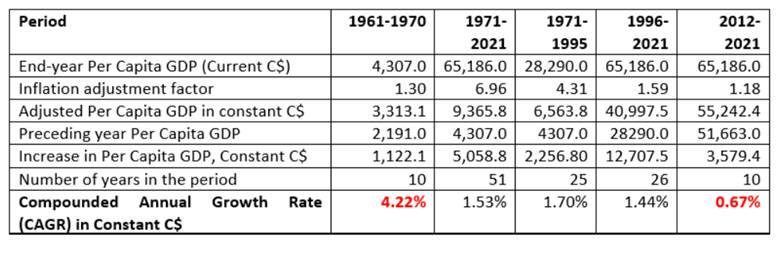
No politician will ever tire of saying that “Canada needs immigration to boost our economy”. An ancillary statement is that “immigrants pay taxes that support Canada’s social programs”. But as I showed in my article “Immigration Does NOT Increase Prosperity“, the inflation-adjusted compounded average growth rate (CAGR) in per capita GDP fell by a precipitous 84% between 1970 and 2021, ending up at an anemic 0.67% in the decade ending in 2021:
Clearly, the capacity of Canadians – long-time residents and newcomers alike – to “boost Canada’s economy” and “pay (more) taxes that support the social programs” has been eroded almost to zero. It is worth pondering how, in spite of clear signs evidenced by data, the exact opposite narrative could prevail over such a long period, and how so many people subscribed to it. This is as if Abraham Lincoln’s sage statement that “You can fool some people all the time, or all the people for some time, but not all the people all the time” was held in abeyance in Canada from 1970 onwards – or is that the case?
Not all of the people, but enough of the boomer generation who were raised with the constant drumbeat of propaganda from the Liberals — Canada’s “Natural Governing Party”, as they liked to refer to themselves — and now that most of them are comfortably retired, they seen no reason to rock the boat, even when their own children and grandchildren tell them how bad Canada has become since their prime.
Comments Off on Canada’s imaginary “immigration consensus”
May 15, 2026
“This is what luxury-belief failure looks like”
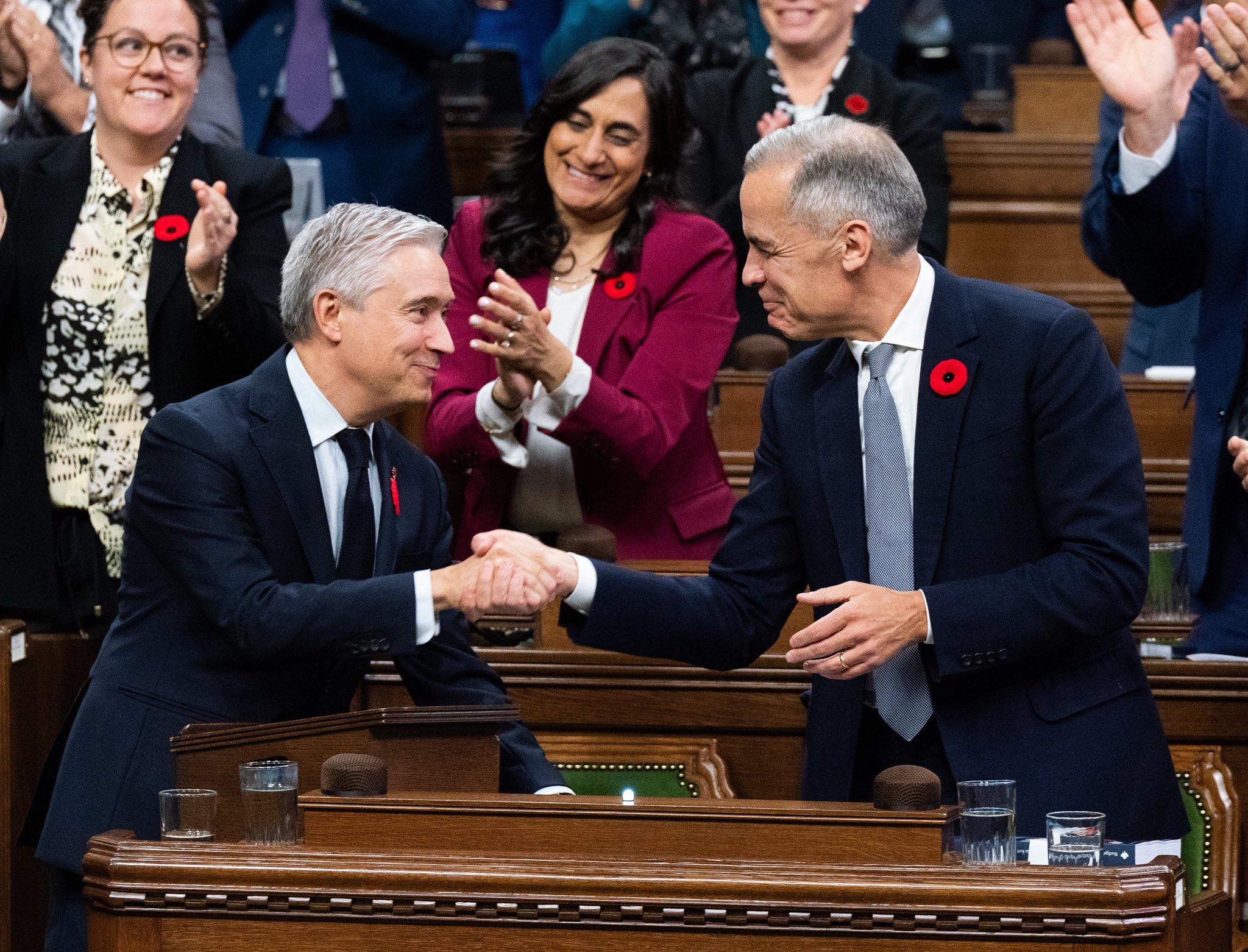
L. Wayne Mathison reacts to a pair of smarmy politicians congratulating one another in the House of Commons to the echoes of the trained seals clapping in the background:
This photo has the stink of Ottawa self-congratulation all over it.
Two suited insiders shaking hands while the room applauds, as if Canadians are supposed to mistake ceremony for competence. The whole scene screams managed success: the smiles, the poppies, the polished wood, the clapping loyalists in the background. Very official. Very staged. Very pleased with itself.
And that is the problem.
This is what luxury-belief failure looks like in picture form: people with secure salaries, protected pensions, communications teams, and zero personal exposure to the damage their policies create, congratulating each other for “building Canada” while ordinary Canadians are buried under housing costs, taxes, debt, inflation, weak productivity, and a government that thinks another announcement is the same thing as a result.
The photo says: “We are proud of what we’ve done.”
The Canadians with a brain say: “That’s exactly the problem.”
For over a decade now, the Canadian government has devoutly believed that appearances matter far more than reality, and conducts all of its operations with PR at the very tip-top of the priority list. If it will look really good on camera, it’s much more likely to get done … for Ottawa values of “done”. That usually means a big flashy announcement with whatever quick background props can be conjured up, followed by little or no actual work. Often the same thing will be re-announced multiple times in different places over an extended period of time, still with little else taking place. This is how Canada’s lost decade (and counting) has gone. And Liberal boomer voters love every performative second of it.
Comments Off on “This is what luxury-belief failure looks like”
May 12, 2026
Something something hoist, something something petard
The Liberal party, both federally and provincially, have been massive fans of immigration for decades. Any kind of restriction on foreigners being allowed into the country was seen as tantamount to treason, in Liberal eyes. This resulted in a lot of votes for Liberal candidates in election after election, as most immigrants associated their welcome in Canada with the party most associated with pro-immigration policies. On the weekend, this happy little virtuous circle suddenly broke in the Toronto-area provincial riding of Scarborough Southwest, and the party is left wondering what is going on:
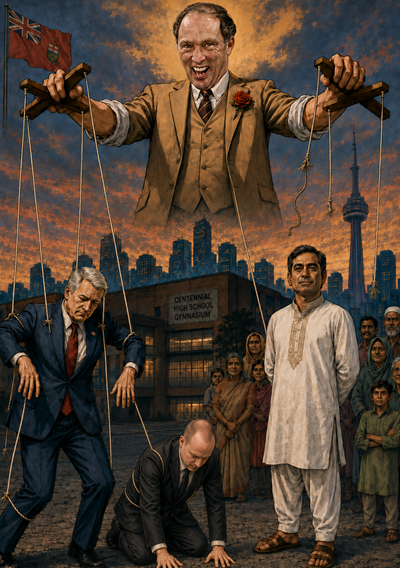
AI-generated image from Upper Canadian Cavalier
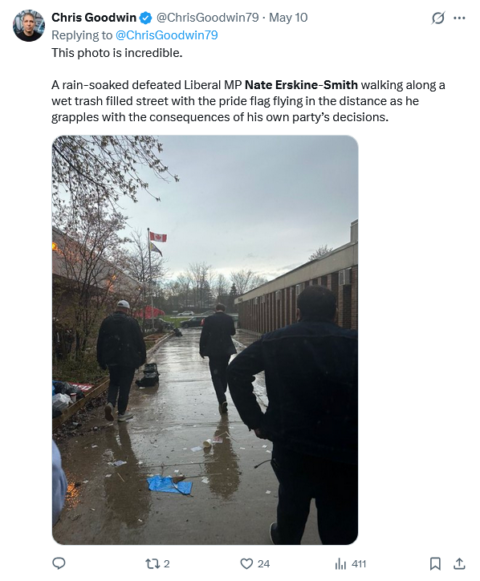
There is a particular flavour of humiliation reserved for the courtier who discovers, too late, that the rules he wrote for everyone else now apply to him. On Saturday afternoon in Scarborough Southwest, Nathaniel Erskine-Smith tasted it. The former federal Minister of Housing, the man Mark Carney himself had blessed to retain his Beaches–East York seat while parachuting into a provincial nomination as a launchpad for the Ontario Liberal leadership, lost. He lost to a man named Ahsanul Hafiz, a Bangladeshi immigrant who had arrived as an international student two decades ago, who had been forced during the campaign to answer for old social media posts of himself posing with firearms and calling for the death penalty of a Bangladeshi politician. Hafiz won not because he was a more accomplished man, not because he had a deeper grasp of public policy, not because he carried the gravitas of a former Crown minister of the Dominion. He won because he could deliver more bodies to a high school gymnasium on a Saturday afternoon than the Oxford-trained lawyer with the cabinet pedigree could.
This is the open secret of Liberal politics in Canada in the year 2026. The white Liberal cannot win his own nomination battles anymore. Not on the merits. Not on the organisation. Not on the strength of his name or the depth of his rolodex. He can only win when the party machinery he himself built bends the rules in his favour, locks the gate behind him, and quietly disqualifies the rivals who would otherwise eat him alive. When the machinery fails, as it failed in Scarborough Southwest, the result is what we saw on the weekend: the dauphin of the Carney court, the heir presumptive, sent home with a participation ribbon and a press release about how concerned he is of the democratic process.
The democratic process. We shall return to that phrase, because it has done a great deal of work for the Liberal Party of Canada these past sixty years, and it deserves the close inspection of an honest mind.
The Scarborough Lesson
Consider the bare arithmetic of what happened. Erskine-Smith is, by every measure the Laurentian establishment recognises, the kind of man the Liberal Party manufactures for leadership. Queen’s University, then Oxford for the BCL. A successful federal MP since 2015. A cabinet minister under both Trudeau and Carney. The blessing of the Prime Minister himself to remain a sitting federal MP while contesting a provincial nomination, an arrangement of breathtaking entitlement that would have been denied to anyone of lesser standing. He had every advantage the system can confer on a chosen son.
And yet the Bangladeshi grocer down the street had more votes.
Three thousand five hundred members were on the final voting list. The Bangladeshi community of Scarborough Southwest, organised through its mosques, its community associations, its weekly newspaper the Weekly Bangla Mail, its television station NRB TV, had decided some time ago that this riding belonged to them. Doly Begum, the former NDP MPP turned federal Liberal, had won the by-election three weeks earlier as the first Bangladeshi-Canadian elected to Parliament. The provincial nomination was the next obvious prize. Three of the four candidates running were of Bangladeshi origin. The fourth was Erskine-Smith.
You can imagine the scene at the high school. The folding tables, the volunteer scrutineers, families arriving in groups of six and eight, elderly grandmothers helped to their seats by grandsons. And against this, the dispersed and atomised liberal professionals of the riding, the kind of people who attend brunches in the Beaches and write earnest letters to the Toronto Star about housing policy. There was no contest. The grandmothers won. They will always win. They were always going to win. Anyone who has spent five minutes thinking honestly about what mass non-European immigration into a Westminster system actually means could have told you so.
This is not a scandal, it is not foreign interference. It is not even when properly understood, a failure of the Liberal Party. It is what democracy looks like when you transplant a foreign communal politics into a parliamentary system that was built for atomised individuals voting their conscience as Englishmen. The system the Liberals constructed across two generations, the system of mass importation without integration, of multiculturalism as official ideology, of the ethnic vote as the quiet hydraulic engine of every Liberal majority, has finally arrived at its terminal stage. The body has now grown larger than the head, and the head has noticed.

At Without Diminishment, Dakota Jeffery-Petts, who once worked as a volunteer on Erskine-Smith’s 2015 campaign, writes:
In Canada, the nomination process remains a glaring national security loophole. These contests are treated as private club matters rather than public democratic exercises. They lack the oversight of a neutral authority. This creates a low-cost, and at times entirely cost-free, environment providing a high-reward entry point for foreign interference.
All you need to do is speak sweet lies to members and constituents. In doing so, you create a motivated interest group that can effectively hand-pick a representative in a safe seat, bypassing the general electorate entirely.
When 3,580 memberships appear overnight in a single riding, we must ask: whose interests are being served? Are they Canadian interests, or diaspora interests?
The primary duty of an elected official, after all, is to the national and public interest. But when a candidate’s mandate is derived from a narrow, diaspora-specific recruitment drive, often centred on grievances or political movements from the old country, that candidate becomes a delegate for a foreign interest rather than a representative of Ontario and the Ontarians in that riding.
The result illustrates the danger of fragmented national and local loyalties.
Multiculturalism, when left without a strong framework of national identity, allows for the importation of foreign conflicts into our legislative halls. We are seeing the rise of a political class that views a seat in a Canadian legislature as a platform for foreign advocacy, rather than a tool for national or provincial governance.
This capture of our nomination process by diaspora activism is the ultimate sign of a hollowed-out democracy. If the gates to our legislatures are guarded by whoever can mobilise the largest bloc of unintegrated interests, then the concept of a Canadian mandate becomes meaningless.
We are effectively outsourcing our leadership selection to the highest bidder, or to the most aggressive foreign-aligned organiser. The decision by the Ontario Liberal Party to allow this surge, and the subsequent defeat of one of the more prominent politicians in the province, shows a party that has lost its way.
By prioritising raw numbers over the quality and loyalty of its candidates, the Ontario Liberals have signalled that they are comfortable being a vessel for proxies acting on behalf of foreign interests, despite the hardships facing so many Ontarians.
Comments Off on Something something hoist, something something petard
May 8, 2026
National Indigenous History Month in Ontario schools
Igor Stravinsky outlines what Ontario schools will be focusing on this June instead of in addition to the normal provincial school curriculum:
Image from the Senate of Canada via Woke Watch Canada
50+ years ago, public schools in Ontario started the day with Bible readings and a recitation of the Lord’s Prayer. Critical Theory, the philosophical and pedagogical approach in force these days in schools is the new religion. It is based on the (unproven) premise that society is rife with power structures, inequalities, and oppression, and asserts that education is inherently political rather than neutral. “Marginalized” students (non-Whites, especially males, plus Whites who are not heterosexual or able-bodied) are to be “centered”. This supposedly promotes “Social Justice”, which is basically the absurd and asinine idea that every aspect of society should be represented by all conceivable identity groups in proportion to their numbers in the general population. It is equality of outcome, not opportunity.
As Indigenous people rank high on the pyramid of oppression, every day is a day of Indigenous recognition in most public schools in Ontario. Students are asked to stand quietly every morning to hear the Indigenous Land Acknowledgement, which is the same text day after day, just like the Lord’s Prayer used to be. But June is special. It is National Indigenous History Month.
During June, students can expect to get hit with an extra large dose of affirmation of their original social justice sin. If you can’t trace your ancestry back to a person who lived here before first contact between Europeans and Indigenous people, then you are a “settler colonist”. This technically means anyone, but of course the main targets of the social justice warriors are European descended people. Just immigrated from Poland last week? Start groveling. You’re White, and that’s that.
The themes of the month are really the same as the ones presented to students all year, just more intensively: Prior to contact with Europeans, Indigenous people lived in peace and harmony with each other and lived sustainably and in sync with nature. Settler ways are depicted as based on greed and a reckless plundering of the lands, along with utter disregard for the wise ways of living of the Indigenous people, who were to be forcibly assimilated into Western ways.
Of course, students in our schools should be learning about the history of Indigenous people, just as they should be learning about the conditions in which so many Indigenous people struggle and suffer today. But that is not the objective of Indigenous History Month or any of the other long list of Annual Indigenous Days of Significance. This year, National Indigenous Peoples day, June 21st, falls on Fathers Day. Luckily, it is a Sunday, so schools won’t be able to erase that. Social Justice warriors hate Fathers Day even more than Mothers Day. If there is one thing they can’t stand, it’s the nuclear family.
Also this year, the fifth anniversary of the false claim by the Kamloops Indian Band that the remains of 215 murdered residential school children had been confirmed in the apple orchard outside the former Kamloops Indian Residential School (May 27) will have just passed. Even the band itself now admits, on their website, that all that was discovered was soil “anomalies”. The technician who performed the ground penetrating radar survey told them there were 200 targets of interest and only excavations could confirm burials (she initially identified 215 but reduced that to 200 when she discovered, after the fact, the part of her survey area had already been excavated and no one had found any bodies there). Of course, even if you found burials, you would need forensic work to determine the identity of the bodies and the cause of death. The band has been paid over 12 million dollars to do that work but they haven’t done anything.

May 7, 2026
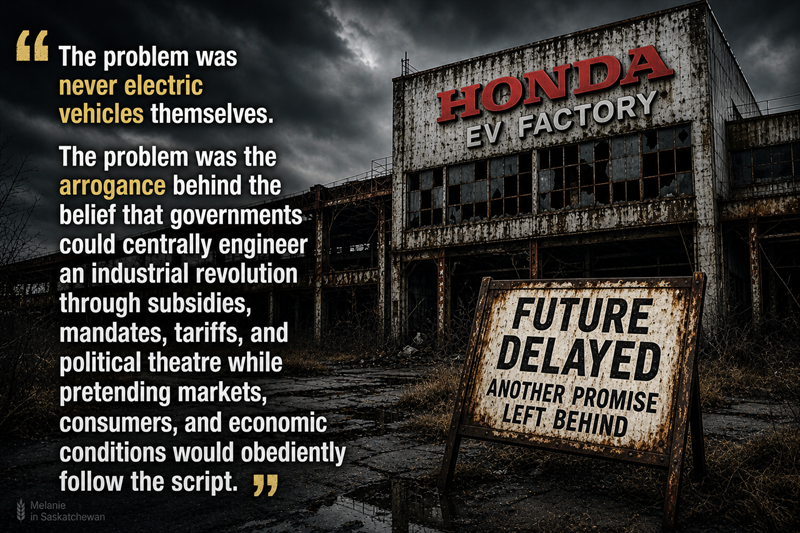
Great success! Honda “postpones” their Ontario EV project
As part of their mindless fanboyism for anything remotely related to “Net Zero”, the federal government and the Ontario provincial government have been serving up subsidies for electric vehicles and hastening the “inevitable transition” away from internal combustion vehicles. Through legislation and regulation, they’ve been doing everything they can to close down the traditional car and truck manufacturing sector and replace them with zero emission vehicles. The various governments have handed out subsidies amounting to billions, and yet one after another after another the much ballyhoo’d EV factories, battery plants, and other futuristic projects fall by the wayside, leaving very little in exchange for those billions:
There was a time, not very long ago, when Liberal politicians treated EV battery announcements like moon landings.
Hard hats. Safety glasses. Giant ceremonial cheques. Breathless speeches about “the future”. Every battery plant was “historic”. Every subsidy package was “transformational”. Every corporate press conference looked like a motivational seminar for people who think buzzwords are infrastructure.
All we were missing was a fog machine and Bono.
Meanwhile ordinary Canadians were standing in grocery aisles doing mental math over bacon prices, delaying dental work, and wondering whether they could survive another winter utility bill without sacrificing whatever scraps remained of their savings.
But while Canadians were trying to keep their heads above water, Ottawa was busy launching one of the most expensive industrial subsidy experiments in modern Canadian history.
AI-generated image from Melanie in Saskatchewan
The Honda EV project in Ontario was supposed to be one of the crown jewels of this brave new green economy. Politicians lined up in hard hats and safety glasses like a traveling theatre troupe performing The Future Is Here. Canadians were assured this was proof the country was becoming an EV superpower.
Turns out it may have been more of a very expensive PowerPoint presentation with taxpayer financing attached.
[…]
In March 2020, Prime Minister Justin Trudeau appointed Mark Carney as an informal economic adviser during the COVID recovery period. Over the following years, Carney increasingly promoted “green transition” investment frameworks, climate-linked financial systems, ESG-focused economic planning, and massive public-private investment partnerships tied to decarbonization strategies.
Which is important context now, because the EV subsidy era did not emerge out of thin air. It grew out of a broader worldview that treated government-directed green investment as both economic policy and moral mission. The assumption underneath all of this was breathtakingly simple:
“If government wants it badly enough, reality will cooperate.”
That is usually where things begin going sideways.
Canadians were told the EV transition was inevitable. Questions about affordability, charging infrastructure, winter range, electrical grid capacity, or consumer demand were often brushed aside like annoying little details raised by peasants who simply lacked sufficient enlightenment.
Then came the subsidy gold rush.
[…]
Corporations are not charities. They are not loyal patriots. They are not emotionally attached to government slogans.
They follow incentives. They chase profitability. They change direction when conditions change.
That is exactly what Honda did.
Meanwhile Canadians are left holding the bill for another “historic transformation” that produced:
- endless announcements
- glossy photo ops
- consultant buzzwords
- government self-congratulation
- escalating subsidy exposure
- and corporate renegotiations every time market conditions shifted
- while producing no completed Honda EV manufacturing hub and no fleet of Canadian-built EVs rolling proudly off Ontario assembly lines.
What remains instead is a stalled megaproject, a confused tariff policy, a government spinning contradictory narratives depending on the week, and taxpayers once again discovering they were voluntold into becoming venture capitalists for political vanity projects.
Apparently this is what “economic leadership” looks like now.
Hard hats. Press releases. Fifty-plus billion dollars in EV-related exposure. And a factory plan slowly evaporating into the mist while Chinese EVs roll through the front gate anyway.
Comments Off on Great success! Honda “postpones” their Ontario EV project
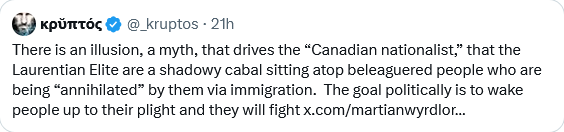
Pay no attention to the Laurentian Elite behind the curtain!
Canada before Confederation was largely run by the Family Compact, an informal oligarchy of wealthy and influential families who had a virtual monopoly on social advancement, political appointments, and the justice system. As kids we were all told in school that this all withered away and now we live in a wonderfully meritocratic society (that’s also a genocidal racist, sexist, homophobic, transphobic dystopia, but those are later lessons after the land acknowledgements). They didn’t fade away, of course, and the behind-the-scenes power brokers are still there, still wielding informal but widespread control over the government and the economy. We just call them the Laurentian Elite, so that’s totally different than the bad old Family Compact, eh?
The Laurentians very effectively keep themselves out of the public eye. Most Canadians don’t even know this class exists. So, they are in that sense a shadowy cabal.
Of course Canadians want prosperity and whatever. Everyone does. Of course they think this is the purpose of the government. Of course the government’s messaging is largely around economics.
The government’s actual activities, however, are immensely economically destructive. This is because of their religious fanaticism. Canadians believe in “peace, order, and good government”. The Laurentians believe in multiculturalism, mass immigration, gender woo, and climate change. They just lie about these things being good for the economy. It’s now obvious that they are very bad for the economy, and yet, they continue, so.
The gimmigration restrictions are a joke. The government is continuing to hand out PRs and passports like Halloween candy, and turd worlders are continuing to grab them like the black kids who think the whole basket is all just for them. It is allowing TFWs to flood the asylum system, which it uses as a back door to keep them in the country. The numbers they publish are a bullshit accounting game, but even if they’re to be believed, letting in hundreds of thousands of new PRs every year isn’t a reduction from anything but the truly insane spike in 2022-24.
The housing market is fucked, yes, but I’m skeptical this is because immigration has been “reduced”. It’s more likely that a decade of zero economic growth, rapid inflation, even more rapid asset inflation, shit jobs, and high taxes means that no one can afford the overpriced housing, so no one buys it. The shoebox condos they threw up all over Toronto are a contributing factor: no one wants to spend $500,000 on a 500 square foot condo, so no one does. Investors can’t afford to sell for less, so they sit on them. Developers look at tens of thousands of units of unsold inventory, and refuse to start new projects. Whole system is seized up because of many years of malinvestment, not because the government has meaningfully reduced the invasion.
You say that Canadians will go back to Laurentian rule once the excesses are curbed. That presumes Laurentian rule slackened for even a moment, and that the Laurentians have any intention of curbing their excesses. Neither of these are true. They are doubling down on everything. Destroying Canada — as one element in the destruction of Western civilization — is a religious imperative for them. Nor was their power ever threatened, because it is propped up by brainwashed parasitic client groups — boomers, women, immigrants — that now comprise the bulk of the country.
The “pivot” was about two weeks of campaign rhetoric, during which a fast-talking globalist banker gave the boomers a reach-around about “British and French heritage”, which dazzled the affection-starved senile coots because it was the first time they’d heard something nice about themselves in a generation. Since then there’s been no rollback in DEI. No rollback in gender woo. No rollback in net zero. No rollback in Internet censorship. To the contrary, it has been full steam ahead on every single one of their hateful programs.
No revolution? You’re probably right, although the Freedom Convoy suggests that there are possibilities. Nevertheless the most likely scenario is that Canada devolves into Argentina Del Norte, its bones picked by vultures posing as patriots, kept in power by the most mind-raped boomers on planet Earth.
I do not think this is a good thing, obviously. I love my country very much. I suppose the reason for my vehemence on this matter is that I do not see any future for Canada with the Laurentians remaining in charge. We cannot work with them. They aren’t going to change. They aren’t going to slow down. They need to be removed, prosecuted for high treason, their assets seized, their oligopolies nationalized, and many of them sent to the gallows. Absent this, Canada is doomed.
Comments Off on Pay no attention to the Laurentian Elite behind the curtain!
May 6, 2026
Carney panders to the Euro elites and his TDS-afflicted base
On the social media site formerly known as Twitter, Ben Woodfinden explains Prime Minister Mark Carney’s constant pandering on the international stage:
The average voter won’t care, but the more Carney lays out his worldview the more the contradictions and incongruences in his thinking (or lack of sincerity) become apparent.
In his famous Davos speech he said “we actively take on the world as it is, not wait around for a world we wish to be”. But the way he talks about and sees Europe does not fit this, and this statement is bizarre.
We should absolutely be pursuing closer ties to Europe, but it is delusional if he actually believes the new international order will be “rebuilt out of Europe”.
Europe for all its grand aspirations cannot even defend Ukraine by itself and without American help. Europe would need something like 300,000 additional troops and €250 billion a year in extra defence spending just to deter Russia without the Americans.
NATO’s own Secretary General told the European Parliament in January that Europe “cannot at the moment provide nearly enough of what Ukraine needs to defend itself today, and to deter tomorrow”, and that without American weapons “we cannot keep Ukraine in the fight. Literally not.” Rutte told European lawmakers that anyone who thinks Europe can defend itself without the US should “keep on dreaming”. Four years into the most serious land war on the continent since 1945 and this is where we are. That is not a continent about to anchor a new international order.
The world order is quickly is reorganising, yes. But around a US-China axis, not Brussels. The eurozone is forecast to grow 0.9% this year. China at 4.5%. China accounts for roughly 30% of global growth, Europe’s share of global GDP keeps shrinking. Europe is just one of many players. Again if you take Carney seriously here, it’s silly. Build closer ties with Europe yes but do not believe this is the next superpower.
But I suspect this is actually just another sign that Carney is good at politics — he knows exactly what the Davos crowd, his boomer base and media admirers want to hear and he is very good at giving it to them. Flattery has done him enormous favours in European capitals. But telling European elites the future runs through them is not realism, it is the opposite of realism. It is telling people what they want to hear, not the truth.
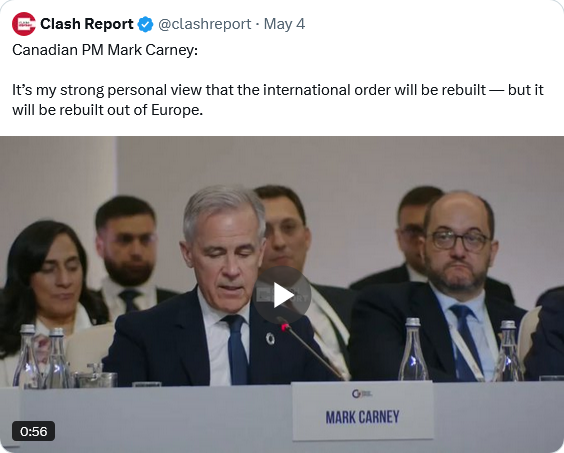
L. Wayne Mathison also comments on Carney’s profound europhiliac positions:
Europe is not the model. It is the warning label.
High regulation. Weak growth. Expensive energy. Soft defence. Endless bureaucracy.
America built. Europe managed. America innovated. Europe regulated.
And Carney wants Canada rebuilt “out of Europe”?
No thanks. Canada needs strength, productivity, energy, defence, and sovereignty, not Brussels-style decline with better catering.
May 4, 2026
Chief Narcissist of the Supreme Court of Canada
On the social media site formerly known as Twitter, David Knight Legg explains why the Chief Justice should recuse himself from deliberation on an upcoming Supreme Court case involving the Freedom Convoy 2022:
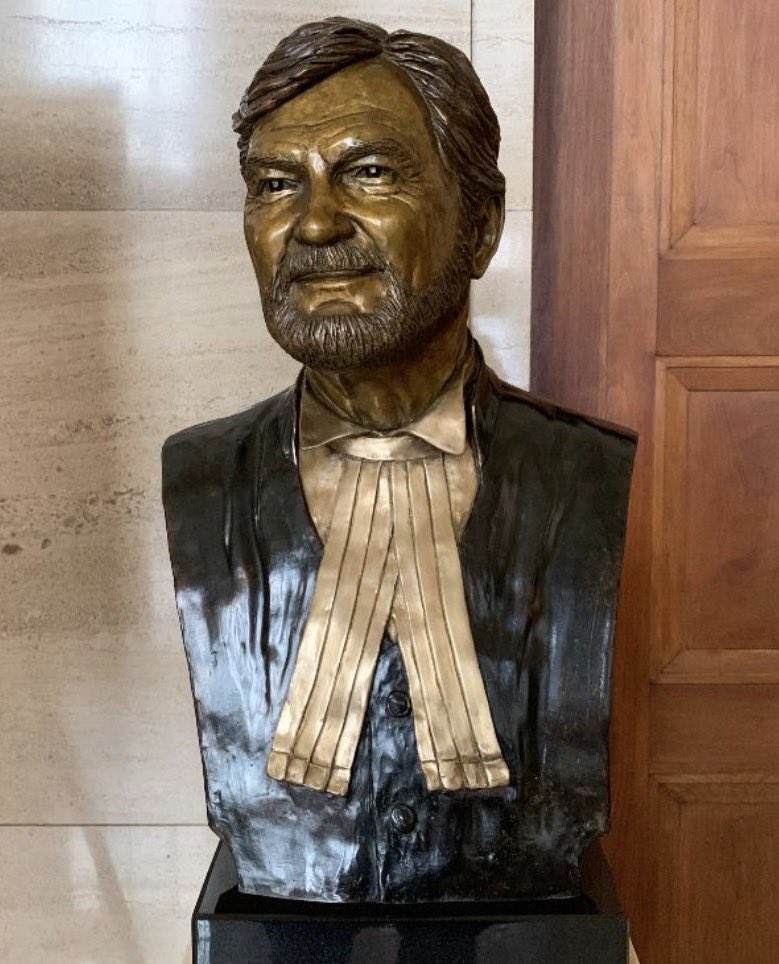
Canada’s Chief Justice Richard Wagner has installed a lifelike bronze bust of himself in our highest court.
It should be called “Narcissus Canadiannus”
– There is no precedent for something this vulgar in the history of the Court. It should be taken down. Richard fancies himself.
– Richard also fancies his own opinion on things. He violated legal due process and the Court’s reputation by publicly accusing the Convoy — who protested backwards federal Covid policies that were soon dropped — of “anarchy” and “hostage taking”.
Now that the Convoy’s freedom of speech, assembly and due process rights have been asserted by lower courts the Supreme Court has to consider the appeal of the federal govt and weigh the rights of citizens against the decision of the federal government to impose the Emergencies Act to suspend those rights.
Wagner’s lack of judicial discretion in the first instance makes his recusal from such an important rights-defining case important because it signals not just fairness in the content of the decision but in the way the decision gets reached by the highest Court.
He has already shown his bias. Any decision against the convoy poisons the integrity of the Court if he remains present.
But Richard — the man with the bust of himself in our Court — doesn’t imagine himself under the law he imposes on others. He hasn’t completed any graduate work in law or published any academic work in law, philosophy or jurisprudence so it’s hard to know how he justifies himself in these matters.
Ironically, he has a reputation for warning others — including those far more qualified in formal jurisprudence than he is — not to critique Canadian judges like himself or their (increasingly bizarre and politicized) decisions.
But, from the Magna Carta onwards, Richard should know that in law as in politics dissent is democracy.
The dissent of the Convoy and the growing critique of Richards own bizarre behaviour and inability to articulate a judicial philosophy is exactly what’s needed to save Canada — and the Court’s reputation as a place where justice — not the ego of the Justices — is at stake.
Richard should recuse himself. And remove that vulgar bust from the Supreme Court.
#SCC #RuleOfLaw
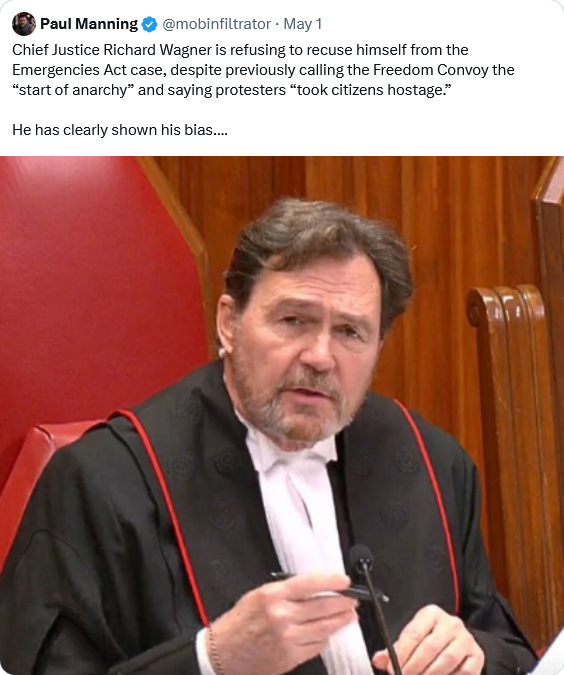
Melanie in Saskatchewan also has concerns, expressed as an open letter to the Chief Justice:
To Chief Justice Richard Wagner,
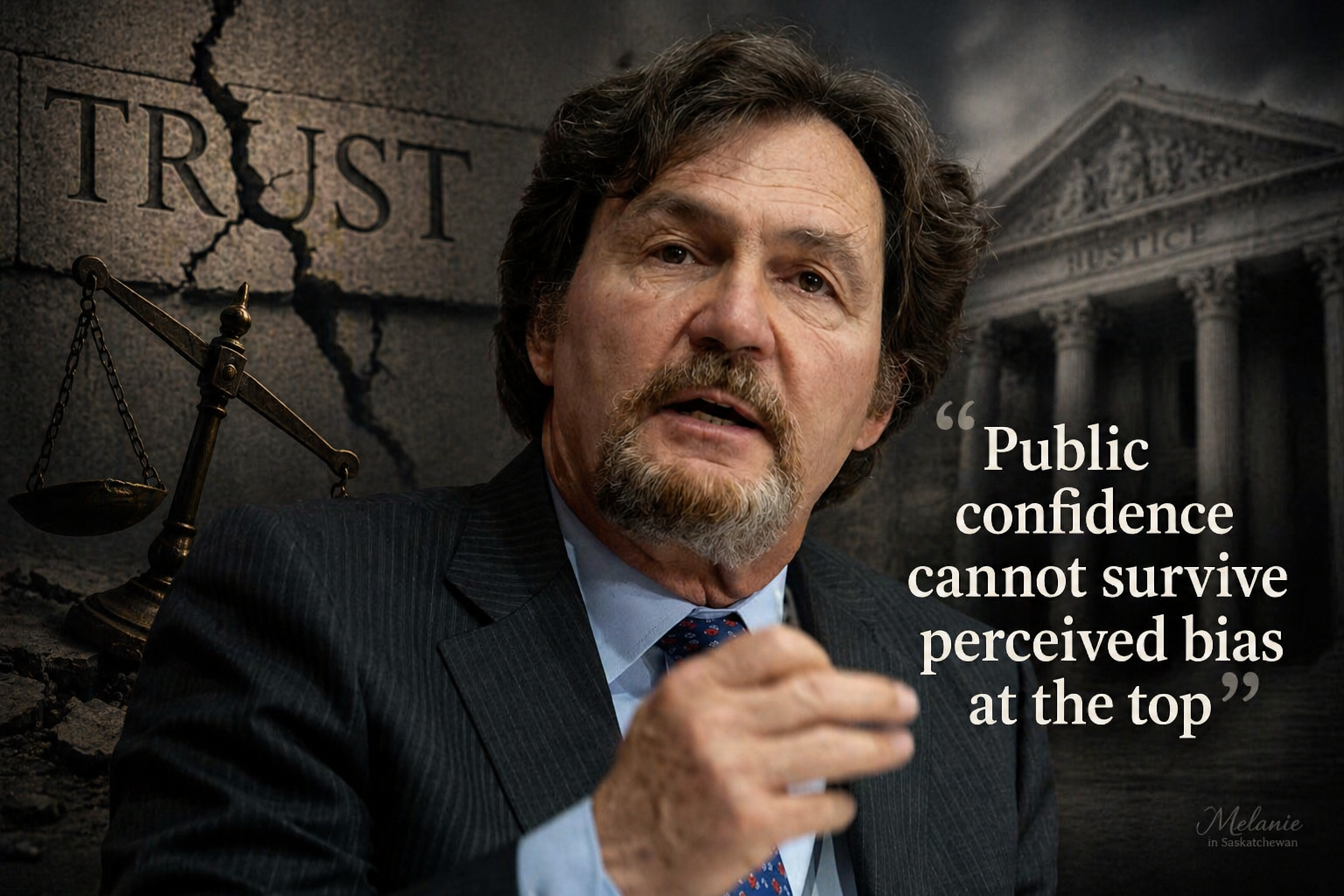
Your refusal to recuse yourself from the Emergencies Act appeal, as reported in the National Post, is not a demonstration of judicial confidence. It is a failure of judgment at a moment that demanded restraint.
Image from Melanie in Saskatchewan
You have justified your decision on the basis that your prior public comments did not address the specific legal questions before the Court. That argument may satisfy a narrow, technical reading of judicial conduct. It does not satisfy the standard Canadians are entitled to expect from the Chief Justice of the Supreme Court.
The governing principle is not whether you commented on the precise statutory interpretation of the Emergencies Act. It is whether a reasonable and informed person would conclude that your previously expressed views could influence your assessment of the case.
You publicly characterized the convoy as the “budding start of anarchy”, described residents as being “taken hostage”, and spoke in terms that conveyed clear condemnation of the events and participants. Those were not neutral observations. They were judgments about the nature, legitimacy, and perceived threat posed by the very situation now under review.
This appeal is not a retrial. It does not exist to rehear evidence or relitigate the convoy as though the past can be reset. Appellate review in Canada is focused on whether the law was correctly interpreted and properly applied to established facts, with significant deference given to the findings already made by the lower courts.
That distinction matters.
[…]
As Chief Justice, you are not merely a participant in this case. You are the steward of the reputation of the Supreme Court of Canada itself. That reputation rests not on assertions of impartiality, but on decisions that demonstrate it beyond reasonable doubt. In choosing not to recuse yourself under these circumstances, you have not strengthened that reputation. You have placed it at risk, at a time when public confidence in national institutions is already fragile. The damage may not be immediate, but it is real, and it is yours to own.
Comments Off on Chief Narcissist of the Supreme Court of Canada
April 29, 2026
Carney elbows out Canadian veterans to support an American company
On his Substack, Brian Lilley points out another glaring inconsistency between Prime Minister Mark Carney’s rah-rah pro-Canadian rhetoric and his anti-Canadian actions:
This story should outrage everyone, regardless of political stripe.
But considering the positions taken by progressive Liberals in this country concerning Donald Trump, it should really outrage them. Sadly, like with Trudeau or whichever politician people seem to support these days, Carney’s backers won’t see the error of his ways.
When I was a young army cadet, the first person I would see checking into the James Street Armouries in Hamilton — now known as the John Weir Foote Armoury after a ceremony I was part of in 1990 — well, the first person I would see would be the Commissionaire. Back in the mid-80s these were mostly people who were veterans of the Korean War or our peacekeeping missions who were now charged with providing security at federal buildings.
Founded in 1925 to give meaningful employment to veterans of the First World War, the Corps of Commissionaires has been providing security services at federal buildings, and others, for just over 100 years. Since shortly after the Second World War, the Commissionaires have had a special relationship with the federal government when it comes to providing security.
Just recently, the Carney government — the Elbows Up and Canada Strong folks — ended the arrangement that gave the Commissionaires first right of refusal on security at federal department buildings. They ended the agreement with the not-for-profit organization that is still the biggest employer of veterans in the country at the behest of a global company scooping up security contracts from the Trump admin including ICE detention centres like Alligator Alcatraz.
You can love Trump or hate him but don’t tell me you are Elbows Up, that we are experiencing a rupture, that the old relationship is over, that being close to the Americans is dangerous and then do this.
I detailed it all in my latest column for the Toronto Sun including who was behind this, how it went down, and why it is outrageous.

From the Commissionaires website:
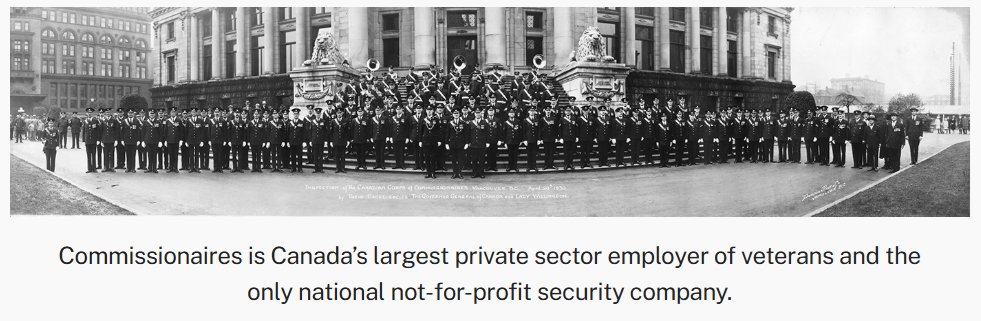
The Canadian Corps of Commissionaires was eventually founded in 1925, specifically to employ Canadian veterans of the First World War. We were initially established in Montreal, then Toronto and Vancouver, to look after these men and women and provide them with transitional and permanent jobs, primarily in the security field. The Right Honourable John Buchan, Governor General of Canada, became the Corps’ first patron in 1937. Viceregal patronage has been an 81-year tradition since then.
In the early years, we mostly provided guarding services for government institutions. From 1925 to 1948, Commissionaires expanded throughout Canada.
In 1950, with the opening of the St. John’s, Newfoundland division, Commissionaires was operating services from coast to coast.
By 1982, Commissionaires exceeded 10,000 employees.
Comments Off on Carney elbows out Canadian veterans to support an American company
April 27, 2026
UOTCAF – EP 003 – PPCLI (Patricias)
Stormwalker Group
Published 5 Dec 2025Join Mario Gaudet, former Army Reservist and military brat, in Episode 3 of “Units of the CAF” as we delve into the legendary Princess Patricia’s Canadian Light Infantry (PPCLI).
Discover their early history, unique uniform quirks and cap badge story, plus their valor in WW1, WW2, the Cold War, and Afghanistan — featuring the most decorated soldiers from each era.
Sources:
•General PPCLI History: https://www.canada.ca/en/department-n…
•Sgt. George Harry Mullin VC (WW1): https://vcgca.org/our-people/profile/…
•Maj. John Keefer Mahony VC (WW2): https://veterans.gc.ca/en/remembrance…
•Sgt. Tommy Prince MM (Cold War/Korea): https://en.wikipedia.org/wiki/Tommy_P…
•WO Patrick Tower SMV (Afghanistan): https://en.wikipedia.org/wiki/Patrick…
•Additional Regimental Details: https://ppcliassn.ca/ppcli-the-regime…#PPCLI #CanadianArmy #MilitaryHistory #CAF #WW1 #WW2 #KoreanWar #Afghanistan #VictoriaCross #Veterans #CanadianForces
Comments Off on UOTCAF – EP 003 – PPCLI (Patricias)
April 25, 2026
Can a genuine Canadian launch capability grow from a sketchy concrete pad in Nova Scotia?
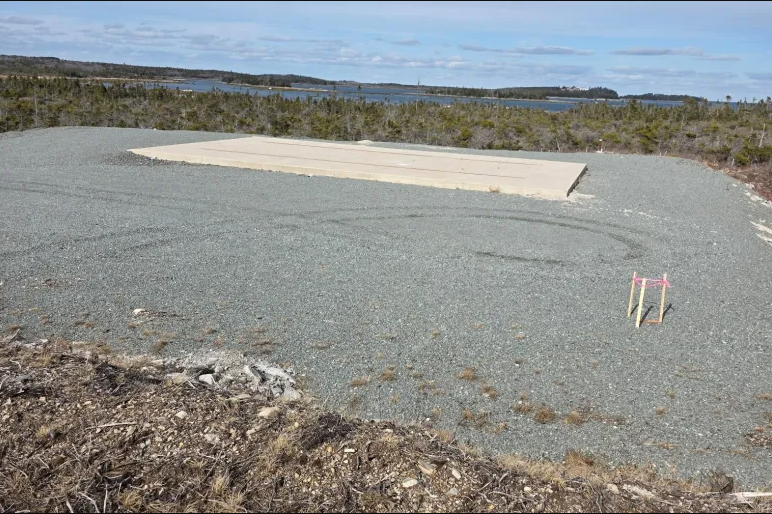
Along with many others, I was boggled to hear this week that the Canadian government was spending $20 million per year to lease a “launch facility” — photos show a pretty rudimentary concrete pad surrounded by gravel and not much else — which the Ukraine-connected lessor itself is leasing from the Nova Scotia for $13,500 per year. John Carter is somewhat more optimistic than I am that there’s a path from the dubious patch of land to a real maple-flavoured space program:
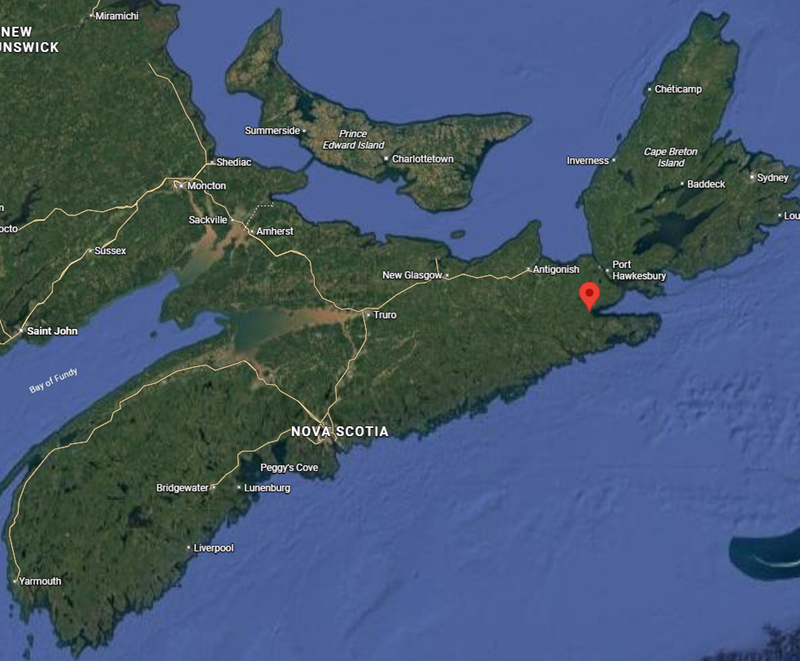
Guysborough, Nova Scotia, site of the MLS “spaceport”
Image from Google Maps.
It would be a gross exaggeration to say that Canada doesn’t have a space program. The launch of the Alouette 1 satellite in 1962 made Canada the fourth country to place an object into orbit around the Earth. Astronaut Marc Garneau nearly became the leader of Canada’s Liberal Party in 2012 (yes, we could have had an astronaut prime minister … Canadians voted for a nepo baby instead); astronaut Chris Hadfield is a minor celebrity in Canada; Jeremy Hansen became the first Canadian to visit the Moon a few weeks ago. Various iterations of the Canadarm have been fixtures of Space Shuttle missions and the International Space Station for decades. However, Canada does not yet have its own, native launch capability. The Canadian Space Agency acts as an appendage of NASA, with Canadian astronauts and satellites hitching rides on American rockets.
The announcement that the Canadian government is taking steps to develop a Canadian launch capacity has roused me from my uneasy slumber of the last several weeks, and I have awakened in a cranky mood. Several aspects of this story have annoyed me, both those relating to the government’s execution, and those emerging from the reaction from influencers whose justified skepticism of Ottawa’s intentions is intersecting with their poor understanding of space in a fashion that is leading them to beclown themselves.
The story that got everyone’s attention was a two hundred million dollar lease Ottawa signed with Maritime Launch Services for a spaceport in Nova Scotia, Canada’s largest Atlantic province, covering ten years of operations at twenty million dollars per year. The spaceport is, at the moment, essentially just a concrete pad at the end a gravel road, with no other apparent infrastructure.
The “spaceport”
Image from Postcards from BarsoomThere are several genuine reasons for serious concern with this, which have been detailed by a Nova Scotian NIMBY who’s been annoyed by MLS for several years now. MLS is a Ukrainian-American company whose original business model was to design, manufacture, and launch the Ukrainian-built Cyclone 4M, which it has never successfully done. To be fair, this effort was interrupted by the Ukrainian war, which for obvious reasons redirected Ukrainian rocketry to military production. However, it’s also worth emphasizing that MLS is an offshoot of the Ukrainian Space Agency, which is every bit as corrupt as you’d expect. The Ukrainian Space Agency has been mired in several expensive scandals over the years; one of them resulted in the theft of $10 million from Export Development Canada.
A former Liberal Party premier, Stephen McNeil, sits on MLS’s advisory board, which could be quite natural and could also be an indication of bog-standard conflict of interest.
The company’s finances are rather suspicious. It has posted operating losses of several million dollars a year, with the exception of 2025 when it lost $47 million1; revenue in 2025 was less than $15,000, and in 2024 it was zero. The incredible 2025 cash burn was apparently due to MLS acquiring Spaceport Canada. The company’s normal losses seem to be mostly due to executive compensation for its small roster of employees: the CEO and CFO between them rake in about a million dollars. This is despite the company not apparently actually have done anything yet. Other expenses include paying the Ukrainians for technical documentation for a launch vehicle MLS had already abandoned, and debt service on funding advanced by investors.
In 2024, MLS abandoned the scheme to launch Ukrainian rockets and pivoted to an “airport model”, the idea being that they would make money by charging launch service providers for the use of their spaceport. In 2025 there were precisely two launches from MLS’s concrete pad. Both of them were suborbital. One of them was a student-designed rocket from Toronto’s York University.
Even more absurdly, MLS’s concrete pad is on Crown land, which the company rents from Nova Scotia for $13,500 a year. This then looks like Ottawa renting its own land for $20 million a year.
In yet another suspicious-looking move, one of MLS’s chief financiers, Sasha Jacob, sold millions of shares immediately after the deal was announced and the stock price 10x’d; he then exercised stock options to replenish his position at below-market rates, thereby maintaining interest in the company while pocketing a couple million dollars.
All of this looks a whole lot like one more public-private partnership grift in which press releases and public relations materials project a hologram of visionary development, while the funds disappear into a complex web of regulatory compliance, stock buybacks, environmental impact studies, and executive salaries, without anything ever actually being built. This is a scam in which Canada’s Laurentian elites have learned to excel. It turns out that it is much easier, and far more profitable, to get paid for something you’re pretending to do instead of actually doing it; when the inevitable questions get asked, you simply throw up your hands and complain of unexpected engineering difficulties, tortuous regulatory pathways, or other factors beyond your control. None of the people involved – not government ministers, not government bureaucrats, not their private-sector partners – care one bit whether any given project succeeds, because they get paid by the taxpayer and the debt taken out in the taxpayer’s name regardless of outcomes. It is my working assumption that there is nothing more to this supposed space program than this. We are governed by theatre kids dancing to the tune of the Music Man, and none of them know anything about doing anything real.
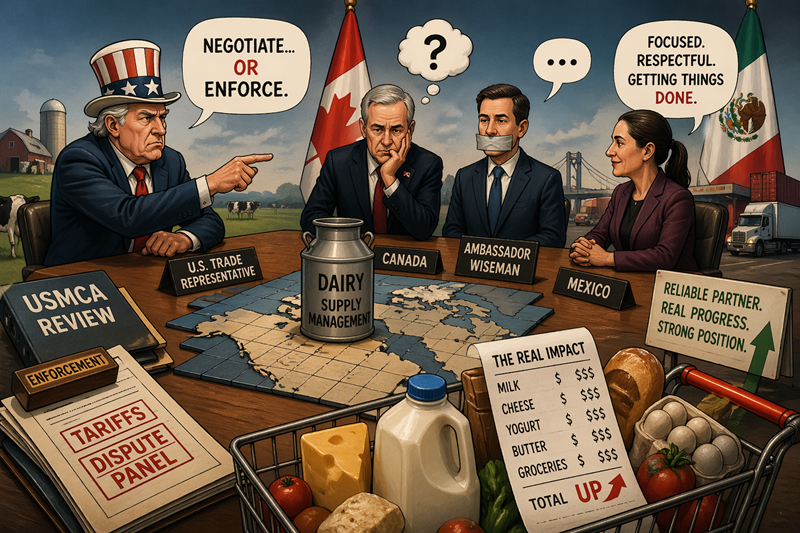
“… as the review of USMCA approaches. Dairy is once again at the center of the storm”
Dr. Sylvain Charlebois on the strong hints the US government has been dropping that Canada’s stance on our restrictive dairy cartel — euphemistically referred to as “supply management” — is going to be a key negotiating point in the upcoming USMCA trade negotiations:
The warning came quietly, but it was unmistakable. According to a Reuters report carried by The Western Producer, U.S. Trade Representative Jamieson Greer made it clear: Canada’s dairy dispute will be resolved one of two ways, through negotiation or through enforcement.
That is not diplomatic nuance. That is a choice.
And it comes at a delicate moment, as the review of USMCA approaches. Dairy is once again at the center of the storm. It always is. Canada’s supply management system, long defended domestically, continues to frustrate U.S. officials over limited market access. As reported by Reuters, tensions remain high around how Canada administers its tariff-rate quotas.
None of this is new. What is new is the tone.
Recent commentary out of the United States, including sharp criticisms aimed at Mark Carney, reflects a growing impatience. Some of it is political theatre. But some of it signals something more consequential, a willingness to move from negotiation to enforcement if progress stalls.
In food trade, that shift matters.
Canada’s agri-food economy is deeply integrated with the United States. This is not a casual trading relationship. It is structural. Supply chains cross the border multiple times before products reach consumers. Roughly three-quarters of Canadian agri-food exports still head south. You do not casually antagonize the market that anchors your value chain.
The critique coming from voices like Brian Switzer, however undiplomatic, boils down to a familiar expectation. Canada should act like a predictable partner. Not subordinate, but steady. When that perception erodes, the consequences are rarely immediate. They emerge later, in tighter border controls, procurement shifts, or dispute panels.
And eventually, in prices.
Comments Off on “… as the review of USMCA approaches. Dairy is once again at the center of the storm”
April 23, 2026
They put out propaganda because it works
I often find myself commenting on social media posts that the Canadian government’s direct subsidies to most of the mainstream media in Canada has created one of the most effective propaganda machines since 1930s Germany. “eLbOwS uP!” They keep doing it because it clearly is working fantastically well on a large enough share of Canadian voters that the polls (which may or may not be biased) keep touting that Dear Leader Carney and the Natural Governing Party are ever more popular. And most of the people consuming the propaganda message have their preferences re-inforced and the cycle starts again.
At Cracking Defence, Matthew Palmer discusses wartime propaganda during the 20th century, emphasizing that it’s the use to which it is put rather than the mechanism itself that has a moral value:
Propaganda is an absolute favourite subject of mine — probably not surprising considering that one of my roles in the military was psychological operations.1 Despite its very negative connotations thanks to the work of interwar writers like Frederick Ponsonby,2 propaganda really should be seen as a neutral term, perhaps best defined as “the deliberate attempt to persuade people to think and behave in a desired way”.3 Nor does it need to be state-driven; propaganda can come be generated from below as much as being driven top-down from the state or elites.
Some of the best propaganda comes out of wartime, and the First and Second World Wars were absolute goldmines. I also have a particular weakness for propaganda drawn up in early modernist and art deco styles, for which the first half of the 20th century was the high watermark. As such, here are a few of my all-time favourites for your delectation.4
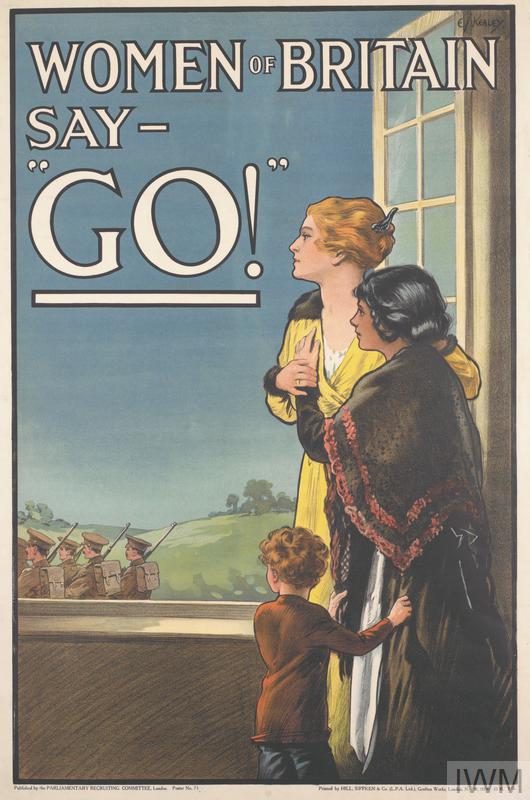
Women of Britain Say — Go!
Women of Britain Say ‘Go!’
Copyright: © IWM. Original Source: http://www.iwm.org.uk/collections/item/object/14592A true classic that has reverbrated through the ages. Despite First World War propaganda having the reputation of being crudely jingoistic, much of it was in fact consciously aware of the pain and sacrifice being endured by the warring population, and did not try to hide it. This one acknowledges the sacrifice undertaken by the women and children left behind, while the background reminds the viewer of the green and pleasant land of ‘old England’ that they are fighting for.
[…]
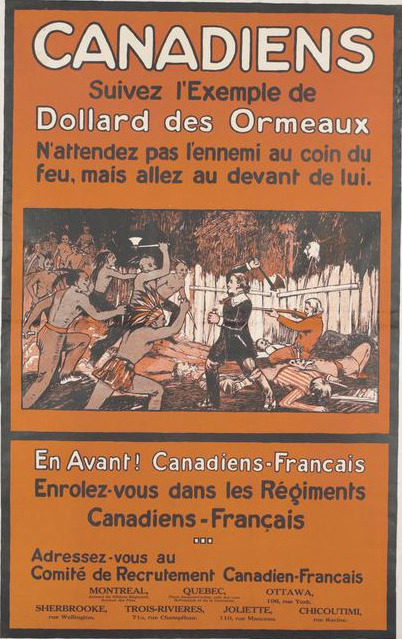
Canadiens, Suivez l’Exemple de Dollard des Ormeaux
Canadiens, Suivez l’Exemple de Dollard des Ormeaux [Canadians, Follow the Example of Dollard des Ormeaux] a depiction of Adam Dollard resisting an attack by Iroquois tribesmen. Dollard’s dead comrades lie at his feet.
Copyright: © IWM. Original Source: http://www.iwm.org.uk/collections/item/object/31027I find this one intriguing, not because I think it is actually a brilliant poster but for what it tells you about historical context and how propaganda was often tailored explicitly for local sensibilities. While Canadian support for the Allies in the First World War was generally fierce, the major exception was Quebec, which saw relatively poor levels of recruitment for overseas service. As such, propaganda aimed at Quebecois often tapped deeply into local traditions, in this case the (extremely dodgy!) myth of Adam Dollard, venerated in the period as a Catholic martyr who died defending Quebec from native Iroquois.5
[…]
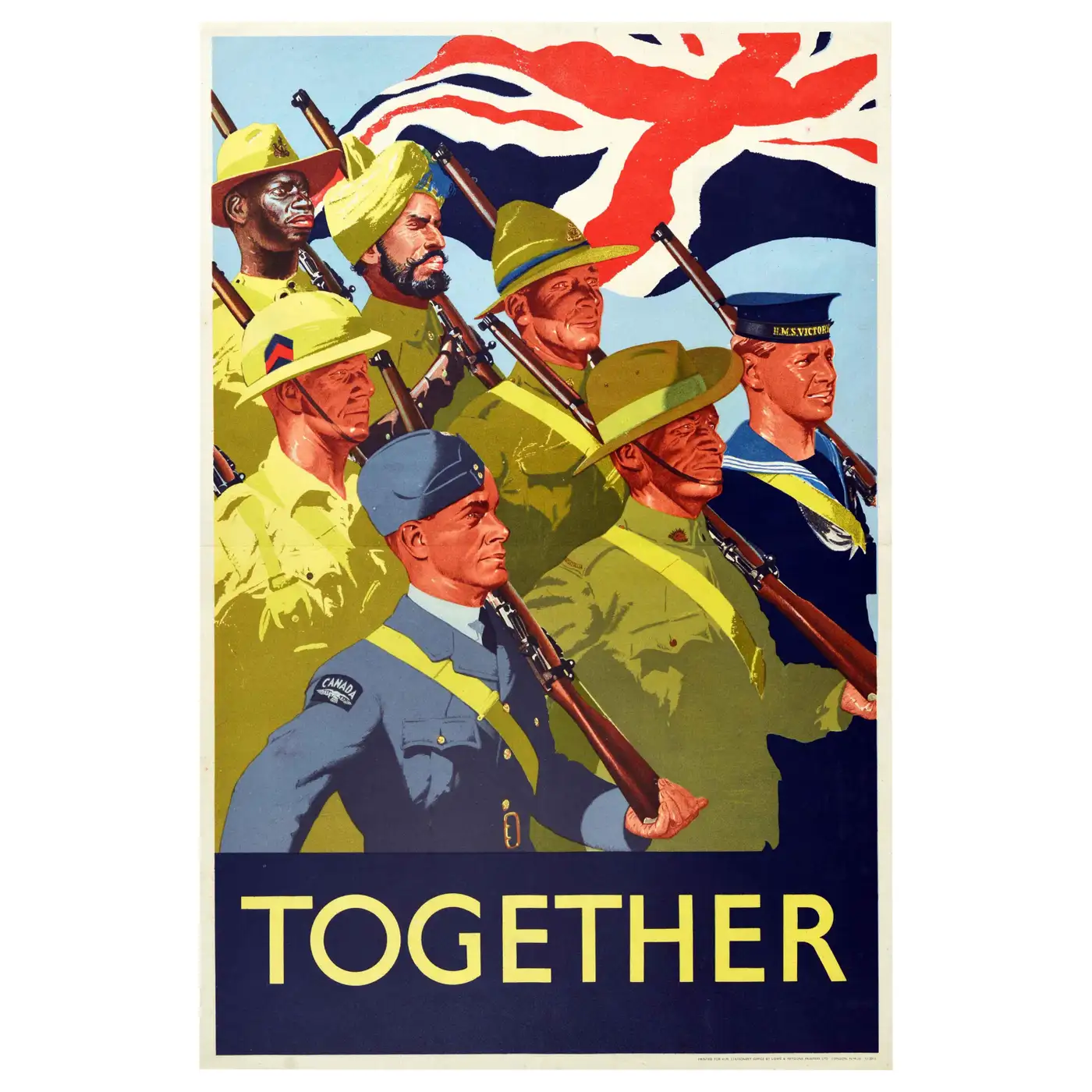
Together
Image courtesy of the IWM.
One can of course criticise the imperialism inherent in this poster, but I think it still works exceptionally well as a bold call for unity between the different nations of the British Empire. It shows how British propagandists took pains to highlight the Second World War as a global conflict against fascism.
- A job which, if I do say so myself, I was pretty bloody good at.
- Ponsonby wrote Falsehood in Wartime in which ironically he basically made up stories about British propagandists in a book supposedly about manufactured atrocity propaganda!
- Phillip Taylor, Munitions of the mind: A history of propaganda (Manchester University Press, 2013).
- I’m only going to present Allied propaganda. Because, frankly, fuck fascism.
- The story of Dollard is mostly myth, and he was more likely an idiot fur-trapper who got himself killed through stupidity.
Arctic defence – Canada can’t “go it alone”
On the social media site formerly known as Twitter, Lee Humphrey explains a few of the reasons that we can ignore Prime Minister Mark Carney’s claims that Canada can defend the north without US assistance:
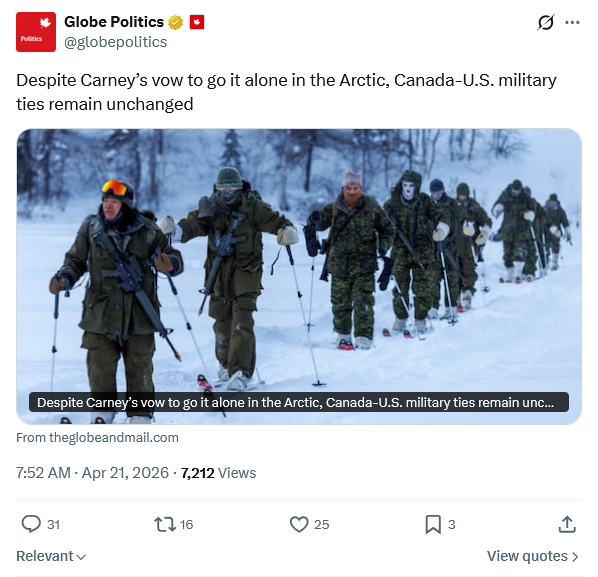
Canada is not capable of going it alone & is not going it alone. It’s a lie to say otherwise.
The majority of new radars being bought to replace existing radars will be from US companies, all our radars including the Australian built OTH radar will use US military satellites to communicate with monitoring stations in the US & Canada.
The armed drones we are buying are built in the US & will use US military satellites to communicate with their ground based controllers.
The subs we are spending $40 billion on are not capable of safely patrolling under sea ice for more than 11 continuous days before they have to turn around & get to clear water so we will continue to rely on US nuclear powered subs to track Russian & Chinese subs who are in sovereign CDN arctic waters.
Over the last year, US fighter aircraft have had to respond to 3 separate incidents that the RCAF were unable to respond to at all or in a timely way.
CDN’s who still believe Trump is going to invade need to realize just how many opportunities he keeps missing 😎
Reality sucks especially when national security or national sovereignty is at stake but the reality is that not only can we not operate independently at home, we can’t & haven’t been capable of operating independently for 60 years now!
Comments Off on Arctic defence – Canada can’t “go it alone”


