Quotulatiousness

November 15, 2025

Canada’s flawed Industrial and Technical Benefits scheme – “We’re architects of our own dependency”

Filed under: Bureaucracy, Cancon, Government, Military, Weapons — Tags: , , — Nicholas @ 03:00

Posted a few days ago, but still of interest — Omar Saleh discusses a part of Canada’s defence acquisition process that provides the illusion of military self-reliance while actually allowing foreign companies to control more and more of our domestic defence manufacturing capacity:

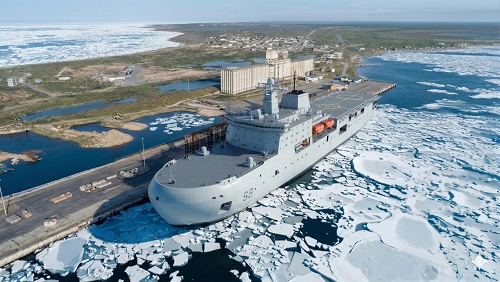
Graphic stolen from Small Dead Animals.

On November 4, the federal government tabled one of the most consequential defence budgets in Canadian history: an $81.8-billion expansion over five years, anchored by a $6.6-billion Defence Industrial Strategy, procurement overhauls, and a vow to claw back sovereignty from decades of polite deferral. It was framed as a national awakening – an overdue recognition that geography is no longer a moat, Russian submarines are testing our Arctic resolve, and allies are no longer willing to pretend Canada is pulling its weight.

But buried underneath all the ambition is a policy that will quietly sabotage it: the Industrial and Technological Benefits (ITB) framework – the mechanism Canada uses to ensure foreign defence contractors reinvest in the Canadian economy and the quiet architecture of our own dependency.

On paper, it’s a sound industrial strategy. So much so that other countries like Saudi Arabia and the UAE – both of which are aggressively seeking to onshore the lion’s share of their own defence spending – have implemented very similar policies as part of their respective Vision 2030 programs.

In practice, however, Canada’s ITB is a compliance machine that has mastered the art of doing nothing loudly. It is a mechanism through which American and European primes deepen their control over Canada’s industrial base while giving Ottawa the comforting illusion of self-reliance. We’re not victims of clever contractors. We’re architects of our own dependency, moralizing away the muscle to build someone else’s blueprint.

The numbers are damning. Since 2011, more than one hundred thousand industrial activities have generated over $64 billion in promised economic activity. And for all of that motion, not a single global defence technology titan has emerged. The work done in Canada – machining, composites, test benches, components – is real, but when the world shifts and architectures evolve, the capability evaporates. It was never ours. The most strategically important capabilities are designed abroad, integrated abroad, and updated abroad. We have activity without ownership – a nation performing sovereignty instead of exercising it.

Call it what it is: Phantom Capacity. The illusion of industrial muscle – until the country is forced to lift something heavy.

The core flaw is structural. ITB rewards dollars spent, not capability created, even as it dangles multipliers of up to 9x for R&D and startup work. A prime receives one-to-one credit for $5 million in routine machining, yet could theoretically earn nine times that for backing a Canadian breakthrough. But the theory collapses in practice. Multipliers accounted for less than one per cent of fulfillment between 2015 and 2019, and auditors still cannot prove they delivered any meaningful innovation. The system does not discriminate between activity and advancement. And when a system does not discriminate, the market follows the path of least resistance.

Predictably, primes funnel work to the safest, most administratively convenient suppliers. It is the industrial equivalent of a potluck where everyone insists on homemade dishes but quietly prefers the store-bought tray. Innovation is welcomed rhetorically and ignored in practice.

This leads to the second, more corrosive consequence: Canadian startups are structurally excluded from shaping Canada’s defence future. They move on six-month innovation cycles. Their technology evolves. Their architectures iterate. But in a system where every offset must be pre-approved, credit-verified, documented, and mapped against a prime’s global program calendar, startups cannot operate on their own terms. They must reshape their roadmaps to fit into architectures designed abroad, updated abroad, and controlled abroad. The result is not partnership but subordination.

A Canadian company can build a breakthrough sensor, a next-generation autonomy stack, or a northern detection layer – but it cannot enter a Canadian program of record unless a foreign prime decides to adopt it. The startup becomes a module inside someone else’s strategy. Sovereignty becomes subcontracting with better branding.

November 14, 2025

“Conscription if necessary, but not necessarily conscription” 2 – Electric Boogaloo

Filed under: Cancon, Government, Media, Military, Politics — Tags: , , — Nicholas @ 05:00

Canada has only had two brushes with military conscription — after voluntary enlistments couldn’t keep up with casualties in both the First and Second World Wars — and both caused severe resentment in Quebec. Canadian politicians have generally avoided any hint of anything that could be framed as “conscription” for fear of triggering yet another existential crisis between Quebec and the rest of the country. Prime Minister Mark Carney isn’t a typical Canadian politician, and does not seem to have any of the built-up scar tissue that most others do. This might make him prone to saying and doing things that seem quite ordinary to him, but trigger civil unrest … like forcing civil servants to become soldiers against their will.

I floated the notion that this might be Carney’s five-dimensional chess strategy to reduce the civil service without having to fire everyone, but it’s far more likely that he genuinely doesn’t understand Canadians and our shared history.

John Carter is … skeptical about the Laurentian Elite being capable of rebuilding the depleted Canadian Armed Forces, as it’s hard to conceal sixty years of open contempt long enough to fake some sincerity:

The Canadian Armed Forces – which refer to themselves as the CAF, pronounced exactly as it’s spelled – recently leaked its intention expand its reserves from the current, anemic 22,000 to 400,000 soldiers. At first I wondered if an extra 0 was added to that number as a typo, but the plan is to grow the Army reserve to 100,000 and the supplementary reserve (which I hadn’t even known existed, and is currently composed of retirees) from a few thousand to 300,000. Further leaked details are that the 300,000-strong supplementary reserve will be created by essentially drafting civilian Federal employees, training them in driving trucks, marksmanship, and drone flying, which really just sounds like the makings of an absolute clown show.

At the same time, Canada’s prime minister Mark Carney has committed to a considerable increase in the CAF’s budget – over $80 billion spread over the next five years, with 2025-26 spending rising to around $62B from the previous average of around $35B – with the goal of reaching the 2% of GDP level that NATO members are expected to (but in practice usually don’t) maintain. As part of this build-up, the CAF is hoping to reach its authorized strength of 71,500 uniformed personnel.

[…]

A recent Angus Reid poll indicates that there is very little enthusiasm for military service amongst Canada’s population. Only one in five Canadians would volunteer no matter the reason if their country called them, while 40% would refuse service under any circumstances.

Young men are even less likely to be potentially willing to unconditionally volunteer than old men, while being far more likely to refuse to volunteer under any circumstances (of course, women are almost universally aghast at the idea of serving). Contrast this to World War 2, when about 1/3 of fighting-aged men volunteered.

Governments that find it impossible to motivate their young men to volunteer for military service, but need their warm bodies in uniform anyhow, have historically resorted to conscription. Since they are manifestly not interested at the moment, the political class has begun floating trial balloons about mandatory military service in its media.

[…]

Just because conscription would be unpopular doesn’t mean that the government won’t reach for it, of course. More or less by definition, conscription has never been popular. It is, however, very far from ideal. Conscripts don’t tend to make the most enthusiastic troops. Their morale tends to be low, their enthusiasm non-existent, and their propensities to shirk their duties, avoid danger, surrender, and mutiny are all much higher than those of the committed volunteer.

[…]

The Canadian government has worked hard to systemically alienated the native population. Official state ideology is that Canada is a post-national multicultural state with no core identity built on stolen native land by genocidal settler-colonialists. As such, there’s nothing to defend. There’s no there, there: no identity to identify with, no boundaries of culture to justify the borders of political geography, no in-group to defend against an outgroup. No nationalism without a nation; no patriotism without patria.

Reinvigorating Canadians’ willingness to serve their country and rebuilding Canada’s military into a force that can win wars would both require the Canadian political class to repudiate the ideological territory of globalism, feminism, multiculturalism, mass immigration, and gender-bothering that they have made themselves synonymous with. However, they can’t reverse course without discrediting themselves, and so, they won’t. Fixing the recruitment crisis is therefore a coup-complete problem: it cannot be accomplished absent wholesale replacement of Ottawa’s political class. We only need to look south of the border for demonstration of this. Until 2025, the American military was suffering from precisely the same recruiting woes as afflict Canada and Great Britain, due entirely to a collapse in interest amongst America’s traditional warrior class: white rural Southern men.

The ascendant Trump replaced the shapeless blob Lloyd Austin as the Secretary of Defense with the young, energetic, crusader-tattooed Pete Hegseth as the Secretary of War (and that difference in terminology matters). Recruitment rebounded immediately, with the US Army alone exceeding its 2025 goals by 61,000, four months ahead of schedule. Including reserves, the US military as whole recruited about 325,000 new personnel in 2025, with each branch either hitting or exceeding its recruitment targets (which were also 10-20% higher than in 2024). Adjusting for population ratios, this would be the equivalent of the CAF recruiting 32,500 personnel in one year.

Of course, as we’ve noted here before, the CAF doesn’t have the same kind of recruiting problem that the American services faced (please pardon the self-quote here):

We’ve had surprising numbers of media folks paying attention to the crippling recruiting crisis, as even on current funding, the CAF is short thousand and thousands of soldiers, sailors, and aircrew. Sadly, but predictably, most of that media attention looks at the shortfall of new recruits being trained for those jobs, which is true but incomplete. The biggest problem on the intake side of the CAF is the bureaucratic inability to bring in new recruits in anything remotely like a timely fashion. The last time I saw annual numbers, the CAF had huge numbers of volunteers coming in the door at recruiting centres, but getting the paperwork done and getting those volunteers into uniform and on to job training was an ongoing disaster area. More than seventy thousand would-be recruits applied to join the CAF and the system managed to process less than five thousand of those applicants and get them started on their military careers.

At a time that we’re losing highly trained technicians in all branches to overwork, underpay, and vocational burn-out, we somehow lack the competence to take in more than one in twenty applicants? That is insane.

November 12, 2025

The legacy media are still fanatically pushing the “Tories in disarray” line

It’s good to see that sometimes you get good value for your money. In this case, it’s the massive financial subsidies the federal government pay out to most of the Canadian legacy media outlets, so that the media ignores stories that the Liberals look bad but push the living bejesus out of anything that makes the Conservatives look bad … even if they have to distort the story almost out of recognition. Brian Lilley has the details:

I told you this would happen, the legacy media is trying to make this whole floor crossing thing into a PC versus Reform Party thing. As I broke down all of the background information that I could muster and tried to present it in a straightforward way, I said this would be a narrative of the MSM.

The reality is, the frustrations exist for a number of reasons but Pierre being too conservative is not the main issue here, it’s that they didn’t win in April. It all goes back to that and how different people interpret that loss and the leader’s response to the loss.

If you haven’t read that piece, it’s worth your time just to understand some of the nuance that you won’t find from other media.

There is no party divide …

The idea that there is still a schism on the modern Conservative Party between old PC voters or members and those that came from the Canadian Alliance or Reform side is not only false, those pushing it are showing their ignorance. The parties merged more than 20 years ago, they governed as the Conservatives for 10 years, anyone that left over this supposed divide left years ago, but the media can’t give this up and so they play into it with Chris d’Entremont on the weekend.

That was followed by Adam Chambers, the Conservative MP for Simcoe North in Ontario who pushed back against the idea that middle of the road Conservatives like him aren’t welcome in Pierre Poilievre’s party.

A hat tip to CBC Watcher on X who grabs so many of these clips and posts them.

Well done by Adam, not that it will help. This is a narrative some in the media are deciding to run with.

They will ignore that d’Entremont first ran under Andrew Scheer, hardly a Red Tory and in fact a so-con and d’Entremont was comfortable with that. Maybe because as a local French CBC outfit pointed out, d’Entremont is also on the pro-life side, the one the Liberals normally hate.

Oh … and another point on CBC’s reporting here. Remember the claim that a staffer was shoved out of the way … this is at the bottom of the CBC article that made the claim.

The Toronto Star will not be outdone …

This is a headline that I can’t believe the Toronto Star actually ran.

I’m pretty sure that columnist Althia Raj is old enough to remember all the way back to the morning of December 16, 2024. I know that was a REALLLLLLY long time ago, like, literally decades (please read that with a Valley girl upspeak).

If you don’t know that date, you will know what happened, because that is the day that Chrystia Freeland stabbed Justin Trudeau in the front, not the back. On the day that she was supposed to deliver the federal government’s fall economic statement, she issued a scathing resignation letter instead.

This of course also came after months of Liberal MPs pushing Trudeau to resign. A letter had even circulated among caucus members demanding he stepped down.

Liberal MPs couldn’t make Trudeau leave, Freeland’s resignation couldn’t make Trudeau leave, the 20 point lead the Conservatives then enjoyed couldn’t make Trudeau leave – it was Trump that did it.

All of that was wilder, had more drama than last week, but sure, tell people we haven’t seen this in decades. The column penned by Raj doesn’t mention Trudeau, it doesn’t mention Freeland, but it does want you to believe we haven’t seen this in like, FOREVER!

November 11, 2025

Four battles of the Canadian Corps

Following on from part one (excerpted here), The Black Horse outlines four major battles that the Canadians fought on the western front during the First World War:

Sir Arthur Currie
Portrait by William Orpen, 1919.

The first part of the series was a political biography of Currie; the second part attempts to tell the story of the Canadian Corps at war through somewhat detailed account of four important battles. The piece is only partly biographical, it partly tells the story of Currie’s war, and partly tells the story the Canadian men who fought for the British Empire in the Great War. It’s a story of incredible martial prowess, but the careful reader will also observe a story of warring duties placed upon the leader of a colonial army; duty to his men, duty to the political leadership of his colonial people and the future of that nation, duty to the objectives of the imperial power on whose behalf he fought, and finally duty to glorious Victory. Currie ended his life understood by those with eyes to see as a great warrior and a military genius; but disliked by his men and hated by the leadership of his people because he prioritized the needs to the Empire and of Victory; but after the war the Empire was of limited service to Currie and to the Canadian people. I leave to the reader, to history, and to God, to decide the value of Victory.

[…]

2nd Battle of Ypres

In the spring of 1915 the early dynamic advances of the German army were a distant memory faded behind the great defeat at the First Battle of the Marne. Through the winter both sides had dug in; and many German troops were redeployed to the Russian front. German chemists Walther Nernst and Fritz Haber brought forward the idea of using heavier-than-air Chlorine gas, carried on the wind, to overcome the mathematical impossibility of conventional attack. On April 22, 1915, Albrecht of Württemberg led 7 German divisions to attack 8 Allied divisions, including the 1st Canadian Division under the command of Sir Edwin Alfred Hervey Alderson. The attack began with the release of 168 tons of chlorine gas at about 1700h along a 4 mile stretch of the front around Langemark.

[…]

Vimy Ridge

For a year and a half after Ypres, Currie & the Canadian Corps continued to fight desperate engagements along the Western front with no clear strategic conclusion. After heavy losses and a lot of hard-learned lessons at the Somme from Sept 1915-Sept 1916, the Canadian Corps and Currie with them had become both hardened by bitter experience, and desperate to find better ways to prosecute the war. In September 1915 he was recorded to have said “I did not care what happened to me, but to my men, to their wives, their mothers, their children and to Canada I owed a duty which I wanted to fulfill to the very best of my ability”. Later that year as the division struggled with desertion, he ordered the execution of a deserter despite a three hour plea for clemency by the divisional cleric. The decision restored discipline, but haunted Currie’s dreams long afterwards.

In May 1916 Julian Byng took command of the Canadian Corps, replacing Sir Edwin Alderson. In the fall of that year, after heavy losses in a series of engagements at the Somme, Byng was given the opportunity to reorganize and refit the Canadian Corps; he looked to Currie as a key partner in the effort. They replaced the ineffective Ross Rifle with the Lee Enfield, reorganized the platoon structure to include heavy weapons within each platoon [machine guns, mortars, etc.], and implemented new training and tactics like rehearsals for advances, and the “creeping barrage”, carefully coordinated intended to keep artillery shells landing slightly ahead of advancing men.

[…]

Hill 70

After Vimy, Julian Byng was promoted. Currie was promoted in turn to lead the Canadian Corps. He would lead the Corps that he and Byng had made into one of the most effective fighting forces on any side of the conflict and lead it to bloody victory again and again. There is perhaps no better example of the mastery of the Canadian Corps, from top to bottom, than the battle of Hill 70. “Hill 70 was as close to a perfect battle as was ever fought on the Western Front” wrote historian Tim Cook.

[…]

The Hundred Days Offensive & the Pursuit to Mons

As the winter of 1917-18 passed, a new set of highly political decisions concerning whether and how to reorganize the Canadian Corps for the next round of fighting were taken. As noted in part one, Currie opted to split up the newly formed 5th division to reinforce the four divisions of the Canadian Corps and triple the size of the field engineering element. The decision optimized the Canadian Corps as an attacking force; and when they returned to the front that’s exactly how they would be used. Between August 8th and November 11th, 1918, the Canadian Corps fought nine major battles advancing 86 miles, and suffering 45,835 casualties [The force that began the offensive was ~100,000]. By comparison, the substantially larger American Expeditionary Force, over this same period, advanced only 34 miles while capturing only half the number of prisoners, suffering roughly twice the casualties per German division defeated.

Vimy Ridge: Canada’s Finest Hour | History Traveler Episode 386

Filed under: Britain, Cancon, France, Germany, History, Military, WW1 — Tags: , , — Nicholas @ 02:00

The History Underground
Published 20 Oct 2024

Battle of Arras: Part 2

When it comes to the legendary actions of the Canadian soldiers in WWI, Vimy Ridge looms large above all of the others. This is where the four division of the Canadian Corps would fight side by side for the first time in The Great War. In this episode, we’re walking the ground on the left flank of the Canadian line, looking at the memorial and showing a few things that typically get overlooked in the Vimy Ridge area.

For more on the Battle of Arras, check out The Old Front Line Podcast with Paul Reed & his YouTube channel, ‪@OldFrontLine‬.

This episode was produced in partnership with The Gettysburg Museum of History. See how you can support history education & artifact preservation by visiting their website & store at https://www.gettysburgmuseumofhistory…

Map animations by @SandervkHistory

November 10, 2025

Canadian military expansion

Filed under: Cancon, Government, Military — Tags: , , , , — Nicholas @ 05:00

In the free-to-cheapskates portion of this week’s dispatch post from The Line, the editors discuss some of the implications of the significant expansion plans for the Canadian Armed Forces (with the caveat that little of these plans are funded and would be subject to major changes if the government fails to get its budget through Parliament):

Canadian Armed Forces photo.

The amount of defence spending we’re talking about here is something that we have not thought about at all in recent generations. It’s a good thing. But it’s going to create some real challenges that we need to start thinking about, and coming up with solutions for, right away.

The numbers look something like this: the government had already announced a $9-billion influx of money into national defence, as well as a little bit of creative accounting, all with the goal of getting our spending up to the NATO two-per-cent-of-GDP target immediately, instead of on the absurdly prolonged trajectory the last prime minister deemed appropriate. A big part of this — and a welcome part — was a pay raise for members of the Canadian Armed Forces, particularly those at the lower scale of the pay grids for enlisted personnel and officers. One of the major problems the military has had in recent years is retaining trained personnel, and a pay raise is a tried-and-true way of helping address that. It also has the effect of juicing our spending at a time when our allies were looking for a tangible commitment. It’s a win-win.

But then there’s the rest of the spending: over $80 billion over the next five years, with a goal of getting up to the new NATO target of five per cent in only nine years, by 2035.

The Line supports this. We support this wholeheartedly. It makes us want to do cartwheels in the streets — and we would, if not for justified concerns for our joints and lower backs. (And dignity, though that’s less an issue.) But we do need to flag how transformative that level of investment would be.

Here’s the simplest way to put this. Almost our entire debate over defence in recent decades has been around the two-per-cent target. Nominally, the Canadian Armed Forces have certain capabilities that were suited to our national willingness to spend around two per cent of GDP. In reality, because of chronic under-funding, a lot of the capabilities we claim to have on paper didn’t really exist in reality. Units were badly undermanned. Equipment either didn’t exist or was not in serviceable condition or was long-since obsolete. Shortfalls of money and trained personnel were cutting into training exercises and basic upkeep on weapons, gear, and facilities. This prolonged fiscal starvation, combined with a fairly high level of demand on the forces for missions abroad and at home, had the effect, year after year, of hollowing out the force.

Getting spending up towards two per cent will help turn that around. This is conditional — and it’s a big condition — on fixing the military’s procurement problems. We could budget a trillion for the military, but it’s not going to make a difference if we have the same broken processes that need 10 to 15 years to actually get from an identified operational need to a signed contract. But still, if only in the big-picture sense, getting to two per cent will actually flesh out the Canadian Armed Forces into the organization that already existed on paper.

That’s good. That would be a big step up. But the problem is, as your Line editors have been screaming into the void for years, even the fully fleshed-out and realized version of the Canadian Armed Forces that existed on paper is too small for the current global environment, and lacks many critical capabilities that will be necessary to effectively fight — or even simply survive — on the battlefield. We need to do things we cannot currently do, and we need to do a lot more of all the things we’re already doing. That’s going to mean a bigger naval fleet, a larger army and a larger air force. That’s just the reality — our current force structure, even if fully manned and ready, is not large enough to meet all our needs.

That’s where the other tens of billions of dollars come in. There’s simply no way around the fact that this amount of money, combined with geopolitical reality and political rhetoric, is pointing to an inescapable conclusion: the Canadian Armed Forces are going to get a lot bigger. A lot bigger. We are looking at a substantial increase in the size of the regular forces, and probably an even larger increase in the size of the reserves.

Indeed, you may have seen this article recently in the Ottawa Citizen, by defence reporter David Pugliese. In it, he discusses proposals being prepared at National Defence Headquarters to establish a new reserve force of approximately 400,000 troops. The Line can confirm the general thrust of Pugliese’s reporting. We have no idea what the politicians will eventually sign off on, and we won’t be surprised if they get weak-kneed when some of the details are laid out before them, but discussion of a massive expansion of the Canadian Armed Forces, on a scale we haven’t seen since the Second World War, is indeed happening in certain rather important rooms in Ottawa.

November 9, 2025

Sir Arthur Currie, commander of the famous Canadian Corps in WW1

Filed under: Britain, Cancon, History, Military, WW1 — Tags: , , , , , , , — Nicholas @ 05:00

As a counterpoint to the OTT summary of Sir Arthur posted last week, here’s The Black Horse with part one of a two-part look at the man’s early career before joining the Canadian Expeditionary Force in Europe:

Sir Arthur Currie with Field Marshal Sir Douglas Haig, February 1918.
Libraries and Archives Canada item ID number 3404878.

The Red Ensign is a publication deeply interested in leadership; the good, the bad, and the ugly. For this reason, this Remembrance Day, I have chosen to draw the audience’s attention to the life and times of Sir Arthur Currie, the first Canadian commander of the Canadian Corps during the Great War. This presents an opportunity to both on honour and reflect upon the courage and sacrifice of the men who have fought under the flag of this great nation, but also offers the language to articulate the task facing any who would attempt to lead Canada today. As Currie’s war was defined by the challenge [of] leadership of Canadians in the context of the shifting priorities of the late British Empire, any who would seek to lead Canadians today face will struggle to harmonize efforts on behalf of the Canadian people and the priorities and policies of the American power block which he cannot eschew.

Dulce et decorum est pro patria mori; but when your country is an Imperial Dominion, who and what is “pro patria“, and how can one spend their life for them?

The Man Before the Great Man:

Arthur Currie was born in 1875 in Napperton, Ontario [50 km West of London], the third of eight children living on a homestead belonging to his grandfather. Raised with a the vigorous discipline of a Methodist home, Currie would remain a convicted Christian for his entire life, though he converted to Anglicanism as an adult. Currie was a good student, intending to pursue a career in law or medicine but dropped out of school twice, first temporarily because of the financial constraints brought on by the death of his father, and then for a second time at 19 because of a quarrel with one of his teachers. After leaving school he went West; after a string of failed efforts to establish himself via entrepreneurship and real-estate speculation he joined the Canadian militia as a gunner in 1897 in Victoria B.C. at the age of 23. A giant man (6’3″ at a time when the average Canadian height was 5’7″) with a noted eye for technical detail and, in the words of his son, a “tremendous command of profanity”, he quickly distinguished himself and was promoted to corporal before earning a commission as an officer in 1900. As an officer in peace time Currie was noted for his detailed inspections and his rapid transformation from “one of the boys”, into a rigid disciplinarian. This duality, an officer raised from the ranks, who could both embody the rigid tradition of the British military and who had an intimate familiarity with the life and ways of the enlisted men would become a defining feature of his career.

During Currie’s peace-time career as an officer he maintained a second career as a real-estate [agent]. After becoming head of Matson Insurance Firm 1904, he and the firm invested aggressively in the Victoria real-estate market. In 1913 Currie’s financial situation began to rapidly deteriorate as a consequence of price declines in the real-estate market. Currie’s financial problems nearly led him to refuse to stand up the 50th Regiment Gordon Highlanders of Canada in 1913. In July 1914 Curry used $10,833.34 of regimental funds intended for the purchase of uniforms and kit to pay his personal debts, and found himself facing forcible retirement just as the Canadian Army was being mobilized for war. At the intervention of one of his subordinates, Major Garnet Hughes, he instead accepted promotion as brigadier-general of the 2nd Brigade of the 1st Canadian Division, and ignored correspondence from the new commander of the 50th regiment, Major Cecil Roberts, about the missing funds until he was overseas.

Currie arrived at camp Valcartier on September 1st, 1914 to find himself charged with 10x as many men as he had ever led before, no staff, a shared tent as a command center, and the duty to prepare these men for one of the most difficult theatres of war the world has ever seen. The six months between taking command and the arrival of his brigade in the trenches near Ypres were marked by two mud besotted poorly supplied training camps, shoddy kit, rampant disease, and the company of a certain bear that was to become beloved by children around the world. Through this period Currie was well liked by the men, but known as a disciplinarian with an eye for technical detail. In March 1915 the brigade was deployed to what was expected to be a quiet part of the front with the intent of allowing the men to gain some experience with trench warfare before they were relied upon for action. Nobody anticipated what would happen next.

November 7, 2025

Crossing the floor in Parliament

Filed under: Cancon, Media, Politics — Tags: , , , , — Nicholas @ 03:00

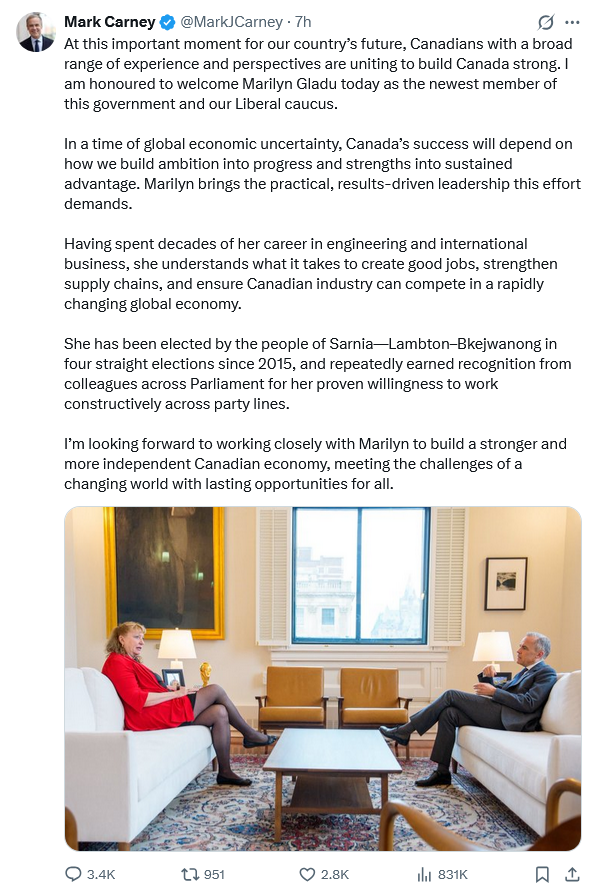
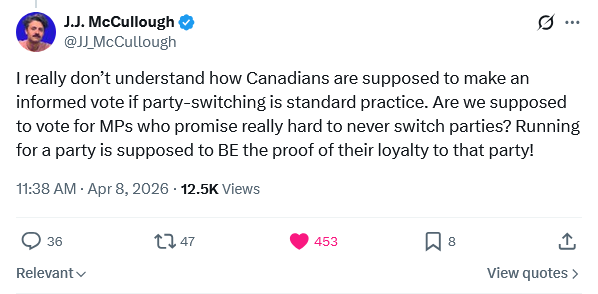
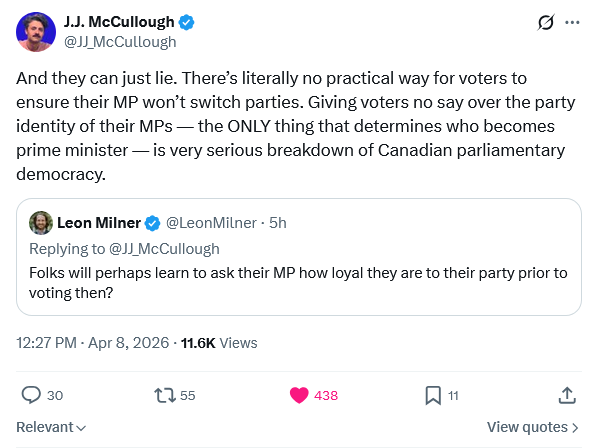
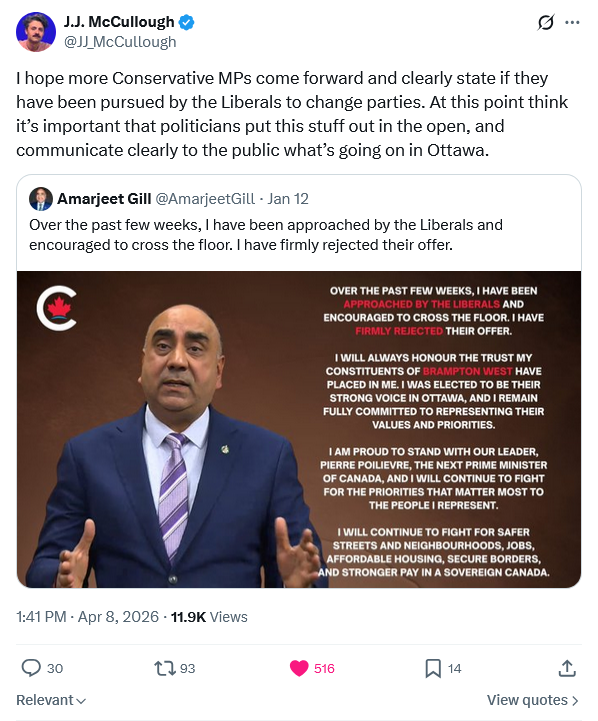
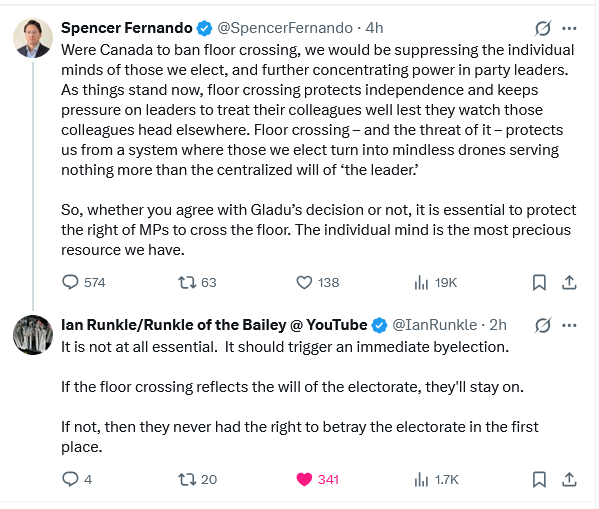
It’s not an everyday thing, but I saw someone mention on social media that there had been over 300 floor-crossings since Confederation. The latest Member of Parliament to switch parties … to literally walk across the floor in Parliament to join Carney’s Liberal party is Nova Scotia’s Chris d’Entremont:

The speculation in Ottawa about floor crossers is getting silly, some of the names being pushed don’t make any sense. Which makes me think that this is really an attempt by the Liberals to try and destabilize the Conservatives.

Sorry, that would be “destablise” in Mark Carney’s new English but more on that shortly.

We have seen Liberals push name after name including Chris d’Entremont who did cross, but others who have said they have no interest in crossing. That was the case for Dominique Vien the Conservative MP from Quebec’s south shore who had to post a video after jerks like me published her name following weeks of speculation.

If you don’t speak French, let me summarize, or sumarise in Carney English. She says that she’s heard the rumours that she would be leaving the Conservative caucus to sit as a Liberal or an independent, but that’s not true. She states clearly that she is and will remain a Conservative and that she doesn’t like Mark Carney’s budget.

Meanwhile, Joël Godin, the MP for Portneuf—Jacques-Cartier a riding northwest of Quebec City, who has been named as a possible floor crosser declined to answer questions entering caucus on Wednesday. Does that mean he’s ready to cross or not just putting up with the BS?

Conservative insiders tell me that he won’t be changing teams anytime soon.

The rumour mill is insane, with Liberals pushing the idea that all kinds of Conservatives are looking to jump ship. I’ve had several Liberals tell me that Michael Chong has been looking to cross the floor, an idea that is so ridiculous that I didn’t even call Chong to ask him because anyone floating that doesn’t know the man or conservative politics.

After I mentioned that on 580 CFRA in Ottawa, Chong called me to assure me that he wasn’t crossing to the Liberals. Michael, I never doubted you.

It’s doubtful that other names Liberals are pushing will come to fruition.

What is clear is that Carney and the Liberals are reaching out to Conservative MPs and making them offers to switch parties. Are they making illegal offers? I’d really like to know what has been put forward.

Is a “comfy landing” being offered for those that will cross? It wouldn’t be the first time that kind of thing has been offered.

As to the particular motivations for d’Entremont decamping to the Liberal benches, discussions on the social media site formerly known as Twitter indicate that he just barely got elected this time around, that he’d been fired by Pierre Poilievre as Deputy Speaker, and he decided he had a better chance of getting back into Parliament as a Liberal in the next election. Quinn Patrick reports that the Liberals had been trying to get d’Entremont to join them for quite some time:

Industry Minister Mélanie Joly said the Liberals had been courting former Conservative MP Chris d’Entremont behind the scenes for five years before he ultimately crossed the aisle.

“We’ve been trying to recruit him for a long time,” Joly told reporters in French on Parliament Hill on Wednesday. “Finally, he saw the light.”

D’Entremont had served as a Conservative MP for six years, after first being elected in the 2019 election.

As several people pointed out, that conveniently meant he’s qualified for the platinum-plated MP pension plan … but I’m sure that’s not why he switched parties.

Liberal MP Kody Blois, who also represents a riding in Nova Scotia, confirmed that he and d’Entremont had been speaking “for a long time about the ways in which we can collaborate.”

“It’s great to see Mr. d’Entremont join. If there’s other members of Parliament feeling the same way, again, I think we’re always welcome to those conversations,” said Blois.

While Blois didn’t explicitly say he had been attempting to enlist d’Entremont, he said the Liberals are a big-tent party with room to accept more “moderate” conservatives.

When asked if the Carney government was actively trying to recruit more MPs, Blois said that “wouldn’t be a conversation I’m going to have right here in front of the media.”

The former Conservative MP met with Prime Minister Mark Carney at a post-budget media conference on Wednesday, saying he didn’t believe his values as a “red Tory” were being “represented.”

“I didn’t find I was represented there … my ideals of an easterner, of a red Tory and quite honestly of trying to find ways to find solutions and help the community rather than trying to oppose everything that’s happening,” said d’Entremont.

He also alluded to the possibility of other Conservative MPs “in the same boat” but stopped short of naming anyone specific, saying he would let them share their stories “if the time comes.”

However, he has been the only one to cross the aisle thus far.

Conservatives and their supporters have accused d’Entremont of betraying his constituents and his values in pursuit of his own ambitions.

November 6, 2025

Reactions to Tuesday’s budget announcement

Mark Carney’s government finally got around to releasing their 2025 budget and lots of folks have thoughts and concerns about what is in it and what isn’t in it. After all, it could be the best possible budget, but it would still not satisfy all concerns … and nobody is pretending that this is anything close to “best possible” territory. Sylvain Charlebois says that the budget ignores the food insecurity issues and grocery prices for ordinary Canadians:

Graphic stolen from Small Dead Animals.

For a government that often talks about food affordability and insecurity, Budget 2025 offers surprisingly little that directly addresses either. There’s no bold food strategy, no affordability roadmap, and no new incentives for domestic food production. Yet, in between the lines, Ottawa has quietly set the stage for some indirect relief — not through grocery subsidies or consumer-facing policies, but through infrastructure, trade, and administrative reforms that could make the food system work a little more efficiently.

The largest signal comes from the government’s $115 billion infrastructure plan, one of its so-called “generational investments”. The new Trade Diversification Corridors Fund aims to modernize ports, railways, and airports — all chronic weak points in Canada’s food supply chain. When bottlenecks ease, goods move faster, and perishable products arrive fresher and cheaper. While no one in Ottawa framed this as a food-price measure, logistics efficiency has long been one of the most effective — and least visible — forms of price control.

[…]

Still, the absence of a broader vision for food affordability stands out. After years of grocery price volatility and public debate about “greedflation”, Canadians might have expected a more direct focus on food resilience — investments in innovation, local processing, or retail transparency. Instead, the government seems to have opted for a quieter, systemic approach: strengthen the arteries of trade and logistics, and trust that efficiency will trickle down to the dinner table.

The budget forecasts a $78.3 billion deficit for the 2025-26 fiscal year, which is significantly higher than notorious spendthrift Justin Trudeau’s last budget number. This adds to an already staggering $1.27 trillion debt load, which is nearly double what it was just before the pandemic. In the lead-up to the budget release Mark Carney had hinted at major sacrifices to be made, and while there wasn’t a lot in the document directly corresponding to sacrifice, the need to service that long-term debt will do the job quite adequately.

In the National Post, John Robson says that the budget is “elbows up, IQs down”:

Since I was last propelled years ago into the purgatory known as “the lockup”, where journalists spend budget day, have either process or contents improved? No. Instead they now insert a false stolen-land “acknowledgement” before even getting to the same old same old labeled bold and new. Which is especially troubling at this supposedly critical juncture.

The document is the familiar brick, 406 paper pages and 493 digitally with no explanation for the discrepancy and no excuse for the length. (Or for being called “Canada Strong” with an inexplicable picture of a ship.) Especially as the Finance Minister gabbled “This is a budget that talks to everyday Canadians,” and its purpose is to state plainly how much the government intends to spend, where it hopes to get the money and how far short it already knows it will fall, you shouldn’t have to wade through 248 pages of sludge to find out.

As P.J. O’Rourke said, “beyond a certain point, complexity is fraud”. Though we “privileged” insiders search “Summary Statement of Transactions” and voila, submerged on p. 249 (all references digital) is a $78.3 billion deficit next year if all goes well, and the national debt increasing $80.5 billion so it already didn’t.

Much commentary, and special-interest attention, focuses on trivial fiddles. But what matters is that Leviathan is in hock up to its horns, with interest payments projected at $55.6 billion next year, soaring to $76.1 billion by 2029-30. If the Lord is willing and the creek don’t rise, both forlorn hopes. NDP MP Leah Gazan, who would jail you for “downplaying” residential schools, snarled about not supporting an “austerity budget” but she won’t get the chance.

Some may bleat that times are tough. Indeed the finance minister’s campaign-speech “Foreword, Budget” gasses “The world is changing, profoundly and in real time; we are no longer living in an era of calm, but of significant change”.

The projected deficits are clearly hallucinatory, as the Liberals never seem to get deficit spending to go down, running deficits every year since 2015:

However, on the ludicrous side, the feds want to spend money to “investigate” Canada taking part in the freaking Eurovision contest:

On the slightly less ludicrous side, Noah considers the military aspects of the budget:

Budget 2025 outlines the government’s generational investment to quote, “defend Canada’s people and values, secure its sovereignty, and position the nation as a strong, reliable partner to its allies“. This starts by initiating a process of rebuilding, rearming, and reinvesting in the DND, CCG, and CAF to provide everyone with the necessary tools and equipment to protect sovereignty and bolster security.

Budget 2025 starts by outlining the government’s previous commitment to accelerate investments to meet NATO’s 2 per cent defence-spending target this year, which is five years ahead of schedule.

Budget 2025 goes a step further by setting Canada on a path to meet NATO’s 5 per cent Defence Investment Pledge by 2035. This will be broken down into two categories, 3.5 per cent of GDP by 2035 in core military needs, including supporting the CAF, modernising equipment and technology, and building up defence industries, and 1.5 per cent on security-related infrastructure and investments.

This reinvestment in defence and security is the largest in decades, totaling $30 billion over a five-year horizon on an accrual basis. This funding is allocated across three main pillars: $20 billion for capabilities, $5 billion for infrastructure and equipment, and $5 billion for industrial support.

On a cash basis, Budget 2025 proposes to provide $81.8 billion over five years, starting in 2025-26, to rebuild, rearm, and reinvest in the CAF. This figure includes over $9 billion in 2025-26 that was previously announced in June 2025. This is the funding previously set out for Canada to reach the 2 per cent NATO target.

Key investments from this $81.8 billion fund include $20.4 billion over five years to recruit and retain a strong fighting force, which incorporates the previously announced updates to pay and support for CAF health care.

An additional $19.0 billion over five years is allocated to repair and sustain CAF capabilities and invest in defence infrastructure, including the expansion of ammunition and training infrastructure. Upgrades to digital infrastructure for the Department of National Defence, CAF, and the Communications Security Establishment, particularly for cyber defence, are funded with $10.5 billion over five years.

Finally, $17.9 billion over five years is designated to expand Canada’s military capabilities, with investments in logistics, utility, and armoured vehicles, as well as counter-drone, long-range precision strike capabilities, and domestic ammunition production.

This is a serious chunk of change, although sadly, and as you will see, we don’t get a major breakdown of what this looks like. What we are left with are general piles of money, which isn’t always a bad thing. It’s also expected. The budget is set for a timeline before many critical capabilities will be delivered, so they won’t be included. Almost everything comes after 2030.

November 4, 2025

Sir Arthur Currie, Canada’s best general in WW1

On the social media site formerly known as Twitter, InfantryDort gives a lesson in Canadian military history that your kids are unlikely to ever get in school:

Canada: Let us remind you of what your nation was once capable of, and likely still is again. Time will tell. Courtesy of @grok UNHINGED👇

SIR ARTHUR CURRIE: The Ontario slide-rule psychopath who turned war into a goddamn spreadsheet and made the Kaiser cry uncle.

Listen up, you trench-foot tourists and armchair Haigs. While Europe’s aristocrats were using human meat to plug shell holes, some lanky insurance salesman from Napperton, Ontario rolled up with a protractor and a grudge against inefficiency so pure it could sterilize a field hospital. Six-foot-four of quiet Canadian fury. No Sandhurst polish. No inherited estate. Just a militia gunner who looked at the Western Front and said: “This is sloppy. Let me fix your murder math.”

Vimy Ridge: the ridge that laughed at French corpses for two years. Currie hands every platoon leader a map accurate to the latrine, rehearses the assault until the boys can do it blindfolded in a thunderstorm, then unleashes a creeping barrage so precise it’s basically a Roomba made of high explosives. Four days later the ridge is theirs. France needed therapy. Canada needed a birth certificate.

Hill 70: supposed to be a sideshow. Currie turned it into a German obituary — 9,000 Canadian casualties for 20,000 German ones. That’s not a battle, that’s a hostile takeover with extra steps.

Passchendaele: Haig wants it. Currie says, “Fine, but it’ll cost exactly 16,000 of my boys”. Mud eats them like clockwork. Sixteen thousand. He predicted it to the body. The man could forecast death better than the Farmer’s Almanac predicts frost.

Amiens: the day the German army discovered existential dread. Currie’s corps punches twenty-two kilometers through the Hindenburg Line in four days like it’s made of wet cardboard. Ludendorff calls it “the black day of the German Army” and probably wet his monocle.

The Hundred Days: wherever the Canadians go, the war ends faster — Arras, Cambrai, Canal du Nord. German prisoners start asking for Currie by name like he’s the Grim Reaper’s polite cousin. “Wenn Currie kommt, bricht die Linie.” When Currie shows up, your defense budget becomes a suggestion.

And the best part? He’s not screaming. He’s not posing for propaganda photos with a riding crop. He’s in the back, recalculating artillery tables while lesser generals are still figuring out which end of the horse goes forward.

Post-war? Becomes principal of McGill because apparently breaking the German army wasn’t challenging enough. Gets slandered for “wasting lives” at Mons, sues the bastard for libel, and wins with the same cold precision he used to win battles. Even his lawsuits had kill ratios.

Runner-ups:
Sir Richard Turner — the human participation ribbon. Managed the 2nd Division like success was contagious.

Sir David Watson — followed Currie’s plans like IKEA instructions: mostly right, but slower.

Sir Henry Burstall — thought “supporting fire” meant “hope the shell lands somewhere in Europe”.

Currie carried their divisions like a Sherpa with a PhD in applied violence.

Verdict: Currie didn’t just win battles. He invented the modern battlefield while everyone else was still playing medieval siege with extra mustard gas. Montgomery called him “the best corps commander of the war”, and Monty would rather die than compliment anyone.

Share this if you’d let Currie balance your checkbook, plan your wedding, and end your existential crisis with a well-timed barrage. Canada’s greatest general was a nerd with a death wish for waste and a heart that bled maple syrup for every lost soul. Never forget.

November 3, 2025

“Vice-Admiral Angus Topshee more or less kiboshed the notion of building new submarines here in Canada”

Filed under: Cancon, Germany, Military, Weapons — Tags: , , , , — Nicholas @ 05:00

Assuming that this government or the next one follows through with current plans, the Royal Canadian Navy (RCN) will replace the four current British-built Victoria-class submarines with up to a dozen new subs based on either the German Type-212CD design or the South Korean KSS-III. There is no reason at all that these new submarines need to be built in Canada, as there is no existing shipyard with any experience in this kind of vessel and no chance that creating a domestic submarine industry would be anything more than a perpetual money-sink. Our existing shipyards can, at a stretch (and at a significant cost increase), build surface ships from small motorboats up to frigates, destroyers, and larger supply ships, but there’s always a hefty premium for building the hulls here because once the order is complete, the shipyard can rarely use that skilled workforce and their specialized expertise to build more ships for other navies, so the yards shrink, the workers move on and a decade or so later, we have to start all over again from basically nothing.

Submarines are even more specialized than the ships the RCN is likely to buy, and there’s almost zero chance an allied navy or a neutral power would choose to have submarines built in Canada. The head of the RCN, Vice-Admiral Topshee clearly recognizes this:

Type 212 submarines at the HDW shipyard in Kiel, Germany, 1 May 2013.
Photo by Bjoertvedt via Wikimedia Commons.

On Thursday in South Korea, Royal Canadian Navy Vice-Admiral Angus Topshee more or less kiboshed the notion of building new submarines here in Canada. He cited two major concerns: One, that we need these submarines “quickly.” And two, that our demand for submarines couldn’t possibly sustain an operation on its own.

“A submarine industry requires a consistent production line, and to be able to build enough submarines … to sustain a production line will be a real challenge,” Topshee said at the Hanwha Ocean Shipyard, where he, Defence Minister David McGuinty and Prime Minister Mark Carney tickled the periscope on one potential replacement for Canada’s aging-out Victoria-class subs.

Both Hanwha and ThyssenKrupp say it’s technically possible they could build the subs in Canada; it would just take a long time to lay down the infrastructure, and we’re in an uncommon hurry. We are assured plenty of Canadian steel and sweat will go into maintaining them.

And I suspect that won’t be very controversial, if at all. We’ve had American submarines, British submarines and German submarines in the past. Submarines are just something that are not made in Canada, like a lot of other things: jumbo jets, fighter planes, aircraft carriers, pineapples, cellular telephones, home electronics.

And we’re fine with it. Aside from the odd Avro Arrow obsessive, everyone seems to accept we’ll be buying new fighter jets off the peg from abroad — assuming we ever come to a final decision on which to buy, of course.

The question is, why isn’t that controversial? Or, why is it by contrast seen as controversial to buy surface vessels from abroad. Whoever’s fault it is, Canadian shipbuilding for the navy is a scrapyard of blown deadlines, outrageous cost overruns and sometimes outright failure. If we’re happy with South Korean or German subs, why not South Korean or German or Danish frigates and destroyers — or passenger ferries, for that matter?

Until this silly “elbows up” narrative took hold, no one seemed to care very much where our ferries were built: Marine Atlantic sails Chinese-built ferries between Cape Breton and Newfoundland with barely a whisper of controversy. But the entire political class is now essentially united against BC Ferries’ decision to buy Chinese ferries from the same shipyard. The fact that BC Ferries needs ferries almost seems like an afterthought.

ROKS Shin Chae-ho, a KSS-III submarine at sea on 4 April, 2024.
Photo from the Defense Acquisition Program Administration (DAPA) via Wikimedia Commons.

Update: Noah posted a Q&A session with his readers that included some comparisons of the two contending designs for the Canadian Patrol Submarine Project (CPSP):

Q4. Have you had a chance to compare the AIP on the Ks III & 212CD yet with respect to Time underwater. There are different numbers floating around with new systems?

The truth is that no manufacturer is going to give you the accurate endurance. None. That is a closely guarded secret. I can say the KSS-III is higher, though out of respect for everyone and to not get myself in trouble I won’t say numbers. Both have endurance of several weeks and fit the HLMR.

I do plan to go into details about the systems themselves soon though, so I’m not leaving it alone!

Q5. The Type 212 has been described as an “ambush” submarine silently lying in wait for Russian subs. What advantages does the 212 bring to the Pacific?

Understand that both the KSS-III and Type 212CD are products of different needs and philosophies. Both focus on different strengths, in this case the 212CD puts almost all its efforts into being as stealthy and quiet as possible.

Its not just about ambush. Its about survival. The Type 212CD is designed to operate in the shallow, tight waters of the Baltic, and the littoral regions of the North Sea. That isn’t just about submarines but also being survivable against a dense field of Russian Maritime Patrol Aircraft and Anti-Submarine Helicopters.

That means a lot of effort was taken to ensure they’re as quiet and undetectable as possible. That’s where things like the Diamond-Shaped hull are supposed come into play, the use of non-magnetic stainless steel.

A lot of its value comes in what role you expect it to play. It is still an excellent asset in the littoral regions of the pacific, however it isn’t optimized for prowling around the open ocean, deep-diving nature of the Pacific. That is the domain of platforms like the KSS-III, at least in my opinion.

That doesn’t mean it can’t, but just as the KSS-III can also operate in the littoral regions of the Baltic doesn’t mean it’s optimized too. That’s the thing about CPSP. There’s a lot of requirements, a lot of different environments we expect these subs to operate in, and both [designs] focus on different priorities.

The advantages it has as a stealth-optimized platform don’t disappear. It could easily act in complement to other assets like U.S. and future Australian SSN [which] are more optimized for operations in the wider Pacific.

Strengths and weaknesses.

Update, the second: South Korea looks to be joining the nuclear-powered navy club with a new class of Korean subs to be built in Philadelphia using US navy nuclear propulsion technology.

South Korea has been wanting to get in the SSN club for a long time. Good on them for their persistence.

I’m not sure how this will work out. The Philadelphia Shipyard, even at its heyday, never built nuclear powered ships of any kind.

The South Koreans build a solid conventional submarine, the KSS-III that they offered to Canada recently, but nuclear submarines are at another level. Besides the infrastructure issues specific to nuclear shipbuilding at the shipyard that would need to be addressed, there is the fact that the U.S. nuclear workforce and hardware providers are already behind schedule with expected demands. While another yard is great, whoever is going to successfully solve those two structural issues needs superhuman abilities and one heck of a funding line.

The BC government “has been doing everything in its power to have Aboriginal title triumph across B.C.”

Filed under: Cancon, Government, Law, Liberty, Media, Politics — Tags: , , — Nicholas @ 03:00

A Fraser Institute commentary by Bruce Pardy addresses the role of the NDP government of British Columbia in undermining the established laws on land title in the province among other actions to the advantage of First Nations bands and to the definite disadvantage of ordinary British Columbians:

Recently, British Columbia Attorney General Niki Sharma said that fee simple title in private property is superior to Aboriginal title. She’s a day late and a dollar short. In fact, her NDP government, led by Premier David Eby, has been doing everything in its power to have Aboriginal title triumph across B.C.

A B.C. Supreme Court judge has granted several First Nations a portion of a 1,846-acre land claim on Lulu Island. B.C. Supreme Court

A few days earlier, the City of Richmond sent out a letter to more than 125 property owners warning them that the security of their land is in doubt. “For those whose property is in the area outlined in black,” the letter reads, “the Court has declared aboriginal title to your property which may compromise the status and validity of your ownership … The entire area outlined in green has been claimed on appeal by the Cowichan First Nations.”

The Richmond letter is a consequence of a recent decision of the B.C. Supreme Court, which awarded Aboriginal title over 800 acres of land in Richmond to the Cowichan First Nation. Wherever Aboriginal title is found to exist, said the court, it is a “prior and senior right” to other property interests, whether the land is public or private.

It is finally dawning on British Columbians that obsequious devotion to reconciliation is putting their land at risk. Sharma claimed that B.C. was pursuing multiple grounds of appeal, but that makes her a hypocrite. Her government did not robustly defend in court against the Cowichan claim. And in a dozen other ways, the Eby government has sought to put title and control of B.C. into Aboriginal hands.

In early 2024, it proposed to amend the province’s Land Act, which governs the use of Crown land in B.C. It planned to give B.C.’s hundreds of First Nations a veto over mining, hydro projects, farming, forestry, docks and communication towers. The government tried to consult quietly, but the backlash was immediate. It withdrew the proposals, promising to be more transparent. But it did not shelve its objectives or its plans. And did not deliver on its promise. Instead, it sought to make agreements over specific territories with specific Aboriginal groups, often negotiated covertly and announced after the fact.

In April 2024, the Eby government recognized Aboriginal title to Haida Gwaii, the archipelago on Canada’s West Coast. Around 5,000 people live on Haida Gwaii. About half are Haida, who voted overwhelmingly in favour of the deal. But non-Haida residents had no say. The Haida agreement says private property will be honoured, but private property is incompatible with Aboriginal title, which is communal. If Haida Gwaii really is subject to Aboriginal title, then no one can own parts of it privately.

Update: I forgot to include the URL to Mr. Pardy’s article … fixed now.

November 2, 2025

Canada finally getting serious about the military? Ignore the words and wait for concrete actions

Filed under: Bureaucracy, Cancon, Government, Military — Tags: , , — Nicholas @ 03:00

The Canadian military used to be one of the best in the world. We “punched above our weight” as the hoary old cliché had it. But it was true. Then came Lester Pearson and the notion of peacekeeping, which is related to but not the same thing as having a military prepared to fight. Then came Pierre Trudeau and his loyal acolyte Paul Hellyer and the notion that merging the Canadian army, the Royal Canadian Navy (RCN), and the Royal Canadian Air Force (RCAF) into a single organization — the Canadian Armed Forces (CAF) — would magically reduce our military spending while maintaining our military power. It may have saved some money on paper, but its real impact was allowing the federal government to cut, cut, cut until the CAF was no longer capable of fielding significant numbers of combat troops, aircraft, or naval vessels and we began quietly withdrawing from our NATO and UN commitments (while still propagandizing about being a “soft power” superpower and persuading Canadians that we were still world leaders in peacekeeping).

Later Canadian governments have made noises about correcting the mistakes of the past half century and getting proper equipment — and enough of it to matter — and resurrecting the fighting capabilities (and numbers) of the CAF … even bringing back the proper names of the RCN and RCAF … but the promises were rarely implemented and even more rarely maintained beyond the life of a given government.

Our allies have been urging us to take the military more seriously for so long that it seems inevitable that any new expansion plans will fade into the mist just as quickly as all the previous fever dreams. Even when the government actually provides new funding, the bureaucracy is so incapable that time expires before they actually spend some or even all of it. All of which is why I’m highly skeptical that ongoing noises about increased military spending will actually result in anything more than a higher head-count in the civil service and lots (and lots, and lots) of re-announcing the spending plans:

In summer 2023, NATO held its largest-ever air exercise in Germany. Canada did not take part because its fleet was up on bricks.

Understaffed by around 10,000 regular soldiers, thanks to a 12 per cent attrition rate, the CAF was rocked by sexual misconduct scandals and chastised by a government more focused on culture change than war fighting.

Critics like Mark Norman, a former vice-chief of the defence staff, said Canada was increasingly seen as irrelevant in Washington.

But Norman said he is encouraged by the Carney government’s moves.

“Let’s be clear, the Forces are still in a decrepit state. We haven’t resolved the fighter jet or recruitment problems, or produced a defence industrial strategy. But I acknowledge that the prime minister has done a lot to try to refocus the government and, more broadly, Canadians,” he said.

A major problem for all governments has been actually spending money approved by Parliament. This week’s PBO report said that between 2017/18 and 2023/24, actual capital spending fell short of planned expenditure by $18.5 billion. Every year, the Department of National Defence failed to spend an average of $2.6 billion of its procurement budget.

“The scale of the planned increase raises questions about the government’s capacity to manage a higher volume of procurement activity and the domestic defence industry’s ability to support it,” the report said.

Norman suggested the new Defence Investment Agency, headed by former banker Doug Guzman, is a positive development. “The public service is not designed to produce operational outcomes, so the (appointment of an outsider) is encouraging,” he said.

According to David Pugliese, the Canadian Army is looking to vastly expand the existing army reserves:

The Canadian military has set in motion an initiative to increase the number of its part-time soldiers from the current 28,000 to 400,000 as part of an overall mobilization plan, according to a directive approved by senior leaders.

The directive, signed by Chief of the Defence Staff Gen. Jennie Carignan and defence deputy minister Stefanie Beck on May 30, 2025, outlines the need to increase the current reserve force from 23,561 to 100,000 and supplementary and other reserves from the current 4,384 to 300,000.

Beck and Carignan approved the creation of a “tiger team” which will work on setting the stage for a Defence Mobilization Plan or DMP to accomplish such a goal. That team will examine what changes are needed to government legislation to allow for such a massive influx of Canadians into the military.

Beck and Carignan pointed out that the plan would require a Whole of Society or WoS effort, meaning that all Canadians would have to contribute to the initiative.

“In order to assure the defence of Canada against domestic threats ranging from a low-intensity natural disaster response to high-intensity large scale combat operations, the DMP will be developed to empower a timely and scalable WoS response by achieving pre-conditions for the expansion and mobility of the CAF,” according to the nine page unclassified directive.

The initiative has drawn some critical responses on the social media site formerly known as Twitter:

November 1, 2025

MAGA is not a monolith, thank goodness

Filed under: Cancon, Government, Media, Politics, USA — Tags: , , , — Nicholas @ 04:00

In The Line, Alex Muir looks at Canada-US relations (such as they are currently) and why MAGA not being a monolith is something Canadian politicians need to understand to stand any chance of successfully navigating our dealings with President Trump and his administration:

If there’s one thing that we’ve seen in recent days, as Donald Trump plays an endless game of “deal or no deal” with countries around the world, it’s that the current administration is volatile.

Why? One answer to that question is factionalism — to an extent that has enshrined unpredictability as a core operating principle of the second Trump term.

Canadians are particularly exposed to this. From north of the 49th, it looks like American policy is oscillating between nationalist populism, business pragmatism, tech conservatism, and social traditionalism. That is, however, a misreading. Administration policy is remarkably consistent if you focus on the current rather than the waves. First and foremost, the president and his team obsess over visible status, a game you can play through flattery or strength and symbolic gesture — there are winning examples of both.

In concrete policy terms, the Trump administration expects us to help them on missile defence, border control, and maritime security. They expect access to our resource and energy assets, on their terms. And they want our manufacturing sector to relocate to America. They also expect Canada to know its place as a loyal American ally.

Zoom out to the bigger picture and all the daily clutter can be understood as moves to advance, or at least attempt to advance, those broad goals. And that understanding, in turn, can help inform a successful Canadian response to U.S. actions.

[…]

You cannot understand what is happening today if you do not understand what factions hold sway within this new structure. I recommend thinking of the United States as a monarchy wearing a representative democracy’s clothes. Decisions do not rest in the administrative state, or even in a political party (like Hungary), they rest in the attention of a restless and aging president and those known to have his ear, and his trust. How close to the president a decision-maker is, and who else has a voice on any given topic, goes a long way toward explaining outcomes.

The various MAGA factions colonizing D.C. share several important background beliefs on Canada. First, and arguably most important, they don’t notice it much, and care even less. Second, they assume all foreigners want to be Americans, or are somehow defective if they do not. Third, Canadians look and sound so much like Americans that the latter assumption is magnified.

Fourth, there is a wide streak of Manichaeism in several of the factions that make up the administration, and the MAGA movement more generally. This means resistance, or even evasion, is quite likely to be taken as evidence of ill intent — or even outright evil intent — as opposed to the furtherance of legitimate competing interests. All of these are wrapped up in a fairly magnificent degree of self-involvement. America is so big, so rich, and so strong, that all administrations overwhelmingly focus on domestic issues and domestic politics since nothing that happens outside their borders is generally seen as existential. (Whereas American elections and culture wars absolutely are.)

For Canada, this has meant many things, none of them positive. We’ve seen the rapid (and apparently random) escalation of tariffs (so far mostly on specific goods, or things not explicitly covered by USMCA), plus the endlessly repeated threats of higher duties in response to perceived Canadian provocations. There have been threats and intermittent moves to sideline Canada from vital security relationships, including the Five Eyes and NORAD. Canada has committed to some initiatives in order to satisfy American demands, like intensified border enforcement initiatives and committing new resources to national security priorities. It is difficult, however, to get out in front of a rapidly moving target in terms of the administration’s desired outcome.

And that’s the crux of the matter — what do the factions of the administration see when they look at Canada, and what do they want? Answering that question involves understanding what the factions are. The following summary of the factions within MAGA has been condensed from my other work, and should help Canadians understand the complexity of what we must face.

October 30, 2025

Unlabelled cloned meat – coming soon to Canadian grocery stores

Filed under: Bureaucracy, Cancon, Food, Government — Tags: , — Nicholas @ 03:00

Dr. Sylvain Charlebois on a recent Health Canada decision to allow cloned meat to be sold in Canada with no label to differentiate it from ordinary meat:

Sometimes the most significant food-policy changes happen not with a bang, but with a bureaucratic whisper.

According to Health Canada’s own consultation documents, Ottawa intends to remove foods derived from cloned cattle and swine from its “novel foods” list — the very process that requires a pre-market safety review and triggers public disclosure. Once this policy takes effect, cloned-animal products could enter the Canadian food supply without announcement, notice, or label.

From a regulatory standpoint, this looks like an efficiency measure. From a consumer-trust standpoint, it’s a miscalculation.

Health Canada’s rationale is familiar: cloned animals and their offspring are, by composition, indistinguishable from conventional ones. Therefore, the logic goes, they should be treated the same. The problem isn’t the science — it’s the silence.

Canadians are not being told that the rules governing a deeply controversial technology are about to change. No press release, no public statement, just a quiet update on a government website most citizens will never read.

Cloning, after all, is not about making food cheaper or more nutritious. It’s a genetic management tool for breeders and biotech firms — a way to reproduce elite animals with prized traits. The clones themselves rarely end up on the dinner plate; their offspring do. The benefits, if any, are indirect: perhaps steadier production, fewer losses from disease, or marginally more uniform quality.

But the consumer sees no gain at checkout. Cloning is costly and yields no visible improvement in taste, nutrition, or price. The average shopper might one day unknowingly buy steak from the offspring of a cloned cow — and pay the same, if not more, for it.

And without labels, any potential efficiencies or cost savings stay hidden upstream. When products born from new technologies are mixed with conventional ones, consumers lose their ability to differentiate, reward innovation, or make an informed choice. In the end, industry keeps the savings, while shoppers see none.

« Newer PostsOlder Posts »

Powered by WordPress