
Ruairidh MacVeigh
Published 5 Sept 2020This week, it’s back to cars, and today we look at the history of a motoring scandal that took place 10 years before DeLorean and his DMC-12, but followed nearly the same notes; a rushed design, shady business practices, an inexperienced workforce in an impoverished part of the world, etc.
The Bricklin SV-1 may have looked good on paper, but in reality it was a severely flawed design that was ahead of its time in many aspects, but highly primitive in others.
(more…)
June 25, 2023
Canada’s DeLorean – Bricklin SV-1
Comments Off on Canada’s DeLorean – Bricklin SV-1
June 24, 2023
Canada’s Online News Act already impacting news delivery for smaller outlets
A local site I use regularly has already begun to feel the negative effects of the federal government’s Online News Act (aka Bill C-18):

Durham Radio News (DRN) doesn’t normally post editorial content, but when local news is being attacked we refuse to stay silent.
Bill C-18 is now law and will have a very negative impact on local independent newsrooms such as DRN.
The bill forces major tech companies such as Google and Meta to pay news outlets for content.
The vast majority of referrals to our DRN site come from Facebook and Google.
Both platforms have been instrumental in growing our audience.
Despite multiple warnings from Meta and Google that they would block news, the Liberal government proceeded with Bill C-18.
It’s now law and in a statement Meta says news will no longer be available on Facebook and Instagram.
Google is expected to follow suit.
Both tech giants have publicly said they don’t make much money off links to news stories so it doesn’t make financial sense for them to pay news providers.
Prime Minister Justin Trudeau called their threats to remove news a bullying tactic and said it will not work with his government.
It really appears the Liberals thought they were bluffing, we now know they were not.
DRN has been trying to get our voices heard for months on the negative impact this bill would have on our business.
We were drowned out by larger media outlets who would stand to benefit from this bill.
We will not be naming other outlets and we don’t begrudge the financial help they are already receiving.
Meta provides funding through fellowships with some media partners, and it is these outlets that became greedy and were asking for more.
For them it doesn’t matter if they get kicked off social media platforms.
For us it will make a huge impact.
Comments Off on Canada’s Online News Act already impacting news delivery for smaller outlets
“… every time I see some fine new supercluster-aspirational buzzword-laden legislative boondoggle coming from our federal government I know that my life is going to get worse in some minor, petty, and yet measurable way”
Jen Gerson is irked by the federal government’s latest petty diktat to “save the planet” from single-use plastic bags that bans the use of bags that are not made of plastic:

Those who follow my work will know that I am an unreformed Calgary evangelist. I like this city for a lot of reasons, but one of them is that I’m a member of the Calgary CO-OP, a chain of local grocery stores. For those who are lucky enough to enjoy something like this, a co-op offers particular advantages over their conventional counterparts; we get a small share of the profits that the chain earns every year, for example. The stores stock local produce, meats, grain, and processed foods from Calgary-based suppliers, and from nearby farms. CO-OP also provides a number of top-notch house brand supplies. National chains are simply not as nimble, nor as local. They can’t be.
But I admit that one of the things I enjoy most about CO-OP is its green grocery bags. When stores across Canada began to phase out the use of single-use plastic bags, I was despondent. The environmental rationale for the ban was thin, but mostly I was annoyed because I’m chronically disorganized and can never remember to bring reusable bags.
So when CO-OP replaced plastic bags with a fully compostable alternative, I was delighted. Granted, we would have to pay a small fee to purchase these bags, but the per-unit cost was actually less than what we would normally spend on a box of Glad compost-bin liners. So it all evened out.
To make matters even better, unlike paper straws, the compostable bags are superior to their plastic alternatives. CO-OP advertises this point on their site: “They are stronger than a plastic checkout bag. You can carry a medium-size turkey or three bottles of wine with no problem.”
I can also attest to this. The bags are an absolute win for everybody involved.
So when I discovered on Thursday that Ottawa plans to ban these items, considering them a “single-use plastic”, I lost my goddamn mind.
Not only will this represent a small inconvenience for me and my family, but it is also one of the laziest, most idiotic decisions issued from this remote, non-responsive federal government I have yet to encounter.
The bags do not contain plastic.
Let me say that again, because apparently the sound of western voices doesn’t quite travel all the way to the the slower bureaucrats in the back: “THE BAGS DO NOT CONTAIN PLASTIC”. You fucking muppets.
[…]
Look, Ottawa, are you there? Are any of you listening, or am I just screaming into the void? For the sake of the entire country, I hope, I pray that there is somebody with an IQ above 92 capable of not just reading this desperate missive, but of really, truly understanding it.
This shit — this, right here.
This. Shit.
This is why we hate you.
This is why we fucking hate you.
Nobody outside the Toronto-Ottawa-Montreal triangle sees a headline like “New Initiative from Ottawa!” and thinks: “Oh, how exciting. I’m so keen to see what grand notion those crafty MPs in Ottawa have cooked up now! Come, Maude, let us settle ourselves before the The National at Six so we can understand how our fine federal government is working to make our lives better.”
Nobody does that. Because every time I see some fine new supercluster-aspirational buzzword-laden legislative boondoggle coming from our federal government I know that my life is going to get worse in some minor, petty, and yet measurable way.
Comments Off on “… every time I see some fine new supercluster-aspirational buzzword-laden legislative boondoggle coming from our federal government I know that my life is going to get worse in some minor, petty, and yet measurable way”
The Most Reliable and Versatile Sub-orbital Rockets Ever Made; the Black Brant Sounding Rockets
Polyus
Published 31 Aug 2018The Black Brant series of sounding rockets was a great success and a proud contribution to the global race for space. While not as glamorous as an orbital rocket, the Black Brants helped scientists from around the globe research and better understand the Aurora and the Earth’s ionosphere.
(more…)
Comments Off on The Most Reliable and Versatile Sub-orbital Rockets Ever Made; the Black Brant Sounding Rockets
June 22, 2023
CDR Salamander’s proposal to “encourage” NATO countries to meet or exceed their agreed defence targets
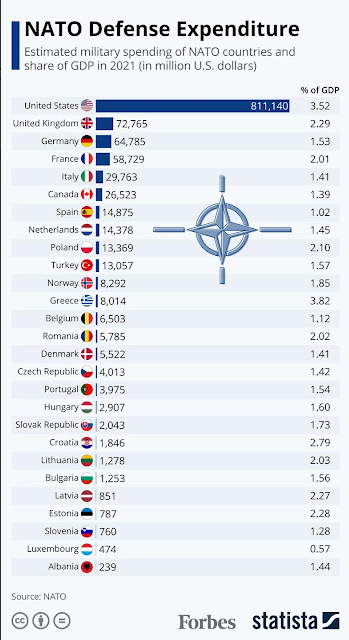
 Canada has been a notorious defence freeloader since the first Trudeau government took office in 1968. Every Canadian government since then — until the current government started telling our allies we had no intention of meeting our treaty commitments — has made more-or-less sincere noises about getting back to the 2% of GDP minimum defence budget and none have done much to make it happen (we’re around 1.39% at the moment). Several years ago, CDR Salamander proposed a new way to allocate NATO leadership roles according to how close to the minimum each member country has managed to get, and it’s surprising that something of the sort hasn’t already been implemented:
It should bring to the front that NATO can no longer allow unserious nations to play like they are anything but security free-riders. They need to contribute their fair share or pay some consequence. Alliances have benefits and responsibilities. You should not have one without the other.
While percentage of GDP is an imperfect measure of contribution, it is better than all the other ones. It is as simple benchmark of national effort.
As these are the best numbers we have, let’s look at 2021 and then forward.
It is amazing that after all Russia has shown Western Europe — both of its nature and the nature of modern warfare — that so many of our NATO allies continue to slow walk defense spending, doing the very minimum to be a full and fair partner in the alliance.
Russian victory — however they define it — or Russian defeat — however Ukraine defines it – will not change the geography or nature of Russia. She is not going anywhere.
[…]
There is so much deferred spending from our free-riding European allies.
Between 1999 and 2021, EU combined defence spending increased by 20%, according to reports by the European Defence Agency. That compares with a 66% increase by the US, and 292% by Russia and 592% by China, over the same period.
“Out years” are where dragons live, so anyone not on guide-slope to 2%+ by the end of 2023 — when one way or another the Russo-Ukrainian War should be over — will find someway to not get there in a wave of excuses and bluffing.
We should call their bluff.
As such, and this is generous, we need to finally pursue PLAN SALAMANDER for NATO “Flags-to-Post” that I first proposed almost six years ago.
In NATO, General and Flag Officer billets are distributed amongst nations in a rather complicated way, but this formula is controlled by NATO – and as such – can be changed.
Entering argument: take the present formula for “fair distribution” and multiply by .75 any nation that spends 1.5% to 1.99% GDP on defense. Multiply by .5 any nation that spends between 1.25% to 1.499%. Multiply by .25 1.0% to 1.240%. If you fall below 1%, you get nothing and your OF5 (Col./Capt) billets are halved.
1.25x for 2.01%-2.25%. 1.5X for 2.26%-2.75%; 1.75x for 2.76% -3.0%. 2x for +3.01%.
The math gets funky when a lot of people get over 2%, but we can refine it later. Doesn’t cost a penny and will unquestionably get the attention of those nations. Trust me on this. By January 1st, 2024 no more excuses. A small and symbolic punishment, but a good start that may be all that is needed. This is not the second half of the 20th Century any more.
Comments Off on CDR Salamander’s proposal to “encourage” NATO countries to meet or exceed their agreed defence targets
Any news about weather or climate is bad news
The transition of weather from merely reporting on weather conditions and relaying (somewhat) authoritative forecasts is pretty much complete, as now every change in the weather pretty much has to be linked to the dreaded anthropogenic climate change. New York City’s recent poor air quality due to Canadian wildfires highlights a change they haven’t been pushing — how much better air quality in major cities has become:
Earlier this month, as wildfires ravaged Canada, the Northeastern United States experienced heavy air pollution problems from the smoke.
The out of control fires and subsequent pollution is a tragedy, certainly. But the fact that a low-visibility New York City was national news highlights how much things have changed.
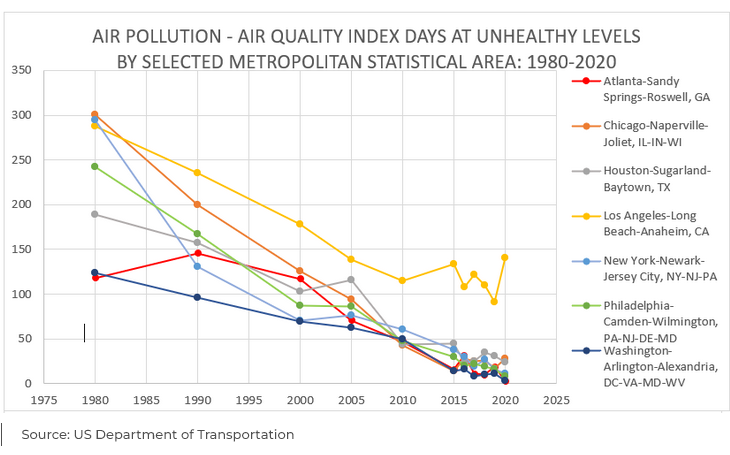
Pollution has dramatically declined over the past few decades. To get a clear picture of how much, look at this graph.
This shows the number of days air quality is considered to be at “unhealthy levels” by the US government in seven major metros in the U.S.
All seven metros have improved their air quality since 1980. This is good news!
In the NYC metro, nearly 300 days in 1980 had unhealthy air quality. Today it’s less than 50.
So what’s going on here? Well, some might argue regulation is the primary source. It’s certainly possible that environmental regulations in the end of the 20th century resulted in less pollution. As our technology has improved, we’ve gained the ability to police people polluting the air of their neighbors. But this isn’t the full story.
Comments Off on Any news about weather or climate is bad news
June 20, 2023
“Mendicino is a dead minister walking, and we suspect he knows it”
Belated (from me, not from them) section from this weekend’s update from the editors at The Line:

Paul Bernardo and Karla Homolka
Though you may find this hard to believe, based on what’s above, we were paying attention to some other things this week. The Ottawa vortex of ridiculousness continued at its usual clip. The government continues to try and find a defensible position on Paul Bernardo’s prison transfer to a medium-security prison. Alas for Mr. Trudeau, he’s been hit by a double-whammy of bad luck. Bernardo is an emotional trigger point with probably no rival across Canada. And the PM’s point man on this file is the hapless (!) Marco Mendicino, minister of Public Safety.
Let’s be clear: your Line editors are far too Vulcan-like to possess strong feelings about the transfer of Bernardo. We are of the right age to have grown up during the era of the Bernardo rapes, murders and eventual trial. He was the boogeyman of our youth. That being said, the important thing is that he dies miserable and alone behind bars. We aren’t particularly invested in which particular prison this happens. If there was a sensible reason for him to be moved to the Quebec facility, hey, whatever. He can rot in any suitable prison as far as we’re concerned.
The issue here, and it’s ridiculous that we have to spell this out, isn’t the transfer itself. Nor are we calling upon Trudeau or the federal government to become intimately involved in decision-making for prisoners, even high-profile ones. The only thing that turned this into a huge story was the latest peek it gave us into the Trudeau government. We have been confronted with — surprise! — more incompetence and dysfunction.
Mendicino’s staff had been repeatedly told about the pending transfer; no one told the boss. The PMO had been told, too. No one told that boss, either. Why tell the boss? So that they don’t get caught flatfooted by a scandal. This is basic issues management and internal communications, and we’re being shown, yet again, that the government is terrible at this. And, absurdly, Mendicino apparently has some of the best and brightest providing the adult supervision he so clearly needs: veteran political staffers were sent to his office after he beclowned himself during the gun-control fiasco a few months ago.
And this is the problem. We don’t care which cell holds Bernardo as he slides closer to hell. We do care about yet another data point in a pattern that has emerged with this government: they aren’t on top of their files, their offices aren’t well run, ministers aren’t properly briefed, and there seems to be zero accountability anywhere in this process. It was left to the Ottawa Parliamentary Press Gallery to hunt down Mendicino like ravenous cheetahs on a wayward gazelle after Mendicino had promised to brief them, and then no-showed. He also promised to brief them again later on Thursday, and failed to show up that time, too.
We know, we know. It’s hard to believe he’d lie. Marco Mendicino? An incompetent bullshitter? Say it ain’t so.
Mendicino is a dead minister walking, and we suspect he knows it. The government is obviously hell bent on getting to the summer break without sacking the minister, because to sack him, despite his manifest and repeated failings, would be to admit said failings, and this government will never do that. If they can get to the break, they can shuffle him off to the sweet oblivion of an obscure ministry, or even the back benches later on this summer. This is just the latest example of what Line editor Gerson has observed about these guys: tactically smart, but strategically dumb.
And, ahem, call us hopelessly naïve, but maybe the politics isn’t the point here? Canadians ought to have someone in the job of Public Safety minister — kind of an important role, you’ll agree — who is competent and well-supported by excellent staff. Instead we get this shitshow and frantic politicking to avoid handing the opposition a one-day media-cycle victory. It’s a bad look on the government. But it’s nothing we didn’t already know, we guess. They aren’t here to serve Canadians. They’re here to save themselves.
Comments Off on “Mendicino is a dead minister walking, and we suspect he knows it”
June 16, 2023
Friday Foundlings
A few items that I didn’t feel required a full post of their own, but might be of interest:
- “Lunch of suffering”: plain “white people food” goes viral in China
- From a review of Njal’s Saga – “There are only about 40,000 people in medieval Iceland. The book focuses on the Southwest Quarter, so let’s say 10,000 there. Each of our characters is a large landowning farmer with many children, servants, tenants, etc; if he is patriarch of a 20 person household, then there must be about 500 such patriarchs. Each of these 500 relevant Icelanders is profiled in loving depth. And if there are 500 characters in Njal’s Saga, and n people can have n(n-1)/2 possible two-person feuds, that’s 124,750 possible feuds. Of these, about 124,749 actually take place over the course of the saga (Njal and his friend Gunnar are best buds, and refuse to feud for any reason).”
- The Canadian government continues to rack up the internet regulation wins – “The fallout from Bill C-11 has been the subject of several posts this week, including the demands from a wide range of services for exceptions to the law and warnings from streaming services such as PBS and AMC that they may block the Canadian market due to the regulatory burden imposed by the law. While those stories focus on the availability of services and content in Canada, a new Variety report points to another negative impact from the bill: less film and television production in Canada, at least in the short term. Throughout the Bill C-11 debate, there were concerns that the large streamers might pause their productions in Canada given the uncertainty over whether they would ‘count’ for the purposes of new CRTC imposed contribution requirements. In other words, the bill could initially lead to less investment in Canada.”
- Random meme of the day:

Comments Off on Friday Foundlings
June 15, 2023
Thursday tab-clearing
A few items that I didn’t feel required a full post of their own, but might be of interest:
- Justin Trudeau’s government is clearly interested in moving to a Central Bank Digital Currency (CBDC), but “Canadians are not at peace with the idea of cash vanishing into thin air, with a consistent 80 per cent of respondents having no plans to go cashless“
- There’s an ongoing shortage of Adderall in the United States … and the Drug Enforcement Agency (DEA) is behind it.
- Alasdair Beckett-King explains what’s wrong with every time travel movie – https://youtu.be/zI0aBzA2K9s
- The man who visited Lenin’s Soviet Union and said “I have been over into the future, and it works.”
- Kim du Toit isn’t a believer in the official inflation statistics: “When the history of this era comes to be written, one of the most egregious falsehoods to be exposed will be the ‘official’ inflation rate.”
- Random meme of the day:
Comments Off on Thursday tab-clearing
June 14, 2023
Battle Of The Rivers (1944)
British Pathé
Published 13 Apr 2014Title reads: “Battle of the Rivers”.
Allied Forces invasion of France.
Various shots of mechanised units of the British and Canadian army preparing for assault on the Rivers Odon and Orne. Infantry mount the Sherman tanks and they head along the dusty road. Various shots of Sherman flail tanks passing camera (not flailing). Road bank collapses and one tank rolls onto its side
Various shots of Lancaster bombers over industrial area of Vaucelles. Aerial shots of bombs dropping from planes. Night shot of coloured markers cascading down to light up target area. More aerial shots, including L/S of Lancaster bomber crashing in flames.
Various shots of heavy artillery in action in the fields. Various shots of Royal Engineers putting Bailey Bridge across the Caen Canal. L/S of tanks crossing the bridge. Various shots of badly damaged industrial area near Caen. L/S of Canadian tanks on the move over open countryside and tracks. We see a soldier extinguishing flames where a tank’s grass camouflage has caught fire. The tanks cross a railway line.
Various shots of Winston Churchill being greeted by American officers as he arrives by plane in the Cherbourg area. He then tours the peninsula, looking at structures that were supposed to be V2 sites. M/S of Churchill climbing into spotter plane (“flying jeep”), piloted by Air Vice Marshal Broadhurst. Various shots of Churchill driving around Caen in an open-topped car, with him are Field Marshal Bernard Montgomery (Monty) and General Dempsey. Various shots of Churchill posing with a group of soldiers, he then spends some time chatting to them.
(more…)
Comments Off on Battle Of The Rivers (1944)
QotD: In hindsight, calling it “Operation HONOUR” was quite ironic
I spent my subaltern years in the light of Operation HONOUR, the signature project of then-Chief of Defence Staff General Jonathan Vance. Operation HONOUR was a massive culture change effort intended to address the findings of the Deschamps Report, which had exposed the “underlying sexualized culture in the CAF that is hostile to women and LGTBQ members, and conducive to more serious incidents of sexual harassment and assault”. General Vance went to great lengths to emphasize that Operation HONOUR was, in fact, a military operation and not a mere policy. Slicing out the tumour of sexualized culture was our mission and the General’s words were our orders. During my first ever round of quarterly performance evaluations, I reported to the company commander that one of my NCOs was non-compliant with the principles of Operation HONOUR.
Loyalty up, remember?
As a young soldier, I had actually worked for this particular NCO. He was an artifact of the Old Army and had a reputation as a hardman. He liked to brag about picking Friday night fights in Native bars out on the Prairies (he wore weighted gloves for extra knock-out power). He described to us in detail what he would do to his wife after a training weekend. He told us she would never say no, followed up with a chuckle and “like she has a choice”. If you were weak in his eyes, he’d belittle you publicly as a “queer” or a “faggot”. The funny thing was that this guy was overweight and never showed up for ruck marches or PT tests. His annual conduct-after-capture briefing was basically forty minutes of “you’re gonna get raped but that doesn’t make you gay”. One of his favourite war stories was about stray dog duty in Bosnia. He’d lure in the strays with peanut butter on the end of shotgun then blow their brains out. Riveting stuff.
Overnight I had gone from from being this man’s subordinate to being his superior, so when the General said we had a duty to report, I did my duty. The next week I was in front of the Regimental Sergeant-Major being asked why I was interfering with a strong NCO’s career prospects. That’s when I learned that loyalty up meant loyalty to the Regiment, and that sensitive matters such as this were handled internally and off the record. That one-way conversation was a major push towards putting in my application for the Regular Force. I didn’t want to be around that type of nonsense (“oh my sweet summer child” says the peanut gallery). Not long after I left, my former supervisor sexually assaulted the mess steward.
[…]
In February 2021, an investigation was opened into General Jonathan Vance, who had just finished his tenure as Chief of Defence Staff. Major Kellie Brennan, a subordinate of Vance at various times, accused him of a preventing her from disclosing their long-running affair. Since their relationship began in 2001, Vance had been married twice. DNA testing confirmed that Vance was the father of one of Brennan’s children, but he had never acknowledged or taken responsibility for the child. Vance plead guilty to obstruction of justice in March 2022 and received a conditional discharge with twelve months of probation.
The heat and light generated by an investigation of the outgoing Chief of Defence Staff led to an unprecedente level of scrutiny on the CAF’s senior leadership. In 2021 alone, the Governor General of Canada, the Minister of National Defence, the incoming Chief of Defence Staff, the Vice Chief of Defence Staff, Commander Canadian Special Operations Command, and Commander Military Personnel Command, amongst others, would resign, retire, or be re-assigned amidst allegations of impropriety. Since 2021, recruiting and retention levels have continued to free fall and the federal government has set aside $900 million in class-action lawsuit compensation for current and former CAF members who experienced sexual harassment, assualt, or discrimination. The social trap has been sprung.
“Shady Maples”, “A Question of Loyalty”, The Powder Horn, 2023-03-12.
Comments Off on QotD: In hindsight, calling it “Operation HONOUR” was quite ironic
June 12, 2023
It’s an insult to Chuck Barris and The Gong Show to compare it to the Justin Trudeau Show
In the weekly dispatch from The Line, the editors defend the honour of the original Gong Show and say that it’s not fair or right to compare that relatively staid and dignified TV show to the Canadian government’s performance art on the foreign interference file:
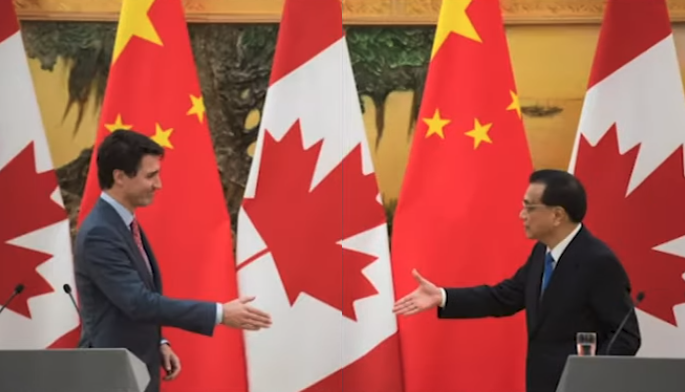
When the news broke late Friday afternoon that David Johnston was resigning from his position as special rapporteur on Chinese interference, the general reaction across the chattering class was a variable admixture of amusement and scorn. There’s probably a German word for it, but the security and intelligence expert Wesley Wark captured the tone of it with the headline on his Substack post, which said, simply: “Gong Show“.
We’re somewhat inclined to concur with Wark, except the three-ring train wreck that has marked Johnston’s time as Justin Trudeau’s moral merkin has been so disastrous that we think apologies are due to Chuck Barris, in light of the relative sobriety of his famous game show.
Reporters at the Globe and Mail and Global News started breaking stories about Chinese interference in Canadian elections a few months back, based largely on leaks from inside the Canadian intelligence apparatus. Almost immediately it was clear that the Liberals had a major problem on their hands, one that was going to require levels of transparency, good judgment and political even-handedness that this government has manifestly failed to achieve during its almost eight years in power.
Yet when Trudeau announced that he was going to appoint an “eminent Canadian” as “special rapporteur” to do an investigation and report back to the government with recommendations for how it should tackle the issue, we gave a collective groan here at The Line. Given the endless similar tasking of retired Supremes passim, it was clear that the pool from which Trudeau was going to fish his eminent personage was very shallow, and pretty well-drained. Indeed, at least one of us here was willing to bet large sums that it would be David Johnston.
What do we make of all this? Here’s the situation as we see it, in bullet form for brevity’s sake:
- Johnston should never have been offered the position of special rapporteur
- Having been offered the job of special rapporteur, Johnston should never have accepted it
And that is basically it. But given that Trudeau had the poor judgment to ask him, and Johnston had the poor judgment to accept, we think everything that has happened since was pretty much inevitable. We couldn’t have guessed at all the details of how this would have played out, especially the delicious elements beginning with the decision to hire Navigator to provide strategic advice (to manage what, exactly?), the revelation that Navigator had also provided strategic advice to Han Dong (who, recall, Johnston more or less exonerated), the firing of Navigator and the involvement of Don Guy and Brian Topp … this is really just gongs piled upon gongs piled upon gongs.
But the overall trajectory of Johnston’s time as special rapporteur? If you had told us ahead of time that this was more or less how things would go, we wouldn’t have been much surprised. Why? Because we live in Canada. And this is how Canada’s governing class behaves. It is a small, incestuous, highly conflicted and enormously self-satisfied group of people that is so isolated from the rest of the country they don’t even realize how isolated they are.
Honestly. What in heaven’s name gave Trudeau the idea that it would be smart to ask a former governor general to help launder his government’s reputation? And why on Earth did Johnston think it was a good idea to accept? Forget the Navigator stuff, this turkey was never going to fly. Johnston’s report was not accepted as the wise counsel of a wise man; instead it was seen as a partisan favour by a conflicted confidant. Sure, Johnston was subject to some pretty unfair attacks from the opposition, but what did he think was going to happen? Has he paid any attention over the last decade? But pride is a form of stubborness, and even after parliament voted for him to go, Johnston insisted he would stay on to finish his work. Until, on Friday afternoon, he decided he would not.
We’re not going to speculate about why Johnston finally pulled the chute. We’d like to think that the former GG in him thought it best to obey the will of the House of Commons. We rather hope it had nothing to do with some pointed (and unanswered) questions put to Johnston’s office by the Globe and Mail, asking whether Navigator had been given a heads-up on Johnston’s conclusions on the Dong file.
Maybe it doesn’t matter. As Paul Wells put it in a recent column, Trudeau sought to “outsource his credibility by subcontracting his judgment,” where credibility was supposed to flow from Johnston to Trudeau. Instead, and we would say, inevitably, the flow went in the opposite direction. If the prime minister had any credibility to lead the country on this issue, he wouldn’t need a special rapporteur in the first place. The fact that Trudeau felt the need to appoint one is a tacit admission that he knows he doesn’t have the trust of the people.
And that is the real problem here. The Johnston saga has ended where it was always going to, with a once-honorable man’s reputation in tatters and the problem he was brought in to address still unresolved. David Johnston has resigned, as he must have. In our view, that’s one resignation too few.
Comments Off on It’s an insult to Chuck Barris and The Gong Show to compare it to the Justin Trudeau Show
“The more recent four or five years at Indigo have been a disastrophe”
In the latest SHuSH newsletter, Ken Whyte outlines the rise and fall of Canada’s biggest bookstore chain that stopped trying to be a bookstore chain and now appears to be looking for a new identity to assume in the wake of several board resignations and the announced resignation of Heather Reisman, the founder and public face of the chain:

“Indigo Books and Music” by Open Grid Scheduler / Grid Engine is licensed under CC0 1.0

Indigo opened its first bookstore in Burlington in 1997 and quickly expanded across the country in competition with the Chapters chain, which it bought in 2001. Heather’s husband, Gerry Schwartz, provided much of the financing in these years. Gerry is the controlling shareholder of Onex, a private equity firm that now has about $50 billion in assets under management.
Influential in Ottawa, the Schwartz-Reismans managed to convince the federal government to approve Indigo’s purchase of Chapters and also keep the US book chain Borders from moving north into Canada — a double play that cleared the field of meaningful competition and wouldn’t have happened in a country with serious antitrust enforcement.
Heather, as Indigo CEO, cast herself as the queen of Canadian literature, making personal selections of books to her customers, hosting book launches, interviewing celebrity authors, etc.
From a financial perspective, Indigo took about five years to get rolling after the Chapters acquisition. It looked steady through the late aughts and into the teens when Amazon showed up in force. Indigo’s share price caved. Unable to convince Ottawa to push Amazon back across the border, Heather adopted a new strategy, backing out of books and recasting Indigo as a general merchandiser selling cheeseboards, candles, blankets, and a lot of other crap to thirtyish women. “We built a wonderful connection with our customers in the book business,” she famously said. “Then, organically, certain products became less relevant and others were opportunities.” This charmed investors, if not the book community, and Indigo’s share price hit a high of $20 a share in 2018. By then, books, as a share of revenue, had fallen from 80 percent of revenue to below 60 percent (they are now 46 percent).
The more recent four or five years at Indigo have been a disastrophe. With its eighty-eight superstores and eighty-five small-format stores, the company lost $37 million in 2019, $185 million in 2020, and $57 million in 2021. Things looked somewhat better in 2022 with a $3 million profit, but its first three quarters of 2023 (Indigo has a March 28 year-end) resulted in an $8 million loss and its fourth quarter featured one of the most spectacular cyberhacks in Canadian commercial history. The company’s website was breached and its employment records held for ransom, resulting in a ten-day blackout for all of the company’s payment systems and a month-long outage in online sales. The share price is now $2.00 or one tenth the 2018 high.
ANALYSIS AND IRRESPONSIBLE SPECULATION
Given everything Indigo has been through over the last several years, and especially the last several months, it’s not surprising that Heather wants to pack it in. She’s seventy-four and super wealthy. There’s nothing but a desperately hard slog ahead for her money-losing company. Why stay?
Still, this has the feel of something that blew up at a board meeting, or in advance of a board meeting. It’s highly irregular for a company to lose almost half its directors in a single day. If these changes had been approached in conventional fashion, there would have been more in the way of messaging and positioning, especially regarding Heather. For all intents and purposes, she is Indigo. It wouldn’t exist without her. They ought to be throwing her a retirement parade and presenting her with a golden cheeseboard. Instead, all she’s getting, for now, are a few cliches in a terse press release.
It’s also weird that this all happened days before we get the company’s year-end results (they were out by this time last year). My guess is that the board got a preview, that the picture is ugly, that there are big changes afoot, and that the directors were nudged out as the start of a major retrenchment or given the option of sticking around for a bloodbath and chose instead to exit.
Comments Off on “The more recent four or five years at Indigo have been a disastrophe”
June 11, 2023
The Invasion of Normandy begins! – WW2 – Week 250 – June 10, 1944
World War Two
Published 10 Jun 2023The Allies’ gigantic amphibious invasion of France begins and by the end of the week they’ve carved out a decent-sized beachhead. Meanwhile in Italy the Allied advance takes Rome. The Soviets are launching new attacks of their own — now against the Finns, and the Japanese at Kohima … have just plain had enough.
(more…)
Comments Off on The Invasion of Normandy begins! – WW2 – Week 250 – June 10, 1944
June 10, 2023
Remember the Freedom Convoy of 2022?
The media worked very hard to demonize the grassroots protests that coalesced into the Canadian Freedom Convoy in early 2022, and they’ve continued to push the notion that either the movement was an utter failure or that it was a maple-flavoured January 6 “insurrection” righteously suppressed by our beloved Dear Leader and his stormtroops. Someone using the handle “Kulak” wants to remind you that the convoy wasn’t a failure and in fact was the catalyst for great changes both in Canada and around the world:

A screenshot from a YouTube video showing the protest in front of Parliament in Ottawa on 30 January, 2022.
Photo via Wikimedia Commons.
I keep encountering this misconception from people who don’t follow Canadian politics …
That somehow the Trucker convoy was defeated.
The Freedom Convoy was the most wildly immediately successful protest in Canadian history, maybe WORLD history.
People remember Trudeau’s crackdown, old ladies having their skulls cracked with batons, Disabled indigenous grandmothers trampled by police horses, Bank accounts frozen and public employees investigated for mere donations …
And there’s a big reason people remember this … It was dramatic, and the media and the regime certainly wanted you to think resistance was futile …
What people don’t remember is what happened in the immediate aftermath: The government caved on absolutely everything within a week for the most important things, and then a month or so for the rest.
First off there was the massive political shift that happened as the convoy was occurring:
Jason Kenny, the pro-lockdown Premiere of Alberta (Canada’s most conservative province) was forced to announce his resignation, and Alberta immediately lifted all its lockdown impositions.
Erin O’Toole the pro-lockdown leader of the Conservative Party was likewise forced to resign, his temporary replacement Candice Bergen (not to be mistaken with the actress) being a longtime rival opposed to lockdowns, and his main rival who replaced her after intra-party elections was Pierre Poilievre, the politician after Maxime Bernier who was quickest to embrace the Truckers and their cry for freedom.
As the convoy was ongoing Trudeau invoked the Emergencies Act (the Act which replaced the War Measures Act for invoking Martial Law) … Now these grant the government almost unlimited powers, famously the War Measures Act was invoked by Trudeau’s Father to detain Quebeckers and raid hundreds of homes without warrants during the FLQ separatist crisis of 1972 … the catch is that while the follow on Emergencies Act can be invoked by a Prime Minister Parliament has to sign off on the act’s continued use within one week.
Well skulls were cracked, accounts frozen, and as the week passed things came down to the deadline … On the very last night … Trudeau managed to get sign-off (without the Conservative opposition) from the House of Commons, but it had to go to the Upper House, the Canadian Senate.
NOW. The Canadian Senate is a shameful institution.
It’s like the British House of Lords but without the nobility.
A Senate seat is a lifetime appointment, by the Prime Minister … and that’s it. Little to no review, no democratic input, and this is supposed to be equivalent or superior to our elected House of Commons …
Naturally the go-to use of the Senate is as a spoils system for cronies. Do some shameful favour for a Prime Minister, raise a lot of money for the party, be politically connected to a provincial gov the PM wants to buy off … get a Senate seat.
One of the longest-standing political agreements in Canada is how badly the Senate needs to be abolished … but can’t be because Quebec is nominally overrepresented in the Senate, and abolishing it would cause a constitutional crisis.
H/T to Donna Laframboise for the link.
Comments Off on Remember the Freedom Convoy of 2022?


