
World War Two
Published 15 Jul 2023Japanese troops and civilians commit mass suicide rather than surrender to the Americans in the Marianas; in Normandy, Caen has finally fallen to the Allies though the fight for St. Lo is not over; the Soviet offensives in the north take Vilnius and the fighting continues up in Finland, but the big eastern front news is the mighty new Soviet offensive in Western Ukraine. (more…)
July 16, 2023
Mass Suicide on Saipan – WW2 – Week 255 – July 15, 1944
Comments Off on Mass Suicide on Saipan – WW2 – Week 255 – July 15, 1944
July 11, 2023
QotD: The Calgary Stampede
… there are those in Calgary who, in their most secret of hearts, would love to abolish the Stampede and wipe out its memory. The Stampede, to the Calgarian, is both curse and blessing, and when all the curses are thrown into the balance, you cannot help being impressed by their weight. For starters, the Stampede kills. And we’re not just talking about the chuckwagon races. There’s a scholarly paper from 2006 in which statisticians from Montreal and Edmonton wrote about their efforts to develop forecasting models for EMS demand in Calgary. They found the numbers don’t quite work unless the Stampede is included as a variable: ambulance and rescue services become so busy during the 10-day party that it throws all the equations off-kilter.
The Stampede itself is very solvent, earning an operating surplus of $3.1 million in 2011, but if the costs and benefits to the city were all counted up, the former would have to include the salaries of the thousands of high-paid Calgary professionals who see major parts of their calendar devoured by Stampede preparations and aftermath. It would include the tacit outright cancellation of nine-to-five work for the duration of the Stampede at key Calgary oil patch companies and law firms. And it would include the arms race of conspicuous consumption that sees expensive entertainers like Cirque du Soleil and the Tragically Hip brought into town for exclusive corporate affairs at Stampede time.
Meanwhile, the perceived importance of the Stampede has led to the entrenchment of a shadowy, at least slightly sinister relationship between the city’s government and the Stampede board. It took a long skein of bailouts, sweetheart deals and low-interest loans from Calgary’s city government to make the show what it is today. Over the decades, Calgary has repeatedly used its power to borrow cheaply to fund Stampede expansions, and even expropriated land outright in the Victoria Park neighbourhood in the late 1960s when some homeowners were reluctant to sell. Because the city technically owns the Stampede grounds, the Stampede pays no property tax on them. Conflicts of interest are rampant and ignored, except on those occasions when the Stampede tries to pull off some particularly ambitious business or real estate deal. Local media know they must tread carefully before broadcasting or printing anything even slightly negative about the various entities that sustain the city’s totemistic event.
Of course the Stampede has made the name of Calgary world-famous. Calgarians abroad are as sure to be asked about their Stampede as Edmontonians are to be asked about their big mall. But the marketing effect is double-edged. Andy Sayers, a communications specialist for a mid-sized Calgary oil-patch-service company, says he and others in his field “struggle with themselves” every year as the bacchanal he compares to “the last days of Rome” approaches. “I spend most of my time trying to inculcate the image of our firm as ultra-modern thought leaders”, he says. “Then I have to create the invitations to our Stampede event. It’s tricky to wrap yourself in the blanket of the Stampede — to offer a down-home feeling to visitors without making yourselves look small-time.”
Colby Cosh, “The Calgary Stampede at 100: It may be over-the-top and at times dangerous, but Calgary’s Wild West show is the best party in Canada”, Maclean’s, 2012-07-06.
Comments Off on QotD: The Calgary Stampede
July 10, 2023
Echoes of War: Accounts of Operation Husky and the Allied Landings in Sicily
OTD Military History
Published 9 Jul 2023On July 9/10 Allied forces launched Operation Husky, the invasion of Sicily. This video presents accounts from various Allied military personnel who were there that day.
(more…)
Comments Off on Echoes of War: Accounts of Operation Husky and the Allied Landings in Sicily
Barbara Kay – “[M]any Canadians [suffer] from highly contagious, patriotism-suppressive Post National Syndrome”
Canadians are deluged with messages that imply — or explicitly demand — that they should be ashamed of Canada and of being Canadians. That there is nothing to celebrate in our history or cultural achievements and instead we should humbly beseech forgiveness for our many, many, many sins. Barbara Kay disagrees:

On Canada Day, near St. Sauveur, Quebec, we were treated to torrential rain, hail, nearby tornado warnings, and continually flickering power. Not a day for fireworks. Just as well, since fireworks are the last thing one craves when one suffers, as many Canadians do, from highly contagious, patriotism-suppressive Post Nationalism Syndrome.
This scourge cannot yet be cured, since it was intentionally cultivated and released into the environment by the current government. Only herd immunity can end it. However, the symptoms of Post Nationalism Syndrome can be alleviated by certain traditional antivirals, like National Postism. Last Saturday’s NP featured several commentaries that buoyed my spirits, in particular Michael Higgins’s misery-loves-company column, “Stop shaming and start celebrating Canada”.
Higgins enumerates recent examples from a tiresome litany of complaints by our elites that “want to turn us into a nation of self-flagellating penitents”. The National Gallery of Canada insinuates that Canada’s iconic artists, the Group of Seven, are linked to white supremacy; a parliamentary motion endorses the residential school system as “genocide”; the attorney general actively considers legal sanctions against “denialism” — dissent from genocide as a proper descriptor (including me); and the erasure of Sir John A. Macdonald’s name from the eponymous Parkway.
In a nearby feature, the false claim that Macdonald was a guilty party in the alleged schools genocide was handily demolished by lawyer Greg Piasetzki, titled, “John A. Macdonald saved more indigenous lives than any other prime minister”. This evidence-based rejoinder to sticky defamatory myths about Macdonald is an excerpt from a new book of essays by 20 writers, The 1867 Project: Why Canada Should be Cherished — Not Cancelled, published by the Aristotle Foundation, and edited by its founder and president, Mark Milke.
Piasetzki’s essay mirrors the 19 others in its forthright challenge of our culture’s reigning anti-western dogmas, which brand Canada as a failed nation. Every author encourages the pride in being Canadian that has not dared to speak its name since Justin Trudeau came to power. I highly recommend it. If enough Canadians read it, we might arrive at herd immunity to Post Nationalism Syndrome.
Comments Off on Barbara Kay – “[M]any Canadians [suffer] from highly contagious, patriotism-suppressive Post National Syndrome”
July 9, 2023
The Destruction of Army Group Center – Week 254 – July 8, 1944
World War Two
Published 8 Jul 2023Operation Bagration continues, smashing the armies of German Army Group Center and taking ever more territory including the prize of Minsk; on Saipan the Americans have taken most of the island when the Japanese resort to a huge suicidal banzai charge to try and turn the tide; and in Normandy new attacks begin try to finally take Caen and St. Lo.
(more…)
Comments Off on The Destruction of Army Group Center – Week 254 – July 8, 1944
Grain Elevator
NFB
Published 30 Sept 2015This documentary short is a visual portrait of “Prairie Sentinels”, the vertical grain elevators that once dotted the Canadian Prairies. Surveying an old diesel elevator’s day-to-day operations, this film is a simple, honest vignette on the distinctive wooden structures that would eventually become a symbol of the Prairie provinces.
(more…)
Comments Off on Grain Elevator
July 8, 2023
Canada’s Nuclear-Armed Cold War Interceptor: the story of the McDonnell CF-101 Voodoo
Polyus
Published 14 Aug 2020When Soviet or unidentified aircraft approached Canadian airspace in the 1960s and 70s, they were met by an iconic cold war interceptor. Armed with both conventional and nuclear weapons, they were a formidable foe in their day. It served to support NORAD and protect the Northern approaches into the North American heartland during the height of the Cold War. Although it was neither designed nor built in Canada, the reliable Voodoo remains a Canadian Cold War icon and was well loved by its ground crews and pilots.
0:00 Introduction
0:29 McDonnell F-101A development
1:06 F-101B Interceptor
3:11 Canada becomes involved with the Voodoo
4:15 The Nuclear question
5:08 Comparison with contemporaries
5:36 Operational History
8:04 Legacy and Retirement
8:48 Conclusion
(more…)
Comments Off on Canada’s Nuclear-Armed Cold War Interceptor: the story of the McDonnell CF-101 Voodoo
July 7, 2023
Justin Trudeau says that Canada is merely defending itself from the “attack” by Facebook
Prime Minister Justin Trudeau has never faced a situation he couldn’t get histrionic about:
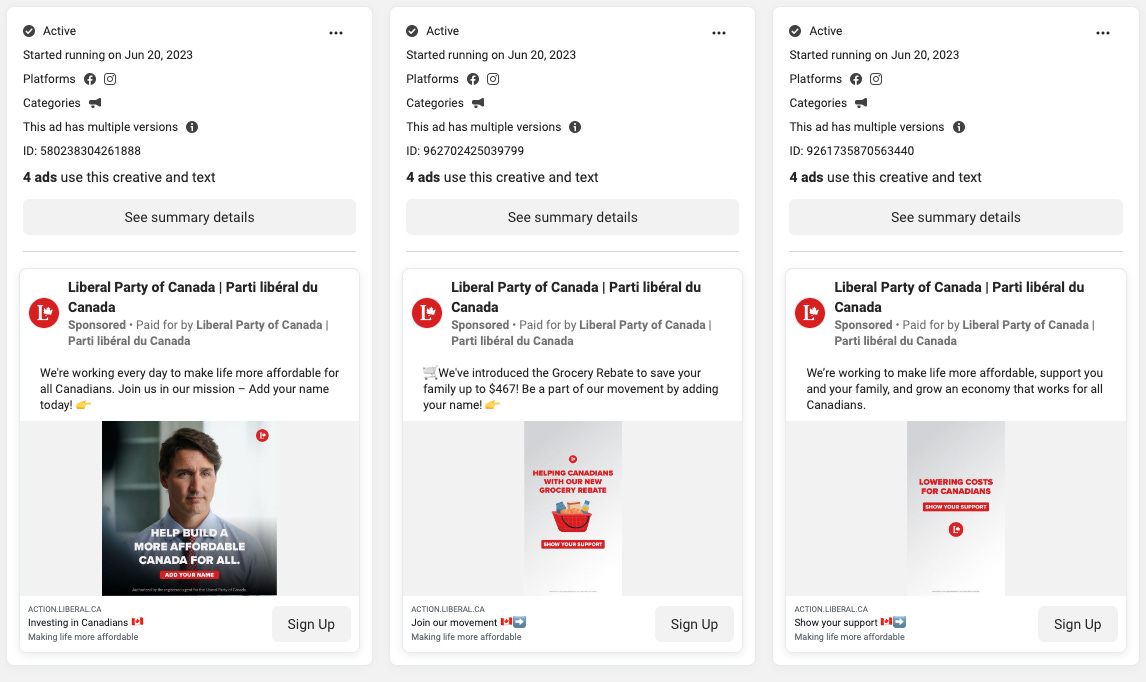
The government escalated the battle over Bill C-18 yesterday, announcing that it was suspending advertising on Meta’s Facebook and Instagram platforms due the company’s decision to comply with the bill by blocking news sharing and its reluctance to engage in further negotiations on the issue. While the ad ban applies to federal government advertising, Liberal party officials confirmed they plan to continue political advertising on the social networks, suggesting that principled opposition ends when there might be a political cost involved. At issue is roughly $11 million in annual advertising by the federal government, a sum that pales in comparison to the Parliamentary Budget Officer’s estimate of at least $100 million in payments in Canada for news links from Meta alone.
In addition to raising the economic cost to Meta for stopping news sharing, Prime Minister Justin Trudeau increased the rhetoric, describing Canada as having been “attacked” by Meta and likening the government’s fight over the bill to defending democracy in Ukraine or during the Second World War [at 13:30]:
Facebook decided that Canada was a small country, small enough that they could reject our asks. They made the wrong choice by deciding to attack Canada. We want to defend democracy. This is what we’re doing across the world, such as supporting Ukraine. This is what we did during the Second World War. This is what we’re doing every single day in the United Nations.
There are strongly held views on both sides of the Bill C-18 debate, but the suggestion that stopping sharing news links on a social network is in any way comparable to World War 2 is embarrassingly hyperbolic and gives the sense of a government that has lost perspective on the issue. Canadian Heritage Minister Pablo Rodriguez has repeatedly described the manner of compliance with Bill C-18 as a business choice for the Internet companies, yet the Prime Minister now calls that choice an attack on the country.
If it were truly comparable to a world war, then surely the Liberal Party (joined by the NDP) would not continue to advertise on the platform. Yet since the 2021 election call, the party alone has run approximately 11,000 ads on Facebook and Instagram. That is separate from individual MPs, who have also run hundreds of ads. The Meta Ad Library provides ample evidence of how reliant the party has been on social media. For example, since the start of the year, Anna Gainey ran over 500 ads as part of her by-election campaign in Quebec. David Hilderley, who was a candidate in the Oxford by-election, ran approximately 180 ads on Facebook during the same timeframe.
Comments Off on Justin Trudeau says that Canada is merely defending itself from the “attack” by Facebook
July 6, 2023
“Too many complaints? That’s racism. Too few complaints? Well, that’s racism, too.”
Amy Eileen Hamm reports on how the British Columbia College of Nurses and Midwives (BCCNM) acted on its concern that not enough complaints against their members were being lodged by First Nations people:
As regular readers of Quillette will know, many Canadian institutions have fervently adopted the cause of “decolonization” — a vaguely defined term that one university describes as the dismantling of “assumed Euro-western disciplinary constructs and traditions”. This can mean anything from abolishing musical scales (which “perpetuate and solidify the hegemony of [the] Euro-American repertoire”); to reimagining our scientific understanding of sunlight, so as to correct “the reproduction of colonialism” that has infected “physics and higher physics education”; to assailing the gender binary through a “decolonizing act of resistance”.
That’s the theory, anyway. In practice, institutional efforts at “decolonization” generally translate into affirmative-action hiring programs and policies to mandate symbolic (generally empty) gestures such as land acknowledgements. They’ve also created a cash cow for “specialist” administrators and third-party consultants in what is now known as the “equity, diversity, inclusion, and decolonization” sector. The premise is that decolonization is so difficult and complex that it can only be overseen by said (highly paid) professionals.
My own professional sector, nursing, provides a useful case study. In British Columbia, where I live and work, nurses are licenced by the British Columbia College of Nurses & Midwives (BCCNM), whose offices are located “on unceded Coast Salish territory, represented today by the Musquea?m, Squamish and Tsleil-Waututh Nations.” In other words, Vancouver.
If a patient feels that he or she has experienced “incompetent, unethical, or impaired nursing or midwifery practice”, he or she can complain to the BCCNM through its complaints portal. It’s not a complicated process. You send an email describing what the nurse allegedly did, when the incident occurred, and whether there were any witnesses. If you’ve already complained to someone else, you’re supposed to note that as well, along with your suggestions for resolving the complaint. That’s it.
But apparently, this process is just too onerous — and even dangerous — for Indigenous people. And so the BCCNM has paid C$97,000 to a self-described “boutique business process management firm” called Novatone, which has duly produced a lengthy report on how to “make the BCCNM complaints process safer for Indigenous Peoples.” The same title — mantra might be a better word — appears at the top of all 50 pages: Looking Back to Look Forward: How Indigenous ways of being, knowing, and doing must inform the BCCNM feedback process and reflect the principles of cultural safety, cultural humility, and anti-racism.
(For the benefit of those outside Canada, the mystical-sounding phrase, “ways of knowing”, along with its “being” and “doing” variants, has now entered the official idiom as a means to signify the unfalsifiable shaman-like intuitions that supposedly guide the consciousness of Indigenous people throughout every facet of their existence — including, apparently, complaining about the care they receive from nurses.)

Juxtaposed images from the Novatone report, Looking Back to Look Forward, contrast the “colonial, western, linear” nature of existing BCCNM processes with a “wholistic, relational, culturally informed process” that would supposedly align with Indigenous values.
Comments Off on “Too many complaints? That’s racism. Too few complaints? Well, that’s racism, too.”
July 4, 2023
Buster Keaton Rides Again (1965)
NFB
Published 15 Jun 2015In this film Keaton rides across Canada on a railway scooter and, between times, rests in a specially appointed passenger coach where he and Mrs. Keaton lived during their Canadian film assignment. This film is about how Buster Keaton made a Canadian travel film, The Railrodder. In this informal study the comedian regales the film crew with anecdotes of a lifetime in show business. Excerpts from his silent slapstick films are shown
Directed by John Spotton – 1965.
Comments Off on Buster Keaton Rides Again (1965)
It’s not “bullying” for corporations to act in their own (and their shareholders’) best interests
The weekly round-up from The Line editors wasn’t happy reading for fans of the Canadian mainstream media:
The Canadian government approached this as if it was “Big Tech” who were reaping all the rewards … when in fact it was the Canadian media companies getting most of the benefit from the arrangement. No wonder “Big Tech” chose to take their bat and ball and go home.
There are two major items up for consideration, and we’ll deal with each in turn. The first is a proposed merger between Postmedia and the Torstar/Metroland newspapers. The second, and most significant, news item, is that following on Meta/Facebook’s decision to stop featuring news on its feeds, Google is promising to drop the Google News Showcase feature, and to stop surfacing Canadian news links on its search feeds. All of this is in response to C-18, the Online News Act.
This law is trying to force Facebook and Google to compensate news organizations for the links that appear on their platforms; so the companies reacted in an entirely predictable way after the bill received Royal Assent last week — they announced they are going to absent themselves from the scope of the bill by no longer providing those links.
The government, its supporters, and many in the media itself reacted to this announcement with the same inane bluster that has come to dominate the conversation around this byzantine and poorly conceived bill. The Liberals promised to stand up to “Big Tech”; and the media organizations that pinned their survival on milking this new revenue stream are now accusing Google et al. of “bullying”. We at The Line don’t consider this rhetoric to be rational or in good faith. We are annoyed — we are horrified — by these companies’ decisions, but we understand them.
Both Facebook and Google made it clear that C-18 was untenable from a business point of view; they both warned that they would consider pulling news links in response. From Big Tech’s perspective, the decision-making tree is real simple here: does the revenue generated by news outweigh the potential uncapped financial liability that C-18 would present? Further, would complying with C-18 in Canada present a greater risk to the company globally if the bill were replicated in larger media markets? Or are the companies better off to withdraw from a low-priority market pour encourager les autres. We can scream about the evils of Big Tech all we want, but ultimately, these are just math conversations.
No one ought to be surprised that the math didn’t go our way. But almost everyone was. Because — and there’s no nice way to say this — this country’s media industry is both painfully parochial and embarrassingly self-important. For people whose job it is to understand and explain the world to Canadians, it often astonishes us at how incompetent we are at understanding and explaining that world to ourselves. Canadian journalists have an unshakeable faith in our vocation; we genuinely believe that our work is a vital service to democracy. Therefore the fruits of that labour — the news content — must be valuable to the digital platforms that we now depend upon to distribute it. This is why many in the industry were so unshakeably convinced that Facebook and Google were bluffing during the course of C-18. Incredibly, many seem to remain convinced that Big Tech will capitulate to their demands for capital, even now. To quote this old gem: “It is difficult to get a man to understand something, when his salary depends on his not understanding it”.
The flaw in this reasoning ought to be apparent, yet the industry lacks the digital savvy to understand the risk it is courting. “What about Bing, amiright?” Denial and self-importance are now sucking Canadian journalism straight into the maw of an existential crisis. To lose Facebook is a major set back; to lose Google is death.
The thing our colleagues and peers need to come to terms with is that Canadian journalism just isn’t that important in the global scheme of things. Facebook and Google aren’t out to get us — they are indifferent to us. Canadian news comprises a small and un-lucrative segment of even Canadian traffic flows. And Canada is a mid-tier market, at best. Optics aside, global tech oligopolies simply don’t lose very much by cutting us off. Facebook and Google are in the business of advertising, not journalism. They share neither our self regard, nor our democratic mandate; as a result, there is no internally coherent reason for them to take losses in order to save our industry. We just don’t matter to them.
On her Substack, Tasha Kheiriddin doesn’t blame Google for the impending destruction of what’s left of mainstream Canadian media:
The funeral has begun. The pyres are lit; the mourners are weeping. RIP, Canadian media industry, we hardly knew ye. Between mergers, acquisitions, closures, and layoffs, you didn’t stand a chance. And then came Bill C-18.
The legislation, passed last week, compels internet behemoths Meta and Google to compensate Canadian news outlets in exchange for featuring links to their content. Bill C-18 is modeled on an Australian law that saw the two tech giants enter into financial arrangements with media outlets in that country. Here in Canada, the Parliamentary Budget Office estimates similar deals could produce annual revenues of $329 million, a juicy sum for the cash-strapped news business.
Instead, Meta and Google announced that they would no longer include Canadian news links. Rather than reap a profit, Canadian media companies now face the prospect of far fewer eyeballs on screens – and the decimation of their ad revenue. Meta also cut its funding to CN2i, the Coopérative nationale de l’information indépendante, which supports six print publications, including La Presse, further damaging media companies’ bottom line.
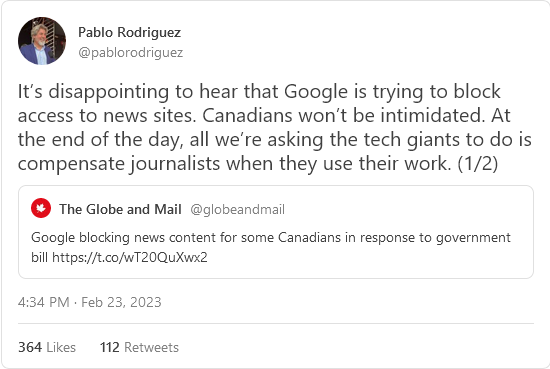
Cue the sound of “Taps” and political outrage. Heritage Minister Pablo Rodriguez had this to say:
Big tech would rather spend money to change their platforms to block Canadians from accessing good quality and local news instead of paying their fair share to news organizations … This shows how deeply irresponsible and out of touch they are, especially when they make billions of dollars off of Canadian users.
No, this shows how deeply out of touch the government is with the business model of these companies – and with internet technology in general.
Comments Off on It’s not “bullying” for corporations to act in their own (and their shareholders’) best interests
July 3, 2023
The Battle That Prevented A Nuclear World War Three | Kapyong: The Forgotten War | Timeline
Timeline – World History Documentaries
Published 2 Jul 2023On April 24, 1951, following a rout of the South Korean army, the Chinese People Volunteer Army pursued their enemy to the lines of Australian and Canadian troops still digging fall-back defences, 39 kilometres to the rear. Here, sometimes at the length of a bayonet, often in total darkness, individual was pitted against individual in a struggle between a superpower and a cluster of other nations from across the world. They fought for a valley, the ancient and traditional invasion route to Seoul. If it fell the southern capital and the war, was lost. The United Nations troops had the military advantage of the high ground and artillery support: the Chinese relied entirely on vastly superior numbers. As a result, young men from both sides found a battle which was very close and very personal.
The Battle of Kapyong became the turning point of China’s Fifth Offensive in that Korea spring. The aim of the offensive was to finally drive the foreign troops out of South Korea and into the sea. What happened instead, changed the history of the Korean War. The Chinese were denied victory and forced back into negotiations. Had they succeeded, another crushing defeat for the US could have triggered events that led to a nuclear holocaust in Asia — and World War Three.
(more…)
July 1, 2023
The Trudeau plan to eliminate Canada from the internet is going great!
Wait, you mean that wasn’t the plan? It must have been, if you judge the plan by the amazing results:

The damage caused by the government’s Bill C-18 continues to grow as Meta has started to cancel its existing agreements with Canadian publishers. The move should not as a surprise since any deals that involve facilitating access to news content would bring the company into the legislative framework and mandate payments for links. Indeed, Meta said earlier this week that its 18 existing deals “did not have much of a future“. When this is coupled with a reported “impasse” between the government and Google over its approach to Bill C-18, the risks to the Canadian media sector look increasingly dire.
This was entirely foreseeable, yet Canadian Heritage Minister Pablo Rodriguez never seemed to take the risks seriously. It raises the question of whether the government developed estimates of the cost of its legislation if Meta and Google chose to comply by stopping news sharing or linking. While there were estimates for the benefits of new deals that ran into the hundreds of millions of dollars, did it conduct a risk assessment of the economic costs that would come from Internet companies exiting the news market in Canada?
There are obviously costs that extend far beyond the economics that include reduced access to news, increased prominence of low quality news sources, harm to the Canadian Internet, and the reputational damage to a government that handled this about as incompetently as possible. But from a pure economic perspective, the risks were always understated as they extended beyond just the value of increased traffic to publishers from the links they were themselves posting. Both Google and Meta have deals with Canadian publishers reportedly worth millions of dollars. As Meta’s step to begin cancelling deals suggests, those agreements are unlikely to survive the decision to exit news in Canada.
And of course, Google doesn’t want to set any kind of precedent by accepting a shakedown from any two-bit hoodlum country like Canada:
The worst case scenario for Canadian Heritage Minister Pablo Rodriguez, the Canadian news sector, and the Canadian public has come to pass: Google has announced that it will block news links in Canada in response to the mandated payment for links approach established in Bill C-18. The decision, which the company says will be implemented before the law takes effect, will cover search, Google News, and Google Discover. The decision – which government seemingly tried to avoid with last minute discussions with Google executives after it became apparent that the risks of exit were real – will have lasting and enormously damaging consequences for Canadians and represents a remarkable own-goal by Rodriguez who has managed to take millions away from the news sector and left everyone in a far worse position than if he had done nothing at all.
If you’re in any way interested in Canadian government … machinations … when it comes to digital policy, you really should be following Michael Geist‘s reporting. He’s been doing a great job and deserves the support.
The Newfoundlanders at Beaumont-Hamel
Vlogging Through History
Published 12 Feb 2022Just after the explosion of the Hawthorn Ridge mine, the 29th Division assaulted German positions at Hawthorn Ridge and the Y Ravine outside the village of Beaumont-Hamel, suffering dreadful losses. No unit suffered more in that attack than the Newfoundland Regiment, part of the third wave that morning. Join me as we visit the Beaumont-Hamel Newfoundland Memorial.
(more…)
Comments Off on The Newfoundlanders at Beaumont-Hamel
June 28, 2023
How to Fund a War: Lend Lease, Billion Dollar Gift, and Aid to Britain
OTD Military History
Published 27 Jun 2023Programs like Lend Lease, Mutual Aid, and the Billion Dollar Gift were support from Canada and the United States that helped Britain with war supplies and material in the darkest days of World War 2.
(more…)
Comments Off on How to Fund a War: Lend Lease, Billion Dollar Gift, and Aid to Britain


