
Fascinating Horror
Published Feb 23, 2021“On the 6th of December 1917 two ships collided in the mouth of Halifax Harbour in Nova Scotia, Canada …”
► Suggestions: hello@fascinatinghorror.co.uk
MUSIC:
► “Glass Pond” by Public Memory#Documentary #History #TrueStories
December 6, 2024
The Halifax Explosion | A Short Documentary | Fascinating Horror
Comments Off on The Halifax Explosion | A Short Documentary | Fascinating Horror
December 5, 2024
Mélanie Joly in Halifax, demonstrated her belief that “communication” is much more important than “action”
In The Line, Matt Gurney continues his report from the recent Halifax International Security Forum, where the Trudeau government’s representatives were Foreign Affairs Minister Mélanie Joly and Bill Blair, the Minister of National Defence:

Whoo boy. Mélanie Joly has got to go. Now. Today, if possible. Because we’ve got problems enough without, uh, well … maybe I should just explain what happened.
Joly is, of course, our foreign affairs minister. She and Bill Blair, the national defence minister, constituted the “star power” the Trudeau government sent to the Halifax International Security Forum, which I attended late last month. Joly would have, no doubt, taken part in many direct meetings with allied counterparts and various stakeholders behind closed doors during the three-day event. I can’t tell you what happened there. I can tell you, though, what happened during her public, on the record appearances. One of them in particular. And I can tell you what happened after it.
It wasn’t good.
I covered a bit of the basics about the Forum itself — what it is, who funds it, who shows up — in my last column about this year’s event, so I’ll skip the recap this time. Except for this: the event schedule is divided up into on-the-record panel discussions, off-the-record sessions (generally, those are the more interesting ones), and just lots of slack time for networking and gabbing over coffee and routinely excellent food. Joly took part in two of the on-the-record sessions. In one, she gave introductory remarks. They were about what you’d expect. The other time, she was a panelist. And that’s the one where things went wrong for Joly.
Joly was on a panel titled “Era of Unity: Victory for Ukraine”, moderated by Russian political dissident and chess grandmaster (uh oh) Garry Kasparov. Kasparov can be an aggressive moderator, and he and Joly sparred about the value of the United Nations. (I’m more of Kasparov’s view on the value of the UN, to put it mildly, but Joly more or less held her own under his questioning.) Kasparov followed up with a question about tangible support by Canada for Ukraine. He set it up as a hypothetical — he alluded to the recent re-election of Donald Trump, and noted that there are many who’d be happy to sell out Ukraine to secure some kind of peace with Russia. “Will Canada step in … will Canada play a bigger role? Canada is an important country, as you said,” Kasparov put to Joly. “When you have free time from diplomatic victories at the United Nations,” he asked, a bit mockingly, “can you help Ukraine win?”
Oh dear, I thought. This could be bad.
And it was. And then it got worse.
To Kasparov’s specific question — would Canada help Ukraine win? Would Canada step up and do more? — Joly replied at length about how much she believes in defence. And collaboration. And working together with allies. And why we need an Arctic strategy. And the value of deterrence. And the need for a stronger security architecture in the Indo-Pacific. And then some stuff about North Korean missiles. And then a nice bit about Canada’s long friendship with Ukraine. And how Canada, even though we’re smaller than the U.S., will always advocate for Ukraine at the NATO table.
I haven’t quoted directly from what the minister said. I am conscious about not wanting this entire column to become long quotes. You can see the entire exchange between Kasparov and Joly here, starting at around the 37 minute mark. What I can tell you as someone who watched it in person was that there was a real vibe shift — see, I can talk about vibes, too! — in the room as Joly spoke. Kasparov had asked a straightforward question and he’d gotten an answer that seemed as if Joly was envisioning a globe in her head, and spinning it, and just commenting on everything that came to mind as a different region came into view. Oh! There’s the Indian Ocean! Say something about the Indo-Pacific!
It was bad. Everyone in the room knew it was bad, with the possible exception of Joly.
But Joly hadn’t hit bottom yet.
Comments Off on Mélanie Joly in Halifax, demonstrated her belief that “communication” is much more important than “action”
Ontario’s housing market squeezed by the 35.6% combined tax rate on new builds
The housing situation in Toronto and the rest of the province has been very tight for years. Lots of would-be buyers chasing the proportionally smaller number of new houses being built. This drives prices higher, but no matter how much of the final price is the builder’s profit margin, the government gets nearly four times as much on every new house sale:
The National Post previously reported that at least a third of a new home’s sticker price in Ontario was comprised of taxes, but an updated report, courtesy of the Canadian Centre for Economic Analysis (CANCEA), now puts the figure at 35.6 per cent.
(It gets even better when it comes to affordable housing — but more on that later.)
The Increasing Tax Burden on New Ontario Homes: 2024, which was commissioned by the Residential Construction Council of Ontario and released by CANCEA on Tuesday, is eye-opening for reasons beyond the fact that a compendium of largely superfluous taxes and production levies has reached 35.1 per cent of the final purchase price of a new home in the city of Toronto. It’s 35.5 per cent in the outlying 905 region, and 34.5 per cent in Ottawa.
The report needed only 16 pages to elucidate how bureaucratic machinations aren’t just gouging prospective homebuyers, but homeowners, too — especially the estimated 1.2 million whose mortgages, according to the Canada Mortgage and Housing Corporation, are due for renewal in 2025.
Read closely enough, CANCEA’s report makes a strong argument that, effectively, Canadians work for the government rather the other way around.
For example, CANCEA’s report demonstrates that 70 per cent of aforesaid taxes on new homes “consist of direct fees on the home, such as DC (development charges) and other fees”.
“For homes priced at $450,000,” which aligns with median income, “… the tax burden rises sharply to 45.2 per cent,” says the report, which also notes that economics often force developers to build smaller units that are insufficient for families.
Comments Off on Ontario’s housing market squeezed by the 35.6% combined tax rate on new builds
December 3, 2024
“Granting more sovereign rights to others surprisingly means that these groups will pursue their own interests. Who could have seen this coming?”
In his weekend round-up, Niccolo Soldo pokes a bit of fun at Justin Trudeau’s federal government for apparently being surprised that First Nations are looking to deal directly with China for their natural resources, rather than through the feds:
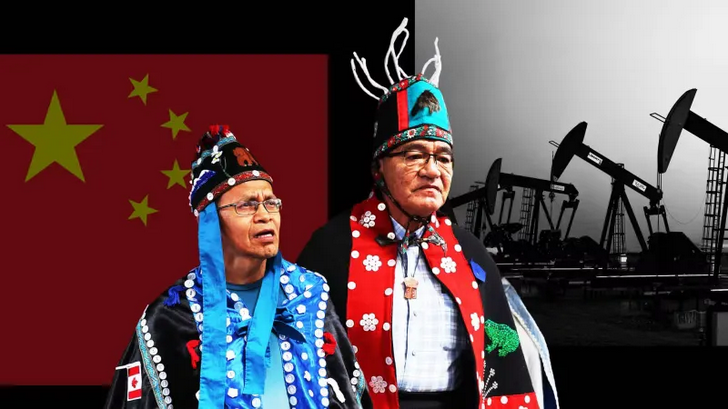
Canada continues to be unintentionally hilarious, all thanks to Prime Minister Justin Trudeau and his government.
The Great White North was forever a boring place politically, but the arrival of Trudeau Jr. on the scene shook things up. One of the first things that he and his government committed themselves to was to work to improve the country’s relations with its Native tribes, both politically and especially economically. The Trudeau government invented a genocide narrative based around residential schools.1 Canada too wanted a dark aspect to its own history, so that it could share in the self-flagellation that has coloured the recent history of its neighbour to its immediate south.
Maybe the intention here was to show these Native communities that Canada really, really did care and that by doing this, everything bad that had happened would be forgiven and forgotten? I dunno … what I do know is that Native bands are now seeking to directly do business with China, whereby they would sell natural resources under their control to Beijing:
Canada’s indigenous communities are seeking deals with China that could give Beijing access to the country’s natural resources, despite warnings from Canadian security services over doing business with Xi Jinping’s government.
This week the Canada China Business Council indigenous trade mission is in Beijing to discuss potential energy and other business deals in a trip that could put Canada’s national “reconciliation” with its First Nation communities at odds with its national security priorities.
Karen Ogen, the trade mission’s co-chair and chief executive of the First Nations Liquefied Natural Gas Alliance, said her goal on the trip, which starts on Wednesday, was to sell LNG for the benefit of the Wet’suwet’en communities in Canada’s western province of British Columbia.
“We’ve been oppressed and repressed by our own government,” she said. “I know the history with China is not good but we have an understanding of what we need and what they need.”
Canada purposely degraded its own national sovereignty in parts of its own country in the name of “reconciliation”. Granting more sovereign rights to others surprisingly means that these groups will pursue their own interests. Who could have seen this coming?
Clever Chinese:
China has spotted an opportunity in the sometimes fraught relations between Canada’s national and provincial governments and indigenous groups.
In 2021, shortly after Canada imposed sanctions on Beijing over the treatment of its Uyghur population, Chinese officials began to object to the “systemic violations of Indigenous people’s rights by the US, Canada and Australia” at the UN’s Human Rights Council.
“The PRC tries to undermine trust between Indigenous communities and Canada’s government by advancing a narrative that the PRC understands and empathises with the struggles of Indigenous communities stemming from colonialism and racism,” said a spokesperson for Canada’s security intelligence service.
A 2023 CSIS report accused China’s government of employing “grey zone, deceptive and clandestine means” to influence Canadian policymaking, including Indigenous communities.
“China knows how sensitive Indigenous reconciliation is to the Trudeau government,” said Phil Gurski, a former CSIS intelligence analyst.
A lot of these First Nations (Native bands) reside in the west of the country. Coincidentally, Canada’s third-largest city, Vancouver (located in Canada’s west), is roughly one-third Chinese in composition.
First Nations will continue to pursue these deals with the Chinese:
But CSIS remains concerned over Beijing’s possible access to resource-rich areas or geopolitically important waterways and regions such as the Arctic through First Nations groups.
“It not only undermines the government but is a way to potentially embarrass them on Canada’s past,” said Gurski.
But Matt Vickers, from Sechelt Nations land in Canada’s western province of British Columbia, who first visited China in the 1990s and is part of the CCBC delegation heading to Beijing this week, rejected the concerns of the security services.
“China now understands that for any major project to receive approval in Canada, you need First Nation consent, and not only consent but the First Nations require a majority equity play in those projects,” he said.
The CCBC is a bipartisan organisation consisting of Canada’s biggest companies, including Power Corp, which is the main sponsor of the Indigenous event.
This week’s trip marks the third time a group of Indigenous officials has travelled with the council to China in an effort to identify export markets, sources of capital and potential tourism projects.
“These missions have been developed in the spirit of reconciliation and collaboration, to help delegates better understand how China’s economy and economic development influences its desire for imports and investment opportunities,” said Sarah Kutulakos, executive director of the CCBC.
It gets even funnier:
Deteriorating relations between Ottawa and Beijing meant this year’s CCBC meeting would likely be “sombre”, said former Canadian ambassador to China Guy Saint-Jacques.
First Nations leaders should have “very limited expectations” from the trip. “I don’t expect big business coming out of it,” he said.
But Ogen, of the First Nations LNG Alliance, said she would put the controversy surrounding the trip to Beijing aside. “I … look at the global energy sector, China’s need for our gas, and how I can make the best deal for my people,” she said.
Trudeau scored an own-goal.
1. From wiki (because I am lazy): “The Canadian Indian residential school system was a network of boarding schools for Indigenous peoples. The network was funded by the Canadian government’s Department of Indian Affairs and administered by various Christian churches. The school system was created to isolate Indigenous children from the influence of their own culture and religion in order to assimilate them into the dominant Euro-Canadian culture.”

Comments Off on “Granting more sovereign rights to others surprisingly means that these groups will pursue their own interests. Who could have seen this coming?”
Canadian Armed Forces: Can the RCN Really Stop Russia and China in the Arctic?
Esprit de Corps Canadian Military Magazine
Published 2 Dec 2024Vice Admiral Angus Topshee recently told the National Post that the Canadian Navy is able to defend our Arctic waterways against China or Russia … without help from our allies (aka the US Navy). It is time to target just what the heck the Admiral is talking about!
Comments Off on Canadian Armed Forces: Can the RCN Really Stop Russia and China in the Arctic?
December 1, 2024
“Fellow Canadians, forget your dire financial plight … it’s only a ‘vibecession'”
Tristin Hopper imagines what Chrystia Freeland might be confiding to her diary after she blithely assured struggling Canadians that no, really, everything’s just fine and dandy and you’re being deceived by “bad vibes”:
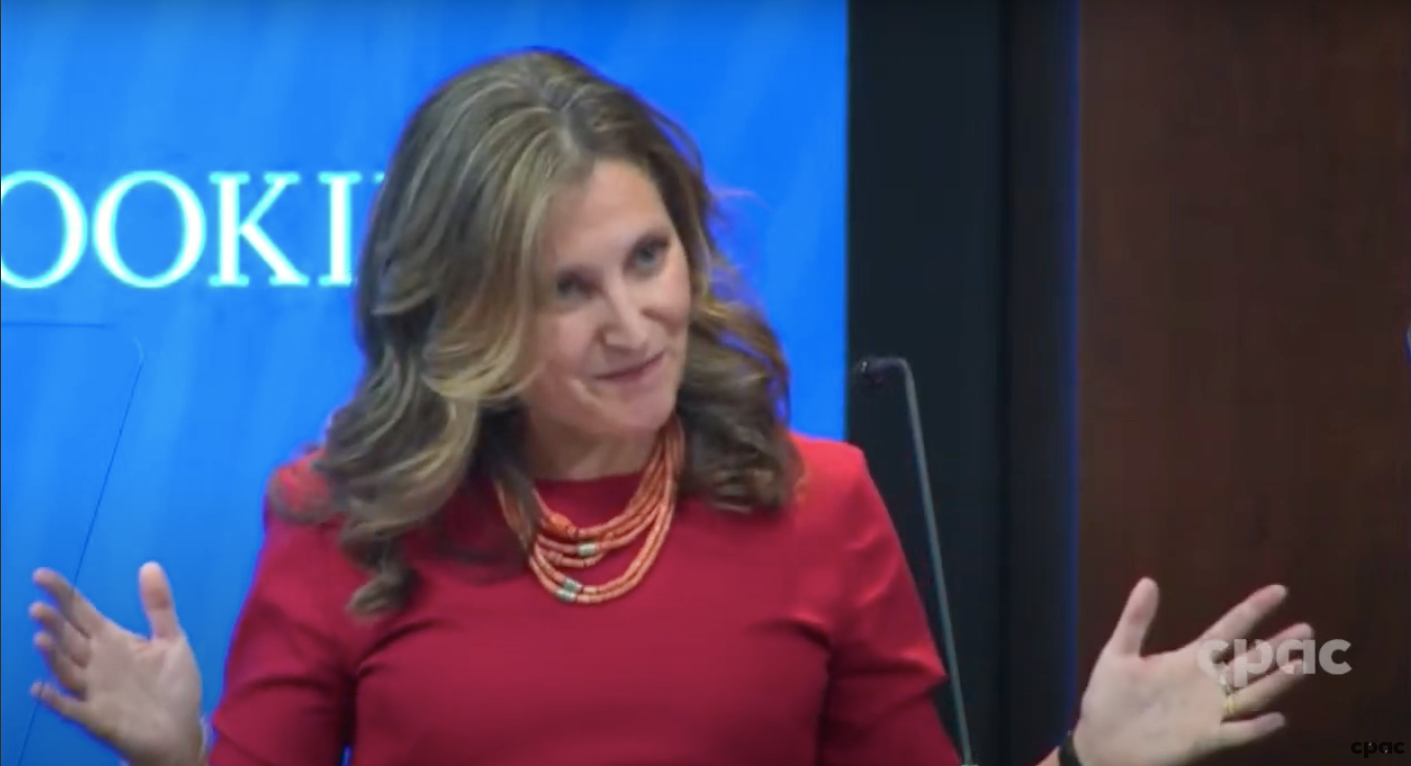
Screencap from a CPAC video of Chrystia Freeland speaking.
Monday
As a former journalist, I am fully aware of the awesome power of the press to distort and pervert reality. Here we all are in 2024 Canada. There is food. There is shelter. There is breathable air. The vast majority of us will go through the rest of the fiscal year without being stabbed on public transit.
And yet, to hear the misinformation and disinformation trafficked by the media, you would think we live in some kind of violent, economically depressed hellscape.
Well, this kind of mendacity has consequences: A nationwide hysteria of bad feelings and negative energy. A fanatical devotion to bad vibes in the face of all evidence to the contrary. I don’t purport to know how to cure such irrational malaise, but I will be very surprised if $250 each and some tax-free liquor and Christmas shopping doesn’t do it.
Tuesday
Donald Trump’s threat of 25 per cent tariffs is easily the most serious challenge I have faced as Canadian finance minister. The United States is our largest trading partner, and the suspension of free trade across our shared border would invite economic ruin the likes of which we’ve never seen.
Worse, Trump is immune to our usual strategies. We suggested sending his tariff threat to committee, or having it reviewed by a Crown inquiry, but neither offer was accepted. Rather, they want us to stem the tide of illegal migrants using Canada as a base to enter the United States. They are under the impression — let’s call it “bad vibes” — that this is a problem.
But let nobody say that the integrity of our trade flows are not my department’s top priority. As such, we are immediately introducing a one-time bursary of between $150 and $240 paid to any resident of Canada who can prove they have not attempted illegal entry of the United States within the past 12 months.
Comments Off on “Fellow Canadians, forget your dire financial plight … it’s only a ‘vibecession'”
November 30, 2024
It’s not just your imagination, the Canadian government is much bigger and much less efficient now
At The Audit, David Clinton shows that the Canadian federal government has gone through significant growth in staff at the same time as just about everything it does is now being done slower and less effectively1 than it was ten or twenty years ago:

Change is normal. The world around us isn’t sitting still and that’s got to have an impact on what’s needed by Canada and Canadians. So we can expect a government’s size and shape to evolve over time, but we’d certainly prefer that the changes were rational.
So let’s take a few minutes to understand how the size, cost, shape, and mandates of our government have been changing over the past few years.
Public service employment
Governments provide a set of services that don’t change dramatically from year to year. Sure, as the population grows they’ll need to process more passport applications and oversee the movement of greater numbers of international travellers across our borders. But task complexity shouldn’t increase faster than the population itself.
Therefore you would expect that the public service should grow in proportion to the overall population. Well, that’s not really true. Due mostly to digital automation, Canada’s private sector labour productivity rose steadily between around 1990 and 2014 and has maintained its peak level ever since. So in fact, since we can now do more with fewer people, you’d really expect public sector employment not to keep pace with rising population levels.
However, the actual proportion of federal employees to Canada’s total population has been growing noticeably over the past six years. Because of the scale I chose for its y-axis, the graph below does exaggerate the changes a bit, but you can see how the federal workforce grew from around 0.72% of the total population in 2017 to 0.9% in 2023. That means about one out of every 59 employed Canadians now works for the federal government.
Which means that – worker-for-worker – Canada’s public service is significantly less productive than it was ten years ago. And the growth in absolute numbers from 257,034 workers in 2015 to 357,247 in 2023 can be accurately characterized as bloat. Unforgivable bloat.
Departmental employment
Since 2011, by my count (and based on Treasury Board data), 11 new federal departments or agencies have come into existence and 18 have been shuffled off to wherever it is old bureaucracies go when they die. In some cases, the change represents nothing more than a technical realignment. The move from the Canadian Polar Commission to Polar Knowledge Canada is probably one such example.
I’m mildly curious to know how much such changes cost, even in terms of simple details like outsourcing designs for a new letterhead and getting IT to set up (and secure) a new website and email domain. I’m sure those don’t come for free.
It’s noteworthy that 11 of those 18 shutdowns took place in 2015 and 2016. That suggests they were the result of the incoming Liberal government’s policy implementations. Nevertheless, those changes don’t explain the scope of civil service employment growth since 2015.

1. I’m sure you’re all completely sick of me saying it, so I’ve relegated it to a footnote: the more the government tries to do, the less well it does everything.
Comments Off on It’s not just your imagination, the Canadian government is much bigger and much less efficient now
November 29, 2024
Trump is a deals guy … and Canadian politicians need to negotiate with him on that basis
In what has turned out to be his final column for TVO, Matt Gurney says that Canadian views on Trump need to evolve if we hope to preserve the overall amicable relationship between the two countries. Trump made his career on making deals … but not many of our political leaders seem to have clued in that this means we need to approach all our post-Biden American affairs with that in mind:
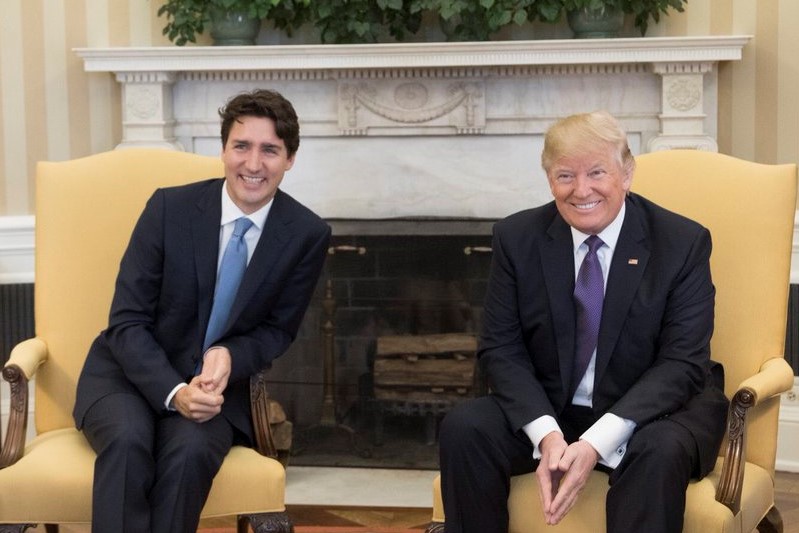
Justin Trudeau meets with President Donald Trump at the White House, 13 February, 2017.
Photo from the Office of the President of the United States via Wikimedia Commons.
Ever since the re-election of Donald Trump earlier this month, the most interesting question in Canadian politics has been “Who gets it?” That’s the main thing I’ve been looking for, and I think some of our leaders get it — or are starting to, at least.
Doug Ford doesn’t get it. Or didn’t, anyway, up until Tuesday afternoon.
On Monday night, president-elect Trump announced via a post on his Truth Social app that, as one of his first acts upon retaking the Oval Office in January, he would levy a 25 per cent tariff against all goods coming in from Canada and Mexico until those two countries fix the problems Trump says exist along the border. That’s a careful bit of phrasing on my part, so let me explain: I don’t disagree that there are issues for the United States along both borders. I don’t necessarily accept that the issues are the same on both borders or that Trump has accurately characterized the overall situation. But, in any case, Canada now has less than two months to figure out what it can do, assuming it can do anything, to satisfy the president-elect’s demands.
It’s very possible that we can do enough. Trump is a negotiator and a dealmaker, and we have to see his social-media post through that lens. He is establishing a strong opening position, and we’ll negotiate him down from there. That’s the good news, such as it is. The bad news, though, is that there’s no reason to assume Trump is going to do this only once. After we meet his demands on the border, he could demand that Canada take on more of the burden of the military defence of North America and the Western alliance. After we’ve drafted a bunch of people and launched a fleet of new warships and sent a heavily armed stabilization force to Haiti, he could come after us for our dairy subsidies. Once we give way on that, it’ll be getting tough on white-collar crime or telecom access or airline access. And so on and so on and so on. It’ll be one damned thing after another.
The broad contours of this were clear to me by about 1:30 in the morning on the day after (or night of, if you prefer) the U.S. election. As I keep saying, the party is over. Some of Trump’s demands will be basically utterly bogus, and others may be arguably unreasonable, but some of them are absolutely going to be fair, and Canada has, to my enormous frustration, left itself very, very vulnerable to his brand of pressure. We have utterly failed as a country to adapt to a changing world order by getting this country onto a more serious footing on any number of fronts, especially trade and defence. We were warned by friendlier U.S. administrations, including by presidents Barack Obama and Joe Biden. We didn’t listen. That was idiotic, and I can only hope not suicidal on our parts. Trump is going to get his way.
Comments Off on Trump is a deals guy … and Canadian politicians need to negotiate with him on that basis
November 28, 2024
“Fly the flag, you bigoted rural cis scum!” said the Human Rights Tribunal of Ontario
Apparently just failing to vote for a “voluntary” observation of Pride season is enough to get the Human Rights Tribunal of Ontario to impose fines and mandatory re-education sentences on elected municipal officials here in the most tolerant province in Canada:
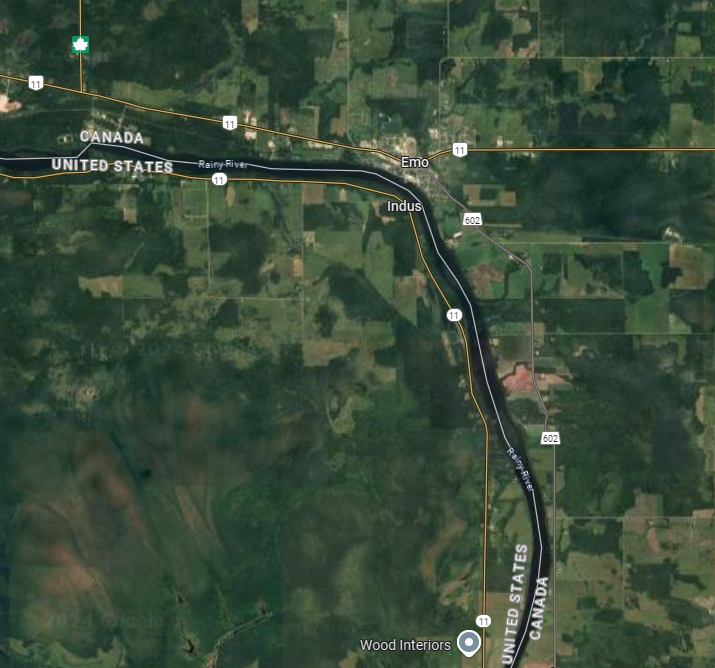
Emo is a township of about 1,300 people located in the far west of Ontario, along the border with Minnesota.
In a decision handed down last week, the Human Tribunal of Ontario ruled that Emo, its mayor and two of its councillors had violated the Ontario Human Rights Code by refusing to proclaim June as “Pride Month”.
The town was also cited for failing to fly “an LGBTQ2 rainbow flag”, despite the fact that they don’t have an official flag pole.
The dispute began in 2020 when the township was approached by the group Borderland Pride with a written request to proclaim June as Pride Month.
Attached to the letter was a draft proclamation including clauses such as “pride is necessary to show community support and belonging for LGBTQ2 individuals” and “the diversity of sexual orientation, gender identity, and gender expression represents a positive contribution to society”.
Emo was also asked to fly an “LGBTQ2 rainbow flag for a week of your choosing”.
Borderland Pride then asked Emo to “email us a copy of your proclamation or resolution once adopted and signed”.
[…]
The claim of discrimination ultimately hinged on a single line uttered by Emo Mayor Harold McQuaker. When the proclamation came up for consideration, McQuaker was heard to say in a recording of the meeting, “There’s no flag being flown for the other side of the coin … there’s no flags being flown for the straight people”.
As Human Rights Tribunal vice-chair Karen Dawson wrote in her decision, “I find this remark was demeaning and disparaging of the LGBTQ2 community of which Borderland Pride is a member and therefore constituted discrimination under the Code”.
Dawson also ruled that given the “close proximity” of McQuaker’s comment to his nay vote — that too “constituted discrimination under the Code”.
[…]
The Human Rights Tribunal ultimately ordered the Township to pay $10,000 to Borderland Pride, and for McQuaker to personally pay them another $5,000.
This was lower than what Borderland Pride had been seeking; they wanted $15,000 from the township and $10,000 each from the three councillors who voted no.
But McQuaker and Emo’s chief administrative officer were also ordered to complete an online course known as “Human Rights 101” and “provide proof of completion … to Borderland Pride within 30 days”.
The course is offered by the Ontario Human Rights Commission, and their latest edition opens with an animated video telling viewers that the Human Rights Code “is not meant to punish”.
Comments Off on “Fly the flag, you bigoted rural cis scum!” said the Human Rights Tribunal of Ontario
Town-class destroyers – Guide 400
Drachinifel
Published Aug 3, 2024The Town class destroyers, old Wickes, Clemson and Cadwell class vessels of the US Navy, transferred to the British Royal Navy and others, are today’s subject.
(more…)
Comments Off on Town-class destroyers – Guide 400
November 26, 2024
Crony Capitalist Canada – “Conservative Leader Pierre Poilievre … has vowed to protect Big Dairy just like every other party leader”
In the National Post, Chris Selley discusses the latest attempt to further protect the outrageous profits our dairy companies make by overcharging Canadians for milk, butter, cheese, and other dairy products:

That unelected senators should not overrule the will of the House of Commons has always struck me as a rule most Canadians could agree on, whatever they think ought to happen with Canada’s upper chamber. Senators can propose amendments to bad bills, rake ministers over the coals at committee, call witnesses the House wasn’t interested in for whatever reason, raise red flags that haven’t yet been raised, all to the good. But gutting a bill, as the Senate has done with proposed legislation that would protect supply management in Canadian dairy, poultry and eggs even more than it’s already protected, is not kosher.
Not all violations of this policy are equally appalling, however. When the House of Commons is clearly not operating for the benefit of Canadians, when its focus demonstrably isn’t the public good but rather coddling and currying favour with special interests, it behooves the Senate to intervene as strenuously as possible while still at the end of the day respecting the lower chamber’s democratic legitimacy.
Coddling and currying favour is exactly what C-282, a private member’s bill from Bloc Québécois Luc Thériault, does: It proposes to make it illegal for a future government to lower the tariff rate for foreign products in supply-managed industries. You could call it the “no to cheaper groceries act.” Some senators wish to neuter it, such that it wouldn’t apply to any existing trade deals or deals already in negotiation. Bloc Leader Yves-François Blanchet had originally demanded the bill passed as one condition of keeping the Liberals afloat (although his deadline to do so has passed).
Fifty-one MPs of 338 opposed the pricey-groceries act at third reading. I would have said “only 51” except that’s a shocking number: 49 Conservatives and two Liberals, Nathaniel Erskine-Smith and Chandra Arya. It’s almost reason for hope … except of course that Conservative Leader Pierre Poilievre voted for it, and has vowed to protect Big Dairy just like every other party leader. It goes without saying that Prime Minister Justin Trudeau not only supported it, but has come out against the Senate’s amendments.
“We will not accept any bill that minimizes or eliminates the House’s obligation to protect supply management in any future trade agreement,” Trudeau reassured Blanchet in the House on Wednesday. ” No matter what the Senate does, the will of the House is clear.”
I mean, what elected politician in Ottawa gives a shit about Canadians being gouged on grocery staples every week? They’d rather get the support of the milk, poultry and egg crony capitalists than help ordinary Canadians, and they’re terrified of being portrayed as anti-Quebec in an election year. Spineless cowards, the lot of them.
Comments Off on Crony Capitalist Canada – “Conservative Leader Pierre Poilievre … has vowed to protect Big Dairy just like every other party leader”
The ghost airport of Nicosia: Rare glimpse inside the abandoned 1974 battleground
Forces News
Published Jul 20, 2024Nicosia International Airport was once a busy hub full of holidaymakers but since the Cyprus conflict of 1974, it has been frozen in time.
Today, the disused airport resembles a ghost town as it sits abandoned in the 180km buffer zone dividing the Republic of Cyprus and the Turkish-occupied north.
On the 50th anniversary of the conflict, Forces News goes inside the eerie airport and learns how it became the site of a major battle.
(more…)
Comments Off on The ghost airport of Nicosia: Rare glimpse inside the abandoned 1974 battleground
November 24, 2024
How Newfoundland and Labrador lost their independence
Geography By Geoff
Published Jul 16, 2024Did you know that Newfoundland and Labrador were once an independent country in the same manner as Canada was? It’s true! It was called the Dominion of Newfoundland and due to a series of unfortunate events, it had to relinquish its independence. In today’s video, we cover the vast geography of the province, it’s very old history (including Vikings!) and how the country managed to lose its independence when it managed to survive on its own for decades. Oh … and we’ll also talk about why Labrador got included in the name upon confederating with Canada.
(more…)
Comments Off on How Newfoundland and Labrador lost their independence
November 21, 2024
“If the Federal Court of Appeal greenlights that standard for freedom of peaceful assembly … then governments would have the power to ban virtually every large protest”
In The Line, Josh Dehaas explains why Justice Mosley’s Federal Court decision earlier in 2024 didn’t go far enough to protect Canadians’ rights, specifically their right to assemble in large numbers where the government claims to think that things might get violent:
Arms of the Federal Court of Canada
Earlier this year, Justice Mosley of the Federal Court of Canada ruled that the invocation of the Emergencies Act in response to the Freedom Convoy protests was illegal.
There was a lot to like in that ruling, not least of which because it agreed with the official position of my organization, the Canadian Constitution Foundation.
First, Mosley agreed that the definitions of “national emergency” and “threats to the security of Canada” weren’t met by the federal government, thus invalidating their use of the Emergencies Act. Second, the Justice agreed that freezing bank accounts without a warrant violated the Charter right against unreasonable searches. Third, he agreed that the regulations that banned travelling to, participating in, and funding certain assemblies under threat of up to five years in prison violated freedom of expression.
But not all of Mosley’s ruling was commendable, from our point of view. What we didn’t like was a finding that the same regulations that violated expression because they banned a person from “merely going onto Parliament Hill waving a placard” regardless of whether that person had blockaded or breached the peace, didn’t also violate the Charter guarantee of freedom of peaceful assembly. How could that be? The CCF is asking the Federal Court of Appeal to overturn that finding when it hears the government’s appeal, most likely in early 2025.
This week, we got the government’s stunning and frankly, disturbing, response to that very point of contention. We expected the government to argue that the limitations to individuals’ rights to peaceful assembly were reasonable, given the need to deal with the protest writ large. That wasn’t their only claim.
Instead, the government pulled out an entirely novel line of reasoning, arguing that the Charter doesn’t protect assemblies if they might turn violent or breach the peace. If the Federal Court of Appeal greenlights that standard for freedom of peaceful assembly — establishing a new precedent on when Charter freedoms can be subject to limits — then governments would have the power to ban virtually every large protest. The federal government’s view that assemblies are not Charter-protected and can be blocked in advance if someone in the crowd might reasonably be expected to breach the peace cannot stand if we’re to have any meaningful right to peaceful assembly at all.
Comments Off on “If the Federal Court of Appeal greenlights that standard for freedom of peaceful assembly … then governments would have the power to ban virtually every large protest”
Canadian defence priorities – don’t listen to what they say, watch what they spend the money on
The Hub provides an edited transcript of what retired Lieutenant General Andrew Leslie (and former Liberal whip in the Commons) said to the Standing Committee on National Defence earlier this month, which shows very clearly where national defence ranks in Justin Trudeau’s world:
My intent is to offer some criticism of the status quo so that we can learn and then perhaps some sort of question period to get into some solutions. Essentially, in my opinion, “Strong, Secure, Engaged“, the precursor to the current defence policy, delivered nothing substantive in terms of modern military equipment, which saw Canada, in fact, become weaker, more insecure, and essentially absent from the deployable stables of troops required for either United Nation missions, or, of course, NATO.
The 2024 defence policy update of “Our North, Strong and Free” is no better, unfortunately, in that it promises some urgently needed equipment years from now, but nothing today. Indeed, the 2024 defence spend will be less than that of 2023. Of course, we’re well aware of what just happened down [in the] United States. Both Republicans and Democrats are united and increasingly vocal about telling Canada how disappointed, frustrated and fed up they are with Canada’s failure to defend itself and their allies, with a special mention on the Arctic.
Meanwhile, as we know, and I was involved in the last NAFTA renegotiations, that’s coming due at a time when a variety of key players down south have articulated clearly the base of 3 percent [of GDP spending on defence] looms on the horizon, and how defence, security, trade, and border security are all intertwined. At this time of crisis internationally, with what’s happening in the Middle East, in Ukraine, Canada’s military readiness is at its lowest level in 50 years. Canada spent last year, in 2023, more money on consultants and professional services than it did on the Army, Navy, and Air Force combined — which quite frankly, is madness.
The Army has over 50 percent of its vehicle fleets, which are awaiting spare parts and technicians. The Navy is struggling mightily — bless them — to keep elderly warships, a handful of them at sea, specifically in the Indo-Pacific, and they’re desperately short of trained sailors. The Air Force has been unable to participate in significant NATO deterrent exercises, either up north or over the oceans, in conjunction with our friends and allies, because they don’t have the pilots, the spare parts, or the money to fly the aircraft.
In the Arctic, which is many times larger than Europe, Canada has fewer than 300 military support staff who are not a deterrent — they’re essentially unarmed. Some of them are part-time, bless them, and about 1,600 Ski-Doos equipped with rifles, and Canadian Rangers who are not combatants. Their role is to observe and report.
The bottom line is that Canada has no permanently assigned combat elements to deter potential presence by the Russians or the Chinese, who are showing up in our waters with increasing frequency. But other people do. Russia specifically has between 25,000 to 35,000 combat troops deployed in their Arctic with huge amounts of operational equipment — air, land and sea. The United States, bless them, has 22,000 full-time military and part-time military professionals with more equipment than the entirety of the Canadian Forces in terms of combat delivery. So really, thank you America for defending our Arctic.
We are facing unprecedented dangers and challenges, and quite frankly, I see no sense of urgency to change, to modify, to re-guide the efforts of the government towards supporting and assisting in the Canadian Forces.
Some facts. We have less than 35 military personnel deployed on UN missions; in 2003, we had close to 2,500. We are the only NATO nation whose level of military operational readiness is going down when everyone else is skyrocketing up. We have the longest and least efficient procurement system in NATO; indeed, in any nation that I can find. We are the only nation in NATO that does not have a costed plan to get to 2 percent of GDP, which was first agreed to by the minister of defence in 2008 and reiterated in 2014, 2015, 2016, 2017, and I could go on. We are the only NATO nation whose defence minister has publicly admitted that he could not convince his fellow cabinet members of the importance of NATO defence spending, and the 2 percent GDP. And, as mentioned already, we’re the only NATO nation whose defence budget decreased this year.
Emphasis mine.
Comments Off on Canadian defence priorities – don’t listen to what they say, watch what they spend the money on


