Quotulatiousness

August 14, 2024

Premier Doug Ford’s weird plan to hold the justice system to account

Filed under: Cancon, Law — Tags: , , , , , — Nicholas @ 03:00

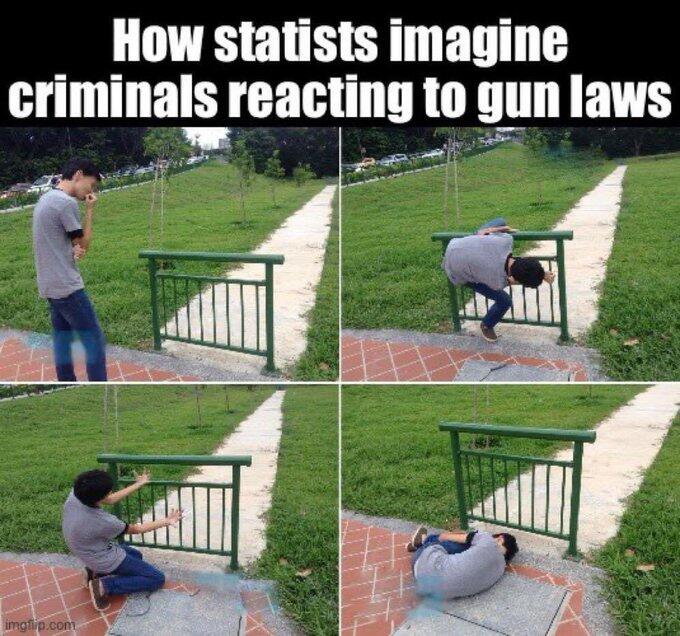
The problem with Premier Ford’s as-yet-unelaborated plan to collect formal statistics on the products of the criminal justice system is that it’s weird. And Canadians don’t like weird things because something something Donald Trump something something Hitler. Despite that, Colby Cosh thinks it’s a good idea:

Superior Court of Justice building on University Avenue in Toronto (formerly the York County Court House).

… the very idea of addressing a social problem by gathering quantitative information is so un-Canadian as to seem radical and startling. It certainly seemed that way to the lawyers and civil libertarians who freaked out at Ford’s mention of “accountability” for judges who fail to protect the public from criminal predators.

Judicial independence is an axiom of our constitution — but to the degree that judges become policymakers, which is perpetually increasing as they discover creative new applications of the Charter, their lack of oversight by elected legislators and by the voting public is also a serious and obvious problem, purely in principle. It is no wonder the legal guild takes fright at the notion of “accountability” if it is interpreted to mean that judges might be subject to enforceable performance measures or firing by a minister.

But, of course, the word “account” is visible in there, and measurement of a social crisis is necessary to establish that one exists, even if almost everybody believes it to exist. Our courts are the first to castigate a government that makes some legislative change affecting individual rights without an attempt at inquiry into its reasonability and urgency. Ford, in proposing to establish the dimensions of preventable re-offending, is doing exactly what a legislator hoping to reduce crime ought to do: gather numbers. Collect and publish information. And let us specify that we mean publish publish, in an open, dependable, accessible way, with maximum detail.

Frankly, Ford’s announcement seems as much as anything like a reaction to being backed into a corner by an unresponsive Liberal government, which controls bail policy and the content of the Criminal Code, and by judges, whose irrational bail and sentencing decisions flood what’s left of our news media. Provincial politicians are bound to be judged by voters on the perceived prevalence of crime, but about all they can actually do about it is to, well, buy more choppers for the coppers and start collecting local data about revolving-door justice.

Update: Fixed broken link.

August 12, 2024

“Premier Doug Ford’s plans for the demon liquor will lead us all to untold poverty and perdition”

In the National Post, Chris Selley points and laughs at the classist viewing-with-alarm and frenzied pearl-clutching over the impending rule change that will allow wine and beer to be sold (and even served) in convenience stores like the 7-Eleven chain:

The plight of poverty-stricken Ontarians, forced to get drunk at their local 7-Eleven dive bar.
Gin Lane, from Beer Street and Gin Lane via Wikimedia Commons.

Ontario politics in recent weeks has played out as something like a real-time satire of itself, with the Latent Methodist Brigade still insisting Premier Doug Ford’s plans for the demon liquor will lead us all to untold poverty and perdition. The news this week has only made them more upset: Japanese convenience store empire 7-Eleven will open licensed areas in 58 of its 59 stores in Ontario, in which you can enjoy an alcoholic drink with your hot dog, nachos or chicken nuggets. The company says it’ll add 60 jobs.

Fifty-eight is not a large number, you will agree, in a province with many thousands of licensed premises, any of which might get you drunk and send you back out to your car or boat (though of course they shouldn’t). Some of those thousands of licensed premises are even attached to gas stations, I can report. And many gas-station convenience stores in Ontario sell beer, wine and liquor as independently run “LCBO agency stores”.

For the record, 7-Eleven announced they were doing this way back in December 2022. Pro-forma neo-puritan controversy ensued, and quickly died down. Two 7-Elevens already operate as licensed restaurants in Ontario, apparently without incident, along with 19 in Alberta. (Unfortunately, bien-pensant Ontarians are trained from birth to believe Alberta’s liquor-retail reforms in the 1990s were a grotesque misadventure that everyone there regrets.)

Nevertheless, the same pro-forma neo-puritan freakout is playing out again.

“Let me get this straight. 7-Eleven locations where people fuel up their cars will now allow folks to drink on the premises? What could possibly go wrong?” sneered JP Hornick, president of the Ontario Public Service Employees’ Union (OPSEU), who was last seen dragging LCBO employees into a disastrous tantrum-cum-strike over expanding retail access.

“We need a government that will focus on real things including bringing down hospital wait times, fixing schools and tackling the housing crisis as their signature achievements, amongst many more,” Toronto Coun. Josh Matlow correctly averred on Twitter … and then, as is the fashion here, went full non-sequitur: “Doug Ford made sure we could drink coolers inside a 7-Eleven.” As if the government decided it could only pick one.

(And can I just say here, any Toronto city councillor complaining about another politician’s lack of “signature achievements” is on bloody thin ice.)

Every fully paid-up member of the Laurentian Elite [Spit!] believes with all their flinty hearts that Alberta is a barren wasteland of ruined lives thanks to the demon liquor being sold in corner stores. Initial issues from a generation ago are firmly ensconced as “the way it is” with liberalized booze access out there in the wild west.

August 11, 2024

Canada’s long-standing issues with national defence won’t be fixed by merely spending more money

Filed under: Cancon, Military — Tags: , , , — Nicholas @ 03:00

In The Line, Greg Quinn explains why meeting the 2% of GDP NATO target for military spending isn’t going to solve Canada’s problems with the military:

Canada isn’t pulling its weight on defence. Is that what Canadians want? Because it isn’t what its allies want. And the allies are more and more willing to say so.

Canada, and Prime Minister Justin Trudeau, likes to talk about how the country punches above its weight in NATO and global affairs more generally. It’s a cliché many countries have resorted to when put under pressure on one issue or another. (And I’ll confess that this includes my own United Kingdom, which I served as a diplomat for decades before my recent retirement.)

It’s also smoke and mirrors, which in Canada’s case on defence, hides an unhappy truth — Canada doesn’t pay its way.

Trudeau says Canada will meet the target of spending two per cent of GDP on defence in 2032. Some 18 years after NATO committed to it. At the moment Canada spends a paltry 1.37 per cent, or some $33.8 billion a year, on defence, damn near the bottom among the allies, in percentage terms. Ottawa claims this will increase to 1.76 per cent, or $49.5 billion, by 2030. If so, that will move Canada up a whopping two places to 25th.

Mind you, the Parliamentary Budget Office disputes even this, stating that Canada’s defence spending will peak at 1.49 per cent of GDP in 2025-26 before dropping (yes, dropping) to 1.42 per cent in 2029-30. Somebody is being economical with the truth.

[…]

The bottom line is simple — what does Canada (and the Canadian people) want its role in the world to be? Words are easy but they need to be backed by action. One of the most obvious demonstrations of action is spending on a defence force that is capable of deploying and acting on the global stage. More bluntly, of fighting and defeating a near-peer enemy as part of a coalition of allies.

If Canada doesn’t want to do that and prefers a defence force that is essentially a glorified local militia that focuses on domestic issues, well, fine. But let’s not pretend it is anything else. Let’s not talk about how much of a force for good Canada is in the world and let’s not try and fool Canada’s allies. They’re not as stupid as Canadian politicians want them to be.

And let’s not expect those allies to happily accept the situation and continue on as if nothing has changed. Canada already complains about being left out of AUKUS. Is it any wonder? More of that should be expected. If you don’t play the game and don’t pull your weight, then sadly, you don’t get the benefits of being in the grown-ups’ club.

Canadians owe themselves, and frankly owe their allies, an honest discussion about kind of role Canada actually wants to play in the world … and whether they’re willing to actually pay the bills required to play that role. Only after such an honest chat can Canadians, and their allies, calibrate their expectations accordingly.

August 10, 2024

The GTA job situation is dire, yet the government keeps allowing special permits to bring in foreign workers

Filed under: Bureaucracy, Business, Cancon, Government — Tags: , , — Nicholas @ 03:00

I try not to moan about my work situation here on the blog … nobody comes here for that … but despite my decades of experience in my technical field, it’s been a very long time since I had an interview (I’m ashamed to admit how long), despite all the jobs I’ve applied for. I have several strikes against me, of course, in that I’m an older slightly disabled white male, but it’s not just about me: Canadian employers in the Greater Toronto Area are still getting special permits to bring in foreign workers despite the huge numbers of un- and under-employed Canadian citizens and permanent residents in the GTA:

With job fair lineups regularly snaking around blocks and experienced professionals unable to secure roles despite applying to hundreds of them, it’s safe to say the job market is pretty terrifying right now for anyone looking for any type of work in the Toronto area.

Population growth has been outpacing employment gains, pushing the city’s unemployment rate to a dismal 7.4 per cent earlier this year (compared to Canada’s 5.8 per cent). So, it’s no wonder that residents are concerned to find how many local businesses are outsourcing labour to foreign workers.

A user-created map shared to Reddit last week shows which employers in the GTA have applied to hire overseas personnel via Labour Market Impact Assessments from 2023 on, which are supposed to be used only when there is “a need for a foreign worker to fill the job [because] no Canadian worker or permanent resident is available to do the job.”

While it seems like the above would be a rare exception given the current work crisis, the map shows quite the opposite: a shocking number of firms trying to use LMIAs to hire thousands of staffers, from food service and retail workers to engineering technicians and administrative assistants.

The data used is from Canada’s Open Government Portal, the page explains, adding that “there have also been instances where employers have illegally sold their approved LMIA positions to workers.”

The post has tacked up thousands of upvotes and a robust discussion of hundreds of comments, almost all from people who are angry and confused about why so many places are actively trying to recruit — and in many cases, successfully recruiting — people from outside of the country when so many here are desperately seeking jobs.

August 9, 2024

Domicidal maniacs in charge

Lorenzo Warby provides an oh-so-useful word to accurately capture what the diversity-at-all-costs elites running most western countries these days are actually up to:

Domicide is the destruction of home. It comes in the “hard” version — the physical destruction of houses and infrastructure.

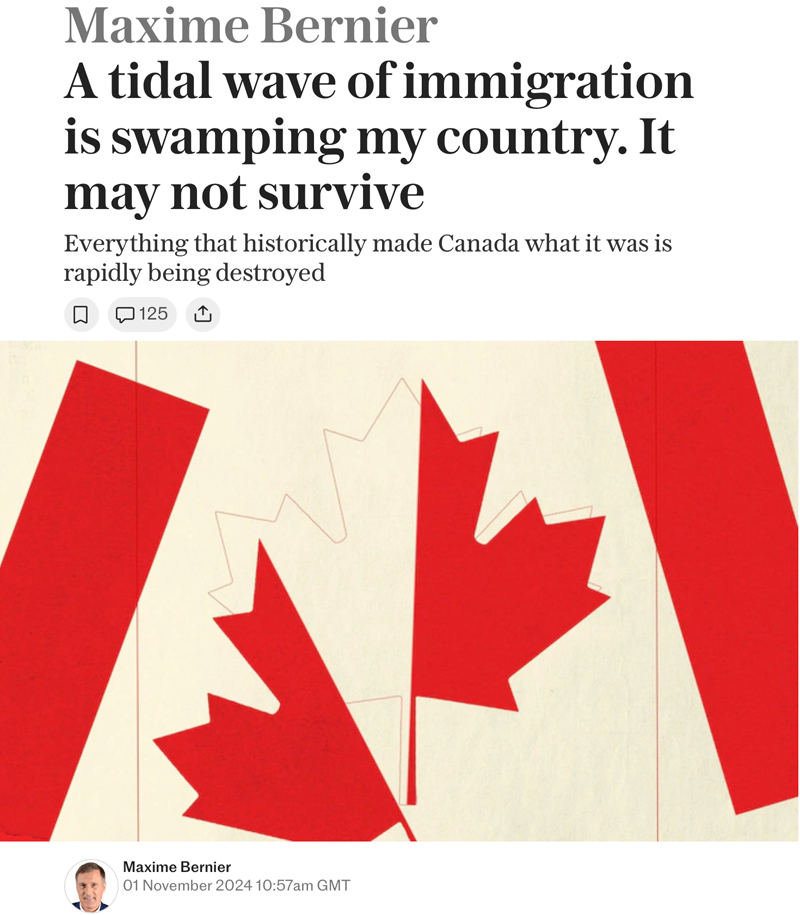
Domicide also comes in a “soft” version — flooding localities with new people, separating people from, and otherwise degrading, their heritage. When folk say Britain is becoming “unrecognisable”, it is the domicidal effect of mass migration they are referring to.

The UK is suffering from a domicidal elite, one that uses mass migration to break up working-class communities; asymmetric multiculturalism to elevate incoming cultures over those of native English (the Celtic fringe get minority brownie points); favours non-“white” faces in advertising; asymmetric race-swapping in entertainment against the native English; denigration of British history as racist, white supremacist, imperialist, colonialist, etc.

Much of this is insulting virtue-signalling allied to, or presenting, cartoonish (simplified) and caricature (distorted) history. It all undermines social cohesion. But it is the use of migration policy as a systematic weapon against the resident working class which does the most damage. Though two-tier policing — obviously treating Muslims in particular with a deference not shown to the natives, especially when it comes to policing speech — is also highly corrosive of social cohesion.

Many working-class communities in Britain were already fairly dysfunctional — though the British state is not innocent in those dysfunctions1 — and sections of the British working class are very far from admirable. None of this justifies the use of mass migration to make things worse for such folk, however much it may help to explain the moralised class contempt that underlies so much of modern progressivism and modern managerialism.

To improve such things, to “level up”, requires a strong sense of how to create and maintain social order. Modern progressivism is strongly antipathetic to such understanding. To “level up” also requires a strong sense of custodianship, which managerialism typically lacks: particularly progressivist managerialism.

Indeed, modern feminist, progressivist, managerialism—in its lack of custodianship; lack of social solidarity;2 in its antipathy to taking the problems of social order seriously — is running the British state into the ground. The post-medieval British aristocratic and mercantile elite did a much better job of state management. But those elites had mechanisms — such as duelling, that forced men to defend their reputation at the risk of their life, and grand country houses, that turned into expensive investments in social isolation if you behaved badly — that selected for character.

Nowadays, the British elite only selects for capacity and even that is being degraded by DEI undermining the signals of competence. It turns out, over the longer term, character matters more than capacity. For capacity without character selects for manipulative, anti-social personalities that degrade institutions over time.


    1. For a particularly brutal depiction in fiction of the dysfunctional British welfare state — especially its school system — see Christopher Nuttall’s Mystic Albion series, especially the first book.

    2. Feminisation of institutions and discourse has tended to degrade social solidarity, see Benenson et al, 2009. The most conspicuous example of this in the UK is how uncouth it is in elite circles to mention the systematic rape and sexual exploitation of underage working class girls by overwhelmingly Muslim gangs.

August 4, 2024

QotD: Canada’s “middle class”

Filed under: Cancon, Economics, Politics, Quotations — Tags: , — Nicholas @ 01:00

Class is everywhere in this election, invoked seemingly every time someone wants to put a sympathetic face on a policy proposal or make a point about being in touch with ordinary Canadians.

There’s the “middle class” that’s constantly prioritized, flattered and fetishized by every campaign and candidate; critiques of people who come from such a privileged class they can’t possibly understand the concerns of normal people; sometimes bizarre pitches aimed at those who want a better future for their kids and just need a boost (camping, anyone?); and leaders who come from hardscrabble backgrounds — except that maybe they don’t quite.

But if class is an ever-present anthem running through campaign 2019, it’s a tune no one seems to know the proper words to, or they’re deliberately mumbling nonsense lyrics and assuming no one else will notice.

[…]

Then there is the electorally beloved — and conveniently poorly defined — “middle class”. Given all the campaign trail hot air devoted to lauding the values and hard work of this population and lionizing their noble struggles, you would think that at some point, other corners of the electorate would get ticked off about being ignored by politicians in favour of these golden children.

But they don’t, because pretty much everyone thinks that’s them.

Shannon Proudfoot, “The ‘family shame’ of Canadian politics: class struggle”, Maclean’s, 2019-10-04.

August 2, 2024

Trudeau won’t – can’t – go voluntarily

In The Line, Michael Den Tandt explains why the Biden option isn’t a viable one for Justin Trudeau at this stage of the Canadian electoral cycle:

US President Joe Biden talks to Canadian Prime Minister Justin Trudeau, March 2023.

It’s a tough time to be a backbench Liberal MP in Canada, yes? The tone, emerging in anonymous leaks to reporters, is grumpy, surly, unhappy. This is unsurprising. We’re in year ten of a ten-year political cycle that feels stretched and road-beaten, by any standard.

Plus, to our south, there’s this shining model now of the transformative power of change. One day President Joe Biden is clinging by his fingernails to his party’s nomination, with the convicted felon Donald Trump seemingly headed for a big win in November. The next, Biden’s out, new hope Kamala Harris is raising tens of millions in campaign donations, and reporters are lasering in on Trump’s highly quotable running mate, J.D. Vance.

All in a week. So, couldn’t something similar happen in Ottawa? Couldn’t Prime Minister Justin Trudeau take a step back, hit the beach or the lecture circuit, make way for fresh blood, and at least give the Liberals a shot at survival in 2025? What’s he waiting for?

Anything is possible. But this scenario is unlikely. That’s because Justin Trudeau isn’t Joe Biden; Chrystia Freeland isn’t Kamala Harris, and Canada isn’t the United States.

Most obviously, the cycle: The cycle is everything. Individuals are all but powerless in its clutches. As it nears a decade it adds lead weights, like those a deep-sea diver might wear, to the feet of Canadian incumbents. Even the most promising of change agents — former prime minister and justice minister Kim Campbell is Exhibit A — will be brought low by its power.

The argument can be made made that the Progressive Conservative party’s obliteration in 1993 (reduced from majority status to two seats) was not just due to late-cycle fatigue, that Campbell herself had run a wobbly campaign. Some will note the deep weariness with the constitutional wrangling that dominated Canadian discourse during the Brian Mulroney years, or the hangover of Mulroney’s, at the time, keen personal unpopularity. Fair points.

But underlying those events was still the implacable cycle — as in 2006, when prime minister Paul Martin, having seen that Liberal government reduced to a minority in 2004 (despite his personal popularity at the time), lost power to a rising Stephen Harper. In the throes of the federal sponsorship scandal (I will spare you the details, but you can find them here if you’re interested in the arcana), Martin was described by gifted wordsmith Scott Reid, then his communications director, as “the wire brush” who would scrape away the stain of sponsorship. It was a bold attempt to rhetorically seize the change wave. But the wave was strong and Martin lost.

August 1, 2024

The Rarest 1911: North American Arms Co

Filed under: Cancon, History, Military, USA, Weapons, WW1 — Tags: , , , , , — Nicholas @ 02:00

Forgotten Weapons
Published Apr 22, 2024

In the summer of 1918, the US government wanted to increase production of M1911 pistols, but all current manufacturers were working at capacity. So they looked to issue new contracts, and someone realized that the Ross rifle factory was a potential option. Now, the Ross Rifle Company was bankrupt by this time, and its factory lay essentially abandoned. So in June of 1918, two Canadian lawyers by the names of James Denison and Edmond Ryckman incorporated the North American Arms Company Ltd in Quebec, signed a contract to manufacture 500,000 1911 pistols for the US, and then leased the Ross factory for a term of 18 months. Whether they would have been successful in producing pistols at scale is unknown, because their contract was cancelled on December 4, 1918 before any deliveries were made. With the end of the war, arms requirements plummeted, and pretty much all ongoing weapons contracts were cancelled, not just this one. However, parts for 100 pistols had been produced, and these were assembled and sold commercially after the contract was cancelled.
(more…)

July 31, 2024

The Jasper wildfire – climate change or blatant government incompetence and neglect?

Filed under: Cancon, Government — Tags: , , , — Nicholas @ 05:00

In The Line, Jen Gerson points out that the federal government had been given plenty of warning — literally years — about potentially serious problems near Jasper and had done nothing about them:

When Ken Hodges heard about the devastating wildfire that took out part of the historic mountain town of Jasper this week, he said he was “frustrated”.

“All I could say is that we tried to warn them that it was coming. We told them constantly. It’s not a matter of if, it’s a matter of when.”

The retired forester, along with his colleague Emile Begin, spent years repeatedly warning the parks service, the federal and provincial government, city council, and residents, that mis-management of the forests around Jasper had created a tinderbox that would inevitably spark a massive wildfire.

“I just feel so badly for the people who have lost their homes and their businesses. Could it have been prevented? I don’t know. If they had done everything they could have? Maybe. Something was going to happen over time, so it’s so frustrating and devastating.”

Hodges first spotted the problem almost a decade ago while skiing near Marmot Basin. From his years working in forestry in B.C. — a province that had previously been devastated by both wildfires and infestations of the Mountain Pine Beetle — Hodges was able to identify similar patterns of decay in the forests in Alberta.

“It was a hillside on the way up to Marmot that I looked up and thought ‘holy crap. The Mountain Pine Beetle is here.'” His experience told him exactly what would follow — fire.

Not just any fire. “It’s the intensity and the ferocity of the fire that can cause the problem. With climate change, that exacerbates the situation as well.”

Eventually Hodges connected with Begin. The two men between them had 40 years of experience in forestry in B.C. and Alberta, respectively. They feared the Parks service was not prepared for what the men had seen in B.C. — and told them so. Repeatedly. Vociferously. They also sent letters of warning to several ministers; they met with the local municipality. They were interviewed by the CBC for a story that was headlined “Jasper National Park not prepared for potential forest fire ‘catastrophe’, researchers say“.

That was in 2018.

Also in 2018, the pair issued an open letter that read: “The potential for a huge fire or mega fire is real. Fires of this type and magnitude generally occur in mid August to early September. With climate change it may occur earlier.”

The response?

“They just wrote us off,” Hodges told The Line this week.

July 30, 2024

The new and improved malaise for the 21st century

Filed under: Cancon, Economics, Government, Politics, USA — Tags: , , , — Nicholas @ 03:00

Back in the 1970s, US President Jimmy Carter identified the theme of the decade as “malaise”, and now, thanks to generations of feckless politicians, burgeoning bureaucratic empires, and economic stagnation, it’s back in an even malaisier form for the Current Year:

“Kamala Harris” by Gage Skidmore is licensed under CC BY-SA 2.0 .

Some time ago, I noticed that a general fatigue had taken a place alongside the malaise that was already being felt by many Americans and Canadians. The malaise stemmed from the overdue recognition that their lives were not going to get any better, and that they would have to work harder to just maintain a standard of living that they were already used to.

The fatigue came from a different, but not too distant place; the politicization of everything these past one and a half decades meant that there was no escape [from] the political. Whether sports, video gaming, or even fashion, everything had to be run by the cultural police before it could be deemed “not problematic”. The problem was (and still is) that everything to this type is “problematic”. This would not be a problem at all if this type were not empowered by the powers-that-be, but for some strange reason the cultural police quickly became ubiquitous, and their constant hectoring and lecturing ground most people down to the point where fatigue set in.

Everything became political, so therefore there was nothing that was not political. The fact that sanctions began to be placed against those who dared to buck the new trends in social mores meant that this was a totalizing form of politics. It wasn’t fascism, nor was it communism … but it was (and is) totalitarianism in a new form all its own. The rise of populism on the right in the West (as this trend is also present in Europe, but is not as thoroughly embedded there as it is in North America) is almost entirely a reaction to this. Freedom and liberty, as traditionally understood in the Anglosphere (i.e. “as long as I don’t harm others, I can do or say what I want”) took a back seat to what they call “equality”, a first step towards the more extreme demand known as “equity”.

Economic precariousness combined with the permanent presence of the Sword of Damocles above your head is a brilliant way to get people to shut up and get with the program. It is very coercive, but it is for the “greater good”, they tell us. What we already see is that it does not convince all, and that it has a negative effect on trust in governing institutions and national elites. The level of control by the managerial elite over the daily lives of its citizens is now at a micro-management one. Everyday, most people have to think carefully before speaking for fear of committing some aggression that could lead to the termination of their employment. They must mouth elite-approved social mores just in order to be able to tread water, as boat rocking is a secular sin. Why would the powers-that-be want to ever give up such a tool of mass control? The people are not to be trusted, which is why this totalizing system must remain in place. Just imagine if it were removed: the dreaded 1990s would return … or something.

Jacob Siegel has written an interesting essay on the concept known as “Whole of Society”, and how it has become a totalizing system:

    To make sense of today’s form of American politics, it is necessary to understand a key term. It is not found in standard U.S. civics textbooks, but it is central to the new playbook of power: “whole of society“.

    The term was popularized roughly a decade ago by the Obama administration, which liked that its bland, technocratic appearance could be used as cover to erect a mechanism for the government to control public life that can, at best, be called “Soviet-style”. Here’s the simplest definition: “Individuals, civil society and companies shape interactions in society, and their actions can harm or foster integrity in their communities. A whole-of-society approach asserts that as these actors interact with public officials and play a critical role in setting the public agenda and influencing public decisions, they also have a responsibility to promote public integrity.

    In other words, the government enacts policies and then “enlists” corporations, NGOs and even individual citizens to enforce them — creating a 360-degree police force made up of the companies you do business with, the civic organizations that you think make up your communal safety net, even your neighbors. What this looks like in practice is a small group of powerful people using public-private partnerships to silence the Constitution, censor ideas they don’t like, deny their opponents access to banking, credit, the internet, and other public accommodations in a process of continuous surveillance, constantly threatened cancellation, and social control.

The catch:

    “The government” — meaning the elected officials visible to the American public who appear to enact the policies that are carried out across the whole of society — is not the ultimate boss. Joe Biden may be the president but, as is now clear, that doesn’t mean he’s in charge of the party.

Siegel writes that the “whole of society” approach arose during Obama’s shift away from the War on Terror to something called “CVE” (Countering Violent Extremism) i.e. the shift away from focusing on Islamist terror towards fighting America’s own citizens who are not with the new political, social, and cultural programs:

    But the true lasting legacy of the CVE model was that it justified mass surveillance of the internet and social media platforms as a means to detect and de-radicalize potential extremists. Inherent in the very concept of the “violent extremist”, was a weaponized vagueness. A decade after 9/11, as Americans wearied of the war on terror, it became passé and politically suspicious to talk about jihadism or Islamic terrorism. Instead, the Obama national security establishment insisted that extremist violence was not the result of particular ideologies and therefore more prevalent in certain cultures than in others, but rather its own free-floating ideological contagion. Given these criticisms Obama could have tried to end the war on terror, but he chose not to. Instead, Obama’s nascent party state turned counterterrorism into a whole-of-society progressive cause by redirecting its instruments — most notably mass surveillance — against American citizens and the domestic extremists supposedly lurking in their midst.

    A reflection on the 20-year anniversary of Sept. 11 written in 2021 by Nicholas Rasmussen, the former director of the U.S. National Counterterrorism Center, captures this view. “Particularly with the growing threat to public safety and security posed by domestic violent extremism, it is essential that we move beyond the post-9/11 counterterrorism strategy paradigm that placed the government at the center of most counterterrorism work.” Instead of expecting the government to deal with terrorist threats, Rasmussen advocated for “a much wider, more expansive and inclusive ‘whole-of-society’ approach” that he said should encompass “state and local governments, but also the private sector (to include technology companies), civil society in the form of both individual voices and non-governmental organizations (NGOs), and academia.”

July 28, 2024

J.D. Vance is an ideological extremist who has pushed an idea also supported by … Canadian deputy PM Chrystia Freeland

Filed under: Cancon, Media, Politics, USA — Tags: , , , , , — Nicholas @ 03:00

There’s much viewing-with-alarm and pearl-clutching going on over some of J.D. Vance’s more outré notions floated before he became Trump’s running mate:

U.S. Senator J.D. Vance speaking with attendees at The People’s Convention at Huntington Place in Detroit, Michigan, 16 June, 2024.
Detail of a photo by Gage Skidmore via Wikimedia Commons.

One of the amusing features of this week’s U.S. election turbulence has been sudden media scrutiny of Ohio Republican Senator J.D. Vance, a former author and pundit newly named as Donald Trump’s running mate. Readers will know I’m a sadistic student of electoral reform crusades, and in 2021 Vance advocated for one of the myriad of utopian ideas that has never quite reached prime time: parents should be given extra votes that they can exercise on behalf of their minor children.

[…]

Critics of Vance are screaming about the sacred principle of “one person, one vote” — but of course the centrists and liberals who have toyed with the same idea support it precisely because children are persons who deserve political representation. (They would be represented second-hand by their parents until the age of majority, but us adults are all represented that way in democratic decision-making now, right?) Earlier this week Reason magazine published a short excerpt from a pro-Demeny paper by two American law professors with strong conservative, originalist credentials: there isn’t all that much daylight between their arguments and Corak’s.

Are the arguments actually any good? Some of them seem circumstantial or even aesthetic. We’re in a transitory era of gerontocracy because of a baby boom that happened eighty years ago, and nobody under 70, whatever their ideology, likes this universal predicament much. But on the grounds of revealed preference, the lack of actual real-world Demeny experiments is a big problem.

If we want the proxy votes to go to custodial parents who are involved with a real child and conscious of its particular interests, you’re suddenly talking about integrating election systems with family law. I.e., an unfathomable technical nightmare. But assigning control of the extra child votes automatically to biological parents, including deadbeats and those who have surrendered children to adoptees or foster families, seems like a non-starter. (And would also be an unfathomable technical nightmare.)

You can say that the democratic principle is more important than the mere design details of a child-voting system, and this is the kind of thing election reformers say all the time — but would you book a seat on an airplane that was built on aerodynamic principles with no attention to detail?

How America RUINED the world’s screws! (Robertson vs. Phillips)

Filed under: Business, Cancon, History, Humour, Tools, USA, WW1, WW2 — Tags: , , , , — Nicholas @ 02:00

Stumpy Nubs
Published Apr 17, 2024

July 26, 2024

Latest Liberal ad totally DESTROYS Pierre Poilievre and the Conservatives

Filed under: Cancon, Media, Politics — Tags: , , , — Nicholas @ 03:00

If you’re new here, you may not recognize my headline as being sarcastic. Here’s Chris Selley‘s attempt to figure out what the Liberal brain trust is up to with their latest anti-Tory ad:

“The CEO of Elections Canada has indicated his opposition to it, and let me just say I’m at peace with that.”

These words, spoken by Pierre Poilievre a decade ago, are part of an absolutely bizarre 46-second video the Liberal Party of Canada released in recent days trying to convince us — a very novel approach — that the Conservative leader is too wacky and full of dangerous ideas to vote for.

Read that sentence again. It’s supposed to be a scare quote. Are you scared? Or, more likely, do you not know what the hell he’s talking about? Removed from its context it’s not just uncontroversial; it barely even exists. It’s like someone negotiating the return date on their dry cleaning, or asking for no mayonnaise on their Whopper.

There’s another quote like that in the same 46-second video: “We’re Conservatives, so we don’t believe in that”.

Believe in what? No idea. Keynesian economics? The curse of the Oak Island treasure? Could be anything.

The notion that communications is the Liberals’ “problem” is as laughable as ever, but good grief are they ever terrible at communicating.

Usually politicians take other politicians’ quotes out of context to make them look bad. Here the Liberals have done … I really have no idea what. It’s like they’re so hopelessly ensconced in their echo chamber that they can’t tell which echoes have even escaped the chamber into the real world … if the real world even still exists.

Those intimately familiar with Poilievre’s parliamentary record (which is what, maybe 90 people in the world?) might surmise, correctly, that in the first instance he was talking in his role as minister of state for democratic reform in the Harper government about Bill C-23. That was the 2014 legislation that, most controversially, toughened voter-ID requirements: Your voter-information card, delivered by mail, would no longer be sufficient proof of your identity to cast your ballot. You wouldn’t be able to “vouch” for another voter.

This was unnecessary, I felt at the time, and I might still, though the prospect of electoral fraud doesn’t make Liberal eyes roll quite as theatrically as it used to. But it seems clear the serious foreign interference in play is considerably smarter and more insidious than just sending some people to vote without proof of citizenship (which few of us offer up to vote as it stands).

Anyway, Poilievre was telling a Senate committee, on April 8, 2014, that he understood then chief electoral officer Marc Mayrand disagreed with the bill, and that he disagreed with Mayrand, and that he was “at peace with it.”

I do hope you were sitting down for that bombshell.

July 23, 2024

The next phase of the campaign to replace “Orwellian” with “Trudeaupian”

On the Fraser Institute blog, Jake Fuss and Alex Whalen outline the Trudeau government’s latest attempt to drive the word “Orwellian” out of common usage by making “Trudeaupian” the more authoritarian descriptor:

A Toronto Sun editorial cartoon by Andy Donato during Pierre Trudeau’s efforts to pass the Canadian Charter of Rights and Freedoms. You can certainly see where Justin Trudeau learned his approach to human rights.

This year marks the 75th anniversary of George Orwell’s classic novel 1984 (and it’s been 40 years since the actual year 1984). In the novel, Orwell explains the dangers of totalitarianism by exploring what happens when government exercises extreme levels of control over citizens including censoring and controlling language. While Canada is a relatively free country in 2024, there are aspects of Orwell’s world reflected in government policy today.

The Human Freedom Index, published annually by the Fraser Institute and Cato Institute, defines freedom as a social concept that recognizes the dignity of individuals by the absence of coercive constraint. In a free society, citizens are free to do, say or think almost anything they want, provided it does not infringe on the right of others to do the same.

Canada currently fares relatively well compared to other countries on the Human Freedom Index, placing 13th out of 165 countries. However, our score has dropped six spots on the index since 2008 when Canada recorded its highest ever rank.

This is not surprising given the Trudeau government’s recent efforts to control and manage the free exchange of ideas. The recent Online Streaming Act imposes various content rules on major streaming services such as Netflix, and requirements to extract funds to be redirected toward favoured groups. The Act seemingly seeks to bring the entire Internet under the regulation of a government body.

In another piece of recent legislation, the Online News Act, the government attempted to force certain social media platforms to pay other legacy news outlets for carrying content. In response, the social media platforms chose simply not to allow content from those news providers on their platforms, resulting in a dramatic reduction of Canadians’ access to news.

Now, a new piece of federal legislation — Bill C-63, the Online Harms Act — seeks to control language and grant government power to punish citizens for what the government deems to be unfavourable speech.

The government has sold Bill C-63 as a way to promote the online safety of Canadians, reduce harms, and ensure the operators of social media services are held accountable. In reality, however, the bill is Orwell’s Big Brother concept brought to life, where government controls information and limits free exchange. The legislation seeks to punish citizens not just for what the governments deems as “hate speech” but also grants the state power to bring Canadians before tribunals on suspicion that they might say something hateful in the future. Not surprisingly, many have raised concerns about the constitutionality of the Bill, which will surely be tested in court.

Trudeau announced new submarines for the RCN … don’t assume he’s really serious

Filed under: Cancon, Government, Military, Weapons — Tags: , , , , , — Nicholas @ 03:00

At The Hub, J.L. Grantastein explains why Trudeau’s hasty commitment under pressure from our exasperated NATO allies is not likely to be met, and almost certainly not to be met fully:

HMCS Chicoutimi escorts Peoples Liberation Army (Navy) ships visiting Victoria on behalf of the Chinese military, 13 December 2016.
Photo: Cpl Carbe Orellana, MARPAC Imaging Services, ET2016-0468-03 ©2016 DND-MDN CANADA

Canada has no capacity to construct submarines, and the country’s shipyards are struggling to build destroyers, icebreakers, and supply ships. This means that submarines will need to be purchased from European or Asian shipyards with experience in building them. (There will be a certain irony if the RCN, having fought against U-boats in two world wars, ends up with German submarines.)

As of Trudeau’s announcement, let us be clear, no submarine design has been selected, and naval officers are said only to have been engaged in seeking the best models for the RCN. Given Canada’s broken defence procurement system, this is unlikely to be a quick process. The RCN may soon know what it wants but the bean counters will rule as they always do, and orders most likely will not be placed for at least three to five years.

Few expect that the Liberals will be in power in 2027, and if the Conservatives do form the government, it is worth noting that Pierre Poilievre has refused to commit to a date for Canada to meet its 2 percent pledge. New subs may not be an idea the Tories will accept.

If an old or new government does decide to continue with a submarine program, it is certain that a new conventional sub will cost at least $1 billion, many millions more to make it strong enough to operate for long periods in the Arctic, and millions more for its torpedoes, missiles, other weapons, radars, and electronic systems. The costs involved all but guarantee that 12 submarines are a pipedream — the RCN will be lucky to get four to six. Trudeau did not offer a timetable in his remarks, but it is highly unlikely that even a single submarine would be ready to go to sea before the early 2030s and the last by the 2040s.

Then there is the problem of manning a fleet of underwater vessels. The RCN has four Victoria-class boats now. These subs, purchased used from the Royal Navy, have not worked well, are constantly undergoing expensive repairs, and scarcely leave the dock. In other words, the crews have relatively little sea-going experience, the RCN is short of sailors already, and experienced mechanics and skilled technicians are in even shorter supply. Each sub will need more than sixty officers and sailors, and there must be at least three times that number on leave, on courses, or in training to support each crew.

There is little point in acquiring new submarines if there are no crews to sail in them, and with the fifteen new destroyers planned and just beginning construction, the senior service’s personnel needs must be a top priority. That need will not be met until the Canadian Armed Forces’ problems with recruitment are fixed, and that problem has bedevilled the military for decades. (I served on a Department of National Defence Special Committee in 1995 that advanced recommendations to improve recruiting, but nothing changed. Nothing has improved in the three decades since.)

Note that referring to the navy as “the senior service” is only appropriate when talking about Britain’s Royal Navy. The Royal Canadian Navy was established in 1910, long after the Canadian Army came into existence. I’m sure members of the RCN won’t mind if you make that mistake, however.

« Newer PostsOlder Posts »

Powered by WordPress