Canada’s Free Speech Union has launched a petition to get rid of all our anti-democratic Human Rights Tribunals in the wake of a BC man being penalized three-quarters of a million dollars for not bending the knee to the trans madness:
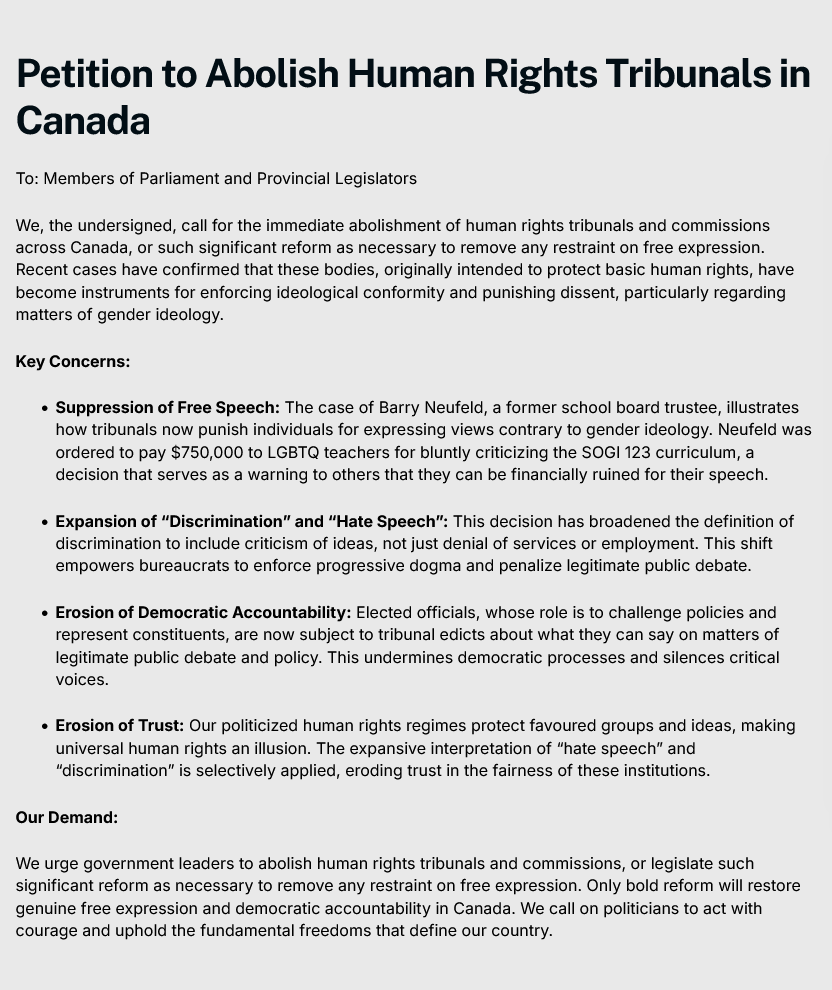

Canada’s Free Speech Union has launched a petition to get rid of all our anti-democratic Human Rights Tribunals in the wake of a BC man being penalized three-quarters of a million dollars for not bending the knee to the trans madness:
Practical Engineering
Published 21 Oct 2025All the things I love about Niagara Falls
The same thing that makes Niagara Falls impressive for tourists (the big drop) makes it valuable for power and a major challenge for shipping. And out of that comes all kinds of fascinating infrastructure.
Practical Engineering is a YouTube channel about infrastructure and the human-made world around us. It is hosted, written, and produced by Grady Hillhouse. We have new videos posted regularly, so please subscribe for updates. If you enjoyed the video, hit that “like” button, give us a comment, or watch another of our videos!
(more…)
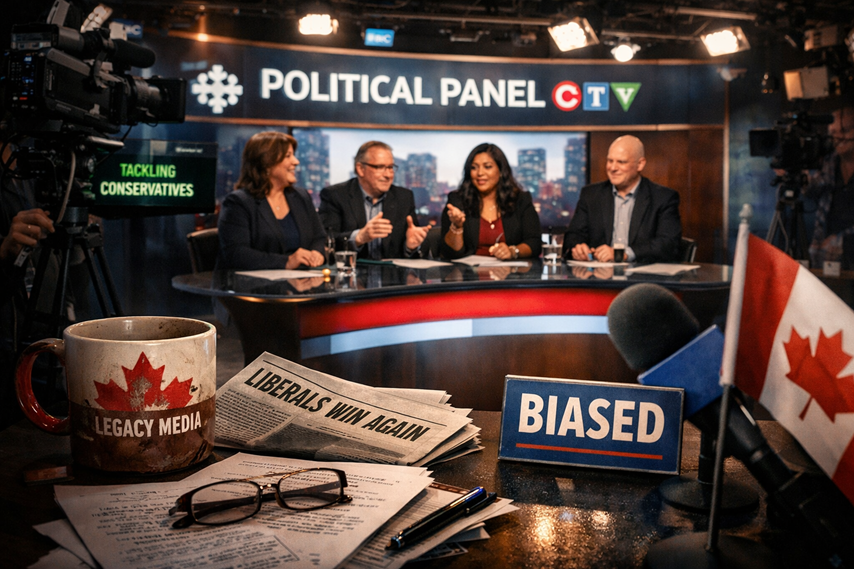
The federal government isn’t noted for being good with money. Yes, I know, understatement of the century … But they did make one investment that has been fantastically beneficial. For the Liberal Party, if not for Canadians in general. That investment was buying the support of almost all of the surviving mainstream media outlets by directly subsidizing their payrolls. Most media folks lean left anyway, but once their paycheque literally depended on keeping the Liberals happy, they joyfully co-operated in ways that 1930s German newspapers would blush at. On her Substack, Melanie In Saskatchewan explains just how far away from representative the media political spectrum has drifted (leftwards, of course, always leftwards):
If you were to draw a Venn diagram of the real Canadian political landscape and the pundit ecosystem on legacy networks, you’d find they barely overlap.
Rosemary Barton is the undisputed matriarch of the CBC’s political brand. As host of At Issue and Rosemary Barton Live, she shapes the entire panel tone for CBC political discourse and anchors the network’s election coverage. She has been at the helm of federal election panels since 2016, interviewing party leaders and moderating debates from coast to coast.
Canada’s mainstream media as Liberal Party propagandists.
Image from Melanie In SaskatchewanNow ask yourself this: if half the population consistently feels unheard by these panels, is that a coincidence, or the predictable result of decades of the same ideological herd wandering through the same studios?
Here is the rub. The At Issue panel rarely rotates through voices that actually represent today’s conservative electorate. Instead, it routinely features professional journalists and political insiders who debate among themselves, talking about conservatives far more often than they engage with conservatives whose voters make up a massive share of the country. That is not centrism. It is an echo chamber assembled by committee.
Then there is Andrew Coyne. He is often presented as the token ideological counterweight on At Issue, the panel’s supposed nod to conservatism. After all, he has spent decades as a columnist and editorial thinker, comfortably critiquing governments from a well upholstered perch.
But let us be clear. Coyne is not remotely representative of today’s conservative electorate. He is not a reflection of the current Conservative Party base. He is not channeling the instincts of voters outside the Ottawa and Toronto corridor.
Positioning him as the conservative voice on a national panel is not balance. It is branding. It allows producers to claim ideological diversity without ever inviting someone who actually carries the convictions, tone, or priorities of the modern conservative movement. Coyne is not a grassroots conservative. He is a professional pundit whose worldview fits tidily within the Ottawa insider class. That is not ideological contrast. It is controlled opposition dressed up as pluralism.
Meanwhile, audiences have been increasingly vocal online about the sense that these panels sound like academic seminars, not reflections of the lived experience of Canadians who didn’t spend their twenties in Ottawa press galleries.
On Substack, John Robson looks at the Canadian federal government’s lofty climate goals and their pathetic strategies to achieve those goals and the vast chasm between the two:

Chinese electric vehicles are likely coming to Canadian roads, like these BYD models.
Forgive us for being fixated on Canada’s climate follies just because we live here. But they are revealing, including the U-turn on EVs that we mentioned last week where the government yanked the steering wheel so hard they did a 360 from banning gasoline vehicles by law to banning them by regulation. Raising the question whether they actually know what they’re doing and, if so, whether they regard themselves as commendably devious or just way smarter than everyone else. We hope not the latter because the policy is going to fail big-time. As Randall Denley just warned in the National Post, “To summarize, the Carney plan relies on electric vehicles (EVs) that Ontario plants don’t produce, a sudden and dramatic new appetite for buying EVs and an imagined export market that doesn’t exist. To top it off, the federal government will provide $2.3 billion in EV rebates that will encourage Canadians to buy cars made elsewhere.” Apart from that, a stroke of genius of the sort that, through decades of diligent effort, has made the nation tragically poorer without hitting any of our targets including the one where they get more humble.
As a Globe & Mail news story blurted out:
A new study published Friday by the Canadian Climate Institute says Canada is not on track to meet any of its climate targets – not the 2026 interim emissions reduction target, the 2030 Paris Agreement commitment, or even the long-term goal of reaching net-zero emissions by 2050.
Oh. Pretty hard to make that one sound like an achievement, isn’t it? Or to sound as if the people who pulled it off should be trusted with the next one.
Now as we’ve complained before, the “Canadian Climate Institute” bills itself as some sort of dispassionate neutral observer when in fact it’s a creature of the state. And, worse, one of those lavishly-funded outfits (we deniers may have all the money, but they got $30 million from the Canadian government and we did not … uh no, that was just one grant, the total’s higher) that exists to push the government to do things it wants to do anyway but needs the appearance of “civil society” support to pull off.
Thus, the Globe sonorously informs us, the problem isn’t that the targets were impractical or the politicians and bureaucrats inept. Heck no. As usual with Thomas Sowell’s “unconstrained vision” of public policy, all you need is love:
The report suggests Canada has moved away from its climate goals thanks to “a slackening of policy effort over the past year, marked by the removal or weakening of climate policies across the country”.
Which gives the impression they had been on track to meet their goals up until some recent backsliding, whereas in reality they have never shown any sign of meeting them. After all, what policies have actually changed since Carney took over as Prime Minister in ways that could possibly affect long-term trends? And how close was Canada to meeting “its climate goals” before this disastrous swerve into the camp of the deniers?
It’s not even true that “Canada” as a collective has collective “climate goals”. The government has climate goals, and they come bundled with a host of other policies at election time, especially since even our “Conservative” party is terrified of challenging climate orthodoxy. Public support for those goals is weak, sporadic and prone to vanish when real costs hove into view. But ignoring that piece of typical collectivist prose, Mark Carney has spent most of his prime ministership flying around virtue-signaling in the presence of others doing the same. (No, really. It’s been less than a year and he’s taken almost three dozen flights.) He hasn’t been in the office shredding this and demolishing that.
Ruairidh MacVeigh
Published 18 Oct 2025During the 1940s and 50s, with World War II rapidly transitioning into the Cold War, Canada, as a major ally of the NATO nations and with large swathes of remote countryside that could easily be penetrated by Soviet fighters and bombers, created the CF-100 Canuck, one of the earliest production jet fighters in the world an a machine that, despite some early flaws, would go on to prove itself rugged and robust for patrolling the turbulent weather of the frozen Canadian north.
At the same time, though, the CF-100 was very much a product of its time, and despite its exceptional rigidity, by the middle of the 1950s it was very much obsolete as swept-wing and delta fighters rapidly became the norm for both Communist and Capitalist factions alike, and through its initial success would lay the groundwork for even more ambitious projects that sadly would not continue Canada’s major involvement in cutting edge military aerospace design.
Chapters:
0:00 – Preamble
0:49 – Facing a New Kind of War
4:28 – Ups and Downs
7:12 – Reworking the Design
10:36 – The CF-103 Project
15:51 – The Canuck Career
19:06 – Later Years
20:30 – Conclusion
(more…)
The Royal Canadian Navy is planning to replace its four current conventional submarines, the British-built Victoria class with a dozen new conventional submarines from either South Korea or Germany (a joint German-Norwegian design). Michael J. Lalonde, a former Canadian intelligence officer, goes through the requirements for the new submarines, the two contending designs’ strengths and weaknesses, and makes his own recommendation for the RCN’s next submarine class:
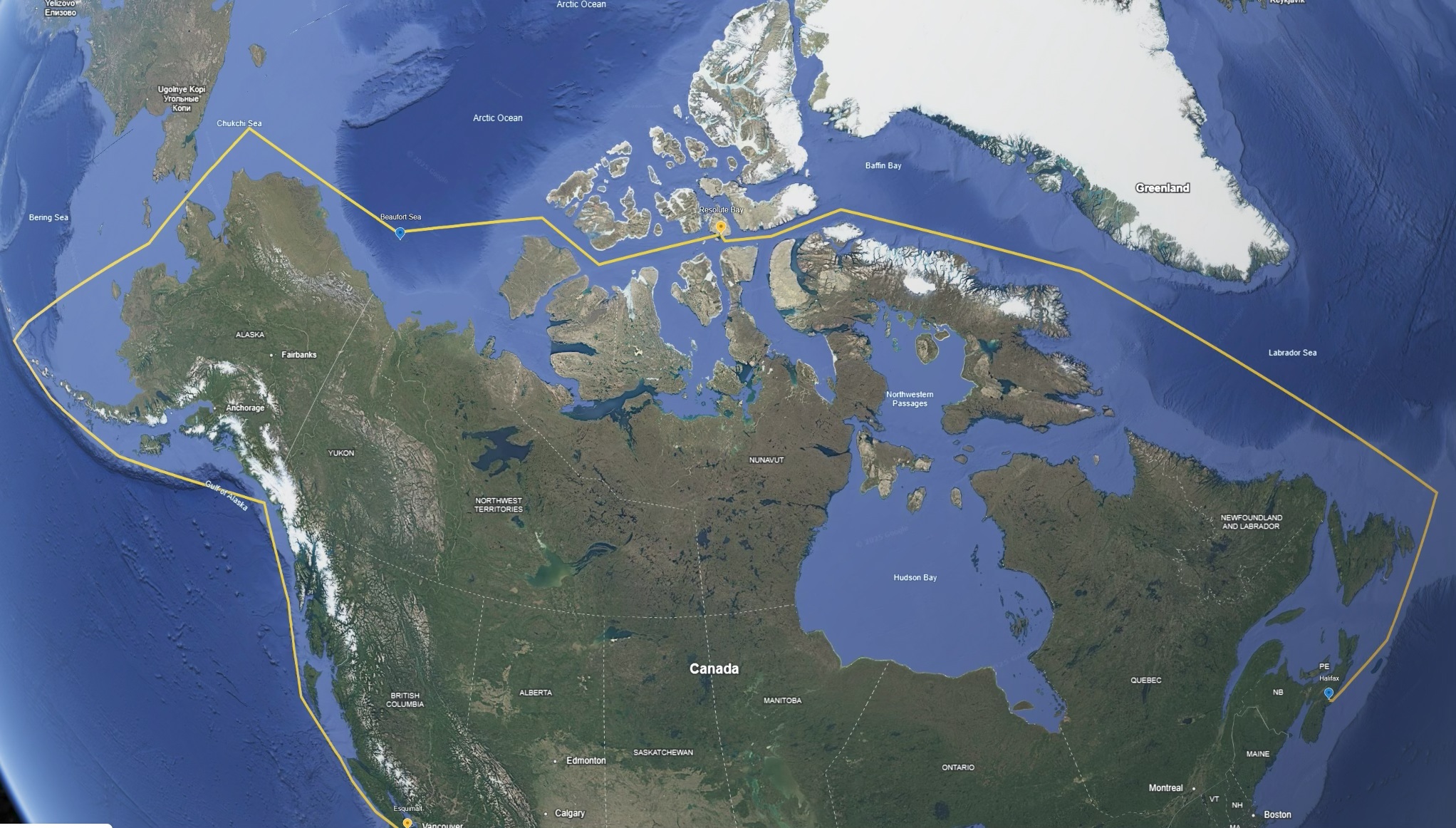
Rough transit routes to Canada’s Arctic from Esquimalt BC and Halifax NS
The first step is to assess what the Government of Canada wants out of its new submarine fleet and what capabilities it will need to achieve its objectives. I’m starting here because there is a common misconception that Canada needs submarines exclusively for Arctic patrol and surveillance, which is false. While it’s true that Arctic sovereignty and security are quite rightfully a preoccupation for the government, patrolling Canada’s Arctic is not the only capability Canada needs out of its new fleet. However, it is the most common argument in favour of a submarine fleet since Arctic sovereignty remains popular within Liberal and Conservative circles alike, along with mainstream media.
Unfortunately, this narrative forces a lopsided conversation about the role these new boats will be expected to play over the coming decades. In addition to Arctic operations, these subs will be expected to deploy far into the North Atlantic with NATO and push across the Pacific to support the Indo-Pacific Strategy. Ottawa’s own defence policy update ties submarine recapitalization to contributions with allies in both theatres.
This implies a blue-water capability, which means these conventionally powered submarines must be able to deploy and fight in the open ocean, far from home ports and daily logistics, for extended periods. This requires long range and endurance for transoceanic transits, sustained submerged persistence through air independent propulsion (AIP) and high-capacity batteries to minimize snorkelling, and habitability and maintenance margins that keep the crew and systems effective past the 30- to 60-day mark. Simply put, the new boats must be able to cross an ocean, remain covert and lethal on station, and deliver effects.
The government further stipulated specific capabilities that the new submarines must have in one of its press releases stating “Through the Canadian Patrol Submarine Project (CPSP), Canada will acquire a larger, modernized submarine fleet to enable the Royal Canadian Navy to covertly detect and deter maritime threats, control our maritime approaches, project power and striking capability further from our shores, and project a persistent deterrent on all three coasts.”
What caught my attention here is the ability to project power and striking capability further from our shores. Power projection is synonymous with a blue-water capability; however, a striking capability, which I take to mean a land strike capability, is not typical for a conventionally powered SSK, which are typically armed only with torpedoes to take out other submarines or surface vessels.
To sum up, Canada’s new subs must be able to:
- Patrol the Arctic with under-ice capability year-round
- Deploy with NATO in the North Atlantic and support Canada’s commitment to the Indo-Pacific Strategy – A blue-water capability
- Remain submerged for three weeks or more at a time
- Covertly detect and deter maritime threats
- Control Canada’s maritime approaches
- A range of 7000 + nautical miles
- Project power far from home ports
- Anti-surface and subsurface warfare
- Land-attack capability via cruise and/or non-nuclear ballistic missiles
- Insert Tier-1 special operators on coastal infiltration missions
- Conduct intelligence, surveillance, and reconnaissance in Canadian maritime approaches and abroad.
With that out of the way, let’s look at what each submarine can do.
He outlines the two competing designs and how they could meet the RCN’s needs and then plumps for the South Korean KSS-III for its stronger case for meeting those needs in the wider ocean environments than the German/Norwegian Type 212CD:
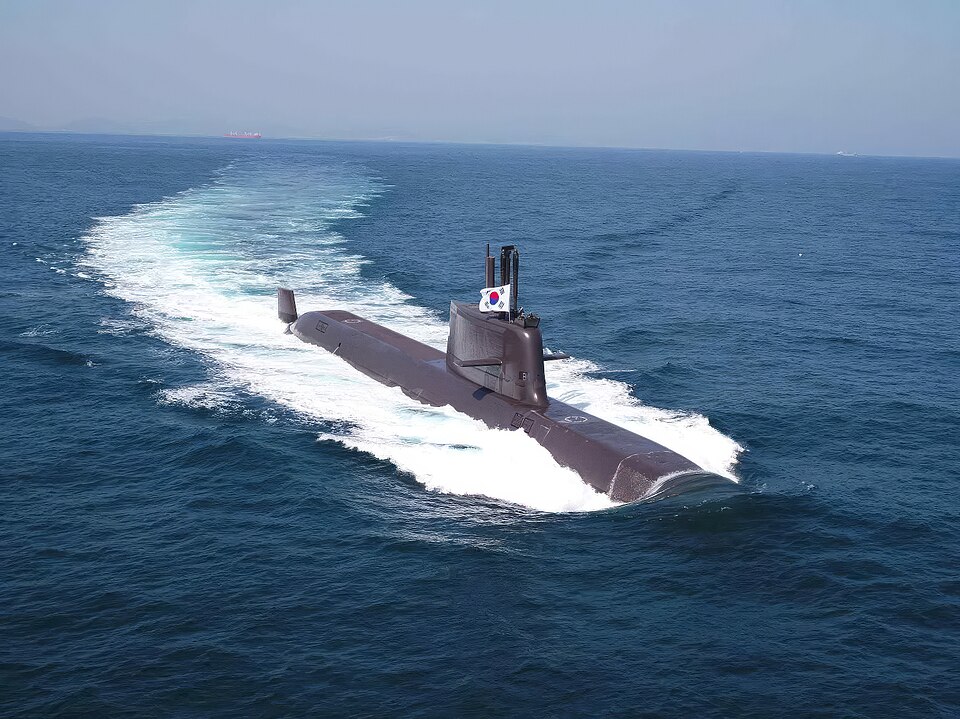
ROKS Shin Chae-ho, a KSS-III submarine at sea on 4 April, 2024.
Photo from the Defense Acquisition Program Administration (DAPA) via Wikimedia Commons.
The KSS-III is the only conventional submarine that can meet all of Canada’s requirements. It combines the blue-water reach and endurance demanded by transoceanic tasking with a vertical launch system that enables credible land-attack and complex anti-surface strike options, supported by lithium-ion batteries that lengthen quiet submerged persistence and improve sortie tempo on distant stations. Its larger hull and higher automation provide the habitability and crew margin needed for 30 to 60 day deployments from Halifax and Esquimalt to the North Atlantic, the Indo-Pacific, and the Arctic ice edge, while remaining within the conventional, non-nuclear profile Canada has set. The design’s modern combat system and sensor suite can be integrated with Canadian and allied command, control, and targeting architectures, and the bilateral sustainment framework required with South Korea can be structured by contract to include full technical data access, in-country training pipelines, and an industrial workshare that anchors through-life support domestically. The delivery cadence proposed for a 2026 award would shorten Canada’s reliance on the Victoria class and reduce associated sustainment exposure during transition, while an initial Canadian order of up to twelve boats would give Ottawa a controlling voice over configuration management, growth paths, and export-variant standards for the life of the class.
Most self-described conservatives in politics are not particularly inclined to “conserve” anything, as Spaceman Spiff points out, they’re pretty much onboard with the liberal vision they just want it to be fractionally slower or infinitesimally not-quite-as-liberal as the liberals. They are the ineffectual, neutered, tame opposition:

Modern conservatism is not conserving our world. Mainstream conservatives seem to have no interest in the real issues affecting us.
At best they merely wish to slow down our decline. At worst, they are fully on board with the destruction.
When they do act or speak they often pick a safe version of a sensitive issue.
In Britain there is lots of talk of illegal immigration and how the state mishandles it. None about ruinous volumes of legal immigration, almost one million per year, and what it is doing to the country.
Pushback against climate policy falters on the speed of changes, not the underlying fraud of climate science itself.
No conservative will honestly discuss the plummeting happiness of women recorded across the West and yet there it is, writ large in antidepressant prescriptions and social media videos. It may have multiple causes, but feminism cannot be challenged so they say nothing lest they are reprimanded by the sisterhood.
Everything real is forbidden. It is all an act.
Like the left, those on the right are increasingly unable to face reality which means they can never course correct. They are trapped within a self-referencing culdesac designed to maintain their position in someone else’s hierarchy. That is why they have become so ineffective and appear to do very little except moan about the pace of change while they say nothing about the changes themselves.
We sense the conservatives do wish to conserve things but they are inexplicably mesmerized by the opinion of their enemies. They seek reassurance and applause from people who view them as evil.
This makes no sense to ordinary people.
Thinking like the enemy
The problem with modern conservatives is they are animated by underlying drives that cannot create a conservative or traditional society. They have adopted the thinking patterns associated with the progressive left while still using the language of conservatism.
The left is traditionally defined by a series of interrelated traits that manifest in much of what they agitate for.
- A desire for centralization;
- A notable external locus of control;
- Seeking approval from the group.
Central control systems feature prominently in all left-wing schemes. From local councils to national governments, those who gravitate to the left often want to create centralized decision-making bodies to manage society. Institutions, government departments, NGOs and even charities all feature, but only when they act as the controlling authority in some field of interest.
Related to this is a clear external locus of control visible in individuals and their decisions. There is a relief others make the key decisions, so people actively seek out direction from an established authority. This ensures minimal resistance to the many centralized schemes we see emerge.
Acting solo creates discomfort. An older formulation understood this as the rejection of responsibility. Today it often manifests as an obsession with experts making key decisions for us all, partly to mask individual cowardice. People making their own decisions in life are derided as naive or dangerous.
During Covid decision makers became hysterical at the very idea we would reject the advice of experts and perform our own research despite the issue being medical and therefore dangerous.
A related phenomenon characteristic of many leftists is the need for approval, often from a group. Not just others making decisions but a dependency on confirmation and endorsement to ensure thinking and behaviour follows an established norm. This is the antithesis of original thinking or bold action; it is how adolescents often behave.
In today’s world this deep urge is reflected most in the social media landscape of harvesting attention and likes. Every fledgling narcissistic applause-seeking trait is given full expression in the endless search for approval from strangers. Whole sections of society seem lost to impulses we once understood as immature and dysfunctional.
Update: Not long after I queued this item for publication, a Canadian example popped up in the news, as yet another rock-ribbed “conservative” suddenly realized that electing a Liberal was what his constituents actually wanted when they inexplicably voted for him as a Conservative candidate in the last federal election.

Edmonton Conservative MP Matt Jeneroux has crossed the floor to the governing Liberals.
“I am honoured to welcome Matt Jeneroux to our caucus as the newest member of Canada’s new government,” said Prime Minister Mark Carney, in a post on X.
“I am grateful to Matt and his family that he will continue his service as a strong voice for Edmonton Riverbend in Parliament.”
Carney said Jeneroux, who has represented the riding of Edmonton Riverbend since 2015, will take on a new role as special advisor on economic and security partnership for the Liberals.
Jeneroux is the third Conservative to join the Liberals, after colleagues Michael Ma and Chris d’Entremont crossed the floor late last year.
A Liberal source says Jeneroux first met Carney back in November, which was the first of at least two conversations, with talks between Carney’s office and Jeneroux continuing since. That source added that it has been a “long journey” to Wednesday’s announcement.
d’Entremont crossed the floor to join the Liberals in November, which unleashed a wave of speculation as to who might be next, with Jeneroux’s name heavily floated. Jeneroux then announced his plans to resign from the Conservative caucus, citing family reasons. Since then, he has not voted with the Conservatives and did not attend the party’s recent convention in Calgary in late January.
After Carney’s announcement, the prime minister updated his daily itinerary, adding a stop in Edmonton to meet with Jeneroux before attending events in British Columbia.
“Matt brings a wealth of experience in Parliament, despite his young demeanor,” said Carney, while sitting next to Jeneroux.
The MP from Edmonton welcomed the prime minister and laid out the reasons for why he had reversed his decision to resign.
“I had announced my resignation back in November, largely due to family reasons, but quite simply, couldn’t sit on the sidelines after seeing what the prime minister’s ambitious agenda he was undertaking across the country and across the world,” he said.
“Quite honestly, it was the speech in Davos where you took everything head on,” he added.
Jeneroux said it felt disingenuous and “quite simply wrong” to sit on the sidelines.
We had a look at how well the British government looks after asylum-seekers yesterday, but other nations are probably doing similarly inequitable things to give money and services to non-citizens than they ever would for the people who pay the taxes for these over-generous programs. In the National Post, Tristin Hopper outlines the findings of a recent analysis from the Parliamentary Budget Office on the costs of supporting huge numbers of foreign nationals in Canada:
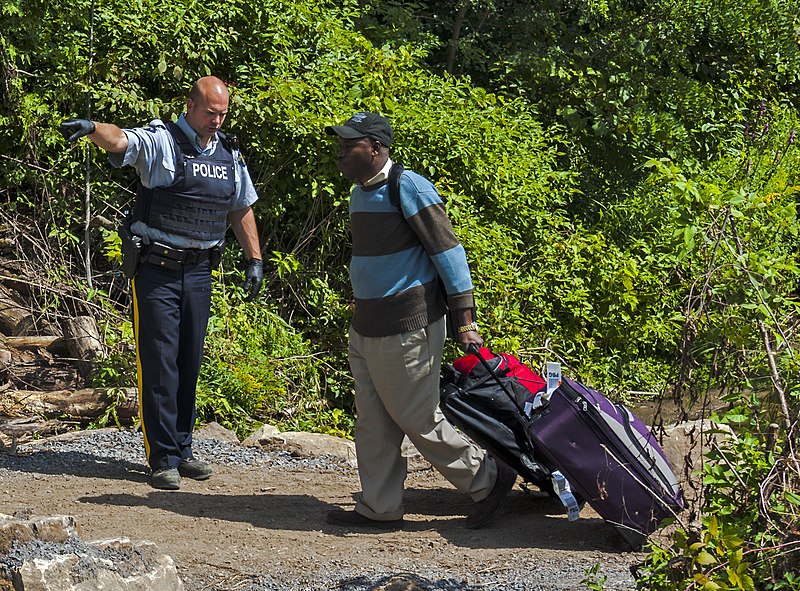
An asylum seeker, crossing the US-Canadian border illegally from the end of Roxham Road in Champlain, NY, is directed to the nearby processing center by a Mountie on 14 August, 2017.
Photo by Daniel Case via Wikimedia Commons.
Paying the health-care premiums of refugee claimants will cost Canadians a record $1 billion this year, with some of the beneficiaries continuing to receive free health care despite their claims having already been rejected.
That’s according to a new analysis by the Office of the Parliamentary Budget Officer, and it’s just one of several ballooning costs wrought by the unprecedented number of foreign nationals currently living in Canada by virtue of a claim of refugee status.
The Interim Federal Health Program, which offers premium health benefits to asylum claimants, is soon set to hit $1 billion in annual costs for the first time, according to an analysis last Thursday by the Office of the Parliamentary Budget Officer.
This is a five-fold increase from just six years ago, when the program was costing $211 million per year. The analysis also projects that costs are expected to surge for the foreseeable future, with the annual budget likely to hit $1.5 billion as early as 2029.
All told, between now and 2030, Canadians are on track to spend $6.2 billion on health care for refugees or refugee claimants.
“The rising volume of asylum claims, along with the longer duration of eligibility caused by extended determination times, has been an important growth driver in recent years,” reads the PBO report.
The report was commissioned following a Conservative-led request made at the House of Commons standing committee on health. In a Thursday statement, the Conservative party noted that the Interim Federal Health Program can be accessed even by asylum claimants who have had their case rejected.
It also offers a higher level of care than that enjoyed by the average Canadian citizen. In addition to hospital care and surgical care, the IFHP also covers dental care, vision care, pharmacare and other services not typically covered by public health plans.
“Rejected asylum claimants are now receiving better health care than many Canadians who have paid into a system their entire life,” read a joint statement by Dan Mazier and Michelle Rempel Garner, the shadow ministers of health and immigration, respectively.
It added, “at a time when six million Canadians cannot find a family doctor and are waiting for care, it’s unacceptable that bogus asylum seekers are receiving better health benefits than Canadians”.
At Without Diminishment, Geoff Russ traces the rise of the “global hub” among western cultures and identifies why we shouldn’t strive to drown distinct local cultures under a tide of “could be anywhere” multicultural slop:

London’s vibrantly diverse bus riders … or is it Toronto … or Sydney … or Montreal?
Multiculturalism is the false prophet of celebrating difference, presented as the ultimate engine for “diversity”.
In practice, it is a factory of global homogenisation, and a solvent that erases local cultures. Cities like Sydney, Toronto, and London now compete to be the top “global hub”, which is no unique identity at all.
There is no preservation of character under the hegemony of the global hub, only its erasure. The officially multicultural city is uniform across continents, like clones of each other in all but the most superficial ways. It sounds contradictory on the surface, but makes perfect sense once it is understood that multiculturalism as a policy and identity is inherently anti-cultural.
The multicultural city has nearly identical urban design, and its bureaucrats and professionals weaponise the same moral vocabulary, deploying terms like “inclusivity” and “openness“. It has all the charm of an airport lounge, justified with the same slogans, decorated with the same grey glass-and-steel architecture, and guided by the same self-reinforcing sensibilities.
It makes people docile, and rewards them with sensory appeasement, like supposedly exotic cuisine. A fusion rice bowl is the consolation for the disappearance of the environment you grew up in.
In Canada, it first came to the Anglo cities like Toronto and Vancouver. Now it has broken linguistic and cultural containment into Quebec. For decades, Montreal was the metropolis of the Québécois. Now, as Kevin Paquette outlined last month, the city has changed. It mirrors the anti-culture that took over Toronto, and has no use for the legacy of those who built it.
Paquette described how Montreal has become a “filter” that promotes an internationalist identity that renders it alien to Quebec’s exurban regions. Bloc Québécois (BQ) leader Yves-François Blanchet has warned that “two Quebecs” have emerged, which are disconnected and alienated from each other.
Jean-François Lisée has gone further, and written of the emergence of an “anti-Québécois identity” in an increasingly diverse Montreal. In public schools, students openly mock the Québécois, and English is more commonly spoken than French in the hallways.
Lisée writes that an alternate, anti-Quebec dynamic now exists among some newcomers. In this dynamic, attachment and assimilation into the Québécois identity become contemptible.
This is the essence of multiculturalism when treated as an end in itself. “Inclusion” is the hollowing out of the obligation to belong, and the transformation of identity into a lifestyle choice.
Not even Quebec City is immune. It was long a living, breathing exception to Canadian multiculturalism, with a dominant Québécois culture and ethos. However, the mayor, Bruno Marchand, has embarked on a mission to destroy what makes it distinct.
The following sentence is from a glowing feature in the Globe and Mail last week: “Mr. Marchand says his hometown’s traditional pure laine image is changing, and it’s a good thing”.
Quebec City’s inherited way of life is being targeted so that it can become just one more global hub. The city’s established symbols, traditions, and habits stand in the way. It takes remarkable ideological and moral heavy lifting to dismiss provincial identities as unworthy, and as something that must inevitably be replaced.
The city still carries deep meaning for francophones across the country.
“I’ve never lived there, or in the province of Quebec, and yet it speaks to me profoundly,” said one resident of Ontario I spoke to. “This is where my ancestors landed 400 years ago and it still bears witness to them.”
What was the point of Quebec’s 400-year effort to survive if it becomes a mirror image of what has happened to the rest of Canada?
Ontario, and the rest of Anglo-Canada, have long been conditioned to regard its own inheritance as unworthy of loyalty or respect.
Anglo-Canada is bound up in the history of the British Empire, the most fashionable whipping boy of leftist academics and activists. Due to the institutional power of these malcontents, it naturally follows that Canada’s historic and cultural self is treated as an embarrassment, whose memory is a problem that must be solved, or rather dissolved.
Update, 17 February: Welcome, Instapundit readers! Have a look around at some of my other posts you may find of interest. I send out a daily summary of posts here through my Substack – https://substack.com/@nicholasrusson that you can subscribe to if you’d like to be informed of new posts in the future.
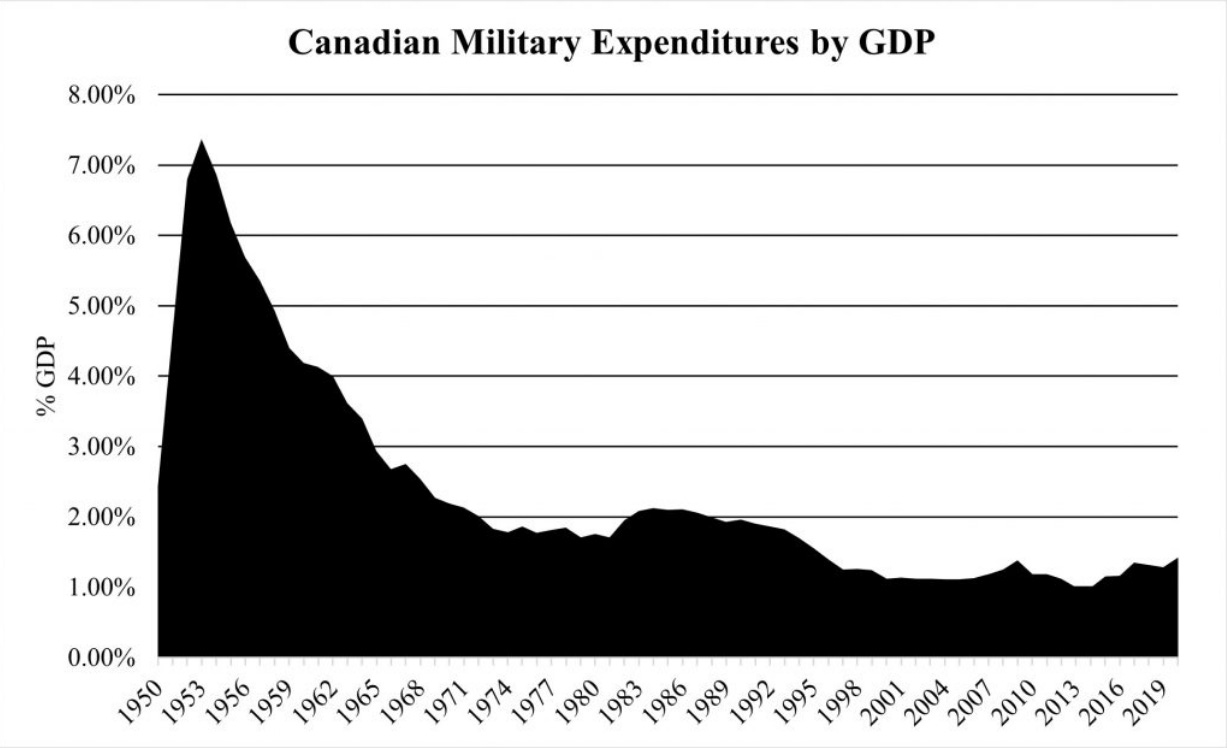
Canada’s military was not always a punchline. At the end of World War II Canada had the world’s third-largest navy, complete with our own aircraft carrier, and over a million men under arms. Since then military spending has steadily declined, from a high of around 7% of GDP in the early 50s to around 1% today, where it’s hovered since the end of the Cold War.
Canada is protected to its east and west by the Atlantic and Pacific oceans, both of which are patrolled by the powerful navy of the friendly superpower to the south, the only country with which Canada shares a land border, which we have long bragged is the longest undefended frontier in the world. Our only other neighbouring country is Russia, and while Russia is a decidedly unfriendly superpower, in practice Canada’s populated south is separated from the Russian Federation by thousands of kilometres of howling arctic wastes which provide an even better natural defence than the oceans.
Cozy and secure in our continental cocoon, Canada has allowed its military to atrophy into a vestigial appendage akin to the stubby wings of flightless birds on isolated Pacific islands, useful only for emotive displays. So far as the Liberal Party is concerned, “emotive display” is, indeed, the only real purpose of the military. Ever since Lester B. Pearson1 was awarded the Nobel Peace Prize for inventing the concept of “peacekeeping” to de-escalate the Suez Crisis (thereby helping to drive the final nail into the coffin of the British Empire), the Canadian military’s primary purpose has been to conduct third-world relief missions. Peacekeeping carries no particular benefit to Canada, but it is of great benefit to politicians, who get to preen in front of the camera as important humanitarian statesmen. The purpose of the Canadian military isn’t to win wars, to defend the country, or to conquer distant lands: it’s to make Liberal Party politicians feel good about themselves.
When the CAF fails to live up to its making-liberals-feel-good mission, Canada’s liberal establishment reacts like a frustrated child taking out her vindictive cruelty by throwing her dolls against the wall. The Somalia Affair is probably the best example of this dynamic. The Canadian Airborne Regiment, an elite commando unit whose core competencies were jumping out of airplanes to break things and kill people, was deployed in Somalia with the contradictory goal of keeping a non-existent peace, a mission to which they were singularly ill-suited. Somalis being Somalis, the Airborne base was immediately subjected to continuous infiltration and theft. A handful of the violent lunatics in the regiment reacted by capturing thieves and torturing them to death, which they had the poor sense to document with photographic evidence; later, photographs emerged of one of the airborne troopers wearing a moustache man t-shirt while raising his arm at a prohibited angle, which wasn’t criminal exactly but was very bad PR. Instead of punishing the guilty troops individually, for instance with field courts martial followed by summary hanging, the Liberal Party flew into a rage and disbanded the regiment for having committed the unforgivable sin of making them look bad. This dragged on in the media for years, sullying the honour of not only the Airborne Regiment but of the entire military. The Somalia affair unfolded over thirty years ago, but the liberal establishment holds it over the heads of the CAF to this day.
In addition to providing politicians with regular hits of the pleasantly addictive buzz of telescopic philanthropy, peacekeeping also has the great advantage of being cheap. Not only does peacekeeping not require all that many troops, you don’t even need tanks, fighter jets, destroyers, or aircraft carriers to distribute aid packages to refugees. Therefore the Canadian military essentially does not have these things. The CAF has a grand total of 112 forty-six-year-old Leopard II main battle tanks (of which roughly half are down for maintenance at any given time), a whole 138 forty-two-year-old CF-18 Hornet fighter jets (of which 89 are operational), twelve Halifax class frigates (of which about half are in drydock at any given time), an intimidating four Victoria class diesel-electric submarines (which are forty-five years old, and all but one of which is out of commission), and zero bombers, zero attack helicopters, zero destroyers, zero troop transports, zero battleships, and zero aircraft carriers. The pathetic size of the Royal Canadian Navy is particularly embarrassing given that Canada has the longest coastline in the world, at 243,042 kilometres, essentially all of which Ottawa expects Washington to defend on its behalf. Airlift capacity is so limited that the CAF essentially cannot deploy overseas without allied logistical assistance.
By contrast with its decrepit armaments, the CAF has 145 generals: it has more generals than it does tanks. This top-heavy general staff is only about a third the size of the US military’s, despite the American military being 20x larger by personnel and 32x larger by budget.
From the perspective of the Laurentian elite, a weak military is actually a political advantage. If Canada effectively does not have the ability to project military force, Ottawa can simply plead lack of capacity when America asks for assistance. It enables Canada to duck out of involvement in America’s various imperial wars, letting Washington shoulder the burden of the Pax Americana while chirping from the sidelines about how the big bad bible-thumbing American bully is so mean, and how peaceful, ethical, liberal, humanitarian Canada is so nice because Canada spends its money on healthcare instead of bombs. It isn’t a morally superior position, of course: it’s simply shameless dependence and shameful parasitism.
John Carter, “The Canadian Political Class is Ideologically Incapable of Rebuilding the Military”, Postcards From Barsoom, 2025-11-13.
- The man who, as prime minister, replaced the red ensign’s ethnic heraldry with the maple leaf’s corporate logo.
The Canadian government is trying to get even more power to exempt their friends and favoured companies from needing to comply with any federal laws or regulations through a provision in an omnibus bill before Parliament. It may sound like a tool to dispense privileges and favours to politically well-connected individuals and organizations, but that’s only because that’s exactly what it does:
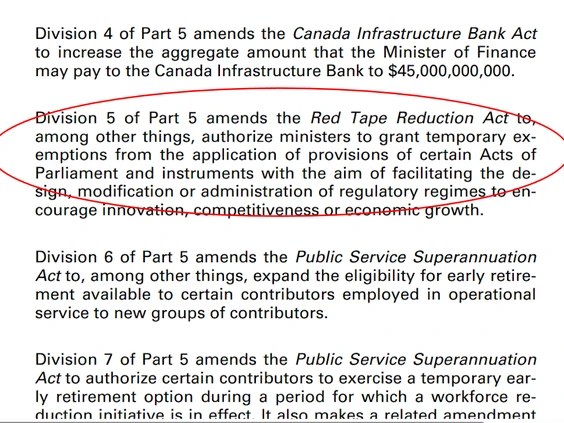
In a little-noticed provision included in the government’s latest omnibus bill, Carney government ministers would be able to override almost any non-criminal law they wanted, and provide special treatment to any person or corporation who requested it.
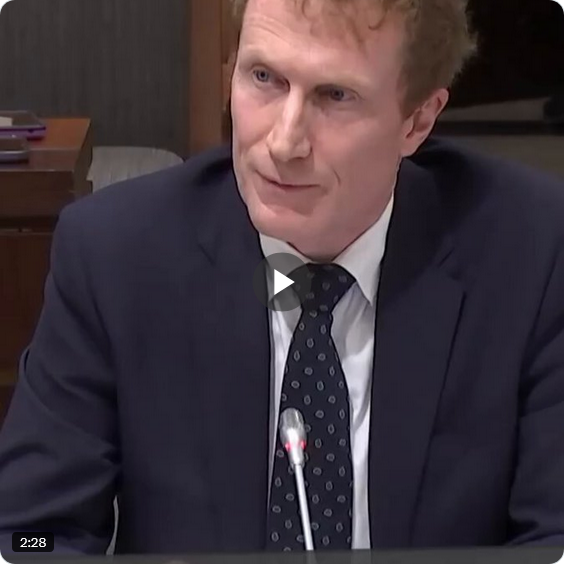
When pressed about the clause in a House of Commons committee this week, Minister of Canadian Identity Marc Miller called it a “useful tool to have”.
The provision is included in C-15, the 634-page “budget implementation” bill currently before the House of Commons.
Among its hundreds of amendments and orders are new powers allowing ministers to hand out special exemptions from any “Act of Parliament” under their purview.
This means that the minister of health would be able to issue exemptions from the Canada Health Act, the Indigenous services minister could oversee exemptions from the Indian Act and the minister of finance would be able to override the Income Tax Act.
Furthermore, ministers could hand out these exemptions to any “entity” they wanted. Under federal guidelines, an “entity” can mean everything from an individual to “a corporation” to an “unincorporated organization”.
You don’t need to be a conspiracy theorist to see all kinds of ways that this provision could be abused to circumvent the normal rules everyone else is bound by. On the social media site formerly known as Twitter, Wall Street Apes reacts:
I can’t even believe this is real
Canada Minister Marc Miller is questioned about their new bill under the Liberal government led by Prime Minister Mark Carney that would EXEMPT ALL MINISTERS FROM ALL LAWS
Yes, you heard that correctly
Hidden in the omnibus budget implementation bill, section 208 or clause 12 amends the Red Tape Reduction Act to grant federal cabinet ministers broad discretionary powers
Ministers would be able to temporarily exempt any individual, company, organization, or entity from the application of almost any provision of any federal law (or regulations made under those laws) that the minister is responsible for administering or enforcing, with the sole exception of the Criminal Code
They can themselves, and deem anyone they choose exempt from ALL laws. The only exception is the criminal code
He says you can trust them because “Canadians expect us to act reasonably”
(Holy cr*p)
On her Substack, Melanie in Saskatchewan explains why the rule of law is not optional in Canada:
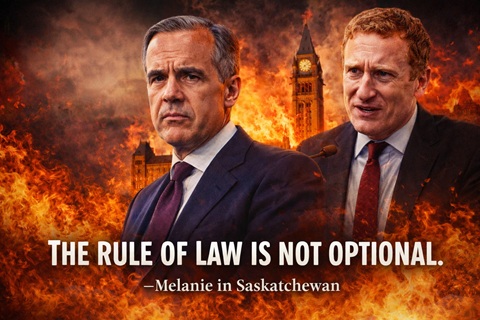
So let us play this forward. A Beijing connected firm establishes operations in Canada. It hires lobbyists. It meets with the appropriate minister. It argues that certain federal regulations are barriers to innovation or economic growth. Under Bill C 15, that minister could grant a temporary exemption. The company does not need to change Canadian law. It does not need to persuade Parliament. It only needs to persuade the right minister.
That is what should alarm Canadians.
When laws become selectively waivable by political discretion, they cease to be stable guardrails and become negotiable privileges. And power, once granted, is never granted because someone intends to leave it unused.
You tell us this is about economic growth amid trade tensions. Yet Canadians were told you were elected to steady the ship on trade and tariffs, to negotiate strength abroad, to stabilize economic uncertainty. Instead, trade tensions persist, tariffs remain contentious, and what advances efficiently is domestic policy architecture that conveniently aligns with the climate finance world you know so well.
Brookfield’s climate investment arm stands to benefit enormously from aggressive climate frameworks. You remain heavily invested. The potential for substantial personal financial gain is not speculation. It is disclosed reality.
You were not elected to refashion Canada into a climate investment thesis calibrated to suit global asset management portfolios. You were elected to manage trade pressures and protect Canadian economic interests.
This exemption clause is not a minor technical detail. It is a structural shift in how power is exercised. If it is so defensible, extract it from the omnibus bill and introduce it as standalone legislation. Let it be debated openly. Let Canadians see it clearly.
Implement a robust foreign agent registry immediately. Answer why a government that acknowledges compromised parliamentarians believes this is the moment to expand ministerial discretion over who must follow federal law.
The rule of law is not optional.
And Canadians did not vote for a system where compliance is mandatory for citizens but negotiable for the well connected.
CDR Salamander reacts with some exasperation to how European mainstream media are choosing to report pretty much anything involving the US/NATO relationship:

I’ve about reached my limit on lazy, high-emotion/low-reason, or performative reporting from Europe on the NATO/U.S. relationship. If the EuroLeft/EU-uber-alles crowd was really concerned about keeping the relationship between the U.S. and European NATO as good as possible, they would be making an effort to bridge and salve over some of the tough-love comments coming out of DC.
However, that is not what they are doing. No, they are seeing a gap, and are trying to pound a wedge into it. They see a spark, and look to throw a litre of petrol on it.
I guess what galls me the most is that their actions are, in operation, producing exactly the opposite condition they will tell you they are concerned about.
These are not dumb people. They, or the ones they work for, know what they are doing. At best, they are farming rage clicks. At worst, they are moving towards a desire the core of the EU nomenklatura has been driving for over decades — get the U.S. out of Europe.
They have found allies in part of the U.S. right-of-center coalition … and they will leverage that as well.
The below is just another example. A ham-fisted one, but one nonetheless.
Let’s dive in.
I don’t like to call out people by name … wait … yes I do.
Anyway, this isn’t personal; this is professional. No, wait. This reporting is so bad that, as a former proud NATO staff officer, I cannot let this stand. It is kind of personal. Plus this makes a larger point.
It isn’t petty either. As mentioned above, very serious people who are not our friends or our NATO allies’ friends — most of whom are citizens of NATO nations — are trying to seize the moment to push a multi-generational effort to wedge conflict between the U.S. and the Europeans in NATO.
Yes, there are some who are unknowingly doing their bidding, but make no mistake — bad reporting is allowed for a variety of reasons and should be called out when it happens.
First the larger point, then the details.
The reaction in Europe to the clear and direct peer counseling of our European allies by the U.S. over the last year has just demonstrated the fact that many of the people who put themselves forward as “experts” simply do not have either the knowledge or inclination to be anything of the sort.
For ideological, political, or standard issue look-at-me’ism, reporting about the state of the alliance and the American place in it drifts from farcical to the edge of a PSYOPS project by the usual suspects of the EuroLeft who have been trying to prove their anti-American bonafides since they first flirted with the cute socialist girl at the anti-NATO march in college.
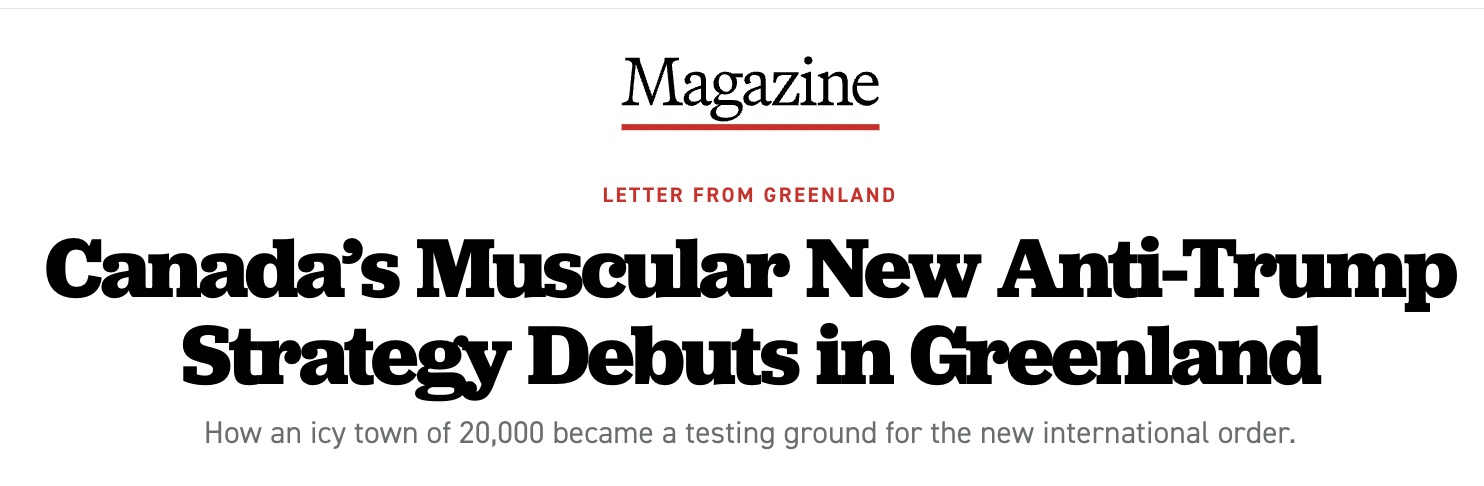
In related news, Chris Bray discusses Canada’s “Muscular New Anti-Trump Strategy™”, showing that it’s not just EU-based media to be suspicious of:
Recall the recent discussion here of the “Carney Doctrine”, after Canadian Prime Minister Mark Carney threw down the gauntlet at Donald Trump’s feet. Orange Man Bad, so Canada is going to become a rising power and lead a new international coalition to challenge the cruel American hegemon and stuff. The deeply silly opinion pages of the deeply silly New York Times celebrated Carney’s deeply silly speech, and declared the potential emergence of “an economic and defense alliance that rivals American power.” Back when all of this happened, I discussed the obvious condition of the Canadian armed forces, and advanced a sophisticated argument that LOL.
Reality keeps making the same joke. At the Federalist this week, I wrote about the recent notifications in the Federal Register about a series of arms deals that will allow Canada to make large purchases of American weapons. So as Carney spoke about challenging American military power on the world stage, he knew that his plan for doing that was to get the weapons from America. It’s an I want to punch you in the face, but first I need you to teach me how to throw a punch maneuver.
And then, this morning, Politico dropped this bomb, by which I mean that Politico has been eating a lot of Taco Bell and dropped into a stall in the gender-neutral office bathroom:
Muscular! Canada’s been puttin’ in work at the world order gym.
Note subhed: This is a story about “the new international order”. America is being shoved into the global background, now, as Canada flexes its haaaard new muscles. The story is illustrated with a ship, so obviously a huge announcement about naval powe— nope.
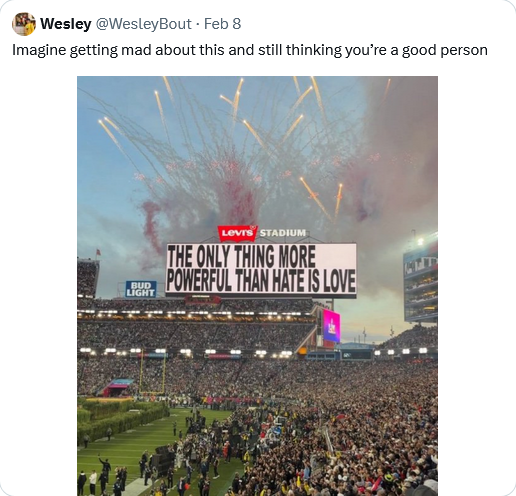
On the social media site formerly known as Twitter, Christian Heiens responds to a typical rage-baiting “we’re all good people except those evil right wingnuts” post:
Every invocation of “universal love” is always invoked to legitimize a very particular form of hatred.
The Left does this thing where it denies the existence of its own ideology as being political at all. It’s just “love”. It’s just morality-as-politics, or simply “being a good person”.
And Leftists insist this is all they’re doing, even as they engage in the most aggressive and ruthless forms of politics imaginable.
Nothing is ever depicted as a power struggle between competing worldviews. It’s always a crusade against social ills, pathologies, and evil itself.
“Conservatism” doesn’t exist to these people. There’s no legitimate opposition, only a criminal element that has to be destroyed because Leftists have already declared themselves to be the universal manifestation of morality, peace, kindness, love, progress, and everything that is good and just in this world.
But everyone can see just how utterly hypocritical these people are. We continuously see examples of these same people exhibiting the most immoral, disgusting, and downright evil manifestations of hatred and violence against people and factions that they despise.
They just call it “love” as they do these things.
Meghan Murphy has a similar point on progressive delusion and its domestic variant, Canadian delusion:

The phenomenon of progressive delusion is very much like the phenomenon of Canadian delusion. Both groups go about their lives presuming that everyone not only respects and admires them, but sees them as they see themselves: 100% right.
There is zero doubt in the minds of progressives and Canadians that the entire world envies their intelligence — they are the most informed, the most invested in The Science, the most rational, and the most educated. Not only that, but they view themselves as the kindest, most compassionate, and most polite.
Should a progressive deem not to ostracize, scream at, or punch a person who dares hold non-left political views, they consider themselves very generous. Imagine! They, a Correct and Good, allowing a Hateful, Stupid, and Wrong to share the same air as them.
The assumption that everyone around them bases their lives and relationships on political parties, activist movements, and propaganda that has been consistently wrong for at least a decade is strange. Imagine buying the Covid scam hook, line, and sinker, or repeating “Transwomen are women” ad nauseam for five+ years, and still assuming you and your “side” are right about everything. Imagine continuing to insist that the “good” side is that side that advocated for child sterilization, forced the elderly to die alone in hospitals on account of a cold, and banned people from the internet and public life for speaking truths we all acknowledge are true now, but were not your party line a few years ago.
I hate to break it to you, but you are the bad guys, not us.
If you depend on the CBC, the Toronto Star or other legacy Canadian media, if you heard anything at all about Bowmanville-Oshawa North MP Jamil Jivani’s visit to key American leaders in Washington DC, you probably got the story framed as Liberals tut-tutting and disapproving of Jivani, his initiative to make the trip, and how he should leave everything to the government. If nothing else, it further proved that Prime Minister Carney doesn’t actually want better relations with the US, as his entire campaign was based on opposition to Trump and its success in riling up Canadian boomers with the moronic eLbOwS uP nonsense.
In the National Post Jivani discusses the trip and what he’s learned from it:
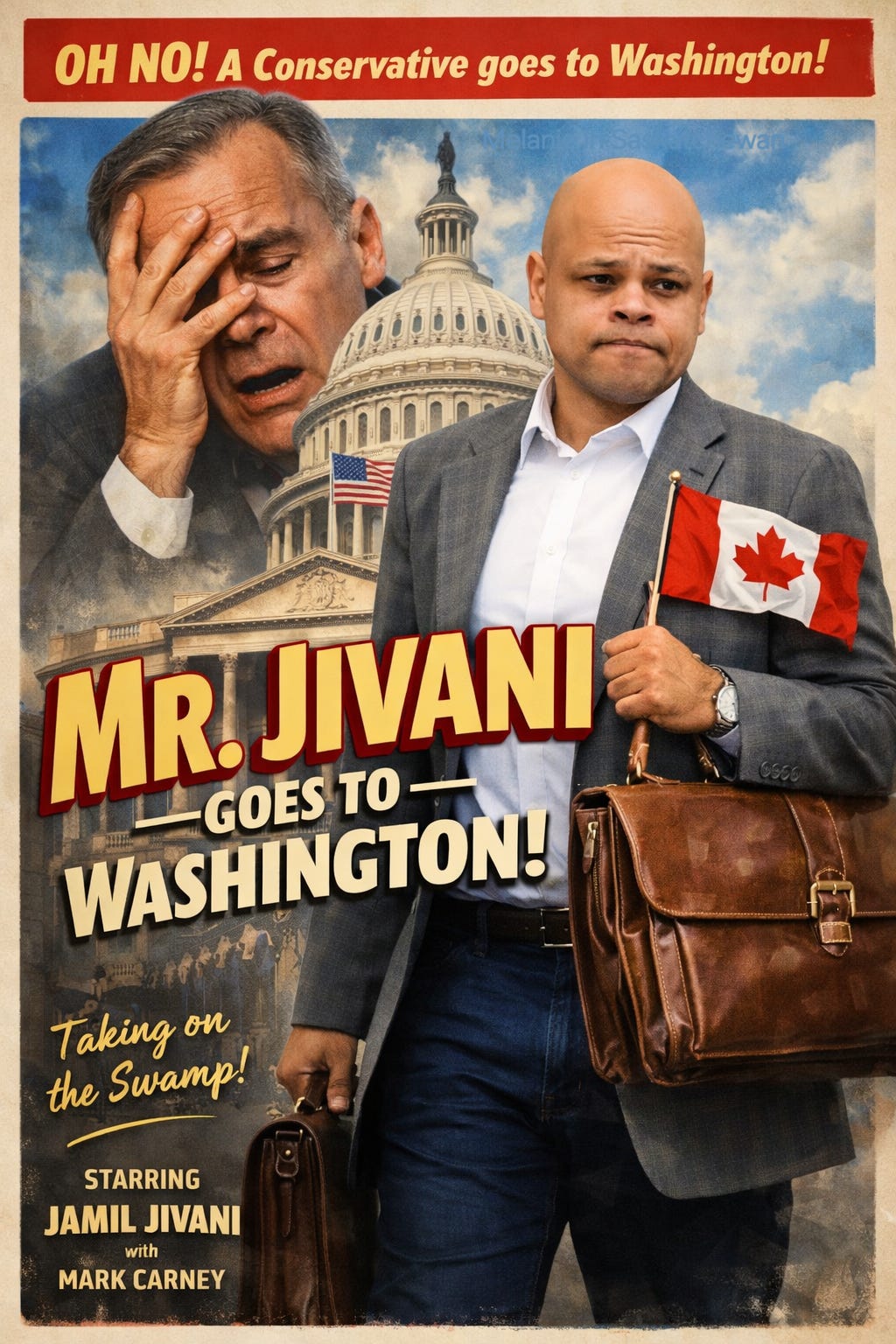
Image from Melanie in Saskatchewan
It was a whirlwind of a trip, full of excellent conversations. I had meetings with the White House and State Department, including conversations with President Donald Trump, Vice-President JD Vance, and Secretary of State Marco Rubio. Senators from Montana, Ohio, and Wisconsin, as well as the United States Trade Representative, each sat down with me to share their priorities. Businesses and industries employing thousands of Canadians shared their insights with me on where Canada-U.S. trade fits into their vision for economic growth.
Doors were open for dialogue about how Canada and the U.S. can work together at a time when pessimism gets most of the media attention. Certainly, my 15-year friendship with the vice-president played a key role in opening those doors. But what I found across the board was optimism about how we can move trade negotiations forward. I was particularly happy to hear key insights on how we can make progress on specific sectoral priorities, and the importance of strategic diplomacy. I offered my perspective on why CUSMA is so important to communities like mine in Bowmanville—Oshawa North, and I expressed my hope that CUSMA will continue to ensure Canada and the U.S. both benefit from a special economic and security relationship.
There is only so much I can share without first having the chance to speak with Prime Minister Mark Carney and Minister Dominic LeBlanc. Out of respect for their unique responsibilities in negotiating trade with the United States, it’s important that I debrief them before saying too much publicly and see how we can work together moving forward as Conservatives and Liberals.
However, I do want to point out a key observation related to the need for strategic diplomacy. Mexico — the third partner in our trilateral trade agreement with the U.S. — is further ahead in its engagement with the U.S. than Canada is. On Jan. 28, 2026, Mexico and the U.S. announced formal talks on CUSMA reforms. A week later, Mexico and the U.S. announced a joint action plan for critical minerals. Neither of these announcements included Canada.
Observers of this news would be right to worry that the current Canadian government may be making similar mistakes as were made under Prime Minister Justin Trudeau during the 2017 CUSMA negotiations. At that time, Mexico advanced its negotiations with the U.S. while Canada was largely left out of the process. It was only at the last minute, when a bilateral agreement between Mexico and the US was a real possibility, that Canada was included and our unique trilateral arrangement continued.
It would be a mistake to relive 2017 all over again, if for no other reason than Canadian workers and businesses deserve to have full representation in a process that has such a significant impact on our economy. The workers at the GM plant in Oshawa deserve to know that their government did everything possible to protect their jobs and encourage investment in their industry. All Canadians deserve to know that their elected officials are making the best effort possible to advance our national interests.
Full disclosure: Jamil Jivani is my Member of Parliament, and I fully support his decision to go and I hope that it actually does help make for improved trade relations between Canada and the United States. Bitterness and uncertainty only benefit the Liberal Party and Mark Carney, not ordinary Canadians. Attacking and criticizing Donald Trump plays well in our deranged and sycophantic media, but it makes Trump less willing to deal fairly with Canada on trade or other issues of critical importance to both nations.
Project ’44 has a nice introduction to the formation and organization of the joint US-Canadian First Special Service Force during the Second World War. The unit was featured in the 1968 movie The Devil’s Brigade, although many liberties were taken in the film’s portrayal of events:

Sgt. Pat O’Neill (Jeremy Slate) in the messhall scene in The Devil’s Brigade (1968).
In August 1942, a unit unlike any other in Canadian military history was formed. Today it is widely known by its nickname, the “Devil’s Brigade”, but officially it was designated the First Special Service Force (FSSF).
This unique formation was a joint Canadian–American unit born from the unconventional ideas of British scientist Geoffrey Pyke. Pyke envisioned a small, elite force operating deep behind German lines in occupied Norway, spreading disruption and chaos. Although this original concept was judged impractical, the decision was made to create the unit regardless.
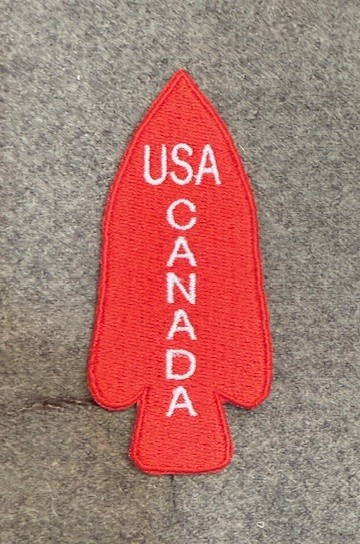
FSSF patch from Project ’44
The combat element of the Force was composed of roughly equal numbers of Canadians and Americans, while the supporting echelon units were entirely American. Most Canadian subaltern officers were recruited almost directly from the Officer Training Centre in Brockville, and the majority of the Other Ranks were drawn from units across Canada. Some personnel were even selected directly from the 1st Canadian Parachute Battalion, much to the frustration of that unit’s chain of command.
The Force was commanded throughout its existence by American Lieutenant Colonel Robert Frederick. The initial Canadian second-in-command, Lieutenant Colonel McQueen, was injured during parachute training and broke his ankle. Because of the limited time available for training, he was returned to his original unit and replaced by Canadian Lieutenant Colonel Williamson.
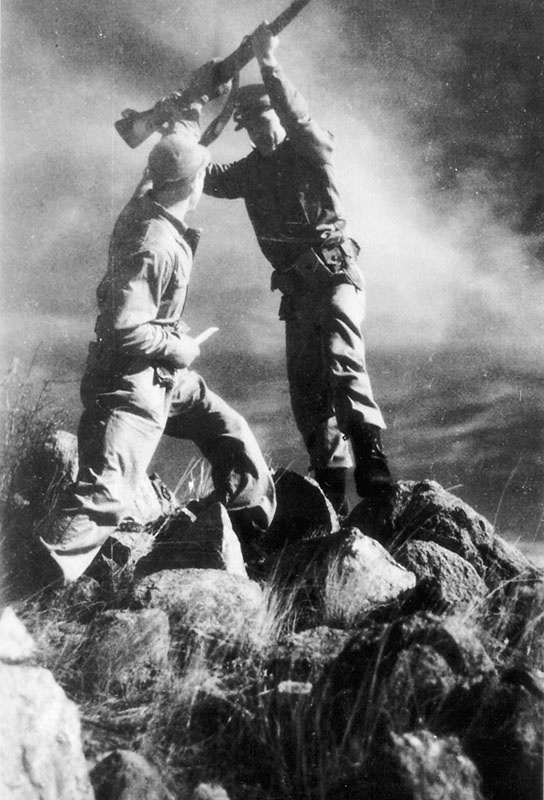
Orval Logan and Stuart Diamond demonstrate hand-to-hand combat
Photo by Paul Moore from Project ’44Williamson served both as second-in-command of the FSSF and as Commanding Officer of the 2nd Canadian Parachute Battalion. This designation served as the administrative cover name for the Canadian component of the Force and was later changed to the 1st Canadian Special Service Battalion. This was not a tactical formation in the field, but rather an administrative structure created to manage Canadian personnel within the joint unit.
As a combined Canadian–American formation, personnel from both nations were distributed evenly throughout the Force. While its overall role and employment resembled that of a brigade, its internal organization followed American regimental doctrine. The Force consisted of three regiments. Whereas a standard American infantry regiment normally contained three battalions and approximately 3,000 soldiers, each regiment within the FSSF comprised only 32 officers and 385 Other Ranks, for a total authorized strength of 412 personnel.



Powered by WordPress