Quotulatiousness

September 9, 2025

Uh-oh. It’s not a good sign to see your town’s name in Not the Bee

Filed under: Cancon, Environment, Law — Tags: , , , , , , — Nicholas @ 04:00

We’ve lived in Bowmanville for ten years and in that time the demographics have changed substantially. Some of those changes have been positive, but others have definitely been negative:

Video out of Bowmanville, Ontario, shows Southeast Asian men (do with that what you will) flipping salmon out of a small stream during the annual salmon run back to their spawning locations.

Early September is peak salmon-fishing season. Fisherman across the continent catch millions of fish as they return upriver to spawn.

But it is highly illegal to catch salmon near their actual spawning sites (especially with nets), which includes Bowmanville (upriver from Lake Ontario). It is also unsafe, as the fish die off in mass numbers after spawning, making the meat inedible.

Despite this, migrants have been seen poaching fish in the area for several years (at least).

In the comment section, some people shared stories of their own, including this anecdote from Port Hope, Ontario.

Over the summer, SE Asian men went viral in Muskoka, Ontario, for filming themselves shooting up a local bridge and river. Locals say they have reported such incidents for years, but despite the danger and the leftover environmental pollution, authorities have been slow to act.

Employers insist that there are lots of high-paying “entry level” jobs that Canadians won’t do

Filed under: Bureaucracy, Business, Cancon, Government — Tags: , , , — Nicholas @ 03:00

Canada’s insanely out-of-control temporary foreign worker program hinges on employers being honest about the jobs on offer being impossible to fill with Canadian citizens or legal immigrants. The huge numbers of these jobs — often listed at much higher than minimum wage in areas with very high unemployment — strongly implies that employers are systematically gaming the system:

A selection of jobs subject to active Labour Market Impact Assessments (LMIA), meaning that an employer has applied for a temporary foreign worker on the grounds that no Canadian is available to fill the position.
Photo by Government of Canada Job Bank.

If public sentiment is turning against the TFW system, it’s partially because of a greater awareness of the conditions under which employers are claiming they cannot find Canadians for their jobs.

Any hiring of a temporary foreign worker has to first be preceded by a “Labour Market Impact Assessment”. It’s effectively a job posting laying out the basic details of the position, and carrying the disclaimer “the employer could not find a Canadian worker for this job and applied for a Labour Market Impact Assessment (LMIA) to hire a temporary foreign worker”.

What’s made many of these LMIAs so controversial is that they often describe quite desirable jobs with minimal qualifications. There are also noticeably high numbers of them being submitted in cities with high unemployment.

Last year, a viral Reddit post featured a heat map of all the Toronto-area employers who had been approved for temporary foreign workers after claiming to find no Canadian applicants. More recently, the website JobWatchCanada has launched a searchable database of active LMIAs, complete with interactive maps and guides to which employers are the heaviest users.

What really bothers a lot of Canadians about the program is the high number of jobs posted with few or no qualifications at well-above market rates at the same time that young Canadians are finding it impossible to get hired no matter how many positions they apply for:

In June, a Calgary auto shop submitted an LMIA for a “motor vehicle mechanic helper”. The job is to essentially act as a “gofer”. The starting wage for the helper job is $36.50 per hour, the employer promises to cover relocation costs, and the “experience” category contains only the words “will train”.

A Langley, B.C., drywall contractor said it can’t find any Canadian drywall installers at $36.75 per hour. A vape shop in Lloydminster, Sask., has filed an LMIA to fill a $36.05 per hour shift supervisor job in which the educational requirement is a high school diploma.

In Woodbridge, Ont., a homeowner filed an LMIA for a $38 per hour housekeeper in which the only qualification is that the applicant has to speak English. “No degree, certificate or diploma”, is listed in the space for educational requirements, and the requirement for work experience is just “will train”.

The useful site fakejobs.ca currently shows three LMIA positions in my small town each paying at least $35 per hour that supposedly can’t be filled by local applicants. The jobs — two food service supervisors and a marketing co-ordinator — can’t possibly have such exotic required qualifications that nobody in the area can match, which is why I strongly suspect they’re fakes.

September 6, 2025

The federal government’s foreign worker program is set up for abuse

Filed under: Bureaucracy, Business, Cancon, Government, Politics — Tags: , , , , — Nicholas @ 03:00

Dan Knight discusses Canada’s deliberately two-track job system, which severely disadvantages unemployed Canadians and favours temporary foreign workers instead:

Canada now has a two-track employment system. On one track, you’ve got over 1.6 million Canadians unemployed the official rate just jumped to 7.1%, the worst since 2016 outside the COVID crash. Youth joblessness? 14.5%. Alberta, supposedly an economic engine, bleeding at 8.4% unemployment. And those folks are drawing EI, funded by your tax dollars.

On the other track? The Temporary Foreign Worker pipeline. In 2024 alone, Ottawa issued over 162,000 TFW permits by October. And they’ve already budgeted another 82,000 entries in 2025. Think about that: while Canadians are struggling to find work, Ottawa is busy handing out golden tickets to foreign workers.

And let’s be honest about how this program actually works. It’s sold as a way to “fill labor shortages”. In practice, it often looks like a backdoor family reunification scheme. Business owner Abdul suddenly needs a “specialized” worker conveniently, his cousin in India just happens to fit the bill. So instead of waiting in line under the normal visa system, he comes in the side door through the TFW program. Legal? Sure. Exploitative? Absolutely. It undercuts the immigration rules that everyone else has to follow, and it keeps wages low for Canadians who should be first in line.

Here’s the part that makes you wonder if Ottawa is even trying: we’ve got two federal departments, Employment and Social Development Canada (who runs EI) and Immigration, Refugees and Citizenship Canada (who runs TFW permits). Wouldn’t a functioning government have these two agencies talk to each other? One department says, “Hey, we’ve got 1.6 million people sitting on EI“. The other says, “We’ve got 162,000 employers asking for TFWs“. The obvious solution? Connect the dots. Fill Canadian jobs with Canadian workers first.

But that would require coordination and “coordination” is a foreign concept in Ottawa. These are the same geniuses who can’t keep escalators running in Parliament Hill without a three-year feasibility study. You expect them to line up two departments, EI and Immigration … and have a five-minute conversation? Forget it. Imagine the radical idea: one arm of government saying, “Hey, we’ve got 1.6 million Canadians unemployed and drawing EI …” and the other saying, “Oh great, we’ve got 162,000 employers begging for workers. Maybe, just maybe, we could match those two groups up“. That’s not rocket science. That’s not even science. That’s called basic competence. And Ottawa can’t even spell it.

Using the fakejobs.ca website, I found three LMIA postings in my small town on the edge of the GTA … all paying well over median for pretty ordinary retail management jobs.

September 5, 2025

End the “temporary” foreign worker scam!

Filed under: Bureaucracy, Business, Cancon, Government — Tags: , , , , — Nicholas @ 05:00

In the National Post, Chris Selley explains why Pierre Poilievre and the federal Conservatives should be hammering their demand to eliminate the much-abused temporary foreign worker program:

Youth unemployment stands at 14.6 per cent, according to Statistics Canada’s latest release. That’s the highest non-pandemic July figure since 2009 (15.9 per cent), at the nadir of the Great Recession. It makes nothing but good sense that Conservative Leader Pierre Poilievre would position himself, as he did on Wednesday, foursquare athwart bringing in any more temporary foreign workers to fill positions that certain employers swear blind they cannot fill with younger Canadians at any conceivable price.

“Why is (the government) shutting our own youth out of jobs and replacing them with low-wage temporary foreign workers from poor countries who are ultimately being exploited?” Poilievre asked, rhetorically, on Wednesday. By rights it ought to be a solid populist pitch to Canadians, and no-brainer policy besides.

Companies who use TFWs will insist it’s not about finding “cheaper” help, but about finding any help. Tim Hortons defended itself Wednesday noting that less than five per cent of its national workforce were TFWs — which seems like a very high number, right? It’s not just me? — and those hires tended to be clustered “in small towns and communities where local candidates are not available”.

But an odd sort of small town or community, surely, that can’t live without a Timmy’s, but that doesn’t have enough people to work at it. And it’s an odd sort of remedial program, surely, to bring in employees not from other parts of Canada but rather from halfway around the world. Especially since groups like the Canadian Federation of Independent Business (CFIB) swear blind they’re not after an hourly wage discount, just anyone who’s willing and able to fill the position. It was certainly a very odd kind of fishing resort, it struck me, that claimed this summer it couldn’t find any Canadian employees and needed the TFW program instead.

Didn’t kids used to flock en masse cross-country to take outdoorsy jobs every summer? Have I not read 150 tiresome baby-boomer op-eds on the topic?

The special pleading sometimes beggars belief. And unemployed young Canadians aren’t free to you and me, after all — whoever’s fault it is, if anyone’s, they’re an anchor on the economy. A Deloitte study commissioned by the King’s Trust Canada, published in November, estimated “that under the right conditions, overall real GDP could increase by $18.5 billion by 2034 — more than Canada’s entire arts, entertainment and recreation sector — and (Canada could) add an additional 228,000 jobs in the process” if “youth engagement in the workforce” significantly increased.

September 2, 2025

Too much empathy can be more dangerous than too little

Filed under: Cancon, Europe, Health, USA — Tags: , , , , , — Nicholas @ 03:00

Spaceman Spiff explains why boundaries matter, in so many different areas of modern life:

Empathy is a virtue many strive to demonstrate. But few will discuss its downsides. Why it is not universally good or useful. How it can be misdirected.

In some situations it is lethal. It can reflect a suicidal urge we now see in Western nations.

Much empathy in society is in fact sentimentality, which is dangerous. Sentimental ideas about mixing cultures, elevating poor performers through quotas, or tinkering with traditional gender roles have real world effects.

With such an emphasis on empathy, which many think of as niceness, we overlook the need for boundaries to maintain a functioning society.

This is the issue at the heart of much that is damaging us today.

Individual rights

We live in an era that champions individual rights to an almost autistic degree. This is a product of Western liberalism, which now seems to be entering its terminal phase as its effects ultimately destroy what made Western societies strong.

Since an individual’s rights trump everything we cannot easily enforce boundaries our ancestors could take for granted. Try challenging a gay pride parade or transgender material in schools on the grounds of public decency and the least you can expect is to lose your job.

Profound changes have happened just in the last few decades and all in the name of individual rights. The erosion of boundaries on behaviour is one of the most visible aspects of this.

Physical boundaries

The concept of boundaries is almost universal and spans everything from the mundane to the spiritual.

Most countries recognize the right to private property and inherent within this is the notion of boundaries. My car is mine and no one else’s, for example.

This is applied to our homes and gardens. These are ours and defendable from theft. Ultimately this in turn includes a neighbourhood or locale, even a region or state. All these things have visible boundaries that demarcate where they begin and end.

Most famously this applies to national borders, a traditional form of boundary in use for thousands of years. Failing to enforce this barrier is national suicide. The world is not like us and if it comes to us we will look like the world in return. Borders keep the barbarians out.

Everyone instinctively grasps these kinds of boundaries. We close our windows and have locks on our doors because of this understanding.

Using boundaries to exclude others feels natural.

Cultural boundaries

Less explicitly visible are cultural boundaries, often transmitted via tradition and convention. We have spent the last century attacking many of these as old fashioned, with little pause to consider why tradition emerges in the first place.

Marriage between men and women. Complementary gender roles. Sexual mores kept private. The sanctity of childhood, its innocence protected from intrusion.

As we removed constraints in the name of progress we destroyed much of the glue that held our societies together. We are now watching things unravel as people marry less and produce fewer children. We see widespread mental illness and anguish as the few basic certainties of life are destroyed in the name of progress.

People don’t know who or what they are when cultural boundaries are deleted. Women, men, natives, newcomers, the working class. Who are we really without some certainties in life?

QotD: “Fixers” and “minders” for foreign visitors

Filed under: Bureaucracy, Cancon, China, Government, Quotations — Tags: , , — Nicholas @ 01:00

Old hands in some foreign places will remember that there are fixers and minders. Fixers are hired by e.g. corporations and news organizations and by embassies to help executives, reporters and senior officials (I was never senior enough ~ I think it was limited to Assistant Deputy Ministers, sometimes directors-general if they were heads of delegation) in strange places. Fixers were interpreters, guides and general helpers, sometimes even bodyguards. Minders did everything fixers did, usually (in my limited experience) better, but they were official; mine was assigned by the Chinese Ministry of Defence and I had no choice about her ~ thankfully she was pleasant and efficient. My minder had a seemingly magical ID card; she was able to move us to the front of almost every line and upgrade air and rail tickets (all at no charge), something that fixers could not do. Of course, she had other duties which included ensuring that I did NOT see or hear what I was not supposed to see or hear. It was just part of dealing with official China.

Ted Campbell, “A new front in Cold War 2.0”, Ted Campbell’s Point of View, 2020-06-26.

August 30, 2025

Canada’s economy is going the wrong way

Filed under: Cancon, Economics, Government, Media, Politics, USA — Tags: , , , — Nicholas @ 03:00

The latest figures show the US economy growing by 3.3% while Canada’s shrank by 1.6% in the same period. It’s bad news for Canadians, except those like Prime Minister Mark Carney who have the bulk of their investments in the United States (91% for Carney, according to various sources). On X, Dan Knight explains what is happening:

Canada’s economy just shrank. That’s the headline. In the second quarter of 2025, real GDP fell 0.4%. On a per-person basis, it was the same. Canadians are poorer than they were three months ago. That’s not speculation. That’s Statistics Canada’s official number.

So, here’s what happened. The government and its media allies spent the spring bragging that the Canadian economy “grew” in the first quarter of 2025. Real GDP was up half a percent. Sounds good, right? But if you read the fine print, if you look at the numbers it wasn’t real growth at all. It was panic.

Exporters rushed to push product into the United States before tariffs came down. Automakers. Machinery producers. Parts suppliers. They all jammed as much across the border as they could, knowing the window was closing. That sugar high showed up in the Q1 GDP number. It made the economy look like it was humming along.

Then the tariffs hit. And in the second quarter, the bottom fell out. Exports collapsed down 7.5% overall. Passenger cars and light trucks? Down nearly 25%. Machinery and equipment? Down 18.5%. Travel services? Down 11%. The result: GDP fell 0.4%. On a per-capita basis, it was exactly the same. Canadians are literally poorer than they were three months ago.

This is the story you’re not hearing: Q1 wasn’t proof of a healthy economy. It was proof of a desperate one. Businesses scrambling to get ahead of trade barriers, because they knew Ottawa wasn’t going to stop them. Q1 was fake growth, and Q2 was the crash.

Meanwhile, households are spending more, saving less, and wages are barely moving up just 0.2%, the slowest since 2016 outside of COVID. Corporate profits are falling. Government revenues are down since the carbon tax was lifted. And Ottawa’s answer? Spend more. Borrow more. Pretend it’s all fine.

So the question is simple: if this is what “growth” looks like under Mark Carney’s Liberal government front-loaded exports, collapsing investment, rising debt what does the next quarter look like?

On her Substack, Melissa Lantsman says that the economic situation in Canada is discouraging investors from putting money into Canadian companies:

You don’t need to be a foreign investor to see that putting your money into Canada is not a winning move.

Recently, Statistics Canada reported “strong foreign divestment in Canadian shares” across many sectors, including energy, mining, and manufacturing. At the same time, Canadian buyers also moved their money stateside, purchasing $13.4 billion of foreign securities in just one month.

If this were a small, short-term blip, it would be easy to dismiss it as market noise or an aberration. But that’s not the case: Statistics Canada found four consecutive months of net divestment from the Canadian economy, adding up to $62 billion in lost capital.

And that’s not to mention that every year since 2015 has seen more Canadian investment going abroad than foreign investment coming here. For those keeping track, this is the fastest rate of divestment in Canada since the Great Recession.

What does this all mean?

From an investor’s point of view, there’s no sugar-coating it. Canada is, simply put, an unattractive place to invest hard-earned cash. People making financial decisions for the future don’t have confidence in the Canadian economy to make them money.

From a government’s point of view, it should mean alarm bells ringing left, right, and centre. Lower investment in Canada translates into lower productivity, fewer employment opportunities, less government revenue, and a weaker Canadian dollar, leaving us all worse off.

But why is this happening in the first place?

According to the C.D. Howe Institute, the culprits are familiar: high taxes, regulatory barriers, policy uncertainty, and anti-growth mindsets that penalize success and demonize the private sector.

Anyone who has been paying attention for the last ten years knows that’s exactly what’s been happening. Nothing says “Welcome to Canada” to investors quite like a hike in the capital gains tax at the last minute, chaos at the CRA, multi-year project approval processes, and the highest deficits on record.

And anyone serious about fixing the problem would do the exact opposite of what the last government did. But when your new government is the same as the old one, it’s hard to believe Canadians will get the bold economic transformation this country desperately needs.

August 28, 2025

No surprise at all – Liberals completely overshoot temporary foreign worker targets

Filed under: Business, Cancon, Government — Tags: , — Nicholas @ 03:00

In the National Post, Tristin Hopper confirms that the Mark Carney government, having promised to cap temporary foreign worker visas at 82,000 for the year, have already brought in over 100,000 TFWs in the first six months:

Despite promises from the Liberal government that they would be curbing the sky-high immigration rates of the Trudeau era, new data from Immigration, Refugees and Citizenship Canada shows that Canada is already on track to exceed its 2025 targets.

In the first seven months of 2025, Canada accepted 246,300 new permanent residents, according to data released last week by IRCC.

If this level of intake keeps up for the rest of the year, Canada is on track to bring in approximately 422,000 new permanent residents by year’s end.

[…]

And the missed targets are even more stark when it comes to categories of temporary migrants.

For the entirety of 2025, Canada was only supposed to approve 82,000 entries under the Temporary Foreign Worker Program.

Nevertheless, Government of Canada data shows that 105,195 Temporary Foreign Worker permits were awarded in just the first six months of 2025.

Temporary migration has been disproportionately responsible for the record-breaking population growth witnessed in Canada over the last four years. Since 2021, Canada’s population has grown from 38 million to 41.7 million. This represents an average annual increase of 900,000, which puts Canada well beyond the population growth rates of any other G7 country.

In late 2024, Statistics Canada estimated that the country was home to an unprecedented three million “non-permanent residents,” be they international students or temporary foreign workers.

Temporary migration is also the category on which Ottawa has promised to crack down hardest. Late in 2024, when then prime minister Justin Trudeau announced plans to “turn off the taps” on immigration, temporary migrants represented seven per cent of the overall Canadian population.

August 25, 2025

Defending your life against an intruder can get you charged in Canada

Filed under: Cancon, Humour, Law, Liberty — Tags: , , , , — Nicholas @ 03:00

Terry Burton‘s satire-that-is-too-close-to-being-true:

A Recent Case in Ontario

An Ontario man recently had the unthinkable happen: he defended his home. Unfortunately for him, this occurred in Canada, where the laws surrounding self-defence have taken a dive off the deep end of “wokeness”. The police, after deep reflection (and a healthy dose of Diversity, Equity, and Inclusion training), chose to charge the homeowner and not the intruder. Why?

Let’s break down the madness.

How a Home Invasion Might Go in 2025 Canada:

Homeowner (middle-class taxpayer, not currently oppressed):
“Hello, sir. You appear to have broken into my home and possess a 7-inch knife. May I inquire about your intentions?”

Intruder (career criminal with a social media following):
“I’m just here to grab some electronics, steal your monies, and stab someone if they resist my incursion. It depends on my mood. Don’t profile me.”

Homeowner:
“Of course. My apologies. Would you like a latte while you loot my home? Oat milk? Almond? I don’t want to assume.”

Intruder:
“You’re a colonialist bigot for offering me food.”

Homeowner:
“Understood. Legally, I’m only allowed to resist you in proportion to your level of violence — yet to be ascertained, as determined by a tribunal of academics who’ve never been in a fist fight. That means if you punch me, I can … maybe glare at you. Anything more, and I’m the criminal.”

But what if the homeowner fights back?

In this case, the homeowner managed to grab a knife and defend himself. The intruder was injured — tragically — during this altercation. So naturally, the police arrived and did what any reasonable, DEI officer was instructed s/he must do:

They charged the homeowner.

The intruder? Off to the hospital, flowers sent courtesy of the Canadian taxpayer, and full support from victim services (taxpayer funded). (Yes, really.)

Reasons Police and Prosecutors Declined to Charge the Intruder (some say over-the-top satirical conjecture by the author):

  1. Mental illness – A catch-all excuse for immunity.
  2. Homelessness – Makes all actions justifiable, including assault.
  3. Drug addiction – A disease, not a crime, apparently.
  4. Identifies as female – We must respect self-identification, even during felonies.
  5. Arrested 55 times, 20 for B&Es – Systemic failure, so we shouldn’t blame him again.
  6. Member of a marginalized group – Intersectionality shields all.
  7. Single-parent upbringing – Automatically voids criminal responsibility.
  8. Not yet a citizen – A conviction could hinder his application; we, the state machinery that is, must protect him.
  9. Linked to child porn – But not convicted, so hands off.
  10. Terrorist affiliations – Political beliefs are personal.
  11. Anti-Semitic – But it’s culturally complex, they say.
  12. Illegally entered Canada – A paperwork issue, not a crime.
  13. Gun and drug trafficking – He’s an entrepreneur, really.
  14. Anti-Christian – Expressing a valid worldview.
  15. Anti–Rule of Law – Which now appears to be mainstream.

The Verdict?

The homeowner is:

  • Charged with attempted murder.
  • Convicted of using “excessive force”.
  • Sued in civil court by the intruder.
  • Ordered to surrender his house and retirement savings.

The intruder is:

  • Awarded the home he broke into.
  • Given legal permission to rent the house back to the homeowner’s family.
  • Allowed to visit the property at will.
  • Celebrated in local media for “surviving trauma”.

What Happened to Common Sense?

It died somewhere between Bill C-18, Bill C-63, and the idea that your lived experience matters more than actual law. In a country where, in some jurisdictions, whistling at night is outlawed, but breaking into homes is a misunderstood cry for help, we’ve lost the thread entirely.

When defending your family is labelled aggression, and violating someone’s home is rebranded asocial protest, Canada ceases to be a democracy and becomes a farce.

August 24, 2025

The Supreme Court of British Columbia has detonated a legal mine under all of Canada’s established property titles

Filed under: Cancon, History, Law, Politics — Tags: , , , — Nicholas @ 05:00

Conrad Black discusses just how much the Supreme Court of British Columbia’s decision on First Nations land claims in BC will undermine established property rights across the entire country:

A map shows the Cowichan title lands outlined in black. (B.C. Supreme Court) Photo by B.C. Supreme Court

The decision earlier this month by the Supreme Court of British Columbia that the Cowichan tribes hold title over federal, city, and private land in Richmond B.C. that enjoys a higher legal status than the fee simple ownership of the current proprietors is outrageous but may have some positive consequences. The decades and $7 billion that have been spent or pledged for what is called the “reconciliation” process, has finally hit a stone wall. The almost universal desire to be fair to Indigenous people and where appropriate to compensate them for inequitable treatment, has finally collided with the entrenched economic rights and interests of every owner of real property in Canada, including those of Indigenous ancestry.

Inexplicable latitude has been granted to the thickening population of crusaders for indigenous rights. Even the NDP government of British Columbia, which has been pathologically addicted to prostrating itself at the feet of anyone or anything purporting to champion any definition of the Indigenous interest, was reduced to monosyllabic waffling by the court decision brought down by Justice Barbara Young. Premier David Eby’s office declared an ambition to continue seeking a negotiated resolution of the conflict between Aboriginal rights and common law rights of affected property owners, (including the municipal, provincial, and federal governments-of $100 billion of property in Richmond B.C. that is directly affected by the decision).

This is an understandable ambition, but in the circumstances, his government might have pressed the negotiations over the six years that this case has been litigated. Our judiciary has been addicted to truckling to almost any Indigenous claim, on the restricted occasions when the federal and provincial governments have even had the temerity to conduct a defense against them. Now the taxpayers’ negotiating position has been tanked by this ludicrous decision, which is being appealed.

If courts with authority for the whole country were to come to similar judgments, and we cannot doubt that activists will continue to push on an open door and quite rightly take all they can get, then every property title deed in the country is compromised, including the Houses of Parliament. There were only approximately 200,000 native people in all of what is now Canada when the French and British explorers and settlers came here starting at the end of the 15th century. Yet the implication of this ruling is that they legitimately owned all of Canada and that in the patchwork of numbered treaties and other agreements following absorption of the politically organized parts of Canada into the British Empire at the end of the Seven Years War in 1763, ancient and undocumented Aboriginal rights took precedence over any subsequent real estate law allocations of property rights under the common or civil law systems that gradually spread across Canada.

Given the activist preferences of courts across the country, we can expect to see similar cases pop up everywhere, as First Nations sensibly try to strike while the iron is hot and lay claim to as much of the real estate of Canada as the courts will let them … which might well be the entire land mass plus fishing rights.

August 22, 2025

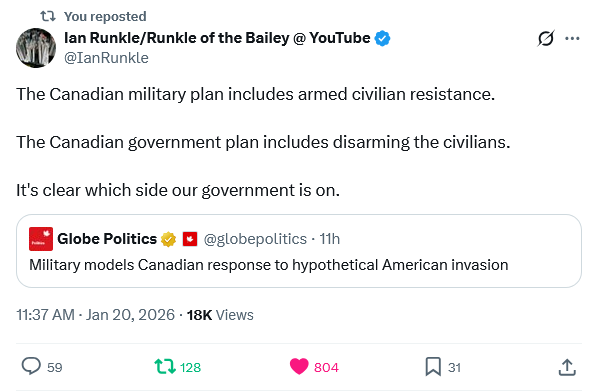
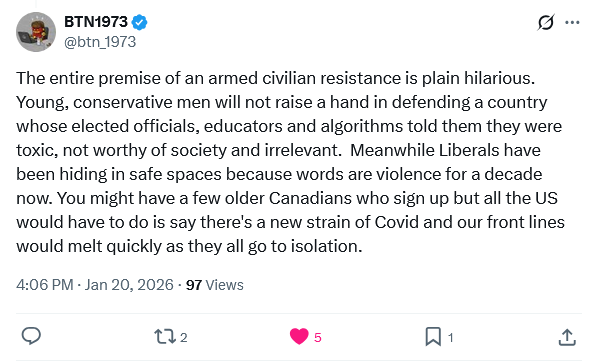
Resolved – This country’s youth will not fight to defend this country

Filed under: Cancon, Government, Military — Tags: , , — Nicholas @ 03:00

On Tuesday, John Robson discussed the results of a recent Angus Reid survey that, among other things, indicated that Canadians are at least as anti-military as they’ve been since the first Trudeau government:

Canadian soldiers set a perimeter position after disembarking a U.S. Navy landing craft during a simulated amphibious landing, 24 April 2009.
U.S. Coast Guard photo by Petty Officer Seth Johnson via Wikimedia Commons.

The National Post reports an Angus Reid survey finding that a significant majority of us favour compulsory voluntary service by the youth of today. Which might sound like a bracingly traditional Jordan Peterson clean-your-room, stand-up-straight, shoulders-back attitude until you read the fine print, which would risk making Peterson ill if he weren’t already. Because it turns out we want to conscript them to work in health care so we get stuff we didn’t pay for, not to defend the country because if ye break faith and so on.

According to the survey, 74 per cent of respondents want young people to have to give a year of their lives to bolstering our failing, structurally unsound socialized medical system. Respondents were also in favour of mandatory service in support of the environment (73 per cent), “youth services” (72 per cent), whatever it might be, and “civil protection” (70 per cent). But when it comes to (ugh) national defence, just 43 per cent supported it, with 44 per cent opposed.

Spending on comfort while barbarians undermine the city walls lacks prudence as well as dignity. As I observed in a long-ago graduate-school debate about American national security, it didn’t matter how wonderfully progressive the Dutch social welfare system was in 1940 when the Nazis came calling. And we too seem to have our priorities backward.

If I might confuse the government by discussing principles of political economy, there are good reasons why national defence is considered a binding duty on those able to contribute to it. First is the “free rider” problem that everyone benefits from successful protection of the community, especially, at least in a narrow and hedonistic sense, if you send some other chump to die for your freedom while you recline comfortably at home.

Second is the moral consideration that, as John Stuart Mill famously if uncharacteristically put it, “War is an ugly thing, but not the ugliest of things: the decayed and degraded state of moral and patriotic feeling which thinks that nothing is worth a war, is much worse”. Which comes from, yes, his “Principles of Political Economy”.

Mill was no warmonger. As he immediately continued, “When a people are used as mere human instruments for firing cannon or thrusting bayonets, in the service and for the selfish purposes of a master, such war degrades a people”.

But not all wars are like Russian President Vladimir Putin’s invasion of Ukraine, let alone Hamas’s attack on Israel. As the anything-but-bellicose Mill added, “A war to protect other human beings against tyrannical injustice; a war to give victory to their own ideas of right and good, and which is their own war, carried on for an honest purpose by their free choice — is often the means of their regeneration”.

August 19, 2025

Bad laws in Canada must be challenged in court

Filed under: Bureaucracy, Cancon, Government, Law, Media, Politics — Tags: , , , , — Nicholas @ 05:00

At Rigid Thinking, Damian Penny says — and I wholeheartedly agree — that it’s a good thing for laws to be challenged in the courts, but especially when it’s called an “emergency”:

[Retired Canadian veteran Jeff] Evely, with the help of some conservative/libertarian-ish legal organizations, plans to challenge the woods ban in court as a violation of the Canadian Charter of Rights and Freedoms. This is not a popular position here in Nova Scotia (in online discussions, the phrases “Maple MAGA” and the venerable “American-style” come up a lot) and I am not sure he’ll be successful.

But, honestly, I give him credit for trying. In fact, I’d argue his Charter challenge is win-win for everyone in Nova Scotia, whether one supports, opposes or remains indifferent to the policy.

That’s not despite the pressing emergency posed by the forest fire threat, but because of it.

When we’re faced with a crisis, that’s precisely when governments are tempted to seize as much power and authority as possible – and, more importantly, when the public is more inclined to go along with it.

Hence, Trudeau I imposing War Measures Act provisions during the 1970 October crisis, the PATRIOT Act debate after 9/11, COVID-19 restrictions during the pandemic, Trudeau II using the Emergencies Act when the “Freedom Convoy” set up shop in downtown Ottawa, and now Premier Houston (whom I support, despite some misgivings about this issue) using sweeping measures to tramp down the forest fire risk.

And sometimes such powers are justified under the circumstances. Even self-professed libertarians will admit as such when the emergency is something they’re personally worried about, and when a leader from the “good” team is in power.1

But they aren’t always justified. And governments definitely can’t be trusted to handle such power responsibly the longer the “emergency” goes on.


  1. The rise of Trump has allowed many “libertarians” to reveal themselves as authoritarians, but that’s for another post.

Dieppe 1942: The Failed Raid That Shaped D-Day

Battle Guide
Published 2 May 2025

On 19th August 1942, as dawn was breaking along the coast of occupied France, a force of just over 6,000 men stormed the beaches around the port town of Dieppe in the first major allied strike against Hitler’s Atlantic Wall. Within a matter of minutes hundreds lay dead or wounded, washed up against seawalls, hung on wire entanglements or incinerated in the burning landing craft. Over 60% of the mainly Canadian assault force were killed, wounded or captured by the end of the day, and the Dieppe Raid has, for the allies, gone down as one of the most infamous days of the Second World War.
(more…)

Operation Jubilee: Canada’s Devastating WWII Loss

Filed under: Britain, Cancon, France, Germany, History, Military, USA, WW2 — Tags: , , , , — Nicholas @ 02:00

WarsofTheWorld
Published 17 Jun 2023

By 1942, the war was no longer another great European conflict. It was now a firmly global affair enveloping all of the world’s great powers as the Allies squared off against the tyranny and aggression of the Axis nations. Against such colossal forces, no one country could stand alone and events that affected one combatant would ultimately have consequences for the other further down the road.

To that end, while the western Allies and the Soviet Union were effectively fighting separate wars against the same enemy, there needed to be cooperation between the two fronts in order to squeeze the life out of Nazi Germany and insure victory against Fascism. However, the relationship was often a strained one as both Allied power blocks were suspicious of the other’s intentions once the war was over.

Thus, we come to the subject of today’s episode and a story of the war that is still the subject of much debate today. It was an operation with no specific military objective other than to experiment with conducting division-sized amphibious landings against a fortified beach and as a gesture to the Soviet Union who were starting to feel abandoned by their Allies. It is an operation that has become seared into the hearts and minds of the Canadian people for the sacrifice they were asked to make for it.

0:00 Introduction
3:26 A Red Request
7:50 Planning and Preparation
13:32 Operation Rutter – A False Start
18:10 Reviving Rutter
24:02 Operation Jubilee
35:52 A Necessary Lesson?
(more…)

August 18, 2025

Canada’s state-subsidized media now seem to see their job as pro-government PR

Filed under: Cancon, Government, Liberty, Media, Politics — Tags: , , , , , — Nicholas @ 05:00

At The Rewrite, Peter Menzies considers the state of Canadian media in how they reported on the Maritime provinces’ draconian policies during the ongoing wildfire season:

Screencaptured image of one of the August 2025 wildfires in the Maritimes from Global News via The Rewrite

There will always be conflicts between collective rights and individual liberties. One is valuable in ensuring there is order in society, which is important. The other is necessary to maintain freedom, which lots of people live without but is nevertheless desirable. When there’s too much freedom, people look for politicians who will restore order. When there is too much order, people rebel and demand freedom (see everything from the French Revolution to the Freedom Convoy).

Traditionally, those inclined to the order side if the ledger have been viewed as conservatives while “liberals” have led the fight for individual freedom manifest in the civil rights movement, the emancipation and advancement of women, freedom of speech, etc. that are now viewed as fundamental to the maintenance of a modern, liberal democracy.

But as Pete Townsend wrote a little more than half a century ago, the parting on the left is now the parting on the right (and the beards have all grown longer overnight). Journalists tend to lean left, which means their traditional opposition to the imposition of order has been replaced by a collectivist tendency to sympathize with those imposing it. It is left to the newsroom minorities on the right to carry the torch for individual liberties.

To wit, this CBC story on Nova Scotia’s wild fire-induced ban — enforced with a $25,000 fine until Oct. 15 — on walking anywhere in the woods was oblivious to the impact on personal freedom. Never crossed their minds. When the issue was raised on social media, Twitter journos took up the cause. Stephen Maher dismissed individual liberty concerns as fringe views and maintained that the restrictions could be justified as “reasonable” limitations of Charter rights. While the Globe and Mail‘s editorial board called the Nova Scotia move “draconian”, Globe columnist Andrew Coyne nevertheless wondered “How the hell did the right to walk in the woods of Nova Scotia during a forest fire emergency get elevated into the right’s latest cultural obsession?”

It was left to commentators such as Marco Navarro-Genie to point out the intellectual flaccidity fueling parts of the collectivist argument when New Brunswick followed Nova Scotia’s lead and NB Premier Susan Holt said this:

    Me going for a walk in the woods is gonna cause a fire. I can understand why people, uh, think that that’s, that’s. That’s ridiculous. But the reality is, it’s not that you might cause a fire, it’s that if you’re out there walking in the woods and you break your leg, we’re not gonna come and get you because we have emergency responders that are out focused on a fire that is, uh, threatening the lives of New Brunswickers.

That, believe it or not, was a good enough explanation for the collectivist thinking in most mainstream newsrooms.

If journalism is to be useful in defending democracy, those involved in it need to be intellectually equipped to understand the stakes. And their first instinct must be to treat the suppression of liberty as a serious issue whenever the powerful indulge in it at the expense of the powerless. That doesn’t mean liberty should always trump order (traffic lights are eminently reasonable). But it does mean that journos should demand that politicians justify their actions rather than simply helping them explain them to the Great Unwashed. To do otherwise is to fail.

« Newer PostsOlder Posts »

Powered by WordPress