Quotulatiousness

August 18, 2025

Canadian grocers are “maple-washing” products to hide their actual origin

Filed under: Business, Cancon, Food — Tags: , , — Nicholas @ 03:00

Sylvain Charlebois on the new phenomenon of grocery stores going to great lengths to pretend that items for sale are Canadian when they’re not — “maple-washing”:

Image by Troy Media via Todayville

Canadian grocery retailers are misleading shoppers about where their food really comes from. Behind the patriotic packaging lies a growing problem: “maple-washing” — using Canadian symbols to suggest products are homegrown when they’re not. It’s eroding consumer trust and must end.

That’s why more Canadians are paying closer attention to what labels actually mean. Awareness around origin labelling has grown as people learn the difference between “Product of Canada”, “Made in Canada”, and “Prepared in Canada”. The Food and Drugs Act requires labels to be truthful and not misleading. A “Product of Canada” must contain at least 98 per cent Canadian ingredients and processing. “Made in Canada” applies when the last substantial transformation happened here, while “Prepared in Canada” covers processing, packaging or handling in Canada regardless of ingredient source.

The differences may seem technical, but they matter. A frozen lasagna labelled “Prepared in Canada”, for example, could be made with imported pasta, sauce and meat — packaged here but not truly Canadian. These rules give consumers the clarity they need to make informed choices.

Armed with this clarity, many Canadians have become more selective about what they buy. That vigilance has emerged alongside a surge in consumer nationalism, spurred partly by geopolitical tensions and anti-American sentiment. Even with U.S. giants like Walmart, Costco and Amazon dominating Canadian retail, many shoppers are deliberately avoiding American food products. The impact has been significant: NielsenIQ reports an 8.5 per cent drop in sales of American food products in Canada over just a few months. In an industry where sales usually shift by fractions of a per cent, such a drop is extraordinary. It shows how quickly Canadians are voting with their wallets.

That kind of shift, rare outside of crises, caught many grocers off guard. The sudden change left supply chains long dependent on U.S. products under pressure, and store-level labelling grew inconsistent. Early missteps — like maple leaves displayed beside imported goods — were excused as logistical oversights. But six months later, those excuses no longer hold. Persisting with misleading displays and false origin claims has crossed the line into misrepresentation. Instances of oranges or almonds labelled as Canadian, with prices quietly adjusted after complaints, show the problem is systemic, not accidental.

August 16, 2025

The First Poison Gas Attack of WW1: 2nd Battle of Ypres 1915

The Great War
Published 15 Aug 2025

By April 1915, the Western Front was mired in trench warfare. Germany’s new Chief of Staff, General Erich von Falkenhayn, didn’t think his army could break the deadlock, and Germany needed to help struggling Austro-Hungarian forces in the East. Before the Germans turned against Russia though, they decided to attack in the West to keep the Allies off balance. They chose to strike at the vulnerable Ypres Salient – and they would support the coming offensive with a weapon their enemies had never seen.
(more…)

August 15, 2025

The Royal Canadian Navy should go for the GLAAM

Filed under: Cancon, Military — Tags: , , , — Nicholas @ 05:00

At True North Strategic Review, Noah returns to a familiar topic when discussing the Royal Canadian Navy’s current and future needs, in this case he recommends that the RCN goes for the GLAAM:

Photo from True North Strategic Review

One thing I neglected to fully discuss during that piece, and one that always comes back to me time and time again, is the Global Logistics, Aviation, Amphibious, Medical Support Platform from Davies, aka GLAAM.

This is quite funny, as I have had somewhat of a monopoly on the GLAAM subject, which is probably why it keeps coming back to me. I think I’m one of the few who ever brings it up, and probably the one who does most frequently.

Maybe that’s why it always surprises people when I don’t throw my support behind it. In fact, historically, like most larger vessel proposals, I have been fairly unsupportive of talks of acquisition. As I stated in my Support Ship post, I believe priorities are needed elsewhere, on getting more important things done, and given the River-class, subs, and CDC are a decade out, there is little pressing need for anything beyond the two JSS in the immediate term.

At least not to the point of urgency. I would rather see CPSP fully funded along with CDC before any talks of new vessels like GLAAM. I have always made that clear. That remains my overall position now.

However, in the last few months, I’ve been surprised to see just how much universal support the proposal has, both from the average online reader and those in the navy. There is a fairly broad love for GLAAM, even among those who would rather have JSS — there is always some love to be thrown its way, even as an “if only x and x allowed it” conversation piece.

And let it be known, I don’t dislike GLAAM at all. I think it’s cool. I think it’s unique and has capabilities I like. Even if it didn’t make it into my initial assessment, I focused on vessels a lot smaller like the Vard 7 313, that doesn’t mean we can’t acknowledge GLAAM and its potential.

So. What is GLAAM?

First, what is GLAAM? For those unaware, GLAAM is a proposal from Davies Shipyard for, essentially, a Multi-Functional Support Ship. One could even call it a Joint Support Ship! In fact, looking at GLAAM you can see a lot of what was originally demanded from the Joint Support Ship in its first proposals with the Afloat Logistics Support Capability (ALSC).

Of course, ALSC would evolve into the JSS project and over time drop the amphibious, RO/RO, and vast majority of HADR capabilities. Of course, that’s another conversation for another day, but a lot of GLAAM, at least to me, reminds me of that concept—and then some.

Visually and capability-wise, she is very similar to the HNLMS Karel Doorman. In fact, you could almost call them sisters. They share many design features and capabilities that take a step above the traditional Landing Platform Dock we see in other navies.

HNLMS Karel Doorman, which GLAAM shares a striking resemblance to.”
Photo and caption from True North Strategic Review

August 13, 2025

“[A]ll those land acknowledgments weren’t just symbolic: they [were] advance notice”

Filed under: Cancon, Government, History, Law, Politics — Tags: , , , , , — Nicholas @ 03:00

In The Free Press, Rupa Subramanya discusses the — in my opinion, insane — court ruling in British Columbia that invalidated existing land titles in part of the Vancouver area, handing the titles to the properties over to the Cowichan First Nation:

A B.C. Supreme Court judge has granted several First Nations a portion of a 1,846-acre land claim on Lulu Island. B.C. Supreme Court

It turns out that all those land acknowledgments weren’t just symbolic. They may have been advance notice.

When Canada adopted its constitution in 1982, Prime Minister Pierre Trudeau slipped in a ticking time bomb: an explicit recognition of indigenous land rights without constitutional protection for property rights for other Canadians. That constitutional clause has fueled decades of lawsuits from First Nations — Canada’s indigenous people — asserting claims to huge portions of their ancestral territories.

Last Thursday, the British Columbia Supreme Court ruled that the Cowichan Nation holds “Aboriginal title” to about 1,846 acres of land on the south shore of Lulu Island in Richmond, and constitutionally protected rights to fish in the south arm of the Fraser River.

This 275,000-word judgment doesn’t just affect government-owned lands. It also includes private property now owned by third parties. So if you’re a Canadian who is a property owner in British Columbia and not indigenous, your claim on what you think you own has just been superseded by indigenous claims, called a “senior” claim in legalese. Down the road, your land or house could be expropriated by the federal government and turned over to an indigenous group that claims ownership.

That has already happened in Ontario, where three northern Ontario First Nations claimed in a lawsuit last month that a 14-acre public park in Kenora called Anicinabe Park is actually unceded territory and should be returned.

“In constitutional terms, aboriginal rights trump private property rights,” Bruce Pardy, a professor of constitutional law at Queen’s University in Kingston, Ontario, told me. He pointed to last November’s ruling by a New Brunswick judge that the court might be in position to order the government to seize private property and turn it over to an indigenous group making a claim on it.

As Prime Minister Mark Carney tries to fast-track major infrastructure projects — roads, bridges, pipelines, power plants, and more — all part of his plan to boost Canada’s global competitiveness and reduce reliance on the U.S., some of those ambitions might be snarled by indigenous land claims that take years to resolve. The British Columbia case began in 2019 and is considered to be the longest trial in Canadian history.

The day before the Cowichan Nation ruling in British Columbia, a Yukon First Nation announced that it would oppose all new mining claims on its traditional territory while a regional land-use plan is developed. Yukon First Nations leaders said that new claims are “unwelcome” and “unlawful”, and that they plan to challenge the mining industry to protect the land from further industrial activity.

Stefan Labbé in BIV last week:

A B.C. court has handed the Cowichan Tribes and other First Nations title over a chunk of federal and city land in Richmond that for centuries was used as a winter fishing village, before colonial administrators evicted the people who lived there.

The landmark Aug. 7 ruling was handed down after more than 500 days of litigation before the B.C. Supreme Court.

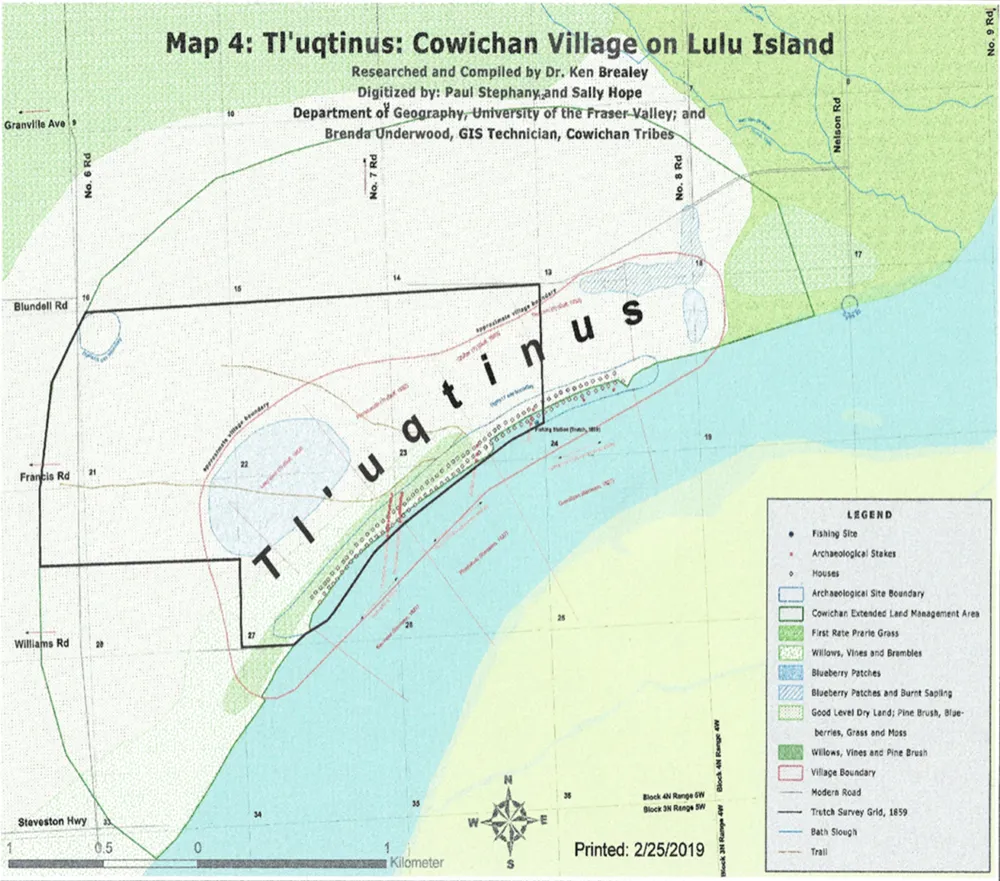
It gives the Cowichan Tribes, the Stz’uminus First Nation, Penelakut Tribe, Halalt First Nation — as well as the Lyackson First Nation in a supporting role — Aboriginal title over the Tribes’ historic Tl’uqtinus village on the southeast side of Lulu Island.

The ruling also gives the First Nations fishing rights at the mouth of the Fraser River.

In a joint statement, the First Nation plaintiffs said: “We raise our hands to the generations of leaders” who fought for the return of the Tl’uqtinus village lands and their fishing rights in the Fraser River.

B.C. Supreme Court Justice Barbara Young suspended her decision for 18 months “to allow for an orderly transition of the lands” in keeping with the principle of reconciliation.

“Now that this multi-year journey has concluded, it is my sincere hope that the parties have the answers they need to return to negotiations and reconcile the outstanding issues,” she wrote.

Jamie Sarkonak in the National Post wrote on Monday:

This case of “land back” in action (Cowichan Tribes v. Canada) casts a shadow over the country’s property system. It jeopardizes the default means of owning land in Canada — the estate in fee simple, where owners have exclusive rights to sell land — wherever Aboriginal title is found to exist.

Aboriginal title is the right of an Indigenous group to use, control and reap benefits from the land. It’s granted to claimant groups that can prove they are descended from the sole occupants of an area at the time the British asserted sovereignty. Unlike regular fee simple ownership, it’s enshrined in Section 35 of the 1982 Constitution and impossible to sell to anyone but the Crown.

The Cowichan claim covered the site of their summer village near the mouth of the Fraser River, where they had established continuous, exclusive seasonal occupancy dating back to European contact in the 1790s.

In 1846, the British Crown asserted sovereignty over that land and the rest of what would become B.C. The following years would see property being surveyed and auctioned off to public and private buyers — but not the Cowichan summer village. Instead, it was set aside in 1860 and continued to be used as a settlement for the group. Colonial officials considered the possibility of making it into a reserve, and took initial steps to do so. After B.C. joined Canada in 1871, however, the summer village was carved into parcels and sold over the years until 1914. Purchasers included private parties (including “well-placed men” in the colony) and even the municipality itself; some of the land purchased privately would eventually be sold back to the Crown. Today, about half of these lots are held by public bodies, with the other half falling under private ownership.

A map shows the Cowichan title lands outlined in black. (B.C. Supreme Court) Photo by B.C. Supreme Court

The question before the B.C. Supreme Court was whether the taking of those village lands was legal to begin with. Justice Barbara Young (a Harper appointee, by the way) concluded it was not.

August 11, 2025

Smug Canadian boomer autohagiography rightly antagonizes the under-35s

Fortissax had an argument with one of his readers over a smug, self-congratulating meme about how wonderful Canada was in the 1990s and early 2000s:

What we lived through long before Trudeau was the Shattering, the breakdown of Canada’s social cohesion, driven by left-liberalism with communist characteristics applied to race, ethnicity, sex, and gender, and punitive almost exclusively toward visibly White men. My generation, those millennials born on the cusp of Gen Z, saw post-national Canada take shape not in the comfortable suburban rings of the GTA or the posh boroughs of Outremont and Westmount, but in self-segregated, ghettoised enclaves of immigrants whose parents never integrated and were never required to.

Memes like that are dishonest because they feed a false memory. The 2000s were not normal. Wages were stagnant, housing was already an asset bubble, and immigration was still flooding in under a policy that explicitly forbade assimilation. Brian Mulroney had enshrined multiculturalism into law in 1988. Quebec alone resisted, carving out the right to limit immigration under the 1992 Quebec–Canada Accord. After Chrétien, Stephen Harper brought in three million immigrants, primarily from China, India, and the Philippines in that order.

The Don Cherry conservatives of that era were Bush lite. They were rootless, cut off from their history, their identities manufactured from the top down since the days of Lester B. Pearson. They conserved nothing. For Canadian youth, it was the dawn of a civic religion of wokeness, totalitarian self-policing by striver peers, and the quiet coercion of every institution. My memories of that decade are of constant assault — mental, physical, spiritual — from leftists in power, from encroaching foreigners, and from the cowardice of conservatives.

Your 2000s might have been great. For us, they were communist struggle sessions. In 2009 we were pulled from class to watch the inauguration of Barack Obama, a foreign president, as a historic moment for civil rights. Our schools excluded us while granting space to every group under the sun: LGBT safe spaces and cultural clubs for Italians, Jamaicans, Jews, Indians, Indigenous, Balkaners, Greeks, Slavs, Portuguese, Quebecois, Iroquois, Pakistanis — every culture celebrated except our own. Anglo-Quebecers and Anglo-Canadians got nothing but an Irish club, closely monitored for “white supremacy” and “racism” by the HR grandmas of the gyno-gerontocracy of English Montreal. Students self-segregated, sitting at different cafeteria tables and smoking at different bus shelters. At Vanier, Dawson, and John Abbott College, these divisions were institutionalised. I remember walking into the atrium of Dawson, my first post-secondary experience, greeted by a wigger rolling a joint while a Jamaican beatboxed to Soulja Boy.

We became amateur anthropologists out of necessity, forced to navigate a nationwide cosmopolitan experiment from birth. We learned the distinctions between squabbling southeastern Europeans of the former Yugoslavia, and we did not care if Kosovo was Serbia or whether Romanians and Albanians were Slavic, they all acted the same way. We learned the divides within South Asia, the rivalries between Hindutva and Khalistani, the differences between a Punjabi, a Gujarati, a Telugu, a Pakistani, a Hong Konger, a mainlander, and a Taiwanese. We know the shades of Caribbean identity, the factions of the Middle East, and the intricacies of North African identity. We should never have needed to know these things, but we do.

For us, childhood in this cesspit was the seedbed of radicalism. We never knew an era when contact with foreigners was limited to sampling food at Loblaws. All we know is being surrounded by those who hate us, governed by a state that wants to erase us, with no healthcare, no homes, no jobs that are not contested by foreigners, and no money to start families.

August 10, 2025

“Believe all women” especially when they imagine (or hallucinate) offense

Filed under: Cancon, Law, Media, Politics — Tags: , , , , — Nicholas @ 05:00

An excerpt from a work-in-progress by James Pew, from an incident during the heydey of #MeToo hysteria in the Toronto media community:

Steve Paikin is a Canadian journalist and author, and the host of TVOntario’s acclaimed flagship program, The Agenda With Steve Paikin. In his brush with #MeToo infamy, Paikin was accused of asking for, or possibly suggesting sex with a woman (who had previously appeared on his show), while at a business lunch with her at Grano restaurant in Toronto. The woman, a former Toronto Mayoral candidate who has a record of previous unsubstantiated claims against former Toronto Mayor Rob Ford, claims to have “politely” declined Paikin’s request, but said she was not invited back on his show because of her refusal to have sex with him.

The Paikin scandal was different from others which had unfolded in the hazardous year of 2018. This was a #MeToo story where the public appeared interested in both sides. Were chinks in the #MeToo armour beginning to appear? As Joe O’Conner wrote in the pages of the National Post, there was “an accusation and a vociferous denial”.1 But similar to other #MeToo narratives, the accuser was reaching deep into the past. According to Sarah Thomson, Paikin’s unwanted proposition for sex occurred in 2010.

Defending himself on Facebook, Paikin called the allegations a “complete fiction”. He wrote: “To be clear, I did not have sex, suggest, request, imply, or joke about having sex with you (Sarah Thomson)”.

Paikin had been a supporter of #MeToo. He wrote that “The #MeToo movement is too important to be undermined by spurious allegations”. Did he not realize that #MeToo means “believe all women”? Aren’t spurious allegations the type we are not supposed to believe? Wouldn’t that mean that women don’t (or can’t) make spurious allegations, but only the type of allegations that must be believed unquestioningly? Didn’t Paikin realize the contradiction in thinking that #MeToo was important, but in his case it was acceptable to cast off its intrinsic blanket credulity concerning the abuse claims of women? Paikin wrote:

    Sadly, in this day and age, too many people are going to believe the lie, especially when it comes to this subject. I am mortified that in many peoples’ eyes, I have lost the presumption of innocence that I’ve previously enjoyed. But I did not do these things. There is simply no truth to these allegations.2

Surprisingly, TVO did not remove Paikin, but launched an investigation instead. In a piece published in the Globe and Mail called “The Humiliation of Steve Paikin”, Margaret Wente wrote, “Mr. Paikin was lucky not to be suspended, people say. Some luck. His name is in the headlines, generally on the same page as all the other #MeToo stories that now dominate the news. I imagine that most people who know him don’t believe a word of it. Others will think, ‘These days you never know’.”3 A fair assessment. Wente later points out “Women (just like men) lie for all kinds of reasons, including the fact that they are unbalanced or unhinged.” However, it should be pointed out that in the #MeToo era and since, women do not get cancelled and humiliated because a man (or men) made unsubstantiated allegations against them.

The most suspicious part of the story is that Thomson’s assistant was present at the lunch meeting when Paikin supposedly propositioned her. Who would do such a thing as Paikin was accused in the presence of other people? Thomson did not provide the name of her assistant, and no investigative journalists were able to find out who she was. A critical detail appeared to go uncorroborated. However, the independent investigator tracked her down and conducted an interview. Her testimony was essential to clearing Paikin, although she chose to remain anonymous.

By April of 2018, the independent investigation into the allegations against Paikin was complete. It was found that while Thomson genuinely believed that Paikin had propositioned her “the evidence brought forward by Thomson and others (did) not support her account of what happened”.4 Rachel Turnpenney, the lawyer who conducted the investigation, referred to Thomson’s former assistant as “Witness J” – whose testimony contradicted Thomson’s account. Witness J told investigators that Paikin did not proposition Thomson or make any inappropriate sexual comments during the lunch.

But even if the allegations were true, was what Paikin alleged to have done really so bad? Aren’t men taught to ask for consent? Isn’t that what “propositioning” Thomson would have been? It could be argued, had the allegations turned out to be true, that Paikin demonstrated inappropriate, perhaps insensitive conduct. Clearly it would have been poor judgement, but should a man like Paikin be fired for a slip in judgement where no crime occurred? In hypothetical defense of a mis-step that never occurred, is it not possible to argue that a man might misread body language or other signs from a woman, and interpret them as mutual sexual interest? Getting this wrong can be embarrassing for both parties involved, but does it meet the severity of a cancellable offense? As Margret Wente wrote, “The truth is that not all men are guilty of what they’ve been accused of, and others aren’t that guilty of very much”.

But the social justice contingent is obsessed with power dynamics. According to them, any man who holds a professional position elevated over a woman he is attracted to, will automatically use his power to coerce the woman for sexual favours. In spite of the high-profile example in figures such as former American movie mogul Harvey Weinstein, it is insane to assume this is the default position of successful men, or men in places of authority or influence, just as it is insane to believe all women unconditionally.

Turnpenney felt that while Paikin’s testimony was consistent and credible, Thomson made “leaps without sufficient evidence to do so and she linked evidence together without factual foundation. Thomson’s evidence also veered toward being exaggerated and untrue.” Even though Paikin was ultimately exonerated, he was humiliated by the experience. In the initial statement he made defending himself, he characterized Thomson’s actions as defamatory. However, lucky for Thomson, Paikin chose not to sue. Thomson paid no penalty for all the trouble she caused, and most people felt Paikin was fortunate to have dodged a #MeToo bullet. As of this writing, Steve Paikin is still the host of The Agenda.


Nova Scotia rediscovers the joys of dictatorial power

Filed under: Cancon, Government, Law, Liberty — Tags: , , , , — Nicholas @ 03:00

Clearly hankering for those glorious days when Canadians cowered in their homes due to the government’s public health diktats, Nova Scotia has now banned almost all outdoor activities in wooded areas across the province:

Image from Junk Economics

Nova Scotia’s Premier has decided that walking in the woods — yes, walking — is now so dangerous it carries a $25,000 fine.

Not for lighting a campfire. Not for running your ATV through dry brush. Not for tossing a cigarette. Just walking. In a province where there are currently four active wildfires … all under control.

This is not about preventing wildfires. This is about the politics of safety — and how governments turn fear into obedience.

I was born in Halifax, and my family’s roots run deep in Nova Scotia — deeper than the roads and towns that stand there now. Generations of my parents, grandparents, and great-grandparents — along with uncles, aunts, and cousins — are buried in its soil. My family weathered centuries of storms, wars, and political upheavals there, carving out a life from raw wilderness. This isn’t some detached policy rant from a distance. It’s personal. And it’s infuriating to watch a government use “safety” as a smokescreen for inaction, punishing people for living their lives while leaving the real problem unsolved.


The Problem They Didn’t Solve

In 2023, Nova Scotia suffered its worst wildfire season in history. At the time, the province had four Airbus H125 helicopters to fight fires.

In 2025, after all the smoke cleared and the “lessons learned” speeches were made, Nova Scotia … still has four Airbus H125 helicopters. Newer paint jobs, slightly upgraded safety features, same firefighting capacity. No fixed-wing aircraft. No surge ability. No major investment in manpower or pre-positioned crews.

The province didn’t fix the problem. They just hit refresh on the equipment list.

[…]


The Legal Overreach

The ban covers 89% of provincial land (Crown land) plus private forested land. Even if you own it, you can’t invite your mother over to walk her dog in your woods.

Section 7 of the Charter protects liberty, and the Forests Act was never intended to give cabinet the power to impose a province-wide walking ban. That’s legislative overreach wrapped in administrative convenience.

And the $25,000 fine? Grossly disproportionate — and in practice, quietly plea-bargained down because it’s more for optics than enforcement. A scarecrow penalty to make the Premier look tough on camera.


The Snitch Line and the COVID Flashback

Just like pandemic tip lines, Nova Scotia has invited citizens to report on each other for the crime of going for a picnic.

It’s hard to overstate how corrosive this is: encouraging suspicion, legitimising neighbour-against-neighbour policing, and normalising the idea that the government can criminalise any movement it decides is risky.

Of course, the commentariat is having a wonderful time of it:

And what may be the first issued fine under the provincial ban went to Jeff Evely:

August 9, 2025

Carney hints at backing away from Trudeau’s digital policy catastrophes

Filed under: Cancon, Government, Media, Technology, USA — Tags: , , , , , , , — Nicholas @ 04:00

Michael Geist on the possibility that Prime Minister Mark Carney is starting to recognize just how damaging to Canadian interests the previous government’s various online bills have been:

Digital policies did not play a prominent role in the last election given the intense focus on the Canada-U.S. relationship. Prime Minister Mark Carney started as a bit of a blank slate on the issue, but over the past few months a trend has emerged as he distances himself from the Justin Trudeau approach with important shifts on telecom, taxation, and the regulation of artificial intelligence. Further, recent hints of an openness to re-considering the Online News Act and heightened pressure from the U.S. on the Online Streaming Act suggests that a full overhaul may be a possibility.

This week’s decision to let the CRTC’s decision on wholesale access to fibre broadband networks stand is a case in point. Last November, the Justin Trudeau-led government sent the CRTC’s initial ruling back to the Commission for reconsideration, noting that it “has concerns about future and ongoing investments in broadband infrastructure and services in Ontario and Quebec, including in rural, remote and Indigenous communities, and concerns that those investments could, if they are unprofitable, lead to a decline in quality and consumer choice in the retail Internet services market”. Nine months later, the CRTC came back with the roughly same ruling. That led to yet another request for a cabinet review but this time the government stood by the CRTC despite significant industry opposition. New leader, dramatically new approach.

The CRTC is example was preceded by the decision to eliminate the digital services tax. While the strategic approach seemed misguided – dropping the DST should have garnered more than just an agreement from the U.S. to return to the bargaining table – some noted at the time that perhaps Carney wasn’t a supporter of the DST and had few qualms with rescinding it. The tax had been a foundational part of the government’s campaign to “make web giants pay” but in a matter of 72 hours in late June it was gone.

The government has also shifted its approach on AI regulation. After months of supporting Bill C-27 and the EU-style AI regulatory approach, a new government brought a new minister and a new approach. Evan Solomon, the newly installed AI and Digital Innovation Minister, used his first public speech as minister to pledge that Canada would move away from “over-indexing on warnings and regulation” on AI. That too represents a significant shift in approach, particularly since Trudeau had embraced the EU style regulatory model.

Then there is the Online News Act and Online Streaming Act. When asked about the Online News Act this week, Carney seemed to suggest he was open to change, stating “this government is a big believer in the value of … local news and the importance of ensuring that that is disseminated as widely and as quickly as possible. So, we will look for all avenues to do that.” While that isn’t a clear commitment to change, it is far from an ironclad commitment to legislation is viewed by many to have done more harm than good. Further, reports indicate that the U.S. Congress is escalating pressure to rescind the Online Streaming Act, which may put that law on the chopping block, particularly if a court appeal strikes down elements of the bill or the CRTC’s implementation of the law puts the bill on the Trump radar screen.

August 7, 2025

“The Beer Store seems to be going down faster than, well, a nice, cold beer”

Filed under: Business, Cancon, Government — Tags: , , , , , — Nicholas @ 04:00

In The Line Scott Stinson discusses the precipitous fall in the fortunes of Ontario’s former beer retail behemoth now that beer is available in — shock! horror! — grocery stores and even (gasp!) convenience stores:

“The Beer Store” by Like_the_Grand_Canyon is licensed under CC BY-NC 2.0

A major Ontario retailer announced last month that it would permanently close 20 locations in August. This follows the closure of 10 of its stores just over a week before that, and precedes the planned shuttering of 10 more locations in September.

What business could possibly be swooning this much? A general retailer pummelled by Amazon? An exporter battered by Trump’s tariffs?

Nope: Beer. Seriously. The Beer Store seems to be going down faster than, well, a nice, cold beer.

Welcome to the uniquely weird world of alcohol sales in the province of Ontario, where somehow selling beer has become a struggling business.

Some background is probably required, for those who, understandably, must think by this point that I am full of shit.

For ages the vast majority of Ontario’s beer sales ran through The Beer Store, a chain of 450-ish outlets that was co-owned by Canada’s largest brewers. You could also get beer at the provincially owned LCBO, but the largest size available there was a six-pack. That was it. This system was exceedingly unfriendly to consumers, but owing to our puritan roots and the fact that the brewers had excellent lobbyists at Queen’s Park, it remained that way through decades — and governments of all three major parties.

About a decade ago, the Toronto Star got its hands on one of the agreements between The Beer Store and the province, which revealed what a sweetheart deal it was getting. Among other things, the deal greatly restricted the degree to which the LCBO could compete in beer retail, which caused much frothing over the fact that The Beer Store, long since owned by multinational conglomerates, was getting preferential treatment over the province’s own booze outlet.

The Liberal government of the day responded by loosening The Beer Store’s stranglehold on beer retail, but just a little: allowing it to be sold at a limited number of grocery stores, a hilariously small step but one that in Ontario was nevertheless a great leap forward.

Doug Ford’s Conservative government had long wanted to expand alcohol sales much further, but always stumbled over the fact that The Beer Store had a deal that prohibited such expansion until 2026. But then Ford wanted to hold an election last spring and he convinced The Beer Store to let him break that deal a year early for $225 million, which always seemed like an awfully steep price to move up that expansion by what amounted to a number of months.

It’s only in recently, though, that it has become clear how spectacularly dumb that giant payment was in the first place.

The Arctic, strategically speaking

Filed under: Cancon, Military, Russia, USA — Tags: , , , — Nicholas @ 03:00

CDR Salamander suggests we tilt our globes (you have a globe on your desk, don’t you?) 90 degrees and consider the Arctic Ocean:

First things first, as it is the focus of the report, let’s go to the chart room and properly define the, “Central Arctic Ocean”.

There it is, the horizontally shaded bit outside everyone’s EEZ.

The chart comes from the report in question by RAND: The Future of Maritime Presence in the Central Arctic Ocean.

Before we dive in — and the Front Porch knows exactly where I am going here — I need to point out again what we see at the very top where all the red, green, and blue lines intersect. You can’t miss it, and it should have you screaming to whatever direction The Pentagon is from where you sit.

Yes kiddies, that is the Bering Strait, half of which is ours, and the other side is Russia. As you move from the Arctic into the greater Pacific or from the Pacific to the Arctic, you have to pass through that strait, and before it the American Aleutian Islands.

As we’ve covered here before, we have criminally avoided leveraging the blessings of the geography bequeathed to our nation, that of controlling both the inner and outer gates to the Arctic Ocean from the Pacific.

I should not have to explain to you the importance of the Arctic shores of Alaska to anyone. Challengers to the security of our resources in the north, both old and new, are back on the scene. We are a decade late in building a base at Nome and reactivating Adak. I covered that in a previous Substack linked in the prior sentence. Read it and come back if you need to catch up.

A weakness of much of the RAND report is, it is mostly based on stale talking points about immediate climate change in the Arctic, and questionably alarmist assumptions about the Arctic climate for the rest of the century, which seem more suited to the first Obama Administration, but put this to the side.

Should the climate in the Arctic mid-century trend towards the more ice or less, the simple facts remain — the competition in the Arctic is only increasing and the time to act on this new reality is now.

August 6, 2025

Do journalists’ “unnamed sources” have to actually exist? Asking for an imaginary friend …

Filed under: Cancon, Media, Politics — Tags: , , , , — Nicholas @ 03:00

At The Rewrite, Peter Menzies discusses the growing trend of Canadian journalists depending on “unnamed sources” to fill in details in their political stories:

No name news image created by Grok, via The Rewrite

If I spun you a tale about my life as a mercenary in the 2012 Guinea-Bissau coup d’etat, I’d probably get your attention.

It would be a ripping good yarn, filled with evil masterminds, hints of Bond villains, precious relics, and blood diamonds. I might even sprinkle it with how I’d heard that the Ark of the Covenant is guarded quietly and stored in Nokolo-Koba National Park, not far from the Gambia River.

You might enjoy it. But I’m thinking you might ask for proof. Trust me, I would say, it’s not something I’m at liberty to discuss freely. Loose lips sink ships, these boys don’t like publicity, I’m not authorized, I wish to speak freely, etc. You’re going to have to put your faith in me.

Which, while I used hyperbole to make the point, is what the nation’s reporters are increasingly asking the public to do.

The once rare use of unnamed sources in the new “just trust me” world of Canadian journalism is getting out of control.

Exhibit A is a National Post story posted on May 23 in which readers learn of changes in the Prime Minister’s Office where staff are now expected to dress professionally and show up on time. In other words, a return to what most people would view as normal office decorum. Yes, you might wonder — as I did — why this constitutes news while the previous nine years’ shabbily-attired tardiness went unreported, but that would involve a significant digression. Another day, perhaps.

The sources were “half a dozen current and former PMO officials, senior bureaucrats and caucus members”, granted anonymity “to discuss internal workings of government openly”.

Two are “former” Liberal staffers, which makes one wonder if they might bear a grudge and what their motivations are. There is not a single named source in the story, nor is there any reference to the Post having asked the current management of the PMO for comment.

Exhibit B is the May 14 analysis on the pages of the Globe and Mail, which explains the thinking involved in selecting a finance minister. The thesis was based on “seven sources who have worked for Liberal and Conservative governments over the last two decades”, whose identities are being hidden “because they were not authorized by their parties to speak publicly about the federal finance minister”.

In Exhibit C, CBC/Radio Canada uses no fewer than 12 — count ’em — anonymous sources discussing whether party leader Pierre Poilievre should dismiss his chief of staff and recent campaign manager, Jenni Byrne. All were granted “confidentiality to discuss internal party matters”.

To his credit, the reporter selected sources offering a variety of perspectives on the issue. But still, other than reference to public statements by Poilievre, no one is on the record even for passive phrases such as “No one seems ready to make this their hill to die on”. Are there no political scientists left to comment on such topics?

August 3, 2025

“Even when accused men win, they lose”

Filed under: Cancon, Law, Media, Politics, Sports — Tags: , , , , — Nicholas @ 03:00

Janice Fiamengo on the recent court decision that acquitted five former junior hockey players of sexual assault charges in a London, Ontario court:

The acquittal, last week, by Justice Maria Carroccia of five former members of the Canadian World Junior Hockey Team charged with sexual assault has provoked the usual exaggerations and question-begging from feminist advocates.

A common theme has been the alleged negative impact of the verdict on “survivors”. Canada’s state broadcaster, the CBC, titled an article “Hockey Canada trial outcome a ‘crushing day’ for sexual assault survivors, says prof“. The Globe and Mail had the same focus: “After the Hockey Canada verdict, advocates fear survivors will fall silent“. For CTV News, also, “Advocates worry about message to survivors following Hockey Canada sex assault trial“. It seems that any not-guilty finding — no matter the accuser’s proven lies and venality — is said to constitute an assault on rape victims everywhere.

Our era’s motto: Better 100 innocent men go to prison than one potential accuser hesitate to come forward.

Many commentators also gushed about the courage of the woman, still identified only as E.M., who took the witness stand to proclaim her truth. E.M.’s lawyer, Karen Bellehumeur, called her “a remarkable person and truly a hero“. Professor Daphne Gilbert credited E.M. with provoking important public conversations at enormous personal cost. Supporters on the courthouse steps carried signs saying “We believe E.M.”

It’s hard to fathom that those declaring their anguish at the verdict and their admiration for E.M. have actually read Judge Carroccia’s 90-page judgement.

That judgement, far from revealing the judge’s failure to understand E.M.’s fear, as one feminist organization alleged, should cause any unbiased observer to question how the case was ever allowed to go to trial in the first place.

It had been found to be a loser when police first looked into it back in 2018. The story was that E.M. had met a hockey player, Michael McLeod, at Jake’s Bar in London, Ontario; McLeod was in town with his team to celebrate their World Junior Championship victory at a ring ceremony and gala dinner. E.M. agreed to go back to McLeod’s hotel room, but once there, he invited many other players to the room, where they took turns sexually assaulting her. She went home crying, and when her mother asked her what had happened, she told her. Her mother called the police.

The problem was that the complainant’s story was full of holes. Questioned by investigators in the days following, she couldn’t say she hadn’t consented, confessed that she may have enjoyed the sexual attention of the players, admitted she could have left the hotel room at any time, and never mentioned fear or intimidation as factors in her actions. London police closed the case in early 2019 without laying any charges. Over time, it seems, E.M. constructed a more compelling story to explain herself in a way that would be acceptable to her mother and to E.M.’s boyfriend.

In 2022, a police investigation was reopened after it was reported that Hockey Canada, the sport’s national governing body, had paid out millions in settlement money to women like E.M. who had alleged sexual misconduct on the part of players. E.M. herself received an undisclosed settlement amount in 2022 after suing for 3.5 million dollars.

Charges were ultimately laid, in early 2024, against five men, all of whom had by then launched careers in the National Hockey League: Dillon Dubé, Alex Formenton, Carter Hart, Callan Foote and Michael McLeod. Their NHL careers are now in tatters while their accuser has enriched herself with a false accusation.

August 2, 2025

Canada’s PM “… has a job which, like that of most politicians, requires low intelligence and moral vacuousness”

At Essays in Idleness, David Warren explains why Canadian political leadership is so desperately uninspiring … except to our enemies and ill-wishers:

The Canadian prime minister — currently Mr Mark Carney — has a job which, like that of most politicians, requires low intelligence and moral vacuousness. At his cleverest he may exhibit a species of rat cunning. His views on Israel and the Middle East are quite uninteresting, for no rat cunning is required. He simply observes that an anti-Semitic policy is necessary, now that Muslim immigration exceeds the Jewish vote.

Not one good thing has come out of the Liberal Party since Louis St-Laurent was defeated in 1957. He, at least, achieved mediocrity. But what can we do? Canada’s population is one with the Liberals.

What happened on October 7th, 2023 — the slaughter of huge numbers of mostly unarmed Jews when Palestinians got outside the Gaza perimeter — can happen again and again. It will happen as long as Palestinians are, from childhood, taught or brainwashed to kill Jews throughout their education and social systems. I also protest against the disproportionate Israeli response. I think the Israelis have been much too restrained.

My model for “Palestine” would be Germany, or Japan. These formerly vicious nations became harmlessly bourgeois after they unconditionally surrendered to the United States and allies. It is ludicrous to think we should have offered them a peace deal, instead.

Damian Penny points out the sad truth that we get more obstinate even in support of a terrible idea when someone tries to bully us out of it:

… I find myself torn between being frustrated with my own government and simultaneously outraged by another government trying to bully us out of a policy decision with which I disagree.

I don’t expect most other Canadians to feel so conflicted, however. Trump may not realize it (nor care one bit even if he does understand it) but he just made it more likely that Canadian voters will rally around the flag.

This flag, specifically.

Nothing, and I mean nothing, has the motivational power of your opponent pushing back against you. That social media has given us a new and effective way to yell at and insult each other across partisan lines is part of the reason partisanship has become so much more entrenched in recent years.

And that includes me. During the last election campaign it was when I argued with Liberals on Facebook that I found myself feeling less like a Conservative voter and more like a Conservative militant, and my sparring partners likely felt the same way, only in the opposite direction.

Now, replace political partisanship with nationalism, and the effect becomes that much stronger.

Of course, hardcore supporters of either side won’t be moved. (That Carney is placing any conditions at all on Palestinian statehood, and saying a two-state solution remains the ultimate goal, makes him a filthy Zionist genocidaire as far as that crowd is concerned.) But sometimes it’s easy to forget that most people simply don’t pay as much attention to, and aren’t nearly as emotionally invested in, this conflict as much as we very online types are.

August 1, 2025

The sad saga of the CH-148 Cyclone helicopters in Canadian service

Filed under: Cancon, Government, History, Military, Weapons — Tags: , , , — Nicholas @ 03:00

In the National Post, Tom Lawson and Gaëlle Rivard Piché argue for the Canadian government to learn from long and bitter past experiences while they “reconsider” the F-35 purchase for the RCAF … specifically the mind-numbing and depressing saga of obtaining helicopters for the Canadian Armed Forces. First, a quick recap of the helicopter story from a post back in 2012:

Pre-delivery Sikorsky CH-148 Cyclone helicopter, 4 April, 2012.
Photo by Gerry Metzler via Wikimedia Commons.

  • In 1963, the CH-124 Sea King helicopter (a variant of the US Navy S-61 model) entered service with the Royal Canadian Navy.
  • In 1983, the [Pierre] Trudeau government started a process to replace the Sea Kings. That process never got far enough for a replacement helicopter to be ordered.
  • In 1985, the Mulroney government started a new process to find a replacement for the Sea Kings.
  • In 1992, the Mulroney government placed an order for 50 EH-101 Cormorant helicopters (for both naval and search-and-rescue operations).
  • In 1993, the Campbell government reduced the order from 50 to 43, theoretically saving $1.4B.
  • In 1993, the new Chrétien government cancelled the “Cadillac” helicopters as being far too expensive and started a new process to identify the right helicopters to buy. The government had to pay nearly $500 million in cancellation penalties.
  • In 1998, having split the plan into separate orders for naval and SAR helicopters, the government ended up buying 15 Cormorant SAR helicopters anyway — and the per-unit prices had risen in the intervening time.
  • In 2004, the Martin government placed an order with Sikorsky for 28 CH-148 Cyclone helicopters to be delivered starting in 2008 (after very carefully arranging the specifications to exclude the Cormorant from the competition).
  • Now, in 2012, we may still have another five years to wait for the delivery of the Cyclones.

A few data points in addition to that list:

  • In 2009, the government granted Sikorsky two more years to begin deliveries … and waived the penalty fees for late delivery.
  • In 2011, the government announced it would impose late delivery fines on Sikorsky.
  • In 2012, Sikorsky announced the delay of the first batch of “interim” helicopters until 2013.
  • In 2015, the first six helicopters were delivered so RCAF crews could begin training, with two more later in the year.
  • In 2018, the first operational deployment of a Cyclone had the helicopter embarked on HMCS Ville de Quebec as part of Operation Reassurance.
  • In 2021, 19 of the 23 helicopters delivered were taken out of service for cracks in the tail assemblies.
  • In January 2025, the 27th helicopter was delivered to the RCAF.

Based on this lengthy and expensive process, Lawson and Piché write:

In 1992, the Progressive Conservative government signed a $4.8-billion contract with a European consortium to replace the aging Sea King helicopters deployed aboard Royal Canadian Navy (RCN) ships. For purely political reasons, when the Liberals came to power the following year, they cancelled the deal — incurring $500 million in termination penalties — and set out to find a more politically acceptable solution. That search dragged on for over a decade, culminating in a 2004 contract with Sikorsky to procure 28 CH-148 Cyclone helicopters.

What the government failed to realize — or chose to overlook — was that Sikorsky was not offering a ready-made military platform. Instead, it proposed to adapt its civilian S-92 model into a maritime helicopter fit for military use, with the hope of replicating the global success of its venerable Sea King.

But developmental issues plagued the project from the outset. The original delivery schedule of 2009 slipped repeatedly, prompting then-minister of national defence Peter MacKay to call the procurement “the worst in the history of Canada”. By 2014, the program was on the brink of cancellation. Only a tense meeting between senior ministers and Sikorsky’s president salvaged the deal, leading to a revised agreement that saw the Cyclone finally enter operational service in 2018.

Yet the challenges did not end there. The Cyclone has consistently posted poor serviceability rates. A crash that cost the lives of six Canadian Armed Forces members in early 2020 was linked to inadequate documentation and flawed software. More recently, the fleet has again been largely grounded — this time due to a shortage of spare parts. The Commander of the RCN has voiced public frustration over the shortage of deployable helicopters, even threatening to replace them with drones if necessary.

To be fair, Sikorsky is not solely to blame. It offered an attractive idea: a modern fly-by-wire maritime helicopter based on a successful civilian platform. The government accepted, underestimating the complexity of the transformation. The key lesson here — one that directly applies to the current fighter jet debate — is that there is enormous risk in buying aircraft, like the Cyclone, that exist in limited numbers worldwide.

The best path forward with the Cyclone may now be to phase out the fleet and absorb the sunk costs. A more reliable option could be the MH-60 Seahawk, also made by Sikorsky. Unlike the Cyclone, the Seahawk is a proven design, with nearly 1,000 units in active service with the U.S., Australian and some NATO navies. While it would be politically awkward to cancel a Sikorsky platform only to purchase another from the same manufacturer, pragmatism must prevail. Perhaps a deal could be struck to return the Cyclones for parts, recouping some value through the civilian S-92 supply chain.

July 31, 2025

“You can see what a monster this very dangerous person is”

Filed under: Cancon, Government, History, Media, Politics — Tags: , , , , — Nicholas @ 04:00

Chris Bray looks north to the Dysfunctional Dominion and our governments’ inability to deal with the narrative of the Residential Schools and the lack of actual evidence to support that narrative:

Kamloops Indian Residential School, 1930.
Photo from Archives Deschâtelets-NDC, Richelieu via Wikimedia Commons.

Frances Widdowson is a cantankerous career academic, an evidence-first Canadian scholar who doesn’t suffer fools. Her personal disregard for sanctimonious performativity has gotten her in some trouble, and now she’s a former professor, though her termination was found to be improper. A few months ago, the CBC interviewed her for a story about how mean she is, because Widdowson has questioned the much-chanted sacred story about the dead children at Kamloops.

If you don’t know the Kamloops story, an anthropologist used ground-penetrating radar to supposedly identify the location of a secret burial ground for 215 dead children near the site of the long-defunct Kamloops Indian Residential School, uncovering evidence of what has been constantly called a hidden genocide. But no human remains have ever been recovered at the site, and the radar evidence of disturbed earth aligns well with the path of an old septic trench. More detailed background here.

Widdowson recorded the entire interview, so we can hear the inner workings of the sausage factory.

Throughout the discussion, CBC reporter Jordan Tucker, speaking with the obligatory vocal fry and upspeak, keeps warning Widdowson to stop shouting at her, which Widdowson obviously isn’t doing, and to watch her tone. She’s presumptively pre-outraged by the existence of a Very Bad Person, conducting an outrage-performance in the form of asking questions.

But then Widdowson flips the script. You can hear this excerpted two-minute high point here. Tucker argues that government officials say there are bodies buried in the apple orchard at Kamloops, so is Widdowson somehow making the outrageous claim that government officials might be wrong? “Are all those different governments lying? Are all those different people just not telling the truth, or they’re going along with these stories imagined by people, by indigenous people?”

Government says, but still Widdowson doesn’t concede. You can see what a monster this very dangerous person is. “How is it that all these government officials have been so connived?” Tucker asks, obviously flabbergasted.

Widdowson responds with an argument about evidence, and about the standards of evidence for the claim. What do we know? What have we seen? What would we need to see to prove a claim of this type? Who has the burden of proof?

And then: “As a journalist, are you satisfied with the evidence?”

The response to this question — just past the 1:30 mark in the excerpted video linked above — is remarkably telling. It produces, first, a short silence, and then a long burst of stammering and high-pitched incredulity: “I am. Of course I am.”

Widdowson, sharpening the direct question: “You think there’s 215 children buried in the apple orchard at Kamloops?”

Listen to Tucker’s shaking voice. This question is a threat. It makes her extremely nervous. “I think that, at this point, there has been enough documentation, there have been enough — there’s enough social and archaeological consensus to say that, to say that, we can just believe indigenous people, and move on with trying to do our best by them as a society.”

So two people are arguing about truth. What is true? How can we know what is true? One person keeps asking what is the evidence. The other person keeps deflecting to identity, authority, and social status. The government says so, there is social consensus, “believe indigenous people”. No human remains have been found, but there are human remains, because government officials and indigenous people say so, and other people with the status to matter say that they agree. Truth is consensus. Defaulting to evidence is cruel. Why would you do such a horrible thing?

  • What’s the evidence?
  • Are you refusing to submit to the narrative consensus?
  • Yes, what’s the evidence?
  • (shocked gasping and trembling voice)

This is the mechanism of woke narrative control: It has been said that this is true. The people who say it possess authority — they are officials — or they possess privileged identities. It is now disinformation to say that government plus indigenous people might not be correct, and an act of dangerous extremism to mention questions of evidence.

« Newer PostsOlder Posts »

Powered by WordPress