
Little Wars TV
Published 6 Sept 2024HBO’s Rome is one of the greatest television shows ever made, but the premium network infamously cancelled Rome after just two seasons. It is a decision HBO executives later admitted was a mistake. In this video essay, we explore why HBO cancelled Rome and what the showrunners envisioned as the full, five-season story arc. Which characters were meant to survive? What historical storylines would have been explored? And what was the show’s final scene supposed to be at the end of five seasons?
We’ll unearth interviews with Bruno Heller and William J MacDonald, hear from actors like Kevin McKidd, and attempt to piece together a vision of Rome‘s full potential if HBO had not cancelled the show prematurely.
(more…)
March 10, 2025
Rome (2004): HBO’s Untold 5 Season Story
March 9, 2025
QotD: HR metastasized
There are really only three management books anyone ever needs to read (soon forthcoming, the fourth, my own precis of those three!) and we can use all of them in explaining this.
The Peter Principle tells us that everyone gets promoted to their own level of incompetence. So, that explains why the people actually running HR departments are incompetent. The second is Parkinson’s Law, which everyone usually takes to be about work expanding to fill the time available etc. In reality the book as a whole is about how bureaucracy will eat an organisation from the inside. Like one of those parasitic wasps where the pupae eat the spider from the inside out. The lesson of this is that proper management of any organisation is a constant battle against the growth of the bureaucracy. Proper managers should — must — spend significant amounts of their time turning a blowtorch on that internal bureaucracy. Real slash and burn, proper Carthaginian Solution on their arses.
The third has the most direct and exact relevance here. Up the Organisation. In which we are told that the personnel department (what we had before Human Resources) should be the secretary of the line manager. Someone wants to hire someone? Sure. The person who decides who to hire is the person doing the hiring. He needs an assistant only in so far as someone should phone up the local rag to put the job ad in.
Now, it is necessary to have someone making sure the details for the paycheque are right, that they enrolled in the company equity scheme, health care is sorted. But that’s some beancounter preferably hundreds of miles away from any actual influence upon anything.
All of which — from that distillation of the finest ponderings upon corporate management civilisation has so far achieved — tells us what to do with Human Resources.
Turn the blowtorches on the power skirts. Possibly even the full Carthaginian. Tho’ who we’ll find to buy as drabs and doxies the usual inhabitants of HR is another matter. Dunno, might be worth ploughing them into the fields and selling the salt instead.
Tim Worstall, “The Invasion Of The Power Skirts”, It’s all obvious or trivial except …, 2024-12-06.
March 7, 2025
Bricking the internet
In The Line, Phil A. McBride explains how the “net giants” have steadily nibbled away at the built-in resilience of the original internet design so that we’re all far more vulnerable to network outages than ever before:

The Internet was originally conceived in the 1960s to be a resilient, disparate and distributed network that didn’t have any single point of failure. This is still true today. While there are large data centres around the world that aggregate traffic, we don’t depend on them. If one were to go offline, things would slow down, but the data would still flow.
The advent of the cloud, though, has completely changed how we use the Internet, especially in the worlds of business, education and government. And the cloud, alas, is not nearly as resilient.
Fifteen years ago, your average small or medium business would have their own servers. Those servers would be used to send/receive email, store files, and run various business or collaborative applications. Some of these servers may have been hosted offsite at a data centre to provide better security or speed of access, but the physical infrastructure belonged to someone — it was something you could touch and, more importantly, account for. Many companies kept their servers on site.
If a company’s server or network went down, it affected that company. They couldn’t send or receive email, they couldn’t open files, collaborate with staff or clients. They were offline.
But only they were offline.
Fast forward to today. Microsoft 365 dominates the corporate productivity services market with an estimated 45-50 per cent market share worldwide, with Google Workspace coming second, with around 30-35 per cent. This means that approximately 80 per cent of businesses are dependent on one of two vendors for their ability to transact business and communicate at even the most basic level.
Government and government-provided services, like education, health care and defence, are just as reliant on these services as the business world.
In today’s world, when Microsoft’s or Google’s services suffer a hiccup, it doesn’t affect one business. Or ten, or a hundred. Tens of thousands of business, and government offices and civil society institutions, all go offline. Simultaneously. Mom-and-pop stores, multi-billion-dollar corporations, elementary schools, hospitals, entire governments, all go out, all at once.
And we haven’t even talked about how Amazon, Microsoft and Google control almost two-thirds of the world’s web/application hosting market share. If one or all of those services go down, most of the websites you go to on a regular basis would suddenly become unreachable.
Kinda-sorta related to the above is Ted Gioia‘s “State of the Culture” post:
So remember the first rule: The culture always changes first. And then everything else adapts to it.
That’s why teens plugged into the most lowbrow culture often grasp the new reality long before elites figure it out. This was true 50 years ago, and it’s still true today.
So that’s our second rule: If you want to understand the emerging culture, look at the lives of teens and twenty-somethings — and especially their digital lives. (In some cases those are their only lives.)
The web has changed a lot in recent years, hasn’t it? Not long ago, the Internet was loose and relaxed. It was free and easy. It was fun. There wasn’t even an app store.
We made our own rules.
The web had removed all obstacles and boundaries. I could reach out to people all over the world.
The Internet, in those primitive days, put me back in touch with classmates from my youth. It reconnected me with friends I’d made during my many trips overseas. It strengthened my ties with relatives near and far. I even made new friends online.
It felt liberating. It felt empowering.
But it also helped my professional life. I had regular exchanges with writers and musicians in various cities and countries—without leaving the comfort of my home.
I made new connections. I opened new doors.
And this didn’t just happen to me. It happened to everybody.
“The world is flat,” declared journalist Thomas Friedman. All the barriers were gone — we were all operating on the same level. It felt like some imaginary Berlin Wall had fallen.
That culture of flatness changed everything. Ideas spread faster. Commerce moved more easily. Every day I encountered something new from some place far away.
But then it changed.
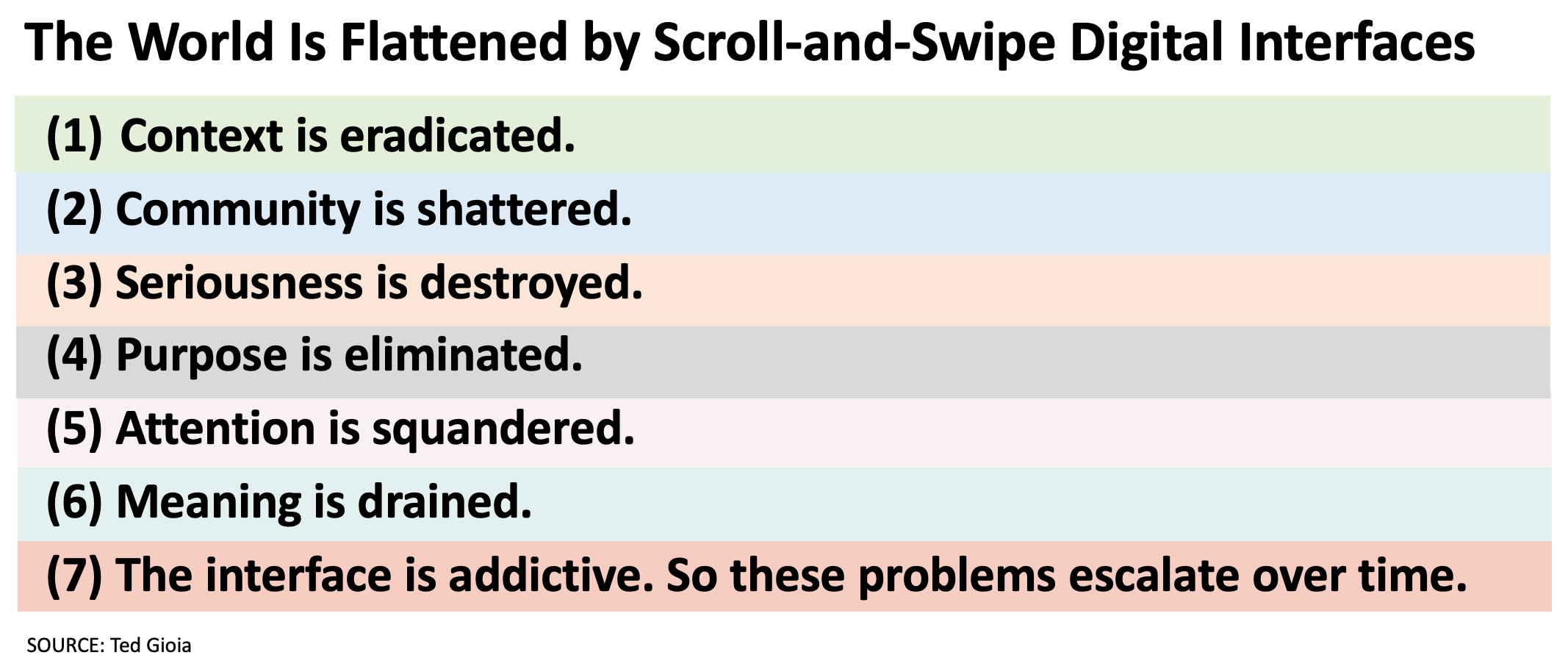
Twenty years ago, the culture was flat. Today it’s flattened.
I still participate in many web platforms — I need to do it for my vocation. (But do I really? I’ve started to wonder.) But now they feel constraining.
Even worse, they now all feel the same.
Instead of connecting with people all over the world, I now get “streaming content” 24/7.
Facebook no longer wants me stay in touch with friends overseas, or former classmates, or distant relatives. Instead it serves up memes and stupid short videos.
And they are the exact same memes and videos playing non-stop on TikTok — and Instagram, Twitter, Threads, Bluesky, YouTube shorts, etc.
Every big web platforms feels the exact same.
That whole rich tapestry of my friends and family and colleagues has been replaced by the most shallow and flattened digital fluff. And this feeling of flattening is intensified by the lack of context or community.
The only ruling principle is the total absence of purpose or seriousness.
The platforms aggravate this problem further by making it difficult to leave. Links are censored. Intelligence is punished by the dictatorship of the algorithms. Every exit is blocked, and all paths lead to the endless scroll.
All this should be illegal. But somehow it isn’t.
March 1, 2025
Celebrity fatigue
I’ve always been pretty disinterested in products and services with celebrity endorsements, but they must have worked well enough as they suddenly seemed to be everywhere. Grant McCracken notes that they seem to have reached their sell-by date recently:

Wayne Gretzky Estates produces wine and other beverages in the Niagara Peninsula. They may be fine products, but I’ve never tried them.
Talented, wealthy, beautiful, admired, they live charmed lives.
Until the last decade or so. Now they take turns doing an Icarus off the high board.
And investors are noticing.
Ann Gehan reports “Investors Drop Celebrity Brands From A-List”.
Four early-stage investors who previously backed celebrity brands said they are shifting focus to promising products as opposed to celebrity buzz
What are investors noticing?
Well, there was COVID. We all noticed how really irritating celebs were, singing us songs from the well staffed majesty of their magnificent homes. This cost them some standing.
And then there was the presidential elections. Say what you will about Kamala, the celebs who supported her must have worried about a loss.
Right?
Of course not.
Celebrities don’t lose elections. Neither do the politicians they support.
So the election too was costly.
You don’t get famous unless you know how to read the room. Celebs are their own strategists. They can hear what the country wants. They can detect change and adapt.
Until they can’t. And now they can’t.
February 25, 2025
Argentina’s experience of life with high tariffs
Marcos Falcone explains how Argentina’s unusually high tariff barriers distort ordinary economic activity for Argentines every day:

When Argentines go abroad, they usually go shopping. Many of the products they want cannot be bought at home, ranging from clothes to smartphones and all kinds of home appliances. Because of this, it has become a tradition to return from a trip with one or two extra suitcases filled with smuggled goods. Did you know that it is more expensive to buy an outdated iPhone in Argentina than it is to fly from Buenos Aires to Miami, stay for three days, and get the newest one?
[…]
Tariffs do not just make it difficult to get phones at home — they can make life dangerous as well. Argentina’s most sold car, which is artificially expensive because of protectionist measures, got 0 (zero) stars on one of Latin America’s most renowned safety tests. Cars in Argentina are not only more expensive than elsewhere in the region, but also markedly less safe.
To achieve these terrible results, the only thing Argentina had to do was enact tariffs, and now the US seems to be heading in the same direction. But in the past, protectionism has caused the same damage in the north as it caused in the south. Back in the first Trump administration, protecting the steel-production industry saved some jobs, but eliminated many more. Tariffs have also hurt businesses that rely on imports within the US and can continue to do so in a world of globally integrated supply chains. More generally, the 1933 Buy American Act, which forces the government to pay more for US-made goods, has been proven to be both ineffective and costly.
There is no escaping the negative effects of blocking outside competition. The more barriers a country enacts, the more damage it causes to itself. If we, as individuals, acted in a protectionist way, we should aim to grow our own food, build our own house, or make our own cars. But how does that make any sense? Economist Robert Solow once said, “I have a chronic deficit with my barber, who doesn’t buy a darned thing from me”. He meant it as a joke, but he had a point: What matters is to create wealth, which can be done both by selling and buying from others.
The revival of protectionism in the US is worrisome. To avoid it, Americans should take a look at the enormous destruction of wealth that tariffs have caused in other countries. Despite President Milei’s recent efforts to lift tariffs and take Argentina out of the “prison” in which it exists, the fact that the country shot itself in the foot decades ago has put it in a very delicate economic position. The US should not follow its path.
February 21, 2025
Tech enshittification continues
Ted Gioia notes that even the world’s biggest search engine provider is doing almost everything it can to make your search experiences worse and worse:

Almost everything in the digital world is turning into its opposite.
- Social media platforms now prevent people from having a social life.
- ChatGPT makes you less likely to chat with anybody.
- Relationship apps make it harder for couples to form lasting relationships.
- Health and wellness websites make it almost impossible to find reliable health advice — instead peddling products of dubious efficacy.
- Product review sites now prevent people from reading impartial reviews by actual users of the product, instead operating as pay-for-play vehicles.
- Etc. etc. etc.
You can often tell by the name. PayPal will never pay you a penny, and it’s certainly not your pal. Microsoft Teams only works if you stay away from your team. If you keep using Safari, you will never go on an actual Safari.
But the worst reversal is happening with search engines. They now prevent you from searching.
I’ve known Google up close and personal from the start. I initially found the company quirky and endearing — but those days ended long ago. The company is now clueless and creepy.
Almost every day I read some ugly news story about Google. Here are a few headlines from a typical week:
- “Google ditches promise not to develop AI weapons” (February 12)
- “Millions of Google users alarmed after discovering new AI tool they can’t turn off” (February 14)
- “Google facilitated Russia and China’s censorship requests” (February 15)
- “Google’s new fingerprinting policy sparks privacy backlash as ads become harder to avoid” (February 17)
- “Google data centers used nearly 6 billion gallons of water in 2024” (February 11)
This company goes out of its ways to do mischief. Messing with people is in its DNA.
Meanwhile, its base business is degrading at an alarming rate. The company doesn’t seem to care.
In a strange turnaround, search engines don’t want you to search for anything. That’s because searching leads you on a journey — and Google doesn’t want you to leave their platform.
The search engine was invented as your gateway to the web. The inventors of this technology tried to index every page on the Internet — so that you could find anything and everything.
That was an exciting era. Search engines were like train stations or airports. They took you all over the world.
At Google today, the goal is the exact opposite. You never leave the station.
Techies once described the Internet as a digital highway. But we need a different metaphor nowadays. Web platforms want to trap you on their app, and keep you there forever.
So, instead of a digital highway, we have a digital roach motel. They let the roaches check in — but not check out.
February 16, 2025
Free-market economist grapples with a new kind of tariff
With US President Donald Trump seemingly utterly entranced by the possibilities of killing off as much world trade as he can using tariffs, I did not expect to read that renowned libertarian economist David Friedman is not sure about the latest kind of tariffs being proposed:
I have finally encountered a kind of tariff that I am not sure I am against. The idea is to impose the same tariff on another country’s exports that they impose on your exports. A tariff makes the country that imposes it worse off, a fact that neither Trump or most of the media appear to understand — Vance may — but it makes the country it is imposed against worse off as well. Imposing a tariff can be in the interest of the politicians who impose it for public choice reasons, as a way of buying support from a concentrated and well organized interest group such as the auto industry at the expense of a dispersed interest group such as their customers. That is one of the two reasons tariffs exist, the other being that the false theory of trade economics is simpler and easier to understand than the true theory.1
But another country’s tariff barriers against your exports make both your country and its politicians worse off. So if imposing tariffs on their imports results in tariffs being imposed on their exports, it might be in the interest of the politicians as well as the country they rule to lower, even abolish, their tariffs — and free trade, zero tariffs, is my first best tariff policy.
Reciprocal reduction of tariffs is, of course, a routine objective of trade negotiations. What Trump appears to be proposing is to automate the process. That might have some advantages. It would reduce the amount of time and effort spent on trade negotiations. More important, it would make it harder for a government that wanted to keep its tariffs to pretend to its citizens that negotiations for mutual reductions had broken down over details.
It is not obvious what “reciprocal tariffs” means in practice, because tariffs, typically, are on particular goods. China imports oil and exports textiles. If they impose a tariff on American oil there would be no point to the US retaliating by imposing a tariff on Chinese oil — we don’t import Chinese oil.
Under the Plan, my Administration will work strenuously to counter non-reciprocal trading arrangements with trading partners by determining the equivalent of a reciprocal tariff with respect to each foreign trading partner. (Reciprocal Trade and Tariffs Memo)
It isn’t clear what “the equivalent” means. One possible approach would be to figure how much revenue a country collects from tariffs on American exports and set a uniform tariff on that country’s exports set to bring in the same amount of revenue. That would be simple and would reduce the political support for tariffs, since they could not be targeted to protect specific industries.
For which reason I don’t expect it to happen. The closest version that seems politically plausible is a nonuniform tariff schedule that brings in the equivalent revenue. Unfortunately that would let the administration protect favored industries with tariffs high enough to reduce imports, and revenue, to near zero.
Of course, the target country could, in a true system of reciprocal tariffs, solve the problem by reducing their tariffs to zero.
1. I discuss the relevant economics in Ptolemaic Trade Theory.
February 15, 2025
Nannies on the right are just as bad as nannies on the left
Jim Treacher briefly gets slightly serious about RFK Jr.’s new role as America’s chief health nanny:

Fake image generated by Grok
First things first: I’m fine with a United States president picking his own cabinet. Donald Trump won, so he gets to choose the people he wants. It’s not fascism, it’s not unconstitutional, and it’s not going to destroy the country. This is the system we have, and so far the Trump administration has been operating within precedent. (Yes, even with Elon Musk and DOGE.) Fair enough.
And, also, in addition to that: I don’t like RFK Jr., and I won’t pretend I do just so you don’t yell at me.
RFK is still the same guy he was before he suddenly started being nice to Trump. He’s the guy who thinks COVID-19 was “ethnically targeted” to attack Caucasians and blacks, while sparing the Jews and Chinese. He’s the guy who bragged about having a worm in his brain. He’s the guy who, just seven months ago, said “Trump was a terrible president“.
Now I’m supposed to pretend none of that happened, just because Trump likes him for the moment? Nah.
And, of course, RFK is the guy who thinks the role of government is to slap your hand at the dinner table. So I’m supposed to pretend nanny-statism is good now.
Yay, let’s embrace lib policies to own the libs!
If you didn’t want Michelle Obama telling you what to eat, why do you want RFK telling you what to eat? If you didn’t want the government telling you which vaccines to put in your body, why do you want the government telling you which food to put in your body?
“But seed oils and high-fructose corn syrup and Red Dye Number Whatever are bad for you!” Okay. So don’t eat that stuff. You can read labels, can’t you? Why do you need the feds to hold your hand?
It’s amazing: At the very same time MAGA is cheering on Trump for reducing the size of government — and buddy, I’m right there with them — they’re begging the government to “clean up the food supply”.
Which is it, friends?
Get mad at me all you want, but at least I’m consistent. I don’t want the government telling me what to do, no matter who’s in charge for the time being.
February 7, 2025
QotD: The Chump Ratio
That’s what you might call the Chump Ratio. In any given crowd, Barnum (or whomever) said, one person in five is a born chump. He’s ready, willing, and able to believe anything you put in front of him, and so long as it’s not skull-fornicatingly obvious fakery — an extremely low bar, as you might imagine — he’s all in. The best part is, chumps don’t know they’re chumps, and they never, ever wise up (poker players have a similar adage: “After a half hour at the table, if you can’t spot the sucker, then you’re the sucker”; it has the same impact on behavior, namely: none whatsoever). You don’t have to do anything to sell the chumps; they’re practically begging you to take their money.
Barnum didn’t say much about these guys, but there’s another ratio that applies to a given crowd, also about one in five: The born skeptic, the killjoy, call them what you will. This is the guy completely unaffected by the lights, the music, the smells of popcorn and cotton candy, the children’s laughter … all he can see at the carny is the tattooed meth head who put everything together overnight with an Allen wrench. He might well show up at your carny — the wife and kids wanted to go — but you’ll never make a dime off him. No show in the world is ever going to sell him, so you don’t need to worry about him.
It’s those other three guys in any given crowd that make you some serious money … or bring the whole thing crashing down on your head. They’re who the show is really for.
It’s pretty easy to sell these folks. After all, they want to be sold. They’re at the carnival, aren’t they? And yet, it’s also pretty easy to screw it up. They’re willing to suspend disbelief — they want to — but the line between “necessary suspension of disbelief” and “an insult to one’s intelligence” is thinner than you think, and lethally easy to cross.
Severian, “Carny World”, Founding Questions, 2021-09-24.
February 2, 2025
Captain Trumpmerica versus the Post-national Maple Protectionists
Donald Trump has made picking fights with the corrupt oligarchs of Mexico and Canada a key part of his appeal to American voters. Canada used to be a proud nation, but after years of deliberate mismanagement and stubborn opposition to innovation and growth, we’ve become — as Justin Trudeau so smugly put it — the first “post-national state” that has “no core identity [and] no mainstream”, because we’re a plaything for the WEF and other transnational organizations. Elizabeth Nickson calls us a “failed state” and that swapping in globalist WEF’er Mark Carney for globalist WEF’er Justin Trudeau will make no positive difference:
25% tariffs will ruin us. The tariffs mean one million small businesses — all which sell to the U.S. — will contract and many will close their doors. And then Trump, as he promised the unions, will pull “our” auto industry. Then we’re done.
Who is to blame for this?
The following is going to be crude because Canada is so boring (that’s deliberate) that no one cares. There are a thousand ultra-complex rationales on why Canada is failing and all they do is obfuscate. I’m not pulling punches, softening rhetoric — it is bad. It is urgent. This is the death of something that 75 years ago was shining, sunlit, exciting. That country? That country was killed by the Laurentian elite, weak, cosplaying Marxism to stay in power, themselves outwitted by investment bankers who plan to steal everything not nailed down. In so doing new elements were forcibly injected into the population: envy, resentment of the successful, sloth, the refusal to grow up, be strong and independent. We effectively sit on top of the U.S., seething with envy, in wet diapers.
We are a broken country. Everyone who understands the world knows this. The only people who don’t are deluded Canadian socialists, which is to say our entire elite and all our “knowledge class”. Dissent is ignored. Or jailed.
Central banker Mark Carney, WEFer paramount, is being parachuted into the Liberal party in order to sell us off to the investment banks who will harvest us for our resources. Our people? Future serfs in Special Enterprise Zones. We already have the regulation in place. No taxes, no worker rights, no enviro controls, no self-determination, no agency, no freedom. Time frame? Ten years, twenty at the outside. The inevitable end of hard-core socialism.
That is what Carney did to Canada in the ‘08 crisis, a crisis entirely created by larcenous government and investment bankers: he loaded us up with so much debt that the moment the economy turned, the working class — and Canada is now 75% working class — paid for it through interest rates so high they crippled and broke every middle class family with a mortgage. Then, he moved to England and did it to the English. His name there? Mark Carnage. During the ’08 crisis, he in Canada and the UK and Obama in the US transferred trillions in public wealth to the investment banks to keep them going after the worst crisis since ’29. A crisis they caused. That was the people’s money, not theirs.


However, as Peter Menzies points out, our Laurentian Elite are still 100% protecting us from the baleful influence of American culture … well, the commercial bits anyway:
Next Sunday, the federal agency responsible for the flourishing of national culture and identity will be swamped with complaints. The grumbling will emanate from Canadians enraged they can’t get more American culture. Yes, America may be in the process of humiliating Canada as its lamest of lame duck leaders, Prime Minister Justin Trudeau, waddles into the sunset. And, for sure, most of us are mortified that U.S. President Donald Trump has chosen to make an example of us as he launches his mission to bring the globe to heel and Make America Great Again.
But the bitching directed in the days to come at the Canadian Radio-television and Telecommunications (CRTC) headquarters in Gatineau will originate from Canadians angry they can’t watch American Super Bowl TV ads along with the game. A perennial contender to be the most watched TV event in Canada, the Super Bowl also has traditionally been the most controversial event on the CRTC’s calendar.
The USA can slap us silly with tariffs. It can send hundreds of thousands of us into unemployment and despair. It can mock our disinterest in maintaining the essentials of nationhood and drive us into unsustainable debt. Trump can brutalize our national esteem and taunt us for our cavalier attitudes towards the defence of our sovereignty. And he can lick his big beautiful lips while pondering our potential as the 51st state.
But what will really light us up Feb. 9 will be being unable to watch Meg Ryan and Billy Crystal reinvent their famous restaurant scene from When Harry Met Sally or Michelob Ultra’s production starring Willem Dafoe and Catherine O’Hara as a couple of pickleball hustlers. Or Matthew McConaughey channeling legendary Chicago Bears coach Mike Ditka for Uber Eats. And the Clydesdales. Everyone loves those Budweiser Clydesdales, particularly the cute little foal making a debut.
It doesn’t matter that the ads cost $7 million U.S. (which will convert into heaven only knows how many bazillion loonies in the months ahead) for a 30-second spot. Or that for more than a decade many of the commercials have been available on YouTube. Canadians don’t want to watch a Super Bowl adorned with Government of Ontario and Maple Leaf Foods ads. They want to watch the game like real Americans and relish the full, unfettered American experience.
At the National Post, a sad recounting of just how badly we’ve been let down by our politicians — and not just recently … this is a decades-long list of conscious self-harm for short-term domestic political advantage:
Bold counter-attacks against the U.S. can’t work, because all the ideas Canada could have put into action to make such a response viable are collecting dust on the cellar shelf. Drop interprovincial trade barriers that amount to a $200-billion penalty on the national economy every year? That only became a serious conversation in the last month. It should have been a serious conversation 10 years ago, if not more.
End supply management? Out of the question — think of the Quebec votes such a move would cost. The Big Milk lobby is a strong one.
How about resource development? Because Canada is ultimately a resource-exporting economy? No; we’ve been cancelling energy projects at the slightest objection and building more legislation to stand in their way. Industries like mining and fishing, already mired in growth-choking regulations, are increasingly refashioned by governments into welfare and “reconciliation” initiatives, repelling private investment that would have brought prosperity to the country as a whole.
Diversify away from the Americans? We’ve only done the opposite: since 2017, Canadian trade has become more focused on the U.S.
Canada should be a prosperous, growth-oriented economy, but instead, its government — and the people who continuously vote for economy-stagnating policy — settle for subsistence and redistribution of a shrinking pie of wealth. Their choices for the past decade have left us without enough fat to get through a cold trade winter.
Prompt retaliatory counter-tariffs are hence unwise. Such a move would put Canadians in the path of two separate blows, one from the front, the other from the back. And while immediate counter-tariffs could affect Americans whose support the president depends on — as was the case in the 1930s, when Canadian counter-tariffs prolonged the American Great Depression (while inflicting domestic pain) — those Americans have much bigger economic fat stores. In a trade war of attrition, expect Canada to lose.
That leaves us, unfortunately, with the less-glamourous immediate option: play this by the book. The United States-Canada-Mexico free trade agreement, which will be violated by any across-the-board tariff Trump applies, needs to be challenged with the mechanisms agreed upon by party states. During the process, Canada must remind Trump that it’s just following the agreement that he made.
QotD: Tariffs
Walter E. Williams, “Economics Reality”, Townhall.com, 2020-02-04.
January 30, 2025
Proposed California legislation to allow “Big Oil” to be sued for “climate change damage … regardless of cause”
California is a lovely place. I’ve only ever been there once, back in January 1991 but it was a wonderful (business) trip. California’s political “leaders” on the other hand are clearly in need of immediate re-institutionalization:
First, the madness of the California state legislature is richly displayed in Senator Scott Wiener’s remarkable new bill that would allow people to sue the oil industry because climate change damaged their property, via “natural catastrophe, including a hurricane, tornado, storm, high water, wind-driven water, tidal wave, tsunami, earthquake, volcanic eruption, landslide, mudslide, snowstorm, or drought, or, regardless of cause, a fire, flood, or explosion”.
I hope you caught that “regardless of cause” thing, there at the end. If this bill passes — it won’t, being mostly a theatrical performance, but let’s pretend — Californians will supposedly be able to sue Chevron or ExxonMobil (and so on) because a flood or fire damages their property, which implicates fossil fuel-induced climate change, regardless of the cause of the flood or fire.
- I threw matches on your couch
- Climate change
- Big Oil burned your couch
On the hook: anyone who sold “fossil fuels” in California “since the year 1965”, although a lawsuit has to be brought within three years of the discovery of the damage caused by the fossil fuel’s effect on the climate.
Favorite part, and look at item #2 (click to enlarge):
I’m not a lawyer, but I have doubts about declaring in a law that you can’t question the constitutionality of the law. We had similar legal doctrines on the playground in elementary school, despite which some members of the first-grade community controversially persisted in utilizing the disallowed tag-back.
Wiener’s press release on the bill is … very special. California government knows why the recent fires were so harmful, and none of it involves California government. Sample quote from, please help me, the state senator who represents my district:
“The Eaton Fire destroyed over 9,000 structures in my District, wiping out almost the entire town of Altadena, leaving thousands of my residents calling for justice and accountability,” said Sen. Sasha Renée Pérez (D-Pasadena). “Our communities have never seen anything like this in urban Los Angeles. The reality is that climate change is here and will continue impacting communities everywhere. What makes this worse is decades ago, Big Oil knew this would be our future, but prioritized lining their own pockets at the expense of our environment and the health of our communities. The Affordable Insurance and Climate Recovery Act will hold the oil industry responsible for the damage it has inflicted, and provide relief for future communities impacted by climate disasters.”
Decades ago, Big Oil knew Altadena would burn, but they did it anyway. Case closed.
I’m also quite fond of the senator’s use of “my residents”, which sounds like she’s buying up dead souls to expand her vassalage. I pay her in grain, of course.

January 23, 2025
The Google of the early modern era
Ted Gioia compares the modern market power of the Google behemoth to the only commercial enterprise in human history to control half of the world’s trade — Britain’s “John Company”, or formally, the East India Company which lasted over 250 years growing from an also-ran to Dutch and Portuguese EICs to the biggest ever to sail the seas:
No business ever matched the power of the East India Company. It dominated global trade routes, and used that power to control entire nations. Yet it eventually collapsed — ruined by the consequences of its own extreme ambitions.
Anybody who wants to understand how big businesses destroy themselves through greed and overreaching needs to know this case study. And that’s especially true right now — because huge web platforms are trying to do the exact same thing in the digital economy that the East India Company did in the real world.
Google is the closest thing I’ve ever seen to the East India Company. And it will encounter the exact same problems, and perhaps meet the same fate.
The concept is simple. If you control how people connect to the economy, you have enormous power over them.
You don’t even need to run factories or set up retail stores. You don’t need to manufacture anything, or create any object with intrinsic value.
You just control the links between buyers and sellers — and then you squeeze them as hard as you can.
That’s why the East India Company focused on trade routes. They were the hyperlinks of that era.
So it needed ships the way Google needs servers.
The launch of the massive East India merchant ship, the Edinburgh — which brought tea from China.
The seeds for this rapacious business were planted when the British captured a huge Portuguese ship in 1592. The boat, called the Madre de Deus, was three times larger than anything the Brits had ever built.
But it was NOT a military vessel. The Portuguese ship was filled with cargo.
The sailors couldn’t believe what they had captured. They found chests of gold and silver coins, diamond-set jewelry, pearls as big as your thumb, all sorts of silks and tapestries, and 15 tons of ebony.
The spices alone weighed a staggering 50 tons — cinnamon, nutmeg, cloves, pepper, and other magical substances rarely seen in British kitchens.
This one cargo ship represented as much wealth as half of the entire English treasury.
And it raised an obvious question. Why should the English worry about military ships — or anything else, really — when you could make so much money trading all this stuff?
Not long after, a group of merchants and explorers started hatching plans to launch a trading company — and finally received a charter from Queen Elizabeth in 1600.
The East India Company was now a reality, but it needed to play catchup. The Dutch and the Portuguese were already established in the merchant shipping business.
By 1603, the East India Company had three ships. A decade later that had grown to eight. But the bigger it got, the more ambitious it became.
The rates of return were enormous — an average of 138% on the first dozen voyages. So the management was obsessed with expanding as rapidly as possible.
They call it scalability nowadays.
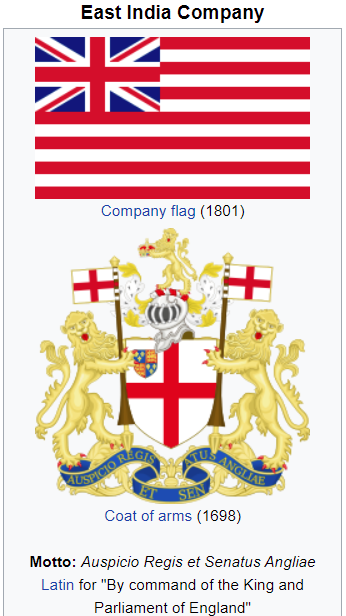
But even if they dominated and oppressed like bullies, these corporate bosses still craved a veneer of respectability and legitimacy — just like Google’s CEO at the innauguration yesterday. So the company got a Coat of Arms, playacting as if it were a royal family or noble clan.

As a royally chartered company, I believe the EIC was automatically entitled to create and use a coat of arms. Here’s the original from the reign of Queen Elizabeth I:

January 17, 2025
Trump’s demands include some things that would be quite beneficial to Canada
In the National Post, Bryan Schwartz suggests that some of the things Trump has raised as issues in Canada/US trade would be economically sensible for Canada to address because they’d reduce costs of doing business in Canada which would be good for all Canadians (except the crony capitalists in the blatantly protectionist “supply management” cartels):
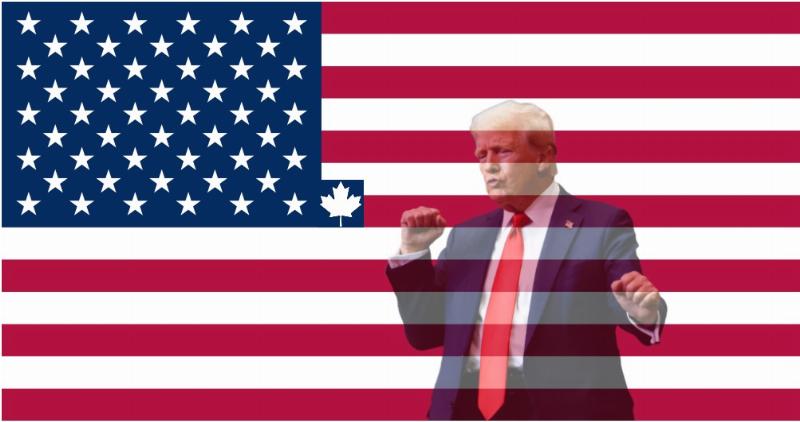
US President-elect Donald Trump trolling about Canada becoming the 51st state of the union does seem to have directed attention to our bilateral trade situation wonderfully.
The threatened Trump tariffs would hurt both the United States and Canada in many ways. But the U.S., with a larger and more productive economy (on a per capita basis), is better able to sustain the immediate pain. The economic pressure on Canada is, therefore, serious and credible.
Canada should first address issues that are of particular importance to the Trump administration. The incoming president tends to emphasize national security, even over economic nationalism. The authority of the president, under the inherent powers of the office and congressional statutes, is greater if the issue relates to national security.
The same holds under international trade agreements. The president can raise issues that Canada can address in a prompt and reasonable manner. These include border security and increasing Canada’s commitment to contributing its fair share to international alliances, which would include increasing military expenditures.
Second, Canada should recognize that external pressures can provide opportunities to do things that are in this country’s own interests, but are otherwise politically difficult. Outside pressures have in the past encouraged Canada to adopt several measures that are good for the country, such as reducing pork-barreling and regional favouritism in government contracting.
Canada’s dairy protectionism provides a good example of a trade concession that would benefit Canada, as it is unfair to lower-income Canadians and, in the long run, hurts the industry itself. An industry more exposed to competitive pressures would be incentivized to be more productive and seek to expand into international markets.
Australia has shown how such marketing boards can be abolished in a manner that gives some time to the industry to adjust and ultimately benefits all concerned. Canada could similarly rid itself of its outdated and counterproductive Freshwater Fish Marketing Corporation, as well. To the extent that the United States pressures us to eliminate such supply management systems, it is actually doing us a favour.
Likewise, given that the U.S. is moving away from suppressing free expression in cyberspace, Canada would benefit from joining such initiatives rather than continuing down the path of having government or big companies effectively engage in censorship under the guise of fighting “disinformation”. The best remedy for any wrongheaded speech is rightheaded speech, not censorship.
At Dominion Review, Brian Graff steals a line from George C. Scott’s portrayal of Patton who said (in the film, not in real life) – “Rommel, you magnificent bastard. I read your book!” after reading the book of Trump’s Trade Representative, Robert Lighthizer:

Lighthizer wrote a book (released in June 2023) about his trade views and experience entitled No Trade Is Free: Changing Course, Taking on China, and Helping America’s Workers, which I just read. I only became aware of Lighthizer in November, in part because of a review of his book in The Guardian.
I don’t think Lighthizer is a bastard (literally or figuratively). He is hardly magnificent, but his book should be required reading for Canadians interested in our upcoming negotiations with the US. Our government would learn how best to counter the US by preparing a strong strategy and going on offence even before negotiations begin.
In short, we should not give away anything for free. This is Lighthizer’s position in matters of trade. For example, Canada should not volunteer to meet the two percent defense spending target ahead of negotiations. If anything, Canada should be accusing the US of whatever complaints we can muster. Trump might complain about the Canadian border being porous when it comes to people and drugs, but we can make the same claims, and add on the fact that the US should do more to stop the flow of illegal guns into Canada across our southern border.
Lighthizer provides a history of the US based around the idea that the US revolution and the constitution were a reaction to the mercantilist policies of Britain, which wanted to export manufactured goods and import only raw materials, while also limiting US trade with the rest of the world. Here is Lighthizer’s essential view:
Today, the tide has turned against the argument for unfettered free trade, in no small part because of the changes we made in the Trump administration. More broadly, evidence and experience have shown us that free trade is a unicorn – a figment of the Anglo-American imagination. No one really believes in it outside of countries in the Anglo-American world, and no one practices it. After the lessons of the past couple decades or so, few believe in it even within that world, save for some hard-core ideologues. It is a theory that never worked anywhere.
This is his critique of the neoliberal free trade approach:
According to the definitions preferred by these efficiency-minded free traders, the downside of trade for American producers is not evidence against their approach but rather is an unfortunate but necessary side effect. That’s because free trade is always taken as a given, not as an approach to be questioned. Rather than envisioning the type of society desired and then, in light of that conception of the common good, fashioning a trade policy to fit that vision, economists tend to do the opposite: they start from the proposition that free trade should reign and then argue that society should adapt. Most acknowledge that lowering trade barriers causes economic disruption, but very few suggest that the rules of trade should be calibrated to help society better manage those effects. On the right, libertarians deny that these bad effects are a problem, because the benefits of cheap consumer goods for the masses supposedly outweigh the costs, and factory workers, in their view, can be retrained to write computer programs. On the left, progressives promote trade adjustment assistance and other wealth-transfer schemes as a means of smoothing globalization’s rough edges.
This section is also key:
… mercantilism and a free market are dramatically different systems, with distinctions that are important to note. Mercantilism is a school of nationalistic political economy that emphasizes the role of government intervention, trade barriers, and export promotion in building a wealthy, powerful state. The term was popularized by Adam Smith, who described the policies of western European colonial powers as a “mercantile system.” Then and now, there are a vast array of tools available for countries seeking to go down this path. Mercantilist governments, for instance, frequently employ import substitution policies that support exports and discourage imports in order to accumulate wealth. They employ tariffs, too, of course, and they limit market access, employ licensing schemes, and use government procurement, subsidies, SOEs, and manipulation of regulation to favor domestic industries over foreign ones.
The focus of the book, and the main villain, is China, followed closely by the World Trade Organization (WTO). Canada gets less than 77 mentions, Mexico gets 99 mentions in the first 352 pages of 576 (the e-book stops counting at 99), and Japan gets 99 mentions in the first 400 pages. Compare this to China, which gets 99 mentions within the first 101 pages alone.
January 16, 2025
For some unknowable reason, high-tax states keep losing population to low-tax states
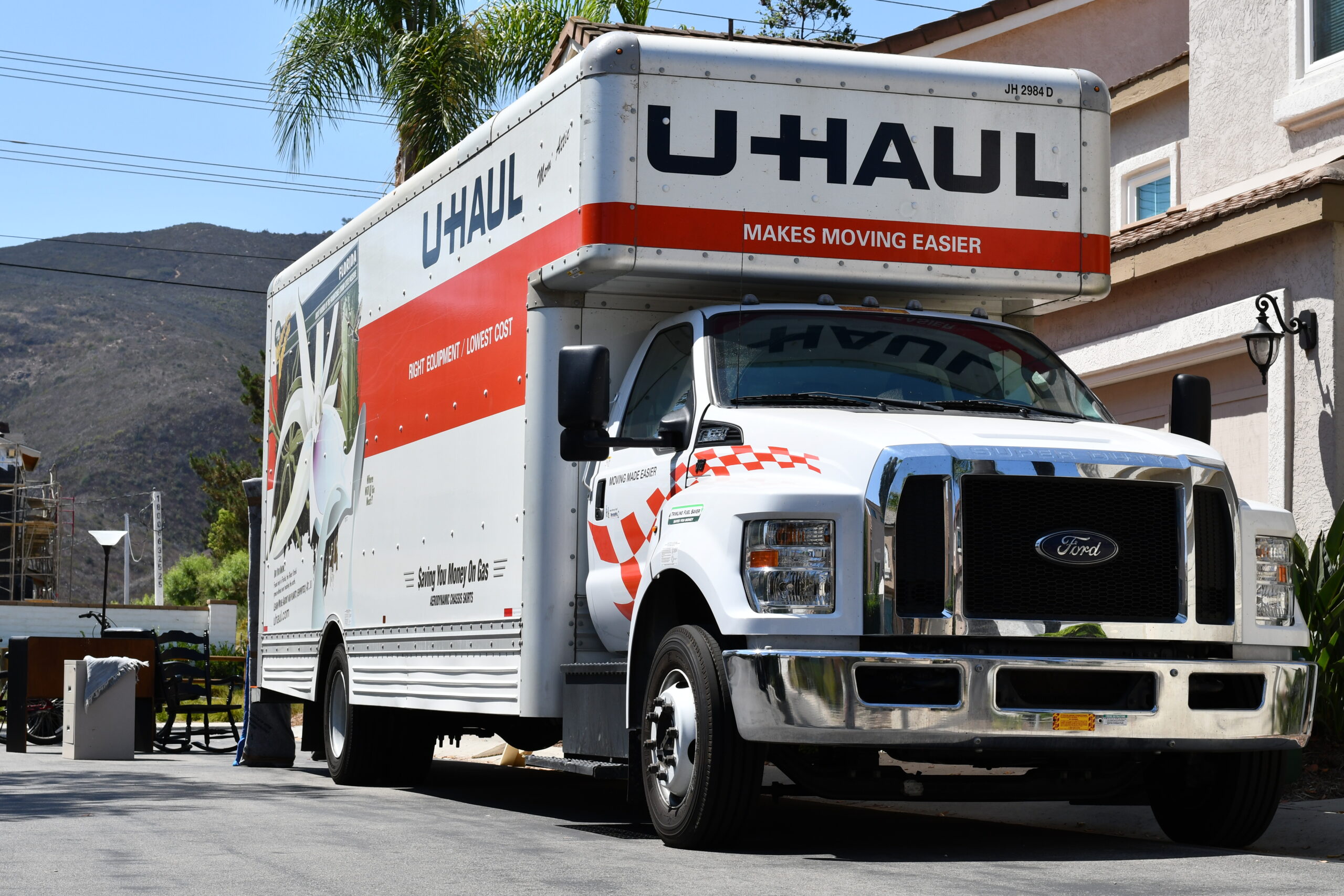
“U-Haul Rental Truck (44601958941)” by HireAHelper is licensed under CC BY 2.0 
 .
.
This probably won’t come as a surprise to many readers, but when people move, they tend to prefer migrating to places where, among other considerations, the taxes are lower than in their old digs. Data from the U.S. government as well as from moving companies reveals that — as we’ve seen in the past — high-tax states are losing residents to states that take a smaller bite out of people’s wallets.
“Americans are continuing to leave high-tax, high-cost-of-living states in favor of lower-tax, lower-cost alternatives. Of the 26 states whose overall state and local tax burdens per capita were below the national average in 2022 (the most recent year of data available), 18 experienced net inbound interstate migration in FY 2024,” Katherine Loughead wrote last week for the Tax Foundation. “Meanwhile, of the 25 states and DC with tax burdens per capita at or above the national average, 17 of those jurisdictions experienced net outbound domestic migration.”
Loughead crunched numbers from both the U.S. Census Bureau as well as U-Haul and United Van Lines. The government data tracks population gains and losses across the country while numbers from the private companies is helpful for comparing flows in and out of various states. The results are revelatory, though not unexpected.
“For the second year in a row, South Carolina saw the greatest population growth attributable to net inbound domestic migration” according to Census Bureau figures. The Tax Foundation separately ranks South Carolina at number 9 for tax burden, with 1 being the lowest tax burden among states and 50 the highest. Rounding out the top-10 population-gainers were Idaho (ranked 29), Delaware (42), North Carolina (23), Tennessee (3), Nevada (18), Alabama (20), Montana (27), Arizona (15), and Arkansas (26).
According to census data, Hawaii lost the biggest share of its population to other states; it’s ranked at 48 for the third-highest tax burden in the country. The rest of the top 10 states for population outflow were New York (50), California (46), Alaska (1), Illinois (44), Massachusetts (37), Louisiana (12), New Jersey (45), Maryland (35), and Mississippi (21).
Numbers released this month by U-Haul and United Van Lines showed migration patterns closely, but not precisely, tracking the Census Bureau’s information. Loughead attributes the disparities, at least in part, to the companies’ varying geographic coverage and market share.


