
When it comes to Roman governance in Egypt, perhaps the best summary of what we know about how typical it was would be to say that Roman rule in Egypt was somewhat unusual, but rather less unusual than we used to think it was, and it became more typical over time (so the level of unusualness is greatest under Augustus and then declines as a factor of time). Ironically, it has been in no small part coming to understand the wealth of the papyrus evidence that has led to this shift, revealing that our literary sources sometimes overstated the degree to which Egypt was unusual.
A lot of that comes from how Tacitus represents the structure of Roman rule in Egypt: he describes Augustus as having “kept in the [imperial] house” (retinere domi) the governance of Egypt, assigning it to an equestrian prefect. Egypt was a relatively late addition to Rome’s growing Empire; the Ptolemaic dynasty had ruled it since the death of Alexander the Great in 323. From the 160s that Ptolemaic kingdom had become effectively a client of Rome, its independence maintained by the threat of Roman arms (demonstrated vividly in 168 when Rome turned back a Seleucid invasion of Egypt with nothing more than a consultum of the Senate), but had remained independent until Cleopatra‘s disastrous decision to back Marcus Antonius (Mark Antony) in the last phase of Rome’s civil war. After their defeat, Octavian (soon to be Augustus) had in 30 BC after the suicide of Cleopatra, annexed the kingdom, creating the province of Roman Egypt.
Tacitus’ description of Augustus keeping the rule of Egypt “in the house” led early scholars to assume that Egypt was taken essentially as the private property of the emperors. This is less crazy than it initially sounds; later emperors administered massive estates through a parallel state treasury called the fiscus (distinct from the main treasury of the Roman state, the aerarium Saturni; the fiscus was the private accounts and property of the emperor) administered in some cases by equestrian officials, so the idea of running an entire province effectively out of the fiscus, with the whole of Egypt effectively the private property of the emperor administered by an equestrian official wouldn’t have seemed impossible and it certainly seems to be what Tacitus is describing.
But as our evidence for the activity of these prefects has improved, what we see are officials who act quite a lot like other provincial governors, despite their non-senatorial origins. Praefecti Aegpyti typically served around three years (fairly typical), where generally not from the province they oversaw (also typical), and wouldn’t be reassigned to a post back in that province (also typical). Unlike with the earlier Ptolemaic government, there was no royal court in Egypt, the prefect’s entourage more nearly resembling that of a Roman governor, nor was the emperor personally present. Residents of Egypt who wished to petition the emperor had to do it through the same channels as any other resident of the Roman Empire. The military enforcement forces in the province, too, were typically Roman, drawn (as was normal) from provinces other than where they served. Consequently, as Dominic Rathbone (op. cit.) notes, local elites looking to operate with this new form of government found that they had to adjust themselves to a system of rule, quintessentially Roman, rather than the more personalistic Ptolemaic regime where favor might be curried with important local figures or the royal court itself.
That said, while we’ve increasingly found that the Praefectus Aegypti was more of a normal governor than we thought, vision into the lower levels of the Roman administration in Egypt reveal a complex and in some cases peculiar system. In most of the Roman Empire, Roman governors oversaw largely self-governing communities, run by local elites, which handled most local affairs. Those communities generally delegated governing functions to elected or appointed magistrates who were amateur part-timers drawn from the elite (the curiales, we’ve mentioned these fellows before).
In Egypt, by contrast, while the Romans disassembled the royal Ptolemaic court, they initially seem to have left much of its administrative apparatus of salaries administrators in place. The division of Egypt into administrative districts – called nomes – was kept and the seat of government in the province was firmly entrenched in Alexandria (whereas at least in the first two centuries, most Roman provinces had no clearly established “capital”). Each of the nomes was governed by a strategos (while the word means “general” these were purely civilian officials), typically drawn from the Alexandrian upper-class (rather than being truly local elites), assisted by a salaried basilikos grammateus, “royal scribe”. Villages also generally had a komogrammateus, village scribe, who reported to the strategos; these fellows also seem to have initially been salaried officials. Some of these positions gradually became truly liturgic in nature, mirroring more closely systems of local governance in much of the rest of the Roman world, but perhaps only in the late second century.
Similarly, it was often assumed early on that land ownership and tenure would look very different with the emperor maintaining a lot of direct control and nearly all of the land in Egypt being effectively public land. That perspective was potentially reinforced by the evidence out of the Arsinoite nome (again, modern el-Fayyum) because most of the land there under the Ptolemies belonged to military settlers and thus had special obligations placed on it and was thus not truly private land. But what we see under the Romans is that first this military settler (cleruchic or katoikic; the distinctions here are a post for another day) land is fully privatized and taxed like it would be anywhere else. Meanwhile, the evidence from the other nomes on the Nile itself suggest that private land was more common there even under the Ptolemies. That said, the expansion of private land holdings seems to have been a process taking place mostly under Roman rule, which in turn meant that in many cases land tenure might look quite different in Egypt (where much land was either public or held by temples) than in the rest of the empire where most land was in private hands (although public and temple lands were also common), though it tended to look more and more like the rest of the empire over time, with the process supposed to be substantially complete by the end of the second century. Scholars broadly seem to still be very much divided on the degree to which late Ptolemaic and early Roman Egyptian landholding was exceptional, but it certainly had its substantial quirks.
Meanwhile the Romans did another odd thing in that they didn’t change: the currency system. While the Roman Empire minted its currency in a series of regional mints (not centrally), the Romans almost always brought new areas under their control into the existing Roman currency system (based principally around the gold aureus, the silver denarius and the copper-alloy sestertius). That was both a tool of Roman imperialism, a way to make physical Rome’s notional dominion over conquered lands, but it also served (probably unintentionally) to lower transaction costs and encourage economic interaction between provinces. But Egypt was not brought into the Roman currency system, instead maintaining the Ptolemaic currency system based on the silver tetradrachma (Egypt was already a very monetized economy under the Ptolemies). That barrier between the economy in Egypt and outside of it can make it tricky to know how representative prices within Roman Egypt were for the rest of the empire. Egypt is only brought into the broader Roman currency system with the currency “reforms” of Diocletian (r. 284-305).
At the same time, Egypt was hardly “cut off” from the broader Roman economy. We have good evidence of quite a lot of trade out of Egypt, particularly in agricultural staples. But here again, Egypt is strange: Egyptian grain was the foundation for the imperial era annona civilis, the distribution of free grain to select citizens in the city of Rome itself. That meant a massive, continuous state-organized transfer of grain, specifically wheat grain, from Egypt to Rome. Some of that grain was taxed in kind, but much of it seems to have been purchased in Egypt; in either case transport was essentially subcontracted by the state. Egypt was hardly the only source of grain for the annona (the province of Africa, modern Tunisia, was another major source), but few provinces likely saw the scale of state-organized goods transfer that Egypt did. And it’s striking that attested Egyptian agriculture is quite heavily dominated by wheat farming, rather more than we might normally expect, which both speak to the high yields the Nile could offer but also Egypt’s role as the breadbasket of the Roman Empire.
Bret Devereaux, “Collections: Why Roman Egypt Was Such a Strange Province”, A Collection of Unmitigated Pedantry, 2022-12-02.
May 23, 2026
QotD: Egypt within the Roman Empire
April 12, 2026
“The ‘Green Energy Transition’ is … a watermelon, green on the outside and red on the inside”
On Substack, John Robson discusses the state of the fake green economy in the wake of a carbon market scandal where a now-bankrupt “green” company appears to have sold far more “carbon credits” than they should have:
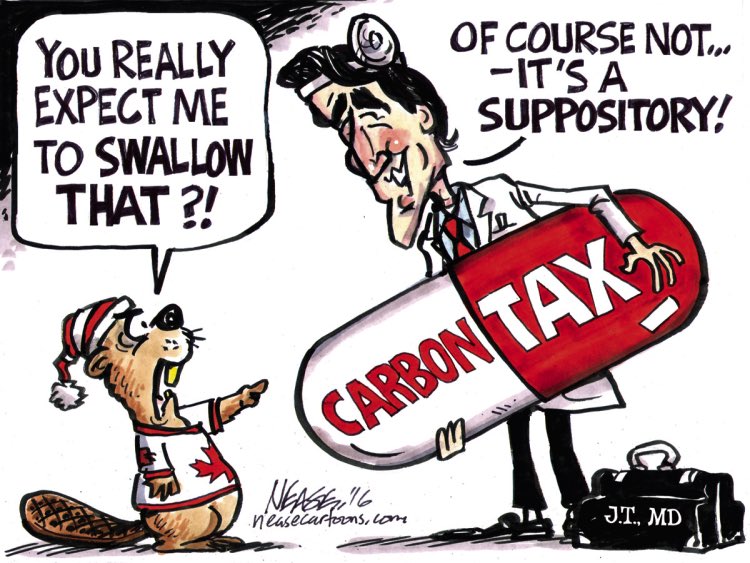
One problem among many with the “Green Energy Transition” is that it was always a watermelon, green on the outside and red on the inside. It wasn’t market-driven, it was designed, and hyped, by people who didn’t care what people actually wanted to buy and indeed, in many cases, who actively believed that consumer preferences were inefficient and unenlightened. As when Bloomberg Green worries about “What a Clean Cookstove Company’s Bankruptcy Means for Carbon Markets”. Why one company’s bankruptcy should mean anything for “carbon markets” is less clear even than what a “clean cookstove” would be. One where you sprayed and wiped the backsplash as well as the main surface? But both are clearer than “carbon markets”. You just can’t go into a store and buy carbon. What are they talking about? Why, another face-plant by central planning, of course.
According to the article, in case you weren’t independently aware of it:
This year was supposed to be a turning point for carbon markets, with the United Nations’ long-delayed country-to-country trading system coming into force and airlines preparing to enter a mandatory program to offset their emissions.
Before we get to “a turning point for carbon markets” let us give a bit of attention to “supposed to be”. Supposed by whom? Perhaps people who think the United Nations was an efficient central planner, or some subset of them. But we’ll bet that nobody normal ever said to you, or anyone else, in the course of a chat last year, “2026 will be a turning point for carbon markets”. Nobody.
Also, who was going to compel airlines to enter a “mandatory program”? Laws are made at the national level, not internationally. Turns out it’s the UN too, via the International Civil Aviation Organization, so no one was going to bungle or cheat, obviously. What could go wrong?
[…]
Why? If a company selling stoves went bankrupt in Peoria, would it cause people in Kenya, or Patagonia, or Tokyo to reconsider the whole issue of applying heat to transform food and decide that stoves, food or both were overrated? No. Of course not. The problem here is that this whole business of carbon credits was flummery.
First you made an estimate of how much harm carbon dioxide did which was nonsense. Then you made an estimate of how much CO2 some activity would release that was also nonsense. And then you made an estimate of how much CO2 some activity would not release (in this case cooking with ethanol in Mombasa) that was also nonsense. And on that basis you proposed to link the worlds of high finance, aviation and having stuff generally to a system that would have been economic rubbish even if it weren’t flashing a big bright sign “Defraud the gullible foreigners HERE!!!” Which it was.
Mathiness being in vogue, Bloomberg Green has a colourful chart explaining that “Cookstove credits are expected to become more important from 2027” that deserves as much respect as the journalistic passive voice typically does. Or perhaps even less.
The story also says:
Prices on Corsia, the marketplace for airlines where Koko was looking to sell its credits, fell as low as $12.25 from about $15 just before the firm’s collapse, according to data compiled by Bloomberg, and now sit at $12.85.
As prices for tulips softened abruptly in the Netherlands in 1637. Except at least there really were tulips and markets for same. Corsia is not a marketplace. It is, instead, the ICAO’s (remember: the International Civil Aviation Organization) “Carbon Offsetting and Reduction Scheme for International Aviation”. As if ethanol stoves in Kenya, a land of some 53.3 million people who presumably only eat three meals a day on average, could offset the vast clouds of so-called “carbon pollution” that travellers, including the big-carbon-footprint bigmouths who lead most western countries, emit every day. The whole thing is speculation piled on ignorance atop mismeasurement built on the sand of dishonesty. What could go wrong?
April 5, 2026
“Easter remains one of the major annual high holy days of confectionery derangement”
At The Freeman, Nicole James remembers her early chocolate obsessions:

Roald Dahl’s chocolate river was the economic policy of my childhood. Dripping with glossy abundance, and available to any enterprising glutton with a low sense of self-preservation. I never looked at Augustus Gloop and thought, “There goes a cautionary tale about excess”. I thought, “There goes a boy with initiative”. I wanted the river. I wanted the factory. I wanted an Oompa Loompa or two, ideally unionized and living in a tasteful outbuilding, making me truffles on demand. I wanted a world in which everything was edible and slightly mad. While everyone else was apparently learning moral lessons, I was busy fantasizing about a life in which I could plunge both arms into a molten tributary of cacao and come up glistening, like some sort of deranged dessert otter.
Easter seemed to offer the nearest thing to this ideal. It was the one annual moment when adults, in a dramatic collapse of judgment, agreed that children should be handed industrial quantities of wrapped chocolate and told to go hard. Easter had tiny eggs hidden in pot plants and larger ones with enough packaging to survive atmospheric re-entry. It was capitalism in a bunny suit.
Then adulthood arrived, lugging excellent literary references. Along came Like Water for Chocolate, with its sexy sorrow and culinary melodrama, and suddenly chocolate was not just a childhood frenzy but a vehicle for yearning and seduction. It could communicate things one would never dream of saying aloud at a suburban dinner party. Chocolate had range.
And this is why the present state of it feels so personally offensive because what is happening to chocolate is a slow-motion mugging. Cocoa is being shaved out. Bars are shrinking. Prices are soaring. Palm oil and vegetable fats are barging into flavor. Chocolate flavor. Not real chocolate, but a cheap mockery of the original deity.
And yet Easter remains one of the major annual high holy days of confectionery derangement. According to Cargill, in the United States, people are expected to plough through around 73 million pounds of chocolate over the Easter season. Around 90 million chocolate bunnies are produced, with — fun fact — 78% being devoured from the ears first.
Easter spending in the US has in recent years hovered around the $23 billion mark, with candy doing much of the heavy lifting. Chocolate, marshmallow Peeps, baskets, flowers, brunches, the whole pastel circus. Christianity may supply the headline act, but the event itself has clearly been workshopped by a mall.
But beneath the cellophane gaiety lies an increasingly grubby truth. Cocoa prices have surged, largely because harvests in West Africa have been hammered. Ghana and Côte d’Ivoire, which together produce the bulk of the world’s cocoa, have been clobbered by poor weather, crop disease, supply chain fragility, deforestation, and the sort of labor abuses that make any cheerful Easter ad feel criminal. The global appetite for chocolate remains immense, but the cacao tree itself is having a nervous collapse.
Update, 19 April: To the surprise of many who’ve latched on to the “woe, woe, mankind bad” chorus, there are now reports of a bumper crop of cocoa and the market prices are dropping:
It all seemed to kick off in March 2024 with the BBC’s chief climate headbanger Justin Rowlatt noting that “climate change” was one of the reasons for chocolate Easter eggs getting more expensive. Experts are said to have claimed that “human-induced” climate change had made extreme heat “10 times more likely” in the main cocoa bean-growing areas of West Africa. The story has had excellent fearmongering legs with a couple of years of bad weather-related harvests sending the world price of cocoa soaring. As late as October last year, the New York Times was stating that higher cocoa prices pushed up by climate change had led to companies changing their chocolate confectionary concoctions. Alas, sadly missing in recent chocolate climate claptrap is that an improved recent harvest (no weather-adjusting humans thought to be involved) has led to a massive 75% slump in global cocoa prices from the peak reached in January last year.
Like coral, polar bears and Arctic ice, any narrative-disturbing news is ignored. The media barkers promoting the Net Zero fantasy simply move onto the next promising climate porn project that can be ramped up to Armageddon level. The Great Choccy Catastrophe is a classic of its kind, but it is just the latest in a long and increasingly tedious line of crying wolf climate tantrums.
[…]
They get a lot of weather in the tropics, particularly in countries like Ivory Coast which accounts for up to 45% of world cocoa bean production. Dry periods alternate with wetter conditions, and there is some short-term variability in decadal temperatures. But according to World Bank climate figures, the average temperature since 1900 has risen just 1°C, while rainfall totals have remained remarkably stable. The average annual total since 1900 is around 1,354 mm. This is nearly identical to the 1,283 mm recorded in 2023, and similar to the 1,239 mm that fell in the supposedly drought conditions in 2024. Neighbouring Ghana is the world’s second largest cocoa producer and its 125 year precipitation average is 1,236 mm. This is a little higher than the 2024 ‘drought’ total of 1,181 mm, and a tad lower than the 1,278 mm in 2023.
The tropics have provided good pickings for climate and Net Zero agitators. Temperatures and rainfall can vary widely over individual years and decades. For instance, Ghana had record low rainfall in 1983 of 851 mm compared with a record high of 1,775 mm in 1968. As we have repeatedly seen over the last few years, any departure from the norm becomes the basis for a politicised junk science prediction that the climate is in crisis.
March 10, 2026
QotD: The slave trade
Brett Pike @ClassicLearner
The Ottoman slave trade, the trans Saharan slave trade, the trans Indian slave trade, lasted for thousands of years and enslaved millions of people … Yet school children are led to believe that slavery was a uniquely European activity.Now why do you think that is?
The Arabs, Turks, and Indians collectively enslaved three times as many people as Europeans, their slave trades lasted three times as long, and the only reason they ended was that Europeans — in particular the British — used military power to force them to stop.
Yet we get the exclusive blame for slavery.
Why?
Simple.
We’re the only ones who felt bad about slavery.
Even at the height of the slave trade it was morally controversial. It never sat right with us. We’re genuinely ashamed of it.
No one else feels bad about it. At all.
And they know this. They know that the European soul is profoundly empathetic in a way that their own petty, clannish chauvinism is not. And in that universalizing empathic conscience they smell weakness, and in weakness, opportunity.
They remind us endlessly of the role we played in continuing slavery, knowing full well that we will be either too courteous, or too distracted by guilt, to point to the much larger role that they played.
By pressing on that sore nerve they sustain a moral assault on our conscience that they then exploit for financial benefits: welfare parasitism, preferment in admissions and hiring, open borders.
The slave societies have found a way to take their revenge for the end slavery, enslaving us with our own conscience.
And they don’t feel the slightest twinge of guilt about that, either.
John Carter, The social media site formerly known as Twitter, 2025-12-08.
February 13, 2026
Lines of Fire: Operation Husky – The Invasion of Sicily 1943 – WW2 in Animated Maps
TimeGhost Cartographic
Published 12 Feb 2026July, 1943. With the German summer offensive in the East well underway, and Allied operations in North Africa wrapped up, a decision is made to strike Axis Europe on the ground for the first real time. Sicily shall be their battleground, and the omens are good. Still, landing and commanding a huge multinational force in hostile territory is a challenge the Western Allies have not had to face head-on before, but one they must overcome if they wish to have any shot of defeating Hitler and Mussolini once and for all.
00:00 Intro
01:13 Background
04:42 Disposition
07:32 The Landings & Initial Fighting
09:34 Fighting Across the Island
11:56 Aftermath
16:38 Conclusion
(more…)
January 30, 2026
QotD: Slavery in the Islamic world
The widespread neglect of the history of slavery in North Africa and the Middle East, which Captives and Companions seeks to redress, partly reflects a culture of American exceptionalism; slavery in other parts of the Americas (it was abolished in Brazil only in 1888) also receives little attention.
Partly, too, it reflects a tradition of denial in the Islamic world itself. Marozzi recalls a professor at Bilkent University in Turkey admonishing a younger historian not to dig too deep: “Our ancestors treated their slaves very well; don’t waste your time”.
In the West, meanwhile, Islamic slavery is an unfashionable — and often suspect — subject: one is reminded of West Germany in the 1980s, when any overemphasis on Soviet crimes against humanity could appear as an attempt to whitewash or relativise the Holocaust. Marozzi is careful not to dwell too much on comparisons between Islamic and Atlantic slavery, except as regards the scholarly attention which they have received. Still, many readers will pick up his book hungry for such comparisons. So here they are.
In both Islamic and Atlantic slavery there was a marked racial — anti-black — component. Slavery was sustained by similar religious and philosophical justifications: the biblical “curse of Ham”, for example, and the idea that geography and climate made sub-Saharan Africans naturally suited for servitude. “Chattel slavery”, Marozzi emphasises, existed in the Islamic world too. Both involved horrific violence and displacement. Both were complex and sophisticated enterprises, often with serious money at stake.
People have always been hesitant to draw any comparisons between Islamic and Atlantic slavery, albeit often for entirely opposite reasons to historians today. Whereas the Jewish-American writer Mordecai Manuel Noah was a vocal supporter of the enslavement of Africans in America, he was also bitterly opposed to the enslavement of Americans in North Africa — and therefore a strong supporter of America’s involvement in the Barbary wars.
Gladstone, meanwhile, thought that Turks killing and enslaving Europeans was far worse than “negro slavery”, which had at least involved “a race of higher capacities ruling over a race of lower capacities”. However dubious his family connections, Gladstone was born after Britain had abolished the slave trade.
The lack of attention given to Islamic slavery is all the more dismaying when one considers just how much longer it survived.
Most of slavery’s 20th century holdouts were in the Islamic world. Iran abolished slavery in 1928; Yemen and Saudi Arabia in 1962; Turkey — which we like to consider more “Western” than the others — in 1964. Mauritania half-heartedly abolished slavery in 1981. Slavery was still a feature of elite life in Zanzibar as late as 1970. When 64-year-old President Karume took an underage Asian concubine, he justified it by declaring that “in colonial times the Arabs took African concubines … now the shoe is on the other foot”.
The Royal Harem in Morocco, meanwhile, was only dissolved on the death of Hassan II in 1999. In the Islamic world, human beings were bought and sold, and forced to do demeaning and painstaking labour, within living memory; some people languish there still.
The key difference between Atlantic and Islamic slavery concerned status. Slaves in the Islamic world could rise to high places: 35 of the 37 Abbasid caliphs were born to enslaved concubine mothers; the slave eunuch Abu al Misk Kafur was regent over Egypt from 946 to 968. Slave dynasties, most notably the Mamluks, were amongst the most powerful in the Islamic world.
The polyglot governor of Hong Kong, Sir John Bowring, when he inveighed against “slavery in the Mohamedan states”, had no choice but to acknowledge that a slave in the East could attain the “highest social elevation” — a far cry from the black slaves of the West Indies. Some slaves, too, were amongst the worthies of Islam, such as the first Muslim martyr, Sumayya bint Khabat.
Slavery occupied a complex place in Islamic law. The Quran, on the one hand, permits men to have sex with female slaves. But on the other, the emancipation of slaves is smiled upon as one of the noblest things a Muslim can do. The Abyssinian slave Bilal ibn Rabah was freed by Abu Bakr and became the first caller to prayer; another freed slave, Zayd ibn Haritha, was briefly the Prophet’s adopted son.
The Quran also expressly forbids Muslims from enslaving fellow Muslims. Nonetheless, as Marozzi shows, this prohibition has not always been strictly observed. The Mahdi (of General Gordon fame) claimed to represent pure, Islamic orthodoxy, but he had no qualms about enslaving Muslim Turks.
Likewise, it mattered little that the Prophet Muhammad had explicitly forbidden castration of male slaves. For over a millennium his tomb in Medina was guarded by a corps of eunuchs. This, too, was an institution which survived into living memory: in 2022 a Saudi newspaper reported that there remained one living eunuch guardian.
Samuel Rubinstein, “The dirty secret of the Muslim world”, The Critic, 2025-10-17.
January 6, 2026
The “developing world” is not poor because the “rich countries” looted them
On the social media site formerly known as Twitter, Lauren Chen reacts to an emotive claim that the Third World is poor only because of the exploitation of their resources by the First World:
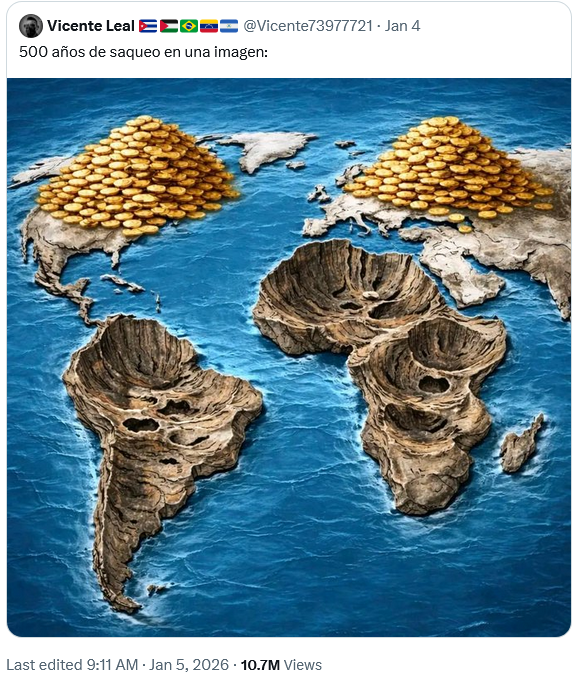
People often say that the developing world is poor because the Western world colonized them and stole their resources.
The truth, however, is that over the past century, the developing world has, for the most part, shown that they are completely incapable of harnessing their own resources. They are not poor because we stole from them. They are poor because they do not know how to run and administer their own countries, resources be damned.
Take Venezuela. The world’s largest oil reserves mean nothing if you have a corrupt communist as your leader. People will actually be starving and trying to eat zoo animals while you sit on trillions of dollars in resources!
Africa is another example. Europeans left behind farmland, trains, roads, and mines in Africa. What happened to it all?
It’s not that all of a sudden, the Africans started running things like anti-colonialist activists had envisioned at the time. No, no.
All the infrastructure fell into disrepair and/or was stripped down and looted. They were literally handed fully functioning, completed supply chains for resource extraction, and basically unlimited wealth, but they couldn’t manage the simple upkeep.
Now, the defense for Africa might be that “The Europeans didn’t teach the Africans how to manage any of this! It’s not the Africans’ fault they couldn’t run it independently! They were never trained!”
But my brother in Christ, the Europeans DID try to train locals for management! Obviously it would have been easier to have at least some locals in administration, rather than having to import an ENTIRE workforce, but efforts to find African talent were largely unsuccessful.
Don’t believe me? Just look at the different outcomes in Hong Kong and Singapore when compared to Africa. In East Asia, Europeans often did work with locals in administrative and management capacities. When colonialism ended, Hong Kong and Singapore were able to manage themselves. Not the case with Africa.
Now, none of this is to say that colonialism is good. People have the right to self-rule and self-determination. However, the idea that colonialism and resources extraction are responsible for the developing world’s ongoing poverty? That is quite simply a crock of shit.
January 2, 2026
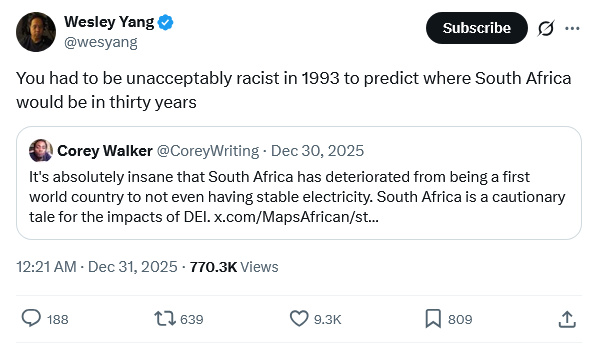
“You had to be unacceptably racist in 1993 to predict where South Africa would be in thirty years”
On the social media site formerly known as Twitter, Wesley Yang posted the comment in the headline. Will Tanner responded:
You did not, in fact. You just had to be paying attention
By 1993, South Africa was the only First World country left in Africa
America and the UN chased Belgium out of the Congo, and it collapsed into decades of civil war and famine
Mugabe destroyed Rhodesia after we aided the Soviets in helping him win. Angola and Mozambique became hells after Salazar died, the Carnation Revolution happened, and they were given up. Kenya and Sierre Leone all showed the hellish state of things that came with decolonization in the name of “democracy”
South Africa was the last man standing. It had a nuclear program. It had a space program. It had clean, reliable water and electricity. It had a thriving industrial sector. Crime was problematic, but not out of control
Now all of that was gone, for the same reason the Congo is a mess and Zimbabwe went from being the breadbasket of Africa to a famine-ridden mess: decolonization and equity
Anyone who paid attention could have predicted that. Maintaining First World life requires a First World mindset; that dies when handed over to race communists who are happy to backslide into the Stone Age if doing so means “equality” exists
And so South Africa went from First World to Third
And John Carter responded in turn:
When you stand back and look at this from ten thousand feet, a very dark pattern emerges.
In the aftermath of WWII, the newly established globalist institutions were used to give moral and financial support to decolonization movements, thereby chasing European countries out of what became the third world.
A governance structure that had successfully brought order, prosperity, and civilization to much of the planet was dismantled, leaving behind a chaotic mess of war and poverty.
Those same globalist organizations then embarked on a program of “foreign aid” that dramatically increased the size of that immiserated third world population (without actually improving conditions for them).
At the same time, their agents were busy at work within the governments of the former colonial powers, changing their immigration policies to allow immigration from more or less anywhere. Countries began adopting “multiculturalism” in the name of fighting “racism” … A newly developed postwar concept, which the media and education arms of the globalist project indoctrinated the youth to consider the worst of all possible sins.
Once the ideological and legal ground had been prepared in the former colonial powers, migration via legal and irregular pathways commenced, facilitated by — of course — the very same set of globalist NGOs that chased Europe out of the colonies.
Somehow, this new form of colonization is a good thing. Somehow, the European peoples enjoy none of the rights of “national self-determination” accorded to “indigenous” peoples which had been invoked to end colonialism.
As the populations of the third world were exploding thanks to the foreign aid being provided by globalist organizations, fertility in the first world fell off a cliff. The pill, abortion, feminism drawing women into universities and careers and therefore away from marriage and child-bearing, no-fault divorce destroying the family, and a gender war incited to new levels of bitter intensity every year which estranged the sexes, all served to reduce the white birth rate.
White fertility crashed just as the population bomb that had been set in the third world exploded, with the gates left open by carefully constructed legal frameworks that made immigration very easy and deportation very, very hard.
Update, 3 January: Welcome, Instapundit readers! Please do have a look around at some of my other posts you may find of interest. I send out a daily summary of posts here through my Substack – https://substack.com/@nicholasrusson that you can subscribe to if you’d like to be informed of new posts in the future.
December 16, 2025
The Battle of Algiers: France’s “Victory” That Lost the War – W2W 057
TimeGhost History
Published 14 Dec 2025In the mid-1950s, what Paris insists on calling a “police operation” in Algeria, steadily sparks into a full-scale war that exposes the fragility of the French Republic itself. As the FLN launches coordinated attacks, the army responds with mass arrests, torture, and collective punishment, drawing the military deeper into politics. The Battle of Algiers becomes a laboratory of counterinsurgency, even as public opinion fractures at home and successive governments collapse under the strain. By the decade’s end, the conflict has eroded faith in France’s imperial mission and helped trigger the fall of the Fourth Republic, proving that Algeria was not just a colonial war, but a crisis of the French state.
(more…)
November 30, 2025
North Africa Ep. 10: Rommel’s Desert Cannae – The Trap at Mechili
World War Two
Published 29 Nov 2025This episode, Rommel sets up a “Cannae, modern style” at Mechili, a three-pronged encirclement with Wechmar pressing from the west, Schwerin/Ariete and MG 8 driving up from the south, and Olbrich’s panzers meant to close the center. A Ghibli, fuel chaos and delays upset the timing, but Ponath cuts the Derna road and captures Generals Neame and O’Connor. And after failed breakout attempts against Fabris, the Bersaglieri and Streich, Gambier-Parry surrenders about 1,700 men and Mechili falls, opening the road to Tobruk.
(more…)
November 27, 2025
Operation Catapult: The Royal Navy’s day of infamy?
Lindybeige
Published 28 May 2025Operation Catapult took place on July 3rd 1940 at Mers El Kebir on the Algerian coast. It remains a point of controversy in the relations between the British and the French. Who was to blame for the sinking of the French ships and deaths of French sailors? You be the judge.
Erratum: Acting Rear Admiral Onslow, captain of the aircraft carrier Hermes, was not “Rodney” Onslow as I named him, but Richard Francis John Onslow, M.V.O., D.S.C. (29 March, 1896 – 9 April, 1942).
(more…)
November 24, 2025
Algeria: France’s War It Refused to Name – W2W 054
TimeGhost History
Published 23 Nov 2025This episode tracks how the doctrine “Algeria is France” — departments, settler power, and forced assimilation — breeds dispossession, mass violence, and a new Algerian nationalism: from conquest and the Sétif massacres to the FLN’s launch in 1954 and Philippeville in 1955. As Paris doubles its forces and passes Special Powers, Suez intertwines with the war, bombings in Algiers begin, and Lacoste hands police powers to General Massu — opening the Battle of Algiers and a system of torture.
(more…)
November 23, 2025
North Africa Ep. 9: Rommel tightens the Noose around Cyrenaica
World War Two
Published 22 Nov 2025April 1941, North Africa. The British forward line at Mersa Brega has collapsed, 2nd Armoured Division is in retreat, and Erwin Rommel’s Afrika Korps is on the move. What was supposed to be a cautious blocking force has turned into a fast-moving desert offensive threatening Benghazi, Mechili, and all of Cyrenaica.
In this episode of our WW2 in Real Time – North Africa miniseries, we follow:
- Rommel as he ignores Hitler’s orders and pushes east after Mersa Brega
- The chaotic British retreat and fuel-starved tanks abandoning the desert
- The fall of Benghazi without a fight
- Wavell’s misjudgements and late reactions from Middle East Command
- The race for Mechili, a vital crossroads and supply dump
- The brutal reality of desert logistics – where sand and distance destroy more vehicles than enemy shells
While Rommel drives his reconnaissance units toward Benghazi and Mechili, British commanders try to trade ground for time and avoid encirclement. At the same time, Italian commanders warn Rommel about overstretch, and German divisional leaders complain about fuel and breakdowns – warnings he largely ignores.
By the end of this week in 1941, the Desert Fox is deep inside Cyrenaica, the British are burning their own supply dumps, and both sides are racing for the next key position. A clash at Mechili is imminent – and so is a showdown at the Er Regima pass with the “Devil’s Own” Australians waiting in ambush.
This is Episode 9 of our North Africa 1941 miniseries – part of our larger effort to cover WW2 week by week, in real time.
If you want to support this work and get deeper into the war in the desert and beyond, join the TimeGhost Army at timeghost.tv or patreon.com.
Excelsior!
Battle for the Mediterranean, 1940
Real Time History
Published 4 Jul 2025In the summer of 1940, the British Empire faces German attacks against the home islands a new Italian adversary in the Mediterranean Sea, the lifeline to its colonies around the globe. In a series of campaigns the British beat back the Italians and eliminate parts of the French fleet. But the service of its overseas subjects won’t come for free.
(more…)
November 16, 2025
North Africa Ep. 8: The Forgotten Battle of Mersa El Brega
World War Two
Published 15 Nov 2025At Mersa Brega a thin British screen, one reinforced battalion with guns, holds a superb defensive choke point until Stukas, artillery, and Panzer Regiment 5 grind it down. Cemetery Hill falls under bombardment, counterattacks stall, and a northern flank probe finally forces a retreat: Rommel’s first major victory in the desert, bought against strong ground and stubborn infantry.
(more…)


