
For most of the Stone Age, this problem was insurmountable. You can’t tax hunter-gatherers, because you don’t know how many they are or where they are, and even if you search for them you’ll spend months hunting them down through forests and canyons, and even if you finally find them they’ll just have, like, two elk carcasses and half a herring or something. But you also can’t tax potato farmers, because they can just leave when they hear you coming, and you will never be able to find all of the potatoes and dig them up and tax them. And you can’t even tax lentil farmers, because you’ll go to the lentil plantation and there will be a few lentils on the plants and the farmer will just say “Well, come back next week and there will be a few more”, and you can’t visit every citizen every week.
But you can tax grain farmers! You can assign them some land, and come back around harvest time, and there will be a bunch of grain just standing there for you to take ten percent of. If the grain farmer flees, you can take his grain without him. Then you can grind the grain up and have a nice homogenous, dense, easy-to-transport grain product that you can dole out in measured rations. Grain farming was a giant leap in oppressability.
In this model, the gradual drying-out of Sumeria in the 4th millennium BC caused a shift away from wetland foraging and toward grain farming. The advent of grain farming made oppression possible, and a new class of oppression-entrepreneurs arose to turn this possibility into a reality. They incentivized farmers to intensify grain production further at the expense of other foods, and this turned into a vicious cycle of stronger states = more grain = stronger states. Within a few centuries, Uruk and a few other cities developed the full model: tax collectors, to take the grain; scribes, to measure the grain; and priests, to write stories like The Debate Between Sheep And Grain, with immortal lines like:
From sunrise till sunset, may the name of Grain be praised. People should submit to the yoke of Grain. Whoever has silver, whoever has jewels, whoever has cattle, whoever has sheep shall take a seat at the gate of whoever has Grain, and pass his time there
And so the people were taught that growing grain was Correct and Right and The Will Of God and they shouldn’t do anything stupid like try to escape back to the very close and easily-escapable-to areas where everyone was still living in Edenic plenty.
… turns out lots of people in early states escaped to the very close and easily-escapable-to areas where everyone was still living in Edenic plenty. Early states were necessarily tiny; overland transportation of resources more than a few miles was cost-prohibitive; you could do a little better by having the state on a river and adding in water transport, but Uruk’s sphere of influence was still probably just a double-digit number of kilometers. Even in good times, peasants would be tempted to escape to the hills and wetlands; in bad times, it started seeming crazy not to try this. Scott suggests that ancient Uruk had a weaker distinction between “subject” and “slave” than we would expect. Although there were certainly literal slaves involved in mining and manufacturing, even the typical subject was a serf at best, bound to the land and monitored for flight risk.
Scott Alexander, “Book Review: Against The Grain“, Slate Star Codex, 2019-10-15.
August 3, 2024
QotD: Grain farming and the rise of organized states
July 15, 2024
QotD: Sticking it to “the Man” in Collegetown, USA
But it made a certain type of college kid, and of course xzhyr professors, feel good about themselves, sticking it to The Man like that, so they kept on keepin’ on. In the grand tradition of puerile student protest, they’d routinely chalk up the parking lot and sidewalk in front of the building with catchy slogans like “this sidewalk brought to you by socialism!” Yes, they really thought that, and if you’ve followed my “inside the ivory gulag” posts, you can easily suss out why: Sidewalks are public services; public services are paid for by taxes; “conservatives” are against taxes; “conservatives” are also against socialism; therefore sidewalks are socialist.
No, really — I’ve heard more than one professor make a version of that “argument”. If it’s a public service of any kind — police, trash pickup, whatever — it’s by definition “socialist”, because it’s paid for by taxes, and “conservatives” think all taxes, everywhere, are totally illegitimate.
College these days runs about $20K per year on average, by the way. What a deal, huh?
Severian, “Caveat Emptor”, Rotten Chestnuts, 2021-06-16.
June 23, 2024
California has “a governing class that wants you to give them power, then shut up and go away”
Chris Bray illustrates some of the many ways that California’s elected politicians are working to ensure that mere voters won’t interrupt their urgent and necessary work:
The Taxpayer Protection Act, a proposed referendum that got enough signatures to qualify for the November ballot, would have required voter approval for all new state and local taxes. State election officials agreed that it met the qualification threshold, and planned to put it before the voters. Democratic officeholders sued, with considerable support from public employee unions and interest groups, and the California Supreme Court ruled this week that the measure may not be placed on the ballot — because it improperly proposes to revise the state constitution, rather than merely amending it. You can watch them try to parse that distinction here, for seventy murky pages. You can change the state constitution through the referendum process, but you can’t change the state constitution through the referendum process. See, totally clear.
At the same time, California Governor Patrick Bateman is telling the organizers of a ballot measure that would increase penalties for drug and theft crimes — after a decade of sharply reduced penalties — that he’ll punish them by blocking criminal justice reform measures in the legislature unless they pull their measure from the ballot. The intended message is a very clear threat: If you insist on your ballot measure and lose at the polls, you’ll be punished with a complete blockade on your agenda through legislative means, for as long as we can manage it.
And a parental rights proposition that aimed for a place on the November ballot — falling short in its efforts to gather enough signatures — ran into a wall when the attorney general’s office assigned it a misleading label that would have described it to voters as a repressive measure that was intended to hurt children.
So a Progressive reform, the great 20th-century transition to direct democracy, is running into a progressive wall of resistance in the 21st century. California Democrats are fighting to limit the likelihood that voters will interfere with their agenda.
People outside California often shrug at the decline of the state, because Californians are just getting what they voted for. But that view misses a bunch of strangeness and ambiguity in a place that has tended to put Democrats in office, then limit their efforts with an ideologically inconsistent hodgepodge of conservative and libertarian ballot measures. The governor and the state legislature just sued to prevent their own voters, the people who sent them to public office, from voting on the new taxes they create. Democrats against direct democracy — a governing class that wants you to give them power, then shut up and go away.
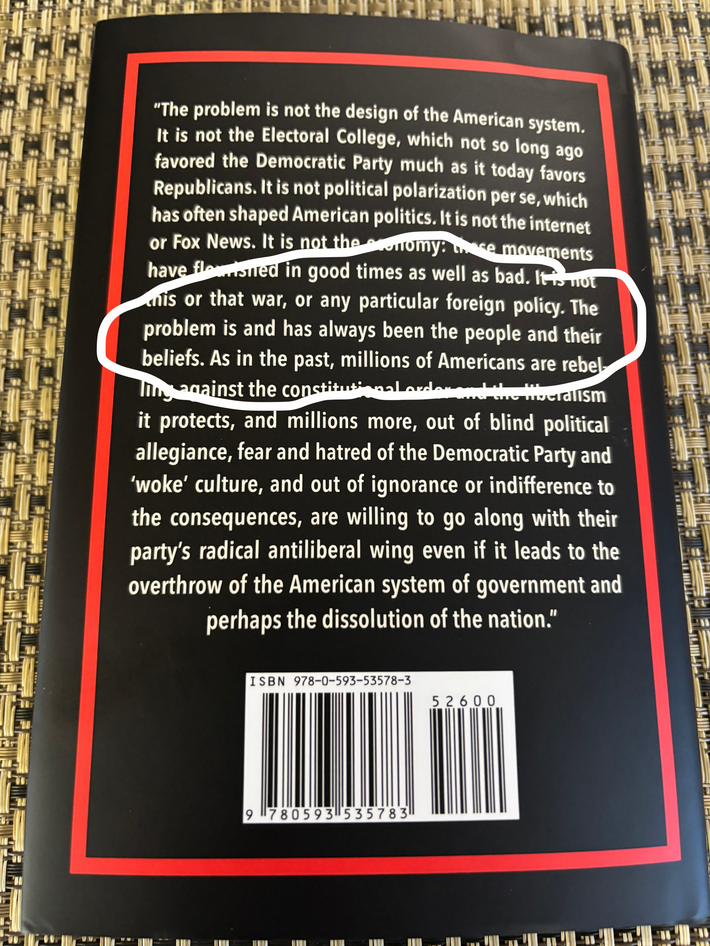
This is not merely a California problem. I wrote a few days ago about the scumbag Robert Kagan and his idiotic book warning that America is facing a rebellion. Here’s the back cover of the book, and I’ve used sophisticated media software to circle the important part:
“The problem is and has always been the people and their beliefs.” This is what the American governing class believes, now. See also the pro-democracy warrior Tom Nichols and his recurring theme about the repulsive people of an ignorant country. We need to protect democracy by getting all the trash that makes up the population to somehow go away and stop bothering their wise and benevolent betters.
The great point of cognitive slippage in American governance has been the degree to which Americans have been willing to vote for officeholders whose agendas they then try to block through lawsuits, referendums, and popular resistance. We’ve voted for shit sandwich over and over again, then declined to eat the whole sandwich. The governing class is now announcing that we’re no longer allowed to refuse the complete meal. You may not have a ballot measure on that.
In the near term, and in the medium term, that pivot leads to greater friction and accelerated decline. In the longer term, preventing people from limiting the aggressive failure of the governing class can only make that failure more apparent. Geological faults that have a lot of small movements release tension in a series of minor earthquakes; faults that can’t release tension through small movements eventually have one big one. We’ll eventually recognize the California Supreme Court’s decision this week as a Pyrrhic victory. There will be more of these, in a political system of increasing brittleness.
June 21, 2024
“Neoliberal ideology is antidemocratic at its very core. Its aim is to give free-reign over our societies to corporations, not citizens”
Tim Worstall responds to a recent Medium essay by Julia Steinberger which illustrates that “neoliberal” has joined “fascist” as a generic term to indicate strong disapproval of a person, organization, or idea:
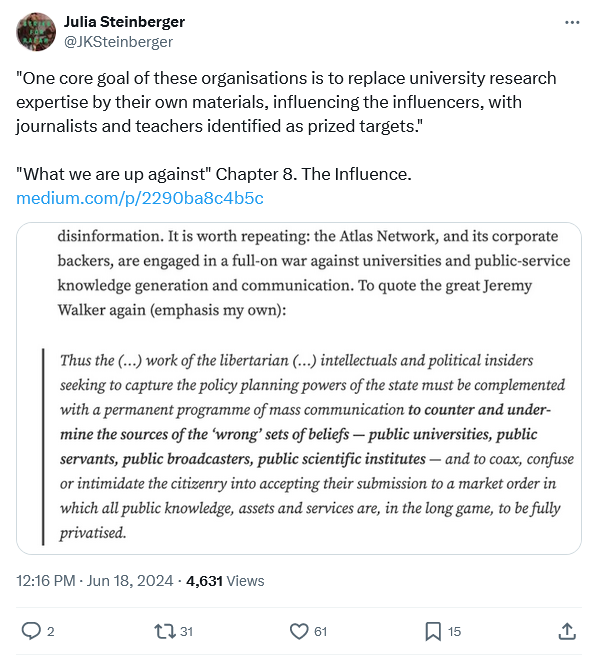
The idea that an adult woman can believe these things is just amazeballs. But here we are. A tweet from Julia Steinberger leads to her Medium essay about what’s wrong with the world.
An upheaval in 10 chapters:
1. The cause. We know the climate crisis is brought to us by highly unequal and undemocratic economic systems.
Err, no? Emissions are emissions. 100 people emitting one tonne each is exactly the same as 1 person emitting 100 tonnes. Sure, it’s true that a more unequal society will have more people emitting those 100 tonne personal amounts. But a more equal society will have more people able to emit another 1 tonne each. For, more equality is by definition the movement of some of those assets of the richer to those poorer — the economic assets which either allow or do the emitting. Sure, Jim Ratcliffe’s £50,000 private jet flight emits more than my £100 Easyjet one. But if we take the £50k off Jim and give it to 500 folk like me then all 500 of us might spend the marginal income on an Easyjet flight each — which would be more emissions than Jim’s spending of the money.
It simply is not true that economic inequality is the heart, the core or the cause of climate change. It’s idiocy to think it is too.
Of course, we know what’s happening here. Climate Change is Bad, M’Kay? Which it is, obviously. Economic inequality is Bad, M’Kay? Well, there the evidence is a great deal more mixed but whatever. But in the minds of the stupid all bad things have the same cause. So, if inequality is bad, climate change is bad, then they must be the same thing because they’re Bad, M’Kay?
2. The rise. The recent history of these economic systems, in the Americas and Eurasia, is dominated by the ascendance of neoliberal ideology.
Oh, that is good. Given that I am a neoliberal — a fully paid up one, Senior Fellow at the Adam Smith Institute and all — that’s very good. Given HS2, looming wealth taxation, the increased bite of idiot regulation and all that I can’t say that I see neoliberalism as winning right now but that might depend upon your starting point. If you’re a socialist — or an idiot but I repeat myself — you might well regard the plenitude of bananas in the supermarket as neoliberal. After all, that is something that socialism never did achieve.
3. The threat. Neoliberal ideology is antidemocratic at its very core. Its aim is to give free-reign over our societies to corporations, not citizens.
And, well, you know, bollocks. The very beating heart of neoliberalism is that corporations need to be controlled and they’re best controlled by the citizens. In the form of free markets rather than voting on which bureaucrats get the gold plated pension, true. But neoliberals are between indifferent and actually against capitalist power. The whole nub of the idea is that markets do the job of controlling capitalists better than bureaucrats, politicians or, obviously, capitalists.
There’s not really any way for her thesis to survive after getting so much of the basics wrong, is there?
But just one more tidbit:
Hayek and his neoliberal colleagues now needed another, antidemocratic way, to organise society. They didn’t want democracy, but they wanted some kind of self-maintaining organisation — by which they meant hierarchy. Organisation was supposed to be supplied by the market, and hierarchy by competition within markets. (It’s worth noting that neoliberals in the 1950s did not, although they should have, predict that unfettered markets lead to concentrations in monopolies or cartels. They would arguably disapprove of the vast corporations running our current economies, even though their market-above-democracy policies predictably brought them into being.)
Well, that wasn’t actually the last tidbit. But the idea that Friedman, Mises, Menger, Hayek and the rest didn’t worry about monopolies? Jesu C is really bouncin’ on that pogo stick right now. And then the idea that democracy will be better bulwark against monopolies than markets? Can you actually do backflips on a pogo stick?
June 17, 2024
Inside the deputy PM’s thoughts
In the National Post, Tristin Hopper imagines what Deputy Prime Minister Chrystia Freeland might be thinking as she pushes her capital gains tax increase:
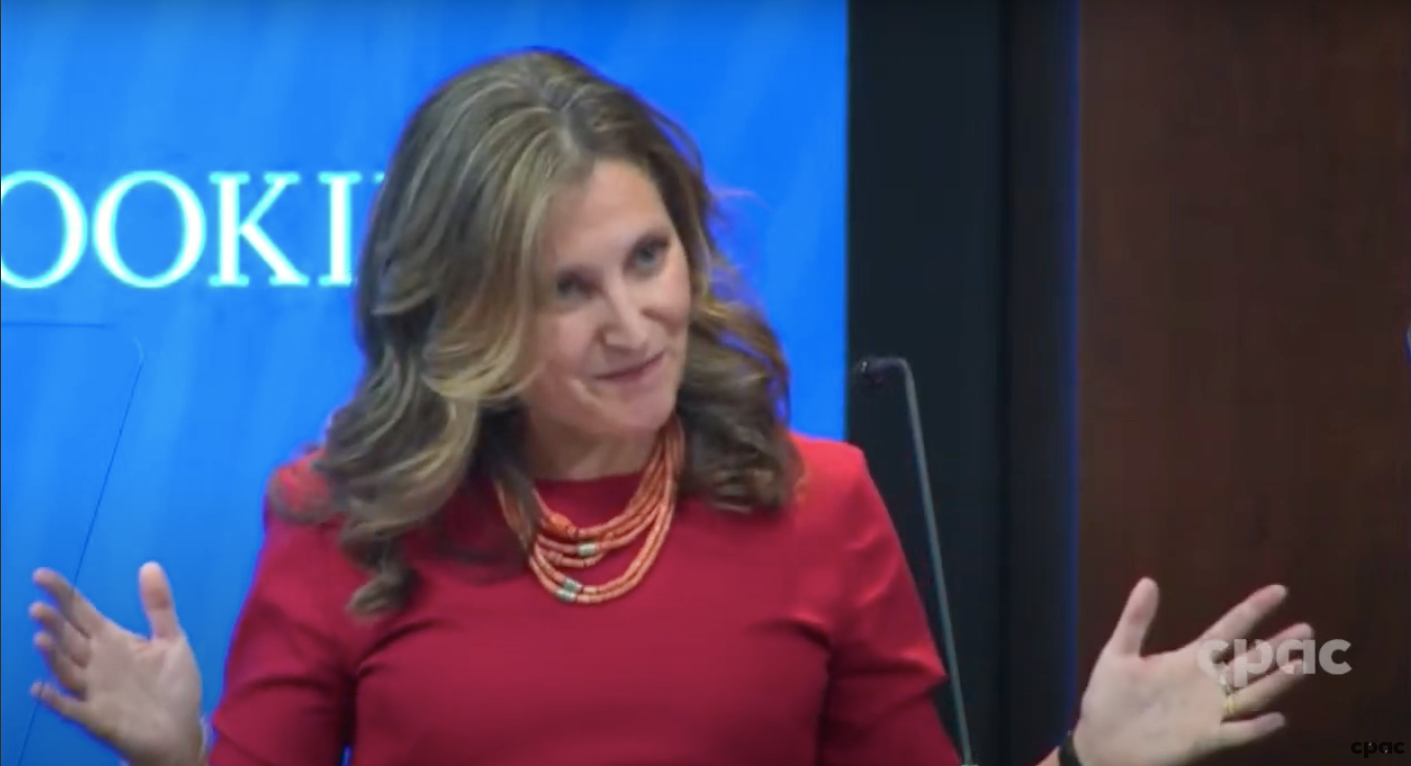
Screencap from a CPAC video of Chrystia Freeland speaking in October, 2022.
On Monday, Deputy Prime Minister Chrystia Freeland defended her government’s raising of the capital gains tax by delivering a weirdly catastrophic lecture speaking of a Canada beset by poverty, division and angry mobs.
“Do you want to be in a country where those at the very top live lives of luxury but must do so in gated communities behind ever higher fences using private health care and airplanes because the public sphere is so degraded and the wrath of the vast majority of their less privileged compatriots burns so hot?” she said.
[…]
Monday
Rivers of blood. Mothers consuming their offspring. Houses of worship employed only as makeshift storehouses for the dead.Abundance will cease. Colour will vanish. The people you now know as loved ones will first become strangers, and then they will become enemies.
These are but some of the fates that realistically lie in store for a Canada that refuses to raise its capital tax inclusion rate from 50 per cent to 67 per cent on gains realized after June 25, 2024. While I am sympathetic to those who have worked hard and wish to retain what they have earned, I would urge them to consider the value of money in a Canada where the only remaining currency is one’s readiness to kill.
Tuesday
As deputy prime minister of Canada, I am fully aware that carbon taxes are an electoral liability for this government. But this is a problem not of policy, but of messaging.If we’re not able to tax carbon-emitting fuels to a rate of $170 per tonne by 2030, the most optimistic scenario I can offer is the complete breakdown of the natural world as we know it.
Agriculture will become a memory. Cities will become unapproachable due to the overwhelming smell of decay. Language will devolve and then disappear. Any surviving art or culture will only inspire fear, because people will not know what it is.
The air may be breathable, but we will wish it was not.
June 8, 2024
Eco-terrorism – it’s all over Canada
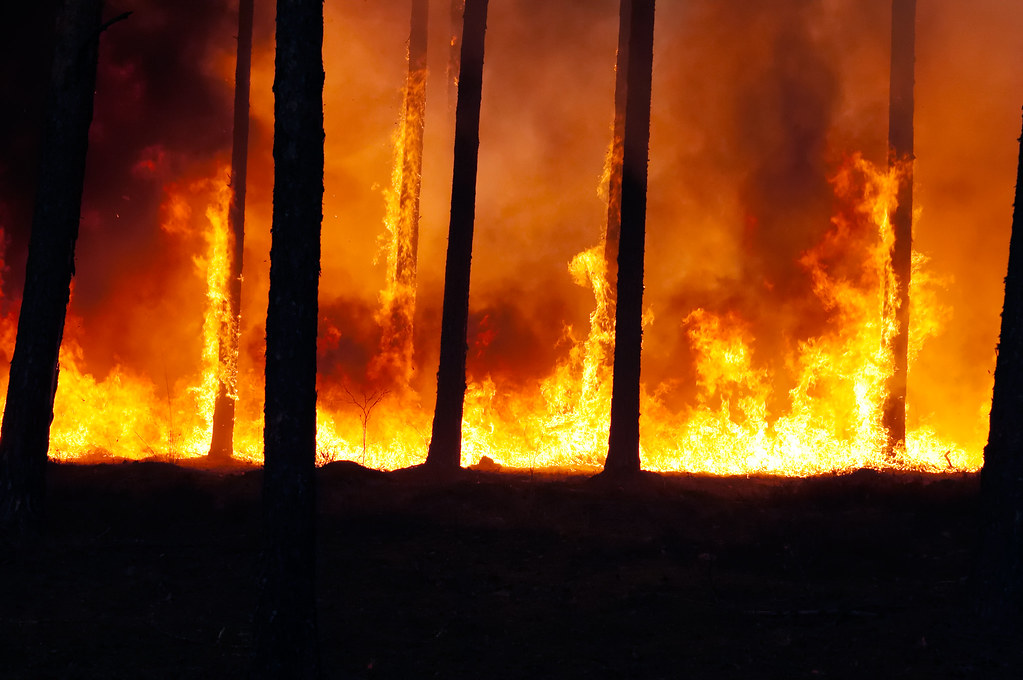
Elizabeth Nickson on the strong likelihood of any given wildfire in Canada being not just man-made but deliberately set for political reasons:
“Forest fire” by Ervins Strauhmanis is licensed under CC BY 2.0 
 .
.
A Google Earth satellite video is making the rounds on twitter. it shows the moment an arc of fires began in northern Quebec, the smoke rising. It looks like people calculated the prevailing winds so that the smoke would blow south. Then connected via sat phone, they lit them. It’s another psy-op from our gracious overlords. We aren’t afraid enough, despite every nasty limiting idiotic play they have visited upon us in the last four years. Monkey Pox failed, more plague warnings were greeted by a shrug. But this one, the world bursting into flame? Be very very afraid.
Justin Trudeau lost no time in announcing that the fires were from “climate change” and the carbon tax, which is impoverishing everyone not in government or on lush pensions, is just the beginning of the restrictions he must institute or we are all gonna die.
The stupidity and cruelty of this is almost unimaginable. But fires have worked over and over again to terrify people into quiescence. The rumours that they were deliberate were the stuff of fantasy until people started getting arrested. Alberta shows that almost 60 percent of fires in that province are human caused. And in Canada, as of today, we have arrested dozens. They will be released, their bails paid by a high-priced lawyer because most of them act as agents of the hyper-rich, paid through a cascade of environmental NGOs. The richest people among us are burning the forests in order to force compliance.
When I moved back to the country 20 years ago, the movement adopted me because I was writing for the Globe and Mail and Harper’s Magazine. I interviewed hundreds of local activists, the ones who, with the inspiration of RFK, Jr. had shut down the biggest industrial forest in the world in an action called “The War of the Woods“. They were mostly ordinary people, socialists and scientists of one stripe or another and deeply profoundly committed to saving the earth. The fact that they had eliminated the principal source of funding for health care and education — forestry — their own in fact, went right over their heads. It didn’t matter. “Climate Change” was an existential threat and those trees must stand to suck up “carbon”, or CO2, as it used to be known.
I met Denis Hayes too, the founder of Earth Day, head of the Bullitt Foundation in Seattle, founded by the heiresses to Weyerhaeuser. He excitedly told me how he created the storm of protest that led to Bill Clinton shutting down the western forests of the U.S., during the same period that Clinton was giving away American manufacturing to China. The result was devastation in forested communities from northern California to the Canadian border. Hayes, a tall, attractive Ivy Leaguer married to a woman whose father won a Nobel in chemistry, slithers through every institution. When I hung out with him, his target was Bill Gates’ climate initiatives and clearly, he has succeeded.
His “work” turned the forests into a tinderbox. Today, the 9th of June, 2023, a full thirty years too late, the Wall Street Journal editorial board finally acknowledges that sustainable forestry management may be the principal cause of the forests burning down. Holly Fretwell, a fellow at the Property and Environment Research Center, and professor at Montana State, gives, in this book, a thoroughgoing analysis of how wrong-headed and destructive “green” has been in the forests. Also this book by me, and a follow-up policy paper, also by me. These were not popular opinions, but they were, in fact, right. It is not “climate change” burning down the forests, it is government in the hands of brutal greens, in pursuit of an impossible goal.
May 25, 2024
Justin Trudeau – “a large percentage of small businesses are actually just ways for wealthier Canadians to save on their taxes”
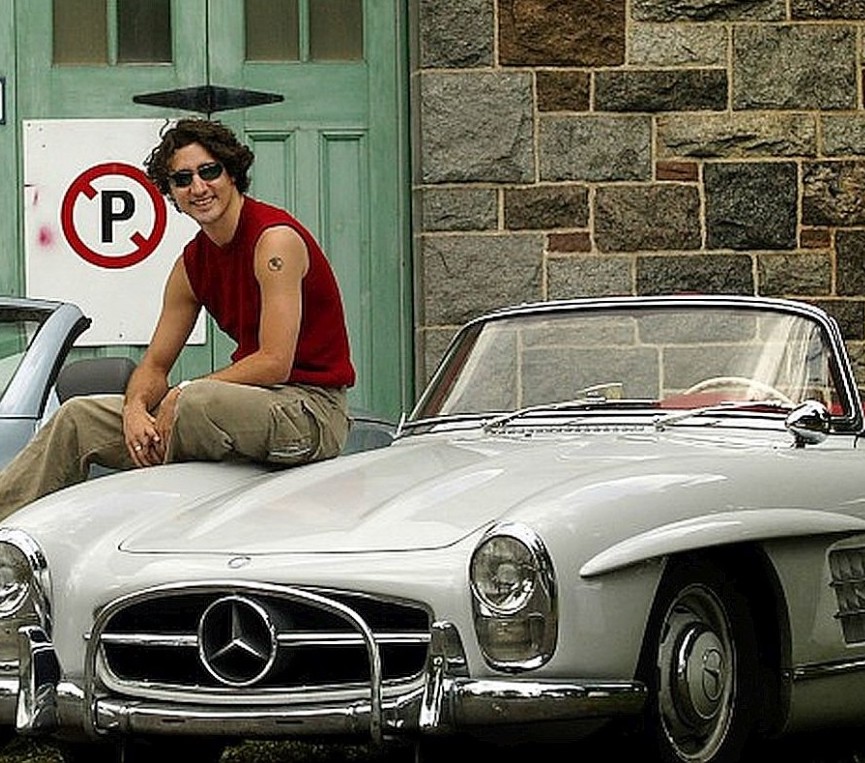
Even before he became Prime Minister, the signs were there that Justin Trudeau was instinctively anti-small-business and that this would inform his approach to taxation and regulation of the private sector:
Changes to capital gains tax in this year’s budget were aimed at the wealthy, said the Trudeau Liberals, but the move has angered small businesses owners who have been snared by the increase.
Maybe that was part of the plan, since Justin Trudeau appears to view small business owners as rich Canadians trying to dodge taxes.
In an illuminating interview with the CBC’s Peter Mansbridge in 2015, Trudeau didn’t directly answer a question about whether he would lower taxes for small businesses.
But he did say, “We have to know that a large percentage of small businesses are actually just ways for wealthier Canadians to save on their taxes and we want to reward the people that are actually creating jobs and contributing in concrete ways.”
It was a remarkable denigration of small business owners and may have passed unnoticed because Trudeau was still a month away from becoming prime minister.
For the record, businesses with fewer than 100 people employ almost 12 million private workers in this country.
And the government’s own statistics state that in the 20 years up to 2020, the number of small businesses increased every year except for three — 2013, 2016 and 2020 — so a decrease in two of the Trudeau years.
Meanwhile, Trudeau’s apparently tax-dodging wealthy small businesses seem to be having a hard time of it. Businesses that began with four or less employees were only 62 per cent likely to still be operating five years later.
Earlier this year, Reuters news agency warned that a 38 per cent spike in bankruptcies of small businesses in the first 11 months of 2023 could rise even further.
Small businesses are “an integral engine of Canada’s economy,” said the budget, but 72 per cent of the owners fear that the new changes to capital gains tax will harm the climate for investment and growth.
Interestingly, when Trudeau was asked in that 2015 interview how he planned to balance the budget by 2019, because that was what he promised, it was investment and growth that was the answer.
Then prime minister Stephen Harper had tried to cut his way out of the deficit, said Trudeau. “That doesn’t work.”
“He has been unable to create growth. He has the worst record on growth of any prime minister in 80 years.”
But as the Fraser Institute has pointed out, in the last nine years under Trudeau, Canadian living standards have declined.
May 19, 2024
QotD: Taxation and theft
An analogy: your house and your neighbour’s house are both burgled. You lose a television. He loses a DVD player, microwave, his collection of Chomsky memorabilia (it’s an inner-city house), and a unique framed Leunig depicting Mr Curly’s pedophilia arrest. Would it be unfair if police were to return all of this fellow’s belongings, and you were only to get back your 24-inch Sony?
Tim Blair, “Simplistic right-wing greed justification attempted”, Road to Surfdom, 2005-05-12.
[H/T to Samizdata, both for the link and for their title on the post, which I’ve purloined.]
May 8, 2024
QotD: Imperial Spain’s “House of Trade”
And it was something that the English tried, for decades, to emulate. Before they embarked on their first explorations of the icy seas around Russia in the 1550s, they first poached the Casa‘s principal navigator, the Pilot Major, Sebastian Cabot. And later, during the few years that England and Spain were united in matrimony, under Mary I, one English navigator, Stephen Borough, had the chance to visit and glean some of its secrets. He was instrumental in having Spain’s key navigational manual translated in English, and he petitioned Elizabeth I to create an English version of the Casa. That dream never materialised, but the quest to emulate the Casa informed many of the smaller-scale projects — lectures, manuals, globes, and maps — which meant that the English did not sail completely into the unknown.
Anton Howes, “The House of Trade”, Age of Invention, 2019-11-13.
April 21, 2024
Publius Rutilius Rufus, an honest man in a dishonest era
Lawrence W. Reed discusses the life and career of Publius Rutilius Rufus, Roman consul and historian, who suffered the revenge of corrupt tax farmers (publicani) after attempting to protect taxpayers from extortion in the province of Asia:
In the last decades of the Roman Republic, as its liberties crumbled and the dictatorship of the subsequent Empire loomed, honesty decayed with each successive generation—an omen we should think long and hard about today. Among the lessons of the Roman experience is this: Liberty is ultimately incompatible with widespread indifference to truth. A society of liars succumbs to the tyrant who brings “order” to its chaos and corruption.
In a book I strongly recommend, The Lives of the Stoics: The Art of Living from Zeno to Marcus Aurelius, authors Ryan Holiday and Stephen Hanselman tell us about a man named Publius Rutilius Rufus (158 B.C.-78 B.C.). They regard him as “the last honest man” of the dying Republic. Though that description surely contains ample hyperbole to emphasize a point, Rufus’s exceptional honesty was indeed notable in his day because it was no longer the rule in a decadent age. As Mark Twain would note many centuries later, “an honest man in politics shines more than he would elsewhere”.
Rufus, the great-uncle of Julius Caesar (his sister Rutilia was Caesar’s maternal grandmother), built an illustrious career in the Roman military. Those under his command were known as “the best trained, the most disciplined, and the bravest” of the legions. He garnered enormous respect because of his Stoic virtues — courage, temperance, wisdom, and justice. In 105 B.C., he served in the highest political post in the Republic, the consulship. He was incorruptible, which meant he was a target of those who weren’t.
It had become a common practice in the late Republic for the government to hire private contractors to collect taxes. These “publicani” often extorted more from their victims than the taxes required because that’s the way the contracts were written. The government didn’t care what the publicani kept for themselves if it got its expected revenues. When Rufus attempted to stop the injustices this arrangement created, the publicani and their allies in the Roman Senate fought back. They arranged a sham trial with a pre-ordained verdict and charged Rufus with the very thing of which they themselves were guilty: extortion and corruption.
Historian Tom Holland in Rubicon: The Last Years of the Roman Republic writes that Rufus’s conviction was “the most notorious scandal in Roman legal history” and “an object lesson in how dangerous it could be to uphold ancient values against the predatory greed of corrupt officials”. With utterly no evidence and all credible testimony to the contrary, the accusers claimed Rufus had extorted money from Smyrna in the Roman province of Asia (what is now western Turkey).
Another historian, Mike Duncan, notes, “The charges were ludicrous as Rutilius [Rufus] was a model of probity and would later be cited by Cicero as the perfect model of a Roman administrator”.
As punishment for his trumped-up offense, Rufus was sent into exile but in deference to his past service, the court gave him the option of choosing where that would be. He chose Smyrna, the place he was charged with victimizing. When he arrived there, he was celebrated as the man who had tried to end the very practices of which he was wrongly convicted. Ryan Holiday and Stephen Hanselman describe what happened to Rufus as “a very old trick”:
Accuse the honest man of precisely the opposite of what they’re doing, of the sin you yourself are doing. Use their reputation against them. Muddy the waters. Stain them with lies. Run them out of town by holding them to a standard that if equally applied would mean the corrupt but entrenched interests would never survive … Smyrna, grateful for the reforms and scrupulous honesty of the man who had once governed them, welcomed [Rufus] with open arms … Cicero would visit there in 78 B.C. and call him “a pattern of virtue, of old-time honor, and of wisdom”.
April 17, 2024
Pay no attention to what “tax me more” folks say – instead watch what they do
One way for an a wealthy person to get a lot of free media attention is to performatively declare that they should be paying more taxes. This ostentatious virtue-signalling is frequent enough that Tim Worstall has been writing the occasional article about it for quite some time:
For there is this:
Public donations to pay off the national debt have hit their highest level in at least a decade amid growing concern about the UK’s soaring debt mountain.
Members of the public handed almost £700,000 over to the Government through six individual bequests and donations last year, according to Debt Management Office (DMO) figures obtained via a Freedom of Information request.
The amount for the 2023-24 financial year was the highest in at least a decade, with the biggest single payment to help pay off Britain’s £2.65 trillion debt pile coming from a £500,000 bequest, according to the DMO, which did not provide names of individual donors.
One way to think of this — an entirely correct way to think of it too — is that an entire 6 people last year thought that inheritance tax was too low. Which, out of the about 600k deaths (not looked it up but that’s right order of magnitude, it’s not 6 million and it’s not 60k) is not actually a lot. 0.001% in fact.
One of the grand insistences of economics is that watching what people do gives more information about their true beliefs than listening to what they say – revealed preferences, not expressed. So, by what people actually do we have 0.001% of the people leaving estates of any size whatever who think that the tax on estates is too small. This is not a large majority in favour of higher taxes upon estates being left.
But back to the far more important subject, me.
As far as the UK is concerned I did start this off. The reporting on how much people voluntarily leave to the government. Who pays extra that is – who makes a voluntary donation to government. Back in 2006 in fact, back in the depths of the Brown Terror:
LAST YEAR there were five people in Britain who thought that their taxes were too low. No, this isn’t the number of people who have called for higher taxes. Rather, it is those who were so convinced of the righteousness of state spending that they voluntarily sent extra money to the Treasury.
The Americans have been doing this since 1843. It’s always been possible to pay extra to HM Treasury — Stanley Baldwin actually handed over one fifth of his estate while he was still alive. Admittedly, he was Financial Secretary to the Treasury at the time and was asking for donations to aid in paying down war debt but still, props for money where mouth is.
Cheques, by the way, should be made out to “The Accountant, HM Treasury”, and sent to 1 Horse Guards Road, London SW1A 2HQ. A 2nd-class stamp is sufficient and you are encouraged to add a covering note so that your donation is spent in the way you like.
I wrote that piece for The Times simply because I thought it would be a cute thing to do — and I wanted the £200 that went with writing it. As ever with freelance journalism, my money is important.
I also know that that was the first piece that appeared in UK journalism on this point. For when I asked the Treasury they’d no idea at all how many had in fact paid extra. Took them months to find out too. The donations had happened before, but no one had been writing about it. At least, not since Baldwin’s generation.
His Majesty King Charles, in right of Canada, would also be happy to accept any unwanted sums of money above your mandatory tax rate here. Go wild, wealthy and patriotic Canadian multi-millionaires!
April 15, 2024
QotD: Cereal cultivation also helped grow the centralized state
Intensive cereal cultivation is miserable work requiring constant toil with little guarantee of a good harvest. Why would anyone leave this wilderness Eden for a 100% wheat diet?
Not because they were tired of wandering around; Scott presents evidence that permanent settlements began as early as 6000 BC, long before Uruk, the first true city-state, began in 3300. Sometimes these towns subsisted off of particularly rich local wildlife; other times they practiced some transitional form of agriculture, which also antedated states by millennia. Settled peoples would eat whatever plants they liked, then scatter the seeds in particularly promising-looking soil close to camp – reaping the benefits of agriculture without the back-breaking work.
And not because they needed to store food. Hunter-gatherers could store food just fine, from salting animal meat to burying fish and letting it ferment to just having grain in siloes like everyone else. There is ample archaeological evidence of all of these techniques. Also, when you are surrounded by so much bounty, storing things takes on secondary importance.
And not because the new lifestyle made this happy life even happier. While hunter-gatherers enjoyed a stable and varied diet, agriculturalists subsisted almost entirely on grain; their bones display signs of significant nutritional deficiency. While hunter-gatherers were well-fed, agriculturalists were famished; their skeletons were several inches shorter than contemporaneous foragers. While hunter-gatherers worked ten to twenty hour weeks, agriculturalists lived lives of backbreaking labor. While hunter-gatherers who survived childhood usually lived to old age, agriculturalists suffered from disease, warfare, and conscription into dangerous forced labor.
Scott Alexander, “Book Review: Against The Grain“, Slate Star Codex, 2019-10-15.
April 8, 2024
“The carbon rebate seems to be one of those rare examples of people getting mad at receiving government money rather than being grateful”
In The Line, Jen Gerson makes a strong argument that the vaunted (by Justin Trudeau and the Liberal Party) carbon tax rebate is actually the big problem with the carbon tax, not the “Conservative misinformation” constantly being pointed at by the government’s paid accomplices in the mainstream media:
Is the purpose of the Liberals’ carbon tax to materially reduce carbon emissions — or is it a wealth redistribution program? I ask because every time the Liberals defend the carbon tax by resorting to the awesomeness of the rebate, what they cease to talk about is how effective it is at actually reducing carbon emissions.
Instead, we fall into an endless series of counterproductive debates about whether what individuals are getting from the rebate equals what they’re paying out in tax. And that debate is repeated every quarter, and each time the carbon tax rises. In other words, our entire political discourse about the tax is centred on wealth redistribution — not emissions.
That makes people suspicious of the government’s actual goals, and skeptical about its claims. This, again, is a problem of message dilution. If you cannot clearly express your intentions, then you’re not going to get political buy-in to your aims. This problem is particularly acute on a policy that is — by definition — demanding a sacrifice of cash and/or quality of life by Canadians. People can get on board with sacrifice, but only if it’s tied to a clear, obtainable, and material objective.
[…]
And here’s where we get into the real dark heart of the problem.
It’s the rebate itself.
I understand why the Canada Carbon Rebate happened. The government wanted to introduce a carbon tax without disproportionately penalizing the poor — the demographic least able to make the investments and lifestyle changes necessary to respond to the tax. But did that relief have to come in the form of a rebate?
Well, no.
There are lots of methods a government can use to ease poverty. But governments love themselves a rebate. Why? Because rebates are normalized vote buying. One that all political parties are guilty of using. The Liberals implemented the rebate thinking Canadians would hit their mailboxes every quarter, see a few hundred bucks, and get warm fuzzy feelings for Papa Trudeau and the natural governing party. “Government’s looking out for me!”
Getting government cheques is popular, and the Liberals were no doubt trying to replicate the appeal of the Canada Child Benefit.
But that didn’t happen here. The carbon rebate seems to be one of those rare examples of people getting mad at receiving government money rather than being grateful. Why?
Well, may I suggest that it’s because every time people open up those cheques, instead of processing the dopamine hit of “free” money, they’re instead reminded of how much they had to pay in to get it. They do the math in their head, think about their rising grocery bills and gas, and come away thinking “not worth it”. Every single quarter, millions of Canadian households are feeling as if they are paying dollars to get dimes — and it’s pissing them right off. Further, demanding they acknowledge they’re better off in the exchange is only adding salt to the wound. Throwing Parliamentary Budget Officer (PBO) reports at them doesn’t change their minds. It just pisses them off more.
To put it more pithily — a benefit is a gift. A rebate is a value proposition. And a hell of a lot of Canadians are looking at this rebate and determining that its value is wanting — all the more so as the goals of that purchase haven’t been clearly articulated.
April 5, 2024
Canada’s carbon tax – “… no emissions policy that doesn’t start with banning private jets can be called ‘fair’ with a straight face”
In The Line, Clarke Ries points out the incredibly uncomfortable truth that no matter how the federal government tries to hide it, the carbon tax regime is going to be painful and the pain is going to be absorbed much more by the rural poor than anyone else:
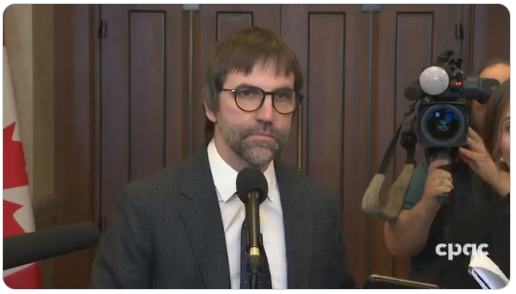
Minister of Environment and Climate Change Steven Guilbeault, 3 February 2020 (when he was Canadian Heritage Minister).
Screencapture from CPAC video.
Consumption taxes are a straightforwardly-effective policy tool. You simply increase the price of the resource you want to see used less and let people adapt to the simulated scarcity via ingenuity, frugality, lifestyle change, repricing their goods and services, etc. The government doesn’t dictate solutions, it lets people find their own. In the process, the consumption tax dispassionately reveals who’s making the most valuable use of that resource.
[…]
So the question remains, who uses a lot of carbon but doesn’t make a lot of money doing it? Who lives in drafty old single-family houses? Who uses archaic methods of keeping those houses warm, like furnaces that run on heating oil? Who has to drive halfway around the world to reach the nearest grocery store and halfway to the moon for the nearest medical clinic? Who’s making that drive in a battered old ride with terrible fuel economy?
The rural poor.
Not the farmers or the ranchers, who mostly make plenty of dough and often know their way around America’s higher-end resort towns, but the rural poor. The kind of people you disproportionately find in Newfoundland outports, eking out a tenuous living as they wait for the cod to return. You know, reliable Liberal voters.
Put another way, a neutrally-applied carbon tax goes after Maritimers first and hardest — forcing them to close shop on their romantic traditional lifestyle and move into apartment blocks in the nearest city, where they’ll earn more for their labour and emit less carbon doing it.
[…]
Remember: for the carbon tax to do what it says on the tin, somebody has to lose. For the carbon tax to be anything other than a purposeless pain in the ass, somebody — a lot of somebodies, frankly, if the Liberals are serious about cutting carbon emissions to 40 per cent under 2005 levels — must be forced to make significant and unpleasant lifestyle changes.
So let’s assume the Parliamentary Budget Office is right, and that Atlantic Canadians are now, after a second round of special supplements and exemptions, definitely net beneficiaries of the carbon tax. All it’s bought the Liberals is a reprise of the same question: who’s for dinner?
Who’s going to trade in their beater for bus tickets? Who’s going to raise their kids in a condo tower instead of a single-family home? Who’s going to start taking their midwinter vacation in the province next door instead of Palm Springs or Costa Rica? Who’s going to shiver on a cold night instead of raising the thermostat?
Only the most diehard of optimists could believe that the roster of ritual sacrifices will substantially consist of financially-comfortable Canadians. The people who can afford to make investments that reduce their carbon emissions without materially sacrificing their lifestyles will do so. A handful will start biking to work during the summer. Others will install solar panels on top of their detached houses — which are mostly located in neighbourhoods where you’re not even allowed to build a condo tower — and that’s going to be that.
Beneath all the aspirational language, what an effective carbon tax actually does is throw the government into a cage match with Canada’s working class. The truth behind the Liberals’ woes on this file is that as long as they’re committed to the carbon tax as a tool for fighting climate change, their only real choice is which part of the working class they land on when they come off the top rope.
March 7, 2024
“The traditional answer to this is to leave those inheritees be and they’ll blow it all on hookers and coke soon enough”
Tim Worstall tackles the ongoing angst about “the wrong sort of people” getting their sweaty mitts on family inheritances and then backhands the ostentatiously super wealthy demanding to be taxed more heavily as “Full Of Shit. Obviously”.
This has to be one of the least sympathy inducing articles ever — rich kids worried about their inheritances. We’re about to have that grand generational shift apparently, trillions upon trillions are going to move from the people who made it to the Lucky Sperm Club.
Woes.
The traditional answer to this is to leave those inheritees be and they’ll blow it all on hookers and coke soon enough. The standard deviation of soon enough is pretty big — the folk tale is clogs to clogs in three generations but the Hervey’s managed to wait until the 7th Marquess for it all to get — quite literally in that case — blown. But, you know, it does eventually happen. There are no really old fortunes.
This isn’t, perhaps, enough for the hurry hurry of the modern world. Thus we get people like this:
Tax, of course, could — should — play a huge part in all this. “Philanthropic donations are a drop in the ocean compared to what even quite minor tax increases on the richest in society would provide,” Lewis says. Patriotic Millionaires is calling for a hike in taxation for the super-rich — and its members aren’t limited to millennials. They include Guy Singh-Watson, founder of Riverford Organic Farmers; Graham Hobson, founder of Photobox; the Perry family, from the posh ready-meal business Cook; and Ian Gregg, whose father founded Greggs.
“At the moment philanthropic donations amount to about £10 billion per year,” Lewis says. “A wealth tax of 1 to 2 per cent on assets over £10 million, which would affect only the wealthiest in the UK, would raise more than double that. Closing tax avoidance loopholes would raise much more than this.”
As I pointed out in the same newspaper, The Times, two decades back, this is purest bollocks. For it’s entirely easy to pay extra tax if that’s what you wish to do:
Cheques, by the way, should be made out to “The Accountant, HM Treasury”, and sent to 1 Horse Guards Road, London SW1A 2HQ.
Job’s a good ‘un. Except, back then, near no one did. I managed to get the numbers out of The Treasury for the previous year — it took some months as they were amazed that anyone had even thought of checking this — and a whole 5 people had paid that extra tax. Four of whom were dead, leaving bequests. That is, the UK, that year, contained one whole person willing to pay higher tax than duly and justly levied upon them. Some flood of patriotic millionaires there was not.
Matters do not seem to have improved greatly:
But something is not working. The accounts of the Debt Management Office for the year ended 31 March 2020 show that it received donations or bequests totalling just £48,957. While that’s a large percentage increase on the £11,069 received during the year ended 31 March 2019, by any standards these figures are tiny.
Not the sorts of amounts likely to make a great impact upon a lifetime’s supply of coke and hookers, is it?
One correct answer to these claims by the Patriotic Millionaires is therefore that they’re full of shit. In slightly more technical language they’re doing ethical performativity. There’s always a difference between expressed preferences — what people say — and revealed preferences, what people do. What people really believe is in what they do — but it’s entirely possible that saying the right things, even if not doing them, will get you invited to the right sorts of parties. You know, the ones where someone else pays for the hookers and coke. So, people say things they don’t do for reasons of societal enrapture. Hardly an uncommon human activity, that.
I seem to remember linking to an article of Tim’s on the old blog, but that’s long been offline. More recently, we’ve seen this exact scenario play out in Norway, the UK, the United States, and the City of Toronto.
His Majesty King Charles, in right of Canada, would also be happy to accept any unwanted sums of money above your mandatory tax rate here. Go wild, wealthy and patriotic Canadian multi-millionaires!


