… the basics of the confidence game have not changed all that much with the new technology. The confidence man gets his name because he is adept at winning the confidence of the mark. The mark then lowers his defenses and foolishly trusts the con man, rather than his own natural skepticism. The mark is manipulated into thinking the con man is a friend or at least someone who can be trusted. The con man then uses that trust to exploit the mark.
The way in which the con men does this is by flattery. The mark trusts the con man, because the con man finds small ways to confirm the beliefs of the mark. The adept grifter will be a good listener and pick up the little things that the mark thinks are important, like religious beliefs or opinions about personal matters. Seemingly out of the blue, the con man will express those same opinions, which flatters the mark. After all, everyone likes being told that their private opinions are smart.
That’s something you see with the internet grifters. They often have worn a lot of masks as they seek out on-line audiences. […]
Another aspect of the con that remains constant is how the con man uses his alleged status as a victim to work the mark. Con men will use their mark’s natural empathy to win their confidence. Today that often means claiming the big bad tech companies are censoring them. Alternatively, they will claim evil trolls are haunting their internet activity, causing them harm. The term troll has been changed from meaning someone seeking attention to something almost supernatural.
The Z Man, “Carny Town”, The Z Blog, 2019-12-29.
April 29, 2025
QotD: The confidence game
April 18, 2025
Notes on the French debate
Paul Wells jotted down some notes in his Substack Chat after the leaders’ debate last night:
A few notes on last night’s post-election scrum fiasco, when reporters from Rebel News and Juno News got most of the questions. Some of the commentary this morning about this, from people who think it was a disaster (I think it’s unfortunate but not quite a disaster), is alarmingly superficial.
So here are some thoughts, threaded.
1. The debate commission didn’t just take it into their fool heads to invite these alt-right news organizations. They tried hard to block them in 2021, got hauled into court, and lost big. Remembering this very recent news event should, it seems to me, be a basic requirement for your pundit’s license. https://globalnews.ca/news/8174634/rebel-news-election-debates-court-challenge/
My first thought was that it’s apparently ok for Mr. Singh to refuse to engage with certain media, but if Mr. Poilievre remarks on CBC bias, he’s the enemy.
2. I’m not fond of Ezra, but in declaring that Rebel News had five divisions, he was engaging in not entirely unfunny satire about the way the CBC shows up with French and English radio and TV to every event. You may not like the joke! But it was clearly, to some extent, obvious satire about an obvious target.
3. I remain astonished that any political leader shows up for scrums after any debate. They just talked for two hours! The only possible newsworthy outcome from a scrum afterwards is, you walk all over the message you prepped for weeks to deliver. We had scrums after our 2015 Maclean’s debate. Stephen Harper just didn’t show up for them. That’s an option! Carney has worked hard since January to control and limit access to his regal person, and then he wanders into a scrum after what would be, for any anglophone, an exhausting two hours in French, as though somebody told him it was where he could get a sandwich? People are weird.
Once upon a time — at least in theory — one of the functions of the mainstream media was to help keep our political leaders under observation for the voters. That fantasy has long since vanished in Canada, as almost all the surviving mainstream media outfits are slavering propagandists, lickspittles, and fart-catchers for the Liberal Party and especially for its leader-of-the-moment. In The Line, a media outlet that isn’t directly funded by the federal government, Andrew MacDougall offers a parable about the Canadian media:
My eldest daughter is nine. Her little sister is five. The little one adores her big sister and believes everything she says.
I, on the other hand, am 49. My eldest often tries to convince me of things. But I am a skeptic when it comes to the things my children tell me, as any good parent should be. And because I push back on the eldest’s arguments, she often comes back moments later with much sharper ones. Sometimes I even change my mind.
Yes, this is a parable about the media and its role in public life, including during this federal election. And yes, we can debate the mechanics of media — who gets access, how many questions, and so on — but this is to both bury the lede and miss the story. There is much more at stake than whether the Toronto Star or the Globe gets a question at a tightly-managed press event.
What’s at stake is whether anyone in power will ever again have a parent to satisfy. Or whether those in power will be nine-year-olds, forever seeking the smoke blown up their asses by the five-year-olds in their life.
The ability to act like a nine-year-old in power is an entirely new phenomenon. In the Before Times, when a politician (or corporate leader) used to have to exchange credible arguments with a member of the media in return for access to the distribution network of their publication or broadcast, serious conversations were par for the course. It wasn’t perfect, no, but it was an adult time. There was no point rocking up to the microphone with a wild ad hominem attack, or armed with a list of faulty facts, because it wouldn’t have passed muster. There was no rolling 24/7 coverage, and easily discredited arguments wouldn’t have made the cut in what was then limited news real estate. Now, thanks to social media, there is an infinite and constantly updating canvas. You don’t even need a credit card, let alone an argument, in order to access and speak to your audience — and then tell them any damn thing you want, no matter its level of adherence to the truth.
It wasn’t supposed to be this way. In their pre-algorithmic infancy, the major social media platforms promised access and connection. In this more gentle, less attention-hogging iteration, the major benefit of the social media platforms and other owned channels was that they allowed you to go — unfiltered — to your intended audiences. A clean message, straight to the target voter. What politician wouldn’t want that? How could that be a bad thing? Well, other than the fact that politicians and other people in positions of power have been known to lie and try to cover up bad things.
April 16, 2025
The “medicalization” or “syndromization” of aspects of the normal human condition
On his Substack, Freddie deBoer wonders why we can’t be honest about the rise of bespoke “mental disorders” that look remarkably like typical human reaction to stimuli:
I will never not be fascinated by those issues or arguments or perspectives that are studiously ignored by the media generally and the New York Times in particular. I’ve whinged about this many times when it comes to education, as the NYT is simply not going to consider the notion that different individual people have fundamentally different levels of academic potential in its pages, not even in an attempt to rebut the idea. I suppose that notion is just too challenging to the elite meritocratic liberalism that the Times epitomizes; the idea that we are all ultimately capable of achieving academic and professional greatness flatters the high-achievers who read and write the paper, and the “anyone can be anything” ethos is pleasant and unchallenging. It’s also destructive, which is the point. Bad ideas grow like weeds in the shade, or whatever the saying is. Disability issues are another place where the Grey Lady is very picky about what ideas to consider, and as usual they set the rhythm for many other publications.
This weekend the Times released a long piece looking at the ever-escalating rates of ADHD diagnoses and what exactly they tell us. What’s in the piece is fine — of course, the ADHD activist class doesn’t like it — but what’s remarkable is what isn’t in it. Once again, there’s just about zero consideration of ADHD as a social contagion, any recognition that there is now a vast and deeply annoying ADHD culture online that acts as a kind of evangelical movement for a neurodevelopment disorder. There are millions of people on ADHD TikTok and ADHD Tumblr and ADHD Twitter. There’s a vast universe of facile memes, dubious statistics, and self-flattering nostrums about ADHD floating around out there, and increasingly they’re penetrating into broader internet culture. (I am genuinely unaware of a subculture that is more directly and shamelessly self-celebrating than the online ADHD community, and I’ve read the comments at LessWrong.) Unsurprisingly, a big subsidiary industry has sprung up, with all kinds of products and services for sale, books and apparel and tchotchkes and conferences and boutique forms of therapy and exclusive members-only Discords … Whether neurodevelopmental disorders should have merch is an open question. What’s not subject to questioning is that this is happening. Five minutes of cursory searching would reveal the remarkable scope of online ADHD culture.
And yet the piece’s author, Paul Tough, is just about totally silent on this glaring reality. I find it genuinely bizarre. In a long and rambling (in a good way) piece where he kicks the various rocks of ADHD and asks good-faith questions about how diagnostic rules and social perception of the disorder influence medical practice, he still somehow fails to ever refer to the large, influential, and growing online movement that has raised the profile of the disorder even beyond its prior notoriety and in doing so injected a ton of money into the equation. You can dismiss that community as an online sideshow if you choose, but of course the online world has become profoundly influential on real life, and in other contexts neither the New York Times specifically nor the elite media generally has any problem acknowledging that fact. Why not here?
This tendency extends beyond ADHD. Recently Holden Thorp, editor in chief of the prestigious journal Science, wrote an essay for the NYT that explores the rise of autism diagnoses, which have expanded at truly ludicrous rates. To the extent that it’s referenced at all, the idea of social contagion is dismissed without argument. A couple years ago the Times published a piece by Azeen Ghorayshi about the absurd case of Tourette’s spreading (or “spreading”) among too-online adolescent girls via TikTok; though Ghorayshi is admirably clear that those young women did not in fact have Tourette’s, her piece is also slavishly, almost comically sympathetic to them, never bothering to suggest that maybe these were just bored teenagers who engaged in a frivolous and offensive bit of minstrelsy. (Imagine, judging teenagers for doing something stupid!) The idea that anyone could ever have unserious and wrongheaded motivations for adopting a disability seems to be one of those stories that the New York Times absolutely refuses to tell.
But why? People make up fake illnesses all the time, both consciously and unconsciously. Factitious disorders are real; we have references to what we might now call psychosomatic illnesses that stretch back to antiquity. Munchausen by internet is real. Hypochondria, factitious illness, Munchausen’s, the worried well … these have represented a major challenge for psychiatry for as long as the field has been formalized and integrated into the larger medical project. Why does no one ever talk about this stuff in our stuffy elite publications? Why do so many people in our media dance and shuffle rather than ask direct questions like “How many of these diagnoses are fundamentally faulty?” Why can’t anyone point out that saying you have a medical disorder is a shortcut to getting sympathy and attention, and that human beings crave sympathy and attention the way they crave water and air? We’ve lived through something like a “vibe shift,” and previously-unchallengeable social justice pieties are increasingly challenged, in good ways and bad. Yet under the broad umbrella of disability rhetoric, it’s always 2018, with both traditional and social media operating under a cloud of fear of giving offense. As I’ve said many times, the number of people who privately agree with me about all this is legion. The number who are willing to say so publicly are very few indeed. Nobody wants to paint that target on their back, I suppose. But why do these issues make people feel like targets at all?
April 10, 2025
Too much free speech is bad for German democracy
eugyppius notes that criticizing German politicians for their lack of commitment to the principles of free speech can land you in prison if you’re not careful:
David Bendels, the chief editor of the AfD-adjacent Deutschland Kurier, has been threatened with prison time and sentenced to seven months of probation for a Twitter meme. It is the harshest sentence ever handed down to a journalist for a speech crime in the Federal Republic of Germany.
This is the illegal tweet, which Bendels posted via the official Deutschland Kurier X account on 28 February 2024:
It shows German Interior Minister Nancy Faeser holding a sign that has been manipulated to read “I hate freedom of speech!” Bendels posted the image to satirise Faeser’s disturbing plans to restrict the speech, travel and economic activity of political dissidents in Germany, which she had announced at a press conference a few weeks earlier.
Faeser personally filed criminal charges against Bendels for defamation after Bamberg police brought the meme to her attention. Last November, the Bamberg District Court summarily ordered Bendels to pay an enormous fine for this speech crime “against a person in political life”. This is yet another prosecution that proceeds from our lèse-majesté statute, or section 188 of the German Criminal Code, which provides stiffened penalties for those who slander or insult politicians, because politicians are special people and more important than the rest of us.
The same Bamberg prosecutor’s office and the same Bamberg District Court had previously pursued the German pensioner Stefan Neihoff for the crime of posting another meme implying that German Economics Minister Robert Habeck might be a moron. That case, too, seems to have been brought to Habeck’s attention by Bamberg police, who requested that Habeck file charges. The Bamberg police apparently have very little to do beyond trawling the internet for political memes and protecting democracy by suppressing democratic freedoms.
Bendels appealed his summary penalty, and so the Bamberg District Court put him on trial. Yesterday the judges found him guilty and sentenced him to seven months in prison, which they suspended in favour of probation. The judges claimed that Bendels was guilty because he had distributed a “factual claim about the Minister of the Interior, Ms Faeser … that was not recognisably … inauthentic”, and judged that his meme was “likely to significantly impair [Faeser’s] public image”. The presiding judge demanded that Bendels submit a written apology to the Interior Minister for having so egregiously slandered her.
March 6, 2025
As Trump’s tariffs begin to bite, Canadians strike back at … King Charles and Wayne Gretzky?
As if more evidence were needed that Canadians aren’t well-served by our political leaders, social media personalities and legacy media types are pointing at uninvolved figures to be rounded up as the targets of maple-flavoured Two Minutes’ Hate sessions:
You can’t have an outburst of nationalism without purity tests coming into play, and two prominent Canadian figures have failed theirs in the court of chattering-class opinion: Wayne Gretzky and King Charles III, of all people.
In recent consecutive days, hilariously, The Globe and Mail‘s website published the following headlines to its online readers’-letters pages: “Wayne Gretzky’s fall from grace is a long time coming”; “Let Wayne Gretzky feel some pain”; and “Wayne Gretzky has always been held in the highest regard … now, he is dead to me”.
Gretzky is friendly with President Trump, you see, which is unacceptable. And if Gretzky isn’t willing to publicly disavow Trump, he should be using his influence to sit Trump down and explain that Canada will never be the 51st state … at which point, presumably, something useful is supposed to happen. It’s never clear what that useful thing would be, beyond a cheap nationalist thrill.
Gretzky’s Yankeeism was confirmed when he served as honorary captain of Team Canada in the final game of the 4 Nations tournament in Boston. (Imagine if he hadn’t served as honorary captain!) He gave the American players a thumbs up — which in any other context would have been considered simple good sportsmanship. He didn’t wear a Team Canada sweater, but rather a suit — which in any other context wouldn’t even have been noticed. He didn’t wear his Order of Canada pin — well, now we’re just grasping at straws.
It’s funny that the same kind of people who have no time for the Crown under normal circumstances (even if they’re not quite out-and-out republicans) are delighted to pile on to any accusations that King Charles isn’t doing … something … to fight off the Bad Orange Man for us:
This brings us to our head of state, and the baffling calls in recent days for him to shake his sceptre toward Washington and declare that Canada shall never never never be the 51st state. If these calls were coming just from anti-monarchists, it would be understandable (though it’s odd to hear them suddenly demanding that the sovereign speak on our behalf). But all kinds of otherwise reasonable people jumped aboard as well, as if this was something the King should self-evidently be doing.
It is self-evidently not what the King should be doing — certainly not before receiving advice from the Canadian prime minister, and probably not at all. Charles’s mother wouldn’t have mouthed off, and I have to wonder if she would have gotten the same criticism were she still alive to see this mess.
Indeed, I think a moment like this is precisely when having an apolitical head of state — maybe even one that doesn’t live here — is most valuable. We have more than enough people, elected and unelected, completely and vocally embroiled in the Trump Tariff Wars, pursuing some combination of national, partisan and personal gain. Isn’t it nice to have precisely the sort of democratic constancy the United States now lacks? You don’t throw away an anchor, however rusty, with a gale on the horizon.
March 5, 2025
Trump’s next target – Europe
Andrew Doyle thinks that the next step of Donald Trump’s culture war will be highlighted by a struggle over freedom of speech with the UK and the regulators of the European Union:
New battle lines are forming in the culture war. While the woke movement appears to be in retreat, the forces of authoritarianism are regrouping for a fresh assault. Rather than maintaining a straightforward conflict between right and left, the next phase of the culture war will most probably be waged between Europe and the United States. It has all the qualities of a novel by Henry James for the digital age, with the distinctions between the old world and the new brought once again into sharp focus.
Free speech will be the key issue. Most of us will have seen the footage of vice-president J. D. Vance last week in the Oval Office taking Keir Starmer to task for the “infringements on free speech that actually affect not just the British” but also “American technology companies and by extension, American citizens”. Starmer pushed back, saying “in relation to free speech in the UK, I’m very proud of our history there”. It’s a bit like Hannibal Lecter boasting about his ongoing commitment to vegetarianism.
The word “history” was apt, given that Starmer’s government is seemingly determined to ensure that free speech is consigned to the past. One of its first acts after seizing power was to ditch the Higher Education (Freedom of Speech) Act. In February, Angela Rayner revealed her plans for the establishment of a sixteen-member council on “Islamophobia” which could see the criticism of religion criminalised. Meanwhile, Yvette Cooper has been staunchly defending the police for recording “non-crime”, while the chairman of the College of Policing, Lord Herbert, has suggested that the best approach to tackling the controversy is to simply rename “non-crime hate incidents” as something more palatable. Apparently Lord Herbert believes that the problem is the nomenclature, not the fact that citizens are being investigated by the armed wing of the state for lawful behaviour.
All of this is before we get to Starmer applying pressure to the judiciary to mete out draconian sentences for offensive posts and memes on social media, and the government’s determination to crack down on online “disinformation”. Ours is an authoritarian government, and Starmer’s Orwellian denial of the truth of his position in the Oval Office is to be expected. Autocrats throughout history have enacted censorship “for the public good”. Today, they target “disinformation”, a term so vague that it can be applied to anyone who questions the narrative of the ruling class.
And so, as I say, the new front of the culture war will most likely be transatlantic. The US government will simply not tolerate the widespread censorship of its citizens by laws passed overseas. Jim Jordan, chairman of the Committee on the Judiciary of the House of Representatives, has already issued subpoenas to eight US tech companies to divulge all communications they have had with the UK government regarding “content moderation” (i.e., censorship). Jordan is particularly concerned about the Labour government’s intention to empower OfCom to regulate social media, and he has specifically mentioned UK officials who “have already threatened to use UK laws to police American speech”.
N.S. Lyons suggested in the latest post at The Upheaval that Vice President J.D. Vance’s real message to the European leaders can be rephrased as “Give Up the Information War and GTFO”:
The political elite of Europe and the Anglosphere appeared shocked by J.D. Vance’s wonderfully blunt speech in Munich last month. The U.S. Vice President declared Washington’s top security concern to be “the threat from within” the NATO alliance and castigated assembled leaders for their increasingly brazen assaults on “democratic values”, including censoring speech, suppressing popular opposition parties, and canceling elections. But if this shock isn’t feigned then it is rather remarkable, given that these elites were in their own way already effectively at war with the United States. All Vance did was point out the nature of this hidden conflict.
Vance delivered multiple messages with his speech, the broadest and most historic of which was that the era of “post-national” globalist liberalism is over. The United States, he indicated, now has a core interest in seeing a Western world that is collectively strong because its sovereign nations are strong, with the self-confidence to independently defend themselves physically, culturally, and spiritually. His emphasis on promoting free speech and democratic legitimacy tied into this message, but was about far more than the importance of “shared values” or even Washington’s new friendliness to nationalist parties. Practically, it was an implied warning that the role Europe has been playing as a proxy actor in the political and ideological conflicts raging in the United States will no longer be tolerated. More specifically, it was a declaration that ongoing transatlantic institutional, technological, and legal support for America’s embattled left-wing deep state must end – or else.
After Donald Trump’s election in 2016, America’s panicked establishment elites reacted by attempting to construct a system for managing public opinion through strict control of information, especially online information. The idea was that growing public support for populism was fueled by “low-information voters” and their consumption of “misinformation” and “disinformation”, including from foreign actors, and that if their “information diet” could just be controlled then they would stop voting wrong. The underlying assumption here was of course that the elite’s own increasingly radical policy preferences were the only rational path, opposable only by the stupid and easily manipulated. As Trump’s defeated opponent Hillary Clinton would later put it, social media platforms had fundamentally changed the information environment and “if they don’t moderate and monitor the content, we lose total control”.
This intended system of thought-control would later grow into the censorship industrial complex that was partially revealed following Elon Musk’s acquisition of Twitter. But a big obstacle initially stood in the way: the U.S. Constitution and its protection of free speech. The public might be receiving the “wrong” information on the internet, but “our First Amendment stands as a major block to be able to just, you know, hammer it out of existence”, as John Kerry lamented in a speech to the World Economic Forum.
Under the Biden administration, this legal problem was partially solved by simply ignoring it, the federal government directly colluding with technology companies and a network of “independent” (state-funded) “fact-checking” organizations to impose mass censorship on American citizens. The result was, as one federal judge later described it, effectively “the most massive attack against free speech in United States’ history”.
A more subtle and sustainable work-around was also discovered, however. This was to circumvent the U.S. Constitution by outsourcing the policing of the internet and populist movements to other countries around the world. This could be done because the internet is global and so the whole network is affected by government regulations on any local market of sufficient size. Leaders on both sides of the Atlantic immediately grasped that legal and regulatory structures imposed by the European Union, with the leverage of its huge unified market, could for example force internet companies the world over – including U.S. companies – to change their behavior in order to comply and avoid losing access (this imperialistic regulatory strong-arming was dubbed the “Brussels Effect”, becoming Europe’s only significant innovation this century).
March 4, 2025
Canada’s nasty authoritarian streak shows up in the “deprive Musk of his citizenship” online mob
In The Line, Leonid Sirota explains why we can’t just arbitrarily deprive a Canadian of his citizenship rights just because Charlie Angus has riled up a social media mob to demand it:
One other incontrovertible fact about Mr. Musk is that he is a Canadian citizen. His mother was born in Canada — which made her a citizen — as are her children, even though they were born abroad.
A large number of Mr. Musk’s and my fellow Canadians find the coexistence of these facts to be obnoxious. Whether out of anger or embarrassment, they are lining up to sign a petition to Parliament to demand that he be deprived of his Canadian citizenship. As of this writing, the petition has been signed by about 300,000 people. (In theory, these are Canadian citizens or residents, though on the Internet, nobody knows you didn’t actually watch the McDavid goal 97 times on loop.) At least one member of Parliament, the NDP’s Charlie Angus, is supportive.
This is appalling. The reasons given for depriving Mr. Musk of his Canadian citizenship are fundamentally authoritarian, as is the contempt for both the substantive and the procedural legal requirements involved in deprivation of citizenship that the petition manifests. That a member of Parliament is supporting this abomination is especially disturbing (and one reason this whole mess is worth caring about).
To start with the substantive point, the idea that a Canadian could be deprived of his citizenship for political reasons ought to be beyond the pale of polite discussion. It is the sort of thing the Soviets did to Mstislav Rostropovich, Aleksandr Solzhenitsyn, and others. Is Mr. Musk a Solzhenitsyn? Well, no. But so what? The principles at stake here are universal. They do not depend on whether one is a martyr or a millionaire, a genius or a jerk. (Solzhenitsyn, at any rate, was both jerk and genius. So is Mr. Musk. Not that it matters.)
More to the point, do you want the Canadian government to have the power to deprive people of their citizenship for their political beliefs, statements, or activities? If you are okay with a government led by a Justin Trudeau or a Mark Carney having this power, do you agree that one led by Pierre Poilievre should? (Or, of course, vice versa.)
And yes, no matter how patriotic and indignant the people who sign the petition, or support it, may feel, the demand to take away Mr. Musk’s citizenship is political. The first recital of the petition accuses him of having “engaged in activities that go against the national interest of Canada”. I think the accusation is well-founded. But it is a political accusation: the national interest is a political concept. The petition then claims Mr. Musk “has used his wealth and power to influence our elections”. If he has, that is political action that Canadian citizens are entitled to take, subject to applicable laws, which the petition isn’t even alleging Mr. Musk broke. Finally, the petition claims that Mr. Musk “has now become a member of a foreign government that is attempting to erase Canadian sovereignty”. Stipulated. But the actions of this foreign government, no matter how dishonourable, distasteful, and dangerous for Canada, have so far stayed within the realm of politics.
QotD: Twitter-thought and the basic university student
Like most people, I gave [Twitter] a look-see when I first heard about it. I quickly concluded that it wasn’t for me. Not because it was vapid garbage, you understand — Facebook was always vapid garbage, but it had some utility for all that, as Twitter does — but because I just don’t think in discrete chunks the way Twitter requires. I just can’t process the fact that “replies” are their own distinct utterances, devoid of all other context, that can come in at random times. A Twitter “thread” is a mad babble of people shouting past each other; it’s not “communication” in any sense my brain can handle, so I dropped it …
Alas, Twitter is still a thing that exists, so even though I tried it for about five minutes and promptly forgot all about it, my students didn’t … which explains, like nothing else can, their bizarre approach to classwork. For every quiz I gave, no matter how straightforward the question, I’d have at least one barracks lawyer coming to me afterwards, trying to weasel her (always her, mentally if not biologically) way back into some points, with some elaborate rationale why her picking the wrong answer was really my fault, because in class I said “The Russians won the Battle of Stalingrad” and the question on the quiz was “Who lost the Battle of Stalingrad?” and how is she supposed to be expected to recognize that “lost” is the opposite of “won” when it comes to battles and blah blah blah (thanks, Greta!).
Or the other depressingly common thing, which was when that same kid, who went to the fucking mattresses for one point on one quiz — which amounts to something like 0.01% of her final semester grade — just didn’t turn in the term paper. This happened at all academic levels, from community college (where you often lose half a class or more by the end of a semester) all the way up through the SPLACs, which cost something in the neighborhood of $70K a year all in. I never could figure this out — I mean, how can they not know that the term paper is 30% of your final grade, while all the quizzes put together amount to 10%? — but then it hit me: Twitter.
Everything on social media has, of necessity, equal weight, in that whatever’s in your feed at the present time is the only thing that exists. So when Snowflake was in “schoolwork” mode and missed that one question on that one quiz, it was the only thing that mattered in her world. My quiz was at the top of her Twitter feed, so she had to put all her energy into battling me for it. By the end of the semester, though, she was in “sorority” mode, or “getting ready for that kickass ski vacation” mode, or “beefing with that basic bitch Becky” mode, so my term paper barely registered — if she bothered to turn anything in at all, it was copy-pasted straight from wikipedia, because who cares, when Becky is out there on Twitter, h8ing?
Severian, “Also Sprach Froggy”, Founding Questions, 2021-09-30.
February 22, 2025
QotD: Modern journalism
We Americans are truly blessed by having a mainstream media full of brilliant renaissance men, women, and gender non-specific entities who are masters of so many varied and intermittently useful skills and who are eager to share their knowledge with us benighted souls. The pandemic has revealed that every urban Twitter blue check scribbler, MSNBCNN panelist, NYT/WaPo doofus, and barely legal “senior editor” of a website you never heard of, is a Nobel Prize-winning epidemiologist, a master logistician, and a diversity consultant to boot.
They may all be lousy journalists, but damn it, they are also lousy at other jobs that they didn’t even pretend to train to do.
It’s awesome to see people with zero life experience in any relevant field weighing in as if we shouldn’t just laugh in their pimply faces. Here’s the typical resume of one of these hacks:
- Went to high school, and never went to parties
- Went to college, majored in journalism, and never went to parties
- Went to journalism grad school, and never went to parties
- Works in the media, and goes to Manhattan/Georgetown cocktail parties
This apparently qualifies them to explain to people like us who have actually done something in our lives how stuff is supposed to work.
Kurt Schlicter, “Our Super Smart Elite Shines During This Pandemic!”, TownHall.com, 2020-04-02.
February 21, 2025
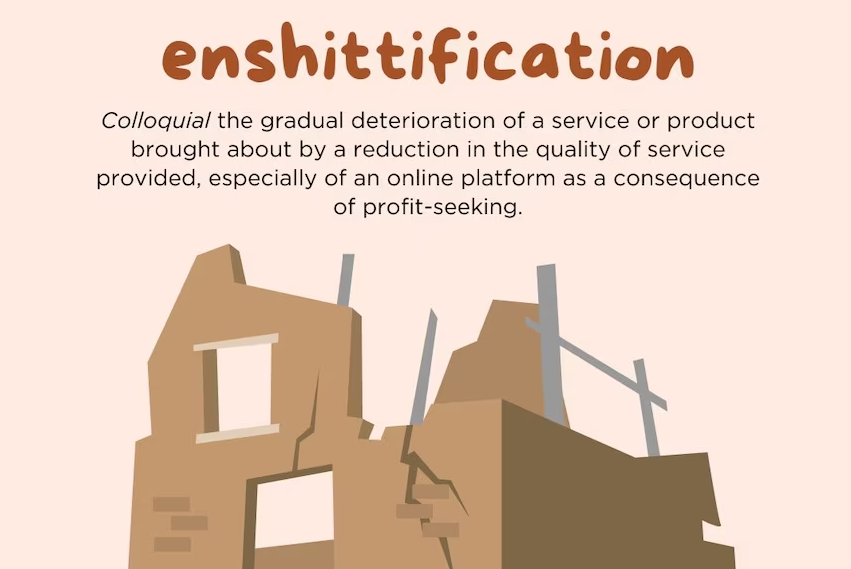
Tech enshittification continues
Ted Gioia notes that even the world’s biggest search engine provider is doing almost everything it can to make your search experiences worse and worse:
Almost everything in the digital world is turning into its opposite.
- Social media platforms now prevent people from having a social life.
- ChatGPT makes you less likely to chat with anybody.
- Relationship apps make it harder for couples to form lasting relationships.
- Health and wellness websites make it almost impossible to find reliable health advice — instead peddling products of dubious efficacy.
- Product review sites now prevent people from reading impartial reviews by actual users of the product, instead operating as pay-for-play vehicles.
- Etc. etc. etc.
You can often tell by the name. PayPal will never pay you a penny, and it’s certainly not your pal. Microsoft Teams only works if you stay away from your team. If you keep using Safari, you will never go on an actual Safari.
But the worst reversal is happening with search engines. They now prevent you from searching.
I’ve known Google up close and personal from the start. I initially found the company quirky and endearing — but those days ended long ago. The company is now clueless and creepy.
Almost every day I read some ugly news story about Google. Here are a few headlines from a typical week:
- “Google ditches promise not to develop AI weapons” (February 12)
- “Millions of Google users alarmed after discovering new AI tool they can’t turn off” (February 14)
- “Google facilitated Russia and China’s censorship requests” (February 15)
- “Google’s new fingerprinting policy sparks privacy backlash as ads become harder to avoid” (February 17)
- “Google data centers used nearly 6 billion gallons of water in 2024” (February 11)
This company goes out of its ways to do mischief. Messing with people is in its DNA.
Meanwhile, its base business is degrading at an alarming rate. The company doesn’t seem to care.
In a strange turnaround, search engines don’t want you to search for anything. That’s because searching leads you on a journey — and Google doesn’t want you to leave their platform.
The search engine was invented as your gateway to the web. The inventors of this technology tried to index every page on the Internet — so that you could find anything and everything.
That was an exciting era. Search engines were like train stations or airports. They took you all over the world.
At Google today, the goal is the exact opposite. You never leave the station.
Techies once described the Internet as a digital highway. But we need a different metaphor nowadays. Web platforms want to trap you on their app, and keep you there forever.
So, instead of a digital highway, we have a digital roach motel. They let the roaches check in — but not check out.
February 17, 2025
A maple-flavoured DOGE? Maxime Bernier proposed this in 2020
It’s both amusing and alarming seeing the kind of things the US government has been pouring money into, as the young auditors of Elon Musk’s DOGE dig into the accounts. Some folks on social media have been asking for a Canadian version of DOGE, but they’re nearly five years behind PPC leader Maxime Bernier:
Did you know that the Canadian government is spending $143,000 to help the African country of Senegal implement a “sectorial gender strategy” in its armed forces?
Or $46,793 to improve healthcare for intersex people in the Chinese province of Shandong?
What about $4.6 million to develop programs promoting a “positive masculinity” in Cuba?
There are hundreds of such crazy programs costing Canadian taxpayers billions of dollars every year to fund the Liberals’ woke ideology in other countries.
Many people on social media just found out that these programs exist last week, after they started looking for them on the website of the Government of Canada.
They were inspired by similar crazy programs that Elon Musk has unearthed with his DOGE team in Washington.
The DOGE – or Department of Government Efficiency – was created by President Trump and has already cut tens of billions of dollars in frivolous spending after only a few weeks.
I’m being asked if I support having the equivalent of a DOGE in Canada.
Not only do I support it, but I didn’t wait for Trump and Musk to do it to propose one. I did years ago!
In 2020, I stated that a PPC government would have a Minister of Government Downsizing to examine every federal program and cut or abolish everything that is inefficient, wasteful or not essential.
And speaking of DOGE, Coyote Blog shares some thoughts about some of the reasons Democrats are critical of the organization’s efforts:
… having thought about this longer, I think this is about more than just money. It is also about class. Just listen to how the cool kids in the media talk about Musk’s group of young weirdly-nicknamed geeks. This is fairly typical:
He was speaking specifically about a Trump executive order that decrees that the Department for Government Efficiency can force federal agencies into firing four people for every new hire. “Who the hell voted for Mr. Musk?” Begala raged. “Who the hell voted for — excuse the phrase — a guy who calls himself Big Balls? A 19-year-old kid going in there and trying to fire cancer researchers and scientists and teachers and agricultural specialists. It’s, it’s appalling.”
This is moderately hilarious from a) a party who still has not told us which unelected people really were making decisions behind the curtain for a senile Joe Biden; and b) an individual (Begala) who wielded immense power and influence across all departments of the Clinton Administration. The department staffs in DC are 99.99% people who are both unelected and unconfirmed by Congress. The issue is not that they are unelected, the issue is that they are “the wrong sort”. I am reminded of the British aristocracy in the 19th century that would tolerate almost any sort of governmental incompetence or malfeasance as long as the people were “the right sort” — meaning of their class.
The mention of Victorian England reminds me of another way that class is likely involved here. In the English aristocracy the oldest son inherited the title and often all the land and income (which was entailed to the title). This left little for any additional sons, so an income had to be found somewhere for them in a profession that did not require them to sully themselves with “trade” (daughters were handled a different way, through the marriage market). Reading for the law was an acceptable profession for a son with brains, and the army or navy were outlets for many. But most families needed a way for their sons without too much brains or ability and not militarily inclined to make a living. A position in the Church was often the solution.
Modern American blue-blood parents are no different — they need a way to secure a living for their kids who won’t or can’t land a job in the modern elite career choices (law, consulting, investment banking, or a sexy startup). Unlike in Victorian times, the military or the Church are no longer preferred elite options. So what to do with your 22-year-old gender studies major? The parents need her to get an income and they need her to do it in a context that they can proudly report to their friends — Paul Begala does not want to tell his friends that his son’s job is maintaining distributor pricing lists (anyone who does not believe the latter criteria should have been at my Princeton or Harvard Business School 25th reunions).
The solution? Get them a job at a non-profit, the modern American version of going to the Church. As Arnold Kling noted once, non-profits tend to have much higher status than do for-profits. And without competition they don’t have to carry the same performance standards as for-profits. And they are incredibly susceptible to trading a position for your kid in exchange for a nice donation.
The employment rosters of non-profits and NGO’s are stuffed with the children of privilege. So much so that there are many non-profits that seem to do nothing EXCEPT employ and pay the travel expenses of 20-something kids from rich and/or influential families. I have been writing about the non-profit scam for years. As I wrote then:
From my direct experience, I would go further. There is a tranche (I don’t know how large) of non-profits that are close to outright scams, providing most of their benefits to their managers and employees rather to anyone outside the organization. These benefits include 1) a salary with few performance expectations; 2) expense-paid parties and travel; 3) myriad virtue-signalling opportunities; 4) opportunities to build personal networks. This isn’t just criticizing theoretical institutions — people I know are in such jobs in these organizations.
The spending that DOGE is going after at USAID and other departments likely threatens the income of a number of under-qualified elite kids. So I will update my meme:
January 24, 2025
When the law schools went woke
In the New English Review, Bruce Bawer reviews Ilya Shapiro’s book Lawless: The Miseducation of America’s Elites:
As Donald Trump begins his second term as president with a mandate to undo the damage done to the country by leftist ideology, incompetence, and corruption, one of the many stables that most need cleaning up is academia – which is, of course, the source of virtually all of the most misbegotten ideas that have sent America astray.
To be sure, some parts of academia are more desperately in need of reform than others. As a rule, the elite universities, especially those in the Ivy League, are more poisoned by the new progressivism than most state schools, especially those in the heartland. Humanities and social science departments are worse off than STEM departments. And as Ilya Shapiro points out in his important new book, Lawless: The Miseducation of America’s Elite, the introduction of woke thinking into law schools is singularly damaging.
Yes, writes Shapiro, it’s unfortunate enough if, say, a sociology faculty is selling ideology rather than fact, for it represents “a loss to the richness of life and the accumulation of human knowledge”. But for a law school to head down the same road is far more perilous. For these schools turn out the lawyers, politicians, and judges who will serve as “the gatekeepers of our institutions and of the rules of the game on which American prosperity, liberty, and equality sit”.
And the sad fact, alas, is that in too many American law schools today, a preponderance of students are the products of classrooms in which, as Shapiro puts it, “the classical pedagogical model of legal education” has been abandoned in favor of “the postmodern activist one” – a process that has been underway for decades but that was greatly accelerated during the Covid pandemic and in the wake of the irrational nationwide hysteria over the killing of George Floyd. Hence those students swallow such dangerous notions as critical race theory and its corollary, critical legal theory, and therefore believe that colorblind justice, due process, and freedom of speech aren’t desiderata but tools of white supremacy.
Lawless has its roots in Shapiro’s own hellish encounter with this ideological leviathan. It happened like this: on January 26, 2022, the day that Supreme Court Justice Stephen Breyer announced his retirement, Shapiro tweeted that the “best pick” for a replacement was Sri Srinivasan, who, if appointed by President Biden, would be the “first Asian (Indian) American” on the Court. Yet because Biden had promised to name a black woman, lamented Shapiro, “we’ll get [a] lesser black woman”. After sending off the tweet, Shapiro went to bed – and awoke in the morning to discover that his comment had caused pandemonium in the legal community, where he was being viciously attacked as a racist and a sexist. Shapiro immediately deleted the tweet and issued an apology for expressing his opinion in such an “inartful” manner.
But that wasn’t the end of it. As it happened, Shapiro, who had just left the Cato Institute, was scheduled to take up a new position at Georgetown University’s school of law in five days. And unluckily for him, the dean of the law school, William M. Treanor, was a wimp of the first order, the kind of craven academic administrator who’s quick to cave to the noisiest and most radical elements. On January 27, Treanor issued a statement in which he represented Shapiro as believing that “the best Supreme Court nominee could not be a Black woman”.
This was the height of disingenuity: it was clear that Shapiro simply meant that Biden shouldn’t limit the pool of possible nominees on the basis of sex or race – a view shared by three-quarters of the American public. But as Shapiro would soon discover, under the current dispensation at woke law schools “what matters is not the objective meaning of a given statement or even its intent but its effect – not the facts but the feelings”.
So it was that Treanor ordered an elaborate and expensive “investigation” by a top-dollar law firm into Shapiro’s tweet – yes, an investigation into a tweet. Ludicrously, it took more than four months – during which Shapiro’s new job was put on hold. In the end, the “investigators” concluded that Shapiro had indeed expressed an offensive opinion but permitted him to start work at Georgetown. Wisely, Shapiro decided that, given everything that had happened, Georgetown would not be a comfortable fit for him – at least not with Treanor at the helm – and chose instead to accept a job offer from the Manhattan Institute, where he works today.
January 20, 2025
Substack
I subscribe to a lot of other folks’ Substack blogs and I’ve been linking to a lot of posts there over the last year or so. It’s a very good site and you’re bound to find things of interest there if you like some of the things I’ve been linking to.
If you would like notifications/summaries of posts here but don’t want to check in every day, you can subscribe to my Substack at https://substack.com/@nicholasrusson as I mail out a daily update with links to all of the day’s blog posts. For example, yesterday’s summary looked like this:
January 8, 2025
QotD: “Striver” lifestyles for each generation
Our forefathers, the Boomers, competed for social status the old fashioned way — bigger houses, fancier cars, trendier job titles, younger / hotter / tighter trophy wives, that kind of thing. When Gen X entered the workforce, we couldn’t compete with that, and not (just) because of Boomer narcissism; there were just too few of us. So we invented the “lifestyle striver” method of social competition. We made fun of the corporate ladder-climbers (anyone else remember “die yuppie scum” from the late 80s?) and embraced “authentic” experience.
That’s why everything was suddenly so Xxxtreeeeem!!! in the early 90s through the Naughts. We can’t afford to fly to Gstaad for a ski weekend, but we can buy a snowboard. Dad might be on Wife 3.0 at that point, and she’s younger than us, but our girlfriends — marriage is for squares — are so much more environmentally friendly. We can’t compete with their high-end clothes, so we’ll push for “business casual” in the office, homeless-casual in our personal lives (everyone can afford thrift store flannel). And so on.
The Millennials and Gen Z, lacking the wherewithal to do even that (what with the six figure college debt and all), invented the “persona striver” as their means of intra-group social competition. For the low low price of a smartphone and a data plan, you too can pretend to be The Most Interesting Persyn in the World online. I’m told there are entire subcultures online, “cottagecore” and the like, revolving around aping the style and mannerisms of prior eras. “Anonymous” seems to think that these kids are actually, physically doing this stuff — that the “cottagecore” lesbians really are moving into little houses on the prairie to bake bread by hand — but it’s obvious that’s not necessary, as this is an entirely online thing and Photoshop exists.
Either way, it’s sufficient for our purposes to note that the cost of entry keeps dropping, while the “totalization” (for lack of a better word) of the lifestyle keeps growing. An old-fashioned, conspicuous-consumption style striver was free to be an individual. Yeah, sure, they were all “yuppies”, but there were Protestant yuppies and Catholic yuppies (and atheist yuppies and everything in between). There were Liberal yuppies and Conservative yuppies (and Libertarian yuppies and everything in between). You might find the same few standard books on all their shelves — management meatball crap; the novels of Danielle Steele and Sydney Sheldon — the same way you’d find the same basic kinds of clothes in their closets, but there was still a lot of individual variety within those broad constraints. You could predict a few broad, superficial things about a yuppie from his business card, but there were no safe bets on anything else.
The lifestyle and persona strivers, on the other hand, are much more narrow. While the yuppie might go to Molokai this summer on vacation, next summer to Italy, because why not?, the lifestyle striver was pretty much trapped in his niche — it’s trail hiking or bust. And the persona striver can’t afford to go anywhere, so xzhey have to make up elaborate justifications for it (“by staying home and baking these muffins from an original 18th century recipe, I’m being completely carbon neutral”). It’s no accident, in the Marxist sense, that marathons and Crossfit and all that shit really took off after the turn of the century, as well as the whole “animal rescue” deal — it’s both a lifestyle and a persona, and it costs next to nothing, and you can, indeed must, do it all day every day.
Severian, “Striving for Revolution”, Rotten Chestnuts, 2021-08-11.
December 18, 2024
Justin Trudeau at bay
However much you may dislike the man — and there’s just so much to dislike — it’s impossible to write him off no matter how bad the situation may look. In The Free Press, Rupa Subramanya explains to non-Canadian audiences what has been going on in the Deranged Dominion lately:
Justin Trudeau’s government could be at the point of collapse. And a social media post from Donald Trump about tariffs may have set off the latest in a chain of dominoes for Canada’s prime minister.
On November 25, Trump posted on his platform Truth Social that, as one of his first executive orders, he would “sign all necessary documents to charge Mexico and Canada a 25% Tariff on ALL products coming into the United States, and its ridiculous Open Borders”. Four days later, Trudeau flew to Mar-a-Lago to meet Trump for dinner. Although the content of their discussion has not been made public, Trump’s tariff threat may have landed a death blow to Trudeau’s cabinet.
On Monday morning, Trudeau’s most important ally — his number two, finance minister Chrystia Freeland — resigned in a fiery letter directed at her boss, which she posted on X.
“Our country today faces a grave challenge,” she wrote. “The incoming administration in the United States is pursuing a policy of aggressive economic nationalism, including a threat of 25 percent tariffs. We need to take that threat extremely seriously.” She continued: “That means pushing back against ‘America First’ economic nationalism with a determined effort to fight for capital and investment and the jobs they bring”.
The same morning, Trudeau’s housing minister Sean Fraser also announced his departure, saying he wanted to spend more time with his family. This brings the total number of cabinet members who’ve resigned under Trudeau in 2024 to nine. But a walkout from Freeland, his most trusted lieutenant, who was expected to release her fall economic statement Monday, is by far the biggest. That such a loyal servant who has worked for Trudeau since 2015 would resign so publicly shows just how deep the rot is these days. Freeland stood by the prime minister as his popularity began to tank in February 2022 when Canadian truckers protested his harsh Covid vaccine mandates. She even authorized the debanking of those protesters, freezing their bank accounts as a means of punishment [NR: with no legal authority, it must be noted].
Now, her resignation is feeding feverish speculation that the longtime progressive darling could finally be on his way out, amid his sinking popularity and the country’s economic slump. By Monday night, a prominent member of Trudeau’s Liberal Party, Anthony Housefather, went on TV to say the prime minister is “past his shelf life“.