
I am Gen X, which means that a whole generation separates me from Gen Z, the youth generation of today. Gen Z grew up in a world that was networked to the hilt, where everything was already on the internet, and where the “meatspace” had already begun to lose its central role in human socialization. This is a generation that has grown up facing electronic screens, to the point where eye contact is in retreat when Gen Zers actually do encounter real humans in person. Their understanding of media, and more importantly, media consumption, is very different than mine. I like to make the joke (and it’s not really a joke as it has happened to me several times) that if you ask someone from Gen Z to explain something to you in a simple fashion, they won’t respond with a one or two line description, but will instead send you a link to a 4 hour podcast that kinda-sorta touches on the subject. Gen Z is the first truly online generation.
Niccolo Soldo, “Saturday Commentary and Review #197”, Fisted by Foucault, 2025-10-25.
January 28, 2026
January 26, 2026
QotD: Twitter isn’t life … it’s far more important than that
Because they talk. Constantly. They never, ever shut up. Most Leftists in my life — and in yours too, I guarantee — never do anything. We all know that the Left take zero interest in their communities. They don’t donate to charity. Let’s say one of those late April blizzards hits and their driveway is snowed in. While everyone else is breaking out the shovels one last time, the Leftist’s natural impulse is to jump on Twitter and start petitioning Congress for some giant, trillion-dollar snow removal bill. It has to have set-asides for Diversity quotas, of course, and isn’t the word “removal” triggering? And so forth, until the snow melts. Hey, problem solved!
I’m kidding, but I’m not joking. Leftists are process people par excellence. Even Stalin won that way, 99% of the time — even though he could have had the entire Politburo shot with a snap of his fingers, he got his way by grinding them down, meeting after meeting after endless meeting. Yes, eventually someone has to actually do something, but that someone isn’t going to be them; it’ll be some toady somewhere, who is only working as hard as he has to in order to get promoted up the totem pole, so that he’s the one in meeting after endless meeting, forever discussing, never doing.
This reaches its apotheosis (apocolocyntosis!) in Twitter, and do you see what I mean? For the Left, tweeting about something is exactly the same as, if not better than, actually doing anything about it. Look around: we’re about to get into WWIII because of this. And speaking of missiles flying, we’ve all remarked on the Left’s signature “fire and forget” policy approach. To them, words are magic — healthcare, for instance, is now Affordable. How can it not be? It says “Affordable Care Act“, right there in the title! Don’t start in with your facts and figures, please — it’s Affordable, damn it! What part of “Affordable Care Act” don’t you understand?
He who talks the loudest and longest, therefore, is the purest.
Combine that with the second step for maximum effect: Emotional incontinence. Just as talking is the same as (better than!) doing, so emotion equals competence. She who feeeeeeels the strongest about an issue wins. This, too, has been obvious for a long time, so much so that Jonah Goldberg, of all people, had a good bit on it back when he was still somewhat convincingly playing a conservative. He joked about how stupid it was to be preoccupied with caring in practical life. Who would you rather have cut that tumor out, your best buddy — who really, really, really cares — or a brain surgeon? Even an utterly dispassionate one, to whom you are nothing more than a slab of meat?
Again, and always: see Twitter. Maximum talk, maximum hysteria, always. I’m belaboring this because in our tabloid-culture society, the identification is complete: The all-talk hysteric is the brahmin; screaming about how much you care just IS morality. Never mind that your caring affects nothing in the best case scenario; worst case it ends up killing people (e.g. the Blue Checkmarks tweeting us into WWIII).
Severian, “Intro to The Way“, Founding Questions, 2022-04-17.
January 24, 2026
Britain’s Amelia phenomenon
On his Substack, Fergus Mason talks about the new Queen of English Resistance, Amelia:

Amelia, the new queen of the British right.
Independent journalism is a pretty grim business right now. Writing about the state of our poor broken country can be soul-destroying. Good news is thin on the ground; new calamities seem to arrive daily, either a fresh atrocity committed by an illegal immigrant or some new Labour assault on our freedom. So it’s nice when something a little more light-hearted comes along — even if it does make some serious points, too.
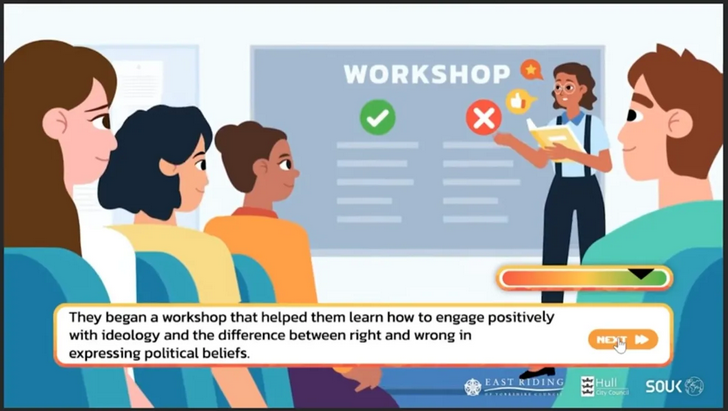
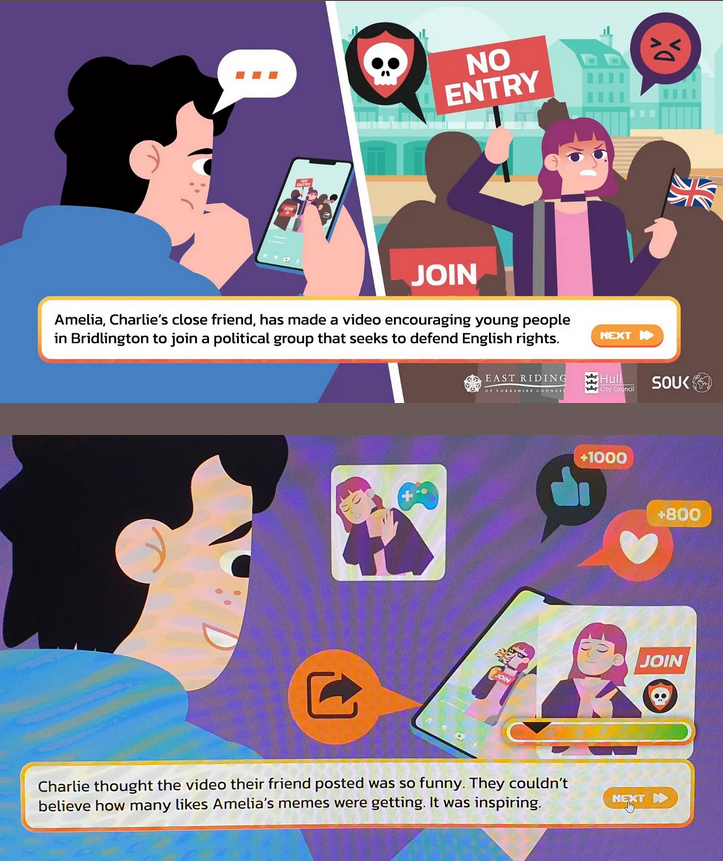
A couple of weeks ago the media started reporting a new online game funded by Prevent, the government’s (completely dysfunctional) department for diverting people away from extremism. Commissioned by Hull City Council and produced by “creative social enterprise” Shout Out UK, the game — called Pathways — is intended to “Encourage learning about the concept of extremism and radicalisation through the process of choice and safe exploration”.
As games go, this is a spectacularly dull one. Players choose a character, from a very limited selection — there are two, one male and one female, but they’re both called Charlie and use they/them pronouns. They then have to navigate their character through a series of scenarios, answering multiple-choice questions. The idea is that if you give the “wrong” answers you’ll get referred to Prevent, but it soon becomes obvious that almost any answers will get you referred to Prevent. The constant theme is that there are approved views and ways of acting — which don’t, for example, include doing research to find out if something you saw on the internet is true or not — and that, if you deviate from this, the state will step in to “support” you. A lot of this support looks suspiciously like re-education:
[…]
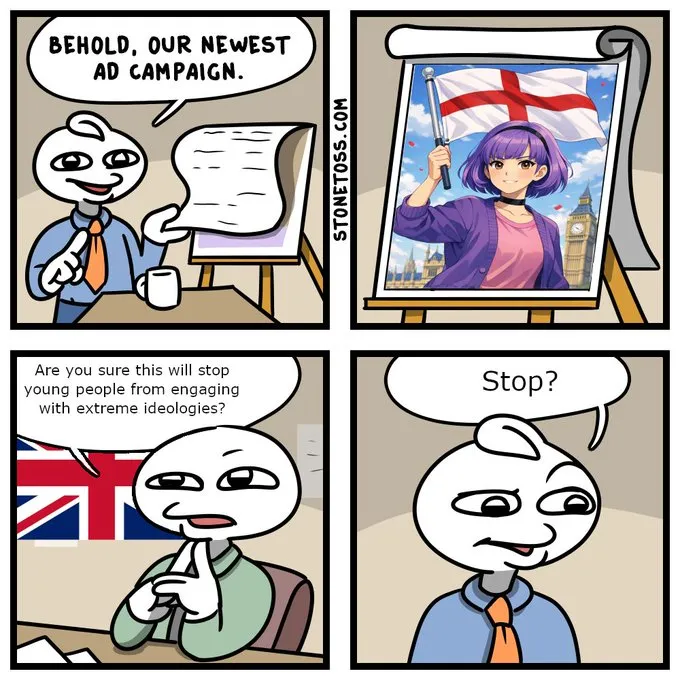
Of course, if you know much about the online right, you’ll probably see the problem already. As one stunned Reddit user commented, “Wait, are you telling me they made the cute goth e-girl the ‘racist’? Do they understand how the internet works?”
Well, they certainly do now.
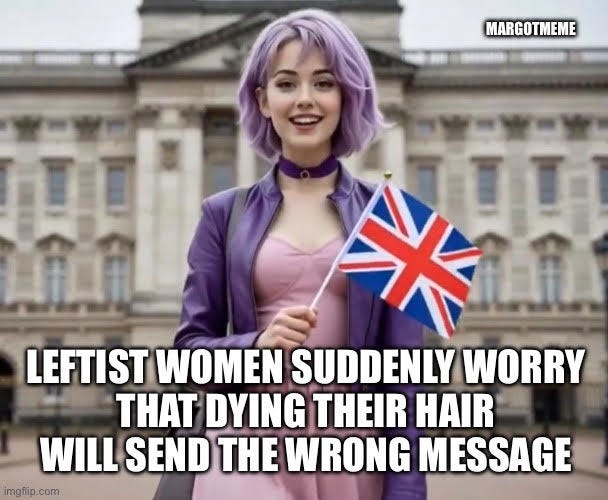
The Daily Telegraph published an article about Pathways on 9 January, bringing the game to public notice. That same day, X user Bovril-Gesellschaft posted “I think I’m in love with Amelia”. It seemed many other right-wingers were too, because within hours Amelia memes were appearing in large numbers. Mostly produced with AI, these depicted Amelia in a wide range of styles (probably reflecting their creators’ personal tastes), but all featured her purple hair and most stuck with the outfit of a pink dress and purple hoodie or cardigan the game depicted her in. Images ranged from cartoons in the style of the original game to photorealism. […]
There’s a lot to laugh about in this. For example, brightly coloured “danger hair” has generally been the hallmark of women on the far left. Amelia subverts this by giving our new heroine her distinctive purple bob. Will we see the pro-Hamas nuts and trans cultists abruptly return to natural hair colours to dissociate themselves from Amelia? That would be funny.
January 21, 2026
“It is a deal so bad that only Keir Starmer could have negotiated it”
In Spiked, Fraser Myers says that British Prime Minister Keir Starmer fully deserves to be humiliated over his give-it-all-away negotiations for the Chagos Islands, which includes the strategic naval base at Diego Garcia:

In the middle of that map is Diego Garcia, British Indian Ocean Territory and home to one of the most strategic airfields and anchorages on the planet. […] The red circle is 2,000 nautical miles from the island. The purple circle is 1,150 nautical miles, roughly the distance from London to Malta, that represents the distance from Diego Garcia. That circle is also the distance from Diego Garcia to the island of Mauritius.
Caption and image from CDR Salamander.
With the assistance of the brightest and best of the UK Foreign Office, the Labour government agreed to an arrangement that would hand over territory containing an Anglo-American military base to an unfriendly country, condemn its former inhabitants to permanent exile, and pay tens of billions of pounds for the pleasure.
I’m talking, of course, about Chagos (officially, the British Indian Ocean Territory), which has briefly caught the attention of the world’s most powerful man. This morning, amid a flurry of Truth Social posts about his designs on Greenland, US president Donald Trump’s gaze briefly alighted on this small, tropical archipelago on the other side of the planet. And he did not hold back in his criticism of Britain’s plans: “Shockingly, our ‘brilliant’ NATO Ally, the United Kingdom, is currently planning to give away the Island of Diego Garcia [the largest of the Chagos Islands], the site of a vital US Military Base, to Mauritius, and to do so FOR NO REASON WHATSOEVER”, he wrote. “The UK giving away extremely important land is an act of GREAT STUPIDITY”.
Trump’s reaction has widely been described as a major about-turn. But, in truth, his team has veered all over the place on the Chagos question. In October 2024, when Starmer initially agreed to hand over the islands, Marco Rubio, then still a US senator for Florida, reportedly warned that this would allow “Communist China” to spy on the US Navy, given Mauritius’s alliance with China. Yet in February 2025, when Starmer visited the Oval Office, the US president said he was “inclined to go along with” the UK’s proposals. And by May, when the deal was signed between the British and Mauritian governments, Rubio, by now US secretary of state, welcomed it. He claimed that Trump himself had “expressed his support for this monumental achievement”, hailing the deal that would cede sovereignty to Mauritius, while Diego Garcia would be leased to Britain for the next 99 years.
Of course, Trump’s motivation for bashing Starmer’s deal now has little to do with the Chagos Islands themselves. The real prize for the US president is in a different hemisphere entirely, as he freely admits. In a bizarre non-sequitur, the US president’s Truth Social post goes on to say that the Chagos deal is “another in a very long line of reasons why Greenland has to be acquired” by the US. This smackdown over Chagos, this attempt to humiliate Starmer and Britain on the global stage, is clearly part of Trump’s broader pressure campaign against the European powers, in his bid to seize Greenland for the US.
Nevertheless, it really should not have taken Trump’s intervention to put the brakes on the dreadful Chagos deal. Whichever way you spin it, this arrangement has never been in Britain’s national interest, nor the interests of the Chagossians who call the islands their home. It poses a risk to Western security interests, handing sovereignty over a territory, where almost 400 UK and US troops and 2,000 contractors are based, to a country that’s allied to China. The cost of leasing back Diego Garcia from Mauritius is also eye-watering. Although the Labour government tried to present the cost as just £3.4 billion, the true figure is believed to be 10 times as much, at around £34.7 billion.
So what on Earth possessed Starmer to sign up to such a risible deal? What leverage was a tiny island like Mauritius able to gain over Britain?
January 17, 2026
Shout Out UK – “… embracing right-wing extremism will give you a shot at getting a manic pixie dream girl gf”
At Postcards from Barsoom, John Carter looks at the most amazing political own-goal I’ve encountered in a long, long time:
Somewhere in the suffocating fog of the unhappy and restless Yookay, a minor functionary of the government’s behavioural shaping bureaucracy is staring at her computer screen in appalled alarm at the horror she’s accidentally helped to summon from the churning depths of the Immaterium.
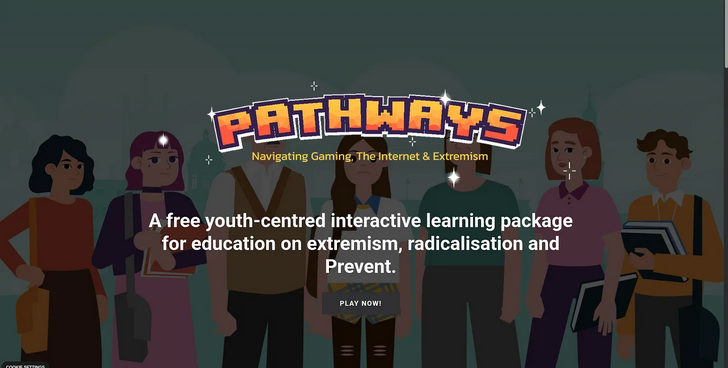
Shout Out UK, which describes its mission as “countering disinformation through political and media literacy”, released a “visual novel” called Pathways, subtitled “navigating the Internet, gaming, and extremism”. The game itself is of course terrible, a ham-fisted “teaching aid” intended to remind British teenagers that even innocuous and entirely peaceful activities – downloading memes, speaking your mind, watching videos, researching things for yourself, attending rallies – will complicate their lives if they draw the concerned and empathetic eye of the managerial state, which after all just wants what’s best for them.
Prevent, if you haven’t heard of them, are a group of government-funded busybodies whose remit is to prevent extremism via early intervention, catching impressionable youth before they can be radicalized. The organization was nominally started to deal with Islamic terrorists, but in recent years it has focused on the “right-wing extremism” of the native British to the exclusion of all else. The Southport butcher Axel Rudakubana, for instance, was referred to Prevent multiple times for his open glorification of white genocide, which Prevent ignored completely.
The player can choose either a male or female character, both of whom are amusingly and awkwardly referred to with they/them pronouns, with grammatical abominations such as “Charlie decided to look for themselves” sprinkled throughout. The character is then placed in a series of scenarios and made to choose between good and bad options: downloading extremist content or telling an adult; agreeing with a classmate that ethnic minorities are being shown favouritism at the expense of native youth vs clapping back at her unconscionable bigotry; watching a video and reading more about the subject or ignoring it; accepting or refusing an invitation to join a secret group chat; attending an anti-immigration rally or staying home. If you make the bad choice, a little “extremism meter” goes into the red.
[…]
If you want to play the game for yourself, your best bet is probably to download the archived version of the Government Approved Goth Girl Dating Simulator. I was able to play it a week ago, but since then it gets stuck on the loading screen, which at first I thought was because they’d taken it offline, but is probably just because Shout Out UK has gotten DDOSed by an entirely unexpected surge of interest in their execrable product (or maybe it’s just that the Shout Out UK website has a dead link on its page, as after poking around a bit on their website I was able to find one that works). Alternatively, you can find most of the screenshots archived here.
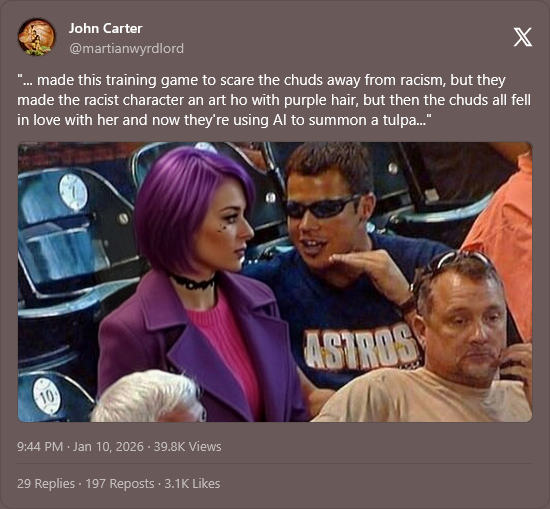
Had it not been for one unfortunate creative choice made by the development team, no one would have taken any notice of Pathways. It would have been one of countless cringe-inducing training aids churned out by regime-adjacent quangos cashing in on the flood of taxpayer lucre sluicing through the DEI-and-disinformation industry. But for some reason, which can be explained only by a calamitous failure on the part of Shout Out UK to develop an accurate theory of mind for their target audience, the creators of Pathways decided that it would be a great idea to cast the awful bigot leading the protagonist step by step to his ideological doom in the form of a cute alt girl, thereby sending the message that embracing right-wing extremism will give you a shot at getting a manic pixie dream girl gf.
Update, 18 January: Welcome, Instapundit readers! Have a look around at some of my other posts you may find of interest. I send out a daily summary of posts here through my Substack – https://substack.com/@nicholasrusson that you can subscribe to if you’d like to be informed of new posts in the future.
January 16, 2026
Rapidly declining democracy in the home of the “Mother of Parliaments”
As I’ve mentioned before, it sometimes seems that Australia, Britain, and Canada are in a three-way race to de-democratize themselves as fast as they possibly can. Here’s the free-to-cheapskates portion of Ed West‘s essay on the return of liberal authoritarianism:

“Palace of Westminster” by michaelhenley is licensed under CC BY-NC-SA 2.0
It’s around this time of year that various NGOs give their assessment on the state of democracy and freedom of the world. The Fraser Institute’s Human Freedom Index was published earlier in December and Freedom House’s next report will arrive in February. It was at the start of last year that Romania was downgraded to a “hybrid democracy” by another body, the Economist Intelligence Unit (EIU), while France is now merely a flawed democracy. Sacré bleu!
What about our own beloved island, the mother of Parliaments? It will be interesting to see where Britain features in this year’s reports, and whether recent developments will impact on our rating.
Just recently, for instance, the British government postponed four mayoral elections until 2028, elections they are certain to lose. The Electoral Commission warned that it risked undermining “the legitimacy of local decision making and damaging public confidence”, while the chairwoman of the Labour Party even refused to rule out delaying the next General Election, leading Nigel Farage to accuse her of having “total contempt for democracy”.
Keir Starmer has also taken effective control of the House of Lords and will almost entirely eliminate opposition among peers by 2027, which he is able to do to the second chamber thanks to Tony Blair’s constitutional reforms. While the government extends the franchise to children, and even plans to place voting booths in schools, a clear violation of rules about politicising the education system, they’re also keen to restrict who can stand in elections.
As the i reported, Emily Darlington, Labour MP for Milton Keynes Central, “is seeking to make the Electoral Commission recommend enhanced DBS checks for candidates and then publish whether or not parties have agreed to the vetting. The aim is to ensure political parties justify whether their candidates are fit for office and name and shame those who refuse to participate.”
This is troubling when one considers that DBS (Disclosure and Barring Service) checks include not just criminal history but “non-crime hate incidents“, which may even appear on the records of people who haven’t been contacted by police. These highly-political charges are far more likely to be directed at those with Right-wing opinions.
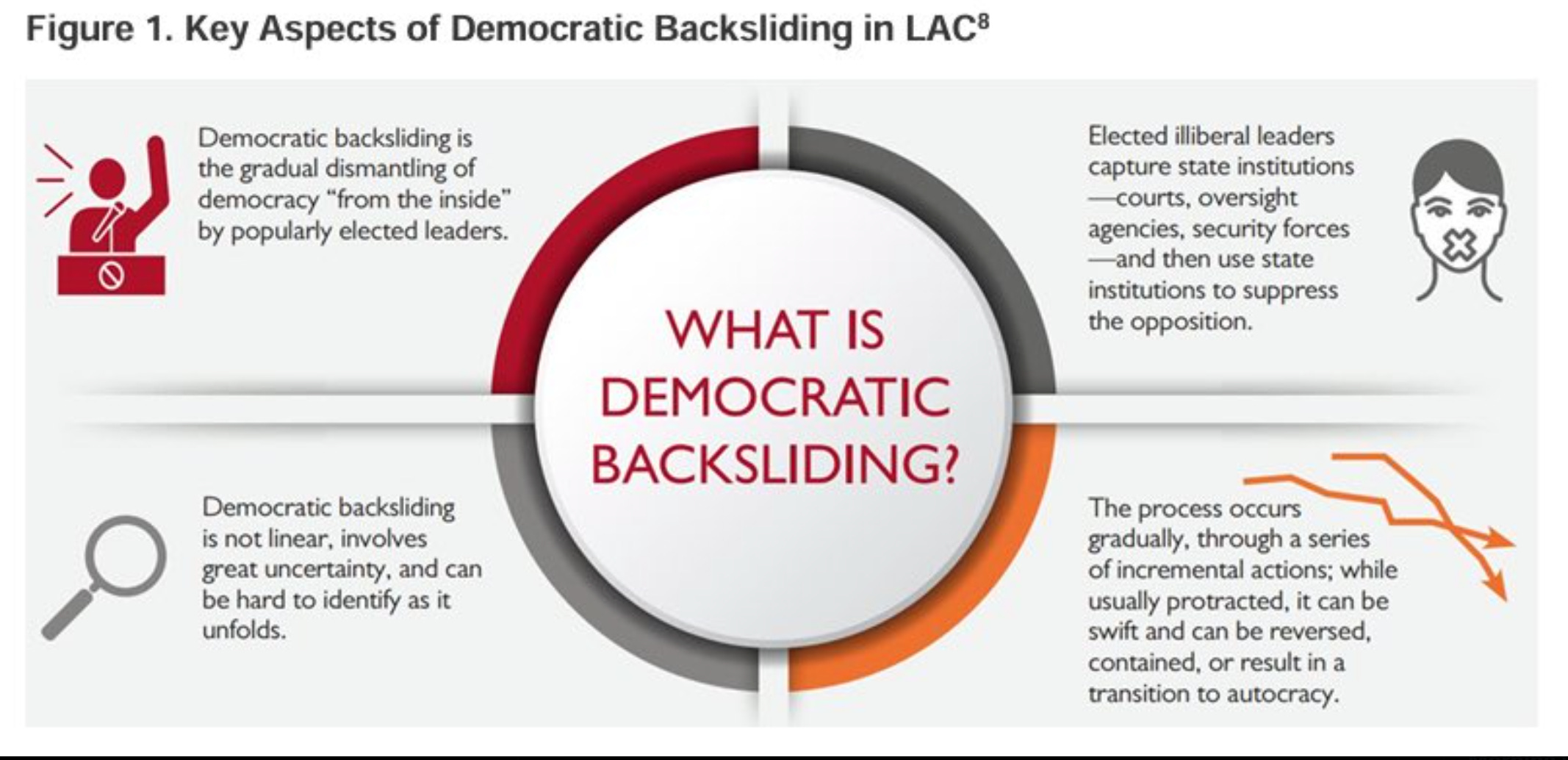
When western European countries do things like this, I try to gauge whether this is normal by asking the question: what if Hungary did this? In most of these cases, I imagine the assessment would be that it was an assault on liberalism and democratic norms. In which case, what if Britain is undergoing the sort of “democratic backsliding” usually levelled at central European countries with conservative governments? What if Keir Starmer is actually one of these illiberal “strongmen” we read about, just not a very effective one.
There are a number of accepted symptoms of democratic backsliding, among the most commonly listed being rejection of democratic rules, a disregard for constitutional norms, attempts to use legal mechanism to sidestep democracy, which is described as “stealth authoritarianism”, denial of opponents’ legitimacy, and the tendency to characterise them as outsiders or a threat to national security; on top of this, one might consider a willingness to curtail civil liberties, restricting the power of the media, and violating freedom of speech and association. Finally, and worst of all, is the toleration or encouragement of violence against opponents.
Credit: the National Opinion Research Center at the University of Chicago
By these broad definitions, Britain arguably meets many of these criteria (but not, most importantly, the last). There is certainly censorship, which has increased with the Online Safety Act, designed to combat “hate” as well as “misinformation”. Misinformation, of course, is everywhere, but its existence certainly provides a convenient excuse for governments to clamp down on the sort of information they dislike. The Government has also pondered banning Twitter, and while I feel that the widespread disgust at the Grok “deepfake” feature is reasonable, such a ban would completely cripple opposition, returning control of the discourse to the old media.
As for the British state’s definition of “hate”, there is a widespread belief that people motivated by hostility to mass immigration are extreme and dangerous, so the full force of the law must be used to stop them gaining support among a public who are totally guileless when it comes to absorbing information. This belief has grown more entrenched with the rise of populism, and makes western European governments increasingly sceptical of democracy itself.
It’s obvious that many people are concerned about the prospect of Nigel Farage becoming prime minister, and as the election date comes closer, and if he’s still in a position to win, the tone will become more shrill. Starmer admitted to this terror when he said, tellingly, that “If there is a Conservative government I can sleep at night. If there was a right-wing government in the United Kingdom, that would be a different proposition.”
Update, 17 January: Welcome, Instapundit readers! Have a look around at some of my other posts you may find of interest. I send out a daily summary of posts here through my Substack – https://substack.com/@nicholasrusson that you can subscribe to if you’d like to be informed of new posts in the future.
January 12, 2026
Britain’s new “war against misogyny”
At Oxford Sour, Christopher Gage explains how a Netflix show ended up as a key exhibit in the British chattering classes’ latest crusade:
Under our Labour government, the dictionary of euphemisms has swollen to rival War and Peace. Each day mints a fresh brick of Lego Language — words pressed together into sentence shapes that feel moral without actually meaning anything. Euphemism is not just annoying speech; it is a habit of mind. The mouth that traffics in euphemisms aligns with the mind that thinks in euphemisms too.
Nowhere is this clearer than in Labour’s declared War on Misogyny. According to our betters, Britain is a scorched plain over which misogynists roam, knuckles dragging, hypnotised by Andrew Tate and the Manosphere. These creatures, we are told, stalk the land, muttering statistics about male athletic advantage like a swarm of demented Daleks.
Our Labour government, its approval rating currently three percent lower than the percentage of Brits who believe there is a monster living in Loch Ness Lake, will train teachers to spot misogyny in boys and send “high-risk” offenders to courses to “tackle the root causes of misogyny”.
Misogyny, however, is not a vibes-based category. The word comes from the Ancient Greek misos (hatred) and gunē (woman): hatred of women. Until recently, it described a pathological condition involving fear, control, and violence directed at women. Such brutal men exist. They always have. But are they representative of the average British schoolboy doom-scrolling through social-media nonsense? Press X to doubt.
Yet this is where the campaign now lands: in classrooms of adolescent boys, taught to interrogate their latent depravity before it has manifested. It is not behaviour being punished, but probability.
In a culture strapped to the algorithm, only the most extreme definitions float to the surface. The brain, trained by screens, learns to seek the sensational, the novel, the ludicrous. And so, Labour shapes its moral imagination on content rather than evidence.
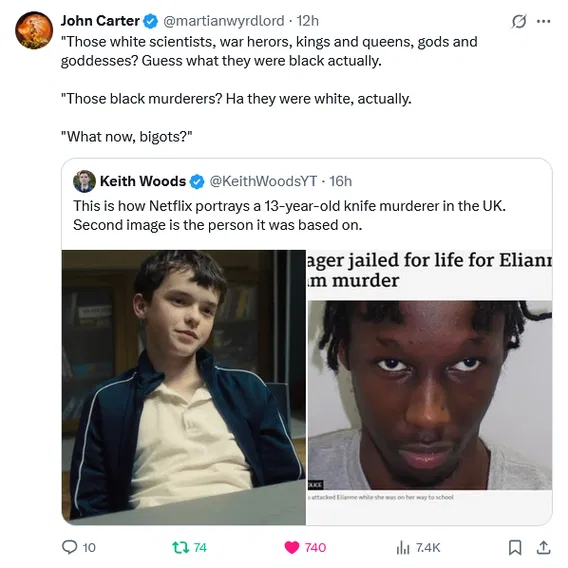
The Netflix drama Adolescence perfectly captures this drift. For the unacquainted, the series — an incel murder story drugged liberally with “that Andrew Tate shit” — was received as revealed truth. For The Guardian, it was “the best TV show ever”. It was not. Even a semi-literate eye would charge Adolescence as, well … adolescent.
Nevertheless, Adolescence assumed the status of revealed truth. On a BBC news panel, Tory leader Kemi Badenoch was interrogated for admitting she had not yet seen it. Middle-class parents dutifully watched alongside their sons, scanning their offspring for signs of misogyny leaking from its gills. Fiction hardened into diagnosis.
Life now imitates social media. Labour’s plan to tackle misogyny appears lifted directly from the website formerly known as Twitter. Schools will teach boys that it is not acceptable to act like barbarians. One wonders who imagined otherwise.
What these awareness seminars will not address — naturally — are the forms of misogyny that are neither hypothetical nor algorithmically inferred, but routine, organised, and existing beyond a Twitter feed or a Netflix menu.
They will not dwell on forced veiling, female genital mutilation, so-called honour violence, or acid attacks — practices documented in Britain and overwhelmingly concentrated within small but electorally critical communities governed by brutal patriarchal codes.
A rational observer might reasonably conclude that such practices meet any serious definition of misogyny: not ironic hatred, not incel posturing, but actual coercion, violence, and control exercised over women’s bodies and lives. You know, the very domination that Iranian women (and men) are currently risking their lives — quite literally — to uproot.
Yet these realities remain untouched and unmentioned, whilst classrooms revert into courtrooms enlisted to pre-emptively correct the imagined sins of adolescent boys. The reason is not moral complexity but political convenience. Euphemism thrives where naming the problem would threaten electoral arithmetic.
And so, the language grows ever softer around real brutality, even as it hardens against boys whose only crime is to physically resemble a fictitious incel murderer on Netflix.
Is Keir Starmer malevolent or stupid? Or both?
On his Substack, Tim Worstall wonders just how damn stupid Two Tier Keir actually is:
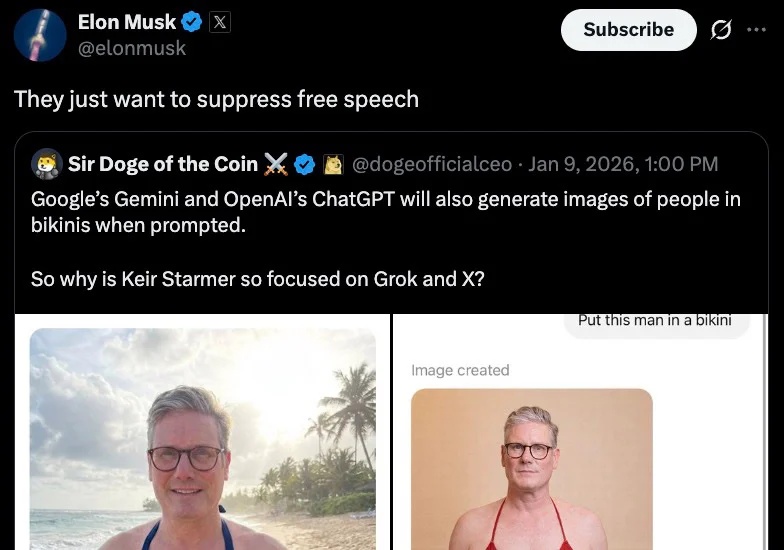
I fear our answer has to be very, very, stupid indeed. Unless he’s simply malevolent which makes things oh so much better, right?
Now, I confess to a fundamental disagreement with the very premise here. For the argument about why we should make child porn legal, see here. Making it more difficult to generate, let alone illegal, strikes me as the wrong decision. But then I’m sufficiently wise in years to realise that I might not be able to persuade some people of either that or of the many other things I am correct about. So, let us leave that aside.
There’s also the point that Grok is hardly the only image generation tool out there these days. Further, the one thing we know about computing is that this year’s leading, bleeding, edge is the free phone app of 5 years in the future. Shrieking that this must be banned just isn’t going to cut it as anyone trying that is simply a Cnut demanding the tide doesn’t flow in.1 On that larger issue of image generation in general we’re just going to end up changing the societal rules. A picture is no longer proof of anything. After all, it wasn’t up until about 1850 — those painters would just do any old thing, the truth be damned — and it won’t be after about 2028. Well, there we are then but …
But OK, let us leave all of that to one side and start from where British politics currently is. Grok generated AI kiddie porn is Bad, M’Kay, and must stop:
Technology Secretary Liz Kendall says she would back regulator Ofcom if it blocks UK access to Elon Musk’s social media site X for failing to comply with online safety laws.
Ofcom says it is urgently deciding what to do about X’s artificial intelligence (AI) chatbot Grok, which digitally undressed people without their consent when tagged beneath images posted on the platform. X has now limited the use of this image function to those who pay a monthly fee.
But Downing Street said the change was “insulting” to victims of sexual violence.
“Downing St” is the equivalent of the American “the White House said” … so yes, that is Keir Starmer, the Prime Minister there.
We’ve also an article from Liz Kendall today:
That Grok continues to allow this kind of content to be created by those willing to pay for it is an insult to victims. No business model should be built on the exploitation and abuse of women and children.
…
The Online Safety Act was designed precisely for situations like this, where platforms fail to take their responsibilities seriously and allow harmful content to proliferate. The British public rightly expects robust action. This is a matter of urgency that demands an urgent response.
I’ve also been clear that the Online Safety Act includes the power to apply to the courts to block services from being accessed in the United Kingdom if they refuse to comply with UK law.
We can see the threat there. If Elon Musk doesn’t do something about this then we’ll block X/Twitter from the UK.
- Why yes, I do know the correct story of Canute and the tides.
A Canadian and Australian connection showed up as well:

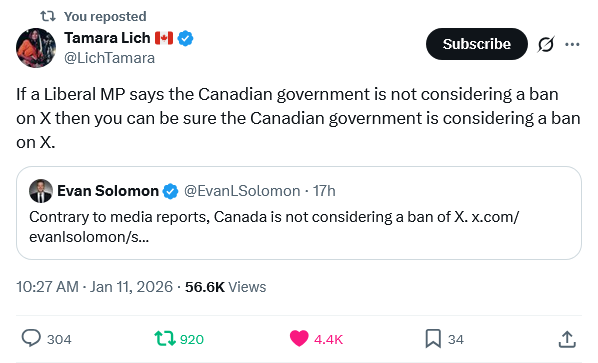
While I don’t depend on the social media site formerly known as Twitter for my news, I have found it a very useful additional source since Elon Musk took over the site. I’m clearly not the only one to feel this way:

As they used to say, however, “never believe anything until it’s been denied by the Kremlin”:
January 11, 2026
“The Paradox of Indifference”
Kulak describes the experiences of crafting takes for the gaping maw of social media and getting … nothing. You might as well not have bothered — we all know how that works, don’t we? But sometimes you catch lightning in a bottle and your post goes viral and then you get the worst kind of feedback:
People don’t show up to comment “No one gets it”, “Another miss”, “You aren’t funny”, “You’re wasting your life on Twitter” [as they tweet at you], “No one loves you”, “You never get laid”, “you’re a whore”, “you know nothing about BDSM Romance in Desert Storm, nor how that relates to the Czech Surrealism”, “No one cares”
When you are actually wasting your time and getting no traction, Not a soul alive is going waste their own time EVEN MORE-SO to sit there and commentate your embarrassment and failure.
Think about it, No matter how much Jehovah’s Witnesses or street preachers are wasting their lives and no one is listening, you’d be wasting your life even more so to sit there trying to persuade them of that fact.
Indeed the ONLY times you’ll EVER get comments like these … Is when you ARE getting traction.
It’s really amazing! Countless times you’ll tweet or post something you thought was clever, insightful, drole, important, philosophically or spiritually relevant … And nothing.
Then one of them Moon-Shoots, takes off to 6, 8, 10 MILLION impressions, 10s of thousands of likes …, thousands of retweets … And suddenly THAT ONE you start getting “No one cares”.
I’ve seen THOUSANDS of comments, “No one cares” “you’re weird for caring” all on the same tweet, RETWEETS from accounts with a MILLION followers “Who cares what this person thinks!? No one’s listening to them” They tweet out to a million people.
YOU DO!
Otherwise you would have just kept scrolling.
Its actually really remarkable the amount of effort, collective work, and social organization that goes into this.
I’ve seen Tweets with THOUSANDS OF COMMENTS, getting hundreds of retweets and hundreds of comments that “No one cares” … Sometimes these retweets themselves get comments and conversations going in circles “These people really think we care what they think?”, “I know right? They’re obsessed with us, as if we care” and if you’re looking closely you can actually see various followers of the people who “don’t care”, Comment themselves that they “don’t care” beneath their favorite E-Celebrity “not caring” that they also “don’t care”, and then follow their way back to your original tweet to say “We don’t care”, before Retweeting you themselves to say “God, these people. They actually think we care!?”
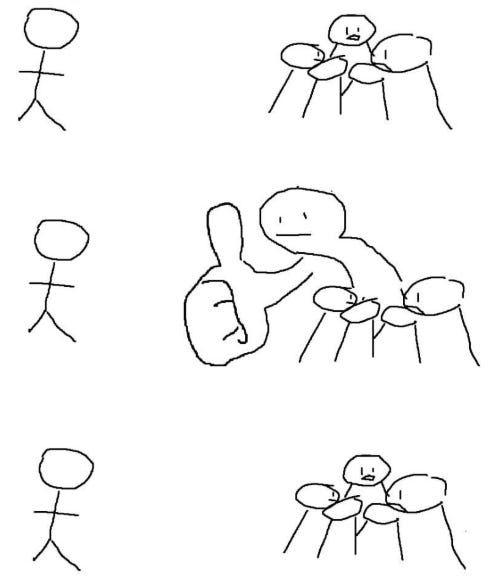
Indeed there’s an entire MEME FORMAT — the only meme as far as I can tell the left has ever successfully created for themselves — That exists solely to express that they “don’t care”
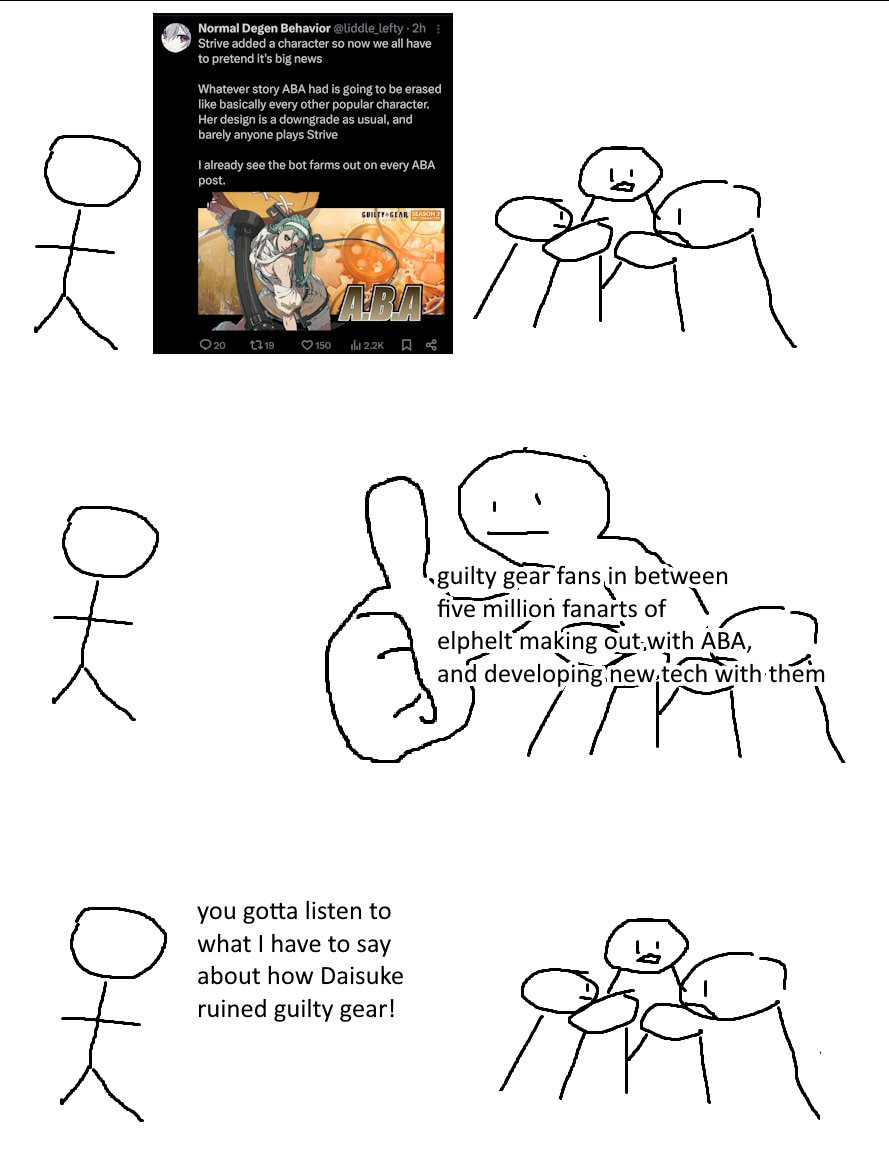
“Giant Thumb Guy”, Look at us Cool people in our group collective, and you outside it, and how we just barely acknowledge you then go back to ignoring you.
You see you can tell it’s a leftist meme format because they didn’t use any wojaks or existing memes … Also it’s poorly constructed and uses a redundant three panel format that has been on its way out in memes since 2015.
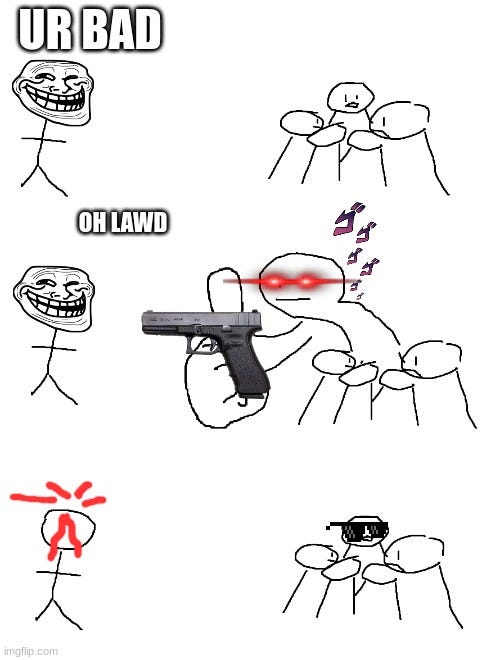
I’ve seen various leftists create elaborate Photoshops of this meme … Just to respond how little they care, because that’s what you do when don’t care.
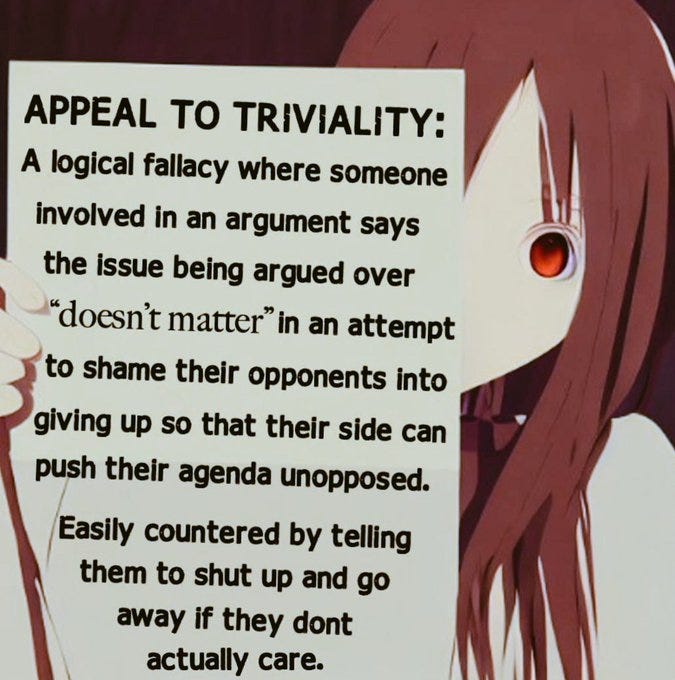
Now admit it, Can you tell a redditor created this? Look at the alt-text that came embedded in the image. (No I don’t actually know what Guilty Gear is…but we’ll be charitable and assume its just a fun and well enough written game and not barely concealed porn)
And of course other times their innate violent impulses infect the meme:
Because escalating immediately from words to threats of violence shows how cool and unconcerned you are.
“But Kulak!?” I hear you say, in a bout of inner-Redditor cleverness, “You’re a hypocrite! You clearly care too! You’ve written this entire piece so far just going on about how you don’t care, about them not caring, about your thing that you did that they didn’t care about!!! Would you have done that if you don’t care?! A-Ha! We got you!”
Ugh … Of course I care. This is fascinating. My anthropological instincts are tickled to the core!
Simply fascinating.
My working hypothesis is that leftists, a wide cross-section of women, effeminate men, the SSRI’d, men who’ve suffered genital trauma, the unintelligent, the weak willed, and just generally those of poor inner conviction, reason, hormonal health, and disagreeable virtue (but then I’ve repeated myself many times now) … Interpret their emotions and ideas via a complex communicative social environment they maintain with each-other.
Their minds and reasoning depends on a group, or longhouse, or “Community”, or “friends” … whereas the superior Chad, Chadette, Chud, and Chudette western autists are able to forgo, for extended periods, any need for such a social mental framework or even forego such “friends” and “community” entirely.
Thus, like the apex predators they are, these noble solitary creatures are able to rely upon their own superior reason and judgement. Inside of you are two wolves … and one of them is fallacious and gay, and the superior rational man should ignore him.
It’s a long post and covers a lot of territory, so do read the whole thing.
Iran in the news
There’s a major upheaval going on in Iran, but the western media seem to be incapable of covering it with any depth — or in far too many cases, at all — even though it’s exactly the sort of thing they used to be very interested in. On the social media site formerly known as Twitter, Tahmineh Dehbozorgi provides useful context:
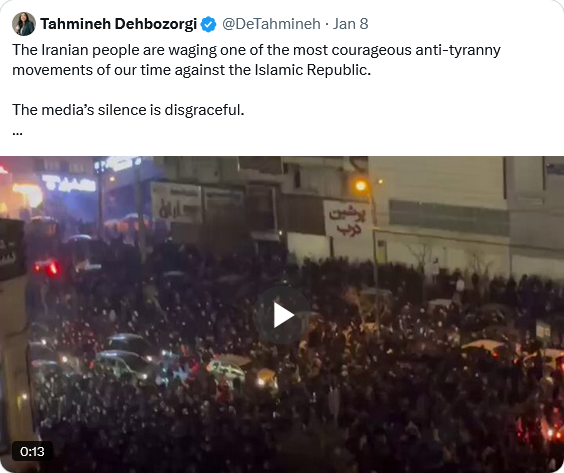
The Western liberal media is ignoring the Iranian uprising because explaining it would force an admission it is desperate to avoid: the Iranian people are rebelling against Islam itself, and that fact shatters the moral framework through which these institutions understand the world.
Ideally, to cover an uprising is not just to show crowds and slogans. It requires answering a basic question: why are people risking death? In Iran, the answer is simple and unavoidable. The people are rising up because the Islamic Republic of Iran has spent decades suffocating every aspect of life — speech, work, family, art, women, and economic survival — under a clerical system that treats liberty as a crime. There is no way to tell that story without confronting the nature of the regime.
Western media refuses to do so because it has fundamentally misunderstood Islam. Or worse, it has chosen not to understand it.
Islam, in Western progressive discourse, has been racialized. It is treated not as a belief system or a political ideology, but as a stand-in for race or ethnicity. Criticizing Islam is framed as an attack on “brown people”, Arabs, or “the Middle East”, as if Islam were a skin color rather than a doctrine.
This confusion is rooted in historical illiteracy. Western liberal media routinely collapses entire civilizations into a single stereotype: “all Middle Easterners are Arabs”, “all Arabs are Muslim”, and “all Muslims are a monolithic, oppressed identity group by white European colonizers”. Iranians disappear entirely in this framework. Their language, history, and culture — Persian, not Arab; ancient, not colonial; distinct, not interchangeable — are erased.
By treating Islam as a racial identity rather than an ideology, Western media strips millions of people of their ability to reject it. Iranian protesters become unintelligible. Their rebellion cannot be processed without breaking the rule that Islam must not be criticized. So instead of listening to Iranians, the media speaks over them — or ignores them entirely.
There is another reason the Iranian uprising is so threatening to Western media is economic issues.
As you know, Iran is not only a religious dictatorship. It is a centrally controlled, state-dominated economy where markets are strangled, private enterprise is criminalized or co-opted, and economic survival depends on proximity to political power. Decades of price controls, subsidies, nationalization, and bureaucratic micromanagement have obliterated the middle class and entrenched corruption as the only functional system. The result is not equality or justice. It is poverty, stagnation, and dependence on government’s dark void of empty promises.
Covering Iran honestly would require acknowledging that these policies are harmful. They have been tried. They have failed. Catastrophically.
This is deeply inconvenient for Western media institutions that routinely promote expansive state control, centralized economic planning, and technocratic governance as morally enlightened alternatives to liberal capitalism. Iran demonstrates where such systems lead when insulated from accountability and enforced by ideology. It shows that when the state controls livelihoods, non-conformity becomes existentially dangerous. That lesson cannot be acknowledged without undermining the moral authority of those who advocate similar ideas in softer language.
Western liberal media prefers not to hear this. Acknowledging it would require abandoning the lazy moral categories that dominate modern discourse: oppressor and oppressed, colonizer and colonized, white and non-white. Iranian protesters do not fit. They show that authoritarianism is not a Western invention imposed from outside, but something many societies are actively trying to escape.
That is what terrifies Western liberal media. And that is why the Iranian people are being ignored.
So the silence continues.
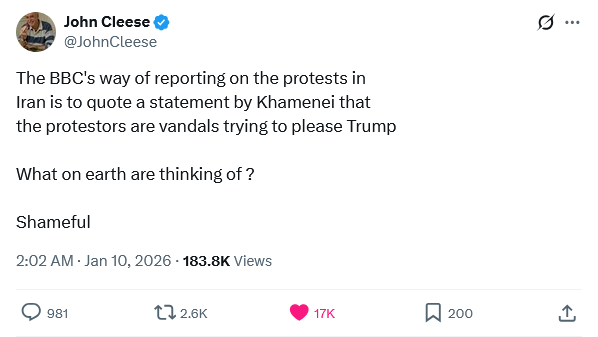
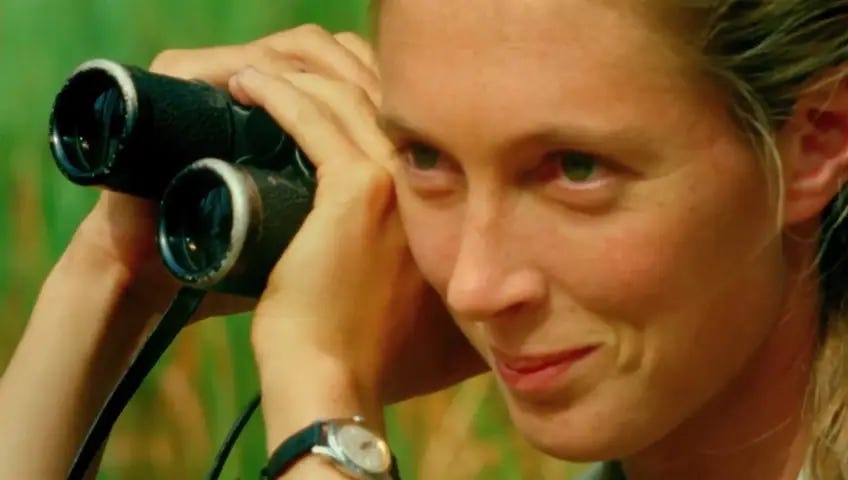
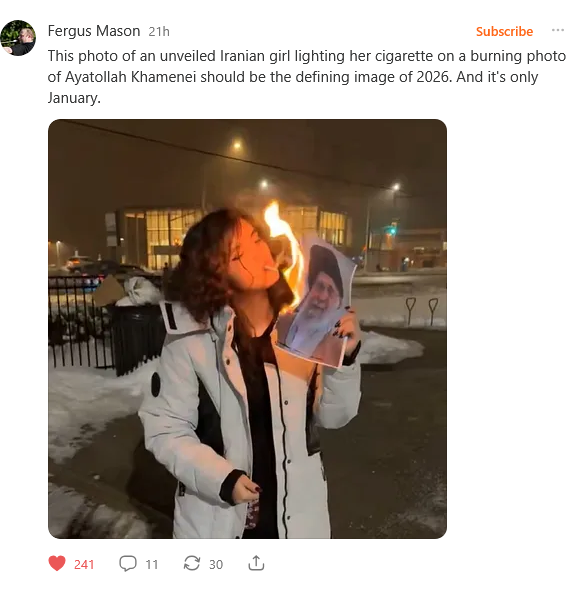
On Substack Notes, Fergus Mason shares what might be the most iconic photo of the young year:
Update, 12 January: Welcome, Instapundit readers! Have a look around at some of my other posts you may find of interest. I send out a daily summary of posts here through my Substack – https://substack.com/@nicholasrusson that you can subscribe to if you’d like to be informed of new posts in the future.
December 6, 2025
The least offensive kind of soft power – The Rest is History
Ed West recounts his (very) early discovery of The Rest is History, a podcast featuring Dominic Sandbrook and Tom Holland (not that Tom Holland, I’m told). I’ve been a (free) subscriber on YouTube for the last year or two, but Ed got there much earlier than I did:

The Rest is History must be the only thing of which I can say that I was into it before it was popular, my sole experience of being an early adopter. I remember listening to the very first episode as soon as it was released, during Lockdown 2, because I had been a fan of Tom Holland for years and followed him on Twitter. Straight away, I knew that it would be an enormous success, because even people who rarely watched history documentaries or read history books would find it entertaining.
And now, as they say, “the rest is history” (ho ho). The programme has just been named Apple Podcasts Show of the Year 2025, the first ever British winner, and is beyond successful, into the realm of “phenomenon”. When television writers in the distant future make dramas set in the 2020s and wish to give immediate shorthand to establish the decade, they’ll put The Rest is History soundtrack somewhere in the background, just as they always have Tears for Fears playing on the radio during any drama set in the 80s.
It became such a huge part of my life that, when cooking or cleaning and unresponsive to questions, the children came to learn that I must be listening to “Tom and Dom” on my AirPods. Initially, of course, when I mentioned that I had actually met Tom Holland a few times, they’d respond with awe until they realised that I was not talking about the Spiderman actor. It became a running joke about “your Tom Holland” rather than the “famous” one.
During the golden years of television there were a number of shows which became so commonly popular in one’s friendship circles that they were routinely talked about – The Sopranos, The Wire, Breaking Bad or Game of Thrones – but there were always plenty of people who had never watched them; there’s so much choice, after all, and the media culture has fragmented.
As Tom and Dom discussed on an old episode about the 1990s, that was the last period when the whole country had a common popular culture. Yet The Rest is History is approaching something close to that. It’s become so all-pervading that literally everyone I know, or ever speak to, listens to it. Perhaps I live in a bubble, but it’s a warm and cosy bubble filled with chat about the Kaiser’s deck shoes and Costa Rica’s infamous Dr Valverde, a sick and twisted psychopath who liked to torture frogs. The word I’d use to describe the show is “wholesome”, a term they’re fond of, an escape from the modern world, without rancour, hectoring or — crucially — swearing.
I realised that it must have become something more than popular when I read that it was the biggest podcast in Finland. Admittedly the Finnish market is not globally important, but this obviously wasn’t some quirky localised fanbase, like Norman Wisdom in Albania. It had become big everywhere, including the largest market of all; to use an analogy that Holland might appreciate, they’d reached their Ed Sullivan moment.
[…]
All the great drama series of the 2000s I mentioned were American, and I’d even go as far as to argue that The Rest is History is now Britain’s main cultural export and proponent of soft power. While the case might be made for the Premier League or Warhammer, the Goalhanger production has far more sway on international elites and how educated, cultured people around the world see our country.
Foreigners tend to value an idea of Britishness characterised by classiness and erudition, but also humour and modesty. Yet the global popularity of our national brand is out of tune with what our own cultural elites value, which reflects their sense of cringe but often comes across as strangely parochial and inward-looking. Two erudite historians who wear their scholarship lightly, whose interests are openly Anglocentric but reflect a passionate interest in the world beyond our island, talking to the audience like a pair of friendly academics in a cosy pub in Oxford – that’s the fantasy they want.
Fans are always conscious that any show will pass its peak, and then start to decline as everyone runs out of ideas. There’s no sign of it yet, and the good thing about history is that it’s literally endless, and you can always return to the subject at greater length. Their recent series on Nelson was outstanding, despite covering previous ground, and nothing says the holiday season like that festive subject, the Nazis. I can’t wait for the eleven-episode series about the Costa Rican Civil War.
November 28, 2025
Social media isn’t completely a depressing waste of time
On the social media site formerly known as Twitter, Devon Eriksen reacts to a political hack who wants to impose regulations on social media that would allow him to shut down people who criticize him and other swamp creatures:
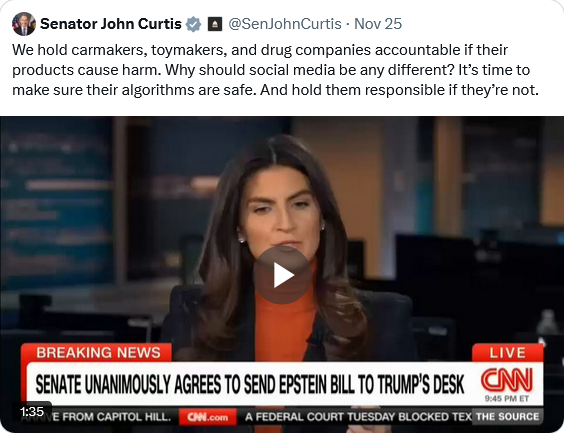
We all know what’s really going on here.
Utah senator John Curtis, and other political hacks like him, are getting their boomer asses handed to them on social media.
They long for the days of television, when they could control the narrative by having a cozy relationship with the networks, and so they could lie to you without fear of contradiction by some autist named @DataRepublican whose existence is solely defined by her full-time hobby of sniffing out lying dirtbags.
So they want to pass a bunch of laws to make the internet behave like television. To filter it all through a set of major website choke-points that they can control by threatening the corporate entities that run them.
Long, complicated, and vaguely defined liability laws are a tool to do that.
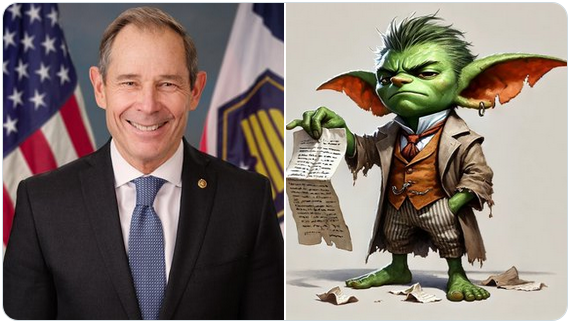
Basically what they do is allow John Curtis to put any website out of business if people say mean things about him on it, such as pointing out that he looks like some kind of deranged and malevolent goblin that just crawled out of a swamp.
The problem he has right now is that when I say stuff like that on Twitter, I’m the one who said it.
Not Twitter.
There’s nothing he can do to me. Because even if I get hit by a unmarked sedan tomorrow in a totally unrelated accident, there’s a million more people like me who are only too happy to point out that John Curtis looks like a deranged and malevolent goblin that just crawled out of a swamp.
So he wants legal tools to punish Twitter for what I said.
So how does he go about that? What is a deranged and malevolent goblin, with a “business management” degree, and a history of changing political parties when convenient, to do?
Why, muddy the waters with vague platitudes about “safety”, of course.
Except we’ve heard that song before, and we’re not interested. So let us laugh at him, remind him that he looks like a deranged and malevolent goblin that just crawled out of a swamp, and mock until he goes back to doing what he normally does, which is shilling for the “Fairness For High Skilled Immigrants Act”.
And then we can eventually replace him with someone who cares about fairness to actual fucking Americans.
Update, 29 November: Welcome, Instapundit readers! Please do have a look around at some of my other posts you may find of interest. I send out a daily summary of posts here through my Substack – https://substack.com/@nicholasrusson that you can subscribe to if you’d like to be informed of new posts in the future.
November 10, 2025
Enshittification, the book
Cory Doctorow originally coined the all-too-useful name for the steady deterioration of pretty much everything in the online world and now it’s the title of his latest book:

Author and activist Cory Doctorow wants you to understand why online digital platforms are failing users, and he’s fighting for a better internet. “Enshittification” — a word he coined to describe the degradation of online platforms and services — is the slightly profane albeit funny title of his latest book.
[…]
First question from me: “What does enshittification look like in Canada?” (Try saying that word without chuckling). The country had several opportunities to lead as a global digital force to be reckoned with, Cory agrees, and in his view, “we dropped the ball on market concentration”.
“The Competition Bureau has, through almost all of its history, until last year when we got a new bill out of Parliament, been, I think, the weakest competition bureau in the world,” Cory declares, emphatically. It’s hard to refute his assessment: The merger of Shaw and Rogers, two very large telecoms in Canada, was made official in 2023, the year before Canada’s competition law was modernized.
“Wouldn’t you think, at the very least, Canada would have a robust domestic network platform available by now?” I ask. Gander Social, a made-in-Canada social media platform, designed as an alternative to large U.S.-based companies, is only now being beta tested.
“There are any number of people who would like very, very much to host a few thousand of their friends on a little Mastodon or Blue Sky server that can talk to all the other ones, and everyone can be in a conversation,” Cory counters.
“We don’t all have to be on the same server,” Cory continues. “If there’s one thing we learned from the Amazon outage, it’s that putting everyone on the same server is an incredibly bad idea, right? So we can all be on different servers in the same way we’re all on different email servers, drive on different roads. We have to live in different cities; we don’t all have to be in the same place to all talk to each other and be part of a single digital network. That’s what networks are, right?
“You know, what we don’t have, the lacuna in this plan, the thing that we need public investment in, is not the bicycles on the road, it’s the bike lanes, it’s the infrastructure, and it’s the kind of thing the private sector can’t do well,” he asserts. The pain points for small businesses, communities, large businesses, cooperatives or any entity wanting to host a social media platform, Cory suggests, include things like security audits and content moderation tools.
He also recommends “some mechanism to ease people’s passage off (existing) social media and onto a new platform”. Right now, Cory explains, “you have people building these new platforms and wondering how the people on the old platforms are going to get there. This is like West Germans building housing for East Germans in West Germany, without thinking about how they’re going to get over the wall. Except that, we built the wall. We are the ones maintaining the wall. The wall is made entirely of law. The wall could be torn down with an act of Parliament at the stroke of a pen.”
And on the related topic of artificial intelligence being crowbarred into everything we use online:
Cory’s also saying very provocative things about AI. His most-memorable quip: “AI is the asbestos we are shovelling into the walls of our society and our descendants will be digging it out for generations”. While he sees the merits of AI to support the work of radiologists or lawyers or software engineers — or nearly anyone — he doesn’t believe AI can do the job. “But,” he warns, “an AI salesman can 100 per cent convince your boss to fire you and replace you with AI”.
November 8, 2025
November 7, 2025
“BookTok on its own sounds innocent enough”
I’ve seen occasional references to BookTok on other platforms but as it seemed to be as female-coded as an online community can be, I’d never bothered to pay close attention to it. If Zoomertea is to be believed, it’s a weird and disturbing space for the unprepared to visit:

Image from “The Female Gooner Epidemic” at Zoomertea
If you’re smart enough to have never downloaded TikTok, then you’ve probably never heard of BookTok and the resulting epidemic of female gooners (a term borrowed from porn culture to describe obsessive arousal and fixation). BookTok on its own sounds innocent enough, women rediscovering the joys of reading, romanticising cozy nights in, or even joining a book club. In theory, what could be more wholesome? However, the reality is more concerning. It turns out the bookish girls have traded the likes of Pride and Prejudice for highly pornographic dark fantasy erotica, stories that make Fifty Shades of Grey seem tame.
Women have always enjoyed a flair for romance. Once it was the slow burn longing of Romeo & Juliet or Wuthering Heights – the stories weren’t explicit, yet still roused deep, passionate feelings. By the 2000s, romance had evolved into “chick lit” – breezy novels about friendship, love and self-discovery. Books like Bridget Jones and the Devil Wears Prada swapped tragic love for witty realism, capturing the struggles of modern women navigating careers, dating, and independence. It seems like in all aspects of modern culture, people have been pushing for the “reliability factor” – they wanted to see themselves in the characters and storylines. But somewhere along the way, the realism and reliability factor lost its appeal.
During the pandemic, while the virus spread and the world stayed home, TikTok spread too, surpassing 2 billion downloads by mid-2020. With endless free time, people picked up new hobbies: some tried Chloe Ting’s “Get Abs in 2 Weeks” workouts, others turned to BookTok and rediscovered their love for literature. Booktok isn’t just for explicit romantasy novels, however it’s become synonymous with women who obsessively consume dark romance. On BookTok, desire isn’t intimate anymore; it’s performed.
While Fifty Shades of Grey, a book very explicitly about sex, came almost ten years before BookTok, it wasn’t exposed to the algorithmic amplification loop we see today. Although its release did shock readers and spark feminist critiques about patriarchal relationships and sexual themes, it still felt more like a dirty secret. Its eroticism was discussed privately, even sheepishly. It was a book club secret, not a TikTok performance. Now, even the most unassuming women are flocking to BookTok and demanding books with a maximum “spice rating”, without an ounce of shame. But how did this happen?
Somewhere between the isolation and scrolling, the lines between fantasy and reality began to blur. The algorithm on TikTok can be very dangerous for enforcing unhealthy habits on its users. When a woman watches or likes just one “spicy book” video, even just out of curiosity, TikTok interprets it as interest in similar content. Without the user’s knowledge, suddenly their ForYou page is filled with similar videos, “books with a max spice rating”, “extreme taboo book recommendations” or “Top five dark romance recs”. The more they see, the more they engage, the more the algo pushes darker more extreme content. Essentially, the algorithm learns: You like desire, here’s more. Louder. Darker


