Quotulatiousness

August 28, 2021

QotD: Social media capitalizes on “the biggest Faculty Lounge Fallacy of them all”

Filed under: Education, Media, Quotations, USA — Tags: , , , , , , — Nicholas @ 01:00

… Twitter (etc.) are specifically set up in such a way as to discourage any real-world action. Basically it’s the faculty lounge writ large. If you’ve been to college in the last half-century, you surely noticed that the faculty are Very Very Concerned about all kinds of stuff … but that the stuff they’re Very Very Concerned about is always happening to some obscure group thousands of miles away.

Even when they’re pretending to Care Very Much about, say, “systemic racism” in “America”, it would never occur to them to go down to the ghetto that, in many notorious cases, is literally right next door to do anything about it. They could find out everything they ever wanted to know — and then some!! — about “the Black Experience” by driving down MLK Blvd. at three in the morning, but somehow they never do. The way you win at victim bingo in the ivory tower is you find the most obscure group, the furthest away, to chastise your peers for not caring enough about. If what you say could possibly have any real-world application in the lives of anyone anybody you know had even the possibility of ever meeting, you lose.

Such is Social Media, so it’s no surprise that the Twitterati all fall victim to the biggest Faculty Lounge Fallacy of them all: That saying something is the same as doing something. Or, in other words, and not to put too fine a point about it, they act like passive-aggressive little bitches, like cat ladies around the company water cooler. You could get Johnny from Accounting to stop leaving his half-eaten sandwich in the lunch room fridge by simply asking him to stop … or you can have daily hen parties about it for weeks, months, years, squawking about how some people need to get some common courtesy … and meanwhile Johnny from Accounting goes on doing it, oblivious.

The genius of Facebook, Twitter, etc. — and it IS genius; sick, evil, twisted genius — is that they figured out how to monetize this.

Severian, “Internet Tough Guys”, Rotten Chestnuts, 2021-05-10.

August 13, 2021

Millennial maternalism

Filed under: Media, Politics, Technology — Tags: , , , , , — Nicholas @ 03:00

In The Critic, Kittie Helmick considers the Millennial generation and their pronounced maternalistic worldview:

“Millennials” by EpicTop10.com is licensed under CC BY 2.0

The popular conception of millennials paints the generation as immature, living an extended adolescence: late to marry, late to have children, late to buy houses. Even the retort — that society hasn’t delivered on its promises; that an unfavourable job market has prevented them from living the lives expected of adults — reads as a refusal to accept responsibility.

The response to Simone Biles’s withdrawal from the Olympics demonstrates that the opposite is true. Millennials are not behaving like teenagers — they are responding like mothers. The breakdown in family life combined with quantum leaps in telecommunication technology has sent the 90s generation to their computer screens for meaningful connections. Instead of growing out of video games and chat rooms, millennials have grown with them. Online communities have not stunted young people’s growth, but absorbed it.

Millennials — now aged in their late 20s and early 30s, some with families of their own — have directed all the maternal instincts of adulthood towards online media. Rather than collect family albums, they amass Instagram and Tumblr accounts with thousands of images of their favourite characters and celebrities. Notifications act as little appeals for attention akin to the tug of a child’s hand. This otherwise unrealised yearning to nurture underpins much of the affective response to news stories about the latest victim of injustice.

There are many strands entangled in the knot of American leftism, but the maternalism of millennials manifests in the self-righteous defensiveness of Biles’s supporters and the emotional outrage they direct at anyone who criticizes the gymnast. Stripped of patriotic sentiments and religious traditions, millennials have nowhere to direct their human instincts of loyalty and affection but at the figures (fictional or fabled) who occupy so many of their hours.

The language of critical theory cloaks these sentiments in intellectual rigor, lending some dignity not only to the mouthpieces of these ideas, but also to the intended objects of their affections. Millennials don’t have to worry about infantilising Biles if they call her an “exceptional Black woman”, even while they simultaneously invoke the moral standards of a kindergarten classroom in asking, “How do we make it our responsibility to love and protect each other?”

Witness these impulses play out in the more thinly veiled account of a father who wonders if he has turned “soft” because his parental cares now eclipse his admiration of Kerri Strug’s feat during the 1996 Olympics: performing a “one-legged vault” on an injured ankle. The father implies that only a monster could cheer when a teenage girl sacrifices her health for victory. He makes no secret of the reason behind his change of heart: “Now that I have two young daughters in gymnastics, I expect their safety to be the coach’s number one priority.”

There is nothing amiss in his love for his daughters, or the extension of that concern to other children, but this father has lost sight of other principles that might compete for priority in the spotlit, split second decisions of athletes and trainers in Olympic competitions. Loyalty to something greater than oneself — to Strug’s teammates, to the country she represented — has fallen out of the picture, leaving behind only the petty incentive of winning. This perspective permits no higher motive to the coach responsible for urging Strug on, than greed for a gold medal.

Millennial parents run to the opposite extreme of the Spartan mother: instead of inculcating self-sacrifice for the good of the community, they insist, “Not my child.” They see their role as shielding children from the dangers of the outside world, rather than preparing them to face it.

August 9, 2021

The modern-day threat of being made an “unperson” is real and very dangerous

Sean Gabb explains why even libertarians need to consider the non-state power in the hands of corporations that can — and does — force people out of their jobs, their homes, and even deprive them of the ability to communicate or to access financial services merely for expressing unpopular opinions. As I said in a different venue, it’s a short step from “no fly lists” to “no eat lists”, especially when the enforcing entity is a nominally private organization:

John Stuart Mill (1806-1873)

The old pressures to conform were wrong. So are the new. And they are wrong simply because they are pressures to conform. I find myself at last appreciating a part of Mill’s essay On Liberty for which I never used to have much time. Until recently, I would insist that the only real oppression was by the State: all else was the working of private choice. If the authorities fined a man £5 for having sex with another man, that was outrageous tyranny. If his tastes became public knowledge, and he was unable to find work, that was merely unfortunate. This is, I still believe, essentially true. Indeed, I could argue that, without a State having centralised and corporatised powers of discrimination that ought to be widely distributed, there would be no problem — or there would be a problem that was bearable. But these powers were centralised and corporatised a long time ago. They are now being used to achieve a uniformity of opinion outside the home in which the formal organs of compulsion have no obvious part. This is not the “tyranny of the majority” that worried Mill. I find it inconceivable that anything close to a majority could believe the insane drivel pouring from the regime media. Neither, though, is it the kind of oppression against which liberal bills of rights have traditionally been written. Because of this —

    when society is itself the tyrant …, its means of tyrannising are not restricted to the acts which it may do by the hands of its political functionaries. Society can and does execute its own mandates: and if it issues wrong mandates instead of right, or any mandates at all in things with which it ought not to meddle, it practises a social tyranny more formidable than many kinds of political oppression, since, though not usually upheld by such extreme penalties, it leaves fewer means of escape, penetrating much more deeply into the details of life, and enslaving the soul itself. Protection, therefore, against the tyranny of the magistrate is not enough: there needs protection also against the tyranny of the prevailing opinion and feeling; against the tendency of society to impose, by other means than civil penalties, its own ideas and practices as rules of conduct on those who dissent from them …

    (J.S. Mill On Liberty, 1859, “Introductory“)

We need protection indeed. But the protection we need is not yet another law telling the police to leave dissidents alone. We already have a stack of these, and they are protections against a threat that largely does not exist. The answer, I suggest, is an amendment to the anti-discrimination laws to outlaw discrimination on the grounds of what may be loosely called political opinion.

I say hardly anyone read my original essay. Sadly, most of those who did read it stand in the more wooden reaches of the libertarian movement, and these set up a cry that I had become a Communist. I was suggesting that private organisations should be coerced in their choices of whom and whom not to employ, and even in their choices of customer and supplier. I had abandoned the non-aggression principle. Here, briefly expressed, is my answer to these claims.

I run the Centre for Ancient Studies. This provides a range of tuition services in Greek and Latin. It is a sole tradership. As such, I reserve the unconditional right to decide what services I offer and to whom. If I dislike the colour of your face, or the status of your foreskin, or your tastes in love, or anything else that I may think relevant, it should be my right not to do business with you. It may be that only a fool turns away customers with money to spend, and I am not that sort of a fool. Even so, I do claim at least the theoretical right, and I ground it on my right to do as I please with my own. But I claim these rights as a human individual. A limited company is not a human individual. Whatever entrepreneurship may exist in them, these companies are artificial persons and creatures of the State. Their owners have the privilege of limited liability. That is, they have the right, in the event of insolvency, not to pay the debts of a company if these are greater than the assets of the company. If this were not a valuable right, there would not be so many limited companies. There are almost no large companies, and none lasting more than a single generation, that do not have limited liability.

This being so, limited companies benefit from a grant of privilege from the State, and are legitimate subjects of regulation by the State for as long as they are receipt of this privilege. No doubt, some forms of state regulation are bad in their objects, or bad as regards the means to their objects. But regulation is not in itself an aggression by the State. It follows that, whether or not we can get it, libertarians should not feel barred from demanding laws to prevent limited companies from discriminating against their employees on the grounds of political opinion, and to require them to do business with customers and suppliers regardless of political opinion.

I appreciate that I am asking for more than the regulation of limited companies. The anti-discrimination laws we have make no distinction between incorporated and unincorporated associations. Even so, the extension of these laws to cover political opinion would mainly affect only the larger limited companies. At the same time, there is an obvious and overriding public interest in the protection of political opinion. People are now scared to speak their minds. Whether intended or just revealed, this is part of the strategy. The reason why the collapse of both freedom and tradition is gathering pace is because no one dares stand up and protest. In the absence of protest, everything will carry on as it is. Given a restored right of protest, there is a chance of stopping the collapse. The only way to lift the blanket of fear that now lies over all but approved opinion is somehow or other to get a law making it clear that no one who speaks his mind can be loaded with shadow punishments.

“Somehow or other!” In a sense, I am making a fool of myself. I am asking the politicians to make a law against what they themselves may not be doing, but that has no effect on their main reason for being in politics, which is to fill their pockets. I am asking them to take on the entire mass of the non-elected Establishment. I am asking a lot of these people. On the other hand, the politicians still need to be elected, and that was the weak point in the Establishment’s plan to stay in the European Union. We had to spend four years voting and revoting, but we did eventually get what we wanted. It is conceivable that, if enough of us call loudly enough for protection, some kind of protection will be granted.

Short of that, we are lost.

July 23, 2021

Panic is infectious, and the dying media are a primary vector

In City Journal, John Tierney looks at the two lethal waves of contagion the world has suffered since 2019, the Wuhan Coronavirus itself and the media-driven panic that almost certainly resulted in far more deaths than the disease that triggered it:

Wuhan Institute of Virology.
Wikimedia Commons.

Instead of keeping calm and carrying on, the American elite flouted the norms of governance, journalism, academic freedom — and, worst of all, science. They misled the public about the origins of the virus and the true risk that it posed. Ignoring their own carefully prepared plans for a pandemic, they claimed unprecedented powers to impose untested strategies, with terrible collateral damage. As evidence of their mistakes mounted, they stifled debate by vilifying dissenters, censoring criticism, and suppressing scientific research.

If, as seems increasingly plausible, the coronavirus that causes Covid-19 leaked out of a laboratory in Wuhan, it is the costliest blunder ever committed by scientists. Whatever the pandemic’s origin, the response to it is the worst mistake in the history of the public-health profession. We still have no convincing evidence that the lockdowns saved lives, but lots of evidence that they have already cost lives and will prove deadlier in the long run than the virus itself.

One in three people worldwide lost a job or a business during the lockdowns, and half saw their earnings drop, according to a Gallup poll. Children, never at risk from the virus, in many places essentially lost a year of school. The economic and health consequences were felt most acutely among the less affluent in America and in the rest of the world, where the World Bank estimates that more than 100 million have been pushed into extreme poverty.

The leaders responsible for these disasters continue to pretend that their policies worked and assume that they can keep fooling the public. They’ve promised to deploy these strategies again in the future, and they might even succeed in doing so — unless we begin to understand what went wrong.

The panic was started, as usual, by journalists. As the virus spread early last year, they highlighted the most alarming statistics and the scariest images: the estimates of a fatality rate ten to 50 times higher than the flu, the chaotic scenes at hospitals in Italy and New York City, the predictions that national health-care systems were about to collapse. The full-scale panic was set off by the release in March 2020 of a computer model at the Imperial College in London, which projected that — unless drastic measures were taken — intensive-care units would have 30 Covid patients for every available bed and that America would see 2.2 million deaths by the end of the summer. The British researchers announced that the “only viable strategy” was to impose draconian restrictions on businesses, schools, and social gatherings until a vaccine arrived.

This extraordinary project was swiftly declared the “consensus” among public-health officials, politicians, journalists, and academics. Anthony Fauci, director of the National Institute of Allergy and Infectious Diseases, endorsed it and became the unassailable authority for those purporting to “follow the science”. What had originally been a limited lockdown — “15 days to slow the spread” — became long-term policy across much of the United States and the world. A few scientists and public-health experts objected, noting that an extended lockdown was a novel strategy of unknown effectiveness that had been rejected in previous plans for a pandemic. It was a dangerous experiment being conducted without knowing the answer to the most basic question: Just how lethal is this virus?

The most prominent early critic was John Ioannidis, an epidemiologist at Stanford, who published an essay for STAT headlined “A Fiasco in the Making? As the Coronavirus Pandemic Takes Hold, We Are Making Decisions Without Reliable Data.” While a short-term lockdown made sense, he argued, an extended lockdown could prove worse than the disease, and scientists needed to do more intensive testing to determine the risk. The article offered common-sense advice from one of the world’s most frequently cited authorities on the credibility of medical research, but it provoked a furious backlash on Twitter from scientists and journalists.

July 20, 2021

Does Facebook have a war on history?

Filed under: History, Media, Politics, USA — Tags: , , , — Nicholas @ 04:00

Study of Antiquity and the Middle Ages
Published 19 Jul 2021

Does Facebook have a war on history? The answer is a simple no but the story is complicated.

In this episode I am joined by author and reporter Peter Suciu on his article “On Facebook, History Can Violate Community Standards”.

To quote the article * One thing that is often taught to students of history is that “history” didn’t happen. Events happened in the past, but history is just our way of chronicling those events. There is also a saying that history is written by the winners, but that too isn’t entirely accurate – if history were only written by the winners we’d never hear of the setbacks, mistakes made by generals or losses incurred by said winners. History, to put it bluntly, is written by historians and those with knowledge of past events.

On Facebook it now seems that merely writing about – and then sharing those writings – could violate community standards. Even in this era of “fake news” it isn’t so easy to understand why the social network has taken this stance – end quote.

Recently an incident on Facebook lead me to create this video … while scrolling through my Roman themed history groups I noticed a post by a member showing that their history post had been taken down by Facebook for violating community standards. The post was a picture of the Roman Eagle with SPQR under its feet. This particular illustration was actually from the Rome Total War Gaming Franchise and that lead me to wonder more about how and why Facebook targets certain posts?

Is there confusion among Facebook employees and its algorithms involving not just Ancient History but specifically Roman History?

Why are Third Reich posts and photos censored? And why are they censored even if there are no violent images or symbols of hate shown?

Why are militaria groups coming under fire for trading, buying and selling Third Reich memorabilia when other memorabilia such as relating to the USSR or the CCP are deemed acceptable?

Why is Facebook warning me that the history groups I’m in may be exposing me to extremist content?

These are questions that I pondered while making this episode and so I hosted a fellow history buff and militaria collector on whether or not history can violate Facebooks Community Standards?

Support our great guest at all these links below!

On Facebook, History Can Violate Community Standards
https://www.forbes.com/sites/petersuc…

Twitter: https://twitter.com/PeterSuciu

Forbes: https://www.forbes.com/sites/petersuc…

National Interest: https://nationalinterest.org/profile/…

His awesome history store: https://www.plundererpete.com/

Reference Links Below!

Facebook warns users they may have been exposed to ‘harmful’ extremists.
https://www.foxnews.com/media/faceboo…

Facebook bans historical St. Augustine groups, pages: Is the word ‘militia’ to blame?
https://www.firstcoastnews.com/articl…

History-themed Facebook groups have become a magnet for racist content.
https://www.newstatesman.com/science-…

An article involving Channel host Nick Barksdale and Facebook.
https://news.law.fordham.edu/blog/202…

Inside “Facebook Jail”: The Secret Rules That Put Users in the Doghouse.
https://www.wsj.com/articles/inside-f…

July 18, 2021

“Yes, we know Facebook is not the only harmful corporation on Earth, but sweet-jeepers-boy-howdy it is a blood-curdling fart in the elevator of existence”

Filed under: Business, Media, USA — Tags: , , — Nicholas @ 05:00

At Damn Interesting, Alan Bellows bids an unfond farewell to Facebook:

For the past few years, we at Damn Interesting have been hearing from scores of long-time fans who were under the mistaken impression that we had ceased all operations years ago. These fans are typically delighted to hear that a) we are still writing and podcasting; and b) there is a wealth of new content since they last visited. When we ask them what caused the assumption of our demise, they invariably cite the fact that our posts disappeared from their Facebook news feeds.

I never had anything like the number of contacts on Facebook that Damn Interesting had, but I had the same experience with people contacting me to ask if I’d given up blogging because none of my posts were showing up in their timelines any more. As more information came out about just how creepy Facebook’s activities are, I stopped even trying to share to that site and eventually stopped linking to any content hosted there. For video credits where the only link for a creator is their FB page, I choose not to make it an active link (although I don’t remove the text). The only use I had after that was for keeping in touch with a few family members who only use that platform, and even that went away after I got locked out of my personal account anyway.

This trend roughly coincides with Facebook’s introduction of “boosting” for pages; in this new model, according to the stats we can see, Facebook stopped showing our posts to approximately 94% of our followers, demanding a fee to “boost” each post into an ad, which would make it visible to more of our audience. We lost contact with tens of thousands of fans practically overnight. We don’t mind paying for a service if it is valuable, but we absolutely don’t want to reach our audience by buying ad space on Facebook. Yuck. But no other option is given to reach the many people who previously followed our posts, and who presumably want to continue to do so.

[…] In a move that feels long overdue, we at Damn Interesting are abandoning all interactions and connections with Facebook.

We really should have done this back when it was revealed that Facebook used the ubiquitous embedded “Like on Facebook” buttons to follow people’s movements around the web without their knowledge or consent.

This bit of belated information prompted me to check the settings on the Share This plug-in I’ve been using for several years and yes, all this time I’ve been inadvertently enabling FB to track anyone on my blog who uses that button (and possibly any other sharing button — that isn’t quite clear). I’ve eliminated that plug-in just in case.

Our reasons for leaving are not entirely abstract. We’re sure many of you, like us, have experienced first-hand how Facebook gives people license to be their worst selves. It can elevate mere differences of political opinion into anger and hostility, pushing friends and family into extreme views, turning loved ones into ugly caricatures of their former selves. Perhaps you have even regretted some of your own posts there; the Facebook interface is designed to make it difficult to engage in good-faith disagreements. It gives undeserved forum to misinformation, disinformation, and hate. Using Facebook has been scientifically demonstrated to cause depression. Facebook subtracts from the quality of the world at a magnitude seldom seen in history, and we’ll all be better off when it goes away.

H/T to Robert Swanson (@WWI) on Gab for the link.

July 17, 2021

“Now I am become Twitter, the destroyer of worlds”

Filed under: Media, Politics, Technology, USA — Tags: , , , — Nicholas @ 05:00

In UnHerd, Douglas Murray remembers what it was like before Twitter ruined everything:

Fifteen years ago today, an innovation was unveiled that has probably changed our lives as much as any other this century. It was on 15 July 2006 that software developer Jack Dorsey and his team launched an online platform where text messages of 140 characters could be shared in a group; six days later Dorsey sent his first tweet, launching a new age of reasoned debate and engagement.

There are some who want to celebrate today — principally Dorsey, along with the small number of other people who have become unimaginably rich off the platform. But for everybody else on the planet, I suspect we should welcome the anniversary with roughly the same enthusiasm that we would the emergence of the Ebola virus. For the further away we have come from Twitter’s birth, the clearer it has become that the platform is a source of unimaginable harm to almost every aspect of society.

In the early days, it didn’t feel like this. Like Facebook, Amazon, Google and the other Big Tech monoliths, it all started out so well. Twitter was actually fun back then. People said whacky things. There were cat videos. There was Follow Friday and friendships were made. As professional and amateur newshounds took to the platform, it became the fastest way to learn about any developing story.

If something was going on, Twitter was there first, certainly ahead of the BBC or any of the other news establishments who had to lumber through the old legal and editorial hurdles, rather than enjoying the lightning-quick response time of social media. Politics is a drug, and the most successful drugs provide an instant hit. But they are also the most dangerous, and the downsides soon started to assert themselves.

Soon many started using the site in a game of competitive grievance, or competitive sanctimony. They took obvious glee in targeting victims who had transgressed some moral code; the obvious righteousness of these online crusaders meant they rarely recognised themselves as the aggressors or bullies.

And soon it became apparent that, while everyone was on the site, everyone also hated it. Those on the ideological Left began to turn against the platform when it became clear that it allowed their opponents on the Right to spread “hate”, a scourge which they defined generously. Just as they used it themselves to spread their message.

This all reached its nadir with Donald Trump, whose presidency is to many people the most concrete result of Twitter. The world watched aghast as Trump was able to say often the craziest of things to millions upon millions of followers, speaking unfiltered and directly — in a way the old news media would never have allowed. When he won the presidency and then thanked Twitter for the helping him to get it, many of these natural Twitter followers lost their faith in the platform. How could they have let it happen? It was their platform, after all, this noisy minority of the American and British electorate. Indeed, if you had read UK Twitter ahead of the 2019 election, you would have been absolute certain of a Jeremy Corbyn landslide. Where were these millions of Tory voters who didn’t like Jeremy?

July 13, 2021

Is the PRC really a paper dragon?

Filed under: China, Media, Politics, USA — Tags: , , , , — Nicholas @ 05:00

Sarah Hoyt is tired of finding posts on MeWe that fluff up the ChiComs as a way of “conservatives” scoring points against “progressives” in the US political context:

“The Chinese People’s Liberation Army is the great school of Mao Zedong Thought”, 1969.
A poster from the Cultural Revolution, featuring an image of Chairman Mao, published by the government of the People’s Republic of China.
Image via Wikimedia Commons.

What bilge? Oh, memes extolling the Chinese in relation to us. And all conservatives pick this crap up and echo it, because it happens to “side rail” against things they hate (and which it’s valid to hate.)

But the memes are crap. The aggrandizing of the Chinese bastards is crap. They’re either outright lies or laughable lies. And the memes, somehow, never hit the Chinese where it hurts: the fact their economy is so f*cked most of their people live like Medieval peasants; the fact their army of little emperors cried when they went up against India; the fact that they are having trouble feeding their own population; the crumbling empty cities they think are “investments”; their population collapse; Xi’s pretensions to world leadership; their slave camps. Which you know, tells you exactly where the meme factory is and who is propagating it.

The problem being when conservatives seize the memes and distribute, they are actively collaborating in the aggrandizing of China and putting down the US. They are also convincing the Chinese their victory over us will be easy. (This is good and bad, but if you have friends and relatives in large cities, think about the chances of it ending up with one of those catching a nuke because the idiots get cocky, okay?)

Chinese are masters of propaganda and psychological warfare, while Americans are so bad at it that it hurts. If you loved 2020 keep collaborating with the enemy.

If not, listen up:

Yeah, sure, the fact that the usurpers of our governmental institutions are making our armed forces participate in inclusivity and CRT training, and prioritizing bullshit SJW goals over preparedness IS a problem. But that doesn’t mean we’re not still the best fighting force in the world. Sure, it’s damning with faint praise, but comparing us to China and saying they’re “prepared for war” and “will win” is bullshit. You know it’s bullshit, I know it’s bullshit. It’s bullshit so rank I can smell it through the internet.
The Chinese have Little Emperors — single descendants of multiple families — who are no more prepared to risk themselves in war than I’m prepared to fly unassisted. Their army is bullshit.

Why is it bullshit? Because they don’t have a fighting force. The only fighting strength they ever had was the ability to submerge any enemy in a wave of people. But they can’t. Because the communists destroyed that too.

Their weapons are bullshit. I’d like independent confirmation of their “achievements in space”. Why? Because, well, the USSR achievement in space was a) what they could steal from us b) flimsy and c) mostly trumped up. In the sense that they only publicized their wins, while it might be one in ten that succeeded.

Look, by definition an authoritarian regime sucks at tech. I’m not saying anything about “capabilities of the people” (duh) but seriously? If you can’t report failed experiments, failed assemblies or builds that need to be improved, you’re going to have crappy tech. And you can’t report any of that, because in a centralized authoritarian regime you’ll be punished for failure, even if it’s not your fault. And you might get accused of doing it on purpose.

When nothing less than 100% success is allowed, the process is corrupt and the result is excrement. (Look at our “science” right now. No, seriously. We’re sliding that way.)

So, no matter how made you are at what the army and our government is doing, stop echoing Xi’s bullshit. And counter it every time you see it. This is war by other means, or in the ancient Chinese tradition, softening the enemy so they’ll surrender at first attack.

July 11, 2021

An “ongoing moral panic against the specter of ‘white supremacy’, which is now bizarrely regarded as an accurate description of the largest, freest, most successful multiracial democracy in human history”

From Andrew Sullivan‘s Weekly Dish free excerpt:

“What happened to you?”

It’s a question I get a lot on Twitter. “When did you become so far right?” “Why have you become a white supremacist, transphobic, misogynistic eugenicist?” Or, of course: “See! I told you who he really was! Just take the hood off, Sully!” It’s trolling, mainly. And it’s a weapon for some in the elite to wield against others in the kind of emotional blackmail spiral that was first pioneered on elite college campuses. But it’s worth answering, a year after I was booted from New York Magazine for my unacceptable politics. Because it seems to me that the dynamic should really be the other way round.

The real question is: what happened to you?

The CRT debate is just the latest squall in a tempest brewing and building for five years or so. And, yes, some of the liberal critiques of a Fox News hyped campaign are well taken. Is this a wedge issue for the GOP? Of course it is. Are they using the term “critical race theory” as a cynical, marketing boogeyman? Of course they are. Are some dog whistles involved? A few. Are crude bans on public servants’ speech dangerous? Absolutely. Do many of the alarmists know who Derrick Bell was? Of course not.

But does that mean there isn’t a real issue here? Of course it doesn’t.

Take a big step back. Observe what has happened in our discourse since around 2015. Forget CRT for a moment and ask yourself: is nothing going on here but Republican propaganda and guile? Can you not see that the Republicans may be acting, but they are also reacting — reacting against something that is right in front of our noses?

What is it? It is, I’d argue, the sudden, rapid, stunning shift in the belief system of the American elites. It has sent the whole society into a profound cultural dislocation. It is, in essence, an ongoing moral panic against the specter of “white supremacy”, which is now bizarrely regarded as an accurate description of the largest, freest, most successful multiracial democracy in human history.

We all know it’s happened. The elites, increasingly sequestered within one political party and one media monoculture, educated by colleges and private schools that have become hermetically sealed against any non-left dissent, have had a “social justice reckoning” these past few years. And they have been ideologically transformed, with countless cascading consequences.

Take it from a NYT woke star, Kara Swisher, who celebrated this week that “the country’s social justice movement is reshaping how we talk about, well, everything.” She’s right — and certainly about the NYT and all mainstream journalism.

This is the media hub of the “social justice movement”. And the core point of that movement, its essential point, is that liberalism is no longer enough. Not just not enough, but itself a means to perpetuate “white supremacy”, designed to oppress, harm and terrorize minorities and women, and in dire need of dismantling. That’s a huge deal. And it explains a lot.

July 9, 2021

QotD: Woke fanaticism

Filed under: Media, Politics, Quotations, USA — Tags: , , — Nicholas @ 01:00

The strange figures known as Wokists currently destroying America aren’t just reprises of earlier enemies. They represent something rather new. The political cult of Wokism combines the worst aspects of every political cult in history.

Whether they realize it or not, Wokists themselves combine the lunatic loyalty of the Manson family with the hollow pseudo-joy of Jonestown residents, the racism of National Socialists, the inhumanity of Mao Tse-Tung, the bratty tantrums of Veruca Salt, the nihilism of Bakunin-style anarchists, the totalitarianism of Stalin’s Soviet Union, the child torture and sacrifice of the Mayans, the derangement of Heaven’s Gate followers, the sadistic violence of the Jacobins, and the ruthless control-freakism of the current Chinese Communist Party.

Now add to that noxious syncretic blend the Wokist use of powerful communication technologies to shape narratives and meta-narratives, destroy opponents, and recruit new converts, and you’ve got yourself a thing.

Through it all, a counterfeit moral imperative with a deceptively appealing name (“social justice”) drives the cult. That counterfeit imperative casts all existence as one great battle between Good (Wokism) and Evil (everything that is not Woke). It denies any constraints on efforts to win that battle. It entails an obsessive totalitarianism. It forbids critical self-examination of itself. Adherents of the cult are Knowers of the One True Truth. They are crusaders in righteous battle. Only victory matters. Anyone so much as questioning the One True Truth, inside or out, must be destroyed.

Tal Bachman, “We Have Met the Enemy”, Steyn Online, 2021-04-06.

July 2, 2021

QotD: Quebec’s legendary sensitivity to criticism

We have a generally pro-Quebec stance; however, these annual meltdowns because Some Anglo Said Something Mean About Quebec are getting really tiresome. Somehow this province has managed to prove itself to be even more thin-skinned than Alberta — yes, we said it. Quebec is more reactive than the province that last week suffered a fit over an unflattering children’s cartoon.

And for some reason, the rest of Canada continues to treat these tantrums as if they are very weighty and serious matters meriting news coverage and discussion by very weighty and serious people. Canada’s indulgence of Quebec’s inability to tolerate pointed criticism is probably why the province gets away with passing racist legislation like Bill 21. And no one — least of all politicians — dare say boo because they’re all too eager to win seats in a populous province perpetually in play.

Attaran’s tweets wouldn’t even be worth our lowly mention, except that they prompted response from Justin Trudeau himself, who responded by saying: “Enough of the Quebec bashing.” That’s right, what we have here is Prime Minister Brownface condemning the tweets of an Iranian-Canadian professor who called Quebec racist by declaring such comments “Quebec bashing.” People, we are down the rabbit hole.

Earlier in this dispatch, we called Attaran a bit of a dumbass, and maybe some of you found that assessment a bit harsh. Others, perhaps not. We leave ourselves open to be capably judged by you, our dear readers. But we must ask this: What kind of dumbass do you have to be to make a figure like Amir Attaran into a national hero on free speech grounds? Good lord.

“Dispatch from The Front Line: Doing the Code Dance”, The Line, 2021-03-26.

June 30, 2021

“We’re having a heat wave/A tropical heat wave …”

Filed under: Cancon, Environment, Media — Tags: , , , , , — Nicholas @ 03:00

Jay Currie is apparently melting in the heat somewhere out on the left coast of Canada:

As my readers know I live on Vancouver Island right by the ocean. Normally, it is too cool to be comfortable having the evening g&t on the deck. Well, yesterday and today and very possibly tomorrow it will be way too hot.

The thing about heat waves is that they bring out the climatistas ready to ascribe weather to climate change. On #bcpoli Twitter it is a dead heat between the unscientific “I will wear a mask until there is no COVID anywhere on Earth” people and the people who insist that the present heat wave “proves” global warming. Well it doesn’t.

What we are in the grips of is a jet stream excursion. A big loop of hot air is sitting on top of us. It is practically the definition of “weather”. Three weeks ago Victoria set an all time record for coldest June day in the middle of a series of anomalously cold days. This too was “weather”.

The warmists are not deterred. “Well, over all the ‘weather’ is getting hotter because of climate change.” “The jet stream is behaving eccentrically because the Arctic is getting warmer and that’s climate change.” And then they add their policy prescription d’jour – Save Old Growth, Raise the carbon tax, Stop LNG exports and so on.

The brutal narcissism of the climate crusaders is touching. The problem and its solution are all about them. Other than the Pacific North West, the rest of the world is normal to cold. The Eastern US has been wet and cool, South America is freezing, Australia and New Zealand are experiencing an early ferociously cold winter, summer snow is falling in Scandinavia. The fact the major factor in the northern and jet stream’s preignitions is the level of solar activity is borne out by the general coolness of 2021. Guess what, the Sun is very quiet at the moment which is historically linked to cooling rather than warming.

But, for fun, let’s propose that the climate change fanatics are right and there is a direct link between CO2 and the present heat wave – not one of their favoured solutions will make the slightest difference. We could all walk to hug the trees and it would not matter.

Here’s why […]

June 23, 2021

Bad legislation rammed through in the small hours of the morning

Filed under: Cancon, Government, Law, Liberty, Technology — Tags: , , , , , , — Nicholas @ 03:00

Michael Geist on how one of the worst pieces of legislation to get extruded from the bowels of the Liberal minority government got pinched off by main force and now sits, steaming, on the docket for the Senate to … well, “rubber stamp” isn’t quite the right phrase but it’s pretty rare for our unelected senators to do anything to benefit ordinary Canadians, so we’re depending on them somehow managing to display an almost supernatural effort to slow down this shitty bill until the end of the session:

Canadian Heritage Minister Steven Guilbeault, 3 February 2020.
Screencapture from CPAC video.

The Liberal government strategy of multiple gag orders and a “super motion” to limit debate bore fruit last night as Bill C-10 received House of Commons approval at 1:30 am. The Parliamentary process took hours as the government passed multiple motions to cut short debate, re-inserted amendments that had been previously ruled null and void, and rejected a last-ditch attempt to restore the Section 4.1 safeguards for user generated content. The debate included obvious errors from Liberal MPs who were presumably chosen to defend the bill. For example, Julie Dabrusin, the Parliamentary Secretary to the Minister of Canadian Heritage, said that Section 2.1 in Bill C-10 “specifically excludes content uploaded by users.” Only it doesn’t as Dabrusin should know given that 2.1 covers users not content and she was the MP who introduced the amendment at committee to remove Section 4.1, which was the provision that excluded content uploaded by users.

Given the public support from the Bloc for cutting short debate, the outcome last night was never really in doubt. Perhaps the most interesting vote of the night came with a motion from Conservative MP Alain Rayes, which once again called for the re-insertion of Section 4.1. While the motion was defeated with the support of Liberal, NDP, and Bloc MPs, there were several notable exceptions. Liberal MPs Nate-Erskine Smith and Wayne Long both abstained and former Justice Minister (and now independent MP) Jody Wilson-Raybould voted in favour of the motion. The report stage was limited to one hour of debate, which meant that the 23 amendments were again subject to no real debate or discussion. Once the bill passed the report stage, it was on to third and final reading, which was limited to 15 minutes of debate per party. The vote followed just before 1:30 am with the Liberals, NDP, and Bloc once again supporting Bill C-10. Wilson-Raybould joined with the Conservatives in voting against it.

A rational government would comprehend that their pitch that the real purpose of the bill is to “make the web giants pay” is completely undermined by the obvious and deliberate attempt to introduce government censorship of what ordinary Canadians watch on the internet and share through social media. It’s all about the control, not about any imaginary financial windfall from shaking down tech companies for spare change. Why the rush to get it rammed through parliament right now, with so many other rather more pressing concerns at hand?

June 17, 2021

QotD: Declaring war on the Upper-Class Media

Filed under: Media, Politics, Quotations, USA — Tags: , , , , , , , , — Nicholas @ 01:00

This is your new term for “mainstream media”. Being against the “mainstream media” sounds kind of conspiratorial. Instead, you’re against the upper-class media, which gains its status by systematically excluding lower-class voices, and which exists mostly as a tool of the upper classes to mock and humiliate the lower class. You are not against journalism, you’re not against being well-informed, you’re against a system that exists to marginalize people like you. Tell the upper-class media that if they want your respect, they need to stop class discrimination.

67% of US families watch the Super Bowl — what percent of New York Times editors and reporters do? 20% of Americans go to religious services weekly — how many of those work for the New York Times? How come 96% of political donations from journalists go to Democrats? Your job is to take a page from the Democratic playbook and insist there is no reason any of this could be true except systemic classism, that any other explanation is offensive, and it’s the upper-class media’s moral duty to do something about this immediately. Until they do so you are absolutely justified in ignoring them and trusting less bigoted and exclusionary sources (I hear Substack is pretty good!)

Insist that working-class people have the right to communicate with each other without interference from upper-class gatekeepers. Make sure people know every single fact about @Jack and what a completely ridiculous person he is, and point out that somehow this is the guy who decides what you’re allowed to communicate with your Twitter friends. Every time tech companies censor social media, even if they’re censoring left-wing views, call their CEOs in for long and annoying Congressional hearings where you use the words “Silicon Valley elites” a lot.

Scott Alexander, “A Modest Proposal For Republicans: Use The Word ‘Class'”, Astral Codex Ten, 2021-02-26.

June 13, 2021

Fundamentally unserious nation – “… for Canada’s leaders, all the world’s a ‘gram”

Filed under: Cancon, Government, Media — Tags: , , , , — Nicholas @ 03:00

In the Friday wrap-up edition of The Line, a consideration of how shallow, insincere posturing, and performing became the hallmarks of Canadian government leadership:

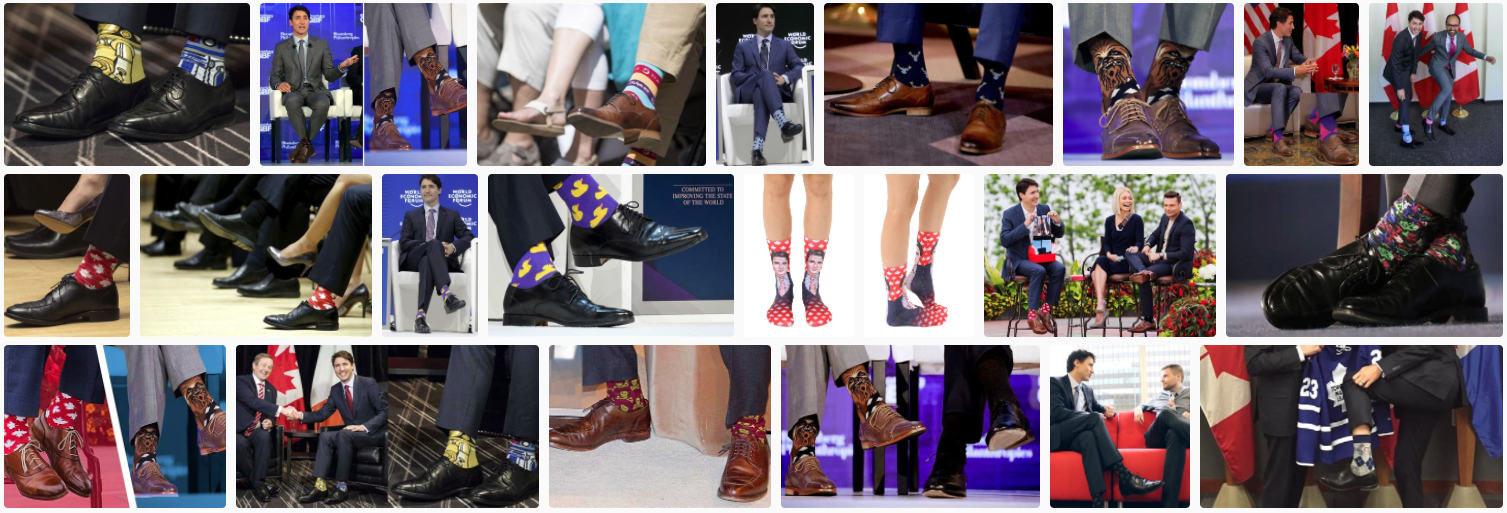
Typical image search results for “Justin Trudeau socks”

Look, we at The Line are as tired as you are about the more, shall we say, theatrical aspects of Justin Trudeau’s approach to being prime minister. Whether it was his Day One “because it’s 2015!” smirk, his obsession with showing off his socks to foreign dignitaries, his fashion sense while vacationing in India, and countless other Trudeauvian trips of the light fantastic, the man has always seemed more interested in performance than in the substance of governing.

But that’s not quite right. Because if there is one thing we’ve come to realize over the past five years and a bit, it is that for the Trudeau Liberals, the performance is the governing. For example, we used to wonder at the amount of time and energy that Cabinet ministers spent working on their Instagram accounts, since it went far beyond what would seem to be necessary for promoting and communicating policy. But once we understood that it was the job of policy to promote the Instagram account, and not the other way around, all of this proudly vacuous behaviour started to make a lot more sense.

But while we’ve gotten more or less used to it here in Canada (or maybe the right word is “numb”), we’ve always wondered how it looks through foreign eyes. Those abstract wonderings became a little more concrete over the past few weeks. Countries are opening up, people are starting to travel, politicians are going back to their old habits of holding regular meetings to make sure the world is still ticking along. And for Canada’s leaders, all the world’s a ‘gram.

So it was that at the G7 summit in Cornwall England this week, Prime-Minister-In-All-But-Name Chrystia Freeland was the only finance minster to wear a mask in a group photo taken outdoors. Ok, we thought, maybe she’s not fully vaxxed, maybe she has reason to be extra cautious. Except in a string of photos taken just before the official photo, Freeland was captured scrambling to put on her mask, not for safety, but for show.

Freeland was just getting the crowd warmed up for her nominal boss, Justin Trudeau. At his official G7 welcome on Friday, Trudeau was the only leader to put a mask on to give Boris Johnson the chummy elbow, only to remove it a few seconds later. We get it. It’s a version of the old “what lie did I tell?” problem, but for acting. Which audience am I playing to at this exact moment? It’s hard for even an old luvvie like Trudeau to keep track.

Once he’s back in Canada, Trudeau is going to hole up in a hotel for a few days, which the Globe‘s Cam Clark aptly referred to as “symbolic penance for a symbolic policy.” We agree with Clark that there’s some good fun in seeing someone get tied up in their own moral posturing. But while Clark is unhappy at the prospect of the prime minister cooling his heels for three days, we’re less fussed about Trudeau’s prospective stay in Hotel Q. Because while Clark thinks “there are real things” for the prime minister to be doing, we doubt that very much.

« Newer PostsOlder Posts »

Powered by WordPress