
What’s happening to pop culture is a reflection of our age. We’ve been turned into Pandas by a smothering, soft totalitarianism. The feminization of the culture means we’re ruled by mothers, who refuse to ever let us wander from the nest, physically, spiritually, creatively or intellectually. That has had all sorts of effects, like the drop in sperm counts and the collapse of popular culture. A deracinated people, kept in adult daycare centers and tended to by belligerent spinsters is not going to have a lot to celebrate or live for.
“The Z Man”, “The Soundtrack Of This Age”, The Z Blog, 2018-03-15.
June 18, 2020
QotD: The feminization of culture
Comments Off on QotD: The feminization of culture
June 5, 2020
Toronto radio station to be required to denounce itself in Canadian Content “Struggle session”
Wikipedia defines a “Struggle session” as “a form of public humiliation and torture that was used by the Communist Party of China (CPC) at various times in the Mao era, particularly years immediately before and after the establishment of the People’s Republic of China and during the Cultural Revolution. The aim of a struggle session was to shape public opinion and humiliate, persecute, or execute political rivals and those deemed class enemies.” It seems that Canada is becoming just a bit more like China (whose “basic dictatorship” has been publicly admired by our Prime Minstrel), as Toronto’s CFRB has been found in violation of the whims of the Canadian Broadcast Standards Council:

The Canadian Broadcast Standards Council has ruled that a news broadcast that jokingly criticized Canadian content violates the Canadian Association of Broadcasters’ (CAB) Code of Ethics and the Radio Television Digital News Association of Canada’s (RTDNA) Code of Journalistic Ethics. The complaint arose from a December 2019 broadcast on Toronto radio station CFRB. David McKee used his lead-in to a report on a possible Netflix tax to state “the libraries of streaming services like Netflix, Disney+ could soon have more of a Canadian flavour that nobody watches or wants if the federal government gets its way.”
That comment was too much for one listener, who filed a complaint with the CBSC, arguing that “Canadian Content is important, and Mr McKee seems to forget that he is part of a Canadian Content Broadcaster. His opinions should be kept off of the regular news sections and limited to a specific commentary section if he is so transfixed on being a commentator.”
The CBSC agreed, taking aim at the words “nobody watches or wants”, which it concluded constituted inserting personal opinion into the broadcast […]
As a penalty, CFRB must now broadcast that it breached the ethics standards on several broadcasts. While few will likely take notice, Canadians should take notice of the regulatory policing of the line between news and commentary on a radio broadcast. Indeed, one wonders if there would be a similar outcome if the broadcaster had expressed support for Canadian content.
Moreover, the Broadcast and Telecommunications Legislative Review Panel, which Canadian Heritage Minister Steven Guilbeault plans to implement, recommended extending Canada’s broadcast regulatory framework to the Internet, including sites and services that aggregate the news.
Comments Off on Toronto radio station to be required to denounce itself in Canadian Content “Struggle session”
May 30, 2020
QotD: The “Americanization” of German philosophy
Allan Bloom, The Closing of the American Mind, 1987.
Comments Off on QotD: The “Americanization” of German philosophy
May 28, 2020
QotD: The decline and fall of the British aristocracy
The historical way-markers to this implosion are well-documented. The First World War delivered a demographic and psychological blow of unprecedented proportion. Yet the next generation laughed into the void. The Roaring Twenties were a whirl of parties and bankruptcies. Only with the aid of married American fortunes did a carapace of their old values remain intact. The ’60s dissolved what remained of those values in a fug of dope and good tail. Those who didn’t succumb to the new addictions succumbed to old ones they could no longer afford. Titans of the British military like Sir David Stirling — cofounder of the SAS and a descendant of Charles II — gambled away their estates at the hands of unscrupulous Mayfair casino-owners who pretended to be their friends. The aristos were co-opted for their charm — read: money — by a new milieu that promoted the glamour of sexual and social transgression. Blinded by their inherited feelings of self-worth, they never realized they were being used by people who despised them. As a result, nowhere was Britain’s postwar political direction — dubbed “The Management of Decline” — internalized as effectively as among the people who had once driven its ascent.
[…]
How could a species that once steered Britain to greatness now claim the Darwin Award in every passing decade? The simple reason is that British aristocrats are the only people on earth among whom stupidity is not only accepted but prized. As the ultimate proof against meritocracy, it is the ultimate badge of honor. As Stendhal wrote in Le Rouge et Le Noir, “It is not doing something well or badly that is the crime: but doing it at all.”
“Bunky Mortimer III”, “Class Rejects: A Guide to the British Aristocracy”, Taki’s Magazine, 2018-03-02.
Comments Off on QotD: The decline and fall of the British aristocracy
May 5, 2020
QotD: Social media encourages autistic behaviour
The genetic fallacy, you’ll recall, is the inability to separate the idea from the speaker. Or, if you’re under age 40, it’s simply “communication,” as our public discourse nowadays proceeds in very little other than genetic fallacies. Try it for yourself. We all know what kind of reaction you’ll get in respectable circles if you say “You know, Donald Trump has a point about …”, but you can do it on “our side” of the fence, too. Watch: Obama was right about Race to the Top. No, really: Compared to W’s No Child Left Behind bullshit, pretty much anything short of letting kids be raised by wolves would’ve been better (and hey, even being raised by wolves worked out ok for Romulus and Remus). Even with the qualifier attached, almost everyone on “our side” instinctively bristles — we’ve been so conditioned by the words “Obama” and “race,” especially in close proximity, that we can’t help ourselves. Even I do it.
It’s especially bad for the younger generations who, as I keep arguing, have been effectively autismized (it’s a word) by social media. Twitter, especially, is so constructed that “replies” can come in hours, days, months, years later. Blogs too for that matter — one of the reasons we close the comments here after a few weeks is to prevent drive-by commenters clogging things up trying to re-litigate something from years ago. Modern “communication” must take place in discrete, contextless utterances. That being the case, understanding a statement in context is impossible — I repeat, impossible. So Lenin (or Hitler, or Mao, or William F. Buckley, or the Stay-Puft Marshmallow Man) didn’t have a point about ___; because that requires understanding how his point fit into the larger context of his thought, his times, his culture, his world. None of that shit fits into a tweet, so we’re trained to respond to the name — Lenin (etc.) is either a good guy or a bad guy, full stop, so anything he says about anything must be good or bad, automatically.
I hardly need to elaborate on the effect this has on our public culture. If Our Thing really wants to get serious, the first thing any “organization,” no matter how loose, must do is: Ban social media.
Severian, “Education, the Genetic Fallacy, and the Spectrum”, Rotten Chestnuts, 2020-01-27.
Comments Off on QotD: Social media encourages autistic behaviour
May 4, 2020
QotD: The eternal “now” of Progressive stasis
None of that matters to the cultural marxist, though. How could it? As I wrote yesterday, to the fanatic, the past is one long catalog of freely chosen error. Nor is there any meaningful future to a fanatic. That seems wrong, I realize, but consider that time passes through contrast. People will be born and die in the Communist Utopia, but since everyone will always have everything, human activity will be exquisitely pointless …
Ignore what Leftists say. Watch what they do, and it’ll soon be obvious that what they long for above all things is stasis. They want everyone and everything to be one way, and one way only, forever. Homosexuals are the most flamboyant example. Imagine that — having your entire life defined by your sexual attraction. I like blondes, but you know, if the right brunette came along I’d go for her. Heck, I’d even go for a ginger (I know, I know, I’m a monster). But according to the Left, that’s not allowed. I like blondes, and therefore I’m only allowed to like blondes. Oh, and I can only vote for Bernie Sanders, because he’s the attracted-to-blondes candidate, and I must support abortion, and use the word “cisgendered,” and …
Thus, to the Leftist there’s no past, and no future either. There’s only now, and the only thing that matters now is power. How could it be otherwise?
Severian, “The Endless Now”, Rotten Chestnuts, 2020-01-23.
Comments Off on QotD: The eternal “now” of Progressive stasis
May 3, 2020
QotD: Tragic cultural misunderstandings
It’s one of those cultural traps which I have read about and which are tragic.
I think I’ve spoken before of the tragic encounter between Zulu and Boers in South Africa. Zulus were doing what they did that had won them Africa (they came from central Africa shortly before the whites arrived): Commit incredibly scary atrocities so the enemy runs/avoids combat/submits. The whites were in their head just another tribe. They could not understand the idea of a “tribe” that was starting to span the globe and which would self-identify as “tribe” in the face of a savage. So their savagery made the Europeans MORE determined to wipe them out.
We’re seeing something like that, again. Islamic CULTURES are big on bragging, exaggeration of force and intimidation of the enemy. This is functional in a desert where there’s always a lot of low-level “war.” Some atrocities, scare “the enemy” and you keep your patch, and you go on. They have a fine tuned ear for this. When the other tribe isn’t committing atrocities against YOU and particularly when they’re being appeasing/accommodating, you have them over a barrel. If you strike with showy force you can take their stuff and enslave them. NOTE most of the attacks are designed to be showy.
TWO things they don’t get: Our elites are appeasing because the elites think they’re SO powerful they can’t be touched and are oikophobes who hate their own people. AND our PEOPLE is pissed, really pissed.
You know the old joke? There are no Muslims in Star Trek because it’s set in the future.
This is unfortunately the likely outcome of the cultures meeting. At some point (already happening) the elites will have to fight or be replaced. And when we go to war, our power is incalculable compared to them. They think we exaggerate our strength, while, culturally, we underplay it. They don’t understand we’re holding back.
The result will be a horrific destruction of guilty and innocent alike and even people like me who look Arab/Mediterranean in a bad light will be at risk.
And they will be the victims of genocide.
Sarah Hoyt, “Cross-Culture”, According to Hoyt, 2017-03-23.
Comments Off on QotD: Tragic cultural misunderstandings
May 2, 2020
QotD: Today’s psychological epidemic
There’s an epidemic of self-diagnosis among young people, there’s a race to multiply pathology, there’s a glorification of disorders like borderline personality disorder, which is rare. When being the most oppressed victim gives you the highest status, then it’s a race to the bottom.
We’re not helping young people figure out a noble and difficult pathway forward, where they bear responsibility and march forthrightly into adulthood. Quite the contrary. We’re saying, “Well, the system is corrupt and there’s no point in taking part in it. You’re going to be victimized no matter what you do.” And so the race is on for who gets to play the victim card with the highest degree of status. And it’s really bad, it’s especially bad for adolescents because they’re trying to sort their identity out, they’re already a mess.
Jordan Peterson, “Christie Blatchford Sits Down With ‘Warrior For Common Sense’ Jordan Peterson”, National Post, 2018-02-07.
Comments Off on QotD: Today’s psychological epidemic
April 7, 2020
Cultural factors in the spread of the Wuhan Coronavirus
Sarah Hoyt explains why any computer model involving actual human beings might as well begin with “Assume a Spherical Cow of Uniform Density in a Frictionless Vacuum“:
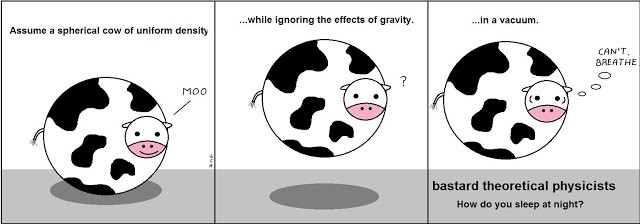
Image from https://worldbuilding.stackexchange.com/questions/96644/plausibility-of-floating-whales
What I do know is that — are you ready? — human societies, involving multiple nations or even our own culturally diverse, geographically spread out nation, are not now nor will they ever be a spherical cow of uniform density in friction-less vacuum.
So … why is it that even now that they admit the scary Imperial model is insane, our authorities, from federal on down are treating the US as though it were just that mythical cow, and on top of that exactly the same as the cow in Italy, Spain or France.
[…] but here’s the thing: Italy has a completely different culture. Yes, it also has a sclerotic, understaffed and just impoverished healthcare system. (Yes, every time I post that I have to spam a million comments telling me how well the WHO ranked Italy — which is great, except the WHO ranks a single payer system above everything else, including outcomes — and how Lombardy is the envy of Italy or something, which leads me to say “Sucks to be you.”)
However, that’s just a factor in the debacle. The other factor is culture and no one is taking it into account. Multi-generational families live together (I should throw stones, yes) or in the same house which becomes a sort of compound. (This is common to all Mediterranean cultures. I grew up in such a compound until the age of six.) which means that while Grandma isn’t abandoned to the tender mercies of Haitian health workers, it’s also really hard to isolate her when little Guido gets the never-get-well at school and cheerfully brings it home. Even when they don’t live together, extended families have a level of closeness that freaks out even the closest American families. If you and your relatives live within driving distance of each other and don’t see each other every other day, there’s something wrong.
Every house is a continuous cacophony of visiting relatives and friends. In safer times, we just left the back door unlocked because it was easier than answering the doorbell every five minutes. When I first got married, I had the TV on all day, because otherwise the house was so silent, it freaked me out. (I left Disney channel on all day, because it was less likely to startle me with explosions or evil laughter. This led my inlaws to believe I only understood “English for children” (rolls eyes.) I wasn’t even in the room with it. I just needed that noise, or I freaked out, because of the habit of a lifetime.
The freakiest thing in my exchange student years was that my family never had people drop by, several times a week, just because.
On top of that, of course, a lot of the younger people live in stack-a-prole apartments with shared air, and most people commute by train or bus or something.
Now, in Portugal at least most trains and buses aren’t as full as they were in my youth. You are rarely packed in like sardines. But it’s still public transport, and at rush hour every seat is taken and there are people standing.
As much as I get sick here, I got sick way more often there, and had a few really close calls, starting at about thirteen. Because you live in each other’s pockets.
And I understand that in Italy, as in Portugal, as in, for instance, France, people kiss a lot more. Adult men might not, unless they’re close(ish) relatives, but women and children get kissed by everyone from close kin to total strangers.
All of those create conditions for the virus to explode. In Italy, in France, in Spain. I understand it’s not exploded nearly as much in Portugal, but I also wonder how much of that is Portuguese reluctance to go to the doctor or the hospital. Because “the hospital is where you die.” (Yes, sue me. Some cultural assumptions remain. Which is why my husband is the one who normally drags me to the hospital.) Because, you see, we DO know for at least one of the clusters, the hospital was making it worse. Go to the hospital for any other reason, catch Winnie the Flu.
Comments Off on Cultural factors in the spread of the Wuhan Coronavirus
QotD: The universal plight of women in pre-modern times
As for “the property of their husbands, etc, etc, blah blah blah” work was so brutal and hard, and providing for a family so difficult, that yes, a man wanted to make sure the children he supported were his own.
Also, because of very early (many women married before even 18) death in childbirth, etc, most women skewed younger than men as a population, which would encourage a certain degree of paternalism. On top of that, hate to tell you, but women while hormonal are often not fully rational. We can sort of compensate for it, but one of the pregnancy hormones is SUPPOSED to make you fat, dumb and happy.
I don’t know if most women need a minder while pregnant, but from both personal experience and watching friends go through it, I imagine many women do.
It is therefore only natural that in a society where most women are pregnant most of the time, men would view it was their duty to look after the puir confused things.
When feminists assume that back in a time with no contraceptive, high child mortality and an horrendous death toll of pregnancy, women should have been recognized as the equals of men, and that men were being evil villains for not doing that, they are demonstrating an astonishingly blind and ideological view of history.
In fact, even back in the middle ages and before SOME women were considered the intellectual equals of men. (And sometimes the military equals.) There are very few of them, again, not because The Man was keeping them down, but because the women attracted to intellectual or military pursuits are (like men) a minority and on top of that they tended to be either unmarried, childless, or the percentage of women not much affected by pregnancy. I.e. a minority of minorities.
Women started making advances in what was considered, traditionally, male realms, like science or scholarship, (the others … well … there is a problem with upper body strength. Sure. Some women. Again a minority of a minority) or being able to vote when two twin advances occurred: the first was the curbing of infant mortality. When it became obvious (after a generation or so) that most of your babies would survive, it was possible for women to spend only a tiny minority of their lives pregnant.
The second was contraception that was cheap, easily available, and safe. Yeah, okay, I have certain issues with the pill, because the medical issues of using it long term are only now showing up in the population at large. That’s fine.
It remains that even the early “horse-dose” pill was safer than anything else anyone else had ever come up with for women to avoid getting pregnant all the time.
Sarah Hoyt, “Wrong Battle, Insane Tactics”, According to Hoyt, 2018-01-15.
Comments Off on QotD: The universal plight of women in pre-modern times
April 3, 2020
“And what are your personal pronouns?”
Last week, Amy Alkon considered the demands of “pronoun authoritarians”:
Personally, I’m disturbed by the whole notion that we “include” people through calling them the right pronoun, which requires all this “homework” about a person before you say one word to them.
This new requirement for doing this seems to be a sort of religion that allows people to have power over others — to push them around and deem them thought and speech criminals, even if they simply forget to use somebody’s requested “pronoun.”
This also seems to be a way for people to feel special without earning it — to require people to find out all sorts of information about them, on penalty of being accused of a thought or speech crime and then cancelled.
It seems outrageous to me that some stranger would be required to prep for conversation by investigating my history — that my family are Eastern European Jews, that old friends call me “Flamey” or “Flame-o,” that I eat keto, that I blah, blah, blah, blah, blah — and that they would be seen as disrespectful and even bigoted for failing to find out all the ways I’m (heh) unique and special.
But that’s what we’re requiring people to do with this notion that we have to ask “what is your preferred pronoun?”
And again, this is done now with threats embedded — with the threat that you will lose your job and be deemed a bigot if you don’t make this “What’s your pronoun?” business a priority.
Oh, and I will be very clear on this again: If you want me to call you “zhe” or “they” or “lemon pie with a slight dusting of confectioner’s sugar on top,” I will do my best to remember that and do it, because it’s kind.
But I think the considerations above are important, and I think it’s too easy to just accept the demand to ask people for their “pronouns” as a requirement for being considered decent — with the possible penalty of losing everything as the penalty for failing in some way, even by forgetting.
Comments Off on “And what are your personal pronouns?”
April 2, 2020
QotD: “To translate is to betray a little”
Although I had studied French and English and German, the translations I’d done so far were of the “I took the pen of my neighbor” variety. I thought the class would teach me to smooth out the sentence to “I took my neighbor’s pen” and that would be that.
I was wrong. Oh, it taught that also, but that was a minor portion of it. The class mostly hinged on the moral, ethical and — most of all — professional dilemmas of being a translator. I know any number of you are translators, formal or informal, but any number of you are also not. So, for the ones who are not, let me break the news with my usual gentleness:
There is no such thing as translation.
The French have a proverb “to translate is to betray a little” — or at least that’s the closest meaning in English. It’s fairly close to the true meaning, but slightly askew, of course. Every language is slightly askew to other languages.
The idea that there exists in every language a word that is exactly the equivalent of other languages is sort of like assuming that aliens will — of course — live in houses, go to school, ride buses, understand Rebecca Black’s “Friday”.
Language is how we organize our thoughts, and each word, no matter how simple, carries with it the cultural freight and experience of the specific language. Oh, “mother” will generally mean “the one who gave birth to” — except for some tribal, insular cultures where it might mean “the one who calls me by her name” or “my father’s principal wife” — but the “feel” behind it will be different, depending on the images associated with “mother” in the culture.
So, when you translate, you’re actually performing a function as a bridge. Translation is not the straightforward affair it seems to be but a dialogue between the original language and the language you translate into. If you’re lucky, you meet halfway. Sometimes that’s not possible, and you feel really guilty about “lying” to the people receiving the translation. When on top of language you need to integrate different cultures and living systems (which you do when translating anything even an ad) you feel even more guilty, because you’re going to betray, no matter how much you try. At one point, a while back, I had my dad on one phone, my husband on the other, and I was doing rapid-fire translation about a relatively straight forward matter. And even that caused me pangs in conscience, because my dad simply doesn’t understand how things are done here. I had to approach his experience and explain our experience in a way he wouldn’t think I was insane or explaining badly. That meant a thousand minor lies.
Sarah Hoyt, “Betraying A Little – A Blast From The Past From June 2011”, According to Hoyt, 2018-01-09.
Comments Off on QotD: “To translate is to betray a little”
March 29, 2020
QotD: Cargo cults, ancient and modern
To say that Pacific island societies were “relatively undeveloped” is a euphemism; they were primitive backward people who, when first encountered by European explorers, lived in a Neolithic stage of development far behind that of Mesopotamia in 1,500 B.C. That natives of Melanesia were at least 3,000 years behind Western civilization is simply a fact, but facts are now racism. Nevertheless, the point about cargo cult thinking is that these primitive islanders were unable to comprehend the advanced social and economic systems that produced, e.g., steam-powered ships, airplanes and the manufactured goods that the white man’s mechanical contrivances delivered. Utterly ignorant of how and why “cargo” had been produced and transported to their remote islands, the natives were understandably mystified when the arrival of “cargo” was interrupted. So they resorted to imitative rituals by which they believed the return of “cargo” might magically be reinstated.
The 21st-century American might laugh at these primitive superstitions, except that similarly ignorant “monkey see, monkey do” behaviors can be observed in our own society every day. My favorite example is the teenage boy who observes that girls are interested in athletes. The star basketball player in high school is popular with the girls, and so lower-status teenage boys — including the ones with zero athletic aptitude — will often emulate the athletic boys in terms of their attitudes, manners and clothing. This is why you see so many dorky suburban white boys wearing Nikes, NFL jerseys, etc., slouching around and speaking in a rap-influenced slang: “Wazzup, bruh?” These behavioral styles are an attempted imitation of popular black athletes. The clumsy adolescent white boy lacks the essential substance of the black athlete’s appeal, yet superstitiously believes (in cargo-cult manner) that he can obtain popularity by performing a superficial imitation.
Robert Stacy McCain, “The Cargo Cult Mentality”, The Other McCain, 2019-12-20.
Comments Off on QotD: Cargo cults, ancient and modern
March 26, 2020
David Warren on the situation in Parkdale
David Warren provides a glimpse of what life is like in the Toronto neighbourhood of Parkdale during the Wuhan Coronavirus epidemic:
Is gentle reader bored with pathogens yet? At some point in the proximate future, death will lose its sting. While there are plausible economic reasons for people to return to work, there is also a dark secret. The most restless society since the invention of restlessness cannot cope with “downtime.” This is what gives me my monopoly on Idleness. Without the “events” which help to distinguish one day from another, we will need to start a war.
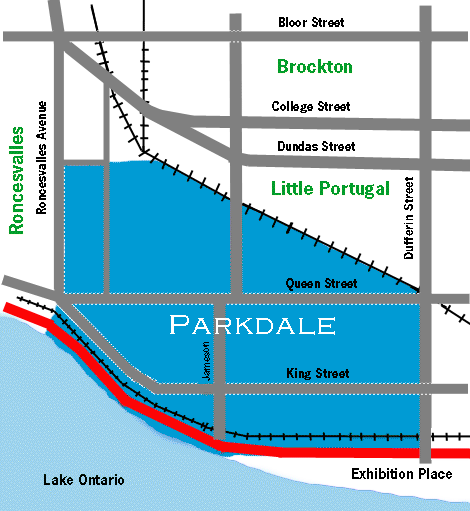
The Parkdale neighbourhood of Toronto.
Map by Alaney2k via Wikimedia Commons.Had we books, and to have developed the habit of using them, we might read history instead; and even a bit of poetry on the side. But now, at loose ends, we are inspired to do something. Also, please note, the doctrine of original sin. I’m a big fan.
My political dogma has surely been established by now. I am against “doing” anything. Fight for a world in which nothing exciting happens, other than the pursuit of beauty, goodness, and truth. Fight relentlessly — by example.
Here in Parkdale, Toronto’s go-to centre for the criminally insane, there is always entertainment. From my balconata I can spy several half-way houses, and for variety, a Tibetan temple. The streets get quieter every day, especially the throb of the superhighways. It has been softening, as the economy bleeds away; and there are clear days with no contrails in the sky.
The “Green Nude Eel” is being accomplished. Superficially, this might seem like a good thing.
But because Parkdale has been unable to start a war with our bourgeois neighbour — Liberty Village, where the childless young professionals live in sterilized apartment blocks — we have had to look for excitement elsewhere. By calling 9-1-1 frequently, the Vallishortensians (demonym for “Parkdale”) are able to keep the sirens blaring, and little knots of emergency vehicles collecting, to no definable purpose here and there. Due to my Scottish genetic endowment, I follow these skits as I would a taxi-meter: How much have we cost the taxpayers today?
Comments Off on David Warren on the situation in Parkdale
March 19, 2020
“Millennial[s are] every bit as shallow, irresponsible, stupid, and smart-assed as” Baby Boomers
David Warren on the awful discovery that the kids not only aren’t all right, they’re just as bad as we are:
Unlike certain oldies, I have retained some awareness of the “young people.” Curiosity alone would drive me to this, although childbearing (not by me personally) has had the same effect. In my research, I have found the so-called Millennial generation to be every bit as shallow, irresponsible, stupid, and smart-assed as my own, and what is worse, younger. I thought we were the Peter-Pan generation that would never grow up, but the claim must now be shared with successive rounds of offspring. To be fair, the rewards for growing up have been sharply curtailed, through that part of history which anyone remembers, and those who never tried were never punished.
History itself has now so far receded — it certainly is not taught in schools — that by now the kids persist on pure theory. They do what seems necessary to them, in the absence of knowledge. I cannot reasonably blame them for lacking what they’ve never come in contact with, for no one can know about what he has never heard of. On religious questions, for example, what could “transubstantiation” mean? It was easier to explain this to a South Sea Islander, in the good old days of the missionaries, before the islanders got cell phones.
On the other hand, the Millennials are human. The instinct to be human, even when repressed, often returns. Several times I have been moved, almost to tears, by a native decency suddenly expressed, by the most unlikely subject in rings and tattoos. There will always be something to work with, there.
While Millennials appear even dumber than their elders, we must allow for the progressive slide. There are just as many smart people as there once were, and some abroad have benefited from improved nutrition. If caught young, and exposed to learning, they would learn. They simply haven’t been exposed to it yet.
Comments Off on “Millennial[s are] every bit as shallow, irresponsible, stupid, and smart-assed as” Baby Boomers


