
Feral Historian
Published 20 Feb 2026American Gods (Neil Gaiman, 2001) is, among other things, a layered examination of the role of mythologies, religion, national identities, and some underlying “American-ness” that bends them all into something new. By necessity this meanders a bit (I’m not going to get into Gaiman’s failings as a human being much) but it gives us a lot to think about.
I mention a couple outside references in here, links below if you want to dig into it.
Lilly Wachowski on the role of the Red Pill in The Matrix: https://screenrant.com/the-matrix-mov…
George Lucas on the Rebellion, and Viet Cong (people often quote the line but miss the context) : • JAMES CAMERON’S STORY OF SCIENCE FICTION |…
00:00 Intro
01:56 The Setup
04:48 Spirit of America
07:57 White and Red
10:50 New Gods and the State
12:51 Author, Intent, and Meaning
(more…)
June 23, 2026
American Gods: Land and Egregores
June 20, 2026
“Get off your high horse”
Devon Eriksen responds to a post from a Japanese man who claims not to understand American racism:

“United States, Canadian and Japanese Flags on Seventh Avenue” by Jim, the Photographer is licensed under CC BY 2.0 
 .
.
NOBUNAGA🇯🇵🏯_夏樹蒼依 @japan_nobunaga
Honestly, racism is one of those things many Japanese people struggle to understand.
If we see a white person, we think, “Oh, they’re white.”
If we see a black person, we think, “Oh, they’re black.”
If there were blue people, we’d probably think, “Oh, they’re blue.”
And that’s about as far as it goes.
If someone is nice, we think they’re nice.
If someone is an asshole, we think they’re an asshole.
If we like them, we like them.
If we don’t, we don’t.
We grow up being told not to cause trouble, not to fight, and to get along with the people around us.
Maybe that’s why judging someone by their race feels so foreign to a lot of Japanese people.
We’re usually too busy judging people by whether they’re good people or not.
This is what we, in America, call a “Luxury Belief System”.
That means something you can believe, and advertise your belief in, precisely because your privileges shelter you from the negative consequences of believing it.
You, @japan_nobunaga, live in a nation that is 99% Japanese, just like you.
You have plenty of time to evaluate gaikokujin as individuals. There are only a few of them around, and they probably aren’t going to stab you while you are trying to figure out the content of their character.
So you have the luxury of telling everyone “look at me, I am not a racist, I am an enlightened being who makes no judgments about wolves” … because you do not live near any wolves, and run no risk of being bitten.
In America, we have another saying … “Get off your high horse”.
This does not mean a literal horse.
But it is meant to make you think about how the daimyo‘s son, on his expensive thoroughbred stallion, does not understand why the peasants have muddy boots.
If you get down off the horse, and walk, you will understand why the farmer’s boots are muddy.
There were some dissenting comments to the original post:
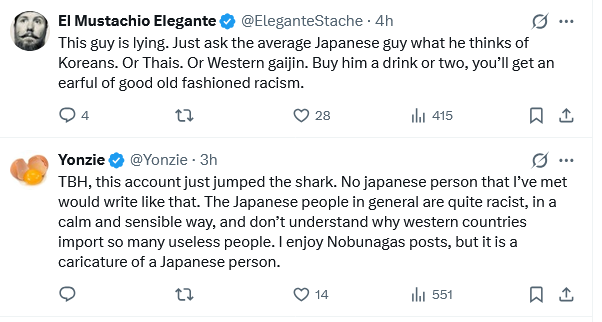
I’ve heard similar stories of Japanese racism toward other East Asian peoples, never mind what they said (and probably still do say) about American black servicemen.
June 19, 2026
US history is unique, it does not map onto the histories of other nations
I’ve noticed this pattern myself, but I hadn’t considered that a lot of Americans don’t just use the patterns of their national history when looking at other western nations:
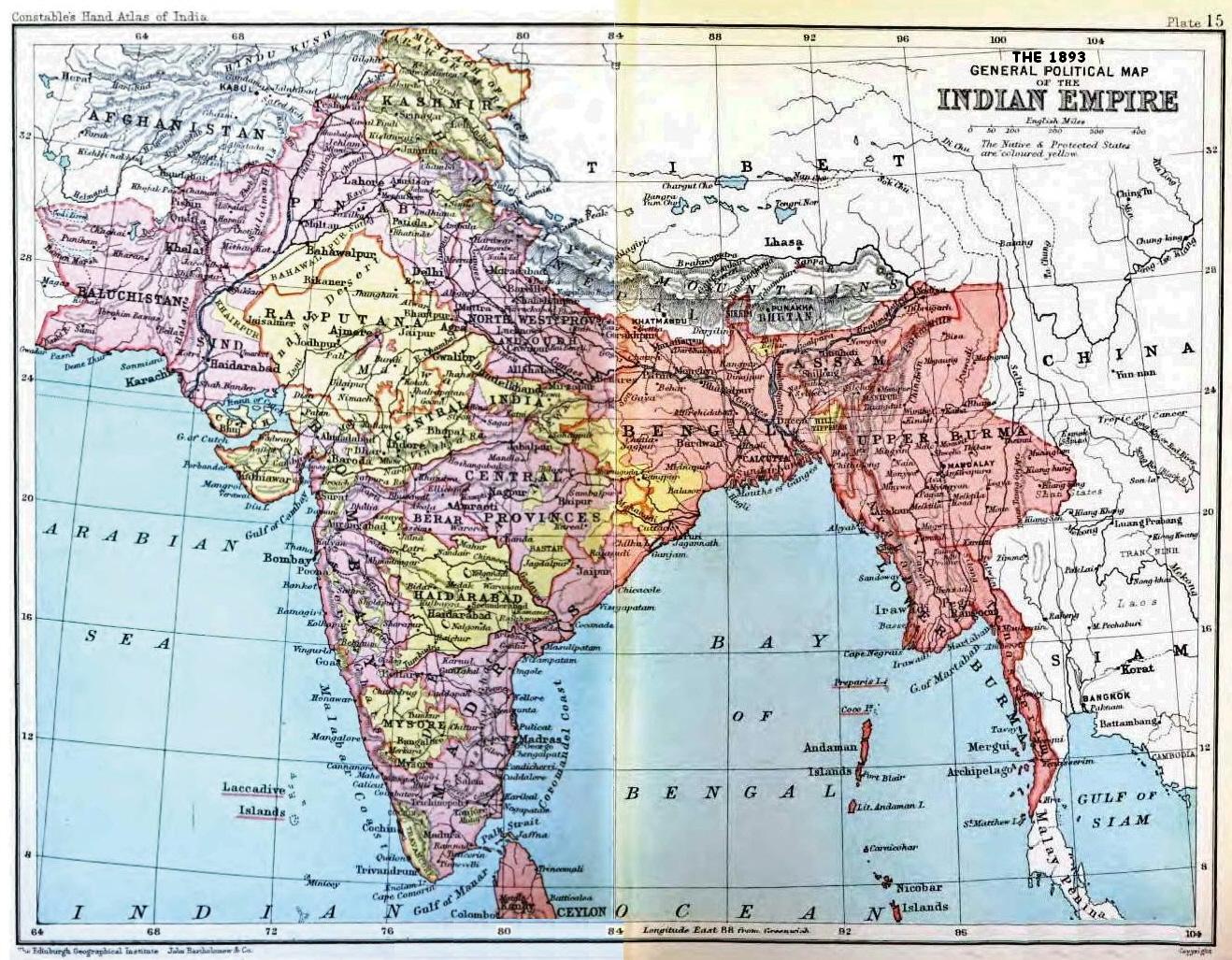
“Political Map of the Indian Empire, 1893” from Constable’s Hand Atlas of India, London: Archibald Constable and Sons, 1893. (via Wikimedia Commons)
Not every place in the world can be examined through the historical template of the United States.
One of the reasons conversations about India are so difficult for folks in the West to untangle is that many of the frameworks Americans use to understand power, intergroup dynamics, identity, and historical injustice do not map onto India. Not at all.
For Americans who have adopted a critical lens, the template derived from American history is fixed. A dominant demographic majority group seeks to preserve power while marginalized demographic minorities fight for recognition and inclusion. Because this template is so fixed in the imagination, there is a tendency to view and interpret dynamics and events in other countries in exactly the same way. I have seen it myself. “We’ve all seen how this works”, someone will say, and proceed to apply the American template to a different place.
And the history of the Americas (both North and South) is dominated by European (white) Christian colonization. As a result, Americans are familiar with the legacies of European empire and Christian missionary expansion. By contrast, the history of Islamic conquest and rule, which shaped large parts of Asia, Africa, and Europe for centuries, occupies far less space in the American imagination. So too does the contemporary influence of petrodollar-funded religious institutions, transnational Islamist movements, and the global circulation of Islamist narratives.
This does not mean these forces explain everything. It does mean that many Americans have little historical or conceptual framework for understanding how they might shape politics, memory, education, or intergroup relations in places like India.
India’s history is not the same as that of the Americas.
For centuries, India experienced successive waves of colonization. The first came through a series of Muslim invasions and dynasties, culminating in the Mughal Empire. The second came through British colonial rule, predated by British mercantile and missionary efforts. Yet unlike many colonized societies, the civilizational majority was never fully displaced, converted, or absorbed. Hindu traditions, practices, languages, stories, temples, and collective memories survived.
This is perhaps the single hardest aspect of India for many Americans to grasp because it has no real analogue in American history: the Hindu demographic majority is also the historically colonized population.
For many Western observers, this creates immediate suspicion because it violates the assumptions embedded within our familiar frameworks. The expectation is that majorities defend power while minorities challenge it.
As a result, contemporary debates about textbooks, public memory, historical figures, temples, and national identity are often seen and interpreted by folks in the West through frameworks that retrofit Indian history into contemporary American critical analysis through the reductive binaries of majority/minority, right/left, which are memeable and digestible, but obscure much more than they reveal about power, history, equity, policy, foreign influence, etc.
When Hindus argue that violent and painful aspects of Mughal conquest have been whitewashed in public education, they are frequently accused of attempting to rewrite history to justify the alleged “Hindu right wing” suppression of a minority group today. (Please do read my analysis of religious-based violence in India. It’s not what you think it is. Link.)
Yet Americans themselves are familiar with the process of revisiting historical narratives to advance truth and reconciliation. We have debated how slavery is taught, how Indigenous history is taught, how immigration is taught, and how women and minority groups have been represented in textbooks and in classrooms. We generally accept that historical narratives evolve as new evidence emerges and as previously marginalized perspectives are taken seriously.
What makes India different is that the group seeking rigorous reconsideration of historical narratives is often the majority population. For many Western observers, this creates immediate suspicion. The assumption is that majorities seek dominance while minorities seek justice.
But history does not always work that way.
The result is that efforts by Hindus to recover historical memory are often denounced as nationalism (which is falsely equated with white or Christian nationalism in the United States) before they are examined on their own terms. Questions about historical representation become questions about political motives. Efforts to revisit narratives become “evidence of extremism” or, even more bizarre, “anti-intellectualism”. And figures who have occupied a central place in Hindu memory for centuries are presented as newly invented symbols of contemporary political power.
The result is that the Indian voices most readily amplified in Western media are often those whose analyses are already legible within familiar Western frameworks. Their arguments are immediately understandable, which lends them “credibility”. Perspectives that do not fit those frameworks are frequently dismissed as “Hindu nationalist” before they are seriously considered.
One need not agree with every argument made in these debates to recognize that they are, in fact, debates. The question is not whether history should be examined. The question is whether everyone is permitted to participate in that examination without having their motives presumed in advance.
Sparta vs Athens – 2(a): Two Greek Worlds (Citizens, Helots, Power)
seangabb
Published 8 Feb 2026Greece: A Brief History, c.700 BC – 500 AD
In this lecture segment I set out the fundamental contrast between Sparta and Athens as social and political systems. Sparta was a permanent military state built on coerced labour and internal discipline. Athens was a quarrelsome democracy that relied on participation, persuasion, and a wider civic culture of debate.
We begin with the basic structures: who counted, who did the work, and how each society organised its citizen body. This is not moral theatre. It is institutional reality. By the end, the students should see why Sparta could produce cohesion and battlefield reliability, while Athens produced instability, argument, and a public life that made intellectual achievement possible.
June 18, 2026
Rules for you young plebs, but not rules for us
The generation that defined itself as “the youth generation”, “the hippies”, etc., are now nailing down every possible way to have fun so that youngsters can’t do what they loudly and proudly did at the same age:

Part of the crowd on the first day of the Woodstock Festival, 15 August, 1969.
Photo by Derek Redmond and Paul Campbell via Wikimedia Commons.
We’re banning raves, because we don’t want you having fun where we can’t watch you. By the way let me tell you about Woodstock.
We’re cracking down on underage drinking. It’s bad for you. Yeah of course we hit up the pubs at your age it was great.
We’re banning smoking, but just for you — the smoking age will go up one year every year. Oh yes of course, we used to be able to smoke inside everywhere, it was great really.
We’re banning flavored vapes. We don’t have any evidence they’re bad for you, you just like them too much.
We’re banning dodgeball during recess, someone might get hurt. Yeah we really enjoyed dodgeball too.
We’re banning flirting, because it might make the girls uncomfortable.
We’re locking you in your room for the next two years. Yes we know you’re in no danger from the virus, but we’re worried that you’ll get us sick. By the way you have to take this needle if you want to leave your room again. Yes, twice. Well there will be boosters too. No, we aren’t worried about side effects, that doesn’t effect us at all.
We’re closing the frat houses, because we don’t want you having fun without our permission. Please join these officially sanctioned university clubs instead.
We’re bringing in labor from the third world to work the service jobs, so you can’t have a summer job.
You need to go to university to get a good job. By the way we’re raising the price of tuition. Oh look we’re raising it again. Don’t worry there are loans. At interest.
Actually we’re giving the good jobs to the foreigners we just imported, to make up for our racist past. We are very good people. No of course we aren’t sacrificing anything. You just have to take one for the team.
Also, we’re giving the foreigners the houses. We needed to increase real estate prices. For our pensions, you see. Sadly no, you’ll probably never be able to afford one yourself. By the way don’t forget to pay your taxes. Need to support those pensions somehow! Eh? No, we’re giving ourselves tax breaks of course. Seniors discount you know.
Oh by the way, that one thing you still have, now that we’ve banned joy and kicked every ladder out from under you? That social media stuff you kids like? You guessed it! We’re banning that too! Just for you though, we’re still going to watch AI videos on Facebook. It’s for your safety, you see. We’ve noticed that you’re all getting rather irate, and we think it would be better for your mental health if you shut up for a while. Why don’t you just go outside?
Eh? No of course we aren’t going to stop Ahmed and his twelve illiterate cousins from raping your sister, that would be culturally insensitive, which would make us feel very bad, and we can’t have that.
Update: Added missing URL.
June 16, 2026
Universal suffrage has its drawbacks
Democracy is a better system than many others that have been tried over the centuries, but it’s far from perfect. Giving everyone the vote sounds like a good idea: you have some small theoretical degree of influence over the people who run the country (note the “theoretical” here). Devon Eriksen points out one of the problems with universal suffrage today:
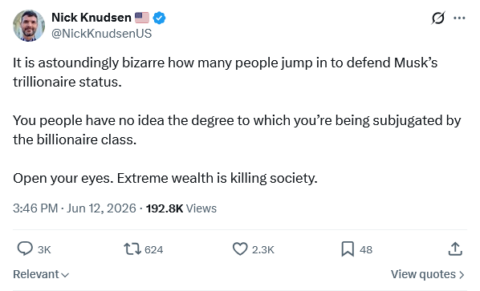
The problem with universal suffrage is that the more technologically advanced a civilization becomes, the smaller the fraction of people there are in it with the native intelligence to understand how it works.
When the majority of humanity was employed in whacking at the dirt with a pointed stick, and the height of technology was a slightly better pointed stick, anyone with a triple digit IQ could understand what was going on.
Now, we have things like stock markets, the internet, transportation infrastructure, and the Linux kernel, but most people who vote are unable to conceive of these as anything but large piles of chocolate coins, or something else they can put their mouths.
Because that’s how the average monkey interacts with money. They stack the blocks, the research assistant gives them a token, they exchange the token for a banana.
It’s no good trying to explain to the monkeys what supply chain is, or how a trillion dollars worth of rockets can’t magically be converted into a trillion dollars worth of bananas just because they’re both measured in dollars, as if a six-foot man and a six-foot plank of wood were interchangeable.
Finding a slightly different explanation, or getting the monkeys to sit still and really listen, doesn’t really help.
Because the problem isn’t just that the monkeys aren’t paying attention. The problem is that the monkeys are monkeys.
Their brains simply don’t have the developmental capacity to grow the neural connections they would need in order to grasp and manipulate the concept.
In the long term, this is why universal democracy is doomed. Because societies that let retards vote will fail, and be replaced by those that don’t.
You may think that we, as a society, face a great variety of problems. We do not. We have only one. Retards. Every other problem we have is downstream from their inability to understand the consequences of their political opinions.
But to fully grasp the implications of this, you have to understand that the definition of “retard” changes over time, as technology advances, because the IQ level required to grasp what’s really going on gets steadily higher and higher.
Eventually, the category “retard” grows until it includes the average person.
This has already happened.
Nick Knudsen isn’t dumber than the average guy. But the average guy, the 100 IQ salt of the earth guy that’s sitting on the next bar stool over, can no longer understand the modern economy. And this isn’t correctable, because the problem isn’t ignorance, it’s complexity.
You can’t make Nick Knudsen smarter by telling him things. You can’t even make him less ignorant, because the bare facts aren’t believable to someone who doesn’t have the framework to understand how they fit together.
The people who understand what’s going on are so much smarter than him that he doesn’t even think they sound smart.
He thinks they sound crazy.
June 13, 2026
The Laurentian Elite
The people who actually rule Canada — including but not limited to Liberal Party members — don’t mind “populists” who want to “spread awareness”, because it’s about as ineffective as can be and dissipates some of the energy that might otherwise be used to oppose the Laurentian Elite’s preferred outcomes:
Homesteaders, agrarians, and populists relying on “spreading awareness”, protesting, or Americanisms like “we the people” and “the silent majority” aren’t nearly as effective or influential as people think they are.
A deeply unpopular Laurentian liberal elite minority, one that increasingly LARPs as blue-state Americans and takes its cues from them, managed to transform the country against the popular will.
Over a roughly twenty-year period between the 1940s and 1960s, they spent decades scheming behind the scenes. They changed the flag, lured French Canadians into supporting them through the Royal Commission on Biculturalism and Bilingualism by promising greater national recognition of Canada’s French heritage, then dropped the whole thing almost immediately. They pulled the rug out from under them and basically said, “SYKE, you thought. Here’s infinite immigrants instead.”
In 1971 they pushed multiculturalism and the cultural mosaic, abolished assimilation while polling showed around 80% of Canadians opposed increased immigration. They later entrenched their ideology through the Charter of Rights and Freedoms, stacked and empowered a judiciary that would future-proof it, formalized the project through the 1988 Multiculturalism Act, and gradually consolidated influence over the media, education system, and cultural institutions.
The result was a decades-long effort to indoctrinate Canadians into viewing their country as a post-national economic zone built on stolen land called Turtle Island, where Canadians don’t exist, but foreigners are just as Canadian as you and me, borders are morally questionable, and none is illegal on stolen land.
This isn’t going to be reversed through awareness campaigns, symbolic protests, or endlessly posting facts online. Political systems are ultimately shaped by elites and counter-elites. The only way this order gets replaced is if a rival elite, or a political force capable of becoming one, displaces the existing ruling class and takes its place.
That process will almost certainly involve some degree of populism, but populism by itself is not enough. You need people who can actually build institutions, wield power, and replace the current establishment rather than just complain about it or bug off into the woods, or try to balkanize the country.
June 11, 2026
“That’s the fun thing about the fall of the West; everybody gets a swing of the sledgehammer”
Devon Eriksen responds to a fairly common boomer-ish post:
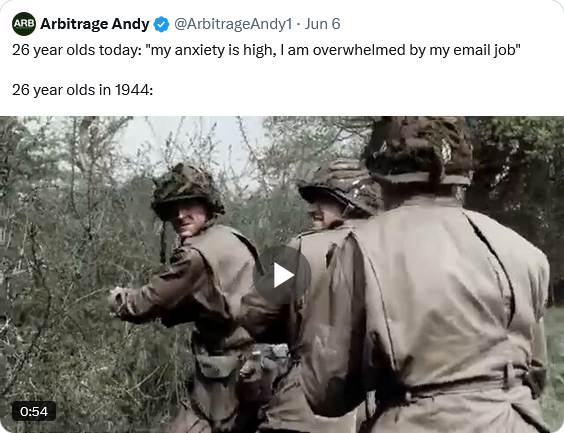
I don’t know if @ArbitrageAndy1 is a Boomer, but here he gives us a mashup of two classics from the Boomers’ greatest hits, “Younger Generations Suck”, and “The Television Never Lies to Me”.
It’s a jaunty little tune, and you can sing in it the shower, but the lyrics don’t actually make much sense.
Back in the real world, which younger generations actually have to live in, and where the television seldom tells the truth, WW2 was fought, on both sides, by guys even younger than 26.
And they were terrified.
The stress of combat against a peer adversary is overwhelming. It’s unendurable. But you endure anyway, because there you are, it’s happening to you, and you’re not getting out of it.
So you actually do have those little moments that Boomers would describe as stress meltdowns if they happened at work. You have them, and you do what you need to do anyway. Sometimes at the very same moment while you are melting down.
When you’re in this kind of war, there’s something terrible in front of you. In reality, that terrible thing is just as young and scared and overwhelmed as you are, but it sure doesn’t feel that way to you.
However, you also have something behind you, and something around you.
Behind you, you have a tribe that accepts and appreciates you. They know they sent you to hell, but they did it because hell was necessary, not because hell was fine. No one is gaslighting you pretending that everything is okay and that any problems you have are personal character flaws.
Around you, you have bros. They’re exactly where you are, doing exactly what you are doing, and they know how much it sucks. You’ve entrusted your lives to each other, and carried each other through things you don’t wanna talk about in your letters home.
Under intense stress and fear and exhaustion, your horizons shrink. You might have signed up for duty and patriotism and high ideals, but when you’re fighting, you fight to save the man next to you. And he fights to save you.
This is a very different experience than being isolated in a society that’s turned against young people, especially young men, especially young White men.
I won’t pretend it’s as difficult as fighting the Waffen SS. But young men fought the Waffen SS together.
They have to face the dissolution of the West alone.
That’s why they are anxious. Everything around them is not just going to shit.
It’s being systematically and deliberately turned into shit by powerful people who want them dead and replaced by someone else who will work cheaper and doesn’t expect to have a share of political power and a nice house and a retirement pension.
But I suppose Andy can still go ahead and dunk on them for clicks and a twenty-three dollar check from Twitter. That’s the fun thing about the fall of the West. Everybody gets a swing of the sledgehammer.
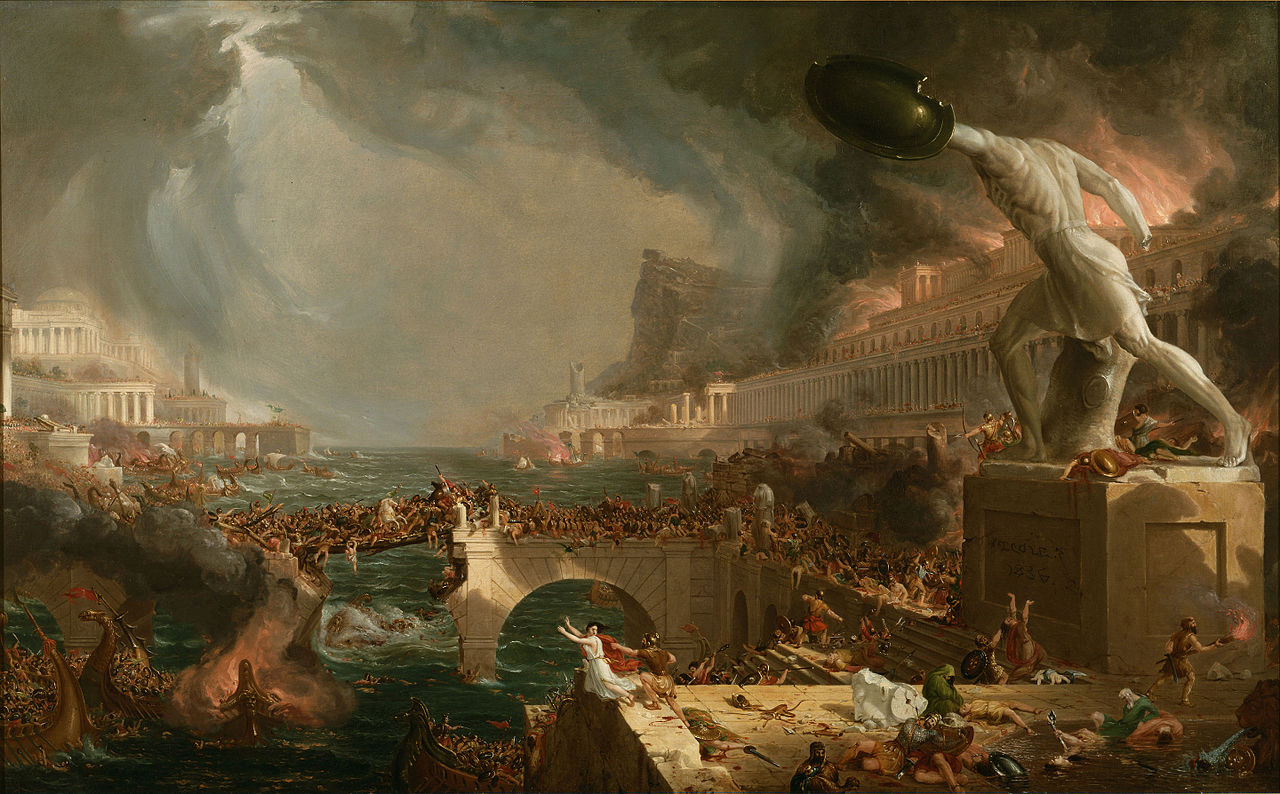
The Course of Empire – Destruction by Thomas Cole, 1836.
From the New York Historical Society collection via Wikimedia Commons.
QotD: Barbarism
I have a friend who’s really into ducks. Obsessed, actually. You might be watching a completely normal movie with him, like Casablanca, and he’ll want to freeze the film on the frame where there’s a duck in the background and carefully examine it. Or you might be discussing some minor celebrity and he’ll proudly inform you that they once had a pet duck and that while Wikipedia says it was a Muscovy duck, he has in fact determined that it was a Moulard. I enter conversations with him torn between terror at the fact that he will inevitably turn it towards ducks, and wonder at what opening he will seize on to do so.1
Sometimes I worry that I’m turning into that guy but for barbarians. One of the very first reviews I wrote here was of James Scott’s The Art of Not Being Governed. That book is about the peoples who inhabit the rugged and hilly region of Southeast Asia known as Zomia, centered around the border between China and Laos. Scott is interested in the practices employed by the “barbarians” — the hill people — to resist domination by the much more numerous and organized “civilized” people living around them. He argues that many of the negative associations we have with barbarism — illiteracy, itinerancy, cousin marriage, religious messianism, and so on — are actually either deliberately adopted or emerge out of a process of cultural evolution that’s optimizing for ungovernability.
Zomia was an effective refuge from the state (in fact it still is — Dan Wang has a beautiful essay about fleeing to the exact same area to escape China’s zero-COVID policies). But what really stuck in my head from Scott’s book was the idea that barbarism is mostly a state of mind and a set of social practices and habits that could be employed anywhere. To be a barbarian is just to recognize that the world is full of forces vastly more powerful than you and coldly indifferent to your survival, be they criminal gangs, nation states, multinational corporations, fanatical social movements, artificial intelligences, or plain old egregores. When one of these entities turns its baleful gaze upon you, your options are to submit and be consumed, or go down fighting in a pointless last stand. But the barbarian chooses a different path — he hides in plain sight, adopts protective coloration, stays on the move, becomes an extremophile clinging to the marginal biomes and the “debatable lands”: a minnow living in crevices too poor and too narrow to interest the leviathans. And if worst comes to worst and he finds himself facing one of those monsters, then he makes himself as indigestible and unappealing a meal as he can manage.
That all sounds great, so why doesn’t everybody do it? The reason is that to be a barbarian carries serious costs. Some of those costs are material: the leviathans of the state, the corporation, etc., aren’t interested in your barbarian biome for a reason (probably because it kind of sucks). Other costs are intellectual and cultural: to be a barbarian is often to have no history or education (it can be used against you), and barbarian societies are often crippled and debased as a result. And some of the costs are psychological and spiritual: to live as a barbarian is to live as a hunted prey animal, always with a wariness verging on paranoia, building a protective shell around you that can make normal human relations even with close family impossible. Last year I read and reviewed the memoir of a modern American barbarian that makes all three of these forms of poverty all too apparent.
John Psmith, “REVIEW: Imperial China, by F.W. Mote”, Mr. and Mrs. Psmith’s Bookshelf, 2025-02-24.
- It isn’t actually ducks.
June 9, 2026
Confucian deference to authority and tradition lead to autocracy and rebellion, time after time
Chinese history is not one of my areas of interest, so I have not read deeply in any specific area. Lorenzo Warby, on the other hand, has a much better grasp of the sweep of historical events in China and some of the philosophical and cultural elements that persist through the centuries:

All political and social philosophies rest, implicitly or explicitly, on some claims or claims about the nature of humans.
Consider the thought of Kong Qiu (c.551 BC – c. 479 BC), known as Kǒngfūzǐ (孔夫子) (Great Master or Wise Teacher Kong), hence Confucius. He held that human nature is naturally good and that it is therefore a reasonable aspiration to create a society of harmony, a society without conflict, if everyone just behaves with the propriety appropriate to their place in society — in particular, according to their placement in the web of social connections. His constant concern for the rites (li 禮) is for people to show the correct forms of, and orientation towards, those socially embedded interactions.
This leads very naturally to a very authoritarian, hierarchical view of politics as enforcing social harmony, particularly as people vary in their willingness and capacity to cultivate such virtuous propriety. The notion that politics is legitimately an arena for bargaining between competing interests — the Western idea of “normal politics” — becomes not a natural way to do politics, but a failure to achieve proper harmony.
Master Kong developed his ideas — that were further developed by disciples and commentators — in a civilisation with no tradition of warrior assemblies, self-governing cities, or deliberative assemblies of any kind. A ruler’s court is a place where officials report, and may even debate, but the ruler decides. You can see this narrow view of politics in comments by Master Kong in the Analects such as:
8.14 The Master said, “If you don’t have a particular [government] position, then don’t meddle with any of its business.”
14.26 The Master said, “If you don’t have a particular [government] position, then don’t meddle with any of its business.” Master Zeng [Zengzi] commented, “The gentleman does not allow his thoughts to go beyond what his position calls for.”
In such a political culture, judicious quotes based on mastery of a shared literature become a way of communicating to superiors while giving minimum offence. Conversely, political rhetoric has little or no value, because there are not the deliberative assemblies to be swayed by argument. Master Kong deprecated glib persuasiveness, on the grounds that it tended to hide one’s real character (or lack thereof).
Where command-and-control hierarchy is the dominant method of political action, hoping for propriety to pervade the hierarchy has obvious resonance. Putting such propriety as a mechanism for social harmony is a way to, ironically enough, be persuasive — which requires a positive view of human nature. But it also hugely elevates the moral claims of governorship. Hence comments such as:
2.1 The Master said, “To rule by virtue is like the way the North Star rules, standing in its place with all the other stars revolving around it and paying court to it.”
12.17 Ji Kangzi asked about the way of governing [zheng]. Confucius replied, “To govern [zheng] is to correct [zheng]. When you set an example by correcting your mistakes, who will dare not to correct his mistakes?”
This concern for harmonious propriety is not a world away from ibn Khaldun‘s concern for asabiyya. Nor is it so far from recognising the importance of a coherent civic culture in order to maintain robust institutions, which rest on norms and rules. This is a factor that much of mainstream Economics fails to seriously grapple with, leading to incompetent analysis of immigration.
The problem is that this cultural and institutional framework turns the thought of Master Kong, his disciples and commentators, into what is, in effect, one-trick moral propriety politics, however sophisticated other aspects of this tradition may be. The choices of governance are narrowed down to punishment and example:
2.3 The Master said, “If you guide the people with ordinances and statutes and keep them in line with [threats of] punishment, they will try to stay out of trouble but will have no sense of shame. If you guide them with exemplary virtue [de] and keep them in line with the practice of the rites [li], they will have a sense of shame and will know to reform themselves.”
They are reduced to trying to make autocratic command-and-control politics work as a successful long-term project: as the repeated dynastic collapses in Chinese history show, they did not succeed. Indeed, the recurring pattern of Chinese political reformers and reform programs ending badly reflects that such fail to break out of that autocratic command-and-control pattern, so end up being swallowed by its incentive structures — including the long-term pathologies of bureaucracy and the inherent fears of autocrats.
The most thorough attempt to implement ideas based on rú (儒) classicism (“Confucianism”) in Chinese history was the disastrous reign of Wang Meng (r.9-23), who provides an object lesson in overweening Theory leading to disastrous policies. Ironically, Master Kong himself was against such grand theorising:
9.4 The Master stayed away from four things: he did not put forth theories or conjectures; he did not think that he must be right; he was not obdurate; he was not self-centered.
The episode is a particularly disastrous example of Etienne Gilson‘s principle that the conclusions of the master are the premises of the disciple, thereby all too readily reducing struggles with complexity to a simplifying dogmatism: a trap that scholarly commentary on The Analects often tried to avoid.
The thought of Master Kong also wanders very close to someone is morally better, not only because learned, but because smart and learned. For instance:
5.9 The Master said to Zigong, “Who is the better man, you or Hui [Yan Hui]?” Zigong replied, “How dare I compare myself with Hui? Having learned one thing, he gives play to ten, while I go only as far as two.” The Master said, “You are not as good as he is. Neither of us is as good as he is.”
This arrogance of the appropriately credentialed periodically led to mass outbreaks of infuriated peasants removing educated heads from elite bodies. The most recent manifestations of this were the Cultural Revolution in China and the megacidal Cambodian horrors under Pol Pot but you can see versions of this reaching back into Chinese history — for example, the massacres by Huang Chao’s rebellion (874-884) towards the end of the Tang dynasty (618-907) and the earlier peasant revolts that brought down Wang Meng.
We can also see the same self-righteous exploitive arrogance of those credentialed with “morally proper knowledge” afflicting contemporary Western societies along with bureaucratic pathologies that have also been a feature of Chinese history — remembering that we Westerners copied the Chinese pattern of bureaucratic selection through examination without considering the long-term patterns of Chinese history. Fortunately, national populism generates a less violent outlet for popular frustrations than Chinese peasant revolts.
Update, 10 June: Welcome, Instapundit readers! Have a look around at some of my other posts you may find of interest. I send out a daily summary of posts here through my Substack – https://substack.com/@nicholasrusson that you can subscribe to if you’d like to be informed of new posts in the future.
June 8, 2026
“Friedrich Nietzsche predicted our culture more than a century ago”
On the social media site formerly known as Twitter, Creative Deduction give Nietzsche credit for predicting how western cultures would change to the state we find ourselves in today:
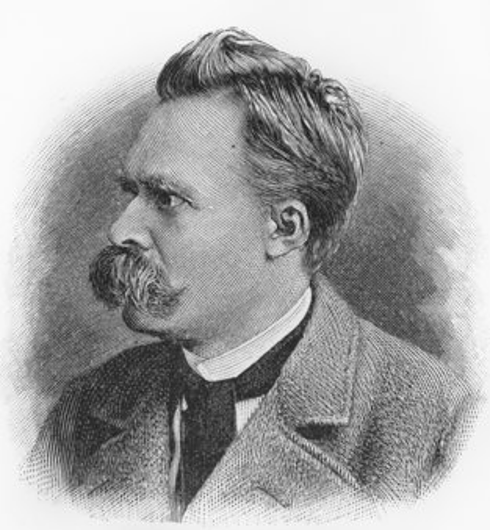
Friedrich Nietzsche predicted our culture more than a century ago.
A society where victimhood confers status; where weakness is celebrated as virtue; where grievance brings moral authority; and where the highest aspiration is not greatness, but comfort.
He regarded it as a symptom of civilisational decline. In place of the old aristocratic values of strength, courage and self-overcoming, Nietzsche saw the rise of what he called “slave morality” — a worldview that elevates weakness, suffering and resentment into virtues. The modern celebration of victimhood, where people compete to present themselves as the most oppressed, is this mentality. Rather than striving to overcome hardship, many now seek status and moral authority through claims of injury and grievance.
Nietzsche was deeply contemptuous of those who pursue safety and comfort above all else. He mocked the “last man”, the small-souled creature who wants nothing more than a warm bed, entertainment and protection from anything difficult or dangerous. For Nietzsche, struggle was not an unfortunate condition to be eliminated, but the very source of meaning, growth and greatness. Without resistance, there is no self-creation.
The modern welfare state would have horrified Nietzsche. By shielding people from the consequences of their actions and removing the necessity of struggle, it does not liberate — it enfeebles. It creates populations that are materially secure but existentially empty, dependent on the state rather than on their own strength and initiative. Nietzsche believed that genuine human flourishing requires the willingness to endure hardship and take responsibility for one’s life. A society that makes comfort its highest value and victimhood its highest status inevitably produces weak, resentful people who have forgotten how to live.
June 7, 2026
Morality and humour
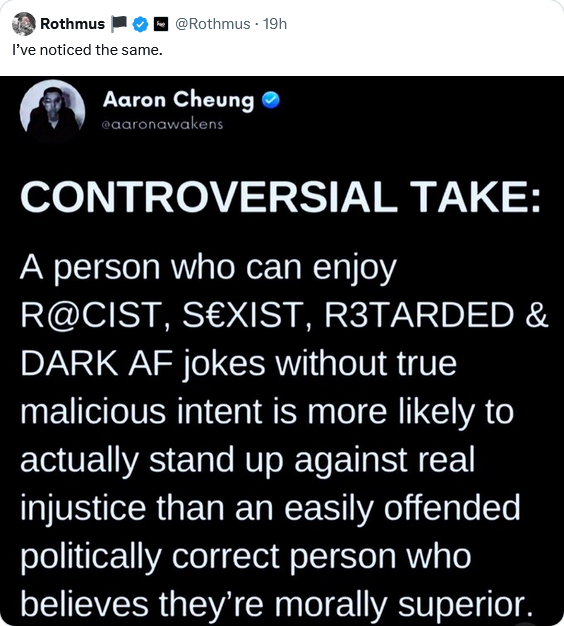
Devon Eriksen suggests that there’s a correlation between a person’s morality and their sense of humour (or lack thereof):
There is probably a correlation between morality and sense of humor.
Larry Niven once theorized that humor is associated with an interrupted defense mechanism.
The idea is that you have a situation presented to you which would normally trigger a defensive response, but when you realize it is actually harmless, the response that you experience as laughter or amusement is your brain’s way of derailing that inappropriate defense mechanism.
Because it isn’t appropriate to fight or run away from harmless things.
This mechanism become easy to see when you look at very simple or developing senses of humor. To a baby, unexpected + safe = comedy gold.
And my cat Dante’s favorite joke is “I BITE your toes! … but actually, I don’t bite them! I just lick them by surprise, watch you jump, then run away mewing and looking pleased with myself!”
Humor can become quite sophisticated, but I’ve never yet seen anything funny that couldn’t be understood this way.
But there’s a certain type of evil person who is evil precisely because they don’t interrupt defense mechanisms.
They fight harmless things. Even beneficial ones. And they give you long lectures about how the harmless or even the wonderful thing is ackshually super-problematic.
This is the visible symptom of a form of neurotic hypervigilance which can, and often does, progress to the point of simply lashing out, figuratively or even literally, at random parts of the environment, because the brain has constructed some narrative whereby it’s a threat.
The humor response is our natural way of not doing this.
June 4, 2026
Bill C-9 is “what happens when the Frankfurt School gets a government badge, a pension, and a corner office in Ottawa”
L. Wayne Mathison explains how the Canadian government persuaded itself to push a “hate speech” bill that will upend centuries of free speech practice and criminalize good-faith arguments. Like many such brainfarts, they cannot imagine what consciously evil people will do with these legal tools in hand:
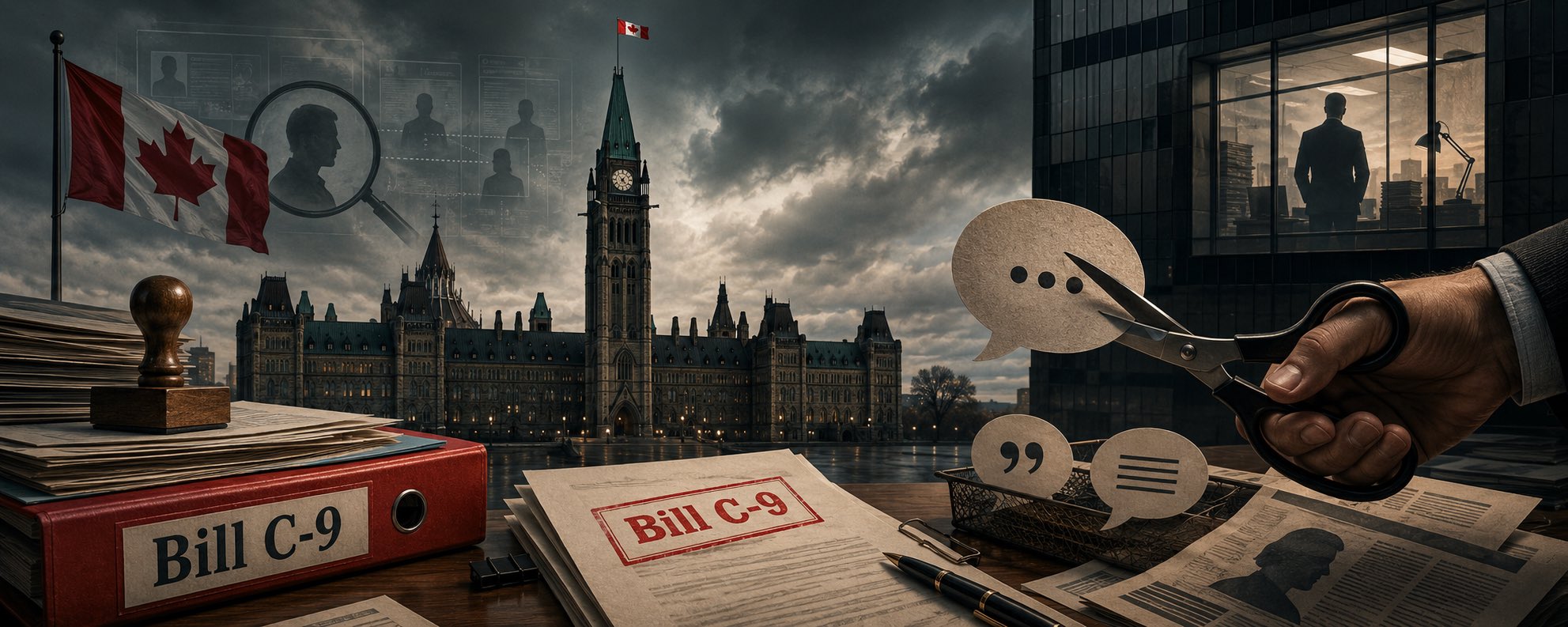
AI-generated image by L. Wayne Mathison
If you want to see what happens when the Frankfurt School gets a government badge, a pension, and a corner office in Ottawa, look at Bill C-9.
This is not just another “hate speech” bill. It is a sign of a much bigger shift.
The old political arguments were about wages, factories, class, ownership, and the economy. That was the old Marxist world. Today’s politics is about language, symbols, identity, emotion, culture, and who gets to decide what “harm” means.
Parliament has stopped arguing about who owns the factory.
Now it wants to control the dictionary.
Bill C-9 reads like a critical theory seminar that escaped campus, found a suit, and got hired by the Department of Justice.
Under the older liberal model, the law punished actions. Assault someone? Crime. Vandalize property? Crime. Block access to a building? Crime. The state dealt with what you actually did.
But C-9 moves the centre of gravity from action to meaning.
What did your words mean?
What did your symbol represent?
What was your motive?
What cultural message did your expression create?
That is not law as a neutral referee. That is law as a cultural therapist with police powers.
The most revealing part is the proposed removal of the long-standing “good faith” religious defence for hate propaganda. That defence existed for a reason. It protected freedom of conscience. It recognized that in a free country, people may express religious beliefs that others find offensive, outdated, or wrong, as long as they are not wilfully promoting hatred or violence.
That was not a loophole.
It was a guardrail.
But to the modern ideological mind, an ancient religious text is not treated as a source of conscience. It is treated as an artifact of power. A legal protection for religious speech is no longer seen as freedom. It is seen as oppression wearing a church hat.
So the guardrail has to go.
And what does government offer instead?
Trust us.
Trust that prosecutors will be reasonable. Trust that judges will interpret the law narrowly. Trust that ordinary Canadians will not get dragged through the process for saying something unpopular, traditional, religious, or politically unfashionable.
Sorry, but that is not how liberty works.
Rights are not protected by hoping the state behaves itself. Rights are protected by limiting what the state is allowed to do in the first place.
That is what makes the Senate debate so revealing. The Senate was supposed to be sober second thought. The old establishment airbag. The place where bad laws were supposed to slow down before hitting the public at full speed.
But now even the Senate is wrestling with a bill built from an intellectual toolkit designed to dismantle the very traditions the Senate was created to preserve.
Bill C-9 does not build social cohesion. It does not repair trust. It does not ask why people are angry, alienated, or radicalized in the first place.
It does what modern bureaucratic progressivism always does.
It manages symptoms by expanding state power.
It turns culture into a compliance file. It treats offensive expression less like a social problem to be answered with argument, courage, and moral confidence, and more like a hazardous substance to be regulated by experts.
The Frankfurt School wrote in dense, foggy jargon to expose hidden systems of power.
The joke is on everyone.
The modern state did not reject those tools. It absorbed them, stripped out the revolutionary romance, bolted them onto the Criminal Code, and called it public safety.
Bill C-9 is what happens when cultural theory becomes administrative power.
It is what happens when the state stops protecting public order and starts managing public meaning.
And that should worry anyone who still thinks freedom means more than government-approved speech.
June 3, 2026
QotD: Rhodesia and the suicide of the West
The story of Rhodesia is not only a regional tragedy, it is a civilisational warning. It is the story of a state that was functional, prosperous, and militarily superior, yet was dismantled not by its enemies in the bush, but by the “kith and kin” of its own civilisational bloc. It serves as a controlled experiment in the “Suicide of the West” , illustrating what happens when a civilisation loses the will to defend its own outposts and succumbs to a “politics of cultural despair“.
Today, as the nations of Europe and the Anglosphere grapple with their own crises of identity, demographic replacement, and institutional decay, the Rhodesian experience has moved from the periphery to the centre of conservative analysis. The arguments made by Ian Smith (former Prime Minister of Rhodesia) and his contemporaries, no longer appear as the reactionary pleas of a dying regime. Instead, they appear as the desperate warnings of men who saw the abyss before the rest of the world was willing to look.
The Philosophical Crisis and the Suicide of the West
To understand the fall of Rhodesia, one must look not to the Zambezi Valley, but to the intellectual salons of London and the university campuses of the United States. The doom of the settler state was engineered by a profound shift in the Western psyche, a shift identified by the philosopher James Burnham as the “Suicide of the West.”
James Burnham’s thesis, articulated in his 1964 classic Suicide of the West, provides the essential diagnostic framework for the Rhodesian tragedy. Burnham argued that liberalism had mutated into an ideology of Western suicide, a system of belief that systematically dismantled the defences of its own civilisation while valorising its enemies. In the context of Rhodesia, this manifested as a perverse diplomatic double standard. As the American economist Milton Friedman observed after his visit to Salisbury in 1976, the West seemed intent on destroying a pro-Western, anti-Communist state that upheld property rights and the rule of law, while simultaneously “welcoming the ministers of the Gulag Archipelago with open arms”.
Friedman explicitly linked the Rhodesian situation to Burnham’s concept, noting that the sanctions imposed on Rhodesia were a clear act of self-immolation by the Western powers. By strangling Rhodesia, the West was not advancing human rights, it was handing a strategic victory to Soviet and Chinese proxies (ZAPU and ZANLA) and signalling to the world that loyalty to the West was a liability. The Rhodesian settler, who had fought for the British Empire in two World Wars, found himself cast as the villain, not because he had changed, but because the West had lost faith in its own legitimacy.
Celina 101, “We are all Rhodesians Now”, Celina’s Substack, 2026-01-31.
June 2, 2026
Low IQ, mens rea, and actus reus
For those like me whose legal Latin isn’t great, “mens rea” is “the mental state of a defendant who is accused of committing a crime”, while actus reus is a “guilty act” (from Wikipedia). On his Substack, William M. Briggs discusses how legal systems decide when an accused person’s IQ is so low that they lack the ability to understand that their action is illegal:
A gang of gypsies in England gang raped a young girl (and another previously) at knifepoint while filming the deeds, laughing all the while and even posted one of the rapes on social media. At their trial, Judge Nicholas Rowland excused their crimes because he said the criminals were “‘very young’, had low intelligence, a ‘limited understanding of consent’ and were susceptible to ‘peer pressure'”.
[Rowland] said that the second boy fell into the bottom one per cent in IQ for his age, and he had been diagnosed with ADHD, while the third boy had ‘low intellectual capacity’ and he had a ‘limited understanding of consent’.
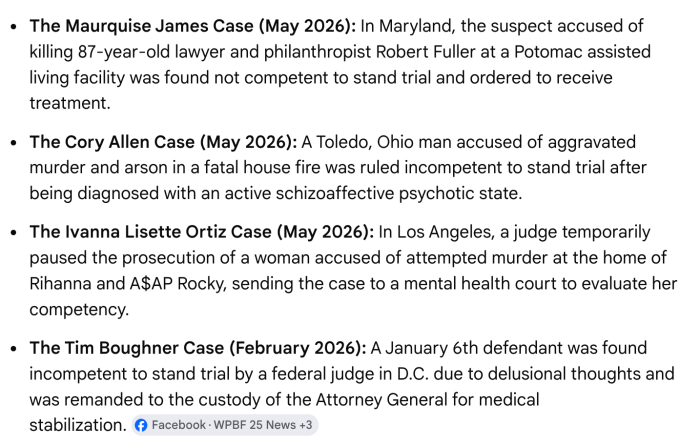
Iryna Zarutska, 23, was riding a train in Charlotte, when Decarlos Dejuan Brown Jr rose up, slit her throat, and as he was exiting the train gleefully declared he “got” his white woman. Brown had been arrested some 14 times before he murdered Zarutska, for crimes including armed robbery. He was freed each time. For the murder, he was found by Experts to be “incompetent to stand trial”.
Brown and the gypsies were not alone. Recently, there were these cases:
Many states have humane destruction laws that apply when animals (usually dogs) have attacked or killed humans. Florida, for instance, confiscates vicious dogs and puts them down. When any animal kills and eats a man it is usually put down, and most think it wise and prudent to do so. But some curiously argue the animals cannot help themselves, that it is their nature to attack and kill and even eat people, and who are we to judge?
In any case, it is clear that dogs, nor any animal, are not as intelligent as man. Just as it is clear obvious truth that some men are not as intelligent as others. Yet this fact does meet resistance from Equalitarians and Universalists, both forgiving every sin except the sin of claiming sin exists.
[…]
The Eighth Amendment reads: “Excessive bail shall not be required, nor excessive fines imposed, nor cruel and unusual punishments inflicted“.
Since 2002, executing a dumb criminal is “cruel”, yet executing an intelligent criminal is not cruel nor unusual. This is odd because, as any dog owner can attest, even dogs can know right from wrong, and even stupid men know murder is wrong.
Scalia wrote in his dissent that an Expert (a psychologist) on one of the appeals testified Smith had “an IQ of 59”. Smith also, and in this case, really had “16 prior felony convictions for robbery, attempted robbery, abduction, use of a firearm, and maiming”. He noted previous courts ruled only the profoundly retarded, those “idiots” who “had an IQ of 25 or below”, had a “‘deficiency in will’ rendering them unable to tell right from wrong”.
On the general topic of IQ, but not directly related to violent crime, ESR discusses the relationship between IQ and the caste system of India:
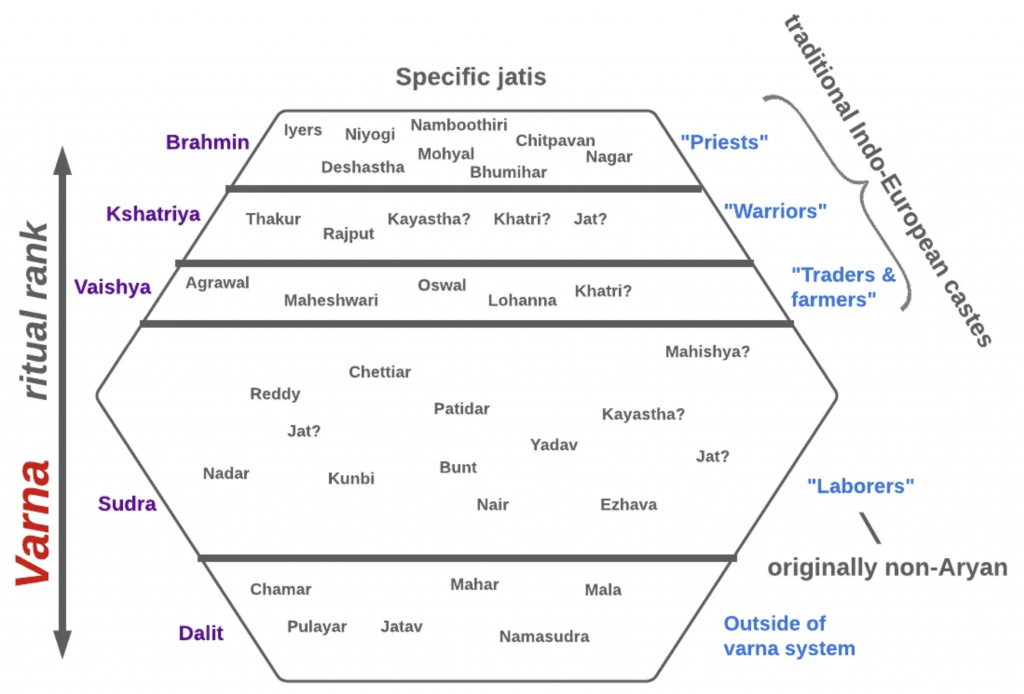
The caste system as a layered varna system with five classes and numerous integrated jati communities.
Razib Khan
That feeling when your knowledge about how average IQ varies with caste rank in India stops being peculiar arcana and suddenly becomes deeply relevant to US domestic politics …
Anybody who has studied the matter knows that castes in India have been maintaining almost perfect endogamy for thousands of years. About the only significant category of exceptions is that if you have an exceptionally beautiful daughter you *might* succeed in getting her taken as a concubine by a higher-caste man, so their offspring might jump a rank.
With no significant gene flow between jatis, divergences in important traits like IQ and time preference not only don’t smooth out, but actually amplify due to genetic drift and differing selective pressures.
Highest-caste Indians have an IQ distribution a lot like Europeans. Low-caste Indians … don’t. They’re not quite as genetically handicapped as the dimmest populations in sub-Saharan Africa, thankfully, but the spread is wide.
This doesn’t mean all low-caste Indians are stupid; Gaussian distributions don’t work that way. It does mean that importing 10,000 low-caste Indians has very different implications for the host society then importing 10,000 Brahmins.
Segue to the recent news stories about American families getting killed by illiterate Indian truck drivers doing crazy stupid things on the roadways. Those truck drivers are not Brahmins.
This is a recent phenomenon because, until one of our political parties decided to import the entire Third World for vote-farming purposes, we were cream-skimming India. Now we’re not, and this makes a serious difference.
Update: Fixed broken link to ESR’s X post.


