
… though I have written probably 50,000 words on the Basic College Girl over the years, I have spent almost no time on her opposite number, hereby christened the Basic College Dude (BCD). Admittedly some part of this is structural: There just aren’t that many Persyns of Penis in college these days — nationwide, college enrollment is something like 65% female and climbing; I bet there are more than a few small colleges that, while technically coed, are almost exclusively female. Also, I taught mostly freshman-level History classes, and since I was one of the few dinosaurs who didn’t make attendance a part of the class grade, only the congenital rule-followers, i.e. chicks, showed up.
But mostly it’s just because none of them stick in my memory. The #1 characteristic of the Basic College Dude is that even if he’s there, he’s not there. He’s checked out — mentally, emotionally, spiritually (if that even means anything anymore). Unlike the girls, all of whom seem to be in 72 different clubs and organizations (and list them all on their email auto-signatures, such that by junior year, their honorifics are longer than my entire resume), the guys don’t seem to do much of anything. How do they while away their hours? I assume with social media, like everyone, and with video games and blackout drinking …
… the latter of which I have seen, a lot, and if you’ll permit a brief digression, if you really want to know how fucked our society is, go to a student bar on a Friday night. I myself was a bit of a party animal in college, and like everyone I went over the line a few times, but college kid drinking these days is almost Soviet — they’re aiming to get knee-walking, gutter-puking, total-blackout shitfaced, and they set about it as grimly and efficiently as possible. The girls, too, with the added bonus that they’re all on Ambien and Klonopin and every other happy pill you’ve ever heard of, which makes for some interesting, by which I mean terrifying, behavior …
[…]
But mostly it’s because college dudes have had their libidos beaten out of them. […]
Not only does the BCD not know how to do this, as Nikolai says, he apparently doesn’t actually want to. Constant stimulation by blinking screens, shit diets, and a lifetime of indoctrination have reversed the sexual dilithium crystals. Heartiste used to go on about this, and while I’m no biochemist, either, I think his theory is sound: There’s so much environmental estrogen floating around that men develop the emotional equivalent of gynecomastia, while women turn butch. Throw nth wave feminism into the mix, and you’ve got women acting like the crudest, most obnoxious male stereotypes (they call this “being strong and empowered”), while the men mope and sigh to their diaries.
The end result is that the BCD walks around like he’s shellshocked. He does the bare minimum, hoping to just grind it out without any further affronts to his basic human dignity … but so mal-educated is he, that the phrase “basic human dignity” doesn’t even register with him.
Severian, “The Basic College Dude”, Founding Questions, 2021-10-05.
March 10, 2025
QotD: The “Basic College Dude” of the 2020s
March 9, 2025
Europe’s leaders start talking about rearmament
Yet another side-effect of the Trumpening has been a shift in attitude among European leaders on the issue of self-defence and military spending. eugyppius points out that the flashy new media campaign to drum up support for the new position has “borrowed” its design from an unfortunate donor:
For three years we have had war in Ukraine, masterminded on the NATO side by senile warmonger-in-chief Joe Biden. This war included bizarre moments, like direct attacks on German energy infrastructure, and also escalatory brinksmanship, as when Biden authorised long-range missile strikes within Russian territory, and the Russians responded with a not-so-subtle threat of nuclear retaliation. Throughout all of this madness, the Europeans slept, sparing hardly a single thought for their defence. Now that Donald Trump hopes to end the war in Ukraine, however, Continental political leaders are losing their minds. War: not scary at all. Peace: an existential threat.
The first way our leaders hope to dispel the disturbing spectre of peace, is via Ursula von der Leyen’s “ReArm Europe” initiative, which will permit member states to take on billions in debt to fund their rearmament. In this way, the clueless histrionic Brussels juggernaut hopes (in the words of Polish Prime Minister Donald Tusk) to “join and win the arms race” with Russia, even if (in the words of the Neue Zürcher Zeitung – h/t the incomparable Roger Köppel) we must “avoid for the moment a confrontation with the new Washington”. Becoming a global superpower with a view towards confronting the hated Americans is all about spending and time, you don’t need strategy or a plan or anything like that.
Those of you wondering whether it might be a better idea to rearm first and then set about alienating our powerful geopolitical partners simply lack the Eurotardian vision. These are such serious people, that in the space of a few days they spun up this remarkable logo for their spending programme …
… which obviously portrays the EU member states smearing yellow warpaint on themselves and in no way evokes the most notorious obscene internet image of all time. Nations just do stuff, but the Eurotards cannot even take a shit without bizarre hamfisted branding campaigns.
As I said, these are deeply serious people, and they also speak very seriously, in declarative sentences that don’t mean anything. In a publicity statement, von der Leyen said that these are “extraordinary times” which are a “watershed moment” for Europe and also a “watershed moment for the Ukraine”. Such extraordinary watersheds require “special measures,” such as “peace through strength” and “defence” through “investment”. Top EU diplomat and leading Estonian crazy person Kaja Kallas for her part noted that “We have initiative on the table” and that she’s “looking forward to seeing Europe show unity and resolve”. Perhaps there will also be money in the ReArm Europe programme to outfit Brussels with an arsenal of thesauruses so we do not have to hear the same words all the time.

At Roots & Wings, Frank Furedi says that “Europe Has Just Become A More Dangerous Place” thanks to the shift to “military Keynsianism” where future economic growth is mortgaged to current military spending:

Net Zero image from Jo Nova
Of course, it is still early days, and wise counsel may well prevail over Europe’s jingoistic shift towards a war economy. The justification for opting for military Keynesianism is the supposed threat posed by Russia to European security and the necessity for defending the integrity of Ukraine. However, it is evident to all that even if all the billions earmarked for the defense of Europe are invested wisely it will have little bearing on developments on the battlefields of Ukraine. Converting Germany’s ailing automobile industry to produce military hardware will take years as will the process of transforming Western Europe’s existing security resources into a credible military force.
Just remember that Germany’s railway infrastructure is currently in too poor a state to transfer tanks and other military hardware across the country. Years of obsessing with Net Zero Green ideology have taken their toll on Germany’s once formidable economy.
It is an open secret that Europe has seriously neglected its defence infrastructure. It is also the case that initiatives led by the EU and other European institutions are implemented at a painfully slow pace. The failure of the EU to offer an effective Europe wide response to the Covid pandemic crisis exposed the sorry state of this institutions capacity to deal with an emergency. The EU is good at regulating but not at getting things done. The EU’s regulatory institutions are more interested in regulating than in implementing a complex plan designed to rearm the continent.
Nor is the problem of transforming European defense into a credible force simply an matter to do with military hardware. European armies – Britain and France included – are poorly prepared for a war. The nations of the EU have become estranged from the kind of patriotic values necessary to support a real military engagement with Russia. Keir Starmer’s “coalition of the willing” raises the question of “willing to do what?”. At a time when neither France nor Britain can secure their borders to prevent mass illegal migration their willingness to be willing will be truly tested.
Macron and his colleagues may well be good at acting the role of would-be Napoleon Bonapartes. But these windbags are not in a position seriously affect the outcome of the war in Ukraine. As matters stand only the United States has the resources and the military-technological capacity to significantly influence the outcome of this war.
While all the tough talk emanating from the Brussels Bubble has a distinct performative dimension it is important to take seriously the dangers of unleashing an explosive dynamic that has the potential of quickly escalating and getting out of control. As we head towards a world of increased protectionism and economic conflict there is a danger that European rearmament could inadvertently lead to an arms race. History shows that such a development inevitably has unpredictable consequences.
What’s really concerning about the decision taken by the European Council is not simply its “spend, spend” strategy or its wager on the economic benefits of the arms industry. What is really worrying is that Europe’s leading military hawks lack clarity about the continent’s future direction of travel. Afflicted by the disease of geopolitical illiteracy the leaders of Europe have failed to address the issue of how they can navigate a world where the three dominant powers – America, China, Russia – have a disproportionately strong influence on geopolitical matters.
Italy’s Italian Fiasco
World War Two
Published 8 Mar 2025Today Sebastian puts Indy and Sparty in the hot seat for questions about the war in China and North Africa. Just what is the deal with the Italian Army anyway? How much fighting did the CCP do against the Japanese? And what’s the most overlooked event of the first year of war?
(more…)
Mark “the human snooze button” Carney
In the National Post, Chris Selley explains the attraction of a Mark Carney-led Liberal Party to mainstream Canadians:

Then-Governor of the Bank of Canada Mark Carney at the 2012 Annual Meeting of the World Economic Forum in Davos, Switzerland.
WEF photo via Wikimedia Commons.
Ironically I suspect what Poilievre is up against is one of the most basic and powerful forces in Canadian politics: conservatism, but in one of its purest forms, namely suspicion of change — especially in a crisis. Recall that Canada saw 10 elections during the pandemic — one federal and nine provincial. The incumbent parties won eight of them, in some cases even as their health-care and long-term care systems collapsed on their heads and their “pandemic preparedness” folders turned out to contain nothing but some old Calvin and Hobbes cartoons.
No question, there are problems here specific to Poilievre and the Conservatives. The Royal Order of Laurentian Elites nearly fainted when Poilievre started saying “Canada is broken”, but people seemed to calm down about it and engage with it once it became clear most Canadians agreed: 70 per cent, according to a Postmedia-Leger poll last year.
Saying “Canada is broken” nowadays is likely to get you branded a traitor by a mob of people who think Beaver Tails, Tim Horton’s, Molson advertisements and a Tragically Hip playlist comprise a national identity. Canada can be broken and Trump can be a lunatic at the same time, but nationalist outbursts have little time for such nuance.
[…]
Change is unavoidable in the forthcoming election, of course. And by rights, Canadians should want it: Like COVID, Trump’s demands on border security and military spending, and his obviously sincere belief in the power of tariffs — as untethered from reality and sense as these demands are — have exposed massive weaknesses on our part that we should want to fix for our own sake. Poilievre should speak more to us about those fixes.
Mark Carney never made any sense to me as a potential saviour for the Liberals. The most obvious recent event they needed to replicate was Kathleen Wynne’s jaw-dropping majority win in 2014 for the Ontario Liberals, after Dalton McGuinty had driven the party into a pond and left it there to drown. Wynne was a proven, veteran campaigner. Carney is … well, certainly not an “outsider”, but this is his first go at politics, and it certainly hasn’t all been smooth sailing.
But Carney seems set to win the party’s leadership race on Sunday, anyway. He’s boring, and he’s a technocrat, and Trudeau is neither. And neither is Poilievre. A boring technocrat might well look like a safe harbour for a lot of Canadians. Poilievre needs to put a more positive spin on the changes we so desperately need.
Sulla: bloodthirsty psycho or saviour of the Republic?
Adrian Goldsworthy. Historian and Novelist
Published 23 Oct 2024Today’s question asked about Lucius Cornelius Sulla, the first man to the march his legions against the city of Rome, starting the first — but far from the last — of Rome’s civil wars. He killed a lot of people, broke a lot of laws and conventions, but as dictator also introduced a very “conservative” programme of reforms. How should we judge Sulla, as a selfish, brutal murderer, or as a reluctant rebel and well-intentioned reformer?
QotD: HR metastasized
The Peter Principle tells us that everyone gets promoted to their own level of incompetence. So, that explains why the people actually running HR departments are incompetent. The second is Parkinson’s Law, which everyone usually takes to be about work expanding to fill the time available etc. In reality the book as a whole is about how bureaucracy will eat an organisation from the inside. Like one of those parasitic wasps where the pupae eat the spider from the inside out. The lesson of this is that proper management of any organisation is a constant battle against the growth of the bureaucracy. Proper managers should — must — spend significant amounts of their time turning a blowtorch on that internal bureaucracy. Real slash and burn, proper Carthaginian Solution on their arses.
The third has the most direct and exact relevance here. Up the Organisation. In which we are told that the personnel department (what we had before Human Resources) should be the secretary of the line manager. Someone wants to hire someone? Sure. The person who decides who to hire is the person doing the hiring. He needs an assistant only in so far as someone should phone up the local rag to put the job ad in.
Now, it is necessary to have someone making sure the details for the paycheque are right, that they enrolled in the company equity scheme, health care is sorted. But that’s some beancounter preferably hundreds of miles away from any actual influence upon anything.
All of which — from that distillation of the finest ponderings upon corporate management civilisation has so far achieved — tells us what to do with Human Resources.
Turn the blowtorches on the power skirts. Possibly even the full Carthaginian. Tho’ who we’ll find to buy as drabs and doxies the usual inhabitants of HR is another matter. Dunno, might be worth ploughing them into the fields and selling the salt instead.
Tim Worstall, “The Invasion Of The Power Skirts”, It’s all obvious or trivial except …, 2024-12-06.
March 8, 2025
The Federal Court of Canada rules in favour of Trudeau’s authoritarian instincts and actions
Apparently we’ve all been under a delusion that Parliament was the paramount elected body and therefore that the Prime Minister needed to operate within the rules of Parliament. The Federal Court saw it otherwise, as Dan Knight explains:
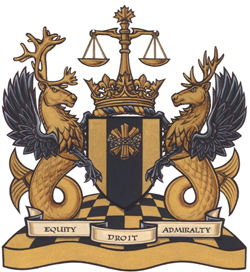
Arms of the Federal Court of Canada
If you’ve been following this case, you already know what’s at stake: whether Justin Trudeau — Canada’s most brazenly authoritarian Prime Minister in modern history — can shut down Parliament whenever he finds it politically inconvenient. Well, today, the Federal Court of Canada, in all its wisdom, just gave him the green light.
Chief Justice Paul S. Crampton released his decision, and while he acknowledged that the courts do have the power to review the Prime Minister’s use of prorogation, he ultimately ruled that Trudeau didn’t exceed his constitutional authority. That’s right — according to the Federal Court, it’s perfectly fine for a sitting Prime Minister to shut down Canada’s elected legislature while his party scrambles to pick a new leader. It’s fine to suspend oversight at a time when Canada is facing real, tangible threats, including Trump’s tariff war. It’s fine to use a legal loophole to avoid answering for one of the biggest financial scandals in Canadian history — the SDTC affair, which saw millions of taxpayer dollars funneled into thin air.
Let’s be very clear about what happened here. On January 6, 2025, Justin Trudeau stood at a podium and declared that Parliament — Canada’s most important democratic institution — was “paralyzed”. He said it was no longer working, that it needed a reset, and that in the meantime, he was resigning. Oh, and conveniently, during that time, the Liberal Party would be selecting a new leader.
Pause for a second and consider that. He wasn’t just shutting down debate on a single issue. He wasn’t suspending a single bill. He was shutting down Parliament entirely — the very institution meant to hold his government accountable.
Now, the Justice Centre for Constitutional Freedoms (JCCF) immediately called this out for what it was — an unlawful, undemocratic, and unconstitutional seizure of power. They filed a legal challenge, and in that case, they pointed out some pretty basic, irrefutable facts:
First, Parliament was not paralyzed. In the weeks leading up to prorogation, four separate bills had been passed. Does that sound like a government that isn’t functioning? Or does it sound like a Prime Minister who was simply looking for an excuse to silence his critics?
Second, and more importantly, Trudeau wasn’t shutting down Parliament to “reset” anything — he was doing it to save his own party. His government was crumbling. His ministers were resigning. His own caucus was at war with itself. And just as an election loomed over his head, he pulled the plug on Parliament, giving his party a clean slate while robbing opposition parties of their ability to challenge him.
And here’s the part the mainstream media will never report — this move wasn’t just about Trudeau’s political survival. It was also a blatant attempt to escape scrutiny over his government’s refusal to release documents related to the Sustainable Development Technology Canada (SDTC) scandal. If you don’t know what that is, it’s simple: Parliament ordered the Trudeau government to hand over records about how millions of taxpayer dollars mysteriously disappeared into politically connected environmental companies. The Trudeau government refused, defied Parliament, and then shut Parliament down before anyone could hold them accountable.
Murder in the Name of Democracy – War Against Humanity 002
The Korean War by Indy Neidell
Published 7 Mar 2025The battles on the Korean peninsula started long before 1950. Today Sparty looks back at the uprising and insurgency on Jeju Island in 1948, the threat of Communist revolt, and the harsh reaction of the Korean government. This really was the war before the war.
(more…)
Kevin Zucker on “The Big Fat Surprise”
I just got the most recent free Wargame Design PDF from Operational Studies Group and found that Kevin Zucker, the head of the company and one of the best wargame designers ever, had indulged in a little bit of non-wargame writing to open this issue:
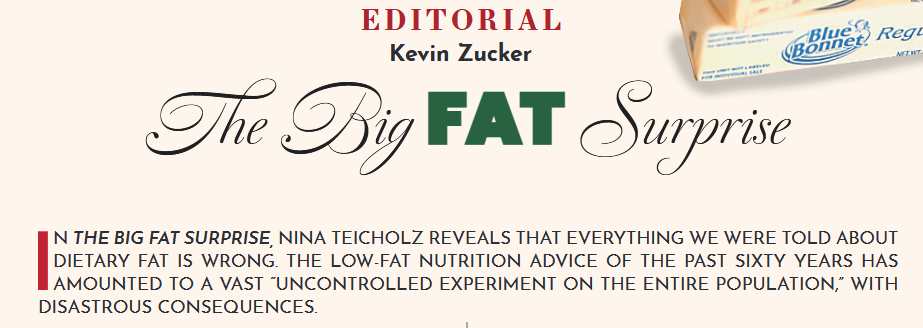
For decades, Teicholz tells us,
… we have been told that the best possible diet involves cutting back on fat, especially saturated fat, and that if we are not getting healthier or thinner it must be because we are not trying hard enough. But what if the low-fat diet is itself the problem? What if the creamy cheeses, the sizzling steaks are themselves the key to reversing the epidemics of obesity, diabetes, and heart disease? Misinformation about saturated fats took hold in the scientific community, but recent findings have overturned these beliefs. Nutrition science has gotten it wrong, through a combination of ego, bias, and premature consensus, allowing specious conclusions to become dietary dogma.1
We are conditioned to think that some specialist always knows better than we do. Despite the common wisdom, I always ate butter, not margarine, despite the “experts”, because I trusted my instincts.2 With experts influencing you to disregard your senses and what you already know, you can learn to believe the opposite of what is natural and true … “Boys and girls are the same”; “men and women are the same”. The French structuralists, who have somehow taken over academia, talk as if the whole world is merely a verbal construct, and whatever we speak becomes literally true if repeated enough.3
In the 1960’s and ’70’s, males joined the feminine on a quest for identity through music, love and drugs. I too was taken-in by the “men and women are the same” argument, and fancied myself a feminist. For me, that illusion was eventually shattered upon contact with reality. Today, instead of liberation, in many quarters the feminine principle is actively denied and suppressed; to prove a point, many women have short-circuited their feminine side, while masculinity is reviled as toxic. So now we have feminized men and masculine women, and neither side is happy. Seventy percent of divorces are initiated by women.
During the recent campaign, women’s anger was used to divide the sexes. A wife filed for divorce in November because her spouse voted for the wrong candidate. Supporters of the two sides cannot even be in the same house, much less discuss their differences rationally. After all, someone might get “triggered”, a brand-new coinage that promotes a fatal lack of reflection. The media have abandoned the fig leaf of nuance and balance and have hit their stride in stirring up fear and polarizing hatred.
The main tool of the demagogue is to stir up one group against another: divide and conquer. How does a society remove the influence of demagogues? History shows that once democracy is destroyed, it doesn’t just grow back. Undemocratic methods, such as censorship, brainwashing, propaganda, and the stifling of dissent, cannot “protect” democracy — just the opposite. A government is only an instrumentality of power, and it is only as democratic as its administrative cogwheels. Power is either administered democratically or it is usurped by a strong man, by the administrative state, or by oligarchs such as the World Economic Forum (who meet regularly in Davos, Switzerland). So that is the choice we face at the moment. Ten years ago, a study by professors Martin Gilens and Benjamin Page found America to be no longer a democracy, but a functional oligarchy. Aside from the eternal vices of greed and projection, we urgently need a strong repudiation of the folly of structuralism. This conversation should be taking place in academia, whose original purpose was to foster such discussions, but academia has now become the stronghold of “safe spaces” where open dialogue cannot be held.
The main reason for studying history, in my view, is to understand the present moment: Where are we, where did we come from, how did we get here, where are we going?4
Today, I am hopeful, for the first time since January 2009. In a chat with my good friend John Prados, I remarked, “Surely, like the proverbial stopped clock, by sheer accident, Trump might be correct about a few things”.
“No, Kevin, everything he says is a calculated lie,” reducing politics to a cartoonish level. We are, after all, the first generation raised on cartoons, where good and evil are simplistically segregated into representative types. Donald Trump has been cast as “Bluto”. The President has certainly brought grist for the mill by his tweet of 15 February, echoing Napoleon: “He who saves his country does not violate any law”.5 We might not have Trump in office today if his first campaign hadn’t been assisted by the Clinton machine in 2016. He was the candidate they wanted to run against, so they promoted his tweets and made a star out of him — just to help him in the primaries. Unfortunately, they created a monster.
It is obvious that the two candidates in the recent election are not the best our country has to offer. This reveals the absolute corruption of the political system. It has been obvious for some time that most of our institutions are vastly corrupt, with disastrous consequences for all of us. As a historian it is not my job to take sides or make predictions about the future. In my view, no one can predict the future: neither of the stock market, nor even tomorrow’s weather. A historian has to be concerned with facts, known, established and well-documented, not gloomy prognostications. Many pundits make their gravy by spouting dire predictions, but there is no one to hold them to account if they are inaccurate or flat-out lies. The voices of hysteria are still tooting like they hadn’t been repudiated at the ballot box.
I was asked recently, which sources of information I trust. I don’t trust any of them. I agree with Suzanne Massie, a scholar of Russian history: “Trust, but verify”. With historical research, a single source is insufficient, especially on controversial issues. As you dig deeper, you find a more three-dimensional view that often lays bare the simplistic assumptions of your primary source.
I cannot claim to have any particular insight into the first five weeks of the Trump Administration, but I look forward to seeing how it all turns out.
1. The Big Fat Surprise: Why Butter, Meat and Cheese Belong in a Healthy Diet, Simon & Schuster, 2014. Nina Teicholz
2. Margarine can also affect the nervous system and lead to depression and mental illness.
3. https://humanidades.com/en/structuralism/
4. D’où Venons Nous, Que Sommes Nous, Où Allons Nous — Paul Gauguin
5. Celui qui sauve sa patrie ne viole aucune loi—Maximes et pensées de Napoléon by Honoré de Balzac (1838), a compilation of aphorisms attributed to the emperor.
Joslyn M1862 and M1864 Carbines
Forgotten Weapons
Published 15 Jun 2015While US infantry forces during the Civil War had only limited access to the newest rifle technology, cavalry units adopted a wide variety of new carbines in significant numbers. Among these were a design by Benjamin Joslyn. It first appeared in 1855 designed to use paper cartridges, but by the time the US Army showed an interest Joslyn had updated the weapon to use brass rimfire ammunition. The first version purchased by the government was the 1862 pattern carbine, of which about a thousand were obtained. Many more were ordered, but it took Joslyn a couple years to really get his manufacturing facility and processes worked out. By the time he had this all straightened out, the design had been updated again to the 1864 pattern, addressing several minor problems with the earlier version. Ultimately more than 11,000 of the 1864 pattern carbines were purchased by the Union, chambered for the same .56-.52 cartridge as the Spencer carbines also in service.
QotD: India’s post-independence economic mistake
Strong and centralised control is something that only a rich country can afford because only a rich economy can weather the costs – the inefficiencies, the politically directed nonsenses – that such control insists upon.
Of course, rich countries shouldn’t make themselves poorer in this manner either but an already poor place can’t afford to have them – because if it does then people die.
India’s poor because of that attempt at socialist development. Something we can prove by the manner in which development sped up when even some portion of the socialism was dropped. Sure, the Webbs set up the LSE, the place I started to learn my economics but they were responsible for far greater evils than my views as well.
Tim Worstall, “A Sad Lesson About India’s History”, Continental Telegraph, 2020-05-01.
March 7, 2025
Trump marks the overdue end of the Long Twentieth Century, part 2
In The Conservative Woman, N.S. Lyons continues his essay contending that the arrival of Donald Trump, version 2.0, may finally end the era we’ve been living in since immediately after the end of WW2:
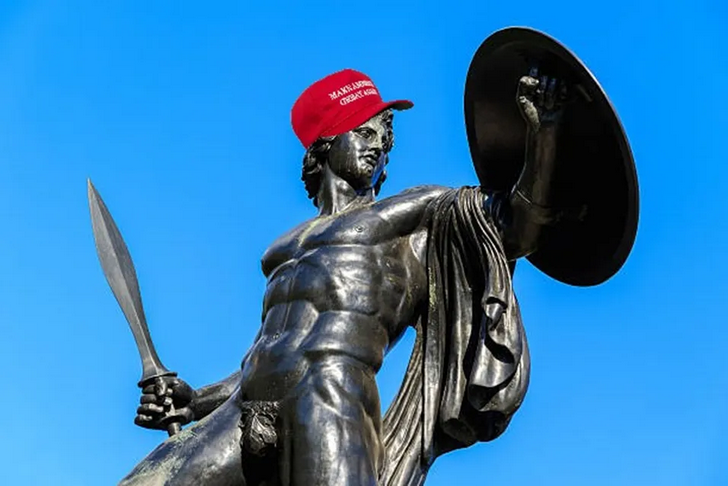
The Long Twentieth Century has been characterized by these three interlinked post-war projects: the progressive opening of societies through the deconstruction of norms and borders, the consolidation of the managerial state, and the hegemony of the liberal international order. The hope was that together they could form the foundation for a world that would finally achieve peace on earth and goodwill between all mankind. That this would be a weak, passionless, undemocratic, intricately micromanaged world of technocratic rationalism was a sacrifice the post-war consensus was willing to make.
That dream didn’t work out, though, because the “strong gods” refused to die.
Mary Harrington recently observed that the Trumpian revolution seems as much archetypal as political, noting that the generally “exultant male response to recent work by Elon Musk and his ‘warband’ of young tech-bros” in dismantling the entrenched bureaucracy is a reflection of what can be “understood archetypally as [their] doing battle against a vast, miasmic foe whose aim is the destruction of masculine heroism as such”. This masculine-inflected spirit was suppressed throughout the Long Twentieth Century, but now it’s back. And it wasn’t, she notes, “as though a proceduralist, managerial civilization affords no scope for horrors of its own”. Thus now “we’re watching in real time as figures such as the hero, the king, the warrior, and the pirate; or indeed various types of antihero, all make their return to the public sphere”.
Instead of producing a utopian world of peace and progress, the open society consensus and its soft, weak gods led to civilizational dissolution and despair. As intended, the strong gods of history were banished, religious traditions and moral norms debunked, communal bonds and loyalties weakened, distinctions and borders torn down, and the disciplines of self-governance surrendered to top-down technocratic management. Unsurprisingly, this led to nation-states and a broader civilization that lack the strength to hold themselves together, let alone defend against external threats from non-open, non-delusional societies. In short, the campaign of radical self-negation pursued by the post-war open society consensus functionally became a collective suicide pact by the liberal democracies of the Western world.
But, as reality began to intrude over the past two decades, the share of people still convinced by the hazy promises of the open society steadily diminished. A reaction began to brew, especially among those most divorced from and harmed by its aging obsessions: the young and the working class. The “populism” that is now sweeping the West is best understood as a democratic insistence on the restoration and reintegration of respect for those strong gods capable of grounding, uniting and sustaining societies, including coherent national identities, cohesive natural loyalties, and the recognition of objective and transcendent truths.
Today’s populism is more than just a reaction against decades of elite betrayal and terrible governance (though it is that too); it is a deep, suppressed desire for long-delayed action, to break free from the smothering lethargy imposed by proceduralist managerialism and fight passionately for collective survival and self-interest. It is the return of the political to politics. This demands a restoration of old virtues, including a vital sense of national and civilizational self-worth. And that in turn requires a rejection of the pathological “tyranny of guilt” (as the French philosopher Pascal Bruckner dubbed it) that has gripped the Western mind since 1945. As the power of endless hysterical accusations of “fascism” has gradually faded, we have – for better and worse – begun to witness the end of the Age of Hitler.
“The Resistance” achieves lame nirvana
President Donald Trump is a boisterous, noisy distraction in so many ways and rubs a heck of a lot of people the wrong way in everything he does … and yet the politicians who oppose him seem to be engaged in a scientific experiment to discover just how cringeworthy they can be:

“REMINDER: It Is Offensive And Possibly Illegal To Photoshop Anything On These Democrats’ Signs That Would Make Them Look Foolish.
The Babylon Bee, https://x.com/TheBabylonBee/status/1897140039777239181/photo/1
Remember when the phrase “the Resistance” would conjure up visions of sexy French youths in berets battling actual Nazis? Now all it brings to mind is ageing dullards in pink suits holding up signs saying “This is not normal” while sporting the most turbo-smug look on their faces. As US president Donald Trump spoke to a joint session of Congress last night, “across the aisle the Resistance was stirring”, gushed the Guardian‘s DC reporter. His piece was illustrated with a pic of some congresswoman in pearls and a balding Democrat looking aghast as Trump talked. Seriously, if this is “the Resistance”, the world’s tyrants can rest easy.
Yesterday’s “Democrat fightback” and “resistance to Trump’s rhetoric” – journalists are literally calling it that – was next-level cringe. It occurred during Trump’s 100-minute speech, the longest Congress talk in 60 years. As Trump bashed Joe Biden and bigged up Elon Musk, the Dems came over all soixante-huitard. Fury coursed through their ranks. Then the revolt started. The Squad’s Rashida Tlaib held up a scrawled sign saying “That’s a lie!”. Dem representative Al Green “shook his cane and pointed his finger” and cried “You have no mandate” to cut Medicaid. How the regime must have quaked at the sight of this revolution!
The way some hacks are talking about this tantrum masquerading as a protest you’d think it was a modern-day storming of the Bastille. The Dems’ “stirring” acts of rebellion will have “given hope to the Resistance” and sent a message to “the world”, said the Guardian. Nurse! Even leftists who’ve been disappointed with the Dem establishment seemed to get a moral kick from this political pantomime. So far, the “resistance” to the Trumpist tyranny has been “splintered”, but now we know it’s “getting better”, fawned Vox. Perhaps, it said, we’ll soon see the “aggressive resistance” we really need.
Can these people hear themselves? Overpaid politicians holding up mass-produced black placards with hackneyed complaints like “False” and “Liar” are not “the Resistance” – they’re the establishment cosplaying as campus radicals for likes and headlines. In one especially squirming scene, some Dems “removed their outer business wear” to reveal black t-shirts with the word “RESIST” in “bold white letters”. Their delusions of radicalism are off the scale. Resistance is when young Iranian women rip off their hijabs or Kurdish revolutionaries fight the neo-fascists of ISIS, not when politicians on $174,000 a year put on a t-shirt their stressed intern ordered from some hip printer on 7th Street.
Bricking the internet
In The Line, Phil A. McBride explains how the “net giants” have steadily nibbled away at the built-in resilience of the original internet design so that we’re all far more vulnerable to network outages than ever before:

The Internet was originally conceived in the 1960s to be a resilient, disparate and distributed network that didn’t have any single point of failure. This is still true today. While there are large data centres around the world that aggregate traffic, we don’t depend on them. If one were to go offline, things would slow down, but the data would still flow.
The advent of the cloud, though, has completely changed how we use the Internet, especially in the worlds of business, education and government. And the cloud, alas, is not nearly as resilient.
Fifteen years ago, your average small or medium business would have their own servers. Those servers would be used to send/receive email, store files, and run various business or collaborative applications. Some of these servers may have been hosted offsite at a data centre to provide better security or speed of access, but the physical infrastructure belonged to someone — it was something you could touch and, more importantly, account for. Many companies kept their servers on site.
If a company’s server or network went down, it affected that company. They couldn’t send or receive email, they couldn’t open files, collaborate with staff or clients. They were offline.
But only they were offline.
Fast forward to today. Microsoft 365 dominates the corporate productivity services market with an estimated 45-50 per cent market share worldwide, with Google Workspace coming second, with around 30-35 per cent. This means that approximately 80 per cent of businesses are dependent on one of two vendors for their ability to transact business and communicate at even the most basic level.
Government and government-provided services, like education, health care and defence, are just as reliant on these services as the business world.
In today’s world, when Microsoft’s or Google’s services suffer a hiccup, it doesn’t affect one business. Or ten, or a hundred. Tens of thousands of business, and government offices and civil society institutions, all go offline. Simultaneously. Mom-and-pop stores, multi-billion-dollar corporations, elementary schools, hospitals, entire governments, all go out, all at once.
And we haven’t even talked about how Amazon, Microsoft and Google control almost two-thirds of the world’s web/application hosting market share. If one or all of those services go down, most of the websites you go to on a regular basis would suddenly become unreachable.
Kinda-sorta related to the above is Ted Gioia‘s “State of the Culture” post:
So remember the first rule: The culture always changes first. And then everything else adapts to it.
That’s why teens plugged into the most lowbrow culture often grasp the new reality long before elites figure it out. This was true 50 years ago, and it’s still true today.
So that’s our second rule: If you want to understand the emerging culture, look at the lives of teens and twenty-somethings — and especially their digital lives. (In some cases those are their only lives.)
The web has changed a lot in recent years, hasn’t it? Not long ago, the Internet was loose and relaxed. It was free and easy. It was fun. There wasn’t even an app store.
We made our own rules.
The web had removed all obstacles and boundaries. I could reach out to people all over the world.
The Internet, in those primitive days, put me back in touch with classmates from my youth. It reconnected me with friends I’d made during my many trips overseas. It strengthened my ties with relatives near and far. I even made new friends online.
It felt liberating. It felt empowering.
But it also helped my professional life. I had regular exchanges with writers and musicians in various cities and countries—without leaving the comfort of my home.
I made new connections. I opened new doors.
And this didn’t just happen to me. It happened to everybody.
“The world is flat,” declared journalist Thomas Friedman. All the barriers were gone — we were all operating on the same level. It felt like some imaginary Berlin Wall had fallen.
That culture of flatness changed everything. Ideas spread faster. Commerce moved more easily. Every day I encountered something new from some place far away.
But then it changed.
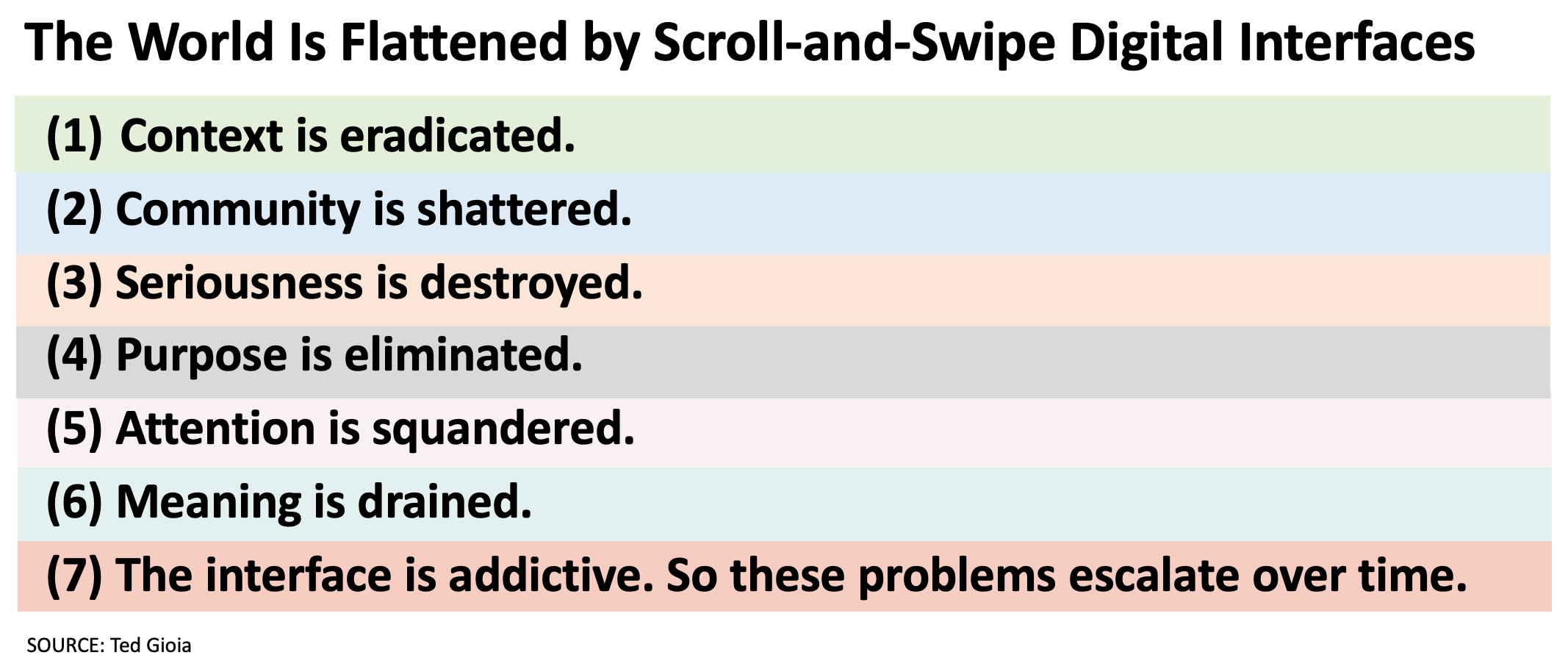
Twenty years ago, the culture was flat. Today it’s flattened.
I still participate in many web platforms — I need to do it for my vocation. (But do I really? I’ve started to wonder.) But now they feel constraining.
Even worse, they now all feel the same.
Instead of connecting with people all over the world, I now get “streaming content” 24/7.
Facebook no longer wants me stay in touch with friends overseas, or former classmates, or distant relatives. Instead it serves up memes and stupid short videos.
And they are the exact same memes and videos playing non-stop on TikTok — and Instagram, Twitter, Threads, Bluesky, YouTube shorts, etc.
Every big web platforms feels the exact same.
That whole rich tapestry of my friends and family and colleagues has been replaced by the most shallow and flattened digital fluff. And this feeling of flattening is intensified by the lack of context or community.
The only ruling principle is the total absence of purpose or seriousness.
The platforms aggravate this problem further by making it difficult to leave. Links are censored. Intelligence is punished by the dictatorship of the algorithms. Every exit is blocked, and all paths lead to the endless scroll.
All this should be illegal. But somehow it isn’t.
Soviet Invasion of Finland: Winter War 1939-40
Real Time History
Published 18 Oct 2024November 1939. Germany and the Soviet Union have conquered Poland, and Germany is at war with France and Britain. Moscow is free to do as it pleases in Eastern Europe and sets its sights on Finland – but the Winter War will be a nasty surprise for Stalin.
Corrections:
02:19 The dot marking Leningrad is about 80km too far east, it’s of course directly at the far eastern end of the Gulf of Finland.
(more…)


