… intersectionality’s intellectual flaws translate into moral shortcomings. Importantly, it is blind to forms of harm that occur within identity groups. For a black woman facing discrimination from a white man, intersectionality is great. But a gay woman sexually assaulted by another gay woman, or a black boy teased by another black boy for “acting white”, or a Muslim girl whose mother has forced her to wear the hijab will find that intersectionality has no space for their experiences. It certainly does not recognize instances in which the arrow of harm runs in the “wrong” direction — a black man committing an antisemitic hate crime, for instance. The more popular intersectionality becomes, the less we should expect to hear these sorts of issues discussed in public.
Perhaps the most pernicious consequence of intersectionality, however, is its effect on the culture of elite college campuses. Some claims about “campuses-gone-crazy” are surely overblown. For instance, judging from my experience at Columbia, nobody believes there are 63 genders, and hardly anyone loves Soviet-style communism. (That said, the few communists on campus tend to despise intersectionality with an unusual passion.) But one thing is certainly not exaggerated: intersectionality dominates the day-to-day culture. It operates as a master formula by which social status is doled out. Being black and queer is better than just being black or queer, being Muslim and gender non-binary is better than being either one on its own, and so forth. By “better”, I mean that people are more excited to meet you, you’re spoken of more highly behind your back, and your friends enjoy an elevated social status for being associated with you.
In this way, intersectionality creates a perverse social incentive structure. If you’re cis, straight, and white, you start at the bottom of the social hierarchy — especially if you’re a man, but also if you’re a woman. For such students, there is a strong incentive to create an identity that will help them attain a modicum of status. Some do this by becoming gender non-binary; others do it by experimenting with their sexuality under the catch-all label “queer”. In part, this is healthy college-aged exploration — finding oneself, as it were. But much of it amounts to needless confusion and pain imposed on hapless young people by the bizarre tenets of a new faith.
Coleman Hughes, “Reflections on Intersectionality”, Quillette, 2020-01-13.
December 2, 2024
QotD: Intersectionality on campus
November 30, 2024
Forgotten War Ep 5 – Chindits 2 – The Empire Strikes
HardThrasher
Published 29 Nov 202402:00 – Here We Go Again
06:36 – Perfect Planning
13:16 – Death of a Prophet
14:51 – The Fly In
18:56 – Dazed and Confused (in the Monsoon)
20:40 – Can’t Fly in This
31:54 – Survivor’s ClubPlease consider donations of any size to the Burma Star Memorial Fund who aim to ensure remembrance of those who fought with, in and against 14th Army 1941–1945 — https://burmastarmemorial.org/
(more…)
The mission of DOGE
One of Donald Trump’s more interesting announcements shortly after winning the federal election early in November was that he was going to give Elon Musk and Vivek Ramaswamy a formal position to do to the US government’s vast array of bureaucratic organizations what Javier Milei did to Argentina’s bloated national government. Here, scraped from the social media platform formerly known as Twitter, is Devon Eriksen‘s thoughts on how to go about pruning back the “fourth branch” of government:

Since the framers of the Constitution created a federal government with three branches, not four, there are no Constitutional checks on the emergent fourth branch.
Currently, the fourth branch is in many ways the most powerful, and certainly the most destructive, arm of the government.
– It has the privilege of targeting individual citizens on its own initiative, which is forbidden to the three other branches.
– It can interfere their lives in any way it wishes by making a “ruling”.
– The only recourse against a “ruling” is to take the bureaucracy in question to court.
– But the process is the punishment, because this takes months if not years and costs tens if not hundreds of thousands of dollars.
– Until recently, courts have deferred to bureaucrats as a matter of legal precedent. Now they merely do so as a matter of practice.
– But should the bureaucracy lose anyway, the only punishment the court inflicts is that they are told they have to stop doing that specific thing.
– Any fines or legal costs imposed on them punish the taxpayer, not the agent or even the agency.
– And the next, closely related, thing the bureaucracy thinks of to do is once again fair game, until the courts are once again brought in, at further cost, to tell it to stop.
All of this creates a Red Queen Effect.
Citizens must establish their own organizations, and raise donations to engage in constant lawfare, just to retain the rights they haven’t lost yet. And they must win every time to maintain the status quo.
Bureaucrats, on the other hand, can fight endless legal battles using money taken from their victims by the IRS, at no cost to themselves. Any victory they claim, they may keep permanently, while any loss may be refought endlessly simply by a slight variance of the attack.
Obviously, if this system is not changed, all power will accrue to the bureaucracy over time. They will constitute a totalitarian authority over every aspect of the life of every citizen.
This is why the name “DOGE” (Department of Government Efficiency) is a serious mistake.
Look, Elon, I like a joke as much as the next guy, and I do think irreverence is a load-bearing component of checking the bureaucracy, because a false aura of gravitas is one of their defenses against public outrage.
But words mean things.
When you create a check on the bureaucracy and call it the department of government efficiency, you focus the attention, and the correction, on the fact that the bureaucracy is stomping on people’s lives and businesses inefficiently, not on the fact that they are doing so at all.
But the name isn’t my decision. The power of the vote isn’t that granular. I can only elect an administration, not protect it from tactical errors by weighing in on individual policy decisions.
Unless someone with direct power happens to read this.
So, regardless of the name, here’s how an organization might be set up to effectively check federal bureaucracies.
1. DOGE must be responsive, not merely proactive.
Being proactive sounds better in the abstract, but it is much easier for a federal agency to gin up some numbers to fight a periodic overall audit, than it is to fight an investigation of a specific case.
2. DOGE must have direct oversight.
If it must take agencies to court, it is merely a proxy for the citizens whose money is being wasted, and whose rights are being trampled.
Imagine the level of inefficiency, waste, and delay, if your process for addressing bureaucratic abuse simply results in one part of the federal government pursuing an expensive court case against another.
Instead, DOGE must have the power to simply make a ruling, via its own investigation hearing process, which is binding on federal agencies.
Any appeals to the court system must be allowed to trigger their own DOGE investigation (for wasting taxpayer fighting a ruling).
3. DOGE must have the power to punish the agent, not just the agency.
“You have to stop that now” is not a deterrent. Neither is fining the agency, because such fines are paid by the American taxpayer.
DOGE must follow Saul Alinsky’s 11th rule: target individuals, not institutions.
Why?
Because agencies are agencies. They consist of agents.
An agent is someone who acts on behalf of a principal — someone whose interests the agent is supposed to represent.
When the agent is incentivized so that his interests diverge from those of the principal, he will be increasingly likely to act in his own interest, not the principal’s.
This is the Principal-Agent Problem.
An agency is a construct, a theoretical entity. What Vonnegut would call a “granfalloon”.
Agencies do not act, they do not make decisions, they do not have incentives they respond to. Any appearance to the contrary is an emergent property created by the aggregate action of agents.
Every decision, whether we admit it or not, has a name attached to it, not a department. It is that person who responds to incentives.
Agents will favor their own incentives over those of their principal (the American people) unless a counter incentive is present for that specific person.
For this reason, DOGE should, must, have the power to discipline individual employees of the federal agencies it oversees.
This doesn’t just mean insignificant letters of reprimand in a file. It means fines against personal assets, firing, or even filing criminal charges. No qualified immunity.
Yes, you read that right. DOGE must be able to fire other agencies’ staff. I recommend that anyone fired by DOGE be permanently illegible for any federal government job, excluding only elected positions.
4. DOGE investigations must be triggerable by citizen complaints.
This is self-explanatory. It gives DOGE the practical capability to redress individual injustices, and it crowdsources your discovery problem.
Establish a hotline.
5. DOGE must have sufficient power to protect and reward whistleblowers, and punish those who retaliate against them.
6. Bureaucrats must be held responsible for outcomes, not just for following procedure.
Often, procedure is the problem. The precedent must be established, and clearly enforced, that because agents have agency, agents are responsible for using their discretion to ensure efficient, just, and sane outcomes, not just for doing whatever departmental policy allows.
7. DOGE must have an adversarial relationship with the bureaucracies is oversees.
This eliminates the phenomenon of “we investigated ourselves and found no wrongdoing”.
Following the previous recommendation is almost sure to make this happen.
The point is not for DOGE to address every instance of waste or wrongdoing, it is to make bureaucrats act responsibly because they fear an investigation.
In essence, I am imagining DOGE (or some superior name that better reflects the mission) as an entity with a license to treat bureaucrats the way bureaucrats currently treat citizens.
QotD: Unrealized promises of a “Great Society”
Amity Shlaes, Great Society: A New History, 2020.
November 29, 2024
Dr. Jay Bhattacharya nominated as Director of the US National Institutes of Health
From the point of view of the establishment, the barbarians are well and truly inside the gates, as President-elect Donald Trump has nominated Stanford epidemiologist Dr. Jay Bhattacharya as the next director of the National Institutes of Health:

Dr. Jay Bhattacharya, Donald Trump’s nominee as Director of the National Health Institutes.
Photo by Taleed Brown, 2020, via Wikimedia Commons.
Four years ago, Jay Bhattacharya was ostracized by his colleagues at Stanford and censored on social media platforms thanks to a campaign against him by the public-health establishment. The director of the National Institutes of Health, Francis Collins, sent an email to another NIH official, Anthony Fauci, urging a “quick and devastating published takedown” of Bhattacharya and his fellow “fringe epidemiologists”.
Bhattacharya is far from the fringe today. Donald Trump nominated him this week for Collins’s old job, director of the NIH. Assuming the Senate confirms him, it will be a major victory for science and academic freedom — and a serious threat to the universities that suppressed scientific debate and promoted disastrous policies during the pandemic, causing public trust in science to plummet. Academic researchers and administrators have mostly refused to acknowledge their mistakes, much less make amends, but Bhattacharya promised yesterday to “reform American scientific institutions so that they are worthy of trust again”.
As NIH director, he would wield a potent tool to induce reform: money. Stanford and more than a dozen other universities each get more than $500 million annually in grants from the NIH, the world’s largest funder of biomedical research. The NIH grants support not only researchers but also their universities’ bureaucracies, which collect a hefty surcharge to cover supposed overhead costs. The federal largesse has helped finance the administrative bloat at universities, including the expansion of diversity, equity, and inclusion bureaucracies under the Biden administration, which took into account a university’s commitment to DEI principles when deciding whether to award grants from the NIH and other agencies.
Those priorities are about to change. Trump has vowed to rescind immediately Biden’s executive order directing federal agencies to promote DEI. During his first term, Trump threatened to issue an executive order barring universities from receiving federal funds if they suppressed free speech. He didn’t issue that order, but whether or not he does so in his next term, the NIH director will already have the power to consider a university’s commitment to academic freedom in deciding whether or not to award funds.
“For science to thrive and progress, we must be open-minded and allow vigorous and passionate debate,” says Martin Kulldorff, a former professor of medicine at Harvard. “Why should taxpayers subsidize universities that don’t allow that?” Kulldorff, an eminent epidemiologist, lost his job at Harvard after he became an early and outspoken critic of pandemic policies. In 2020, he joined with Bhattacharya and Sunetra Gupta, an epidemiologist at Oxford, to write the Great Barrington Declaration, a critique of lockdowns that was signed by tens of thousands of scientists and physicians.
Bhattacharya, who has a Ph.D. in economics as well as an M.D. from Stanford, hung on to his job as professor of health policy at the latter’s medical school, but his views were taboo on campus. After he and colleagues did a field study at the start of the pandemic showing that the Covid fatality rate was much lower than the doomsday number used to justify lockdowns, they were vilified by academics and journalists, and Stanford subjected them to a two-month inquiry by an outside legal firm. (They were vindicated by the inquiry and also by subsequent research confirming their findings.)
Trump is a deals guy … and Canadian politicians need to negotiate with him on that basis
In what has turned out to be his final column for TVO, Matt Gurney says that Canadian views on Trump need to evolve if we hope to preserve the overall amicable relationship between the two countries. Trump made his career on making deals … but not many of our political leaders seem to have clued in that this means we need to approach all our post-Biden American affairs with that in mind:
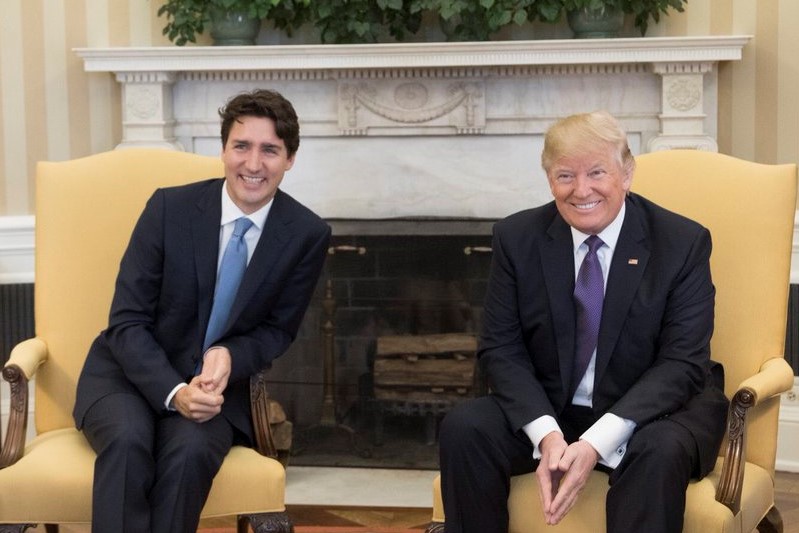
Justin Trudeau meets with President Donald Trump at the White House, 13 February, 2017.
Photo from the Office of the President of the United States via Wikimedia Commons.
Ever since the re-election of Donald Trump earlier this month, the most interesting question in Canadian politics has been “Who gets it?” That’s the main thing I’ve been looking for, and I think some of our leaders get it — or are starting to, at least.
Doug Ford doesn’t get it. Or didn’t, anyway, up until Tuesday afternoon.
On Monday night, president-elect Trump announced via a post on his Truth Social app that, as one of his first acts upon retaking the Oval Office in January, he would levy a 25 per cent tariff against all goods coming in from Canada and Mexico until those two countries fix the problems Trump says exist along the border. That’s a careful bit of phrasing on my part, so let me explain: I don’t disagree that there are issues for the United States along both borders. I don’t necessarily accept that the issues are the same on both borders or that Trump has accurately characterized the overall situation. But, in any case, Canada now has less than two months to figure out what it can do, assuming it can do anything, to satisfy the president-elect’s demands.
It’s very possible that we can do enough. Trump is a negotiator and a dealmaker, and we have to see his social-media post through that lens. He is establishing a strong opening position, and we’ll negotiate him down from there. That’s the good news, such as it is. The bad news, though, is that there’s no reason to assume Trump is going to do this only once. After we meet his demands on the border, he could demand that Canada take on more of the burden of the military defence of North America and the Western alliance. After we’ve drafted a bunch of people and launched a fleet of new warships and sent a heavily armed stabilization force to Haiti, he could come after us for our dairy subsidies. Once we give way on that, it’ll be getting tough on white-collar crime or telecom access or airline access. And so on and so on and so on. It’ll be one damned thing after another.
The broad contours of this were clear to me by about 1:30 in the morning on the day after (or night of, if you prefer) the U.S. election. As I keep saying, the party is over. Some of Trump’s demands will be basically utterly bogus, and others may be arguably unreasonable, but some of them are absolutely going to be fair, and Canada has, to my enormous frustration, left itself very, very vulnerable to his brand of pressure. We have utterly failed as a country to adapt to a changing world order by getting this country onto a more serious footing on any number of fronts, especially trade and defence. We were warned by friendlier U.S. administrations, including by presidents Barack Obama and Joe Biden. We didn’t listen. That was idiotic, and I can only hope not suicidal on our parts. Trump is going to get his way.
QotD: Why nothing gets done in the Current Year
Having pumped billions of dollars into building the next generation of computer chip factories in the US, the Biden administration is facing new pressure over the health and safety risks those facilities could pose. Environmental reviews for the new projects need to be more thorough, advocates say. They lack transparency around what kinds of toxic substances factory workers might handle, and plans to keep hazardous waste like forever chemicals from leaching into the environment have been vague.
A coalition of influential labor unions and environmental groups, including the Sierra Club, have since submitted comments to the Department of Commerce on draft environmental assessments, saying that the assessments fall short. The coalition’s comments flag lists of potential issues at several projects in Arizona and Idaho, including how opaque the safety measures that manufacturers will take to protect both workers and nearby residents are.
This is not a serious complaint. This is actually the national association of environmental studies writers spotting a gravy train passing by and desiring to dip their ladle in. And that’s all it is too. But it’s also that excellent example of why fuck all ever gets built. We’ve an entire — and politically powerful — class that makes their living producing the hundred tonne reports that accompany building anything. And they’re not going to allow anything to be built unless they get paid for writing hundred tonne reports. And, to complete the circle, if every activity requires a hundred tonne report then fuck all will ever get done.
There was, back a time, a law passed about blood minerals. The law said anyone who might use them must write to all suppliers to ask if they do. Then those said anyones must tell consumers whether they do. This cost $4 billion just in the first year. From what I’ve heard — and might take the trouble to prove one day — the bloke who led the campaign for the law requiring the letters now runs a very profitable consultancy advising large corporates on how to write the letters. $4 billion spent by society so that one bloke can gain a minor summer place in the Hamptons. This doesn’t make us richer as a whole, it’s pissing the wealth of the nation up the wall.
Carthage, it’s the only solution. The biggest problem who is who the hell would buy our nice new stock of enslaved environmental bureaucrats? Razing, salt, ploughs, these are easy but who’s mad enough to offer a positive price for the last part of the process?
Tim Worstall, “Why Fuck All Ever Gets Done In This Modern World”, It’s all obvious or trivial except …, 2024-08-28.
November 28, 2024
A thought about “Second Thanksgiving”
Real Thanksgiving happened over a month ago, but our American friends constantly mis-read the calendar and schedule their event near the end of November instead. Just another one of those minor differences between the two countries, I guess. One thing that is similar, regardless of the month the holiday is celebrated, is the eternal Thanksgiving dilemma: is it best to be a host or a guest?
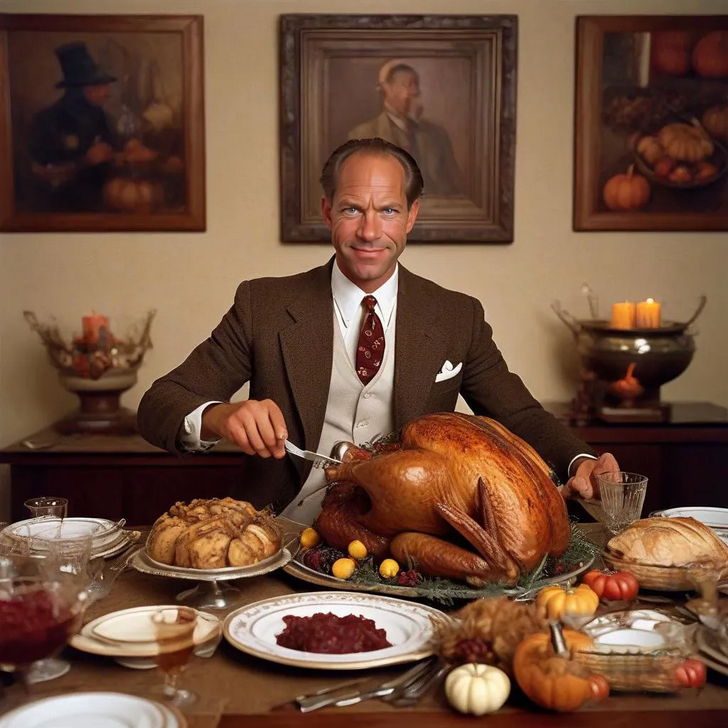
I don’t know what’s better: hosting Thanksgiving, or being a guest. And I don’t know which is worst, either. Each has its perils and pleasures.
Hosting: it’s so draining, so exhausting. I mean, watching your wife work so hard, it just takes it right out of you. Kidding: I help as best as I can, but it’s with the non-food jobs. My Thanksgiving culinary skills are limited to spanking the cranberry cylinder out of its can. I do the Cleaning. I make sure the wine glasses out, and the right ones — can’t have people drinking red out of white glasses, or the world as we know it would come to an end. I get the water pitcher down from the top shelf. No, not that one, the good one. The other good one. I vacuum and dust, in case guests want to push the piano away from the wall and check out our housekeeping.
[…]
Being a guest is hard because you just sit and wait and talk, and periodically say “anything I can do?” No. There is nothing you can do. So you drift to the living room where the kids are playing – all these small children, where did they come from? Just a few years ago their Mom or Dad was at your house at the kid’s table. And now they’ve reproduced. Hey, there’s football! You sit with the other guys and share the overhanging cloud of guilt — the womenfolk are doing everything, and you’re in here watching the Lions (why is it always the Lions). Occasionally one of the sisters or daughters who’s not doing anything at the moment wanders in and requests that someone explain football to her, and then she picks a team and gets excited when a player makes a great catch. Then she goes back to the kitchen and will not think about football for another year.
If I had to choose, I’d host, rather than be a guest. For some odd reason my wife at this point in life probably thinks the obverse. But I’ve noted over the years that even if you’re a guest at a family member’s thanksgiving, all the women end up in the kitchen anyway, talking amongst themselves about mysteries no man will ever know.
There’s a third option between guesting and hosting. For a few years we drove up to Fargo and had Thanksgiving Buffet at the Holiday Inn. Nothing to clean up. Turkey galore and unstinting stuffing. The hall was loud with communal consumption, and that somehow felt marvelously America. When you were done you just … got up and walked away and left the dishes where they were. Nothing more to do but digest, which brings an entirely new quality to the idea of gratitude.
Anyway: Happy Thanksgiving, be you guest or host. Here’s to lumpy potatoes and slabs of noble fowl. Gratitude is one of those things we figure we’ll get around to, and it’s marvelous to have a day where it’s absolutely required.
Town-class destroyers – Guide 400
Drachinifel
Published Aug 3, 2024The Town class destroyers, old Wickes, Clemson and Cadwell class vessels of the US Navy, transferred to the British Royal Navy and others, are today’s subject.
(more…)
November 27, 2024
Trump’s plan to dismiss transgender troops will apparently “gut” the US military
As if the US military services hadn’t suffered enough from their own government, it’s now being widely asserted in the media that Trump’s declared plan to get rid of all current transgender service members will be a desperately hard blow to an already over-stressed military structure:
The news media is calmly warning that Donald Trump is planning to ban transgender servicemembers from the American military, which will absolutely gut the armed forces.
Sample claim, from Newsweek, quoting the leader of an LGBT advocacy nonprofit:
Abruptly discharging 15,000-plus service members, especially given that the military’s recruiting targets fell short by 41,000 recruits last year, adds administrative burdens to war fighting units.
There would be a significant financial cost, as well as a loss of experience and leadership that will take possibly 20 years and billions of dollars to replace.
We’ll practically have no military left! It would be like a whole infantry division suddenly just vanishing: 15,000-plus transgendered service members.
You’re going to see this number a lot in the weeks ahead. The New Republic, today: “Donald Trump’s plan to ban transgender people from the military would have a devastating effect: At least 15,000 members would be forced to leave.”
That number comes from a 2018 report by the now-defunct Palm Center, a pro-LGBT independent research institute in California, which reached this conclusion: “Transgender troops make up 0.7% (seven-tenths of one percent) of the military (Active Component and Selected Reserve)”. Their best guess about a total number: 14,707. The media is just rounding that number up to the next thousand.
The Palm Center … extrapolated a lot, let’s say, in good part by multiplying their guess about a percentage, derived from a grossly inadequate survey of a select number of active duty troops, times the total number of servicemembers. Page 4:
Assuming that the distribution of transgender men and women is roughly equivalent in the Active and Selected Reserve Components, it is possible to derive an estimate of the number of transgender troops in the Selected Reserve as follows. The number of transgender women is .0066 x 652,623 = 4,307 and the number of transgender men is .0091 x 156,080 = 1,420. The total number of transgender members of the Selected Reserve is 4,307 + 1,420 = 5,727. And, the total number of transgender troops is 8,980 (active) + 5,727 (reserve) = 14,707.
Assuming the distribution, it is possible to derive an estimate. That’s the basis of the 15,000 number that you’ll see in news stories. Remember that language.
Similarly, a 2016 RAND study offered these findings (among others), and note the remarkable thing that happens between the first and second paragraph:
It is difficult to estimate the number of transgender personnel in the military due to current policies and a lack of empirical data. Applying a range of prevalence estimates, combining data from multiple surveys, and adjusting for the male/female distribution in the military provided a midrange estimate of around 2,450 transgender personnel in the active component (out of a total number of approximately 1.3 million active-component service members) and 1,510 in the Selected Reserve.
Only a subset will seek gender transition–related treatment. Estimates derived from survey data and private health insurance claims data indicate that, each year, between 29 and 129 service members in the active component will seek transition-related care that could disrupt their ability to deploy.
So studies indicate that there are 3,960 transgendered servicemembers, and also that there are 14,707 transgendered servicemembers, and “between 29 and 129 service members in the active component” who will actively seek gender transition services in a typical year.
So it’s definitely somewhere between 29 and 15,000.
The Korean War 023 – The Eagle Versus the Dragon – November 26, 1950
The Korean War by Indy Neidell
Published 26 Nov 2024Thanksgiving 1950 comes and goes in the snowy north of Korea, and Eighth Army’s push to the Yalu River begins the following day. It soon becomes apparent, though, that the Communist Chinese are ready and waiting for them, in numbers greater than anyone on the UN side have predicted. After weeks of preamble and preparation, the two forces finally collide in full strength.
Chapters
00:00 Intro
00:51 Recap
01:16 X Corps
03:14 Turkey Time
05:50 The US Offensive
09:05 The Second Phase Offensive
12:39 East Flank Disaster
15:27 Summary
15:47 Conclusion
(more…)
Scolianormativity
At FEE, Michael Strong defines the neologism and provides evidence that it has been a long-term harm to children forced into the Prussian-originated school regimentation regime:

Scolianormative (adj.): The assumption that behaviors defined by institutionalized schooling are “normal”. An assumption that became pervasive in industrialized societies in which institutionalized schooling became the norm that resulted in marginalizing and harming millions of children. Once society began to question scolianormativity, gradually people began to realize that the norms set by institutionalized schooling were perfectly arbitrary. It turned out that it was not necessary to harm children. The institutions that led to such widespread harms were dismantled, and humanity transcended the terrible century of institutionalized schooling.
The conventional educational model, government-enforced and subsidized, is based on 13 years of schooling consisting of state-defined curriculum standards and exams leading to a high school diploma.
Young human beings are judged as either “normal” or not based on the extent to which they are “on track” with respect to grade level exams and test scores. Students who are not making the expected progress may be diagnosed with learning differences (formerly known as disabilities). Students who can’t sit still adequately may be diagnosed with ADD/ADHD. Students who find the experience soul-killing may be diagnosed with depression or anxiety. Students who can’t stand to be told what to do all day may be diagnosed with Oppositional Defiant Disorder (ODD). Students who score higher on certain tests are labeled “gifted”.
Massive amounts of research and institutional authority have been invested in these and other diagnoses. When a child is not progressing appropriately in the system, the child is often sent to specialists who then perform the diagnosis. When appropriate, then the child is given some combination of medication, accommodations, and/or sent to a special program for children with “special needs”.
Many well-intentioned people regard this system as life-saving for the children who might otherwise have “not had their needs met” in the absence of such a diagnosis and intervention. And this is no doubt often true, but our fixation on scolianormativity blinds us to the fact that an entirely different perspective might actually result in better lives for more children.
How could one possibly deny mountains of evidence on behalf of such a life-saving system?
Scolianormativity
The Prussian school model, a state-led model devoted to nationalism, is only about two hundred years old. For much of its first century it was limited to a few hours per day, for a few months per year, for a few years of schooling. It has only gradually grown to encompass most of a child’s waking hours for nine months a year from ages 5 to 18. Indeed, in the U.S., it was only in the 1950s that a majority of children graduated from high school (though laws requiring compulsory attendance through age 16 had been passed in the late 19th and early 20th century). In addition, for most of its first century, it was far more flexible than it has become in its second. The increasing standardization and bureaucratization of childhood is a remarkably recent phenomenon in historical terms.
In his book Seeing Like a State, the political scientist James C. Scott documents how governments work to create societies that are “legible”, that can be perceived and managed by the state to suit the needs of the state’s bureaucrats and political leaders. Public schools are one of the most pervasive of all state institutions. The structure of public schooling has grown to suit the needs of the state bureaucrats who monitor it.
November 25, 2024
Andrew Sullivan as an (unconscious?) exemplar of the mentalités school
I sent the URL to Andrew Sullivan’s article I linked to yesterday to Severian to see what he’d make of it. He certainly didn’t disappoint me:

Founding Questions coat of arms by “urbando”.
The Latin motto translates to “We are so irrevocably fucked”.
Because someone like Andrew Sullivan is the kind of guy he is, we might have a good example to hand of a mentalités approach to History [Wiki]. We can all play along, because the key to a mentalités approach is a version of our favorite game, “For That to Be True”. Let’s see if we can’t ferret out some of Sullivan’s cultural assumptions here, and what that might tell us about our world.
There was something truly surreal about President Biden suddenly changing course and agreeing to give Ukraine advanced long-range missiles to attack deep inside Russian territory in the last two months of his administration. There was no speech to the nation; no debate in the Senate; just a quiet demonstration of unilateral presidential fuck-you power. You know: the kind we’ve long worried about with Donald Trump.
A couple things stand out immediately. The great thing about fags and chicks as pundits is that they’re hyper-emotional, so they always go for the big splashy adjectives. “Surreal”, for instance (and not just surreal, “truly surreal”). Let us instead return to the cool, rational prose of 18th century diplomacy, and term this a volte-face.
They happen all the time, of course. Indeed it’s one of the standard criticisms of representative government — they’re impossible to deal with, long term, because the volte-face is baked into the system. No agreement is so airtight that it’s not at immediate risk of repudiation if one of the other guys wins the next election. This is Diplomacy 101.
So, there’s the first assumption we need to examine: Since this kind of thing does, in fact, happen all the time — as any professional political analyst surely knows — why does this particular volte-face seem so “truly surreal?”
Moreover, it’s not as if the Biden Administration has been the model of consistency up to now. Not only is the diplomatic volte-face pretty common, so is the domestic — again, it’s a standard criticism of parliamentary-style government. And not just during election season. Domestic policy changes with the winds, because that’s kinda what it’s supposed to do. Vox populi, vox dei, at least as far back as the early 18th century, and the populi are notoriously fickle.
So why is this one “truly surreal”? If I were one of those Peter Turchin or Steve Sailer types, I’d plug all the Biden Administration’s policy decisions, foreign and domestic, into an Excel sheet and graph the changes. You know, plotting “variance ratios” against “consistency coefficients” and whatnot. It’d be all over the damn place, for reasons we here in this clubhouse call “The Do Long Bridge” — Brandon is the titular head of government, but there ain’t no fuckin’ CO, and if you look at the spastic incoherence of “Biden’s” policy decisions you’d see it plain as day.
It seems extremely unlikely, to put it no stronger, that a paid political analyst like Andrew Sullivan doesn’t see that. So either he does see it, but is pretending not to, for fun and profit — possible cultural assumption #1 — or he truly doesn’t see it, which would be revealing of cultural assumption #2.
I can’t decide which is which yet, but I can see a common denominator for both. It’s the last sentence I quoted in that paragraph:
You know: the kind we’ve long worried about with Donald Trump.
There’s a whole world full of embedded assumptions there. Does Trump actually do that — “a quiet demonstration of unilateral presidential fuck-you power”? […] To me, it sure looks like Trump was actually remarkably restrained when it came to unilateral demonstrations of presidential fuck-you power, alas, compared to Biden and especially Obama (he of the infamous pen and phone). And the few times he tried, he got Hawaiian Judged to hell and back. But since I don’t have my Steve Sailer graph to hand, I’m not going to assert that (maybe it’s one of my assumptions — I really want to see Trump exercise some fuck-you power).
And the verb is extremely interesting. They’re worried about Trump doing it; they’ve heretofore not been bothered by Biden doing it.
In search of bluer skies
In The Critic, Benedict Spence channels his inner David Attenborough to document the majestic migration of American progressives from their habitual grazing lands to friendlier territory:

What will Twitter do without its smuggest inhabitants?
And so we come to it again. It is that time of year when we put on our David Attenborough voices, and talk in low, slightly wistful tones about the great migration that is about to unfold. Everywuh you look, creatures great and small are beginning their treacherous juhneys across a vast and inhospitable wilduhness to happiuh hunting grounds and more pleasant pastures under the clear blue skies. The hullabaloo that accompanies them is impossible to miss — across the plains, the cries go up from elders to alert the rest of the herd of the imminent departure.
Though some may never return from this arduous trek, most will. Disavow yourself of the mental image of elephants and zebras crossing the African savannah — that’s not what we’re here for. This migration is metaversical in nature: it is time, once more, for people to announce they are leaving Twitter.
This year’s exodus came later than usual, prompted by Donald Trump’s bulldozer of a victory over Kamala Harris in the US presidential election, with grown men and women across the country — and its second largest airbase, the UK — deciding that Elon Musk, the platform’s owner and the Orange Man’s endorser-in-chief, was at least partly responsible for this travesty. Not the economy, you understand, oh no. Nor immigration, nor the preoccupation by Democrats with shoulder-chewingly stupid culture war issues the average voter thinks are at best mad and at worst satanic.
No, no, it is all about Musk — who is at once the world’s wealthiest evil genius and also a gibbering moron, according to people who thought Cacklin’ Kamala was a born winner. Musk, we are told, has ushered in a stream of “hate” ever since buying Twitter and rebranding it 10, warping the minds of the impressionable and irreparably damaging the future of the West by facilitating Trump’s return.
This is not Musk’s only crime, though. He has also tweaked other aspects of X’s features, including the block function, making it possible for those on the receiving end of this internal exile to see the posts of their nemeses again without being able to interact with them. This was for a fair few blockees how they were reminded of the existence of their blockers, many of whom they had long since forgotten. Often, in the same instance, it was also how they learned said blocker was off somewhere else.
Musk has also moved to erode the power of institutions and individuals who lived their lives high on the power of credentialism, and the authority this brought them. The changing of blue tick criteria and the emphasis on community notes now means many who were once feted on the site by virtue of who they were must now work harder for their dopamine. But above all else, Musk has refused to silence a swathe of right wing voices who always existed but lived their X lives in the shadows. The platform became more right wing, and for many that was just too much. Having been reliably told throughout the past year that the crude reply guys were just Russian bots and that their gal would ride over them on a wave to victory, they and their allies over here — the infamous adults back in charge of the UK — are doing the grownup thing and going off in a huff to play somewhere else.
Looking toward the first order effects of 47
At Postcards From Barsoom, John Carter is delighted that his pessimistic election forecast turned out to be wrong and considers what the incoming Trump administration will be doing in the short-term:
There are obvious parallels between the 2024 election, the 2016 election, and the Brexit vote, all of which are a bit awkward for elite theory maximalists. Their position, taken to its extreme, seems to be that only the elite can actually do things, that all political phenomena are ultimately a consequence of elite machinations. Which makes elite theory in many ways the highbrow version of conspiracy theory, the main difference being that they talk about the Cathedral’s systems of power instead of the Illuminati, the Freemasons, and smoky backrooms. And yet, the elite clearly don’t always get their way. In the case of Brexit, the elite were absolutely unanimous in their support for Remain … and the elite lost. Similarly in the case of the 2016 US election. Elite preferences carry an enormous amount of weight; it’s generally much better for a cause to have elite support than suffer elite opposition. But elites are not actually decisive. They can be beaten.
It’s obviously much too early to judge the 47th US presidency, which hasn’t started yet. Cynics expect a repeat of 2016: just as Trump’s promises to drain the swamp and build the wall came to, if not nothing, then very little, so will his promises to deport them all, replace the income tax with tariffs, reign in the universities by going after their accreditation and endowments, drain the swamp for real this time, and so on prove to be so much hot air. So far all we know are Trump’s cabinet picks and other appointments, which suggest that this cynicism might be premature. […]
The new Trump admin shows every sign of gearing up for a Dark MAGA rampage through the Beltway.
If you’re curious about where Dark MAGA came from, why yes it was memed into reality. Aristophanes
tells the wild saga: from in-joke to shitcoin to the hat on Elon Musk’s head.They aren’t going to just drain the swamp. They’re going to drain it, dry it, soak it in gasoline, and set it on fire. They are going to purge the US government of the useless, the incompetent, the subversive, and the criminal. At least, that seems to be the intention … and given the way the rats are scrambling to escape the ship before it sinks, the regime’s minions, at least, seem to think that plan has a good chance of succeeding. […]
Of course, a lot could happen between now and January. The Democrats might find some convoluted legal pathway to deprive The Insurrectionist of the Oval Office, as Tree of Woe suggested, which of course would initiate a constitutional crisis and probably a civil war. They could assassinate him, which would also probably start a civil war, and which is probably why Trump has been holed up in Mar-a-Lago since the election. Either of these outcomes would probably place JD Vance in the presidency, which is probably much worse for the regime than Trump: Vance is marine corps combat vet who reads Curtis Yarvin and is fluent enough in meme that he probably has a frog alt on Twitter.
[…]
News that suicides spiked after the election is apparently fake, though crisis call centres catering to the Pronoun Jugend did experience a massive increase, and one guy apparently unalived his entire family. They’re still in a state of shock: shaving their heads, vowing to start a sex strike, fleeing to Canada (I do not recommend).
The left are religious fanatics, and religious fanatics don’t give up just because it looks hopeless. It’s also worth recalling that the last time Trump won, the riots didn’t start until inauguration. There’s plenty of time yet, and there are a lot of very wealthy and very influential people who probably feel they have nothing to lose as their precious oxen are in danger of being lethally gored by Dark MAGA on the Washington Mall as a sacrifice to America’s Founding gods, after which they themselves will be hanged from Wotan’s Tree of Liberty. Note that it doesn’t matter if Trump will really follow through with all of this; what matters is if the other side thinks that he will. Ruling out a dramatic escalation in civil violence in the US is almost certainly hasty.
[…]
Another play the regime could make is to just start World War III before Trump takes office, either in order to justify a military coup d’etat, or just to dump a catastrophe in Trump’s lap so that he’ll be too busy dealing with that to drain the swamp. They definitely seem to be ramping things up in Ukraine, with the new strategy of long-distance missile strikes deep into Russian territory. The idea is probably to provoke the bear so badly that it starts mauling NATO countries directly, rather than just chewing through their exhausted national arsenals in the mud of the Donbass. That might work; then again, Putin knows full well that all he has to do is wait a couple months and he’ll be dealing with Trump directly, and Trump is on record as wanting to wind down hostilities as a top priority as soon as he’s in office. Vlad may be a bad man, but he is a very patient bad man.
Assuming that the regime is unsuccessful in baiting Russia into a direct attack on Europe, Trump’s victory probably has very big, tumultuous, and positive implications for European politics. Positive, at least, for anyone who doesn’t hate Europe … and therefore very bad implications for the people currently running the civilizational centre of the human species into the dirt.
The Germans, at least, seem to think so.
Yes, it’s real.
Chancellor Scholz’ unstable “traffic light” coalition disintegrated almost immediately after Trump was elected, sending Germany into its own election … in which the AfD is poised to do very well for itself, much to the consternation of Germany’s political class. eugyppius has been doing invaluable work covering Germany’s politics for the anglosphere audience; he provides an excellent overview of the reasons for the coalition’s collapse in this recent interview on the J Burden show.