
The Korean War by Indy Neidell
Published 11 Mar 2025Operation Ripper kicks off this week, and gains plenty of ground … but the enemy is almost nowhere to be found. Douglas MacArthur gives what becomes known as his “die for a tie” speech, which could have a serious negative effect on UN troop morale. But the Chinese are building up their forces for an eventual counterstrike, and the North Koreans even have a new Chief of Staff.
Chapters
00:00 Intro
00:50 Recap
01:15 Plans for Operation Ripper
04:45 Die for a Tie
06:34 MacArthur Won’t Toe the Line
08:17 The KPA Build-Up
10:38 Nam Il
12:31 The Chinese Build-Up
14:01 Ripper Begins
15:33 Summary
15:45 Conclusion
(more…)
March 12, 2025
The Korean War 038 – The US President is Angry! – March 11, 1951
Comments Off on The Korean War 038 – The US President is Angry! – March 11, 1951
Colt Sidehammer “Root” Dragoon Prototype
Forgotten Weapons
Published 17 Nov 2016During the development of the 1860 Army revolver, Colt did consider mechanical options other than simply scaling up the 1851 Navy pattern. One of these, as evidenced by this Colt prototype, was an enlarged version of the 1855 Pocket, aka “Root”, revolver. That 1855 design used a solid frame and had been the basis for Colt’s revolving rifles and shotguns, and so it would be natural to consider it for use in a .44-caliber Army revolver. How extensive the experimentation was is not known, and I believe this is the only known surviving prototype of a Dragoon-size 1855 pistol. It survives in excellent shape, and is a really neat glimpse at what might have been …
Comments Off on Colt Sidehammer “Root” Dragoon Prototype
March 11, 2025
Could even William Shakespeare rescue Hollywood?
Ted Gioia laments the apparent death of creativity in Hollywood over the last few decades:
They need somebody like Bill Shakespeare in Hollywood today.
That’s not as crazy as it sounds. We know very little about the Bard of Avon, but these facts are indisputable:
- He worked successfully in the entertainment business for 30 years.
- He mastered the art of the deal — all six of his surviving signatures come from legal documents.
- He handled money wisely, as entrepreneur, grain merchant, property owner, money lender, etc.
- He still sells tickets today — more than 400 years after his death.
Not even Harvey Weinstein can match that track record.
And — best of all—Shakespeare didn’t let business get in the way of creativity. He knew how to make a buck without compromising his Bard status.
Here’s another fact about Shakespeare: He never used the words “intellectual property” or “content” or “brand franchise”.
I was reminded of that recently when I encountered this headline in The Hollywood Reporter.
I’ve often accused the entertainment industry of abandoning creativity — and turning into boring IP [intellectual property] management companies run by lawyers, bankers, and accountants.
But they don’t even hide it anymore.
There was a day when they pretended to care about artistry — seeking out fresh talent and bold new ideas. But today it’s the exact opposite. They actually want content.
(This is where I concur with Barbara Broccoli, who had creative control over the James Bond films until last week. She forced Amazon execs to buy her out, after she called them “fucking idiots”. This outburst happened in response to the head of Amazon Studios describing the Bond films as content.)
So I read the Bain report and wept. So would Shakespeare — he would rage like King Lear on the heath if he saw a sentence like this:
[Media] companies are essentially themselves converging to compete with the tech media platforms; they’re also acquiring to gain more evergreen IP that can be used across modalities. By owning these cross-sector assets and IP, they create fan communities and multimodal content …
I thought content was bad enough. But we’re now dealing with multimodal content.
That sounds like one of the seven plagues of ancient Egypt — a step above locusts, but definitely worse than frogs and hail. Somebody at the consultancy deserves to be smote down at bonus time.

Comments Off on Could even William Shakespeare rescue Hollywood?
QotD: Herbert Hoover wins the presidency
Finally, it is 1928. Hoover feels like he has accomplished his goal of becoming the sort of knowledgeable political insider who can run for President successfully. Calvin Coolidge decides not to run for a second term (in typical Coolidge style, he hands a piece of paper to a reporter saying “I do not choose to run for President in 1928” and then disappears and refuses to answer further questions). The Democrats nominate Al Smith, an Irish-Italian Catholic with a funny accent; it’s too early for the country to really be ready for this. Historians still debate whether Hoover and/or his campaign deserves blame for being racist or credit for being surprisingly non-racist-under-the-circumstances.
The main issue is Prohibition. Smith, true to his roots, is against. Hoover, true to his own roots (his mother was a temperance activist) is in favor. The country is starting to realize Prohibition isn’t going too well, but they’re not ready to abandon it entirely, and Hoover promises to close loopholes and fix it up. Advantage: Hoover.
The second issue is tariffs. Everyone wants some. Hoover promises that if he wins, he will call a special session of Congress to debate the tariff question. Advantage: Hoover.
The last issue is personality. Republican strategists decide the best way for their candidate to handle his respective strengths and weaknesses is not to campaign at all, or be anywhere near the public, or expose himself to the public in any way. Instead, they are “selling a conception. Hoover was the omnicompetent engineer, humanitarian, and public servant, the ‘most useful American citizen now alive’. He was an almost supernatural figure, whose wisdom encompasses all branches, whose judgment was never at fault, who knew the answers to all questions.” Al Smith is supremely charismatic, but “boasted of never having read a book”. Advantage: unclear, but Hoover’s strategy does seem to work pretty well for him. He racks up most of the media endorsements. Only TIME Magazine dissents, saying that “In a society of temperate, industrious, unspectacular beavers, such a beaver-man would make an ideal King-beaver. But humans are different.”
Apparently not that different. Hoover wins 444 votes to 87, one of the greatest electoral landslides in American history.
Anne McCormick of the New York Times describes the inauguration:
We were in a mood for magic … and the whole country was a vast, expectant gallery, its eyes focused on Washington. We had summoned a great engineer to solve our problems for us; now we sat back comfortable and confidently to watch our problems being solved. The modern technical mind was for the first time at the head of a government. Relieved and gratified, we turned over to that mind all of the complications and difficulties no other had been able to settle. Almost with the air of giving genius its chance, we waited for the performance to begin.
Scott Alexander, “Book Review: Hoover”, Slate Star Codex, 2020-03-17.
Comments Off on QotD: Herbert Hoover wins the presidency
March 10, 2025
Chinese Civil War Part 1 – W2W 11 – Q1 1947
TimeGhost History
Published 9 Mar 2025After WWII, China is plunged into chaos as Chiang Kai-shek’s Nationalists and Mao Zedong’s Communists reignite a decades-old conflict. This episode traces the roots of the Chinese Civil War — from the guerrilla strategies honed in Yan’an to the shifting power dynamics after Japanese occupation. Discover how ideological fervor, battle-hardened tactics, and the struggle for legitimacy set China on a path that would redefine its future.
(more…)
Comments Off on Chinese Civil War Part 1 – W2W 11 – Q1 1947
QotD: The “Basic College Dude” of the 2020s
But mostly it’s just because none of them stick in my memory. The #1 characteristic of the Basic College Dude is that even if he’s there, he’s not there. He’s checked out — mentally, emotionally, spiritually (if that even means anything anymore). Unlike the girls, all of whom seem to be in 72 different clubs and organizations (and list them all on their email auto-signatures, such that by junior year, their honorifics are longer than my entire resume), the guys don’t seem to do much of anything. How do they while away their hours? I assume with social media, like everyone, and with video games and blackout drinking …
… the latter of which I have seen, a lot, and if you’ll permit a brief digression, if you really want to know how fucked our society is, go to a student bar on a Friday night. I myself was a bit of a party animal in college, and like everyone I went over the line a few times, but college kid drinking these days is almost Soviet — they’re aiming to get knee-walking, gutter-puking, total-blackout shitfaced, and they set about it as grimly and efficiently as possible. The girls, too, with the added bonus that they’re all on Ambien and Klonopin and every other happy pill you’ve ever heard of, which makes for some interesting, by which I mean terrifying, behavior …
[…]
But mostly it’s because college dudes have had their libidos beaten out of them. […]
Not only does the BCD not know how to do this, as Nikolai says, he apparently doesn’t actually want to. Constant stimulation by blinking screens, shit diets, and a lifetime of indoctrination have reversed the sexual dilithium crystals. Heartiste used to go on about this, and while I’m no biochemist, either, I think his theory is sound: There’s so much environmental estrogen floating around that men develop the emotional equivalent of gynecomastia, while women turn butch. Throw nth wave feminism into the mix, and you’ve got women acting like the crudest, most obnoxious male stereotypes (they call this “being strong and empowered”), while the men mope and sigh to their diaries.
The end result is that the BCD walks around like he’s shellshocked. He does the bare minimum, hoping to just grind it out without any further affronts to his basic human dignity … but so mal-educated is he, that the phrase “basic human dignity” doesn’t even register with him.
Severian, “The Basic College Dude”, Founding Questions, 2021-10-05.
Comments Off on QotD: The “Basic College Dude” of the 2020s
March 8, 2025
Murder in the Name of Democracy – War Against Humanity 002
The Korean War by Indy Neidell
Published 7 Mar 2025The battles on the Korean peninsula started long before 1950. Today Sparty looks back at the uprising and insurgency on Jeju Island in 1948, the threat of Communist revolt, and the harsh reaction of the Korean government. This really was the war before the war.
(more…)
Comments Off on Murder in the Name of Democracy – War Against Humanity 002
Kevin Zucker on “The Big Fat Surprise”
I just got the most recent free Wargame Design PDF from Operational Studies Group and found that Kevin Zucker, the head of the company and one of the best wargame designers ever, had indulged in a little bit of non-wargame writing to open this issue:
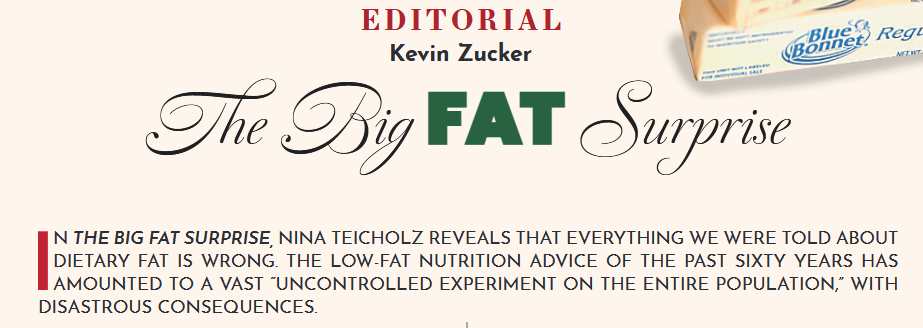
For decades, Teicholz tells us,
… we have been told that the best possible diet involves cutting back on fat, especially saturated fat, and that if we are not getting healthier or thinner it must be because we are not trying hard enough. But what if the low-fat diet is itself the problem? What if the creamy cheeses, the sizzling steaks are themselves the key to reversing the epidemics of obesity, diabetes, and heart disease? Misinformation about saturated fats took hold in the scientific community, but recent findings have overturned these beliefs. Nutrition science has gotten it wrong, through a combination of ego, bias, and premature consensus, allowing specious conclusions to become dietary dogma.1
We are conditioned to think that some specialist always knows better than we do. Despite the common wisdom, I always ate butter, not margarine, despite the “experts”, because I trusted my instincts.2 With experts influencing you to disregard your senses and what you already know, you can learn to believe the opposite of what is natural and true … “Boys and girls are the same”; “men and women are the same”. The French structuralists, who have somehow taken over academia, talk as if the whole world is merely a verbal construct, and whatever we speak becomes literally true if repeated enough.3
In the 1960’s and ’70’s, males joined the feminine on a quest for identity through music, love and drugs. I too was taken-in by the “men and women are the same” argument, and fancied myself a feminist. For me, that illusion was eventually shattered upon contact with reality. Today, instead of liberation, in many quarters the feminine principle is actively denied and suppressed; to prove a point, many women have short-circuited their feminine side, while masculinity is reviled as toxic. So now we have feminized men and masculine women, and neither side is happy. Seventy percent of divorces are initiated by women.
During the recent campaign, women’s anger was used to divide the sexes. A wife filed for divorce in November because her spouse voted for the wrong candidate. Supporters of the two sides cannot even be in the same house, much less discuss their differences rationally. After all, someone might get “triggered”, a brand-new coinage that promotes a fatal lack of reflection. The media have abandoned the fig leaf of nuance and balance and have hit their stride in stirring up fear and polarizing hatred.
The main tool of the demagogue is to stir up one group against another: divide and conquer. How does a society remove the influence of demagogues? History shows that once democracy is destroyed, it doesn’t just grow back. Undemocratic methods, such as censorship, brainwashing, propaganda, and the stifling of dissent, cannot “protect” democracy — just the opposite. A government is only an instrumentality of power, and it is only as democratic as its administrative cogwheels. Power is either administered democratically or it is usurped by a strong man, by the administrative state, or by oligarchs such as the World Economic Forum (who meet regularly in Davos, Switzerland). So that is the choice we face at the moment. Ten years ago, a study by professors Martin Gilens and Benjamin Page found America to be no longer a democracy, but a functional oligarchy. Aside from the eternal vices of greed and projection, we urgently need a strong repudiation of the folly of structuralism. This conversation should be taking place in academia, whose original purpose was to foster such discussions, but academia has now become the stronghold of “safe spaces” where open dialogue cannot be held.
The main reason for studying history, in my view, is to understand the present moment: Where are we, where did we come from, how did we get here, where are we going?4
Today, I am hopeful, for the first time since January 2009. In a chat with my good friend John Prados, I remarked, “Surely, like the proverbial stopped clock, by sheer accident, Trump might be correct about a few things”.
“No, Kevin, everything he says is a calculated lie,” reducing politics to a cartoonish level. We are, after all, the first generation raised on cartoons, where good and evil are simplistically segregated into representative types. Donald Trump has been cast as “Bluto”. The President has certainly brought grist for the mill by his tweet of 15 February, echoing Napoleon: “He who saves his country does not violate any law”.5 We might not have Trump in office today if his first campaign hadn’t been assisted by the Clinton machine in 2016. He was the candidate they wanted to run against, so they promoted his tweets and made a star out of him — just to help him in the primaries. Unfortunately, they created a monster.
It is obvious that the two candidates in the recent election are not the best our country has to offer. This reveals the absolute corruption of the political system. It has been obvious for some time that most of our institutions are vastly corrupt, with disastrous consequences for all of us. As a historian it is not my job to take sides or make predictions about the future. In my view, no one can predict the future: neither of the stock market, nor even tomorrow’s weather. A historian has to be concerned with facts, known, established and well-documented, not gloomy prognostications. Many pundits make their gravy by spouting dire predictions, but there is no one to hold them to account if they are inaccurate or flat-out lies. The voices of hysteria are still tooting like they hadn’t been repudiated at the ballot box.
I was asked recently, which sources of information I trust. I don’t trust any of them. I agree with Suzanne Massie, a scholar of Russian history: “Trust, but verify”. With historical research, a single source is insufficient, especially on controversial issues. As you dig deeper, you find a more three-dimensional view that often lays bare the simplistic assumptions of your primary source.
I cannot claim to have any particular insight into the first five weeks of the Trump Administration, but I look forward to seeing how it all turns out.
1. The Big Fat Surprise: Why Butter, Meat and Cheese Belong in a Healthy Diet, Simon & Schuster, 2014. Nina Teicholz
2. Margarine can also affect the nervous system and lead to depression and mental illness.
3. https://humanidades.com/en/structuralism/
4. D’où Venons Nous, Que Sommes Nous, Où Allons Nous — Paul Gauguin
5. Celui qui sauve sa patrie ne viole aucune loi—Maximes et pensées de Napoléon by Honoré de Balzac (1838), a compilation of aphorisms attributed to the emperor.
Comments Off on Kevin Zucker on “The Big Fat Surprise”
Joslyn M1862 and M1864 Carbines
Forgotten Weapons
Published 15 Jun 2015While US infantry forces during the Civil War had only limited access to the newest rifle technology, cavalry units adopted a wide variety of new carbines in significant numbers. Among these were a design by Benjamin Joslyn. It first appeared in 1855 designed to use paper cartridges, but by the time the US Army showed an interest Joslyn had updated the weapon to use brass rimfire ammunition. The first version purchased by the government was the 1862 pattern carbine, of which about a thousand were obtained. Many more were ordered, but it took Joslyn a couple years to really get his manufacturing facility and processes worked out. By the time he had this all straightened out, the design had been updated again to the 1864 pattern, addressing several minor problems with the earlier version. Ultimately more than 11,000 of the 1864 pattern carbines were purchased by the Union, chambered for the same .56-.52 cartridge as the Spencer carbines also in service.
Comments Off on Joslyn M1862 and M1864 Carbines
March 7, 2025
Trump marks the overdue end of the Long Twentieth Century, part 2
In The Conservative Woman, N.S. Lyons continues his essay contending that the arrival of Donald Trump, version 2.0, may finally end the era we’ve been living in since immediately after the end of WW2:
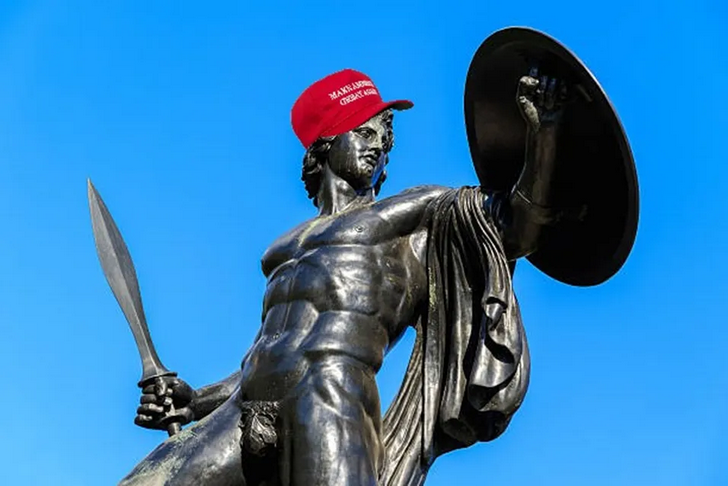
The Long Twentieth Century has been characterized by these three interlinked post-war projects: the progressive opening of societies through the deconstruction of norms and borders, the consolidation of the managerial state, and the hegemony of the liberal international order. The hope was that together they could form the foundation for a world that would finally achieve peace on earth and goodwill between all mankind. That this would be a weak, passionless, undemocratic, intricately micromanaged world of technocratic rationalism was a sacrifice the post-war consensus was willing to make.
That dream didn’t work out, though, because the “strong gods” refused to die.
Mary Harrington recently observed that the Trumpian revolution seems as much archetypal as political, noting that the generally “exultant male response to recent work by Elon Musk and his ‘warband’ of young tech-bros” in dismantling the entrenched bureaucracy is a reflection of what can be “understood archetypally as [their] doing battle against a vast, miasmic foe whose aim is the destruction of masculine heroism as such”. This masculine-inflected spirit was suppressed throughout the Long Twentieth Century, but now it’s back. And it wasn’t, she notes, “as though a proceduralist, managerial civilization affords no scope for horrors of its own”. Thus now “we’re watching in real time as figures such as the hero, the king, the warrior, and the pirate; or indeed various types of antihero, all make their return to the public sphere”.
Instead of producing a utopian world of peace and progress, the open society consensus and its soft, weak gods led to civilizational dissolution and despair. As intended, the strong gods of history were banished, religious traditions and moral norms debunked, communal bonds and loyalties weakened, distinctions and borders torn down, and the disciplines of self-governance surrendered to top-down technocratic management. Unsurprisingly, this led to nation-states and a broader civilization that lack the strength to hold themselves together, let alone defend against external threats from non-open, non-delusional societies. In short, the campaign of radical self-negation pursued by the post-war open society consensus functionally became a collective suicide pact by the liberal democracies of the Western world.
But, as reality began to intrude over the past two decades, the share of people still convinced by the hazy promises of the open society steadily diminished. A reaction began to brew, especially among those most divorced from and harmed by its aging obsessions: the young and the working class. The “populism” that is now sweeping the West is best understood as a democratic insistence on the restoration and reintegration of respect for those strong gods capable of grounding, uniting and sustaining societies, including coherent national identities, cohesive natural loyalties, and the recognition of objective and transcendent truths.
Today’s populism is more than just a reaction against decades of elite betrayal and terrible governance (though it is that too); it is a deep, suppressed desire for long-delayed action, to break free from the smothering lethargy imposed by proceduralist managerialism and fight passionately for collective survival and self-interest. It is the return of the political to politics. This demands a restoration of old virtues, including a vital sense of national and civilizational self-worth. And that in turn requires a rejection of the pathological “tyranny of guilt” (as the French philosopher Pascal Bruckner dubbed it) that has gripped the Western mind since 1945. As the power of endless hysterical accusations of “fascism” has gradually faded, we have – for better and worse – begun to witness the end of the Age of Hitler.
Comments Off on Trump marks the overdue end of the Long Twentieth Century, part 2
“The Resistance” achieves lame nirvana
President Donald Trump is a boisterous, noisy distraction in so many ways and rubs a heck of a lot of people the wrong way in everything he does … and yet the politicians who oppose him seem to be engaged in a scientific experiment to discover just how cringeworthy they can be:

“REMINDER: It Is Offensive And Possibly Illegal To Photoshop Anything On These Democrats’ Signs That Would Make Them Look Foolish.
The Babylon Bee, https://x.com/TheBabylonBee/status/1897140039777239181/photo/1
Remember when the phrase “the Resistance” would conjure up visions of sexy French youths in berets battling actual Nazis? Now all it brings to mind is ageing dullards in pink suits holding up signs saying “This is not normal” while sporting the most turbo-smug look on their faces. As US president Donald Trump spoke to a joint session of Congress last night, “across the aisle the Resistance was stirring”, gushed the Guardian‘s DC reporter. His piece was illustrated with a pic of some congresswoman in pearls and a balding Democrat looking aghast as Trump talked. Seriously, if this is “the Resistance”, the world’s tyrants can rest easy.
Yesterday’s “Democrat fightback” and “resistance to Trump’s rhetoric” – journalists are literally calling it that – was next-level cringe. It occurred during Trump’s 100-minute speech, the longest Congress talk in 60 years. As Trump bashed Joe Biden and bigged up Elon Musk, the Dems came over all soixante-huitard. Fury coursed through their ranks. Then the revolt started. The Squad’s Rashida Tlaib held up a scrawled sign saying “That’s a lie!”. Dem representative Al Green “shook his cane and pointed his finger” and cried “You have no mandate” to cut Medicaid. How the regime must have quaked at the sight of this revolution!
The way some hacks are talking about this tantrum masquerading as a protest you’d think it was a modern-day storming of the Bastille. The Dems’ “stirring” acts of rebellion will have “given hope to the Resistance” and sent a message to “the world”, said the Guardian. Nurse! Even leftists who’ve been disappointed with the Dem establishment seemed to get a moral kick from this political pantomime. So far, the “resistance” to the Trumpist tyranny has been “splintered”, but now we know it’s “getting better”, fawned Vox. Perhaps, it said, we’ll soon see the “aggressive resistance” we really need.
Can these people hear themselves? Overpaid politicians holding up mass-produced black placards with hackneyed complaints like “False” and “Liar” are not “the Resistance” – they’re the establishment cosplaying as campus radicals for likes and headlines. In one especially squirming scene, some Dems “removed their outer business wear” to reveal black t-shirts with the word “RESIST” in “bold white letters”. Their delusions of radicalism are off the scale. Resistance is when young Iranian women rip off their hijabs or Kurdish revolutionaries fight the neo-fascists of ISIS, not when politicians on $174,000 a year put on a t-shirt their stressed intern ordered from some hip printer on 7th Street.
Comments Off on “The Resistance” achieves lame nirvana
March 6, 2025
The Iron Curtain Descends – W2W 10 – News of 1946
TimeGhost History
Published 5 Mar 20251946 sees the world teetering on the brink of a new global conflict. George Kennan’s long telegram outlines Moscow’s fanatical drive against the capitalist West, while our panel covers escalating espionage, strategic disputes over Turkey, and the emerging ideological battle between the U.S. and the USSR. Tune in as we break down the news shaping the dawn of the Cold War.
(more…)
Comments Off on The Iron Curtain Descends – W2W 10 – News of 1946
March 5, 2025
The Korean War 037 – Matt the Ripper! – March 4, 1951
The Korean War by Indy Neidell
Published 4 Mar 2025This week is really a week of planning, as Matt Ridgway unveils the plans for Operation Ripper — to follow the somewhat disappointing Operation Killer, but there are South Korean spies involved, the blockade of Wonsan, and the continuing escalation of tensions between Douglas MacArthur and Harry Truman, with people in American High Command concerned that MacArthur is bent on starting World War 3.
Chapters
00:00 Intro
00:25 Recap
00:44 Killer and Ripper
04:14 Intel and Distractions
06:57 South Korean Spies
08:06 Truman and MacArthur (Again)
(more…)
Comments Off on The Korean War 037 – Matt the Ripper! – March 4, 1951
Trump’s next target – Europe
Andrew Doyle thinks that the next step of Donald Trump’s culture war will be highlighted by a struggle over freedom of speech with the UK and the regulators of the European Union:
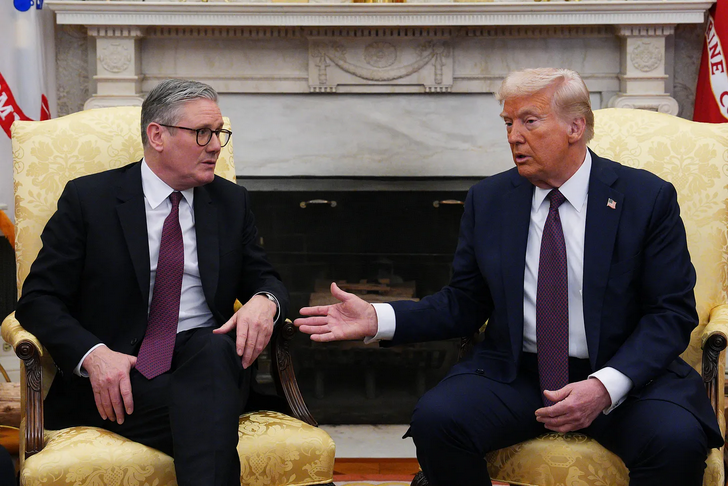
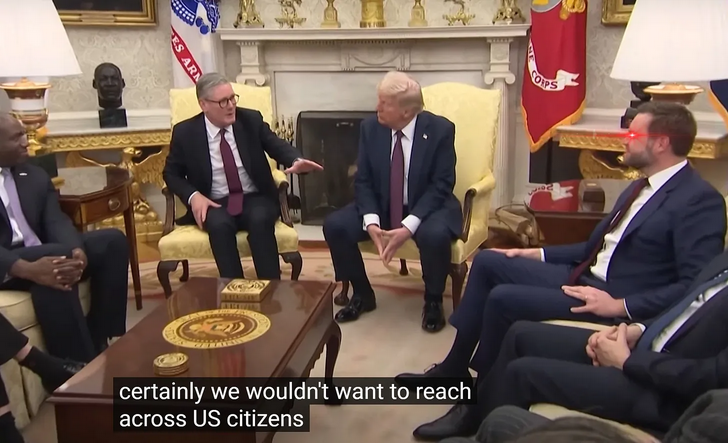
British PM Keir Starmer talks with US President Donald Trump in the White House.
New battle lines are forming in the culture war. While the woke movement appears to be in retreat, the forces of authoritarianism are regrouping for a fresh assault. Rather than maintaining a straightforward conflict between right and left, the next phase of the culture war will most probably be waged between Europe and the United States. It has all the qualities of a novel by Henry James for the digital age, with the distinctions between the old world and the new brought once again into sharp focus.
Free speech will be the key issue. Most of us will have seen the footage of vice-president J. D. Vance last week in the Oval Office taking Keir Starmer to task for the “infringements on free speech that actually affect not just the British” but also “American technology companies and by extension, American citizens”. Starmer pushed back, saying “in relation to free speech in the UK, I’m very proud of our history there”. It’s a bit like Hannibal Lecter boasting about his ongoing commitment to vegetarianism.
The word “history” was apt, given that Starmer’s government is seemingly determined to ensure that free speech is consigned to the past. One of its first acts after seizing power was to ditch the Higher Education (Freedom of Speech) Act. In February, Angela Rayner revealed her plans for the establishment of a sixteen-member council on “Islamophobia” which could see the criticism of religion criminalised. Meanwhile, Yvette Cooper has been staunchly defending the police for recording “non-crime”, while the chairman of the College of Policing, Lord Herbert, has suggested that the best approach to tackling the controversy is to simply rename “non-crime hate incidents” as something more palatable. Apparently Lord Herbert believes that the problem is the nomenclature, not the fact that citizens are being investigated by the armed wing of the state for lawful behaviour.
All of this is before we get to Starmer applying pressure to the judiciary to mete out draconian sentences for offensive posts and memes on social media, and the government’s determination to crack down on online “disinformation”. Ours is an authoritarian government, and Starmer’s Orwellian denial of the truth of his position in the Oval Office is to be expected. Autocrats throughout history have enacted censorship “for the public good”. Today, they target “disinformation”, a term so vague that it can be applied to anyone who questions the narrative of the ruling class.
And so, as I say, the new front of the culture war will most likely be transatlantic. The US government will simply not tolerate the widespread censorship of its citizens by laws passed overseas. Jim Jordan, chairman of the Committee on the Judiciary of the House of Representatives, has already issued subpoenas to eight US tech companies to divulge all communications they have had with the UK government regarding “content moderation” (i.e., censorship). Jordan is particularly concerned about the Labour government’s intention to empower OfCom to regulate social media, and he has specifically mentioned UK officials who “have already threatened to use UK laws to police American speech”.
N.S. Lyons suggested in the latest post at The Upheaval that Vice President J.D. Vance’s real message to the European leaders can be rephrased as “Give Up the Information War and GTFO”:
The political elite of Europe and the Anglosphere appeared shocked by J.D. Vance’s wonderfully blunt speech in Munich last month. The U.S. Vice President declared Washington’s top security concern to be “the threat from within” the NATO alliance and castigated assembled leaders for their increasingly brazen assaults on “democratic values”, including censoring speech, suppressing popular opposition parties, and canceling elections. But if this shock isn’t feigned then it is rather remarkable, given that these elites were in their own way already effectively at war with the United States. All Vance did was point out the nature of this hidden conflict.
Vance delivered multiple messages with his speech, the broadest and most historic of which was that the era of “post-national” globalist liberalism is over. The United States, he indicated, now has a core interest in seeing a Western world that is collectively strong because its sovereign nations are strong, with the self-confidence to independently defend themselves physically, culturally, and spiritually. His emphasis on promoting free speech and democratic legitimacy tied into this message, but was about far more than the importance of “shared values” or even Washington’s new friendliness to nationalist parties. Practically, it was an implied warning that the role Europe has been playing as a proxy actor in the political and ideological conflicts raging in the United States will no longer be tolerated. More specifically, it was a declaration that ongoing transatlantic institutional, technological, and legal support for America’s embattled left-wing deep state must end – or else.
After Donald Trump’s election in 2016, America’s panicked establishment elites reacted by attempting to construct a system for managing public opinion through strict control of information, especially online information. The idea was that growing public support for populism was fueled by “low-information voters” and their consumption of “misinformation” and “disinformation”, including from foreign actors, and that if their “information diet” could just be controlled then they would stop voting wrong. The underlying assumption here was of course that the elite’s own increasingly radical policy preferences were the only rational path, opposable only by the stupid and easily manipulated. As Trump’s defeated opponent Hillary Clinton would later put it, social media platforms had fundamentally changed the information environment and “if they don’t moderate and monitor the content, we lose total control”.
This intended system of thought-control would later grow into the censorship industrial complex that was partially revealed following Elon Musk’s acquisition of Twitter. But a big obstacle initially stood in the way: the U.S. Constitution and its protection of free speech. The public might be receiving the “wrong” information on the internet, but “our First Amendment stands as a major block to be able to just, you know, hammer it out of existence”, as John Kerry lamented in a speech to the World Economic Forum.
Under the Biden administration, this legal problem was partially solved by simply ignoring it, the federal government directly colluding with technology companies and a network of “independent” (state-funded) “fact-checking” organizations to impose mass censorship on American citizens. The result was, as one federal judge later described it, effectively “the most massive attack against free speech in United States’ history”.
A more subtle and sustainable work-around was also discovered, however. This was to circumvent the U.S. Constitution by outsourcing the policing of the internet and populist movements to other countries around the world. This could be done because the internet is global and so the whole network is affected by government regulations on any local market of sufficient size. Leaders on both sides of the Atlantic immediately grasped that legal and regulatory structures imposed by the European Union, with the leverage of its huge unified market, could for example force internet companies the world over – including U.S. companies – to change their behavior in order to comply and avoid losing access (this imperialistic regulatory strong-arming was dubbed the “Brussels Effect”, becoming Europe’s only significant innovation this century).
Comments Off on Trump’s next target – Europe
Colt Boa: Rarest of the Snake Revolvers
Forgotten Weapons
Published 13 Nov 2024Of the seven revolvers Colt named after snakes, the rarest is the Colt Boa. Only a single production run of these were made totaling just 1,200 guns. They were made in 1985 as a custom order for the Lew Horton distribution company, which wanted something unique to offer its buyers. The Boa was an intermediary between the standard Colt MkV and the high-end Python. It was a 6-shot .357 Magnum with a full underlay and ventilated shroud. The only variation was in barrel length, as half were made with 4” barrels and half with 6” barrels. The serial numbers were “BOAxxxx”, with the 4” guns having odd numbers and the 6” ones getting even numbers. Five hundred of each were sold individually, but the first 100 of each length were packaged together into sequentially-numbered pairs in fancy cases.
The Boas all sold in 1985, and they are now the hardest to find for the Colt Snake collector. This particular pair is a gorgeous example of an original cased set, numbers 43 and 44.
(more…)
Comments Off on Colt Boa: Rarest of the Snake Revolvers


