
Atun-Shei Films
Published 15 Mar 2025What caused the American Revolution? Let’s dive beneath the surface-level understanding of British tyranny and unjust taxation and try to understand the long-term social, political, and economic forces which set the stage for our War of Independence.
00:00 Introduction
03:00 1. The World Turned Upside Down
13:50 2. The Paradox of American Liberalism
28:34 3. The Rage Militaire
38:12 Conclusion / Credits
(more…)
March 20, 2025
The REAL Cause of the Revolutionary War
Comments Off on The REAL Cause of the Revolutionary War
March 19, 2025
The Trumpocalypse – “The outlook for universities has become dire”
John Carter suggests that American higher education needs to find a new funding model that doesn’t depend on governments to shower their administrative organizations with unearned loot:
Shortly after taking power, the Trump administration announced a freeze on academic grants at the National Science Foundation and the National Institute for Health. New grant proposal reviews were halted, locking up billions in research funding. Naturally, the courts pushed back, with progressive judges issuing injunctions demanding the funding be reinstated. Judicial activism has so far met with only mixed success: the NSF has resumed the flow of money to existing grants, but the NIH has continued to resist. While the grant review process has been restarted at the NSF, the pause created a huge backlog, resulting in considerable uncertainty for applicants.
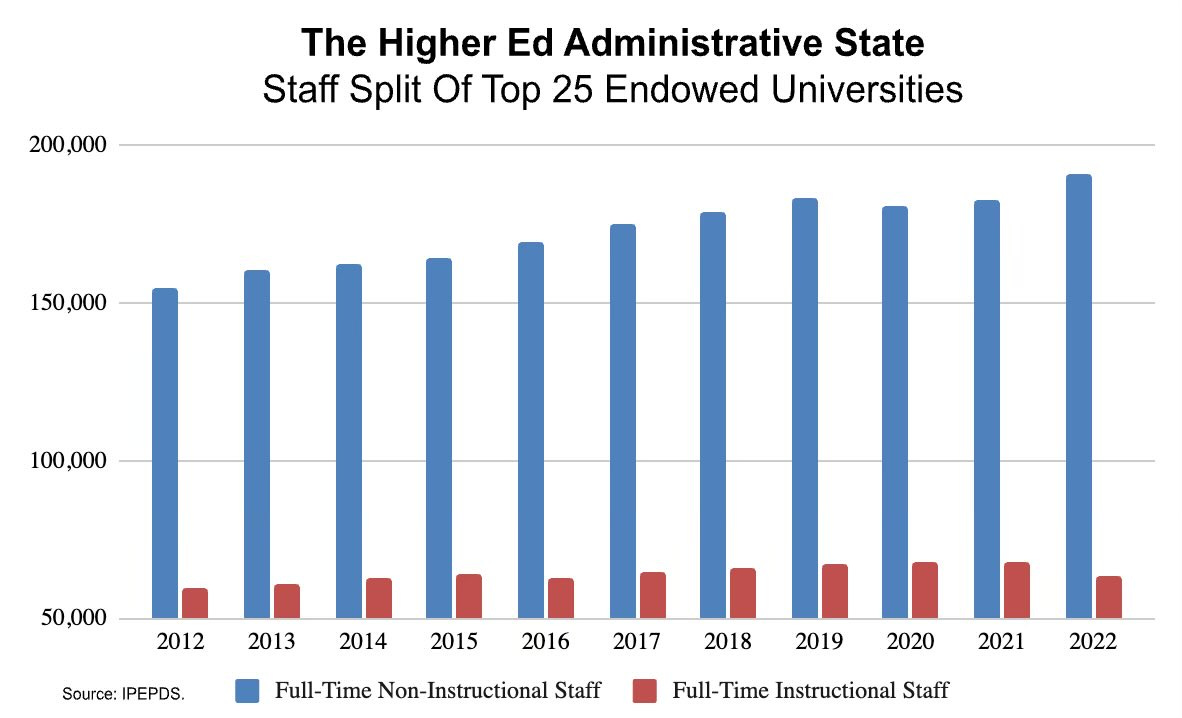
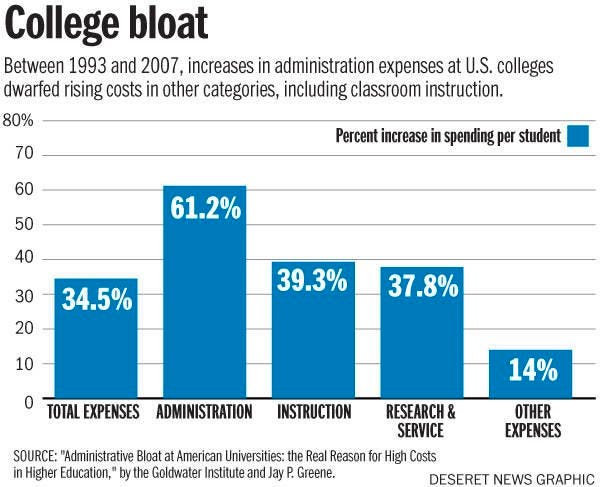
The NIH has instituted a 15% cap to indirect costs, commonly referred to as overheads. This has universities squealing. Overheads are meant to offset the budgetary strain research groups place on universities, covering the costs of the facilities they work in – maintenance, power and heating, paper for the departmental printer, that kind of thing. Universities have been sticking a blood funnel into this superficially reasonable line item for decades, gulping down additional surcharges up to 50% of the value of research grants, a bounty which largely goes towards inflating the salaries of the little armies of self-aggrandizing political commissars with titles like Associate Vice Assistant Deanlet of Advancing Excellence who infest the flesh of the modern campus like deer ticks swarming on the neck of a sick dog. Easily startled readers may wish to close their eyes and scroll past the next few images btw, but I really want to make this point here. When you look at this:
A 15% overhead cap, if applied across the board, has an effect on the parasitic university administration class similar to a diversity truck finding parking at a German Christmas market. Thoughts and prayers, everyone.
Meanwhile at the NSF, massive layoffs are ongoing, and there are apparently plans to slash the research budget by up to 50%. While specific overhead caps haven’t been announced at the NSF yet, there’s every reason to expect that these will be imposed as well, compounding the effect of budget cuts.
There is no attempt to hide the motivation behind the funding freeze, which is obvious to both the appalled and the cuts’ cheerleaders. Just as overheads serve as a blood meal for the administrative caste, scientific research funding has been getting brazenly appropriated by political activists at obscene scales. A recent Senate Commerce Committee report found that $2 billion in NSF funding had been diverted towards DEI promotion under the Biden administration. In reaction to this travesty, as this recent Nature article notes, there are apparently plans to outright cancel ongoing grants funding “research” into gay race communism. DEI programs, formerly ubiquitous across Federal agencies, have already been scrubbed both from departmental budgets and web pages. Indeed, killing those programs was one of the first actions of the MAGA administration.
The outlook for universities has become dire, and academics have been sweating bullets all over social media. Postdocs aren’t being hired, faculty offers are being rescinded, careers are on hold, research programs are in limbo. This comes at the same time that budgets are being hit by declining enrolment due to the demographic impact of an extended period of below-replacement fertility along with rapidly declining confidence in the value of university degrees, with young men in particular checking out at increasing rates as universities become tacitly understood as hostile feminine environments. They’re hitting a financial cliff at the same point that they’ve burned through the sympathy of the general public.
The entire sector is in grave danger.
Politically, going after research funding is astute. Academia is well known to be a Blue America power centre, used to indoctrinate the young with the antivalues of race Marxism, provide a halo of scholarly legitimacy to the left’s ideological pronouncements, and hand out comfortable sinecures to left-wing activists. The overwhelming left-wing bias of university faculties is proverbial. The Trump administration is using the budgetary crisis as a handy excuse to sic its attack DOGE on the unclean beast – starting with cutting off funding to the most ideological research projects, but apparently also intending to ruin the financial viability of the progressives’ academic spoils system as a whole.
Cutting the NSF budget by half may seem at first glance like punitive overkill, and no doubt the left is screeching that Orange Hitler is throwing a destructive tantrum like a vindictive child and thereby endangering American leadership in scientific research. After all, for all the attention that NASA diversity programs have received, the bulk of research funding still goes to legitimate scientific inquiry, surely? However, the problems in academic research go much deeper than its relentless production of partisan activist slop. Strip out all of the DEI funding, fire every equitied commissar and inclusioned diversity hire, and you’re still left with a sclerotic academic research landscape that has spent decades doing little of use – or interest – to anyone, and doing this great nothing at great expense.
Comments Off on The Trumpocalypse – “The outlook for universities has become dire”
The Korean War 039 – Kim Gets ROKrolled – March 18, 1951
The Korean War by Indy Neidell
Published 18 Mar 2025Seoul falls to the South Koreans this week — the 4th time it’s changed hands since last June. There is no big celebration this time, though, since much of the city has been completely destroyed. This is just part of Operation Ripper, which advances all over to little enemy resistance, also taking the important town of Hongcheon.
Chapters
00:00 Intro
00:58 Recap
01:46 Soviet Intervention?
04:22 Operation Rugged
07:01 Task Force 77
09:36 South Korean Porters
11:02 MacArthur and McClellan
13:55 Summary
14:13 Conclusion
(more…)
Comments Off on The Korean War 039 – Kim Gets ROKrolled – March 18, 1951
Moore Teatfire Revolver
Forgotten Weapons
Published 21 Jun 2015The Moore patent “teatfire” revolver was one of the more (no pun intended) successful workarounds to the Rollin White patent. Designed by Daniel Moore and David Williamson, the gun was a six-shot .32 caliber pocket revolver which used a proprietary type of cartridge. It was loaded from the front, and the rear of the case had a nipple in its center full of priming compound. This allowed the rear of the cylinder to only have a small hole through which the hammer could reach to hit the nipple and fire the round, as opposed to a rimfire design in which the whole rear of the cartridge had to be exposed at the back of the cylinder. Some examples, including this one, included a unique type of extractor for pushing out spent cases.
Comments Off on Moore Teatfire Revolver
March 18, 2025
Getting rid of Houthi and the Blowfish
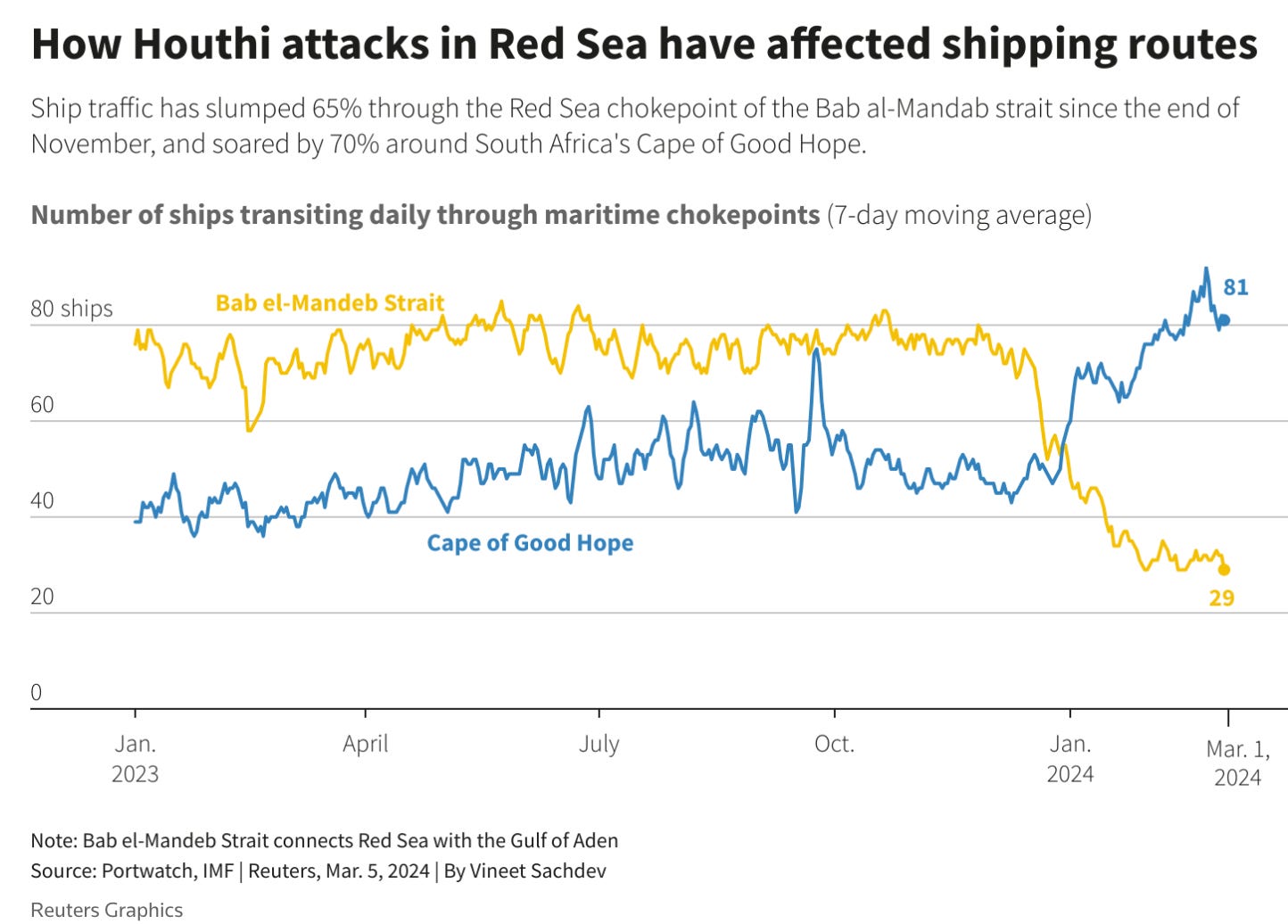
It has been alarming just how long the west — and especially the United States — have been willing to put up with Houthi attacks on shipping going through the Red Sea. President Trump has indicated that American patience has run out, as CDR Salamander discusses:

The Houthi Ansarullah “Al-Sarkha” banner. Arabic text:
الله أكبر (Allah is the greatest)
الموت لأمريكا (death to America)
الموت لإسرائيل (death to Israel)
اللعنة على اليهود (a curse upon the Jews)
النصر للإسلام (victory to Islam)
Image and explanatory text from Wikimedia Commons.
… in the almost 18 months since the Houthi rebels have been attacking Western shipping in the Red Sea, we have mostly been playing defense.
Why have we been playing defense? The Biden Administration, like the Obama Administration, was worm-ridden with Iranian accommodationalists. The Houthi, like Hamas and Hezbollah, are Iranian proxies.
After the murder, rape, slaughter, and kidnapping from Gaza into Israel on October 7th, 2023 by Iranian proxies, the Houthi started their campaign of support — as directed by Iran — by attacking shipping in the Red Sea.
It could not be ignored, but we never took the needed action. We did not even do half-measures. At best we did quarter-measures.
The attacks continued and our credibility on the world stage degraded in proportion to that.
As we have discussed often here, we have a few thousand years of dealing with piracy and bad-faith actors on the high seas. It has direct costs in commerce, treasure, and lives.
This cannot be allowed to continue.
Over the weekend, the new Trump Administration put down a marker. We seem to have ratcheted things up a bit. Not much available on open source, but over the weekend, CENTCOM put out a few things;
CENTCOM Forces Launch Large Scale Operation Against Iran-Backed Houthis in Yemen On March 15, U.S. Central Command initiated a series of operations consisting of precision strikes against Iran-backed Houthi targets across Yemen to defend American interests, deter enemies, and restore freedom of navigation.
[…]
Where is all this going? Well, let’s establish a few things first.
- Clearly what we were doing was not working.
- The Houthi are a 4th rate non-naval power. We like to tell everyone that, though we are the world’s second largest navy, we are the most capable. If we can’t keep the Houthi away from shipping through a major Sea Line of Communication, then why should anyone expect we could do more.
- Europe won’t/can’t help. They not only lack the capability to project power ashore against the Houthi to any reasonable measure, they lack the will.
- China does not care. It does not impact them. They benefit from this chaos against the West.
- Russia thinks this is wonderful.
- Iran can’t believe we are letting this go on. The Houthi are the last significant proxy, so they will do all they can to keep them going.
The lines are fairly clear right now. Not much room to maneuver. Looks like we will be at this for awhile. More extended range time.
Comments Off on Getting rid of Houthi and the Blowfish
QotD: Lester Thurow and the other cheerleaders for “Industrial Policy” in the 1980s
The late Lester Thurow was quite popular in the 1980s and 1990s for his incessant warnings that America was losing at the game of trade with other countries. Most ominous, Thurow (and others) warned, was our failure to compete effectively against the clever Japanese who, unlike us naive and complacent Americans, had the foresight to practice industrial policy, including the use of tariffs targeted skillfully and with precision. Trade, you see, said Thurow (and others) is indeed a contest in which the gains of the “winners” are the losses of the “losers”. Denials of this alleged reality come only from those who are bewitched by free-market ideology or blinded by economic orthodoxy.
And so – advised Thurow (and others) – we Americans really should step up our game by taking many production and consumption decisions out of the hands of short-sighted and selfish entrepreneurs, businesses, investors, and consumers and putting these decisions into the hands of the Potomac-residing wise and genius-filled faithful stewards of Americans’ interest.
Sound familiar? It should. While some of the details from decades ago of the news-making proponents of protectionism and industrial policy differ from the details harped on by today’s proponents of protectionism and industrial policy, the essence of the hostility to free trade and free markets of decades ago is, in most – maybe all – essential respects identical to the hostility that reigns today.
Markets in which prices, profits, and losses guide the decisions of producers and consumers were then – as they are today – asserted to be stupid, akin to a drunk donkey, while government officials (from the correct party, of course) alone have the knowledge, capacity, willpower, and power to allocate resources efficiently and in the national interest.
Nothing much changes but the names. Three or four decades ago protectionism and industrial policy in the name of the national interest was peddled by people with names such as Lester Thurow, Barry Bluestone, and Felix Rohatyn. Today protectionism and industrial policy in the name of the national interest is peddled by people with different names.
Don Boudreaux, “Quotation of the Day…”, Café Hayek, 2020-03-12.
Comments Off on QotD: Lester Thurow and the other cheerleaders for “Industrial Policy” in the 1980s
March 17, 2025
America’s modern Triumvirate
Last month, I posted John Carter’s amusing riff on Trump, Musk, and Vance as the American Pompey, Crassus, and Caesar, the original Triumvirate. Apparently John isn’t the only one struck by the similarities, as David Friedman also considers the three as America’s modern Triumvirate:

Trump, Vance, and Musk as America’s Triumvirate – Grok
Trump is the most important at present, since both Vance and Musk have political power only to the extent he gives it to them. He is a very competent demagogue, as demonstrated by his winning a series of political conflicts that almost everyone expected him to lose. So far as I can tell from his history he has no political views of his own, uses ideology as a tool to get power, attention, status. Conservatives were a substantial faction unhappy with the state of the nation, with what they viewed as the political and cultural domination of the country by their opponents, hence a potential power base for him. Progressives had overplayed their hand, pushed woke ideology too far, due to face a backlash, useful as enemies. He adopted the role of conservative champion, destroyer of wokeism, borrowing details of his program most recently from Project 2025, a detailed conservative plan for how a conservative administration could restructure the federal government.
Trump’s Ukraine policy is to produce a peace for which he could claim credit, a deal that holds until at least 2028. To force Zelensky to accept he had to make it believable that he was willing to drop US support for Ukraine if Ukraine refuses to go along, and he did. To force Putin to accept he will have to make it believable that the US is willing to continue, even expand, support for Ukraine if Russia refuses to accept a peace plan.
[…]
Assuming no rupture with Trump and no failure of their administration extreme enough to break Trump’s control over his party, Vance will be the Republican nominee in 2028. He is young, handsome and smart with a beautiful and intelligent wife, is playing a minor role now but could be a major political figure in the post-Trump world. Unlike Trump he has political views of his own, not merely the desire for power. What are they?
I devoted two of my earlier posts to trying to answer that question, Vance and Revising the Republican Party. My conclusion:
The conservative movement of Bill Buckley rejected the New Deal. Vance does not. The past he wants to return to is an idealized version of America in the fifties, perhaps the sixties. The movement he wants to build rejects both the pro-market economics of the pre-Trump conservative movement and the cultural program of current progressives. He wants an America of stable marriages, views parents as more reliably committed to the future than the childless — hence the much-quoted line about childless cat ladies. One of his more intriguing proposals is that children should get votes, cast by their parents, giving a family with three children five votes.
…
The Republican party Vance wants to build looks, economically, like the Democratic party of the fifties and sixties, culturally like the inverse of the progressive, aka woke, movement.
[…]
The project the three of them are attempting is a full scale revision of the federal government. Of the three, Musk is the one who might be competent to do it. Trump’s skill is charisma, the ability to get people to pay attention to him, admire him, want to please him. That is how he got to a position from which to revise the government but it is not the skill needed to do it. Vance has demonstrated even less of the relevant abilities; his accomplishments so far are writing a very interesting book and winning a senate election
Musk, in contrast, has created two very successful firms, taken over and revised a third. None were projects on the scale of what he is now attempting but they are smaller projects of the same sort. Hence it is at least possible that, with the authority Trump has so far been willing to delegate to him, he can convert the federal government into something smaller, less expensive, better functioning, judged at least by the standards of Trump and his supporters.
Comments Off on America’s modern Triumvirate
QotD: Myths from Norman Rockwell’s America
The complaint generally continues that we were robbed of this by bad policy choices. But that is at best only half true.
World War II smashed almost the entire industrial capacity of the world outside the U.S., which exited with its manufacturing plant not only intact, but greatly improved by wartime capitalization. The result was that for about 30 years, the US was a price-taker in international markets. Nobody could effectively compete with us at heavy or even light manufacturing.
The profits from that advantage built Norman Rockwell’s America — lots of prosperous small towns built around factories and mills. Labor unions could bid up salaries for semi-skilled workers to historically ridiculous levels on that tide.
But it couldn’t last. Germany and Japan and England recapitalized and rebuilt themselves. The Asian tigers began to be a thing. U.S. producers facing increasing competitive pressure discovered that they had become bloated and inefficient in the years when the penalty for that mistake was minimal.
Were there bad policy choices? Absolutely. Taxes and entitlement spending exploded because all that surplus was sloshing around ready to be captured; the latter has proven politically almost impossible to undo.
When our windfall finally ended in the early 1970s, Americans were left with habits and expectations formed by the long boom. We’ve since spent 50 years trying, with occasional but only transient successes, to recreate those conditions. The technology boom of 1980 to 2001 came closest.
But the harsh reality is that we are never likely to have that kind of advantage again. Technology and capital are now too mobile for that.
Political choices have to be made within this reality. It’s one that neither popular nor elite perception has really caught up with.
Eric S. Raymond, X (the social media platform formerly known as Twitter, 2024-07-08.
Comments Off on QotD: Myths from Norman Rockwell’s America
March 16, 2025
Female sexual predators
Every civilized person rejects the notion that male sexual predators should be tolerated, yet few are willing to accept the notion that female sexual predators might even exist. They absolutely do exist and they do commit terrible crimes against their — often very young — victims, as Janice Fiamengo shows:
Even when we are aware that women prey on children, many of us can’t really believe it. When Florida Congresswoman Anna Luna, a Republican elected to the U.S. House of Representatives, proposed three new bills last year that would impose harsh penalties, “including the death penalty”, for various forms of sexual abuse, child pornography, and child sexual exploitation, it is impossible to believe that Luna thought any number of women would be executed for child rape, and nor will they be given the leniency that is shown to women in the criminal justice system (see Sonja Starr’s research).
Yet similar crimes to Ma’s are easily discovered. In the same month that Ma pled guilty, a Martinsville, Indiana teacher was charged with three counts of sexual misconduct against a minor, a 15-year-old boy who has alleged that as many as ten other students were raped by the same woman. The month before that, a New Jersey primary school teacher was charged with aggravated sexual assault against a boy who was 13 years old when she bore his child; it is alleged that she began raping the boy when he was 11. The month before that, a Tipton County, Tennessee teacher [pictured below] pled guilty to a dozen sex crimes against children ranging in age from 12-17 years old. It is thought that she victimized a total of 21 children.
In the same month, a Montgomery, New York teacher pled guilty to criminal sexual assault of a 13 year old boy in her class, whom she assaulted over a period of months. In the previous month, a San Fernando Valley teacher was charged with sexual assault of a 13 year old male student; police believe she victimized others also. Earlier in the year, a substitute teacher in Decatur, Illinois was charged with raping an 11 year old boy. These are just a few recent cases, and only those involving female schoolteachers. Female predators are also to be found amongst social workers, juvenile detention officers, and sports coaches.
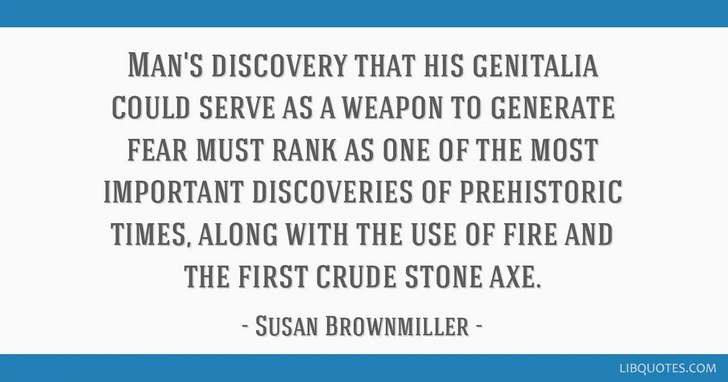
The feminist position on male sexual abuse of women and girls has for a long time been that it is about power. Men rape and abuse, according to Susan Brownmiller [quoted above] and others, because they believe it their right as men to keep women subordinate. Rape compensates for male inadequacy and allows for the expression of men’s hostility toward women: it is not about lust but about men’s need to humiliate and degrade. As Paul Elam once noted in a Regarding Men episode, the theory is fatally weakened if even a single woman does the same thing. Feminists have responded by saying that female sexual abuse is fundamentally different from male, less dangerous to society, less hurtful to its victims.
While I was doing research for this essay, I happened upon a recent podcast discussion between Louise Perry, British author of The Case Against the Sexual Revolution, and Meghan Murphy, Canadian Substack author and editor of Feminist Current. The podcast was called “What Happened to Feminism?” and I tuned in because I have enjoyed their perspectives on other issues.
Perry and Murphy are both critics of feminism who remain, as their conversation confirmed, staunchly feminist and anti-male. At one point in the podcast (at about 50:00), the conversation turned to #MeToo, and especially to allegations against teachers. Having already agreed that 95% of MeToo allegations were true, or at least based on something real, the pundits went on to agree, with disconcerting laughter, that there was no comparison between a “crazy” woman who “had sex” with a male student in her class, and a “dangerous” man, a “predatory rapist”, who went after under-age girls in his power.
Murphy even trotted out the old chestnut that abused boys were “stoked about the situation” in getting with “the hot teacher”. After all, she chuckled, “Men are gross predators. Men are perverts. They can’t keep it in their pants.” Perry, seeming taken aback by Murphy’s vulgarity, nonetheless agreed that the sexual abuse of boys is in an entirely different category from that of girls: “It is so annoying to me,” she said, “when people will go around claiming that these are exactly the same”.
Indifference to the victimization of boys, and lack of shame in admitting it, could hardly have been more stark. I mention the podcast not because it was singularly outrageous but because the attitudes expressed in it are still so much the norm, even amongst women who claim to have rethought other feminist beliefs.

Comments Off on Female sexual predators
George Hyde’s First Submachine Gun: The Hyde Model 33
Forgotten Weapons
Published 11 Mar 2018George Hyde was a gun designer who is due substantial credit, but whose name is rarely heard, because he did not end up with his name on an iconic firearm. Hyde was a German immigrant to the United States in 1927 who formed the Hyde Arms Company and started designing submachine guns. His first was the Model 33, which we have here today. This quickly evolved into the Model 35, which was tested by Aberdeen Proving Grounds in the summer of 1939. It was found to have a number of significant advantages over the Thompson, but also some durability problems. The problems could probably have been addressed, but Hyde (who had gone from working as shop foreman at Griffin & Howe to later becoming chief designer for GM’s Inland division during WWII) had already moved on to a better iteration. His next design was actually adopted as the M2 to replace the Thompson, but production problems caused it to be cancelled. The M3 Grease Gun was chosen instead, and Hyde had designed that as well. He was also responsible for the design of the clandestine .45 caliber Liberator pistol.
The Hyde Model 33 is a blowback submachine gun which obviously took significant influence from the Thompson — just look at the front grip, barrel ribs, controls, magazine well, and stock design. However, it was simpler, lighter, and less expensive than the Thompson. It fared better than the Thompson in military mud and dust tests, probably in part because of its unusual charging handle, a long rod mounted in the rear cap of the receiver. This was pulled rearward to cycle the bolt, a bit like the AR15 charging handle. Like the AR15, this setup eliminated the need for an open slot in the receiver. Apparently, however, the handle had a disconcerting habit of bouncing back into the face of the shooter when firing.
Cool Forgotten Weapons merch! http://shop.bbtv.com/collections/forg…
Comments Off on George Hyde’s First Submachine Gun: The Hyde Model 33
March 15, 2025
Trump’s actual goal in Ukraine
David Friedman posted this a couple of days ago, considering what President Trump’s real goals may be in the Russo-Ukraine conflict:

There are two possible interpretations of Trump’s policy. The pessimistic one is that he plans to give Putin what he wants, force Zelensky to accept peace terms that give Russia substantial amounts of Ukrainian territory and leave Ukraine disarmed and defenseless against future Russian demands. On that theory the clash with Zelensky was a pre-planned drama intended to provide an excuse for the US withdrawing support, make it less obvious that Trump now supports Putin. As of Monday that looked like a plausible reading of the situation.
The optimistic reading was that Trump wanted to force an end to the war on compromise terms, use the withdrawal of support to force Zelensky to agree. Tuesday’s news, Zelensky agreeing to a proposed cease fire and Trump responding by resuming US support for Ukraine, is evidence for that reading. The ball is now in Putin’s court. If he rejects the proposal Trump will be under pressure to continue, perhaps even increase, US support. That is a reason for him not to reject the proposal. My guess is that Putin will agree to a temporary cease fire, at least in principle, although he may haggle over details, try to push for a version more favorable to him.
What Trump wants, on the optimistic interpretation, which I now find likely, is to end the war. To do that he needs to find terms that both sides will accept. Zelensky will not accept terms that amount to surrender — even if the US abandons him, he has the option of continuing the war with increased support from the European powers, now moving to rearm. If they are sufficiently committed to Ukraine or sufficiently annoyed at the US they should be able to replace most, although not all, of what the US has been providing, if necessary with munitions purchased from the US; it is hard to imagine even Trump forbidding US arms manufacturers from selling to allies. Ukraine would be worse off than continuing the war with US support but, if Russia is willing to agree to terms Trump approves of and Ukraine is not, that will not be an option.
Putin was, despite American support for Ukraine under the previous administration, winning, although very slowly and at considerable cost. Unless Trump is willing to respond to Russian rejection of his peace plan by greatly increasing US support, which I think unlikely — no boots on the ground nor wings in the air — Putin has the option of returning to that, so will not accept anything much less. That suggests that the most likely terms amount to an extended cease fire. Ukraine does not disarm, Russia does not withdraw from territory it is occupying. Both sides stop blowing things up on territory controlled by the other, stop shooting at each other.
Judged by territorial control that is a win for Russia, since it ends up controlling most of what it wanted, the parts of Ukraine occupied by Russian speakers plus the areas that can block the water supply into Crimea, with Ukraine even further from recovering Crimea than before. That might be enough to let Putin present it to his population has a victory sufficient to justify the decision to invade Ukraine.
Seen from the outside, it would be an expensive victory, which might be enough to deter future adventurism or a renewal of the war. To get it, Russia has consumed a large part of the store of military equipment inherited from the Soviet Union, making it less formidable in any future conflict with Ukraine or anyone else. Worse still, the war has driven two neutral powers, both militarily substantial and one of them on the Russian border, into joining NATO. And between Putin and Trump they may have pushed the European powers into finally rearming. The population of the European NATO members is several times that of Russia, their economies as well:
“It’s striking but it’s true. Right now, 500 million Europeans are begging 300 million Americans for protection from 140 million Russians who have been unable to overcome 50 million Ukrainians for three years.” (Donald Tusk, prime minister of Poland)
What would be the effect of an extended pause in the war on the balance of power between Russia and Ukraine, the prospects for a renewed conflict? Both Russia and Ukraine will be able to rebuild what the war has destroyed; that will be a bigger benefit for Ukraine, since it has lost much more. One of Russia’s advantages in the war was that it not only had more munitions, it could build more, could fire far more shells at Ukrainian forces than Ukraine could fire back. An extended pause will give Ukraine and its allies time to build the factories they need. It will give states not involved in the war, such as South Korea and India, time to build up supplies of armaments and ammunition some of which can be sold to Ukraine when and if the pause ends. It will give US arms firms time to expand for a world where there is increased demand for what they produce.
If the European powers go through with their current talk of greatly increased military expenditure and continue to back Ukraine, there will be much more money bidding for arms on behalf of Ukraine than on behalf of Russia. That could shift the balance when and if the war resumes.
Comments Off on Trump’s actual goal in Ukraine
Eliminating “environmental justice” from the EPA
J.D. Tuccille suggests that you not take the New York Times coverage too literally as they wail about the Trump administration’s plans for the Environmental Protection Agency:

If you were to believe reporting from The New York Times — which is an increasingly unwise idea — the Trump administration is diverting the attention of the Environmental Protection Agency (EPA) from poor and minority communities that face “disproportionately high levels of pollution”. But if you scratch the surface even a bit, you find that what’s really being eliminated are “environmental justice” offices that infuse identitarian ideology into EPA enforcement efforts. Americans should welcome efforts to strip racial obsessions from the armory of regulators who already wield too much power.
Competing Takes on “Environmental Justice”
“The Trump administration intends to eliminate Environmental Protection Agency offices responsible for addressing the disproportionately high levels of pollution facing poor communities, according to a memo from Lee Zeldin, the agency administrator,” Lisa Friedman wrote for the Times. She added that the memo directed the reorganization and elimination of “offices of environmental justice at all 10 E.P.A. regional offices as well as the one in Washington”.
Contrast that with a press release from the EPA, which states “that EPA will immediately revise National Enforcement and Compliance Initiatives to ensure that enforcement does not discriminate based on race and socioeconomic status (as it has under environmental justice initiatives) or shut down energy production and that it focuses on the most pressing health and safety issues”.
Whatever you think of the Trump administration in general, EPA Administrator Zeldin is on the right side of this debate. As I wrote in 2022 when the Biden administration formally introduced “environmental justice” concerns to the EPA, the term refers to “a decades-old school of thought that seeks to graft identitarian politics onto environmental concerns. That allows practitioners to wield civil rights law in addition to traditional environmental laws against perceived malefactors. It also makes it possible to slam offenders as ‘bigots’ if their actions affect one community more than another.”
There’s no need to read between the lines to figure out what is meant by “environmental justice” — its advocates are quite clear about their meaning. In 2021, the Northeastern University School of Public Policy and Urban Affairs published A User’s Guide to Environmental Justice: Theory, Policy, & Practice by Ken Kimmell, Alaina Boyle, Yutong Si, and Marisa Sotolongo.
The Ideology’s History of Racial Obsessions
“The demand for ‘environmental justice’ (EJ) has gained substantial traction in the last few years, as well it should,” the authors wrote in their introduction. “A key pillar in EJ will be widespread, community-designed and community-supported investment in neighborhoods that have been economically and environmentally burdened by a long history of racist government and industry decisions.”
“The environmental justice movement has evolved in parallel with and in response to traditional environmentalism to focus on the unequal distribution of environmental harms among different people and communities,” the authors add in summarizing the history of the movement. “Research revealing the whiteness of the environmental community elevated concerns that social justice and racial justice were not prioritized in mainstream environmentalism.”
“Applying the Civil Rights Act of 1964, which prohibits discrimination based on race, color, or national origin … frontline communities and others began to use the term ‘environmental racism’ to focus on the unequal (social and spatial) distribution of environmental burdens,” they continue.
Comments Off on Eliminating “environmental justice” from the EPA
March 14, 2025
Firefly and the Lost Cause
Feral Historian
Published 8 Nov 2024I’ve often been questioned for making Civil War comparisons when discussing Firefly. Here I explain why Firefly not only reflects but is based on the Lost Cause mythology of the Confederacy.
For further background on how secession was framed at the start of the American Civil War, battlefields.org has plain text copies of several of the Confederate States’ declarations of causes for secession up at https://www.battlefields.org/learn/pr…. You can see how slavery is mentioned a lot, but often framed in terms of the second-order effects of Northern policy damaging their economy, infringing on sovereignty, etc. It varied by state of course, Virginia kept it vague with references to the Federal government “perverting said powers” granted it, while Mississippi was very clear about slavery being the cause.
00:00 Intro
01:12 The Lost Cause
03:27 Selling the Peace
05:28 Causes
06:59 Firefly as a Lost Cause
Comments Off on Firefly and the Lost Cause
QotD: You can’t cut taxes without disproportionally benefitting “the wealthy”
Anybody who uses the phrase “tax cuts for the wealthy” to gin up opposition to lowering taxes is either a dupe or a villain.
How do I know this? Do some research. Find a graph of how income taxes paid segregates by wealth of the payer. I’d post one here, but X hates links.
The bottom 40% in income pay effectively nothing in income tax. The “rich” pay such a disproportionately high percentage of it that the tax take of entire states can be significantly affected by a handful of high-net-worth individuals moving out. In Europe this happens to small countries.
Because of this, it is effectively impossible to cut taxes in any way at all without disproportionately benefiting the “wealthy”.
When demagogues like Reich honk about “tax cuts for the wealthy”, what they actually mean is: taxes should never decrease. The state should confiscate and reallocate more and more wealth, forever and ever, amen.
March 13, 2025
This explains a lot … IRS employees aren’t issued personal computers (in 2025!)
You sometimes read a small item and the information in it is so unexpected, it’s like being suddenly dumped into icy cold water, like this little item from Reason‘s “Morning Roundup” email:

Everything’s computer! But not at the IRS.
“The upheaval at the IRS is already having real impacts,” reports The Washington Post, referring to plans (already underway) to reduce the workforce by half. “Sources familiar with the agency report that its level of phone service is falling, in part because employees are spending their time waiting to use shared computers to respond to [the Department of Government Efficiency’s] requests for weekly emails detailing their work. (Not all IRS employees are issued their own computers.) And they report that taxpayer behavior is already adjusting to the reality of a diminished IRS workforce: IRS receipts — taxes paid already and taxes the agency is scheduled to receive from those who have already filed — are significantly lower than they were at this point last filing season.”
Wait, back up. They don’t have their own computers? And they’re sitting in a queue like schoolchildren in the library, waiting to use a single shared computer to respond to Musk’s five-things-you-did-last-week emails? How long does it take to write those emails? And why don’t they have computers?
Look, I’m worried by the slapdash approach Elon Musk’s Department of Government Efficiency has taken. But the continued federal employee freakout over being asked to justify their jobs by detailing what they’ve done at work makes no sense to me.
I know a girl from college who is a “Work-Life Specialist and Mindfulness Facilitator” at the U.S. Department of Transportation. She leads yoga sessions and “meditation made simple” workshops for federal employees, per her LinkedIn. This is a job I don’t want my taxpayer dollars funding. For Musk to apply scrutiny to this type of thing is a huge win for the American people.
There are lots of legitimate criticisms to make about whether cuts in staffing will actually lead to a better IRS. Taxpayer services will surely suffer if there are fewer people available to answer phone calls and emails; refunds might be delayed, which comes at a real cost to people. Worse tax collection means less revenue for the government, and it’s not like spending is under control — expect the fiscal hole we’re in to get worse if this continues. But “we just can’t figure out how to ration computer use in the year 2025 to craft a bullet-pointed email” is an absurd line that elicits no sympathy, and just leaves me confused about what the hell they’ve been doing all this time. Everything’s not, in fact, computer in the federal government.
Comments Off on This explains a lot … IRS employees aren’t issued personal computers (in 2025!)


