
The Korean War by Indy Neidell
Published 25 Mar 2025Harry Truman is moving forward with his plans to somehow end the fight with the Chinese, but Douglas MacArthur takes a hatchet to those plans. Truman is furious, and the question remains, for how long will MacArthur’s defiance be tolerated? In the field, Operations Ripper, Courageous, and Tomahawk are in action, but are all disappointing for the UN forces, as they fail in their mission to destroy the enemy’s war making capacity. They don’t actually do much of that at all.
Chapters
00:00 Intro
00:51 Recap
01:08 Operation Ripper Ends
04:09 Operation Courageous
06:20 Operation Tomahawk
09:44 MacArthur’s Sabotage
13:27 Summary
13:36 Conclusion
(more…)
March 26, 2025
The Korean War Week 040 – MacArthur Sandbags Truman – March 25, 1951
Comments Off on The Korean War Week 040 – MacArthur Sandbags Truman – March 25, 1951
Rich country foreign aid – threat or menace?
John H. Cochrane on the benefits and harms that aid from rich countries has done to the poor recipient nations around the world:

At half the dinners I go to, someone says, well, yes, a lot of the USAID money was mis-spent, but what about the poor starving children in Africa? If you are in that situation, this is the article for you.
This article is about about the centerpiece of aid: “development” aid, designed to boost economic growth, not about the politicized “nonprofits” that USAID was supporting and their bloated staffs, funneling aid money to political advocacy and employment, promoting American self-loathing around the world, and so forth.
Development spending accounts for almost three-quarters of all aid.
And the enterprise is a colossal failure.
The capital of Malawi, one of the world’s poorest countries, runs on aid. A city built in the 1970s by the World Bank, Lilongwe’s straight streets are filled with charities, development agencies and government offices. Informal villages house cooks and cleaners for foreign officials; the entrance to each is marked with the flag of its national sponsor.
The money is small compared to advanced country GDP, but huge compared to poor country government resources […]
The results of such spending are no better in Malawi than in the US — even if it’s free to the recipient. Add the preference of aid advocates for “sustainable” or “appropriate” and “green” technology, including these days hostility to GMO foods, and social or environmental wrappers, “climate justice” and so on, indeed even the hostility to capitalism, “consumerism” and growth itself and it’s not a surprise this is a rathole. (Again, it’s cheap from our perspective. The problem is that it’s wholly ineffective. If money really could jump start growth, that would be great.)
One of the central conundrums of aid is that it can destroy local industry. Sending food, for example, seems like a no-brainer of mercy. And in a war, crop failure, or other catastrophe it is. But sending food on a regular basis bankrupts local farmers.
Central idea 1: Imagine just how happy the US might be if China decided in its mercy to tax Chinese citizens, buy crops at overvalued prices (which incidentally pleases Chinese farmers), and send bags of rice to the US for free, marked “gift of the CCP”, thereby bankrupting US rice farmers. Or if it decided to send us really cheap electric vehicles to help us speed towards net zero, thereby undermining our own state-supported EV business. Well, you know exactly how our government feels about this sort of thing! And this is exactly what aid does.
Now, a good free market economist welcomes subsidized imports, and a push to leave agriculture and move to export-oriented manufacturing or other higher value industries. But Malawi doesn’t have other higher value industries, and exporting anything to the advanced economies is getting harder and harder. Extending the old proverb, send a man a fish a day forever, and he forgets how to fish.
The article opened my eyes (some more) to the delicate intertwining of economics and politics. We really don’t live in a free market world in the US (note our executives rushing to change ideology and please the new team in Washington), and even less so in poor countries.
Western aid officials often want to prevent local politicians, who control crucial industries, from profiting as a result of their projects, meaning they select obscure sectors for tax breaks, credit and subsidies. With few investors willing to stump up capital, and little interest from local politicians, the businesses duly flop.
Here is a conundrum for you. Without 10% off the top for the big guy, businesses will flounder.
Comments Off on Rich country foreign aid – threat or menace?
March 25, 2025
Analyzing the structure of Tim Walz’s “joke”
On his Substack, Jim Treacher shares his deep knowledge of the cultural and linguistic complexities of the humour of Minnesota Governor Tim Walz:

Tim Walz as a standup comedian
Fake image generated with Grok
A joke is a delicate thing.
Let’s say you write a joke and then tell it to some people. The joke might “kill” (get a big laugh) with one audience, but then it might “die” (be met with stony silence or outright anger) with another audience.
Maybe you don’t get the wording quite right: “Why did the chicken cross the street? Wait, no …” Maybe the crowd doesn’t understand a reference you’re making. Maybe it’s just not your day. It can take a lot of work to perfect a joke, and any number of things can still go wrong. You’ll fail at least as often as you succeed, and past performance does not guarantee future results.
I’ve never done stand-up comedy because it would require me to leave the house, but I do have a bit of experience writing jokes for television. And sometimes, a joke I thought was funny when I wrote it in the morning just doesn’t land with that evening’s audience. It’s a crummy feeling, but that’s showbiz.
So, I know just how Tim Walz feels these days!
Last week he made a really funny joke, but a lot of people weren’t smart enough to get it because they’re not Democrats […]
I was saying, on my phone, some of you know this, on the iPhone they’ve got that little stock app? I added Tesla to it to give me a little boost during the day. 225 and dropping!
And if you own one, we’re not blaming you. You can take dental floss and pull the Tesla thing off, you know.
Ha ha ha ha ha! [SLAP KNEE, BUST GUT, ETC.]
I will now analyze this brilliant joke, using my hard-won comedy experience, and explain why you’re misguided for not laughing.
You’re welcome.
Now, to the uninitiated, it might sound like Tim Walz is celebrating the misfortune of an opponent. “Ha-ha, your stock is dropping. It’s funny because I don’t like you!” The humor of the bully. Trying to out-Trump Trump.
You might think the audience laughed because they hate Elon Musk so much that they’re happy when he fails, even when it hurts a lot of other people. Maybe even themselves.
But here’s the big twist: That’s not it at all!
See, Governor Walz was being self-deprecating.
When he made that really, really good joke, he already knew that his own state holds 1.6 million shares of Tesla stock in its retirement fund. He was well aware that he was celebrating the misfortune of his own constituents.
But his stage persona didn’t know that.
Comments Off on Analyzing the structure of Tim Walz’s “joke”
March 24, 2025
Canada could learn from the Finnish example
US President Donald Trump tossed several grenades into the still waters of Canadian defence platitudes and forcefully called attention to the clear fact that Canada has been a world-leader in defence freeloading since the late 1960s. In The Line, Tim Thurley suggests that Canada should look more closely at how Finland has maintained its sovereignty with a larger, militarily dominant, and unpredictable neighbour for more than a century:
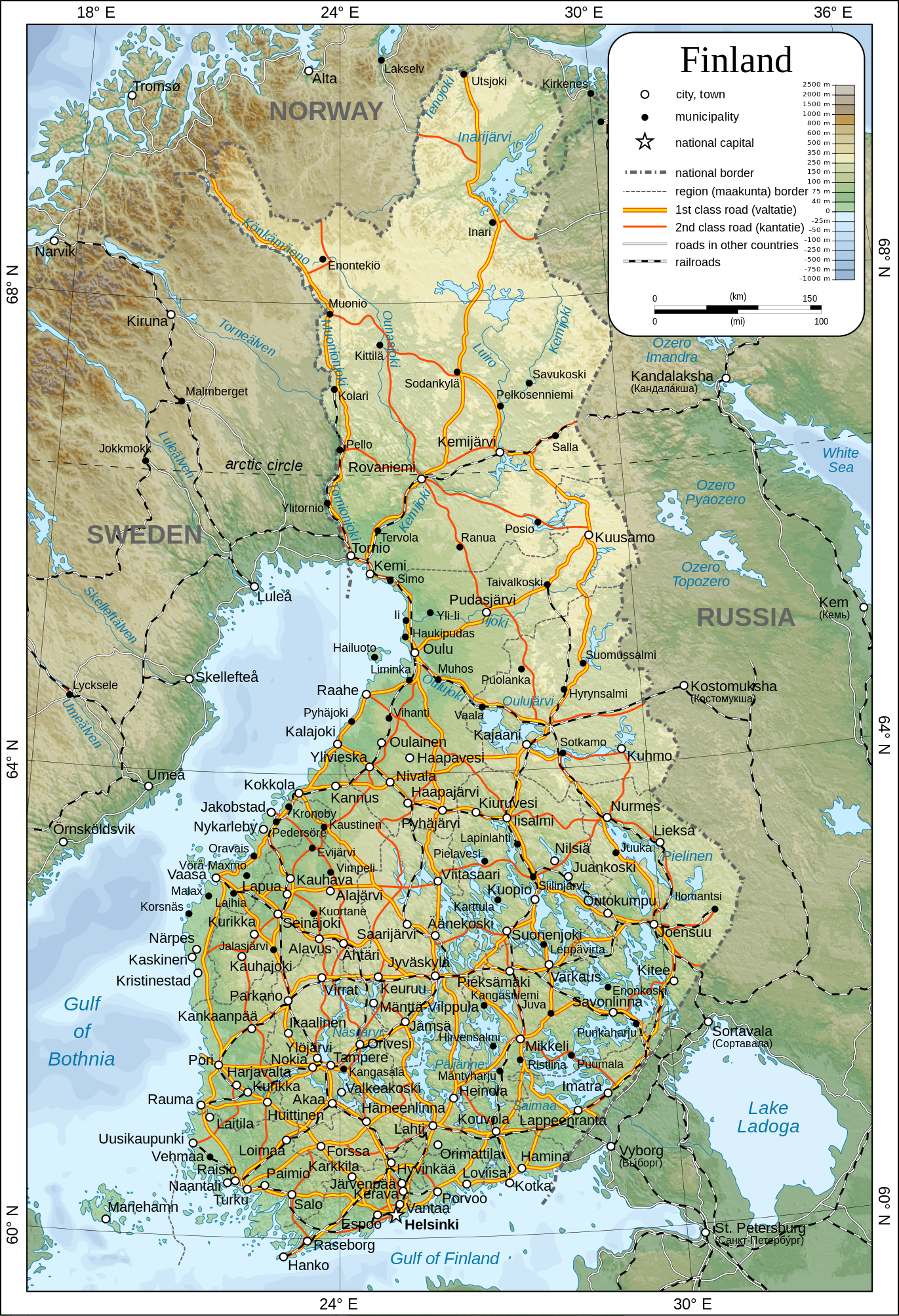
Map of Finland (Suomen kartta) by Oona Räisänen. Boundaries, rivers, roads, and railroads are based on a 1996 CIA map, with revisions. (via Wikimedia – https://en.wikipedia.org/wiki/File:Map_of_Finland-en.svg)
Canadians pretended we didn’t need to take defence seriously. We justified it with fantasies — the world wasn’t that dangerous, threats were distant, and America would rescue us if needed. That delusion is dead. U.S. Republicans and some Democrats don’t trust us to defend our own territory. Trump openly floated annexation and made clear that military protection now comes at a price — potentially statehood. Canadian military leaders now describe our closest ally as “unpredictable and potentially unreliable”. And even when America was a sure bet, our overreliance was reckless. Sovereignty requires self-defence; outsourcing it means surrendering power.
We should take cues from nations in similar situations, like Finland. Both of us border stronger powers, control vast, harsh landscapes, and hold valuable strategic resources. We’re internally stable, democratic, and potential targets.
We also share a key strength — one that could expand our military recruitment, onshore defence production, rebuild social trust, and bolster deterrence: a strong civilian firearms tradition.
We should be doing everything we can to make that tradition a bigger part of Canadian defence, and a larger part of our economy, too.
That may sound absurd to some Canadians. It shouldn’t. Finland is taking full advantage by attempting to expand shooting and military training for civilians both through private and public ranges and the voluntary National Defence Training Association. Finland is seeking to massively upgrade civilian range capacity by building 300 new ones and upgrading others to encourage civilian interest in firearms and national defence, and is doing so in partnership with civilian firearm owners and existing non-government institutions.
Multiple other states near Finland are investing in similar programs. Poland is even involving the education system. Firearm safety training and target practice for school children are part of a new defence education curriculum component, which includes conflict zone survival, cybersecurity, and first aid training. Poland’s aim is to help civilians manage conflict zones, but also to bolster military recruitment.
Lithuania and Estonia encourage civilian marksmanship as part of a society-wide comprehensive defence strategy. The Lithuanian Riflemen’s Union, one of the small nation’s most recognizable institutions, is a voluntary government-sponsored organization intended to prepare civilians for resistance to an occupying power. It has 15,000 members in a population of 2.8 million. The Estonian Defence League trains mostly-unpaid civilian volunteers in guerrilla warfare. It has an 80 per cent approval rating in Estonia, where over one in every 100 men and women with ordinary jobs have joined to learn defence techniques, including mastering standard-issue military service rifles that they may keep at home, ready to fight on a moment’s notice.
These strategies are modern. These countries are no strangers to cutting-edge modern warfare, necessitated by a common border with an aggressive Russia. But technologies like drones are not a replacement for a trained and motivated citizenry, as the Ukraine conflict illustrates. Against a stronger and more aggressive neighbour, these societies deter and respond to aggression through organized, determined, and trained populations prepared to resist attackers in-depth — by putting a potential rifle behind every blade of grass.
Canada, meanwhile, is spending money to hurt our own capacity. It’s coming back to bite us. The Trudeau government misused civilian firearm ownership as a partisan political wedge and ignored the grave flaws of that strategy when they were pointed out, hundreds of times, by good-faith critics. Thousands of firearm models have been banned at massive and increasing expense since 2020 despite no evident public safety benefit. In the recently concluded party leadership race, Mark Carney pledged to spend billions of dollars confiscating them. Government policies eliminating significant portions of business revenue have maimed a firearm industry that historically contributed to our defence infrastructure. Civilian range numbers, which often do double-duty with police and even military use, plunged from roughly 1,400 to 891 in five years. Without civilians to maintain ranges for necessary exercises and qualification shoots, governments must assume the operating expenses, construct new ranges, or fly participants elsewhere to train.
March 23, 2025
Tariffs versus income taxes – pick your poison
Walter Block on the pros and cons (from the government’s point of view) of income taxes and tariffs:

Every fiber of my economic being cries out against tariffs. If they are so good, why doesn’t each state in the US have one against the products of all of the other 49? That is, Ohio could “protect” its industries against the incursions from Arizona. This is obviously silly. One of the important reasons America is so prosperous is that we have a gigantic, internal, free trade area.
Donald Trump supports them on the ground that the McKinley administration was prosperous, and relied upon tariffs. But this is to commit the post hoc ergo propter hoc logical fallacy: that since A precedes B, A must be the cause of B. No, America did indeed become rich during this epoch, but that was in spite of tariffs, not due to their benign influence. If you are looking for a historical episode to shed light on this matter, the Smoot-Hawley Tariff of 1930 will do far better: it greatly worsened an already bad recession, plunging our economy into a deep depression.
Our President also claims that the US is victimized by a negative balance of trade: we buy more from Canada and other countries than they purchase from us. However, I have a horrid balance of trade with McDonald’s and Wal-Mart. I acquire several hundreds of dollars’ worth of their products every year, and neither has yet seen fit to reciprocate with any of my economic services (hint, hint!). On the other hand, I have a very strong positive balance of trade with my employer, Loyola University New Orleans. They pay me a decent salary; apart from a few lunches in their cafeteria, my expenditures to them fill their coffers to a zero degree. Should anyone worry about this sort of thing? Of course not. Ditto for international trade. If Country A buys more from B than it sells to it, money will flow from the former to the latter, reducing prices in the former and raising them in the latter, until matters balance out.
Everyone realizes the foolishness of tariffs when it comes to absolute advantage. No Canadian objects to the importation of bananas from Costa Rica. Producing this tropical product in the frozen North would be financially prohibitive (gigantic hothouses). Ditto for maple syrup in the country to the south. The only way they could produce this item would be to place maple trees in gigantic refrigerators. Ludicrous and prohibitively expensive.
But when it comes to comparative advantage, all too many people are out to lunch insofar as the teachings of Economics 101 are concerned. They fear that other countries might be more efficient than we are; with free trade, they would produce everything, we, nothing, and we would all starve to death from massive unemployment.
Comments Off on Tariffs versus income taxes – pick your poison
Rigged Votes and Terror: Stalin’s Takeover Tactics! – W2W 014 – 1947 Q2
TimeGhost History
Published 21 Mar 2025By 1947, Stalin’s Soviet Union has begun to firmly grip Eastern Europe, reshaping nations through rigged elections, terror tactics, and propaganda. From Poland to Bulgaria, countries are forced into Moscow’s orbit, crushing opposition and extinguishing democratic freedoms. As Truman declares a doctrine to contain communism, the stage is set for decades of Cold War confrontation.
(more…)
Comments Off on Rigged Votes and Terror: Stalin’s Takeover Tactics! – W2W 014 – 1947 Q2
QotD: Herbert Hoover as president
Herbert Hoover spent his entire presidency miserable.
First, he has no doubt that the economy is going to crash. It’s been too good for too long. He frantically tries to cool down the market, begs moneylenders to stop lending and bankers to stop banking. It doesn’t work, and the Federal Reserve is less concerned than he is. So he sits back and waits glumly for the other shoe to drop.
Second, he hates politics. Somehow he had thought that if he was the President, he would be above politics and everyone would have to listen to him. The exact opposite proves true. His special session of Congress comes up with the worst, most politically venal tariff bill imaginable. Each representative declares there should be low tariffs on everything except the products produced in his own district, then compromises by agreeing to high tariffs on everything with good lobbyists. The Senate declares that the House of Representatives is corrupt nincompoops and sends the bill back in disgust. Hoover has no idea how to solve this problem except to ask the House to do some kind of rational economically-correct calculation about optimal tariffs, which the House finds hilarious. “Opposed to the House bill and divided against itself, the Senate ran out the remaining seven weeks [of the special session] in a debauch of taunts, accusations, recriminations, and procedural argument.” The public blames Hoover, pretty fairly – a more experienced president would have known how to shepherd his party to a palatable compromise.
Also, there are crime waves, prison riots, bootlegging, and a heat wave during which Washington DC is basically uninhabitable. Also, at one point the White House is literally on fire.
… and then the market finally crashes. Hoover is among the first to call it a Depression instead of a Panic – he thinks the new term might make people panic less. But in fact, people aren’t panicking. They assume Hoover has everything in hand.
At first he does. He gathers the heads of Ford, Du Pont, Standard Oil, General Electric, General Motors, and Sears Roebuck and pressures them to say publicly they won’t fire people. He gathers the AFL and all the union heads and pressures them to say publicly they won’t strike. He enacts sweeping tax cuts, and the Fed enacts sweeping rate cuts. Everyone is bedazzled […] Six months later, employment is back to its usual levels, the stock market is approaching its 1929 level, and Democrats are fuming because they expect Hoover’s popularity to make him unbeatable in the midterms. I got confused at this point in the book – did I accidentally get a biography from an alternate timeline with a shorter, milder Great Depression? No – this would be the pattern throughout the administration. Hoover would take some brilliant and decisive action. Economists would praise him. The economy would start to look better. Everyone would declare the problem solved – especially Hoover, sensitive both to his own reputation and to the importance of keeping economic optimism high. Then the recovery would stall, or reverse, or something else would go wrong.
People are still debating what made the Great Depression so long and hard. Whyte’s theory, insofar as he has one at all, is “one thing after another”. Every time the economy started to go up (thanks to Hoover), there was another shock. Most of them involved Europe – Germany threatening to default on its debts, Britain going off the gold standard. A few involved the US – the Federal Reserve made some really bad calls. The one thing Whyte is really sure about is that his idol Herbert Hoover was totally blameless.
He argues that Hoover’s bank relief plan could have stopped the Depression in its tracks – but that Congressional Democrats intent on sabotaging Hoover forced the plan to publicize the names of the banks applying. The Democrats hoped to catch Hoover propping up his plutocrat friends – but the change actually had the effect of making banks scared to apply for funding and panicking the customers of banks that were known to have applied. He argues that the “Hoover Holiday” – a plan to grant debt relief to Germany, taking some pressure off the clusterf**k that was Europe – was a masterstroke, but that France sabotaged it in the interests of bleeding a few more pennies from its arch-rival. International trade might have sparked a recovery – except that Congress finally passed the Hawley-Smoot Tariff, the end result of the corruption-plagued tariff negotiations, just in time to choke it off.
Whyte saves his barbs for the real villain: FDR. If the book is to be believed, Hoover actually had things pretty much under control by 1932. Employment was rising, the stock market was heading back up. FDR and his fellow Democrats worked to tear everything back down so he could win the election and take complete credit for the recovery. The wrecking campaign entered high gear after FDR won in 1932; he was terrified that the economy might get better before he took office, and used his President-Elect status to hint that he was going to do all sorts of awful things. The economy got skittish again and obediently declined, allowing him to get inaugurated at the precise lowest point and gain the credit for recovery he so ardently desired.
Scott Alexander, “Book Review: Hoover”, Slate Star Codex, 2020-03-17.
Comments Off on QotD: Herbert Hoover as president
March 22, 2025
“Humiliate yourself before us,” I was being told, “And we still won’t hire you, lol”
The accelerating downfall of the academic-political complex is the subject of John Carter’s most recent post at Postcards from Barsoom:

University College, University of Toronto, 31 July, 2008.
Photo by “SurlyDuff” via Wikimedia Commons.
Look. In any given case, for any given scientist working inside the university system, there are exactly two possibilities.
One: they embraced all of this with cheerful, delirious, evangelical enthusiasm. Religious devotees of the unholy cause of converting every institution to the One False Faith of Decay, Envy, and Incompetence, they have spent the last decade or more enforcing campus speech codes, demanding inclusive changes to hiring policies, watering down curricular requirements to improve retention of underrepresented (because underperforming) equity-seeking demographics, forcing their research collaborations to adopt codes of conduct, and mobbing any of their colleagues who voiced the mildest protest against any of this intellectual and organizational vandalism.
Two: they had reservations, but went along with it all anyhow because what were they to do? They needed jobs; they needed funding; and anyhow they didn’t go into STEM to fight culture wars. As the article says, “They’d prefer to just get back to the science,” and the easiest way to get back to the science was to just go along with whatever the crazies were demanding. Even if the crazies were demanding that they abandon any pretense of doing actual science.
The first group are enemies.
The second are cowards.
Both deserve everything they get.
And I am going to enjoy every moment of them getting it.
Look, I am going to vent here a bit, okay? Because the mewling in this article succeeded in getting under my skin.
Not long ago I was considered a promising early career scientist, with an excellent publication record for my field, a decent enough teaching record, and all the rest of it. After several years as a semi-nomadic postdoc – which had followed several years as a semi-nomadic graduate student – it was time to start looking for faculty positions. My bad luck: Fentanyl Floyd couldn’t breathe, and the networked hive consciousness of eggless harpies infesting the institutions was driven into paroxysms of preening performative para-empathy.
What this meant was two things. First, more or less every single university started demanding ‘diversity statements’ be included in faculty application packages, alongside the standard research statements, teaching statements, curriculum vitae, and publication list. The purpose of the diversity statement was to enable the zampolit in HR and the faculty hiring committee to evaluate the candidate’s level of understanding of critical race theory, gender theory, intersectionality, and all the rest of the cultural Marxist anti-knowledge; to identify candidates who had already made contributions to advancing diversity; and to identify candidates who had well-thought-out ten-point plans to help advance the department’s new core principle and overriding purpose, that being: diversity.
The second thing it meant was that hiring policies now implicitly – in the United States – and explictly (in Canada) mandated diversity as an overriding concern in hiring. As everyone knows, this means that if you’re a heterosexual cisgendered fucking white male, you are not getting hired.
In other words, I was now expected to write paeans praising the very ideology that had erected itself as an essentially impermeable barrier to my own employment, pledging to uphold this ideology myself and enforce it against others who look like me. “Humiliate yourself before us,” I was being told, “And we still won’t hire you, lol.”
Having some modicum of self-respect, I refused to go along with this. This meant that I simply could not apply for something like 90% of the available positions. And when I did apply to positions that didn’t require a diversity statement, and successfully got an interview, guess what? One of the first questions out of the mouth of one of hiring committee members would be “what will you do for diversity”, or “I see you didn’t mention diversity in your teaching statement …” See, even if it isn’t mandated by the administration, that doesn’t stop the imposter-syndrome-having activist ladyprofs from insinuating the diversity test on their own initiative. I once had a dean, a middle-aged Hispanic woman, tell me “women in science are very important to me” right at the beginning of the interview; I very nearly got that job, because everyone on the committee wanted me, but later – after they inexplicably ghosted – found out that she’d nixed it. They just didn’t hire anyone.
Right around the same time, of course, we were in the thick of the COVID-19 scamdemic. You remember, the one that was just the flu, bro, until it became the new Black Death that definitely did not come from a laboratory shut up you conspiracy theorist; which couldn’t be stopped by masks so don’t be silly until suddenly masks were the only thing that could save you; which led to us all being locked in our houses for a year because some idiot wrote a Medium article called “the dance of the hammer with your soft skull” or whatever which then went viral inside the hysterosphere; which motivated the accelerated development of a novel mRNA treatment that no one was going to get because you couldn’t trust the Evil Orange Man’s bad sloppy science until suddenly it was safe and effective and then overnight absolutely mandatory and anyone who refused to take it should be sent to a camp.
Yeah, remember that?
I guarantee you that every single credentialed scientist in that article was on board for all of it.
How do I know this?
Because they all were.
Comments Off on “Humiliate yourself before us,” I was being told, “And we still won’t hire you, lol”
Fundraising is much tougher for Democrats right now … and they’re not coping well
It’s not just Canadian politicians getting driven completely insane by the Bad Orange Man’s antics — he’s even doing it to his domestic opponents in the Democratic party as well:

“REMINDER: It Is Offensive And Possibly Illegal To Photoshop Anything On These Democrats’ Signs That Would Make Them Look Foolish.
The Babylon Bee.
Kansas City Star:
Democrats Suffer Blow Ahead of Senate Elections
It’s a goddamn slide show, but as it might be amusing I shall wade in. The things I do for you people …
Sen. Jeanne Shaheen’s retirement is expected to significantly impact the Democratic Party’s prospects for the upcoming Senate elections, amplifying pressure on Senate Minority Leader Chuck Schumer (D-NY). The party’s challenges ahead have heightened with the departures of Sen. Gary Peters (D-MI) and Sen. Tina Smith (D-MN). Democrats must regain four seats to reclaim the majority.
It sure looks like the Donks are planning to get clobbered in 2026. Or, more likely, they anticipate a series of bruising primary fights as the old grift-and-grin Democrats are challenged by True Believers, because as HGG has taught us — credit where it’s due — SJWs always double down. Batshit insanity is the hill they’ve chosen to die on — Trump keeps handing them 80/20 issues, and they keep jumping on the 20 with both feet.
CNN’s Chris Cillizza recently noted the Party’s challenges in the upcoming Senate elections. With the need for a net gain of four seats, Cillizza expressed concern over potential financial limitations that may hinder effective campaigning.
Yes. “Financial limitations”. Democrat donors are stupid — if they weren’t, they wouldn’t be Democrats — but even they can see that 80 is way, way bigger than 20.
Oh, and also: It doesn’t help that you’re openly, gleefully endorsing no-shit terrorism against Tesla dealerships — and drivers! — calling for Musk’s assassination, and so on. It’s a bad look in general, and a bad look in particular, because now the guys with the big checkbooks are wondering if that kind of thing won’t happen to them if they get crosswise with the most lunatic members of the lunatic fringe (hint: It will. As the scorpion said to the frog: can’t be ‘elped, mate, it’s me nature).
Cillizza said, “The money that gets spent there playing defense, just to hold Democratic seats, means money that doesn’t get spent playing offense in, let’s say, a state like Ohio, where Democrats are trying to recruit Sherrod Brown, the former senator, to take on John Huston, the appointed Republican senator.”
Yes, a dwindling asset pool forces those kinds of choices. It also doesn’t help that you keep going back to the well like that. One assumes there’s a reason Sherrod Brown is a former senator. Do you have no one else?
Haha, just kidding, obviously you don’t have anyone else. That’s one of the biggest problems with gerontocracy — the Groovy Fossils are going to have to be carried out at room temperature, so anyone with anything on the ball has been giving Government a pass since the 1980s. Trump went around the Official GOP for lots of reasons, but not the least of them was: he had to. They have the same gerontocracy problem as the other side of the Uniparty. It’s turtles all the way down.
Cillizza concluded, “I just do not see it. I don’t see the money there. I don’t see the energy there. I don’t see the candidates there to expand the playing field”.
It won’t be for lack of trying, though. You’ve still got The Media in your pocket, and they can still do some damage. You’ll never get to the 80 side of those 80/20 issues, but you might get it to 50/50 — as has been done with abortion, gay “marriage”, and so on. On the other hand, those took 40, 50 years, and The Media hadn’t totally pissed away all its credibility back then. It’s a real corner you’ve backed yourselves into,
guysgalspersyns.It also doesn’t help that you’re stupid:
Democrats have identified potential pickup opportunities in Maine and North Carolina, targeting Sen. Susan Collins (R-ME) and Sen. Thom Tillis (R-NC).
Holy breakdancing Buddha, why would you target them? Thom Tillis is the very definition of “RINO”; Collins is a Leftist, full stop. The next time they vote against the Democrats on any issue of substance will be the first time they’ve ever done it. It’s as predictable as sunrise, so much so that it’s a joke to anyone right of Mao — the GOP officially has X number of seats, minus Collins and Murkowski.
Vulnerabilities among current incumbents, especially Sen. Jon Ossoff (D-GA), have added to the party’s challenges.
Oh, don’t worry about it — the GOP will find some way to throw it. Georgia, Georgia … hey, what’s Herschel Walker up to these days? Think he’s up for another run? Why not parachute in Alan Keyes or Ben Carson? They’re still alive, right? What about “Nikki” “Haley”? She’s gotta keep her arm loose for the 2028 primaries …
Some Democrats have remained optimistic despite the hurdles. Discussions have included potential candidates such as Rep. Haley Stevens (D-MI) and State Sen. Mallory McMorrow (D-MI) for key races. New Hampshire Democrats have prepared for competitive primaries, with Rep. Chris Pappas (D-NH) considering a bid for Shaheen’s seat.
As we know, when it comes to crime 13 does 50. When it comes to Leftism, though, it’s more like 20 does 100, and there’s no better illustration than New Hampshire. It should be the reddest state in the union, and people who live there tell me it really is… except for their Congresscritters, because the good people of New Hampshire didn’t shoot every Masshole they could catch. The fine folks in Oregon, Colorado, and (soon enough) Texas know what I mean — y’all didn’t introduce migrating Californians to wood chippers when you had the chance.
Comments Off on Fundraising is much tougher for Democrats right now … and they’re not coping well
Allen & Wheelock Lipfire Navy Revolver
Forgotten Weapons
Published 12 Apr 2015Not all companies responded in the same way to the development of cartridge revolvers and the Rollin White patent. Allen & Wheelock, for example, decided to simply ignore the patent and make revolvers for their proprietary lipfire cartridges (fairly similar to rimfire) while relying on their lawyers to delay the anticipated patent infringement suit for as long as possible. Ultimately it took 4 years for Rollin White and S&W to gain a legal injunction against them, and when that did happen they were ready and converted their production to percussion revolvers of the same basic type. This particular piece is a .36 caliber (“Navy”) version for the lipfire round, which have been since converted to use either lipfire or more common rimfire ammunition.
Comments Off on Allen & Wheelock Lipfire Navy Revolver
QotD: The Dunbar Number in the ivory tower
Leave your logical brain aside for a second — I’ll pause, to let you pound as many shots as necessary — and think like a chick. Declining enrollment numbers are just a line on a graph. Indeed, the students themselves are mostly an abstraction — professors hate teaching and avoid it whenever possible, which, thanks to grad students, research sabbaticals, and the like, is fairly often. But that radical-even-by-academic-standards lesbian? She’s right there. All the time.
If you’ve never been inside the ivory gulag, it’s hard to convey just how tiny and all-encompassing that world is, but I’ll try. Imagine you’re just out of school and living with two roomies (for the one or two young folks who might still remain among the readership: It was once considered a good thing to move away from home, so much so that even if they had the opportunity to live in Mom’s basement after graduation — even if it would make great financial sense to do so — young folks would endure quite a bit of deprivation in order to make their own way in the world. This often necessitated living in crappy apartments in a dodgy part of town with one or more roommates, for several years). Your roomies do what young guys do — sometimes their girlfriends move in; sometimes they move out; sometimes their friends crash on the couch — but here’s the kicker: Everyone involved does the same job at the same company, such that you’re effectively always at work. Anything you do at “home” gets brought into the office, because everyone you live with — and everyone you could potentially ever live with — is there.
Imagine living life like that. That’s the ivory tower.
Severian, “The Dunbar Problem”, Founding Questions, 2021-10-06.
Comments Off on QotD: The Dunbar Number in the ivory tower
March 21, 2025
Apparently the US Constitution elevates the judiciary over the other branches of government
Chris Bray on recent innovative judicial activism to constrain the evil machinations of the Bad Orange Man:
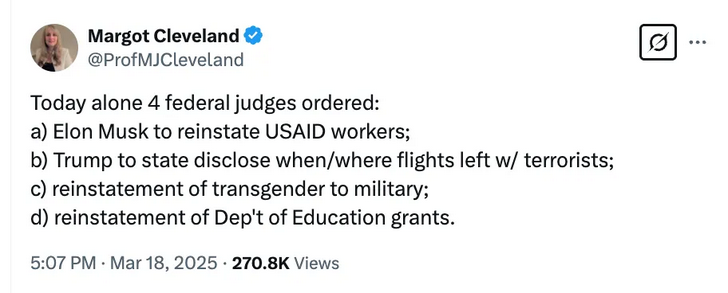
It won’t be news to anyone that the federal judiciary has decided Donald Trump has no authority as President of the United States but to serve and protect the status quo, absolutely without deviation. Change is unconstitutional. Policy is unconstitutional. But even by that standard, today has been very special.
Without digging into all the details about everything, skim your way through a single judicial decision to begin to see what’s happening: the decision from District Court Judge Ana Reyes, ordering the Department of Defense to allow the continued service of transgender military personnel. You can click here to read it, or open the PDF file below.
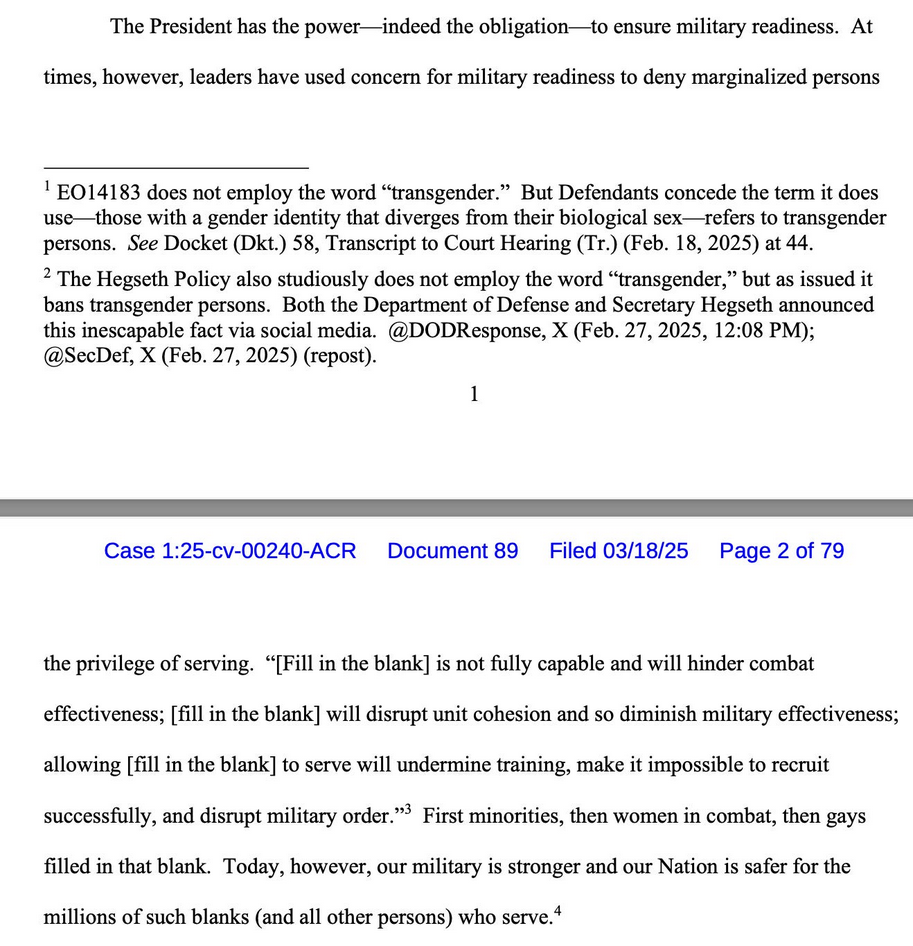
This is not a judicial decision. I mean, it is a judicial decision, but it doesn’t represent judicial culture or a judicial outlook. At all. It’s a bitchy schoolgirl essay about being fair and not being mean, with healthy doses of platitudinous foot stompery. Screenshot, bottom of page one and top of page two:
“Today, however, our military is stronger and our Nation is safer for the millions of such blanks (and all other persons) who serve.” Because she says so, is why. The old bigoted American military was very weak. I don’t remember: Did the old dumb bigots ever even win any wars or anything?
[…]
Our military is much stronger now than it was when gay and transgender service wasn’t warmly encouraged, the end. (Stomps foot.) It’s a TikTok video formatted to look like a, you know, a judge thing. You can even agree with the judge and see that she hasn’t made an argument. “Today, however, our military is stronger.” Like when we beat the Taliban, or all the other wars we’ve won lately. This is the declarative reality in which a thing becomes true because you type it.
Now, watch this. Watch Judge Ana Reyes roll right over herself without noticing that she’s doing it. You don’t have to read past page two to see this.
On page one, she characterizes the reasoning — the premise the administration advanced to forbid military service by transgender personnel: “Service by transgender persons is ‘inconsistent’ with this mission because they lack the ‘requisite warrior ethos’ to achieve ‘military excellence’.” That’s it, those mean monsters! That’s their whole reason! They said trans people can’t serve because of, I don’t know, some stupid ethos thing. What does that even mean?

Comments Off on Apparently the US Constitution elevates the judiciary over the other branches of government
Star Trek: Jobs, Money, and Replicators
Feral Historian
Published 14 Jun 2024So the Federation doesn’t use money and magic walls give you anything you ask for. What kind of economy are we really looking at here, and is some approximation of this possible without first having those replicators?
First we have to talk about what money is, what a job is (vs just being employed) and a little historical detour into modern efforts at Universal Basic Income. All of which lead to a very hypothetical look at how we might be able to build a rough approximation of a Star Trek economy in the near-term future.
This is all analysis and thought-experiment. I’m not necessarily endorsing any of these ideas, just bouncing things around for consideration.
00:00 Intro
01:00 Qualitatively Distinct Model
02:27 The Triple Revolution
05:00 Jobs ≠ Employment
06:32 Universal Basic Income
11:35 Federation Credit
13:45 Impacts of Currency
15:16 Can We Really Do This?
(more…)
Comments Off on Star Trek: Jobs, Money, and Replicators
March 20, 2025
US Supreme Court to hear case that might overturn the Kelo decision
J.D. Tuccille discusses a US Supreme Court case on abuse of the power of eminent domain that might be the key to reversing the ridiculous Kelo precedent:

… the U.S. Supreme Court may soon overturn one of its worst decisions in recent memory — a ruling that justified government stealing property from its owners to pass it to better-connected private parties. On Friday, the court will decide whether to consider a New York case that could upset the precedents set by Kelo v. New London, an eminent domain battle that prompted books, a movie, and state-level legal reforms. While Kelo was a loss for anybody who wants to set boundaries around government power, the court could take the opportunity this week to set things right with Bowers v. Oneida County Industrial Development Agency.
Kelo Abandoned Basic Limitations on Government Power
In dissenting to the majority’s 2005 decision in Kelo allowing the taking of a house owned by Susette Kelo by the city government of New London, Connecticut to transfer it to a favored developer, Justice Sandra Day O’Connor quoted Calder v. Bull (1798): “[A] law that takes property from A. and gives it to B: It is against all reason and justice, for a people to entrust a Legislature with such powers; and, therefore, it cannot be presumed that they have done it”.
“Today the Court abandons this long-held, basic limitation on government power”, O’Connor added. “Under the banner of economic development, all private property is now vulnerable to being taken and transferred to another private owner, so long as it might be upgraded — i.e., given to an owner who will use it in a way that the legislature deems more beneficial to the public — in the process.”
That dissent was joined by Chief Justice William H. Rehnquist and Justices Clarence Thomas and Antonin Scalia. Also agreeing with the dissenters were a great many Americans horrified that the Supreme Court had signed off on the confiscation of private property so long as a potential new owner could show spiffy plans for the confiscated parcels and promise greater tax revenue. It wouldn’t even have to be a fulfilled promise — Susette Kelo’s house remained undeveloped when financing for the project fell through.
The response to Kelo included books, a movie — Little Pink House — and a wave of state-level court decisions and legislative efforts intended to rein-in the abuse of eminent domain.
Most States Have Reformed Eminent Domain — but Not New York
“Since Kelo v. New London, 47 states have strengthened their protections against eminent domain abuse, either through legislation or state supreme court decisions,” notes the Institute for Justice (I.J.). Of course, not all the reforms were created equal. I.J. grades the various efforts, with states like Florida getting an “A” grade and Connecticut — where the Kelo case occurred — lagging with a “D”. A 2009 study found that “states with more economic freedom, greater value of new housing construction, and less racial and income inequality are more likely to have enacted stronger restrictions, and sooner” on eminent domain.
And then there’s New York. I.J. gives that state an “F” because it failed to even attempt reform. In 2009, that state’s highest court conceded “it may be that the bar has now been set too low” as it approved seizure of private property for redevelopment. “But any such limitation upon the sovereign power of eminent domain as it has come to be defined in the urban renewal context is a matter for the Legislature, not the courts.” The legislature never acted.
Comments Off on US Supreme Court to hear case that might overturn the Kelo decision
Oh, goodie … the ever-bouncing F-35 fighter decision is back in play
My initial reaction on seeing Alex McColl’s headline was to immediately reject the notion of the Royal Canadian Air Force operating two completely different fighter aircraft, both for cost and for personnel reasons: the RCAF is already underfunded and short on trained aircraft technicians for a single fighter (the CF-18 Hornet), never mind two even higher-tech replacements. But on reading the article, I’m open to further investigation of the idea:

“F-35 Lightning II completes Edwards testing” by MultiplyLeadership is licensed under CC BY 2.0

Canada’s new Prime Minister Mark Carney didn’t waste any time standing up to Donald Trump’s illegal trade war. Within hours of being sworn in, Bill Blair — who was minister of national defence under Justin Trudeau and remains in the role under Carney — went on CBC’s Power & Politics to deliver a bombshell: Canada is going to re-examine our plan to purchase 88 American F-35A fighter jets.
This was in response to a question about if Canada would emulate Portugal, which announced that it was reconsidering a planned purchase of American F-35 jets: “We are also examining other alternatives, whether we need all of those fighter jets to be F-35s or if there might be alternatives. The prime minister has asked me to go and examine those things and have discussions with other sources particularly where there may be opportunities to assemble those fighter jets in Canada, to properly support them and maintain them in Canada, and again we’re looking at how do we make investments in defence which also benefits Canadian workers, Canadian industry and supports a strong Canadian economy.”
When asked about a partial cut to the F-35 order, Blair responded: “The direction I’ve been given by the prime minister is go and look at all of our options to make sure that we make the right decision for Canada.” He noted that this didn’t mean the government planned to outright cancel the F-35 contract.
[…]
With the first 16 F-35s already on order, and the first four already in production on the assembly line in Texas, it’s likely too late to cancel the F-35 order without significant penalties.
Saab JAS-39 Gripen of the Czech Air Force taking off from AFB Čáslav.
Photo by Milan Nykodym via Wikimedia Commons.This opens the door to a mixed fleet that includes a smaller number of expensive F-35A fighter-bombers and a larger number of affordable Gripen-E fighters. All of Canada’s G7 allies fly a mixed fleet of fighter jets today, some have 3 or more types. While it wouldn’t be easy, it is possible for a serious nation to fly a mixed fleet. Before the CF-18, Canada had 3 different types of armed fighter jets in service. The RCAF wanted to replace them all with expensive F-15 Eagles, but Pierre Trudeau made them settle for the cheaper F/A-18 Hornet. His government ordered 138 CF-18s, but that fleet shrank over time as a cost saving measure. The big cut happened during the CF-18 modernization under the Harper Government, when the hornet fleet shrank from 120 to 80 jets.
Living up to our commitments to our NATO allies is about more than just spending 2 percent of GDP, it also means living up to our mission requirements. Keeping our word means showing up, and 88 F-35As was never going to be enough jets for us to meet our commitments to NORAD and NATO at the same time. To do that, we need at least 120 jets. Reevaluating our options does not mean starting from scratch. To paraphrase minister Blair: A great deal of work was done during the FFCP evaluation. Two jets met the requirements: the expensive American F-35, and the Swedish Gripen-E with an offer to make them in Canada. Let’s just buy them both.
The first step is easy: Have Saab and IMP refresh their FFCP submission with new delivery deadlines and place an order for 88 Gripen-E jets. The second is to announce that we’re reducing the F-35 order down to 65 jets – the number that the Harper government planned to sole source but never ordered. Finally, we put our elbows up and announce that the F-35 order would be cut by 5 jets for every week the Trump administration maintains their threats of illegal tariffs, down to a minimum of 40 jets.
The F-35A has a total cost of ownership about double that of the Gripen-E, so we could afford to add two Gripens for every F-35 cancelled. A mixed fleet of about 120 Gripen-Es and 45 F-35As would help us get to 2% of GDP while reliably pulling our weight on NORAD and NATO missions.

Comments Off on Oh, goodie … the ever-bouncing F-35 fighter decision is back in play


