Tasting History with Max Miller
Published 3 Dec 2024Tuna noodle casserole made with spaghetti, and rice with canned apricots for dessert
City/Region: Topaz War Relocation Center, Utah
Time Period: 1943In 1942, anyone of Japanese ancestry in the United States was forcibly sent to live in incarceration camps. Food was often in the form of leftover military rations that was augmented by crops grown by the people living in the camps, but there were also canteens that sold food and sundries. These items were great luxuries as the Japanese Americans living in the camps made only about 1/5 of a typical wage and included things like Ovaltine, apple juice, and canned tuna.
This recipe, from a newspaper printed in the Topaz War Relocation Center, makes a tasty, if basic, tuna noodle casserole. I would add more of the paprika, or really some more spices in general, but I really like the lightly crunchy texture of the bread crumbs and the celery.
If you’d like to serve this forth with dessert, as I did, then you simply need some cooked white rice and some canned apricots with syrup.
(more…)
April 16, 2025
Food in the Japanese-American Internment Camps of World War 2
April 15, 2025
What is it with the progressives’ love for (some) brutal murderers?
I’ve managed to avoid watching any of the interview, but Taylor Lorenz was on CNN, where utter inhumanity is apparently the flavour of the month for all right-thinking progressives:

Former New York Times and Washington Post reporter Taylor Lorenz, speaking about accused killer Luigi Mangione on CNN MisinfoNation with Donnie O’Sullivan:
To see these millionaire media pundits on TV clutching their pearls about someone stanning a murderer when this is the United States of America. As if we don’t lionize criminals … There’s a huge disconnect between the narratives and the angles that mainstream media pushes and what the American public feels … You’re going to see women especially that feel like, “Oh my God”, right? Like, “Here’s this man who’s revolutionary, who’s famous, who’s handsome, who is young, who’s smart”. He’s a person that seems like this morally good man, which is hard to find.
I know Lorenz is a human bug-zapper whose purpose is luring people to doom by drawing them to the glow of the impossibly stupid online utterance, but even by her standards this is nuts. For one thing, Lorenz is a leading advocate for dumbed-all-the-way-down media like her “beloved” Vine, which featured six-second-max videos. If someone handed her a hardcover book, she’d be a serious threat to bite it. Her invoking Flannery O’Connor and A Good Man is Hard to Find in the context of Luigi Mangione is high comedy. Regarding America “stanning” murderers because “we give them Netflix shows,” which does she mean? Americans may be fascinated by O.J. and Bundy and Phil Spector, but we don’t gush cartoon hearts at them over cable, we watch them in lurid docudramas.
As Jim Treacher puts it:
The thing I like most about journalism is the moral authority.
Journos are better human beings than the rest of us — morally, ethically, and intellectually — and they’re not shy about saying so. Their views are the correct views, after all. Their political opinions are the North Star. And if you disagree with anything they know to be true about the world, you’re the enemy and they don’t care what happens to you.
Hell, if you’re on their literal hit list, they’ll openly laugh and swoon over anyone who hurts you. If you don’t believe it, just watch the following clip from a cable news network.
Dramatis Personae:
- Donie O’Sullivan is a “senior correspondent” for CNN.
- Taylor Lorenz is a reporter who has worked for the New York Times and the Washington Post.
- Luigi Mangione, the heir to a wealthy Baltimore family, shot a health insurance executive named Brian Thompson in the back as he was walking to work in Manhattan.
And now, here are O’Sullivan and Lorenz celebrating the murder on national television.
Learning from history can be helpful … if you learn the correct lessons
Tim Worstall explains why Donald Trump and his advisors pointing to the historical experience of high tariffs after the US civil war fails to take into account all the technological changes that happened during that time:

Trump and his economics team clearly believe that tariffs work (at least for certain values of “work”)
Post US Civil War tariffs rose strongly. Doubled and in some cases more than that. It’s also true that the US economy expanded remarkably in that period. Went from the exploitative frontier (and slave) economy to the world’s richest manufacturing one in fact. So, yay for tariffs, obviously.
Except US trade kept increasing over this period. So, tariffs were not reducing imports. Or rather, the total level of imports did not fall because tariffs even as tariffs obviously had an effect upon limiting imports — without tariffs there would have been more.
So, what happened here? The answer is the ocean going steamship.
Tariffs are only one barrier to trade, one cost of trade. Paperwork is another, local standards a third, the theft by rapacious dockside unions a fourth and, obviously enough, the cost of transport a fifth. And we can go on — the cost of information flow a sixth and soon enough we’ll be Richard Murphy shouting eleventhly.
The ocean going steamship reduced the total costs of trade by more than the tariffs raised it. Therefore trade carried on increasing.
Now forward a century, the 1970s and following. We’re told that there’s been some grand policy turn to free trade. That everyone decided to gut the rich world of real manly jobs and ship them off to sweating coolies who could be paid peanuts. The GATT, WTO, just proof of the contention and look, look, they lowered tariffs!
But the container ship (which did for those rapacious dockside unions in most places other than the US), the jet liner, the telephone and now the internet have lowered all those other costs of trade massively. The total costs of trade have dropped massively whatever we could have, should have, done about tariffs. Global trade was going to expand by multiples whatever GATT or WTO did that is.
Which is why these tariffs now have to be so large and bigly. Because to get back to that 1970s – let alone 1870s — it’s necessary to raise total costs of trade to where they were, not just tariffs.
Daniel Defense H9: The Hudson Reborn and Completely Reengineered
Forgotten Weapons
Published 16 Dec 2024In 2017, Hudson released a new pistol that was the darling of the firearms industry. It purported to offer a radically low bore axis and 1911-style trigger in a striker-fired system that would be fast and simple to use.
In 2019, Hudson went bankrupt, out of money and having started to scavenge parts off returned pistols to fix other customers’ broken guns. It was an ignominious end to a product with such potential.
About that same time, Daniel Defense was looking for a way to expand their catalog into the pistol market. They saw Hudson, and it looked like the perfect opportunity to pick up a good design that seemed to have been the victim of management and cash flow problems. So DD bought up the patents and other aspects of the H9 pistol … but when they got a close look at the gun they realized, belatedly, that the whole thing needed to be redesigned.
In the years since, Daniel Defense has been fixing the H9. The fire control system remains fundamentally the same, but with no interchangeable parts — and now actually drop-safe. The exotic forward-mounted unlocking cams on the barrel are gone now, and the accessory rail is moved up enough to allow reasonable use of lights and lasers. The frame is aluminum and shortened for better concealment. The recoil spring system is much stronger, and the slide stop redesigned to prevent the breakages that plagued the original Hudson. Every part of the magazine has been changed, to fit the same 15 rounds into a shorter body and prevent over insertion. The slide is now cut for optics, with four different adapter plates to fit all the common footprints.
Shooting the new H9 side by side with the original Hudson, I think Daniel Defense has kept all the qualities of the design while fixing a lot of the problems it had. The gun does indeed have a lot less muzzle rise than more conventional designs, and the trigger feels quite nice. This is not a Grand Master’s IPSC gun and it is not a subcompact pocket gun. It is a jack of all trades piece that can be carried as well as any service pistol (better than most, thanks to its quite narrow construction) and can hold its own in a variety of competition venues as well.
(more…)
QotD: PhD delusions of (universal) competence
My guess – and this is only a guess – is that it’s part of their comprehensive delusion of competence. Just as your Basic College Girl assumes that her 1100 (or whatever slightly-above-average is now) SAT score makes her a genius without portfolio, so those with PhDs assume that their sheepskin is proof that they can master any subject they put their minds to. It’s not that rude mechanicals like plumbers and whatnot are doing something they can’t; they’re doing something they shouldn’t have to, by virtue of their superior intellects and social standing (that the same people who assume trade labor is for dirty, sweaty, smelly proles are also the most vocal champions of The Working Class™ is so ironic, Alanis Morissette must be weeping salty tears of joy right now, is infuriating but irrelevant).
And the delusion of competence is truly a thing to behold. They expend enormous effort in maintaining it. Just as the “gender is just a social construction” feminist somehow retains her belief in this every time she has to call the stock boy over to help her lift the can of economy-sized kitty litter, so the other eggheads shrug it off when they have to call in tradesmen to perform the simplest household maintenance. I think I’ve told this story before, but it’s worth repeating as an illustration:
Back in grad school, I was invited to a back-to-school shindig at the Department Chair’s house. She made sure to tell us that the only toilet in the house (she lived in a breathtakingly restored Victorian; it must’ve cost close to a million all in) wouldn’t work unless you followed the elaborate five-step process she and her “domestic partner” had worked out over months of trial and error. Said process was helpfully taped on the tank lid for us. They were on the plumber’s list, she said, but it would be a while (“you know how those people are,” wasn’t stated outright, but very clearly, sneeringly implied).
I had few beers, the inevitable happened, and so I meandered upstairs to throw a whiz. After zipping up, I followed the elaborate handle-jiggling procedure … and, well, look, y’all, I’m far closer to those helpless eggheads than I am to Mr. Fix-it. I have ten thumbs, and thank god I never had to do one of those “spatial rotation” tasks for real back in grade school, or they’d have stuck me on the short bus. But even I know when a toilet float bobber is stuck. So I lifted the lid, turned the little screw, flushed twice more to double-check my handiwork, and went back downstairs to report my success …
They looked at me like I’d just contracted leprosy, y’all. Instead of being happy that I’d saved them a lot of effort, not to mention a fair amount of money, they were disgusted. I mean, I’d done a menial’s job. With my hands. On the one hand, I suppose it was proof that people with PhDs can master very, very, very basic plumbing. But on the other … eeeeewwww. I was a class traitor!
Severian, “Gettin’ Jiggy in College Town”, Founding Questions, 2021-10-08.
April 14, 2025
Huế: Battle for the Heart of Vietnam
Army University Press
Published 22 Nov 2024The Battle of Huế is known for urban combat, destruction, and anguish. The city of Huế mattered to all the combatant forces. The city and its people paid the price. Interviews with noted subject matter experts Drs. Pierre Asselin, Gregory Daddis, James Willbanks, and Cpt. Wyatt Harper are augmented with archival audio and film, and detailed maps. This documentary places the Battle of Huế within the context of Hanoi’s 1968 Tet Offensive. How North Vietnam, South Vietnam, and the United States perceived the Vietnam War in 1967 and 1968 are central to this documentary. Covered are the key moments of the battle — including the People’s Armed Forces of Vietnam (PAVN) and People’s Liberation Armed Forces (PLAF) planning and assault on Hue. The responses of the Army of the Republic of Vietnam (ARVN), Vietnam Marine Corps (VNMC), the United States Marine Corps (USMC), and the U.S. Army (USA) are addressed to offer insight into an informative example of urban warfare.
0:02:39 – Why the Tet Offensive
0:10:53 – Why Huế
0:15:53 – Military Decision Making Process | Doctrine
0:26:51 – Warfighting Function | Doctrine
0:27:59 – Paralysis by analysis | Doctrine
0:33:15 – Courses of action | Doctrine
0:38:22 – Weather and operations | Doctrine
0:40:52 – Huế Massacre
0:41:18 – My Lai
0:46:05 – Huế and Modern Warfare
QotD: Pax Americana replaces Pax Britannica
The British government spent most of the next century being dragged – reluctantly – into being arbitrators of conflicts they wanted nothing to do with. Finishing with being stuck with the Great War, and then responsibility for some of the most hopeless basket-case states handed over to “Mandate Powers” by the Versailles peace … as one British minister presciently pointed out, no one wanted Palestine, and it would be nothing but a disaster for whoever gets stuck with it … (Fortunately for the US, their Congress repudiated Wilson’s ridiculous League of Nations before the plan to lumber the US with the Mandate for places like Georgia – the Russian bit on the Black Sea that is! – could be put through.)
It is unsurprising that the British taxpayer spent the next 50 years trying to get out of international police-keeping obligations. With the sole exception of reluctantly agreeing to fight against the expansionary dictatorships in World War Two, British taxpayers voted for disarmament and de-colonisation whenever they could. (Abandoning some states – particularly in Africa – that might eventually have developed into safe and secure states, way before they were ready for independence … much to the cost of world peace and security since …)
The United States has had a similar experience more recently. Having inherited responsibility for maybe 50 years of the “Pax Americana” by the simple expedient of being the strongest economy standing after the Second World War. (Their only potential rival being the British Commonwealth of Nations — who between them had 5 of the next 10 biggest and healthiest post-war economies — being more than happy to let the dumb Americans have a go at being world policemen for a time, and see how they liked being blamed by everyone else for absolutely everything.)
The Americans discovered pretty quickly that the things they had been complaining about the British doing for the last 200 years were exactly what they had now signed up for, and finding even quicker that their taxpayers simply weren’t willing to carry the can, and take the blame, for very long at all.
Arguably the US’s fun with being world policeman was already pretty much over after Korea, and certainly after Vietnam. It is notable that the first Gulf War was NOT paid for by the US taxpayer … the US troops turned up but only if Saudi Arabia and Europe paid for them to do so (and preferably with a British Division on one flank, Australian warships on the other, and NATO fighters overhead …) none of this “we will carry the can and our taxpayers will just cope” crap for post-Vietnam American taxpayers.
Nigel Davies, “Types of Empires: Security, Conquest, and Trade”, rethinking history, 2020-05-02.
April 13, 2025
Gender is a social construct … or isn’t a social construct [confused screaming]
Is it a good thing or a bad thing that some female athletes choose not to compete against transgendered athletes? Yes. No. Answer unclear, ask again later:

Feminist and gender ideologies have always appealed to women (and continue to appeal) with the promise that women are strong and should be applauded for competing with and winning against men. Any woman who does so is almost automatically granted elevated status in our culture, praised for her guts, stamina, and even “balls”. Women who “break [gender] barriers” enter a special pantheon of heroines. Cartoons and action-movies are filled with super-athletic females who successfully battle all manner of male antagonists.
Feminists were, for a long time, extremely enthusiastic about this view of things. It was radical feminist Kate Millett, author of feminism’s bible Sexual Politics (1970), who praised sexologist John Money for experiments allegedly showing that gender had little or nothing to do with biological sex. She declared approvingly that “In the absence of complete evidence, I agree in general with Money and the Hampsons who show in their large series of intersexed patients that gender role is determined by postnatal forces, regardless of the anatomy and physiology of the external genitalia” (p. 30).
Many other feminists similarly emphasized gender’s social character and declared transgenderism a form of sexual liberation for women, with feminist writer Jacqueline Rose pronouncing in an essay for The New Statesman that “The gender binary is false” and that “Challenging the binary by transitioning becomes one of the most imaginative leaps in modern society”.
Feminist sociologists Judith Lorber and Patricia Martin argued extensively in “The Socially Constructed Body” (see especially the gob-smacking pp. 258-261) that women would at last pass men in many traditional sports when they truly believed they could, for “If members of society are told repeatedly that women’s bodily limitations prevent them from doing sports as well as men, they come to believe it […]”. Lorber and Martin lamented that opportunities were so rare for men and women to compete directly with one another (strongly implying that the patriarchy kept men and women apart so that women couldn’t judge for themselves), and they looked forward to a feminist future in which women could at last demonstrate their true physical capabilities.
From the first, the machinery of this kind of celebration backed men into an impossible corner. Most men have always known that women are not as strong as they; few men want to compete against a woman in sport or elsewhere. Yet no man dared gainsay the right of any woman to show herself equal to or better than a man if she could, whatever the context. If a man refused to compete with a woman, to welcome her into his club, to hire her into his firm, to respect her in any athletic endeavor — then he was a Neanderthal and a misogynist who should be shamed, shouted down, and immediately dismissed from his job.
But a man who competes with a woman, or treats her as he would treat a man, is often in trouble too, as we are seeing now. Yes, a woman was just as good as a man, our culture has insisted, but always and only on the woman’s terms. Sometimes the woman did not wish to be treated as an equal or a competitor, and that too was her right. Men had no say in the matter.
Over the years, there have been cases in which women didn’t like the culture men had created in their places of business; didn’t like male jokes, male camaraderie, male means of competition, or male methods of evaluation. Some women felt harassed, disrespected, held to an unreasonable standard, judged too harshly, given inadequate mentoring, singled out, left too much alone, treated cruelly, looked down upon, forced to behave in ways they didn’t prefer.
In general, women like competing against men and getting praise for it, but they don’t like losing to men.
Some women have turned in fury on the men who took the feminists at their word, preposterously claiming, as did “gender critical” (i.e. anti-trans) feminist journalist and former academic Helen Joyce in her Quillette essay “The New Patriarchy: How Trans Radicalism Hurts Women, Children, and Trans People Themselves” (2018), that trans women exemplify the latest form of the patriarchy that seeks to subjugate women, usurping their bodies and silencing their voices.
Many men, keen to avoid the gender wars they’d never wanted to fight in the first place, have felt understandably flummoxed and on the defensive. Which is it? Are women equal to men in all areas of endeavor, or not? Should women be kept out of direct competitions, or encouraged to show their mettle? Should men champion male-female sameness, or respect male-female difference?
In some once-exclusively-male areas, elaborate protocols have had to be worked out to protect women from feeling as if they have been beaten by men, while also protecting them from the knowledge that they were being protected.
They really are trying to shut down “wrong” speech on the internet
I’ve always been a huge fan of free speech, which has been under continuous and escalating threat by many governments both in person and online. A side-note in the ongoing Canadian federal election has been Liberal leader Mark Carney’s commitment to addressing “online harm” as he defines it:

At a campaign rally in Hamilton, Ontario, Liberal leader Mark Carney unveiled what can only be described as a coordinated assault on digital freedom in Canada. Behind the slogans, applause lines, and empty rhetoric about unity, one portion of Carney’s remarks stood out for its implications: a bold, unapologetic commitment to controlling online speech under the guise of “safety” and “misinformation”.
We announced a series of measures with respect to online harm … a sea of misogyny, anti-Semitism, hatred, conspiracy theories — the sort of pollution that’s online that washes over our virtual borders from the United States.
He then made clear his intention to act:
My government, if we are elected, will be taking action on those American giants who come across [our] border.
The former central banker, who now postures as a man of the people, made it clear that if the Liberals are re-elected, the federal government will intensify efforts to regulate what Canadians are allowed to see, say, and share online. His language was deliberate. Carney condemned what he called a “sea of misogyny, anti-Semitism, hatred, conspiracy theories” polluting Canada’s internet space — language borrowed directly from the Trudeau-era playbook. But this wasn’t just a moral denunciation. It was a legislative preview.
Carney spoke of a future Liberal government taking “action on those American giants who come across our borders”. Translation: he wants to bring Big Tech platforms under federal control, or at least force them to play the role of speech enforcers for the Canadian state. He blamed the United States for exporting “hate” into Canada, reinforcing the bizarre Liberal narrative that the greatest threat to national unity isn’t foreign actors like the CCP or radical Islamists — it’s Facebook memes and American podcasts.
But the most revealing moment came when Carney linked online speech directly to violence. He asserted that digital “pollution” affects how Canadians behave in real life, specifically pointing to conjugal violence, antisemitism, and drug abuse. This is how the ground is prepared for censorship: first by tying speech to harm, then by criminalizing what the state deems harmful.
What Carney didn’t say is just as important. He made no distinction between actual criminal incitement and political dissent. He offered no assurance that free expression — a right enshrined in Canada’s Charter of Rights and Freedoms — would be respected. He provided no definition of what constitutes a “conspiracy theory” or who gets to make that determination. Under this framework, any criticism of government policy, of global institutions, or of the new technocratic order could be flagged, throttled, and punished.
And that’s the point.
Mark Carney isn’t interested in dialogue. He wants obedience. He doesn’t trust Canadians to discern truth from fiction. He believes it’s the job of government — his government — to curate the national conversation, to protect citizens from wrongthink, to act as referee over what is and isn’t acceptable discourse. In short, he wants Ottawa to become the Ministry of Truth.
In Britain, their equivalent to Canada’s “online harms” legislation has induced Bitchute to discontinue service to users in the UK:

A READER alerted us to this statement posted on the Bitchute homepage, visible to geolocated UK users:
After careful review and ongoing evaluation of the regulatory landscape in the United Kingdom, we regret to inform you that BitChute will be discontinuing its video sharing service for UK residents.
The introduction of the UK Online Safety Act of 2023 has brought about significant changes in the regulatory framework governing online content and community interactions. Notably, the Act contains sweeping provisions and onerous corrective measures with respect to content moderation and enforcement. In particular, the broad enforcement powers granted to the regulator of communication services, Ofcom, have raised concerns regarding the open-ended and unpredictable nature of regulatory compliance for our platform.
The BitChute platform has always operated on principles of freedom of speech, expression and association, and strived to foster an open and inclusive environment for content creators and audiences alike. However, the evolving regulatory pressures — including strict enforcement mechanisms and potential liabilities — have created an operational landscape in which continuing to serve the UK market exposes our company to unacceptable legal and compliance risks. Despite our best efforts to navigate these challenges, the uncertainty surrounding the OSA’s enforcement by Ofcom and its far-reaching implications leaves us no viable alternative but to cease normal operations in the UK.
Therefore, effective immediately, BitChute platform users in the UK will no longer be available to view content produced by any other BitChute user. Because the OSA’s primary concern is that members of the public will view content deemed unsafe, however, we will permit UK BitChute users to continue to post content. The significant change will be that this UK user-posted content will not be viewable by any other UK user, but will be visible to other users outside of the UK. Users outside the UK may comment on that content, which the creator will continue to be able to read, delete, block, reply and flag. Users outside the UK may share UK-user produced content to other users outside of the UK as normal. In other words, for users in the UK, including content creators, the BitChute platform is no longer a user-to-UK user video sharing service.
This is the exactly the kind of consequence we at TCW feared a result of the overly restrictive and poorly written Online Safety Act 2023, which has now come into force.
The way the technology works is that websites can use a geolocation service to analyse the IP address your internet service provider has given your service, and use this to determine where you are. Google does this to tailor ads to you, Amazon does this to get you the most convenient version of their website.
Now Bitchute are using this service to protect themselves from the UK Government’s overreach.
The good news: there is a way round this.
April 12, 2025
President Trump … or any president … shouldn’t have the unilateral power to levy tariffs
Love him or hate him — and there are lots of people in both camps — President Donald Trump has the power to randomly throw spanners into the international trade arena … because Congress ceded that power to the presidency long before Trump began his political career:
In response to Donald Trump’s tariff maneuvers, Senator Rand Paul has been arguing that presidents shouldn’t have the power to raise tariffs themselves. Taxing power belongs to Congress, and that’s where tariffs should be born. Trump’s tariffs result from the use of emergency power that Congress gave to the POTUS, and we shouldn’t normalize emergency rule. You can watch him say all of that here.
Every word of that is completely right. I don’t disagree with a single breath of it. I respect Rand Paul, and I’m inordinately fond of his dad. But it misses the point about how we got here, and why, starting with the fact that Congress gave away its taxing authority.
- Congress delegated its authority;
- Donald Trump used the authority that Congress gave him;
- Therefore, Donald Trump is very bad, and what he’s doing is wrong.
The core sickness at the heart of the American republic is Congress, and we keep discussing that sickness by saying that Trump sucks. He’s doing what you gave him the power to do, and he’s not the first.
See also my recent post in which I described a time when Congress made something illegal, than asked the administrative agencies to explain to them what they had just banned. Congress has delegated its authority, over and over again, and the resulting political vacuum is a serious problem. But anyway, TRUMP TRUMP TRUMP.
American political discourse keeps taking a wide range of political pathologies and assigning them to the same account. Orange Man Bad, Orange Man Bad, Orange Man Bad, they explained, with drool running down their chins. Donald Trump is our deflector object, our national excuse. [Problem name here]; OH NO WHY IS TRUMP DOING THIS TO US.
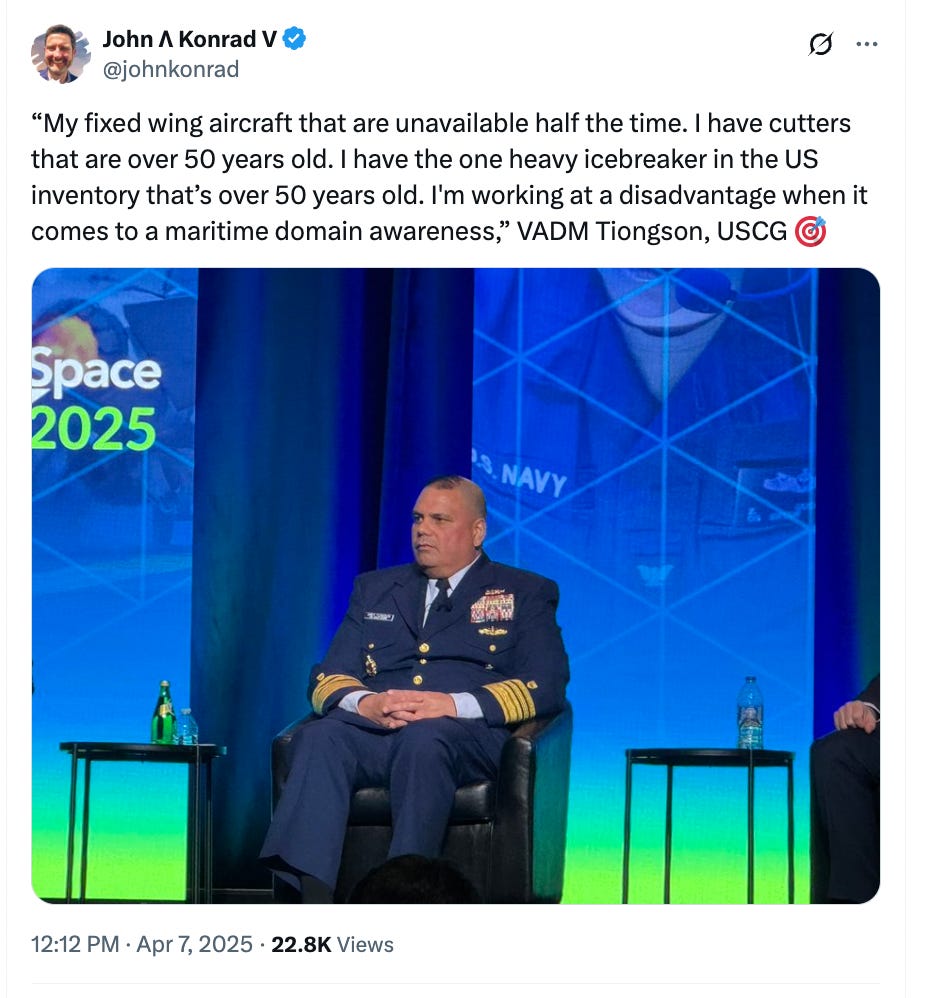
The commandant of the United States Coast Guard spoke at a maritime conference, a few days ago, and he said that the organization he runs wakes up every day and tries to keep the doors from falling off: “The US Coast Guard is less ready today than any other time since World War II. We are on a readiness spiral. Today our fleet of cutters are in significant decline. We are in repair failure mode … No ship today gets underway without cannibalizing others for parts.”
See also, from one of his subordinates:
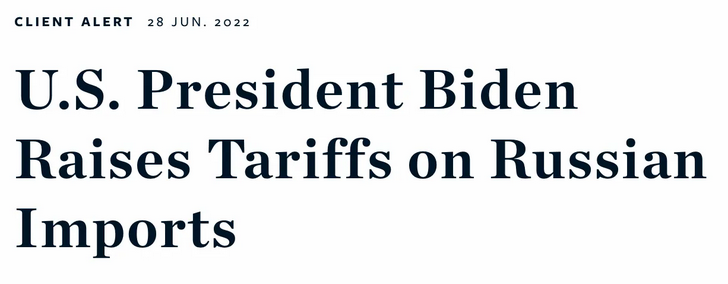
Serious question: Did all of those problems begin at noon on January 20, 2025?
April 11, 2025
Critical Trade Theory
A discussion at the amusingly named Handwaving Freakoutery on the ongoing wave of tariff activity under the Trump II administration, characterizing them as “woke” tariffs:

The great argument playing out in the media right now about the relative value and ethical implications of reciprocal tariffs is not relevant. It is not relevant because these tariffs are not reciprocal tariffs in any measurable way. They aren’t reciprocal, they aren’t sensible, and the justification for them is Woke in every sense of the word. Let’s take a close look at what we might call Critical Trade Theory, back our way into an understanding of what a woke tariff is and how this is definitely that, and close with a quick word about how political realignments portend doom for the left even though the right is really screwing this up. Then we’ll all buy mop handle futures.
Awokening
The Great Awokening of the prior decade was founded in part on the False Cause Fallacy. Our major institutions for the better part of the last ten years were operated by wokerists, who used an Intersectional Matrix of Culturally Encouraged Race and Gender Prejudice to counteract what they viewed as hidden unmeasurable forces such as “systemic racism”. They couldn’t point to the systemic racism, but they knew it must be there because of the imbalance in socioeconomic metrics, and they denied any other possible explanation for the imbalance. Once the False Cause was in place, the devout wokerist was forced to fight the hidden prejudice with overt reverse prejudice, because they couldn’t conceive any other cause.
For example, if black folks have a hard time getting into Harvard or UNC, it must be because society is systemically racist against black people, and no other reason, therefore we should redirect admission slots from Asians who earned them to blacks who didn’t, for race balancing.
Harvard did exactly that, for exactly that reason, and admitted it, and it was sent to the Supreme Court, and the Supreme Court banned it, and then Harvard kept doing it and is still doing it using different words.
Some of our other institutions are still running this wokery program, although the Trump Administration purged much of it from the halls of federal power this year under their DEI ban, and many other institutions used Trump as cover to independently purge it from theirs. But this same smooth-brained thinking wiggled its way right into Trump’s tariff plan last week, through an equation that looks fancy but is something my middle school son could figure out.
[…]
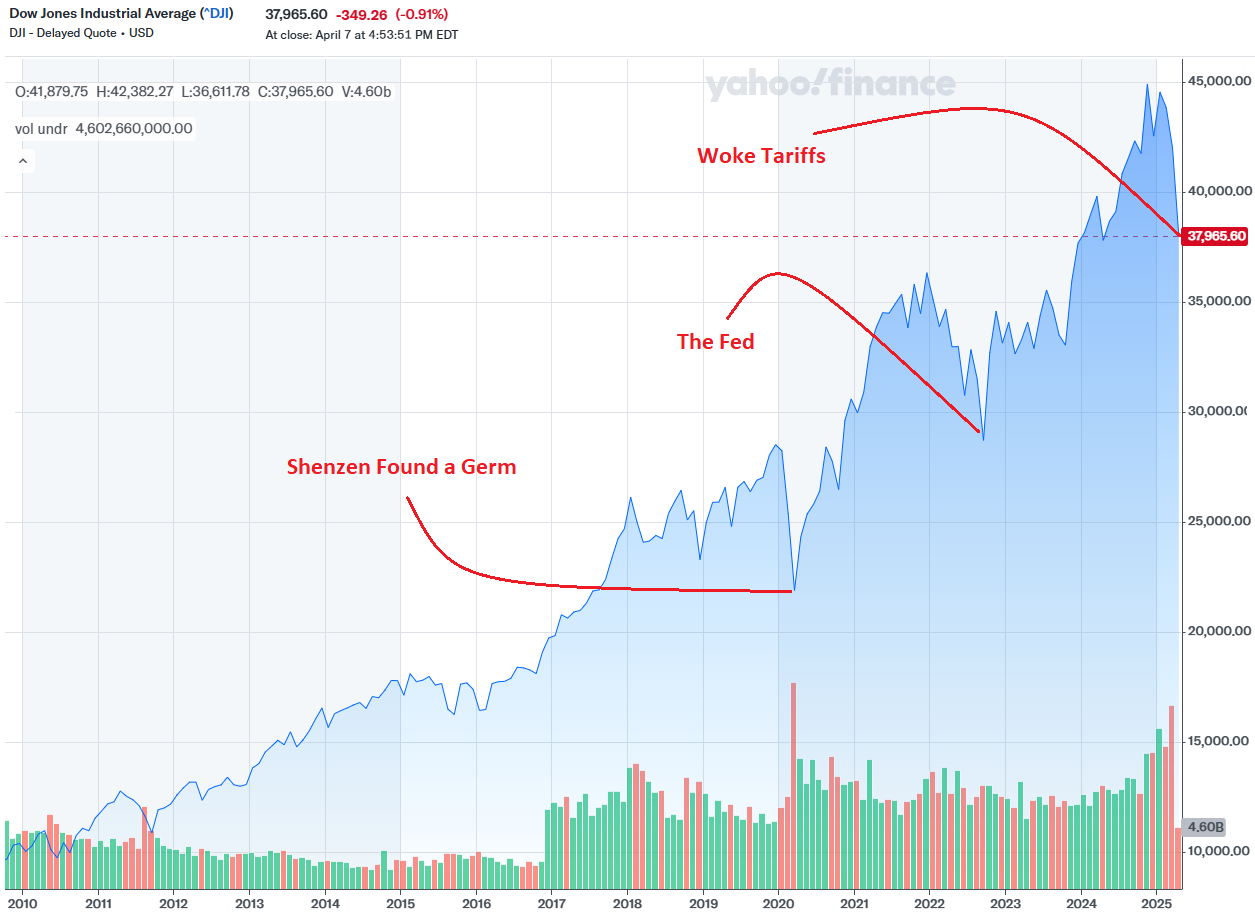
The media thinks these woke tariffs are going to bomb the economy back to the stone age, but when I make the abhorrent choice to read the graphs myself it looks more like January 2024. A 20% tariff on Chinese goods is rough. Adding 34% more to it is rougher. But a 54% tariff on Chinese goods is nothing compared to Shenzhen closing its entire manufacturing sector down because they found a germ, and probably not significantly worse than the Fed turning off the free money spigot in 2022.
These tariffs are going to do goofy shit to the economy. I don’t like the goofy shit they’re likely to do. I think that trade balancing through tariffs is an idea so stupid that only Rust Belt union workers could come up with it, which is why they probably did come up with it, and also probably why Trump won the election by flipping the Rust Belt.
April 10, 2025
Late onset Trump Derangement Syndrome
Ed West diagnoses himself with a raging case of late onset TDS:
What has caused this late-onset TDS, however, is not Trump’s behaviour, but the relative silence of his critics. During Trump’s first term, everyone in the American establishment seemed to be calling him the next Hitler, and this included not just the usual academics and journalists but many major corporations; companies like Nike, Heineken and Airbnb were at the forefront of the “resistance” against the president, a trend labelled “CEO Activism”. It was quite obviously self-interested and performative, because if everyone in your country is calling its leader a fascist dictator, then you probably don’t live in a fascist dictatorship.
I have no idea where I saw this meme, but it makes me laugh
That is not the case this time around, and that is more troubling. I recall from my time volunteering for first aid training that, when you arrive at the scene of an accident, you don’t go to the person screaming in pain, but the individual lying on the ground in stony silence. Similarly, the fact that people working for large corporations now keep quiet about Trump, even as he embarks on the most reckless economic policy in recent years, should probably concern us. The reason they keep quiet — and this is something I have heard from the horse’s mouth — is because they feel that there is a real risk of punitive action if they speak out.
One of the things more moderate folks used to warn the far left activists about using any and all tools to “get” their enemies is that it can — and in this case has — unleashed exactly the same kind of retribution when their former target now has the power to do so. “Muh norms!” indeed.
The constant evocation of fascism is not just mistaken in my view, but neurotic. Western civilisation is emotionally scarred by the violent racial supremacism of the Nazi regime and in particular the Holocaust, the worst crime in history, yet people have a tendency to fight the last war and this isn’t the danger that Trump represents. He is not a white supremacist and not especially motivated by ethnic nationalism. He is, however, authoritarian in nature, prone to be vengeful to those who cross him while also surrounding himself with yes-men, and he does seem to have territorial ambitions, even if they concern a frozen wasteland. Those things are all bad enough in themselves.
Rather than being a new Hitler, a more realistic concern is that Trump represents the 19th century spectre of Caesarism, a man who uses democracy in order to establish himself as an imperial figure. The fear of a Caesar always haunted the founders of the Republic, obsessed with Roman history as they were and sceptical of democracy and mobs.
Trump as a modern Louis Napoleon? A case could certainly be made for it.
Caesars do not come out of nowhere, and the progressivism of the last few years has been deeply illiberal, hostile to freedom of speech and even more so to freedom of association. Jonathan Haidt talked of “decentralized totalitarianism” and it was the chaotic nature of woke progressivism that made it so disconcerting and caused many people, including those same corporate leaders, to stay silent.
Many of the things Trump is now doing are not entirely dissimilar to what radical progressives did when the opportunity arose, in particular the determination that institutions are cleared of their opponents. It is bitterly ironic, for instance, to have the Left accuse Trump of “rewriting history” for ideological reasons (gosh, imagine!). Yet there is something quite different about people scared of online mobs and being scared of the government. Activists, though loud and hysterical, could be ignored if people only had the courage to face them (which they usually didn’t); the state can make your life very difficult indeed. Already the Trump regime has punished law firms which oppose their leader; foreign nationals who’ve expressed criticism of the regime have been detained. These are not good signs.
I’ve sneered at the American critics who worked themselves up into hysterical rages about Trump, not just because of their puritanical piety but because of the lack of awareness about their own behaviour, in particular the conspiracies about Russia and the dishonest, partisan nature of American journalism (Trump is probably the most dishonest president in US history, but it may also be true that he is the most lied about). In the modern liberal imagination, in part because so many people read far more fiction than history, Trumpian figures tend to be opposed by a courageous “resistance”, whereas in reality most dictatorial leaders arise because there are no moderate alternatives, and the opposition is similarly extreme and unpalatable. There were no real goodies in the Spanish Civil War, nor in Syria, nor even in much of central-eastern Europe in the mid-20th century, where fascists fought communists for control of the streets.
April 9, 2025
The Korean War Week 42 – Seize Hwacheon Reservoir? A Dam Good idea – April 8, 1951
The Korean War by Indy Neidell
Published 4 Apr 2025Operation Rugged is in full swing, and it’s taking a decent amount of territory, but Matt Ridgway is worried about the possibility of the enemy blowing the dam at the Hwacheon Reservoir and flooding his army, so he gets set to try and soon take it. Meanwhile there’s an explosion in Congress in Washington DC, when the Minority Leader openly reads Douglas MacArthur’s letter of his plans for the war that are diametrically opposed to those of President Harry Truman. Truman realizes that he’s going to have to remove MacArthur from UN command.
Chapters
00:57 Recap
01:31 When to Fire MacArthur?
03:53 Joe Martin Speaks
07:11 Operation Rugged
09:23 The Hwacheon Reservoir Dam
13:35 Summary
13:51 Conclusion
(more…)
Battle of Saipan 1944: Total War in the Pacific
Real Time History
Published 15 Nov 2024In June 1944, an armada of warships and landing craft is getting ready for D-Day. Thousands of American soldiers are about to attack a prepared enemy with formidable defenses. But this isn’t Normandy, this is the island of Saipan. And the bloody battle there will bring total war to the Pacific.
Chapters:
00:00 Why the US Landed on Saipan
01:46 American Plan for Saipan
03:38 Japanese Defenses on Saipan
05:08 Preparations for D-Day on Saipan
06:39 D-Day on Saipan
08:46 Marine Combat Shotguns on Saipan
14:48 Japanese Counterattack
16:30 D-Day Plus 3 on Saipan
17:01 Battle of the Philippine Sea
20:45 D-Day Plus 7-9 on Saipan
22:33 D-Day Plus 11-15 on Saipan
24:10 Japanese Banzai Charge on Saipan
26:46 Civilian Casualties on Saipan
27:57 End of the Battle of Saipan
28:48 Battles of Tinian and Guam
30:04 Epilogue
(more…)
April 7, 2025
Those brave, rare contrarians willing to risk everything by … criticizing Trump?
Chris Bray is deeply concerned that a free society seems unable to produce even a mild array of differing political opinions these days:
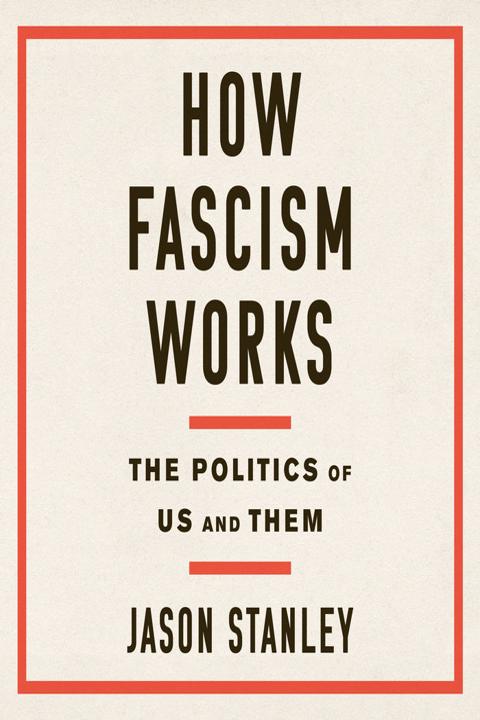
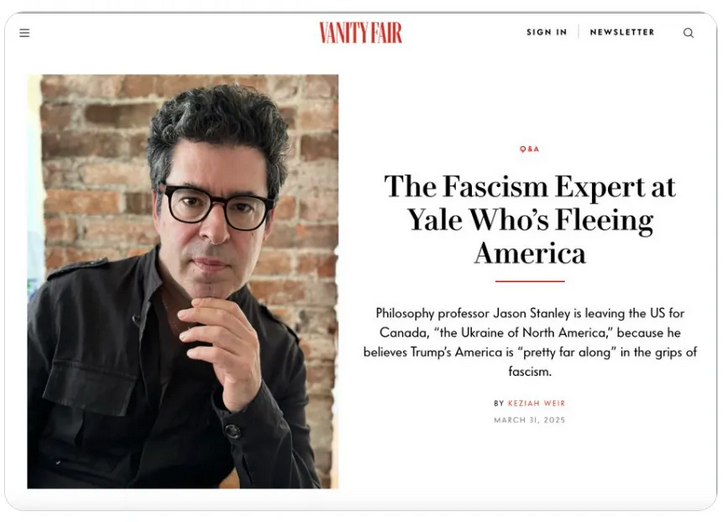
I was at a small independent bookstore today, the exact kind of place that’s supposed to curate a culture of argument and criticism. The prominently displayed books about politics and current events were Timothy Snyder’s book about the terrifying rise of American fascism under that monster Trump, Jason Stanley’s book about the terrifying rise of American fascism under that monster Trump, Anne Applebaum’s book about the terrifying rise of American fascism under that monster Trump, and a bunch of other books by prominent journalists and professors about … okay, try to guess.
On the other side of that exchange, the books by public intellectuals offering a favorable or even neutral view of Trump and the Trump era were … not there? Maybe I just missed them. So every prominent figure moving to the cultural foreground from academia and “mainstream” journalism — every brave contrarian, every freethinking intellectual warrior rising against the prevailing fascist sentiment of the age to speak in his own voice as a free person — thinks and says the same things, the same ways, with the same evidence and the same framing and the same tone and in the same state of mind. They’re so free and brave and iconoclastic that they’re essentially identical, chanting in intellectual unison.
Forget Trump for a moment and answer this question in general: If you’re living through an era in which every prominent journalist and academic and artist says exactly the same fucking thing all the time, what kind of moment are you living in? Would you call people who all chant in unison the resistance?
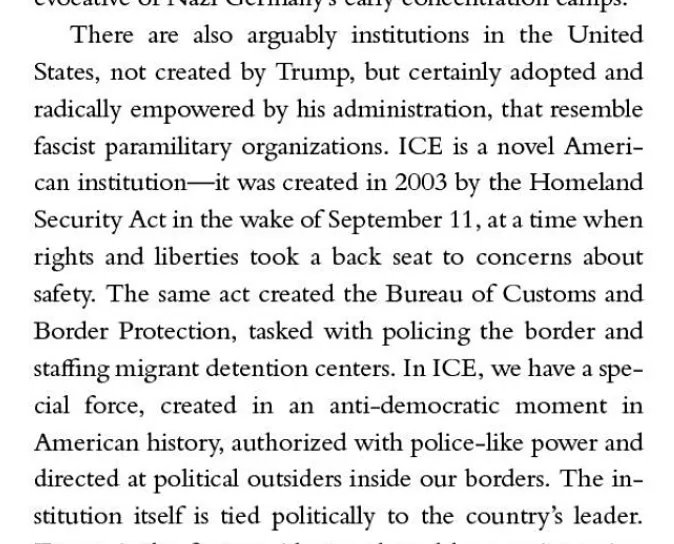
Any engagement with these books reveals their emptiness. Snyder, Stanley, Applebaum, whatever: pick a book, then pick a page. See if it makes sense. Here, I spent a few nauseating minutes today with brave Jason Stanley’s book How Fascism Works: The Politics of Us and Them. Here’s a paragraph from the introduction to the paperback edition:
ICE is novel: It was created after 9/11, by the same law that created a bureau tasked with border protection: a “special force, created in an anti-democratic moment”.
I can’t calibrate the degree to which this person is a fool or a liar, but let’s go with both. The Border Patrol was created in 1924, and was itself the successor agency to a different organization that was created in 1904. You can read that history here. The post-9/11 organization that supposedly created this novel American institution merely reorganized a century-old American institution, making it not the least bit novel. Before ICE, we had INS. Yes, we had a border before 2003, and we policed it. This isn’t a novel concept at all, as it has operated in any form of practice.
You can go through that single amazing paragraph sentence by sentence and tear every last bit of it apart, at the lowest, simplest factual level. The argument isn’t wrong: all of it is wrong, every layer of fact and interpretation. This man is an absolutely enormous jackass. And he’s … important. An important public intellectual, you see.