
“An Army marches on its stomach.” — Napoleon
As we take our own little march down memory lane, let me state up front that I can’t stomach applesauce, just can’t. I liked it as a kid but now it has less appeal than the prospect of being duct taped to a chair, face down, in prison. Yeah, I hate it.
This may seem unreasonable, but anyone who was in at the time, at least in the Army or Marines, and some portion thereof that actually went to the field a lot, will probably remember the Great Applesauce Blight of 1977 and 1978, which was the reason I can’t stand the crap.
The “Great Applesauce Blight?” you ask. Oh, yeah.
The story I got, after some years and some digging, goes like this: It seems that sometime in the late 1960s or early 1970s, a fruit company – the Monterey Fruit Company, so it was said – was going out of business. So the Monterey Fruit Company, if that’s who it really was, called the Department of Defense and said, “Boys, have we got a deal for you. Hundreds upon hundreds of tons of Grade A applesauce, and you can have it. All of it. Cheap.”
McNamara and his Whiz Kids – neither of them ever sufficiently to be damned, of course – were gone, but their spirits remained. Department of Defense, ever conscious of the value of a well-squeezed penny, bought that inventory of applesauce, and began to put it into the old style, canned, MCI; Meal, Combat, Individual, which is to say, “C-rations”.
C Rations of the day were entirely canned and composed of a main meal, for one meal, plus either a cake (or very rarely, canned bread) or fruit of some kind, usually a small tin of peanut butter or cheese of some kind of jam or jelly, and one or another type of B Unit, which would have some variant of crackers plus either candy or cocoa. Sometimes, as with the B-2 unit, the cheese was in those.
Now, perusing a case of 1978 C-rats, which would have been newer than those of the Great Applesauce Blight, but still broadly similar, one notes that there were twelve menus, twelve different main meals, and 12 different kinds of dessert, a sundry pack, plus variable candies, spreads, etc. Of that latter twelve, eight were fruit and four were cake of some kind. I seem to recall that, possibly for reasons of economy, the amount of fruit during the Great Applesauce Blight had gone up to usually ten cans out of twelve, some extra cheese or peanut butter seemed to be included with some, and the cakes went down to two, one of which was going to be Chocolate Nut Roll, essentially inedible, from the Nashville Bread Company and the other would be the even more thoroughly disgusting fruit cake. I don’t recall who made that, and that lack of memory may have been an automatic defense against a future charge of capital murder. None of the cakes except pound cake could be relied on to be edible, and pound cake was always rare.
Now picture this, you’re a soldier in the Panama Canal Zone, training – training hard – to fight for the Canal, living in the jungle maybe twenty-five or more days and nights a month, eating C-rats to the tune of sixty or seventy a month, and virtually every meal contains applesauce or something more innately disgusting. “No, none of that nice fruit cocktail or those ever so delectable pear slices for you, young man; Department of Defense, to save a few bucks, has determined that applesauce is good enough, three meals a day, for weeks on end.”
*****
Now we were already kind of thin, because no military feeding system can ever completely keep up with the caloric requirements for a soldier either continuously fighting or realistically training to fight. Normally, this isn’t a problem because he can pack it on in the mess hall. These were unusual circumstances, though, with an unusually high chance of fighting – or riot control, which is worse – over the Canal. So we’re pretty much living out there, in pretty much trackless jungle, with nothing like enough helicopters for regular hot rations from the mess. Besides that, the old 193rd Infantry Brigade, in the Panama Canal Zone, was unusual in that it made a very serious effort to train even the cooks to fight, which takes time, too. C’s are pretty much it.
Even so, thin and hungry or not, after a month or two we could not eat the applesauce. That was probably seven or eight hundred calories a days that just got tossed.
We began going from thin to frigging emaciated.
*****
When I think upon the Great Applesauce Blight, though, I do not think about hardship or hunger. No, I think – as we old farts are wont to – about happier aspects of it.
Now this is no shit:
There we were, the heavy mortar platoon of 4th Battalion, 10th Infantry, stuck on top of a non-descript hill somewhere southwest of Gamboa, Canal Zone.
PFC McBrayer had a birthday out there in the jungle. I think it was his nineteenth birthday. None of us had been able to do any shopping, so we were all just stuck for getting him a birthday present. “I’m not giving up my pet scorpion,” said Big Al, who in fact, had a pet scorpion for the mega-ant versus scorpion gladiatorial combats we used to stage. “I’d offer to give him some of my crotch rot,” said Art, “but I think he already has some of his own.” “Howler monkey?” “Who’s going to catch it? And those suckers are mean, too.” “How about a sloth? They’re easy to catch.” “If the Lord God didn’t see fit to give B’rer Sloth an asshole, I don’t see why we should add to his troubles by catching him and wrapping him as a present.” Finally someone, I don’t think it was me, might have been Sergeant Sais, said, “Gentlemen, there can be only one proper gift under the circumstances,” and then he held up a – you guessed it – can of applesauce.
So we stuck nineteen or twenty Canal Zone Matches in a Nashville Bread Company Chocolate Butt Roll, invited McBrayer over, torched off the matches, sang Happy Birthday, then presented him his can of applesauce.
He was touched; you could see that. As he dashed tears from his eyes while making his, “Gee, you guys are just all so special … you shouldn’t have,” speech, you could see the emotion radiating from his face. And then, all choked up, he turned to go and tossed that can off applesauce off the hill with a casual contempt I have never seen before or since. It was the sheer, distilled essence of everything we all felt about applesauce.
Tom Kratman, The social media site formerly known as Twitter, 2025-09-05.
December 7, 2025
QotD: The Great Applesauce Blight of 1977/78
December 6, 2025
Battle of Tarawa, 1943
Real Time History
Published 5 Dec 2025The Marine and US Army landing on the Tarawa Atoll’s Betio and Makin islands were the first operations in the new Central Pacific front of the Pacific War. Tarawa was one of the deadliest amphibious landings for the Marine Corps which hadn’t yet perfected such complex operations. But the lessons learned at Tarawa would already be applied a few months later at Kwajalein and Eniwetok.
(more…)
December 5, 2025
QotD: The Anglosphere
Ironically – and this must drive those of a pro-EU frame of mind nuts – it is still North America, with its rawer culture and politics, its legal similarities to the UK (for good and for ill) that resonates, even in the minds (for want of a better noun) of the sort of folk going on BLM demos. What goes on in France, Germany or Italy tends not to have the same grip on the mind. The Atlantic is wide and the Channel is narrow, but in every other sense, it is the other way around. To that extent, then, the Anglosphere lives, even in the hearts and minds of the far Left.
Johnathan Pearce, “The Anglosphere and our present discontents”, Samizdata, 2020-06-08.
December 4, 2025
“… the biggest problem facing disabled people is that they aren’t eager enough to call themselves disabled”
On his Substack, Freddie deBoer decries the New York Times viewpoint that “there is no such thing as a person, only beings that exist to function as sets of interlocking identities”:

(you would find this horribly condescending too)
Image from Freddie deBoer
I’m not joking! Paula Span has produced this particular bit of scolding for The Official Publication of Liberals Who Occasionally Look Up From Their Crosswords to Disapprove of Everyone and Everything. Span writes
Identifying as a person with a disability provides other benefits, advocates say. It can mean avoiding isolation and “being part of a community of people who are good problem-solvers, who figure things out and work in partnership to do things better”
Of course, you can enjoy those benefits without identifying as disabled, without allowing one unfortunate aspect of your life become an entire identity. But that doesn’t fly in the world of the brownstone liberals who fund and run the New York Times, who seem to believe that there is no such thing as a person, only beings that exist to function as sets of interlocking identities.
Here’s the maddening thing about this piece: it quietly smuggles in a worldview that has metastasized across the discourse, a worldview in which the biggest problem facing disabled people is that they aren’t eager enough to call themselves disabled. Not, you know, being blind or paralyzed or suffering from dementia or constantly wracked with chronic pain, no, all of that is subservient to the only question anybody seems to care about anymore, the all-devouring question of identity. The whole thing hums along with the cheery institutional conviction that the answer to every human frailty is more identitarian self-labeling. If only the elderly would embrace the capital-D Disability identity, we’re told, everything would be better — their health care would run smoother, their interactions with institutions would be less demeaning, their sense of community would blossom. Maybe they’d even be happier! The Times treats this as self-corroborating common sense, like, well, everything else argued in the New York Times.
What this kind of thinking actually represents is the natural endpoint of a cultural project that has turned medical pathology into a personality type. It’s the codification of a worldview where suffering is not something to address, treat, alleviate, or recover from, but a new kind of boutique identity, complete with community membership, branded discourse, and moral status. It turns vulnerability into a form of social currency, rewarding performance over authenticity and turning genuine suffering into a spectacle for peer validation. In doing so, it erodes the very possibility of meaningful treatment, because the focus is no longer on recovery or well-being, but on cultivating a carefully curated self-image that fixates on impairment. And what I think, as I read this person tut-tutting senior citizens for not embracing that new ethos, is “Maybe they just feel like they’re too fucking old to take part in such nonsense?”
The piece insists, without evidence or even really argument, that treating disability as an identity will improve access to accommodation. Disability accommodations matter; of course they do. But what this article is concerned with is patently not getting older adults the practical support they need. The piece is instead fixated on the idea that the real issue here is that people don’t want to be disabled in the metaphysical, self-defining sense, as though the reluctance of an 84-year-old to call herself Disabled-with-a-capital-D is some retrograde psychological failure rather than a perfectly sane human impulse born of a lifetime of struggle. Span frames this as a story about insufficiently enlightened seniors who need to be ushered into the disability “community”. But maybe the reluctance they’re describing is the whisper of something older and much wiser: the understanding that disability is not a polity you join, not a club whose membership conveys special epistemic authority, but a condition of life that you endure and attempt to mitigate. These older people don’t identify as disabled because they remember, stubbornly enough, the distinction between having a problem and being the problem. They treat disability as a practical reality, not an existential category. And they’re right to do so.
Update, 5 December: Welcome, Instapundit readers! Please do have a look around at some of my other posts you may find of interest. I send out a daily summary of posts here through my Substack – https://substack.com/@nicholasrusson that you can subscribe to if you’d like to be informed of new posts in the future.
The Swiss vote overwhelmingly against a new wealth tax
As the California government wants to impose a new wealth tax, it’s worth checking how similar schemes are viewed in other jurisdictions. The Swiss voters were given an opportunity to scalp their very richest citizens and permanent residents with a proposed wealth tax, but it went down with 78% voting against it:

“Switzerland on Sunday overwhelmingly rejected a proposed 50% tax on inherited fortunes of 50 million Swiss francs ($62 million) or more, with 78% of votes against the plan, an outcome that even exceeded the two-thirds opposition indicated in polls,” Reuters reported this week.
All Swiss cantons already tax assessed gross worldwide assets, minus debts and with exceptions, making it one of the few countries in the world to retain a wealth tax. But competition among cantons keeps the tax burden relatively low and, as the Tax Foundation notes, “the Swiss wealth tax acts as a substitute for a capital gains tax and an estate tax, which are common in other countries”. The referendum would have imposed an additional and very steep national tax.
This was actually the second recent failed attempt to impose a national wealth tax on inheritances. Seventy-one percent of Swiss voters rejected a 2015 proposal for a 20 percent tax on estates and gifts of over 2 million francs. The revenues would have been earmarked for old-age pensions.
‘Inequality in Opulence is Better than Equality in Poverty’
The 2025 tax scheme openly played to envy. It was targeted at combating “inequality” by seizing half the assets of the rich and allocating proceeds to offset the climate damage they allegedly cause.
Finance Minister Karin Keller-Sutter opposed the proposal, warning that “many wealthy people would simply emigrate to avoid the tax and keep their wealth”. She also pointed out that while all but two of the country’s 26 cantons tax inheritances, “the people have abolished inheritance tax for children and spouses in many cantons”. She added, “I think it is right that what was developed in the nuclear family can be passed on”.
Philosopher Olivier Massin, a professor at the University of Neuchâtel, criticized the motivation driving much of the campaign for the tax. He wrote that “inequality is by nature neither good nor bad” and that envy is the main driver of egalitarianism. “Envy being inglorious, we grimace in indignation, making what is ultimately only the expression of resentment a moral cause.”
Massin added that “inequality in opulence is better than equality in poverty”.
And Switzerland is undoubtedly “opulent” — or, at least, prosperous — with a per capita gross domestic product of $103,669 as compared to $85,809 for the U.S., according to the World Bank. It builds that wealth with a second-place score in the current Index of Economic Freedom (the U.S. is now ranked at 26), suggesting that less government meddling in economic matters is the best way to increase prosperity.
M103: The Tank With No Name
The Tank Museum
Published 1 Aug 2025In 1950, the USA was facing a tank crisis … and the M103 was supposed to be part of the solution. But it would hardly ever be used.
After the Second World War, the USA made massive cuts to their conventional forces – declaring the majority of their tanks obsolete, with those left coming to the end of their service life. And the appearance of the Soviet IS-3 meant that the pressure was on. The US Army and the US Marine Corps wanted new tanks – and they wanted them fast. And the appearance of the Soviet IS-3 meant that the pressure was on. The USA declared a “Tank Crisis”.
The T-43 heavy tank was intended to be the response to new Soviet armour. But vehicles were being built before the bugs had been ironed out – and the delays began to mount up. Whilst the Army began to question the need for a heavy tank, the Marines went all in on the concept – ordering over 200 for their forces. But the T-43 was nowhere near ready to enter service, and the vehicles went into storage with 114 improvements needed.
Changes were made and eventually the Marines got their heavy tank – now named the M103. But its effectiveness was limited, and the M103 was only operationally deployed once. The Marines rejected replacement M60s in favour of the Future Main Battle Tank – a project that would end up being cancelled. Their existing M103AA1s were modernised using M60 parts, creating the M103A2 – which The Tank Museum has an example of in its running fleet.
The M103 is a heck of a tank: powerful, capable and incredibly imposing to be around. But did the Americans really need it? Was it the ultimate panic buy?
This is the story of the M103 Heavy Tank – and the panic that produced it.
00:00 | Introduction
00:30 | Meet the M103
03:06 | T-43 and the Tank Crisis
06:21 | Unfit for Service?
11:33 | In Service
15:26 | M103 In Retrospect
December 3, 2025
Like him or loathe him, Trump’s response to the DC shootings was “spot on”
In The Conservative Woman, Richard North makes the case that US President Donald Trump is the only western political leader who can stop the migration crisis:

Like him or loathe him, question his inconsistencies and his many other flaws, but in my view Donald Trump’s response to the shooting of two members of the West Virginia National Guard in Washington DC by an Afghan migrant was spot on.
There was none of the pussyfooting “my thoughts are with …” etc. Without equivocation, he immediately branded the shooting “an act of evil, an act of hatred and an act of terror”, adding: “It was a crime against our entire nation”.
Shortly thereafter, Secretary of State Marco Rubio posted a tweet declaring: “President Trump’s State Department has paused visa issuance for ALL individuals travelling on Afghan passports. The United States has no higher priority than protecting our nation and our people.”
Attached was an official tweet from the Department of State making it clear that the ban was of immediate effect, with the Department “taking all necessary steps to protect US national security and public safety”.
This added to the ban in June when Trump imposed restrictions on citizens from 12 countries, including Afghanistan, but that ban did not revoke visas previously issued, and holders of Special Immigrant Visas (SIV) were exempt.
Now Trump has gone further. In a Thanksgiving message posted on X, he offered a salutation which, in Trumpian style, didn’t mince words. It started with: “A very Happy Thanksgiving salutation to all of our Great American Citizens and Patriots who have been so nice in allowing our country to be divided, disrupted, carved up, murdered, beaten, mugged, and laughed at, along with certain other foolish countries throughout the world, for being ‘politically correct’, and just plain STUPID, when it comes to immigration …”
That was only the start of a very long and quite extraordinary tweet which, if nothing else, can be criticised for a complete absence of paragraphs and sentences which rivalled in length those in a Dickens novel.
With his opening out of the way, Trump asserted that the official United States foreign population stands at 53million, most of whom, he averred, “are on welfare, from failed nations, or from prisons, mental institutions, gangs, or drug cartels”.
“They and their children,” Trump continued, “are supported through massive payments from patriotic American citizens who, because of their beautiful hearts, do not want to openly complain or cause trouble in any way, shape or form”.
Warming to his theme, he declared: “They put up with what has happened to our country, but it’s eating them alive to do so! A migrant earning $30,000 [£27,000] with a green card will get roughly $50,000 [£38,000] in yearly benefits for their family. The real migrant population is much higher.”
Pressing his point, he stated what none of Starmer’s motley crew will admit.
“This refugee burden is the leading cause of social dysfunction in America, something that did not exist after World War II (failed schools, high crime, urban decay, overcrowded hospitals, housing shortages, and large deficits, etc)”, the Donald wrote.
In a passage which might have got him arrested had he posted in the UK, with refreshing candour, the President gave the example of “hundreds of thousands of refugees from Somalia” who were “completely taking over the once great State of Minnesota”.
Somali gangs, he said, “are roving the streets looking for ‘prey’ as our wonderful people stay locked in their apartments and houses hoping against hope that they will be left alone”.
No matter which country they end up in, Somalis tend to be bad news. There are multiple reports stretching back to 2007 of a plague of criminal gangs among the 32,000 Somalis who have settled in Minnesota.
Recently the Minnesota gangs have been associated with a series of massive welfare fraud schemes, the proceeds of which may have been funnelled to the Somalia-based terror group al-Shabab.
The largest fraud scandal involving Somalis was the “Feeding Our Future” scheme. Prosecutors racked up 56 criminal convictions in what they alleged was a plot to steal $300million (£270million) from a federally funded programme meant to feed children during the covid event.
The Korean War Week 76: Is America Favouring The Communists? – December 2, 1951
The Korean War by Indy Neidell
Published 2 Dec 2025This week at the Panmunjom Peace Talks the two sides agree on a Demarcation Line for an armistice based on the current battle lines, provided the other items on the agenda have been dealt with within 30 days — or else it is invalid. There is still a huge issue, though concerning rotation and replenishment of force during an armistice, and also the right of inspection. The two sides are very far apart on all that. And 8th Army Commander Jim van Fleet issues orders which are misconstrued in the global press and lead to some embarrassment for Washington.
#KoreanWar #peacetalks #Korea #history #militaryhistory #Ridgway
Chapters
00:00 Intro
01:02 Recap
01:44 Item Three
05:08 Inspections After Armistice?
07:53 Ridgway’s Concerns
09:54 The POW Issue
11:45 Van Fleet’s Instructions
13:51 Summary
14:26 Conclusion
16:36 Call to Action
(more…)
Battle of Peleliu 1944
Real Time History
Published 18 Jul 2025In September 1944, the US 1st Marine Division is on its way to another amphibious invasion in the Pacific – the tiny island of Peleliu. For almost half the Marines it will be their baptism of fire against veteran Japanese troops with a new defensive doctrine. Some American commanders call for the operation to be cancelled, but it goes ahead. By its end, half the Marines and all the Japanese will be killed or wounded – but was Peleliu worth it?
(more…)
December 2, 2025
H&R Handy Gun: A Smoothbore Pistol Killed Off by the NFA
Forgotten Weapons
Published 19 Jul 2025The Handy Gun was introduced by Harrington & Richardson in 1924. H&R took their Model 1915 single-barrel break-action shotgun and cut it down into a handgun. It got a pistol grip and an 8″ barrel, and was offered in both .410 and 28 gauge (the .410 model also able to fire some .44-caliber single-bullet cartridges). A 12″ version was also made, to be legal in a few states that had length restrictions. It was advertised specifically for personal protection, probably exploiting the common belief that one need not aim a shotgun at close range.
In 1931 H&R attempted to pivot the Handy Gun into the target pistol space, introducing .22LR and .32 S&W models with rifled barrels. These didn’t sell very well, as there were many other, better options for target pistols. A detachable wire stock was introduced in 1933, but this didn’t help much either.
Ultimately the National Firearms Act of 1934 conclusively killed off the Handy Gun (along with similar products from other companies, like Ithaca’s “Auto & Burglar”). That law categorized smoothbore pistols as “Any Other Weapons”, and subjected them to NFA registration with a $200 tax on their manufacture and a $5 tax on their transfer. This overhead destroyed demand for the gun, and the company simply ceased to offer it commercially. It did continue to be sold in Canada until World War Two however as Canadian law did not restrict it at that time. Total production was about 54,000.
(more…)
December 1, 2025
If they’re behind bars, they can’t easily re-offend
In City Journal, Tal Fortgang makes the case for keeping repeat offenders in prison (which used to be the norm) rather than allowing the small minority of violent criminals to rejoin society ever more easily and more speedily:
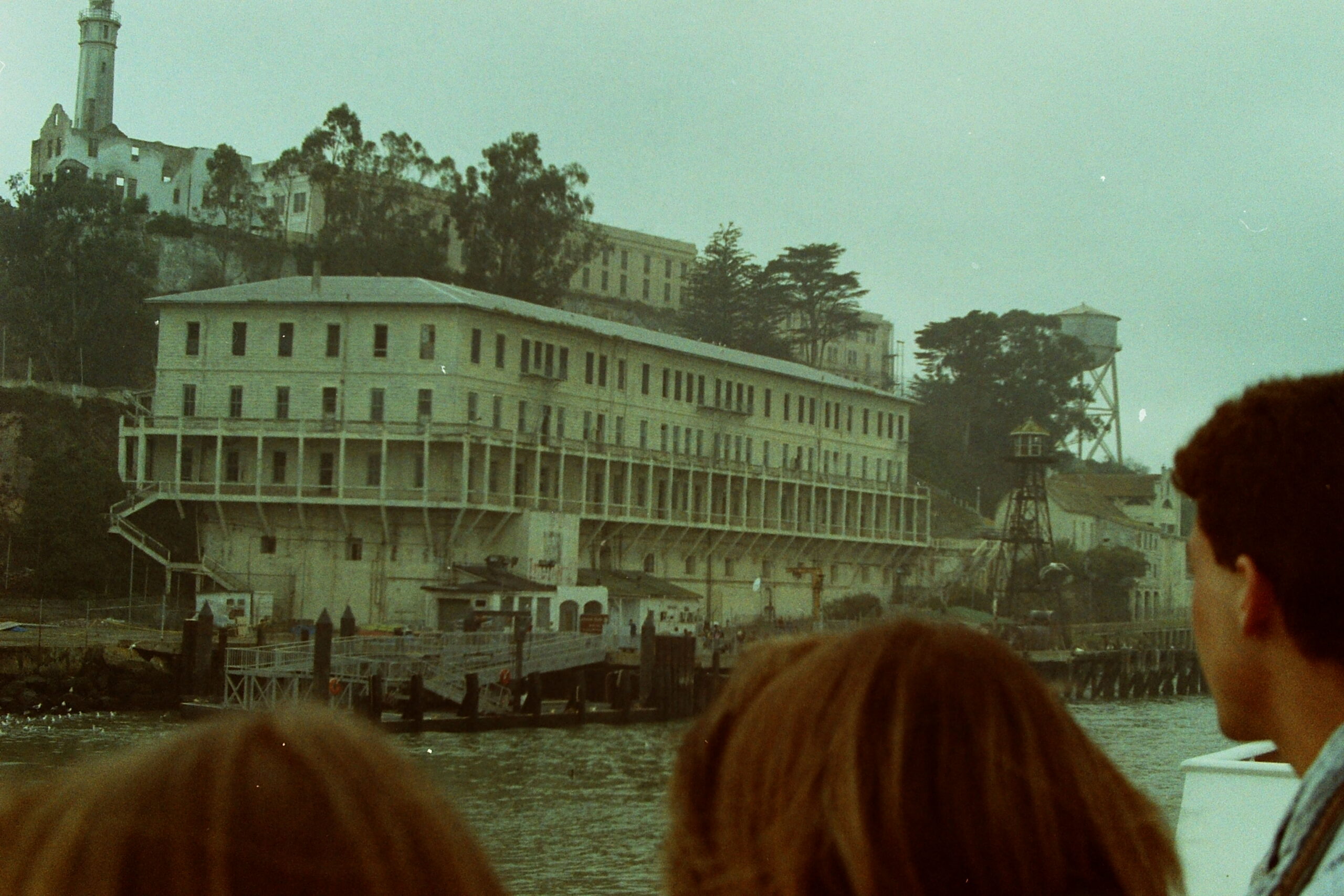
Approaching the dock at Alcatraz on a foggy January afternoon, 1991.
Photo by Nicholas Russon
It’s fashionable to blame America’s high incarceration rates on social injustice — and law enforcement — rather than lawbreaking. If policymakers would just provide disadvantaged people with sufficient resources and economic opportunity, on this view, the crime problem could be solved. That utopian vision gained traction during the mad summer of 2020, when activists, rioters, and the mainstream press, reacting to the death of George Floyd in Minneapolis, sought to replace law enforcement with programs that target the root causes of antisocial behavior. “As a society,” wrote activist Mariame Kaba in the New York Times, “we have been so indoctrinated with the idea that we solve problems by policing and caging people that many cannot imagine anything other than prisons and the police as solutions to violence and harm”.
The truth is otherwise. As Hyland’s case exemplified, violent crime is overwhelmingly the work of a small group of repeat offenders — that is, it is highly concentrated. The remedy, as [political scientist James Q.] Wilson argued half a century ago in his classic book Thinking About Crime, is not social engineering but incapacitation: keeping the violent few from striking again.
Most people are not teetering on the edge of felony, waiting to become, in the Left’s favored euphemism, a “justice-impacted individual”. The overwhelming majority of Americans never engage in serious criminal behavior, let alone commit violent felonies like murder or armed robbery. But those who do are likely to do so again, the evidence shows. Indeed, crime’s concentration is one of the most well-established findings in social science. In 1972, University of Pennsylvania criminologist Marvin Wolfgang reported that just 6 percent of males in a birth cohort accounted for 52 percent of all police contacts. (Violent crime, in particular, is overwhelmingly committed by young males.) Thirty years later, a similar study in Boston found that 3 percent of males were responsible for more than half of their cohort’s arrests after age 31.
The pattern holds across time and place. In 2014, data showed that three-quarters of state prisoners — the core of America’s incarcerated population — had at least five prior arrests. Nearly 5 percent had 31 or more, a larger share than those imprisoned after just a single arrest. In 2022, the New York Times reported that “nearly a third of all shoplifting arrests in New York City … involved just 327 people,” or 0.004 percent of the population, who had been “arrested and rearrested more than 6,000 times”. And in Oakland, a gun-violence-prevention group found that about 400 individuals — 0.1 percent of the city — were responsible for most of the city’s homicides. Violence is concentrated geographically as well. It occurs primarily in poor minority neighborhoods, whose members make up most of its victims.
These figures may even understate how concentrated antisocial behavior is. Wolfgang found that the offending minority committed dozens of crimes for every one that led to arrest. Fifty years later, a similar study reported that delinquent youth “self-reported over 25 delinquent offenses for every one police contact … with some youth reporting upwards of 290 delinquent offenses per police contact or arrest”. Combined with the fact that more than 60 percent of violent crimes reported each year go unsolved, the implication is clear: by the time a violent offender ends up in prison, he has likely committed multiple violent acts and many lesser offenses. Again, these patterns are most common among young men “who exhibited more psychopathic features”, the 2022 study’s authors noted, and “who displayed temperamental profiles characterized by low effortful control and high negative emotionality”. As a massive study from Sweden concludes: “The majority of violent crimes are perpetrated by a small number of persistent violent offenders, typically males, characterized by early onset of violent criminality, substance abuse, personality disorders, and nonviolent criminality”.
Update, 2 December: Welcome, Instapundit readers! Please do have a look around at some of my other posts you may find of interest. I send out a daily summary of posts here through my Substack – https://substack.com/@nicholasrusson that you can subscribe to if you’d like to be informed of new posts in the future.
Why Uncle Sam entered the Vietnam War – W2W 055
TimeGhost History
Published 30 Nov 2025The Vietnam War didn’t begin with American boots on the ground. It began with a promise — and a break. After the French defeat at Dien Bien Phu in 1954, the Geneva Accords split Vietnam at the 17th parallel. Ho Chi Minh led the North. In the South, Ngo Dinh Diem struggled to hold a fragile new state together while armed sects, crime syndicates, and political rivals challenged his rule. Washington saw Vietnam as the next battleground of the Cold War, and threw its support behind Diem — believing he could stop the spread of communism in Southeast Asia.
But as elections for reunification approached, tensions rose. Diem refused the vote. The North rebuilt. The South descended into repression, unrest, and quiet rebellion. Former Viet Minh fighters slipped into the shadows. Secret networks formed. Targeted killings began. By 1958, the storm clouds of a new war gathered — one the United States could no longer afford to ignore.
This episode explores how the U.S. found itself pulled into Vietnam, how Diem rose to power, why the reunification election collapsed, how American aid reshaped the South, and how the first sparks of insurgency ignited a conflict that would define a generation.
Join us as we trace the origins of a war long before the Marines landed at Da Nang — to understand why Uncle Sam entered the Vietnam War in the first place.
(more…)
The United States is not – and should not be – the arbiter of all the world’s conflicts
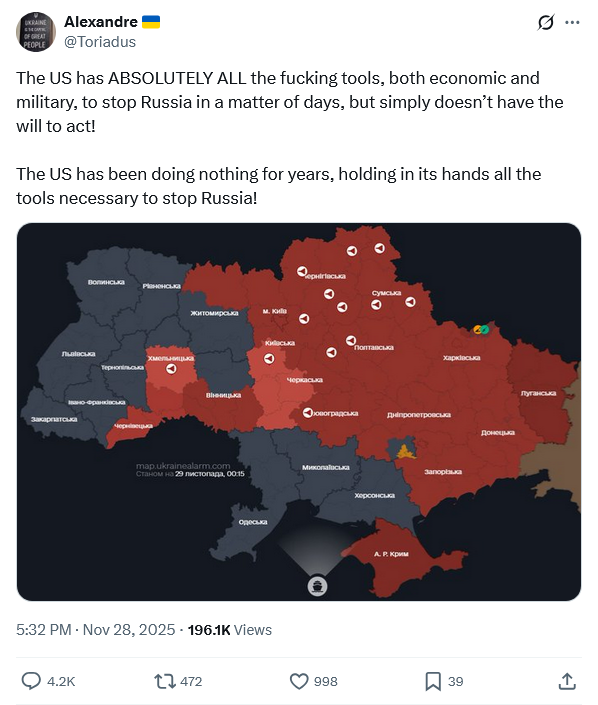
On the social media site formerly known as Twitter, Devon Eriksen responds to a demand that the United States intervene directly in the Russia-Ukraine war:
America is not special. It’s just a country.
Yes, it’s the best country, but it is not the god of all other nations.
A lot of people like to point this out when saying that America doesn’t have special rights, but those same people very rapidly and conveniently forget that phrase when they want something from America.
Because no special rights means no special obligations.
We don’t have to rob our own citizens to keep African AIDS patients alive, or feed nations that overbreed while they are unable to feed themselves.
We don’t have to stop the genocide in East Ethnicklashistan.
We don’t have to accept refugees from anywhere, much less from the worst failed states on the planet.
We don’t have to cooperate with, fund, host, or even participate in the United Nations.
And we don’t have to take sides in ethnic conflicts on the other side of the planet.
The assumption that any conflict is between the good guys and the bad guys, and that the US must help the good guys is the assumption that America is god, responsible for bringing peace, justice, and prosperity to the planet.
Are you ready to be ruled by us as if we were gods?
No?
Then don’t demand justice from us as if we were gods.
The responsibility of America, as just another nation, is to look after the interests of Americans.
Look, we all know that Russia is dogshit at warfare, because wars are not won by being tough. They are won by being organized, coordinated, trained, and equipped.
And Russia is an extraction economy, not a high-trust, high-tech first world state.
So, yes, we could easily beat Russia in a war. That does not mean it is in our best interests to do so. Lots of costs, no benefits.
And while we are wealthiest nation in the history of … everything … we still have a severe overspending problem, mostly because we’ve been the wealthiest nation for a long time, and have developed some bad problem with political corruption, and throwing money at ever grifter with a sob story and an outstretched hand.
I know you think your cause is just. I’m not trying to tell you it isn’t, because I don’t need to decide if it is or not.
It doesn’t matter.
America’s responsibility is to Americans, and if that responsibility is not being discharged, taken care of, thoroughly handled, then support of any other side quest, regardless of its merits, is dereliction of duty.
Update, 2 December: Welcome, Instapundit readers! Please do have a look around at some of my other posts you may find of interest. I send out a daily summary of posts here through my Substack – https://substack.com/@nicholasrusson that you can subscribe to if you’d like to be informed of new posts in the future.
Feeding the Robber Barons of the Gilded Age
Tasting History with Max Miller
Published 24 Jun 2025
Two majestic tiers of grapes, mandarin oranges, and raspberries suspended in pink champagne gelatin topped with whipped cream
City/Region: United States of America
Time Period: 1877The Gilded Age, a period of late 19th century United States history when a handful of people got mind-bogglingly wealthy off of industrialization, conjures up images of the social elite in New York. High society families had more money than most of us could imagine, and they spent it in the most ostentatious ways. One of those ways was by throwing parties that could cost up to the equivalent of millions of dollars in today’s money. These parties would host lavish feasts with dozens of dishes, like this gelée macédoine, which would have been served in a sweet course alongside plum puddings, mince pies, and fruit cakes.
I’m not normally a fan of gelatin, but this was really nice. It wasn’t rubbery at all and the champagne flavor really comes through. It takes a while to make, but feels fancy and is delicious. You could also use the recipe as a base and swap out other types of wine or use other flavorings like liqueurs or spices. If you do add spices (cinnamon was popular at the time), put them into the syrup, and be sure to use a cloth jelly bag or nut milk bag to strain the gelatin mixture. This will ensure a clear jelly.
If you don’t have a gelatin mold, you can use a bundt cake pan, or really any bowl of pan that you have.
Gelée Macédoine. This is made with any kind of jelly; however, jelly made with Champagne or sherry is preferable. Any of the delicate fruits of the season, such as grapes, cherries, peaches, strawberries, raspberries, mulberries, currants (on their stems), plums, and orange sections, or preserved fruits, such as brandied cherries, peaches, etc., are tastefully imbedded in the jelly, so as to show their forms and colors to best advantage.br/>
— Practical Cooking, and Dinner Giving by Mrs. Mary F. Henderson, New York City, 1877
November 30, 2025
The plight of most young western men
At Postcards from Barsoom, John Carter explores the dangerous psychological rift in western thought that casts young men into a literal no-win situation and yet blames them for not succeeding:
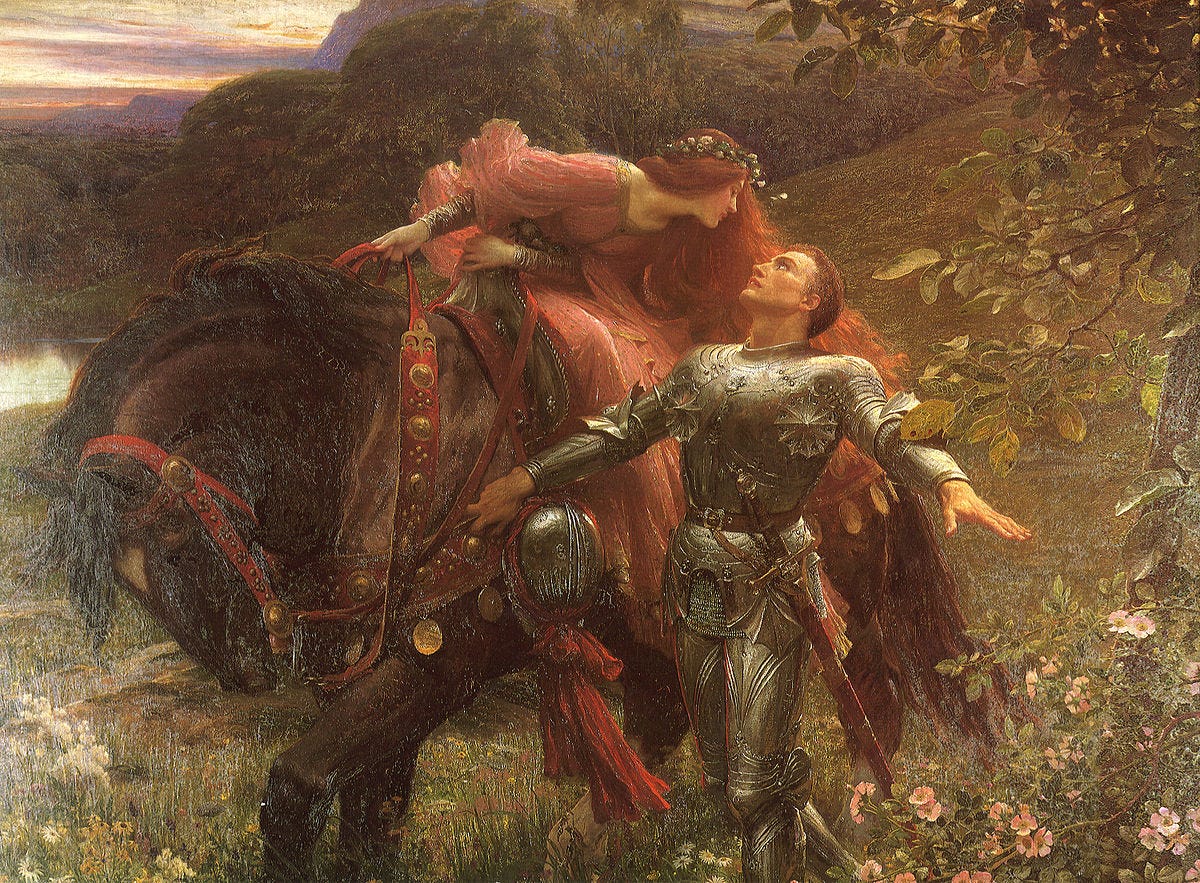
La Belle Dame Sans Merci by Frank Bernard Dicksee, 1901
A great deal of Discourse revolves around the desultory state of the broken modern young man. We wring our hands about porn brained incels, and about the incel’s mirror image in the sociopathic gym bro fuckboy. We talk about how men need to man up, put down the console controller, get out of the basement, talk to real girls, and wife them up. At the same time, we do everything we can to make this as difficult and unappealing as possible. Male sexuality is relentlessly demonized, and this is at the root of great deal of social dysfunction.
Our society has established new social norms that make talking to girls in the wild, or even looking at them, tantamount to a sex crime. Buying a girl a drink at the bar is an imposition, an implicit expectation that she will at the very least say thank you, and this is essentially sexual harassment. As a result of this men do not buy girls drinks anymore. Glance at a girl’s cameltoe as she places her yoga pants between you and the mirror to do hip thrusts while you’re trying to focus on your deadlift, and get put on blast on TikTok as a perv. As a result men carefully avoid looking at girls, and girls wonder why they don’t get attention. Office romances are right out: ask Betty from accounting if she’d like to get a coffee, and you’re rolling the dice between getting lucky and getting a talking to from HR (if you’re lucky). Friend-group romances are discouraged: they bring too much drama.
The only romantic avenue still permitted is the dating apps. The de facto proscription of every other venue was so abrupt and thorough that I can’t help but wonder if MeToo was engineered by Match Group, in order to do to dating what Uber did to taxis. Just like Uber took an occupation that was able to provide a reasonable living standard for working class guys and turned it into piece-work for an imported third-world precariat, so Tinder wiped away thousands of years of accumulated social technologies optimized for the purpose of bringing young men and women together into stable, loving, and fecund matrimony, and replaced it with a winner-take-all meat market in which a small minority of the best-looking men swipe their way through a digital harem of emotionally crippled cum-dumpsters, while women retaliate by using their matches to get free meals and ghosting as soon as the cheque comes without so much as a thanks for the company. Commoditizing romance left everyone more lonesome and miserable than ever, but would you look at that market cap.
The decay set in long before Tinder, however.
Feminists have gotten a great deal of mileage out of Freud’s Madonna-whore complex. This is the idea of a Manichean division of femininity: the chaste purity of the innocent nurturing mother, contrasted with the wanton looseness of the degraded prostitute. The Madonna is embodied by the Virgin Mary, whose only begotten child was conceived immaculately, which is to say without actually having sex. Both archetypes are caricatures that fail to capture the full range of feminine sexuality, but a traditional, god-fearing society effectively forced women to choose between one or the other. Either she represses her instincts and lives a passionless life of quiet misery, or she becomes a fallen woman.
Unlike much of Freud’s oeuvre, which largely consisted of the author’s barely concealed fetishes, the Madonna-whore complex has held up fairly well in the era of evolutionary psychology. Freud’s explanation for the phenomenon – that it is rooted in the Oedipal desire to rut with your own mother – is of course nonsense (except possibly insofar as it may have applied to him). Its origin is more plausibly in the predicament of paternal uncertainty which has bedevilled men since before the dawn of mankind, and which leads to a trade-off between short- and long-term mating strategies with easy women on the one hand (with whom paternity is always in question, and in whom investment should therefore be kept to a minimum, but since they’re easy you can sow your seed in lots of them), and chaste women on the other (with whom paternity can be more reliably determined, and in whom greater investment is therefore warranted). It doesn’t matter that we have paternity tests now: evolved instincts don’t care about your technology.
In the aftermath of the sexual revolution female sexuality was freed from these ancient constraints. Women are permitted to dress as they please, date who they want, have sex with as many partners as they desire. Any attempt to dissuade women from such behaviour is attacked as slut shaming, a ploy by the patriarchy to control their bodies.
Promiscuous premarital sex was once a one-way street to single motherhood. The pill and legal abortion reduced that risk considerably, which provided the justification for eliminating sexual restraint in the first place. Male sexual psychology presents its own problems, however. Revealing attire invites male attention, and often not from the males whose attention a woman wants to attract. Women enjoy male attention, and so dress to attract it. Sexually excited men are liable to behave badly. Badly behaving men result in women getting hurt. Obviously, if a man behaves badly, society will punish him … but the wise course is to avoid putting temptation in his way in the first place. Those ancient restrictions on female sexuality weren’t there to oppress women: they were there to protect women from themselves.
Women may have chafed under the chastity belt of the Madonna-whore complex, but it caused problems for men too. Men don’t generally want either a frigid Victorian schoolmarm or a drunken slattern for a wife: he wants the happy medium between the two, purity in the streets but a prostie in the sheets, a girl who enjoys sex and is good at it, but only has it with him. The Madonna-whore complex is a schizoid separation of these two conflicting desires, which then leads to the romantic frustration of both sexes: men have to choose between two equally unappealing options, and women are required to deny one or the other aspect of their own sexuality.
Just like men, women tend to want two, somewhat contradictory things from the opposite sex. First, they want men to protect and provide for them: to build what needs building, fix what needs fixing, pay for dinner, buy them pretty jewellery. In other words, they want men to sacrifice their time and energy of their behalf. At the same time they want men who are dominant, strong, confident, and at least potentially dangerous, for the obvious reason that men must compete with other men, and men who do not possess these traits make terrible protectors and providers in comparison with men who do. The necessary tension is that dominant, aggressive men are generally much less interested in protecting and providing: a man who won’t submit easily to other men, won’t submit to women either; a man who can force other men to submit to his will, can also force a woman to do the same. This mirrors the tension in male desires: a girl who’s a good lay might not be the most impeccably virginal of innocent maidens.
We can’t call women whores anymore in order to enforce virginal purity, but bad romantic decisions still carry bad consequences, and women also need to be protected from those consequences (and can’t ever be held responsible for them). The emphasis has therefore shifted from policing female sexuality to policing male sexuality. The result of this is the emergence of the simp-rapist complex.
The only way to create a safe environment for women whose behaviour is entirely unrestricted is to ruthlessly suppress precisely those masculine traits of dominance and aggression that women find attractive in the first place. All of these traits get included into the broad category of “rape culture”. Even looking at a woman without her expressly stated positive consent becomes a problematic act. Men who violate these norms become, according to this standard, “rapists”.
Update, 1 December: Welcome, Instapundit readers! Please do have a look around at some of my other posts you may find of interest. I send out a daily summary of posts here through my Substack – https://substack.com/@nicholasrusson that you can subscribe to if you’d like to be informed of new posts in the future.


