
Army University Press
Published Jan 22, 2024Created for the Department of Command and Leadership and the Department of Military History at the US Army Command and General Staff College, The Korean War: The First Year is a short documentary focused on the major events of the Forgotten War. Designed to address the complex strategic and operational actions from June 1950 – June 1951, the film answers seven key questions that can be found in the timestamps below. Major events such as the initial North Korean invasion, the defense of the Pusan Perimeter, the Inchon landing, and the Chinese intervention are discussed.
Timestamps:
1. Why are there Two Koreas? – 00:25
2. Why did North Korea Attack South Korea? – 02:39
3. How did the UN stop the Communist invasion? – 06:30
4. Why did MacArthur attack at Inchon? – 10:24
5. Why did the UN attack into North Korea? – 14:27
6. Why did China enter the Korean War? – 18:51
7. How did the UN stop the Communist invasion … again? – 21:44
January 23, 2024
The Korean War: The First Year
QotD: Shakespeare was apparently a terrible writer, according to Bayesian analysis
When SBF (whose initials immediately joined those of MBS and JFK as being instantly recognizable) was first arrested, I immediately proposed a typology of financial swindlers with two distinct poles — though no doubt there is a continuum between them that somewhat reduces the elegance of my typology.
First there is the dull, seemingly steady, respectable type, instantiated by Bernie Madoff, who had just the kind of personal gravitas that inspired confidence in the cautious. “Yes,” the cautious type thought as he gazed into Madoff’s calm and wise face, “he is just the type to whom I can safely entrust my money. He knows, if anyone knows, how to make money fruitful and multiply.”‘ His very dullness obscured from the cautious man the fact that he, the cautious man, was as motivated by greed and lust for painless enrichment as the most reckless gambler; and no man wants to think that he is motivated by greed. That is a vice that motivates others, not oneself.
Second there is the flamboyant genius type. For more adventurous investors in search of quick returns, a man like SBF is just the one to follow. His refusal to comply with elementary social conventions, even his wild hair, stood guarantor of his genius. Those who followed SBF as the children followed the pied piper deluded themselves by the following false syllogism:
Geniuses are unconventional.
SBF is unconventional.
Therefore, SBF is a genius.(Actually, even his unconventionality was conventional. Convention is that from which no man can ever fully escape.)
The nature of SBF’s “genius” has come to light in his thoughts of Shakespeare, against whose genius he applies statistical reasoning:
I could go on and on about the failings of Shakespeare … but really I shouldn’t need to: the Bayesian priors are pretty damning. About half the people born since 1600 have been born in the past 100 years, but it gets much worse than that. When Shakespeare wrote, almost all Europeans were busy farming and very few people attended university; few people were even literate — probably as low as ten million people. By contrast there are now upwards of a billion literate people in the Western sphere. What are the odds that the greatest writer would have been born in 1564? The Bayesian priors aren’t very favourable.
One could have a great deal of fun with this argument, for example by proving statistically that Isaac Newton was not one of the greatest physicists who ever lived, and indeed could never really even have existed, because the number of people in his time who could do simple arithmetic was so exiguous. How could he, then, together with Leibniz (another impossibility), have invented the calculus?
By contrast, we could also prove that we are living through a golden age of literature (as of every art) because there are now so many people who know how to write. Of course, our painting must be best because, comparatively speaking, our materials are so cheap and within the range of most people, all of whom have the time to take up painting. Think of how poor Spain was when Velasquez was painting! In Vermeer’s day they didn’t even have flush toilets! How, then, could his paintings be beautiful? Basquiat’s paintings must be much better because now we have electric light.
How could Dickens have been so funny when the infant mortality rate was so high and the life expectancy so low? Therefore, he was not funny. As for Mozart, he didn’t even have an electronic amplifier to his name, so how could his music have been any good? He hadn’t even heard of rap.
One swallow doesn’t make a summer, of course, or one vulture a flock, but one cannot help but remark that SBF was not some poor child who managed, by hook or by crook, to crawl out of a noisome slum, but the child of two professors at Stanford University (admittedly of law) who was himself expensively educated and who was, by the standards of 99.999 percent of all previously existing humanity (to use an SBFian type of statistic), extremely privileged. He was of the elite. His immortal thoughts on Shakespeare would not have been possible without his education, for they certainly would not have occurred to — shall we say — an illiterate illegal immigrant from El Salvador or Honduras.
No, it requires many years of training to come up with arguments such as his. And this in turn raises the question of what is going on in schools and universities (if, that is, SBF is not completely sui generis) that their alumni end up by saying things that make the pronouncements of Azande witch doctors look like those of the latest science. Perhaps — and let us hope that — SBF is not typical of his breed.
Theodore Dalrymple, “The Literary Financier”, New English Review, 2023-10-21.
January 22, 2024
NATO at 75
In The Critic, Peter Caddick-Adams considers the role of NATO as the alliance enters its 75th year:

In addition to NATO’s 12 founding countries, four others joined during the Cold War: Greece and Turkey (1952), West Germany (1955) and Spain (1982). Afterwards, the Czech Republic, Hungary and Poland (1999), Bulgaria, Estonia, Latvia, Lithuania, Romania, Slovakia, and Slovenia (2004), Albania and Croatia (2009), Montenegro (2017), and North Macedonia (2020) were all ushered safely into the NATO fold. Prompted by Russia’s aggression in Ukraine, Finland joined last year, while Sweden (currently held up by Hungary and Turkey), Bosnia-Herzegovina, Georgia, and Ukraine have applications pending. In every case the lure has been one of collective security against precisely what Russia is doing to Ukraine at present, and future procurement collaboration.
NATO standards of training and equipment are the envy of the world. When I was last in Lviv, before the 2022 invasion, I found a sticker affixed to the front door of the apartment block in which I was staying. It was placed there by a dodgy private military company seeking to recruit unemployed Ukrainians for foreign military adventures. Apart from modern kit and high rates of pay, it advertised Стандартная подготовка НАТО (NATO-standard training). Yes, even Russian mercenaries then regarded the alliance as the gold standard of military expertise.
NATO further reinvented itself in 1994 with the still-current Partnership for Peace (PfP) programme, aimed at creating trust and cooperation between members and (currently 19) others, mostly the remaining post-Soviet states, plus nations like Austria, Bosnia, Ireland, Malta, Serbia and Switzerland. It also engages with 7 other countries through its Mediterranean Dialogue initiative. During this era, NATO extended its activities into political and humanitarian situations that had not formerly been its concern, notably intervening during the breakup of Yugoslavia. Its first ever military deployment since establishment was to Bosnia in 1995, for which I was the official historian, headquartered a few hundred metres away from where the Austrian Archduke met his fate 81 years earlier, in Sarajevo.
For a seventy-five-year-old institution, NATO has shown itself remarkably resilient in taking on new roles, reflecting the concerns of the post-Soviet era. Since 1997, it has fostered the Euro-Atlantic Partnership Council, comprising all 31 NATO members and the 19 PfP countries. The same year saw the establishment of a NATO-Russia Permanent Joint Council, though Moscow’s mission to NATO was suspended in October 2021, along with that of the alliance in Moscow. With Finland becoming the 31st member state on 4 April 2023, and the application of Sweden pending, NATO is bigger than ever. Yet it is not cumbersome or ossified; its thinking and doctrine are regarded as world-beatingly agile. However, as Grant Shapps outlined on 15 January, the challenges are bigger than at any period during its life. This was the same day that Steve Rosenberg, the BBC’s Moscow correspondent, spotted an electronic billboard in the Russian capital. Next to Putin’s face, it read “Russia’s borders do not end anywhere”.
Although the “peace dividend” effectively ended with Russia’s annexation of the Donbass and Crimea in March-May 2014, it has taken ten years for a UK government minister to formally acknowledge that the world has changed irrevocably. In this election year there is one elephant in the room which neither party will address in any detail. Defence spending. Currently standing at 2.3 per cent of GDP, the national credit card is already maxed out on the NHS, transport, police, education, local government, justice and the rest. There is no more money in the pot, and although £50 billion may sound a lot, it isn’t. According to the World Bank, in 1960, we spent just over 7 per cent of GDP on defence; by 1970 this had declined to 5.2, and in 1990, to 4 percent. In 2017-18, we hit a low of 1.9 per cent of GDP. The largest chunk is spent on its workforce, military and civil service.
The combined militaries of all NATO members include around 3.5 million personnel, with much standardised equipment and logistics. More than enough to take on any global competitor. Yet, such protection and its main headquarters in Brussels, with various cutting edge command centres around Europe, do not come cheap. NATO’s requirement is that all member states contribute a minimum of 2 per cent of their GDP on defence. Only ten member states do this, including Britain, the USA, Greece, Croatia, Estonia, Latvia, Poland, Lithuania, Romania and France. Of these, America spends vastly far more ($811 billion) than the rest of the alliance put together. This imbalance feeds directly into the Republican narrative that Europe is freeloading on American muscle and goodwill. Not even the prospect of a Trump presidency seems to have shaken the non-compliant member states out of their somnolence. If this eventuality arises in Washington DC, and America starts to renege on its commitments to Europe and Ukraine, it will fall to Britain to lead NATO in Europe.
QotD: Mao’s theory of “protracted war” as adapted to Vietnamese conditions by Võ Nguyên Giáp
Giáp was facing a different set of challenges in Vietnam facing either France or the United States which required the framework of protracted war to be modified. First, it must have been immediately apparent that it would never be possible for a Vietnamese-based army to match the conventional military capability of its enemies, pound-for-pound. Mao could imagine that at some point the Red Army would be able to win an all-out, head-on-head fight with the Nationalists, but the gap between French and American capabilities and Vietnamese Communist capabilities was so much wider.
At the same time, trading space for time wasn’t going to be much of an option either. China, of course, is a very large country, with many regions that are both vast, difficult to move in, and sparsely populated. It was thus possible for Mao to have his bases in places where Nationalist armies literally could not reach. That was never going to be possible in Vietnam, a country in which almost the entire landmass is within 200 miles of the coast (most of it is far, far less than that) and which is about 4% the size of China.
So the theory is going to have to be adjusted, but the basic groundwork – protract the war, focus on will rather than firepower, grind your enemy down slowly and proceed in phases – remains.
I’m going to need to simplify here, but Giáp makes several key alterations to Mao’s model of protracted war. First, even more than Mao, the political element in the struggle was emphasized as part of the strategy, raised to equality as a concern with the military side and fused with the military operation; together they were termed dau tranh, roughly “the struggle”. Those political activities were divided into three main components. Action among one’s own people consisted of propaganda and motivation designed to reinforce the will of the populace that supported the effort and to gain recruits. Then, action among the enemy people – here meaning Vietnamese who were under the control of the French colonial government or South Vietnam and not yet recruited into the struggle – a mix of propaganda and violent action to gain converts and create dissension. Finally, action against the enemy military, which consisted of what we might define as terroristic violence used as message-sending to negatively impact enemy morale and to encourage Vietnamese who supported the opposition to stop doing so for their own safety.
Part of the reason the political element of this strategy was so important was that Giáp knew that casualty ratios, especially among guerrilla forces – on which, as we’ll see, Giáp would have to rely more heavily – would be very unfavorable. Thus effective recruitment and strong support among the populace was essential not merely to conceal guerrilla forces but also to replace the expected severe losses that came with fighting at such a dramatic disadvantage in industrial firepower.
That concern in turn shaped force-structure. Giáp theorized an essentially three-tier system of force structure. At the bottom were the “popular troops”, essentially politically agitated peasants. Lightly armed, minimally trained but with a lot of local knowledge about enemy dispositions, who exactly supports the enemy and the local terrain, these troops could both accomplish a lot of the political objectives and provide information as well as functioning as local guerrillas in their own villages. Casualties among popular troops were expected to be high as they were likely to “absorb” reprisals from the enemy for guerrilla actions. Experienced veterans of these popular troops could then be recruited up into the “regional troops”, trained men who could now be deployed away from their home villages as full-time guerrillas, and in larger groups. While popular troops were expected to take heavy casualties, regional troops were carefully husbanded for important operations or used to organize new units of popular troops. Collectively these two groups are what are often known in the United States as the Viet Cong, though historians tend to prefer their own name for themselves, the National Liberation Front (Mặt trận Dân tộc Giải phóng miền Nam Việt Nam, “National Liberation Front for South Vietnam”) or NLF. Finally, once the French were forced to leave and Giáp had a territorial base he could operate from in North Vietnam, there were conventional forces, the regular army – the People’s Army of Vietnam (PAVN) – which would build up and wait for that third-phase transition to conventional warfare.
The greater focus on the structure of courses operating in enemy territory reflected Giáp’s adjustment of how the first phase of the protracted war would be fought. Since he had no mountain bases to fall back to, the first phase relied much more on political operations in territory controlled by the enemy and guerrilla operations, once again using the local supportive population as the cover to allow guerrillas and political agitators (generally the same folks, cadres drawn from the regional troops to organize more popular troops) to move undetected. Guerrilla operations would compel the less-casualty-tolerant enemy to concentrate their forces out of a desire for force preservation, creating the second phase strategic stalemate and also clearing territory in which larger mobile forces could be brought together to engage in mobile warfare, eventually culminating in a shift in the third phase to conventional warfare using the regional and regular troops.
Finally, unlike Mao, who could envision (and achieve) a situation where he pushed the Nationalists out of the territories they used to recruit and supply their armies, the Vietnamese Communists had no hope (or desire) to directly attack France or the United States. Indeed, doing so would have been wildly counter-productive as it likely would have fortified French or American will to continue the conflict.
That limitation would, however, demand substantial flexibility in how the Vietnamese Communists moved through the three phases of protracted war. This was not something realized ahead of time, but something learned through painful lessons. Leadership in the Democratic Republic of Vietnam (DRV = North Vietnam) was a lot more split than among Mao’s post-Long-March Chinese Communist Party; another important figure, Lê Duẩn, who became general secretary in 1960, advocated for a strategy of “general offensive” paired with a “general uprising” – essentially jumping straight to the third phase. The effort to implement that strategy in 1964 nearly overran the South, with ARVN (Army of the Republic of Vietnam – the army of South Vietnam) being defeated by PAVN and NLF forces at the Battles of Bình Giã and Đồng Xoài (Dec. 1964 and June 1965, respectively), but this served to bring the United States more fully into the war – a tactical and operational victory that produced a massive strategic setback.
Lê Duẩn did it again in 1968 with the Tet Offensive, attempting a general uprising which, in an operational sense, mostly served to reveal NLF and PAVN formations, exposing them to US and ARVN firepower and thus to severe casualties, though politically and thus strategically the offensive ended up being a success because it undermined American will to continue the fight. American leaders had told the American public that the DRV and the NLF were largely defeated, broken forces – the sudden show of strength exposed those statements as lies, degrading support at home. Nevertheless, in the immediate term, the Tet Offensive’s failure on the ground nearly destroyed the NLF and forced the DRV to back down the phase-ladder to recover. Lê Duẩn actually did it again in 1972 with the Eastern Offensive when American ground troops were effectively gone, exposing his forces to American airpower and getting smashed up for his troubles.
It is difficult to see Lê Duẩn’s strategic impatience as much more than a series of blunders – but crucially Giáp’s framework allowed for recovery from these sorts of defeats. In each case, the NLF and PAVN forces were compelled to do something Mao’s model hadn’t really envisaged, which was to transition back down the phase system, dropping back to phase II or even phase I in response to failed transitions to phase III. By moving more flexibly between the phases (while retaining a focus on the conditions of eventual strategic victory), the DRV could recover from such blunders. I think Wayne Lee actually puts it quite well that whereas Mao’s plan relied on “many small victories” adding up to a large victory (without the quick decision of a single large victory), Giáp’s more flexible framework could survive many small defeats on the road to an eventual strategic victory when the will of the enemy to continue the conflict was exhausted.
Bret Devereaux, “Collections: How the Weak Can Win – A Primer on Protracted War”, A Collection of Unmitigated Pedantry, 2022-03-03.
January 21, 2024
The Red Army Overruns Poland! – WW2 – Week 282 – January 20, 1945
World War Two
Published 20 Jan 2024The huge new Soviet offensives charge ahead this week, taking Warsaw and Krakow; in the west the Battle of the Bulge is officially called over … though there is still fighting there. On Luzon, the Americans push out of their beachhead, though there is heavy fighting to secure their flank.
(more…)
Polycules – “Reading about this shit is like watching paint dry. It’s astoundingly sexless.”
One of the first times I encountered the term “polycule” was in joking reference to the pre-prison lifestyle of SBF and his intimate (?) circle and a photo of the seven diverse individuals from the Disney Snow White cast, but as Chris Bray says, it’s suddenly becoming a popular topic in the legacy media:
Sex is a lagging indicator. As the historians John D’Emilio and Estelle Freedman have written, sexual behaviors reflect everything that happens around them: “Political movements that attempt to change sexual ideas and practices seem to flourish when an older system is in disarray and a new one forming.” Radical changes in sexual practices tell you that significant social change is already well advanced, and sex is trying to catch up.
It appears that an older system is in disarray. Polyamory litters the media landscape, suddenly, like a memo went out.
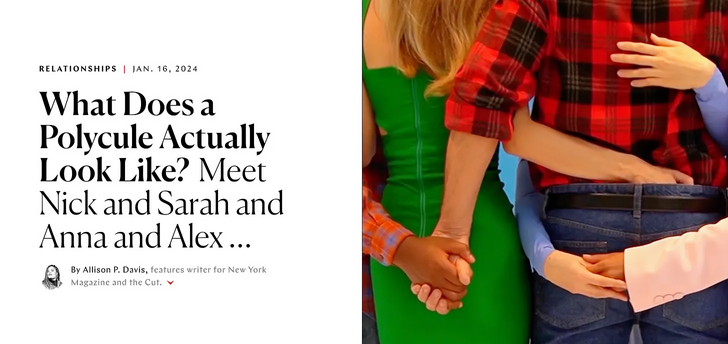
See if you can spot a trend, because the last week has brought big features on polycules and their enthusiasts from New York magazine, the New York Times, and the New York Post. If you live in Brooklyn, have hand sanitizer and a reliable source of Valtrex.
As the Times notes, television and publishing are similarly rushing to join in:
Along with novels, TV shows and movies that depict throuples, polycules and other permutations of open relationships, there is a growing body of nonfiction literature that explores the ethics and logistical hurdles of polyamory. Recent titles include memoirs like the journalist Rachel Krantz’s 2022 book Open: An Uncensored Memoir of Love, Liberation, and Non-Monogamy, and self-help and inspirational books like The Anxious Person’s Guide to Non-Monogamy, The Polyamory Paradox and A Polyamory Devotional, which has 365 daily reflections for the polyamorous.
I’m begging you: read some of this stuff, because you’re not going to believe what I say about it. At least skim the thing in New York; here’s the link again. Here’s a link to the Amazon preview of A Polyamory Devotional, with daily thoughts about mindfulness and relationship structures. Now, armed with evidence, here’s my Big Conclusion:
Reading about this shit is like watching paint dry. It’s astoundingly sexless.
Polyamory turns out to be a front for therapeutic culture and a neurotic love of mirrors. The sexy thing with Alice and Anna and Nick and Sarah involves a lot of checking in and managing expectations and maintaining supportive dialogue. Actual quote from Nick: “Some people like to run marathons. We like to do polyamory, complex relationship stuff. Sarah’s favorite activity for the two of us to do is couples therapy.” You’re jealous of all that heat and pleasure, right? It’s so sexy that it’s like running a marathon. Of talking. With a therapist.
January 19, 2024
QotD: How the internet changed the dating world
First, preferences get formalized. 90% of swipes by women are for men over 6’0, which does not reflect the importance women place on height in the real world. This also makes sense: When people only spend 2-3 seconds per app, superficial qualities rise to the top.
Online dating also changes our expectations regarding relationships more broadly. Since we now date outside of our circles, it’s now easier to cheat or ghost or just otherwise leave if the relationship isn’t perfect. Why stay in a non-perfect relationship, the logic goes, when there are millions of other potential matches at your fingertips?
This perhaps explains why breakup rates for couples who meet via apps are twice as high as couples who meet via friends and family. Friends and family not only refer better, but there’s a higher incentive to stay in a relationship when there’s the social encouragement of family and friends.
What online dating does is enable hypergamy at a massive scale. Hypergamy is the tendency for women to want to date the best men, no matter where the woman is in the hierarchy. Men also want top women of course, but they’re on average willing to settle for any woman, at least for casual sex, whereas women are much more discerning, which makes sense given women have a much bigger risk than men when it comes to sex, since women can get pregnant. It’s basic biology: Sperm is cheap, eggs are expensive.
What we see with algorithmic online dating isn’t a mechanism to assign the perfect match to each person of the opposite sex. Instead, we’ve created a machine where the top 20% of men mate with many different partners and the top 80% of women try to get the top 20% of men to date and ultimately marry them (and not just have sex with them).
Algorithmic dating conflates two markets, the market for relationships and the market for sex under the ambiguous banner of “dating”. What happens then is men on apps try to match with as many women as possible and women try to match with a small selection of higher status men. That leads to the situation where a dating app’s natural equilibrium is that a narrow set of men have “dating” access to almost all the women if they choose to, and they typically do. Even with the best intentions, these men aren’t interested in long-term relationships with all these women. The more options a man has, the less inclined he is to want one single relationship.
To put some numbers on it:
- Men swipe right on 60% of women, women swipe right on 4.5% of men.
- The bottom 80% of men are competing for the bottom 22% of women and the top 78% of women are competing for the top 20% of men.
- A guy with average attractiveness can only expect to be liked by slightly less than 1% of females. This means one “like” for every 115 women that see his profile.
And if the majority of women are vying for these men and ignoring the rest of them, that creates both a large amount of lonely women and men. Indeed: 28% of men under 30 have reported no sex in the last year, which has doubled in the last decade. This celibacy level is reminiscent of feudal medieval times. In the old days these men would have become monks or cannon fodder for the war. But these days, they just watch porn and play video games (don’t give up, guys!).
Erik Torenberg, “The Matching Problem in Dating”, Erik Torenberg, 2023-09-23.
January 17, 2024
“The thing liberals don’t understand about the average Republican voter in 2024 is that they hate the Republican Party”
In The Free Press, Batya Ungar-Sargon attempts to explain at least one aspect of the inexplicable-to-liberals Trump appeal for many Republican voters:

Donald Trump addresses a rally in Nashville, TN in March 2017.
Photo released by the Office of the President of the United States via Wikimedia Commons.
To the surprise of no one and the dismay of the liberal commentariat class, former president Donald Trump has crushed the first GOP primary election.
Iowa, which voted twice for Barack Obama before flipping to Trump in 2016, gave Trump a decisive win Monday night. And in Iowa, as in the Republican Party and the country more generally, the class divide was the defining feature of the night.
According to MSNBC’s early entrance polls, Trump won voters without a college degree by 65 percent, to Florida governor Ron DeSantis’s 17 percent and former UN ambassador Nikki Haley’s scant 8 percent. Trump won college grads, too, but by a much slimmer margin — just 35 percent caucused for Trump. Haley, meanwhile, got nearly as many — 33 percent, with DeSantis trailing at 23 percent. The AP had a similar breakdown.
That’s a 30-point gap in support for Trump — and a 25-point gap for Haley. It’s the gulf separating the college-educated from the working-class, who don’t just have different candidates of choice but different concerns, different struggles, and different priorities.
Working-class Americans are worried about the economy, immigration, our foreign entanglements, and the disappearing American Dream — all issues Donald Trump not only talks about but has a solid record on. Haley represents the GOP that Trump replaced — the free-market, chamber-of-commerce, nation-building version of the party that is dominated by a donor class whose interests are completely at odds with those of the working class.
Unfortunately for Haley, her party is now the party of the working class. In 2020, Bloomberg found that truckers, plumbers, machinists, painters, corrections officers, and maintenance employees were among the occupations most likely to donate to Trump (Biden got the lion’s share of writers and authors, editors, therapists, business analysts, HR department staff, and bankers.) As much as the Republican donor class wishes Haley were the party’s nominee, there’s no going back for your average corrections officer.
The thing liberals don’t understand about the average Republican voter in 2024 is that they hate the Republican Party. The average liberal feels well-represented by the Democratic Party because the Democrats’ base, like the party leadership, are college-educated elites. They share the same list of priorities. But the average Republican voter is working class and truly loathes the Bush-era version of the Republican Party, which meant tax cuts for the rich, failed wars, and an economic agenda that outsourced jobs to China.
Whether they realize it or not, this is why Democrats truly hate Trump. Without him, the left would soon have had a pretty permanent monopoly on power.
But if Iowa is any indication, not so soon after all.
Should Trump manage not to get thrown off the ballot (or sent to jail) by the time the election rolls around, he can’t count on Justin Trudeau for support:
Prime Minister Justin Trudeau says voters in the United States will face a choice later this year between optimism for the future or nostalgia for a past that never existed.
Trudeau made the comments in Montreal today to a business crowd in reference to Donald Trump’s victory Monday in the Iowa Republican caucuses, which gives the former president an early lead for the Republican nomination ahead of the November election.
The prime minister says a second Trump presidency would be difficult for the Canadian government, as there are many issues on which he and former president disagree.
On Monday, a majority of Iowa Republican supporters said they back Trump’s “Make America Great Again” movement.
Though he didn’t mention Conservative Party Leader Pierre Poilievre by name, Trudeau said Canadians will face a similar choice to American voters when they head to the polls.
January 16, 2024
“Flatly, if you think Trump is horrible, it’s time to think about where he comes from and why he isn’t going away quietly”
Chris Bray plays the “for the sake of argument” game about the Bad Orange Man:

Let’s pretend. I’m going to accept a bunch of arguments that I don’t believe, for the sake of argument, and see where they take us. For the next two minutes, it’s all true: Donald Trump is a vicious racist, an unspeakably cruel man, and the figure whose ascension to power ends American democracy and turns the country into a fascist dictatorship. All of that is perfectly obvious, for the purposes of our exercise, and only a fool or a fellow traveling fascist could pretend not to see it.
Now: If all of that is true, why can’t America stop him? A thoroughly established constitutional republic, nearing its 250th year, with a deep well of legal and political tradition and thoroughly entrenched institutions, can’t stop a vulgar Nazi thug, who keeps winning and advancing. Right? Distinguished statesmen like Joe Biden and Jerrold Nadler can’t hold the line against the death of the republic, despite their decades of accumulated wisdom. This is already making me feel like an idiot, but I’m committed.
The problem is that, if the prevailing “mainstream” argument about Donald Trump is true, it condemns all of the important political norms that Trump’s critics say they’re protecting. Immune systems that can’t stop a virulent infection are failed immune systems. If Trump is what Jamie Raskin and Adam Schiff and Liz Cheney say he is, then they’ve condemned … everything else. Everything else. The emergence of a Hitler figure, the implosion of the rule of law, the collapse of political institutions, and on and on: None of that happens in a healthy country.
So if you want to argue that this is what’s happening, you must argue that America is in a state of ruin. You have no choice. No Weimar republic, no Nazis. Failure comes from failure. Hitler figures don’t arise from healthy societies.
Turning well to my left, Christopher Hedges has been making this argument for years:
The parting gift, I expect, of the bankrupt liberalism of the Democratic Party will be a Christianized fascist state. The liberal class, a creature of corporate power, captive to the war industry and the security state, unable or unwilling to ameliorate the prolonged economic insecurity and misery of the working class, blinded by a self-righteous woke ideology that reeks of hypocrisy and disingenuousness and bereft of any political vision, is the bedrock on which the Christian fascists, who have coalesced in cult-like mobs around Donald Trump, have built their terrifying movement.
Taking off my Daily Kos hat, let’s reformulate. Donald Trump is an unusual political figure, and both his election to the presidency and his continued political importance are signs of an unusual moment. But outsider attacks on the supposed mainstream are not uncommon, and we have a long line of outsider figures who’ve played this role in various forms: William Jennings Bryan, Huey Long, George Wallace, Ross Perot. Thomas Jefferson attacked the Federalist mainstream, and the existence of the Republican Party grew from exhaustion with a broken center. A schoolhouse in Ripon was our Trump Tower, the place where people broke with the available choices. And then, you know, the Civil War, but still.
The ridiculousness of the current manufactured crisis is found precisely in the inability of existing institutions to fend off the challenge. To deliver the kind of sophisticated analysis that makes bartenders enjoy our conversations so much, it’s because our existing institutions suck. I roll my eyes at the “Orange Hitler” part, but I see the failed Weimar republic part that Trump’s critics (other than Hedges) often imply without noticing. The common refrain on social media in the face of institutional failure: “You want more Trump? This is how you get more Trump.” A healthy politics would already have seen off the moment, instead of deepening a completely unnecessary societal wildfire with a long series of increasingly insane overreactions: WELL LET’S ARREST HIM AND IMPRISON SOME OF HIS SUPPORTERS AND THROW HIM OFF THE BALLOT THAT SHOULD PRODUCE CALM AND RESTORE ORDER.
Flatly, if you think Trump is horrible, it’s time to think about where he comes from and why he isn’t going away quietly.
Mark Twain’s Huck Finn
In Quillette, Tim DeRoche re-reads Huck Finn after finally engaging with Harriet Beecher Stowe’s Uncle Tom’s Cabin, and finds the two books are not in opposition but should be read as complementing each other:
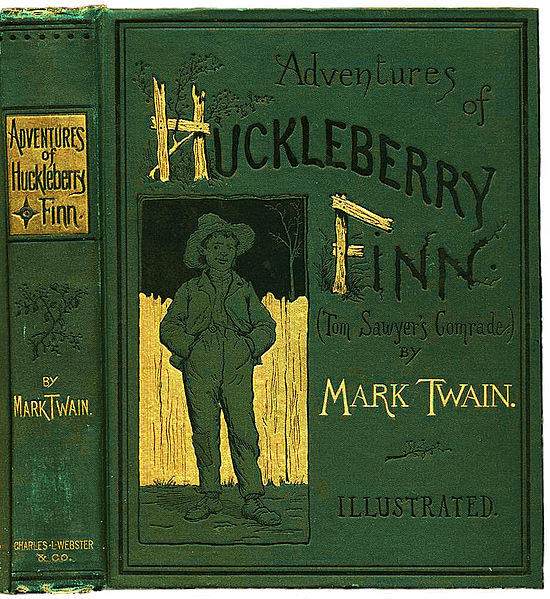
Mark Twain’s Adventures of Huckleberry Finn, 1884.
Image from Wikimedia Commons.
Twain scholar Laura Trombley (now the President of Southwestern University in Texas) once told me that Huck Finn isn’t about slavery. “It’s about an abused boy looking for a safe haven,” she said. It was daring for Twain to give a voice to the untutored, unwashed son of the town drunk.
You don’t know about me without you have read a book by the name of “The Adventures of Tom Sawyer”; but that ain’t no matter. That book was made by Mr. Mark Twain, and he told the truth, mainly. There was things which he stretched, but mainly he told the truth. That is nothing. I never seen anybody but lied one time or another …
Huck’s voice, often described as “realistic”, is actually a highly stylized literary device and a brilliant riff on how real boys talk. In these first few sentences, Twain inserts himself into the story and sets his protagonist up to be an unreliable narrator, as Huck admits that there will be “stretchers” of his own along the way.
Huck Finn is our national epic, much like The Odyssey is for Greece or the Nibelungenlied is for Germany. Like those older epics, Huck Finn can be read as version of a Jungian myth, in which the hero descends into the Underworld, undergoes trials and tribulations, and returns to us reborn. This story of two travelers on an epic journey is an archetype of our culture, which is why it is retold with such frequency. It’s possible to read every American road novel or movie as a reworking of Huck Finn.
Twain may not have written in verse, but Huck’s narration is beautiful and lyrical and so distinctively American that it has influenced generations of American writers, both popular and literary. That indelible voice, at once innocent and highly perceptive, is the fixed moral point from which Twain can then satirize so many different segments of his beloved country — preachers, con men, politicians, actors, and ordinary gullible Americans.
The book has been criticized as one of the first “white savior” narratives, but this gets it exactly backwards. Huck doesn’t save anyone in the novel. (One of Jane Smiley’s criticisms, in fact, is that Huck doesn’t “act” to save his friend.) It is actually Jim, the slave, who saves Huck — both literally and figuratively. It is Jim who provides Huck with a safe haven, and it is Jim who calls Huck to account when Huck treats him as less than human: “En all you wuz thinkin ’bout wuz how you could make a fool uv ole Jim wid a lie. Dat truck dah is trash, en trash is what people is dat puts dirt on de head er de fren’s en makes ’em ashamed.”
Huck eventually humbles himself before Jim and tells us, “I didn’t do him no more mean tricks, and I wouldn’t done that one if I’d a knowed it would make him feel that way.” Huck may be the protagonist of this story, but the slave Jim is its moral hero. It is Jim who reveals himself to be a fugitive slave so that Tom Sawyer can get medical attention for his gunshot wound. And after he is freed from slavery, Jim heads home to assume his responsibilities as a husband and father.
In contrast to Jim, Huck yearns for adventure and escape. Forced to live with the Widow Douglas and Miss Watson at the start of the book, he resents their attempts to “sivilize” him. He feels “all cramped up” by the clothes they make him wear, and he dismisses their Biblical teaching because he “don’t take no stock in dead people”. Instead of returning home with Jim, Huck tells us that he intends to “light out for the territory”. He represents one aspect of the American spirit — ironic, secular, individualistic.
January 15, 2024
An alternative recruiting strategy for the US military
Theophilus Chilton suggests there’s a deeper plan for the US federal government’s blatant encouragement of mass illegal immigration across the US-Mexican border, and if true it might indicate that things are about to “get spicy”:
It genuinely is a mystery …
This move by Texas [using state resources to enforce federal border control against the will of the federal government] represents a ratcheting up of our collapse phase trend towards decentralisation. At least for now (and let’s hope Abbott has the fortitude to follow through), a state is openly defying FedGov in a non-Regime approved way that would have been unthinkable even twenty years ago. Even if FedGov wins this standoff, it presages more and more movement in that direction. The Regime is bleeding power and everyone knows it, even if they can’t afford to let on to that fact. Either way, the Regime is going to have to stop this quickly before other states start getting ideas. If they can’t, their already tarnished reputation will take a further massive hit.
So in light of this news, we saw something else on Thursday that ought to be of interest. A very odd bill has been proposed in the House of Representatives by two Democratic representatives – a bill that would ban “private military activity“. On its face this seems strange since every state in the union already does this. However, the bill, as written, is so vague that it could be interpreted to outlaw organised range shooting activities or even paintball games as “combat training”. This bill reeks of desperation because the Regime knows that its path to collapse is further along than a lot of people think and they know that “private military activity” is a very real possibility. The Regime has been accelerating to the point of no return and is trying to stifle any potential serious opposition.
Opposition to what? Well, that’s a good question. Let’s put some pieces together.
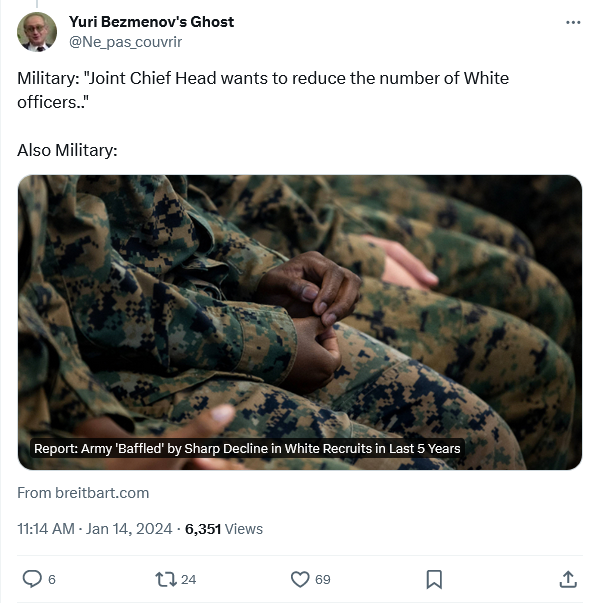
It’s no secret that the US military is facing a serious recruiting shortfall. Obviously, the current Regime has little use for the American military as it has traditionally been constituted. This is shown by the absolutely disrespectful way in which our troops are routinely treated by their own government and chain of command. Especially driving this recruitment deficiency is the huge drop in enlistment by the military’s traditional recruiting stock – rural and suburban White men from the South, the Midwest, and the Mountain West. In other words, exactly the kind of people being demonised by the new military with its DIE initiatives, rainbow flags, and trooned officer corps.
So who is going to fill the ranks? Fortuitously, we seem to have a huge flow of military aged males from all over the world crossing our border for whom the Regime has been rolling out the figurative red carpet. These are guys who probably have a lot of time on their hands. Wouldn’t it be a swell idea if we inducted all these guys into the military to make up for the lack of Heritage American interest? Indeed, history repeatedly shows that unpopular regimes typically do exactly this. They start to rely on foreign mercenary forces for a number of purposes.
Certainly, as GAE struggles to keep its steam, there may be a need to send Guatemalans and Nigerians into various Middle Eastern sandboxes to take shrapnel that Americans won’t take. After all, there will still be the vain and desperate attempts to shore up American globohomo empire in that (and other) regions. But historical, one of the main uses of foreign troops has been to try to keep your own potentially rebellious natives in line. Foreign troops have no real connexion with those whom they are suppressing and thus are willing to follow almost any orders that their paymasters give them.
However, unlike many first world countries that are under the Regime’s heel, the USA has a large body of well-armed citizens, many of whom have military training and combat experience. These guys – plus any other patriotic citizens they may be willing to help train – probably won’t take too kindly to being suppressed by foreign hirelings, something that will quickly make a lot of people’s patience run out. Say, wouldn’t it be a shame if all of these armed, trained and trainable people started organising to protect their homes, families, states, and country?
Despite all of the bravado from left-wing
QotD: Beyond mere superstition, moderns believe in literal magic
Magic dirt: There’s something about the Rio Grande, or the Ellis Island ferry, such that crossing it transforms 70-IQ campesinos into bourgie app developers. Magic shapes: Mold plastic into something that looks like a Glock, and anyone who sees it will be compelled to start shooting people. And of course the granddaddy of them all, magic words: Race, sex, these are all “social constructions”, such that a persyn who says xzhey are a woman really IS a woman, physiology be damned. Within the space of a generation, the same people who were smugly slapping Darwin fish on the bumpers of their Subaru Outbacks have declared the very basics of biology rank heresy.
Everyone knows that Karl Marx called religion “the opium of the masses”. It’s a fun quote, but it wasn’t particularly effective rhetoric back in the 19th century, since drug addiction wasn’t really a thing back then.1 Far more effective was David Hume’s description — “sick men’s dreams” — but even that paled in comparison to the 19th century’s go-to tactic: Implied infancy. If religious belief developed naturally, in a predictable pattern — and who could deny it, having read the formidable logic of E.B. Tylor? — then anyone who still clung to his belief in a Magic Sky Fairy must belong, despite his physical presence here in this best of all possible worlds, to Mankind’s intellectual infancy. Of course we’re not saying that the religion of Aquinas and Galileo, of Newton and Boyle, was all piffle … but come now, old sock, you must admit that the Thirty Nine Articles can only be understood “in a non-natural sense”, as Cardinal Newman (of all people!) put it. Are we not, in the face of all-triumphing science, all Robert Elsmere? Surely no one as obviously intelligent as yourself could possibly still …
Marx had that other quote that fits this situation much better, the one about “second time as farce”. Our Postmodern Elite, the I-Fucking-Love-Science crowd, has gone way past intellectual Luddism. They’re digital infants, chanting their hosannas to magic dirt, watching the same cartoon play out over and over again in Minnesota, in Chicago, soon enough in a neighborhood near you (infants love repetition). Tantrums, nom noms, and whee! A shiny!!
Such are the fruits of rationalism.
Severian, “Digital Infants”, Rotten Chestnuts, 2021-04-16.
1. Despite the easy availability of all kinds of highly addictive shit like opium and cocaine. Ponder that in the dark watches of the night, if you ever feel like giving yourself insomnia.
January 14, 2024
Soviet and American Massive Attacks – Week 281 – January 13, 1945
World War Two
Published 13 Jan 2024In the East, the Soviets launch a massive series of new offensives. In the West, Monty holds an ill-judged press conference about the Battle of the Bulge. Operation Nordwind, the German offensive in Alsace, continues. In Hungary, there’s house to house fighting as the Red Army besieges Budapest. In Asia, the Allies wrestle with the Kamikazes, begin their landings on Luzon, and advance in Burma.
00:54 Intro
01:12 Recap
01:22 Montgomery’s Press Conference
05:53 Operation Nordwind
07:07 The battle for Hungary
09:38 The huge Soviet offensive begins!
12:22 American landings on Luzon
15:29 Anti-Kamikaze tactics
18:11 Slim’s advance in Burma
21:11 Conclusion
(more…)
January 13, 2024
Troubled by Rob Henderson
Stephanos Bibas reviews Rob Henderson’s autobiography Troubled: A Memoir of Foster Care, Family, and Social Class for the University of Chicago Law Review:

Life at the bottom is troubled. Charles Dickens, Victor Hugo, and many others have long shown us that. To understand criminal justice, education, and family law, we lawyers typically look to social scientists, and their external expertise does teach us much. But we often neglect lived experience. Occasionally, we should toggle from the dry regressions and clinical detachment of social science to the internal perspective and expertise of those who live through family breakup, foster care, disrupted schooling, drugs, and crime. And that is what Rob Henderson’s breakout memoir, Troubled, gives us: a window on troubled youth.1
Henderson, a brilliant young psychologist, illumines how harmful childhood instability is by reflecting on his own experience. He never knew his father, was abandoned by his drug-addicted mother, and bounced around foster care. After squandering much of his early education and drowning his rage in alcohol, drugs, fights, and vandalism, he managed to make his way through the Air Force to Yale and now Cambridge. But few of his friends escaped the wounds from their childhoods; many wound up unemployed, in prison, or dead. His eye is as keen as his intellect, recalling and reporting how adults in his life kept abandoning him and his fellow foster children and how they in turn acted out. As an outsider to the elites who dominate the Ivies, he also turns his critical eye on the groupthink and victimhood culture that is strongest among the most privileged. And building on literary historian Paul Fussell’s work, Henderson develops his own critique of the shibboleths that educated American elites use to set themselves—ourselves—apart while ignoring the harm to the rest of society.2
Henderson has much to teach us lawyers and legal scholars. He shows us how much we miss by focusing public policy on educational attainment and cost-benefit analysis, overlooking what is priceless: love and emotional attachment. The most important things in life can’t be quantified; at best, outcomes are mere proxies for them. We are more than our résumés! His account undermines our persistent habit of viewing humans as fully informed rational actors — a habit that makes much more sense in corporate law than in criminal law and the like. He showcases how poorly used adult autonomy harms children, leading to broken homes, drug addiction, numbness, and rage.
Lastly, Henderson critiques “luxury beliefs”, the term he coins for sociological opinions that are popular only among those who need not worry about their own survival. These beliefs are status signals to the educated elite who are not harmed by the fallout from any cultural shifts they might cause. But these beliefs corrode the social structures that children need to develop. (He could do more to develop the causal nexus to social harm, but his claims are still powerful.)
In short, Henderson’s memoir powerfully challenges prevalent views of education, family policy, and class. It shows how we hyperfocus on educational outcomes and other quantifiable goals at the expense of softer emotional goods. And it does it all in a plainspoken, understated voice that illustrates his points from his own lived experience and that of his buddies. Many will disagree with Henderson’s conclusions, of course, but scholars should grapple with his challenge.
Part I of this Review summarizes Henderson’s long journey from foster care to Yale. Part II canvasses his argument that adult instability breeds chaotic childhoods, leaving neglected kids to raise themselves in Hobbesian competition, impulsive indulgence, or reckless rage. Part III then develops Henderson’s signature concept of luxury beliefs and how nonjudgmentalism backfires on those at the bottom. Though one can quibble with some of his causal claims, his thrust is compelling. Finally, Part IV considers how Henderson’s account suggests reorienting some criminal justice, education, and family law reforms toward children’s need for stable structures to guide them.
1. Rob Henderson, Troubled: A Memoir of Foster Care, Family, and Social Class (forthcoming 2024) (on file with publisher). All further citations to this work are by page number in parentheticals in the text.
2. See generally Paul Fussell, Class: A Guide Through the American Status System (1983).
January 12, 2024
“… normal people no longer trust experts to any great degree”
Theophilus Chilton explains why the imprimatur of “the experts” is a rapidly diminishing value:
One explanation for the rise of midwittery and academic mediocrity in America directly connects to the “everybody should go to college” mantra that has become a common platitude. During the period of America’s rise to world superpower, going to college was reserved for a small minority of higher IQ Americans who attended under a relatively meritocratic regime. The quality of these graduates, however, was quite high and these were the “White men with slide rules” who built Hoover Dam, put a man on the moon, and could keep Boeing passenger jets from losing their doors halfway through a flight. As the bar has been lowered and the ranks of Gender and Queer Studies programs have been filled, the quality of college students has declined precipitously. One recent study shows that the average IQ of college students has dropped to the point where it is basically on par with the average for the general population as a whole.
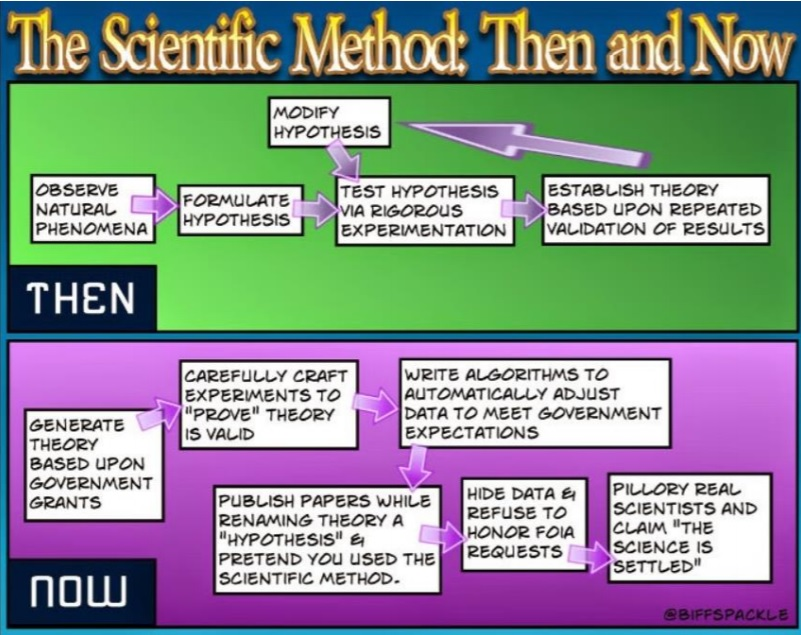
Another area where this comes into play is with the replication crisis in science. For those who haven’t heard, the results from an increasingly large number of scientific studies, including many that have been used to have a direct impact on our lives, cannot be reproduced by other workers in the relevant fields. Obviously, this is a problem because being able to replicate other scientists’ results is sort of central to that whole scientific method thing. If you can’t do this, then your results really aren’t any more “scientific” than your Aunt Gertie’s internet searches.
As with other areas of increasing sociotechnical incompetency, some of this is diversity-driven. But not wholly so, by any means. Indeed, I’d say that most of it is due to the simple fact that bad science will always be unable to be consistently replicated. Much of this is because of bad experimental design and other technical matters like that. The rest is due to bad experimental design, etc., caused by overarching ideological drivers that operate on flawed assumptions that create bad experimentation and which lead to things like cherry-picking data to give results that the scientists (or, more often, those funding them) want to publish. After all, “science” carries a lot of moral and intellectual authority in the modern world, and that authority is what is really being purchased.
It’s no secret that Big Science is agenda-driven and definitely reflects Regime priorities. So whenever you see “New study shows the genetic origins of homosexuality” or “Latest data indicates trooning your kid improves their health by 768%,” that’s what is going on. REAL science is not on display. And don’t even get started on global warming, with its preselected, computer-generated “data” sets that have little reflection on actual, observable natural phenomena.
“Butbutbutbut this is all peer-reviewed!! 97% of scientists agree!!” The latter assertion is usually dubious, at best. The former, on the other hand, is irrelevant. Peer-reviewing has stopped being a useful measure for weeding out spurious theories and results and is now merely a way to put a Regime stamp of approval on desired result. But that’s okay because the “we love science” crowd flat out ignores data that contradict their presuppositions anywise, meaning they go from doing science to doing ideology (e.g. rejecting human biodiversity, etc.). This sort of thing was what drove the idiotic responses to COVID-19 a few years ago, and is what is still inducing midwits to gum up the works with outdated “science” that they’re not smart enough to move past.
If you want a succinct definition of “scientism,” it might be this – A belief system in which science is accorded intellectual abilities far beyond what the scientific method is capable of by people whose intellectual abilities are far below being able to understand what the scientific method even is.


