
People are being stampeded into telecommuting. The thing is, dear media, once that happens, you can’t put it back in the bottle.
For two decades now, telecommuting and distance learning have been perfectly possible and even, frankly, beneficial. What has held it back is managers afraid they don’t know how to manage at a distance, corporations who think mega cubicle farms are a great way to be “important” and a general sense that only us, ne’er do wells, work in our pajamas on the sofa (I’ll have you know I’m wearing a sweatshirt and yoga pants. Never mind.)
If the panic lasts even two months (and the press will ensure it does before it collapses under its own weight) that reluctance to telecommute is going to be blown to hell. For one, once workers taste of THAT fruit, just anecdotally, 90% of them LOVE it. (The other 10% have very annoying children or spouses.)
And in the wake of the financial panic and wobbles, corporations are going to notice that they spend a lot less money when most of the workers work from home. At some point, they’ll also realize that they need much smaller facilities if they need facilities at all. And hey, money.
This will cause all sorts of other things, which I think will lead within two years to an exodus from the big cities everyone has crammed into because it’s where the jobs are. I think in turn this will lead to a world the social engineers really don’t like.
Sarah Hoyt, “Unintended Consequences”, According to Hoyt, 2020-03-12.
July 8, 2020
QotD: Telecommuting in the post-Wuhan Coronavirus era
July 4, 2020
The birth of the steam age
In the latest installment of his Age of Invention newsletter, Anton Howes explores the very early steam age in England:
Why was the steam engine invented in England? An awful lot hinges on this question, because the answer often depends on our broader theories of what caused the British Industrial Revolution as a whole. And while I never tire of saying that Britain’s acceleration of innovation was about much, much more than just the “poster boy” industries of cotton, iron, and coal, the economy’s transition to burning fossil fuels was still an unprecedented and remarkable event. Before the rise of coal, land traditionally had to be devoted to either fuel, food, or clothing: typically forest for firewood, fields for grain, and pastures for wool-bearing sheep. By 1800, however, English coal was providing fuel each year equivalent to 11 million acres of forest — an area that would have taken up a third of the country’s entire surface area, and which was many times larger than its actual forest. By digging downward for coal, Britain effectively increased its breadth.
And coal found new uses, too. It had traditionally just been one among many different fuels that could be used to heat homes, alongside turf, gorse, firewood, charcoal, and even cow dung. When such fuels were used for industry, they were generally confined to the direct application of heat, such as in baking bricks, evaporating seawater to extract salt, firing the forges for blacksmiths, and heating the furnaces for glass-makers. Over the course of the seventeenth century, however, coal had increasingly become the fuel of choice for both heating homes and for industry. Despite its drawbacks — it was sooty, smelly, and unhealthy — in places like London it remained cheap while the price of other fuels like firewood steadily increased. More and more industries were adapted to burning it. It took decades of tinkering and experimentation, for example, to reliable use coal in the smelting of iron.
3D animation of an aeolipile or Hero’s engine.
Animation by Michael Frey via Wikimedia Commons.Yet with the invention of the steam engine, the industrial uses of coal multiplied further. Although the earliest steam engines generally just sucked the water out of flooded mines, by the 1780s they were turning machinery too. By the 1830s, steam engines were having a noticeable impact on British economic growth, and had been applied to locomotion. Steam boats, steam carriages, steam trains, and steam ships proliferated and began to shrink the world. Rather than just a source of heat, coal became a substitute for the motive power of water, wind, and muscle.
So where did this revolutionary invention come from? There were, of course, ancient forms of steam-powered devices, such as the “aeolipile”. Described by Hero of Alexandria in the 1st century, the aeolipile consisted of a hollow ball with nozzles, configured in such a way that the steam passing into the ball and exiting through the nozzles would cause the ball to spin. But this was more like a steam turbine than a steam engine. It could not do a whole lot of lifting. The key breakthroughs came later, in the late seventeenth and early eighteenth centuries, and instead exploited vacuums. In a steam engine the main force was applied, not by the steam itself pushing a piston, but by the steam within the cylinder being doused in cold water, causing it to rapidly condense. The resulting partial vacuum meant that the weight of the air — the atmospheric pressure — did the real lifting work. The steam was not there to push, but to be condensed and thus pull. It saw its first practical applications in the 1700s thanks to the work of a Devon ironmonger, Thomas Newcomen.
Science was important here. Newcomen’s engine could never have been conceived had it not been for the basic and not at all obvious observation that the air weighed something. It then required decades of experimentation with air pumps, barometers, and even gunpowder, before it was realised that a vacuum could rapidly be created through the condensation of steam rather than by trying to suck the air out with a pump. And it was still more decades before this observation was reliably applied to exerting force. An important factor in the creation of the steam engine was thus that there was a sufficiently large and well-organised group of people experimenting with the very nature of air, sharing their observations with one another and publishing — a group of people who, in England, formalised their socialising and correspondence in the early 1660s with the creation of the Royal Society.

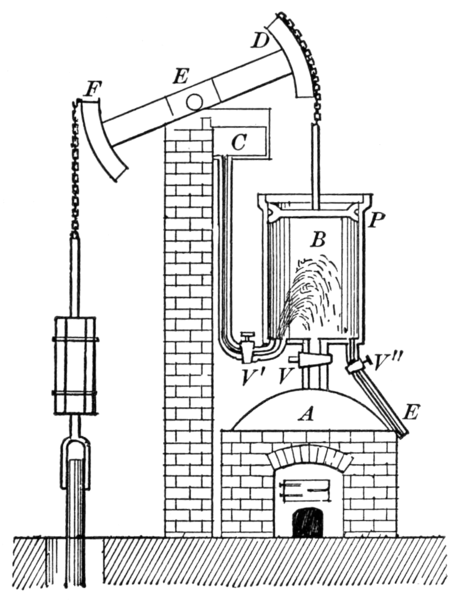
Newcomen’s Atmospheric Steam Engine. The steam was generated in the boiler A. The piston P moved in a cylinder B. When the valve V was opened, the steam pushed up the piston. At the top of the stroke, the valve was closed, the valve V’ was opened, and a jet of cold water from the tank C was injected into the cylinder, thus condensing the steam and reducing the pressure under the piston. The atmospheric pressure above then pushed the piston down again.
Original illustration from Practical Physics for Secondary Schools. Fundamental principles and applications to daily life, by Newton Henry Black and Harvey Nathaniel Davis, 1913, via Wikimedia Commons.
July 3, 2020
Birth, rapid growth, profitable stasis, bureausclerosis, decline, death – typical tech firm lifecycle
In the Continental Telegraph, what looks to be a pretty solid characterization of the corporate life-cycle for technology firms:

There are generally, 6 stages in the life of a tech company:
- Inception. A couple of smart kids start something in a garage. Massive innovation.
- Fast growth. The business moves to some good offices, number of staff increases. They take on smart, fast moving people who are innovating big. A few people know them.
- Steady growth. The business is now something of a household name. They get their own small head office. Staff are more like normal business. Innovation continues, but the bureaucracy starts to grow.
- Bureaucracy. The business is a household name. They have multiple offices, or something designed by a smart-ass architect. There’s still staff coming in, but they’re mostly seeing it as a nice warm place to sit and be bureaucrats. The innovators start leaving as it’s just not interesting. They might even be making lots of money, but it’s mostly just living off what was built in earlier phases, or large dumb wasteful projects that go nowhere for years.
- Decline. A new disruptor arrives on the scene. They innovate in a field you’re involved in. You can’t keep up because in the previous phase, you replaced the innovators with bureaucrats. You’re outsmarted.
- Terminal decline and death. You slowly or quickly disappear, maybe holding onto a few customers who habitually use you.
I think there might also be something about when government starts taking an interest in you, and I think it’s quite some time into stage 4. Google are already there. Firing James Damore is very much bureaucracy state behaviour. They wouldn’t have cared when it was a tiny number of staff in an office. And how much have they really innovated in the last decade?
July 1, 2020
British Railways: Goodbye To Steam aka Railway Modernisation (1958) | British Pathé
British Pathé
Published 13 Apr 2014This archive footage from 1958 depicts British Railways’ journey to modernisation and the transition away from steam-powered trains.
For Archive Licensing Enquiries Visit: https://goo.gl/W4hZBv
#BritishPathé #History #Railway #Trains #BritishRailways
(FILM ID:1549.07)
Full title reads: “Goodbye To Steam”Intertitle reads: “British Railways meet the challenge of the age of abundant power”
Angle shot, railway engine going past camera. GV Outside one of the large London Railway stations showing railway lines and train coming out of station. CU Man in signal box, pan to show him pulling levers. CU Signal going up. GV Train coming towards camera. GV Steam train. GV Aerial shots steam train. CU Man filming from plane. CU man in plane fitting equipment and then giving thumb’s up sign. GV Aerial shot, railway lines. CU Man filming from plane. Steam train going along line. SV Draughtsmen in office. CU Men looking through magnifier at a plan. CU Magnified picture of plan, zoom to show Railway chiefs seated round table with plan, among them is Sir Philip Warter. SV Elevated, railway chiefs looking at plan. CU One of the railway executives. SV Man with model of section of railway line which he places on the table and the railway executives study it. CU Sign reading “Kent Coast Electrification Widening to Provide Four Tracks”, pan to show railway line with only two tracks. GV Kent Coast line with men on bridge. SV Bridge with surveyor. CU Surveyor looking through theodolite. GV Tracking shot of men working. GV Men working at side of railway line with clouds of smoke coming from wood. CU New diesel engine. CU Sir Brian Robertson talking to train driver. CU People watching. CU Sir Brian Robertson blowing whistle. CU Int. diesel engine with driver operating controls. SV Diesel train moving out of station. CU Driver of diesel train. CU. Sir Brian Robertson sitting in carriage. LV Through window of diesel cab as train enters tunnel. SV Three engines on lines. CU Front of one of the engines with plate reading “Cornish Riviera Express”. CU Driver. SV Cornish Riviera Express in station. SV Woman taking in washing because smoke is billowing up from railway lines beside her garden. GV Cornish Riviera Express coming towards camera.
CU Front of steam train “The Bristolian”. SV along top of engine as blows off steam. CU Hand pulling chain. CU valve. GV Platform. CU shovelling coal. GV As train goes along. CU Driver of train. CU Driver. CU Fireman. CU Fire with coal being shovelled. SV Looking over coal tender. SV From driver’s cab of train going under bridge and out the other side. CU Driver. GV From driver’s cab of railway lines with another steam train. SV Int. class for instruction of diesel engine drivers. CU Lecturer talks about metal object. CU Men looking at machinery. SV Royal Scot in station. CU Driver of Royal Scot. GV Activities on platform in which Royal Scot is standing. GV Royal Scot leaving station. GV Building with sign, “English Electric Co. Ltd. Preston”. GV Int. of workshop showing men working on armatures. GV Ext. of building with “Vulcan Locomotives” painted on wall. GV Int. of workshop showing men working on railway engines. CU Man working inside railway engine. GV Workshop. SV Diesel train in station. CU Driver of diesel. GV railway lines in front of train as it moves along. SV Int. dining car in diesel train with attendant pouring coffee. GV Looking through cab window of railway lines in front of train as it goes under bridge and straight past station. CU Glass panel in door with “York Signal Box, Strictly Private”, door opens. SV Man sitting at control panel of box, he reaches over to controls. CU Man’s hands working controls. CU Plan on wall showing different lines and points. CU Hand pushing buttons. CU Signals. CU Point on lines. GV Steam train along lines. CU Train in museum. CU Compartment of old train. SV Ancient train “Locomotion 1828”. SV Diesel Locomotive. CU “Deltic” written on side. GV Deltic. GV Train in station. Various shots in Deltic carriage. SV Coal trucks. SV Railway worker attaching pipe to train. GV Calder Hall Nuclear / Atomic Power station. GV Electrical pylons and cables. GV Diesel train “Sir Brian Robertson” in platform with crowds. GV Crowds. SV “Sir Brian Robertson” unveiled by Mr Grand, General Manager of the Western Region of British Railways. SV Crowd. SV Sir Brian Robertson by train. CU Sign “Sir Brian Robertson”. GV The “Sir Brian Robertson” leaving Paddington Station. SV Steam train letting out smoke. CU Signals. GV Steam train. CU Train over the points. GV steam train leaving clouds of smoke.
BRITISH PATHÉ’S STORY
Before television, people came to movie theatres to watch the news. British Pathé was at the forefront of cinematic journalism, blending information with entertainment.

Parler, pro and con
The latest social media challenger to Twitter has been getting a fair bit of attention over the last couple of weeks, as many British and American conservative Twitter users have announced they’ll be relocating to the newer service due to their concerns over Twitter’s progressive bias and very uneven-handed moderation. In The Critic, David Scullion points out that Parler may not be the dream social network for the unwoke:

The avowedly “unbiased” social media site based in Nevada has been around for two years but has rapidly gained traction amongst Trump supporters in the US, Brexit and Conservative supporters in the UK, and pro-monarchists in Saudi Arabia. (Yes really).
The raison d’être is free speech and in its “Declaration of Independence” Parler outlined the injustices, as they see it, of the existing big tech firms:
They manipulate their platform to hide information. They shadow ban, trick and deceive. They have become enablers, and often leaders, of the vicious cancel-culture mob who goose-step through our online communities and scream down those who dare to disagree.
The document ends by calling on users to “#Twexit to Parler” – i.e. leave Twitter and join them.
But will they succeed?
[…]
It seems like Parler’s popularity is a symptom of censorship in big tech, but building a rival “free speech” network has its own problems.
For a start, Parler will throw you to the wolves if they get sued over your posts.
Parler requires users to “agree to defend and indemnify Parler, as well as any of its officers, directors, employees, and agents, from and against any and all claims, actions, damages, obligations, losses, liabilities, costs or debt, and expenses (including but not limited to all attorneys fees) arising from or relating to your access to and use of the Services.”
And in order to use Parler, individuals must also forfeit their right to sue it in court or join a class-action claim. Instead they must settle disputes in arbitration.
It’s also worth pointing out that Twitter once branded itself as “the free speech wing of the free speech party” and said it took a “neutral” view of tweets posted by users because of the company’s founding principles. Those principles are now gone, gradually removed in response to a need to protect their bottom line.
June 29, 2020
The End of the Line
NFB
Published 2 Sep 2015This documentary short offers a nostalgic look at the steam locomotive as it passes from reality to history. In its heyday, the big smoke-belching steam engine seemed immortal. Now, powerful and efficient diesels are pushing the old coal-burning locomotives to the sidelines, and the lonely echo of their whistles may soon be a thing of the past.
Directed by Terence Macartney-Filgate – 1959.
June 24, 2020
Trudeau government wants to introduce an Internet “link tax”
Michael Geist on the Trudeau government’s latest indications of support for a tax grab to benefit certain favoured groups and organizations:

Canadian Heritage Minister Steven Guilbeault, 3 February 2020.
Screencapure from CPAC video.
Last week, Canadian Heritage Minister Steven Guilbeault called into question his own government’s policies on supporting news media, suggesting that those programs should be replaced by copyright rules that would open the door to payments from internet companies such as Google and Facebook. Mr. Guilbeault indicated that a legislative package was being prepared for the fall that would include new powers for Canada’s communications regulator and what are commonly referred to as Netflix taxes and internet linking taxes.
My Globe and Mail op-ed notes the government’s support for new internet taxes should not come as a surprise. There were strong signals that the spring budget – postponed indefinitely due to the current public health crisis – was going to include expanding sales taxes to capture digital sales such as Netflix or Spotify subscriptions.
[…]
It is Mr. Guilbeault’s plans for a link tax that should spark the most concern, however. The government has long promoted its policies designed to support the Canadian media sector, including direct funding for local journalism as well as labour and subscription tax credits. The taxpayer cost runs into the hundreds of millions of dollars, but is justified on the grounds that journalism is an essential service that requires public support.
Yet Mr. Guilbeault now says that government should not be funding media, characterizing the policies as short term measures aimed at mitigating a media emergency. Instead, Mr. Guilbeault supports a controversial copyright reform measure that would establish a news publisher’s right to demand payment for services that link to their content.
This payment – effectively a tax on linking – raises a host of concerns, not the least of which is that the proposal was not recommended by the government’s own copyright review last year. Copyright reform in Canada is always complicated, particularly given that responsibility for it is shared with Innovation, Science and Economic Development Minister Navdeep Bains, but delving into reforms that sparked protests in Europe could be politically risky for a minority government.
News organizations already benefit from large platforms linking to their content since the links generate visitors that increase advertising revenues and paying subscribers. Organizations that do not want the links can easily opt-out of appearing in services such as Google News or Facebook. In fact, after Google shut down its Google News service in Spain, studies found publisher website traffic dropped by 10 per cent.
June 15, 2020
African History Disproves Guns Germs and Steel by Jared Diamond
The Cynical Historian
Published 26 Oct 2019There’s a question in the history profession that if sufficiently answered could not only reshape how we conceive ourselves, but reveal the best course of action for politics around the world. What makes the West strong? While there are many answers, the most popular of these has been Jared Diamond’s Guns Germs and Steel. You’ll see his argument all over the place, including a NatGeo documentary. But of course it has its detractors, to the point that some historians consider it pseudo-history. Now I think that’s going too far, but there are enough problems with his thesis that we can’t take it as the final answer to these questions. So let’s talk about that.
————————————————————
errata
10:32 – not “Blaut’s theory” but “Diamond’s theory” (thx PunkSci)
————————————————————references:
James M. Blaut, Eight Eurocentric Historians: The Colonizer’s Model of the World, Volume Two (New York: The Guilford Press, 2000), 149-172. https://amzn.to/2YFt0iQMichael C. Campbell and Sarah A. Tishkoff, “African Genetic Diversity: Implications for Human Demographic History, Modern Human Origins, and Complex Disease Mapping,” Annual Review of Genomics and Human Genetics 9 (22 September 2008): 403-433.
Jared Diamond, Guns Germs and Steel: The Fates of Human Societies (New York: WW Norton, 1997). https://amzn.to/2GK6AqI
Martin W. Lewis and Karen E. Wigen, The Myth of Continents: A Critique of Metageography (Berkeley: University of California Press, 1997). https://amzn.to/2H0ylv7
Richard York and Philip Mancus, “Diamond in the Rough: Reflections on Guns, Germs, and Steel,” Human Ecology Review 14, no. 2 (2007): 157-162.
https://thetruesize.com
————————————————————
Support the channel through PATREON: https://www.patreon.com/CynicalHistorianLET’S CONNECT:
Subreddit: https://www.reddit.com/r/CynicalHistory/
Discord: https://discord.gg/Ukthk4U
Twitter: https://twitter.com/Cynical_History

QotD: The very first “road trip”
By 1888, he had a working prototype, which had successfully driven down a road. The now-patented Motorwagen had no gears and could not go up hills, but it worked. One morning, Benz’s wife Bertha decided to take the car on its first extended road trip. With her two sons, she pushed the car out of the garage, until it was far enough from the house that they could get it started without waking her husband.
Bertha Benz had a destination in mind — her parents’ house in Pforzheim, about 65 miles from her home. Following roads meant for wagons, she and her sons started the drive — the first recorded road trip in a car.
There were challenges. A pipe clogged; Benz cleaned it with her hat pin. A wire shorted; she insulated it with her garter. They needed more fuel; she convinced a pharmacist to sell her an unusually large amount of the gas the car used. When the brakes started wearing out, she had them shod with leather at a cobbler. When she reached a hill, she had the boys push (along with local help).
By the end of the day, the Benzes had reached Pforzheim, where Bertha telegraphed her husband that they were safe. After a few days’ visit, they drove back home to Mannheim.
Ten years ago, Germany created an official Bertha Benz Memorial Route, marking her historic road trip. Part of Bertha Benz’s motivation was to sell potential customers on the advantage of automobiles; although it took another decade or so, people eventually bought into this transportation revolution.
Sarah Laskow, “An 1888 Road Trip Sparked Germany’s Romance With Cars”, Atlas Obscura, 2018-02-28.
June 13, 2020
Is Invisibility Possible? | James May’s Q&A (Ep 1) | Head Squeeze
BBC Earth Lab
Published 10 Jan 2013James May answers the question as to whether or not invisibility is possible. James draws upon quite a few interesting theories during this discussion.
Outtakes from this video: https://www.youtube.com/watch?v=6Fy1Xkx5VFc
James May’s Q&A:
With his own unique spin, James May asks and answers the oddball questions that we’ve all wondered about from ‘What exactly is one second?’ to ‘Is invisibility possible?’

May 27, 2020
The Battle to Crack Enigma – The real story of ‘The Imitation Game’ – WW2 Special
World War Two
Published 26 May 2020For the British, breaking the Germans’ seemingly unbreakable codes is one of the most vital battles of the war. If they fail, there is litte to stop the German U-Boats hunting down Allied shipping in the Atlantic.
Join us on Patreon: https://www.patreon.com/TimeGhostHistory
Or join The TimeGhost Army directly at: https://timeghost.tvFollow WW2 day by day on Instagram @World_war_two_realtime https://www.instagram.com/world_war_t…
Between 2 Wars: https://www.youtube.com/playlist?list…
Source list: http://bit.ly/WW2sourcesHosted by: Indy Neidell
Written by: Francis van Berkel
Director: Astrid Deinhard
Producers: Astrid Deinhard and Spartacus Olsson
Executive Producers: Astrid Deinhard, Indy Neidell, Spartacus Olsson, Bodo Rittenauer
Creative Producer: Joram Appel
Post-Production Director: Wieke Kapteijns
Research by: Francis van Berkel
Edited by: Mikołaj Cackowski
Sound design: Marek Kamiński
Map animations: Eastory (https://www.youtube.com/c/eastory)Colorizations by:
Jaris Almazani (Artistic Man), https://instagram.com/artistic.man?ig…
Norman Stewart, https://oldtimesincolor.blogspot.com/
Carlos Ortega Pereira, BlauColorizations, https://www.instagram.com/blaucoloriz…Sources:
Bundesarchiv
Narodowe Archiwum Cyfrowe
IWM D 23310, A 13709, A 23513
Picture of Enigma G model, courtesy Austin Mills https://flic.kr/p/2bQ9Q
reconstructed bombe machine at Bletchley Park, courtesy Gerald Massey
Picture of Enigma M4 model displayed at Bletchley Park, courtesy Magnus Manske
Picture of John Herivel, courtesy GCHQ
From the Noun Project: Letter by Mochammad Kafi, Desk by monkik, Phone by libertetstudio, person by Adrien Coquet, Letter by Bonegolem, Table by Creative Stall, documents by Johannes Hirsekorn, sitting at desk by IYIKON, Paper by James KopinaSoundtracks from the Epidemic Sound:
Reynard Seidel – “Deflection”
Johannes Bornlof – “The Inspector 4”
Phoenix Tail – “At the Front”
Johannes Bornlof – “Deviation In Time”
Gunnar Johnsen – “Not Safe Yet”
Hakan Eriksson – “Epic Adventure Theme 3”
Howard Harper-Barnes – “London”Archive by Screenocean/Reuters https://www.screenocean.com.
A TimeGhost chronological documentary produced by OnLion Entertainment GmbH.
From the comments:
World War Two
4 hours ago (edited)
Hopefully you’re all staying safe in these difficult times. We’re still marching on so that we can keep all of you entertained when you’re stuck at home. But we can only continue doing so thanks to your ongoing support. Ad revenue has dropped significantly because of COVID, and we rely on your support now more than ever. If you can, please support us on www.patreon.com/timeghosthistory or https://timeghost.tv.Please let us know what other specials you’d like to see. And if you would like to know something about a smaller topic, make sure to submit that as a question for our Q&A series, Out of the Foxholes. You can do that right here: https://community.timeghost.tv/c/Out-of-the-Foxholes-Qs.
Cheers,
Francis

May 25, 2020
The Ingenious Design of the Aluminum Beverage Can
engineerguy
Published 14 Apr 2015Bill details the engineering choices underlying the design of a beverage can He explains why it is cylindrical, outlines the manufacturing steps needed to created the can, notes why the can narrows near it lid, show close ups of the double-seam that hold the lid on, and details the complex operation of the tab that opens the can.

May 23, 2020
QotD: Computer trade show tchotchkes
You can see them staggering back to their hotel rooms, arms full of corporate-branded freebies, where they have prepared an empty suitcase specifically for shipping it all back to their BOFH Central at the end of the show.
Sure, it’s all crap. It’s usually the likes of childish desk toys, cable tidies that will snap within the week, pencils and logo-shaped erasers (as if you use such items all the time, right?), and Swiss army knives that will be routinely confiscated as you pass through airport security for the trip home. No matter, just turn up to the expo and companies will toss gifts at you like you were the GitHub messiah taking a seaside donkey ride into sysadmin Jerusalem.
Well, nobody tosses any in my direction. No blotchy ballpoint pens for me. No evil-smelling pads of sticky-notes that don’t stick to anything. No spongey stress balls. No smartphone stands. No sharply angular keyfobs that stab into my bollocks when I sit down.
Me, when I visit an IT exhibition stand on the cadge, I have to provide evidence of my media accreditation, two forms of photo ID, an electricity bill, birth certificates of my family going back four generations (originals only, please) and a DNA swab before I qualify to receive a boiled sweet.
Alistair Dabbs, “‘Don’t tell anyone but I have a secret.’ There, that’s my security sorted”, The Register, 2020-02-21.
May 16, 2020
How It’s Made – Utility Poles
How Its Made
Published 12 Jul 2016How It’s Made season 26
Utility Poles
QotD: Division of labour in the modern world
In another example — the making of a woollen coat — Smith emphasises that the division of labour allows us to use machines, even “that very simple machine, the shears with which the shepherd clips the wool”.
The shepherd has the perfect tool for a focused task. That tool needs countless other focused specialists: the bricklayer who built the foundry; the collier who mined fuel; the smith who forged the blades. It is a reinforcing spiral: the division of labour lets us build new machines, while machines work best when jobs have been divided into one small task after another.
The rise of the computer complicates this story. Computers can certainly continue the process of specialisation, parcelling out jobs into repetitive chunks, but fundamentally they are general purpose devices, and by running software such as Microsoft Office they are turning many of us into generalists.
In a modern office there are no specialist typists; we all need to be able to pick our way around a keyboard. PowerPoint has made amateur slide designers of everyone. Once a slide would be produced by a professional, because no one else had the necessary equipment or training. Now anyone can have a go — and they do.
Well-paid middle managers with no design skills take far too long to produce ugly slides that nobody wants to look at. They also file their own expenses, book their own travel and, for that matter, do their own shopping in the supermarket. On a bill-by-the-minute basis none of this makes sense.
Why do we behave like this? It is partly a matter of pride: since everyone has the tools to build a website or lay out a book, it feels a little feeble to hand the job over to a professional. And it is partly bad organisational design: sacking the administrative assistants and telling senior staff to do their own expenses can look, superficially, like a cost saving.
Tim Harford, “Why Microsoft Office is a bigger productivity drain than Candy Crush Saga”, The Undercover Economist, 2018-02-02.


