
It is difficult for us, today, to take some of the teachings of the ancients seriously. The ancient Greeks believed, for example, that peacock flesh did not rot, and that various small creatures — think mice, maggots, and clams — spontaneously generated from inanimate matter like wheat, meat, and sand.
These seem, today, to be so obviously wrong that our ancestors seem stupid. But they were not. Have you, for example, ever actually observed a mouse being born? And if you’d never seen a peacock, might you not also believe that its flesh really does not rot? We generally do, even now, take our facts on authority, trusting that somebody, somewhere, has observed them or performed the relevant experiments and found them to be true. In fact, things can get all the more convincing when we try the experiments ourselves. I described last week how the rapid “growth” of metals in certain solutions seemed to confirm the theory that they also grew, albeit much more slowly, underground. Or take Jan-Baptiste van Helmont, who in the early seventeenth century reported that, having placed some wheat and a sweaty shirt in a barrel, lo and behold, a few days later there appeared some mice. Spontaneous generation confirmed! (He also, somehow, found that small scorpions spontaneously generated from placing basil under a brick in the sun.) In fact, the persistence of spontaneous generation as a theory should give us pause — although it was tested from the seventeenth century onwards, it was only finally completely debunked by Louis Pasteur in the 1860s.
How could the authority of the ancients be so potent for so long? Well, consider the context. Today, in a world of skyscrapers, indoor plumbing, and the widespread use of horse-less metal chariots, we rarely think that the ancients were in any way more advanced than us. We would, automatically, question them. In the sixteenth and seventeenth centuries, however, in a world of wooden houses, dirt floors, and carts, then the still-standing achievements of the ancients must have been mind-blowing: centuries-old pyramids, aqueducts, amphitheatres, and arenas, not to mention the written accounts of technologies long lost. Archimedes had allegedly set fire to Roman ships at the siege of Syracuse in the 3rd century BCE, using only mirrors focusing the sun’s beams. Archytas had apparently made a flying pigeon out of wood, and Daedalus had achieved human flight. Perhaps Vulcan’s legendary army of iron men might have been real automata.
Anton Howes, “Trusting the Ancients”, Age of Invention, 2019-10-10.
January 14, 2024
QotD: The misleading wisdom of the ancient world
January 13, 2024
The ongoing encrapification of the internet – “When I hear the phrase ‘web platform’ I reach for my gun”
Ted Gioia used to be a techno-optimist, eagerly looking forward to ever-improving online experiences. He, like so many of us, has reluctantly come to the conclusion that those hopes are fading out of sight:
I once loved new technology. I lived in the heart of Silicon Valley for 25 years, and was bursting with enthusiasm for its free-wheeling mission to transform the world — and have some fun along the way.
When the Worldwide Web made its debut, I thought I’d found Nirvana. It was like tech was turning everything into a game.
But look at me now. When I hear the phrase “web platform” I reach for my gun.
Where did it go wrong? Did I just get old and embittered? Or did something change in the tech world?
Let me share a story that might help us decide.
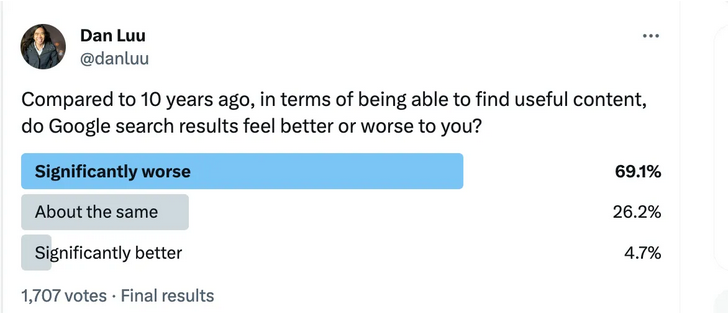
What kind of business spends hundreds of billions over 10 years — just to get worse?
This is a story about the birth of the search engine.
There were no commercial search engines back in 1993. But a Stanford student named David Filo compiled a list of his 200 favorite websites.
His buddy Jerry Yang helped turn this into an online list. They called it “Jerry’s Guide to the Worldwide Web”. Filo and Yang added new websites every day to their list — and classified them according to categories.
This turned into Yahoo.
Here’s my favorite part of the story: These two students didn’t even know they were running a business.
They did it for fun. They did it out of love. They did it because it was cool. “We wanted to avoid doing our dissertations”, Yang later explained.
But a venture capitalist named Mike Moritz heard about Filo and Yang, and tracked them down. The founders of Yahoo were living in total squalor in a trailer littered with stale food and pizza boxes, strewed alongside sleeping bags and overheating computers. A phone rang constantly — but nobody bothered to pick it up.
Moritz was dismayed by this dorm-room-gone-wild ambiance, but he was impressed with the students’ web searching technology. So he asked them the obvious question: How much did they plan to charge users?
Filo and Yang had no answer for this. They wanted to give their tech away for free.
Yahoo wasn’t even selling ads back then. It wasn’t tracking users and selling their private information. It didn’t even have a bank account.
But it was a community and had millions of users.
That was a word you heard frequently in Silicon Valley in the early days. People didn’t build web platforms — they formed online communities.
It was a FUN community. People enjoyed being a member. Even the absurd name Yahoo was part of the game — although early investors hated it.
Yang’s job title was “Chief Yahoo”. Filo’s position was “Cheap Yahoo”.
Investors always hate those kinds of things.
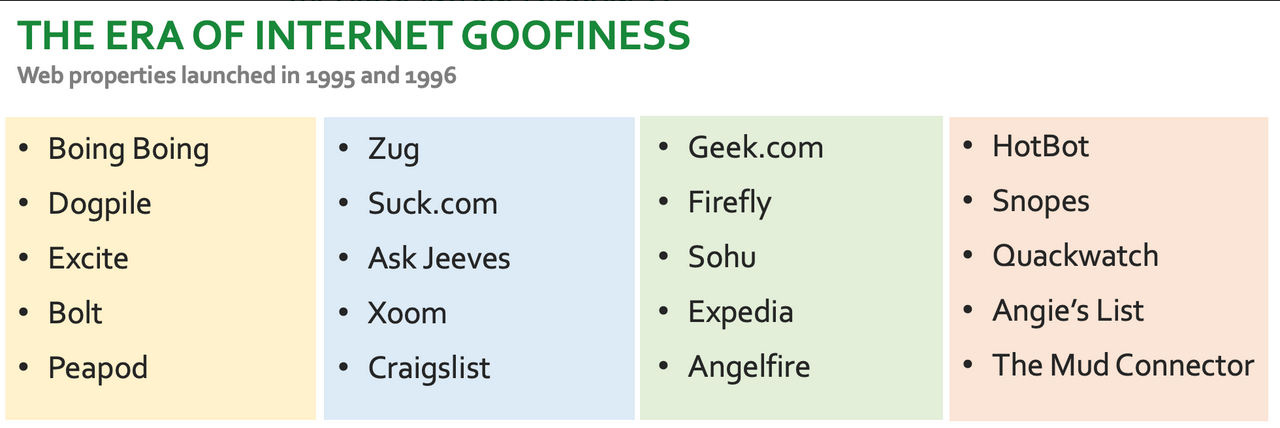
But a new web business, back then, was expected to have a silly name. Here are some of the websites launched in the mid-1990s.
Moritz wanted to turn Yahoo into a business. And the founders realized that their fun community was growing faster than they could handle in their down-and-out trailer. So they sold out 25% of Yahoo for $1 million.
January 6, 2024
QotD: “Computer people are just people”
Severian, “For Future Historians’ Benefit…”, Rotten Chestnuts, 2021-02-21.
January 3, 2024
They all spy on you, the FBI, RCMP, MI5 … and apparently your Subaru
JoNova linked to this disturbing little article explaining what legal rights you give away merely by being a passenger in a modern Subaru vehicle:

Subaru is a Japanese car company started back in the 1950s. Their all-wheel drive, sporty SUVs and cars are popular with outdoor types and the LGBT+ community (and your privacy researcher’s Mom … Mom swears by Subaru and has since the 1980s). Popular models in the Outback, Forester, Crosstrek, Impreza, Legacy, the sporty WRX, and the electric Solterra. The MySubaru app and Subaru’s Starlink connected services offer up all the usual connected car things like remote start/stop, lock/unlock, honk your horn and flash your lights from bedroom, automatic collision notification, multimedia services like navigation and news, trip logs, and a way to manage other people who might drive your Subaru with boundary, speed, and curfew alerts. So, do we love Subaru’s privacy? Not really. But hey, they aren’t the worst car company we reviewed, so there’s that.
Here’s something you might not realize. The moment you sit in the passenger seat of a Subaru that uses connected services, you’ve consented to allow them to use — and maybe even sell — your personal information. According to their privacy policy, that means things like your name, location, “Audio recordings of Vehicle Occupants“, and inferences they can draw about things like your “characteristics, predispositions, behavior, or attitudes“. Call us bonkers, but we don’t think that simply sitting in the passenger seat of someone’s Subaru should mean you consent to having any of your personal information use for, well, pretty much anything at all. Let alone potentially sold to data brokers or shared with third party marketers so they can target you with ads about who knows what based on the the inferences they draw about you because you sat in the back seat of a Subaru in the mountains of Colorado. We’re gonna really call out Subaru for this, because they lay it out so clearly in their privacy policy, but please know, Subaru isn’t the only car company doing this sort of icky thing.
If you go read Subaru’s privacy policy (or don’t, we did it for you, you can just read our review here), you’ll see at the very start they say this: “This Privacy Policy applies to each user of the Services, including any ‘Vehicle Occupant’, which includes each driver or passenger in a Subaru vehicle that uses Connected Vehicle Services, such as Subaru Starlink (such vehicle, a ‘Connected Vehicle’), whether or not such driver or passenger is the vehicle owner or a registered user of the Connected Vehicle Services. For the avoidance of doubt, for purposes of this Privacy Policy, ‘using’ the Services includes being a Vehicle Occupant in a Connected Vehicle.” So yeah, they don’t want there to be any doubt that when you sit in a connected Subaru, you’ve entered the world of using their services.
QotD: Iron and steel
Compared to the other materials available for tools and weapons, high carbon “spring steel” was essentially the super-material of the pre-modern world. High carbon steel is dramatically harder than iron, such that a good steel blade will bite – often surprisingly deeply – into an iron blade without much damage to itself. Moreover, good steel can take fairly high energy impacts and simply bend to absorb the energy before springing back into its original shape (rather than, as with iron, having plastic deformation, where it bends, but doesn’t bend back – which is still better than breaking, but not much). And for armor, you may recall from our previous look at arrow penetration, a steel plate’s ability to resist puncture is much higher than the same plate made of iron (bronze, by the by, performs about as well as iron, assuming both are work hardened). of course, different applications still prefer different carbon contents; armor, for instance, tended to benefit from somewhat lower carbon content than a sword blade.
It is sometimes contended that the ancients did not know the difference between iron and steel. This is mostly a philological argument based on the infrequency of a technical distinction between the two in ancient languages. Latin authors will frequently use ferrum (iron) to mean both iron and steel; Greek will use σίδηρος (sideros, “iron”) much the same way. The problem here is that high literature in the ancient world – which is almost all of the literature we have – has a strong aversion to technical terms in general; it would do no good for an elite writer to display knowledge more becoming to a tradesman than a senator. That said in a handful of spots, Latin authors use chalybs (from the Greek χάλυψ) to mean steel, as distinct from iron.
More to the point, while our elite authors – who are, at most dilettantish observers of metallurgy, never active participants – may or may not know the difference, ancient artisans clearly did. As Tylecote (op. cit.) notes, we see surface carburization on tools as clearly as 1000 B.C. in the Levant and Egypt, although the extent of its use and intentionality is hard to gauge to due rust and damage. There is no such problem with Gallic metallurgy from at least the La Tène period (450 BCE – 50 B.C.) or Roman metallurgy from c. 200 B.C., because we see evidence of smiths quite deliberately varying carbon content over the different parts of sword-blades (more carbon in the edges, less in the core) through pattern welding, which itself can leave a tell-tale “streaky” appearance to the blade (these streaks can be faked, but there’s little point in faking them if they are not already understood to signify a better weapon). There can be little doubt that the smith who welds a steel edge to an iron core to make a sword blade understands that there is something different about that edge (especially since he cannot, as we can, precisely test the hardness of the two every time – he must know a method that generally produces harder metal and be working from that assumption; high carbon steel, properly produced, can be much harder than iron, as we’ll see).
That said, our ancient – or even medieval – smiths do not understand the chemistry of all of this, of course. Understanding the effects of carbuzation and how to harness that to make better tools must have been something learned through experience and experimentation, not from theoretical knowledge – a thing passed from master to apprentice, with only slight modification in each generation (though it is equally clear that techniques could move quite quickly over cultural boundaries, since smiths with an inferior technique need only imitate a superior one).
Bret Devereaux, “Collections: Iron, How Did They Make It, Part IVa: Steel Yourself”, A Collection of Unmitigated Pedantry, 2020-10-09.
January 1, 2024
The largest telescope that will ever be built*
Tom Scott
Published 2 Oct 2023The asterisk is important.
■ More on the ELT: @ESOobservatory https://eso.orgThe Extremely Large Telescope, in Paranal, Chile, is probably going to be the largest optical telescope that will ever be constructed. I was invited out there by the UK Science and Technology Facilities Council and the European Southern Observatory, and I wasn’t going to turn down a chance like that.
📰 DISCLAIMER
While the STFC and ESO invited me and arranged the logistics after arrival into the Antofagasta region, I was not paid for this (not even my travel costs) and I have sole editorial control over the video. This is not an advert.
(more…)
December 30, 2023
Social prosecution … because they can’t send you to the Gulag
Theophilus Chilton reposted an older article from 2019 that clearly still has relevance:

For the past few years, we have been seeing a tremendous increase in a phenomenon which I refer to as “social prosecution”. This has taken place as the Left finds itself in a position of increasing power over the culture and the means of cultural discourse (e.g. social media, flow of information on the internet, etc.). Yet, the Left has not been able to establish more than a relative parity with the nominal Right in the formal political arena. As a result, the Left has had to seek alternative means for punishing its enemies since they don’t have much ability to do so formally yet.
Before I proceed to the main discussion about social prosecution, I’d like to lay a little groundwork first. It’s often said that politics is downstream from culture. In other words, as trends, assumptions, mores, and whatnot within a society’s cultural milieu begin to change, these values will begin to be reflected in the political realm after a bit of lag time. However, an equally salient fact is that culture, in turn, is downstream from power – which is not to be confused with politics.
Power is the ability to shape or change your circumstances in a real way, one that is actually effective. As a result of the Left’s long march through the institutions, they have gained significant (and in some cases total) control over most areas of information control and influence – the academy, entertainment, social media, journalism, and much more. This allows them to alter the direction in which western cultures evolve, which then translates into political change on down the road. That is an exercise of real power, no matter how silly we may be tempted to think Clown World is. But, it’s necessarily a slow process.
We all know the Left would love to be able to persecute and destroy its opponents completely, if only it were in a position to be able to. We know this because that’s what the Left always does when it achieves political power. It even does this to the extent of cannibalising itself of those who are not the “right kind” of leftists, the sort of purity spiraling that was observed in the early portion of Solzhenitsin’s Gulag Archipelago, whereby the Bolsheviks were as quick to purge Social Democrats, Anarchists, and other leftists as they were those on the Right. It’s seen even today in the USA on a smaller scale in the form of intra-leftist fighting and virtue signaling between various intersectional special interest groups.
What we all need to understand is that when it comes to the Left, there is really no such thing as a “moderate leftist” or “left-leaning centrist”. There are only leftists who cannot exercise the power they would like, and therefore cannot reveal their radicalness to the extent they would wish to, but who WILL do so as soon as they sense the opportunity. The default setting for the Left is permanent revolution, whether they are currently able to act on that impulse or not. This is why Cthulhu always swims left – apart from nominal rightist opposition (which, let’s face it, has been purposefully tepid in most of the West for over a generation), there really are no brakes checking the Left’s movement in that direction.
So what can the Left do when it finds itself in the position of having “soft” power (through control of institutions, opinion-shaping, etc.) such that it can influence the culture, but their ability to exercise political power has not “caught up” yet?
This is where social prosecution comes in. It is a technique that the Left uses as a “cheat code” to harm its enemies, even though it would seemingly have no formal power available to really be able to do so (through being restrained by residual constitutionalism, control of political offices by political enemies, etc.). It does so by playing to its strength – power over culture dissemination (which is not the same thing as culture creation, we should remember) and the flow of “social information” via social media, “woke capital,” and so forth. It uses these to create social circumstances in which those with the wrong attitudes, who express the wrong opinions, or are even merely representative of the wrong demographic or cultural idea, can be targeted (akin to Alinksy’s Rule 12 – “Pick the target, freeze it, personalise it, and polarise it”) and neutralised.
December 18, 2023
Napoleon Bonaparte on film
In The Critic, Peter Caddick-Adams considers the revival of the biopic, with emphasis on Napoleon Bonaparte, thanks to the recent Ridley Scott movie:

One of the posters for a much-shortened cut of Abel Gance’s Napoléon for the German market, 1927.
Some of the first motion pictures were biopics, initially silent. In portraying a high-minded individual, historical or contemporary, who has influenced our lives in some way, cinema’s hope is that some of the character’s prestige will rub off into the film. Both sides of the Atlantic have seen countless examples, because the genre is traditionally presented as culturally above a thriller, western or a musical. Its offer is an invitation to see history. Let us take Oppenheimer or Napoleon, with Cillian Murphy and Joachim Phoenix in the title roles. Viewers are attracted by the concept of a true story, be it the designer of the first atomic bomb, or the little emperor who dominated Europe. They may know little or a lot about the subject, even if only hazy knowledge from distant schooldays, but they start with more base knowledge than any other genre.
Gifted directors, in this case Christopher Nolan and Ridley Scott, with their cast hold our hands and walk us into an historical context, hinting at grandeur or importance. We are led into a panorama of life that’s now seen as great or significant. Whether you’re glued to a small screen nightly, or whether you go to the cinema only once or twice a year, the biopic demands attention as “education”, in a way a thriller, horror or romcom flick does not. We are sold the idea that reel history (which can never be real history) somehow merits our valuable time, more than mere “entertainment”.
Napoleon first burst onto the screen in 1927 with a silent-era masterpiece directed by Abel Gance. Far ahead of its time, the final scenes were shot by three parallel cameras, designed to be projected simultaneously onto triple screens, arrayed in a horizontal row called a Triptych, the process labelled “Polyvision” by Gance. It widened the cinematic aspect to a field of vision unknown then or since. The director tried to film the whole in his Polyvision, but found it too technical and expensive. When released, only the centre screen of footage was shown, to a specially composed score. Designed as one episode of several to tell the emperor’s life, which we would today label a franchise, the 1927 extravaganza came in at 5.5 hours, necessitating three intermissions, including one for dinner. Gance had interpreted his biopic as a grand opera. It has been much trimmed and revisited by other directors, including Francis Ford Coppola in the 1980s, and restoration of lost footage is still ongoing. I saw the 5.5-hour version in the Royal Festival Hall in 2000, with a score by Carl Davies (of World at War fame). For a film emerging from the Stone Age of cinematography, its excitingly modern ambition was worth my bum ache. I could see what all the fuss was about.
Curiously, the real value of Gance’s Napoléon was in technique rather than content. If you think of the silent era, it’s mostly the comics who come to mind, playing out their dramas in front of a single static camera. Gance seized this new medium, first embraced in December 1895 by the Parisian Lumière Brothers, and turned it on its head. Napoléon featured not just the Triptych experiment, but many other innovative techniques commonplace today. These included fast cutting between scenes of alternating dialogue, extensive close-ups, a wide variety of hand-held camera shots, location shooting, multiple-camera setups and film tinting (colouring), so altering cinematography for ever.
Although Rod Steiger gave us a different take on Napoleon in Sergei Bondarchuk’s Waterloo of 1970, with its leading actors of the day and massive cast of extras, comprising much of a Soviet army division in period costume and filmed behind the old Iron Curtain, Ridley Scott’s new Napoleon is clearly paying homage to the Gance Napoléon in ambition and length. Scott pretty much picks up the story where Gance left off, and he is able to deploy technology of which Gance could only dream. However, with both films, screenwriter, director and actors are at a disadvantage common to all biopics of having to work against the viewers’ check-list of facts they know, or expect to see included. Thus Scott, like Gance, relies on spectacular technique over storyline. This brings viewers, especially my fellow fuming historians, into a collision between historical truth and the possibilities of celluloid story-making.
Most of us have a mental picture of the character we are invited to watch, which constrains actors and their make-up teams, who have to imitate particular people, with all the wigs, prosthetics and accents that entails. Yet, to view the biopic as a piece of history is to miss the point of the motion picture industry. Pick up a screenplay, and you will be surprised at how few pages it comprises, how few words on each page. None read like a literary biography. With only 90–120 minutes in a typical movie, there is not enough time to cover a character’s full life — not even that of Napoleon in 5.5 hours. Instead, the challenge for the writing-directing team is to extract snippets of a life to demonstrate the evolution of character.
December 17, 2023
Justapedia, the latest “new Wikipedia“
At Quillette, Shuichi Tezuka introduces the latest challenger to the ever-more-biased free online encyclopedia Wikipedia:

In the aftermath of Elon Musk’s purchase of Twitter late last year, the journalist Jon Levine asked him: “I wonder how much Wikipedia would cost?” Musk had recently complained that Wikipedia has a “non-trivial left-wing bias”, and a few months earlier, had commented that “Wikipedia is losing its objectivity.” But regardless of whether Musk would have liked to purchase the site, there never was any real possibility of that happening, as stated by Wikipedia’s symbolic leader Jimmy Wales: “Wikipedia is not for sale”.
Following this exchange, there were several discussions on Twitter (as it was called at the time) about whether Musk might create his own alternative to Wikipedia. In the end Musk did not make such an attempt, but approximately eight months later, someone else did.
This new online encyclopedia, known as Justapedia, is the latest in a long series of attempts by various individuals to create a competitor to Wikipedia. So far all previous attempts have either been unsuccessful, or morphed into something so unlike Wikipedia that they could no longer be considered a competitor. However, one thing working in Justapedia’s favor is that the need for such a competitor is stronger now than it has been in past years, due to several recent controversies revolving around the manipulation and/or politicization of Wikipedia, along with a widespread perception that Wikipedia has not done enough to prevent this type of problem.
Justapedia was recently publicized by Larry Sanger, who co-founded Wikipedia alongside Wales, during an interview with Russell Brand and in a subsequent blog post. This article will present a more detailed examination of Justapedia’s background, including some of the recent controversies that demonstrate why it is needed, as well as the poor record of success other Wikipedia alternatives have had up to this point. Will Justapedia succeed where most other Wikipedia competitors have failed?
December 15, 2023
Bill S-210 “isn’t just a slippery slope, it is an avalanche”
You sometimes get the impression that the only person in Ottawa who actually pays attention to online privacy issues is Michael Geist:

“2017 Freedom of Expression Awards” by Elina Kansikas for Index on Censorship https://flic.kr/p/Uvmaie (CC BY-SA 2.0)
After years of battles over Bills C-11 and C-18, few Canadians will have the appetite for yet another troubling Internet bill. But given a bill that envisions government-backed censorship, mandates age verification to use search engines or social media sites, and creates a framework for court-ordered website blocking, there is a need to pay attention. Bill S-210, or the Protecting Young Persons from Exposure to Pornography Act, was passed by the Senate in April after Senators were reluctant to reject a bill framed as protecting children from online harm. The same scenario appears to be playing out in the House of Commons, where yesterday a majority of the House voted for the bill at second reading, sending it to the Public Safety committee for review. The bill, which is the brainchild of Senator Julie Miville-Duchêne, is not a government bill. In fact, government ministers voted against it. Instead, the bill is backed by the Conservatives, Bloc and NDP with a smattering of votes from backbench Liberal MPs. Canadians can be forgiven for being confused that after months of championing Internet freedoms, raising fears of censorship, and expressing concern about CRTC overregulation of the Internet, Conservative MPs were quick to call out those who opposed the bill (the House sponsor is Conservative MP Karen Vecchio).
I appeared before the Senate committee that studied the bill in February 2022, where I argued that “by bringing together website blocking, face recognition technologies, and stunning overbreadth that would capture numerous mainstream services, the bill isn’t just a slippery slope, it is an avalanche”. As I did then, I should preface criticism of the bill by making it clear that underage access to inappropriate content is indeed a legitimate concern. I think the best way to deal with the issue includes education, digital skills, and parental oversight of Internet use including the use of personal filters or blocking tools if desired. Moreover, if there are Canadian-based sites that are violating the law in terms of the content they host, they should absolutely face investigation and potential charges.
However, Bill S-210 goes well beyond personal choices to limit underage access to sexually explicit material on Canadian sites. Instead, it envisions government-enforced global website liability for failure to block underage access, backed by website blocking and mandated age verification systems that are likely to include face recognition technologies. The government establishes this regulatory framework and is likely to task the CRTC with providing the necessary administration. While there are surely good intentions with the bill, the risks and potential harms it poses are significant.
The basic framework of Bill S-210 is that it creates an offence for any organization making available sexually explicit material to anyone under the age of 18 for commercial purposes. The penalty for doing so is $250,000 for the first offence and up to $500,000 for any subsequent offences. Organizations (broadly defined under the Criminal Code) can rely on three potential defences:
- The organization instituted a “prescribed age-verification method” to limit access. It would be up to the government to determine what methods qualify with due regard for reliability and privacy. There is a major global business of vendors that sell these technologies and who are vocal proponents of this kind of legislation.
- The organization can make the case that there is “legitimate purpose related to science, medicine, education or the arts”.
- The organization took steps required to limit access after having received a notification from the enforcement agency (likely the CRTC).
The enforcement of the bill is left to the designated regulatory agency, which can issue notifications of violations to websites and services. Those notices can include the steps the agency wants followed to bring the site into compliance. This literally means the government via its regulatory agency will dictate to sites how they must interact with users to ensure no underage access. If the site fails to act as instructed within 20 days, the regulator can apply for a court order mandating that Canadian ISPs block the site from their subscribers. The regulator would be required to identify which ISPs are subject to the blocking order.
December 11, 2023
This man built his office inside a lift
Tom Scott
Published 28 Aug 2023The Baťa Skyscraper, in Zlín, Czechia, is a landmark of architecture. And the office of Jan Antonín Baťa … is an elevator.
Thanks to the museum staff for fact-checking and translation!
(more…)
December 10, 2023
The history of the steam engine … but interactive
In the latest Age of Invention newsletter, Anton Howes is pleased to announce the release of a new ongoing project to illustrate the steam engine in an interactive format:
I’m excited to announce something I’ve been quietly working on for a few months now behind the scenes. Some of you may be familiar with the explorable interactive articles of Bartosz Ciechanowski. They are so clearly written and so cleverly explorable, that they give an intuitive grasp of how many very complicated technologies work. My favourite is his article on mechanical watches. Be warned: if you’ve not seen these before, you’re about to lose a good few hours.
But his article on watches — which came out just as I was doing some research on the development of watches, and which proved an invaluable reference work — got me thinking about how great it would be to have something similar not just for how current technologies function, but to show how they changed over time. Wouldn’t it be great, I dreamed, to have a similarly intuitive way to explore and appreciate the process of improvement. And to correct lots of misapprehensions about the development of various technologies along the way.
As it turned out, my fellow inventions history fanatic Jason Crawford, who runs the non-profit The Roots of Progress, had been thinking along the same lines. (Drumroll starts softly.) So with the help of the Matt Brown we’ve been able to realise what is hopefully just the first small step of our vision. (Drumroll intensifies.) Based on my recent work re-writing the standard pre-history of the steam engine (drumroll crescendoes), allow me to present:
(Cue trumpets!)
The interactive, animated, **Origins of the Steam Engine**
Alongside contemporary illustrations of the many devices, you can play around with the animated models, dragging them to see them from different angles. It introduces what are so far the only interactive and animated models yet made of a great many devices — from Philo of Byzantium’s 3rd Century BC experiments, to Salomon de Caus’s 1610s solar-activated and self-replenishing fountains and musical instruments, and the 1606 steam engine of the Spanish engineer Jerónimo de Ayanz y Beaumont:
It also contains the first depictions of the 1630s and 40s devices of Kaspar Kalthoff and William Petty. These are the experiments I discovered about a year ago, which I hope will now be given a place in the canon of the history of the steam engine. (You can read my discussion of the evidence I’d stumbled across about them here.)

December 9, 2023
The coming Micro-Macro culture war … and who’s going to win it
Ted Gioia outlines the dismal state of the “macro” culture — television, movies, newspapers, book publishing and all the big corporations that control them — with the dynamism of the “micro” culture:
In the beginning, all culture was microculture.
You knew what was happening in your tribe or village. But your knowledge of the wider world was limited.
So you had your own songs and your own stories. You had your own rituals and traditions. You even had your own language.
But all these familiar things disappeared when you went off into the world. That was dangerous, however. That’s why only heroes, in traditional stories, go on journeys.
You learn on the journey. But you might not survive.
But all that changed long before I was born.
In my childhood, everything was controlled by a monoculture. There were only three national TV networks, but they were pretty much the same.
When I went to the office, back then, we had all watched the same thing on TV the night before. We had all seen the same movie the previous weekend. We had all heard the same song on the radio while driving to work.
The TV shows were so similar that they sometimes moved from CBS to NBC, and you never noticed a change. The newscasters also looked pretty much the same and always talked the same — with that flat Midwestern accent that broadcasters always adopted in the US.
The same monoculture controlled every other creative idiom. Six major studios dominated the film business. And just as Hollywood controlled movies, New York set the rules in publishing. Everything from Broadway musicals to comic books was similarly concentrated and centralized.
The newspaper business was still local, but most cities had 2 or 3 daily newspapers — and much of the coverage they offered was interchangeable. Radio was a little more freewheeling, but eventually deregulation allowed huge corporations to acquire and standardize what happened over the airwaves. [NR: I suspect the “freewheeling” went away once the government started imposing regulations, and the corporate consolidation was enabled when they “deregulated” the radio licensing regime several decades later.]
When I went to work in an office, back then, we had all watched the same thing on TV the night before. We had all seen the same movie the previous weekend. We had all heard the same song on the radio while driving to work.
And that’s why smart people back then paid attention to the counterculture.
The counterculture might be crazy or foolish or even boring. But it was still your only chance to break out of the monolithic macroculture.
Many of the art films I saw at the indie cinema were awful. But I still kept coming back — because I needed the fresh air these oddball movies provided. For the same reason, I read the alt weekly newspapers and kept tabs on alt music.
In fact, whenever I saw the word alt, I paid attention.
That doesn’t mean that I hated the major TV networks, or the large daily newspaper, or 20th Century Fox. But I craved access to creative and investigative work that hadn’t been approved by people in suits working for large organizations.
The Internet should have changed all this. And it did — but not much. Even now the collapse in the monoculture is still in its early stages.
But that’s about to change.
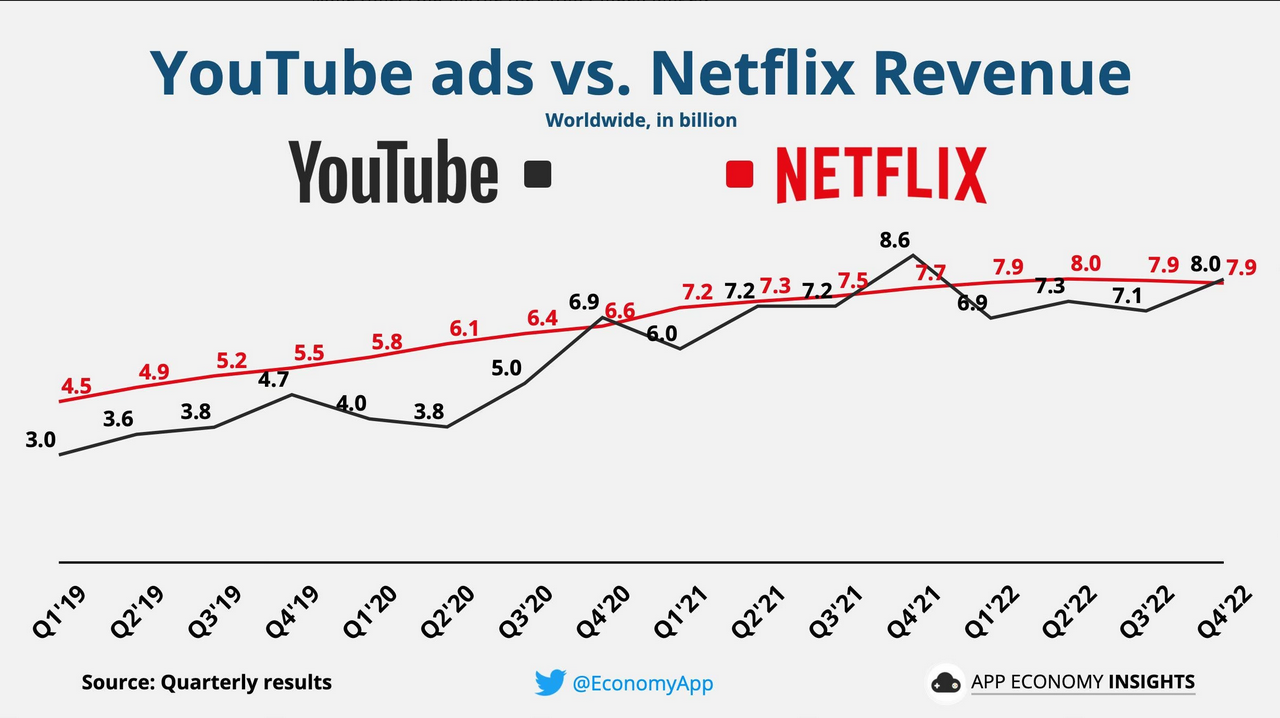
If you don’t pay close attention, the media landscape seems pretty much the same now as it did in the 1990s. The movie business is still controlled in Hollywood. The publishing business is still controlled in New York. The radio stations are still controlled by a few large companies. And instead of three national TV networks plus PBS, we have four dominant streaming platforms — who control almost 70% of the market.
So we still live in a macro culture. But it feels increasingly claustrophobic. Or even worse, it feels dead.
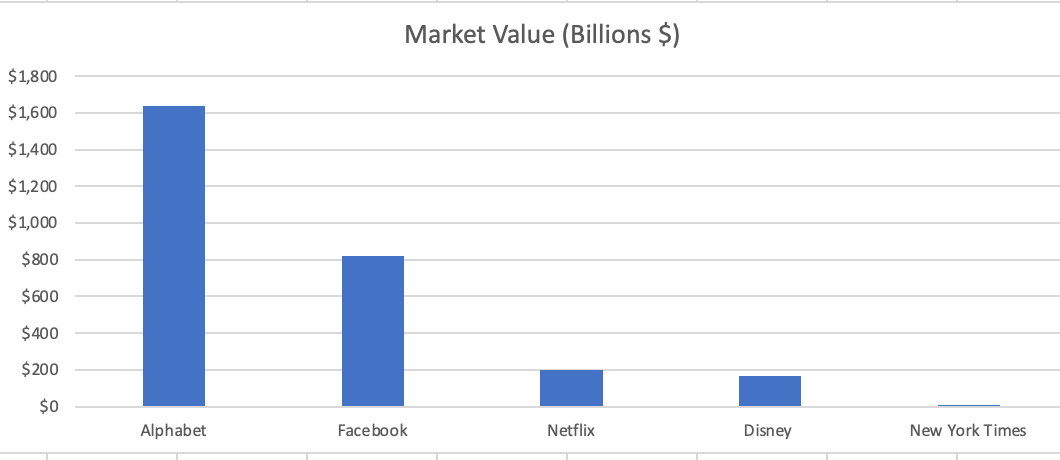
Meanwhile, a handful of Silicon Valley platforms (Google, Facebook, etc.) have become more powerful than the New York Times or Hollywood studios or even Netflix. It’s not even close — the market capitalization of Google’s parent Alphabet is now almost ten times larger than Disney’s.
But here’s the key point — these huge tech companies rely on the microculture for their dominance.
Where is Facebook without users contributing photos, text and video? Where is Google’s YouTube without individual creators?
In terms of economic growth or audience capture, the microculture has already won the war. But it doesn’t feel that way.
Why not?
First and foremost, Silicon Valley is a reluctant home for the microculture. To some extent Alphabet and Facebook are even going to war with microculture creators — they try to make money with them even while they punish them.
- So Mark Zuckerberg needs creators, but won’t even let them put a live link on Instagram and limits their visibility on Facebook and Threads.
- Alphabet needs creators to keep YouTube thriving, but gives better search engine visibility to total garbage that pays for placement.
- Twitter also claims it wants to support independent journalists — but if you’re truly independent from Elon Musk, your links are brutally punished by the algorithm.
This tension won’t go away, and next year it will get worse. The microculture will increasingly find itself at war with the same platforms they rely on today.
And legacy media and non-profits are even more hostile to emerging media. Go see who wins Pulitzer Prizes, and count how many journalists on alternative platforms get honored.
I’ll save you the trouble. They don’t.
December 3, 2023
Every Construction Machine Explained in 15 Minutes
Practical Engineering
Published 15 Aug 2023A very quick overview of nearly every machine you’ll see on a construction site.
It takes a lot of big tools to build the roads, dams, sewage lift stations, and every other part of the constructed environment. To me, there’s almost nothing more fun than watching something get built, and that’s made all the better when you know what all those machines do.
(more…)
December 1, 2023
“I considered shopping a proposal for an anti-helicopter parenting book called Your Kid Sucks, but for some strange reason my agent dissuaded me”
Freddie deBoer on the modern phenomenon of “helicopter parenting”:

Collapse in childhood freedom – Graphic showing the diminishing “free ranges” of each generation of an English family.
For the New York Times, Jessica Grose details how new online grading systems allow parents to track the progress of their children not from year to year, semester to semester, report card to report card, but week to week or even day by day. The results are depressingly predictable, in today’s parenting environment. There’s stress for students and teachers alike, a collapse in interest in learning in and of itself, an adversarial relationship between parents and teachers, and the rise of “hyperchecking”, where parents complain about each and every single grade that isn’t an A. The piece is about K-12, but Grose notes that parents are increasingly seeking access to college online gradebooks, which seems crazy to me; as someone who’s taught a lot of college classes, the idea of someone constantly monitoring a student’s grade with the mindset of a litigious lawyer sounds awful. But then again, perhaps I shouldn’t be surprised. Here’s a piece about helicopter parenting extending into the college years to the extent that the parents are arranging social calendars. Of their college-age children.
I’ve been thinking about these issues for some time — I considered shopping a proposal for an anti-helicopter parenting book called Your Kid Sucks, but for some strange reason my agent dissuaded me — and what I can’t stop wondering is why parents don’t stop doing this stuff for the good of their kids themselves. There are social and philosophical critiques to be made of helicopter parenting, some very good ones. But we never need to wonder why people choose to pursue selfish interests over social or philosophical ones. What consistently surprises me is that parents keep puttering along in the clouds above their kids, binoculars in hand, when there seem to be really compelling arguments against doing that for reasons that are completely aligned with the selfish interests of the kids. I get ignoring social responsibility for the sake of your kid; it’s hard to understand ignoring what’s best for your kid for the sake of your kid.
There’s the social case to be made against helicopter parenting, of course. If you wanted to define the essential moral project of human beings in the broadest terms possible, you could do worse than “put others before self”. Aggressive parenting allows people to juke this basic logic — parents who act as though their child’s best interest is the only important criterion are, in a literal sense, putting someone else before themselves. “Hey, I may be disadvantaging already-disadvantaged kids with my hyperactive parenting, but I’m doing it for a greater cause than myself.” And the intrinsic (genetic) dedication to the good of one’s child obliterates the broader social concerns once freed from the guilt of traditional for-myself selfishness. But hyper-parenting still reflects selfishness, putting your own kin above the interest of everyone else, especially in cases where the harm done to society is a lot bigger than the benefit to your child. Academic malfeasance like the Varsity Blues scandal has obvious negative social consequences, for example, while those specific kids faced only going to slightly less competitive or desirable schools had there been no fraud in their applications. Less directly illicit behavior, like grade grubbing — which, among other things, inevitably benefits the students with the parents who are the most aggressive and who hold the most social capital — are a greyer area, but ultimately do more to unbalance an already-unbalanced system. If these parents were confronted with the opportunity to do this for themselves, I genuinely think that most of them would decline, out of a sense of social obligation. But once it’s “for my kid”, it’s no holds barred.
I think absolutely all parenting contains a little narcissism, and that’s OK; it’s probably a part of our genetic endowment that helps compel parents to nurture their children, and anyway parenting is a tough job that we shouldn’t expect people to perform with no sense of self-satisfaction. But it is one of those quirks of our social order that the parents who are the most politically progressive, who most ardently advocate for a society that serves all of our people, are often also the most unapologetic about putting their thumb on the scale for their own children. Plus, the sort of second-order selfishness of parenting allows for the sidestepping of more philosophical objections to helicopter parenting. These objections are less about the social good of others and more about the content of our individual characters. These include personal values such as the notion that we just should, as human beings, be able to live with a degree of independence in youth; that we just should experience hardship and the consequences of our actions to better appreciate what it means to be alive; that we just should, as human beings, secure our own interests to whatever degree we’re able, without help from above, including in school; that we just should operate as though we are but one in a broad collection of human beings, all of whom matter as much as we do, for our own spiritual good. The thing about these personal values is that they’re only motivating if they are indeed personal — that is, these might sway an individual, but not even occur to their parents, and in our system parents have remarkable ability to obstruct the agency of their kids. They can do the dirty work the kids might not do for themselves.


