Quotulatiousness

September 5, 2023

The worst Prime Minister in Canadian history?

Filed under: Cancon, Media, Politics — Tags: , , , , , — Nicholas @ 03:00

My own opinion is that the Trudeaus, taken together, are certainly the worst family to have been political leaders of Canada, but is Justin Trudeau the single worst PM in history?

Like father, like son, a dynastic peril. I should mention at this point that the best short article on Justin Trudeau’s unfitness for office was posted on this site by my wife Janice Fiamengo some two years back. It would be folly for me to try to outdo her writerly excellence, unflappable tact, and marksman-like precision. Here I offer an updated summing-up of why Justin Trudeau is surely unprecedented in the annals of Canada’s ideological destitution. The daily spectacle we are witnessing, the eruption of political sludge and magma from the depths of government policy, puts paid to any promotional salvage operation.

This is a prime minister who has been implicated in numerous scandals and cited for several ethics violations, all to no avail. He has imposed a needless and prohibitive carbon tax upon a groaning nation and propelled the national debt into the fiscal asteroid belt. He is soft on terrorism, having awarded a $10.5 million reparation payment to al-Qaeda terrorist, and the son of Ahmed Said Khadr, Omar Khadr, who had been imprisoned in Guantanamo for killing an American medic in Afghanistan. Trudeau also sympathized with Boston Marathon bomber Dzhokhar Tsarnaev, a Muslim immigrant from Chechnya, who killed three people and injured another 170, saying, “there is no question that this happened because there is someone who feels completely excluded”.

As noted, this is a prime minister who has bought the media with elaborate financial gifts, who admires the “basic dictatorship” of Communist China, and has made no secret of his fondness for Castro, waxing eloquent in his eulogy for the dead dictator, and who, like his father, has adopted an energy policy intended to phase out the western petroleum industry in the interests of a “just transition” to inefficient green renewables, and thus cripple the economic foundation of the country in perpetuity.

This is a prime minister who mandated draconian COVID-19 protocols — masks, quarantines, lockdowns, vaccines. The entire effort is now known to have been a colossal blunder whose results were ineffective at best and noxious, even lethal, at worst. Concerning the vaccines, Trudeau now claims that he did not force anyone to take them but “chose to make sure all of the incentives and all of the protections were there to encourage Canadians to get vaccinated”. In other words, offer them an incentive they can’t refuse. The “incentives” amounted to interventions like losing one’s job, livelihood, social freedoms, and Charter rights. Even people who did remote work had to be vaccinated; if they were fired, they were ineligible for Employment Insurance.

Giving Trudeau’s protestations the lie, in a Sept. 16, 2021 interview aired on the French-language program “La semaine des 4 Julie“, he referred to unvaccinated Canadians as “extremists”, as people who “don’t believe in science or progress and are very often misogynistic and racist”. “A leader who expresses such detestation for his own people,” Janice writes, “and encourages frightened followers to participate in their dehumanization should not be trusted with the reins of government.” It’s hard to disagree.

We should never forget that this is a prime minister who in February 2022 invoked the dictatorial powers of the Emergencies Act — a Trudeau habit — to crush a peaceful, legitimate, and justifiable protest against the vaccine mandates by a brave and patriotic cohort of the country’s truckers and who authorized the banks to freeze protesters’ accounts, reminiscent of the Nazi 1938 Decree for the Reporting of Jewish-Owned Property issued by Hitler’s government. The mind boggles.

QotD: “Karl Marx was right after all”

Alas, as my fictional namesake said somewhere, time has a habit of turning all our lies into truths. It turns out Karl Marx was right after all. Who, I ask you, is more cartoonishly evil, more like the caricature capitalist of paranoid Communist fantasies, than Jeff Bezos? Mark Zuckerberg? Tim Cook? Jack Dorsey? Sundar Pichai?

We’re actually living, comrades, in the class-warfare world Marx preached in the 1840s. Everything Marx said about the factory owners of the First Industrial Revolution, that seemed so luridly absurd that even other Socialists criticized him for it, is true of the tech fascists of the Biden-Harris Revolution. Solzhenitsyn cites Russian writers from the late nineteenth century noting that Marxian socialism would end up as nothing more than dialectically-constructed feudalism, and lo, here we are. America in 2021 looks almost exactly like the USSR looked upon Lenin’s death …

… that was 1924, gang, and in case you’ve forgotten, what happened next was a vicious intra-Party civil war, in which Stalin crushed his enemies. AOC makes a pretty unlikely Trotsky, but it’s no less ludicrous than the thought of Nancy Pelosi as Koba … but that’s just the thing, isn’t it? We’ve been noting here for years that the modern Left is dedicated to being the Hollow Men in all things. They’re Revolutionaries without a Revolution — they go on and on (and on and on and on) about fighting the power and sticking it to the Man, even though they, themselves, have been the Man since at least 1974. They’re moralizers without morality — you’ll be scolded for not being as perverse as humanly possible. And, of course, their politics is a cult of personality without the personality — not even Orwell or Kafka could’ve come up with the Party installing an obvious dementia patient as its figurehead, not even if you’d dropped LSD in their tea.

As always — and yes, even in the depths of Stalin’s terror — the real rulers are the nomenklatura, the apparatchiki. Not even Koba the Dread can be everywhere. Being Hollow Men, our Postmodern Leftist masters have decided to dispense with the whole Kremlin thing. Who needs the NKVD, the gulag, the dreaded Lubyanka? The Junior Volunteer Thought Police “fact checking” everything on social media will do it for free, and much more efficiently, at which point their fellow travelers in the banking system will simply cut the badthinkers off. The only reason the gulag persisted after Khrushchev’s “secret speech” was that the Soviets, those fools, wanted to exploit their natural resources themselves, to build things themselves; labor camps were thus integral to the Soviet economy. Our masters don’t care about that, and their masters, the Chinese, certainly don’t. Much more efficient, and psychologically effective, to let the unperson simply starve in the middle of the town square, pour encourager les autres.

But hey, at least we’ll have some fun figuring out who the new Trotsky is. Again, my money’s on AOC — she’s so stupid that she’s bound to do something irrecoverably dumb sooner or later, after which she gets the digital icepick. That’ll be a hoot. Enjoy what parts of the spectacle you can, comrades – if you’re a student of human folly, you’re going to love the next few decades, because Marx was right about that too, the bastard — second time as farce.

Severian, “Marx Was Right After All (on ongoing series”, Rotten Chestnuts, 2021-01-12.

September 4, 2023

Our own little Cyberpunk Dystopia

Filed under: Cancon, History, Media, Military, Politics, USA — Tags: , , , , — Nicholas @ 04:00

Kulak suggests we get comfortable with the tropes of Cyberpunk Dystopias, since we’re already living in one:

One need not spend long in radical or dissident Right discourse to encounter talk of Psy-ops and demoralization campaigns.

Some of this traces back to Yuri Besmenov’s work on subversion, some to speculation about “Operation Mockingbird” type media manipulation schemes, and some to simply obvious symbolic work being done for seeming for no reason except to horrify, offend, “blackpill”, and create a sense of helplessness amongst regime enemies.

One can point to the massive sentences for Jan 6th protestors, the recent charges of Trump (outside any norm or existing political theory or constitutional theory), or most ridiculous: Dystopia Porn news stories.

I recently heard a story repeated by a commentator of a news story of a trans-woman working with doctors to be amongst the first to receive a womb transplant which would allow a biological male to gestate a baby, this person was excited, completing the South Park plotline (seriously 2005 s09e01 “Mr. Garrison’s Fancy New Vagina” look it up), stating that they were excited that they might be the first trans-woman to get an abortion.

Why would the medical establishment play along and at least pretend to enable this obviously malicious and self-destructive wish? Why would the media bother to report such a crazy person’s putrid desire?? This religious commentator could only describe it as “satanic”, and speculated that it was a psy-op meant to break decent people’s will …

Setting aside the question of intention, and whether it wasn’t “just” medical professionals salivating at a paying guinea pig, and the media looking for clicks that aligned with their propaganda …

Why would it demoralize!?

Abortions happen by the hundreds of thousands annually, and the nightmare of the trans-medical process is visited on thousands of souls more sympathetic than this South Parkian weirdo every year … outside of the immediate outrage, such a bizarre one-off intersection of the two is basically of no broader political import … indeed if one is of the social conservative set one has seen rather major political victories on both fronts, with the overturning of Roe vs. Wade and the end of adolescent gender treatment across wide sections of Europe.

And yet for this one-off story of someone saying they would like to do something evil and stupid … you got outrage and horror and many an invocation of “It’s so over”.

What are the point of Psy-ops? What is the goal of demoralization?

Well as a perfidious leaf I am uniquely positioned to tell you, indeed, indeed one might say my country only exists because of the greatest psy-op in human history …

No not anything to do with Trudeau sr. or the liberal government’s corruption and bribery to keep Quebec from leaving …

The founding Canadian Psy-op occurred in 1812 … carried out by the greatest psychological warfare operative in human history, and Canadian national hero:

General Sir Isaac Brock

According to former President Jefferson, the conquest of Canada was to be “just a matter of marching” … indeed it should have been, the woefully outnumbered British Regulars and under-trained Canadian Militia should have been in no position to hold Upper Canada (now Ontario) and by rights should have lost what is now English Canada to American expansion … The defence of Canada depended on keeping America’s superior numbers on the far side of the St Lawrence/Great Lakes waterway bound up and unable to deploy in force for such an invasion …

… a seemingly hopeless task since they already had a beachhead for such an invasion at Fort Detroit (site of the current, well former, major city).

So Brock went on the attack, marching on Detroit with vastly inferior numbers to even the garrison.

His 1300 men of three different nationalities (British, Canadian, and Native) attacked 2500 unified defenders across the massive Detroit River, in a prepared defensive position.

It should have been suicide … he didn’t lose a single man.

Brock dressed his militia in excess redcoat uniforms of British regulars to make it appear as if he had more professionally trained soldiers … then throughout his maneuvers created the illusion that he had vastly more men than his opponent, marching his men in circles to create the illusion from the walls of the fort that he had thousands more than reality.

He then wrote to his opposite general William Hull begging him to surrender, stating that he did not believe he could control his 3000 Indian allies (in reality just 600) and prevent scalping and war crimes once battle broke out.

Hull wrote back asking for three days to arrange the surrender, Brock gave him three hours.

Once surrendered, Hull’s men spat on him seeing the inferior force they had just turned their guns over to.

At a court martial General Hull was sentenced to be shot, however, President Madison commuted his sentence to mere dismissal from the service … beginning a 200+ year-long tradition of US military retreat and lack of accountability.

In 1945 Canadian forces would repeat this obscene tactic at the battle of Zwolle, when soldier Leo Major single-handedly tricked ~1500 German soldiers into believing they were surrounded by superior forces and retreating.

“… the ‘Teachers should tell parents’ people outnumber the ‘Teachers must not tell parents’ folks by something like four-to-one”

Filed under: Cancon, Education, Health, Media, Politics — Tags: , , , , , , , — Nicholas @ 03:00

In the free-to-cheapskates segment of The Line‘s weekly round-up post, they discuss the suddenly “brave” Conservative provincial premiers jumping onto a hot culture war topic on the side of the vast majority of Canadians:

New Brunswick now has Policy 713, that requires teachers or school officials to notify parents and obtain consent if a child younger than 16 wishes to change his or her name or pronouns. Saskatchewan has announced a similar proposal; Ontario is considering one, too.

The Line looks upon these proposals with extreme skepticism. To be frank, we wish the provinces weren’t doing this. We think it’s strategically misguided: every moment a Conservative spends defending “parental rights” is a moment in which they are not talking about highly salient economic issues that affect far more people. Further, we don’t trust their motives. Either they’ve decided to pick this fight because they thought parental consent was going to be a winner for them, or they simply felt pushed into it by the more excitable elements of their respective bases. (We assign a probability assessment of absolute zero to the notion that the leaders might be doing this out of moral conviction.)

So yeah, it’s cynical and exploitive policy, but gosh, is it ever popular policy, too. Polling shows it’s like 80-per-cent approval popular.

Because of course it is.

Again, we stress that we don’t support the imposition of sweeping legislation. Absent evidence of abuse or mismanagement, we think parental notification of social transition should be handled on a case-by-case basis. In the midst of a moral panic on trans issues, we’d prefer to keep politicians as far away from this third rail as possible, with long pointy sticks and cages if necessary.

However, we also recognize that cynicism cuts both ways. We have also borne witness this week to some hysterical rhetoric from those who seem to seriously believe that schools should be forbidden from sharing this information, if the minor in question so chooses.

These people are in the minority, as we suggested above. The polling shows that the “Teachers should tell parents” people outnumber the “Teachers must not tell parents” folks by something like four-to-one. This is the kind of lopsided result you almost never see on contentious policy issues — the numbers are what we would expect if we asked Canadians “Is ice cream tasty?” or “Do you enjoy cuddling a puppy?” And of course this is so. Parents are, generally speaking, not going to have a whole lot of time for the suggestion that children will be better off if the state, at any level, adopts a policy of withholding information from them.

We don’t support what the conservative premiers are doing, because we think they’re doing it for cynical reasons, but we would absolutely oppose any policy that goes in the opposite direction. And the majority of the country — a massive supermajority — is onside with us on this one.

There are no easy answers here, because we do not dismiss the concerns raised by the minority. We absolutely agree and accept that there are going to be families and parents that may react badly, even dangerously, to their child changing their name or pronoun. But the answer isn’t to involve teachers and schools in a coverup; it’s to have policies in place that give any child that may fear for their safety all the help they need, including, if necessary, intervention. To this end, we would note that teachers are mandatory reporters — they must report a variety of issues (or concerns) because society has learned through tragedy and horror what happens when parents and other guardians are excluded from knowing details of their child’s life. If teachers have reasonable grounds to suspect abuse, mental health issues and more, they are legally required to inform authorities and families. Limiting their ability to inform parents would cut against this necessary and overdue progress. Further, we have already passed laws banning “conversion therapy.”

Your Line editors support the right of trans people to live lives of legal equality, safety and dignity, and we honestly believe that most Canadians would agree with us on that. We also note that the rising tide of trans activism has raised complicated concerns that exist at the edges of reasonable accommodation, and must necessarily raise thorny concerns about how we manage competing rights between disadvantaged people. Can minors consent to puberty blockers and cross-sex hormones? Is it fair to allow trans women who enjoy the permanent physical advantages bestowed by male puberty into female athletics? When should trans men be permitted in women’s prisons and shelters, if ever? These questions demand a thoughtful and nuanced response. They don’t disappear the moment someone screams “trans women are women!” and threatens to kill that bigoted TERF J.K. Rowling. They aren’t resolved by hysterics and warnings of suicide.

By staking out maximalist positions on the most difficult topics, and granting no ground for concession and compromise, trans-rights activists have polarized their own cause. Shouting down critics worked for a while, but the pendulum is now rapidly swinging back to the plumb line. Labelling every concerned parent a transphobe is tired and played out. It’s failing as a strategy of persuasion. Which brings us to the current moment; the place of four-to-one support for cynical policies proposed by conservative premiers. Keep it up, and we suspect it’ll be nine-to-one in short order.

Backlashes are rarely measured, sane, or logical, and we fear this one is already teasing out some very dark and long-repressed demons, even among people who once counted themselves allies of LGBTQ people and causes. We are seeing this backlash in a rise in hate crimes, growing counter-protests, and in a decline in support for LGBTQ people generally. And, yes, we are seeing it in in heavy-handed and misguided legislation both here and in the U.S. We aren’t arguing that any of this is justifiable; rather, we are merely noting that it has long been inevitable and predictable. We were warned.

One of the only real questions we have is how self-styled progressive parties and leaders are going to navigate trans issues when the population is very much not on their side. We talk a lot about how the conservatives are beholden to the most vocal minorities within their parties; but we fear that the progressives suffer the same fundamental problem.

We’d like to think that the Liberals and the NDP will handle trans issues maturely, responsibly and well. But we know better. They’ll go all in, setting everyone up for a very nasty confrontation that we think they’ll lose, and badly. Brace yourselves, friends.

September 1, 2023

How the term “the Deep State” morphed from left-wing to (extreme, scary, ultra-MAGA) right-wing jargon

Filed under: History, Media, Politics, USA — Tags: , , , , , , — Nicholas @ 05:00

Matt Taibbi wants to track the changes in political language in US usage, starting today with “Deep State”:

In July of last year David Rothkopf wrote a piece for the Daily Beast called, “You’re going to miss the Deep State when it’s gone: Trump’s terrifying plan to purge tens of thousands of career government workers and replace them with loyal stooges must be stopped in its tracks.” In the obligatory MSNBC segment hyping the article, poor Willie Geist, fast becoming the Zelig of cable’s historical lowlight reel, read off the money passage:

    During his presidency, [Donald] Trump was regularly frustrated that government employees — appointees, as well as career officials in the civil service, the military, the intelligence community, and the foreign service — were an impediment to the autocratic impulses about which he often openly fantasized.

This passage portraying harmless “government employees” as the last patriotic impediment to Trumpian autocracy represented the complete turnaround of a term that less than ten years before meant, to the Beast‘s own target audience, the polar opposite. This of course needed to be lied about as well, and the Beast columnist stuck this landing, too, when Geist led Rothkopf through the eye-rolling proposition that there was “something fishy, or dark, or something going on behind the scenes” with the “deep state”.

Rothkopf replied that “career government officials” got a bad rap because “about ten years ago, Alex Jones and the InfoWars crowd started zeroing in on the deep state, as yet another of the conspiracy theories …”

The real provenance of deep state has in ten short years been fully excised from mainstream conversation, in the best and most thorough whitewash job since the Soviets wiped the photo record clean of Yezhov and Trotsky. It’s an awesome achievement.

Through the turn of the 21st century virtually no American political writers used deep state. In the mid-2000s, as laws like the PATRIOT Act passed and the Bush/Cheney government funded huge new agencies like the Department of Homeland Security, the word was suddenly everywhere, inevitably deployed as left-of-center critique of the Bush-Cheney legacy.

How different was the world ten years ago? The New York Times featured a breezy Sunday opinion piece asking the late NSA whistleblower Thomas Drake — a man described as an inspiration for Edward Snowden who today would almost certainly be denounced as a traitor — what he was reading then. Drake answered he was reading Deep State: Inside the Government Secrecy Industry by Marc Ambinder, whose revelations about possible spying on “eighteen locations in the Washington D.C. area, including near the White House, Congress, and several foreign embassies”, inspired the ACLU to urge congress to begin encrypting communications.

On the eve of a series of brutal revelations about intelligence abuses, including the Snowden mess, left-leaning American commentators all over embraced “deep state” as a term perfectly descriptive of the threat they perceived from the hyper-concentrated, unelected power observed with horror in the Bush years. None other than liberal icon Bill Moyers convinced Mike Lofgren — a onetime Republican operative who flipped on his formers and became heavily critical of the GOP during this period — to compose a report called “The Deep State Hiding in Plain Sight“.

QotD: Process thinking about the Russo-Ukraine war

Filed under: Europe, Military, Politics, Quotations, Russia, USA — Tags: , , — Nicholas @ 01:00

Process thinking has goals, of course, but they’re all interpersonal. The outcomes, small-o, of Process thinking all have to do with relationships within the group. Why are there blacks in ads for camping gear, despite no black person ever having gone camping in the history of the human race? Because the set designer assumes the writer wants it, and the writer assumes that the creative director wants it, and the creative director assumes the client wants it … which he does, but only because he in turn assumes that the creative director wants it, and etc. To return it to politics, it’s all Narrative.

Combining them, consider the Ukraine Narrative as one giant ad campaign. The lack of Outcome-thinking hit all of us from the very moment it became The Current Thing. What, exactly, are we doing in Ukraine?

Note that there is a case to be made. I don’t agree with it, obviously, but I can make one, and of course it’s ruthlessly Outcome-driven: In a world where States have no friends, only interests, it is consistent with Realpolitik to weaken your rivals when it can be done at low cost and minimal risk. We’re doing to Russia what Russia (and China) did to us in Vietnam — they were quite open about aiding their fraternal socialist brothers in the struggle against Capitalism and Western Imperialism.

One can — and of course in this case would — argue that fucking around in Ukraine is neither low-cost nor low-risk, but that too is Outcome-thinking. You can persuade me, an Outcome thinker, with facts and reason. Steve Sailer is almost a caricature of an Outcome thinker at this point, and he’d be just super at demolishing my hypothetical Realpolitik argument for US aid to Ukraine.

But not only do the Process-“thinkers” in [Washington, DC] not have an Outcome in mind, it never crossed their minds to have one in the first place. This is why I keep coming back to Jaynes [Wiki]. We — normal people — keep trying to assign goals to people like Victoria Nuland. The only goals we can come up with, though, are bugfuck insane — she seems to really believe that not only can Ukraine win the current conflict, but that they’ll march all the way to Moscow, Regime-Change everyone, and invite all the Western parasites in to carve up the country …

… nothing else makes sense, but “sense” left the building with Elvis. There is no Outcome. Which is likelier:

  1. that she has some top secret Master Plan in a manila folder in a safe somewhere, that reads “Ukraine captures Moscow; Exxon CEO is on the first flight in”; or
  2. Her behavior seems purposive the way the eerily coordinated gyrations of a school of fish or a flock of birds seems purposive? It looks coordinated, but it can’t actually BE coordinated — it happens too fast for all the individual members to process the signals.

I’ve done a lot of Ukraine shit in the stoyak roundups, and I have never once seen a Victory scenario. The closest even the wildest-eyed optimist comes is very clearly Underpants Gnome shit:

  1. Send Wunderwaffen to Zelensky
  2. ???
  3. Victory!!!

And the third term — the crucial one, Victory — is never ever defined. Let’s assume the Wunderwaffen work and the Big Spring Counteroffensive that they’ve almost literally been advertising, Mad Men-style, goes off flawlessly. What then? At what point do we call off the dogs? Again, unless you seriously believe in Victoria Nuland’s Master Plan — a real document in a real safe, that she got Brandon’s puppeteers to forge his signature on — there simply IS no answer. Their “plan” for “victory” on the battlefield is exactly the same as Bud Light’s “plan” for “victory” with the [Dylan Mulvaney] ads.

It’s all Narrative, all Process. The only outcomes anyone involved considers are all small-o, and they’re all interpersonal. Nobody thinks about battlefield victory — the actual movement of lines on a map, let alone the reality of fighting and dying. But they obsess over being seen to believe in victory. To return to Geo. Orwell‘s commentary:

    Creatives spend perhaps half their time in protracted meetings where the primary activity is herding cats, making sure everyone agrees on the current direction of things … until the direction changes, a couple of hours later.

And everyone is fine with this, because everything of importance happens interpersonally.

I’m going to reuse this quote, but this time quote it in full. Two paragraphs, and they’re long, but extremely important. Here’s the first:

    The art directors and copywriters who dream up what you see in commercials tend to have a few things in common. The copywriters imagine themselves future screenwriters or novelists, the art directors imagine themselves movie directors eventually. For them, every commercial is a little self-contained movie with a plot and characters, even though no one in the real world gives fifty milliseconds of thought to the character of the TV housewife using that new dustbuster. They very seldom discuss sales, in the sense of “Will this sell more widgets?” In fact they mostly loathe “hard sell” advertising, where you emphasize price.

Emphasis mine, because the question “Will this sell more widgets?” is the definition of Outcome thinking. And if you’re trying to herd cats — as anyone who has had to endure this kind of meeting knows — measurable results are the enemy. Because I really want you to consider the answer to the following question: What’s in it for you, personally, if Acme Corp. sells a thousand more widgets?

Unless you’re a salesman on commission, the answer, for all practical purposes, is: Nothing. Maybe a small bump in your end-of-year bonus, if you get a year-end bonus, but that’s the absolute best case scenario: Another hundred bucks on a single paycheck, six months down the line.

And while I’m certainly not going to sneeze at a hundred dollars, consider what that Benjamin cost you. Half the office hates you now, because you were right. You’re smarter than them, you bastard, and now they know it. You showed them up. Oh, and you’ve also alienated the other half of the office, because what should have been a thirty minute meeting stretched for two hours because you stuck to your guns. Thanks, asshole, I got caught in rush hour and didn’t get home until 7:30. I hope you choke on your $100 bonus. (And don’t think you’re going to get any love from the people who agreed with you in the meeting from the get-go, because they’re all jealous they didn’t think of it themselves).

Now consider the second paragraph, that gets to the heart of Process thinking:

    They [“creatives”] favor “conceptual” advertising, where instead of telling you why this cellphone is superior to another, they show you an ironic or cute story involving the cellphone, or maybe you merely show exciting, vibrant people dancing with the thing, with bright colors and music video tropes. This goes back to the recent discussion here of cultural conformity and “mood boards”. Mood boards have been a very big thing in advertising, even more so than twenty years ago. “Look and feel” takes precedence over most things, especially in corporate, nationwide campaigns. For example, you will see Lexus nationwide commercials where the car drives heroically through some surreal industrial or desert landscape, with extreme lighting and lots of flashy cinematography. Local dealer ads for Lexus will concentrate on terms and pricing, and art directors hate doing local dealer car ads. Not artsy enough.

“Conceptual” ads are collaborative ads. With Outcomes, you’re either right or wrong; it either sells more widgets or it doesn’t, but everyone contributes to “mood”. No one can be proven right via sales figures, but no one can be proven wrong, either. Jane sucks at Outcome-driven advertising, because none of her ads moved the sales needle. But Jane is great at “mood boards”; Jane’s a real team player; Jane makes everyone in the meeting feel special. When Jane runs the meeting, we achieve consensus in thirty minutes. When you run the meeting, Mr. Will This Sell More Widgets, it goes on for hours, and we never get the answer — IF we get the answer — until the next quarter’s sales figures come in.

Apply that to the Ukraine Narrative, and test it against Nehushtan‘s heuristics:

    “We have always been at war with Eurasia”: what you have to support turns on a dime and doesn’t have to be consistent with anything that went before.

Check. What you “believe” changes as the “mood board” changes, and the “mood board” changes as the group consensus changes in the pitch meeting. We’re all susceptible to this to some degree — someone with stronger Google-fu than mine can no doubt find that old psych experiment from the Fifties, with something like Müller-Lyer lines. No doubt you recall hearing about it: They planted some kids in the crowd who insisted that the shorter lines were really longer, and since these kids were absolutely adamant in their “belief”, eventually most of the class “agreed” that the shorter lines were actually longer.

That’s all consensus stuff, Process stuff. What does it really cost me to say that the shorter line is actually the longer? If it’ll get Jane to finally shut the fuck up, ok. If Jane happens to be really popular, and especially if I think agreeing with her will get me closer to her panties, then the faster I’m going to agree. And if Jane happens to hold my entire career in her hands, and can get me kicked out of the Cloud, to wander the Cursed Earth among the Dirt People …

    “Two Minutes Hate”: doesn’t matter who or what the target person is, they are always slotted into the same role, given the same attributes, and the same criticisms are made of them.

Severian, “What is Leftism? (and what to call it?)”, Founding Questions, 2023-05-30.

August 31, 2023

The sciences have replication problems … historians face similar issues

Filed under: Britain, History, Media, Politics — Tags: , , , , , — Nicholas @ 03:00

In the latest Age of Invention newsletter, Anton Howes considers the history profession’s closest equivalent to the ongoing replication crisis in the sciences:

… I’ve become increasingly worried that science’s replication crises might pale in comparison to what happens all the time in history, which is not just a replication crisis but a reproducibility crisis. Replication is when you can repeat an experiment with new data or new materials and get the same result. Reproducibility is when you use exactly the same evidence as another person and still get the same result — so it has a much, much lower bar for success, which is what makes the lack of it in history all the more worrying.

Historical myths, often based on mere misunderstanding, but occasionally on bias or fraud, spread like wildfire. People just love to share unusual and interesting facts, and history is replete with things that are both unusual and true. So much that is surprising or shocking has happened, that it can take only years or decades of familiarity with a particular niche of history in order to smell a rat. Not only do myths spread rapidly, but they survive — far longer, I suspect, than in scientific fields.

Take the oft-repeated idea that more troops were sent to quash the Luddites in 1812 than to fight Napoleon in the Peninsular War in 1808. Utter nonsense, as I set out in 2017, though it has been cited again and again and again as fact ever since Eric Hobsbawm first misled everyone back in 1964. Before me, only a handful of niche military history experts seem to have noticed and were largely ignored. Despite being busted, it continues to spread. Terry Deary (of Horrible Histories fame), to give just one of many recent examples, repeated the myth in a 2020 book. Historical myths are especially zombie-like. Even when disproven, they just. won’t. die.

[…]

I don’t think this is just me being grumpy and pedantic. I come across examples of mistakes being made and then spreading almost daily. It is utterly pervasive. Last week when chatting to my friend Saloni Dattani, who has lately been writing a piece on the story of the malaria vaccine, I shared my mounting paranoia healthy scepticism of secondary sources and suggested she check up on a few of the references she’d cited just to see. A few days later and Saloni was horrified. When she actually looked closely, many of the neat little anecdotes she’d cited in her draft — like Louis Pasteur viewing some samples under a microscope and having his mind changed on the nature of malaria — turned out to have no actual underlying primary source from the time. It may as well have been fiction. And there was inaccuracy after inaccuracy, often inexplicable: one history of the World Health Organisation’s malaria eradication programme said it had been planned to take 5-7 years, but the sources actually said 10-15; a graph showed cholera pandemics as having killed a million people, with no citation, while the main sources on the topic actually suggest that in 1865-1947 it killed some 12 million people in British India alone.

Now, it’s shockingly easy to make these mistakes — something I still do embarrassingly often, despite being constantly worried about it. When you write a lot, you’re bound to make some errors. You have to pray they’re small ones and try to correct them as swiftly as you can. I’m extremely grateful to the handful of subject-matter experts who will go out of their way to point them out to me. But the sheer pervasiveness of errors also allows unintentionally biased narratives to get repeated and become embedded as certainty, and even perhaps gives cover to people who purposefully make stuff up.

If the lack of replication or reproducibility is a problem in science, in history nobody even thinks about it in such terms. I don’t think I’ve ever heard of anyone systematically looking at the same sources as another historian and seeing if they’d reach the same conclusions. Nor can I think of a history paper ever being retracted or corrected, as they can be in science. At the most, a history journal might host a back-and-forth debate — sometimes delightfully acerbic — for the closely interested to follow. In the 1960s you could find an agricultural historian saying of another that he was “of course entitled to express his views, however bizarre.” But many journals will no longer print those kinds of exchanges, they’re hardly easy for the uninitiated to follow, and there is often a strong incentive to shut up and play nice (unless they happen to be a peer-reviewer, in which case some will feel empowered by the cover of anonymity to be extraordinarily rude).

August 30, 2023

Extreme maskaholism alert!

Filed under: Health, Media, Politics — Tags: , , , , , — Nicholas @ 05:00

In City Journal, John Tierney says we can safely ignore the mask-lovers latest attempt to move us back into the misery of the Wuhan Coronavirus pandemic years:

“Covid 19 Masks” by baldeaglebluff is licensed under CC BY-SA 2.0

Unfazed by data, scientific research, or common sense, the maskaholics are back. In response to an uptick in Covid cases, they’ve begun reinstating mask mandates. So far, it’s just a few places — a college in Atlanta, a Hollywood studio, two hospitals in Syracuse — but the mainstream media and their favorite “experts” are working hard to scare the rest of us into masking up yet again.

Never mind that at least 97 percent of Americans have Covid antibodies in their blood as a result of infection, vaccination, or both. Never mind that actual experts — the ones who studied the scientific literature before 2020 and drew up plans for a pandemic — advised against masking the public. Never mind that their advice has been further bolstered during the pandemic by randomized clinical trials and rigorous observational studies failing to find an effect of masks and mask mandates. Scientific evidence cannot overcome the maskaholics’ faith.

It’s tempting to compare them with the villagers in Cambodia who erected scarecrows in front of their huts to ward off the coronavirus — but that’s not fair to the villagers. Their Ting Mong, as the magic scarecrows are called, at least didn’t hurt any of their neighbors. The mask mandates imposed harms on the public that were well known before Covid, which was why occupational-safety regulations limited workers’ mask usage. Dozens of studies had demonstrated “Mask-Induced Exhaustion Syndrome“, whose symptoms include an increase of carbon dioxide in the blood, difficulty breathing, dizziness, drowsiness, headache, and diminished ability to concentrate and think. It was no surprise during the pandemic when adverse effects of masks were reported in a study of health-care workers in New York City. More than 70 percent of the workers said that prolonged mask-wearing gave them headaches, and nearly a quarter blamed it for “impaired cognition”.

A possibly toxic effect of prolonged mask-wearing, particularly for pregnant women, children, and adolescents, was identified in a review of the scientific literature published this year by German researchers. They warn that mask-wearers are rebreathing carbon dioxide at levels linked with adverse effects on the body’s cardiovascular, respiratory, cognitive, and reproductive systems. Writing for City Journal, Jeffrey Anderson summarized their conclusions: “While eight times the normal level of carbon dioxide is toxic, research suggests that mask-wearers (specifically those who wear masks for more than 5 minutes at a time) are breathing in 35 to 80 times normal levels.”

Because of research linking elevated carbon dioxide levels with stillbirths, the German researchers note, the U.S. Navy began limiting the level on its submarines when female crews began serving. The researchers warn that this level of carbon dioxide is often exceeded when wearing a mask, especially an N95 mask, and they point to “circumstantial evidence” that mask usage may be related to the increase in stillbirths worldwide (including in the U.S.) during the pandemic. They also observe that no such increase occurred in Sweden, where the vast majority of citizens followed the government’s recommendation not to wear masks.

No drug with all these potential side effects would be recommended, much less mandated, for the entire population — and a drug that flunked its clinical trials wouldn’t even be submitted for approval. Yet the Centers for Disease Control, disdaining any cost-benefit analysis, continues to recommend masking for all Americans on indoor public transportation, and for everyone living in areas with high rates of Covid transmission. At the start of the pandemic, even Anthony Fauci advised against masks because there was no evidence of their efficacy. But then, in response to media hysteria, he and the CDC went on to recommend masks anyway, and justified themselves by citing cherry-picked data and consistently flawed studies.

It’s hard to believe, but the big cabinet shuffle didn’t help Trudeau’s poll numbers

Filed under: Cancon, Economics, Government, Media, Politics — Tags: , , , — Nicholas @ 04:00

Rather the opposite, as Paul Wells explains:

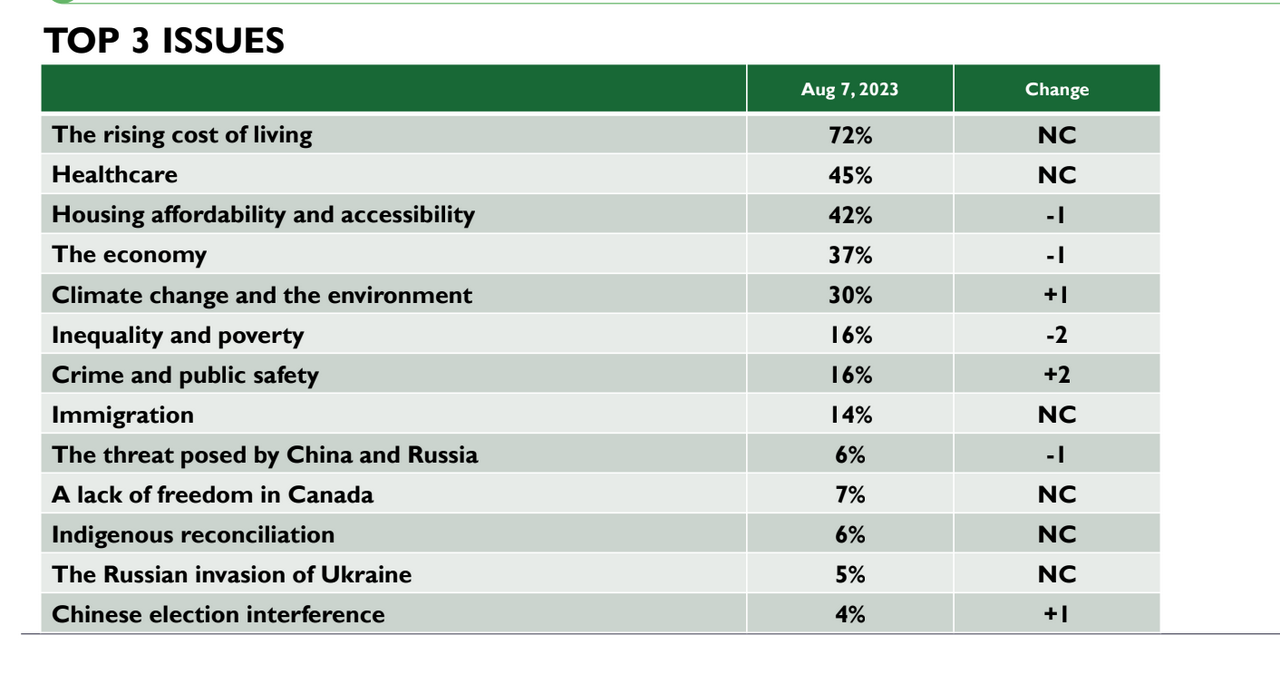
The good news for Team Trudeau is that sometimes new inertia pushes old inertia off the front pages. In June, the apparent decision to stall on an inquiry into foreign election interference seemed bold to the point of recklessness. Now the conventional wisdom barely notices it’s happened. Perhaps one explanation for Pierre Poilievre’s rise in the polls is that he is now complaining about things more Canadians care about.

From Abacus

Did somebody mention polls! For many more reasons than this, the polls are dire for the Liberals. A cottage industry sprang up over the weekend, consisting of Liberal sympathizers pointing out that polls have often been lousy at predicting the future: Dan Arnold and Tyler Meredith; Gerald Butts; David Herle. They all have this much of a point: polls don’t predict the future, opinions can change, campaigns matter. Neither you nor I know what the future holds.

And yet. If Brian Mulroney managed to overcome John Turner’s polling lead in 1986-88, it’s partly because Mulroney’s government was still new, Mulroney was much less of a known quantity than Turner, and Mulroney was able to turn Turner’s chosen issue, free trade, into a huge advantage. If Trudeau has won three times while his share of the popular vote declines, it’s partly because he was less of a known quantity in earlier elections. There’s a reason why the last leader to win four consecutive elections was Wilfrid Laurier. It’s hard.

What Trudeau used to have was agility. He was a critic of the status quo. Stephen Harper needed to have jets in the air over Iraq; Trudeau didn’t. Harper had a low cap on the number of Syrian refugees he could accept; Trudeau didn’t. Harper and Mulcair were obsessed with balanced budgets. Trudeau was less of a fuddy-duddy. He’d change everything, from the electoral system on up.

This sort of stuff is simply easier for the young leader of a third party than for a prime minister nearing a decade in office. But as their manoeuvring room and novelty wear off, incumbent leaders can usually offer compensating virtues: their experience and wisdom. Sure, he’s less exciting than before, but now he’s a surer hand.

Unfortunately, for that to work you need to be a surer hand.

August 29, 2023

The noble reasons New Jersey banned self-service gas stations

Of course, by “noble reasons” I mean “corrupt crony capitalist reasons“:

“Model A Ford in front of Gilmore’s historic Shell gas station” by Corvair Owner is licensed under CC BY-SA 2.0

New Jersey’s law, like Oregon’s, ostensibly stemmed from safety concerns. In 1949, the state passed the Retail Gasoline Dispensing Safety Act and Regulations, a law that was updated in 2016, which cited “fire hazards directly associated with dispensing fuel” as justification for its ban.

If the idea that Americans and filling stations would be bursting into flames without state officials protecting us from pumping gas sounds silly to you, it should. In fact, safety was not the actual reason for New Jersey’s ban (any more than Oregon’s ban was, though the state cited “increased risk of crime and the increased risk of personal injury resulting from slipping on slick surfaces” as justification).

To understand the actual reason states banned filling stations, look to the life of Irving Reingold (1921-2017), a maverick entrepreneur and workaholic who liked to fly his collection of vintage World War II planes in his spare time. Reingold created a gasoline crisis in the Garden State, in the words of New Jersey writer Paul Mulshine, “by doing something gas station owners hated: He lowered prices”.

In the late 1940s, gasoline was selling for about 22 cents a gallon in New Jersey. Reingold figured out a way to undercut the local gasoline station owners who had entered into a “gentlemen’s agreement” to maintain the current price. He’d allow customers to pump gas themselves.

“Reingold decided to offer the consumer a choice by opening up a 24-pump gas station on Route 17 in Hackensack,” writes Mulshine. “He offered gas at 18.9 cents a gallon. The only requirement was that drivers pump it themselves. They didn’t mind. They lined up for blocks.”

Consumers loved this bit of creative destruction introduced by Reingold. His competition was less thrilled. They decided to stop him — by shooting up his gas station. Reingold responded by installing bulletproof glass.

“So the retailers looked for a softer target — the Statehouse,” Mulshine writes. “The Gasoline Retailers Association prevailed upon its pals in the Legislature to push through a bill banning self-serve gas. The pretext was safety …”

The true purpose of New Jersey’s law had nothing to do with safety or “the common good”. It was old-fashioned cronyism, protectionism via the age-old bootleggers and Baptists grift.

Politicians helped the Gasoline Retailers Association drive Reingold out of business. He and consumers are the losers of the story, yet it remains a wonderful case study in public choice theory economics.

The economist James M. Buchanan received a Nobel Prize for his pioneering work that demonstrated a simple idea: Public officials tend to arrive at decisions based on self-interest and incentives, just like everyone else.

August 28, 2023

Climate alarmists don’t see costs (to you) as a drawback

Filed under: Environment, Media, Politics, USA — Tags: , , — Nicholas @ 05:00

David Friedman explains why few if any climate change activists would bother to do a proper cost-benefit analysis of the “solutions” they demand to address climate change:

From the standpoint of an economist, the logic of global warming is straightforward. There are costs to letting it happen, there are costs to preventing it, and by comparing the two we decide what, if anything, ought to be done. But many of the people supporting policies to reduce climate change do not see the question that way. What I see as costs, they see as benefits.

Reduced energy use is a cost if you approve of other people being able to do what they want, which includes choosing to live in the suburbs, drive cars instead of taking mass transit, heat or air condition their homes to what they find a comfortable temperature. It is a benefit if you believe that you know better than other people how they should live their lives, know that a European style inner city with a dense population, local stores, local jobs, mass transit instead of private cars, is a better, more human lifestyle than living in anonymous suburbs, commuting to work, knowing few of your neighbors. It is an attitude that I associate with an old song about little boxes made of ticky-tacky, houses the singer was confident that people shouldn’t be living in, occupied by people whose life style she disapproved of. A very arrogant, and very human, attitude.

There are least three obvious candidates for reducing global warming that do not require a reduction in energy use. One is nuclear power, a well established if currently somewhat expensive technology that produces no CO2 and can be expanded more or less without limit. One is natural gas, which produces considerably less carbon dioxide per unit of power than coal, for which it is the obvious substitute. Fracking has now sharply lowered the price of natural gas with the result that U.S. output of CO2 has fallen. The third and more speculative candidate is geoengineering, one or another of several approaches that have been suggested for cooling earth without reducing CO2 output.

One would expect that someone seriously worried about global warming would take an interest in all three alternatives. In each case there are arguments against as well as arguments for but someone who sees global warming as a serious, perhaps existential, problem ought to be biased in favor, inclined to look for arguments for, not arguments against.

That is not how people who campaign against global warming act. They are less likely than others, not more, to support nuclear power, to approve of fracking as a way of producing lots of cheap natural gas, or to be in favor of experiments to see whether one or another version of geoengineering will work. That makes little sense if they see a reduction in power consumption as a cost, quite a lot if they see it as a benefit.

[…]

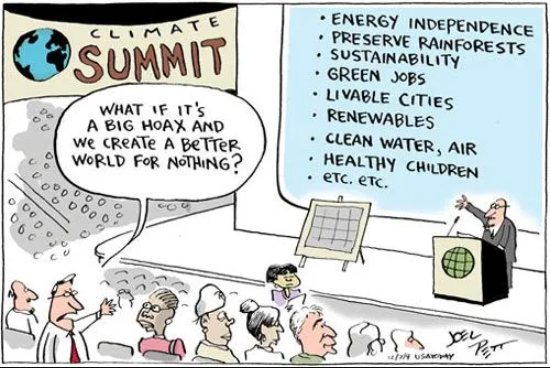
The cartoon shown below, which gets posted to Facebook by people arguing for policies to reduce global warming, implies that they are policies they would be in favor of even if warming was not a problem. It apparently does not occur to them that that is a reason for others to distrust their claims about the perils of climate change.

Most would see the point in a commercial context, realize that the fact that someone is trying to sell you a used car is a good reason to be skeptical of his account of what good condition it is in. Most would recognize it in the political context, providing it was not their politics; many believe that criticism of CAGW is largely fueled by the self-interest of oil companies. It apparently does not occur to them that the same argument applies to them, that from the standpoint of the people they want to convince the cartoon is a reason to be more skeptical of their views, not less.1

That is an argument for skepticism of my views as well. Belief in the dangers of climate change provides arguments for policies, large scale government intervention in how people live their lives, that I, as a libertarian, disapprove of, giving me an incentive to believe that climate change is not very dangerous. That is a reason why people who read my writings on the subject should evaluate the arguments and evidence on their merits.


    1. One commenter on my blog pointed at a revised version of the cartoon, designed to make the point by offering the same approach in a different context.

QotD: Progressives don’t have collections, but they may have fetish objects

Filed under: Education, Politics, Quotations, USA — Tags: , , , , , — Nicholas @ 01:00

The reason SJWs are so hung up on “capitalism” is, as we’ve seen, they regard it as something very like an addiction. Specifically, like sex addiction — we “capitalists” are compelled to accumulate new, different, better, more-for-more’s-sake, though the acquisition is harmful to both ourselves and society. Ever known a Leftist with a collection? Coins, stamps, baseball cards, anything? It’s 100 to 1 that you don’t, because Leftists aren’t wired like that.

Leftists put their entire lives on display at all times. They might have some knickknacks or mementos (though it’s shocking how few of them have even that), but they’re all for show — if a Leftist ever had a baseball card, it would be framed and displayed in the center [of] xzhyr apartment’s living room, and would have something to do with the player’s politics (the only openly gay player on the Yankees or something). The collector’s joys are unknown to them, because the collector collects for personal reasons. Collectors often can’t wait to show you their collections, of course, and they can be godawful tedious about it, but — pace the Left — they aren’t showing you to brag about it; they’re showing you because you’re their friend, and they assume you’re interested in what interests them.

[…]

SJWs always project, right? They know better than anyone that money can’t buy you happiness, because SJW-ism is strictly an upper-middle-class pursuit. They have all the stuff in the world, and they’re miserable. Look at the ivory tower. I hate to keep beating this dead horse, but it’s really the best example I can think of. Those people are “the 1%” by any measure that makes sense. They have everything. They work 24/7 — that’s “24 hours a week, 7 months a year” — and get comped, on average, nearly $100K for it. You can always tell which one is the faculty parking lot — no make cheaper than Volvo; no model year earlier than 2017. The houses in the faculty ghetto tend to be physically small, it’s true, but that’s because they’re all restored Victorians — go ahead and cost out what it takes to fully restore one of those puppies, and contemplate a lifetime of pauperism.

Commodity fetishism? In spades, kameraden, and we haven’t even gotten to the “lifestyle” stuff yet. Organic food — tiny little bananas from Trader Joe’s that wouldn’t feed a pygmy marmoset, but cost $4 per pound. Hot yoga lessons — $100 per hour. Eat-pray-loving your way across Indonesia — I can’t even begin to calculate it. SJWs live niiiice; way too nice for us deplorables to afford, filthy “capitalists” that we are.

Severian, “Junkies (II)”, Rotten Chestnuts, 2021-01-18.

August 27, 2023

Climategate 2023: Electric Boogaloo? The first time as tragedy, the second as farce?

Filed under: Environment, Italy, Media, Politics — Tags: , , , — Nicholas @ 05:00

At Climate Sceptic, Chris Morrison outlines the circumstances around the retraction of a journal article critical of the “climate consensus”:

Shocking details of corruption and suppression in the world of peer-reviewed climate science have come to light with a recent leak of emails. They show how a determined group of activist scientists and journalists combined to secure the retraction of a paper that said a climate emergency was not supported by the available data. Science writer and economist Dr. Roger Pielke Jr. has published the startling emails and concludes: “Shenanigans continue in climate science, with influential scientists teaming up with journalists to corrupt peer review”.

The offending paper was published in January 2022 in a Springer Nature journal and at first attracted little attention. But on September 14th the Daily Sceptic covered its main conclusions and as a result it went viral on social media with around 9,000 Twitter retweets. The story was then covered by both the Australian and Sky News Australia. The Guardian activist Graham Readfearn, along with state-owned Agence France-Presse (AFP), then launched counterattacks. AFP “Herald of the Anthropocene” Marlowe Hood said the data were “grossly manipulated” and “fundamentally flawed”.

After nearly a year of lobbying, Springer Nature has retracted the popular article. In the light of concerns, the Editor-in-Chief is said to no longer have confidence in the results and conclusion reported in the paper. The authors were invited to submit an addendum but this was “not considered suitable for publication”. The leaked emails show that the addendum was sent for review to four people, and only one objected to publication.

What is shocking about this censorship is that the paper was produced by four distinguished scientists, including three professors of physics, and was heavily based on data used by the UN’s Intergovernmental Panel on Climate Change (IPCC). The lead author was Professor Gianluca Alimonti of Milan University and senior researcher of Italy’s National Institute of Nuclear Physics. Their paper reviewed the available data, but refused to be drawn into the usual mainstream narrative that catastrophises cherry-picked weather trends. During the course of their work, the scientists found that rainfall intensity and frequency was stationary in many parts of the world, and the same was true of U.S. tornadoes. Other meteorological categories including natural disasters, floods, droughts and ecosystem productivity showed no “clear positive trend of extreme events”. In addition, the scientists noted considerable growth of global plant biomass in recent decades caused by higher levels of carbon dioxide in the atmosphere.

In fact this scandal has started to attract comparison with the Climategate leaks of 2009 that also displayed considerable contempt for the peer-review process. One of the co-compilers of the Met Office’s HadCRUT global temperature database Dr. Phil Jones emailed Michael Mann, author of the infamous temperature “hockey stick”, stating: “I can’t see either of these papers being in the next IPCC report. Kevin and I will keep them out somehow – even if we have to redefine what the peer-reviewed literature is!”

August 26, 2023

The United Banana Republics of America and their efforts to “get” Trump

Filed under: Government, History, Politics, USA — Tags: , , — Nicholas @ 05:00

Chris Bray points out an interesting historical precedent for the US government’s determination to pin something on former President Donald Trump:

There’s a whole lot of this sentiment on social media this morning, and I agree with it entirely:

But also read this. It’s important, and it’ll take you three minutes. Click on that link and read. You’ll see the point with every paragraph.

There are American precedents for the shameful acts of disgusting political lawfare being directed against Donald Trump (and his lawyers and political staff), and the most obvious and extremely telling precedent is the behaviour of Federalists during the Adams administration. The Sedition Act of 1798 made criticism of the federal government a crime, on a comparable construction of the idea of “disinformation” that’s now used as a repressive tool: the law forbade “any false, scandalous, and malicious writing” about the government, subjective terms that in practice opened the prison doors to mere disagreement and ordinary political criticism. Federalists arrested and prosecuted newspaper editors and a congressman. Representative Matthew Lyon was imprisoned for criticizing the Adams administration.

But the effects of the Sedition Act are extremely important. Here’s a description from archives.gov — from a site run by the federal government:

    The laws were directed against Democratic-Republicans, the party typically favoured by new citizens. The only journalists prosecuted under the Sedition Act were editors of Democratic-Republican newspapers.

    Sedition Act trials, along with the Senate’s use of its contempt powers to suppress dissent, set off a firestorm of criticism against the Federalists and contributed to their defeat in the election of 1800, after which the acts were repealed or allowed to expire.

The criminalization of dissent by Federalists destroyed the Federalists. The party went into a hard decline; John Adams became the only Federalist president in our history (because Washington, sentimentally a federalist, declined to identify as a Federalist), though the party continued to be regionally important in New England until it finally destroyed itself at the Hartford Convention. The event that historians call the Revolution of 1800, the election of the Democratic-Republican Thomas Jefferson to the presidency, was in significant part a result of American disgust over the political repression of dissent1. See this point clearly:

Federalists jailed their political opposition, so America loathed the Federalists and turned against them.


    1. See also the High Federalist response to the Fries Rebellion, which treated a careful act of resistance as a dangerous insurrection. If you’ve never read about this one, I strongly recommend this book.

The Cloward-Piven strategy in action

David Solway outlines the “playbook” apparently being followed in the ongoing dismantling of western civilization:

The malignant playbook of the contemporary left is generally considered to be Saul Alinsky’s 1989 Rules for Radicals, and there is certainly much truth to the story of the book’s destructive influence. But the source text for social and political upheaval is Richard Cloward and Francis Fox Piven’s far more detailed and authoritative 1997 manual, The Breaking of the American Social Compact.

The Cloward-Piven strategy seeks to hasten the fall of the free market and the republican structure of government by overloading the administrative apparatus with an avalanche of impossible demands, thus pushing society into crisis mode and eventual economic collapse. Choking the welfare rolls, for example, would serve to generate a political and financial meltdown, break the budget, jam the bureaucratic gears, and bring the system crashing down. The fear, turmoil, and violence accompanying such a debacle would provide the perfect conditions for fostering radical change.

We see the strategy in action today, forging a situation that was unnecessary from the start via a series of tactical steps, among which: the campaign against productive farming; the so-called 15-minute city herding people into condo-congested urban centers where they are readily supervised and mastered; open borders allowing for a refugee tsunami to alter the character of the nation; a censoring and disinformative media rendered corrupt to the core; the mandating of useless masks or plausibly toxic vaccines; and the implementation of a digital currency in which citizens’ spending can be monitored, restricted, or even frozen. Such phenomena have no basis in even the remotest necessity but are essential in order to prepare the ground for an imminent totalitarian state.

This is the rationale for the so-called COVID pandemic and the bugbear of “Climate Change”. A bad flu season affecting mainly the elderly with comorbidities is not a viral pandemic, as Dr. Vernon Coleman ironically shows. The climate is always changing as a matter of course — the term “climate change” is a gross oxymoron; the thesis of anthropogenic forcing obscures the fact that carbon is material for life and nitrogen for farming. COVID and Climate are tactical phantoms that have nothing to do with reality and everything to do with social control. The Clowardly rePivening put in place by the Democrat Party has only one aim: to create a crisis out of thin air and then seek to defuse it by creating a real crisis that advantages only the Party. It is the diabolical form of creation ex nihilo.

Thus, a ginned-up pandemic is a perfect excuse for mail-in ballots and ballot harvesting, especially if the voter rolls have been flooded with uncountable and counterfeit names and the voting stations have been commandeered. There is no immigration chaos unless a chain system is entrenched and the border is left wide open. There is no such thing as “white supremacy” unless it is apodictically proclaimed and false-flag operations are carried out. There is no need for costly, largely ineffective, and harmful renewable energy installations unless drilling has been rendered illegal and the oil pipelines have been shut down to avoid a bogus climate catastrophe. The bible of the Democrat left begins: Let there be a crisis. And there was a crisis.

H/T to Blazing Cat Fur for the link.

« Newer PostsOlder Posts »

Powered by WordPress