Quotulatiousness

August 25, 2023

Only an extreme right-wing bigot would say that “BDSM is not for four-year-olds”

Filed under: Books, Education, Health, Media, Politics, USA — Tags: , , , — Nicholas @ 05:00

Noted extreme right-wing arch-conservative Brendan O’Neill somehow seems to think that the full panoply of LGBT sexual identities are not appropriate for the pre-school set:
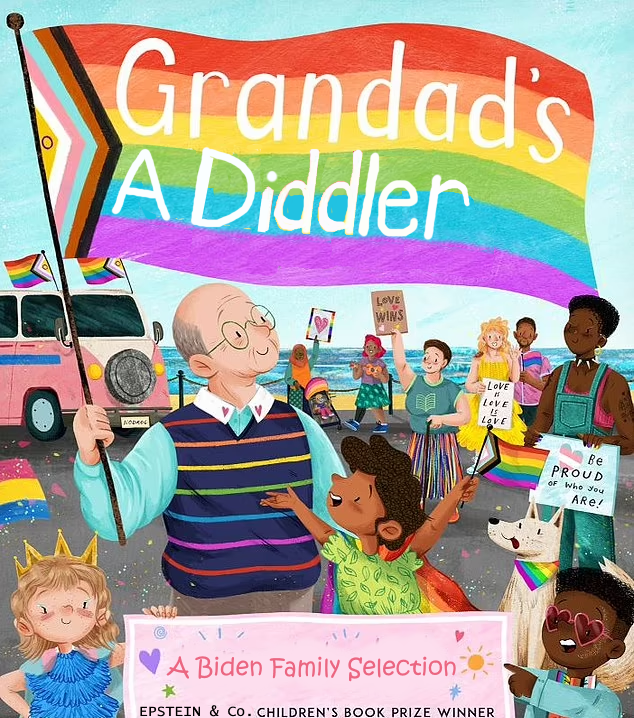
This may not be an accurate portrayal of the book in question, by way of Blazing Cat Fur.

BDSM is not for four-year-olds. Apparently, that’s a controversial statement these days. Only a bigot would want to protect little kids from images of old blokes in fetish gear snogging the faces off each other in public. If you think under-fives should be reading books about hungry caterpillars or tigers coming for tea, not books featuring pictures of ageing men in dog collars and studded leather underwear, you’re a queerphobe and you need to pipe down.

Truly we have reached the seventh circle of woke lunacy. This week it was reported that a mum and dad in Hull in the north of England pulled their four-year-old daughter from a pre-school after she was shown a book called Grandad’s Pride which contains illustrations of “men who are partially naked in leather bondage gear”. The pre-school’s response? According to the mum and dad, it branded them “bigots”. Yes, who else but a hateful phobe would want to stop a toddler from seeing a tattooed, half-naked, grey-bearded homosexual kissing his boyfriend?

Grandad’s Pride is written by Harry Woodgate, an award-winning children’s author who uses they / them pronouns. Of course he does. Or of course they do. Whatever. It tells the story of a girl called Milly, who is playing in her gramps’ attic one day when she happens upon an old Pride flag. She asks what it is and grandad suggests they organise their own Pride march in the village. As you do. Then come the iffy illustrations: old men in fetish gear; a “trans man” (ie, woman) with mastectomy scars under her nipples; an activist in a spiked dog collar waving a placard that says: “Break the cis-tem”. And you thought Where the Wild Things Are was scary.

You don’t have to be a prude to think this is ridiculous bordering on sinister. My view is that consenting adults should do whatever they want. Wear chafing leather trousers, pierce your cock, whip your friends in dim-lit dungeons. It’s not my cup of tea, but knock yourselves out. But it’s not for kids! No four-year-old should be looking at illustrations of a mutilated woman who now identifies as a “man” or of pensioners in leather suspenders. And it doesn’t make you Mary Whitehouse to say so. When you read to little kids, you want them to ask questions like, “Can we have a tiger over for tea?”, not: “Why does that man have stitches on his chest?”

One of the most frustrating things for freedom-lovers like me is that when we raise questions about age-inappropriate woke crap in schools, we get lumped with the religious right or PC fanatics who previously waged war on classic texts like Judy Blume’s Are You There God? It’s Me, Margaret (too much talk about menstruation, apparently) and John Steinbeck’s Of Mice and Men (too many utterances of the n-word). Nonsense. Of course schoolkids should read Blume and Steinbeck. Teens in particular should be expected to engage with challenging texts, even ones that contain racial epithets or girls eagerly awaiting their first period. Schools should err on the side of being open with literature, though let’s hope they don’t start stocking American Psycho or The 120 Days of Sodom.

August 24, 2023

“Facebook has made a calculated business decision about the value of its fucks. These fucks are expensive. So they won’t give any.”

In The Line, Jen Gerson fought the good fight as long as she could, but finally had to load up the old shotgun and share both barrels with the participants in the ongoing clusterfarce over the Online News Act (the artist formerly known as Bill C-18):

Look, I’ve largely said my piece on the Online News Act: it’s poorly conceived legislation that risked terrible outcomes. It’s pointless, now, with those terrible outcomes unfolding, to say “I told you so”.

But the response to the news that Meta has decided to continue blocking news — even in the face of devastating wildfires in B.C. and the Northwest Territories — has been such disingenuous dumbfuckery from every corner that I have failed to bestill my cursed fingertips.

Let’s start with this quote from Prime Minister Justin Trudeau, who at a recent press conference, said: “Right now in an emergency situation where up-to-date local information is more important than ever, Facebook’s putting corporate profits ahead of people’s safety, ahead of supporting quality local journalism … This is not the time for that”.

Wait, a major global corporation that has been labelled as actually literally evil by both progressives and conservatives in recent years is putting its own profits and self-interest ahead of the priorities and values of politicians and pundits?

Sir, surely thou art in jest.

Is this government only now figuring out that major global corporations exist to extract profits; that whatever social corporate responsibility roles they may choose to enact, they aren’t a public service? Is Trudeau shocked — shocked, I say! — to just this very moment discover that Meta isn’t actually some combination of the Red Cross and Reuters?

I mean … welcome to the adult world, I guess, and please leave your copy of Adbusters near the coat check at the door.

But if Meta is as evil as all that, why did so few politicos or pundits anticipate that the company would follow through on its explicit threat to block news if C-18 were passed? This is like watching an Allied general who says: “I think these Nazi fellows are the baddies!” and then gets flustered when the guys with skulls on their caps pull out their guns and start shooting in the midst of afternoon trench tea. “Well, I never. That’s hardly sporting!” This is some Black Adder comedy, friends, and we may be on the side of the angels, but our angels also happen to be a little slow in the head.

Oh, but surely Meta wouldn’t block news to put their own self interest “ahead of people’s safety”, hmmmm?

With advance apologies, but is our antipathy toward Meta so intense that we’re going to straight-face pretend that AM radio, FM radio, emergency text alerts and broadcasts, municipal and provincial emergency websites, formal and informal social media networks and chat groups, and local news broadcasts with websites that can be accessed directly through web browsers all just ceased to exist, simultaneously, the very moment that CBC stopped being able to post news links to Instagram?

If Facebook is actually putting lives in danger, that’s an admission of impotence and incompetence from our entire communications infrastructure, including government, private and public media. It is an incredible and embarrassing self-own.

August 23, 2023

Frustration as a key driver in motivating mass unrest

Filed under: Books, History, Politics — Tags: , , , — Nicholas @ 03:00

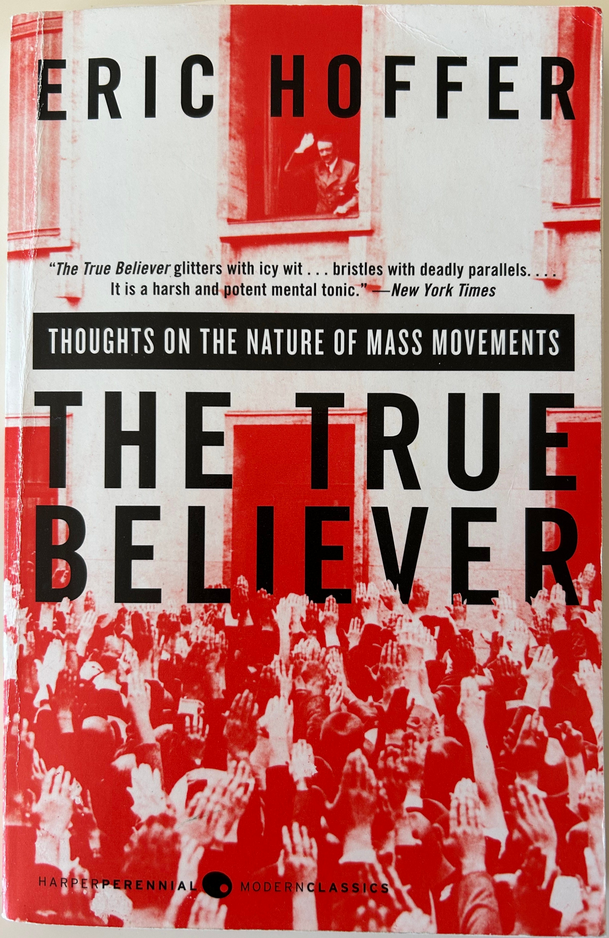
Rob Henderson reviews the old classic The True Believer by Eric Hoffer:

Eric Hoffer made the case that if you peel back the layers of any mass movement, you will find that frustration is their driving force.

Frustration, though, doesn’t arise solely from bleak material conditions. The dockyard philosopher argued that “Our frustration is greater when we have much and want more than when we have nothing and want some. We are less dissatisfied when we lack many things than when we seem to lack but one thing.”

He points out in the years leading up to both the French and Russian Revolutions, life had in fact been gradually improving for the masses. He concludes, “It is not actual suffering but the taste of better things which excites people to revolt” and that “The intensity of discontent seems to be in inverse proportion to the distance from the object fervently desired.”

Personally, I saw this when I first arrived at Yale. I recall being stunned at how status anxiety pervaded elite college campuses. Internally, I thought, “You’ve already made it, what are you so stressed out about?” Hoffer, though, would say these students believed they had almost made it. That is why they were so aggravated. The closer they got to realizing their ambitions, the more frustrated they became about not already achieving them.

Hoffer’s conceptions of frustration highlight how if your conditions improve, but not as much or as quickly as you’d like, you will be vulnerable to recruitment by mass movements that promise to make your dreams come true.

In Democracy in America, Alexis de Tocqueville wrote, “When inequality is the general law of society, the most blatant inequalities escape notice. When everything is virtually on a level, the slightest variations cause distress. That is why the desire for equality becomes more insatiable as equality extends to all.” For Hoffer, this insatiability cultivates frustration — a nebulous, simmering emotional state that can be harnessed by any ideology.

He describes what has now become known as the “Tocqueville effect”: A revolution is most likely to occur after an improvement in social conditions. As circumstances improve, people raise their expectations. Societal reforms raise reference points to a level that is usually not matched, eliciting rage and frustration.

August 22, 2023

With Bill C-18 about to come into effect, there is zero sense for the “tech giants” to start negotiating

Filed under: Business, Cancon, Government, Law, Media, Politics — Tags: , , , , , — Nicholas @ 05:00

Michael Geist explains why there are no incentives for Google and Meta to begin any kind of negotiations with the Canadian government over the ruthlessly self-destructive Online News Act:

The rhetoric around Bill C-18 has escalated in recent days in light of the awful wildfires in NWT and British Columbia. In my view, the issues associated with these tragic events have little to do with Meta blocking news links and the attempt to bring it into the conversation is a transparent attempt to score political points (the connectivity issues with some NWT communities completely taken offline for days is somehow never mentioned). The reality is that Meta was asked about just this scenario at committee and it made it clear that it would not block any non-news outlet links. That is precisely what has been happening and the government’s legislative choices should be the starting point for understanding why compliance with the law involves blocking a very broad range of news links that extend beyond even those sources that are defined as “eligible news outlets”.

The government and supporters of Bill C-18 talking points now emphasize two things in relation to Meta blocking news links: the law has yet to take effect and there is room to address their concerns in the regulation-making process. Both of these claims are incredibly deceptive, relying on the assumption that most won’t bother to read the actual legislation. If they did, they would see that (1) the law has received royal assent and can take effect anytime and (2) the regulation making process addresses only a small subset of Bill C-18 issues with most of the core issues finalized. In other words, the time to shape the law and address many of the key concerns was before the government repeatedly cut off debate in order to ensure it that received royal assent before the summer break.

Start with when the law takes effect. As noted above, the law has been passed and received royal assent. It is the law of the land and there is no scope for changes or amendments without a new bill that must be passed by Parliament. Section 93 establishes when the provisions come into force. The law initially envisioned a staged approach whereby certain sections would be proclaimed in effect by the government in stage one, followed by four additional stages, some of which were contingent on certain regulations coming into force. Yet at the last minute the government approved a Senate amendment that basically discarded the entire approach. Section 93(6) states:

    (6) Despite subsections (1) to (5), any provision of this Act that does not come into force by order before the 180th day following the day on which this Act receives royal assent comes into force 180 days after the day on which this Act receives royal assent.

The entire law therefore takes effect no later than 180 days after royal assent, which is December 19, 2023. This change was included at the urging of the Canadian media sector (specifically Quebecor) which lobbied to have it take effect as soon as possible. Under this approach, the law can take effect at any time as the government need only issue the relevant Orders-in-Council. There is now little wiggle room. As of today’s post, the latest the law will take effect is in 120 days but it could happen well before that.

Once the law takes effect, the clock on negotiations and potential mediation and arbitration begins. The timelines are fixed in Section 19(1) of the law: 90 days to negotiate and 120 days for mediation. If there is no agreement and no request to the CRTC to extend the deadlines, the issue can go to final offer arbitration. To be clear, none of these timelines are subject to the regulation making process. They are fixed and they create obvious urgency for anyone facing compliance requirements.

The government threatened Meta and Google with mandated payment to Canadian news sources if their online services merely linked to articles or videos from those news sources. Meta and Google rationally decided that the tiny little Canadian market wasn’t worth the cost of paying CBC and other Canadian news outlets for the privilege of sending them readers and are in the process of obeying the letter of the new law and blocking such links on their respective platforms. They told the Canadian government that this is what they’d do if the law was passed in its current form, yet the government is pretending to be shocked and surprised that Meta and Google are going to obey the law.

After all, there’s no real risk that lives might be endangered because so many Canadians are used to getting their news by way of Facebook or Google, is there?

“… the theatrics employed by Hitler and Mussolini just seemed too weird and downright ridiculous to the British”

In Spiked, Ralph Schoellhammer discusses some of the difficulties the Green Gestapo, er, I mean the likes of Extinction Rebellion and their mini-mes like Just Stop Oil have been encountering with the British public:

Roderick Spode, 7th Earl of Sidcup, leader of the “Saviours of Britain”, also known as the Black Shorts.
Still from Jeeves and Wooster (1990).

I have long been convinced that one of the reasons why fascism never had a chance in Britain was due to the predispositions of her people. If nothing else, the theatrics employed by Hitler and Mussolini just seemed too weird and downright ridiculous to the British.

PG Wodehouse captured this perfectly in an exchange between a British wannabe fascist, Roderick Spode, and Bertie Wooster: “The trouble with you, Spode, is that just because you have succeeded in inducing a handful of half-wits to disfigure the London scene by going about in black shorts, you think you’re someone.”

I don’t intend to liken fascists to environmentalists, but Brits have at least expressed a similar, visceral distaste for the theatrics of eco-activist groups in recent years. Marching in black “footer bags”, pretending to be the voice of the people, is just as ridiculous as holding up traffic in an orange “Just Stop Oil” t-shirt.

The environmental movement becomes more absurd by the day. The Guardian‘s George Monbiot, for instance, has just called for the reintroduction of deadly wolves and lynxes to Great Britain, in order to manage a surging deer population. One can only hope that this call to action will have about as much success as his campaign against meat, milk and eggs, which Monbiot is convinced are an “indulgence” humanity can no longer afford.

Sadly, the same is not true in Germany, where the elites are all too keen to humour even the most extreme climate fanatics. German discount supermarket Penny recently decided to increase the prices of its meat and dairy products, to include the environmental costs incurred in their production, as part of a week-long experiment. The price of frankfurter sausages rose from €3.19 to €6.01. The price of mozzarella rose by 74 per cent, to €1.55. And the price of fruit yoghurt rose by 31 per cent, from €1.19 to €1.56.

While the usual suspects in the establishment are clearly excited by this idea that in the future even shopping at a discount shop might become the preserve of the rich, average Germans are less pleased. Germany’s public broadcaster, WDR, asked Penny customers what they thought about the price-hike experiment. Due to a lack of enthusiasm from shoppers, WDR decided to have one of its employees cosplay as a happy shopper. That taxpayer-funded broadcasters now have to resort to outright fraud in order to drum up support for idiotic climate action tells you everything you need to know.

August 19, 2023

“Twitter used to work well, but now he receives negative comments, which means that it has stopped working”

Filed under: Media, Politics, Technology, USA — Tags: , , , — Nicholas @ 03:00

Chris Bray on the claims that Twitter, er, I mean “X” is broken from people who are suddenly being exposed to unfriendly opinions that the old platform used to kindly keep out of their very comfortable bubbles:

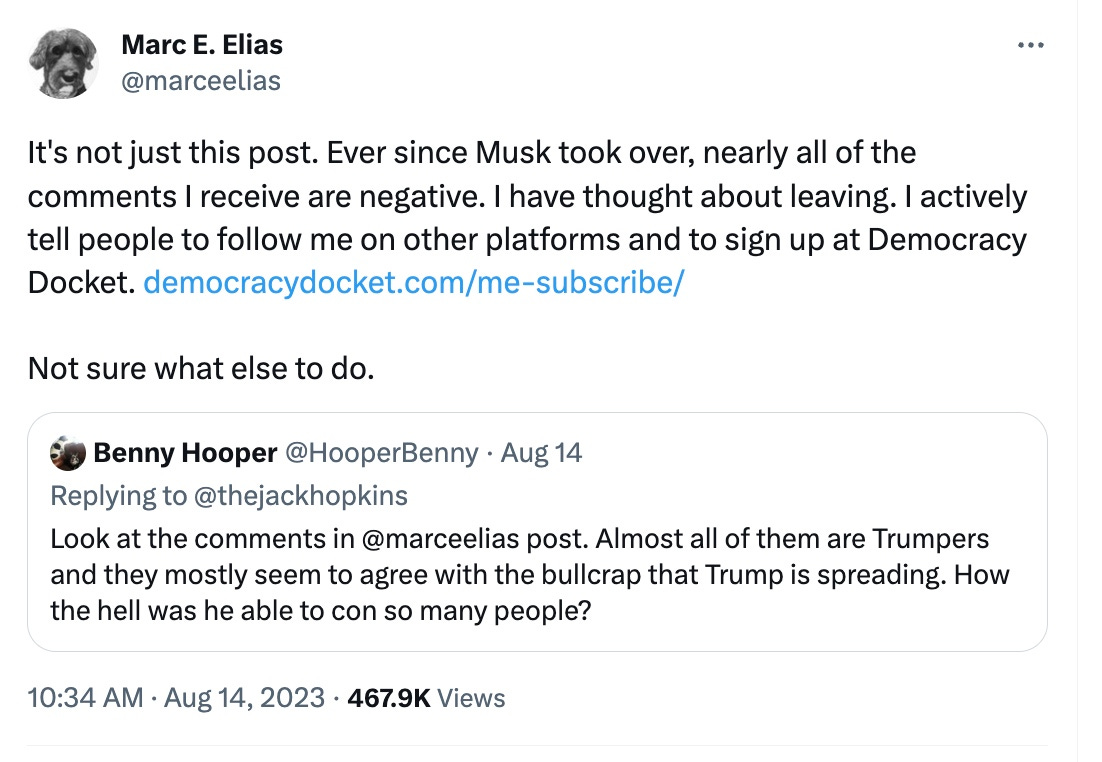
The Democratic Party’s go-to election lawyer, Marc Elias, is disturbed by the decline of Twitter:

Twitter used to work well, but now he receives negative comments, which means that it has stopped working. People can criticize him and express disagreement, so the platform is broken. If it worked, he would only be praised.

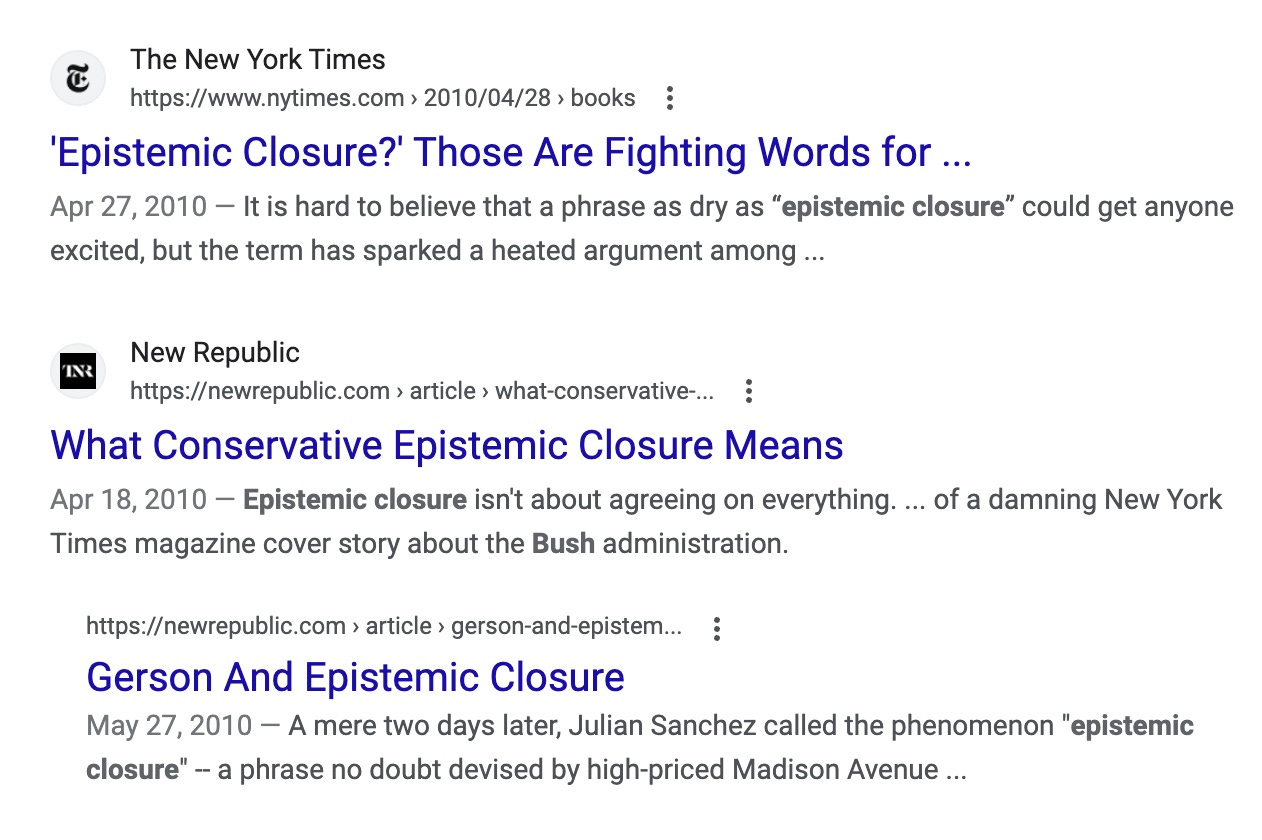
“Epistemic closure” had its pet rock moment in 2010, as the news media looked back on the George W. Bush years and the Iraq War and concluded that American neoconservatives had simply lost their ability to think.

[…]

It was supposed to mean this:

    It’s rather about information, and what counts as evidence about the real world … if one only gets information from a narrow set of sources that feed back into each other but do not engage beyond themselves, that one will have a closed mind … regardless of what one does with that information.

And this:

    Epistemic closure is a fancy term for the practice of defining – or redefining – reality in ways that support your pre-existing ideological preferences. Most of us think of it as “creating and living in a bubble”.

It was a fair enough point, as Bush watched sectarian brutality continue in post-Saddam Iraq and kept drawing the conclusion that everyone everywhere really yearns for democratic pluralism, honest elections, and a free press.

But that era’s epistemic closure is bush-league — sorry — compared to the sealed-in-a-jar-in-a-closed-box-in-a-deep-cave closure of the “mainstream” mind in 2023. If you’ve been on social media since roughly the night of November 8, 2016 and you’ve expressed disagreement with a politician, academic, or media figure, you’ve been a Russian bot, and Putin told you to say that. Criticism of institutions can’t simply arise from authentic grievances, or even from an authentically felt but misperceived grievance; rather, criticism is an op, a calculated string-pulling effort by manipulative forces. The far-right Putin-aligned Nazi grifters are tricking you into believing that you’re unhappy with the Biden administration. Your brain has been fooled by cognitive warfare, see?

August 18, 2023

When your friendly local bank turns into a branch of the Stasi

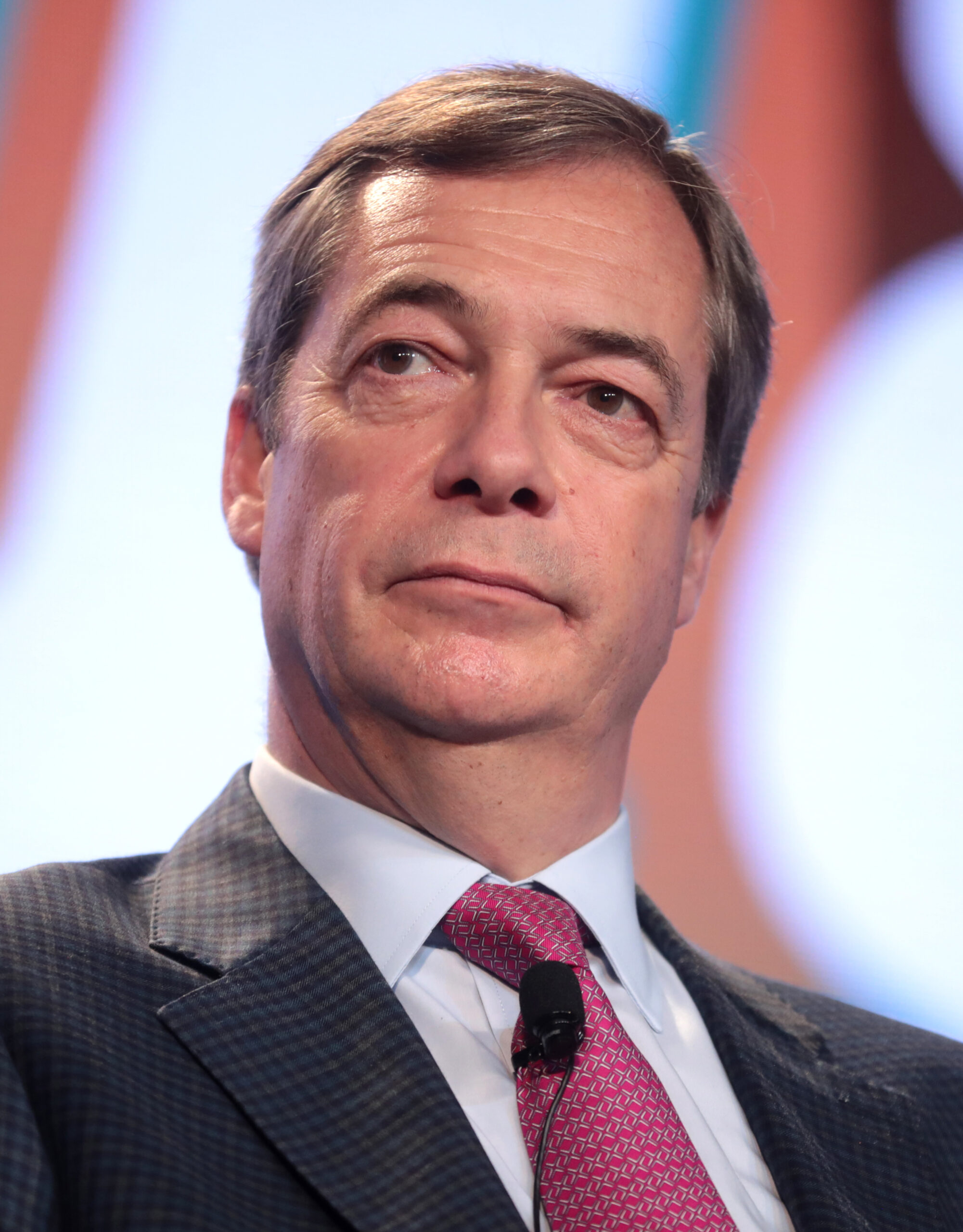
Theodore Dalrymple on the British bank — probably not the only one to do things like this — that compiled a “dossier” of information on one of their long-term clients with a view to de-banking him, his family, and associates. It might have worked if the client was a private citizen with no particular public profile, but the client was someone who absolutely is not that kind of man:

The following day, [National Westminster Bank CEO Alison] Rose resigned, admitting to “a serious error of judgment”. The value of the bank fell by more than $1 billion.

The weasel words of Ms. Rose and the bank board are worth examination. They deflected, and I suspect were intended to deflect, the main criticism directed at Ms. Rose and the bank: namely, that the bank had been involved in a scandalous and sinister surveillance of Mr. Farage’s political views and attempted to use them as a reason to deny him banking services, all in the name of their own political views, which they assumed to be beyond criticism or even discussion. The humble role of keeping his money, lending him money, or perhaps giving him financial advice, was not enough for them: they saw themselves as the guardians of correct political policy.

It was not that the words used to describe Mr. Farage were “inappropriate”, or even that they were libelous. It is that the bank saw fit to investigate and describe him at all, at least in the absence of any suspicion of fraud, money laundering, and so forth. “The error of judgment” to which Ms. Rose referred was not that she spoke to the BBC about his banking affairs (it is not easy to believe that she did so without malice, incidentally), but that she compiled a dossier on Farage in the first place — and then “error of judgment” is hardly a sufficient term on what was a blatant and even wicked attempt at instituting a form of totalitarianism.

This raises the question of whether one can be wicked without intending to be so, for it is quite clear that Ms. Rose had no real understanding, even after her resignation, of the sheer dangerousness and depravity of what the bank, under her direction, had done.

As for the board’s somewhat convoluted declaration that “after careful consideration, it concluded that it retains full confidence”, etc., it suggests that it was involved in an exercise of psychoanalytical self-examination rather than of an objective state of affairs: absurd, in the light of Ms. Rose’s resignation within twenty-four hours. The board, no more than Ms. Rose herself, understood what the essence of the problem was. For them, if there had been no publicity, there would have been no problem: so when Mr. Farage called for the dismissal of the board en masse, I sympathised with his view.

QotD: Everyone’s a woke cop

The woke world is a world of snitches, informants, rats. Go to any space concerned with social justice and what will you find? Endless surveillance. Everybody is to be judged. Everyone is under suspicion. Everything you say is to be scoured, picked over, analyzed for any possible offense. Everyone’s a detective in the Division of Problematics, and they walk the beat 24/7. You search and search for someone Bad doing Bad Things, finding ways to indict writers and artists and ordinary people for something, anything. That movie that got popular? Give me a few hours and 800 words. I’ll get you your indictments. That’s what liberalism is, now — the search for baddies doing bad things, like little offense archaeologists, digging deeper and deeper to find out who’s Good and who’s Bad. I wonder why people run away from establishment progressivism in droves.

I read about the PWR BTTM accusations. They’re disturbing. I take them seriously. But these guys have had their careers erased overnight, and the idea that we have any responsibility to give them the chance to defend themselves is treated like you took part in their alleged crimes. You simply cannot say, in polite society, “basic fairness requires us to avoid a rush to judgment and to give people the right to respond to accusations”. To do so gets you lumped in with the criminals. Like a friend of mine said, “the only acceptable reaction to an accusation is enthusiastic and unqualified acceptance”. I don’t know how people can simultaneously talk about prison abolition and restoring the idea of forgiveness to literal criminal justice and at the same time turn the entire social world into a kangaroo court system. Like I wrote once, we can’t simultaneously be a movement based on rehabilitation and restorative justice AND a viciously judgmental moral aristocracy. You know who thinks everybody’s guilty until proven innocent? Cops. You know who thinks people don’t deserve the right to defend themselves? Cops. You know who says those who defend basic fairness and due process are as bad as criminals themselves? Cops.

Freddie deBoer, “Planet of Cops”, reposted by Jesse Singal, originally published 2017-05-17.

August 17, 2023

Lawfare as politics by other means

Filed under: Law, Media, Politics, USA — Tags: , , , , , , — Nicholas @ 03:00

Chris Bray explains why getting rid of the Donald Trump candidacy wouldn’t even begin to solve the real problems in US politics today:

Donald Trump has been charged with crimes, so the Republican Party should drop him as a candidate and move on to someone else who hasn’t been indicted. That’ll solve the problem!

It won’t. The problem is lawfare. The Republican governor of Wisconsin defeated a recall effort, so Democratic district attorneys launched a long series of predawn raids on his supporters — until the courts made them stop. The Republican governor of Texas won four terms, but then was indicted by the office of a Democratic district attorney — for a budget veto, an action within his constitutional authority. Again, the courts intervened, and the legally absurd charges were dismissed.

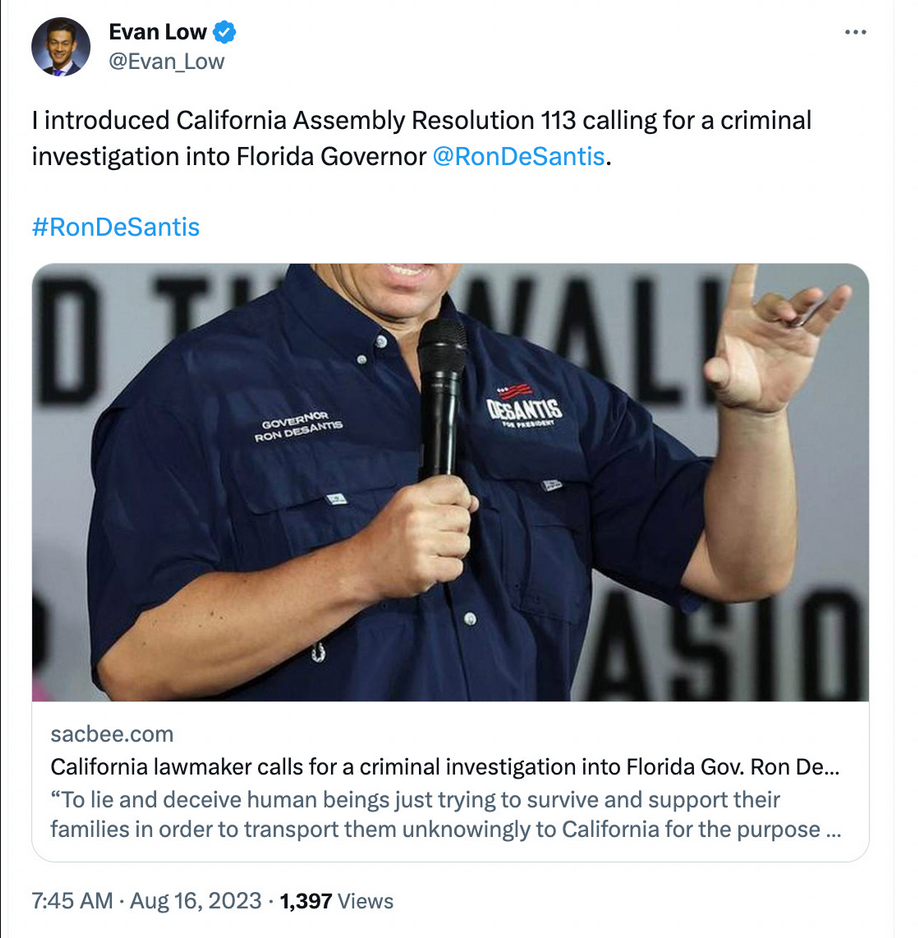
Today, scumbag California Assemblyman Evan Low, a uniquely craven publicity chaser even by the local standards, proudly announces that he’s just introduced a legislative resolution calling for the federal government to open a criminal investigation into Florida Governor Ron DeSantis.

So. Get rid of Trump and nominate DeSan— oh, wait. Okay, name someone, anyone: Chris Christie, Vivek Ramaswamy, a utility nominee to be named later in exchange for three rookie infielders. Oh no, it turns out that the new nominee is under criminal investigation for [TBD]! As of, uh, tomorrow.

I have mixed feelings about Donald Trump, who supported pandemic lockdowns and school closures and the rushed development of mRNA injections with limited testing. Dumping him as a candidate because he’s been indicted misses the point. No Republican candidate will run for the presidency without being indicted, unless he’s a court-eunuch Mitt Romney figure, too safe to bother attacking.

August 15, 2023

History must be forced to fit the narrative

Filed under: Books, History, Media, Politics, USA — Tags: , , , , — Nicholas @ 03:00

Chris Bray revisits an older article from the Obama years:

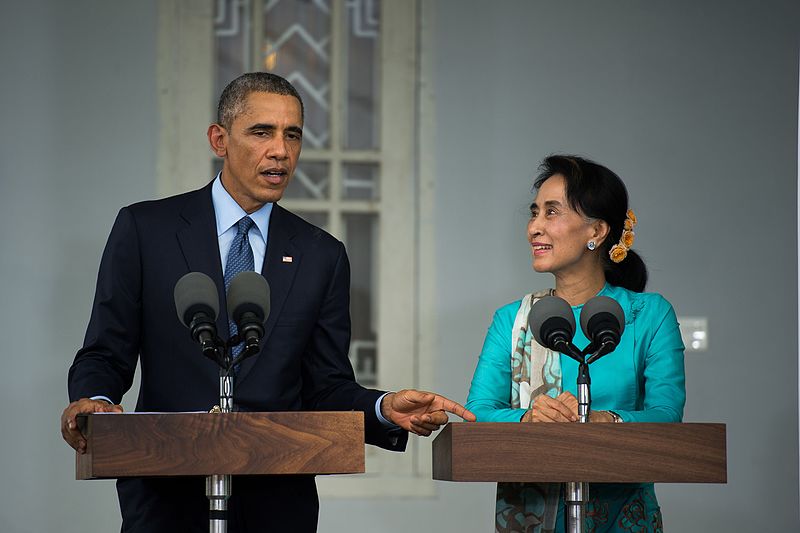
President Barack Obama and Aung San Suu Kyi in 2014.
Photo via Wikimedia Commons

There is no question that authoritarianism is descending on the United States of America, quickly. There is also no question where it’s coming from, as you quickly learn from the current social media musings of the most wonderfully progressive people. Trump must be silenced NOW! Why is the authoritarian being ALLOWED TO SPEAK? Ruth Ben-Ghiat, please call your office.

How have we gotten here?

I’ve mentioned before a looooong essay I wrote, more than ten years ago, about the cottage industry in Barack Obama hagiographies. Obama’s fellatiographers noted, for example, that Obama’s stepfather, Lolo Soetoro, had been ordered back to Indonesia in 1966, and that photos of him from that time show him in the uniform of the Indonesian army. They also mention, with remarkably disingenuous vagueness, that there was maybe some political trouble going on in Indonesia while Obama was there as a child and his stepdad was a soldier.

But what was happening in the mid-1960s in Indonesia is that the Indonesian Communist Party tried to restructure Sukarno’s careful balancing of competing forces in the new country with the kidnapping and killing of a group of right-wing flag officers by leftist soldiers, beheading conservative military power — after which the military responded with the wholesale killing of hundreds of thousands of communists, often with machetes and with a serious commitment to doing the job as grimly as possible: bodies in rivers, heads on pikes, slow killing in front of mass graves. Here’s my last paragraph from that section on the Obama biographies:

    And the lesson? Indonesia was where “Ann was Barry’s teacher in high-minded matters—liberal, humanist values”, Remnick concludes. It’s where she taught him the values of “honesty, hard work, and fulfilling one’s duty to others”, where she lectured him about “a sense of obligation to give something back”, Scott adds. It’s where she “worked to instill ideas about public service in her son”. Because Indonesia in the late sixties was the perfect place and time to learn about liberal humanist values and public service.

Barack Obama was a Democrat who attained the presidency, which means that journalists knew he had to be a sainted figure, and he was the first black president, which means that journalists knew he had to be brilliant and extraordinary. So they assembled the threads of his story — Barack Obama went to Indonesia in 1966 with his stepfather, a soldier, during a long period of extraordinarily brutal political retribution by the Indonesian army — and then, pro forma, wove those threads into the foundation of “liberal, humanistic values”.

If Barack Obama had spent his childhood torturing kittens to death and eating their eyeballs in front of a sobbing crowd of kitten-loving toddlers, the Obama biographies would have said that Barack Obama spent his childhood torturing kittens to death and eating their eyeballs in front of a sobbing crowd of kitten-loving toddlers, a heartwarming experience that taught him the value of democratic pluralism and fundamental human decency. The story was written before anyone began working on it: Barack Obama [experience TBD] and [experience TBD], the formative experiences that made him the kind and wonderful genius he is today.

See also this recent discussion with David Garrow, a historian who has written a new (corrected: published a post-Obama-presidency) biography — and who found, as he researched his subject, that he was often looking at evidence no one had ever pursued before. The hagiographers of the Obama presidency-era weren’t looking for evidence; they already knew the story they meant to write. They came up with some evidence-simulating objects for form’s sake, to assemble their liturgy in the apparent form of biography. Their “Barack Obama” was never Barack Obama.

Their “Donald Trump” is not, now, Donald Trump. There’s a formula; they apply it. There’s a narrative to be written. Donald Trump said he would repeal two federal regulations for every new regulation he implemented — textbook authoritarianism! Donald Trump said that America has fought a bunch of “dumb wars”, and should be much more careful about foreign military involvement — JUST LIKE ADOLF HITLER!!!!!!

It’s beside the point to note that the conclusions never matched the evidence. They were never meant to.

This is crazymaking behavior. Constantly spinning narratives that have nothing to do with anything in the actual, physical world is a recipe for a psychotic break. And we have multiple layers of institutional actors who cosplay “elite” — in media, in academia, in government, and in corporations — who’ve been playing with their shadow puppets for so long that they’ve forgotten they’re shadow puppets. They believe themselves.

That’s how you get to we need a single-party ballot to prevent authoritarianism and we have to arrest the opposition leader to prevent authoritarianism. It’s socially distributed insanity, a real descent into the world of false symbols. And it’s becoming incredibly dangerous.

August 14, 2023

“Behold rationalism’s turncoats”

Filed under: Health, Media, Politics — Tags: , , , — Nicholas @ 05:00

Brendan O’Neill calls out the New Atheist community for their wide adoption of the trans ideology-cum-faith:

Fractal Pride flags

We are living through a great showdown between hysteria and reason. On one side stand the adherents to the cult of transgenderism, hawking their hocus pocus about gendered souls and self-authentication through castration. On the other side stand those of us who know that biology is real, and that every cell in the human body is sexed, and that a man is as likely to become a woman as that chalice of wine is to become the blood of Christ during Mass (apologies, Catholics).

You’ll never guess which side some New Atheists are taking in this clash between delusion and truth. The crazy side. The side that says a bloke with a beard and balls can literally be a lesbian. Which is infinitely more cranky than the idea that a bloke with a beard and balls can literally be the Son of God. How did rationalist bros, those secularists on steroids, those Dawkins acolytes whose hobby for years was to make fun of the faithful, become devotees of such a strange, post-truth sect?

One by one, atheists are falling at the altar of trans. This week a Twitterfeed called The New Atheists slammed Richard Dawkins for becoming a TERF. Dawkins is a rarity in the new rationalist ranks: he thinks people with penises are men, not women, just as bread is bread, not the body of Christ. He is “utterly confused”, decreed his angry apostates. Biology “isn’t black and white, it’s a full spectrum of colour just like a rainbow”, they said. This hippyish belief that humans can pick their sex from a multicoloured smorgasbord is entirely an article of faith, of course, not science. Behold rationalism’s turncoats.

We’ve witnessed Neil deGrasse Tyson, America’s best-known scientist, bow to the creed of gender-as-feeling. In a TikTok video he said “XX/XY chromosomes are insufficient” when it comes to reading someone’s sex, because what people feel matters along with their biology. So someone might feel mostly female one day but “80 per cent male” the next, which means they’ll “remove the make-up” and “wear a muscle shirt”. Sir, that’s cross-dressing; it does nothing to refute the truth of chromosomes, which absolutely do tell us what sex a person is. As destransitioner Chloe Cole said to Tyson, you’re “confusing basic human biology with cosmetics”.

We’ve seen Matt Dillahunty, a leading American atheist, promote the mystic cry that there’s a difference between “what your chromosomes are” and your “gender identity”. “Transwomen are women”, he piously declares, perhaps keen to prove that while he might be fond of bashing the old religions, he has not one cross or blasphemous word to say about the new religion. Well, no one wants to be excommunicated from polite society.

Stephen Fry is another godless lover of science who appears to have converted to the trans belief. Phillip Pullman, Stewart Lee and others who were once noisy cheerleaders for rationalism are likewise strikingly reserved on this new ideology, this devotional movement which, among other things, invites young women to submit themselves to bodily mortification in order that they might transubstantiate into “men”. Seems like something a rationalist should question.

August 13, 2023

Don’t worry about losing all your news links, citizen! The Liberal government’s Ministry of Propaganda will tell you everything you need to know!

Filed under: Business, Cancon, Government, Law, Media, Politics — Tags: , , , , — Nicholas @ 05:00

The federal government still seems shocked and a little bit hurt that the “tech giants” are carefully obeying the letter of their new Online News Act instead of pumping millions of dollars into government-favoured media outlets. How dare Alphabet and Meta obey the law we wrote? We wanted to soak them for bribes subsidies to give to legacy corporations who can be depended upon to cheerlead our agenda!

Blocking of news links on Facebook and Instagram in Canada has becomes increasingly widespread in recent days, leading to a growing number of public comments from media outlets and reporters expressing surprise or shock about the scope of the link blocking. Indeed, outlets with blocked links include university student newspapers, radio stations, and foreign news outlets. While there may have been some errors (Facebook has a page to seek review of any blocked link decision), the inclusion of a very wide range of Canadian and foreign news outlets is no accident. Rather, it reflects the government’s Bill C-18 approach, which effectively covers all news outlets worldwide whose links are accessed in Canada. The Canadian government could have adopted a more targeted approach – for example, limiting the scope to news links from those news outlets eligible to negotiate agreements with Internet platforms under the law – but it instead went for the broadest possible approach that includes foreign news outlets with little or no connection to Canada.

Understanding why Bill C-18 covers news links from outlets who are not “eligible news businesses” under the law requires unpacking several provisions. First, start with the definition of a “digital news intermediary”, which states:

    digital news intermediary means an online communications platform, including a search engine or social media service, that is subject to the legislative authority of Parliament and that makes news content produced by news outlets available to persons in Canada. It does not include an online communications platform that is a messaging service the primary purpose of which is to allow persons to communicate with each other privately.‍ 

This definition is critical since the only companies that are subject to Bill C-18’s requirement to negotiate agreements with news outlets are (1) those that qualify as DNIs under this definition and (2) meet the requirements found in Section 6 on a significant bargaining power imbalance. The absence of significant bargaining power imbalance is why companies such as Twitter, Microsoft or Apple are not subject to the law. That leaves Google and Meta, provided that they qualify as DNIs. The key phrase in the qualification requirement is that the companies “make news content produced by news outlets available to persons in Canada”. If the companies do not make news content produced by news outlets available to persons in Canada they are not DNIs and are not subject to the law.

[…]

… the government’s choice was to try to bring Meta and Google into the scope of the law by virtue of any news links to any news outlet anywhere in the world, even if those outlets have nothing to do with Canada or with the Bill C-18 system. Given Meta’s stated goal of complying with Bill C-18 by removing links to news content that would render it a DNI, the government’s legislative choice of covering all news links from all news outlets therefore effectively requires it to block all of those news links.

It takes a lot to make Google, of all companies, a sympathetic victim … yet Canada’s awesomely awful Liberal government aced it. Bananada strikes again!

August 11, 2023

Queer Eye for the Tudor ?guy?

Filed under: Britain, History, Politics — Tags: , , , , — Nicholas @ 04:00

At First Things, Carl R. Trueman looks into a recent post from the Mary Rose Museum (where the remains of King Henry VIII’s favourite warship now resides), considering Tudor artifacts recovered from the wreck from a Queer perspective:

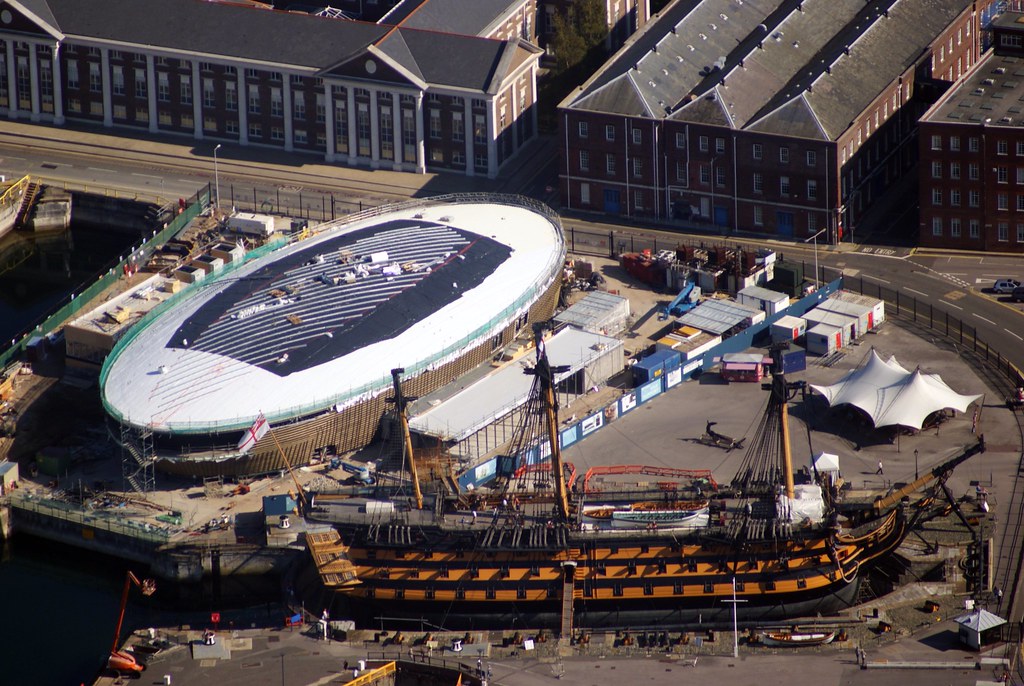
“Mary Rose Museum & HMS Victory” by Silly Little Man is licensed under CC BY-SA 2.0 .

The anti-Western left has been exposed for its sexual imperialism over the last few months. Evidence is all around. American Muslims have led protests against the imposition of LGBTQ policies and curricula in schools, leaving American progressives uncomfortably caught between two pillars of their favored rhetoric of political thought-crime: transphobia and Islamophobia. The Washington Post opined that anti-LGBTQ moves in the Middle East were “echoing” those of the American culture wars—as if Turkey, Saudi Arabia, and Pakistan had been listed by the Human Rights Campaign as favored vacation destinations until their ruling elites started reading the website of Moms for Liberty.

It is, of course, the nature of imperialism that everything, everywhere, is always to be measured by the imperialists’ standards. And that is also what makes them so impervious to spotting their own imperialism. “Queering the Mary Rose‘s Collection”, an article on the website of the Mary Rose Museum in Portsmouth, England, is a recent example of this. The Mary Rose was a Tudor warship that sank in 1545 and was raised from the seabed in 1982 in a groundbreaking act of marine archaeology. The museum is dedicated to displaying artifacts retrieved from the wreck, some of which are now been analyzed “through a Queer lens”.

The specific examples are an octagonal mirror, nit combs, a gold ring, and Paternosters. Apparently, looking into a mirror can stir strong emotions for both straight and queer people, and for the latter it can generate, for example, feelings of gender dysphoria or euphoria, depending on whether the reflection matches their gender identity. Combs would have been used by the sailors to remove the eggs of hair lice. Today they are reminders of how hairstyles can be the result of imposed gender stereotypes, but also make possible the subverting of these through hairdos that break with social expectations. Rings are a reminder of marriage and, of course, that the Church of England founded by Henry VIII, king during the Mary Rose‘s working life, still does not allow gay marriage. Finally, the Paternosters remind us that the crew were “practicing” Christians and that, once again, Henry VIII, via his initiation of the English Reformation, facilitated the civil criminalization of homosexual acts.

Two things are striking about the article, in addition to its lack of any intellectual merit. First, the absence of any historical awareness is striking. For example, the category of “practicing Christian” is essentially meaningless when applied to the early sixteenth century. Everybody, bar a few underground Jews, Anabaptists, and radicals, was part of the Catholic Church by baptism. The question of how the crew might have understood themselves, whether in terms of mirrors, rings, combs, or Paternosters, is never asked. To be fair, a short blog post cannot ask all the relevant questions, but this does not even nod in the direction of suggesting that the differences between yesterday and today might be remotely interesting or instructive.

David Thompson also has some thoughts on the Mary Rose artifact interpretations:

It’s quality stuff. Just like being there, in the mists of history. And not at all inept, or jarring, or comically incongruous.

    As we have seen, many objects can be viewed through a Queer lens and can indirectly tell LGBTQ+ stories.

And thanks to peering through this “Queer lens”, readers will doubtless find that their understanding of Tudor history has been enriched no end.

We’re told – indeed, assured – by Hannah McCann, of the museum’s collections and curatorial staff,

    From the Tate Britain and the Wellcome Collection, to the Rijks Museum in Amsterdam and the Whitney Museum of American Art in New York City, museums are reinterpreting and Queering their objects.

A comfort, I know.

Exactly why such “queering” is underway – what its relevance might be – is not, however, made clear. An explanation for this bolting-on of irrelevant, flimsy tat – in the name of “queer theory” – was not, it seems, deemed necessary. Nor is it entirely obvious how such “queering” of museum contents benefits those who wish to know more about Henry VIII’s favourite warship.

August 10, 2023

“Forget global boiling … It’s global gaslighting we should be worried about”

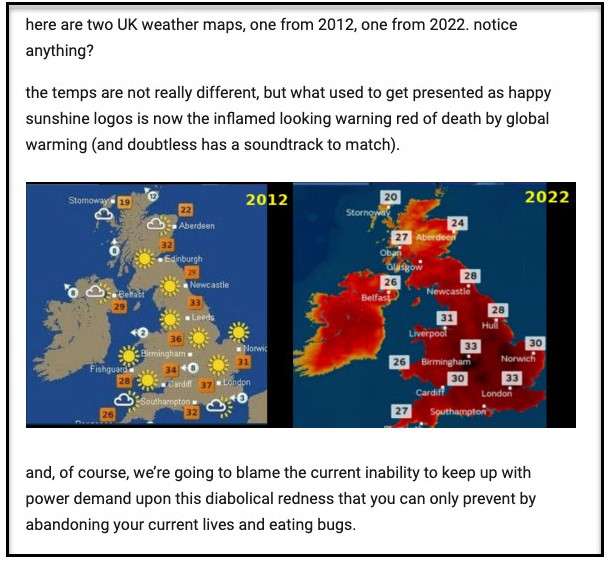
Remember when [your local TV station/newspaper] was blaring the alarming news that your [city/town/state/province] was warming at twice the rate of everything else? All the legacy media NPCs got the same patch at the same time — and it was blatant enough that most people realized it was utter bullshit. As Brendan O’Neill explains, they’re not normally quite so clumsy in their constant attempts to gaslight us all about the climate, but they’re definitely still doing it:

Picture the scene. You’re in London, the sky is menacingly grey, it’s drizzling. You zip your jacket against the elements, annoyed that Britain has just had one of its wettest Julys since records began. Then you reach for your copy of the Evening Standard as you head home from work, only to see splashed across the front page a Photoshopped image of the Earth on fire. “WHO WILL STOP EARTH BURNING?”, the hysterical headline asks. The drizzle turns to rain and you fold your Standard in two to use as an impromptu umbrella, turning a mad piece of global-boiling propaganda into flimsy protection from this strange, wet summer.

This was London yesterday. It really happened. It was yet another overcast day, in keeping with the record-breaking precipitation of the past month. The UK had an average of 140.1mm of rain in July, the sixth-highest level of July rainfall since records were first kept in 1836. And yet here was the freebie London paper warning us that flames will shortly engulf our celestial home. That heat death is coming. That an inferno of our own dumb making is licking at our feet. I know we live in mad times but even I never expected to see damp commuters brushing raindrops off their shoulders while surrounded by discarded papers telling us it’s so hellishly hot we might all soon die. Rarely has the gap between MSM BS and real life felt so cavernously vast.

They’re lying to us. Forget global boiling, the crazy term invented by UN chief António Guterres a couple of weeks ago. Forget global warming, even. It’s global gaslighting we should be worried about. If gaslighting, in the words of the Oxford dictionary, is “the process of making somebody believe untrue things in order to control them”, then that lunatic Standard cover was classic gaslighting. The planet is not on fire. Earth is not burning. These are untruths. This is delirium, not journalism; fearmongering, not fact-gathering. And the aim, it seems to me, is to try to control us; to frighten us with pseudo-Biblical prophesies of hellfire and doom until we obediently bow down to the eco-ideology.

Adding insult to injury, the Standard frontpage had pics of Joe Biden, Xi Jinping, Narendra Modi and Rishi Sunak next to its crackpot query, “WHO WILL STOP EARTH BURNING?”. Let’s leave to one side that President Biden doesn’t seem to know what planet he’s on half the time, never mind being able to save one; and that Rishi can’t even control Britain’s borders, far less the climate of our entire mortal coil; and that Xi and Modi are surely more concerned with their pursuit of economic development than with indulging the End Times hysteria of the Notting Hill set that writes and publishes the Standard. The more pressing point is this: no one needs to stop Earth from burning because Earth isn’t burning. You can’t put out a fire that doesn’t exist. As Bjorn Lomborg said last week, the idea that the “world is ablaze” is pure bunkum.

“Ultra-Processed Food” is so bad that we need extra scare-quotes!!

Filed under: Books, Food, Health, Politics — Tags: , , , , — Nicholas @ 03:00

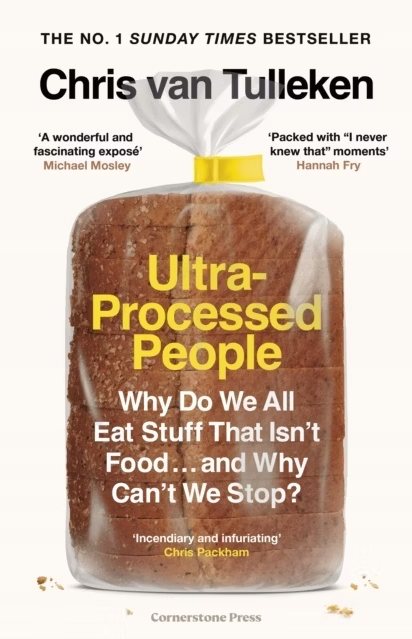
Christopher Snowden seems, for some inexplicable reason, to be skeptical about the hysterical warnings of people like Chris van Tulleken in his recent book Ultra-Processed People: Who Do We All Eat Stuff That Isn’t Food … and Why Can’t We Stop?

If Jamie Oliver is the fun police, Chris van Tulleken is the Taliban. The selling point of books like Ultra-Processed People is the idea that everything you know is wrong. Van Tulleken, an infectious diseases doctor and television presenter, takes this to extremes. In this book, almost everybody is wrong, many of them are corrupt and almost no one is to be trusted. Only Dr. van Tulleken, a handful of researchers and anyone who pays £25 to read this book knows the real truth. The problem is not sugar. The problem is not carbs. Artificial sweeteners don’t work. Exercise doesn’t work. Willpower doesn’t work. Every scientist who has published research contradicting his theory is in the pay of the food industry or — how’s this for an ad hominem argument? — has cited studies by people who are. The British Nutrition Foundation, the Academy of Nutrition and Dietetics, the British Dietetic Association, the Centre for Social Justice, the Institute of Economic Affairs, Tortoise Media, Diabetes UK, Cancer Research UK and the British Heart Foundation are all tainted by food industry funding. Even Jamie Oliver – Saint Jamie, the Sage of Essex — is guilty by his association with Tesco and Deliveroo, and because he makes ultra-processed food (“albeit fairly marginal items”).

It is this ultra-processed food (UPF), argues van Tulleken, that is the real cause of obesity and diet-related diseases in the world today. Food is classified as UPF if it is wrapped in plastic and contains an ingredient you don’t have in your kitchen. This includes everything from mustard to Magnums but, counter-intuitively, doesn’t include sugar, salt or fat. Van Tulleken doesn’t quite put it like this but, in effect, anything you make at home is healthy while nearly anything you buy in a supermarket, aside from raw ingredients, is bad for you.

The evidence for this striking proposition can be briefly outlined, and van Tulleken deals with it swiftly in a single chapter. Firstly, there are a number of studies using observational epidemiology which find a correlation between diets which are high in UPF and various ailments, including not only obesity, heart disease and type 2 diabetes, but also dementia, depression, cancer and more. Secondly, there is a randomised controlled trial which gave a small group of volunteers a two-week diet of either ultra-processed food or minimally processed food. The nutritional profile of each diet was similar (the same levels of salt, sugar, etc.) and the volunteers were offered twice as much as they needed to maintain a healthy weight. The people on the ultra-processed diet ended up eating 500 calories more than the people on the minimally processed diet and put on nearly a kilogram of weight.

The randomised controlled trial was published in 2019 and already has over 1,200 academic citations. Van Tulleken considers it to be extraordinarily robust, but it only really stands out because the general standard of dietary research is so poor. The volunteers were not given ultra-processed versions of the same meals. They were given totally different meals, plus very different snacks, and they could eat as much as they wanted for free. What does it actually demonstrate? Arguably, all it shows is that if you give people unlimited quantities of tasty food, they will eat more of it than if you give them blander food. Van Tulleken assures us that “the two diets were equally delicious”, but this would seem to contradict his claims elsewhere that UPF is “hyper-palatable”, delicious and irresistible.

As for the epidemiological correlations, what is it that actually correlates? UPF is an incredibly broad category encompassing most foods that are known as HFSS (high in fat, sugar or salt) and many more besides. People who eat a lot of UPF tend to have lower incomes, which correlates with all sorts of health conditions. In the study van Tulleken cites to demonstrate that UPF causes cancer, the people who ate the most UPF had the highest smoking rate and were least likely to be physically active. Epidemiologists attempt to control for such factors, but with so much going on in the data, it is an heroic assumption to think that the effect of food processing can be teased out from the effects of fat, sugar, salt, obesity, smoking, stress, exercise and numerous socio-economic influences.

« Newer PostsOlder Posts »

Powered by WordPress