Quotulatiousness

August 9, 2023

“Soon, they say, white America will be over”

Filed under: Media, Politics, USA — Tags: , , , — Nicholas @ 03:00

At Oxford Sour, Christopher Gage considers the prominent media narrative about the inevitability of a “majority-minority” America within the next twenty years:
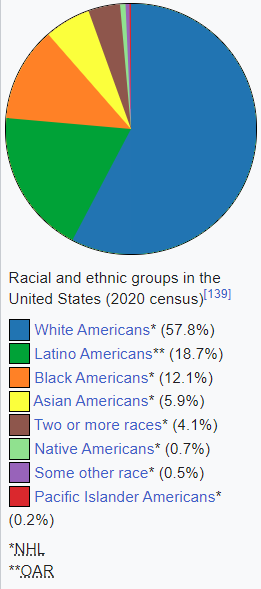
According to both the Daily Stormer and the Washington Post‘s Jennifer Rubin, white people will be a minority sometime in the 2040s.

In 2008, the U.S. Census Bureau projected that “non-Hispanic” white Americans would fall to 49 percent by the year 2042.

Since then, breathless media-politicos have taken the coming “majority-minority” as gospel. Some on the left celebrate the forthcoming date as the first day of their permanent dominance. Some on the right employ the doomsday date to encourage lunatics to rub out innocent people in a synagogue.

The 2020 census continued the theme. Breathless, lazy journalists took the clickbait. Ominously, they said the white population was “shrinking”. According to the Census Bureau, the white population shrunk to just 57.8 percent. Michael Moore did a little dance.

On white nationalist forums, users with names like WhiteGenocide88 were traumatised, and tooling up for war. No doubt, there are a few Robert Bowers with monstrous campaigns lurking around their skulls.


The problem with this theory, or so my Jewish puppet masters instruct me to say, is that it’s nonsense.

Firstly, the white population didn’t “shrink”. Not unless one believes the Jim Crow “one-drop” rule meaning one non-white ancestor renders one non-white. Secondly, the census ignores millions of white Americans who check the “Hispanic” box. These Americans more than cover any white decline.

According to the census, only those of one hundred percent white European ancestry are white. The Ku Klux Klan tends to agree.

For the first time on the census form, white people could include their varied multi-racial ancestry. Over 31 million whites did so. When we count these white people as white, the white population climbs to 71 percent. So, rather than “shrinking”, the white population has since 2010 increased by four million.

With a sensible definition of white, even by 2060, America remains around 70 percent white.

Professor Richard Alba, a sociologist at the City University of New York, says that definition means America remains a majority-white nation indefinitely — no doomsday clock, no murderous rampages, no primitive bloodsport over a faulty horoscope.

I’m no demographer but counting all white people as white people means there are more white people. I’m no sociologist either but revealing the increase in white people means fewer Robert Bowers keen to pump shotgun rounds into human flesh.

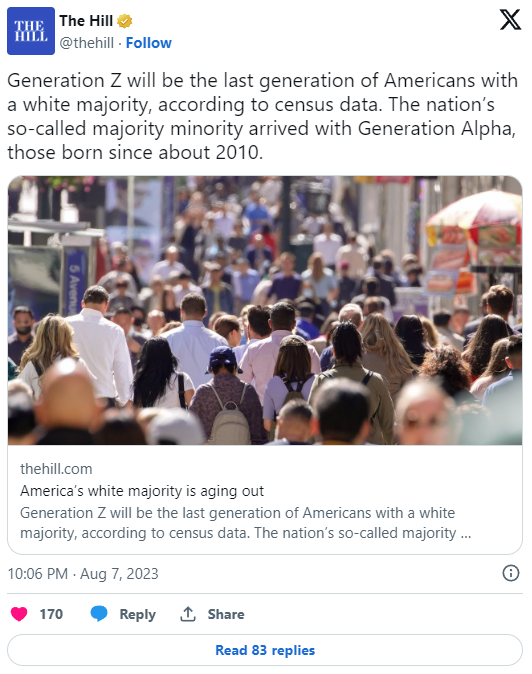
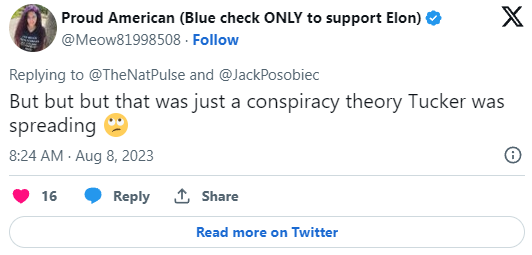
At Not the Bee, Joel Abbott is concerned about the obvious glee displayed by legacy media folks when they push the “replacement” story line:

You can practically feel the excitement here from the quivering fingers of the journalist that wrote this.

Ah.

Hmm.

Well, this is awkward.

See, I’m told this isn’t happening. White people aren’t being “replaced,” they’re just simply being phased out with a percentage that isn’t white at the same time all our institutions, companies, and leaders are pushing to eradicate things like “whiteness” and “white rage” in the name of equity.

For the record, I really couldn’t care less about the skin color of who lives in America. I care an infinite amount more about the spiritual worldview and values of my neighbor than whether their physical DNA gave them dark skin, blue eyes, or a big nose.

This is why I find it weird that the media keeps reporting, with abject glee, that people who look like me will be in the minority soon.
August 7, 2023

Legacy media puzzled at falling levels of public trust in the scientific community

Given the way “the science” has been politicized over recent years and especially through the pandemic, it’s almost a surprise that there’s any residual public trust left for the scientific community:

Sagan’s warning was eerily prophetic. For the last three-plus years, we’ve witnessed a troubling rise of authoritarianism masquerading as science, which has resulted in a collapse in trust of public health.

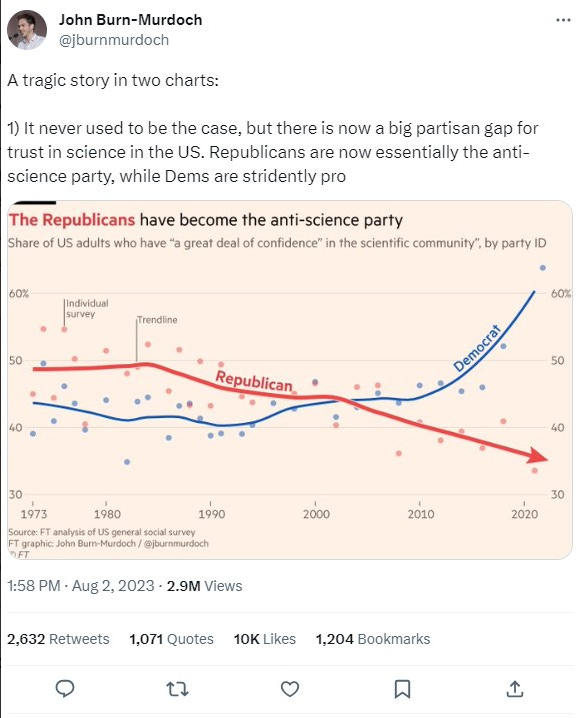
This collapse has been part of a broader and more partisan shift in Americans who say they have “a high degree of confidence in the scientific community”. Democrats, who had long had less confidence in the scientific community, are now far less skeptical. Republicans, who historically had much higher levels of trust in the scientific community, have experienced a collapse in trust in the scientific community.

John Burn-Murdoch, a data reporter at The Financial Times who shared the data in question on Twitter, said Republicans are now “essentially the anti-science party”.

First, this is a sloppy inference from a journalist. Burn-Murdoch’s poll isn’t asking respondents if they trust science. It’s asking if they trust the scientific community. There’s an enormous difference between the two, and the fact that a journalist doesn’t understand the difference between “confidence in science” and “confidence in the scientific community” is a little frightening.

Second, as Dr. Vinay Prasad pointed out, no party has a monopoly on science; but it’s clear that many of the policies the “pro science” party were advocating the last three years were not rooted in science.

“The ‘pro science’ party was pro school closure, masking a 26 month old child with a cloth mask, and mandating an mrna booster in a healthy college man who had COVID already,” tweeted Prasad, a physician at the University of California, San Francisco.

Today we can admit such policies were flawed, non-sensical or both, as were so many of the mitigations that were taken and mandated during the Covid-19 pandemic. But many forget that during the pandemic it was verboten to even question such policies.

People were banned, suspended, and censored by social media platforms at the behest of federal agencies. “The Science” had become a set of dogmas that could not be questioned. No less an authority than Dr. Fauci said that criticizing his policies was akin to “criticizing science, because I represent science”.

This could not be more wrong. Science can help us understand the natural world, but there are no “oughts” in science, the economist Ludwig von Mises pointed out, echoing the argument of philosopher David Hume.

“Science is competent to establish what is,” Mises wrote. “[Science] can never dictate what ought to be and what ends people should aim at.”

August 6, 2023

QotD: Pierre Trudeau’s legacy

Filed under: Cancon, History, Military, Politics, Quotations — Tags: , , , — Nicholas @ 01:00

I have banged on and on and on, to the annoyance of some of my readers, about how Pierre Elliot Trudeau reshaped Canada, almost entirely, in my considered opinion, for the worse. I have singled out, frequently, his evident distaste for the Canadian military and his very real isolationism and reluctance to have armed forces, at all.

There is a lot of documentation about Pierre Trudeau and his views and attitudes, much of it laudatory, some of it critical. I make no secret of the fact that I assert that one Canadian prime minister (perhaps, in my opinion, Canada best-ever leader) the great Liberal Louis St. Laurent, gave Canada a coherent, principled, liberal, values-based grand strategy in the late 1940s and then, just 20 years later another Liberal, Pierre Trudeau, tore it all down, threw it all aside and imposed new, very illiberal, values on Canada ~ all because, I guess, he could not reconcile the facts that stared him in the face in the late 1940s with his own personal choice to have stood, firmly, on the wrong side of history in 1944 when he elected to continue to study (this time at Harvard) rather than to join in the fight to crush Hitler.

M. St. Laurent and M. Trudeau could not have been more different. Louis St. Laurent was an internationally respected lawyer, he was “a man of the world”, neither an anglophile, like Sir Wildred Laurier, nor an anglophobe like Trudeau, he was secure in being a Canadian. He came to politics reluctantly, as a duty, but he quickly became known to, respected by, and, indeed, often friends with Harry Truman, George Marshal, Dwight Eisenhower and Dean Acheson, with Anthony Eden, Ernest Bevin, Clement Atlee, Sir Winston Churchill and Harold Macmillan, and with Tage Erlander of Sweden, Jawaharlal Nehru and V.K. Krishna Menon in India, Sir Robert Menzies of Australia, Tunku Abdul Rahman in Malaysia and leaders, from the West, the East and the non-aligned states. Pierre Trudeau, on the other hand, was a small, very parochial man who did not, really, understand Canada, beyond French-speaking Québec. He became “famous” for opposing Maurice Duplessis ~ something, I have suggested, that would not be much beyond the intellectual capabilities of a somnolent house cat. He travelled the world but never seemed, to me, to have acquired the respect that was accorded to Louis St. Laurent or Mike Pearson … except, perhaps from Fidel Castro.

Ted Campbell, “Pierre Trudeau’s legacy”, Ted Campbell’s Point of View, 2019-08-02.

August 5, 2023

In the “New World Order”, China was expected to become more democratic. Instead, the west is rapidly becoming more like China

Filed under: China, Europe, Media, Politics, USA — Tags: , , , , — Nicholas @ 05:00

N.S. Lyons discusses the unhappy convergence of Communist China with the post-democratic western world, led by the United States:

Differences and tensions between the United States and China have never been greater. The whole world is dividing itself between the blocs of these two opposing superpowers. A new Cold War is dawning, complete with a global ideological “battle between democracy and autocracy“. Freedom is on the line. The future of global governance will be determined by the winner of this extended competition between two fundamentally opposed political and economic systems – unless a hot war settles the question early with a cataclysmic fight to the death, much as liberal democracy once fought off fascism.

This is the simple and easy narrative of our present moment. In some ways it is accurate: a geopolitical competition really is in the process of boiling over into open confrontation. But it’s also fundamentally shallow and misleading: when it comes to the most fundamental political questions, China and the United States are not diverging but converging to become more alike.

In fact, I can already predict and describe the winner set to prevail in this epochal competition between these two fiercely opposed national systems. In this soon-to-be triumphant system …

Despite a rhetorical commitment to egalitarianism and “democracy”, the elite class deeply distrusts and fears the people over whom it rules. These elites have concentrated themselves into a separate oligarchic political body focused on prioritizing and preserving their rule and their own overlapping set of shared interests. Wracked by anxiety, they strive constantly to maximize their control over the masses, rationalizing a need to forcefully maintain stability in the face of dangerous threats, foreign and domestic. Everything is treated as an emergency. “Safety” and “security” have become be the watchwords of the state, and of society generally.

This elite obsession with control is accelerated by a belief in “scientific management”, or the ability to understand, organize, and run all the complex systems of society like a machine, through scientific principles and technologies. The expert knowledge of how to do so is considered the unique and proprietary possession of the elite vanguard. Ideologically, this elite is deeply materialist, and openly hostile to organized religion, which inhibits and resists state control. They view human beings themselves as machines to be programmed, and, believing the common man to be an unpredictable creature too stupid, irrational, and violent to rule himself, they endeavor to steadily condition and replace him with a better model through engineering, whether social or biological. Complex systems of surveillance, propaganda, and coercion are implemented to help firmly nudge (or shove) the common man into line. Communities and cultural traditions that resist this project are dismantled. Harmfully contrary ideas are systematically censored, lest they lead to dangerous exposure. Governing power has been steadily elevated, centralized, and distributed to a technocratic bureaucracy unconstrained by any accountability to the public.

All of this is justified by a utopian ideological dialectic of historical progress and inevitability. Those more in tune with the tide of history (i.e. elite interests) are held to be morally and intellectually superior, as a class, to backwards reactionary elements. Only certain views are stamped “scientific” and “correct,” although these may change on a political whim. An economism that values only the easily quantifiable reigns as the only moral lodestar, and frictionless efficiency is held up as highest common good; the individual is encouraged to fulfill his assigned role as a docile consumer and cog in the regime’s machine, not that of a self-governing citizen. The state regularly acts to stimulate and manage consumer demand, and to strategically regulate and guide industrial production, and the corporate sector has largely fused itself with the state. Cronyism is rampant.

The relentless political messaging and ideological narrative has come to suffuse every sphere of life, and dissent is policed. Culture is largely stagnant. Uprooted, corralled, and hounded, the people are atomized, and social trust is very low. Reality itself often feels obscured and uncertain. Demoralized, some gratefully accept any security offered by the state as a blessing. At the same time, many citizens automatically assume everything the regime says is a lie. Officialdom in general is a Kafkaesque tragi-comedy of the absurd, something only to be stoically endured by normal people. Yet year by year the pressure to conform only continues to be ratcheted higher…

Which country does this describe? If you can’t quite tell, well, that’s the point. For many citizens of the West, the systems of governance under which we live increasingly feel uncomfortably similar to what appears offer in the People’s Republic of China.

August 4, 2023

Vivek Ramaswamy as “Trump 2.0”

Filed under: Media, Politics, USA — Tags: , , , — Nicholas @ 03:00

Bari Weiss considers Vivek Ramaswamy as an improved version of Donald Trump, appealing to a similar audience but with less obvious baggage. Here are some excerpts from her recent interview with Ramaswamy:

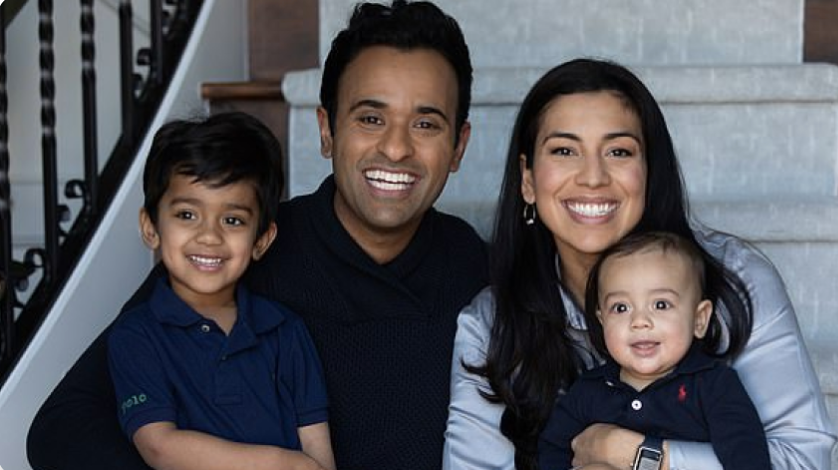
Vivek Ramaswamy and his family.
Detail of a photo from his campaign website, https://www.vivekramaswamy.com/

BW: Politics is all about storytelling, and the winning candidate — or the candidate that catches fire — is almost always the one with the best story. What is your story, and why is it the story that Americans are craving right now?

VR: Whether Americans are craving it or not, that’ll be for them to decide. But I’ll tell you what my story is. I’m the embodiment of the American dream. My parents came to this country over 40 years ago with almost no money. I’ve gone on to found multibillion-dollar companies that created value by doing valuable things for other people, developing five medicines that are FDA approved today. One of them is a life-saving therapy for kids, another one for prostate cancer. I did it while getting married, while bringing two sons into this world, while following my faith in God, while growing up with the ultimate privilege in this country. And I think the thing that’s extraordinary about that story is that it isn’t extraordinary. It is the story of this country. And I don’t think we’re in decline. I think we are still a nation in our ascent, in the early stages of our ascent actually, a nation whose best days are still ahead. I think it takes someone in my shoes to see our nation that way, too. That’s truly what pulled me into the race.

BW: There’s a lot of people running on a reformist platform. You’re running on a radical or a revolutionary one. You say America needs a second revolution. Many people hear revolution, and they think bloodshed and violence. What do you mean by that, and what does that revolution look like?

VR: To me, it does not mean bloodshed and violence, but it means a revival of the ideals that set this nation into motion in 1776. I do think we live in a 1776 moment. I think that the American bargain was built on the idea that we, the people, determine how we settle our political differences through free speech and open debate in the public square where every person’s voice and vote counts equally. That is self-governance. And I think that there is the Old World vision now rearing its head in multiple forms that says, no, we the people cannot be trusted. The citizens of a nation cannot be trusted to determine what’s actually good for them — so we, the intelligentsia, must make that determination centrally at large. I stand on the side of the American Revolution, the ideals that birthed this nation. I think we live in a moment where we have to confront those radical ideals. I think that the American ideals are very fundamentally radical ideals: self-governance, free speech, like absolute free speech, the idea that you get ahead through unbridled meritocracy, the unbridled pursuit of excellence, the steadfast commitment to the rule of law rather than the whims of men. These are radical ideals, because for most of human history, it was done the other way. I think it is the radicalism of the American Revolution and those ideals that are our last best chance for national unity, because that is what actually binds us together across our diverse attributes. And without embracing that radicalism, I think we’re nothing.

BW: You’re incredibly entertaining. You have a view on everything. You’re a phenomenal talker, which will take you far. And remarkably, as of the latest polls, you’re third behind Trump and DeSantis. But many commentators say that ultimately, you have no shot at the nomination. Why is that conventional wisdom wrong about you?

VR: Everyone seems to be shocked where I am right now. I’m not surprised. This is exactly where we expected to be. The reality is, I think people are hungry for the unfiltered truth. I would rather speak the truth about my own beliefs at every step and lose the election than to play some political Snakes and Ladders. And I believe that our voters across this country have a good sixth sense for being able to tell the difference for somebody who’s actually sharing their true beliefs versus somebody who’s giving them carefully constructed, poll-tested slogans. And that is the competitive advantage. My gut instinct is we’re going to win this election. We’re going to win it in a landslide of a margin similar to what Reagan delivered in 1980.

BW: So you’re going to be the Obama of this race, not the Andrew Yang?

VR: I’m going to be the Vivek Ramaswamy of this race, and that’s what I’m committed to being.

At 7% in the polls at the moment, Ramaswamy is a long-shot to win the Republican nomination, but you’ll know if his chances are improving when the media slow-walks the Bad Orange Man stories and starts criticizing Ramaswamy (or “Bad Curry Man” as some online wits have dubbed him).

August 2, 2023

You say you want a revolution …

Filed under: Books, History, Politics — Tags: , , , , , , — Nicholas @ 04:00

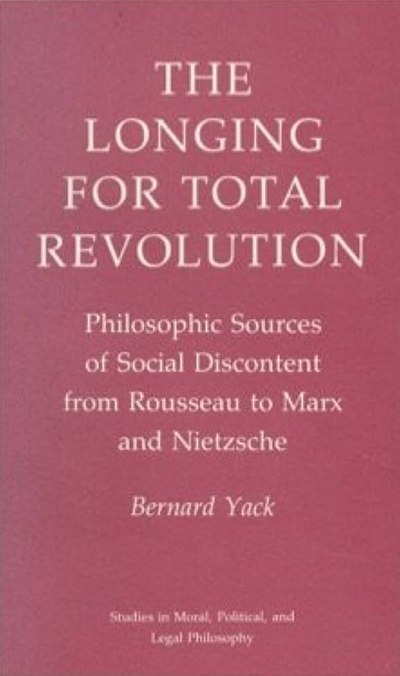
The latest book review from the Psmiths is Bernard Yack’s The Longing for Total Revolution: Philosophic Sources of Social Discontent from Rousseau to Marx and Nietzsche, by John Psmith:

This is a book by Bernard Yack. Who is Bernard Yack? Yack is fun, because for a mild-mannered liberal Canadian political theorist he’s dropped some dank truth-bombs over the years. For example, check out his short and punchy 2001 journal article “Popular Sovereignty and Nationalism” if you need a passive-aggressive gift for the democratic peace theorist in your life.1 The subject of that essay is unrelated to the subject of the book I’m reviewing, but the approach, the method, and the vibe are similar. The general Yack formula is to take some big trendy topic (like “nationalism”) and examine its deep philosophical and intellectual substructure while totally refusing to consider material conditions. He’s kind of like the anti-Marx — in Yack’s world not only do ideas have consequences, they’re about the only things that do. Even when this is unconvincing, it’s usually very interesting.

The topic of this book is radicalism in the ur-sense of “a desire to get to the root”. What Yack finds interesting about radicalism is that it’s so new. It’s a surprising fact that the entire idea of having a revolution, of burning down society and starting again with radically different institutions, was seemingly unthinkable until a certain point in history. It’s like nobody on planet Earth had the idea, and then suddenly sometime in the 17th or 18th century a switch flips and it’s all anybody is talking about. We’re used to that sort of pattern for scientific discoveries, or for very original ways of thinking about the universe, but “let’s destroy all of this and try again” isn’t an incredibly complex or sophisticated thought, so why did it take so many millennia for somebody to have it?

Well, first of all, is this claim even true? One thing you do see a lot of in premodern history is peasant rebellions, but dig a little deeper into any of them and the first thing you notice is that (sorry vulgar Marxists)2 there’s nothing especially “revolutionary” in any of these conflagrations. The most common cause of rebellion is some particular outrage, and the goal of the rebellion is generally the amelioration of that outrage, not the wholesale reordering of society as such. The next most common cause of rebellions is a bandit leader who is some variety of total psycho and gets really out of control. But again, prior to the dawn of the modern era, these psychos led movements that were remarkably undertheorized. The goal was sometimes for the psycho to become the new king, sometimes the extinguishment of all life on earth, but you hardly ever saw a manifesto demanding the end of kings as such. Again, this is weird, right? Is it really such a difficult conceptual leap to make?

Peasant rebellions are demotic movements, but modern revolutions are usually led by frustrated intellectuals and other surplus elites. When elites did get involved in pre-modern rebellions, their goals were still fairly narrow, like those of the peasants — sometimes they wanted to slightly weaken the power of the king, other times they wanted to replace the king with his cousin. But again this is just totally different in kind from the 18th century onwards, when intellectuals and nobles are spending practically all of their time sitting around in salons and cafés, debating whose plan for the total overhaul of society, morality, and economic relations is best.

The closest you get to this sort of thing is the tradition of Utopian literature, from Plato’s Republic to Thomas More, but what’s striking about this stuff is how much ironic distance it carried — nobody ever plotted terrorism to put Plato’s or More’s theories into practice. Nobody ever got really angry or excited about it. But skip forward to the radical theorizing of a Rousseau or a Marx or a Bakunin, and suddenly people are making plans to bomb schools because it might bring the Revolution five minutes closer. So what changed?

Well this is a Bernard Yack book, so the answer definitely isn’t the printing press. It also isn’t secularization, the Black Death, urbanization, the Reformation, the rise of industrial capitalism, the demographic transition, or any of the dozens of other massive material changes that various people have conjectured as the cause of radical political ferment. Instead Yack points to two abstract philosophical premises: the first is a belief in the possibility of “dehumanization”, the idea that one can be a human being and yet be living a less than human life. The second is “historicism” in the sense of a belief that different historical eras have fundamentally different modes of social interaction.

Both views had some historical precedent (for instance historicism is clearly evident in the writings of Machiavelli and Montesquieu), but it’s their combination that’s particularly explosive, and Rousseau is the first person to place the two elements together and thereby assemble a bomb. Because for Rousseau, unlike for any of the ancient or medieval philosophers, merely to be a member of the human species does not automatically mean you’re living a fully-human life. But if humanity is something you can grow into, then it’s also something that you can be prevented from growing into. Thus: “that I am not a better person becomes for Rousseau a griev­ance against the political order. Modern institutions have deformed me. They have made me the weak and miserable creature that I am.”

But what if the qualities of social interaction which have this dehumanizing effect are inextricably bound up with the dominant spirit of the age? In that case, it might be impossible to really live, impossible to produce happy and well-adjusted human beings, without a total overhaul of society and all of its institutions. This also clarifies how the longing for total revolution is distinct from utopianism — utopian literature is motivated by a vision of a better or more just order. Revolutionary longing springs from a hatred of existing institutions and what they’ve done to us. This is an important difference, because hate is a much more powerful motivator than hope. In fact Yack goes so far as to say (in a wonderfully dark passage) that the key action of philosophers and intellectuals upon history is the invention of new things to hate. Can you believe this guy is Canadian?


    1. Of course, if my reading of MITI and the Japanese Miracle is correct, popular sovereignty may not be around for that much longer.

    2. I say “vulgar” Marxists, because for the sophisticated Marxists (including Marx himself) it’s already pretty much dogma that premodern rebellions by immiserated peasants aren’t “revolutionary” in the way they care about.

August 1, 2023

“Tonight in the news: the moon is made of green chees- wait, patch downloading … not made of green cheese, and anyone who says it is is a MAGA conspiracist h8er.”

Filed under: Media, Politics, USA — Tags: , , , — Nicholas @ 03:00

Sarah Hoyt on the amazing co-ordination of messaging from so many legacy media and their social media collaborators:

Many of us are amused with how fast the left acquires a sudden mission to propagate the one holy acceptable opinion. How it changes overnight, and how it comes from all of them at once, in almost the same words. And how it gets repeated ad-nauseam, in defiance of all sense, until the message changes.
This has led the least kind among us (eh. Myself, sometimes) to refer to our leftist brethren as “NPC”s who do whatever the programmers put in their heads.

The sad truth, though, is they’re not NPCs. They’re humans, like the rest of us, just — a lot of them — through cowardice or a more conformist temperament, humans who want to be “right” with the “majority” as they perceive it. They, like most primitives the world over, have no moral center, and want to back the winner and the strong horse.

Add in a dose of truly bad education, and their self-conceit as smart, and what you have is someone who reads all the accepted publications, catches on to what they’re saying, and runs to get ahead of what they think will be (and to be fair is, of their kind only) a parade.

The sequence goes something like this: Leftists, for nefarious, stupid, or money reasons (and often all three) declare that they want something utterly, inconceivably stupid to happen: ban something, force some tech, whatever.

Immediately, on command, some “scientist” (usually of the softer side) who smells grant money does studies showing this idea is brilliant and will bring about utopia. The stupid is flawed and irreproducible, but the journalists are all leftists who want to “support the current thing” and jump on it. Suddenly every possible and some imaginary publications tell us how the Current Thing is the most important thing ever, and it must be done nowwwww.

Take Joe Biden’s idea of cooling the Earth by covering the sunlight. — Okay, not his idea. Or maybe it is. Who knows how much meth they’re putting in his ice-cream? — But the idea of the group of people who form “Joe Biden.” Or the idea of those jokers at the WEF that the planet is BOILING and the only solution if for us peasants to surrender to their wisdom and eat the bugs, and give up private transportation.

July 30, 2023

Letting a UN agency police “disinformation” online? What a great idea! With the best of intentions! What could possibly go wrong?

Filed under: Media, Politics, Technology — Tags: , , , , — Nicholas @ 03:00

Savroula Pabst outlines the United Nations Development Program’s new online anti-disinformation tool, iVerify:

The United Nations Development Programme (UNDP) has quietly announced the rollout of an automated anti-disinformation tool, iVerify, this spring. The instrument, initially created to support election integrity, centers a multi-stakeholder approach spanning the public and private sectors to “provide national actors with a support package to enhance identification, monitoring and response capacity to threats to information integrity”.

The UNDP demonstrates how iVerify works in a short video, where anyone can send articles to iVerify’s team of local “highly-trained” fact-checkers to determine if “an article is true or not”. The tool also uses machine learning to prevent duplicate article checks, and monitors social media for “toxic” content which can then be sent to “verification” teams of fact-checkers to evaluate, making it a tool with both automated- and human-facilitated elements.

On its website, the UNDP makes a blunt case for iVerify as an instrument against “information pollution“, which they describe as an “overabundance” of harmful, useless or otherwise misleading information that blunts “citizens’ capacity to make informed decisions”. Identifying information pollution as an issue of urgency, the UNDP claims that “misinformation, disinformation, and hate speech threaten peace and security, disproportionately affecting those who are already vulnerable”.

But, behind this rhetoric of fact-checking expertise and protecting society’s most marginalized, iVerify, as a tool functionally claiming an ability to separate the true from the false, actually provides governments, adjacent institutions, and the global elite an opportunity for unprecedented dismissal, and perhaps thus subsequent censorship, of dissenting perspectives and inconvenient information and reporting, all behind the pedigree of a UN institution with international reach.

July 28, 2023

QotD: “Stakeholder” Capitalism

Like many things faddish and ephemeral — disco, Pet Rocks, feathered hair, taking Michel Foucault seriously as an intellectual — the 1970s gave birth to the concept of stakeholder capitalism, one of the most unfortunate yet enduring of the bad ideas that polyester decade bequeathed us. At its essence, stakeholder capitalism is Marxian capitalism run through a lens of business ethics. It is the attempt to maintain authoritarian control over capitalism by displacing the Invisible Hand with a Velvet Glove, then using that glove, which hides an iron fist, to pound the world into adopting values that both assert and maintain its worldview. It is Theory applied to markets, marketing, wealth creation and management, and an overall globalized ethos of required and policed “virtue”, with the end goal being — as it always is under the discourses of Cultural Marxist thought — power: who has it, who controls it, and who uses it for their own ends most effectively and ruthlessly.

Of course, nobody participating in the push to replace shareholder capitalism with stakeholder capitalism would describe it this way. But then, euphemism and branding are each crucial tools in the Marxist’s verbal toolbox. So when you ask a stakeholder capitalist to describe stakeholder capitalism, what you ordinarily hear is that, as a business ethic, it combines the “sustainability” shareholder capitalism supposedly lacks with the “inclusivity” we’re not supposed to recognize is merely stultifying, policed conformity, the yield being a Woke capitalism that replaces production and consumption with “sharing and caring,” taking it out of the realm of the invisible and mechanical, as Adam Smith would have it, and placing it into the realm of values, where it can be used to shape the Greater Good the Marxist pretends he cares about. It’s fascism with a smiley face.

In the stakeholder capitalist system, investors aren’t — or at least, they shouldn’t be — solely interested in profits driven by production and consumption. And this is because to the stakeholder capitalist, itself a euphemism for collectivist corporatist, “it is well proven that our current form of Capitalism is inherently unsustainable because it requires endless growth on a planet with finite resources.”

Of course, none of this is “well proven” — the history of shareholder capitalism suggests the opposite, in fact, as innovation has led to the production of more and more out of less and less — but whether this is or isn’t the material case is incidental to those who are working on this inorganic worldwide paradigm shift commonly known as The Great Reset.

Because the move toward a “caring and sharing” worldwide economy, especially one that we’re told will be both sustainable and inclusive, requires those who care, those who share, and — most importantly, and at the very heart of the turn — those who get to determine what is cared about, who must do the sharing, and how most effectively to police the excesses that the ruling elite determine aren’t sustainable, while slowly dissolving the idea of the individual and his will to make way for an inclusive collective required to run the machinery of the self-installed Elect. It’s a global system of neo-Feudalism dressed in the finery of familiar values that have been deconstructed and re-signified, often without their consumers even aware that the values they reference — which were once commonly understood and largely shared by the civil society — are now their precise inverse: “tolerance”, thus, becomes the violent rejection of intolerance, as they define it; free speech is separated from “hate speech”, as they adjudicate it; individualism is but a controlling fiction maintained by the white male power structure that must be replaced by an ordered and value-determined collection of identity markers that construct you, while simultaneously acknowledging that there is no “you” beyond this assembly of discourses that assign your being its social situatedness, then places you within a collective of those with similar — though never identical — constructions. Once here, you are graded on the intersectional scale. Your relative worth and power come down to not to the content of your character, but rather to the collection and arrangement of your victimization tokens.

Jeff Goldstein, “Maybe I’ll be there to shake your hand, maybe I’ll be there to stakeholder capitalist the land”, protein wisdom reborn!, 2023-04-26.

July 27, 2023

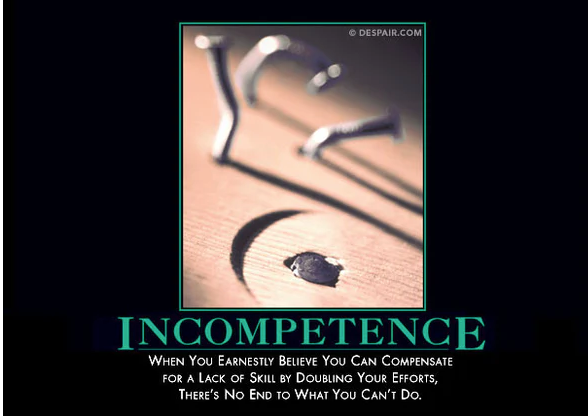
Instead of a malignant conspiracy, consider the possibility it’s really a society-wide dearth of competence

Filed under: Education, Media, Politics, USA — Tags: , , , , — Nicholas @ 05:00

Sarah Hoyt on a topic I’ve been pushing for years in casual conversation:

Recently, in a conversation between friends, the hypothesis was floated: what if all the burning farms, derailed trains, crop failures, etc. etc. etc. etc. ad scary nauseam aren’t really enemy action, but more a competency crisis.

As in these things happen not because big-bad is plotting against us, but because no one knows how to do the things they purportedly do anymore. Some kind of know, but they are hampered, slow, and sometimes hemmed in by counterproductive regulation or the result of previous “strokes of genius” decisions that broke the system.

I’m not going to bore anyone with what I know to be a massive crisis of competency plus inherited factors breaking ability to function in the field. I already did that at Mad Genius Club this morning, and am not unpacking the whole thing again.

But here’s the thing: All of us can live without a functioning fiction writing/selling market. Maybe not as pleasantly/happily, at least for those of us addicted to reading, but we can survive. We have old books to re-read, and if we get really desperate we can write our own fanfic.

It’s another thing when you talk of transportation or medicine, or farming, or – Well, everything else.

I have friends and fans in a lot of places. And almost everyone’s story is of being caught in the middle of a system where nobody knows or can do much of anything. It’s all the way the cogs and bureaucracy move. And the way they move is completely divorced from what needs done, or what anyone knows how to do.

To give an example: Suppose you were hired to haul buckets from a well. But when you actually get the job, you find out, no. Because of inherited systems, and what your superiors expect, you’re supposed to climb down the wall, hand over hand, and bring up water by the cupfull. And there are regulations in the works to make that by the spoonfull. However, you’ll be fully held to account if you can’t provide the amount of water the company is contracted for. You. Personally.

So, you do what you can. You fudge the books. On paper, you’re getting all this water up. Where the water goes no one knows, every one down stream (pardon the pun) from you does the same.

If this sounds like the soviet system? It is. It’s just that the directives don’t come directly and traceably from the government. (Though under the infestation of Bidentia they increasingly do.) Instead, they come from “experts” “scientists” “Studies” “marketing gurus.” And sometimes they are curtailed or made worse by agencies and regulations.

Yes, the managerial or worse “expert” class is the same that furnishes government. These are not your friends, are not meant to be your friends, and are convinced they know much more than you do.

What they know in fact is “how to manage.” But it’s not how to manage anything. They know theory of management (or whatever) derived from no reality (mostly from the writings of Marx, if you dig a little) and pushed ALL THE WAY DOWN.

It’s like — exactly like — being run by “experts” who memorized the Little Red Book. It might please those in power, but it has nothing to do with accomplishing the actual job in front of you.

Part of this has to do with colleges. Remember all those student demonstrations of the 60s? If you’re like me, and didn’t hit college till the eighties or younger, you might think these are, as the movies show, all anti-war and for civil rights, and all that jazz.

Unspoken to any of us is the fact that half of these demonstrations were to DUMB DOWN THE CURRICULUM. To demand easier grading. And social factors taken into account. And to “update” to “relevant things.”

The idea being that we were in a sort of an year zero and anything else, in the long storied glories of Western civ no longer counted, except for us to declare ourselves superior to it.

July 26, 2023

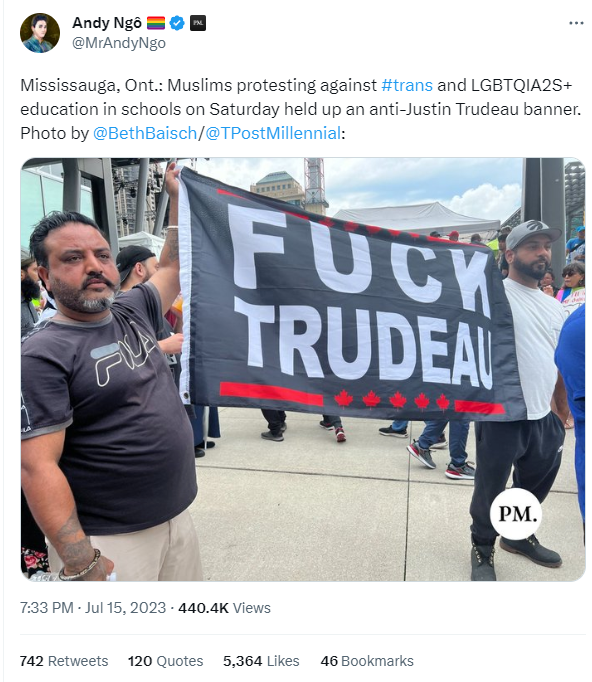
Justin Trudeau’s odd choice to agitate Muslim Canadians over his LGBT beliefs

Filed under: Cancon, Education, Media, Politics, Religion — Tags: , , , , — Nicholas @ 03:00

In the weekend’s roundup post from the editors of The Line, one of the topics discussed was Prime Minister Trudeau’s attempt to blow smoke up the collective butts of deeply religious Canadian Muslims that the only reason they were upset about his blatant dedication to LGBT issues was due to brainwashing by extreme right-wing Americans:

this week offered us a video clip of Trudeau that was just too interesting for us to pass up. Readers may recall a story from a few weeks ago in which several Muslim students in Edmonton absented themselves from Pride events and were lambasted by their teacher, who told them that they had to support this event or they “can’t be Canadians.” We didn’t make much note of it at the time because our colleague and friend at the National Post Colby Cosh had the definitive and winning take: that is, the teacher is a fucknut. These kids didn’t protest or object to pride or make their peers feel uncomfortable in any way. They just declined to participate. And in a pluralistic society, politely absenting oneself from ideological events with which one disagrees and instead hanging out at the Orange Julius or wherever the hell kids spend time these days is about the most perfect and Canadian response.

Perhaps not coincidentally, upon receiving such clear signals about the conduct that is now expected of a Canadian, Muslim parents are organizing ever louder protests against what they deem to be LGBTQ “indoctrination” in schools. And if you’ve been paying any attention to the logic pretzels that have been spun about intersectionality, lived experiences, the importance of listening to minority voices in majority cultures and so on, this is about the point at which you’re going to grab the popcorn, because what we have here, ladies and gentlemen, is a bona fide clash of values between competing minority interest groups.

So we give the prime minister a lot of credit for meeting with Muslim parents in a Calgary-area mosque last week to discuss the issue. And we mean that! Genuinely! Heading face-first into a mob of angry parents is a really difficult thing for anybody to do. He deserves credit for doing this.

However, the response that was recorded by attendees was also very, very interesting. The furore over LGBTQ issues in schools is much ado about nothing, he insisted; the result of right-wing extremists spreading “a lot of untruths about what’s actually in provincial curriculums”.

Trudeau continued: “They are weaponizing the issue of LGBT, which is something that, yes, Islam has strong opinions on …. That is something that is being weaponized by people who are not doing it because of their interest in supporting the Muslim community.”

A few notes about this response: The first is that it is undeniably true. There are anti-LGBTQ activists who are trying to mobilize the Muslim community because this minority population has greater moral suasion among the intersectionality set than socially conservative white Christians. There are right-wing commentators out there who focus on cases, videos, examples and books that they claim demonstrates a pervasive trend of “indoctrination” on LGBTQ issues in school environments. The examples are out there, and some are age-inappropriate. However, we have no sense that those examples are representative of what’s happening in most classrooms. Are there a lot more non-binary 12-year-olds in middle school nowadays? Sure. Is that a problem? We don’t know. Maybe? But we’ve yet to walk into an elementary school hosting a 24/7 Pride Parade with naked men and women throwing rainbow glitter and condoms to the kiddies. We are savvy enough media consumers to know that in a social-media age, edge cases have a habit of being falsely portrayed as routine.

Our snark aside, Trudeau’s response is interesting because it is also a dodge. Trudeau doesn’t actually want to deal with the hard problem of how to accommodate competing minority rights. So instead he pretends there is no problem. He blames the perception of a problem on disinformation agents. Marvellous — right up until the moment we see some video from a Toronto school of a teacher screaming at eight-year-olds that there is no such thing as boys and girls and that the whole concept of biological sex is an expression of imperialism and white supremacy. (Ed note: pin this graf for future victory lap.)

Or, just as an example of the sort of thing that just maybe could happen, when an ostensibly trans shop teacher shows up to class in a wig and Size-Z prosthetic breasts with armour-piercing nipples and the school board responds by saying “This is not a problem, you bigot,” and then it turns out that the teacher in question hasn’t been entirely upfront about their life! Or until, well, some teacher tells a bunch of Edmonton kids that skipping pride to head to the mall makes them un-Canadian. Oops! Wait, so who’s lying now?

The second reason we found this response interesting is that it’s become this government’s go-to deflection. All criticism is just disinformation. Anybody who disagrees with the Liberals is a baddie because can’t you see how awesome and empathetic and genuinely well intentioned they are? Throw in a little threadbare virtue, a touch of white saviour: “you, poor, deluded, Muslims, are just being manipulated by malign forces and can’t possibly understand what you’re saying or what you really believe,” and you’ve got a pitch-perfect urban progressive Canadian non-comment. It’s a mask slip moment, when we see exactly how Trudeau seems himself, and how he sees the people he’s talking to. Oh wait: actual Muslims find this statement condescending and insulting? Don’t they know whose side they’re supposed to be on? Maybe they’re just watching too much Matt Walsh. Why does anybody need to define what a woman is anyway? Maybe we need a new law for that so the plebes stop getting so confused …

You see where this logic takes us. We may wade into this one a bit more at The Line in coming days and weeks, so enough said for now. But for now, it’s enough to note that this is not how a mature, pluralistic society handles irreconcilable differences in values and beliefs. Generally speaking, everyone is pretty content to let adults live and let live, but when you bring kids into any ideological agenda, expect matters to get ugly quickly. And you’re going to need a better response to legitimate concerns about how an emerging secular ideological consensus around gender and ideology crashes against deeply held religious values than: “YouTube lies”.

July 25, 2023

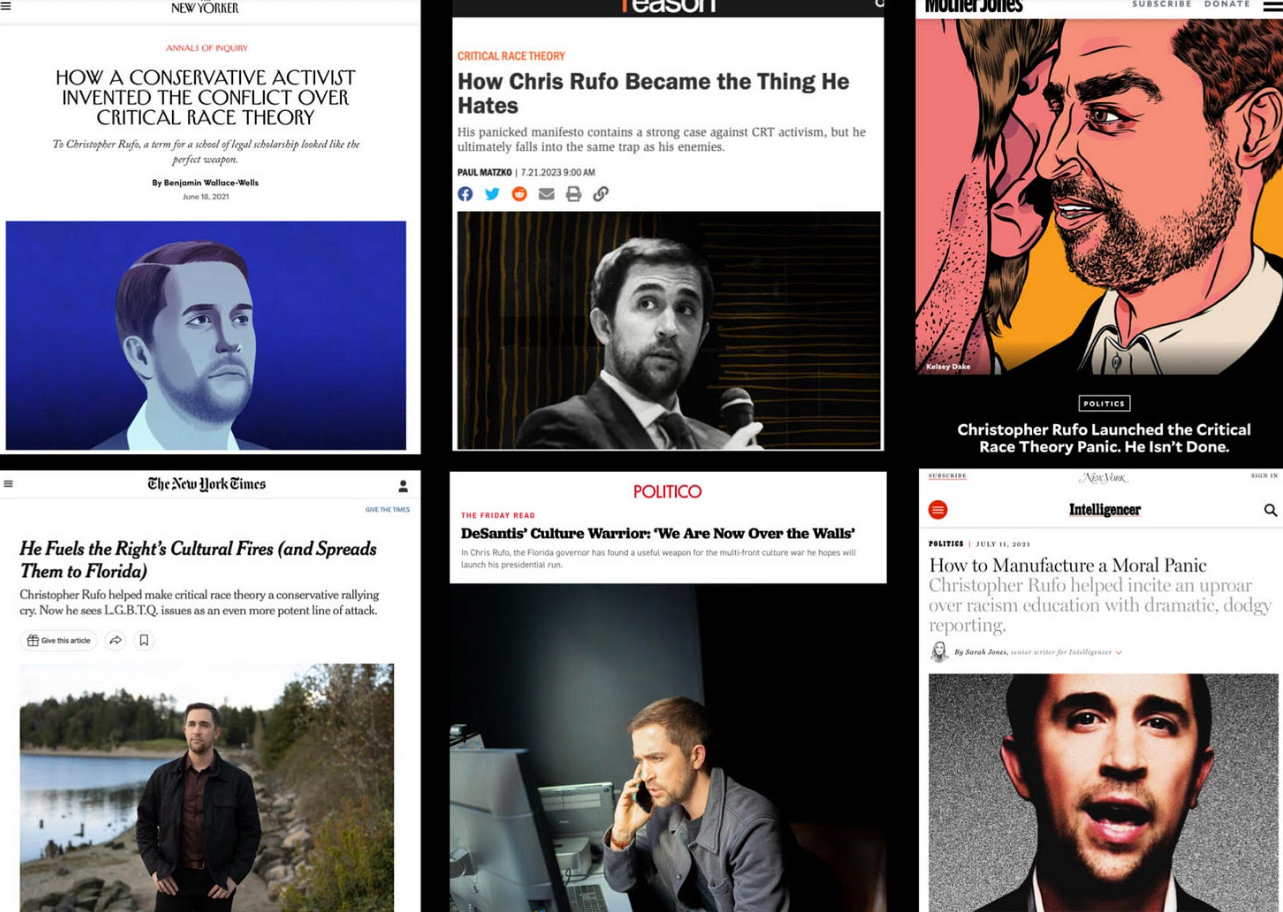
Chris Rufo, enemy of the [legacy media] people

Filed under: Books, Education, Government, Media, Politics, USA — Tags: , , , , — Nicholas @ 03:00

Last week, Richard Hanania posted this review of Chris Rufo’s new book America’s Cultural Revolution: How the Radical Left Conquered Everything:

Some facts are so shocking that you don’t want to believe them. And if you do believe them, there’s a tendency to forget, downgrade their importance, and often have to be reminded of them again. Here’s one fact that falls into this category: The American education system, or at least the field of education itself, was taken over by literal communists. Those entrusted to teach children and young adults have as their greatest intellectual inspirations lunatics who would clearly have massacred their fellow Americans if they had the chance.

We know this because during the Cold War, some of the leading lights of modern academia were openly in favor of distant regimes that were engaging in mass killings in the name of equality. Some of them, like members of the Weather Underground and Angela Davis, personally participated in violent acts themselves. Instead of locking these people up and throwing away the key, we made them into tenured professors, and some of the most highly cited scholars in the world. They now are major intellectual figures in education schools, which train future teachers and administrators and ultimately control what kids learn, along with the DEI bureaucracies that exert so much control from within our most powerful institutions.

What does one do with these facts? Chris Rufo’s work over the last several years has been about taking them seriously. Tomorrow, he is publishing his first book, America’s Cultural Revolution: How the Radical Left Conquered Everything, which explains the history behind and intellectual foundations of modern wokeness. It serves as a wakeup call as to how bad things are. Many of the facts presented may be familiar to the reader, but taken together, they tell a story that serves as a searing indictment of the American establishment.

Rufo’s book is built around intellectual biographies of four activist-scholars: Herbert Marcuse, Angela Davis, Paulo Freire, and Derrick Bell. He traces their influence through political organizing and propaganda efforts. Marcuse was the intellectual godfather of the New Left. Davis’ Black Panther movement can be considered the precursor to BLM. Freire’s Pedagogy of the Oppressed “became the bible of teachers colleges throughout the United States and created a cottage industry in academic publishing,” with the author’s research having garnered about half a million citations. Finally, Derrick Bell was the force behind Critical Race Theory, a movement that seems to have been resisted and laughed at by most of the academic legal establishment before it wore its opponents down and gained a foothold in top law schools.

I can’t help but feeling a certain parallelism between Rufo’s work and my own. We both started becoming well known for writing about wokeness in the last few years. We both make extensive use of Twitter and longform writing to communicate to the world, and we both have books coming out two months apart with the same publisher trying to explain the origins of the radical ideas and concepts that have taken over American institutions. He’s exactly one year and two days older than me, so we’ve lived through the same formative political and cultural experiences, watching “white” become an epithet and homosexuals go from being a leper class when we were in high school to individuals having a preference that seems almost quaint in the era of public celebration of trans and the alphabet people.

Of course, an important difference is that Rufo has maintained a laser-like focus on wokeness and avoided alienating natural allies as he’s built a broad coalition within the conservative movement to take on the enemy. And his accomplishments have been quite impressive. Rufo was almost single-handedly responsible for Trump banning Critical Race Theory in the federal government, as he’s also developed close working relationships with Ron DeSantis and other politicians. Today, when Republican-controlled states ban gender transitions for minors, forbid the discussion of Critical Race Theory in schools, or abolish DEI offices in public universities, Rufo is serving as an intellectual inspiration to decision makers when he’s not directly involved in the policy process himself. If wokeness is ever defeated, one can imagine a leftist in thirty years writing a book on the career and activities of Rufo the way he writes about Marcuse and others today.

July 24, 2023

Revolutionary boredom

Filed under: History, Media, Politics, USA — Tags: , , , , , — Nicholas @ 04:00

Chris Bray rises to passionately denounce [Comrade to be named later] as a traitor to the revolution who must be purged from the movement instantly!

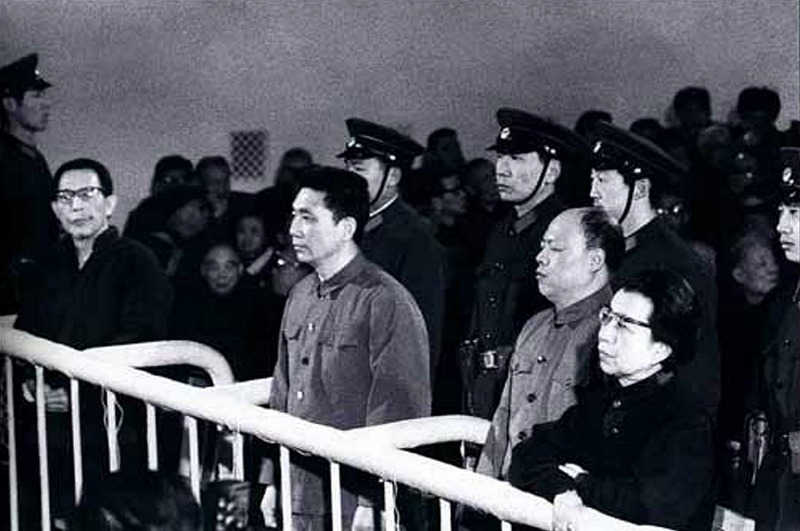
Well-written histories of the Great Terror or the Cultural Revolution — or of the final years of the Roman republic, say for example — have the strange effect of becoming incredibly boring. The 94th bonfire of humanity, appearing on page 678, resembles the previous 93 bonfires. The grim machine of political purges makes brutal depravity tedious. Commissar X, Commissar Y, and Commissar Z run the Committee to Kill Wrongthinkers; then, and you always see this coming, Commissar X, Commissar Y, and Commissar Z are declared to be wrongthinkers, and are tossed on their own bonfire. The managerial tier is always consumed by its own instrument. Purge culture is the center of a politics of repression, the inevitable dynamic of a system that has degenerated to the stage of an unprincipled grasping for status and position. Someone was denounced yesterday; someone is being denounced today; someone will be denounced tomorrow.

The “Gang of Four” on trial in 1981.

In two instances, now — the frenzied shark attack on Matt Taibbi and Michael Shellenberger, and the obviously insane response to RFK Jr. this week — prominent House Democrats have mimicked a cultural style that should be extremely familiar to anyone who has read some history. Debbie Wasserman Schultz is so fascinatingly horrible a figure that she echoes, a bug-eyed ranting halfwitted sociopath with a hollow core like a long historical line of hollow bug-eyed sociopaths. These are the people who are drawn to destructive political stages. Repellent and ascendant, they call to others of the type. Destroyers flock.

I assume you’ve seen some footage from yesterday’s hearing, which was widely covered and widely discussed, so I’m not going to rehash that nasty piece of Theatre of Cruelty. If you missed it, just know that Robert F. Kennedy, Jr. is OBSOLETE OBSOLETE OBSOLETE.

But I want to point at the water underneath the waves we can see in national media, because the presumptions of the Central Commissariat go all the way down.

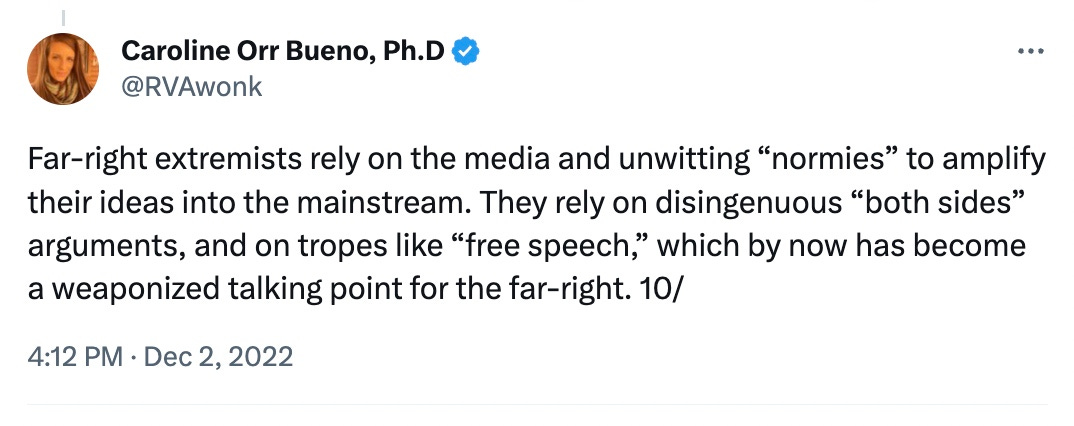
The week that led to the ritual denunciation of RFK Jr. started with a fascinatingly naked declaration in a Pasadena courthouse. Two California physicians, Mark McDonald and Jeff Barke, are suing the California Medical Board to block enforcement of AB 2098, the new law that threatens the medical license of any doctor in the state who expresses consensus-deviating crimethink about the darkly sacred Covid-19, a High Enemy of the Glorious Motherland. McDonald and Barke are relying on the First Amendment and its protection of the so-called “free speech” trope, a well-known tool of dangerous far-right extremists.

Courts have split on AB 2098, and so far some have declined the premise that this regulation of physicians’ speech is unconstitutional, so the case is now before the 9th Circuit on appeal. A three-judge panel heard oral argument in the case this week, in an architecturally pleasant forum that used to be a luxury hotel. And this is where Deputy Attorney General Kristin Liska said this to the court: “In order to effectively regulate the practice of medicine, the state needs to be able to reach the aspects of speech that are used to care for patients.”

If you take a professional license from the state, the regulatory power of the state reaches your speech acts; you can lose your license not only for harming patients or providing poor quality care, but for saying things that the state disagrees with. Your conversations belong to the government.

July 22, 2023

“… no-one has a ‘right’ to a bank account …”

Unlike in Canada, where the extra-legal debanking of an unknown number of what Justin Trudeau described as a “small fringe minority … holding unacceptable views” had all the bien-pensants in and out of the legacy media nodding along, British opinion is not so friendly toward the extra-legal debanking of Nigel Farage and his family and friends:

An acquaintance of mine on Facebook, a hardline capitalist (so he says) made a comment that no-one has a “right” to a bank account, as they don’t have “rights” (those inverted commas are doing a lot of work here) to healthcare, education, paid-for holidays, etc. He was, of course, writing about the Nigel Farage/Coutts saga that has seen the CEO of NatWest, Coutts’ parent firm (39% owned by the taxpayer) issue a sort-of apology to the former UKIP leader.

[…]

When a person is “debanked” today, they can have a problem opening an account anywhere else if the bank asks them why they left a bank in the past. As a result, we have almost a sort of “cartel” system operating.

In time, hopefully, competition will swing back, and some of the nonsense going on will disappear. In the meantime, while I agree with you that the idea of having a “right” to a bank account is as bogus as many of the other “rights” that people talk about today, the fact that banking is such an embedded form of life in a modern economy means this issue hits hard in a way that, say, isn’t the case if you are banned from a pizza restaurant or candy store for holding the “wrong” views. Of course, it may be that the Farage case might encourage a firm to go out of its way to court business from those who have been targeted. Let’s hope so. For example, a bank could, without incurring wrath from the “woke” or regulators, say something like “Banking is all we do. No politics. No agendas. Just finance.”

And as I have said before, the outrageous Nigel Farage case, and that of others, surely demonstrates that a central bank digital currency idea must be resisted. This would be the end of any financial autonomy at all.

As you’d expect, Brendan O’Neill isn’t a fan of this latest attempt to make certain political viewpoints effectively illegal:

So there you have it. Nigel Farage really was given the boot from the prestigious private bank Coutts because of his political views. Because he is very pro-Brexit, is fond of Donald Trump and has been critical of Black Lives Matter. Because, in the words of an extraordinary internal dossier compiled by Coutts, his views “do not align’ with the bank’s values”. For the past fortnight the chattering classes have been chortling over Farage’s claim that Coutts was persecuting him for his political beliefs. How dumb – worse, how complacent in the face of corporate tyranny – those people look now.

Last month, Farage went public about the closure of his Coutts account. I’ve been given the heave-ho for political reasons, he said. He also said that nine other banks have since rejected his custom. Now he has published a dossier that was distributed at a meeting of Coutts’ “reputational risk committee” on 17 November 2022. It is a truly chilling read. It runs to 36 pages. There is a strong case for “exiting” Farage from the bank, it says, because his publicly stated views are “at odds with our position as an inclusive organisation”. The Stasi once compiled dossiers on dissident activists and artists whose views ran counter to those of the GDR regime. Now Coutts seems to be doing similar on customers who dare to bristle against the regime of woke.

The dossier basically finds Farage guilty of wrongthink. It highlights his renegade views not only on Brexit and Trump but also on Net Zero and even on King Charles – he has had the audacity to criticise His Majesty. Like dissidents in East Germany, his friendships are held against him, too. His links with Trump and tennis champ Novak Djokovic make him suspect, apparently. The dossier quotes the Independent‘s description of Farage’s visit to Djokovic’s trophy room in Belgrade, during which he criticised Australia’s expulsion of Djokovic for failing to get vaccinated against Covid, as “the spineless, chaotic behaviour of a chancer”.

[…]

The Farage / Coutts story is important because it highlights what a huge threat woke capitalism poses to freedom and fairness. Let’s be clear about what has happened here: a man has been economically unpersoned for having the supposedly wrong views. He’s been blacklisted for being a little too dissenting on the big issues of the day. And it’s happening to others, too – including people who do not have access to the same media platforms as Farage and thus have little leeway to protest against their expulsion from economic life by unelected, unaccountable banks and businesses. We acquiesce to this capitalist policing of thought at our peril. It is surely time for the government to act and clip the wings of banks and companies that believe they have the right to penalise citizens for the contents of their conscience. It might be Farage today, it could be you tomorrow.

Theodore Dalrymple sees it as a sign of the rise of woke totalitarianism:

It isn’t a question of whether Mr. Farage is always right or sometimes horribly wrong; when the bank says that it “uncovered” something that he said, as if he had recorded saying it by secret microphones, it makes itself ridiculous. Not even his worst enemies, or perhaps his best friends, would accuse him of hiding his light under a bushel.

The question is whether it’s the role of a bank to examine its clients’ views and deny them service if those views don’t accord with those of the chief executive, as if the latter were indisputably true and from which it were heresy to dissent. Is a bank an inquisition?

The chief executive of the parent bank, Alison Rose, said soon after her appointment that “tackling climate change would be a central pillar” of her work, and on the occasion of the so-called Pride month last year said that “our focus on diversity, equity and inclusion is integral to our purpose of championing the potential of people, families, and businesses”. This year, the company headquarters were covered in the rainbow colors of the LGBT flag, with lettering the height of humans declaring the “Championing the power of Pride”. Under her leadership, staff may “identify” as women and men on alternate days, should they so wish.

Of course, when she said that “diversity” and “inclusion” was “integral to our purpose”, she was using these terms in a strictly technical sense to mean “everyone who thinks as I do and has a fair bit of money”. The diversity “integral” to the “purpose” of Coutts doesn’t include those persons with less than $1 million to deposit, who even in these days of currency depreciation remain a small minority. People bank with Coutts because it’s exclusive, not inclusive.

The chief executive, however, is safely within what we might call the Coutts Community, because she was paid about $5.2 million last year. The prospect of being barred from the bank will no doubt inhibit anyone who banks with her banks from suggesting in public that she’s paid too much.

In European politics, “far right” doesn’t mean what Americans think it means

Filed under: Europe, Germany, Italy, Media, Politics — Tags: , , , , , — Nicholas @ 03:00

In The European Conservative, Rod Dreher tries to put the various “far right” European political parties into context for North American readers:

If you are an American who depends on the U.S. and other English-language media for news about continental European politics — and most Americans obviously do — then you might well be afraid that a wave of fascism is poised to sweep Europe.

The European Conservative, obviously, is a great source of news and information about Europe for our American readers — and I hope with this column to help American conservatives better understand what’s going on with the European Right — because there are very few venues for them to do so.

American and British news agencies are reporting that the “far-right” party VOX is likely to do well in this weekend’s Spanish elections. The “far-right” Alternative für Deutschland (AfD) is surging in German opinion polls. It seems like just yesterday that the “far-right” party of Giorgia Meloni topped Italian elections. “Far-right” parties are key to governing coalitions in Finland and Sweden.

And, of course, the BBC website informs its readers to mind “the ultra-conservative, authoritarian-leaning governments in Poland and in Hungary”. Far-rightists to the fingertips, the lot, right?

Well, no. Not even close. American conservatives should understand that by U.S. standards, the “far-right” parties are basically center-right contemporary Republicans. The declining establishment conservative parties of the European continent are more or less Clinton-style Democrats. There do exist genuinely far-right parties in Europe, but they aren’t anywhere near government.

(Though in this spring’s Hungarian elections, the actually far-right party Jobbik, which considers Viktor Orban to be a squish, went into coalition with the left-wing parties. This caused the coalition prime ministerial candidate to boast moronically that his side was truly diverse, because it spanned the ideological spectrum from communist to fascist.)

When U.S. journalists describe these nationalist and populist parties as “far-right”, they intend to call up images of burly fascists marching down cobblestone streets in hobnail boots, shouting abuse at Jews and minorities. I can’t decide if they do this deliberately to mislead American readers into thinking Europe is two tics away from a gran mal Nazi seizure, or if the reporters themselves are so absorbed in the ideology of their class that they honestly cannot discern gradations of right-wing politics.

H/T to Blazing Cat Fur for the link.

« Newer PostsOlder Posts »

Powered by WordPress