Quotulatiousness

September 17, 2023

How much mis-, mal-, and dis-information do you encounter on an average day on the internet?

Filed under: Media, Politics, Technology, USA — Tags: , , , , , — Nicholas @ 05:00

I don’t know the answer to that question … although I suspect it’s a pretty big proportion of what you’ll see, especially if you stick to legacy media sites who regularly indulge in cover-up, state propaganda, and outright lies while condemning other media as “conspiracy theorists”. Chris Bray, on the other hand, thinks there are hopeful signs that we’ve passed peak disinformation as the pandemic lockdowns get further behind us:

I’ve been trying to come up with a count: If you consume a typical amount of news media and social media product, how many individual pieces of dishonest, misleading, and calculatedly or ignorantly unreal “information” do you take on board over the course of a typical day?

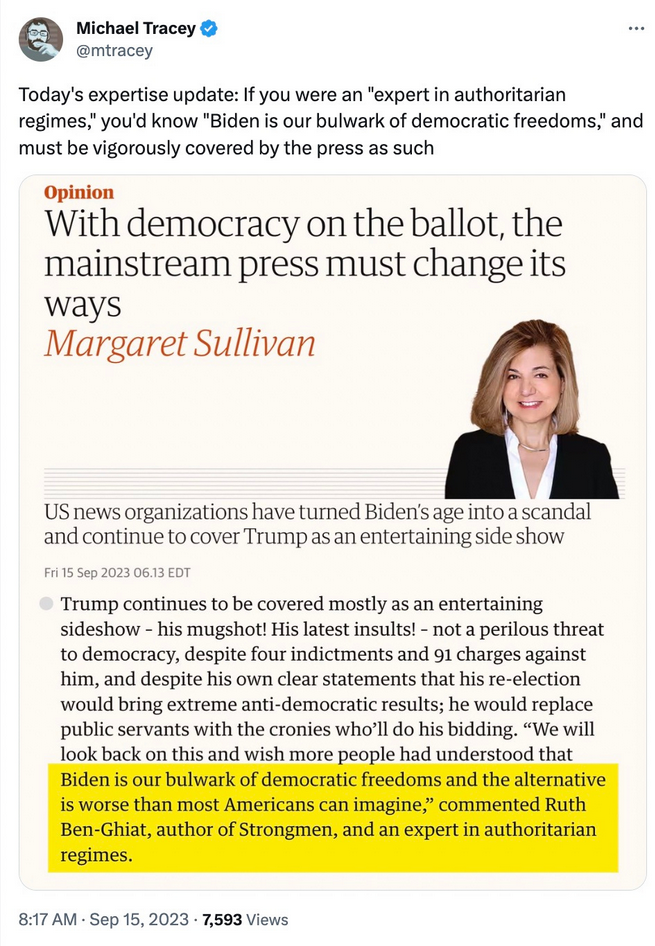
Walter Kirn’s one-sentence summary of contemporary media is stuck in my head: “This is a world-concealing layer of diversionary and illogical and internally inconsistent noise, under which the world exists somewhere.” How much noise do you have to purge to merely get to zero, not at all informed but not not deeply misinformed? And if you encounter the deep thoughts of Ruth Ben-Ghiat, does the deficit merely double, or is it much worse than that?

Democracy means you must not question or oppose the head of state

I’ve been reading on The Site Formerly Known as Twitter this week that Elon Musk’s refusal to activate the privately owned Starlink network over Crimea is a violation of the Geneva Conventions, which now apparently apply to corporate product, and also high treason, for which Elon Musk should be executed. At the risk of mixing metaphors, it’s like the Internet allows strangers to use your brain as a toilet. Although, as the Twitter randos always end up explaining, I just feel this way because I’M PUTIN’S NAZI BUTTBOY.

All day, every day, 24/7/365 — well, maybe with some breaks for sleep, but only if you stop looking at your phone at night — you take on garbage. Your brain is loaded with information barriers, dressed up as information. You read and hear sentences that are designed to prevent understanding.

September 16, 2023

Public health officials don’t seem to realize just how badly they’ve damaged their credibility

Filed under: Bureaucracy, Cancon, Government, Health, Media, Politics — Tags: , , — Nicholas @ 03:00

Chris Selley on the apparantly huge gap between how ordinary Canadians view their public health officials and how those officials think they’re viewed:

Throughout the pandemic, polls have shown a decline in confidence in public health: Researchers at McMaster University and Vox Pop Labs found that in March 2020, 59 per cent of Canadians had “a great deal of trust” in public health officials. Two years later that had plummeted to 37 per cent.

We have recently enjoyed months of being able to ignore COVID-19. Even the relentlessly, uniquely pessimistic Canadian media seemed to have exhausted themselves. So I found it a bit jarring to see Dr. Theresa Tam, Canada’s chief public health officer, suddenly back on the TV this week admonishing us to “get your mask ready” for fall and book yourself in for a booster. Dr. Kieran Moore, Tam’s counterpart at Queen’s Park, is due in the coming days to give Ontarians what will likely be a similar update.

If this year’s flu/RSV/COVID season is as bad as last, it will be fascinating to see how Canadians react. Perfervid opposition to masking and vaccination are minority positions: In the midst of last year’s autumn surge in childhood hospitalizations, a Nanos Research poll found 69 per cent of Canadians would support a return of mask mandates “if authorities deem(ed) it necessary”.

But are people ready to hear it, again, from the same public-health officials who have all-but destroyed their entire field in the last three years — seemingly without realizing it? It will be intriguing to see.

Tam’s original sins remain totally unexplained — at an official inquiry, for example, hint hint — never mind expiated. For days and weeks in early 2020, while our peer countries were closing borders and preparing for a pandemic, Tam assured us “the risk to Canada is low”. She lied that World Health Organization rules prohibited us from closing borders. She told us masks were worse than useless, and the only excuse anyone can offer is that she was fibbing to prevent Canadians from hoarding PPE. (I think she actually believed it. Either explanation is a firing offence.)

Remember the utterly incoherent advice the Public Health Agency of Canada provided to incoming travellers in the early days? Remember the built-to-fail, purely political quarantine hotels that Tam said weren’t necessary until they suddenly were — just as she said 14-day quarantine at home wasn’t necessary until it suddenly was? We were weeks if not months behind most of our peer countries. Regardless of your position on any given restriction, none of it made any sense.

September 15, 2023

Donald Trump as a political autoimmune condition

Filed under: Government, Media, Politics, USA — Tags: , , — Nicholas @ 05:00

Kulak has a very interesting view on the role of Donald Trump within the American body politic:

People ask me why I’m so keen on Trump

Trump is not an exceptional political thinker, he’s a fairly awful organizer and a worse hirer of people (despite his claims otherwise)… Indeed one need only look at his choices for the Department of Justice, or his COVID response to see him consistently hiring the absolute worst enemies of his supporters and indeed himself…

He seemingly only hired people anyone on the 2008 Ron Paul campaign could have predicted would have betrayed him… and indeed would have been able to predict it in 2008.

(ex Bush people are loyal to the regime, hate their own base, and view ordinary Americans as the enemy? Who would have guessed!)

And yet little of that matters.

And to understand why, you have to understand Autoimmune disease.

Autoimmune diseases result when the immune system, the thing that is supposed to protect the body from outside threats… goes haywire and attacks the body, in response to something that is no threat at all.

All immune responses and most external disease treatments have some drawbacks … Minor immune responses like a fever or the mucus responses of the sinuses make physical exertion torturous for example … But as the response gets more extreme the more they threaten the patient itself … a medical response like Cemo might kill cancer, but its also a poison… potentially fatal to a patient if not measured precisely … Likewise, the body’s immune responses can be fatal: High Fevers can result in death or brain damage … and the Anaphylaxis response, a flood of chemicals and white blood cells meant to combat the most dangerous exposures … can and does kill people.

Of course, we are all familiar with allergies, where a harmless exposure such as certain pollens or nuts can provoke devastating and sometimes fatal Autoimmune responses.


Trump provokes such an autoimmune response in the regime.

He is not a Hitlerian master of oratory or political organizing and maneuvering, he’s not even the most impressive populist America has produced … And he’s certainly not a bloodthirsty ideological and military/political genius like Lenin or Mao (which sadly the Right-Libertarians have failed to produce, despite rivaling the communists in their output of theory and economics texts)

Yet Trump activates the class and ethnic disgust response of the regime so violently that the American regime might actually kill itself trying to reject him.

Trump should have been like Ronald Reagan, an aging artifact of an older generation, keen to compromise with the regime, easily appeased with deals that would make him at least look like he’s winning … and ultimately un-committed to combating Either the security state or the Civil Rights priesthood… the first of whom defeated JFK and the combo of whom took down Nixon.

And yet this man who showed up stating he wanted to make “big beautiful deals” and who was incapable of even hiring anyone who thought like his movement …

They went to DEFCON 1 and nearly destroyed the republic to stop him.

Because they hate his voters that much …

It’s a point Severian has made several times:

If they were capable of taking a “loss”, they [the Democrats] could’ve made Trump into the best friend they ever had. That guy was begging them to be allowed to “grow in office”. Had the Cloud People said a few nice things about him on Twitter, he would’ve done anything they wanted.

But their own convulsive reaction to the Trump insurgency made it impossible for them to do the clever thing, and their ongoing attempts to “get” Trump through any legal mechanism they can come up with has made him more politically powerful. They might have to put him up in front of a firing squad to get rid of him at the rate they’re going … but Trump as a martyr would be even more deadly to their plans than Trump as federal inmate 98722580.

September 14, 2023

Canadians’ opinions have flipped on the immigration issue this summer

Filed under: Cancon, Government, Media, Politics — Tags: , , , , — Nicholas @ 03:00

Tristin Hopper covers the rapid change in public opinion from majority in favour of the Liberal government’s expanded immigration targets to majority opposed in recent polling:

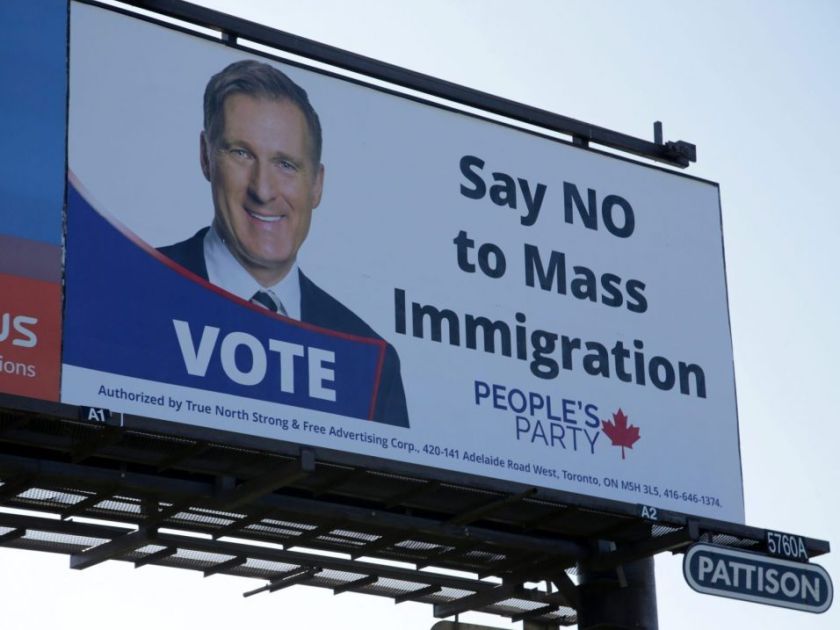
A billboard in Toronto in 2019, showing PPC leader Maxime Bernier and an official-looking PPC message.
Photo from The Provincehttps://theprovince.com/opinion/columnists/gunter-berniers-legitimate-position-on-immigration-taken-down-by-spineless-billboard-company/wcm/ecab071c-b57d-4d93-b78c-274de524434c

A majority of Canadians now seem to think that immigration is too high, according to a recent Nanos poll. Of respondents, 53 per cent said that the government’s plan to accept 465,000 new permanent residents was too high. It’s a sharp turnaround from just a few months prior, when a similar Nanos poll in March found that only 34 per cent of Canadians thought immigration was too high.

Canada has long been one of the most pro-immigration countries on earth, and since at least the 1990s the mainstream Canadian position on immigration levels was that they were just fine. On the eve of Justin Trudeau’s election as prime minister in 2015, an Environics poll found that a decisive 57 per cent of Canadians disagreed with any notion that there is “too much immigration in Canada.”

But if this sentiment is changing, it might be because Ottawa has recently dialled up immigration to the highest levels ever seen in Canadian history. Below, a quick guide to just how many people are entering Canada these days.

Immigration is nearly double what it was at the beginning of the Trudeau government (and way more when you count “non-permanent” immigrants)

In 2014 — the last full year before the election of Justin Trudeau — Canada brought in 260,404 new permanent residents. This was actually rather high for the time, with Statistics Canada noting it was “one of the highest levels in more than 100 years”.

But last year, immigration hit 437,180, and that’s not even accounting for the massive spike in “non-permanent” immigration. When the estimated 607,782 people in that category are accounted for, the Canadian population surged by more than one million people in a single calendar year. Representing a 2.7 per cent annual rise in population, it was more than enough to cancel out any per-capita benefits from Canada’s GDP rise for that year.

It’s about on par with the United States (a country which is eight to 10 times larger)

Proportionally, Canada has long maintained higher immigration than the United States. But in recent months immigration has gotten so high that Canada is even starting to rival the Americans in terms of the raw number of newcomers.

Last year, while Canada marked one million newcomers, the U.S. announced that its net international migration was about the same. Given the size of the U.S. (331 million vs. 40 million in Canada), this means that Canada is absorbing migrants at a rate more than eight times that of the Americans.

When these trends first began showing themselves in early 2022, CIBC deputy chief economist Benjamin Tal credited it with driving down Canadian wage growth. “The last time I checked, the U.S. is 10 times larger than we are,” he said.

September 13, 2023

“It is premature to write the epitaph for a politician that has defied gravity as many times as Justin Trudeau”

Filed under: Cancon, Media, Politics — Tags: , , , — Nicholas @ 03:00

I have to admit that Justin Trudeau is a very talented political campaigner and Canadian politicians always need to take that into account in dealing with him. I’m very much not a fan, but he has accomplished something I didn’t think was possible — his efforts in office have persuaded me to move Pierre Trudeau down to second-place in my personal list of “Worst Prime Ministers of Canada”:

For the longest time, Justin Trudeau was the party’s best asset. It didn’t matter if the Liberals trailed the Conservatives by a few points, the prime minister was viewed by Canadians as the best choice to continue to lead the country when compared to the other party leaders.

That hope now lies in tatters. Trudeau now trails Pierre Poilievre by double digits for preferred prime minister. More importantly, Trudeau trails his party on the generic (“who would you vote for?”) ballot question by nine points. What this means in plain language is that a significant number of people are still willing to vote for the Liberals, even though they no longer believe that Justin Trudeau is the best candidate to be prime minister. In only one demographic — women over the age of 55 — does the prime minister lead Poilievre. More importantly for Trudeau, only 45 per cent of Liberals believe he would make the best prime minister; 77 per cent of Conservatives believe the same thing about Poilievre.

For the first time in his decade as leader, Justin Trudeau is a drag on the Liberal Party of Canada.

This has been wondered about for months. I have always believed that Trudeau gave the party a better chance of success in the critical places in which it absolutely must win (in Quebec, in the B.C. Lower Mainland and in the GTA) than any other hypothetical leader would. He is a uniquely talented political campaigner. He went from third to first in the campaign in 2015, he recovered from a blackface scandal that would have ended a lesser campaigner in 2019, and he almost-single-handedly saved a Liberal campaign in 2021 that fell flat out of the gate and needed almost three weeks to find anything that even remotely resembled a coherent message.

That was then, though, and today, this is the longest and most significant stretch of time since election night in 2015 where Trudeau has been a personal liability for Liberals. This is a massive change that I’m not sure the public, and even many Liberals, have fully appreciated.

There is still an argument to be made, even at this late stage, that Trudeau remains the sole unifying force for a party whose main objective is the pursuit of power. That he is the only leader capable of forging the fractured elements of the current Liberal coalition together. You could convince me of these arguments.

September 12, 2023

Justin Trudeau should just stay away from India … it’s an ill-omened place for him

Filed under: Cancon, India, Media, Politics — Tags: , , , , , , — Nicholas @ 05:00

Paul Wells on the latest subcontinental pratfall of Prime Minister Look-At-My-Socks:

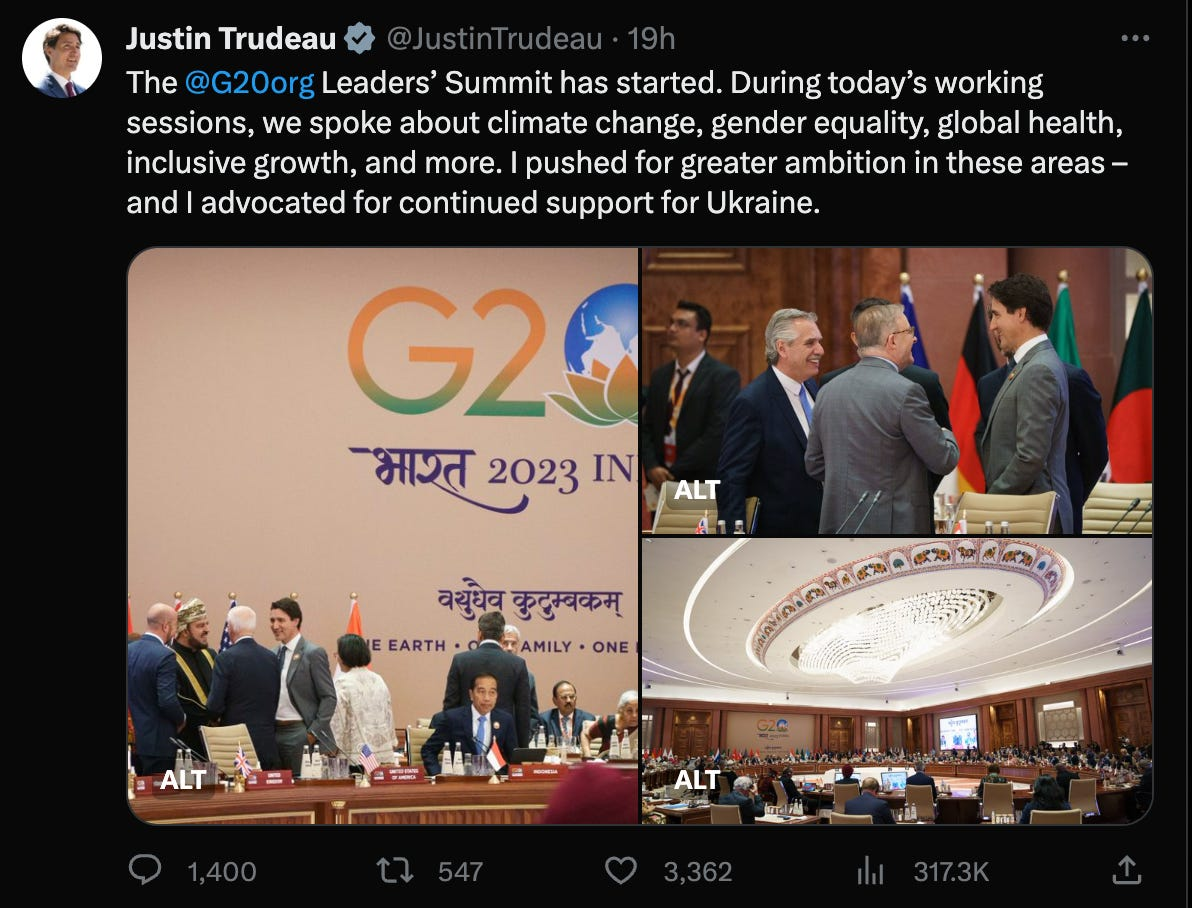
Later, word came from India that Justin Trudeau’s airplane had malfunctioned, stranding him, one hopes only briefly. It’s always a drag when a politician’s vehicle turns into a metaphor so obvious it begs to go right into the headline. As for the cause of the breakdown, I’m no mechanic, but I’m gonna bet $20 on “The gods decided to smite Trudeau for hubris”. Here’s what the PM tweeted or xeeted before things started falling off his ride home:

One can imagine the other world leaders’ glee whenever this guy shows up. “Oh, it’s Justin Trudeau, here to push for greater ambition!” Shall we peer into their briefing binders? Let’s look at Canada’s performance on every single issue Trudeau mentions, in order.

On climate change, Canada ranks 58th of 63 jurisdictions in the global Climate Change Performance Index. The country page for Canada uses the words “very low” three times in the first two sentences.

On gender equality, the World Economic Forum (!) ranks Canada 30th behind a bunch of other G-20 members.

On global health, this article in Britain’s BMJ journal calls Canada “a high income country that frames itself as a global health leader yet became one of the most prominent hoarders of the limited global covid-19 vaccine supply”.

On inclusive growth, the United Nations Conference on Trade and Development has a composite indicator called the Inclusive Growth Index. Canada’s value is 64.1, just behind the United States (!) and Australia, further behind most of Europe, stomped by Norway at 76.9%.

On support for Ukraine, the German Kiel Institute think tank ranks Canada fifth in the world, and third as a share of GDP, for financial support; and 8th in the world, or 21st as a share of GDP, for military support.

Almost all of these results are easy enough to understand. A small number are quite honourable. But none reads to me as any kind of license to wander around, administering lessons to other countries. I just finished reading John Williams’ luminous 1965 novel about university life, Stoner. A minor character in the book mocks the lectures and his fellow students, and eventually stands unmasked as a poser who hasn’t done even the basic reading in his discipline. I found the character strangely familiar. You’d think that after nearly a decade in power, after the fiascos of the UN Security Council bid, the first India trip, the collegiate attempt to impress a schoolgirl with fake trees, the prime minister would have figured out that fewer and fewer people, at home or abroad, are persuaded by his talk.

But this is part of the Liberals’ problem, isn’t it. They still think their moves work. They keep announcing stuff — Digital adoption program! Growth fund! Investment tax credits! Indo-Pacific strategy! Special rapporteur! — and telling themselves Canadians would miss this stuff if it went away. Whereas it’s closer to the truth to say we can’t miss it because its effect was imperceptible when it showed up.

In a moment I’ve mentioned before because it fascinates me, the Liberals called their play a year ago, as soon as they knew they’d be facing Pierre Poilievre. “We are going to see two competing visions,” Randy Boissonault said in reply to Poilievre’s first Question Period question as the Conservative leader. The events of the parliamentary year would spontaneously construct a massive contrast ad. It was the oldest play in the book, first articulated by Pierre Trudeau’s staff 50 years ago: Don’t compare me to the almighty, compare me to the alternative. It doesn’t work as well if people decide they prefer the alternative. It really doesn’t work if the team running the play think it means, “We’re the almighty”.

Why Mark Steyn stopped marking the 9/11 anniversary

Filed under: History, Media, Military, Politics, USA — Tags: , , , , , — Nicholas @ 03:00

His reasoning makes a lot of sense:

For most of the last two decades we have observed the anniversary of 9/11 by re-posting my columns from the first few days of the new era. We ceased to do so after September 11th 2017 when “a president who, on the campaign trail, mocked his predecessor’s inability to use the words ‘radical Islam’ himself eschewed all mention of the I-word” — and a defense secretary laughably hyped as Mad Dog Mattis turned out to be just another dribbler from the Washington Generals and retreated to the madrassah wing of the Pentagon to explain that it was all just a theological misunderstanding.

We shall not resume our anniversary observances today. The war is lost, at home and abroad. On the domestic front, we doubled the rate of Muslim immigration to the west and began assimilating ourselves with Islam’s strictures on freedom of expression and the like. The decade-and-a-half since the Danish Mohammed cartoons has been one long remorseless surrender on core western liberties. When a school teacher gets beheaded in the street, there is no outrage at the act, just a mild regret that he should have been foolish enough to provoke his own fate. Even the milder jests from the immediate post-9/11 era — the cartoon of the woman trying on new burqas in the changing room and wondering, “Does my bomb look big in this?” — would not be published today.

In the broader society, our rulers quickly determined that it was easier to punish us than our enemies. The post-9/11 security state surely helped soften up western populations for the ChiCom-19 lockdowns, in which entire nations have been reduced to TSA-administered airports.

As for the war overseas, it ended with a military that can do everything except win handing the keys to Afghanistan back to the guys who pulled off 9/11 — and apologizing for the two-decade inconvenience by gifting the mullahs with some of the most expensive infrastructure on the planet plus an air force, approximately five assault rifles for every Taliban fighter, and express check-in for the forty-seven per cent of the Afghan population that apparently served as US translators.

The position of the United States is far weaker than it was twenty years ago. Around the planet, the assumption of friends and enemies alike is that the American moment is over and the future belongs elsewhere. They are making their dispositions accordingly. It is not a question of wishing “the post-American world”, but of accepting the known facts.

September 9, 2023

The US military’s recruiting crisis

Filed under: History, Military, Politics, USA — Tags: , , — Nicholas @ 05:00

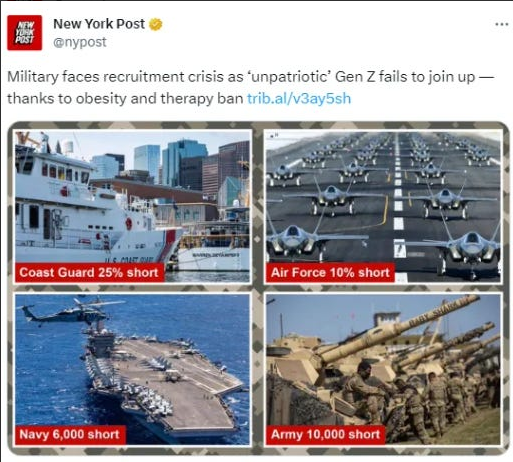
As I joked earlier this year after one or another of the US services reported falling significantly short of their recruiting goal, “I find this hard to believe now that Uncle Sugar is not only willing to fund your gender transition, but will then guarantee that you won’t be sent into a combat zone.” Kulak has been reading some histories of the 20th century and was surprised to find that the recruiting problem faced by most military organizations in that time was having too many good recruits:

This was after WW1! Millions of young men had just died as part of regiments many little different than this. And yet there was this much demand from young men to be part of the martial world.

This is because the Military and military life was ACTUALLY a good career move, and ACTUALLY formed life long bonds in the early 20th century.

Amidst the population boom of the early 20th century and all the excess young men with little inheritance… the military and militia life was a major vehicle for social mobility and aspiration and forming social connections…

So what changed? Why is it almost completely the opposite in early 21st century America?

These attitudes survived the world wars, even the western front of WW1 …

But they were devoured by Vietnam and the Civil Rights era.

Implicit in a lot of 19th and 20th century militarism was the vision of “Every Soldier a Citizen, Every Citizen a Soldier” this ethos was first expressed during the french revolution … It was aspirational. The subjects divorced from the state and military were now armed and able to participate in civic and military life, they were now citizens … of course by the early 20th century this sounds very menacing… Soldiers must obey orders, every day … if every citizen is a soldier, and bound to obey, on pain of death, that’s Totalitarianism.

You can make a strong case that US military recruiting never fully recovered from the Vietnam era, even through the temporary boost of the post-9/11 patriotic rush.

America has gone from over 1% of the population actively serving at any one time to nearly a third of that.

The “Professionalization” of the US military to an “All Volunteer force” has in effect just been a cover for this collapse in recruiting capacity.

America’s military isn’t significantly structurally different. These aren’t really professionals.

Your average 3 year contract private isn’t making some obscene Yuppie amount of money for his ambitious professional commitment. A private makes under 30k a year. A Second Lieutenant, with a university degree and years of professional development, who may have had to plan out his career from 16 years old getting a Congressman’s letter of recommendation to attend West Point or another service academy … Makes 40-60k a year.

US GDP per capita is 72k. If that Lieutenant had gone to a second tier school and gotten a Computer Science degree he’d be making 6 figures and have vastly more control over his life.

It’s not a good career move, in the 1780s or 1900s and ambitious scion of a decayed noble family desiring to conquer the world might want to become an artillery officer… Today he wants to work on wall street or at Google.

Even if you’re starting out from a very rough place there ar almost certainly a dozen better things you could do to advance yourself faster, for better money, and with less effort than joining the Military.

The only appeal of the US military, for decades now, has been to people who really want to escape their situation, who really felt they needed to hard reboot their life, or who are really drawn to military life out of sheer love of it.

And then the Army went woke.

The long-serving senior officers of every branch of the US military are now locked in to pushing diversity in all its manifold ways, to the point of knowingly discouraging non-diverse service members out of the way to make room for this month’s gender, racial, or other quotas.

So America’s effective recruitment capacity and civic feeling will continue to collapse even as Americans hate each other and their government even more.

You think recruit capacity is bad now? Wait til they imprison Trump.

The Republican race – “There don’t seem to be a lot of takers for ‘pretending this is normal'”

Filed under: Media, Politics, USA — Tags: , , , , , — Nicholas @ 03:00

Mark Steyn on the establishment GOP’s attempt to run the 2024 campaign as though nothing has changed other than the calendar:

I mentioned on Monday that on his long-running Radio Derb John Derbyshire drew his listeners’ attention to an observation of yours truly:

    I can’t improve on Steyn — nobody can — so I’ll just quote him from that piece.

I always feel Derb thinks I’m a bit of a pantywaist on the hardcore issues, but in today’s America even a reasonably sentient pantywaist should be able to get to the nub of the issue. Here’s the bit Derb quoted:

    So two years later the American Right still talks about the justice system and the election campaign as if either term means what it does in functioning societies. As I said above, I don’t intend to comment on this week’s Trump indictment either, nor do I wish to talk about who would make the best president, who has the best platform, who has the skill-set to implement the platform … That would be all well and good if we were in, say, France, but, when the dirty stinking rotten corrupt U.S. justice system is criminalizing political opposition, there’s no point pretending this is a normal situation, right?

“There’s no point pretending this is a normal situation, right?” And yet at least three-quarters of the candidates in that Republican debate insisted on doing just that: This is just a normal quadrennial election in the greatest country in the history of countries where we’re renowned around the planet for our uniquely peaceful “peaceful transfer of power”, etc, etc.

Sorry, I don’t buy that — and evidently nor does the GOP base. Which is why Trump has a forty-point lead over his nearest rival, and Nikki Haley’s alleged triumph on stage in that debate has seen her numbers soar to — stand well back!6.1 per cent. The avowedly normal vice-president, senator and three governors nipping at her heels can barely muster ten percent between them. There don’t seem to be a lot of takers for “pretending this is normal”.

John Derbyshire quoted me in the context of the latest sentences on the January 6th “insurrectionists”. Dominic Pezzola broke a window at the Capitol and was given ten years; the government had asked for twenty. Joseph Biggs moved a crowd-control barrier and was sentenced to seventeen years; the government had wanted him banged up for thirty-three.

So the prosecutors and the judges seem to have reached a cozy understanding that, whatever sentence the former demand, the Court will be totally reasonable and cut in half. You want another? The feds demanded thirty years for Zachary Rehl; the judge gave him fifteen. And this is after two-and-a-half years in gaol awaiting their “constitutional right” (don’t wave that constitution at me!) to a speedy trial.

Oops, wait, I spoke too soon. The US Attorney wanted thirty-three years for Proud Boys leader Enrique Tarrio, but this time the judge decided to up it to two-thirds of the feds’ demand: twenty-two years. For a guy who wasn’t in Washington on January 6th.

All this of course in an ugly and violent land where actual career criminals who like to beat up disabled women with their own canes have the run of the playground. And with the connivance and support of the Democrat Party, even when very occasionally it all goes wrong for one of their own.

Oh, well. Mr Tarrio is a Proud Boy. I’m not really a Proud Boys type, if only because their founder, Gavin McInnes, has been a bit of an arse about me re Cockwombling Cary Katz and the CRTV cases. Still, I’m all about first principles — and a decade for breaking a window is not, even by lousy American standards, the verdict of a “justice” system.

September 8, 2023

The legacy media really value Conservative gab-fests like the current CPC convention

Filed under: Cancon, Media, Politics — Tags: , , , , — Nicholas @ 04:00

Chris Selley explains why the fringe views of obscure Conservative riding associations get so much more juice in the legacy media than equivalent brain-farts from Liberal or NDP groups:

Whatever lands in your news hole from the Conservative Party of Canada convention, which kicks off Thursday night in Quebec City, it’s a safe bet you’ll hear the result of the vote on Policy Resolution 1258. Sponsored by the North Okanagan—Shuswap riding association, it reads, in part, as follows: “A Conservative government will protect children by prohibiting life-altering medicinal or surgical interventions on minors under 18 to treat gender confusion or dysphoria”.

Needless to say this hasn’t gone down very well at the Ottawa press club, where discussion generally confines itself to two countries. “The pitch is similar to ones found across the United States, including in Florida where Gov. Ron DeSantis signed a bill in May banning gender-affirming care for transgender youth,” the increasingly breathless Canadian Press reported. “(It’s) a move many health professionals, parents and advocates of LGBTQS+ youth says places them at greater risk for suicide and depression.”

This is a distraction that leader Pierre Poilievre really doesn’t need. As I wrote last week, on the question of how schools should treat children who wish to change name or gender at school even quite reasonable policies can receive extraordinarily negative press if they are perceived to have been drafted by intolerant people. It’s as if the policies, reasonable on paper, might have some kind of cooties that could harm the children they affect. (That said, in some cases journalists and commentators don’t even seem to have read the policies in question.)

Policy Resolution 1258, like New Brunswick’s and Saskatchewan’s supposedly extreme “social transitioning” policies, isn’t at all extreme by world standards. Gender issues have enflamed the American culture wars, true enough — at last count 19 states, including Florida, had implemented new rules on “gender-affirming care” for kids (and in some cases adults). Naturally Canadian conservatives are watching, some approvingly.

So the legacy media loves intramural disputes within parties on the right, both because it gives them interesting things to report and pontificate about, and also because as a class, journalists tend to skew very heavily progressive. This leads naturally to a difference between how Conservative fringe opinions and progressive fringe opinions are treated in the media.

Especially for a neutral like myself, and especially given how much power party leaders have amassed relative to everyone else, there is a certain pleasure in making a party leader squirm. In the often hidebound and unimaginative world of Canadian politics, that can have benefits. These resolutions often serve as a sort of conscience-check for the party in question: Why aren’t the Liberals liberal enough? Why aren’t the Conservatives conservative enough? Sometimes the party even listens.

That said, I have no idea why parties inflict this on themselves. Mostly these resolutions just stir up trouble. Opposition parties and media alike use these resolutions to craft the dastardly narratives of their choice. The Conservatives in particular suffer from this, and in particular from the Ottawa media.

When the Conservatives ran advertisements claiming the Liberal government wanted to legalize hard drugs — a 2018 policy resolution brought forward by the caucus itself — CTV News declared the ads objectively “false.” The Liberals routinely chuck overboard progressive-minded proposals that come from the party’s left — on legalizing prostitution, for example, or electoral reform — and they’re never heard about again.

The Conservatives’ more right-wing policy proposals seem to get chucked into a giant narrative cauldron and fished out by reporters whenever necessary to prove that there is, in fact, a narrative that needs propagating: on abortion, on climate change, on euthanasia, on gender dysphoria, you name it, and no matter what the leader of the day — the guy everyone knows is in charge — might say.

UN official denounces Canada’s migrant worker program as a “form of slavery”

Filed under: Cancon, Government, Media, Politics — Tags: , , , , — Nicholas @ 03:00

That this scathing report made it to the CBC’s website must really hurt for the federal government, who have a collective “white saviour” complex about their immigration stance:

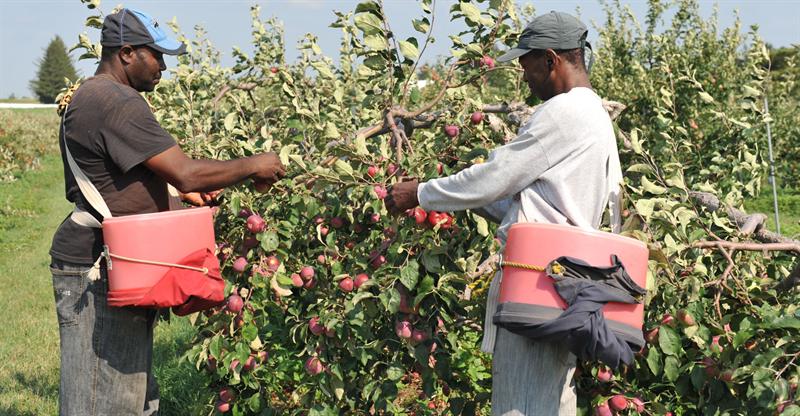
Temporary foreign workers picking fruit in a Canadian orchard.
Image from http://www.yorkfeed.com/apple-picking-urgently-canada/

A United Nations official on Wednesday denounced Canada’s temporary foreign worker program as a “breeding ground for contemporary forms of slavery”.

Tomoya Obokata, UN special rapporteur on contemporary forms of slavery, made the comments in Ottawa after spending 14 days in Canada.

“I am disturbed by the fact that many migrant workers are exploited and abused in this country,” he said.

“Agricultural and low-wage streams of the temporary foreign workers program constitute a breeding ground for contemporary forms of slavery.”

Obokata’s comments echo those of Jamaican migrant workers who, in an open letter to their country’s ministry of labour last month, described their working conditions in Ontario as “systematic slavery”.

The special rapporteur role was created by the UN in 2007. Its mandate includes investigating and advocating against forced or coerced labour.

Obokata said migrant workers face deportation if they lose their work permits, which also prevent them from changing employers if they face abuse.

“This creates a dependency relationship between employers and employees, making the latter vulnerable to exploitation,” he said, adding that many workers are reluctant to report abuse because they fear losing their permits.

Thousands of workers come to Canada each year to work through the program. Statistics Canada estimates that temporary foreign workers make up 15 per cent of Canada’s agricultural workforce.

The system came under scrutiny during the pandemic. Auditor General Karen Hogan reported in 2021 that the federal government did not do enough to ensure those workers were being protected.

Obokata said he spoke with a number of migrant workers who described having to work excessive hours with no access to overtime pay, being denied access to health care and being forced to live in cramped and unsanitary living conditions.

September 7, 2023

The not-at-all hidden authoritarian desires of the climate activists

Brendan O’Neill on the increasingly blatant wish of the comfortable greenies to impose actual judicial punishment on those who disagree with their agenda:

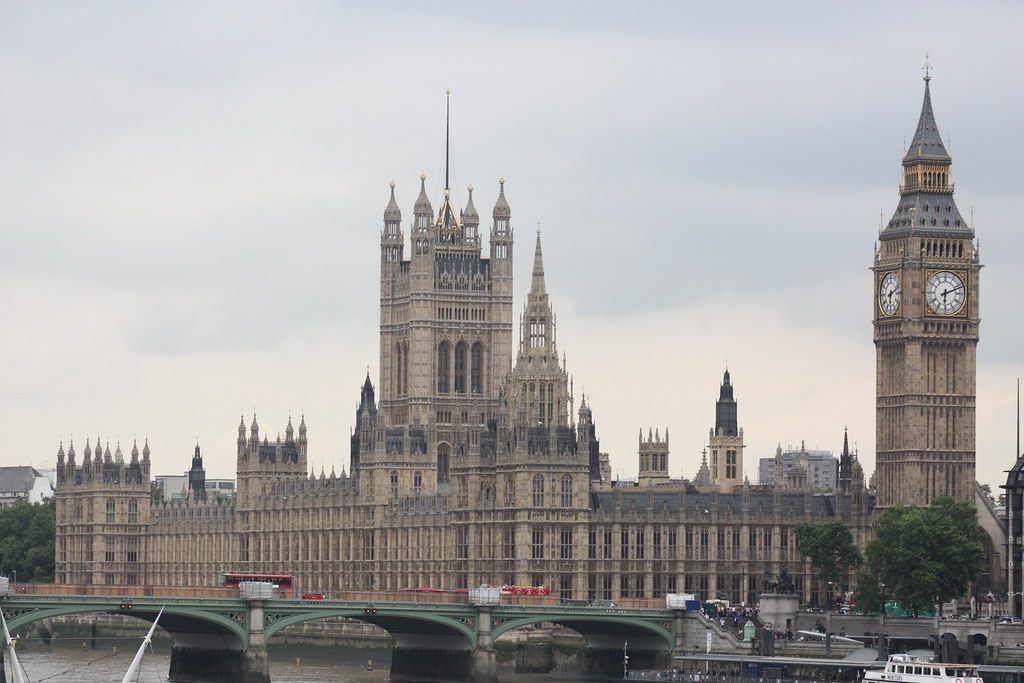
Greens have been dreaming about jailing “climate criminals” for a very long time. Climate-change deniers in particular will “one day have to answer for their crimes”, said eco-author Mark Lynas a few years back. Well, Gaia’s authoritarian army might finally be getting its way. The new Energy Bill currently before the UK House of Commons provides for “the creation of criminal offences”, possibly including jail time, where there is “non-compliance” with energy-saving regulations. Shorter version: keep the lights on for too long and you could end up in the slammer.

The Telegraph is reporting that property owners who fail to adhere to “energy-performance regulations” could “face prison” under the government’s crazy plans. There is concern that homeowners, landlords and business bosses could be whacked with fines of up to £15,000 or a year behind bars if they fall foul of regulations on energy consumption. The government says it has no plans to make it a crime to be an eco-unfriendly user of light and heat, but the bill allows for the creation of such crimes. And this has rattled some MPs. They’re concerned that ministers would be able to “create new offences with limited parliamentary scrutiny” thanks to the new bill.

What is the aim of all this tightening of the screws on energy use? Of the possible future criminalisation of us thieves of heat and light? To help Britain reach its Net Zero targets, of course. Like other Western nations, we’re committed to achieving Net Zero emissions by 2050. And if that means strongarming the little folk into reducing their energy use, so be it. Let’s be clear about what the new bill’s provision for the creation of crimes really represents: the state threatening to punish anyone who refuses to convert to the religion of Net Zero and to sacrifice their energy to the jealous god of environmentalism.

We can now see the iron fist in the green glove. There’s been a creeping criminalisation of eco-disobedient behaviour for some time now. In the UK, we’ve had “rubbish police” looking through people’s bags of trash and slapping them with a £100 fine if they are not properly recycling plastic and paper. Under Low Traffic Neighbourhood schemes, officious local councils erect eyesore bollards to stop people from driving on certain roads, and fine them if they fail to comply. In recent years, more than a million such fines have been served on defiers of the LTN regime, raising more than £100million for the Net Zero cultists who rule over us.

Then there’s London mayor Sadiq Khan’s Ultra Low Emission Zone (ULEZ), now expanded to cover every inch of London. Hundreds of cameras have been installed across the capital, a vast infrastructure of Stasi-like watchmen, to ensure that drivers of “dirty” vehicles have paid the daily ULEZ toll of £12.50. A fine of £500 awaits any driver of a sinful car who hasn’t. To those saying “Of course the government isn’t going to fine people for un-green behaviour!”, wake up – officialdom has been doing this for years.

September 6, 2023

Some key planks from Scott Alexander’s presidential platform

I was a bit surprised to find that Scott Alexander has decided to toss his hat into not one, but two party primaries for the 2024 presidential nomination:

The American people deserve a choice. They deserve a candidate who will reject the failed policies of the past and embrace the failed policies of the future. It is my honor to announce I am throwing my hat into both the Democratic and Republican primaries (to double my chances), with the following platform:

Ensure Naval Supremacy And Reduce Wealth Inequality By Bringing Back The Liturgy

The liturgy was a custom of ancient Athens. When the state needed something (usually a new warship) it would ask for volunteers among its richest citizens. Usually one would step up to gain glory or avoid scorn; if nobody did, the courts were allowed to choose the richest person who hadn’t helped out recently. The liturgist would fund the warship and command it as captain for two years, after which his debt to the state was considered discharged and he was given a golden crown. Historians treat the liturgy as a gray area between voluntary service and compulsory taxation; most rich Athenians were eager to serve and gain the relevant honor, but they also knew that if they didn’t, they could be compelled to perform the same service with less benefit to their personal reputation.

Defense analysts warn that America’s naval dominance is declining:

    Only 25 per cent of America’s 114 commissioned surface combatants (cruisers, destroyers, and littoral combat ships) are less than a decade old. By comparison more than 80 per cent of China’s 141 destroyers, frigates, and corvettes have been commissioned in the past decade. In the same time period, the United States commissioned 30 surface combatants … The nearly 600-ship Navy of the late 1980s deployed only 15 per cent of the fleet on average. Today, with fewer than 300 ships, the US Navy deploys more than 35 per cent to service its global missions, contributing to a material death spiral.

So America is short on warships. But it is very long on rich people with big egos. An aircraft carrier would cost the richest American billionaires about the same fraction of their wealth as a trireme cost the richest Athenian aristocrats. So I say: bring back the liturgy!

The American rich already enjoy spending their money on exciting vehicles — yachts for the normies, rockets for the more ambitious, Titanic submersibles for the suicidal. Why not redirect this impulse towards public service? Imagine the fear it would strike into the hearts of the Chinese when the USS Musk enters Ludicrous Mode in the waters off the Taiwan Strait, with Elon himself at the wheel. Imagine how efficiently the USS Jeff Bezos will deliver its payloads! And does anyone doubt that billionaires – usually careful to avoid taxes — will jump at the chance to do this?

The Athenians had a parallel liturgy for rich people who would select and sponsor theater productions, but I think we can skip this one for now.

[…]

Legalize Lying About Your College On Resumes

Colleges trap Americans in a cycle of burdensome loans and act to reinforce class privilege. I have previously advocated making college degree a protected characteristic which it is illegal to ask people about on job applications. But this would be hard to enforce, and people would come up with other ways to communicate their education level.

So let’s think different: let’s make it legal to lie about your college on resumes (it is already not technically illegal to lie on a resume, but companies can ask for slightly different forms of corroboration which it is illegal to lie on). Everyone can just say “Harvard”, and nobody will have any unfair advantage over anyone else.

Start An Internet-Pop-Up Trade War With The European Union

For too long, Americans have groaned under the weight of foreign cookie-related-pop-ups which they and their elected representatives have no control over. It’s time to fight back.

When I am elected, I will mandate that all American websites serve popups to European Union residents explaining why the GDPR is annoying and why it affects even Americans who have no say in it. If the Europeans want to be able to access Google, Facebook, Twitter, or any other US-based site without clicking “I understand” every time they reload it, they’ll have to pressure their government to do something about GDPR.

Appoint Donald Trump Constitutional Monarch

This would require a constitutional amendment, but I’m sure I could convince enough people.

The British experience suggests that the role of a constitutional monarch is to flaunt how rich they are, get 24-7 news coverage regardless of whether or not they do anything interesting, and have scandals. Donald Trump is the best person in the world at all three of these things

Trump wants to be on top, but is not that interested in governing. Meanwhile, American liberals (by revealed preference) want to continue thinking about him every hour of every day forever, but also don’t want him to govern. Constitutional monarchy would satisfy everyone’s preferences. If Trump is destined to destroy democracy — and everyone agrees that he is — let’s make it happen as gently and non-destructively as possible.

Obviously the royal family can’t participate in regular electoral politics, which means no Trump would ever be able to run for office ever again. This is the only way we are ever getting rid of them, you know this is true, please don’t throw away this chance.

I would support reverse primogeniture-based inheritance — ie the youngest son takes the throne — just so we can have a “King Barron”.

“[T]he preemptive hype about [Bottoms] has been fundamentally false, fundamentally dishonest about what constitutes artistic risk and personal risk in 2023″

Filed under: Media, Politics, USA — Tags: , , , , , — Nicholas @ 04:00

Freddie deBoer — whose new book just got published — considers the way a new movie is being marketed, as if anything to do with LGBT issues is somehow still “daring” or “risky” or “challenging” to American audiences in the 2020s:

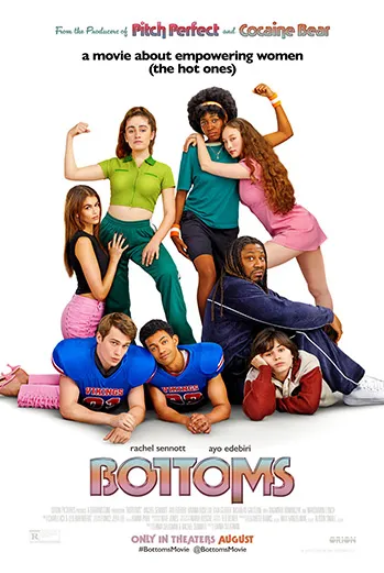
Consider this New York magazine cover story on the new film Bottoms, about a couple of lesbian teenagers (played by 28-year-olds) who start a high school fight club in order to try and get laid. I’m interested in the movie; it looks funny and I’ll watch it with an open mind. Movies that are both within and critiques of the high school movie genre tend to be favorites of mine. But the preemptive hype about it — which of course the creators can’t directly control — has been fundamentally false, fundamentally dishonest about what constitutes artistic risk and personal risk in 2023. The underlying premise of the advance discussion has been that making a high school movie about a lesbian fight club, today, is inherently subversive and very risky. And the thing is … that’s not true. At all. In fact, when I first read the premise of Bottoms I marveled at how perfectly it flatters the interests and worldview of the kind of people who write about movies professionally. As New York‘s Rachel Handler says,

    [Bottoms has] had the lesbian Letterboxd crowd, which treats every trailer and teaser release like Gay Christmas, hot and bothered for months. After attending its hit SXSW premiere, comedian Jaboukie Young-White tweeted, “There will be a full reset when this drops.”

And yet to read reviews and thinkpieces and social media, you’d think that Bottoms was emerging into a culture industry where the Moral Majority runs the show. One of the totally bizarre things about contemporary pop culture coverage is that the “lesbian Letterboxd crowd” and subcultures like them — proud and open and loud champions of “diversity” in the HR sense — are prevalent, influential, and powerful, and yet we are constantly to pretend that they don’t exist. To think of Bottoms as inherently subversive, you have to pretend that the cohort that Handler refers to here has no voice, even as its voice is loud enough to influence a New York magazine cover story. This basic dynamic really hasn’t changed in the culture business in a decade, and that’s because the people who make up the profession prefer to think of their artistic and political tastes as permanently marginal even as they write our collective culture.

Essentially the entire world of for-pay movie criticism and news is made up of the kind of people who will stand up and applaud for a movie with that premise regardless of how good the actual movie is. And I suspect that Rachel Handler, the author of that piece, and its editors at New York, and the PR people for the film, and the women who made it, and most of the piece’s readers know that it isn’t brave to release that movie, in this culture, now. And as far as the creators go, that’s all fine; their job isn’t to be brave, it’s to make a good movie! They aren’t obligated to fulfill the expectation that movies and shows about LGBTQ characters are permanently subversive. But the inability of our culture industry to drop that narrative demonstrates the bizarre progressive resistance to recognizing that things change and that liberals in fact control a huge amount of cultural territory.

And here’s the thing: almost everybody in this industry, in media, would understand that narrative to be false, were I to put the case to them this way. This obviously isn’t remotely a big deal — in fact I’ve chosen this piece and topic precisely because it’s not a big deal — and I’m sure most people haven’t thought about it at all. (Why would they?) Still, if I could peel people in professional media off from the pack and lay this case out to them personally, I’m quite certain many of them would agree that this kind of movie is actually guaranteed a great deal of media enthusiasm because of its “representation”, and thus is in fact a very safe movie to release in today’s Hollywood — but they would admit it privately. Because “Anything involving LQBTQ characters or themes is still something that’s inherently risky and daring in the world of entertainment and media, in the year of our lord 2023” is both transparently horseshit and yet socially mandated, in industries in which most people are just trying to hold on and don’t need the hassle.

“[W]hy does the press focus so intently on climate change as the root cause? … it fits a simple storyline that rewards the person telling it”

Filed under: Environment, Media, Politics, USA — Tags: , , , , , — Nicholas @ 03:00

Patrick T. Brown in The Free Press on how he had to leave out the full truth on climate change to get his paper published:

If you’ve been reading any news about wildfires this summer — from Canada to Europe to Maui — you will surely get the impression that they are mostly the result of climate change.

Here’s the AP: Climate change keeps making wildfires and smoke worse. Scientists call it the “new abnormal”.

And PBS NewsHour: Wildfires driven by climate change are on the rise — Spain must do more to prepare, experts say.

And The New York Times: How Climate Change Turned Lush Hawaii Into a Tinderbox.

And Bloomberg: Maui Fires Show Climate Change’s Ugly Reach.

I am a climate scientist. And while climate change is an important factor affecting wildfires over many parts of the world, it isn’t close to the only factor that deserves our sole focus.

So why does the press focus so intently on climate change as the root cause? Perhaps for the same reasons I just did in an academic paper about wildfires in Nature, one of the world’s most prestigious journals: it fits a simple storyline that rewards the person telling it.

The paper I just published—”Climate warming increases extreme daily wildfire growth risk in California” — focuses exclusively on how climate change has affected extreme wildfire behavior. I knew not to try to quantify key aspects other than climate change in my research because it would dilute the story that prestigious journals like Nature and its rival, Science, want to tell.

This matters because it is critically important for scientists to be published in high-profile journals; in many ways, they are the gatekeepers for career success in academia. And the editors of these journals have made it abundantly clear, both by what they publish and what they reject, that they want climate papers that support certain preapproved narratives — even when those narratives come at the expense of broader knowledge for society.

To put it bluntly, climate science has become less about understanding the complexities of the world and more about serving as a kind of Cassandra, urgently warning the public about the dangers of climate change. However understandable this instinct may be, it distorts a great deal of climate science research, misinforms the public, and most importantly, makes practical solutions more difficult to achieve.

[…] as the number of researchers has skyrocketed in recent years — there are close to six times more PhDs earned in the U.S. each year than there were in the early 1960s — it has become more difficult than ever to stand out from the crowd. So while there has always been a tremendous premium placed on publishing in journals like Nature and Science, it’s also become extraordinarily more competitive.

In theory, scientific research should prize curiosity, dispassionate objectivity, and a commitment to uncovering the truth. Surely those are the qualities that editors of scientific journals should value.

In reality, though, the biases of the editors (and the reviewers they call upon to evaluate submissions) exert a major influence on the collective output of entire fields. They select what gets published from a large pool of entries, and in doing so, they also shape how research is conducted more broadly. Savvy researchers tailor their studies to maximize the likelihood that their work is accepted. I know this because I am one of them.

« Newer PostsOlder Posts »

Powered by WordPress