Quotulatiousness

December 9, 2024

“… liberalism has become a political ideology that is utterly incapable of policing itself for its own worst excesses”

Filed under: Media, Politics, USA — Tags: , , , , , — Nicholas @ 03:00

Freddie deBoer patiently explains why outrageous over-the-top emoting isn’t a useful or productive way to argue for your political views:

I’ve written several times about the phenomenon of adolescent women on TikTok pretending to have dissociative identity disorder for social media clout and attention. I’ve focused on it not because I necessarily think the issue itself is particularly important, but rather because it’s so emblematic of what liberalism has become: a political ideology that is utterly incapable of policing itself for its own worst excesses, a collection of well-intentioned people who mistake the responsibility to fight discrimination for a broad, vague duty to shield certain groups of people from any criticism.

For the book I’m currently writing, I’m talking to a ton of people in the broad world of mental health — psychiatrists, therapists, researchers, policymakers, journalists, fellow patients — and I’ve brought up the TikTok DID community over and over again. Remarkably, not one person defends the phenomenon as a true expression of genuine illness, not even a few disability rights activists I’ve talked to, who usually have an ethic of never questioning a disability claim. Countless normie liberals I’ve chatter with, over the past several years, have also accepted my basic position that these young women don’t actually have dissociative identity disorder. But, also, almost no one is willing to affirmatively say anything about this dynamic themselves. Indeed, The Verge reported that many experts have decided that the costs of speaking out about that whole culture just aren’t worth it. And so you have a set of behaviors that no one defends but that no one feels comfortable criticizing, thanks to the pathologies of 21st century liberalism and online rage. That’s what I’m really here to talk to you about today.

I don’t, of course, want to be too harsh on the individual young women who have turned a debilitating and controversial disorder into an opportunity to put on vertical video fashion shows; they’re just kids and kids do stupid shit, sometimes even genuinely offensive shit. What you usually have, or used to have, is the ability to tell someone doing stupid shit to knock it off. Not oppress anyone, not humiliate anyone, not permanently shun anyone. But just to say, “You don’t have dissociative identity disorder, pretending you do is unhealthy and offensive towards people who actually have serious mental illnesses, knock it off“. I find that very easy to say. But clearly a lot of people don’t, and the reasons are fairly obvious. First, despite whatever vibe shift we may be living through, it remains the case that in progressive discursive spaces, saying the wrong thing is still very fraught and can result in accusations of bigotry that are personally and professionally damaging. Second, liberals have trained themselves to avoid any position at all that might be construed as siding with the enemy, as a matter of in-group identification. Take it from me: “A lot of people in Gen Z appear to be lacking in emotional resilience, in a way that’s unhealthy for them” has become, in the internet-soaked mind, “Gen Z is a bunch of snowflakes”, and so a ton of liberals recoil at that idea. Can’t appear to make a concession to the enemy! I’m afraid we do not have a vocabulary for critical solidarity anymore.

All of this is bad, and you only have to look at how incredibly harsh certain slices of “queer fandom” can be to see what I’m talking about.

December 8, 2024

The potential for retribution in a second Trump presidency

Francis Christian meditates on whether or how President-elect Donald Trump will indulge in eye-for-an-eye revenge against the individuals most clearly involved in the lawfare and other attempts to derail his re-election:

It was the English poet Alexander Pope who admonished us in the manner of the New Testament that “to err is human; to forgive, divine” — Errare humanum est, ignoscere divino.

The Old Testament in contrast, has the equally familiar and perhaps far more popular, “eye for an eye“, and in one of the most revolutionary statements ever uttered, Jesus in the Sermon on the Mount talked about us “having heard that it was said, ‘an eye for an eye’ — but I say unto you, love your enemies“.

To wish to take revenge upon one’s enemies is therefore human, but Jesus is asking mankind to rise above this basic instinct and instead, to forgive and love one’s enemies. This was all of course part of His Mission on earth — to change by His Life, His Cross and the Resurrection, the destiny of human beings from being bound to basic instincts and death — to being bound for eternal life, a different destiny and a new creation.

The mavens of Hollywood of course march to a different and more ancient tune (which has been handed down unchanged to them) and generations of movie goers and consumers of media have been brought up on the idea that revenge of the most explosively visceral kind is a good thing, even a noble thing.

My readers will undoubtedly have their own sincerely held beliefs about Jesus’ command to love our enemies and to do good to those who hate us and once again, I do not wish this essay to turn out to be a sermon! What I wish to address instead, is to ask the question: what is the place for retribution, vengeance and revenge in the conduct of statecraft?

In other words, when President elect Trump said in a recently widely publicized interview that he was, “not looking for retribution, grandstanding or to destroy people who treated me very unfairly“, was he declaring a principle of statecraft that makes for a fulfilling and productive Presidency? And is this also a principle of statecraft that will “make American great again?

In typical, inimitable and endearing Trumpian fashion, the President-elect also added the tongue in cheek comment: “I am always looking to give a second and even third chance, but never willing to give a fourth chance — that is where I hold the line!

It could be argued from the life of no less a colossal figure than Julius Caesar that decisive and devastating revenge upon one’s enemies makes for a strong and respected ruler and nation. Whilst still a private citizen, Julius Caesar was captured by pirates on the way to the Greek island of Rhodes (to which he was travelling in order to learn oratory from the famous professor Molon). Caesar raised his own ransom — then raised a naval force, captured his pirate captors and had them all crucified.

The later assassination of Caesar and the subsequent civil wars that rocked and roiled Rome is the subject of Shakespeare’s magnificent, Tragedy of Julius Caesar. The subsequent rule of Augustus Caesar was marked by stability, expansion of the empire, the building of roads and bridges (via which the Gospel was to travel), the making of sea and land routes safe for travellers (again, to the advantage of the early Christians taking the Gospel to Asia and Europe) the consolidation of Roman power — and the rule of (Roman) law. It was also during the reign of this austere, learned emperor that Jesus was born in a manger, in the Roman province of Palestine.

H/T to Brian Peckford for the link.

Why your landscape photos are boring 🥱

Filed under: Britain, Media — Tags: , , — Nicholas @ 02:00

Yorkshire Photo Walks
Published Jun 9, 2024

In this video Tom outlines a five-step process for turning your landscape photos from flat, boring shots to professional looking images.
(more…)

December 7, 2024

QotD: Game of Thrones as PoMo “deconstructionism”

Filed under: Books, Education, Media, Quotations — Tags: , , , , , — Nicholas @ 01:00

Finally, Game of Thrones. I think it’s the same deal here, the same faux world weary cynicism. I’ve only seen one or two episodes of the show, but I read the first two or three books, up to the point where I realized two things: 1) he has no idea how he’s going to finish the story, and 2) it’s yet more tedious PoMo “deconstruction”.

Again, I guess I can forgive my colleagues, under-sexed little closet cases that they are, for being distracted by the boob cornucopia up on screen, but in the books, anyway, this comes through plain as day: Everyone in Westeros is either a psychopathic scumbag, or dead. In the very best PoMo style, the author is rubbing our faces in his belief that, since it’s extremely difficult to be heroic — or, all too often, merely decent — everyone who even thinks about trying is a fool, and deserves all the awful shit that happens to him. I’m told that back in the 18th century, a fun topic of debate at salons is whether a society of atheists could endure. Martin’s entire oeuvre seems dedicated to proving that life — mere, grubby, eating-shitting-sleeping existence — will continue in a society composed entirely of scumbags … but he has no idea why.

I have no idea why this idea (if that’s the right word) is so deeply appealing to academics, but evidently it is … and these are the people who are teaching your children.

Severian, “The One Pop Culture Thing”, Rotten Chestnuts, 2021-09-16.

December 6, 2024

Hegseth is clearly unfit to be Secretary of Defense because LOOK! A SQUIRREL!

Filed under: Government, Media, Military, Politics, USA — Tags: , , , — Nicholas @ 04:00

I don’t recall having heard Pete Hegseth’s name before Trump nominated him to be the next Secretary of Defense, but Chris Bray clearly thinks the accusations are purely partisan:

Pete Hegseth is being Kavanaughed. And the only people dumb enough to fall for it are Republican senators.

I was willing to hear arguments that Hegseth wasn’t the best choice for Secretary of Defense. In his 40s, he’s on his third marriage, and while the rape allegation from his visit to a conservative conference in Monterey is clearly false, I was wide open to the argument that his actions demonstrated poor judgment. I was prepared to hear an argument. Like many combat veterans, Hegseth had some post-war chaos in his life. Discussion was merited.

But the more these arguments have been made, the dumber they’ve become. We’ve seen this play, and we know the third act: more heat, less light, the descent into completely irrational ranting.

Let’s pretend to take this number at face value, for the sake of argument, though Warren is egregiously misrepresenting the estimate about unreported assaults. Let’s just look at the structure of the claim: In 2023, while Lloyd Austin was the Secretary of Defense, 29,000 troops were sexually assaulted. Therefore, Pete Hegseth must never become the Secretary of Defense.

This is the kind of argument people make when they’re piling on, in an atmosphere of hysteria. It has no logic or order to it, and it does the opposite of the thing it’s intended to do: It depicts current leadership as failures, while arguing against a course correction. Bob punched me in the face, which proves that John is very bad. This is currently the logical structure of half the “news”.

In another Martha-do-you-hear-yourself moment, Lloyd Austin himself recently attacked Hegseth for arguing that women shouldn’t serve in the combat arms:

But read this carefully, and look for the own-goal:

Women serving in combat are facing more danger than men, Austin said.

Therefore, women should serve in combat. Explain the logic, Lloyd. Amazingly, the journalist who reported Austin’s comments missed the implications, mindlessly typing up the claim that women in combat are in more danger than men, then — next paragraph! — framing that statement as a rebuke to someone who warned that the service of women in combat “made fighting more complicated.” We’re not discussing; we’re ritually lining up behind our teams.

Liberal cabinet minister accepts “free” Taylor Swift tickets

Filed under: Cancon, Media, Politics — Tags: , , , , , — Nicholas @ 03:00

I’ve often joked that it isn’t surprising that politicians can be bought … what is surprising is just how little it can take. This situation isn’t quite as clear-cut as that, but it looks bad to everyone except Liberal Party insiders:

Former Canadian Defence Minister Harjit Sajjan in happier times (yeah, it’s the only picture I have of the minister).

On Tuesday we learned that federal Liberal cabinet minister Harjit Sajjan will be attending a Taylor Swift concert at BC Place in Vancouver, in a private suite, courtesy of PavCo, the Crown corporation that operates the stadium. The federal government partially funds PavCo, including $116 million earlier this year for improvements to the stadium in advance of the 2026 World Cup.

It’s a textbook conflict of interest. Open and shut. Dead to rights. So much for Sajjan’s political career. Only … not. The only people who seem to disagree that it’s a conflict are federal Liberals and, sorry to say, the office of the Conflict of Interest and Ethics Commissioner — because Sajjan donated $1,500 to a food bank as a gesture to compensate for the coveted opportunity.

“If an item is paid for through a charitable donation, then it would not be considered a gift,” a spokesperson for the commissioner said in response to questions from National Post. “In the case of Minister Sajjan, for example, the original market value of a ticket to a Taylor Swift concert in Vancouver was roughly $600.”

Where do we even begin with this nonsense?

PavCo offered private-box seats to various dignitaries on the understanding they would donate some appropriate amount of money to good causes. Sajjan says he’s proud to have participated.

But you can’t “pay for” a free concert ticket — to use the commissioner spokesperson’s term — by giving money to a food bank. That’s like The Keg offering you a free dinner so long as you pay for it at Montana’s … except food-bank donations, unlike steak dinners, come with tax receipts.

December 5, 2024

Mélanie Joly in Halifax, demonstrated her belief that “communication” is much more important than “action”

Filed under: Cancon, Media, Military, Politics — Tags: , , , — Nicholas @ 05:00

In The Line, Matt Gurney continues his report from the recent Halifax International Security Forum, where the Trudeau government’s representatives were Foreign Affairs Minister Mélanie Joly and Bill Blair, the Minister of National Defence:

Whoo boy. Mélanie Joly has got to go. Now. Today, if possible. Because we’ve got problems enough without, uh, well … maybe I should just explain what happened.

Joly is, of course, our foreign affairs minister. She and Bill Blair, the national defence minister, constituted the “star power” the Trudeau government sent to the Halifax International Security Forum, which I attended late last month. Joly would have, no doubt, taken part in many direct meetings with allied counterparts and various stakeholders behind closed doors during the three-day event. I can’t tell you what happened there. I can tell you, though, what happened during her public, on the record appearances. One of them in particular. And I can tell you what happened after it.

It wasn’t good.

I covered a bit of the basics about the Forum itself — what it is, who funds it, who shows up — in my last column about this year’s event, so I’ll skip the recap this time. Except for this: the event schedule is divided up into on-the-record panel discussions, off-the-record sessions (generally, those are the more interesting ones), and just lots of slack time for networking and gabbing over coffee and routinely excellent food. Joly took part in two of the on-the-record sessions. In one, she gave introductory remarks. They were about what you’d expect. The other time, she was a panelist. And that’s the one where things went wrong for Joly.

Joly was on a panel titled “Era of Unity: Victory for Ukraine”, moderated by Russian political dissident and chess grandmaster (uh oh) Garry Kasparov. Kasparov can be an aggressive moderator, and he and Joly sparred about the value of the United Nations. (I’m more of Kasparov’s view on the value of the UN, to put it mildly, but Joly more or less held her own under his questioning.) Kasparov followed up with a question about tangible support by Canada for Ukraine. He set it up as a hypothetical — he alluded to the recent re-election of Donald Trump, and noted that there are many who’d be happy to sell out Ukraine to secure some kind of peace with Russia. “Will Canada step in … will Canada play a bigger role? Canada is an important country, as you said,” Kasparov put to Joly. “When you have free time from diplomatic victories at the United Nations,” he asked, a bit mockingly, “can you help Ukraine win?”

Oh dear, I thought. This could be bad.

And it was. And then it got worse.

To Kasparov’s specific question — would Canada help Ukraine win? Would Canada step up and do more? — Joly replied at length about how much she believes in defence. And collaboration. And working together with allies. And why we need an Arctic strategy. And the value of deterrence. And the need for a stronger security architecture in the Indo-Pacific. And then some stuff about North Korean missiles. And then a nice bit about Canada’s long friendship with Ukraine. And how Canada, even though we’re smaller than the U.S., will always advocate for Ukraine at the NATO table.

I haven’t quoted directly from what the minister said. I am conscious about not wanting this entire column to become long quotes. You can see the entire exchange between Kasparov and Joly here, starting at around the 37 minute mark. What I can tell you as someone who watched it in person was that there was a real vibe shift — see, I can talk about vibes, too! — in the room as Joly spoke. Kasparov had asked a straightforward question and he’d gotten an answer that seemed as if Joly was envisioning a globe in her head, and spinning it, and just commenting on everything that came to mind as a different region came into view. Oh! There’s the Indian Ocean! Say something about the Indo-Pacific!

It was bad. Everyone in the room knew it was bad, with the possible exception of Joly.

But Joly hadn’t hit bottom yet.

We must always trust the experts, say the experts and their journalistic fart-catchers

Glenn Reynolds (aka the “Instapundit”) welcomes Nate Silver to the expert-doubting party:

Well. I was writing about this stuff long before Nate got hip. Back in 2017, just as Donald Trump began his first term, I wrote “The Suicide of Expertise”, by way of responding to Tom Nichols’ book, The Death of Expertise. Nichols’ thesis was that the experts were expert, but that ignorant, superstitious Americans rejected their advice out of insecurity and an unwillingness to be proven wrong. My response was that the experts’ actual track record wasn’t looking so good:

    Well, it’s certainly true that the “experts” don’t have the kind of authority that they possessed in the decade or two following World War II. Back then, the experts had given us vaccines, antibiotics, jet airplanes, nuclear power and space flight. The idea that they might really know best seemed pretty plausible.

    But it also seems pretty plausible that Americans might look back on the last 50 years and say, “What have experts done for us lately?” Not only have the experts failed to deliver on the moon bases and flying cars they promised back in the day, but their track record in general is looking a lot spottier than it was in, say, 1965.

    It was the experts — characterized in terms of their self-image by David Halberstam in The Best and the Brightest — who brought us the twin debacles of the Vietnam War, which we lost, and the War On Poverty, where we spent trillions and certainly didn’t win. In both cases, confident assertions by highly credentialed authorities foundered upon reality, at a dramatic cost in blood and treasure. Mostly other people’s blood and treasure.

    And these are not isolated failures. The history of government nutritional advice from the 1960s to the present is an appalling one: The advice of “experts” was frequently wrong, and sometimes bought-and-paid-for by special interests, but always delivered with an air of unchallengeable certainty …

    On Syria, experts in Barack Obama’s administration produced a policy that led to countless deaths, millions of refugees flooding Europe, a new haven for Islamic terrorists, and the upending of established power relations in the mideast. In Libya, the experts urged a war, waged without the approval of Congress, to topple strongman Moammar Gadhafi, only to see — again — countless deaths, huge numbers of refugees and another haven for Islamist terror.

    It was experts who brought us the housing bubble and the subprime crisis. It was experts who botched the Obamacare rollout. And, of course, the experts didn’t see Brexit coming, and seem to have responded mostly with injured pride and assaults on the intelligence of the electorate, rather than with constructive solutions.

And this was long before the experts’ ne plus ultra of failure, the bungled, dishonest, and downright self-serving response to the Covid pandemic. The pandemic stemmed from experts’ arrogance, in the form of illegal “gain of function” research funded by the U.S. and laundered through Chinese labs, was met with ass-covering “wet market” lies to try to conceal that origin, and then with public health measures, such as lockdowns and social distancing and masking rules, that were backed by no actual science at all, and that were cheerfully flouted by those propounding them whenever it suited their purposes. The final nail in the experts’ authority-coffin, though, was when, after all the lockdown hysteria, they approved massive public marches by Black Lives Matter because, we were told, racism was a public health problem.

Well, so are STDs, but they weren’t encouraging anyone to march against gonorrhea.

Rather they were (ab)using their position to promote the leftist cause du jour. Everyone saw through it, and their stock collapsed.

So. Welcome to the party, pal. Nate’s noticing just how far things have gone downhill.

December 4, 2024

Facing the Sphinx

Filed under: Britain, History, Media, Politics — Tags: , , , , , , , — Nicholas @ 05:00

Andrew Doyle provides a bit of historical context for the question currently convulsing Britain’s supreme court:

Bonaparte Before the Sphinx, 1886, by Jean-Léon Gérôme (1824–1904).
Painting from the Hearst Castle collection (Accession number 529-9-5092) via Wikimedia Commons.

It was known as the sphinx: a terrifying hybrid with a lion’s body and a human head. According to the legend, the sphinx was sent to guard the city of Thebes by the goddess Hera who wanted to punish the citizens for some ancient crime. It perched on a nearby mountain, and whenever anyone attempted to enter or leave the city it would pose a riddle. If the traveller failed to answer, he or she would be devoured, but the riddle was so confounding, so esoteric, so abstruse, that even the greatest intellectuals of the day soon found themselves reduced to snacks for the mighty sphinx.

And what was this riddle? What was the question that foxed even the sharpest of minds? It was simply: “what is a woman?”

And now, a hearing at the UK’s supreme court has taken place to solve the sphinx’s riddle once and for all. The campaign group For Women Scotland raised the case in order to challenge the Scottish government’s contention that the word “sex” in the Equality Act includes men who identify as female and hold a Gender Recognition Certificate. We can expect the results of this hearing over the next few months.

And yet I’m sure most of you are thinking to yourselves: “How will these judges possibly answer such a metaphysical conundrum?” And you’re not alone. Many valiant and learned individuals have fallen in the attempt.

[…]

Inevitably, activists tend to frame the entire question of “what is a woman?” as some kind of “gotcha”. Or they claim that to even broach the question of sex differences is “transphobic” and “hateful”, a means to bully the most marginalised. But of course, the transgender lobby wields incredible power in our society; it can see people silenced, harassed and even arrested for speaking truth, and all in the name of “progress”. Genuinely marginalised groups do not enjoy this kind of clout.

Others will say that all of this is a distraction from the “real issues”. But gender identity ideology has a deleterious impact on everyone, and has proved to be a major factor in political change. In its post-election analysis in November 2024, entitled “How Trump won, and how Harris lost”, the New York Times singled out an advertising campaign by Trump’s team which drew attention to Kamala Harris’s statement that all prison inmates identifying as transgender ought to have access to surgery. The tagline was: “Kamala is for they/them. President Trump is for you”.

Although the New York Times considered this a “seemingly obscure topic”, its writers were forced to admit its efficacy. Even Trump’s aides had been astonished at how popular the campaign had proven. According to the political action committee Future Forward, a group established to support the Democratic Party, this advertisement actuated a 2.7 point shift in favour of Trump among those who saw it. Inevitably, the New York Times misclassified the message as “anti-trans”, a ploy guaranteed to exacerbate the very resentment that made the campaign so effective in the first place.

To ask a politician the question “what is a woman?” isn’t some kind of cruel test. It’s a way to ensure that those in power are being honest with us. We know that they know the answer. And they know that we know that they know the answer. It isn’t that they can’t define it, it’s that they are too frightened to do so. It’s one thing for politicians to lie and hope they get away with it, but quite another for them to lie when they know that we are all fully aware that they are lying. It suggests a degree of contempt for the electorate that is unlikely to translate to success at the ballot box. And it hasn’t escaped the attention of feminists that the question “what is a man?” mysteriously never seems to be asked.

December 2, 2024

“I think we’re moving out of the ‘FA’ stage into the ‘FO’ era on that one, friends”

Filed under: Media, Military, Politics, USA — Tags: , , , — Nicholas @ 05:00

In a rare sighting of a Matt Gurney column from The Line outside the paywall, he shares some of his thoughts after attending this year’s Halifax International Security Forum in Nova Scotia:

For those who don’t know, the “Forum”, or HISF, is an annual gathering of military leaders, defence and intelligence experts, and others whose work relates to defence and security issues, from across NATO and the Western alliance broadly. Funded by NATO, the Canadian government and private-sector sponsors, it is something of a jewel in Canada’s defence crown, a chance to bring some very powerful and influential people to a gorgeous Canadian city to wine and dine them, in hopes that they don’t realize our military is a disaster that is largely incapable of contributing to our collective defence. The agenda is always divided into a mix of free time for social networking, off-the-record chats (which are generally the most interesting) and also a series of on-the-record events that can be quoted from, and which are broadcast live online.

[…]

In our latest episode of The Line Podcast, we discussed this at length, in the context of the ICC issuing arrest warrants for Israeli prime minister Benjamin Netanyahu and his now-former defence minister. I quipped on the pod that the “rules-based international order” is a lot like the “sanctity of marriage”. It’s something we talk about as if it exists, and we’d all like it to exist, but it really doesn’t. It just doesn’t. It’s an ideal worth striving for, but not actually a thing that exists and can be counted on. The Line had also previously written about our belief that there is no rules-based international order in a prior dispatch, and then ran a counterpoint to that perspective by a reader who disagreed. It was a good counterpoint! It didn’t change my mind.

Shearer tackled the question directly, and so perfectly that I think his answer has changed my view of the situation. It hasn’t changed my opinion, but it has changed how I’m going to describe it. Here’s what Shearer said (I’ve tidied up the quote a tiny bit for clarity, but you can watch the whole thing around the 39-minute mark of this video). For context, the panel was about the so-called “CRINKS” — China, Russia, Iran and North Korea, and the challenge they are posing to the Western alliance. I’ll include Coomarasamy’s question, and then show you what Shearer said that made me go “Huh”.

    Coomarasamy: Are we in a world now where we can’t really talk about a rules-based international order, but two separate, competing ones?

    Shearer: That’s a big question. I think the rules-based order, frankly, turns out to have been, in hindsight, a power-based order. It was unchallenged U.S. military power that made possible the liberal order of the last 50 years. With all its benefits for so many countries. Was the U.S. always a perfect hegemon within that system? Occasionally not. It would shift its weight around, and there were consequences from that. But overall, it worked because the United States was a relatively benign hegemon.

That’s it. That’s exactly it. That’s exactly what I have intuitively felt in the last few years, and haven’t done a good enough job explaining. I grasped it in a big-picture intellectual sense, but I hadn’t been able to shrink it down into a single sentence like that. When Shearer said that the rules-based order was, actually, a U.S. military power-based order, it clicked in my brain. That’s the way to articulate it.

For the last few decades, we thought we were living in a rules-based-international order, and planned our lives around that. But what we were actually living in was a global order led by a relatively benign global superpower and preserved by its astonishing military power.

And that world is ending.

The question of our era

Filed under: Books, Media, Politics, USA — Tags: , , , , , — Nicholas @ 04:00

At PJ Media, Athena Thorne asks the most pertinent, relevant question of our times:

Is Donald Trump the Long-Awaited Messiah of the Band ‘Rush’ Era?

Rush in concert, Milan 2004.
Photo by Enrico Frangi, via Wikimedia Commons

Greetings, PJ readers! I hope you all had a wonderful Thanksgiving and are still feeling lazy and slovenly. In that vein, here is a tasty morsel of a column from a friend and fellow reader, Kato the Elder. He makes an excellent argument — one with which I heartily agree — that President-elect Donald Trump is the small-L libertarian hero of our time. Enjoy!

    In a particular moment during my precocious, autodidact pre-teen years, I stumbled upon a copy of Ayn Rand’s novel Atlas Shrugged at an estate sale in an old New England barn. There, in a hay-covered stall, I found that dense brick of a book that seemed, in a creepy sort of way, to be waiting for me to pick it up and take it home — consequences be damned. It was like Guy Clark’s song about a haunted guitar, found in a pawn shop, with the name of the next victim to pick it up already written on the case. And, like Guy Clark’s guitar, Atlas Shrugged is one of those cultural objects that once picked up cannot be put down. Who could ever forget, on page 455, where it is asked, “What advice would you give Atlas if he became weary of holding up the world? Shrug.” A libertarian is born. I quickly worked my way through the remainder of Rand’s parables and then the essays.

    Rand’s novella “Anthem” led to my discovery of the Canadian rock band Rush, which had adapted “Anthem” as the rock opera entitled 2112. It’s the story of a man who suffers under the autocratic rule of the Priests of the Temple of Syrinx, progressives who use computers to create a scientific, expert-driven utopia that does not recognize the value of the individual or the right to think and create and dissent. In “Anthem”, it is the protagonist’s discovery of an ancient incandescent light bulb that leads to the discovery of an earlier and freer society and puts the hero on a collision course with the collectivists. In the Rush version, the long-lost incandescent light bulb is replaced with a guitar, but of course it would be, because what kind of crazy government would take away someone’s light bulbs?

    A very strong Randian libertarianism runs through Rush’s music; the heroes of many Rush songs are those individuals struggling, of course, against a government that is determined to pound the individualism and free thought out of its subjects, whether that individual is Tom Sawyer or teenagers living in subdivisions or the teen boy awaiting the world’s applause or the community suffering from mob violence and witch hunts. But Rush, and Rand, are not rejecting the Eisenhower-era type of corporate conformity, but rather the conformity of counter-culture which has taken power and proven the deficiency of the government-expert-knows-best mindset. The epitome of that strain of Randian libertarianism comes in the song “Red Barchetta”, a power ballad about a boy who, in conspiracy with his uncle, escapes to the countryside to race a classic, gas-powered Ferrari against a bland EV car of some kind that has supplanted the freedom and adrenalin rush of gas-powered freedom. Because what kind of crazy government would take away someone’s choice of car?

    I saw Rush in concert at least 12 times, and every concert was full of people who looked like me, dressed like me, and sounded like me. We sang along with Rush at the top of our lungs about the freedom of music and the individualism which is closer to the heart. As we all grew older and grayer and our American society became less tolerant of dissent and more dependent on corporate/government cronyism, we could only wonder whether we would find our Howard Rourke, the nonconformist New York developer and architect of Rand’s novel The Fountainhead, who would lead us to the promised land.

December 1, 2024

“Fellow Canadians, forget your dire financial plight … it’s only a ‘vibecession'”

Tristin Hopper imagines what Chrystia Freeland might be confiding to her diary after she blithely assured struggling Canadians that no, really, everything’s just fine and dandy and you’re being deceived by “bad vibes”:


Screencap from a CPAC video of Chrystia Freeland speaking.

Monday

As a former journalist, I am fully aware of the awesome power of the press to distort and pervert reality. Here we all are in 2024 Canada. There is food. There is shelter. There is breathable air. The vast majority of us will go through the rest of the fiscal year without being stabbed on public transit.

And yet, to hear the misinformation and disinformation trafficked by the media, you would think we live in some kind of violent, economically depressed hellscape.

Well, this kind of mendacity has consequences: A nationwide hysteria of bad feelings and negative energy. A fanatical devotion to bad vibes in the face of all evidence to the contrary. I don’t purport to know how to cure such irrational malaise, but I will be very surprised if $250 each and some tax-free liquor and Christmas shopping doesn’t do it.

Tuesday

Donald Trump’s threat of 25 per cent tariffs is easily the most serious challenge I have faced as Canadian finance minister. The United States is our largest trading partner, and the suspension of free trade across our shared border would invite economic ruin the likes of which we’ve never seen.

Worse, Trump is immune to our usual strategies. We suggested sending his tariff threat to committee, or having it reviewed by a Crown inquiry, but neither offer was accepted. Rather, they want us to stem the tide of illegal migrants using Canada as a base to enter the United States. They are under the impression — let’s call it “bad vibes” — that this is a problem.

But let nobody say that the integrity of our trade flows are not my department’s top priority. As such, we are immediately introducing a one-time bursary of between $150 and $240 paid to any resident of Canada who can prove they have not attempted illegal entry of the United States within the past 12 months.

November 29, 2024

Dr. Jay Bhattacharya nominated as Director of the US National Institutes of Health

From the point of view of the establishment, the barbarians are well and truly inside the gates, as President-elect Donald Trump has nominated Stanford epidemiologist Dr. Jay Bhattacharya as the next director of the National Institutes of Health:

Dr. Jay Bhattacharya, Donald Trump’s nominee as Director of the National Health Institutes.
Photo by Taleed Brown, 2020, via Wikimedia Commons.

Four years ago, Jay Bhattacharya was ostracized by his colleagues at Stanford and censored on social media platforms thanks to a campaign against him by the public-health establishment. The director of the National Institutes of Health, Francis Collins, sent an email to another NIH official, Anthony Fauci, urging a “quick and devastating published takedown” of Bhattacharya and his fellow “fringe epidemiologists”.

Bhattacharya is far from the fringe today. Donald Trump nominated him this week for Collins’s old job, director of the NIH. Assuming the Senate confirms him, it will be a major victory for science and academic freedom — and a serious threat to the universities that suppressed scientific debate and promoted disastrous policies during the pandemic, causing public trust in science to plummet. Academic researchers and administrators have mostly refused to acknowledge their mistakes, much less make amends, but Bhattacharya promised yesterday to “reform American scientific institutions so that they are worthy of trust again”.

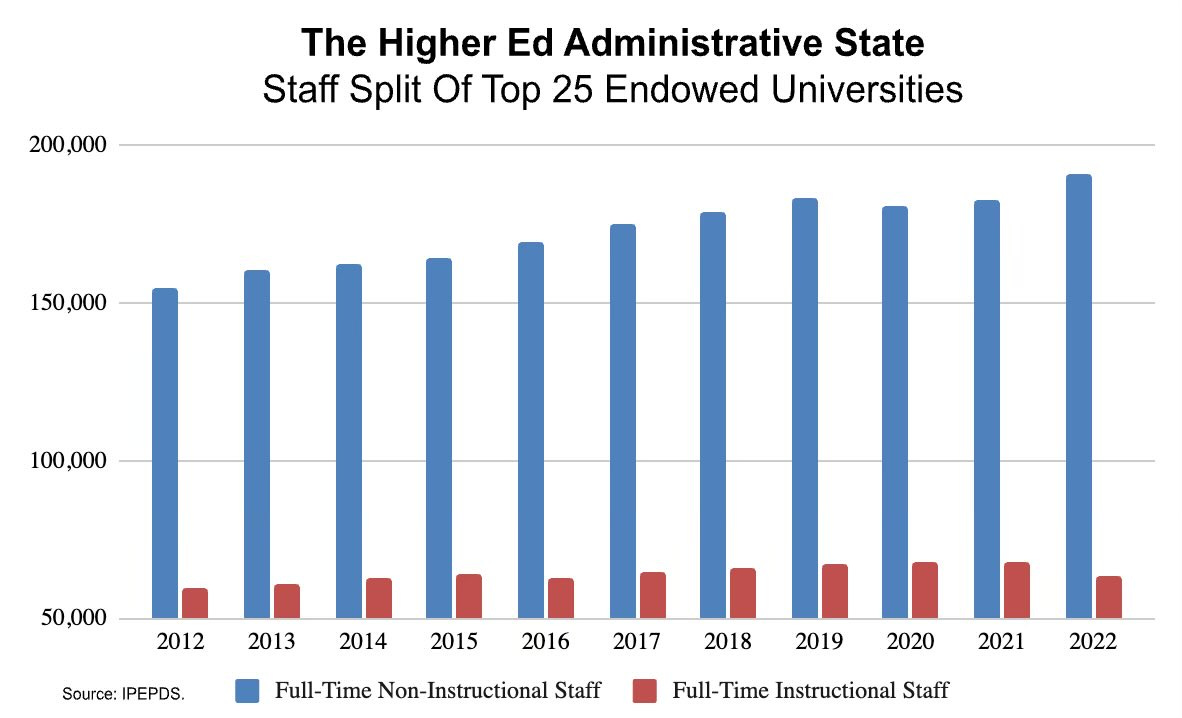
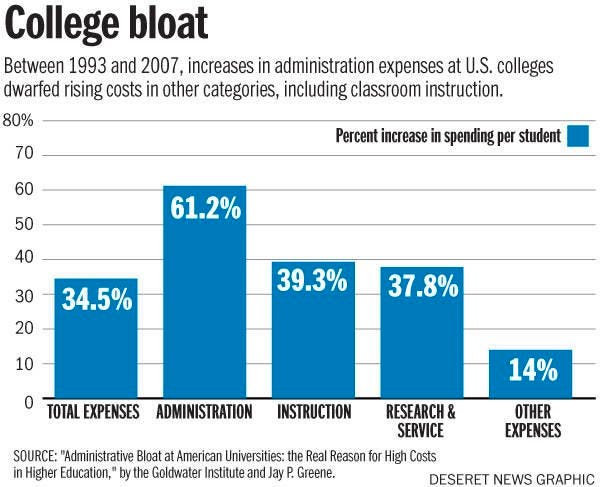
As NIH director, he would wield a potent tool to induce reform: money. Stanford and more than a dozen other universities each get more than $500 million annually in grants from the NIH, the world’s largest funder of biomedical research. The NIH grants support not only researchers but also their universities’ bureaucracies, which collect a hefty surcharge to cover supposed overhead costs. The federal largesse has helped finance the administrative bloat at universities, including the expansion of diversity, equity, and inclusion bureaucracies under the Biden administration, which took into account a university’s commitment to DEI principles when deciding whether to award grants from the NIH and other agencies.

Those priorities are about to change. Trump has vowed to rescind immediately Biden’s executive order directing federal agencies to promote DEI. During his first term, Trump threatened to issue an executive order barring universities from receiving federal funds if they suppressed free speech. He didn’t issue that order, but whether or not he does so in his next term, the NIH director will already have the power to consider a university’s commitment to academic freedom in deciding whether or not to award funds.

“For science to thrive and progress, we must be open-minded and allow vigorous and passionate debate,” says Martin Kulldorff, a former professor of medicine at Harvard. “Why should taxpayers subsidize universities that don’t allow that?” Kulldorff, an eminent epidemiologist, lost his job at Harvard after he became an early and outspoken critic of pandemic policies. In 2020, he joined with Bhattacharya and Sunetra Gupta, an epidemiologist at Oxford, to write the Great Barrington Declaration, a critique of lockdowns that was signed by tens of thousands of scientists and physicians.

Bhattacharya, who has a Ph.D. in economics as well as an M.D. from Stanford, hung on to his job as professor of health policy at the latter’s medical school, but his views were taboo on campus. After he and colleagues did a field study at the start of the pandemic showing that the Covid fatality rate was much lower than the doomsday number used to justify lockdowns, they were vilified by academics and journalists, and Stanford subjected them to a two-month inquiry by an outside legal firm. (They were vindicated by the inquiry and also by subsequent research confirming their findings.)

Trump is a deals guy … and Canadian politicians need to negotiate with him on that basis

Filed under: Cancon, Government, Media, Politics, USA — Tags: , , , , — Nicholas @ 03:00

In what has turned out to be his final column for TVO, Matt Gurney says that Canadian views on Trump need to evolve if we hope to preserve the overall amicable relationship between the two countries. Trump made his career on making deals … but not many of our political leaders seem to have clued in that this means we need to approach all our post-Biden American affairs with that in mind:

Justin Trudeau meets with President Donald Trump at the White House, 13 February, 2017.
Photo from the Office of the President of the United States via Wikimedia Commons.

Ever since the re-election of Donald Trump earlier this month, the most interesting question in Canadian politics has been “Who gets it?” That’s the main thing I’ve been looking for, and I think some of our leaders get it — or are starting to, at least.

Doug Ford doesn’t get it. Or didn’t, anyway, up until Tuesday afternoon.

On Monday night, president-elect Trump announced via a post on his Truth Social app that, as one of his first acts upon retaking the Oval Office in January, he would levy a 25 per cent tariff against all goods coming in from Canada and Mexico until those two countries fix the problems Trump says exist along the border. That’s a careful bit of phrasing on my part, so let me explain: I don’t disagree that there are issues for the United States along both borders. I don’t necessarily accept that the issues are the same on both borders or that Trump has accurately characterized the overall situation. But, in any case, Canada now has less than two months to figure out what it can do, assuming it can do anything, to satisfy the president-elect’s demands.

It’s very possible that we can do enough. Trump is a negotiator and a dealmaker, and we have to see his social-media post through that lens. He is establishing a strong opening position, and we’ll negotiate him down from there. That’s the good news, such as it is. The bad news, though, is that there’s no reason to assume Trump is going to do this only once. After we meet his demands on the border, he could demand that Canada take on more of the burden of the military defence of North America and the Western alliance. After we’ve drafted a bunch of people and launched a fleet of new warships and sent a heavily armed stabilization force to Haiti, he could come after us for our dairy subsidies. Once we give way on that, it’ll be getting tough on white-collar crime or telecom access or airline access. And so on and so on and so on. It’ll be one damned thing after another.

The broad contours of this were clear to me by about 1:30 in the morning on the day after (or night of, if you prefer) the U.S. election. As I keep saying, the party is over. Some of Trump’s demands will be basically utterly bogus, and others may be arguably unreasonable, but some of them are absolutely going to be fair, and Canada has, to my enormous frustration, left itself very, very vulnerable to his brand of pressure. We have utterly failed as a country to adapt to a changing world order by getting this country onto a more serious footing on any number of fronts, especially trade and defence. We were warned by friendlier U.S. administrations, including by presidents Barack Obama and Joe Biden. We didn’t listen. That was idiotic, and I can only hope not suicidal on our parts. Trump is going to get his way.

November 26, 2024

“Bluesky is going to give us hours of amusement as a platform full of wannabe school prefects all report each other”

Filed under: Media, Politics — Tags: , , , , — Nicholas @ 04:00

I don’t mean to make poking fun at Twit/X alternative sites like Bluesky a regular thing, but the performative flouncing as progressives announce they’re leaving Twit/X for a more congenial — for which read “censorious” — site continues to amuse.

Bluesky welcomes former Twitter/X luminaries

I’m going to take a pop at a sub-group of flouncers, though, the ones moaning about being called hurty words. This includes a number of individuals who genuinely seem to think it’s their role in life to go looking for nasty bigoted shite, then report it to Twitter’s overlords (and now Bluesky’s overlords as well, if things like [the image on the right] are anything to go by).

“Bluesky is going to give us hours of amusement as a platform full of wannabe school prefects all report each other” seems a fair assessment.

And yes, I have to engage in a little ritual genuflection here, because I have genuinely been called a large number of nasty names in my life. And despite that, dibber-dobbers still give me hives.

If I had a quid for every use of “dyke” (and related) sent my way, I would be matching millions with sundry oil sheiks, and that’s before we get to the ire directed at any columnist with whom ordinary members of the public disagree. I am old enough to have received thousands of abusive letters (about both novels and columns), some of them written in green ink. People are allowed to dislike me and my kind, or to argue that I’ve written a load of cobblers. They’re also allowed to dislike you and your kind. It would be astonishingly easy for me to wander over to Arabic Twitter and report lots of sincere Muslims for saying bigoted things about homosexuals. I don’t engage in this behaviour because I don’t expect the world to be my friend.

Relatedly (and this is directed at ethnic minorities as well as fellow gayers), a lot of folks from “historically disadvantaged groups” have become dab hands at dishing it out over the last twenty or so years. A necessary corollary of this behaviour is “learn to take it”. Yes, that means you. People are not going to stop saying hurty words to each other. People are also going to judge you based on the behaviour of your worst activists and vote accordingly (see recent US election results).

What of the core claims being made? Is Twitter genuinely worse now, a victim of what goes by the name “social media enshittification“?

Well, yes and no. I know many people dislike what Musk has done to Twitter, but when he made “likes” private, he stopped his site being used as a vector for HR vindictiveness (something about which HR mavens have complained, by the way, at least privately). It’s also now substantially more difficult to generate a pile-on using a quote-tweet, as well as possible to read tweets (but without interaction) from people who are hot on the block button.

The latter change has allowed me to establish why Baroness Nicholson had me blocked. I’d always wondered, because she’s had me blocked for as long as I can remember, yet like me, she can legitimately be described as “sex realist” or “gender-critical”. Musk’s change meant I was able for the first time to see an entire thread underneath one of her tweets, so learned that she blocks anyone — friend and foe alike — for swearing. Women who know her socially and get on with her well “IRL” have been blocked for saying “bugger” and “shite” on Twitter.

Well, glad that’s cleared up. Good to know.

The worst change Musk has made involves deboosting external links. This first emerged in April last year, in response to Substack releasing Notes (which Musk considered so derivative of Twitter’s code as to be a “clone”). At first only direct links to Substack were affected. If you had your own domain — as I do — you were fine. However, external link deboosting is now being applied uniformly. Everyone from a local tradesman selling new driveways and conservatories to the BBC and the Spectator now has to make use of some tedious version of “link in following tweet” or “link in bio”.

If Musk doesn’t fix this, he will legitimately lose the journalists and commentators currently on the site. Those people came, originally, to share stuff from their mastheads, and this applies regardless of politics. I first gained a following thanks to professional experience — yes, it was once fine for commercial solicitors to natter on the socials about the Enterprise Investment Scheme and how it related to start-ups and spin-outs etc — and later through Speccie columns along with a couple of books. A tweet from Tim Harford praising my second novel (with a link, bless him) went “viral” and led to thousands of sales. Pieces for the magazine proved popular. Just as I enjoyed Twitter for other people’s links, other people paid me the same courtesy.

Spotted on Instapundit:

« Newer PostsOlder Posts »

Powered by WordPress