
Drachinifel
Published 26 Feb 2020A quick look at the origins of a vital part of the ship’s maintenance crew, and some notable examples.
(more…)
September 23, 2022
A Short History of Ships Cats – Floating Felines, Maritime Moggies and Kleptomaniac Kittens
Comments Off on A Short History of Ships Cats – Floating Felines, Maritime Moggies and Kleptomaniac Kittens
September 22, 2022
RAF Coastal Command vs U-Boats
The History Guy: History Deserves to Be Remembered
Published 5 Oct 2020The contest between aircraft and U-Boats during the Second World War was one of competing technological innovations, culminating with a decisive struggle in the summer of 1943. The History Guy tells the forgotten story of the development of anti-submarine warfare and the contest between the aircraft of RAF Coastal Command and U-Boats of the Kriegsmarine in the Bay of Biscay.
(more…)
Comments Off on RAF Coastal Command vs U-Boats
September 21, 2022
Jonathan Kay on cultural appropriation
In Quillette, Jonathan Kay put together “a somewhat lengthy manifesto” on the topic of cultural appropriation in response to a request from Robert Jago who wanted to do an interview with Kay on this issue:
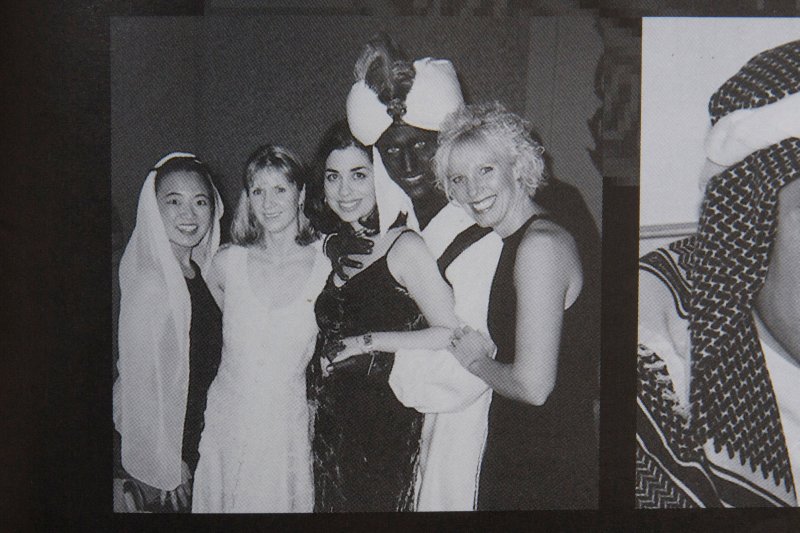
Justin Trudeau (Canada’s most prolific cultural appropriator) with dark makeup on his face, neck and hands at a 2001 “Arabian Nights”-themed party at the West Point Grey Academy, the private school where he taught.
Photo from the West Point Grey Academy yearbook, via Time
“Cultural appropriation” typically gets defined in a way that depends on whether one is defending it or denouncing it. If you’re defending it, you prefer to look at the big picture: Every new kind of art form, literary genre, style of dress, or cuisine typically represents a mix of inherited and borrowed elements. Shakespeare’s sonnets were written in an Iambic pentameter that Chaucer had “appropriated” from the French and Italians. So if Indigenous or African poets want to appropriate it from the English, no one has any basis for complaint. If you define cultural appropriation in this big-picture way, the concept isn’t just permissible. It’s artistically necessary, and indeed inevitable.
But if you’re denouncing cultural appropriation, on the other hand, the argument is more persuasive when your frame of reference is small, local, and community-rooted. I’m thinking of the (white) novelist or film director who passes through a region, and hears some garbled version of folklore that relates to a nearby Indigenous community. The guy thinks, “Oh wow, that’ll make a great novel” (or TV show, movie, etc.), and then makes a mint without consulting (let alone cashing in) the Indigenous community.
So the debate over cultural appropriation is like a lot of debates: It’s really easy to win if you get to define the terms. And since both sides pick definitions that suit them, it can become a dialogue of the deaf.
Indeed, there’s often no dialogue at all. Rather, both sides are apt to retreat into apocalyptic language about, respectively, (a) totalitarian censorship, and (b) white supremacist (cultural) genocide. This is absolutist language that leaves no room for nuance or discussion.
The cultural-universalism side of this dialogue is represented by people like me. I write about every topic under the sun, and so I get my back up when someone tells me that I’ve got to “stay in my lane”. My whole career is built around hopscotching from one idea to the next without worrying (much) about who gets offended. For me, the imposition of rules on what people are allowed to write about isn’t just an annoyance. It’s an existential threat to the creative faculties.
But if you’re on the other end of this — say, you’re a member of a small Indigenous community whose history and folklore have yet to be recorded or celebrated in any definitive form — you don’t care about some white guy in Toronto whining about how he can’t do the equivalent of wearing a sombrero on Cinco de Mayo. A small First Nations community might get only one real shot at telling its story to the world. If that shot gets used up by an outsider who strip-mines the locals’ oral history for a bestseller, that can no doubt feel like existential threat to one’s cultural autonomy. It’s like: “So you took our land, punished us for using our own language, sent our kids to residential schools, and now all we really have left is our culture, and you want to steal that, too?”
There’s this trite expression that often gets trotted out these days: Intent doesn’t matter, only the harm you cause. But of course, intent does matter. And if an author, director, or artist intends to respectfully and accurately include a community’s story in his or her work, then, for me, that’s very much a mark in their favour. That said, I absolutely do not think that this means there is an obligation to “honour” or “uplift” the community in question — let alone express “solidarity” or “allyship” with them. Doing so means you’re writing activist propaganda. What I mean, rather, is that you shouldn’t be intending to mock or belittle whole swathes of humanity.
The problem is that, in Canadian cultural circles at least, this isn’t really the standard that’s applied. I’ve spoken to a number of Canadian writers who, out of the best of intentions, invest their own funds in “sensitivity readers” — a process that can be not only expensive and time-consuming, but also creatively ruinous, since these consultants often are bursting with ideas about how to turn your novel or movie into a specimen of the above-referenced activist propaganda. I know one woman, in particular — a novelist — who appeared before a First Nations tribal council, and got its official permission to include a character in her book whose identity related to their community. But then a community member, someone not even involved with the band leadership, went after the woman and tried to smear her as racist. This is after she’d dotted every I and crossed every T of the sensitivity-reader process.
Comments Off on Jonathan Kay on cultural appropriation
The Medieval Saint Diet
Tasting History with Max Miller
Published 20 Sep 2022
(more…)
Comments Off on The Medieval Saint Diet
Radom’s Vis 35: Poland’s Excellent Automatic Pistol
Forgotten Weapons
Published 9 Feb 2016In the 1920s Poland began looking for a new standard military pistol, and tested a variety of compact .380s. The representative from FN brought along an early iteration of the High Power (along with their other entry) even though it was much too large and heavy to meet the Polish requirements. After a couple iterations of testing, it became clear to the Polish Ordnance officers that the High Power was a much more effective service pistol than the compact guns they had been instructed to look for.
Lo and behold, the ultimate choice was a domestic design based largely on the High Power (a direct deal with FN was not an option after Poland’s relationship with FN had suffered through problems with the wz.28 version of the BAR). Toss in a delay to redesign the early decocking mechanism to satisfy the Cavalry (who didn’t realize that the decocker wasn’t actually meant to be used, but rather to just add another claim to the patent), and by 1935 the pistol was finished and formally adopted.
The Vis 35 is one of the best automatic pistols of WWII in terms of both handling and quality. In total 46,000 were made pre-war for Poland’s military, and German occupation forces built another 300,000+ during the war.
(more…)
Comments Off on Radom’s Vis 35: Poland’s Excellent Automatic Pistol
QotD: Why postwar western economic and humanitarian “interventions” almost always failed
… it is a general truism that the majority of persons who run for office in North America and various European countries do so because they sincerely want to help and improve their communities/countries. However, in all of Africa and most of Asia, persons who seek public office do so for one purpose, and one purpose only: to steal everything that they can get away with. So when some ignorant, naïve, American shows up with buckets full of money, oblivious of the culture and the longstanding, entrenched, corruption, and with an announced intention to make the local community more like an American community, they are welcomed with open arms while suppressing their snickering. This also explains something where Americans exhibit willful blindness: other cultures don’t play fair. Honesty is seen as the trait of fools. Fools are to be taken advantage of. Especially in trade and diplomacy. Just look at China.
Prior to the Cold War, America’s interference in other countries’ internal affairs was practically nonexistent outside of the Caribbean where America’s preoccupation was with the stability in the region. What went on in Egypt, Thailand, Argentina, or Greece was none of our business, nor did we frankly care. However, having just survived the cataclysm of WWII, and the realization that Communism was a danger bent on world domination, and that each country that became Communist made that possibility much more likely changed that laissez faire attitude 180 degrees. Whereas NATO was formed for the purpose of deterring a military attack on Western Europe by the Soviet Union (the generals mentally fighting the last war as is always the case, not realizing that the war now was ideological and propagandistic rather than military), diplomats began to question how to best combat Communist insurgencies in the Third World. The arrived (wrong) conclusion was that the reason a country became Communist was because the dirt-poor people were so desperate that they became Marxists in order to improve their lives, so if the West helped poor countries economically Communists could not gain a foothold. As such, they ignored the fact that most Communist movements are organized and headed not by poor people, but by a cadre of power-hungry middle-class intellectuals.
As has been mentioned, the first approach was with foreign aid. The second was with military intervention, in Korea, Vietnam, Santo Domingo, Grenada, and Lebanon. Although such interventions were mostly successful, they carried a heavy price as American blood was spilled in foreign countries. America’s supposed allies hardly helped at all, including the citizens of the countries (Korea and Vietnam) that themselves were in danger of being conquered by Communist forces.
Armando Simón, “Schlimmbesserung“, New English Review, 2022-06-16.
Comments Off on QotD: Why postwar western economic and humanitarian “interventions” almost always failed
September 20, 2022
Hannah Arendt in postwar Germany
In Quillette, Roger Berkowitz discusses what Hannah Arendt found when talking to Germans after the Second World War, which she characterized as their collective “escape from reality”:
In 1949, when Hannah Arendt (1906–1975) went to Germany as part of the New York-based Jewish Cultural Reconstruction Commission, she was struck by the way the Germans showed an “at times vicious refusal to face and come to terms with what really happened”. This “escape from reality”, as Arendt named it, meant that the reality of the Holocaust and the death factories was spoken of as a hypothetical. And when the truth of the Holocaust was admitted, it was diminished: “The Germans did only what others are capable of doing”.
The Germans, at times, simply denied the facts of what had happened. One woman told Arendt that the “Russians had begun the war with an attack on Danzig”. What Arendt encountered was a “kind of gentleman’s agreement by which everyone has a right to his ignorance under the pretext that everyone has a right to his opinion”. The underlying assumption for such a right is the “tacit assumption that opinions really do not matter”. Opinions are just that, mere opinions. And facts, once they are reduced to opinions, also don’t matter. Taken together, this led to a “flight from reality”.
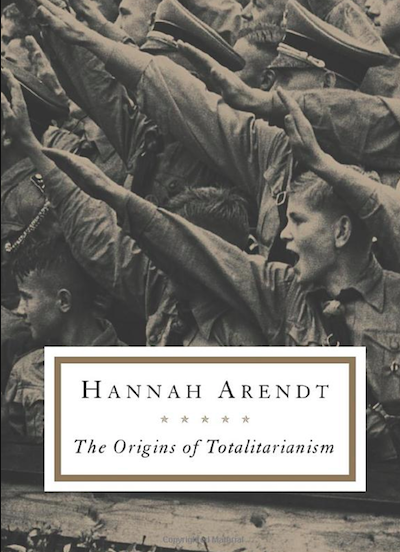
The focus of Arendt’s lifelong engagement with the human flight from reality was her encounter with ideologies, specifically Nazism and Bolshevism. In The Origins of Totalitarianism and other texts (especially her essay, “On the Nature of Totalitarianism“), Arendt defines an ideology as a system that seeks to explain “all the mysteries of life and the world” according to one idea. Nazism is an ideology that blames economic disaster, political loss, and the evils of modernity on the Jews — inhuman flotsam who must be exterminated to allow a master race to flourish. Bolshevism, on the other hand, “pretends that all history is a struggle of classes, that the proletariat is bound by eternal laws to win this struggle, that a classless society will then come about, and that the state, finally, will wither away”. The bourgeoisie are not simply class traitors, they are a dying class, and killing them only supports a law of history. As ideologies, both Nazism and Bolshevism insist on explaining the events of the world according to theories “without further concurrence with actual experience”. The result, Arendt argues, is that such ideologies bring about an “arrogant emancipation from reality”.
Because an ideology “looks upon all factuality as fabricated”, it “no longer knows any reliable criterion for distinguishing truth from falsehood”. As reality recedes, ideologies organize society to transform their ideas into living reality. If antisemitism as an ideology says that all Jews are beggars without passports, the fact of wealthy and established Jews must be eliminated. If Bolshevism says that the bourgeoisie are corrupt, they must admit their corruption or be killed. The realization of such ideological realities can be accomplished, of course, through terror.
But even before a totalitarian movement takes power and mobilizes the secret police in the machinery of terror, ideological movements can employ propaganda to deny and nullify facts, or change them. The Nazis, she writes, “did not so much believe in the truth of racism as desire to change the world into a race reality”. Similarly, the Bolshevist ideology that classes were dying was not something real, but something that had to be made real. The purges and terror that Stalin unleashed were supposed to “establish a classless society” by exterminating all social groups that might develop into classes. In both instances, the purpose of the ideology was to transform a mere opinion — race consciousness or class consciousness — into the “the lived content of reality”.
The point, as Arendt concludes, is that “ideological consistency reducing everything to one all-dominating factor is always in conflict with the inconsistency of the world, on the one hand, and the unpredictability of human actions, on the other”. What ideology demands is that man — an unpredictable and spontaneous being — cease to exist as such, that all humans be subjected to laws of development that follow ideological truth. That is why the turn from an unreliable reality to coherent fantasy requires an absolute elimination of human spontaneity and freedom.
Comments Off on Hannah Arendt in postwar Germany
The Byzantine Empire: Part 4 – Justinian, The Hand of God
seangabb
Published 1 Jan 2022Between 330 AD and 1453, Constantinople (modern Istanbul) was the capital of the Roman Empire, otherwise known as the Later Roman Empire, the Eastern Roman Empire, the Mediaeval Roman Empire, or The Byzantine Empire. For most of this time, it was the largest and richest city in Christendom. The territories of which it was the central capital enjoyed better protections of life, liberty and property, and a higher standard of living, than any other Christian territory, and usually compared favourably with the neighbouring and rival Islamic empires.
The purpose of this course is to give an overview of Byzantine history, from the refoundation of the City by Constantine the Great to its final capture by the Turks.
Here is a series of lectures given by Sean Gabb in late 2021, in which he discusses and tries to explain the history of Byzantium. For reasons of politeness and data protection, all student contributions have been removed.
(more…)
Comments Off on The Byzantine Empire: Part 4 – Justinian, The Hand of God
The Evolution of the Rifleman’s Uniform 1860-1990’s
Queen’s Own Rifles of Canada Regimental Museum
Published 30 Nov 2020See the evolution of the rifleman’s uniform throughout most of our history.
You can also read more about this evolution on our Museum website:
https://qormuseum.org/history/timelin…
(more…)
Comments Off on The Evolution of the Rifleman’s Uniform 1860-1990’s
QotD: Why purple was such a rare colour in the flags of the pre-industrial era
Bret Devereaux, “Collections: Clothing, How Did They Make It? Part IVa: Dyed in the Wool”, A Collection of Unmitigated Pedantry, 2021-04-02.
Comments Off on QotD: Why purple was such a rare colour in the flags of the pre-industrial era
September 19, 2022
Albania – Hitler’s Latest Ally? – WAH 078 – September 18, 1943
World War Two
Published 18 Sep 2022The German Nazi Genocide of the Jews surpasses four million deaths, while the Soviet Union and US step up oppression against some their own citizens.
(more…)
Comments Off on Albania – Hitler’s Latest Ally? – WAH 078 – September 18, 1943
City Minutes: Crusader States
Overly Sarcastic Productions
Published 13 May 2022Crusading is one thing, but holding your new kingdoms is a much trickier business. See how the many Christian states of “Outremer” rolled with the punches to evolve in form and function over multiple centuries.
(more…)
Comments Off on City Minutes: Crusader States
September 18, 2022
Jailbreak! Mussolini on the Loose Again! – WW2 – 212 – September 17, 1943
World War Two
Published 17 Sep 2022
(more…)
Comments Off on Jailbreak! Mussolini on the Loose Again! – WW2 – 212 – September 17, 1943
“King Eeyore”
In the latest edition of the SHuSH newsletter, Kenneth Whyte recounts some of the anti-Carolean gossip from the early years of King Charles:
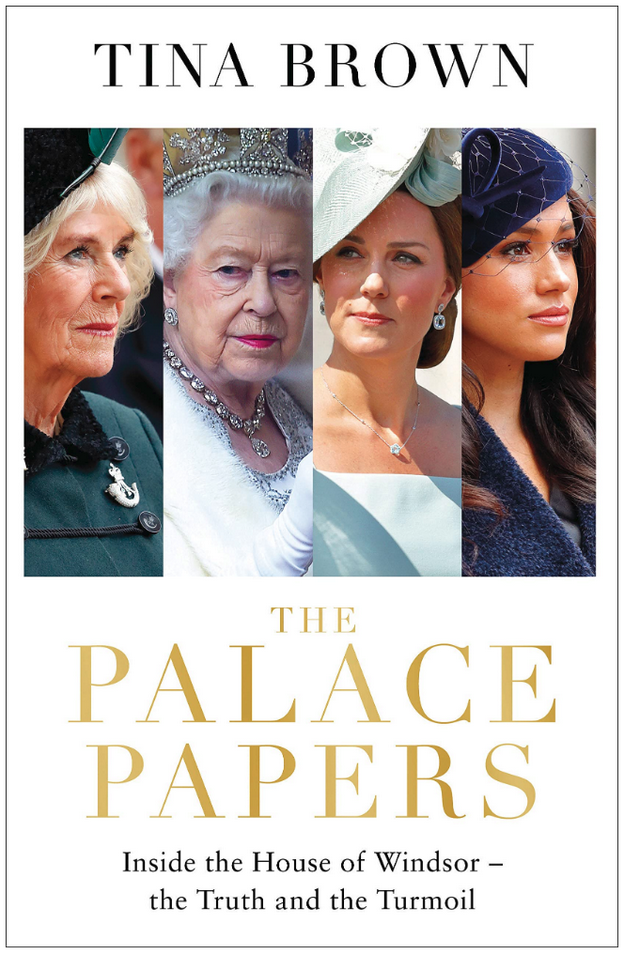
My library of royalist literature is thin, but I did find Tina Brown’s The Palace Papers on the shelf. Published last spring, it chronicles the recent history of the House of Windsor and while it treats the whole cast of characters — Elizabeth, Philip, Margaret, Charles, Anne, Andrew, Edward, William, Kate, Harry, Meghan — much is revealed about the new king.
Charles, writes Brown, the former Vanity Fair and New Yorker editor, was never a happy fellow. She calls him “Prince Eeyore”. He “felt bruised by his childhood and miserable school days, misunderstood by his domineering father, and deprived of an emotional connection with his mother”. Among the “brutalities” he endured in his youth: his schoolmates at Gordonstoun beat him with pillow because he snored.
Although an indifferent student, he attended Cambridge where he read anthropology and archaeology. In 1969, a year before graduating, his mother crowned him Prince of Wales. He spent his early twenties in the Royal Air Force and the Royal Navy, distinguishing himself in the latter service by lowering an anchor without noticing on his chart the presence of a telecommunications cable linking Ireland and Britain. “It was snagged,” writes Brown, “and the two divers send down to dislodge it nearly drowned.” Charles earned a “stern rebuke”.
Having done his military duty, he devoted himself to polo, windsurfing, and test-driving prospective wives. Charles’s royal status made him an obvious catch, writes Brown, who judges that his “Dumbo ears were offset by his excellent tailoring and debonair polo prowess.”
Finding a wife proved difficult, not least because of his affinity for married women. At one point he was sleeping with both Camilla Parker Bowles, wife of Andrew Parker Bowles, and Dale “Kanga” Harper, wife of his buddy, Lord Tyron. “In the mid-seventies,” says Brown, “both married women were on call for the Prince while their husbands looked the other way.”
That’s not exactly true. Both men seemed pleased to lay down their wives for their country, as the joke went at the time. Charles was godfather to Tom Parker Bowles, son of Andrew and Camilla Parker Bowles, and also to a middle child of the Tyron’s who, naturally, was named Charles.
What Camilla and Kanga had in common were game personalities and maternal instincts that accommodated the Prince’s “sentimentality and tantrums, and needs to be soothed and amused”.
It wasn’t until 1981, at the age of 32, that the Prince of Wales made his choice of a bride. It was famously awful for all concerned. He married twenty-year-old Diana Spencer who bore him an heir, William, in 1982, and a spare, Harry, in 1984. Brown reports that Charles behaved properly in the marriage until the birth of Harry who, to his disappointment, was not a girl. “Oh God,” he said, “it’s a boy … and he’s even got red hair.”
He was back with Camilla in no time. Diana ratted him out to the author Andrew Morton in 1992 and Charles unwittingly confirmed his infidelity the next year in a notorious telephone conversation with Camilla in which he said that he wanted to “live inside your trousers or something”. You know the rest.
Comments Off on “King Eeyore”
Austria’s Take on the Uzi: Steyr MPi-69
Forgotten Weapons
Published 13 May 2022
(more…)
Comments Off on Austria’s Take on the Uzi: Steyr MPi-69


