
Let’s say you are the leader of a small country, surrounded by a bunch – let’s say five – large neighbor countries, which never, ever change. Each of these big neighbors has their own culture and customs. Do you decide which one is morally best and side with that one? That might be nice for your new ally, but it will be bad for you – isolated and opposed by your other larger neighbors. Picking a side might work if you were a big country, but you’re not; getting in the middle is likely to get you crushed.
No. You will need to maintain the friendship of all of the countries at once (the somewhat amusing term for this in actual foreign policy is “Finlandization” – the art of bowing to the east without mooning the west, in Kari Suomalainen’s words). And that means mastering their customs. When you go to County B, you will speak their language, you wear their customary dress, and if they expect visiting dignitaries to bow five times and then do a dance, well then you bow five times and do a dance. And if Country C expects you to give a speech instead, then you arrive with the speech, drafted and printed. You do these things because these countries are powerful and will destroy you if you do not humor whatever their strange customs happen to be.
(I should add that, over time, these customs won’t seem so strange anymore. Humans have a tendency to assume that whatever the customs – for instance, for diplomacy – are in our time, that this is just the right and normal way to do things. But diplomatic customs vary wildly by time and culture and are essentially arbitrary.)
Ah, but how will you know what kind of speech to write or what dance to do? Well, your country will learn by experience. You’ll have folks in your state department who were around the last time you visited County B, who can tell you what worked, and what didn’t. And if something works reliably, you should recreate that approach, exactly and without changing anything at all. Sure, there might be another method that works – maybe you dance a jig, but the small country on the other side of them dances the salsa, but why take the risk, why rock the boat? Stick with the proven method.
But whatever it is that these countries want, you need to do it. No matter how strange, how uncomfortable, how inconvenient, because they have the ability to absolutely ruin everything for you. So these displays of friendship or obedience – these rituals – must take place and they must be taken seriously and you must do them for all of these neighbors, without neglecting any (yes even that one you don’t like).
Bret Devereaux, “Collections: Practical Polytheism, Part I: Knowledge”, A Collection of Unmitigated Pedantry, 2019-10-25.
September 29, 2022
QotD: The essence of diplomacy for small pre-modern powers
September 28, 2022
Putin’s nuclear option may not be as decisive in Ukraine as many fear
Like almost everyone else, I’m still hopeful that the Russians will not resort to nuclear weapons as their invasion of Ukraine drags on and on — especially as it’s expected that any first use of nuclear weapons will trigger a global crisis or even a new world war. At Quora, John Mark McDonald offers his take on the issue that certainly doesn’t match what most pundits appear to believe:
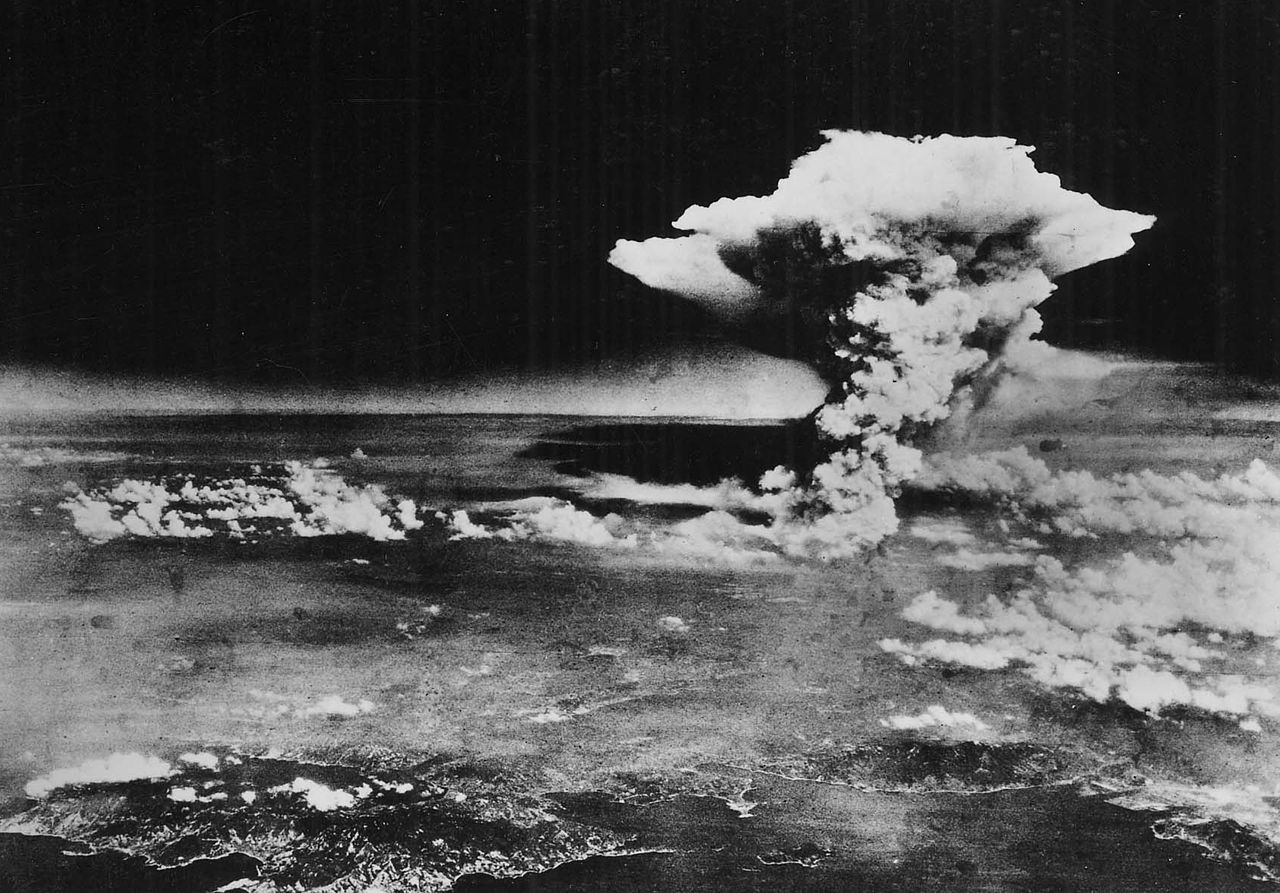
Atomic cloud over Hiroshima, taken from “Enola Gay” flying over Matsuyama, Shikoku, 6 August, 1945.
US Army Air Force photo via Wikimedia Commons.
As someone who has studied nuclear war for close to forty years now, I am going to give you an answer that will blow your mind. Even if the entire Russian nuclear arsenal were used against Ukraine, it wouldn’t substantially change the course of the war. How could I possibly say that? Because, the power of nuclear weapons has been used as a boogeyman for so long that the actual power of a nuclear detonation has almost no relation to their actual destructive power. No nuclear power can afford to actually use one in combat because it would expose the mythical nature of nuclear weapons.
Nuclear weapons are hyped to the point that no one contradicts it when a media outlet publishes a statement indicating that even a single nuclear device will destroy the world. This is a blatantly, stupidly, obviously untrue, but never corrected. After all, two were used in WWII. BUT that is just the tip of the iceburg. I thought there had been a couple of hundred nuclear test that prove this point. I was off by over an order of magnitude. There have been nearly THREE THOUSAND NUCLEAR DETONATIONS ALREADY, that are either known or suspected and this has not effected the survivability of life on Earth even slightly.
Well then, how dangerous are nuclear weapons? Nuclear weapons, if they weren’t their own catagory, would be classified as incendiary weapons. They set stuff on fire. They set a lot of stuff on fire. In fact they can set things on fire as far as two miles away from the actual detonation. Besides this, nuclear detonation are very bright, capable of blinding people 20–30 miles away. This is only constrained by the curvature of the earth. They also create hurricane force winds as the air around the detonation expands and contracts. If you are outside and unshielded and within a mile of a nuclear detonation, you are going to die.
The problem here is that Ukraine is really big. I mean the size of Texas big. Cities there tend to be spread out in modern times and their larger ones cover over a hundred square miles. The average nuclear detonation are only burn 2–3 square miles of territory. A city the size of Kiev would take on the order of 200 warheads to cover the whole thing.
Which brings us to our next point. Modern cities are just not that vulnerable to incendiaries. Modern city centers and industrial areas are made of concrete and steel. Most of the damage in Hiroshima and Nagasaki was done because almost all the buildings were made of wood and paper. The initial blast set the city centers on fire which spread and ended up burning down most of the city. Modern cities are just not that vulnerable. In Ukraine, despite millions of rounds of being poured into their cities, not one of them caught fire and burned to the ground like the Great Chicago or Great London Fires in the 19th century or the fire storms of WWII. In the Japanese nuclear detonations, the brick buildings were still standing, despite being much less sturdy than modern buildings. This leads to the most surprising revelation about nuclear detonations: If you are not outside, you stand a good chance of surviving even within the blast zone. Nuclear blasts are mainly line of sight killers. The vast majority of “radiation” created by an nuclear detonation is infrared radiation, or heat the same as a gas stove or fireplace makes. Unless the building you are in is collapsed by the wind or you fail to leave if it catches on fire or you happen to be in front of a window with a direct line of sight to the detonation, you are probably going to be fine.
Thus we get to the real reason why Putin will not use nuclear weapons: they’re just not all that effective compared to the boogeyman that is in our collective imaginations. Were a nuclear missile to detonate over central Kiev, no one would believe that it was an actual nuclear blast because the city is still there and all the major buildings are still standing.
Secondly, he doesn’t have very many of them. The numbers given for the Russian nuclear arsenal are an outright farce. You get that number by taking of bombs that the USSR claimed to have built, and subtract the number used in their testing program. This leaves you with about 9,000 warheads. First of all, Russia doesn’t have nearly enough delivery systems to put those warheads on. The second problem here is that nuclear warheads have a very short shelf life. Nuclear warheads require a detonator made of conventional explosives. These detonators are some of the most precision pieces of engineering in the history of mankind. A series of explosives has to go off in such a way that the core is hit by the same amount of pressure from all directions simultaneously. If any of those explosives are even slightly off, the nuclear warhead will not go off. You now have an extremely precise machine sitting around a core of material emiting hard radiation. Hard radiation is not friendly to machines. Nuclear warheads need to be rebuilt a least every five years and maintained a lot more often than that. Even with that, a twenty year old warhead is a piece of junk. It’s been more than twenty years since the Putin kleptocracy came to power. I’m sure that Russia has a number of Potemkin warheads that are kept in top shape for inspectors, but given the current Russian system, the Russian nuclear arsenal most likely resembles the Russian tank reserves: the bare minimum kept in service while the rest is a scrap pile.
Currently, the spector of the vast Russian nuclear arsenal is the last card he has in his hand. If he were to actually use it, it would expose that he never had anything but a junk hand and bluffing to back it up.
H/T to Never Yet Melted for the link.
CDR Salamander also looks at the nuclear question:
Some are looking closer at the nuclear option that Russia has. I think they are looking too hard. A good example of this line of concern was in yesterday’s WaPo by Joseph Cirincione.
NB: Before the pull quotes, a fair warning – Cirincione is selling a book titled, Nuclear Nightmares: Securing the World Before it is Too Late, so keep that in consideration;
Russian President Vladimir Putin is losing his war. If the Ukrainians continue to liberate areas of their country from his invading army, would he actually use nuclear weapons as he has threatened? If so, how? And what would the U.S. response be?
It is difficult to put percentages on risk. Nor does it really matter. Given the stakes, if the chances are 10 percent or 40 percent, the response would be the same: Minimize the possibility of nuclear use, and prepare responses in advance.
This is when I remind everyone that “we” are horrible at predicting the next war early enough to prevent them. The track record is simply not very good. However, Cirincione has invested a lot of time and effort in looking at this — so we should give his ideas some consideration;
The next quote reminded me of a little reminder a peer gave me back when I was a NATO staff weenie at the other end of the HQ p-way from him. As a JO, he was on the other side of the wire as an JO in the Warsaw Pact. “Americans may not follow their doctrine very well, but Russians do.”
Russian military writings describe in detail how, if Russia is losing a conflict, it could use nuclear weapons to force its enemy to retreat. This “escalate to de-escalate” or “escalate to win” strategy is somewhat controversial, but it is not dissimilar to various U.S. plans for using nuclear weapons first.
Well, sometimes we follow our doctrine. Sometimes the Russians don’t … but if you are playing odds …
I still stand by my belief — and that is a weak thread, I know — that in the next war, nuclear weapons will be what chemical weapons were during WWII. Everyone had them; no one used them.
If nuclear weapons were to appear on the Ukrainian stage, Cirincione does not have this COA as his most likely … but it is my most likely if one must choose from the “Nuke” basket;
Demonstration shot. One option is for Russia to fire a nuclear weapon over an uninhabited area — say, part of the Black Sea — as a demonstration of its seriousness in hopes that the West will back down. Some scientists involved in the Manhattan Project urged just such a demonstration shot as an alternative to bombing Japanese cities at the end of World War II. While no one would be killed and there would not be physical damage, the explosion would stop the world in its tracks. There has not been a nuclear weapon used in combat in 77 years. No one has even seen a nuclear explosion above ground since 1980.
This is their neighborhood and fallout will drift to their lands if nukes are used. Is anyone going to buy grain downwind? No. Next to underground explosions, explosions high over the water or in the atmosphere create the least secondary radiation effects. Don’t underestimate the lingering memory of Chernobyl. I see “Demonstration Shot” of the most likely COA of the least likely Nuke COAs.
As shocking as this would be, Russia would likely reject this option for the same reason U.S. military leaders did in 1945: It is not shocking enough.
Don’t agree. Russia believes their own FITREPs, so to speak. The arrogance of their initial OPLAN speaks to this. They hold most of Central and especially Western Europe in contempt. I am sure a nuke over the Black Sea would be shocking enough (and they’re right).
Pemmican: History’s Power Bar
Tasting History with Max Miller
Published 27 Sep 2022
(more…)
September 27, 2022
The War That Made Germany Prussian – Austro-Prussian War 1866
Real Time History
Published 23 Sep 2022After settling the Schleswig-Holstein question in 1864, Austria and Prussia are uneasy allies. Both are the biggest players in the German confederation. In Bismarck’s dream of a united Germany, he sees Prussia as the only leader and wants to force the so called “small German solution” without Austria. And so, in 1866 a war between Austria and Prussia (plus other German states like Bavaria, Baden, Württemberg, Saxony, Hanover) breaks out to settle this question once and for all.
(more…)
Sarah Hoyt on how Americans are mis-understanding the TV show Bridgerton
I don’t watch TV, so I haven’t seen the show myself, but apparently a lot of Blacks in the US are taking away the multi-racial casting of a parallel-universe TV show set in the Regency period as being a true representation of British history:

Anyway, all this came to a head with my watching the Bridgerton series. As other people know, it bothers the living daylights out of me to cast well-known historical figures as another race. Not because there can’t be decent actors of another race, but because I know there is a percentage of the population who takes fictional movies and shows as revealing “the truth”.
My mom, who is better educated (alas) than most American high school graduates is one of those. She will adapt her vision of the past according to some crazy movie she just watched. (The number of arguments I’ve had.)
For those who haven’t watched Bridgerton (bog standard regency romances, with gorgeous, if not period-accurate clothing) they cast a certain number of noblemen as black or indian or other “races” and the English Queen in Bridgerton is black.
The buried history in the mini-series (suggested and Heinleined in) is that black and white people coexisted in England side by side, until the king married a black Queen, and then suddenly mixed marriages were allowed.
This is obviously a fantastic parallel world history. Yes, there were black people in England in the regency. I’m sorry to tell you there were very few and 99% of them were slaves or servants brought by people who had lived in Africa.
There was no “black nobility” and no system of apartheid.
HOWEVER as we found out, American people absolutely believe this nonsense. They believe Queen Charlotte (mostly German, honestly) was “black” based on a very bad portrait and rumors of a Moorish ancestress. (Note this rumor was almost certainly political slander. Also that Moor at that time in the peninsula depending on whether in the South or the North might mean slim, small and tan, but did not mean AFRICAN.) Weirdly the best debunking I found was from Quora.
HOWEVER I also found endless pages of well-educated black-Americans celebrating Queen Charlotte for “Black history month”.
Let me also point out that both the Queen and her husband (Yes, mad King George) were ardent abolitionists and that did she have any legitimate hint of African blood ALL the opposition would have fixated on this, and the caricatures would have been next level. However this never happened. Queen Charlotte was and looked German, even if a portrait can imply “stereotypical” African features … As long as you remember that those features exist in a lot of other races, and that a lot of them are also Neanderthal.
Sure, if you go with the one drop theory, Queen Charlotte was black. So is everyone else. EVERYONE else, even those whose 23andme swears they’re pure Scandinavian. Because sometime in the last two thousand years all of us got an African ancestor, somewhere, on one of the many, many lines that fed into our family. (Note genealogy is also a lie to some extent, since it’s impossible to follow every single female (if you’re tracking the male. Vice versa otherwise) line that dropped into your family, and everyone who fed into every other of those lines.)
The problem is that it was the rats in the head of the American black producers of the series that led them to create this entire parallel universe which they THINK IS TRUE on the basis of “well the queen was black”. WITHOUT LOOKING.
And now those rats are reproducing everywhere, but most notably in black American heads, who now believe that “Well, the king married a black queen, so it must be true that the Americans rebelled to keep enslaving the black people”.
This is all not just arrant nonsense, but poisonous bullshit, and has no contact whatsoever with reality.
What can we do about it?
Correct it, ruthlessly, whenever we come across it. And keep pointing out that a queen who was blond and blue eyed was not in fact “black” unless everyone is. And that reading racial tea leaves is a pseudo-science, like phrenology.
I would very much appreciate if we could put this behind us so may family doesn’t keep getting asked “what is your racial background” by complete strangers. (And not just census takers, whom I like to answer with “human”.)
Look, in the end, the darkest African and the lightest Scandinavian have more in common with each other than not. To pretend otherwise is arrant nonsense.
Yes, our far-distant ancestors developed racism as a necessary survival tool (along with the uncanny valley discomfort) because you could fall into the hands of another hominin band and become “food”. (The chimps are less discriminating and will also eat babies of their own band.)
We are now past that, and I would like it not to return. Yes, there are physical characteristics that go with certain character traits, but it’s harder to track than you think, and they’re often things that have nothing to do with race, let alone racial stereotypes.
We all have one drop of slaves and enslaved, or saints, sinners, murderers, murder victims, kings and peasants, ascetics and whores. And we all have all the inclinations of all of mankind in varying degrees.
It’s what you make of it and with it that determines whether you can wear “human” as a crown, or in fact get cast out of the human race for shoving in line.It’s time to stop with the nonsense.
QotD: The Poor Law Reform Act of 1834
One of the law’s architects, Edwin Chadwick — a man who made Mr Gradgrind [Wiki] look like one of the Cheeryble brothers [Wiki] — infamously commented that it was vital that the inmates of workhouses should be given the coarsest food possible. William Cobbett, a leading opponent of the bill, gleefully seized on this, nicknaming the Whigs, who pushed the legislation hardest, the “Coarser Food Party”. The idea of all this — rooted in the principles of utilitarianism, political economy and Malthusianism — was, as future Archbishop of Canterbury John Bird Sumner put it, to encourage the labouring poor to do everything they could to avoid the “intemperance and want of prudent foresight” that creates poverty, the “punishment which the moral government of God inflicts in this world upon thoughtlessness and guilty extravagance”.
In the 1830s, these ideas were at the very vanguard of progressive thinking. They were promoted by the metropolitan liberal elite of the age, men such as James Mill, Jeremy Bentham and David Ricardo, the forward-thinking “Philosophic Radicals” who spewed out reforming and “improving” ideas through their famous organ The Westminster Review. Other contributors included happy-go-lucky eugenicist pioneer and social Darwinist Herbert Spencer, as well as Harriet Martineau, the sort of woman who would cheerfully have put her “enlightened benevolence” into practice by personally taste-testing workhouse food to ensure it was sufficiently coarse.
These ideas were gleefully leapt upon by a large swathe of the Church leadership, who endorsed the grim dogmas of political economy with an alacrity that would only surprise anyone unfamiliar with the long history of our episcopacy’s lamb-like submission to secular liberal orthodoxies. As E.R. Norman pointed out many decades ago, the Church of England’s leaders have, again and again since at least the eighteenth century, “readily adopted the progressive idealism common to liberal opinion within the intelligentsia, of which they were a part”. They have “always managed to reinterpret their sources in ways which have somehow made their version of Christianity correspond to the values of their class and generation”, a process intimately connected to the fact that bishops are nearly always tied (by personal links, economic interests and a desire to conform) to their secular peers who set the broader cultural and political agenda.
Capel Lofft, “The closing of the Episcopal mind”, The Critic, 2022-06-21.
September 26, 2022
Canada, a confessed “ongoing” genocidal state, has no moral grounds to criticize China, Russia, or Iran
In Quillette, Jonathan Kay expresses his frustration as Canadian Prime Minister Trudeau’s performative moral posturing and virtue signalling for his globalist comrades comes back to bite him in the ass … again:
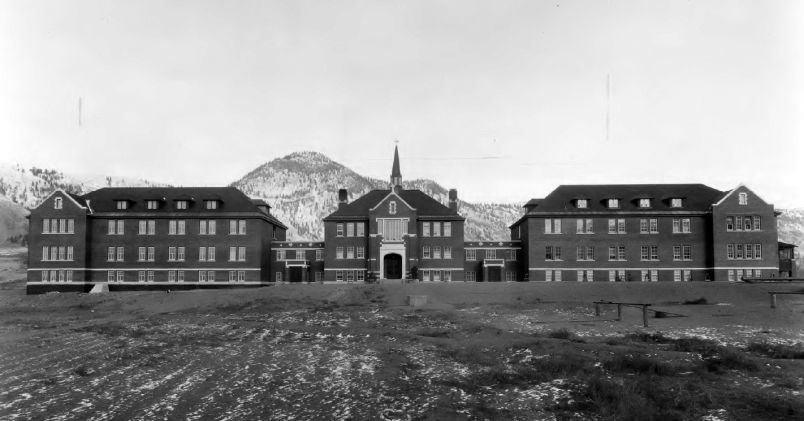
Kamloops Indian Residential School, 1930.
Photo from Archives Deschâtelets-NDC, Richelieu via Wikimedia Commons.
… [Iranian President Ebrahim Raisi] also threw in an attack on Canada’s treatment of Indigenous peoples, declaring that “bodies of hundreds of children were discovered in mass graves in a [former residential] school.”
The issue of supposed unmarked Indigenous child graves dominated the Canadian media in the latter half of 2021. But as I reported in Quillette several months ago, no “mass graves” were ever found. In fact, even the Indigenous groups that initially reported ground-penetrating radar (GPR) survey results consistent with the possible presence of unmarked burial sites weren’t talking about “mass graves”. Rather, the invented mass-graves claim was popularized by a badly botched New York Times May 28th, 2021, story written by reporter Ian Austen. (For a definitive debunking, see Terry Glavin’s account in Canada’s National Post).
In the 16 months that have passed since the unmarked-graves story broke in late May 2021, not a single body has been found, nor any human remains. And so even the less sensational allegation that 215 individual unmarked child graves lie buried under the grounds of a former Indigenous residential school in Kamloops, British Columbia, now seems doubtful. Nor have bodies or human remains been recovered at any of the other former residential-school properties where GPR surveys were conducted.
Yet that didn’t prevent Prime Minister Justin Trudeau from lowering flags on Canadian public buildings for more than five months, nor from speaking publicly as if bodies were already being dug up. And aside from the National Post, not a single major Canadian media outlet has admitted its role in feeding the unmarked-graves social panic that exploded last year, and which often included lurid speculation that the supposed grave sites not only contained the remains of Indigenous children, but that these children had been murdered through methods worthy of a horror-movie plot.
Given this, what can Canadian public figures say to Raisi now that he’s throwing spurious moral equivalences into our faces? Nothing. In making the false claim that “bodies of hundreds of children were discovered in mass graves in a [former residential] school”, the man is merely reading our own officially sourced misinformation back to us.
This isn’t the first time that Trudeau has managed to maneuver Canada into this kind of mortifying position vis-à-vis the world’s tyrants. Last year, when Canadian lawmakers voted to denounce China’s treatment of Uighurs in western Xinjiang as a form of genocide, Trudeau and his Cabinet abstained. The suspected reasons for that move were complex. But they included the fact that Canada was, by its own description, morally compromised on the genocide file: Back in 2019, Trudeau had explicitly acceded to the (absurd) claim that Canada, too, was guilty of “genocide” — this one against Indigenous women. Indeed, according to the official report that precipitated Trudeau’s mea culpa, this supposed Canadian genocide remains ongoing.
Did D-Day win WW2? – a WW2 expert discussion
World War Two
Published 25 Sep 2022WW2 historians Indy Neidell, Spartacus Olsson, and Paul Woodadge moderated by Ryan Socash discuss the meaning and significance of D-Day from historical, current, and future perspectives. Recorded on the road while shooting in Normandy for TimeGhost’s 24-hour documentary on the events of June 6, 1944.
(more…)
QotD: “Comrades of proven worth”
So too they didn’t have to line up for the scraps of whatever rotting junk the ration stores had. The KGB, for example, had its own commissary just around the back of Lubyanka – I know, I’ve shopped in it. And higher ranks simply never needed to go shopping at all, the nomenklatura had the government delivery service. Ocado for commies but only really important commies.
This all came under the rubric of comrades of proven worth…
Tim Worstall, “Emma Thompson Is A Comrade Of Proven Worth To Extinction Rebellion”, Continental Telegraph, 2019-04-19.
September 25, 2022
Red Army Reaches the Dnieper – WW2 – 213 – September 24, 1943
World War Two
Published 24 Sep 2022Benito Mussolini proclaims a new fascist republic in Italy, but this time it is a full puppet state to Germany. There is scattered fighting around Italy and the Dodecanese — including a massacre of Italian POWs, but the big Allied advances this week are the Australians in New Guinea and the Soviets retaking their own territory. They take ground, in fact, from near Smolensk all the way south to the Sea of Azov.
(more…)
200 Medals Won in an Hour – The Raid on Zeebrugge, 1918
Historigraph
Published 11 May 2022
(more…)
QotD: Sparta’s military reputation as “the best warriors in all of Greece”
That reputation could be a real military advantage. Greek hoplite armies arranged themselves right-to-left according to the status of each polis‘ army (poleis almost always fight in alliances). Since Sparta was always the leader of its alliance, the Spartan king and his force always took the right – opposite the weakest part of the enemy army. You may easily imagine the men facing the Spartans – they know the Spartan reputation for skill (and do not have the advantage of me telling them it is mostly hogwash) and by virtue of where they are standing know that they do not have the same reputation. Frequently, such match-ups resulted in the other side running away before the Spartans even got into spear’s reach (e.g. Thuc 5.72.4).
There’s a story in Xenophon, embedded in the larger Battle of Lechaeum, which I think illustrates the point well. Early on, the Argives (the men of Argos, always the enemy of Sparta) meet and rout a group of Sicyonians (who are allies of Sparta). A passing Spartan cavalry company under a Pasimachus sees this and rushes in; getting off their horses, they grab the Sicyon shields (marked with the city’s sigma) and advance against the Argives. But whereas later in the battle the arrival of the Spartans will trigger panic and retreat, here the Argives do not know they are fighting Spartans (because of the shields) – and so they advance with confidence; Pausimachus with his small force is crushed. As he attacks Pausimachus declared (according to Xenophon), “By the two gods, Argives, these Sigmas will deceive you” (Xen. Hell. 4.4.10; the “two gods” or “twin gods” here are Castor and Pollux).
I rather think that Pausimachus was deceived by the lambda his own shield may have carried (there is debate about if Spartan shields always had the lambda device, I tend to think they did not). Pausimachus expected to surprise the Argives with his Spartan skill. Instead, he found out – fatally – that the magic was never in the Spartan, it was in the image of Sparta that lived in the mind of his opponent.
Bret Devereaux, “Collections: This. Isn’t. Sparta. Part VI: Spartan Battle”, A Collection of Unmitigated Pedantry, 2019-09-20.
September 24, 2022
Life Inside a Panzer – Tank Life Part 1 – WW2 Special
World War Two
Published 23 Sep 2022The German Panzers are high on the list of the most feared and respected weapon systems of the Second World War. Much of their effectiveness however did not simply stem from technical or tactical superiority, but was achieved through rigorous training and the tight camaraderie of their crews. Days, weeks, or even months on end, the men operating a Panzer would stay together, maintaining the tank, and training for the battle to come. Through summer and winter, heat and snow, mud and rain, the tank would become their home.
(more…)
QotD: The evolution of the domestic corridor
But certain features of a 200 year old apartment remain constant. There are bedrooms. There is a privy (now a flushing toilet). There is a kitchen. There is a living room. And there is a corridor.
This apartment was built around 1820, for the builder of the tenement it’s part of: he was a relatively prosperous Regency working man and his family would have included servants as a matter of course in those days. And where one has servants, one perforce has corridors so that they may move about the dwelling out of sight of the owners. But it was not always so.
Rewind another 200 years and look around a surviving great house, such as Holyrood Palace, also in Edinburgh. Holyrood largely dates to the 16th and 17th century, and reflects the norms of that earlier era, and if you tour it one thing is noteworthy by its absence: corridors. The great houses of that period were laid out as a series of rooms of increasing grandeur, each leading to the next. Splendid wide main doors in the centre of each wall provided access for nobility and people of merit: much smaller, unadorned doors near the corners allowed servants to scuttle unobtrusively around the edges of the court. Staircases ascended through grand halls at the centre of such houses (accessible from doors leading to the main function rooms around the periphery): servants’ areas such as the kitchen, stores, and pantry might boast their own staircases, and the master apartments of a great house had their own stairs leading to privy or ground floor.
But the corridor in its modern, contemporary sense seems to have started out as a narrowing and humbling of the grand halls and assembly rooms of state, reduced in scope to a mere conduit for the workers who kept things running — before, of course, they later became commonplace.
Charles Stross, “Social architecture and the house of tomorrow”, Charlie’s Diary, 2019-04-29.
September 23, 2022
Lessons from the Eighteenth Century for the Russo-Ukraine conflict
In Strategika, Edward Luttwak considers what lessons can be drawn from wars of the past to help inform the ongoing Russian invasion of Ukraine:
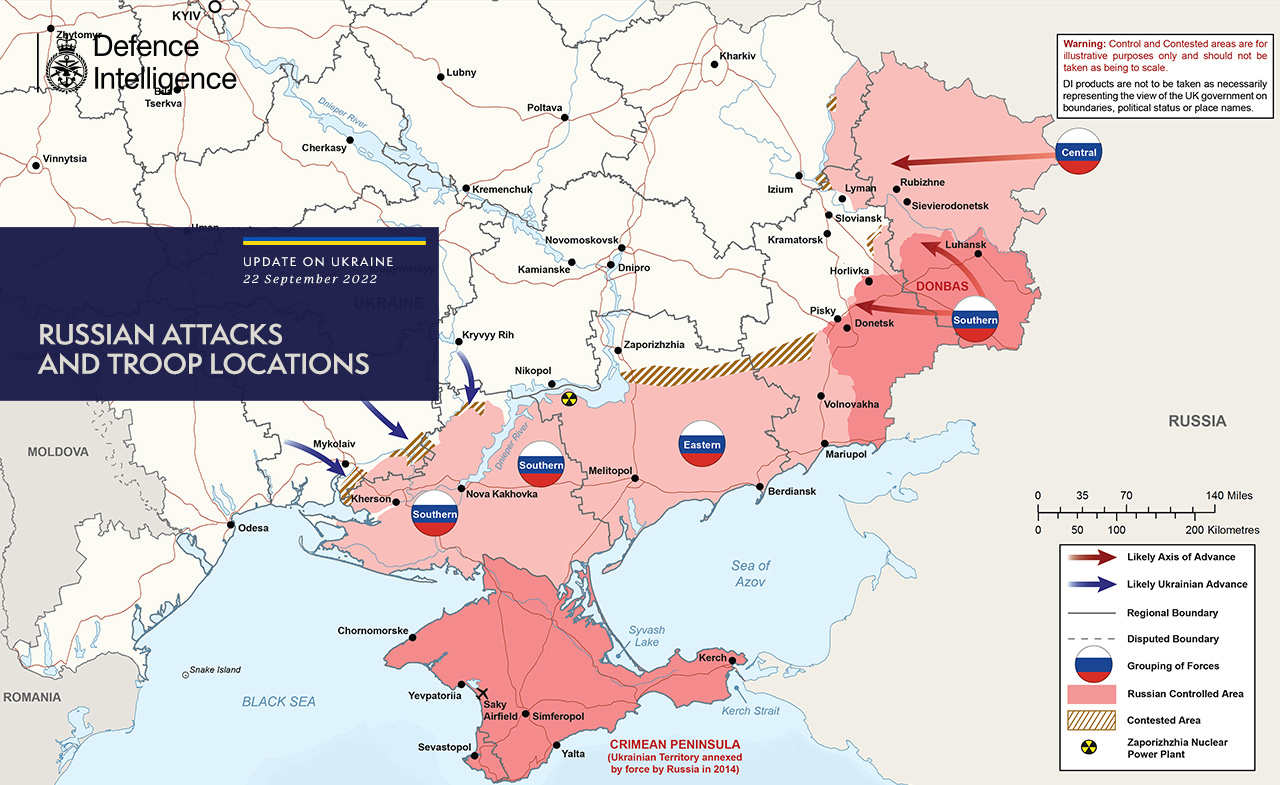
Every war must end, but no war need end quickly — neither world war makes it to the top ten in longevity. The nearest parallel to the Ukraine war – the Dutch War of Independence (1568–1648), fought between a smaller but more advanced nation, and the world-spanning Spanish Empire, the superpower of the age – persisted for eighty years because the Spanish kept losing, but there was so much ruination in that declining power.
In our own days, expeditionary wars fought against enemies far away who could hardly fire back, lasted for many years as the different war-ending theories promoted by fashionable generals were tried seriatim to no avail, till the day when evacuation was preferred even if utterly ignominious.
The eighteenth-century wars fought by rival European monarchs who could all converse in French with each other, were enviously admired in the bloody twentieth century, because they allowed much commerce and even tourism to persist — utterly unimaginable even in Napoleon’s wars, let alone the two world wars — and because they ended not in the utter exhaustion of the collapsing empires of 1918, nor in the infernal destructions of 1945, but instead by diplomatic arrangements politely negotiated in-between card games and balls. The 1763 Treaty of Paris that ended the Seven Years’ war and French America, inadvertently opening the way for the American republic, was not drafted by the victorious British Prime Minister Lord Bute, but by his very good friend the French foreign minister Étienne-François de Stainville, duc de Choiseul, who solved the three-way puzzle left by the French defeat by paying off Spain with Louisiana, Britain with money-losing Canada, and regaining the profitable sugar islands for France, which still has them.
And instead of the winners charging the losers with incurable bellicosity as Versailles did with Germany, or stringing them up individually as war criminals, as in the ending of twentieth-century wars, eighteenth-century winners were more likely to console the losers just short of “better-luck next time” — and in a century in which there was war every single year without exception from 1700 to 1800, if one war ended another necessarily started or at least persisted, allowing a “next time” soon enough.
By contrast, the ensuing nineteenth-century wars held no lessons at all for the twentieth century, which was equally bereft of a Napoleonic superman at the start and ample tropical lands easily conquered later on, while the Crimea expedition in the middle was mostly a counter-example of how not to wage war, and the Franco-Prussian war was just as sterile: all it proved was that there really was only one Helmuth von Moltke who could win wars by parsimonious force, unlike his homonymous nephew who lost a five-year war in its first five weeks; and that there really was only one Otto von Bismarck, who crowned his incomplete 1871 unification of German lands by refusing to complete it by unifying all Germans as the Italians were unified, lest the world combine to make a bigger Germany smaller.
Clearly only the eighteenth-century precedents apply to the Ukraine War. Neither Putin nor Zelensky speaks French but neither needs it to converse in their Russian mother-tongue, and if they do not actually talk (Putin demurely said that he could not possibly be expected to negotiate with Kiev’s drug addicts and Neo Nazis), their officials certainly can, and do so often.
When it comes to the persistence of commerce in war — the habit that Napoleon wanted to break with his Blocus Continental against British exports — every day Russian gas flows to the homes and factories of Ukraine on its way into Western Europe, with Ukraine transferring money to Russia every day, even as it attacks its faithful customer. And, Ukrainian wheat is now shipped past Russian navy vessels to reach the hungry Middle East, after a negotiation unthinkable in twentieth-century wars, or in Napoleon’s either.
In Russia, sanctions have certainly diminished easy access to imported luxuries in local franchised shops, but they still arrive via Turkey at a slight premium … or discount depending on the previous Moscow markup. All over Russia the sanctions have been felt in all sorts of ways because the country was actually more internationalized than anyone realized, including Putin no doubt (arriving in Tomsk at 0600 one winter morning at a temperature of minus infinity, the one place to eat was McDonalds).
But unlike China, which must choose between fighting and eating protein — some 90% of its chicken, pork, and beef is raised on imported cereals plus some 150 million metric tons of soya per annum from U.S. and Canadian Pacific ports, or the Atlantic ports of Brazil and Argentina that would be an ocean too far for China-bound vessel – Russia produces all its own staple foods and can therefore fight and eat indefinitely, and neither does it import any energy as China must.
In other words, just as Russian propaganda has claimed from day one, the sanctions cannot stop the war materially, even if they played a large role in the flight of tens of thousands of elite Russians, once again diminishing the human capital of the largest European nation, as the Bolsheviks and Civil War did a century ago, and the opening of borders did again a generation ago.
It is a problem that the sanctions, which end the war by stopping Russia, might cause defections from the Western camp if the winter happens to be unusually cold, a subject on which Angela Merkel – so enthusiastically applauded for closing nuclear power stations and preferring Russian piped gas over American and Qatari liquified gas – has remained strangely silent.


