
World War Two
Published 2 Oct 2022The Wehrmacht continues Operation Axis and its slaughter of Italian soldiers. In Western Europe, the situation of the Jews becomes increasingly precarious, especially so in Denmark.
(more…)
October 3, 2022
Nazis Go Fascist Hunting – WAH 079 – September 25, 1943
Comments Off on Nazis Go Fascist Hunting – WAH 079 – September 25, 1943
France in the Cold War: AA52 Replaces the Hotchkiss
Forgotten Weapons
Published 27 May 2022
(more…)
Comments Off on France in the Cold War: AA52 Replaces the Hotchkiss
QotD: The foundation of Rome, as recounted by Vergil and Livy
Both Vergil and Livy begin by putting down Homeric roots and anchoring their stories in the Trojan War. That makes a good deal of sense from a mythic perspective: the Iliad and the Odyssey were the most illustrious legends of the Hellenic world and so it made sense for the Romans, looking to claim a place in the Mediterranean, to make that claim through connection to this most illustrious of tales (and of course later, when Rome was a colossus astride the Mediterranean, which the Romans by then called mare nostrum, “our sea”, it made sense they would prefer a heroic origin with grandeur to match their power at the time). And so both Vergil and Livy begin their story with Aeneas and his plucky band of Trojan refugees, fleeing the fall of Troy (though interesting, while Vergil tells the tale as a harrowing escape, Livy politely suggests that perhaps Homer’s Achaeans let Aeneas go, Liv. 1.1).
Aeneas (son of Aphrodite/Venus and a mortal man, Anchises) does appear, by the by, in the Iliad, though he isn’t a particularly notable or impressive hero (naturally Vergil will embroider Aeneas until he is presented as the equal of an Achilles or Odysseus because … well, wouldn’t you?). The Aeneid follows (with the aid of a major flashback) Aeneas as he shepherds his surviving Trojans from Troy to their prophesied new homeland in Italy (with a minor stopover in Carthage) and then covers also the war that breaks out between Aeneas’ Trojans and the local inhabitants (the Latins) when he arrives. Vergil cuts off at the climactic moment of the war (which in turn presents Aeneas as rather morally grey, a feature that is also present, as we’ll see, in Livy’s retelling of Rome’s legends), but Livy provides the denouement. After a period of conflict (Livy presents two different versions of the exact sequence), Aeneas ends up married to Lavinia, the daughter of Latinus, king of the Latins (Livy calls them the Aborigines – lit, “the native inhabitants”, Vergil the Latins; in both cases Latinus is their king) and the Trojan exiles and Latinus’ people form a single community at Lavinium, which in turn founds a colony at Alba Longa, both in Latium (the region of Italy in which Rome is, although note we haven’t founded Rome yet).
We then fast forward a few generations. Rhea Silvia, a priestess of Vesta at Alba Longa gives birth to twins, Romulus and Remus by (Livy expresses some doubt) the god Mars. The twins are exposed (for complicated royal-family-drama reasons we needn’t get into) and rescued by either a she-wolf or a woman of ill-repute (Livy isn’t sure which on account of Latin lupa having both meanings and clearly both legends existed, Liv. 1.4) and raised among shepherds in the hills of northern Latium. More politics ensues, Romulus and Remus, having grown to adulthood, right some wrongs in their home city of Alba Longa and set out to found their own city.
At which point Romulus promptly gets into a fight with and murders Remus over who is going to be in charge (this sort of intense moral ambiguity where the venerated legendary founder figures are also quick to violence and deeply flawed is also a feature of the Aeneid and can be read either as a commentary on Augustus or as some lingering Roman discomfort with their own recent history of civil wars running from 88 to 31 BC; we are not the first people in history to have very mixed feelings about how well people in our country’s past lived up to our ideals). Crucially, Romulus forms his new settlement (prior to the fratricide) out of – as Livy has it – “the excess multitudes of the Albans and Latins, to which were added the shepherds” (Liv. 1.6.3). After this, desiring to increase the population of the city, Romulus sets a place of refuge in the city so that “a crowd of people from neighboring places, altogether without distinction, free and slave, fled there eager for new things” (Liv. 1.8.6) and were incorporated into Romulus’ growing city. Livy approves of this, by the by, declaring it the first step towards rising greatness.
Romulus quickly has another problem because all of these new settlers were men, so he concocts a plot to carry off all of the unmarried women of the neighboring people, the Sabines – an Umbrian people (we’ll come back to this, for now we’ll note they are ethnically and linguistically distinct from the Latins) – who lived in the hills north of Rome under the guise of a religious ceremony (Liv. 1.9-13). At a festival where the Sabines had been lured to under false pretenses, the Romans abduct and forcibly marry the Sabine women, while using hidden weapons to chase away their families (I should note Livy goes to some length to assure the reader that the captured maidens were subsequently persuaded to marry their Roman captors, rather than forced (Liv. 1.9.14-16), though what choice he imagines the unarmed, captive women to have had is left for the reader to wonder at in vain; in any event, we need not share Livy’s judgement or his effort at patriotic euphemism and may simply note that bride-capture is a form of rape). The Sabines naturally go to war over this but (according to Livy) a peace is mediated by the captured women (according to Livy, unwilling to see their new husbands and old fathers kill each other) and the two communities instead merge on equal terms. In the midst of all of this, Livy does have Romulus set down a set of common customs for his people, which he thinks to have been mostly Etruscan (Liv. 1.8.3), the Etruscans being the people inhabiting Etruria (modern Tuscany) the region directly north of Rome (Rome sits, in essence, on the dividing line between Latium to the South and Etruria to the North).
Now we want to note two things here from this high-speed trip through the first few chapters of Livy. First is the deep ambivalence towards Roman violence here. Livy presents Rome as a city founded on fratricide, conquest, rape and sacrilege. Livy occasionally attempts to soften the impact of these legends (particular with the Sabines), but only so far. This isn’t really the place to unpack of all of that but suffice to say that I think that Livy’s willingness to open his history of Rome – practically an official history of Rome – so darkly speaks to a literary project still attempting to come to grips with the stunning civil violence which had gripped Rome for Livy’s entire adult life and had, as he wrote, only recently ended. And one day we also ought to come back and do a deeper look at how women function in Livy’s legends and histories (Livy’s account becomes much more properly historical as he gets closer to his own time); women, mostly Roman women, suffering (often sexual) violence so that in their sacrifice the Roman state might be enhanced is a repeated motif in Livy (e.g. Lucretia, Verginia).
But more directly to our topic today, I want to note at this point exactly the sort of society Livy is imagining the earliest Rome, under its first king Romulus, in particular that it consists of a lot of different peoples and heritages. We’ll come back to exactly who all of these peoples are (historically speaking) in a moment. But Livy and Vergil first create a Trojan-Latin fusion community, which produces both Romulus and Remus and their initial core of settlers (mixed in with other, apparently purely Latin communities), who then gather up shepherds from all around, and then invite literally anyone from nearby communities to join them (which must include Etruscan communities to the north as well as Umbrians and Falisci of various sorts from the hills) and then finally fuses that community with the Sabines (an Umbrian people).
So we have our very first Romans, as the first Senate is being set up (1.8.7) and the very first spolia opima – the prize for when one commander defeats his opposite number in single combat – being won (1.10.7) and the very first temple being founded in the city (1.10.7). And those very first Romans, as Livy imagines them, are not autochthonous (that is, the original inhabitants of the place they live), nor ethnically homogeneous, but rather a Trojan-Aborigines-Latin-Faliscian-Umbrian-Etruscan-Sabine fusion community. For Livy, diversity – ethnic, linguistic, religious – defines Rome, from its very first days.
But of course this is all legends – important for understanding how the Romans viewed themselves, but necessarily less valuable for understanding the actual conditions in Rome at its earliest. Unfortunately, we lack reliable written sources for this part of the world so early (most of the “regal” period, when Rome was ruled by kings, notionally from 753 – the legendary founding date for the city – to 509, is beyond historical reconstruction).
Bret Devereaux, “Collections: The Queen’s Latin or Who Were the Romans? Part I: Beginnings and Legends”, A Collection of Unmitigated Pedantry, 2021-06-11.
Comments Off on QotD: The foundation of Rome, as recounted by Vergil and Livy
October 2, 2022
Smolensk and Naples Liberated! Both in ruins – WW2 – 214 – October 1, 1943
World War Two
Published 1 Oct 2022Major prizes are taken by the Allies this week on two fronts — Naples in Italy and Smolensk in the USSR, but they are advancing all over the Eastern Front, across the Italian peninsula, and in the South Seas, but the enemy is leaving a trail of destruction as he pulls back.
(more…)
Comments Off on Smolensk and Naples Liberated! Both in ruins – WW2 – 214 – October 1, 1943
“We are governed by a transnational criminal enterprise”
Elizabeth Nickson on the deliberately created web of disasters the entire western world faces thanks to our governments’ allegiance to philosophies promulgated by organizations like the WEF:
We are governed by a transnational criminal enterprise.
What are you doing about it?
One sentence caught my attention in Giorgia Meloni’s speeches this week. She said that most insulting thing for her and other Italians, was the EU’s order to erase all references to Christianity, Christmas and Christ from all government documents by Christmas (ironic) of 2022.
This is another of those blows from the One Worlders that feels like someone is stepping on your heart and pressing down. I may not be a church-going Christian, but it defines me like almost nothing else. It is my history, my literature, my culture, my ethical standards, my everything. Christianity defines the western world, it is an activist faith, it orders a congregant to spread goodness wherever he or she goes. Erasing it is a crime similar in effect as the death camps of which our leaders dream. It destroys the ground of our being.
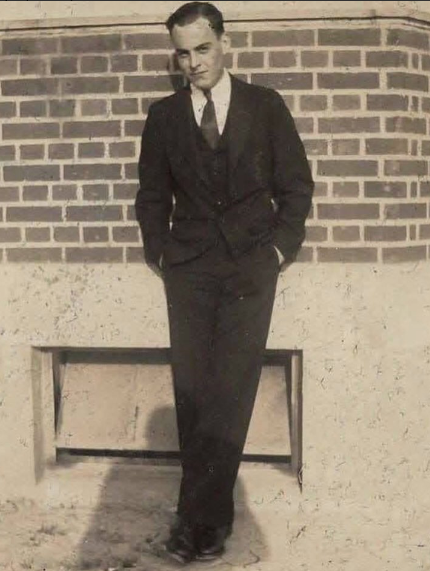
And then I think of my father. Look at this photograph. As a teen, he was very much like the kids of today, self-involved, vain, a girl magnet like his great grandson, Bryson, who never sees a girl who doesn’t interest him. But he was one of the few fully adult men I have known. I want to say only, but I’ve met thousands of men and know few of them as well as I knew him.
It wasn’t until long after my father’s death that I discovered that he was at the tip of the spear of the British Army as they landed at D-Day, pressed forward into France and then into Germany. The Canadian Army, the fourth largest standing army in the world in 1945, had a reputation of brutalism like no other army, famous for it in WW1. This was in part because it was built – as was Canada – by some of the fiercest medieval clans in Europe. Just before James 1 murdered the British border clan heads, Elizabeth I said that with 10,000 such men, James could topple any throne in Europe. Canada attracted those clans, the climate, the terrain was the roughest in the world, and only they could conquer it. And in 1943, they formed an army like none other.
Being his child, I can grope myself into what he was feeling during those two years under remorseless fire, on the ground, buried into caves on the Rhine that last winter, responsible for hundreds of men. He woke up every day for two years, with death certain. I have his Book of Common Prayer. It is swollen with use, especially the prayers for the dead he read over the bodies of his friends. After the war he was put in charge of a Nazi camp and told to “sort those people out”. Kind of like a desert in hell, I would think.
His faith carried him through those years. He was welded to it by the time it was over, although he never proselytized, it was just part of him. Christianity acts, with good men, as spur and comfort. It informed every ethical decision he made. After the war, he came home and worked, fighting unions that destroyed the textile industry in Quebec, trying to keep his factory going in the face of actual bags of burning shit thrown at our house. He retired at 55 with a non-compete clause and spent the rest of his life in charity, working for free. He ran in succession one enterprise after another. His entire life, all of it, he used his spare time to work in the community. Three meetings a week, no matter what. He knew where every sparrow fell in the country village I grew up in, and in the city to which he retired. And if he missed one, his uncles, aunts or cousins picked them up and set them right. It was how they lived.
That used to be a requirement for adulthood. He learned it from his family who came to the New World in 1630, and who all, to a man or woman, worked for free in whatever village or county they found themselves in, making sure everyone was all right. In the towns and cities they settled, across the US and Canada from 1600 to 1945, you were only considered an adult if you rolled up your sleeves and worked for other people in the place that you lived, without being paid, and without expecting praise.
If you didn’t do that work, you were considered a baby that everyone else had to carry. You were made to feel that.
It was that above every single other thing, that made the US and Canada the magnet it is for every other race and country in the world. Self-government by adults. And by the way, for the race-hustlers, they were officers on the Underground Railroad, when it wasn’t popular to be on the side of people of color. They married into Indian bands when it was absolutely beyond the pale.
The boomer generation abandoned that task, and the devolution of the culture was swift. The left creates jobs by creating bureaucrats and the responsibilities that used to be held in common, solved in common, done for goodness alone, are now done for money and benefits by people who generally do not live in the regions they supervise. They have screwed up everything because they can’t make decisions because they have no courage. And they have no courage because they have no ethical standards. Their only standard is whether it increases their own comfort. And that of maybe two other people. To whom they are related.
The only thing they create is debt and obstacles to growth. Aside from technical/engineering standards, (which are being broken) everything they do, can be done by citizens acting in concert.
Our disengagement led to our current economic catastrophe, like nothing else. It is the reason the globalist criminals were able to take over. It is why we now sit in danger of nuclear war.
Comments Off on “We are governed by a transnational criminal enterprise”
What is a Bopper Car?
Lake Superior Railroad Museum & NS Scenic Railroad
Published 5 Jun 2020Railroads came up with lots of great ideas to make things more efficient. Many of those ideas, like bottled water, and the red carpet, are part of our daily lives … as we have shown you in previous episodes.
Today, we talk about an idea that sounded good, but didn’t work out: The Bopper Car. A combination of hopper car and box car. Only a few were made, and the remaining ones were donated to the Lake Superior Railroad Museum. Today they’re used as storage for many of the shop’s parts.
(more…)
Comments Off on What is a Bopper Car?
QotD: US intelligence failures in the Tet Offensive
By summer 1967, MACV (for convenience) had convinced itself that the North Vietnamese no longer had the resources to win the war militarily, and they knew it. This conclusion was based in large part on metrics coming in from field commanders. Specifically, MACV argued that by mid-1967, the Communists had passed what they, MACV, termed the “inflection point” — the North Vietnamese were losing more forces than they could replace, which led to a significant decrease in NVA / VC fighting capacity, plummeting morale, etc.
At no point, it seemed, did they question this assumption, or the bases of this assumption, the key to which was: Kill ratio. We all know how that goes, no need to get into the weeds, but note that everything hinges on the North Vietnamese not only losing the war, but knowing themselves to be losing.
[…]
So, too, with ever-increasing reports that the Viet Cong were going to launch major attacks on South Vietnamese cities. Since US analysts assumed the VC didn’t have the forces for that, these reports were dismissed as propaganda.
Finally, the assumption that the NVA knew themselves to be losing was seemingly confirmed with the siege of the big US firebase at Khe Sanh. It shared a similar geography with Dien Bien Phu, and when some of the same units that had participated in the original battle showed up to take on the Marines, US analysts concluded that the Communists, desperate for a psychological victory, were trying to make another Dien Bien Phu out of Khe Sanh.
At most, US analysts reasoned, Khe Sahn was another Battle of the Bulge — a last-ditch “saving throw”-type attack by an almost-beaten enemy. Much like German forces in the Ardennes, then, the North Vietnamese would attack the Americans, because they were the strongest part of the Allies, and therefore the most immediate military threat.
In fact, almost the exact opposite was true, pretty much all the way down the line. The NVA’s plan was to attack ARVN (the South Vietnamese Army) because they were the weakest, and would be even weaker during Tet, when half of them would be on furlough. But ARVN wasn’t out on the perimeter and along the DMZ. They were in the cities. The whole point of the attack on Khe Sanh (and of a whole series of skirmishes called “the border battles”) was to keep US forces out on the perimeter and away from the cities.
It worked spectacularly, too — even as Tet was unfolding, Gen. Westmoreland assumed it was a diversion, to draw American troops away from Khe Sanh. Half the country had been overrun before Westy began to think maybe Khe Sanh wasn’t the target after all; he only really believed it when the NVA broke off the siege and withdrew.
It was Narrative uber alles.
Severian, “Book Rec: Tet, Intelligence Failure”, Founding Questions, 2022-06-30.
Comments Off on QotD: US intelligence failures in the Tet Offensive
October 1, 2022
“Father” – Fritz Haber – Sabaton History 113 [Official]
Sabaton History
Published 29 Sept 2022Fritz Haber is a controversial historical figure. He was responsible for scientific advances that fed billions, yet he created weapons of mass destruction that filled millions with terror. This is his story.
(more…)
Comments Off on “Father” – Fritz Haber – Sabaton History 113 [Official]
American Empire, question mark
An interview with Niall Ferguson in the Dartmouth Review by Lintaro Donovan revisits Ferguson’s 2005 book Colossus in light of what has happened during the nearly two decades since it was published:
TDR: In your 2005 book Colossus: The Rise and Fall of the American Empire, you advance the thesis that the United States is an empire in denial and that such denial will be our undoing, both domestically and abroad. Does that thesis still hold in the world of 2022?
NF: I think it has withstood quite well the test of nearly 20 years. If you recall, the analysis was that the United States was trying essentially an imperial enterprise in Afghanistan and Iraq and that there were three deficits that were going to make it fail. There was the manpower deficit, because people really did not want to spend that much time in Afghanistan and Iraq – hence the short tours of duty. There was the fiscal deficit, which was already obviously a problem and has only gotten worse. And then there was the attention deficit. The prediction was that the US [BREAK] public would become disillusioned with these endeavors just as it became disillusioned with Vietnam. And if anything, the surprising thing is how long it took to get out of Afghanistan.
I wouldn’t have predicted it would be 2021. I expected it sooner than that. But I think that the overall framing of the US as an empire-in-denial works because it’s so deeply rooted in the way Americans think about themselves and the language that their leaders use. What was odd was that some neo-conservatives back then really were willing to say, “We’re an empire now”.
Of course, it kind of blew them up politically so that they’re now an irrelevant bunch of never-Trumpers. So I feel that book stood up remarkably well to the test of time. I’d stick by it.
TDR: What I’m hearing from your answer is that our denial is sort of endemic to what Americans are and that there were issues that were already present before the invasion of Iraq. Do you think that there’s any personality in American public life today who might be able to get us out of our denial and fix these issues that you’re talking about?
NF: No, because I think, if anything, the kind of aversion to empire has grown on both the left and the right. And so you have different versions of it.
Those wings, the progressive wing of the Democratic Party and the Trumpian wing of the Republican Party, are much stronger than they were then. I don’t think we are going to see any revival until the US suffers the kind of attack that it suffered at Pearl Harbor or 9/11.
Until there’s a punch landed, what will happen is that the US will try to exercise power through indirect means like sanctions or getting Ukrainians to fight Russians or arming the Taiwanese. And, in that sense, I think we’ve reverted to a Cold War playbook without calling it a cold war.
The problem is that we aren’t as far ahead [of China] economically and technologically as we were relative to the Soviet Union. If you’re doing a cold war with China, you have to reckon with quite a formidable antagonist, but that I think is where we are.
It’s amazing how far there is now a bipartisan consensus that China’s the problem. The continuities from the Trump to Biden Administration are very striking in that respect. I don’t see that changing until something bad happens, whether it’s a showdown over Taiwan that the US actually loses, or the collapse of Ukraine, which I guess is a conceivable if now unlikely scenario, or another terrorist attack, though I think that’s not especially likely these days.
The other thing to watch out for is the Middle East. Basically, as in the Cold War, you’ve got the potential for a crisis to happen. The problem for the US is that it’s quite overstretched. If there’s a crisis in Eastern Europe and a crisis in the Far East, say Taiwan, and one in the Middle East, then the US is going to be completely unable to respond to all of those.
It’s already in the position that it can’t give Stinger and Javelin missiles to the Taiwanese, because they’ve already been given to the Ukrainians and we can’t actually make that many new ones. It feels like we are doing Cold War but with quite a bit more overstretch than was true certainly in the 1980s.
Comments Off on American Empire, question mark
Tank Chat #154 | Valentine DD | The Tank Museum
The Tank Museum
Published 27 May 2022We’re back with another Tank Chat this week! Catch up with Historian David Fletcher as he chats in detail about the Valentine DD tank.
(more…)
Comments Off on Tank Chat #154 | Valentine DD | The Tank Museum
September 30, 2022
History Re-Summarized: The Roman Empire
Overly Sarcastic Productions
Published 16 Sept 2022
The plot twist of Rome is that it was always a mess, now sit back and enjoy the marble-covered mayhem.This video is a Remastered, Definitive Edition of three previous videos from this channel — “History Summarized: The Roman Empire”, “History Hijinks: Rome’s Crisis of the Third Century”, and “History Summarized: The Fall of Rome”. This video combines them all into one narrative, fully upgrading all of the visuals and audio, with a substantially re-written script in parts 1 and 3.
(more…)
Comments Off on History Re-Summarized: The Roman Empire
M1C Sniper Garand
Forgotten Weapons
Published 18 Sep 2016The M1C was an M1 Garand with a telescopic sight, using a mounting system developed by the Griffin & Howe company of New York. It utilized a rail pinned and screwed to the left side of the receiver, coupled with a quick-release scope on top. The rails had to be installed prior to heat treating the receivers, which had the unfortunately consequence of preventing rifles form being chosen for sniper conversion based on their mechanical accuracy. Instead, accuracy would be tested only after rifles were complete, leading to a 60% rejection rate.
The scope was offset to the left of the receiver so as not to interfere with the Garand’s clip loading, and issued with a leather cheek pad to give the shooter’s cheek weld a matching offset to the left. The scope used with the M1C was the M73B1, later replaced with the M81 and M82 scopes — all military versions of the 2.5x Lyman Alaskan hunting scope (which was a very good piece of equipment despite its low magnification)
The M1C was adopted in 1944, but production and quality control delays would prevent it from seeing any action in WWII. It was in use during the Korean War, however, before being replaced by the M1D.
(more…)
Comments Off on M1C Sniper Garand
September 29, 2022
The Byzantine Empire: Part 5 – The Death of Roman Byzantium, 568-628 AD
seangabb
Published 21 Jan 2022In this, the fifth lecture in the series, Sean Gabb discusses the progressive collapse of Byzantium between the middle years of Justinian and the unexpected but sterile victory over the Persian Empire.
Between 330 AD and 1453, Constantinople (modern Istanbul) was the capital of the Roman Empire, otherwise known as the Later Roman Empire, the Eastern Roman Empire, the Mediaeval Roman Empire, or the Byzantine Empire. For most of this time, it was the largest and richest city in Christendom. The territories of which it was the central capital enjoyed better protections of life, liberty and property, and a higher standard of living, than any other Christian territory, and usually compared favourably with the neighbouring and rival Islamic empires.
The purpose of this course is to give an overview of Byzantine history, from the refoundation of the City by Constantine the Great to its final capture by the Turks.
Here is a series of lectures given by Sean Gabb in late 2021, in which he discusses and tries to explain the history of Byzantium. For reasons of politeness and data protection, all student contributions have been removed.
(more…)
Comments Off on The Byzantine Empire: Part 5 – The Death of Roman Byzantium, 568-628 AD
Nostradamus
In the latest post at Astral Codex Ten, Scott Alexander considers prophecy “From Nostradamus to Fukuyama”. Here’s the section on Nostradamus (because I don’t have a lot of time for Fukuyama, you’ll have to read the rest at ACX):
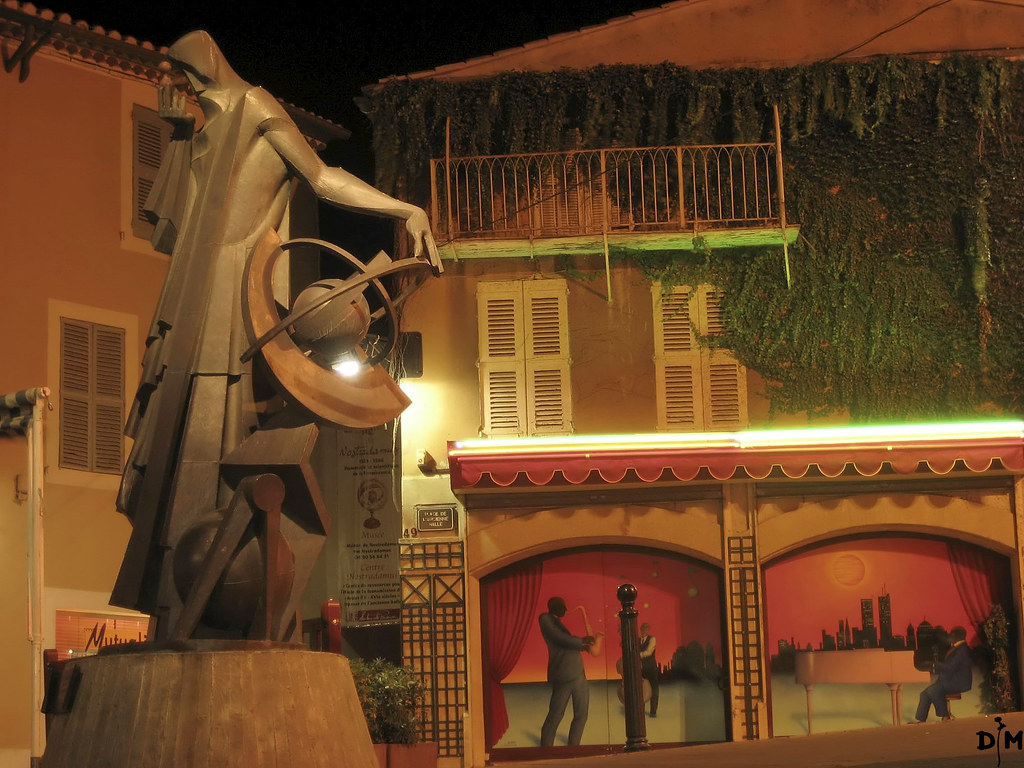
“House of Nostradamus in Salon, France. Now a museum.” by photographymontreal is marked with Public Domain Mark 1.0  .
.
Nostradamus was a 16th century French physician who claimed to be able to see the future.
(never trust doctors who dabble in futurology, that’s my advice)
His method was: read books of other people’s prophecies and calculate some astrological charts, until he felt like he had a pretty good idea what would happen in the future. Then write it down in the form of obscure allusions and multilingual semi-gibberish, to placate religious authorities (who apparently hated prophecies, but loved prophecies phrased as obscure allusions and multilingual semi-gibberish).
In 1559, he got his big break. During a jousting match, a count killed King Henry II of France with a lance through the visor of his helmet. Years earlier, Nostradamus had written:
The young lion will overcome the older one,
On the field of combat in a single battle;
He will pierce his eyes through a golden cage,
Two wounds made one, then he dies a cruel deathThe nobleman was a bit younger than the king, supposedly they both had lions on their shield (false), maybe King Henry was wearing a golden helmet (I can’t find evidence for this, but as a consolation prize please accept this picture of his amazing parade armor), and his slow agonizing death over ten days from his wounds was pretty cruel. Seems like a match, sort of. Anyway, for the next five hundred years lots of people were really into Nostradamus and spent goodness knows how many brain cycles trying to interpret his incomprehensible quatrains.
The basic Nostradamic method was:
Write 942 vague and incomprehensible quatrains, out of order and without any dates.
Whenever something happens, say “that sounds a lot like quatrain #143!” or “quatrain #558 predicted that”
Prophet
For example, prophecy 106:
Near the gates and within two cities
There will be two scourges the like of which was never seen,
Famine within plague, people put out by steel,
Crying to the great immortal God for reliefThis is an okay match for the atomic bombs, in the sense that there were two cities where something really bad happened. But read on to prophecy 107:
Amongst several transported to the isles,
One to be born with two teeth in his mouth
They will die of famine the trees stripped,
For them a new King issues a new edict.… and it starts to sound like he’s just kind of saying random stuff and some of it’s sticking by sheer luck.
A few prophecies sound more impressive than this, eg:
The lost thing is discovered, hidden for many centuries.
Pasteur will be celebrated almost as a god-like figure.
This is when the moon completes her great cycle,
but by other rumours he shall be dishonouredThis seems to name Pasteur, who was indeed a celebrated discoverer of things. And Nostradamus scholars note that a historian accused Pasteur of plagiarism in 1995, which is a kind of dishonorable rumor. But the work here is being done by the translator: Pasteur is just French for “pastor”, and an honest translation would have just said “the pastor will be celebrated …”, which is in tune with all his other vague allusions to things happening.
The blood of the just will be demanded of London
Burnt by fire in the year ’66
The ancient Lady will fall from her high place
And many of the same sect will be killed.Seems like a match for the London fire of 1666. But again checking the original French and the commentators, the second line is more properly “burnt by fire in 23 the 6”, which a fanciful translator rounded off to 20 * 3 + 6 = 66 and then assumed was a year. The experts say that this is really a coded reference to 23 Protestants being burned, in groups of six, during Nostradamus’ lifetime (many of his quatrains are references to past or present events, for some reason). This sounds more compatible with the “many of the same sect will be killed” ending.
I had a weird experience writing the end of this first part of the post. When I was a kid, reading through my parents’ old books, I came across an weird almanac from the 70s that had a section on Nostradamus. It listed some of his most famous prophecies, including the ones above, but also (reconstructing from memory and probably getting some things wrong, sorry):
The way of life according to Thomas More
Will give way to another more sweet and seductive
In the land of cold winds that first gave it birth
Without strife, without a war it will fall… and the 70s almanac interpreted this as meaning Soviet communism would fall peacefully. Reading this in 1995 or whenever it was I read it, a few years after Soviet communism did fall peacefully, I was really impressed: this is the only example I know where someone used a Nostradamus quatrain to predict something before it happened.
But I searched for the exact text so I could include the correct version in this essay, and I didn’t find it — this is none of Nostradamus’ 942 prophecies! The almanac authors must have made it up, or unwittingly copied it from someone else who did.
But I remember this very clearly — the almanac was from 1970-something. So how did the faker know Russian communism would collapse?
The moral of the story is: just because Nostradamus wasn’t a real prophet, doesn’t mean nobody else is.
Comments Off on Nostradamus
The History of Cyprus Explained in 10 minutes
Epimetheus
Published 24 May 2022The history of Cyprus explained from ancient times to modern.
(more…)
Comments Off on The History of Cyprus Explained in 10 minutes


