
Part of the mythos surrounding the Parachute Regiment is its near legendary “bad behaviour” – it is not seen as a gentlemanly and affable club, it is, arguably, the Millwall of the British Army infantry units. Their role is simple – to leap from the air, and land in the most difficult and demanding of circumstances, probably at night, probably amid confusion, disarray and destruction, and then fight until relieved. It calls for a uniquely aggressive and determined mindset, and a willingness to go on long after others would have stopped.
The Regimental history is littered with gallantry awards and tales of valour that are both inspirational and humbling to read. There is no doubt that within their world, the airborne infantryman can, when deployed on operations, be a ferocious foe, who few would wish to tangle with. The problem is that this aggression and drive is not something that is commonly needed outside of military operations, and the chances of these occurring are in ever shorter supply.
After a period when there were opportunities for deployments and kinetic action in Afghanistan and Iraq, the call for missions for Paratroopers is, currently, slim. Designed as a force intended to be ready to go when called, their leadership have to balance off maintaining an aggressive “ready for anything” mentality, coupled with trying to keep the behaviour of their people under manageable control.
Sir Humphrey, “Values, Standards, and Leadership in the Internet Age”, Thin Pinstriped Line, 2022-06-18.
October 9, 2022
QotD: The Paras in peacetime … the “Millwall of the British Army”
October 8, 2022
Prelude to WW1 – The Balkan Wars 1912-1913
The Great War
Published 7 Oct 2022The Balkan Wars marked the end of Ottoman rule in Southeastern Europe, and they involved several countries that would join the First World War just a few years later. A complicated alliance between Serbia, Montenegro, Bulgaria and Greece imploded over disagreement of the war spoils after defeating the Ottomans. This led to the 2nd Balkan War and also created much resentment that would play a role between 1914 and 1918 too.
(more…)
Tank Chat #155 | Warthog | The Tank Museum
The Tank Museum
Published 3 Jun 2022David Willey is back with another Tank Chat. This week join David as he chats about the armoured vehicle Warthog — the Viking successor.
(more…)
October 7, 2022
The Combat Dogs of World War Two – WW2 Special
World War Two
Published 6 Oct 2022Where man goes, so does man’s best friend. Across the globe, tens of thousands of dogs are called up. They play their part in tales of heroism and joy. But without any agency over their own lives, they also experience fear, death, and cruelty.
Churchill and the Queen
In The Critic, Andrew Roberts outlines the relationship between Prime Minister Winston Churchill and Queen Elizabeth II:
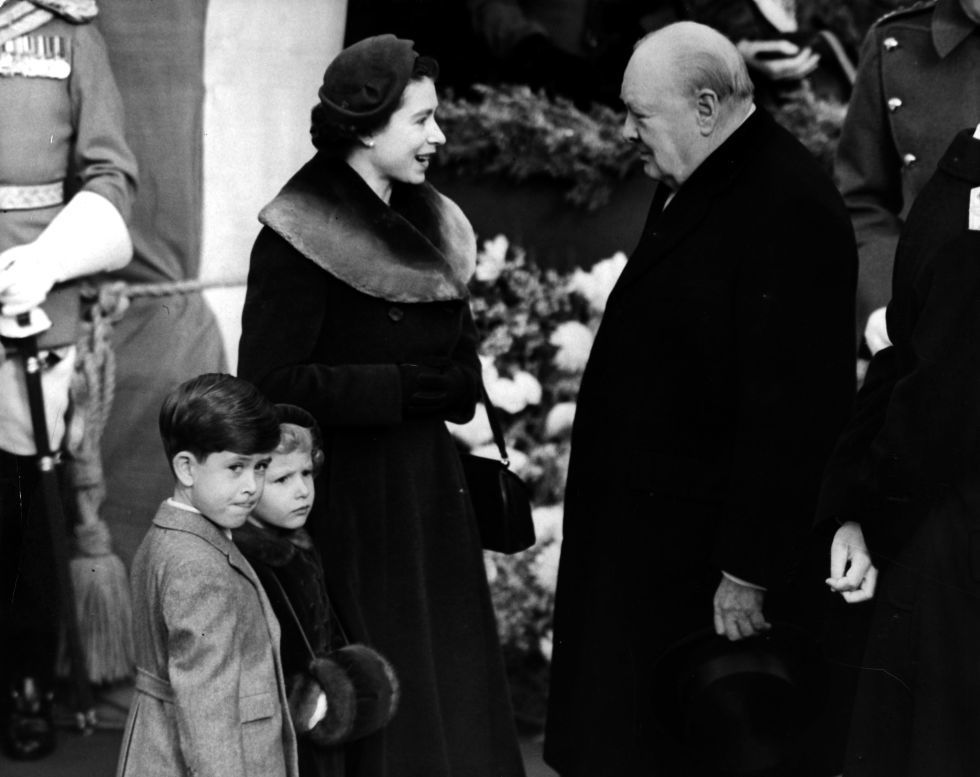
Queen Elizabeth II and Sir Winston Churchill, with Prince Charles and Princess Anne in the foreground, 10 Februrary 1953.
Official photograph via Wikimedia Commons.
Winston Churchill was besotted with Queen Elizabeth II: the word is precise. He worshipped and adored her. His relations with some other members of the royal family were, on occasion, complicated — not least when King Edward VII was sleeping with his mother. But for the late Queen he had nothing but an almost puppy-dog love.
[…]
When King George VI died unexpectedly on 6 February 1952, aged only 56, Churchill was devastated, weeping copiously both on hearing the news and at the funeral. Of the new monarch he told his private secretary, Jock Colville, that “he did not know her and that she was only a child”.
Nonetheless he saw an opportunity of romanticising the country’s situation. “Famous have been the reigns of our queens,” he said in his BBC broadcast on the King’s death. “Some of the greatest periods in our history have unfolded under their sceptre. Now that we have the second Queen Elizabeth, also ascending the Throne in her twenty-sixth year, our thoughts are carried back nearly 400 years to the magnificent figure who presided over and, in many ways, embodied and inspired the grandeur and genius of the Elizabethan Age.”
Although she was his sixth sovereign, Churchill was the new Queen’s first prime minister and old enough to be her grandfather. For all the 51-year age difference — or perhaps because of it — Churchill quickly grew devoted to her. “There was one lady by whom, from 1952 onward, Churchill was dazzled,” noted Colville. “That was the new Queen. Here was a woman whom he respected and admired more than any man.”
[…]
On 24 January 1965, 70 years to the day after the death of his father Lord Randolph Churchill, Sir Winston died. The Queen waived all custom and precedent to attend his funeral at St Paul’s Cathedral. She added a message in her own handwriting to the wreath of white flowers that was placed upon his coffin: “From the Nation and the Commonwealth. In grateful remembrance, Elizabeth R.” It echoed that which Churchill had placed on her father’s coffin, simply saying “For Valour”, the motto of the Victoria Cross, and a reference to the late king’s moral and physical courage during the Second World War, and perhaps also at the battle of Jutland in 1916.
[…]
The Queen decided Churchill should have a State funeral following his stroke in 1953. Once he had recovered, she told him so. The plans had to be rewritten several times over the next 12 years because, as Lord Mountbatten joked, Churchill kept on living but the pallbearers kept on dying.
There is a powerful symmetry to the friendship of monarch and premier that the next State funeral after Churchill’s was to be the Queen’s own, a full 57 years later.
Pease Pudding – Weird Stuff In A Can #74
Atomic Shrimp
Published 28 May 2018This is Pease Pudding — A sort of spreadable paste made from yellow split peas, and with a very long history as a staple food in England.
Here’s the link to the article on Atomic Shrimp (includes a recipe, of sorts): http://atomicshrimp.com/post/2007/01/…
QotD: King Agis IV’s and King Cleomenes III’s failed reform attempts in Sparta after 371BC
Thus the Spartan state might grant marginal, borderland to small groups of freed helots – the neodamodes and the Brasidioi – but actually bringing up the military strength of the polis in full could only be achieved by de-consolidating the kleroi – the best, most productive land (because you can only support so many hoplites on disputed, marginal land). This is one thing, of course, that the wealthy Spartiates who dominated the state were unwilling to do. The mothakes and hypomeiones, pushed to the edges of Spartan society, might be brought in to make up the difference, but unless they were made equals – homoioi – this was a recipe for instability, as seen with Lysander and Cinadon. This is the other thing the Spartiates were unwilling to do – if I had my guess, because for the poor Spartiates who still clung to their status (and might still use the Apella to block reform, even if they couldn’t use it to propose reform), that status differential was just about the only thing they had (apart from all of the slave labor they enjoyed the benefits of, of course).
(A different polis might have tried to make up this difference by either hiring large numbers of mercenaries, or arming its own people at state expense, as a way of using the fortunes of the rich to fund military activity without expanding the citizenry. But, as Aristotle notes – (we’ll come back to this when we talk about Spartan war performance) the public finances of Sparta were pitiful even by ancient standards – for precisely the same reason that deconsolidating the kleroi was politically impossible: the state was dominated by the wealthy (Arist. Pol. 2.1271b). With no real source of wealth outside of landholding and all of the good land held by the Spartiates, it seems that Sparta – despite being by far the largest polis in Greece and holding some of the best farmland outside of Thessaly, was never able to raise significant revenue.)
Instead, the clique of wealthy Spartiates arrayed about the kings did nothing, decade on decade, as the Spartiate citizen body – and the military power of Sparta – slowly shrank, until at least, in 371 it broke for good. But what is perhaps most illustrative of the dysfunction in the Spartan political system is the sad epilogue of efforts in the second half of the third century (in the 240s and 220s) to finally reform the system by two Spartan kings.
The first effort was by Agis IV (r. 245-241; Plut. Agis). By the time Agis came to power, there were only a few hundred Spartiate households. Agis tried to reform through the system by redividing all of the kleruchal land into 4,500 plots for Spartiates and another 15,000 for the Perioikoi (who might also fight as Hoplites). Agis gets the Apella to support his motion – his offer to put his own royal estates into the redistribution first earns him a lot of respect – but the Gerousia, by a narrow margin, rejects it. Agis is eventually politically isolated and finally executed by the Ephors (along with his mother and grandmother, who had backed his idea) – the first Spartan king ever executed (I have left out some of the twists and turns here. If you want to know Plutarch has you covered).
Cleomenes III (r. 235-222) recognizes what Agis seemingly did not – reform to the Spartan system could not happen within the system. Instead, he stages a coup, having four of the five Ephors murdered, exiled eighty citizens – one assumes these are wealthy and prominent opponents – and possibly had the other king assassinated (Plut. Cleom. 8, 10.1; Plb. 5.37). Cleomenes then redistributed the kleroi into 4,000 plots and made his own brother his co-king (Plut. Cleom. 11), essentially making him a tyrant in the typical Greek mold. He then set about continuing his war with the neighboring Achaean League in an effort to re-establish Spartan hegemony in the Peloponnese and presumably retake Messenia (which by that point was free and part of the Achaean league).
It was far, far too late. Had this been done in the 380s or even the 350s, Sparta might well have resumed its position of prominence. But this was the 220s – Macedon had dominated Greek affairs now for a century and the Antigonids – the dynasty then ruling in Macedon – had no intention of humoring a resurgent Sparta. In 224, a Macedonian army marched into the Peloponnese in support of Sparta’s enemies and in 222 it smashed the Spartan army flat at Sellasia, almost entirely wiping out the Spartiate citizen body – new and old – in the process (Plutarch claims only 200 adult Spartiate males survived, Plut. Cleom. 28.5). The victorious Macedonian – Antigonis III Doson – for his part re-crippled Sparta: he occupied it, restored its constitution to what it had been before Cleomenes and then left, presumably content that it would not threaten him again (Plut. Cleom. 30.1). The time when a state with a citizen body in the few thousands could be a major player had been over for a century and the great empires of the third century were in no mood to humor self-important poleis who hadn’t gotten the message.
Bret Devereaux, “Collections: This. Isn’t. Sparta. Part V: Spartan Government”, A Collection of Unmitigated Pedantry, 2019-08-29.
October 6, 2022
This vehicle belongs in a museum. Why is it still being used in Ukraine?
Imperial War Museums
Published 5 Oct 2022The BMP-1 is a Soviet infantry fighting vehicle from the 1960s. Ours was captured during Operation Desert Storm in 1991 and has been on display at IWM Duxford for over 30 years. Yet vehicles just like It are still being used by both sides in the ongoing Russo-Ukrainian War, with heavy losses. So why are museum pieces being fielded in a 21st century war? And how are they performing?
(more…)
The pendulum swings back toward institutionalization
During the 1950s and 60s, many mental institutions were shut down due to concerns about the way the patients in those institutions were being treated. Those suffering from mental health issues were, to a large degree, just discharged into the larger community with few supports to help them re-integrate. Today, the concerns about severely mentally ill peoples’ actions may be pushing the system back toward some form of formal re-institutionalization, as Michael Shellenberger reports for Common Sense:
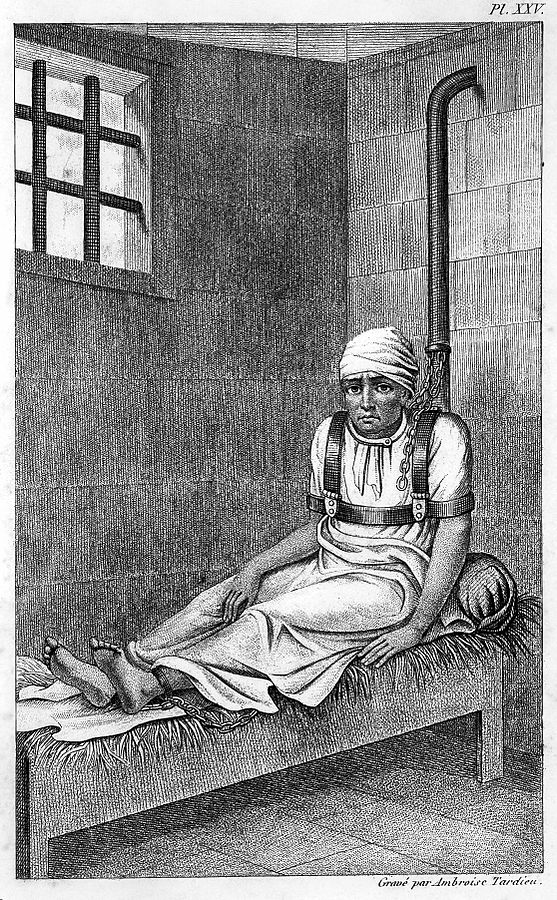
William Norris, shackled sitting upright on his bed at Bedlam, 1838.
Engraving by Ambroise Tardieu, Des maladies mentales Esquirol via Wikimedia Commons.
Though it is difficult to get an exact estimate, a large body of research makes clear that people like Zisopoulos, Mesa, and Simon are just three among hundreds of cases of people in New York alone — to say nothing of cities like Los Angeles, Seattle, San Francisco and others — in which mentally ill people off their medication have assaulted or killed people. And if you think the problem is getting worse, you are right.
In 2021, felony assaults in New York’s subway were almost 25 percent higher compared to 2019, despite a lower ridership because of the pandemic. The number of people pushed onto tracks rose from 9 in 2017 to 20 in 2019 to 30 in 2021. Psychiatrists and emergency department workers in San Francisco and Los Angeles tell me that they have seen a significant increase in homeless patients in psychotic states over the last few years.
How have we arrived at the point where we leave people with psychosis to their demons, and leave the public to take their chances? How have we allowed so many of our cities to have no decent plans or places for the burgeoning number of the violent mentally ill on the streets?
There are two major forces at work. The first is that the U.S. never created a functioning mental health care system. The second is that powerful groups have effectively prevented dangerously mentally ill people from getting treatment.
Starting in the late 19th century, the U.S. created large psychiatric hospitals, often in the countryside, known as asylums, for the mentally ill. Asylums were a major progressive achievement because they delivered, for many decades, significantly more humane, evidence-based care to people who, until then, had often been neglected, abused, or even killed.
But by the middle of the 20th century, the reputation of psychiatric hospitals was in tatters — and deservedly so. Conditions in many of them were appalling, even barbaric. People who were not severely mentally ill were sometimes subjected to years of involuntary hospitalization.
Many reformers just wanted better funding and oversight, but other reformers were more radical, and proposed shutting the hospitals down entirely and replacing them with community-based clinics. Some reformers claimed that serious mental illnesses were the result of poverty and inequality, not biology, and argued that they could be cured through radical social change.
The reformers largely won. State hospitals were shut down in droves before sufficient community centers could be built to treat the suffering. Over the next two decades, as state mental hospitals emptied out, many released patients ended up on the street, or incarcerated. Those community clinics that did start operating tended to treat “the worried well” — those suffering from comparatively low-level anxiety and depression, rather than psychosis.
Decades later, governments were still cutting funding for the treatment of the mentally ill. New York State in 2010 reduced Medicaid reimbursement for inpatient stays of the mentally ill in hospitals beyond 12 days. As a result, New York hospitals released the mentally ill earlier than they should have. From 2012 to 2019, the number of mentally ill adults in inpatient psychiatric care in hospitals and mental institutions in New York City declined from 4,100 to just 3,000. Meanwhile, the number of seriously mentally ill homeless people rose from 11,500 to 13,200.
The story is similar in California. Between 2012 and 2019, more than one-third of the group homes in San Francisco that served mentally ill and disabled people under the age of sixty closed their doors. Why? The measly Medi-Cal and Medicare reimbursement of $1,058 per person per month, and rising estate prices, made it more valuable for the private owners of group homes to sell than to keep operating them.
At the national level, the same dynamic was in play. The U.S. as a whole lost 15,000 board and care beds for the mentally ill and disabled between 2010 and 2016. Today, approximately 121,000 mentally ill people are conservatively estimated to be living on America’s streets.
Carl Gustav m/42: A 20mm Recoilless Antitank Rifle
Forgotten Weapons
Published 21 Apr 2017The Swedish Pansarvärnsgevär fm/42 made by the Carl Gustav company was an interesting early hybrid antitank weapon — a recoilless rifle firing solid armor-piercing projectiles. It used a 20x180mm case, propelling the 108g (1650gr) bullet at 950 m/s (3150 fps). This was capable of perforating 40mm of perpendicular armor plate at 100m (a high explosive projectile was also made). This was on the high end of armor penetration for anti-tank rifles, and the m/42 was able to do this with a weapon weighing just 11.7kg (25 lb) — less than a quarter of a comparable 20mm conventional rifle.
This was possible because of its recoilless design — upon firing, the rear end of the cartridge case would blow out and vent out the back of the weapon, instead of being firmly sealed like a conventional rifle. This created a counter balancing recoil impulse which prevented the gun and shooter from having to absorb the full recoil energy produced by a heavy bullet launching off at high velocity. The tradeoff was that much of the potential energy of firing was wasted venting out the back instead of pushing the bullet forward, which is why the cartridge case was so oversized.
About a thousand of the guns were made by the end of World War 2, at which time even it had been made quite thoroughly obsolete by the rapidly increasing thickness of tank armor. It would, however, be the stepping-stone to the m/48 Carl Gustav 84mm recoilless rifle, which used a shaped charge warhead to perforate armor with a stream of molten metal instead of relying on velocity of a hardened projectile.
(more…)
October 5, 2022
Ancient Roman Jellyfish for the Black Banquet
Tasting History with Max Miller
Published 4 Oct 2022
(more…)
The Amusing Inspiration Behind Dire Straits Classic 70s Hit | Professor of Rock
Professor of Rock
Published 16 Jun 2021The story of the 1979 classic “Sultans of Swing” by Dire Straits. Mark Knopfler was inspired to write the song after witnessing a band playing Dixieland Jazz in a dive bar.
Hey music junkies and vinyl junkies Professor of Rock always here to celebrate the greatest artists and the greatest 70s vinyl songs of all time for the music community and vinyl community.
If you’ve ever owned records, cassettes and CD’s at different times in you life or still do this is your place Subscribe below right now to be a part of our daily celebration of the rock era with exclusive stories from straight from the artists and click on our patreon link in the description to see our brand new show there.
Mark Knopfler was performing in London’s pub scene in the mid 70s, living on next to nothing in a flat with aspiring bassist John Illsley. Knopfler’s younger brother, David, introduced him to Illsley, following the dissolution of Mark’s first marriage. Mark, John, and David teamed up with “Pick” Withers, another London area musician, to form a group they aptly named Dire Straits.
The 4 members all had day jobs, but they lived a “hand to mouth” existence — struggling to pay their utilities bill. One rainy evening, Mark & a few friends decided to go to a nearby pub for a couple of pints in a dilapidated (dih-lap-ih-dated) section of South London. The pub was nearly empty, except for a couple of guys playing pool. In a corner of the bar, a band was playing — seemingly unaffected by the lack of an audience.
The band was “blowing Dixie — double-four time” as Knopfler would later transcribe. “Dixie double” is a performance style that was popularized by Django (jang-go) Reinhardt (rain-hart), and in the early days of Les Paul — where the guitar, bass, and drums are played harmoniously at a very fast pace.
If you’re playing “Dixie double-four time” as Knopfler describes in “Sultans of Swing”, you are playing twice the speed of the normal 4/4 time, and the drummer is working extra hard to keep up with the tempo. Knopfler remembered asking the hapless Dixie outfit to play “Creole Love Call” or “Muskrat Ramble”, much to the band’s delight, because they were undoubtedly shocked that someone in the pub actually knew some of the songs in their repertoire.
At the end of the band’s performance, the leader announced triumphantly to the 3-4 people in attendance … “We are the Sultans of Swing!”, as if they were playing in front of a packed house of ardent fans. Mark found the irony of the scene very amusing; a frumpy looking band playing a hole in the wall pub in a dodgy part of town, declaring themselves “the sultans of swing”.
To be a “sultan” would be to rule over a country, or hold a dynasty over people. The term originated from the Arabic language meaning to have “authority” or “rulership” over others. The true “Sultans of Swing” would’ve been the “swing” genre’s originator Fletcher “Smack” Henderson in the late 20s & 30s, or one of his revered disciples, Duke Ellington & Benny Goodman.
Babe Ruth and the Yankees legendary murderers row of the 20s if you’re talking baseball.
(more…)
October 4, 2022
Sweden: The Jews’ Salvation? – WAH 080 – October 2, 1943
World War Two
Published 2 Oct 2022As the Allies advance in southern Italy, the people of Naples join them in fighting the Wehrmacht. In Denmark, the biggest rescue operation of Jews thus far begins.
(more…)
The History of the Wine Glass
Tasting History with Max Miller
Published 31 May 2022
(more…)
QotD: “The world bought British and British was best”
The world has never offered us an easy living. There is no reason why it should. We have always had to go out and earn our living — the hard way. In the past we did not hesitate. We had great technical skill, quality, reliability. We built well, sold well. We delivered on time. The world bought British and British was best. Not German. Not Japanese. British. It was more than that. We knew that to keep ahead we had to change. People looked to us as the front runner for the future.
Our success was not based on Government hand-outs, on protecting yesterday’s jobs and fighting off tomorrow’s. It was not based on envy or truculence or on endless battles between management and men, or between worker and fellow worker. We did not become the workshop of the world by being the nation with the most strikes.
I remember the words written on an old trade union banner: “United to support, not combined to injure”. That is the way we were. Today we still have great firms and industries. Today we still make much of value, but not enough. Industries that were once head and shoulders above their competitors have stumbled and fallen.
It is said that we were exhausted by the war. Those who were utterly defeated can hardly have been less exhausted. Yet they have done infinitely better in peace. It is said that Britain’s time is up, that we have had our finest hour and the best we can look forward to is a future fit for Mr Benn to live in. I do not accept those alibis. Of course we face great problems, problems that have fed on each other year after year, becoming harder and harder to solve. We all know them. They go to the root of the hopes and fears of ordinary people — high inflation, high unemployment, high taxation, appalling industrial relations, the lowest productivity in the Western world.
People have been led to believe that they had to choose between a capitalist wealth-creating society on the one hand and a caring and compassionate society on the other. But that is not the choice. The industrial countries that out-produce and outsell us are precisely those countries with better social services and better pensions than we have. It is because they have strong wealth-creating industries that they have better benefits than we have. Our people seem to have lost belief in the balance between production and welfare. This is the balance that we have got to find. To persuade our people that it is possible, through their own efforts, not only to halt our national decline, but to reverse it and that requires new thinking, tenacity, and a willingness to look at things in a completely different way. Is the nation ready to face reality? I believe that it is. People are tired of false dawns and facile promises. If this country’s story is to change we the Conservatives must rekindle the spirit which the socialist years have all but exhausted.
Margaret Thatcher, “Speech to Conservative Party Conference”, 1979-10-12.


