
World War Two
Published 13 Oct 2022They say every masterpiece has its cheap copy. Well, the German Sicherheitsdienst are trying to copy the success of the Soviet Partisans. With Walter Schellenberg, Heinrich Himmler, and Reinhard Heydrich in charge, you know it’s going to be a bloody affair.
(more…)
October 14, 2022
Nazis Suck at Sabotage – WW2 – Spies & Ties 23
Comments Off on Nazis Suck at Sabotage – WW2 – Spies & Ties 23
When Potatoes were Illegal
Tasting History with Max Miller
Published 7 Jun 2022
(more…)
Comments Off on When Potatoes were Illegal
October 13, 2022
The Nazis’ Justification for the Genocide – October 9, 1943 – WAH 081
World War Two
Published 12 Oct 2022This week the Nazis go on the record about their genocide of the Jews. Meanwhile the Jews in Denmark are coming closer to safety, and the Roman Jews are again at peril.
(more…)
Comments Off on The Nazis’ Justification for the Genocide – October 9, 1943 – WAH 081
QotD: “Russia is a nation built for tank warfare”
Some nations possess very large numbers of tanks indeed — others barely any. Russia, China and North Korea are some of the worlds largest tank fleet operators, with thousands of tanks listed on their order of battle. Russia is a nation built for tank warfare — large open borders, and endless steppes that have over the last century played host to some of the biggest armoured battles ever seen. Having visited the Kursk salient many years ago, Humphrey can personally attest to the sheer size of the Eastern Front, and how a militarized society can make good use of armour.
Russia also benefits from an outstanding rail network able to quickly move tanks and other heavy elements of military power such as APCs and self-propelled guns around easily, and has the space and reserves of conscript manpower from previous generations to draw on to crew its simple but effective designs, such as the T64 and T72.
This is underpinned by a national philosophy which is best summed up as “don’t throw away any military asset that, no matter how old it is, could be used to kill an invader”. There are storehouses across Russia full of elderly tanks that with a bit of TLC could, probably function as a last gasp capability. Russia regularly exercises its armoured capability, mobilising forces and moving them around the country to test readiness against the theoretical threat of a NATO invasion.
Russia then is a nation intended for operating tanks, but only when supported by a logistics chain that can support the front. Start moving away from the Russian landmass and their ability to sustain a force at any distances is quickly called into doubt. While Russia may “rank” as the largest tank operator in the world, much of this is only a threat to any nation foolish enough to invade Russia in the first place.
Sir Humphrey, “Tanks for nothing — Why it does not matter if the British Army has fewer tanks than Cambodia”, Thin Pinstriped Line, 2019-04-24.
Comments Off on QotD: “Russia is a nation built for tank warfare”
October 12, 2022
History’s Real Macbeth
Tasting History with Max Miller
Published 11 Oct 2022
(more…)
Comments Off on History’s Real Macbeth
Walther P38 Development
Forgotten Weapons
Published 13 Apr 2016The Walther P38 was adopted by Germany in 1938 as a replacement for the P08 Luger — not because the Luger was a bad pistol, but because it was an expensive pistol. Walther began development of its replacement in 1932 with two different development tracks — one was a scaled-up Model PP blowback in 9x19mm and the other was the locked-breech design that would become the P38.
The initial prototypes look externally quite similar to the final P38, although the locking system went through several changes and the controls did as well. Several of the early developmental models used shrouded hammers.
In this video I will take a look at both initial “MP” pistols (the blowback and the locked breech), then the Armee Pistole (aka the AP) in its standard configuration and also a long barreled model with a shoulder stock, then the second Model MP, and finally the HP which was the commercial model of the final P38. In addition, I will check out a sheet metal prototype of the locked breech model form the very beginning of the development program.
(more…)
Comments Off on Walther P38 Development
October 11, 2022
Quebec politics explained (in Quebec!)
J.J. McCullough
Published 9 Oct 2022Politics in Canada’s French province. Thanks to Bespoke Post for sponsoring this video! New subscribers get 20% off their first box — go to https://www.bespokepost.com/jj20 and enter code
JJ20at checkout.My election watching buddy Sisyphus55: https://www.youtube.com/c/Sisyphus55
(more…)
Comments Off on Quebec politics explained (in Quebec!)
Looking for a full definition of “Two-Spirit” is a fruitless task
In Quillette, Jonathan Kay tries to find a satisfactory definition of the term “Two-Spirit” but despite his best efforts comes up empty:
On August 28th, Justin Trudeau’s government announced “Canada’s first federal 2SLGBTQI+ action plan: Building Our Future With Pride“, which was described as “a whole-of-government approach to achieve a future where everyone in Canada is truly free to be who they are and love who they love”. One aim of the $100-million plan, the government explained, is to convince Canadians to adopt the term “2SLGBTQI+” in place of “LGBT” — on the basis that 2SLGBTQI+ “is more inclusive and places the experiences of Indigenous 2SLGBTQI+ communities at the foreground as the first 2SLGBTQI+ peoples in North America”.
The two characters given pride of place, “2S”, signify “Two-Spirit”, a term that’s been a form of self-identification among Indigenous North Americans since the 1990s. But the descriptor doesn’t appear to be in wide everyday use outside Canada. And so non-Canadian readers will sometimes ask me to explain its meaning — at which point, I have to admit that I can’t. And I’m hardly alone: While most Canadians know that the “Two-Spirit” category is connected to Indigenous identity in some way, there’s an unspoken rule against requesting more specific information.
Last week, the Elementary Teachers’ Federation of Ontario (ETFO), the province’s elementary-school teachers union, published what the authors present as a primer on Two-Spirit identity, a document written in close consultation with 2S-identified Indigenous people. Since the report’s target audience consists of workaday teachers who educate young students, I imagined that Niizh Manidoowag: Two-Spirit might finally provide me with a straightforward explanation of what the 2S identifier actually means.
Unfortunately, it doesn’t. In fact, one of the main themes of the 32-page document is that the task of defining the Two-Spirit concept is (quite literally) beyond the powers of Western language and epistemology. And in any case, the category is almost completely open-ended: The act of proclaiming oneself Two-Spirited could be a statement about one’s gender, or sexual orientation, or both, or neither. Or 2S can be a statement about one’s politics, spirituality, or simply one’s desire to present as “anti-colonial”.
According to the ETFO report, there are only two non-negotiable elements of a Two-Spirited individual—both of which are spelled out multiple times in the document, and in bold letters. Neither rule is concerned with sex or gender, but rather with race and political orientation: To be Two-Spirited requires (1) that you are Indigenous; and (2) that you are engaged in a “decolonizing act of resistance”:
There is no one way to prescribe usage of the term [Two-Spirit] … There is no one way to define the term Two-Spirit. Two-Spirit people and their roles predate colonial impositions, expectations, and assumptions of sex, gender, and sexual orientation. Where colonial worldviews often frame concepts as linear, compartmentalized, categorical, and hierarchical, Indigenous worldviews tend to be understood as non-linear, reciprocal, (w)holistic, relational, and independent of Eurocentric perspectives and framings. As such, identifying as two-spirit is a decolonizing act of resistance in and of itself.
The term Two-Spirit was first popularized in 1990, at an inter-tribal Native American/First Nations gay and lesbian summit in Winnipeg, and is derived from the Ojibwa words Niizh Manidoowag. By one account, delegates were looking for a term that would “distance Native/First Nations people from non-Natives, as well as from the words ‘berdache‘ [a European term suggesting deviancy] and ‘gay'”. But lore has it that the true originator is a Fisher River First Nation woman named Myra Laramee, who experienced a vision of the world as seen “through the lens of having both feminine and masculine spirit”.
On the surface, that sounds like what today might be called “non-binary”. But that analogy fails on a fundamental level. The idea of gender identity relates to the (perceived) nature of oneself. Two-Spirit people, on the other hand, are described in the ETFO report as possessing a savant-like power (or “lens”) that channels truths about the nature of the external world.
The Two Spirit concept is also entirely distinct from run-of-the-mill gender dysphoria. In everyday progressive gender parlance, it is typically insisted that trans women are just like other women. Two-Spirited people, by contrast, are presented as an entirely unique specimen whose arrival within traditional Indigenous societies was “celebrated” — “highly valued” “gifts” who “possess the best of both gendered identities”.

Comments Off on Looking for a full definition of “Two-Spirit” is a fruitless task
A tribute to the F-101 ‘Voodoo’ Fighter
Matsimus
Published 4 Jun 2022The McDonnell F-101 Voodoo is a supersonic jet fighter which served the United States Air Force (USAF) and the Royal Canadian Air Force (RCAF).
Initially designed by McDonnell Aircraft Corporation as a long-range bomber escort (known as a penetration fighter) for the USAF’s Strategic Air Command (SAC), the Voodoo was instead developed as a nuclear-armed fighter-bomber for the USAF’s Tactical Air Command (TAC), and as a photo reconnaissance aircraft based on the same airframe. An F-101A set a number of world speed records for jet-powered aircraft, including fastest airspeed, attaining 1,207.6 miles (1,943.4 km) per hour on 12 December 1957.[1] They operated in the reconnaissance role until 1979.
Delays in the 1954 interceptor project led to demands for an interim interceptor aircraft design, a role that was eventually won by the B model of the Voodoo. This required extensive modifications to add a large radar to the nose of the aircraft, a second crew member to operate it, and a new weapons bay using a rotating door that kept its four AIM-4 Falcon missiles or two AIR-2 Genie rockets hidden within the airframe until it was time to be fired. The F-101B entered service with USAF Air Defense Command in 1959 and the Royal Canadian Air Force in 1961. US examples were handed off to the USAF Air National Guard where they served until 1982. Canadian examples remained in service until 1984.
(more…)
Comments Off on A tribute to the F-101 ‘Voodoo’ Fighter
QotD: The debt we owe to the Carolingian Renaissance
Bret Devereaux, “Collections: A Trip Through Dhuoda of Uzès (Carolingian Values)”, A Collection of Unmitigated Pedantry, 2020-03-27.
Comments Off on QotD: The debt we owe to the Carolingian Renaissance
October 10, 2022
How tall?
“An Englishman in New York” contemplates the ideal heights of city buildings:
I have often wondered what the maximum number of storeys for a good street is. No doubt an individual building can be indefinitely high, in the right setting. But this surely cannot be true of streets: a street with a thousand storeys would either be terrifyingly dark and claustrophobic, if the street were of normal width, or vast and bleak, if its width were scaled up to correspond with its height. So there must be some maximum beyond which pleasing street-based urbanism becomes impossible.
Some people think that the maximum is two or three. These people often believe that one is moving into inhumane scales when one goes above this point. Growing up in London, I knew the maximum must be at least four or five, since that is the norm for the Georgian terraces. I have a distinct memory of visiting Paris and realising it could not be less than eight, since that is the norm for the Belle Epoque.
Visiting Manhattan for the first time, I find it must be more still. The streets of Midtown Manhattan, each 60 feet wide, are often built up to ten or twelve storeys, with four or six more slightly set back above. The avenues, 100 feet wide, are often built up to fifteen or twenty storeys, with another five or ten set back. And to be clear: I refer to the height at which they are continuously built up, excluding the towers that rise above. The avenues of New York are perhaps not paradigmatic great streets, notably because they are almost invariably packed with four lanes of traffic. But their underlying form is good, as is borne out in the handful of cases in which they have been partly pedestrianised.
These streets evolved under New York’s famous 1916 building regulations. Before 1916, New York landowners could essentially build as high as they liked, and this did indeed generate streets that were sometimes rather menacing (pictured below left). The 1916 system was designed to allow as much height as possible while preserving the amenity of the street, indexing the height of the buildings to the width of the street and setting back the upper storeys in the time-honoured European fashion (pictured below right). This system lasted until 1961, when it was replaced with modernist regulations designed to generate slab blocks standing on open plazas; the results of this were so obviously inferior that the older system has been partly reinstated.
A pre-1916 street; a post-1916 avenue
My sense is that Manhattan’s tallest 1916-61 streets could not take many more storeys without losing amenity: the regulators basically succeeded in allowing as much height as possible without compromising the public spaces. In a city at a more southerly latitude, where the light is more intense, perhaps a few could be added; and perhaps the avenues could be widened further, with a corresponding growth in the buildings. It is hard to judge imaginary streets. But at any rate, New York shows we can go a lot higher than I had once supposed: there can be great streets with twenty storeys, five or ten more under a light plane, and more again in isolated towers.

And on grid-pattern streets:
Gridiron street plans have been used for planned cities in many times and places — in Harappa, in Dynastic China, in European Antiquity, even in the Middle Ages — so I assume there must be something very good about them. But I have never quite worked out what it is. One annoying thing about gridiron plans is the great frequency of road crossings. Walking the 3.2 miles from the Empire State Building to 1 Wall Street, one must wait, by my count, at 62 traffic lights. Walking the 3.3 miles from the Tower of London to Buckingham Palace, one encounters only 12, along with 8 crossings without lights that probably do not require waiting.
That is a slightly extreme example, but I think frequency of crossings is a general truth about gridirons. A gridiron distributes crossing points evenly and regularly, such that there is no way to reduce the number that one passes. If one wants to go three blocks east and twelve blocks south in Manhattan, there is no way one can avoid traversing fifteen roads. In an organic street plan with an equal overall density of roads, the crossings will be grouped in irregular ways. If one walked randomly, one would average the same number of crossings. But of course people do not walk randomly: one chooses one’s route, with a view in part to reducing the number of roads one has to cross. And so, rather picturesquely, the street plans long called “irrational” are in this respect preferable precisely because they are used by rational creatures.
Comments Off on How tall?
Chinese Warlords and the Royal Canadian Navy – WW2 – OOTF 028
World War Two
Published 9 Oct 2022In today’s episode of Out of the Foxholes, we discuss the role of Chinese warlords played in the war against Japan, while also shining a bit more light on the Canadian Navy and its impact on WW2.
(more…)
Comments Off on Chinese Warlords and the Royal Canadian Navy – WW2 – OOTF 028
Look at Life — Trouble Shooters (1964)
PauliosVids
Published 20 Nov 2018
From the comments:
David Mills
1 year ago
We never wore berets but jungle hats. This is an honest attempt to illustrate their role but so obviously, painfully stage managed. In reality, it was a hot, sweaty, stinking environment with constant tensions. Contacts were few and far between. Going into the IBAN long houses and chatting with the headman (Kampong Ketua) was fascinating, useful and, for the short period, relaxing. Between June 1965 and Aug 1982 I had four tours in the area. Learning Malay was essential and welcomed by the indigenous population.Iolis
1 year ago
The late Paddy Ashdown at 6.36. Later in life he would becone leader of Britain’s Liberal Democrat Party. He sadly died on 22 December 2018.
Comments Off on Look at Life — Trouble Shooters (1964)
October 9, 2022
Could the Soviets Cut Off Crimea? – WW2 – 215 – October 8, 1943
World War Two
Published 8 Oct 2022The Germans booby-trapped Naples when they evacuated last week and local civilians now pay the price. In the Mediterranean, Kos falls to the Germans while Corsica is liberated by the French. There is action all along the Dnieper in the USSR, and the Australians advance in New Guinea, and the Japanese evacuate Vella Lavella in the Solomons.
(more…)
Comments Off on Could the Soviets Cut Off Crimea? – WW2 – 215 – October 8, 1943
The Nanny State’s manifold failings
Christopher Snowden scoffs at the pro-Big Nanny maunderings of Matthew Parris in the Spectator recently:
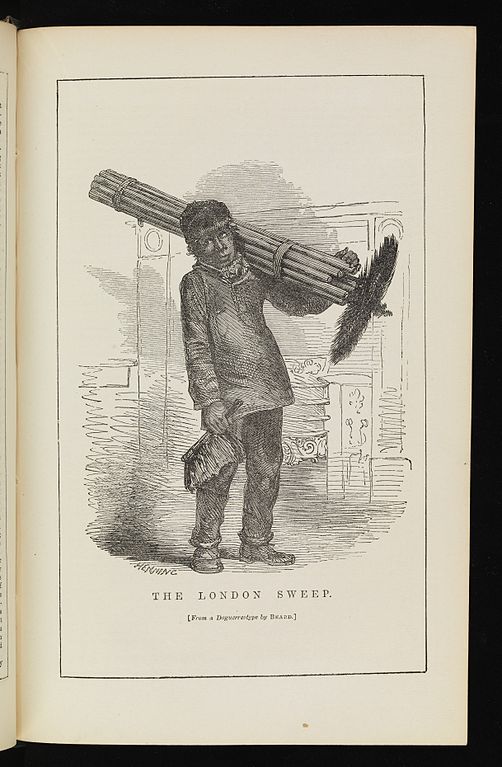
The London Sweep (from a Daguerreotype by BEARD).
Image from London labour and the London poor: a cyclopaedia of the condition and earnings of those that will work, those that cannot work, and those that will not work, 1851, via the Wellcome Collection.
A few years ago I was on the panel at the Battle of Ideas in London. I can’t remember what the topic was exactly, but it was something like the sugar tax or e-cigarette regulation. Rather than deal with the merits of these policies directly, I noticed that my opponents talked in general terms about the good that government can do, referencing the abolition of slavery and the ban on children going up chimneys.
Given all the regulation of recent decades, I found it telling that they had to go back 200 years to find laws that everyone can agree were jolly good. If I had been presenting the case for anarchism, their arguments might have landed, but since I was making the more modest case that perhaps there might be one or two laws in existence that are unnecessary and illiberal, their approach looked more like a diversionary tactic.
Matthew Parris did the same thing in last week’s Spectator. Thanks to the Royal Mail strike, it only landed on my doormat today, but you can read it here. It is titled “Maybe Nanny does know best”. Confusingly, Parris does not use the term “nanny state” in the conventional sense meaning lifestyle paternalism, but as a catch-all term for any government regulation whatsoever.
His target is Liz Truss whom Parris dislikes even more than he disliked Brexit and Boris Johnson. Unless Rory Stewart or Nick Clegg somehow become Prime Minister, I suspect that Parris will be demanding the head of whoever is in charge of the government until his dying day. He is not impressed by Truss’s “dash for growth”.
Parris’s argument is that Big Government is the friend of economic growth, not its foe. He confesses that he, like Truss, once held the view that the “dead hand of the state” stifled growth and led to inefficiencies but that he has grown out of all that stuff now and, with two gin-scented tears trickling down the sides of his nose, he welcomes his bureaucratic overlords.
Why? Because, a hundred years ago, the government gave women the vote and allowed them to work.
There was a time not so long ago when a certain group – half our potential workforce – were all but disqualified from contributing to Britain’s GDP. This group were called “women”. Women were generally unable to own property, or to play much more than a menial role in business (let alone politics, where they could not vote). So who helped unleash women’s potential, gave them rights in the workplace, stopped employers throttling their potential by restricting them to mindless occupations? Was it free trade? Was it big business? Was it competition? Was it Adam Smith’s “Invisible Hand”? No. Step forward Nanny. Nanny it was – legislation, the House of Commons, the first world war, the state – who commanded these things, driven in part by the forces of democracy.
The idea that women only started “contributing to Britain’s GDP” — i.e. working for pay — after the First World War is historically illiterate. It may have been true of the upper class and some of the middle classes, but for all other households it was a financial necessity for women to work, whether in agriculture, textiles, domestic service, pubs or whatever. It is true that more men were employed than women, but women were pregnant a lot of the time and had an enormous amount of unpaid work to do. They were certainly never “all but disqualified” from working, except in a few sectors such as the police force.
And who was it who banned women from owning property and voting in the first place? It wasn’t Adam Smith. It was the government, or, as Parris, would have it, the “nanny state”. So which nanny state are we supposed to be thankful for — the one that gave women the vote for a hundred years or the one that denied them the vote for hundreds of years?
Nanny had been busy since the 18th century, when in the Papists Act of 1778 she decreed that Catholics should not be excluded from key parts of the economy. She was still busy in the 20th century, starting with the Sex Disqualification (Removal) Act 1919, and later the 1944 Education Act outlawing the barring of married women from teaching.
Again, who excluded Catholics from key parts of the economy in the first place? Who barred married women from teaching? That’s right, it’s our old friend Big Government, the arsonist that Parris treats like a fireman.
Comments Off on The Nanny State’s manifold failings


