
Historigraph
Published 15 Oct 2022On May 21st 1982, the United Kingdom landed thousands of troops at San Carlos Water in the Falkland Islands, to begin their recapture from Argentina. But only hours after arriving, British forces were under intense attack, as the Argentine air force attempted to push the troops clambering ashore back into the sea. This was the Battle of San Carlos.
0:00 – Intro
0:37 – Britain’s Invasion Plans
2:59 – Bespoke Post
4:16 – The Argentine Onslaught
8:46 – Attack on Coventry and Conveyer
(more…)
October 19, 2022
South Atlantic D-Day: Battle of San Carlos – Falklands War
Comments Off on South Atlantic D-Day: Battle of San Carlos – Falklands War
QotD: Ritual change over time in pre-modern polytheistic religions
… if you asked a Roman or a Greek (or an Egyptian, or Mesopotamian, or what have you) how they came upon their knowledge of the gods, this would more or less be the answer: at some time in the deep past, our ancestors either figured out the correct way to keep the gods happy, or else the gods themselves delivered such a method to us (or often, some combination of the two) and we have done everything exactly that way ever since.
With the benefit of the strange sort of historical vision that lets us view multiple centuries at the same time, we can see that this is not so. Cult (by this term I don’t mean “creepy religion” I just mean “a unit of religious practice”, which is what it actually means) expands in importance or contracts. Certain gods that were seen as very important become less so and vice-versa. New practices move in, or arise seemingly out of nowhere, old practices pass out of use. And I find that also often befuddles students: so much is obviously changing, so how can these folks believe they’ve been doing everything the same since forever?
A big part of the answer is that they do not see history the way we do. For someone taking, say, a Greek history survey, you are viewing Greek society from space – zooming over entire decades, sometimes whole generations, in a single paragraph, compressing vast amounts of granularity. Change that appears rapid and obvious to us was often so slow as to be unnoticeable to people at the time – something we should remember will seem true about us when we are viewed by future humans as well.
The other thing to note is that these religious systems do allow for the idea that the gods are known imperfectly – this is another one of Clifford Ando’s excellence observations – and so the system is both devoted to tradition (if it works, keep doing it) and open to change (if it doesn’t work, innovate!). The system is thus more able to incorporate change without it seeming like anything has changed than many modern religions which have fixed religious texts with strongly accepted meanings.
Note here: it is not that the gods change, but that information about how to keep them happy can be learned. That does not produce a “newer is better” mentality though: new rituals are untested, whereas a ritual that has been practiced for centuries beyond counting has clearly worked for centuries beyond counting – after all, our society still exists and functions, so clearly, it worked!
Consequently, old practices are seen by practitioners as the best practices, but in the event of an emergency – a sudden setback that might imply the goodwill of a god (or, worse yet, the gods generally) has been lost, innovation is possible. And if that new ritual sets things right – the crisis abates – then it gets added to the portfolio of rituals-that-work, to be repeated, step for step, precisely, for future generations.
Bret Devereaux, “Collections: Practical Polytheism, Part I: Knowledge”, A Collection of Unmitigated Pedantry, 2019-10-25.
Comments Off on QotD: Ritual change over time in pre-modern polytheistic religions
October 18, 2022
CENSORED: The Great Escape from Death Camp Sobibor – October 16, 1943 – WAH 082
World War Two
Published 16 Oct 2022The German Nazis and their helpers are facing increasing resistance, this week in Rome from the Vatican, and at the Sobibor extermination camp from their victims.
(more…)
Comments Off on CENSORED: The Great Escape from Death Camp Sobibor – October 16, 1943 – WAH 082
“On average, a twenty-five year old man has the same level of impulse control as a 10 year old girl”
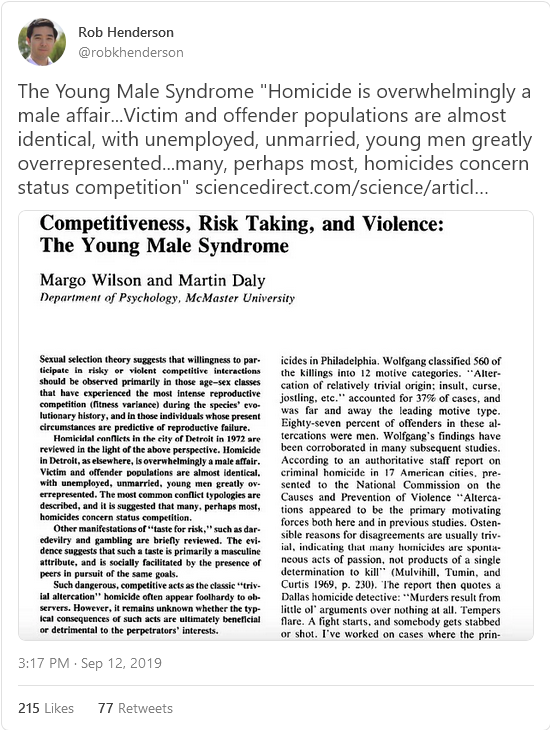
Rob Henderson considers how early humans managed to overcome violent tendencies as human communities got larger, and specifically considers the social role of young men, then and now:
One challenge to overcome involves the behavioral tendencies of young males.
[Oxford evolutionary psychologist Robin] Dunbar writes:
When males (and younger males, in particular) are deprived of social, economic, and mating opportunities, they are prone to behaving in ways that both stress other group members (especially reproductive females) and threaten the stability and cohesion of the group. This is as true of the more social primates as it is of humans, and is often associated with high mortality rates. Under these circumstances, males are also likely to indulge in raiding neighbouring groups, which can result in poor inter-community relations as well as retaliation. Managing male behaviour may, thus, be critical to maintaining an environment conducive to successful reproduction.
Young males are (unknowingly) experts at disrupting social cohesion. To be fair, they are also required to maintain and defend it. They’re a mixed bag.
Disputes that spill over into violence and homicide have been an ever-present risk in both contemporary and pre-modern small scale societies. Young men make up the overwhelming majority of such conflicts, both as perpetrators and as victims.
[…]
The vast majority of violence is carried out by young men.
Psychologically, a key reason for this is that women are more sensitive than men to penalties. Men are more inclined to take risks, oblivious to the punishments they may receive. Men also have lower levels of empathy and a higher tolerance for pain.
The psychologist Simon Baron-Cohen has posited the hypothesis of the “extreme male brain”, suggesting that males are at higher risk for a clinical diagnosis of autism because of the constellation of traits men tend to score higher on (e.g., systematizing over empathizing, favoring things over people, etc). It also implies that most males may be a little bit autistic. Of course, some women score highly on these traits, and there are girls and women who are diagnosed with autism. Just at much lower rates than males.
I have wondered if, in addition to autism, the idea of the “extreme male brain”, could just as easily apply to psychopathy.
For both psychopathy and autism, the ratio of males to females is about three to 1.
Men (especially young men) are more pronounced than women on just about every trait that characterizes psychopathy.
Relatively low impulse control, low empathy, low fear, high sensation seeking, relatively shallow emotions, need for stimulation, proneness to boredom, violent fantasies, desire for revenge, and increased likelihood of criminality. Of course, some women score highly on these traits, and there are women who are psychopaths. But far fewer than males.
The psychologist John Barry has pointed out that when he was a student, he learned he couldn’t use standard adult psychopathy tests to administer to teenage boys. The reason? Because adult tests might give teen males a false positive.
Just as (relative to women) most men might be a little bit autistic, most (young) men might be a little bit psychopathic.
On average, a twenty-five year old man has the same level of impulse control as a 10 year old girl.
Comments Off on “On average, a twenty-five year old man has the same level of impulse control as a 10 year old girl”
The War That Ended the Ancient World
toldinstone
Published 10 Jun 2022In the early seventh century, a generation-long war exhausted and virtually destroyed the Roman Empire. This video explores that conflict through the lens of an Armenian cathedral built to celebrate the Roman victory.
(more…)
Comments Off on The War That Ended the Ancient World
QotD: The US media and the Democratic Party since 1968
That suited the Democrats’ short-term interests just fine. Then as now, the Democrats were a bunch of fellow-traveling wannabe-totalitarians. The difference, though, is that in 1968 grownups were still in charge of the party. Being intimately familiar with the concept of “useful idiots”, the grownup Dems were happy to encourage the journo-kids’ delusions of grandeur. The kids might not have been able to stir up enough shit to get Hubert Humphrey elected — that would’ve been a tough sell for Josef Goebbels — but they could make life hot for Richard Nixon. In other words, the Democrats thought they held the whip.
1972 should’ve been a wakeup call, but to be fair, all the campaign wonks were still reeling from The Great Magic Party Switch of 1964. Both halves of the failed Democratic ticket from 1968 ran in the 1972 primaries, and so did George Wallace (who actually won more primaries than either Humphrey or Muskie — 6 to 5 and 4, respectively). Which left George McGovern, a goofy hippie from a nothing state who was so bad at politics that he got outflanked as a peacenik by Richard Nixon, the man who was right at that moment actually running the goddamn war. […]
[McGovern’s platform was], in short, “amnesty, abortion, and acid,” a Donald Trump-level linguistic killshot if ever there was one.
The point isn’t that McGovern was a goofy hippie. The point is that McGovern was The Media’s fair-haired boy. Hubert Humphrey was no one’s idea of a steely-eyed realist, but he was a grown-up. When he attacked McGovern as too radical during their primary debates, he was expressing America’s frustration with bratty, coddled, know-nothing college kids and their bong-addled, patchouli-soaked nonsense. But since it was the aforesaid spoiled, stoned college kids who wrote the election coverage …
Viewed from this perspective, Democratic Party politics up to now can be seen as the increasingly desperate attempts of the few remaining grownups to fend off The Media’s increasingly frantic grabs for the whip. Take a gander at these goofballs from 1976. Remember the “Scoop Jackson Democrats” all the National Review types kept gushing about when they needed some Democratic cover for W’s imperial misadventures? “Scoop” Jackson was a real guy, and probably the only adult in the room in 1976. Jimmy Carter, the eventual nominee, could at least fake being a serious, mature human being when he wasn’t being chased by enraged, swimming bunnies. The Jerry Brown of 1976 is the very same Jerry Brown who is putting the finishing touches on the shitholization of California here in 2019, and guess who The Media just loooooooved back in the ’76 primaries?
See also: Every other election through 2016. Sometimes The Media and the Party moved in tandem — e.g. Bill Clinton — but more often it played out like 1988, when the Party had to drag a bland nonentity (Mike Dukakis) over the finish line in the face of a Media darling (Jesse Jackson). This dynamic also explains the weird “enthusiasm gap” of Democratic voters starting in 2000 — nobody actually liked Al Gore or John Kerry, but since W. made The Media lose their tiny little minds, they went all-in on painting those two human toothaches as The Saviors of Mankind.
Severian, “Which Hand Holds the Whip?”, Rotten Chestnuts, 2019-07-17.
Comments Off on QotD: The US media and the Democratic Party since 1968
October 17, 2022
Tank Chat #156 | FV432 Bulldog | The Tank Museum
The Tank Museum
Published 10 Jun 2022Want to learn more about Bulldog? Check out David Willey’s Tank Chat on this infantry transport vehicle this week.
(more…)
Comments Off on Tank Chat #156 | FV432 Bulldog | The Tank Museum
QotD: Julius Nyerere
One day, the not very difficult thought occurred to me that Nyerere’s stated aim was not the real aim, that the aim of his policies was not the economic development of the country or anything like it, but rather the maintenance of himself and his cronies in power. Once I made this simple assumption, I could see what should have been obvious to me from the first: that far from being a miserable failure, Nyerere was a brilliant and outstanding success. Not only had he maintained himself in power for more than twenty years with very little challenge, apart from an early attempt at a coup by the army, but he had successfully managed to present himself to the world as a man of outstanding principle: indeed, there are even now moves afoot by the Catholic Church, to which he was more attached even than he was to Kim Il Sung, to canonise him, notwithstanding his imprisonment of political opponents and his forced removal of the peasantry from where it was living into collectivised villages. One of his miracles was to have extracted huge sums of aid money from the willing dupes of Scandinavia and elsewhere, which disappeared in Tanzania as water through sand but was so essential to him in the maintenance of his power.
If the aim of politicians is the attainment of power, Nyerere was one of the most successful politicians of the twentieth century, and very far from the fool or incompetent that I had thought him.
Theodore Dalrymple, “Brexit Doesn’t Mean Brexit”, Law & Liberty, 2019-04-15.
Comments Off on QotD: Julius Nyerere
October 16, 2022
Zaporizhzhia! – WW2 – 216 – October 15, 1943
World War Two
Published 15 Oct 2022The Allies begin an aerial bombing campaign against the Japanese base at Rabaul. It has big success, though Allied bombing in Europe this week achieves big failure. The Allied advance in Italy is slowing down to a crawl, but in the USSR the advance across the Dnieper continues, specifically at the Zaporozhe bridgehead.
(more…)
Comments Off on Zaporizhzhia! – WW2 – 216 – October 15, 1943
The concept of “childhood” changes over time
Chris Bray on the steady changes in how adult societies have viewed their children from the “better whipped than damned” views of the Puritans to the “childhood is sexy” views of today’s avante-garde opinion pushers:
Childhood is mercury.
Puritans thought that children were born in a state of profound corruption, marked by Original Sin. Infants cry and toddlers mope and disobey because they’re fallen, and haven’t had the time and the training to grow into any higher character. The devil is in them, literally. And so the first task of the Puritan parent was “will-breaking”, the act of crushing the natural depravity of the selfish and amoral infant. A child was “better whipped than damned”, in need of the firm and steady repression of his natural depravity. Proper parenting was cold and distant; parents were to instruct.
By the back half of the 19th century, children were sweet creatures, born in a state of natural innocence, until the depravity of society destroyed their gentle character. (“Man is born free, and everywhere he is in chains.”) Meanwhile, the decline of family-centered industry changed the household. The historical father, present all day on the family farm and guiding his children with patriarchal modeling and moral instruction, left for work at the factory or the office, and mom occupied “the women’s sphere“, the nurturing home.
Depraved infants, stern and firm parents; innocent children, nurturing mothers. Those two conceptions of childhood and the family can be found less than a hundred years apart at their edges. There are some other pieces to layer into that story, and see also the last thing I wrote here about the history of childhood. But the briefest version of an explanation is that the changing idea of what it meant to be a child was a reflection of growing affluence and security: Calvinist religious dissenters living hard and unstable lives viewed childhood darkly, while the apotheosis of Romantic childhood appeared in the homes of the emerging Victorian management class.
So childhood is mercury: It moves and morphs with societal changes, becoming a different thing in different cultures and economies. It tells you what the temperature is.
In the febrile cultural implosion of 2022, childhood is sexy, and legislators work hard to make sure 12 year-olds can manage their STDs without the interference of their stupid clingy parents.
Or click on this link to see a fun story about a teacher in Alabama who has a sideline as a drag queen, reading a story to young children about a dog who digs up a bone and then cleverly telling the children, “Everybody loves a big bone.” Wink wink! I mean, really, what could be sexier or more fun than talking to very young children about thick adult erections, amirite?

Update: Corrected link.
Comments Off on The concept of “childhood” changes over time
An Israeli LMG, Part II: The 8mm Dror
Forgotten Weapons
Published 8 Jun 2022
(more…)
Comments Off on An Israeli LMG, Part II: The 8mm Dror
October 15, 2022
From perpetual motion machines to “Philosopher’s Stoves” (no, that’s not a misprint)
In the latest Age of Invention newsletter, Anton Howes digs deeper into the question of why it took so long for the steam engine to be invented:
As I hinted in Part II, there were still more wonders to issue from [Cornelis] Drebbel’s workshop — many of them building on the same principles as his perpetual motion machine.
So it’s worth a very brief recap of how that device worked. Drebbel had improved upon an ancient experiment involving an inverted flask in water: that is, to heat the base of a long-necked glass flask and place it mouth-first into a bucket of water. The heated air trapped inside the flask would bubble out, and as the remaining air cooled, the water of the bucket would rise up into the flask.
The inverted flask experiment. The air bubbles out on the left. As the remaining trapped air cools, on the right, the water rises up the flask (in fact pushed up by the pressure of the atmosphere).Drebbel’s big breakthrough was to notice that once the water was already sucked into the flask, it would continue to rise and fall even when it wasn’t being heated or cooled on purpose — movements that were the result of natural changes to atmospheric pressure and temperature.
From this continued movement — to his mind, a harnessing of the perpetual movement of the universe itself — Drebbel then constructed a machine that seemed to show the ebb and flow of the tides, as the liquid inside it rose and fell between the cold of night and the heat of day. He also exploited that same rise and fall of the liquid in order to rewind clockwork that continually showed the time, day, months, and years, along with the cycle of the zodiac and the phases of the moon.
Few have now heard of Drebbel’s perpetual motion machine, but noticing that same rise and fall of the liquid in response to changes in the weather would also serve as the basis for the invention of the thermometer and barometer. Or, more accurately, to the reinterpretation of the ancient inverted flask experiment as a device capable of measuring both temperature and atmospheric pressure. (The two different applications were not disentangled and isolated until later, as we’ll see below, and so in modern terminology the initial device is often referred to as an air thermoscope.)
[…]
For alchemists like Drebbel, being able to control the temperature of furnaces and ovens was a valuable prize, because so much of their skill in manipulating metals and minerals depended upon it. The alchemist’s art — the intangible, tacit skill built up over years of experience — was one of sensitivity to heat, being able to judge, by feel and by look, the varying intensities of flame, and then to manipulate it so as to keep it at a constant level. The art was known as pyronomia, or as regimen ignis — the governing of fire.
At some point before 1624, Drebbel worked out that he could exploit the inverted flask experiment to radically improve furnaces. He did this in two ways. One was simply to affix a mercury thermometer to the furnace, to indicate its heat (mercury, with a higher boiling point, would be less liable than water to simply evaporate away). But the other, and more ingenious way, was to create a feedback mechanism to control the oven’s heat automatically. Drebbel placed a cork to float atop the mercury in yet another thermometer, which as it rose or fell would then cover or uncover the furnace’s air supply. He could thus choose a desired heat, and then let the oven do the rest. If it grew too hot, the air supply would be restricted. If it grew too cold, it would be increased. Drebbel had invented the thermostat, and perhaps one of the first widely-applied practical feedback control mechanisms.
Drebbelian self-regulating ovens, or Philosopher’s Stoves, spread beyond England, to be adopted in France, the Netherlands, Germany, and even across the ocean in New England — they were a major source of business for the husbands of Drebbel’s daughters, the brothers Abraham and Johannes Sibertus Kuffler, to whom he passed many of his secrets. Drebbel even applied its thermostatic principles to artificially incubating eggs, for which maintaining a constant temperature was essential. To give an idea of how big a deal this was, Francis Bacon filled his techno-utopian vision of a New Atlantis with “furnaces of great diversities, and that keep great diversity of heats; fierce and quick; strong and constant; soft and mild; blown, quiet; dry, moist; and the like”, some of which, like the incubator, were able to provide even the gentle heat of animal bodies. Drebbel, in Bacon’s lifetime, was thus producing the stuff of science fiction. He was, as one admirer termed him, a true Mysteriarch.
And the Mysteriarch did not stop there. Just before his death in 1633 he was working on improving the stoves, making them more efficient, reducing the need for people to attend the fire, and reducing their smoke. They could thus be applied to drying hops, malt, fruit, spices, and gunpowder, heating rooms in houses, and distilling fresh water from sea water. His heirs, the Kufflers, even made the stoves portable enough to be used for baking the bread for armies — they were allegedly used by Frederick Henry, Prince of Orange, in his various successful campaigns against Spain. Both the portable ovens and the seawater distilling machines were apparently used in the 1650s aboard ships headed for the Indian Ocean.
By the 1620s, then, many of the key elements for a steam engine were already coming into fairly widespread use. Scientists across Europe, inspired by Drebbel’s perpetual motion and Santorio’s thermometer, were eagerly pursuing the possibilities from expanding and contracting gases. And Drebbel had invented a widely-used thermostatic feedback system — a general concept that would later prove extremely useful in making steam engines practicable. Feedback systems and safety valves would come to regulate the movements of engines and reduce the risks of them overheating and exploding.

Comments Off on From perpetual motion machines to “Philosopher’s Stoves” (no, that’s not a misprint)
An Israeli LMG, Part I: The .303 Dror
Forgotten Weapons
Published 6 Jun 2022
(more…)
Comments Off on An Israeli LMG, Part I: The .303 Dror
QotD: Spartan strategic and diplomatic blunders during and after the Peloponnesian War
It takes Sparta years of fighting Athens to finally recognize this – an effort in 413/2 to support revolts from Athens is pathetically slow and under-funded (Thuc. 8, basically all of it) and it isn’t until Sparta not only allies with Persia but entrusts its fleet to the mothax Lysander that they seriously set about a strategy of cutting Athens’ naval supply lines. This isn’t a one-time affair: Sparta’s inability to coordinate ends and means shows up again in the Corinthian war (e.g. in Argos, Xen. Hell. 4.7), where they are pulled into a debilitating defensive stalemate because the Corinthians won’t come out and fight and the Spartans have no other answers.
This is compounded by the fact that the Spartans are awful at diplomacy. Sparta could be the lynch-pin of a decent alliance of cities when the outside threat was obvious and severe – as in the case of the Persian wars, or the expansion of Athenian hegemony. But otherwise, Sparta consistently and repeatedly alienates allies to its own peril. Spartan leadership at the end of the Persian wars had been so arrogant and hamfisted that leadership of the anti-Persian alliance passed to Athens (creating what would become the Athenian Empire, so Spartan diplomatic incompetence led directly to the titanic conflict of the late fifth century). And to be clear, Athenian diplomacy does not score high marks either, but it is still a far sight better than the Spartans (Greek diplomacy, in general was awful – rude, arrogant and focused on compulsion rather than suasion – so it is telling that the Spartans are very bad at it, even by Greek standards).
In 461, Spartan arrogance towards an Athenian military expedition sent to help Sparta against a helot revolt utterly discredited the pro-Sparta political voices at Athens and in turn set the two states on a collision course. Sparta had ejected the friendly army so roughly that it had created an outrage in Athens.
During the Peloponnesian War, Spartan diplomatic miscalculations repeatedly hurt their cause, as with the destruction of Plataea – the symbol of Greek resistence to Persia. Later on in the war, terrible Spartan diplomacy repeatedly derails efforts to work with the Persian satrap Tissaphernes, who has the money and resources Sparta needs to defeat Athens; it is the decidedly un-Spartan actions first of Alcibiades (then being a traitor to Athens) and later Lysander who rescue the alliance. After the end of the Peloponnesian War, Sparta promptly alienated its key allies, ending up at war first with Corinth (the Corinthian War (394-386) and then with Thebes (378-371), both of which had been stalwarts of Sparta’s anti-Athenian efforts (Corinth was itself a member of the Peloponnesian League). This led directly to the loss of Messenia and the breaking of Spartan power.
In short, whenever Sparta was confronted with a problem – superior enemy forces, maritime enemies, fortified enemy positions, the need to keep alliances together, financial demands – any problem which could not be solved by frontal attack with hoplites, the traditional Spartan leadership alienated friends and flailed uselessly. Often the Spartans attempted – as with Corinth and later Thebes – to compel friendship with hoplite armies, which worked exactly as poorly as you might imagine.
It is hard not to see both the strategic inflexibility of Sparta and the arrogant diplomatic incompetence of the spartiates as a direct consequence of the agoge‘s rigid system of indoctrination. Young Spartiates, after all, were taught that anyone with a craft was to be despised and that anyone who had to work was lesser than they – is it any surprise that they disdained the sort of warfare and statecraft that depended on such men? The agoge – as we are told – enforced its rules with copious violence and was designed to create and encourage strict, violent hierarchies to encourage obedience. It can be no surprise that men indoctrinated in such a system – and thus liable to attempt to use its methods abroad – made poor diplomats and strategic thinkers abroad.
Bret Devereaux, “Collections: This. Isn’t. Sparta. Part VII: Spartan Ends”, A Collection of Unmitigated Pedantry, 2019-09-27.
Comments Off on QotD: Spartan strategic and diplomatic blunders during and after the Peloponnesian War
October 14, 2022
That time that H.G. Wells fell afoul of Muslim sentiments
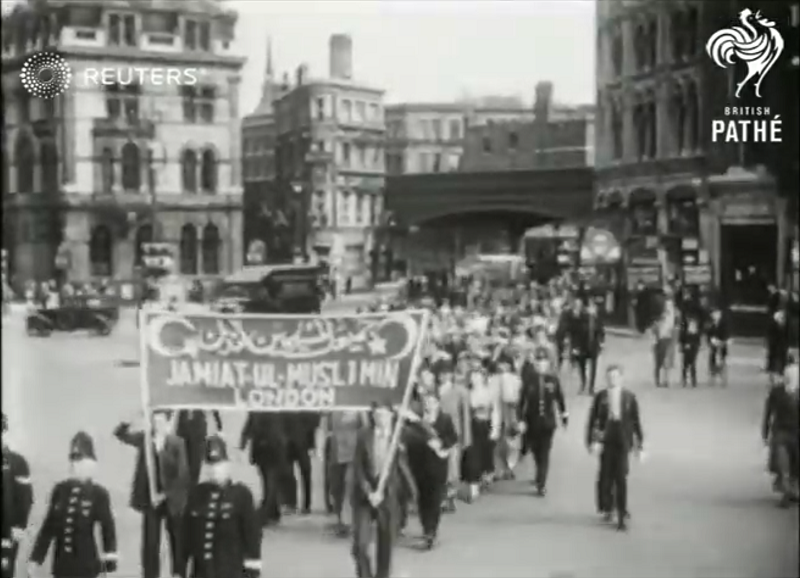
In the New English Review, Esmerelda Weatherwax recounts an incident from the 1930s where Muslim protestors took to the streets of London in reaction to a recent Hindustani translation of H.G. Wells’ A Short History of the World:
Screen capture of the 1938 Muslim protest march in London from a British Pathé newsreel – https://www.youtube.com/watch?v=ADausiEe4pM
… my husband was at the Museum of London and spotted a very brief mention of this protest in 1938 on a list of 20th century London events. I did some research.
The book they objected to was HG Wells’ A Short History of the World. This was originally published in 1922 but in 1938 an abridged version was tranlated into Hindustani and published in India. His observations about the Prophet Mohammed did not find favour with Indian Muslims (and as you know pre-partition the area called India covered what is now Pakistan and Bangladesh). There were protest meetings in Calcutta and Mumbai (then transliterated as Bombay) and the consignments of the books that WH Smith the booksellers sent to Hyderabad mysteriously never arrived. Investigation showed that the Sind government banned its import. Protests spread to east Africa and were reported in Nairobi and Mombasa.
The paragraphs concerned said “He seems to have been a man compounded of very considerable vanity, greed, cunning, self-deception, and quite sincere religious passion”. Wells concludes, not unfavourably, that “when the manifest defects of Muhammad’s life and writing have been allowed for, there remains in Islam, this faith he imposed upon the Arabs, much power and inspiration”.
There had been a number of Muslims living in east London for some years, sailors who came through the docks, retired servants, some professional men and in 1934 they formed a charitable association for the promotion of Islam called Jamiat-ul-Muslimin; they met on Fridays at a hall in Commercial Road.
On Friday 12th August 1938 a copy of A Short History of the World was, as apparently reported in the Manchester Guardian the following day “ceremoniously burned”. The main Nazi book burnings were over 5 years previously but I can’t but be reminded of them. I can’t access the Guardian on-line archive for 1938 as I don’t have a subscription, but I have no reason to doubt what they reported.
A few days later Dr Mohammed Buksh of Jamiat-ul-Muslimin attended upon Sir Feroz Khan Noon, the high commissioner for India. Sir Feroz tried to explain that in Britain we could (or could then) freely criticise Christianity, the Royal family and government as a right. He reminded Dr Buksh that Muslims were “a very small minority in England, and it would do them no good to try and be mischievous in this country, no matter how genuine their grievances were”.
Comments Off on That time that H.G. Wells fell afoul of Muslim sentiments


