
World War Two
Published 18 Jan 2023There is a second war raging on the Eastern Front. From the huge expanses of no man’s land behind the German lines, Moscow’s battle-hardened and well-armed partisan bands are waging a Rail War in support of Red Army offensives. But every successful mission brings down the wrath of the genocidal Axis war machine.
(more…)
January 19, 2023
The Partisan War Behind the Frontlines – WW2 Documentary Special
Comments Off on The Partisan War Behind the Frontlines – WW2 Documentary Special
Tanks Chats #164 | M-50 Sherman | The Tank Museum
The Tank Museum
Published 23 Sep 2022In this episode of Tank Chats, David Willey discusses the history of the M-50 version of the Sherman.
(more…)
Comments Off on Tanks Chats #164 | M-50 Sherman | The Tank Museum
QotD: Did Sparta achieve its strategic objectives?
The final objective we can be quite certain about is that Sparta aimed to protect the internal social and political order of Sparta, which essentially amounts to a strategic objective to be able to continue mistreating the helots and the perioikoi. In practice – given Sparta’s desperate shortness of manpower (and economic resources!) and continued unwillingness to revisit the nature of its oppressive class system, we may say with some confidence that Sparta effectively sacrificed all other objectives on the altar of this one.
And yet Sparta’s failure here was perhaps the most complete of all. The collapse of the Spartiate class did not abate after Leuktra; by the 230s, there were hardly any Spartiates left. Meanwhile, the transition of Messenia from a group of subject communities supporting Sparta economically to an active and hostile power on Sparta’s border essentially represented the end of the Spartan social order as established in the seventh century with the reduction of Messenia to helotry in the first place.
So, does Sparta achieve its strategic objectives? By and large, I think the answer here has to be “no”. Sparta – the supposed enemy of tyrants – by mismanaging its own leadership invited one foreign oppressor (Macedon) into Greece after another (Persia). As a state that seems – to me at least – to have considered itself the natural and rightful leader of all of the Greek states, Sparta, routinely and comprehensively proved itself unworthy of the position.
The one thing we may say for Spartan foreign and military policy is that it seems to have made the world safe for helotry – it preserved the brutal system of oppression which was foundational to the Spartan state. But consider just how weak an achievement that is – we might, after all, make the same claim about North Korea: it has managed only to successfully preserve its own internal systems of oppression.
Bret Devereaux, “Collections: This. Isn’t. Sparta. Part VII: Spartan Ends”, A Collection of Unmitigated Pedantry, 2019-09-27.
Comments Off on QotD: Did Sparta achieve its strategic objectives?
January 18, 2023
The Roman Army, With Adrian Goldsworthy
Well That Aged Well
Published 12 May 2021In this episode we take a look at the Roman Army, and its comanders. What made the Roman Army so efficent? Was it the practice? The motivation? Their courrage? Or was it more to it? Find out in this week’s episode of “Well That Aged Well”, With Erlend Hedegart.
(more…)
Comments Off on The Roman Army, With Adrian Goldsworthy
L’affaire Dreyfus
Robert Zaretsky on an espionage scandal that convulsed the French Third Republic and still has resonance down to today:
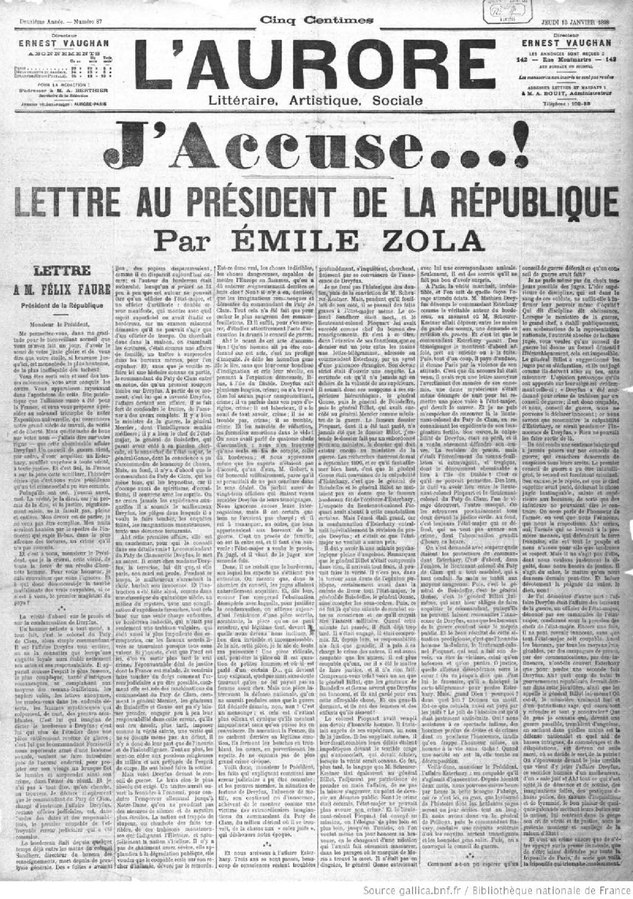
Front page of L’Aurore for 13 January, 1898 with Zola’s J’Accuse headline.
Wikimedia Commons.
On January 13, 1898, Parisians awoke to the chorus of hundreds of news criers who, striding along the grand boulevards and brandishing copies of the newspaper L’Aurore, were shouting passages from the article that sprawled across the front page. It had originally been titled by its author, the novelist Émile Zola, “A Letter to M. Félix Faure, President of the Republique”. But with a flair for the sensational, the newspaper’s editor, Georges Clemenceau, slapped on a punchier headline. Stepping out of a department store or stepping down from a carriage, sitting at a café or standing at an intersection, pedestrians were greeted by two words that continue to resonate 125 years to the day after their first publication: “J’Accuse!”
With this exclamation, Zola’s letter transformed une affaire judiciare into l’affaire Dreyfus or, more simply, the Dreyfus Affair. It catapulted the French novelist onto the world stage at a critical moment in the history of his country, which was reeling from the forces of globalisation and industrialisation and riven by opposing understandings of its revolutionary heritage. It is thus hardly surprising that Zola’s fame rests more heavily on the letter than on his sweeping 20-volume masterpiece of literary realism, the Rougon-Macquart. It took a novelist to heave the facts of this affair into a narrative which, more than a century later, thrums with equal urgency. Moreover, as with the novels of the Rougon-Macquart, the letter thrusts onto centre-stage a lone individual swept up, and all too often swept under, the political and social, irrational and ideological forces of the modern age.
It all began with the contents of a rubbish bin. In September 1894, a cleaning woman at the German Embassy, in the pay of France’s military intelligence service, delivered her nightly harvest to her employers. Buried in the mound of discarded papers was a memorandum, known as the bordereau or note, revealing top secret advances in French artillery technology and tactics. In a frantic scramble to find its author, the war ministry’s suspicion settled on Captain Alfred Dreyfus, an officer in the High Command who stood out for his standoffishness and Jewishness.
Upon being arrested and charged, a bewildered Dreyfus denied the charges, pointing out several things mentioned in the bordereau he could not possibly have known. The seven members of the military tribunal, ignoring these inconsistencies as well as the insistence of their own graphologist that Dreyfus’s handwriting did not match the bordereau‘s, unanimously found him guilty. He was sentenced to life imprisonment in solitary confinement on Devil’s Island, a malarial rock off the coast of French Guyana.
But first came a remarkable ritual of public humiliation. Dreyfus was marched into the courtyard of the École militaire, the renowned military academy a short distance from the recently erected Eiffel Tower. In the shadow of that monument to modernity, an officer preceded to snap Dreyfus’s sword — broken and soldered back together with tin the night before, to make the gesture seem effortless — and tear off his insignia — whose threads were already loosened — while a dense crowd howled with calls for the death of the “Jewish traitor!”
Two years later, as Dreyfus wasted away in solitary confinement, Colonel Georges Picquart, the newly appointed head of military intelligence, found that another missive about French military plans had ended up in the rubbish bin at the German Embassy. Moreover, the handwriting on this new document, which matched that of the bordereau, also matched the hand of Ferdinand Esterhazy, an officer notorious for his womanising and gambling.
Picquart disliked Jews as much as his many of his fellow officers did. But when his commanding officer asked him why it mattered if “this Jew remains on Devil’s Island”, Picquart replied: “Because he is innocent!” The answer earned Picquart a rapid transfer to a desert outpost in North Africa. Before he was packed off, though, Picquart vowed that he would not “carry this secret to my grave”. He then shared what he knew with Auguste Scheurer-Kestner, the leader of Dreyfusards, a small but growing coterie of politicians and writers seeking a retrial for Dreyfus.
In late 1897, Zola met with Scheurer-Kestner, who told him about Picquart’s discovery. As the mesmerised novelist listened, he glimpsed the theatrical as well as moral dimensions of the affair. “It’s thrilling!” he gasped. “It’s frightful! But it is also drama on the grand scale!” It took Zola to scale it to greatness by flipping Oscar Wilde’s sly quip that anyone could make history, but only a great man could write it. Instead, Zola showed, a man becomes truly great only by, in every sense of the word, making history.
Comments Off on L’affaire Dreyfus
Ask Ian: Why No German WW2 50-Cal Machine Guns? (feat. Nick Moran)
Forgotten Weapons
Published 20 Sep 2022From Nathaniel on Patreon:
“Why didn’t Germany or Axis powers have a machine gun similar to the American M2?”Basically, because everyone faced the choice of a .50 caliber machine gun or 20mm (or larger) cannons for anti-aircraft use, and most people chose the cannons — including Germany. There were some .50 caliber machine guns adopted by Axis powers, most notably the Hotchkiss 1930, a magazine-fed 13.2mm gun that was used by both Italy and Japan (among others). However, the use of the .50 caliber M2 by the US was really a logistical holdover form the interwar period. The M2 remained in production because it was adopted by US Coastal Artillery as a water-cooled anti-aircraft gun, and commercial sales by Colt were slim but sufficient to keep the gun in development through the 20s and 30s. It was used as a main armament in early American armor, but obsolete in this role when the war broke out.
However, with the gun in production and no obvious domestic 20mm design, the US chose to simply make an astounding number of M2s and just dump them everywhere, from Jeeps to trucks to halftracks to tanks to self-propelled guns. And that’s not considering the 75% of production that went to coaxial and aircraft versions …
Anyway, back to the question. The German choice for antiaircraft use was the 20mm and 37mm Flak systems, and not a .50 MG on every tank turret. And so, there was really no motive to develop such a gun. The Soviets did choose to go the US route, though, and developed the DShK-38 for the same role as the US M2 — although it was made in only a tiny fraction of the quantity of the M2.
(more…)
Comments Off on Ask Ian: Why No German WW2 50-Cal Machine Guns? (feat. Nick Moran)
January 17, 2023
“Karl Marx was one hollow and rotten tree, inside and out, from beginning to end”
To mark the passing of Paul Johnson, the Foundation for Economic Education reposted an appreciation of Johnson’s Intellectuals by Lawrence W. Reed praising his essay on Karl Marx:
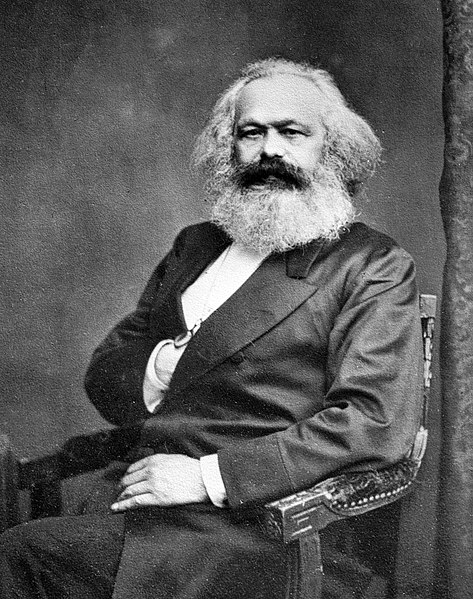
None of Johnson’s subjects can match Karl Marx for sheer loathsomeness and shameless fakery. He was a virulent racist and anti-Semite with a vicious temper (“Jewish n****r” was one of his favorite epithets). On a good day, he enjoyed threatening those who disagreed with him by blurting, “I will annihilate you!” His personal hygiene was, well, suffice it to say he had none. He was heartlessly cruel to his family and anyone who crossed him. This is the same man who postured as a thinker whose ideas would save humanity.
We learn in Intellectuals that the chef who cooked up communism professed to be “scientific”. In reality, Johnson argues, “there was nothing scientific about him; indeed, in all that matters he was anti-scientific”. His most famous lines — including “religion is the opiate of the masses” and workers “have nothing to lose but their chains” — were flagrantly ripped off from other authors. He “never set foot in a mill, factory, mine or other industrial workplace in the whole of his life”, steadfastly abjured invitations to do so, and denounced fellow revolutionaries who did. He never let a fact or a glimmer of reality stem the flow of poison from his pen. He had no money because he refused to work for it, then cursed those who had it and didn’t share it with him. His own mother said she wished her son “would accumulate some capital instead of just writing about it”.
And that’s for starters. Read Johnson’s chapter on Marx, and you’ll begin to understand the connection between the evil within the man and the evil his gibberish wrought. The Black Book of Communism estimates the death toll from attempts to put the rantings of this detestable lunatic into practice at minimally 100 million.
“What emerges from a reading of Capital is Marx’s fundamental failure to understand capitalism”, writes Johnson.
He failed precisely because he was unscientific: he would not investigate the facts himself, or use objectively the facts investigated by others. From start to finish, not just Capital but all his work reflects a disregard for truth which at times amounts to contempt. That is the primary reason why Marxism, as a system, cannot produce the results claimed for it; and to call it “scientific” is preposterous.
Many people who don’t know better, and an awful lot of those in “intellectual” circles who should, still think Karl Marx was some sort of prescient genius motivated by compassion for workers. Some even disgrace themselves with T-shirts bearing his unkempt image. They really ought to thank Paul Johnson for doing the thinking they themselves never made time for.
Actually, we were warned about people like Marx 2,000 years before Johnson. Matthew 7:16 wisely counsels:
Beware of false prophets. They come to you in sheep’s clothing, but inwardly they are ravenous wolves. By their fruit you will know them. Are grapes gathered from thornbushes, or figs from thistles? Likewise, every good tree bears good fruit, but a bad tree bears bad fruit.
Karl Marx was one hollow and rotten tree, inside and out, from beginning to end.
Comments Off on “Karl Marx was one hollow and rotten tree, inside and out, from beginning to end”
The Early Emperors, Part 11 – The Flavian Reconstruction
seangabb
Published 29 Dec 2022This is a video record of a lecture given by Sean Gabb, in which he discusses the three Flavian Emperors who ruled between 69 and 98 AD — Vespasian, Titus, and Domitian. He also discusses the Jewish Revolt and the eruption of Vesuvius.
The Roman Empire was the last and the greatest of the ancient empires. It is the origin from which springs the history of Western Europe and those nations that descend from Western Europe.
(more…)
Comments Off on The Early Emperors, Part 11 – The Flavian Reconstruction
Growing an Ancient Roman Garden
Tasting History with Max Miller
Published 23 Aug 2022
Comments Off on Growing an Ancient Roman Garden
January 16, 2023
Paul Johnson on Jean-Jacques Rousseau
The book Paul Johnson may best be known for is Intellectuals, an essay collection highly critical of many of the “great men” of intellectual history. Birth of the Modern, the first Johnson book I read, was also skeptical of the bright lights of European intellectualism, but Intellectuals is where he concentrated on the biographical details of many of them. Ed West selected some of Johnson’s essay on Jean-Jacques Rousseau as part of his obituary post:
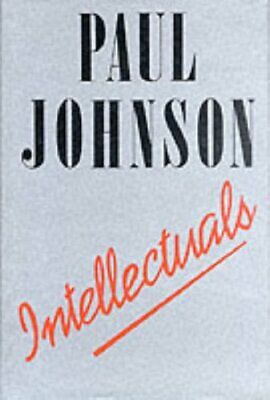
… Johnson is best known to many for his history books, one of the most entertaining being Intellectuals. Published in 1989 and structured as a series of – very critical – biographies of great philosophers, poets, playwrights and novelists, Johnson’s book got to the essence of the intellectual mindset in all its worst aspects: their intense selfishness and narcissism, their callousness towards friends and lovers, and their fondness for giving moral support to some of the worst ideas and regimes in history.
One of the most prominent Catholics in British journalism, Johnson saw secular intellectuals as modern successors to the theologians of the medieval Church, the difference being that, without the restraints of religious institutions, their egotism was uncontrolled.
Writers and artists are often incredibly selfish people, and this is true across the political spectrum, but of course it’s far more satisfying to read about those men who claimed to be the saviour of the poor and humble yet were so relentlessly horrible to actual people around them. That’s what makes the book – published just as the system imagined by one of its subjects came crashing down in eastern Europe – so satisfying.
One of the targets, er, I mean “subjects” of Intellectuals was Jean-Jacques Rousseau, who was quite the piece of work indeed:
It begins with Jean-Jacques Rousseau, the “first of the modern intellectuals” and perhaps the subject of Johnson’s most intense vitriol.
“Older men like Voltaire had started the work of demolishing the altars and enthroning reason,” he wrote: “But Rousseau was the first to combine all the salient characteristics of the modern Promethean: the assertion of his right to reject the existing order in its entirety; confidence in his capacity to refashion it from the bottom in accordance with principles of his own devising belief that this could be achieved by the political process; and, not least, recognition of the huge part instinct, intuition and impulse play in human conduct.
“He believed he had a unique love for humanity and had been endowed with unprecedented gifts and insights to increase its felicity.” He was also an appalling human being.
[…]
Madame Louise d’Épinay, a lover who he treated terribly, said “I still feel moved by the simple and original way in which he recounted his misfortunes”. Another mistress, Madame de Warens, effectively supported him in hard times but, when she fell into destitution, he did nothing to prevent her dying of malnutrition.
Rousseau had a “pseudo-wedding” with his mistress Therese Levasseur where he gave a speech about himself, saying there would be statues erected to him one day and “it will then be no empty honour to have been a friend of Jean-Jacques Rousseau”. He later accused her brother of stealing his 42 fine shirts and when he had guests for dinner she was not allowed to sit down. He praised her as “a simple girl without flirtatiousness”, “timorous and easily dominated”.This easily-dominated woman gave birth to five of his children, whom he had sent to an orphanage where two-thirds of babies died within the first year and just one in 20 reached adulthood, usually becoming beggars. He made almost no attempt to ever track them down, and said having children was “an inconvenience”.
“How could I achieve the tranquillity of mind necessary for my work, my garret filled with domestic cares and the noise of children?” He would have been forced to do degrading work “to all those infamous acts which fill me with such justified horror”.
He was spared that horror and instead given time to develop his ideas, which were fashionable, attractive and completely unworkable. “The fruits of the earth belong to us all, the earth itself to none”, he said, and hoped that “the rich and the privileged would be replaced by the state which reflected the general will”.
What would this mean in practice? “The people making laws for itself cannot be unjust … The general will is always righteous”.
Despite his ideas veering between woeful naivety and sinister authoritarianism, they proved hugely popular, especially with the men and women who in 1789, just a decade after his death, would bring France’s old regime crashing down — with horrific consequences. As Thomas Carlyle famously said of Rousseau’s The Social Contract: “The second edition was bound in the skins of those who had laughed at the first.”
Rousseau was perhaps the most influential figure of the modern era. In particular his rejection of original sin would become far more popular in the late 20th century; indeed it is at the core of what we call the culture war, and its fundamental conflict over human nature.
Comments Off on Paul Johnson on Jean-Jacques Rousseau
I thought the treadmill crane was fictional
Tom Scott
Published 26 Sep 2022The treadwheel crane, or treadmill crane, sounds like something from Astérix or the Flintstones. But at Guédelon in France, not only do they have one: they’re using it to help build their brand new castle.
▪ More about Guédelon: https://www.guedelon.fr/
(more…)
Comments Off on I thought the treadmill crane was fictional
QotD: The avant-garde
Of course, in certain fields the latest is inclined to be best. For example, no one would wish to be treated surgically using the methods of Sir Astley Cooper: but if we want modern treatment, it is not because it is modern but because it better as gauged by pretty obvious criteria. If it were worse (as very occasionally it is), we should not want it, however modern it were.
Alas, the idea of progress has infected important spheres in which it has no proper application, particularly the arts. It is difficult to overestimate the damage that the gimcrack notion of teleology inhering in artistic endeavour has inflicted on all the arts, exemplified by the use of the term avant-garde: as if artists were, or ought to be, soldiers marching in unison to a predetermined destination. If I had the power to expunge a single expression from the vocabulary art criticism, it would be avant-garde.
Theodore Dalrymple, “Architectural Dystopia: A Book Review”, New English Review, 2018-10-04.
Comments Off on QotD: The avant-garde
January 15, 2023
Time to Liberate Leningrad! – Ep 229 – January 14, 1944
World War Two
Published 14 Jan 2023Three Soviet Fronts launch major offensives to try and finally free Leningrad, under siege for nearly two and a half years now. The Soviets are, in fact, making attacks along most of the Eastern Front. In the South Pacific, the Allies step up their aerial assault to wreck Rabaul’s air power, thus neutralizing it as a base.
(more…)
Comments Off on Time to Liberate Leningrad! – Ep 229 – January 14, 1944
How Lea & Perrins Makes Worcestershire Sauce Using A 185-Year-Old Recipe | Regional Eats
Food Insider
Published 25 Dec 2019We visited Lea & Perrins factory in Worcester to see how they produce their ever-popular Worcestershire sauce.
(more…)
Comments Off on How Lea & Perrins Makes Worcestershire Sauce Using A 185-Year-Old Recipe | Regional Eats
January 14, 2023
Colonial History on the Mississippi River
Scenic Routes to the Past
Published 13 Jan 2023This video explores the surprising traces of French and American colonial history along the 150 miles of Mississippi River between St. Louis and Cairo, Illinois.
(more…)
Comments Off on Colonial History on the Mississippi River


