
ReasonTV
Published 22 Sep 2022Transit ridership, especially rail, has collapsed post-pandemic, but the Atlanta BeltLine Coalition says now is the time to take federal dollars and build a $2.5 billion streetcar.
Full text and links: https://reason.com/video/2022/09/22/i…
—
Twenty-three years ago, Atlanta-native and architecture and urban planning student Ryan Gravel had an experience that opened his mind to what urban living could be.“My senior year I spent abroad in Paris and lived without a car for a year and traveled by train everywhere,” says Gravel. “And within a month of arriving, I had lost 15 pounds. I was in the best shape of my life because I was walking everywhere, and the role of the physical city was made clear to me in a way it really had never been before.”
For his Georgia Tech master’s thesis, Gravel sketched out a plan to make Atlanta more like Paris. He proposed redeveloping the land along the city’s historic rail lines to create a 22-mile loop called the Atlanta BeltLine. He proposed turning the city’s abandoned industrial areas and single-family home neighborhoods into business districts and walking trails. And he proposed connecting downtown to the rest of the city all with a new train running along the entire Atlanta BeltLine.
“I never imagined we would actually do it,” says Gravel.
But they did — for the most part. Cathy Woolard, who was president of the Atlanta City Council, read Gravel’s thesis and decided to use it as a blueprint to remake much of the city. Today, the Atlanta BeltLine is a walking and biking trail, parts of which are bordered by retail and condos.
But one piece of Gravel’s grand vision didn’t get built: The train.
Today, Gravel runs a co-working and event space along the BeltLine, which also serves as a gathering place for urbanists interested in making Atlanta less dependent on cars. He says that the train line is essential for improving city life.
“In those early days, when we built the movement behind the [BeltLine] project, it was around transit,” says Gravel.
The three COVID relief bills set aside $69 billion in federal funding for local transit agencies to operate and add to their transportation systems, meaning that Atlanta might finally get its train—with many American taxpayers who will never step foot on it picking up much of the tab.
Many American cities have used federal money in the past to build rail transit lines that suffer from dismal ridership, that are expensive to maintain, and that are a major drain on their budgets.
(more…)
September 23, 2022
Is This Atlanta Streetcar “The Worst Transit Project of All Time”?
QotD: Ron DeSantis for Caesar?
Oswald Spengler suggests that we’re in for a period of Caesarism, which is warlord rule that maintains the trappings of the old system. It might be as simple as [Mussolini]’s old litmus test: Do the trains run on time? But, since this is Clown World, fake and gay: Are the lights on for more than two days running?
Ron DeSantis, for example, has gotten a lot of Grillers’ panties moist, and while that’s one of the strongest possible arguments for the proposition that he’s just another Swamp Thing — Ace of Normies might not remember how hard he used to squeeeee for fucking Paul Ryan, but I do — it’s nonetheless true that Ron DeSantis has acted at least kinda sorta like … what’s the word?
Ah yes: An adult.
Ron DeSantis’s response to Covid was pretty much exactly what even the most flaming moonbat liberal governor would’ve done as late as 1990, because there were still some grownups in politics back then. Now that the entire Swamp is filled with autistic Mean Girls with PMS, the State can’t carry out even its most basic functions. Governors still have real power […], and there are a few of them that aren’t totally retarded, and so I’d imagine we’ll see a period of retail-level Caesarism — the lights are on three days a week in Nebraska; quick, everybody load up the Conestoga wagon and head for Omaha!
Severian, “Friday Mailbag”, Founding Questions, 2022-06-17.
September 22, 2022
Why Electronic Voting Is Still A Bad Idea
Tom Scott
Published 9 Dec 2019We still shouldn’t be using electronic voting. Here’s why.
(more…)
September 20, 2022
Pierre Poilievre and the role of the Governor of the Bank of Canada
In The Line, Jen Gerson looks at new Conservative leader Pierre Poilievre’s threat to fire the head of the Bank of Canada if and when he becomes Prime Minister:

Conservative leader Pierre Poilievre at a Manning Centre event, 1 March 2014.
Manning Centre photo via Wikimedia Commons.
In May, Poilievre claimed that Macklem was “surrendering his independence” to the government of the day by using quantitative easing — printing money — to ease the COVID economic crisis. During the party’s English-language debate in Edmonton, Poilievre also said he would fire the governor if he ascended to prime minister.
This, very rightly, ticked off a lot of people. The governor of the Bank of Canada ought to be independent of daily partisan machinations for very good reason; we don’t want the person setting inflation targets to be subject to political pressure, otherwise we would risk a lot more money printing to pay for social programs in the short term, and devaluation of our currency in the long term. So threatening to fire the governor because he or she failed to hew to an incoming government’s wishes is a bad idea. We want that person to stay above the partisan fray.
A Conservative ought to understand this better than most.
Further, much of our inflationary woes is the result of international supply chain issues, which is something beyond the governor’s control. The bank’s defenders have been quick to make this point. Looking at overall increase in the monetary supply, including the significant amounts of money that was pumped into the economy for pandemic relief measures, in addition to the thwack of cash sitting on the banks’ books in the form of potential debt, I suspect that this argument is still highly debatable.
Regardless, the response to Poilievre’s comments from the bank itself was interesting. Although he didn’t call for the firing of his boss, Paul Beaudry, the deputy governor of the Bank conceded that Poilievre had at least a smidgen of a point.
“The aspect that we should be held accountable is exactly right,” Beaudry told a news conference in June. “Right now we completely understand that lots of Canadians can be frustrated at the situation,” he said. “It’s difficult for a lot of people. And we haven’t managed to keep inflation at our target, so it’s appropriate [that] people are asking us questions.”
Macklem himself acknowledged that he had misjudged the possibility for a serious inflationary period back in April. He deserves praise for admitting this! It’s difficult for people in senior roles to admit they were wrong and seek to course correct. One might even argue that his humility on this point demonstrates a personality that is particularly well-suited for his role.
So I want to reiterate that I think threatening to fire Tiff Macklem is a bad idea. It directly undermines the independence of his office, and it places blame on the bank for inflation, when the causes of that inflation are, at best, not his fault, and at worst, still not perfectly understood.
That said — again, messing with the independence of the bank is bad, m’kay — there is a historical precedent for this kind of institution-meddling chicanery. The last politician to threaten an unpopular Bank of Canada governor for political gain was that notable far-right populist … Jean Chrétien. That was back in 1993, in a situation that almost perfectly mirrors the economic and political dynamics of today.
In the ’90s, the incumbent Conservatives had appointed Bank of Canada governor John Crow, who had set interest rates to about seven per cent in order to keep inflation in check. If that figure, which is closer to historical norms than we like to remember, makes you eye your mortgage renewals a little warily, so it should. The Liberals, who were gunning to take over the government from the Conservatives, had argued that Crow’s obsession on maintaining low inflation had worsened a recession; they wanted Crow to prioritize reducing Canada’s unemployment rate instead.
Of course, if that sounds like a potential prime minister taking swipes at an ostensibly independent agent of the Bank of Canada, well, that’s because that’s exactly what it was. And media at the time recognized this at the time.
I think this is another case of a politician indulging in a bit of “bad policy but good politics” rhetoric. Unless he actually means it…
September 19, 2022
QotD: Representative government
Hawaiian judges are our kakistocracy‘s public face, but all the decisions that matter are made long before the hacks in black get involved. As we know, we Americans commit, on average, three felonies a day. If, when, and how these come to the State’s attention are almost completely random. This is true for any law, actually, and because it is, it’s not really an exaggeration to say that your livelihood, and often your actual freedom, depends on what side of the bed the cop got up on this morning.
If The Authorities notice you when they’re in a good mood, you skate. If The Authorities are in a bad mood, though — tired, hung over, had a fight with the spouse, whatever — you’re screwed. What actually happens to you depends on the lawyers, a.k.a the most incestuous little fraternity on the planet. Whether they choose to prosecute or not, and for what, and what deals they make over a drink or seven determine what happens to you once you get in front of hizzoner … who, of course, is also butt-buddies with all the lawyers who appear in his chambers, since he was one of them not too long ago and they remain his entire social circle.
Who in his right mind could possibly agree to this? No, forget “right mind” — it’s simply not possible for anyone, not even someone as far out on reality’s fringes as the SJWs, to consent to this. Those “people” (in the strict biological sense) think houseplants have human rights, but not even they would agree to have their life’s course determined by two dimbulbs with great hair and ugly neckties cutting deals with each other in a dive bar.
But so long as we fetishize the form of “representative government,” it can’t be otherwise. As folks in Our Thing never tire of pointing out, had The People ever been consulted about our preferences, at any time after 1963, we’d still be living in a White Christian nation with a solid manufacturing base and a minuscule military footprint. If it were possible to throw the bums out, we would’ve thrown out every bum on every ballot since at least Calvin Coolidge. But we can’t throw the bums out, because the process is rigged.
Severian, “Form > Process > Outcome”, Rotten Chestnuts, 2019-09-06.
September 17, 2022
Is it still a conspiracy theory if more than 50% of Canadians believe it?
Chris Selley posted a link to this rather eye-opening Abacus Data poll summary by Bruce Anderson and David Coletto:
We recently completed nationwide surveying among 1500 Canadians. The focus was on the levels of trust people have in institutional sources of information, and belief in conspiracy theories. This is the first in a series called “Trust & Facts: What Canadians Believe”
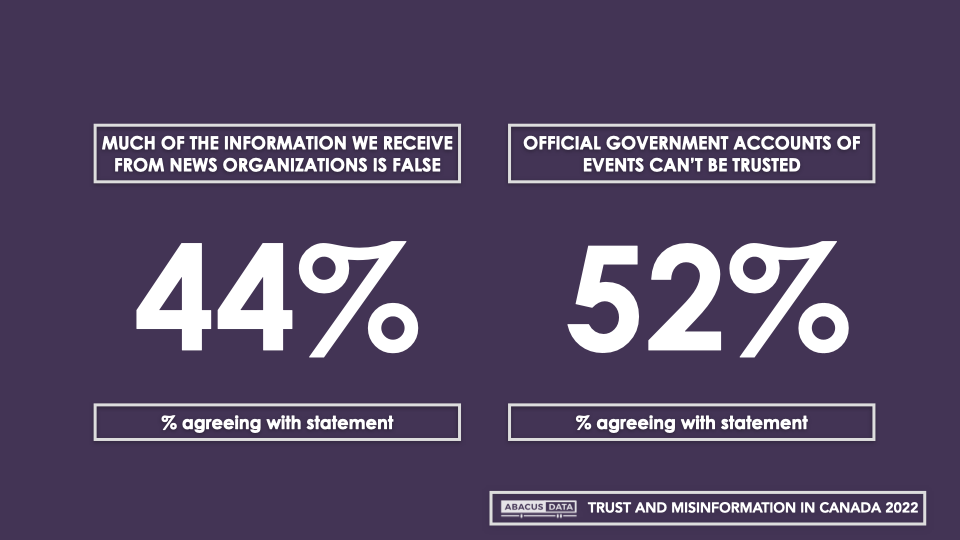
44% THINK MUCH OF THE INFORMATION FROM NEWS ORGANIZATIONS IS FALSE
Almost half of those interviewed found themselves agreeing with the statement “much of the information we receive from news organizations is false”.
While this means a majority of Canadians have some trust in news organizations, more than 13 million adults (extrapolating 44% to an adult population of 29.5 million) don’t.
Those with no post-secondary education, Alberta residents and those on the right show greater mistrust. But by far the biggest differences are visible when we look at party affinity. The vast majority of People’s Party supporters don’t trust news organizations and a (smaller) majority – 59% – of Conservative voters feel the same way.
Among those who think Pierre Poilievre is the Conservative leadership candidate who best reflects their views, 55% don’t trust media information, while among those who identify with Jean Charest the proportion is much lower, at 27%.
52% THINK OFFICIAL GOVERNMENT ACCOUNTS OF EVENTS CAN’T BE TRUSTED
More than half of those interviewed found themselves agreeing with the statement “official government accounts of events can’t be trusted”
As with trust in news organizations, those with no post-secondary education, Alberta residents and those on the right showed markedly higher levels of mistrust in government.
Majorities of People’s Party, Conservative and Green Party voters indicate mistrust. Those on the left and Liberal voters show higher levels of trust.

September 15, 2022
The promise of grand “green” plans versus the reality when the plans are implemented
Elizabeth Nickson on the contrast between how things like the “Green New Deal” are represented by their proponents and the media and what their actual real-world outcomes are like:

“Forest fire” by Ervins Strauhmanis is licensed under CC BY 2.0 
 .
.
Ever wonder what happens to a region once it is “preserved”? Right now, all through the US and Canada, governments are taking giant bites of land, and locking them down under the guidance of the UN’s Agenda 2030, which means a full 30% of the land and waters will be “saved”. If anyone notices, the local media preens and praises itself. Aren’t we all so wonderful and enlightened and caring, the PR says, and the newspapers copy it line-for-line.
No, it’s terrible. It is possibly the very worst thing ever. Set-aside land degrades. There aren’t enough bureaucrats in the world to take care of it. Besides out in the forest or up on the ranges is decidedly not where a civil servant wants to be. As a result none of them know what they have done. It’s a loop, politicians, stupid women and beta males, civil servants engaged in a masturbatory celebration of their goodness and triumph over commerce. From hipster neighborhoods all over North America a song of self-praise rises like smoke into the air.
Except now, right now, I sit in a smoke haze courtesy of the set aside forests in Washington State which are burning. Look, this is simple to think through. In the early 90’s Clinton ratified the spotted owl preservation plan and hundreds of millions of acres of forest were left to themselves, no cutting, no grazing, no firewood collection, no thinning, no fire breaks, no removal of dead trees, especially not beetle-killed trees. In fact, no touch.
What happens when a formerly industrial forest is left to itself? A thousand tiny trees start to grow right up against each other. They grow like carrots that haven’t been thinned. They grow so thick they can’t get light. They draw all the water from the ground, they end up like tinder. Around them brush grows — it too cannot get light or much water so it too is desiccated. It grows up the trees, trying to get at the water in the trees, and acts as a fire ladder
Boom.
Massive canopy fires, which, since they decommissioned the roads into the forest, are very very difficult to either brake or put out.
On every single environmental metric, in every single system, these people destroy the land. What they do is exactly the opposite of what they claim. They take massive amounts of tax money to “save” land and then they destroy the resource. And the towns in the resource area. And the families, and the tax base.
I could go through every environmental goal, and tear it apart. None of them use science that is provable. It can’t be duplicated, its assumptions are wrong, its statistics fiddled. Tens of thousands of papers are used to create these policies, written by the environment movement through its NGOs, funded by rich morons from old families, most of whose ancestors created environmental devastation themselves. I can refute the math and assumptions of EVERY SINGLE ONE OF THEM given a maximum of four hours and one phone call. No one challenges these studies, and these abominations then become law. Law that destroys the water and land.
QotD: Protectionism
At the other end of the spectrum, government officials have no discretion in doling out the privilege of tariffs because all industries are equally protected, to the same degree, by tariffs from import competition. Here, everyone robs everyone.
Pick any point along this spectrum, and you’ll find – in practice – some people robbing others but not themselves being robbed; other people robbing others while they themselves also are robbed; and yet other people who do no robbing but who are robbed.
What you’ll not find anywhere along this spectrum is a point at which no robbery occurs, for protectionism is in essence a scheme of organized theft.
Protectionists, as has often been observed, have the ethics of thugs. Regardless of their legerdemain or their excuses – or even their felt intent – they are all apologists for plunderers.
Don Boudreaux, “Bonus Quotation of the Day…”, Café Hayek, 2019-03-17.
September 14, 2022
Whisky – Scotland’s Water of Life
Tasting History with Max Miller
Published 13 Sep 2022
September 12, 2022
The art of the constitutional monarchy
At The Ruffian, Ian Leslie considers the form of government nobody set out to design, but has proven to be one of the most stable forms of government we’ve had:
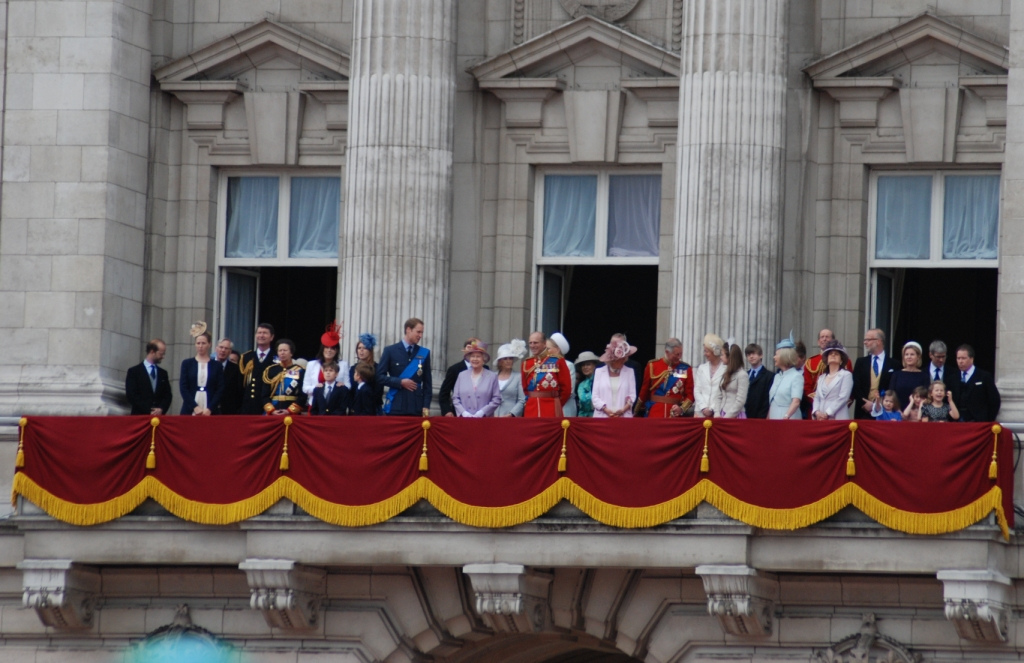
The royal family at Buckingham Palace for the Trooping of the Colour, 30 June, 2015.
Photo by Robert Payne via Wikimedia Commons.
When I said that nobody would design this system, that is not a criticism. Evolved systems tend to work better than designed ones, even if they can seem maddeningly irrational to those who presume to know better. Yesterday somebody posted extracts from an essay by Clement Attlee. As a socialist, Attlee might have been expected to oppose or at least be sceptical of constitutional monarchy, but he was a strong believer in it. Attlee was writing in 1952, a year after the end of his term as Prime Minister, and the same year that Queen Elizabeth came to the throne. When he refers to the monarch, he refers to her – one of those examples of how the Queen’s longevity stretches our perception of time. “You will find the greatest enthusiasm for the monarch in the meanest streets,” he writes. After qualifying as a lawyer, Attlee ran a club in the East End of London for teenage boys raised in dire poverty. He remembers one of them saying, “Some people say as how the King and Queen are different from us. They aren’t. The only difference is that they can have a relish with their tea every day.”
Attlee notes that Norway, Sweden, and Denmark — countries in which there is “the highest equality of well-being” — have royal families. That’s still true and we might add the Netherlands to that list. While it’s impossible to disentangle the many historical factors that make for a decent and successful society, it is at the very least tough to make the case, on evidence alone, that democratic monarchies are inherently bad. Indeed, they seem to work pretty well versus other forms of government. As the left-wing American blogger Matt Yglesias remarked yesterday, “It’s hard to defend constitutional monarchy in terms of first principles, but the empirical track record seems good.”
If this is so, I’m interested in why (let’s agree, by the way, that there isn’t one definitively superior way of running a country, and that every system has flaws). My guess is that it’s because constitutional monarchies do a better job than more “rational” forms of government of accommodating the full spectrum of human nature. They speak to the heart as well as the head. Attlee puts it succinctly: “The monarchy attracts to itself the kind of sentimental loyalty which otherwise might to the leader of a faction. There is, therefore, far less danger under a constitutional monarchy of the people being carried away by a Hitler, a Mussolini or even a de Gaulle.” (I need hardly add that for Attlee, these were not merely historical figures.) Martin Amis, in the closing paragraph of his 2002 piece about the Queen for the New Yorker, expresses the same idea with characteristic flair:
“A princely marriage is the brilliant edition of a universal fact,” Bagehot wrote, “and as such, it rivets mankind.” The same could be said of a princely funeral — or, nowadays, of a princely divorce. The Royal Family is just a family, writ inordinately large. They are the glory, not the power; and it would clearly be far more grownup to do without them. But riveted mankind is hopelessly addicted to the irrational, with reliably disastrous results, planetwide. The monarchy allows us to take a holiday from reason; and on that holiday we do no harm.
Yes, there is something deeply sentimental and even loopy about placing a family at the centre of national life, and ritually celebrating them, not for what they’ve done but for who they are. But here’s the thing: humans are sentimental and yes, a bit loopy. Constitutional monarchies accept this, and separate the locus of sentiment from the locus of power. They divert our loopiness into a safe space.
In republics, the sentimentality doesn’t go away but becomes fused with politics, often to dangerous effect. Russia, despite having killed off its monarchy long ago, retains an ever more desperate hankering after grandeur, the consequences of which are now being suffered by the Ukrainians. America’s more “rational” system has given us President Donald Trump, and I don’t think it’s a coincidence that their political culture is more viciously, irrationally polarised than ours.
Monarchy, in its democratic form, can also be a conduit for our better natures. It gives people a way to express their affection for the people with whom they share a country, by proxy. Think about that boy in Limehouse: it’s not that he wouldn’t have preferred to have relish with his tea – to be rich, or at least richer. But he recognised that, as different as human lives can be, they are always in some fundamental ways the same. People have mothers and fathers (present or absent, kind or cruel), brothers and sisters, hopes, fears, joys and anxieties. That’s why one family can stand in for all of us, even if that family lives in a very privileged and singular manner.
September 10, 2022
Magical Monetary Theory (MMT) – You’re soaking in it
At the Foundation for Economic Education, Kellen McGovern Jones outlines the rapid rise of MMT as “the answer to everyone’s problems” in the last few years and all the predictable problems it has sown in its wake:

“Inflation & Gold” by Paolo Camera is licensed under CC BY 2.0 .
Modern Monetary Theory (MMT) was the “Mumble Rap” of politics and economics in the late 2010s. The theory was incoherent, unsubstantial, and — before the pandemic, you could not avoid it if you wanted to.
People across the country celebrated MMT. Alexandria Ocasio-Cortez, the Democrat Congresswoman from New York heralded MMT by proclaiming it “absolutely [must be] … a larger part of our conversation [on government spending].” The New York Times and other old-guard news sources authored countless articles raising the profile of MMT, while universities scrambled to hold guest lectures with prominent MMT economists like Dr. L. Randall Wray. Senator Bernie Sanders went as far as to hire MMT economists to his economic advisory team.
The most fundamental principle of MMT is that our government does not have to watch its wallet like everyday Joes. MMT contends that the government can spend as much as it wants on various projects because it can always print more money to pay for its agenda.
Soon after MMT became fashionable in the media, the once dissident economic theory leapt from being the obscure fascination of tweedy professors smoking pipes in universities to the seemingly deliberate policy of the United States government. When the Pandemic Hit, many argued that MMT was the solution to the pandemics problems. Books like The Deficit Myth by Dr. Stephanie Kelton became New York Times bestsellers, and the United States embarked on a massive spending spree without raising taxes or interest rates.
Attempting to stop the spread of Covid, state and federal governments coordinated to shut down nearly every business in the United States. Then, following the model of MMT, the federal government decided to spend, and spend, and spend, to combat the shutdown it had just imposed. Both Republican and Democrat-controlled administrations and congresses enacted trillions of dollars in Covid spending.
It is not hard to see that this spray and pray mentality of shooting bundles of cash into the economy and hoping it does not have any negative consequences was ripe for massive inflation from the beginning. Despite what MMT proponents may want you to believe, there is no way to abolish the laws of supply and demand. When there is a lot of something, it is less valuable. Massively increasing the supply of money in the economy will decrease the value of said money.
MMT economists seemed woefully unaware of this reality prior to the pandemic. Lecturing at Stoney Brook University, Kelton attempted to soothe worries about inflation by explaining that (in the modern economy) the government simply instructs banks to increase the number of dollars in someone’s bank account rather than physically printing the US Dollar and putting it into circulation. Somehow — through means that were never entirely clear — this fact was supposed to make people feel better.
In reality, there is no difference between changing the number in someone’s bank account or printing money. In both cases, the result is the same, the supply of money has increased. Evidence of MMTs inflationary effects are now everywhere.
“Things have gone horribly wrong in American medicine; for example, ‘physicians are sharing ideas'”
Chris Bray on the American healthcare system’s descent into not just “rule by experts” — which you rather expect for a field like medicine — but the far worse “rule by government-approved experts”:
Our $3.7 trillion medical system is characterized by its fragility, the narrative says, with patients who can’t get treatment and doctors who can’t learn. So what’s gone wrong? Here’s the headline, with a whole universe of silly assumptions baked into every word:
Things have gone horribly wrong in American medicine; for example, “physicians are sharing ideas”.
I’m just taking a moment to stare at my own sentence. Be right back.
Anyway, medicine is broken — doctors are thinking. Sick people show up to see them, and they try to figure it out themselves by using, like, evidence and diagnostic practice and their medical knowledge. Lacking government directives, physicians are living with a horrible system in which they have to assess sick people and come up with their own answers about their illnesses and the best course of treatment. And so, Politico reports, networks of doctors are gathering to share data and work collaboratively, a sure sign that things have gone horribly wrong:
While the network is helping patients and doctors navigate the disease’s uncharted waters, long Covid doctors say there’s only so much they can do on their own. The federal government should be doing more, they say, to provide resources, coordinate information sharing and put out best practices. Without that, the doctors involved fear the condition, which has kept many of those afflicted out of the workforce, threatens to spiral.
Imagine what doctors will be like after two more generations shaped by the assumption that the federal government is the only proper source of “best practices”. The pathologization of socially and institutionally healthy behavior — professionals, confronted with a new problem, work together to gather evidence so they can analyze and apply it — speaks to the ruin inflicted by the pandemic, by the federal funding and steering of science, and by the Saint Anthonying of medicine: If government doesn’t tell you how, you can’t possibly know how. You expect your doctor to use a lifetime of education and experience to figure out what’s wrong with you; Politico expects your doctor to apply the government guidelines, but finds to its alarm that the government doesn’t offer any. How can you make a sandwich if the government hasn’t published a protocol on the application of condiments?
If you’ve felt rigidity and a lack of productive exchange in your conversations with your own doctor, we may have a suggestion here about the why part. I can’t assert that with total confidence, because the federal government hasn’t provided me with an analytical framework.
And so the debilitation of people who should have professional knowledge and competence becomes normal and expected. A scientist is someone who gets checks from the NIH, unless the scientist is one of the other kind and gets checks from the NSF, and ideological compliance is part of the deal. A doctor is someone who applies the government protocols. Federal agencies wear your doctors like a skin suit, and apply their medical solutions through the hands of others. If that’s not how it works — if your doctor works in creative and thoughtful ways to make sense of an illness and provide an effective treatment — something has gone wrong.

QotD: “Working toward the Führer“
This had several big advantages. First, it’s in line with Nazi philosophy. The Nazis were Social Darwinists. Social Darwinists hold that “survival of the fittest” applies not only to humans as a whole, but to human social groups as well. Any given organization, then, must exist to do something, to advance some cause, to reach some goal. Ruthless competition between groups, and inside each group, is how the goal works itself out (you should be hearing echoes of Hegel here). The struggle refines and clarifies what the group’s goal is, even as the individual group members compete to reach it. The end result gets forced back up the system to the Führer, such that, dialectically (again, Hegel), “National Socialism means X” now encompasses the result of the previous struggle.
[…]
As with philosophy, “working towards the Führer” fit well with German military culture. Auftragstaktik is a fun word that means “mission-type tactics.” In practice, it delegates authority to the lowest possible level. Each subordinate commander is given an objective, a force, and a due date. High command doesn’t care how the objective gets taken; it only cares that the objective gets taken. Done right, it’s a wonderfully efficient system. It’s the reason the Wehrmacht could keep fighting for so long, and so well, despite being overpowered in every conceivable way by the Allies. The Allies, too, were constantly flabbergasted by their opponents’ low rank — corporals and sergeants in the Wehrmacht were doing the work of an entire Allied company command staff (and often doing it better).
Consider the career of Adolf Eichmann. In the deepest, darkest part of the war, this man pretty much ran the Reich’s rail network. Say what you will about the Nazi’s plate-of-spaghetti org chart, that’s some serious power. He was a lieutenant colonel.
The final great advantage of “working towards the Führer” is “plausible deniability”. Let’s stipulate Atrocity X. Let’s further stipulate that we’re in the professional historian’s fantasy world, where every conceivable document exists, and they’re all clear and unambiguous. It’s a piece of cake to pin Atrocity X on someone … and that someone would, in all probability, be a corporal or a sergeant. Maybe a lieutenant. What you wouldn’t be able to do is trace it up the chain any higher. Everyone from the captain to Hitler himself could / would give you the “Who, me?” routine. “I didn’t tell Sergeant Schultz to execute those prisoners. All I said was to go secure that objective / defeat that army / that National Socialism means fighting with an iron will.”
*I’m deliberately conflating them here — to make it clearer how confusing this could be — but in talking about this stuff the terminology is crucial. Adolf Hitler, the man, played the role of The Führer. What Hitler the man wanted was often in line with what the Führer role required, of course, but not always. This is one of the footholds Holocaust deniers have. Did Hitler-the-man actually put his name to a liquidation order? No. Did Hitler-the-man actually want it to happen? Unquestionably yes, but like all men, Hitler-the-man vacillated, had second thoughts, doubted himself, etc., and you can find documented instances of that. But The Führer very obviously wanted it to happen, and it was The Führer that motivated the rank-and-file. The man created the role, but very soon the role started playing the man …
Severian, “Working Towards the Deep State”, Rotten Chestnuts, 2020-01-06.
September 9, 2022
Britain’s “Lord of Misrule” at the end of the “Borisarchy”
In Quillette, John Lloyd considers the parts of Boris Johnson’s personality that allowed him to achieve the premiership but not to retain it:

The respectable consensus on Boris Johnson’s resignation is that the Lord of Misrule was an opportunist who rose to power amid the mayhem of Brexit that he’d helped to create, but that his fecklessness finally caught up with him. There’s something in that, but more in what’s not. Although his critics will refuse to admit it, what’s mostly missing is the laughter, which is now a more important factor in British public life than before.
Much of public and media life in the UK — and it isn’t unique in this — is a search for laugh lines, and Johnson — instinctively but also with calculation — played heartily into this. He always had. In a largely affectionate biography, Andrew Gimson, Johnson’s former colleague at the Spectator and the Daily Telegraph, writes that, “To make people enjoy being led by him was an aspect of leadership which Boris mastered at a very young age. He made people helpless with laughter, and so great was their enjoyment that they scarcely cared what he did with their support, as long as he kept on amusing them.”
With the laughter came Johnson’s inchoate libertarianism — a strong aversion to condemning activities in which others like to indulge, especially those in which he likes to indulge himself, such as adultery. He is fond of telling the story of when Churchill, Johnson’s lodestar as a public figure, was taken aside during his second administration (1951–55) by his chief whip and told that a cabinet minister had been discovered having sex with a guardsman in Hyde Park at 3am on a freezing morning in February. The press had found out, which the whip advised, meant the minister would have to resign. “Caught with a guardsman?” Churchill asked. “Yes Prime Minister.” “In Hyde Park?” “Yes Prime Minister.” “On a park bench?” “That’s right, Prime Minister.” “At three o’clock in the morning?” “That’s correct, Prime Minister.” “In this weather! Good God man, it makes you proud to be British!”
To Johnson, this is evidence of Churchill’s goodhearted tolerance and defiance of narrow prejudice (this was a time when homosexual acts were quite severely punished), which are matched only by his own in generosity and wit. To be generous and broadminded in his speech (he is said to be quite mean with his money) is attractive to the many sinners among us. We see in the Prime Minister a person with the moral outlook of Casanova and yet (or, and so) finds attractive women willing to dally with him — a cheering thought. As one of these, Allegra Mostyn-Owen, who became his first wife, later admitted, “at least he made me laugh.”
[…]
Accustomed to lying to wriggle out of embarrassments like the discovery of an adultery, he continued to mislead when he joined aides for impromptu parties at No. 10, when the strictest lockdowns and prohibitions on the public were in force. How could a man of such intelligence fail to realise that his bluster would unravel almost as soon as they were uttered? He had, it seemed, an inbuilt arrogance — a conviction that he was able to avoid consequences that brought others down, but which only made him stronger.
In the end, he ran out of that road. Ironically, what finished him was denying that he knew that a government whip, Chris Pincher, had a history of groping other men. Johnson refused to take the scandal seriously enough to fire Pincher, as his senior colleagues pressed him to do — an echo of the Churchill joke he liked to tell, and a reaction which accorded with his libertarian instincts. However, his colleagues finally wearied of delivering statements to the media that made them look ridiculous within days or even hours. It was the last straw.
When Lord Dannatt, a former head of the British Army, was confronted with the (admittedly faint) possibility that Johnson would be considered for the post of NATO Secretary General, he was quoted as saying: “There is no doubt that [Johnson] has done a lot of good, and our full support for Ukraine is just fantastic. But I am afraid that these are personal things, a lack of integrity, a lack of trust. Frankly, we do not want to put Boris Johnson on the international stage for further ridicule. He is a disgrace to the nation.”
September 5, 2022
QotD: Why bureaucracies are inherently slow
The great economist Ludwig von Mises analyzed these tendencies and incentives in his 1944 book Bureaucracy.
In that book, Mises identified “slowness and slackness” as among the inherent features of government bureaucracy that no reform can remove.
We have all experienced the “slowness and slackness” of government bureaucracy: with the post office, the DMV, the public school system, etc. That’s why the animated movie Zootopia had sloths working at the DMV and everyone got the joke. And police bureaucracies are no exception to this reputation.
Why is this so? In part, it is due to another indelible feature of bureaucracy: that it is, as Mises wrote, “bound to comply with detailed rules and regulations fixed by the authority of a superior body. The task of the bureaucrat is to perform what these rules and regulations order him to do. His discretion to act according to his own best conviction is seriously restricted by them.”
Sometimes a delay is simply due to the fact that the government employee is too tied up in red tape to respond in a timely manner. The timely response may be outright prohibited by the rules. Or the delay may be owing to Kafkaesque procedural mazes that first must be navigated or chains of command that must be climbed for permission.
[…]
Again, Mises considered such features of bureaucracy to be unreformable. Why? He argued that it is the only way that a government bureaucracy can be made at all accountable to the public. A bureaucrat with a free hand is even more dangerous than a bureaucrat with his hands tied.
“If one assigns to the authorities the power to imprison or even to kill people,” Mises wrote, “one must restrict and clearly circumscribe this power. Otherwise the officeholder or judge would turn into an irresponsible despot.”
Dan Sanchez, “How Bureaucracy May Have Cost Lives in Uvalde”, Foundation for Economic Education, 2022-05-31.


