Quotulatiousness

January 21, 2026

QotD: White elephant airports

Filed under: Australia, Cancon, Germany, Government, History, Humour, Quotations — Tags: , , , , , — Nicholas @ 01:00

Few things capture modern planning like a multibillion-dollar airport no one’s entirely sure will have any planes. Enter Western Sydney International Airport (WSI), Australia’s shiny $5 billion gamble at Badgerys Creek. It’s a development so hyped it already has merch, an anticipated metro line, and a better skincare routine than most of us, despite rumors it may spend its first year servicing only freight and the occasional confused ibis.

If history teaches us anything, it’s that airports, like wrinkle creams which cost the GDP of a small country but couldn’t iron out a bedsheet, can be wildly overpromised and underdelivered. Western Sydney’s runway might yet join the vainglorious global herd of White Elephant Airports: majestic, expensive, and standing alone in a field wondering where everyone went.

Let’s take a safari.

Mirabel: Montreal’s Monument to Inconvenience

Built in 1975, Mirabel International was meant to replace Montreal’s Dorval Airport and usher in a new aviation era. Instead, it became the architectural embodiment of “We should’ve checked the map”. Located more than 50 kilometers from the city, it was so unpopular that passengers would rather fling themselves onto dogsleds than make the commute.

Eventually, Mirabel stopped pretending to be an airport and transitioned into its second act: a car-racing track and film set. Somewhere in Quebec there’s probably still a baggage carousel being used as a wedding dance floor.

Ciudad Real: A Billion-Euro Garage Sale

Spain saw Mirabel and said, “Hold my sangria”. Ciudad Real International Airport opened in 2009 with a €1.1 billion price tag, dreams of high-speed rail links, and the confidence of a Bachelor contestant in week one. Within three years, it had no flights, no buyers, and no shame.

It was eventually auctioned for €10,000, less than a parking space in Bondi or a bottle of champagne at a Sydney rooftop bar. One imagines the bidding process was just two blokes shrugging in a room and someone whispering, “Ten grand and a paella voucher?”

Berlin Brandenburg: German Efficiency, But Make It Chaos

If you’ve ever wanted to see what happens when a nation famous for precision tries on farce, just pay a visit to Berlin Brandenburg Airport. Construction began in 2006, with an opening scheduled for 2011. By 2015, it was such a national embarrassment that Berliners stopped making jokes about British plumbing to recover emotionally.

In 2020, it finally launched amid the global COVID pandemic, after delays caused by faulty fire systems, suspicious cables, and the ghost of every German engineer pacing in dismay.

Nicole James, “Australia’s New Albino Elephant Sanctuary (Now with Parking)”, The Freeman, 2025-10-16.

January 19, 2026

British Islamists scare Islamic governments more than the British government

Filed under: Britain, Education, Government, Religion — Tags: , , , , , — Nicholas @ 04:00

In Spiked, Rakib Ehsan discusses the recent efforts by the governments of some Gulf states to limit potential radicalization of their own people by reducing support for students attending British universities:

Flag of the United Arab Emirates (UAE)

In yet another blow to Britain’s reputation on the global stage, the United Arab Emirates (UAE) has curbed state funding for its citizens seeking to enrol at UK universities, over concerns they will be radicalised by Islamists.

As reported in the Telegraph last week, the Gulf state has taken this drastic step because of the influence in the UK of the Muslim Brotherhood – a transnational Sunni Islamist organisation, which is a designated terror group in the UAE. It is also banned in Egypt, Saudi Arabia and Jordan. The UAE has long offered Emirati students generous grants – including rent and living allowances – for studying “priority” subjects at British universities. These scholarships have now ended because, according to a source quoted in the Telegraph, “the UAE doesn’t want its kids to be radicalised on campus”.

This is not the first time that the UK has been embarrassed for being a soft touch on Islamism by a Muslim country. In January last year, the UAE placed eight UK-based organisations on its local terror list on the grounds of their alleged connections to the Muslim Brotherhood. Most of these entities, which range from property firms to video-production outlets, are registered in London. Then, in April, the head of the Muslim World League, Saudi Arabia’s Sheikh Mohammad bin Abdulkarim al-Issa, warned that the UK should treat poor integration as a national-security issue. He said that young British Muslims had grown disillusioned because of conflicts in the Middle East, advising the UK that “a political situation outside should not interfere with integration inside”.

The UAE’s latest decision should hardly come as a surprise. Indeed, for some time, British universities have embraced the very extremism that Muslim-majority countries have long sought to root out.

Regulating the clankers

At the Foundation for Economic Education, Kevin T. Frazier and Antoine Langrée consider how artificial intelligence can be regulated by state and federal bodies:

Yes, I’m still 12

President Donald Trump’s executive order on artificial intelligence invites analysis of a question so complex that it rarely gets asked: “What exactly do states have the authority to regulate?”

The current, somewhat trite answer is, “The residuary powers reserved under the Tenth Amendment”. Omitting the legalese, that means that states can do whatever the federal government cannot.

States have the power to look out for the health, safety, and welfare of their residents. Thus, for instance, they have the power to address local concerns through zoning laws, professional certifications via licensing regimes, and ensure public safety through law enforcement. These authorities make up what’s often referred to as a state’s “police powers”.

While this generic reading of state power is not necessarily wrong, it’s imprecise. As the AI Litigation Task Force created by Trump’s EO starts its work, a more specific answer is warranted.

The task force is charged with challenging “unconstitutional, preempted, or otherwise unlawful State AI laws that harm innovation”. Reading between these lines, its mission is to contest state laws that interfere with the Administration’s vision for a national AI policy framework. This isn’t an unlimited charge, though. Federal courts reviewing state laws will only strike them down if they fail to align with the Constitution’s allocation of authority or otherwise prove unlawful.

Many stakeholders in AI debates liberally interpret the authorities afforded to states. Based on concerns of existential risk to humanity and the idea that states must protect the health of their citizens, state legislators have proposed and enacted laws that impose significant obligations on the development of AI. Some assume they must have this right, since protecting the lives of their residents is a core priority and unquestioned authority of state governments. After all, since the founding, states have been able to enforce quarantines out of a concern for public health — aren’t aggressive AI laws just extensions of such public health measures, but tailored to the threat of modern threats?

It’s not that simple. States’ police powers are reasonably broad, but not unlimited. States must respect both an upper bound — the purview of enumerated powers reserved for federal authority — and a lower bound—the rights retained by the states’ citizens. These constraints have been tested in litigation throughout our Constitution’s history, notably when state law conflicts with the federal government’s exclusive authority over interstate commerce and when states unduly limit the freedoms of their residents.

These notions are relatively blurry and highly contextual. As national regulatory policy evolves, so too does the extent of preemption. The Lochner era, for example, was a paradigm shift for state police power: as courts expansively interpreted the individual liberty to contract, states’ police power over health, labor protections, and market regulation shrank significantly — only to be restored later. Likewise, individual liberties and valid justifications for their abridgment have evolved to fit developments in civil rights law — from Brown v. Board to Dobbs and Lawrence.

Despite these significant changes in context, the constitutionality of states’ exercise of their police powers follows a bounded framework. This can be observed in the jurisprudence on public health measures — a prime example of police powers. Quarantine orders, from nineteenth-century epidemics to Covid-19, have a direct link to protecting local communities — one of the most important elements of state police powers. They respect the upper and lower bounds of police powers. First, they are geographically specific: they only affect local residents or people coming into local communities. Second, they directly reduce the risk to state residents: quarantines are known solutions to real threats to the health and safety of local communities. They infringe the individual liberties only insofar as is necessary to protect state residents’ vital interests.

January 18, 2026

“Voluntary”. You keep using that word. I do not think it means what you think it means.

Filed under: Cancon, Government, Law, Liberty, Media, Politics, Weapons — Tags: , , , , — Nicholas @ 05:00

The federal government, rather than abandoning its ridiculous and ineffective “voluntary” firearm buyback program, is determined to carry on:

🇨🇦 The “Voluntary” Trap: Ottawa’s Buyback Is Coercion, Not Consent 🇨🇦
by GoC Admins

The federal government unveiled the next phase of its firearms confiscation program on Saturday, insisting, yet again, that the process is “voluntary”. But as the details emerge, that claim collapses under the weight of its own contradictions.

What the government is offering Canadians is not a choice. It is a trap designed to force compliance through financial coercion and the threat of criminal prosecution.

Beginning January 19, licensed firearm owners will be contacted by the National Firearms Centre and invited to voluntarily declare their property. The declaration period runs until March 31, 2026. Those who comply may receive compensation. Those who do not will be required to surrender, deactivate, or export their legally acquired property before the amnesty expires on October 30, 2026, or face criminal charges for illegal possession.

That is not voluntary. That is coercion dressed in bureaucratic language.

The “Voluntary” Deadline Is a Financial Squeeze
The most manipulative aspect of this program is its timeline.

The government has set the amnesty to expire on October 30, 2026, but the window to declare firearms for compensation closes seven months earlier, on March 31, 2026. Owners who wait to see whether a future election, court ruling, or policy reversal intervene are punished for doing so.

This gap is not accidental. It predictably pressures owners to act early, before political uncertainty can resolve itself.

If you wait until the summer or fall of 2026 to see whether the law changes, you will have missed the compensation window entirely. At that point, your only options will be to surrender your property for free or face criminal liability.

Yes, owners can technically wait until October 30, 2026, but only if they are willing to receive nothing in return.

That is not a voluntary choice. It is a financial ultimatum.

🇨🇦 Surrender First, Get Paid … Maybe 🇨🇦

Perhaps the most astonishing revelation from the government’s announcement is that declaring your firearms does not guarantee compensation.

Payment will be issued on a “first-come, first-served” basis, subject to available funding.

In any other context, forcing people to surrender lawfully acquired property without guaranteed compensation would violate basic principles of fairness and due process. Under this program, owners are asked to declare thousands, or tens of thousands, of dollars’ worth of property with no legal assurance that the money to compensate them actually exists.

If the budget runs dry, you are still left holding a prohibited firearm you must destroy or surrender. The cheque may never come.

Compliance is mandatory. Compensation is optional.

🇨🇦 A Pilot Project That Already Failed 🇨🇦

Ottawa insists this national rollout will succeed, despite the fact that the pilot version of this program was an embarrassment.

Public reporting indicates that when the government tested the scheme in Cape Breton, Nova Scotia, it resulted in the collection of approximately 25 firearms from just 16 individuals. After millions spent on administration, IT systems, and police coordination, only a handful of people participated.

If this were a private-sector initiative, it would have been cancelled outright. Instead, the government is expanding it nationwide without addressing the structural failures that doomed the pilot from the start.

🇨🇦 It’s Not About Safety; It’s About Control 🇨🇦

The government inadvertently revealed its true motivation when officials remarked that they do not want owners using compensation money to “buy an SKS”.

This statement exposes the emptiness of the public-safety argument.

The SKS is already licensed, regulated, and subject to existing Canadian firearms law. By acknowledging that owners might simply replace prohibited firearms with other legal ones that function similarly, the government is admitting that the bans are arbitrary.

The objective is not to remove a particular mechanical risk from society. It is to financially exhaust and discourage lawful firearm ownership altogether.

This program is not designed to stop criminals. Criminals do not declare firearms. Criminals do not comply with amnesty deadlines. Criminals do not interact with government portals.

Only compliant, vetted, RCMP-checked Canadians do.

🇨🇦 The Deadlines Are Real. The Logic Is Not 🇨🇦

Government officials closed their announcement by warning Canadians that “the deadlines are real”.
They are right about that.

The government is fully prepared to criminalize people who followed every rule it imposed. People who acquired their property legally, stored it safely, and harmed no one. It is prepared to spend billions enforcing a program that criminals will ignore entirely.

This is not a buyback. It is not voluntary. It is a forced surrender program aimed at the easiest possible target: responsible firearm owners.

While those driving Canada’s violent crime problem continue entirely outside the scope of this policy, law-abiding citizens are left facing a stark reality: Comply now, or be punished later.

History will judge this program not by its press releases, but by its results. And all available evidence suggests it will deliver exactly what it already has: massive cost, deepened division, and no measurable improvement in public safety.

Who Will Be Chancellor? – Rise of Hitler 27, January 1933

Filed under: Germany, Government, History, Politics — Tags: , , , — Nicholas @ 04:00

World War Two
Published 17 Jan 2026

Back to monthly coverage for this month, because too much is happening in Germany just now. Franz Von Papen meets with Adolf Hitler as 1933 gets going, both of them scheming against Chancellor Kurt von Schleicher. Could they possible form a coalition government with a majority of the Reichstag? Can they even trust each other? Also, who is this von Ribbentrop character? And what’s up with President Hindenburg’s son Oskar? So much going on this month, and when it all reaches its head … just … wow!
(more…)

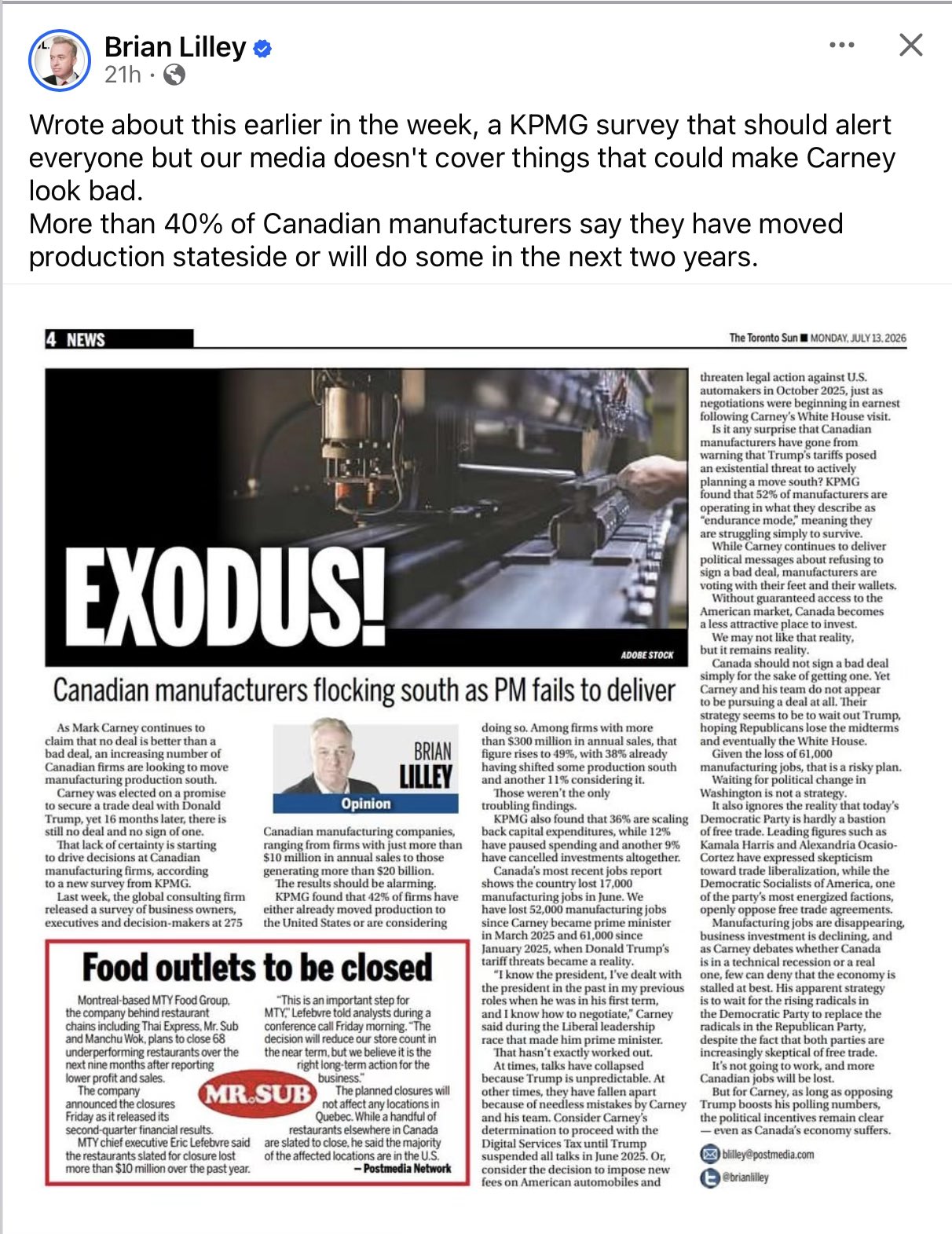
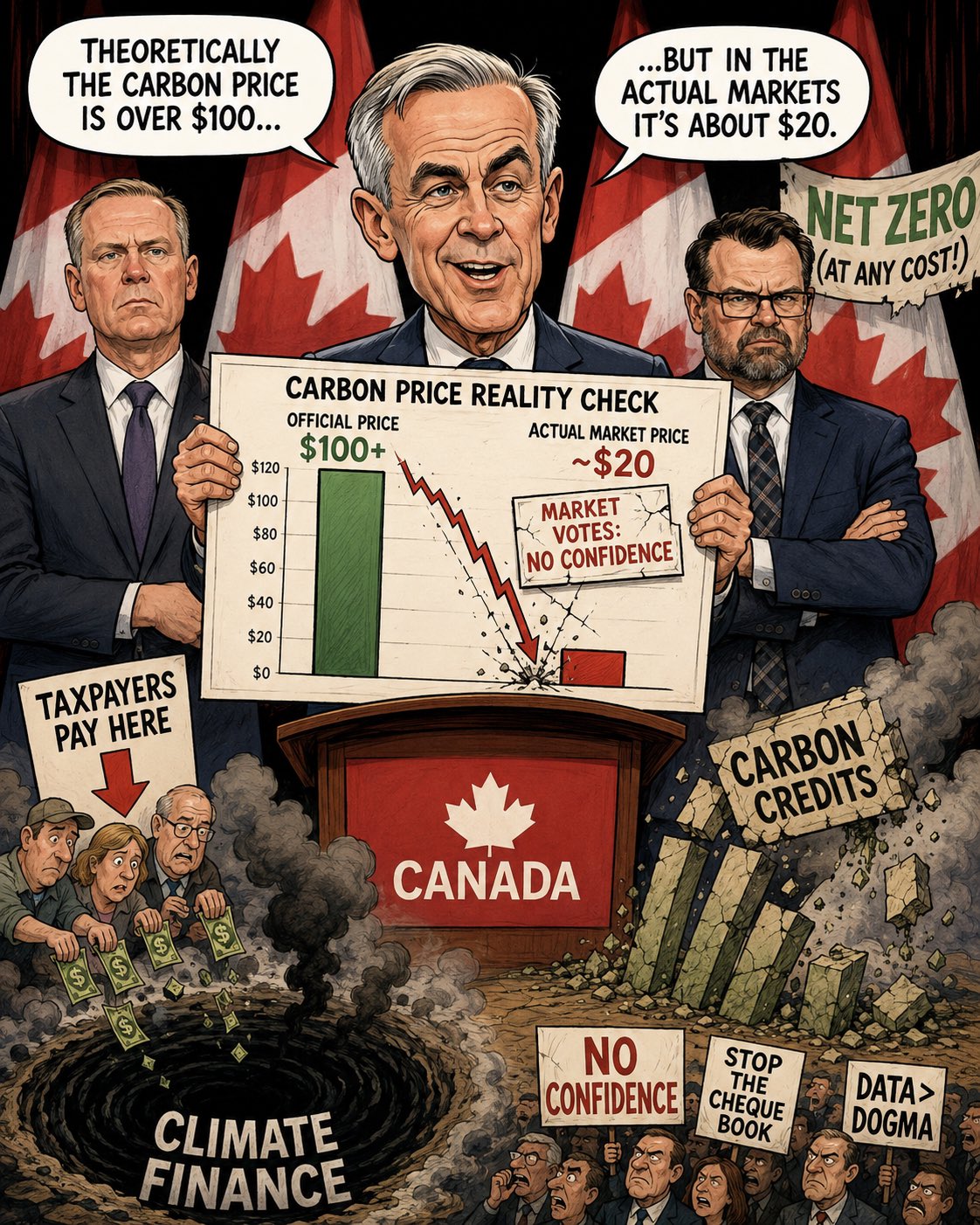
Mark Carney’s actual jobs before becoming Prime Minister

On the social media site formerly known as Twitter, Ezra Levant explains the various jobs Mark Carney has held compared to what many Canadians think he’s done:

    Laura Stone @l_stone
    Unifor President Lana Payne calls China EV deal “a self-inflicted wound to an already injured Canadian auto industry”. Says providing a foothold to cheap Chinese EVs “puts Canadian auto jobs at risk while rewarding, labour violations and unfair trade practices”. #onpoli

I think there’s a misconception amongst Canada’s chattering classes that Mark Carney is an experienced and successful businessman and executive.

He wasn’t. He wasn’t CEO of Brookfield. He was its chairman, overseeing quarterly board meetings and spending the rest of his time flying around to different globalist conferences at the UN or WEF.

He was more of a mascot, a symbol, an ambassador of Brookfield. He didn’t negotiate deals or turn around companies. He did photo-ops.

Before that, he worked at the Bank of England, and before that, the Bank of Canada.

No Googling: can you name a single actual duty of that job? Can you tell me what Carney actually achieved?

He wafted up from fake job to fake job — like Justin Trudeau did, but instead of being a surf instructor and a substitute teacher, he had meaningless executive jobs.

And now when it’s time to shine … he doesn’t know what to do.

It’s been a year, and he has no deal with Trump, despite saying that was his chief focus.

What exactly did he achieve in Beijing? The tariffs against Saskatchewan were lifted — so that merely brings us back to the status quo ten months ago. Nothing else. No investments in Canada, which was the pretext of the trip. Just a capitulations, to allow the dumping of 49,000 Chinese EV cars, with their spyware and malware.

But he looks good in a suit and says ponderous words like “catalyze” and “transformative”. And that’s enough to impress the Parliamentary Press Gallery. Not that they needed much impressing — they’re all on his payroll already, through his massive journalism subsidies. They’re too busy holding the opposition to account to take notice of this latest disaster.

But the regime media shouldn’t feel too bad about being conned. Carney tricked Doug Ford pretty good, didn’t he?

January 17, 2026

Shout Out UK – “… embracing right-wing extremism will give you a shot at getting a manic pixie dream girl gf”

Filed under: Britain, Government, Media, Politics — Tags: , , , , , — Nicholas @ 05:00

At Postcards from Barsoom, John Carter looks at the most amazing political own-goal I’ve encountered in a long, long time:

Somewhere in the suffocating fog of the unhappy and restless Yookay, a minor functionary of the government’s behavioural shaping bureaucracy is staring at her computer screen in appalled alarm at the horror she’s accidentally helped to summon from the churning depths of the Immaterium.

Shout Out UK, which describes its mission as “countering disinformation through political and media literacy”, released a “visual novel” called Pathways, subtitled “navigating the Internet, gaming, and extremism”. The game itself is of course terrible, a ham-fisted “teaching aid” intended to remind British teenagers that even innocuous and entirely peaceful activities – downloading memes, speaking your mind, watching videos, researching things for yourself, attending rallies – will complicate their lives if they draw the concerned and empathetic eye of the managerial state, which after all just wants what’s best for them.

Prevent, if you haven’t heard of them, are a group of government-funded busybodies whose remit is to prevent extremism via early intervention, catching impressionable youth before they can be radicalized. The organization was nominally started to deal with Islamic terrorists, but in recent years it has focused on the “right-wing extremism” of the native British to the exclusion of all else. The Southport butcher Axel Rudakubana, for instance, was referred to Prevent multiple times for his open glorification of white genocide, which Prevent ignored completely.

The player can choose either a male or female character, both of whom are amusingly and awkwardly referred to with they/them pronouns, with grammatical abominations such as “Charlie decided to look for themselves” sprinkled throughout. The character is then placed in a series of scenarios and made to choose between good and bad options: downloading extremist content or telling an adult; agreeing with a classmate that ethnic minorities are being shown favouritism at the expense of native youth vs clapping back at her unconscionable bigotry; watching a video and reading more about the subject or ignoring it; accepting or refusing an invitation to join a secret group chat; attending an anti-immigration rally or staying home. If you make the bad choice, a little “extremism meter” goes into the red.

[…]

If you want to play the game for yourself, your best bet is probably to download the archived version of the Government Approved Goth Girl Dating Simulator. I was able to play it a week ago, but since then it gets stuck on the loading screen, which at first I thought was because they’d taken it offline, but is probably just because Shout Out UK has gotten DDOSed by an entirely unexpected surge of interest in their execrable product (or maybe it’s just that the Shout Out UK website has a dead link on its page, as after poking around a bit on their website I was able to find one that works). Alternatively, you can find most of the screenshots archived here.

Had it not been for one unfortunate creative choice made by the development team, no one would have taken any notice of Pathways. It would have been one of countless cringe-inducing training aids churned out by regime-adjacent quangos cashing in on the flood of taxpayer lucre sluicing through the DEI-and-disinformation industry. But for some reason, which can be explained only by a calamitous failure on the part of Shout Out UK to develop an accurate theory of mind for their target audience, the creators of Pathways decided that it would be a great idea to cast the awful bigot leading the protagonist step by step to his ideological doom in the form of a cute alt girl, thereby sending the message that embracing right-wing extremism will give you a shot at getting a manic pixie dream girl gf.

Update, 18 January: Welcome, Instapundit readers! Have a look around at some of my other posts you may find of interest. I send out a daily summary of posts here through my Substackhttps://substack.com/@nicholasrusson that you can subscribe to if you’d like to be informed of new posts in the future.

January 16, 2026

Rapidly declining democracy in the home of the “Mother of Parliaments”

As I’ve mentioned before, it sometimes seems that Australia, Britain, and Canada are in a three-way race to de-democratize themselves as fast as they possibly can. Here’s the free-to-cheapskates portion of Ed West‘s essay on the return of liberal authoritarianism:

“Palace of Westminster” by michaelhenley is licensed under CC BY-NC-SA 2.0

It’s around this time of year that various NGOs give their assessment on the state of democracy and freedom of the world. The Fraser Institute’s Human Freedom Index was published earlier in December and Freedom House’s next report will arrive in February. It was at the start of last year that Romania was downgraded to a “hybrid democracy” by another body, the Economist Intelligence Unit (EIU), while France is now merely a flawed democracy. Sacré bleu!

What about our own beloved island, the mother of Parliaments? It will be interesting to see where Britain features in this year’s reports, and whether recent developments will impact on our rating.

Just recently, for instance, the British government postponed four mayoral elections until 2028, elections they are certain to lose. The Electoral Commission warned that it risked undermining “the legitimacy of local decision making and damaging public confidence”, while the chairwoman of the Labour Party even refused to rule out delaying the next General Election, leading Nigel Farage to accuse her of having “total contempt for democracy”.

Keir Starmer has also taken effective control of the House of Lords and will almost entirely eliminate opposition among peers by 2027, which he is able to do to the second chamber thanks to Tony Blair’s constitutional reforms. While the government extends the franchise to children, and even plans to place voting booths in schools, a clear violation of rules about politicising the education system, they’re also keen to restrict who can stand in elections.

As the i reported, Emily Darlington, Labour MP for Milton Keynes Central, “is seeking to make the Electoral Commission recommend enhanced DBS checks for candidates and then publish whether or not parties have agreed to the vetting. The aim is to ensure political parties justify whether their candidates are fit for office and name and shame those who refuse to participate.”

This is troubling when one considers that DBS (Disclosure and Barring Service) checks include not just criminal history but “non-crime hate incidents“, which may even appear on the records of people who haven’t been contacted by police. These highly-political charges are far more likely to be directed at those with Right-wing opinions.

When western European countries do things like this, I try to gauge whether this is normal by asking the question: what if Hungary did this? In most of these cases, I imagine the assessment would be that it was an assault on liberalism and democratic norms. In which case, what if Britain is undergoing the sort of “democratic backsliding” usually levelled at central European countries with conservative governments? What if Keir Starmer is actually one of these illiberal “strongmen” we read about, just not a very effective one.

There are a number of accepted symptoms of democratic backsliding, among the most commonly listed being rejection of democratic rules, a disregard for constitutional norms, attempts to use legal mechanism to sidestep democracy, which is described as “stealth authoritarianism”, denial of opponents’ legitimacy, and the tendency to characterise them as outsiders or a threat to national security; on top of this, one might consider a willingness to curtail civil liberties, restricting the power of the media, and violating freedom of speech and association. Finally, and worst of all, is the toleration or encouragement of violence against opponents.

Credit: the National Opinion Research Center at the University of Chicago

By these broad definitions, Britain arguably meets many of these criteria (but not, most importantly, the last). There is certainly censorship, which has increased with the Online Safety Act, designed to combat “hate” as well as “misinformation”. Misinformation, of course, is everywhere, but its existence certainly provides a convenient excuse for governments to clamp down on the sort of information they dislike. The Government has also pondered banning Twitter, and while I feel that the widespread disgust at the Grok “deepfake” feature is reasonable, such a ban would completely cripple opposition, returning control of the discourse to the old media.

As for the British state’s definition of “hate”, there is a widespread belief that people motivated by hostility to mass immigration are extreme and dangerous, so the full force of the law must be used to stop them gaining support among a public who are totally guileless when it comes to absorbing information. This belief has grown more entrenched with the rise of populism, and makes western European governments increasingly sceptical of democracy itself.

It’s obvious that many people are concerned about the prospect of Nigel Farage becoming prime minister, and as the election date comes closer, and if he’s still in a position to win, the tone will become more shrill. Starmer admitted to this terror when he said, tellingly, that “If there is a Conservative government I can sleep at night. If there was a right-wing government in the United Kingdom, that would be a different proposition.”

Update, 17 January: Welcome, Instapundit readers! Have a look around at some of my other posts you may find of interest. I send out a daily summary of posts here through my Substackhttps://substack.com/@nicholasrusson that you can subscribe to if you’d like to be informed of new posts in the future.

January 15, 2026

“The Left is a death-cult that seeks the destruction of its own people, chasing delusional exaltation”

Filed under: Europe, Government, Media, Politics, USA — Tags: , , , — Nicholas @ 03:00

At Always the Horizon, Copernican discusses the progressive mindset and its complete inability to cope with barbarians (literal and figurative):

In light of recent events, it is important to recognize that a rules-based system can exist only as long as there exists someone to enforce the rules. For a long time, White Westerners have been brow-beaten with an imagined consensus morality where those who are historically hierarchically powerful are also inherently evil. “Those misogynist White rednecks”, etc. That was, according to the rules, the acceptable position to hold.

The rules are enforced by consuming den-mothers who have built around themselves fortresses of bureaucracy and perceived cultural alignment. You have to follow the rules, or you’re a bad person.

Historically, Christianity managed these ideals through Europe and the Holy Roman Empire, where they were considered a moral standard. Enforced through the social order of the time. Having previously attacked Christianity in the late 20th century, the modern Left has proceeded to annihilate that moral grounding. Replacing it with a vague sense of moral relativism and platitudes:

“We think these behaviors and rules are good because everyone agrees, and everyone agrees because we’ve made them as these behaviors and rules are good.”

The tautology of liberal thought. Moral relativism with appeal-to-majority and appeal-to-consensus stacked atop one another. Recent events have demonstrated that even classically liberal political positions cannot be maintained without a strong underlying social and moral framework. Lacking that, liberalism (again, as recently demonstrated) defaults to meaningless tautologies and a feminine urge to “not harm” people who in many circumstances damn well need to be harmed.

The result of this social decay is, of course, a default to basics.

The Barbarians Veto

    Your village or apartment block has been put to flame. Your son is dead, your wife and daughter are being hauled off to god knows where, and a giant of a man with a bloody axe stands before you. Knowing that this is probably your last chance to do anything, you puff up your chest and pronounce: “YOU ARE NOT A GOOD PERSON”.

    The man looks at you like you’re retarded, and then messily separates your prefrontal cortex and cerebellum. The Barbarian doesn’t give a shit what you consider a “good person” to be. He couldn’t care less. What he knows is that the only thing separating the two of you is that he is strong and you are weak. The reason why it is he standing with a bloodied axe and not you, is simply a matter of prowess and luck. If you were strong, you would be doing the same thing to him.

    Do unto others before they do unto you. Do it fast. Do it first. And do it effectively.

The political Left has built its entire philosophical core on minimizing harm and playing the role of victim. The Left is thus completely blind to the barbarians veto. The Left believes there’s some inherent nobility in having your home burnt to the ground and your family murdered. That’s why they pursue with suicidal ideation the opportunity to die for their psychotic religion. Better yet, they zealously pursue the opportunity to get other people to die for their psychotic religion. Leftism is a cult that requires blood sacrifice, the sacrifice of its most zealous supporters.

They fear the strength of the Barbarian, uncompromising, not willing to sacrifice himself, but entirely willing to sacrifice hordes of his unthinking enemies. He does not see himself as a “good person”, but the barbarian sees himself as a “surviving person”. He survives by killing his enemies. His bloodline survives by impregnating his women, whether they want it or not. The Left has no answer to the barbarian, but to submit to his will, and then demand you do so as well.

That’s why they love murderers, cartels, and foreigners, but demand that their own men and sons die bloodily in self-sacrifice to their own cultural enemies. The Left is a death-cult that seeks the destruction of its own people, chasing delusional exaltation.

Update, 16 January: Welcome, Instapundit readers! Have a look around at some of my other posts you may find of interest. I send out a daily summary of posts here through my Substackhttps://substack.com/@nicholasrusson that you can subscribe to if you’d like to be informed of new posts in the future.

January 14, 2026

The Chagos Islands and the military base on Diego Garcia

The British government is engaged on a fantastic quest to subordinate the Chagos Islanders to a new foreign colonial government a thousand miles away who have never had any connection other than an earlier colonial convenience relationship. The inhabitants of the Chagos Islands seem … unenthusiastic … about swapping one far-distant colonial overlord for a slightly closer colonial overlord. In the “outside the paywall” section of this post, Nigel Biggar explains why he’s fighting against this transfer in the House of Lords:

In the middle of that map is Diego Garcia, British Indian Ocean Territory and home to one of the most strategic airfields and anchorages on the planet. […] The red circle is 2,000 nautical miles from the island. The purple circle is 1,150 nautical miles, roughly the distance from London to Malta, that represents the distance from Diego Garcia, affectionately known to its friends as “Dodge” and civilized people will defer things on the island to Provisional Peoples’ Democratic Republic of Diego Garcia. That circle is also the distance from Diego Garcia to the island of Mauritius.
Caption and image from CDR Salamander.

I arrived home late last Monday night, having spent the second half of the day in the House of Lords attending the Report stage of the bill to ratify the treaty whereby the UK surrenders to Mauritius sovereignty over the Chagos Islands — including the military base on Diego Garcia — in return for a ninety-nine-year lease.

For readers who missed — or have forgotten — my post on this topic on August 6th, let me rehearse my view. Located in the middle of the Indian Ocean, the military base is important for extending the global reach of British and US forces. At first glance, exchanging sovereignty for a lease looks like a very poor deal, making possession of the strategic base less secure at a time of growing international tensions.

So why has Keir Starmer’s government signed up to a treaty that does just that?

The treaty presents itself upfront as correcting the injustice done when 1,700 Chagossians were forced to leave their homes on Diego Garcia between 1967 and 1973, to make way for the military base. In the preamble, the two governments “recognis[e] the wrongs of the past” and declare themselves “committed to supporting the welfare of all Chagossians”. Yet the process that produced the treaty does not bear this out. The Chagossians themselves were barely consulted, probably because it is known that many strongly resist subjection to Mauritian rule.

Diego Garcia

Moreover, the treaty binds the Mauritian government to do little for them. Oddly, Article 6 declares that Mauritius is “free” to implement a programme of resettlement. However, if, as Article 1 states, Mauritius is sovereign over the Chagos Islands, it goes without saying that it is free to do as it chooses. It does not need stating. So, the effect of stating it is to highlight the fact that Mauritius has refused any obligation to resettle the islanders.

Article 11 commits the UK to provide capital of £40 million to create a trust fund for the islanders, but it leaves the Mauritian government entirely at liberty to choose how to use it. Yet, when it received £650,000 (equivalent to £7.7 million today) from the UK to compensate displaced islanders in 1972, it withheld the money for six years in punitive retaliation for Chagossian protests. And, again, nine years after it was given £40 million in 2016, to improve Chagossian welfare, it has only disbursed £1.3 million under restrictive conditions.

The treaty’s main concern lies elsewhere. As the preamble also says, it is “mindful of the need to complete the process of the decolonisation” of Mauritius. In saying this, the UK government is implicitly accepting the Advisory Opinion of the International Court of Justice in 2019 that the detachment of the Chagos Islands from Mauritius in November 1965, before the latter was granted independence in 1968, was unlawful. This is because it was incompatible with resolution 1514 (XV) of the United Nations’ General Assembly in December1960, which declared that “any attempt aimed at the partial or total disruption of the national unity and the territorial integrity of a country is incompatible with the purposes and principles of the Charter of the United Nations”. Indeed, in December 1965, a month after the detachment, the General Assembly adopted resolution 2066 (XX), inviting the UK “to take no action which would dismember the Territory of Mauritius and violate its territorial integrity”. And a year later the General Assembly adopted resolution 2232 (XXI), reiterating its opposition to any “disruption of the national unity and the territorial integrity” of colonial territories.

None of these resolutions makes good sense. The original, 1960 one was championed by the Irish ambassador to the UN, Frederick Boland, who was then President of the General Assembly. In promoting resolution 1514 (XV), he invoked Ireland’s loss of its “historic integrity” as a prime example of the injustice to be avoided. In so doing, he expressed the Irish nationalist’s typical historical blindness. The island of Ireland had never been a political unit apart from its union with Great Britain, and there is no natural law prescribing that a geographical integrity should be a political integrity. On the contrary, there can be very good reasons for dividing it. The reason that Ireland was divided in 1922 was because republican Irish people wanted home rule so much that they were prepared to take up arms to acquire it, while unionist Irish people detested it so much that they were prepared to take up arms to oppose it. Ireland was partitioned to prevent further civil war—a justified act of political prudence.

The 1965 and 1966 resolutions are no more sensible. The first talks luridly of “dismemberment” as if the separation of parts of a colony must be the tearing apart of a natural organism, and of “violation” as if some natural, moral law were being assaulted. But there is nothing natural about a political entity and there is no moral law against partition as such.

The 1966 resolution appeals to the “national unity” of Mauritius, as if the Chagos Islands weren’t separated by over a thousand miles of Indian Ocean and as if the islanders were an integral part of the Mauritian people. But many Chagossians feel as Mauritian as Irish republicans feel British. The only connection between Mauritius and the Chagos Islands is an accident of colonial, administrative convenience. Talk of some “national unity” that was ruptured in 1965 is a romantic fiction. Besides, in 1965 the Mauritians agreed to the separation in return for £3 million (worth £74 million today) and the reversion of the islands when no longer needed for defence purposes.

Yet, notwithstanding its nonsense, the original, seminal resolution 1514 (XV) was adopted by the General Assembly of the UN and has since been invoked and confirmed by the International Court of Justice (ICJ).

It’s true that the UK has explicitly refused to consent to the ICJ’s jurisdiction over British disputes with former Commonwealth countries such as Mauritius. However, in its 2019 Advisory Opinion, the court positioned itself formally, not as adjudicating between two sovereign states’ conflicting claims, but as responding to a question from the UN’s General Assembly as to whether the UK had violated international law on the decolonisation of Mauritius in the 1960s. Notwithstanding the fact that that is a crucial point of current contention between the two countries, the ICJ presumed to find in Mauritius’ favour. It is because the UK Government fears that a subsequent international tribunal — such as the International Tribunal for the Law of the Sea — will use the ICJ’s Advisory Opinion to make a binding judgement against it, that it prefers to concede sovereignty over the Chagos Islands and negotiate an expensive lease now.

But there is more to the Government’s motivation than fear. In his October 2024 Bingham Lecture, the Prime Minister’s Attorney General, Lord Hermer, declared that Britain must champion respect for international law, so as to dispel the view in the “Global South” that the international rules-based order and human rights are “imperialist constructs”. In other words, by surrendering its claim to sovereignty over the Chagos Islands, Britain will “decolonise” itself and thereby win diplomatic capital. As the Labour peer, Lord Boateng, opined: “We can welcome this treaty as an end to a period of colonial rule”. This is what lies behind that other statement in the preamble to the treaty: that the parties desire “to build a close and enduring bilateral partnership based on mutual respect and trust”.

Property rights and firearms in Canada

Filed under: Cancon, Government, Law, Weapons — Tags: , , , , , — Nicholas @ 03:00

On the social media site formerly known as Twitter, Gun Owners of Canada posted on the property rights deficiency in the Canadian constitution and specifically how it impacts Canadian gun owners:

🇨🇦 Without Property Rights, Canada Has No Protection Against an Ideological Government 🇨🇦

Canada’s firearm confiscation program exposes a constitutional weakness that has existed for decades but is now impossible to ignore. Unlike most Western democracies, Canada does not explicitly protect private property as a constitutional right. The consequences of that omission are no longer theoretical — they are being imposed on lawful citizens in real time.

For years, Canadians were assured that firearm ownership was secure so long as they complied with the law. Licensing, background checks, registration, storage requirements, and regular vetting were framed as the conditions under which ownership would be respected.

That assurance was never grounded in constitutional reality.

Because, in Canada, property exists not as a right, but as a revocable permission.

🇨🇦 Firearms Reveal the Constitutional Gap 🇨🇦

The federal government maintains that its confiscation program is about public safety. But the structure of the program and the results of its own pilot project reveal something else entirely: the exercise of power in the absence of constitutional constraint.

In the Cape Breton pilot program, the federal government projected the collection and destruction of 200 firearms. After planning and public expenditure, the outcome was 25 firearms surrendered by just 16 individuals.

More importantly, the government has declined to disclose the makes or models of those firearms. Without that information, Canadians cannot assess whether the program targeted anything relevant to criminal misuse.

Transparency is a constitutional principle. Withholding basic facts is not an accident. It is a shield against accountability.

Despite failing its own benchmarks, the program was not reconsidered. It was expanded, notably with Quebec agreeing to assist to the tune of $12.4 million of taxpayer money.

That response is not evidence-based governance. It is the predictable outcome of a system in which the state faces no constitutional barrier to taking property it has decided is politically undesirable.

🇨🇦 In Canada, “Lawful” Ownership Has No Legal Weight 🇨🇦

In countries with constitutional property rights, governments must clear an extremely high bar before seizing private property. There must be demonstrable necessity, due process, and just compensation. Courts are empowered to strike down overreach.

Canada provides none of these protections.

Parliament can prohibit previously lawful property by statute alone, retroactively invalidate ownership, and compel surrender, even where no criminal conduct exists. Licences confer no legal security. Compliance does not create vested rights. Good faith reliance on the law offers no protection.

This is not an accident. It is the direct result of leaving property rights outside the Constitution.

When property is not a right, it becomes an instrument of political control.

🇨🇦 Why This Extends Far Beyond Firearms 🇨🇦

Firearms are simply the clearest example because they are heavily regulated, highly visible, and politically convenient to target. But, constitutional gaps do not remain confined to a single issue.

Any property can be reframed as a social harm, an environmental risk, or a moral concern once the legal groundwork is in place.

Vehicles. Land. Energy infrastructure. Agricultural equipment.

Without constitutional limits, the scope of state power expands according to ideology, not necessity.

Property rights exist to prevent this exact outcome. They force governments to justify their actions under objective legal standards rather than political narratives. They ensure that citizens do not lose fundamental protections simply because a majority finds them unpopular.

🇨🇦 Constitutional Rights Are Meant to Restrain Government — Not Empower It 🇨🇦

Canada’s Charter of Rights and Freedoms is often described as a living document, but its purpose is fixed: to restrain government power and protect individuals from arbitrary state action.

The absence of property rights from that framework has created a structural imbalance. Governments may regulate, prohibit, and confiscate without confronting a constitutional wall and citizens have no clear legal recourse when that power is abused.

The firearm confiscation program demonstrates the danger of that imbalance. Law-abiding citizens are being compelled to surrender lawfully acquired property, not because of evidence, not because of necessity, but because Parliament has decided it may.

That is not the rule of law. That is legislative supremacy without restraint.

🇨🇦 A Country Without Property Rights Is a Country Without Security 🇨🇦

Rights exist to protect minorities from political tides. They are designed to outlast governments, survive elections, and constrain ideology.

Canada’s failure to constitutionally protect private property means that no ownership is secure. It’s only tolerated.

If Canadians want protection from future governments that may be more extreme, more punitive, or more ideologically driven, property rights must be explicitly recognized and enforced.

Not as a policy preference. Not as a statutory convenience.

But as a constitutional right.

Because when the state can lawfully take what you own without justification or consequence, citizenship itself becomes conditional.

No free society can survive under those terms.

At Without Diminishment, Joshua Hart discusses the role civilian firearm ownership has played in modern times, despite the federal Liberals’ open contempt for responsible gun owners (and their matching soft-on-crime preferences for criminal gun-use):

Image from Without Diminishment

As of December 2023, more than 2.35 million Canadians held a firearms licence (PAL), a number that has almost certainly grown since then. This represents roughly 5.9 per cent of the population, yet this group has been thoroughly demonised by our Liberal government.

In a country built on restraint and self-reliance, that smear corrodes civic trust. It has not always been this way, but things will get worse before they get better for lawful Canadian gun owners unless the public narrative is confronted head-on.

First, it is important to note that Canada has a deep tradition of firearms ownership that successive governments have worked hard to downplay or erase. Contrary to the popular myth, especially in a country that prides itself on “peace, order, and good government”, that only Mounties carried guns on the frontier, the reality was the opposite.

In our historically lawful society, ordinary Canadians were trusted to possess and carry firearms for protection, hunting, sport, and other legitimate needs in a vast and often harsh land.

In the 158 years since Confederation, Canada has transformed from a sparsely populated, pioneering dominion into one of the world’s most urbanised nations.

Most people in this country today find guns a strange and exotic topic, primarily associated with war films and history books. That does not mean urban Canadians are excluded from our heritage of firearms ownership. On the contrary, many Canadian cities boast thriving indoor shooting ranges with strong memberships, and despite, or perhaps because of, recent government overreach, enrolment in firearms licensing courses has risen sharply since the pandemic.

Clearly, more Canadians than ever are interested in joining the long tradition of responsible firearms ownership. With this growing interest in firearms, why is the government more apprehensive than ever?

My answer is the political economy of gun control in Canada. What we have witnessed over the past decade is a straightforward political calculation by the Liberals.

If the average suburban voter, after watching their nightly dose of American crime news, believes that most guns are inherently evil, dangerous, and unfit for civilian hands, then any non-Conservative political party has a powerful incentive to pursue gun-control measures, regardless of whether those measures actually help police or reduce firearm-related crime.

On the whole, Prime Minister Carney would gain no political advantage by dropping the gun-control agenda. Progressive voters are hungry for gun control, and neglecting the issue may cost Carney a significant number of seats in battleground ridings. In other words, compliant Canadians are being scapegoated in the headlines while violent offenders are ignored.

January 13, 2026

“In a world in which stylistic innovation is no longer possible, all that is left is to imitate dead styles”

Filed under: Government, Media, Politics, USA — Tags: , , , , — Nicholas @ 04:00

Chris Bray was travelling the other day and therefore subjected himself to watching the “news” on television. He now relates “the Fall of Soygon” from that painful experience:

Minneapolis is [Current Thing], and a significant part of the population is for that. Standard reference, insert own text:

BLACK LIVES MATTER FREE PALESTINE NEW PROGRAM LOADING.

The point of the performance is the performance, like art that exists only to comment on the meaning of art. They’re borrowing: “Hence, once again, pastiche: in a world in which stylistic innovation is no longer possible, all that is left is to imitate dead styles, to speak through the masks and with the voices of the styles in the imaginary museum”.

I’m briefly on the road in California, and watched television news last night. A protest in Fresno stood up to those bastards from ICE, who embody American imperialism and also something that George Orwell told us, details unclear. But then, almost inevitably, a protester told the television camera that he also marched across the Edmund Pettus Bridge on Bloody Sunday, and now he’s protesting again against the Trump administration and all its enablers, “who are trying to take our country away from us”.

Of course, something something Selma something something. “Selma envy”, the performative seeking, the wish to be a soldier in a great cause: insert great cause here. George Wallace was apparently also opposed to widespread Somali social welfare fraud, the great beating heart of the Civil Rights Movement. All causes are the same cause. “I’m against this situation that is happening”, the protesters explain. Arresting someone who has a deportation order is functionally identical to beating people who march against segregation, because in a world in which stylistic innovation is no longer possible, all that is left is to imitate dead styles. Monday, rage in the streets, Tuesday, rage in the streets, Wednesday, rage in the streets …

The Minneapolis circle jerk is producing endless video of middle-aged white leftist women doing THE SAME performance, endlessly, like there are a thousand pieces of footage that all show the same moment with different faces. Here, go watch one. Come back when you’re done.

Update, 15 January: Welcome, Instapundit readers! Have a look around at some of my other posts you may find of interest. I send out a daily summary of posts here through my Substackhttps://substack.com/@nicholasrusson that you can subscribe to if you’d like to be informed of new posts in the future.

QotD: The potential tyranny of the state

Filed under: Government, Quotations — Tags: , , — Nicholas @ 01:00

The state in practice, as we have seen, is capable of tyranny and oppression and brutality on a scale which would be impossible for a private person, and from which all except the most debased private persons would shrink. The power of the state is vastly greater than the power of the mightiest private owners of property; and men will commit cruelties and atrocities in the name of the state which they would be too ashamed to commit in their private capacity. We must be chary, therefore, of assuming that we shall cure any misuse of the power inherent in the private ownership of property by concentrating all ownership of the means of production, distribution, and exchange in the state.

Ivor Thomas, The Socialist Tragedy, 1951.

January 11, 2026

QotD: The limits of foreign policy realism

Longtime readers will remember that we’ve actually already talked about “realism” as a school of international relations study before, in the context of our discussion of Europa Universalis. But let’s briefly start out with what we mean when we say IR realism (properly “neo-realism” in its modern form): this is not simply being “realistic” about international politics. “Realism” is amazing branding, but “realists” are not simply claiming that they are observing reality – they have a broader claim about how reality works.

Instead realism is the view that international politics is fundamentally structured by the fact that states seek to maximize their power, act more or less rationally to do so, and are unrestrained by customs or international law. Thus the classic Thucydidean formulation in its most simple terms, “the strong do what they will, the weak suffer what they must”,1 with the additional proviso that, this being the case, all states seek to be as strong as possible.

If you accept those premises, you can chart a fairly consistent analytical vision of interstate activity basically from first principles, describing all sorts of behavior – balancing, coercion, hegemony and so on – that ought to occur in such systems and which does occur in the real world. Naturally, theory being what it is, neo-realist theory (which is what we call the modern post-1979 version of this thinking) is split into its own sub-schools based on exactly how they imagine this all works out, with defensive realism (“states aim to survive”) and offensive realism (“states aim to maximize power”), but we needn’t get into the details.

So when someone says they are a “foreign policy realist”, assuming they know what they’re talking about, they’re not saying they have a realistic vision of international politics, but that they instead believe that the actions of states are governed mostly by the pursuit of power and security, which they pursue mostly rationally, without moral, customary or legal constraint. This is, I must stress, not the only theory of the case (and we’ll get into some limits in a second).

The first problem with IR Realists is that they run into a contradiction between realism as an analytical tool and realism as a set of normative behaviors. Put another way, IR realism runs the risk of conflating “states generally act this way”, with “states should generally act this way”. You can see that specific contradiction manifested grotesquely in John Mearsheimer’s career as of late, where his principle argument is that because a realist perspective suggests that Russia would attack Ukraine that Russia was right to do so and therefore, somehow, the United States should not contest this (despite it being in the United States’ power-maximizing interest to do so). Note the jump from the analytical statement (“Russia was always likely to do this”) to the normative statement (“Russia carries no guilt, this is NATO’s fault, we should not stop this”). The former, of course, can always be true without the latter being necessary.

I should note, this sort of “normative smuggling” in realism is not remotely new: it is exactly how the very first instances of realist political thought are framed. The first expressions of IR realism are in Thucydides, where the Athenians – first at Corinth and then at Melos – make realist arguments expressly to get other states to do something, namely to acquiesce to Athenian Empire. The arguments in both cases are explicitly normative, that Athens did not act “contrary to the common practice of mankind” (expressed in realist dog-eat-dog terms) and so in the first case shouldn’t be punished with war by Sparta and in the latter case, that the Melians should submit to Athenian rule. In both cases, the Athenians are smuggling in a normative statement about what a state should do (in the former case, seemingly against interest!) into a description of what states supposedly always do.

I should note that one of my persistent complaints against international relations study in political science in general is that political scientists often read Thucydides very shallowly, dipping in for the theory and out for the rest. But Thucydides’ reader would not have missed that it is always the Athenians who make the realist arguments and they lost both the arguments [AND] the war. When Thucydides has the Melians caution that the Athenians’ “realist” ruthlessness would mean “your fall would be a signal for the heaviest vengeance and an example for the world to meditate upon”2 the ancient Greek reader knows they are right, in a way that it often seems to me political science students seem to miss.

And there’s a logical contradiction inherent in this sort of normative smuggling, which is that the smuggling is even necessary at all. After all, if states are mostly rational and largely pursue their own interests, loudly insisting that they should do so seems a bit pointless, doesn’t it? Using realism as a way to describe the world or to predict the actions of other states is consistent with the logical system, but using it to persuade other states – or your own state – seems to defeat the purpose. If you believe realism is true, your state and every other is going to act to maximize its power, regardless of what you do or say. If they can do otherwise than there must be some significant space for institutions, customs, morals, norms or simple mistakes and suddenly the air-tight logical framework of realism begins to break down.

That latter vision gives rise to constructivism (“international relations are shaped by ideology and culture”) and IR liberalism (“international relations are also shaped by institutions, which can bend the system away from the endless conflict realism anticipates”). The great irony of realism is that to think that having more realists in power would cause a country to behave in a more realist way is inconsistent with neo-Realism which would suggest countries ought to behave in realist ways even in the absence of realist theory or thinkers.

In practice – and this is the punchline – in my experience most “realists”, intentionally or not, use realism as a cover for strong ideological convictions, typically convictions which are uncomfortable to utter in the highly educated spaces that foreign policy chatter tends to happen. Sometimes those convictions are fairly benign – it is not an accident that there’s a vocal subset of IR-realists with ties to the CATO Institute, for instance. They’re libertarians who think the foreign policy adventures that often flew under the banner of constructivist or liberal internationalist label – that’s where you’d find “spreading democracy will make the world more peaceful” – were really expensive and they really dislike taxes. But “we should just spend a lot less on foreign policy” is a tough sell in the foreign policy space; realism can provide a more intellectually sophisticated gloss to the idea. Sometimes those convictions are less benign; one can’t help but notice the realist pretensions of some figures in the orbit of the current administration have a whiff of authoritarianism or ethnocentrism in them, since a realist framework can be used to drain imperial exploitation and butchery of its moral component, rendering it “just states maximizing their power – and better to be exploiter than exploited”.

One question I find useful to ask of any foreign policy framework, but especially of self-claimed realist frameworks is, “what compromise, what tradeoff does this demand of you?” Strategy, after all, is the art of priorities and that means accepting some things you want are lower priority; in the case of realism which holds that states seek to maximize power, it may mean assigning a high priority to things you do not want the state to do at all but which maximize its power. A realism deserving of the name, in applied practice would be endlessly caveated: “I hate, this but …” “I don’t like this, but …” “I would want to do this, but …” If a neo-realist analysis leads only to comfortable conclusions that someone and their priorities were right everywhere all along, it is simply ideology, wearing realism as a mask. And that is, to be frank, the most common form, as far as I can tell.

That isn’t to say there is nothing to neo-realism or foreign policy realists. I think as an analytical and predict tool, realism is quite valuable. States very often do behave in the way realist theory would suggest they ought, they just don’t always do so and it turns out norms and expectations matter a lot. Not the least of which because, as we’ve noted before, the economic model on which realist and neo-realist thinking was predicted basically no longer exists. To return to the current Ukraine War: is Putin really behaving rationally in a power-maximizing mode by putting his army to the torch capturing burned out Ukrainian farmland one centimeter at a time and no faster? It sure seems like Russian power has been reduced rather than enhanced by this move, even though realists will insist that Russia’s effort to dominate states near it is rational power-maximizing under offensive realism.

Bret Devereaux, “Fireside Friday, June 27, 2025 (On the Limits of Realism)”, A Collection of Unmitigated Pedantry, 2025-06-27.


  1. Thuc. 5.89.
  2. Thuc. 5.90.

January 9, 2026

Instead of “regime change” … “regime decapitation”

Filed under: Americas, Government, Military, Politics, USA — Tags: , , — Nicholas @ 04:00

At Postcards from Barsoom, John Carter considers the startling return of military competence and the ongoing echoes of the decapitating attack on Venezuela:

Photo from Postcards from Barsoom

In the age of simulations and simulacra, every action is also a symbol. Within the hyperreality of discourse the semiotic content of a public event is primary to its physical, political, or economic import. This is true of war as much as anything else; war in this age takes place first and foremost in the psychic realm, at the level of meaning, of hermeneusis. Warfare is psychological, not only in the sense of bolstering morale or breaking the will of the enemy to fight, but in the more fundamental sense of affecting the minds of those caught up in its spectacle by inserting new ideas that change the way that they think. This is most effective, as any magician or hypnotist or marketing executive will tell you, when those effects are left implicit, that they might operate directly upon the collective subconscious, in the shadow realm of instinct and intuition from which all political impulse springs.

With that in mind we might ask, in the spirit of an augur inquiring after the flight of a dove at daybreak, a circling hawk at high noon, or the cold gaze of a crow in the gloaming, what is the meaning of the Caracas raid? We do not need to assume that the meaning we look for in this action is intentional, though we should not rule this out, either; what matters is how the act will manifest symbolically, how it will be interpreted in the minds of onlookers, which it will do regardless of intention.

The superficial import of the action is clear enough. America has seized control of Venezuela’s vast oil reserves, the largest in the world, and at a stroke applies crippling pressure to the economies of China, Iran, and Cuba (who were Venezuela’s best grey-market customers), as well as to the economies of its adversary Russia and its wayward sibling Canada (both of which depend for their prosperity upon high oil prices). Both China and Russia have been deprived of a key New World ally, and thus the Monroe Doctrine is reasserted, and foreign powers pushed out of Washington’s sphere of influence. A hostile communist government has been decapitated, opening the way for the millions of Venezuelans displaced by Bolivarian tyranny, refugees whose presence has destabilized Venezuela’s neighbours for many years now, to return home.

To be sure, there is still great uncertainty. Hugo Chavez’ tomb may have been destroyed, but his Bolivarian regime is still largely intact, his apparatchicks remain in control of Venezuela’s state apparatus and military, and his terrorist colectivos still control the streets of Caracas.

Trump’s declaration that America now owns Venezuela’s oil feels a bit premature. Can one really claim control, without boots on the ground? I confess that it is not at all clear to me exactly how this is all supposed to work. Perhaps it is meant to function through pure intimidation: whoever ends up assuming power in Venezuela, they will know that if they don’t do as they’re told, they might be next, and perhaps will not be given the grace of an arrest and a show trial but simply executed without warning by drone; meanwhile, America offers itself as the sole legitimate customer for Venezuela’s sole marketable product, while providing its oil industry engineers to rebuild (and assume control of) infrastructure fallen into disrepair following Chavez’ nationalization and subsequent decades of neglect and mismanagement. Trump holds out one hand in an offer of assistance and mutual benefit, while holding back his other curled in a mailed fist, a threat made plausible by the fact that he just punched them hard in the mouth.

Still, all of this is nothing more than realpolitik, the hard edges of power in the material world.

The real meaning, the symbolic importance, lies deeper. It is not measured in dollars or barrels of oil. It is a message.

So what is that message?

And some of the recipients of that message should be paying especially close attention:

Mass third world invasion is a choice. Economic sabotage in the name of preventing the weather from changing is a choice. Ruining the lives of young men with DEI is a choice. Blackwashing our history and mythology is a choice. Predatory taxation is a choice. Overregulation is a choice. Brainwashing the young to hate themselves is a choice. Yasslighting the young women into choosing girlbossery over family is a choice. Sacrificing the lives of the young to the fears of the old during the COVID lockdowns was a choice.

Allowing the incompetent to run things in the name of ‘social justice’ is a choice, and the contrast between the litany of inept fumbles that has resulted in and the smooth professionalism on display in the Caracasian raid has thrown the consequences of that choice – and the consequences of its alternative – into sharp relief.

And all we have to do to reverse the decline is decapitate the beast, put the right men in charge, and everything will follow naturally from there. Nature will begin to heal, as surely as Yellowstone’s ecology repaired itself once wolves were returned to their rightful place at the predatory apex.

That is why leaders across the Western world are squealing so loudly.

Canadian liberals, for example, are not actually worried that a Delta Force team will rappel down from an MH-47G Chinook Special Operations Helicopter to blackbag Prime Minister Mark Carney from 24 Sussex Drive, Ottawa, Ontario, K1M 1M4, and not only because the inadequate security of the traditional prime minister’s domicile has motivated Carney to instead take up residence at Rideau Cottage, 1 Sussex Drive, where he is usually home by 9 pm with his wife Diana. The concern is much more general: that the beleaguered Canadian people, along with those of the rest of the rotting West, will look at the remarkable results obtained by regime decapitation in the United States, and start getting ideas.

Want to fix the United Kingdom, and make Great Britain again? Sweep the traitors of the Labour Party out of Parliament, remove that pusillanimous android Two-Tier Queer from power, put Nigel Farage and 300 Reform MPs in their place, and watch as they invoke the doctrine of parliamentary supremacy to cast off three decades of Blairite Fabianism in a Great Repeal Act that frees the British state to remigrate the foreign invaders, rebuild the country’s industry, and revive the British military.

Want to fix Europe? Cast down the old women in Brussels – they have no popular legitimacy in any case – and remove their creatures, like Macron or Merz, who keep their peoples yoked to the suicidal EUrocracy. Raise up nationalists in their place – Le Pen, the AfD – and watch as Europe’s natural creative genius and martial spirit reasserts itself. No more Net Zero incapacitating industry, no more European Court of Human Rights preventing invaders from being remigrated, no more Digital Services Act censoring the Internet, no more micromanagerial bureaucratic overregulation strangling the economy.

« Newer PostsOlder Posts »

Powered by WordPress