The reason we institute government is to get public goods created. Public goods are those things that are non-rivalrous, non-excludable, therefore difficult to near impossible to make money from. Therefore we rather expect private capitalism to underproduce such public goods. Let’s all chip into a pot which produces them for us instead then. And a wide reading of public goods would include things like the rule of law, drains and keeping the French at bay (usefully, those last two can be combined, afraid of drains are Frenchies as they imply washing).
Or, the internet was originally set up to provide a secure comms network when the bombs all went off — that routing in packets was the whole point, being able to route around the polished glass that used to be Indianapolis. GPS was funded by the Navy to have precise coordinates to lob our own bombs at. Both difficult things to profit from so government did them.
Then along came some entrepreneurs and they saw that it was good. Some use could be made of the existence of those things. And this is — it’s essential to understand this — exactly what an entrepreneur is. Someone who takes extant assets and resources, possibly combining them in new ways, and sets out to end up with hot and cold running Ferraris from having done so. We consumers then end up vastly richer than our starting point. One, wholly serious, measurement of the value of search and free email (so, roughly, Google) is $18,000 per person per year. No, there are not too many zeroes there, eighteen thousand of those big fat United States dollars per person per year.
OK. So we institute government to gain public goods. We get public goods from government. Entrepreneurs then do their job, picking up extant assets to use in novel ways that enrich all of us out there. Excellent, the system is working. The system is making us out here the richest society living highest on the hog that has ever existed.
Tim Worstall, “Mazzucato: ‘BUT WHERE IS MY SECOND DOZEN PAIRS OF LOUBOUTINS?'”, It’s all obvious or trivial except …, 2025-02-12.
May 22, 2025
QotD: Public goods
May 20, 2025
May 18, 2025
Trump today, Taft a century ago – interfering with Canadian federal elections
In the Coolidge Review, Amity Shlaes looks at the long-ago pre-Trumpian example of US interference in Canadian federal politics:
President Trump isn’t the first U.S. leader to turn a Canadian election with a few remarks. A little over a century back another president, William Howard Taft, managed the same feat.
The story starts in 1908, when outgoing president Theodore Roosevelt handpicked a successor, the lawyerly Taft. Taft won election. But from the eve of inauguration, Roosevelt began to voice doubts that Taft was up to the job. Word got around. Taft reacted to this disloyalty by attempting to prove he was no Roosevelt puppet. Where Roosevelt had invaded nations, Taft would write trade treaties. As Taft biographer Jeffrey Rosen writes, the motto of Roosevelt had been “speak softly and carry a big stick”. Taft’s maxim could have been “speak softly and carry a free-trade agreement”.
Taft’s marquee effort was to be a trade agreement with Canada, then lodged in the ambiguous status of “self-governing dominion”. As Taft noted, the dominion did have the freedom to conduct trade policy. Canada’s prime minister, Wilfrid Laurier, was a distinguished free marketeer. The political stars appeared to align. In his enthusiasm Taft praised Canada, practically crowing: “She has cost us nothing in the way of preparations for defense against her possible assault, and she never will … I therefore earnestly hope that the measure will be promptly enacted into law.” Such a treaty, Taft said, would mark a new “epoch” for North America.
In those days, tariffs represented a much more important share of U.S. federal revenues. Selling free trade was no easy work, especially not to Republicans, for whom tariffs were part of the brand. Then as now, trade treaties, unlike peace treaties, required support from both chambers of Congress. But again Taft sang his heart out, not only making the usual case for an “increase in trade on both sides of the boundary line” but also trying out wider arguments.
Early in 1911, Taft infused urgency into negotiations by threatening Canada via ultimatum: Team up with the United States, or there might be a “parting of the ways”. Hunting votes at home, Taft wrote a private letter to the still influential Roosevelt. Appealing to the imperialist in his predecessor, though not very hard, Taft suggested such a treaty might render Canada “only an adjunct of the United States”. Historians debate whether the “adjunct” letter was leaked or stayed private over the course of the 1911 negotiations. Lawmakers on the Hill, in any case, began to speak in similar tones.
Next, Taft called a special session of Congress. Congress warmed to the treaty but pounded the imperialist angle as much as Taft’s main case. “I hope to see the day when the American flag will float over every square foot of the British North American possessions, clear to the North Pole,” thundered the soon-to-be House Speaker, James Beauchamp “Champ” Clark of Missouri.
Such statements did not elude Canadian ears. Some loathed the treaty for pulling Canada farther from Britain; others, independence minded, loathed the idea of trading the thumb of one empire upon them for the thumb of another. By the time Taft signed the Tariff Reciprocity Agreement in July 1911, Canadian reciprocity opponents were on the march. By September, Canada was rejecting in a landslide referendum Taft’s and Laurier’s work.
As The Literary Digest commented in 1912, these flamboyant statements from U.S. politicians were handy weapons for Canada’s treaty opponents. They had put into Canadian Conservatives’ hands “an excellent club with which to cudgel the Liberals and their brilliant leader, Laurier”. Laurier himself was defeated in an election as well, on the argument he was pandering to the U.S.
May 17, 2025
German democracy … saved by bureaucratic incompetence?
Checking in to the situation in Germany, it seems that the big secret report compiled by the German spy agency on the extremely extreme extreme right-wing Alternative für Deutschland party is a bit less than what was expected. Okay, a lot less:
In my last post, I wrote that “The campaign to ban Alternative für Deutschland is not going well“. Today – a mere seventy-two hours later – you could say that the campaign to ban Alternative für Deutschland is all but dead. This is because the people most committed to banning the AfD also happen to be some of the stupidest, most incompetent legal and political operators the world has ever seen. Their incompetence is so enormous that I am for once willing to entertain conspiracy theories as to why they might have undermined their own project. It is that bad.
Two weeks ago, you may remember, Interior Minister Nancy Faeser forced the Federal Office for the Protection of the Constitution (BfV) to rush their long-planned upgrade of the AfD and declare the party to be a “confirmed right-wing extremist” organisation. Word spread of a mysterious 1,100-page assessment, full of damning proofs that allegedly supported this upgrade. This document had to be kept secret, Faeser explained in an interview, “… to protect sources and withhold indications of how our findings were obtained”. So espionage, much secret, wow.
The thing was, the anti-AfD dossier could not have been that secret, because somebody (almost certainly, somebody in the Interior Ministry) immediately leaked it to Der Spiegel, whose journalists published various excerpts in an effort to make the case for how evil and fascist and Nazi and Hitler the AfD are. In this way the press could climax repeatedly in a wave of democratic orgasms over the renewed possibility of an AfD ban, even in the absence of the supersecret report.
The media circus dissipated quickly, however. The publicity campaign, the roll-out – a lot of things went wrong, some of them inexplicably wrong. Still, I thought there was a 40% chance that the Bundestag would try to open ban proceedings sometime this year. That, as I said, was on Monday. What happened on Tuesday, is that Cicero, NiUS and Junge Freiheit all received the secret 1,100-page assessment (actually, it contains 1,108 pages) and published it in its entirety. Since Tuesday evening, a great many people have been reading this document, and they have been realising various things.
The first thing they’ve realised, is that it contains hardly anything derived from supersecret spy sources at all. It is little more than a collection of public statements by AfD politicians. Faeser’s sources-and-methods justification for keeping the report hidden was a total lie.
The second thing they’ve realised, is that it is an abomination. The vast majority of material that the BfV have collected is not even suspect. It is a lot of off-colour jokes, memes, but also just banal nothing statements – thousands and thousands and thousands of them, arranged under various hysterical subject headings. Nothing in here is remotely strong enough to support the case for banning the AfD and a lot of it is also very bizarre in terms of argument. Not only have the prospects of an AfD ban all but evaporated, but I think it’s even likely the party will succeed in their present lawsuit and that the administrative court in Cologne will throw out the “right-wing extremist” label.
May 15, 2025
“You can earn a degree in economics without ever encountering the Depression of 1920-1921”
Most modern economists focus on the lessons learned (and not learned) from the Great Depression, but as John Phelan points out, a better learning experience occurred nearly a decade earlier:
In July 1921, the United States emerged from a depression. Though the economic statistics of the time were rudimentary by modern standards, the numbers confirm that it had been bad.
By one estimate, output fell by 8.7 percent in real terms. (For comparison, output fell by 4.3 percent in the Great Recession of 2007-2009). From 1920 to 1921, the Federal Reserve’s index of industrial production fell by 31.6 percent compared to a 16.9 percent fall in 2007-2009. In September 1921, there were between two and six million Americans estimated unemployed: with a nonagricultural labor force of 31.5 million, this latter estimate implies an unemployment rate of 19 percent.
“In this period of 120 years,” wrote one contemporary, “the debacle of 1920-21 was without parallel”.
And then it was over. From 1921 to 1922, industrial production jumped by 25.9 percent and residential construction by 57.9 percent. Manufacturing employment increased by 9.5 percent and real per capita income by 5.9 percent. The 1920s began to roar.
What caused the crash of 1920-1921? Why was it so short? And why was the economic recovery so vigorous?
[…]
Bust to Recovery
As output slumped and unemployment soared, there were those urging action. In December 1920, Comptroller of the Currency John Skelton Williams wrote:
It is poor comfort to the man or woman with a family denied modest comforts or pinched for necessities each week to be told that all will be, or may be, well next year, or the year after. Privations and mortifications of poverty can not be soothed or cured by assurances of brighter and better days some time in the future. Our hope and purpose must be to forestall and prevent suffering and privation for the people of today, the children who are growing up and receiving now their first impression of life and their country.
No such policies were forthcoming.
In October 1919, Woodrow Wilson, then entering the last year of his presidency, was incapacitated by a stroke and his administration ground to a halt: “our Government has gone out of business”, wrote the journalist Ray Stannard Baker.
Wilson’s successor Warren G. Harding, who took office in March 1921, supported Strong’s policies, noting “that the shrinkage which has taken place is somewhat analogous to that which occurs when a balloon is punctured and the air escapes”.
While lower prices meant reduced incomes for some, they meant reduced costs for others. Eventually, producers and consumers started to buy again. By March 1921, lead and pig iron prices bottomed out: cottonseed oil, cattle, sheep, and crude oil followed by midsummer.
The higher interest rates had attracted gold. From January 1920 to July 1921, foreign bullion augmented the American gold stock by some $400 million to $3 billion. By May 1921, 80 percent of the volume of Federal Reserve notes was supported by gold. Interest rates could fall.
In April, the Federal Reserve Bank of Boston cut its main discount rate from 7 to 6 percent. The Federal Reserve Bank of New York followed suit next month, cutting from 7 to 6.5 percent. The Roaring Twenties began.
The Lessons
Students of macroeconomics will learn about the Great Depression of the 1930s. They will learn that many of the policies routinely used to fight downturns now — fiscal stimulus and expansive monetary policy — were forged in those years. You can earn a degree in economics without ever encountering the Depression of 1920-1921. Yet, initially, it was as bad as that which began in 1929 but ended more quickly and was followed by a rapid recovery.
Whereas the policymakers of the 1930s — led by the defeated vice-presidential candidate of 1920, Franklin D. Roosevelt — diagnosed the economic problem facing them as unemployment and deflation, those of 1920 diagnosed it as the preceding inflation. Where policymakers of the 1930s used cheap money and government spending to boost demand, those of the 1920s saw this as simply repeating the errors which had created the initial problem. To them, there could be no true cure that didn’t deal with the disease, rather than the symptoms.
It is for history to judge who was correct, but it’s undeniable that the recovery of the Depression of 1920–1921 was immensely stronger and faster than that of the Great Depression. Ironically, this may be the very reason it is often overlooked in history and economic courses.
An additional lesson of eternal relevance can also be drawn: successful solutions will be those which are based on a correct diagnosis of the problem.
May 14, 2025
We welcome (almost) all refugees
Mark Steyn notes the odd situation of rabid pro-refugee organizations suddenly finding that there are some refugees they don’t want to come to the United States after all:
We are told, relentlessly, that “diversity is our strength”. But it’s a delicate balance, isn’t it? After Biden’s untold millions of drug mules and sex fiends, just fifty-nine whites from South Africa could completely destroy all the multiculti harmony:
I confess to mixed feelings about those scenes myself. When I was a kid, the Boers had a reputation, unlovely as they might be in certain aspects, as the toughest buggers on the planet. In Britain and Canada, it was not uncommon to hear fellows, depressed at how their own countries were going, talk breezily about emigrating to South Africa. Yet in the end they folded in nothing flat — and the country’s new masters don’t want them and they have to find somewhere to go. Gee, it’s almost like that might be a lesson of more general application in the year ahead.
So it’s interesting to see the American left tiptoe all the way up to making the real purpose of “diversity” explicit: We’re in favour of open borders … except for whites. Rather than sully their hands with fifty-nine Afrikaners, the Episcopal Church has declared it’s willing to forego the moolah from the federal “refugee resettlement” racket. The spousal-abusing MS-13 gangbanger may be the quintessential “Maryland man”, but these white guys never can be.
Watching hoity-toity upper-class whites like NBC’s Andrea Mitchell finger-wagging from the anchor chair about their anti-whiteness is instructive. They assume that they will never have to face the consequences of their virtue-signalling. But the chasm between Eliteworld and Reality yawns wider with every day, and it will one day consume most of the west’s high-status “progressives” too. There are limits to kingly power. That’s the lesson Canute tried to teach his courtiers when he took them to the water’s edge and commanded the tide to lay off his loafers. But King Canute would never have ordered his staff to tell the peasantry to eat crickets on a bed of cockroach coulis. Because that would be too ridiculous.
For that we had to wait until Justin Trudeau, sinking bazillions of dollars into bug farms as part of the masterplan: that’s not just a bug, it’s an indispensable feature. Because at the World Economic Forum all the clever guys decided that, in the interests of saving the world from “climate change”, our rulers had to do to our own farmers what the mob is doing to white South Africans: destroy their farms, kill all the cows and sheep, and ensure that nothing grazes there ever again.
There are few things sadder than a post-developed society. If you walk around South African towns at the end of the day, you will notice in high-rise buildings the absence of lights on the upper floors: the inability to maintain skyscrapers is one of the first signs of a society in decline. It starts at the heights and then sinks to the basement, whether those heights are Boeing or bug farms. If you’re in on the racket, you can still live high off the hog-simulating scorpions … for a while. But the people who make the running in the western world are mad, and their fever dreams are boundless.
Carney’s new cabinet – remarkably similar to Trudeau’s cabinets
Prime Minister Mark Carney talked as if he was initiating a new era in Canadian politics, but when it came to nominating his first cabinet, it’s plus ça change, plus c’est la même chose with most of the same cast of incompetents, crooks, lickspittles, and fart-catchers. Justin Trudeau would feel right at home:
Prime Minister Mark Carney promised change, a new way of doing things at speeds never before seen. Yet to help him do this, he is relying on the same old, tired, incompetent ministers who got us into the mess we’re currently in.
The Liberals will trumpet the large number of new faces in Carney’s 28-member cabinet — there are 15 MPs who have never served before.
But the top tier of ministers — the ones sitting in the front row at the swearing-in ceremony on Tuesday — were all former Trudeau acolytes, cabinet ministers now committed to rescuing us from a crisis of their own making.
In the front row was Sean Fraser, our new justice minister and attorney general, and the man who, under former prime minister Justin Trudeau, was responsible for immigration and then housing, two files he spectacularly failed at. If we want to know how bad Fraser was in those jobs, we need only look to Carney’s election platform.
“The last time we faced a housing crisis at such a broad scale was after the Second World War”, read the platform. This crisis “has left younger generations facing rents, down payments and mortgage payments so high that it turned housing into a barrier to opportunity instead of a cornerstone of opportunity”.
What about Fraser’s record at immigration? According to the Liberal platform, the Trudeau government let immigration “grow at a rapid and unsustainable pace”.
In December, when Liberal fortunes were in the toilet, Fraser announced that, for family reasons, he was quitting politics. Strangely, after the party witnessed a reversal in the polls, he announced he was returning.
In Carney’s eyes, Fraser’s blundering on two key files qualifies him to become justice minister. The only thing worse than Fraser as a cabinet minister may be Carney’s judgment.
Also in the front row was Chrystia Freeland, who served as deputy prime minister and finance minister under Trudeau and is now returning to cabinet as minister of transportation and internal trade.
Freeland’s record is best summed up, again, by the Liberal platform: “Business investment in Canada has dropped from 14 per cent of GDP in 2014 to 11 per cent in 2024, undermining long-term economic growth”.
Meanwhile, long-time Trudeau lieutenant Mélanie Joly, whose reign at foreign affairs was about as successful as Fraser was at housing and immigration, moves to industry.
Well, if we’re stuck with Carney’s retreads, at least we can laugh about ’em. Through the tears:
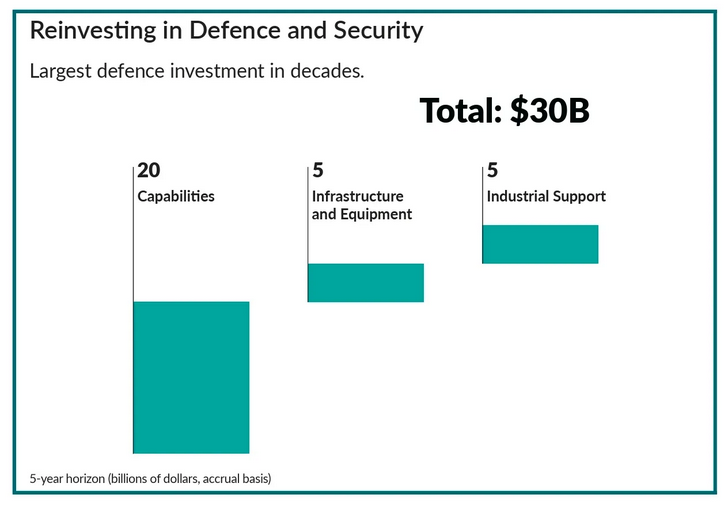
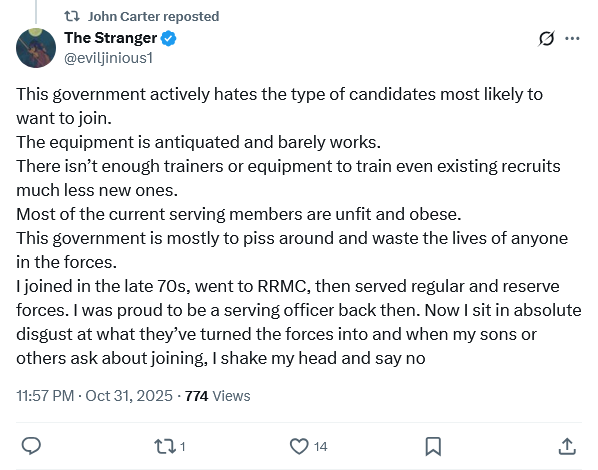
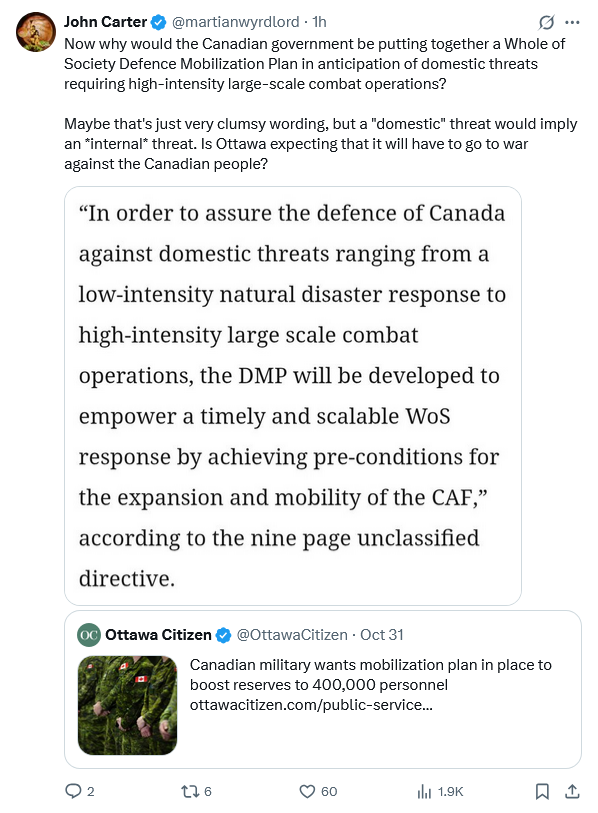
Noah has some faint praise for the new minister of National Defence and the new Secretary of State for Defence Procurement:
Welp it’s official. Bill Blair is out.
I cant say that it’s overly shocking. I don’t think anyone truly expected Blair to be MND by the end of today. While I will give Blair some credit for holding the fort, most of you already know I wasn’t his biggest fan.
He was a great placeholder who was able to smoothly roll out the plans left to him. He also did have several good public showings, such as his efforts in Korea last year. I will give credit where it is due.
However, he was also uninspiring, too passive in his role, and while I have no doubt he took it seriously, was never going to be a great long-term option. He had long overstayed his welcome […] Now he’s out completely from cabinet and in his place we have not one but two new ministers on the defence profile!
David McGuinty, best known for his eight-year stint as Chair of the National Security and Intelligence Committee has taken the reigns as the new Minister of National Defence While Kelowna MP and veteran Stephen Fuhr will take on a new role as Secretary of State for Defence Procurement.
In this role Fuhr will work under McGuinty specifically to tackle the file of Defence Procurement ahead of the establishment of the DPA. He is one of eight new secretaries of state that will operate on a “junior” level in cabinet.
Now McGuinty wouldn’t have been my first pick. I will openly admit that, but it is hard [not] to argue that he is the most prepared for the role, and likely the best we have available.
McGuinty previously held the NSICOP chair from 2017 all the way until December when he was appointed Minister of Public Safety. He has a background in International Development before becoming a parliamentarian, including stints with UNICEF.
He isn’t coming into this without a background on the current security climate we’re facing. He certainly can’t be said to be ill-prepared to take the role at a time when CAF and the DND are at one of their most pivotal moments in restructuring.
May 13, 2025
Checking on the parlous state of German democracy this week
First, Sabine Beppler-Spahl points out how difficult it was for the new ruling coalition to get their candidate for Chancellor actually installed:
The spectacle in the Bundestag this week sent shockwaves through Germany’s political establishment. For the first time in modern German history, a chancellor candidate – Christian Democratic Union (CDU) leader Friedrich Merz – failed to get elected by parliament. In the first round of voting, he received just 310 out of 621 votes – six votes short of the necessary majority. A total of 18 members of his own coalition brazenly refused to support him.
A second round of voting was then called and Merz managed to scrape through with 325 votes. But this was a stinging embarrassment for both Merz himself and the new coalition government more broadly. “Never before has there been a political car crash on such a scale”, wrote Berthold Kohler, editor of the conservative FAZ.
In hindsight, Merz’s failure shouldn’t have been such a surprise. From the beginning, the new government was always going to be in for a rough ride. For a start, it is made up of two parties that both received phenomenally bad results in February’s federal elections. The CDU suffered its second-worst result since its founding. Meanwhile, the CDU’s coalition partner, the Social Democrats (SPD), received its worst result ever.
Worse still, the coalition was losing even more support in the polls in the weeks running up to the chancellor vote. At times, the governing parties barely managed 40 per cent between them. Hermann Binkert, head of the INSA polling institute, described this as a “loss of approval like never before in the period between a federal election and the formation of a new government”.
Many commentators are now questioning whether Merz and his coalition will ever truly recover from this humiliation. The fiasco certainly confirms that Germany is in a deep political crisis, which isn’t going anywhere. It also undermines the smug assertions of Europe’s anti-populist establishment, which has been claiming, against all evidence to the contrary, that German politics is less prone to populist upheavals than those of other Western democracies.
Outside parliamentary machinations, the move to declare the largest opposition party to be a formal threat to German democracy isn’t going smoothly either:

The anti-AfD protest in Essen on Sunday, photographed carefully lest the viewer see how small it was.
On 2 May, the Federal Office for the Protection of the Constitution (BfV) yielded to intense pressure from their boss, Interior Minister Nancy Faeser, and declared Alternative für Deutschland to be a “confirmed right-wing extremist organisation“. The media filled with hit pieces and leftoids began a new round of shouting and morally hyperventilating about the evil fascist Nazi Hitler party. I thought we might be seeing the beginning of an earnest campaign to prohibit the AfD and that over the coming weeks the momentum would just build and build.
Instead it’s kind of fizzled out.
One thing that went wrong, was the roll-out. The AfD immediately filed suit with the Cologne Administrative Court to have their extremist status lifted, and the BfV ended up temporarily suspending their assessment for tactical reasons – above all, to avoid a temporary court injunction that the AfD could portray as a victory. I’ve said many times that a lot of the media pressure against the AfD seems to be coordinated by the constitutional protectors themselves. Now that they’re no longer agitating behind the scenes, the steady drumbeat of pearl-clutching news stories has ground to a halt.
The second thing that has gone wrong, is the publicity campaign. You may remember that the constitutional protectors have produced a 1,100-page assessment documenting the right-wing extremism of the AfD. This dossier, however, remains entirely secret, and so journalists have been leaking choice passages from its pages instead. Their leaks strongly suggest that this document is little more than a vast assemblage of public statements by AfD politicians and functionaries that people in the BfV find untoward.
First we had the three leaks in Welt, which I covered in my first post on this topic. These featured people saying such benign things as “There is more to being German than simply holding citizenship papers” and “Failed migration policy and asylum abuse have led to the importation of 100,000 people from deeply backward and misogynistic cultures”.
That did not impress anybody, so Der Spiegel rushed out a new round of leaks. This piece tells us, breathlessly, that “politicians from the party have been ‘continuously’ agitating against refugees and migrants”, that “they have made xenophobic and Islamophobic statements” and that they have an “ethnic-ancestral understanding” of human descent groups that “is not compatible with the free democratic basic order”. They particularly deplore the use of terms like “knife migrants” (“Messermigranten“) which “attribute an ‘ethnocultural propensity for violence to entire groups'”. They say that the party does not consider Germans “with a migrant background from Muslim-influenced countries” to be equal citizens and that the AfD thus “devalues entire population groups in Germany”, violating their human dignity.
May 12, 2025
QotD: The Gracchi
Tiberius and Gaius Gracchus’ tribunates – both of which ended with them being killed (I think it is perfectly fair to say “murdered”) – typically occupy a position in survey coverage of the Roman Republic as the inciting incident that begins (if not quite causes) the collapse of the Republic itself, the first outbreak of violence in Roman politics, the first escalation in a spiral that would lead to the repeated outbreak of civil war in the first century. And that is certainly how they were understood in antiquity; both Plutarch and Appian make this claim (App. BCiv. 1.17; Plut. Ti. Gracch. 20.1). And in part because the sources (again, Plutarch and Appian) frame the Gracchi quite positively and in part, to be frank, because their reforms are generally “left-coded” in a university environment that is inherently sympathetic to left-coded things, the Gracchi tend to come across to students as righteous reformers killed by foolish, hidebound and greedy reactionary Roman senators. And that is, to be fair, a potentially valid reading (if employed with some caveats).
But it is also generally the only reading students get and it is not the only valid reading of the evidence we have. So for this week, I want to complicate the Gracchi, presenting some of the details that often get left out of introductory surveys. In particular, we’re going to discuss the problems that Tiberius Gracchus’ key law, the Lex Sempronia Agraria was designed to solve and I am going to argue that Tiberius was attempting to solve a problem that didn’t exist (though he couldn’t have known it), a view which is now quite common in the scholarship but almost entirely absent in how we tend to teach the Gracchi.
But more to the point, I am going to argue that Tiberius and Gaius Gracchus’ behavior did, in fact, violate the norms of the Republic and that it was not entirely unreasonable for the senatorial elite to conclude these men, in their unrestrained and nakedly ambitious approach to politics, represented a real threat to the Roman political order and that they might be aiming for something approaching a “soft coup” in the context of a political order whose features – including the democratic ones – worked through an unwritten constitution of norms (what the Romans called the mos maiorum, “the customs of the ancestors”), which both brothers actively undermined. The claim that the Gracchi threatened to make themselves tyrants was not an empty claim and that is the dark reflection of their role as well intentioned reformers.
In short, then, if the only version of the Gracchi you have encountered is that of the near-saintly, then martyred proto-progressive reformers, that’s not quite the complete picture (and the left-coding of their ideas is decidedly anachronistic). Naturally, in trying to complicate this picture, I am essentially taking the position of prosecutor, so this “take” is going to be far more negative on the Gracchi than how I would, say, teach them in class or, indeed, how I regard them myself.
So the way we’re going to approach this problem is first to discuss the problem that Tiberius Gracchus thought he was addressing (and some of the issues there), before walking through the means he used to push forward the Lex Sempronia Agraria. Then I want to look at some of the wide-ranging laws proposed by Gaius Gracchus to assess the degree to which those laws cohere and ways we might understand his program and actions, potentially rather more negatively.
Bret Devereaux, “Collections: On the Gracchi, Part I: Tiberius Gracchus”, A Collection of Unmitigated Pedantry, 2025-01-17.
May 11, 2025
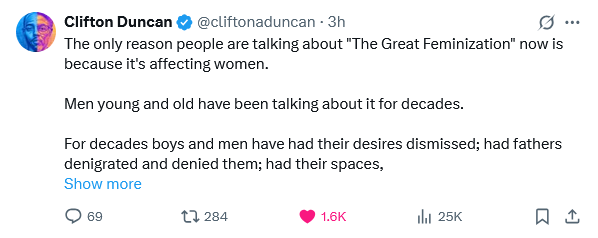
The devastating toll of Trump’s reckless plan to dismiss transgendered members of the armed forces
Chris Bray called this to our attention back in November, as President-elect Donald Trump foolishly planned to purge the US military of transgendered troops, regardless of the vast impact it was predicted to have on military readiness:
We’ll practically have no military left! It would be like a whole infantry division suddenly just vanishing: 15,000-plus transgendered service members.
You’re going to see this number a lot in the weeks ahead. The New Republic, today: “Donald Trump’s plan to ban transgender people from the military would have a devastating effect: At least 15,000 members would be forced to leave.”
That number comes from a 2018 report by the now-defunct Palm Center, a pro-LGBT independent research institute in California, which reached this conclusion: “Transgender troops make up 0.7% (seven-tenths of one percent) of the military (Active Component and Selected Reserve)”. Their best guess about a total number: 14,707. The media is just rounding that number up to the next thousand.
And … Chris Bray follows up on his November post, documenting the huge, unimaginable scale of long-term damage to US military preparedness:
As the new Trump administration prepared to issue an order forbidding transgender people to serve in the armed forces, a bunch of profoundly stupid news stories issued panicked warnings that military readiness would DEVASTATED by a giant purge of at least 15,000 transgender servicemembers, the very core of our military strength. Warplanes grounded! Ships trapped in port as all their trans sailors were tossed out! Whole artillery batteries sitting silent! […]
The removal of trans servicemembers would inflict such a ghastly crisis on the armed forces that it would take twenty years to recover our military strength! Destruction and ruin and crisis and collapse!
[…]
Now the removal of transgender troops is actually underway, and guess what?
The number is “up to” 1,000. It’s in the hundreds.
So. When — quite recently! — dozens of panicked news stories reported as fact that 15,000-plus transgender servicemembers were about to be purged, the news was frankly and nakedly a complete invention. They made it up. They sold an invented panic. The “news” was entirely fake.
Remember that, and apply that lesson widely.
Will Amtrak survive the DOGE treatment?
J.D. Wong outlines Amtrak’s never-ending financial difficulties:

“Amtrak” by Mike Knell is licensed under CC BY-SA 2.0 .
Founded 54 years ago, Amtrak set out on a bold adventure to see if passenger trains could be profitable. Fast forward to today, this experiment has been unsuccessful. Politicians have often crafted routes to win votes rather than attract riders. As a result, Amtrak has been squandering taxpayer money since its start in 1971.
Take, for instance, the Infrastructure Investment and Jobs Act of 2021. It allocated a monumental $66 billion to bolster passenger rail. Yet, even with this backing, Amtrak’s losses soared from $1.12 billion in FY2019 to $2.12 billion in FY2024. This financial drain isn’t new; America’s passenger trains have lost money for 79 years.
Amtrak asserts that it is “on-track to reach operational profitability”. Yet, this is a bald-faced lie. While Amtrak reported a loss of $705.2 million for FY2024, it didn’t include:
- $966.2 million in depreciation;
- $447.3 million in “Project Related Expenses”;
- $314.1 million in state subsidies, which it classified as “revenue”;
- $26.9 million in Office of Inspector General funding
By omitting these costs, Amtrak paints an optimistic view of its financial health. In reality, Amtrak needs larger subsidies than ever before. In fact, Amtrak has been deceiving Congress with its “path to profitability” since 1990.
Although Amtrak touted a “ridership record” for FY2024, this figure is misleading too. Ridership numbers don’t reflect the average length of each passenger’s trip. A more insightful metric is passenger-miles, which measures how far people are traveling. In fact, Amtrak only transported 6.54 billion passenger-miles in FY2024. This is a decrease of 3.40 percent since FY2013.
Amtrak often attributes its financial struggles to its long-haul routes. Yet, the outlook is even bleaker for its short-haul, state-supported routes. Amtrak reported a $251.5 million loss for these routes in FY2024. Yet, with $314.1 million in state subsidies included, the true loss hits $565.6 million. This represents a shocking 94 percent increase from the $291.7 million lost in FY2019.
Amtrak’s advocates often cite highway “subsidies” to explain its financial debacles. But Amtrak guzzles about 39 times more subsidies per passenger-mile than highways do.
Amtrak asserts that freight trains “interfere” with its passenger services. However, Amtrak often makes questionable route choices despite having legal priority over freight. Between Chicago and Los Angeles, the Desert Wind lost less money than the Southwest Chief. Despite this, Amtrak favored the Southwest Chief, which passed through more congressional districts. It discontinued the Desert Wind in 1997, leaving Las Vegas with no train service.
QotD: Corporate taxes
Many politicians, pundits and some economists would have us believe that corporations pay taxes, but do they? Economists distinguish between entities who ultimately bear the tax burden and those upon whom tax is initially levied. Just because a tax is levied on a corporation doesn’t mean that the corporation bears its burden. Faced with a tax, a corporation can shift the tax burden by raising its product prices, lowering dividends or laying off workers. The lesson here is that only people pay taxes, not legal fictions like corporations. Corporations are simply tax collectors for the government. Similarly, no one would fall for a politician telling a homeowner, “I’m not going to tax you; I’m going to tax your property”. I guarantee that it will be a person, not the property, writing out the check to the taxing authority. Again, only people pay taxes.
Walter E. Williams, “Economics Reality”, Townhall.com, 2020-02-04.
May 10, 2025
QotD: Undocumented America
In the Panopticon State, the Shadowlands are thriving: a state that presumes to tax and license Joe Schmoe for using the table in the corner of his basement as a home office apparently doesn’t spot the half-dozen additional dwellings that sprout in José Schmoe’s yard out on the edge of town. Do-it-yourself wiring stretches from bungalow to lean-to trailer to RV to rusting pick-up on bricks, as five, six, eight, twelve different housing units pitch up on one lot. The more Undocumented America secedes from the hyper-regulatory state, the more frenziedly Big Nanny documents you and yours.
This multicultural squeamishness is most instructive. Illegal immigrants are providing a model for survival in an impoverished statist America, and on the whole the state is happy to let them do so. In Undocumented America, the buildings have no building codes, the sales have no sales tax, your identity card gives no clue as to your real identity. In the years ahead, for many poor Overdocumented-Americans, living in the Shadowlands will offer if not the prospect of escape then at least temporary relief. As America loses its technological edge and the present Chinese cyber-probing gets disseminated to the Wikileaks types, the blips on the computer screen representing your checking and savings accounts will become more vulnerable. After yet another brutal attack, your local branch never reconnects to head office; it brings up from the vault the old First National Bank of Deadsville shingle and starts issuing fewer cards and more checkbooks. And then fewer checkbooks and more cash. In small bills.
The planet is dividing into two extremes: an advanced world — Europe, North America, Australia — in which privacy is vanishing and the state will soon be able to monitor you every second of the day; and a reprimitivizing world — Somalia, the Pakistani tribal lands — where no one has a clue what’s going on. Undocumented America is giving us a lesson in how Waziristan and CCTV London can inhabit the same real estate, like overlapping area codes. There will be many takers for that in the years ahead. As Documented America fails, poor whites, poor blacks, and many others will find it easier to assimilate with Undocumented America, and retreat into the shadows.
Mark Steyn, After America, 2011.