In Spiked, Fraser Myers says that British Prime Minister Keir Starmer fully deserves to be humiliated over his give-it-all-away negotiations for the Chagos Islands, which includes the strategic naval base at Diego Garcia:
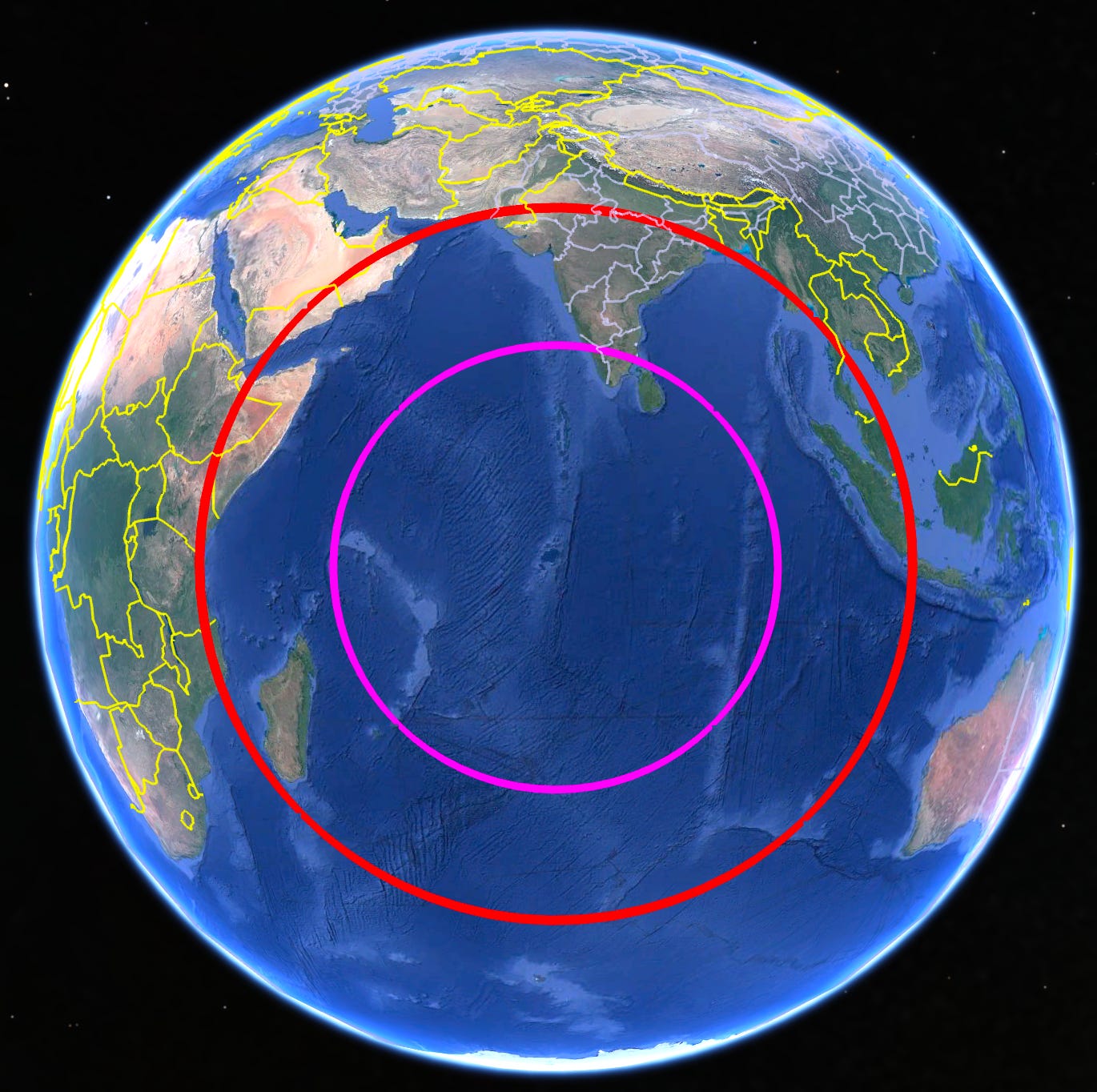
In the middle of that map is Diego Garcia, British Indian Ocean Territory and home to one of the most strategic airfields and anchorages on the planet. […] The red circle is 2,000 nautical miles from the island. The purple circle is 1,150 nautical miles, roughly the distance from London to Malta, that represents the distance from Diego Garcia. That circle is also the distance from Diego Garcia to the island of Mauritius.
Caption and image from CDR Salamander.
With the assistance of the brightest and best of the UK Foreign Office, the Labour government agreed to an arrangement that would hand over territory containing an Anglo-American military base to an unfriendly country, condemn its former inhabitants to permanent exile, and pay tens of billions of pounds for the pleasure.
I’m talking, of course, about Chagos (officially, the British Indian Ocean Territory), which has briefly caught the attention of the world’s most powerful man. This morning, amid a flurry of Truth Social posts about his designs on Greenland, US president Donald Trump’s gaze briefly alighted on this small, tropical archipelago on the other side of the planet. And he did not hold back in his criticism of Britain’s plans: “Shockingly, our ‘brilliant’ NATO Ally, the United Kingdom, is currently planning to give away the Island of Diego Garcia [the largest of the Chagos Islands], the site of a vital US Military Base, to Mauritius, and to do so FOR NO REASON WHATSOEVER”, he wrote. “The UK giving away extremely important land is an act of GREAT STUPIDITY”.
Trump’s reaction has widely been described as a major about-turn. But, in truth, his team has veered all over the place on the Chagos question. In October 2024, when Starmer initially agreed to hand over the islands, Marco Rubio, then still a US senator for Florida, reportedly warned that this would allow “Communist China” to spy on the US Navy, given Mauritius’s alliance with China. Yet in February 2025, when Starmer visited the Oval Office, the US president said he was “inclined to go along with” the UK’s proposals. And by May, when the deal was signed between the British and Mauritian governments, Rubio, by now US secretary of state, welcomed it. He claimed that Trump himself had “expressed his support for this monumental achievement”, hailing the deal that would cede sovereignty to Mauritius, while Diego Garcia would be leased to Britain for the next 99 years.
Of course, Trump’s motivation for bashing Starmer’s deal now has little to do with the Chagos Islands themselves. The real prize for the US president is in a different hemisphere entirely, as he freely admits. In a bizarre non-sequitur, the US president’s Truth Social post goes on to say that the Chagos deal is “another in a very long line of reasons why Greenland has to be acquired” by the US. This smackdown over Chagos, this attempt to humiliate Starmer and Britain on the global stage, is clearly part of Trump’s broader pressure campaign against the European powers, in his bid to seize Greenland for the US.
Nevertheless, it really should not have taken Trump’s intervention to put the brakes on the dreadful Chagos deal. Whichever way you spin it, this arrangement has never been in Britain’s national interest, nor the interests of the Chagossians who call the islands their home. It poses a risk to Western security interests, handing sovereignty over a territory, where almost 400 UK and US troops and 2,000 contractors are based, to a country that’s allied to China. The cost of leasing back Diego Garcia from Mauritius is also eye-watering. Although the Labour government tried to present the cost as just £3.4 billion, the true figure is believed to be 10 times as much, at around £34.7 billion.
So what on Earth possessed Starmer to sign up to such a risible deal? What leverage was a tiny island like Mauritius able to gain over Britain?