
Longtime readers will remember that we’ve actually already talked about “realism” as a school of international relations study before, in the context of our discussion of Europa Universalis. But let’s briefly start out with what we mean when we say IR realism (properly “neo-realism” in its modern form): this is not simply being “realistic” about international politics. “Realism” is amazing branding, but “realists” are not simply claiming that they are observing reality – they have a broader claim about how reality works.
Instead realism is the view that international politics is fundamentally structured by the fact that states seek to maximize their power, act more or less rationally to do so, and are unrestrained by customs or international law. Thus the classic Thucydidean formulation in its most simple terms, “the strong do what they will, the weak suffer what they must”,1 with the additional proviso that, this being the case, all states seek to be as strong as possible.
If you accept those premises, you can chart a fairly consistent analytical vision of interstate activity basically from first principles, describing all sorts of behavior – balancing, coercion, hegemony and so on – that ought to occur in such systems and which does occur in the real world. Naturally, theory being what it is, neo-realist theory (which is what we call the modern post-1979 version of this thinking) is split into its own sub-schools based on exactly how they imagine this all works out, with defensive realism (“states aim to survive”) and offensive realism (“states aim to maximize power”), but we needn’t get into the details.
So when someone says they are a “foreign policy realist”, assuming they know what they’re talking about, they’re not saying they have a realistic vision of international politics, but that they instead believe that the actions of states are governed mostly by the pursuit of power and security, which they pursue mostly rationally, without moral, customary or legal constraint. This is, I must stress, not the only theory of the case (and we’ll get into some limits in a second).
The first problem with IR Realists is that they run into a contradiction between realism as an analytical tool and realism as a set of normative behaviors. Put another way, IR realism runs the risk of conflating “states generally act this way”, with “states should generally act this way”. You can see that specific contradiction manifested grotesquely in John Mearsheimer’s career as of late, where his principle argument is that because a realist perspective suggests that Russia would attack Ukraine that Russia was right to do so and therefore, somehow, the United States should not contest this (despite it being in the United States’ power-maximizing interest to do so). Note the jump from the analytical statement (“Russia was always likely to do this”) to the normative statement (“Russia carries no guilt, this is NATO’s fault, we should not stop this”). The former, of course, can always be true without the latter being necessary.
I should note, this sort of “normative smuggling” in realism is not remotely new: it is exactly how the very first instances of realist political thought are framed. The first expressions of IR realism are in Thucydides, where the Athenians – first at Corinth and then at Melos – make realist arguments expressly to get other states to do something, namely to acquiesce to Athenian Empire. The arguments in both cases are explicitly normative, that Athens did not act “contrary to the common practice of mankind” (expressed in realist dog-eat-dog terms) and so in the first case shouldn’t be punished with war by Sparta and in the latter case, that the Melians should submit to Athenian rule. In both cases, the Athenians are smuggling in a normative statement about what a state should do (in the former case, seemingly against interest!) into a description of what states supposedly always do.
I should note that one of my persistent complaints against international relations study in political science in general is that political scientists often read Thucydides very shallowly, dipping in for the theory and out for the rest. But Thucydides’ reader would not have missed that it is always the Athenians who make the realist arguments and they lost both the arguments [AND] the war. When Thucydides has the Melians caution that the Athenians’ “realist” ruthlessness would mean “your fall would be a signal for the heaviest vengeance and an example for the world to meditate upon”2 the ancient Greek reader knows they are right, in a way that it often seems to me political science students seem to miss.
And there’s a logical contradiction inherent in this sort of normative smuggling, which is that the smuggling is even necessary at all. After all, if states are mostly rational and largely pursue their own interests, loudly insisting that they should do so seems a bit pointless, doesn’t it? Using realism as a way to describe the world or to predict the actions of other states is consistent with the logical system, but using it to persuade other states – or your own state – seems to defeat the purpose. If you believe realism is true, your state and every other is going to act to maximize its power, regardless of what you do or say. If they can do otherwise than there must be some significant space for institutions, customs, morals, norms or simple mistakes and suddenly the air-tight logical framework of realism begins to break down.
That latter vision gives rise to constructivism (“international relations are shaped by ideology and culture”) and IR liberalism (“international relations are also shaped by institutions, which can bend the system away from the endless conflict realism anticipates”). The great irony of realism is that to think that having more realists in power would cause a country to behave in a more realist way is inconsistent with neo-Realism which would suggest countries ought to behave in realist ways even in the absence of realist theory or thinkers.
In practice – and this is the punchline – in my experience most “realists”, intentionally or not, use realism as a cover for strong ideological convictions, typically convictions which are uncomfortable to utter in the highly educated spaces that foreign policy chatter tends to happen. Sometimes those convictions are fairly benign – it is not an accident that there’s a vocal subset of IR-realists with ties to the CATO Institute, for instance. They’re libertarians who think the foreign policy adventures that often flew under the banner of constructivist or liberal internationalist label – that’s where you’d find “spreading democracy will make the world more peaceful” – were really expensive and they really dislike taxes. But “we should just spend a lot less on foreign policy” is a tough sell in the foreign policy space; realism can provide a more intellectually sophisticated gloss to the idea. Sometimes those convictions are less benign; one can’t help but notice the realist pretensions of some figures in the orbit of the current administration have a whiff of authoritarianism or ethnocentrism in them, since a realist framework can be used to drain imperial exploitation and butchery of its moral component, rendering it “just states maximizing their power – and better to be exploiter than exploited”.
One question I find useful to ask of any foreign policy framework, but especially of self-claimed realist frameworks is, “what compromise, what tradeoff does this demand of you?” Strategy, after all, is the art of priorities and that means accepting some things you want are lower priority; in the case of realism which holds that states seek to maximize power, it may mean assigning a high priority to things you do not want the state to do at all but which maximize its power. A realism deserving of the name, in applied practice would be endlessly caveated: “I hate, this but …” “I don’t like this, but …” “I would want to do this, but …” If a neo-realist analysis leads only to comfortable conclusions that someone and their priorities were right everywhere all along, it is simply ideology, wearing realism as a mask. And that is, to be frank, the most common form, as far as I can tell.
That isn’t to say there is nothing to neo-realism or foreign policy realists. I think as an analytical and predict tool, realism is quite valuable. States very often do behave in the way realist theory would suggest they ought, they just don’t always do so and it turns out norms and expectations matter a lot. Not the least of which because, as we’ve noted before, the economic model on which realist and neo-realist thinking was predicted basically no longer exists. To return to the current Ukraine War: is Putin really behaving rationally in a power-maximizing mode by putting his army to the torch capturing burned out Ukrainian farmland one centimeter at a time and no faster? It sure seems like Russian power has been reduced rather than enhanced by this move, even though realists will insist that Russia’s effort to dominate states near it is rational power-maximizing under offensive realism.
Bret Devereaux, “Fireside Friday, June 27, 2025 (On the Limits of Realism)”, A Collection of Unmitigated Pedantry, 2025-06-27.
- Thuc. 5.89.
- Thuc. 5.90.
January 11, 2026
QotD: The limits of foreign policy realism
January 9, 2026
Instead of “regime change” … “regime decapitation”
At Postcards from Barsoom, John Carter considers the startling return of military competence and the ongoing echoes of the decapitating attack on Venezuela:
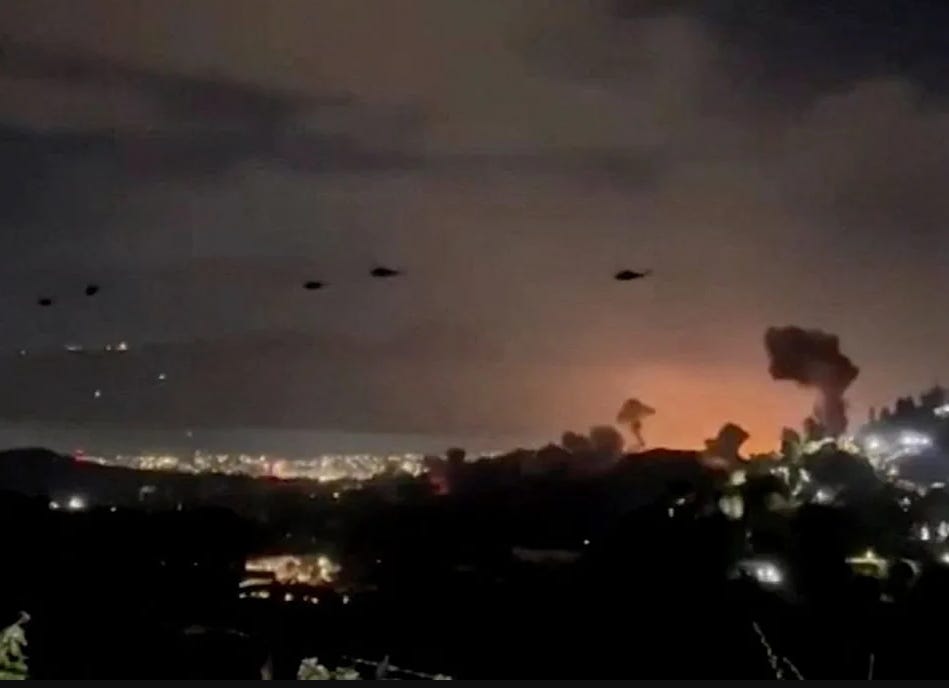
Photo from Postcards from Barsoom
In the age of simulations and simulacra, every action is also a symbol. Within the hyperreality of discourse the semiotic content of a public event is primary to its physical, political, or economic import. This is true of war as much as anything else; war in this age takes place first and foremost in the psychic realm, at the level of meaning, of hermeneusis. Warfare is psychological, not only in the sense of bolstering morale or breaking the will of the enemy to fight, but in the more fundamental sense of affecting the minds of those caught up in its spectacle by inserting new ideas that change the way that they think. This is most effective, as any magician or hypnotist or marketing executive will tell you, when those effects are left implicit, that they might operate directly upon the collective subconscious, in the shadow realm of instinct and intuition from which all political impulse springs.
With that in mind we might ask, in the spirit of an augur inquiring after the flight of a dove at daybreak, a circling hawk at high noon, or the cold gaze of a crow in the gloaming, what is the meaning of the Caracas raid? We do not need to assume that the meaning we look for in this action is intentional, though we should not rule this out, either; what matters is how the act will manifest symbolically, how it will be interpreted in the minds of onlookers, which it will do regardless of intention.
The superficial import of the action is clear enough. America has seized control of Venezuela’s vast oil reserves, the largest in the world, and at a stroke applies crippling pressure to the economies of China, Iran, and Cuba (who were Venezuela’s best grey-market customers), as well as to the economies of its adversary Russia and its wayward sibling Canada (both of which depend for their prosperity upon high oil prices). Both China and Russia have been deprived of a key New World ally, and thus the Monroe Doctrine is reasserted, and foreign powers pushed out of Washington’s sphere of influence. A hostile communist government has been decapitated, opening the way for the millions of Venezuelans displaced by Bolivarian tyranny, refugees whose presence has destabilized Venezuela’s neighbours for many years now, to return home.
To be sure, there is still great uncertainty. Hugo Chavez’ tomb may have been destroyed, but his Bolivarian regime is still largely intact, his apparatchicks remain in control of Venezuela’s state apparatus and military, and his terrorist colectivos still control the streets of Caracas.
Trump’s declaration that America now owns Venezuela’s oil feels a bit premature. Can one really claim control, without boots on the ground? I confess that it is not at all clear to me exactly how this is all supposed to work. Perhaps it is meant to function through pure intimidation: whoever ends up assuming power in Venezuela, they will know that if they don’t do as they’re told, they might be next, and perhaps will not be given the grace of an arrest and a show trial but simply executed without warning by drone; meanwhile, America offers itself as the sole legitimate customer for Venezuela’s sole marketable product, while providing its oil industry engineers to rebuild (and assume control of) infrastructure fallen into disrepair following Chavez’ nationalization and subsequent decades of neglect and mismanagement. Trump holds out one hand in an offer of assistance and mutual benefit, while holding back his other curled in a mailed fist, a threat made plausible by the fact that he just punched them hard in the mouth.
Still, all of this is nothing more than realpolitik, the hard edges of power in the material world.
The real meaning, the symbolic importance, lies deeper. It is not measured in dollars or barrels of oil. It is a message.
So what is that message?
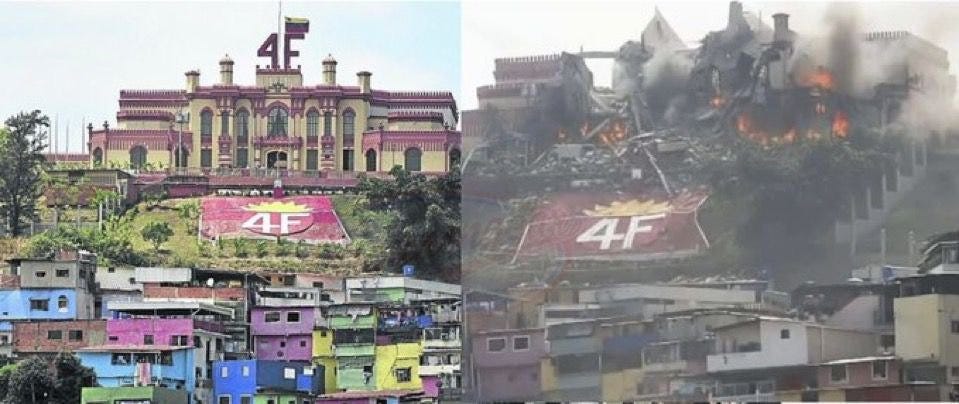
And some of the recipients of that message should be paying especially close attention:
Mass third world invasion is a choice. Economic sabotage in the name of preventing the weather from changing is a choice. Ruining the lives of young men with DEI is a choice. Blackwashing our history and mythology is a choice. Predatory taxation is a choice. Overregulation is a choice. Brainwashing the young to hate themselves is a choice. Yasslighting the young women into choosing girlbossery over family is a choice. Sacrificing the lives of the young to the fears of the old during the COVID lockdowns was a choice.
Allowing the incompetent to run things in the name of ‘social justice’ is a choice, and the contrast between the litany of inept fumbles that has resulted in and the smooth professionalism on display in the Caracasian raid has thrown the consequences of that choice – and the consequences of its alternative – into sharp relief.
And all we have to do to reverse the decline is decapitate the beast, put the right men in charge, and everything will follow naturally from there. Nature will begin to heal, as surely as Yellowstone’s ecology repaired itself once wolves were returned to their rightful place at the predatory apex.
That is why leaders across the Western world are squealing so loudly.
Canadian liberals, for example, are not actually worried that a Delta Force team will rappel down from an MH-47G Chinook Special Operations Helicopter to blackbag Prime Minister Mark Carney from 24 Sussex Drive, Ottawa, Ontario, K1M 1M4, and not only because the inadequate security of the traditional prime minister’s domicile has motivated Carney to instead take up residence at Rideau Cottage, 1 Sussex Drive, where he is usually home by 9 pm with his wife Diana. The concern is much more general: that the beleaguered Canadian people, along with those of the rest of the rotting West, will look at the remarkable results obtained by regime decapitation in the United States, and start getting ideas.
Want to fix the United Kingdom, and make Great Britain again? Sweep the traitors of the Labour Party out of Parliament, remove that pusillanimous android Two-Tier Queer from power, put Nigel Farage and 300 Reform MPs in their place, and watch as they invoke the doctrine of parliamentary supremacy to cast off three decades of Blairite Fabianism in a Great Repeal Act that frees the British state to remigrate the foreign invaders, rebuild the country’s industry, and revive the British military.
Want to fix Europe? Cast down the old women in Brussels – they have no popular legitimacy in any case – and remove their creatures, like Macron or Merz, who keep their peoples yoked to the suicidal EUrocracy. Raise up nationalists in their place – Le Pen, the AfD – and watch as Europe’s natural creative genius and martial spirit reasserts itself. No more Net Zero incapacitating industry, no more European Court of Human Rights preventing invaders from being remigrated, no more Digital Services Act censoring the Internet, no more micromanagerial bureaucratic overregulation strangling the economy.

Mark Carney’s play-acting on the international stage
There is no way that Canada can make itself economically independent of the United States, no matter how much wishcasting power is exerted to persuade anti-American boomers who habitually vote Liberal. Our entire economy is oriented to serve the vast market to our south, and we’ve been freeloading on our own military because the Americans have been willing to take up the slack and — until recently — not castigate our leaders for their fecklessness. It was bad under Justin Trudeau, but it’s actually gotten worse under Mark Carney’s leadership. Trudeau was performative and loved to play to the world media, but Carney seems to actually believe that he can reverse the entire direction of the Canadian economy by jetting around the world and bad-talking Donald Trump. The Canadian economy has been stalled for ten years now, and if Trump finally loses patience with our idiotic elites, it’ll go into free-fall.
On the social media site formerly known as Twitter, James E. Thorne points out just how few cards Carney actually has in his hand:
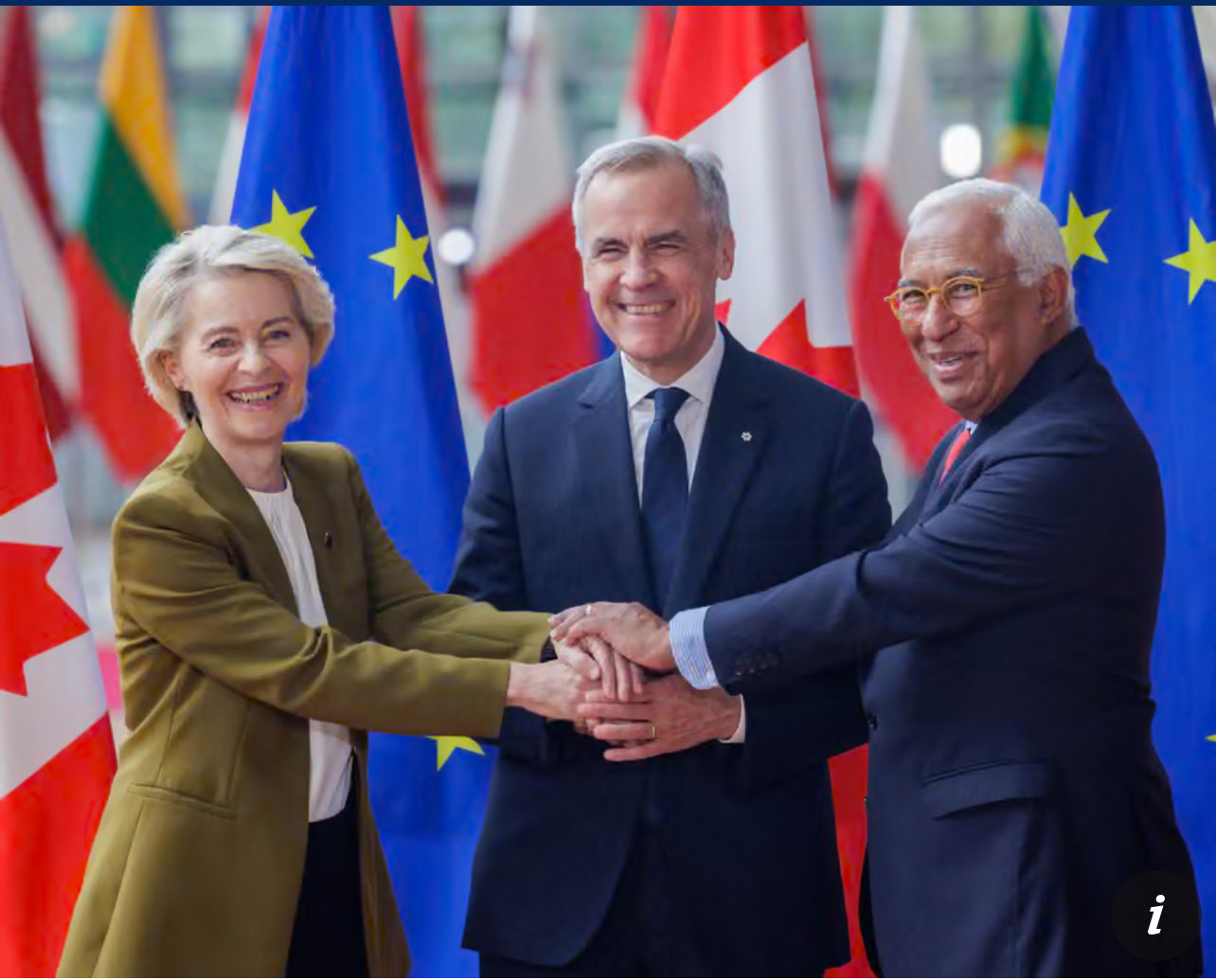
Mark Carney’s and Canada’s Dangerous Refusal to Face Reality.
Mark Carney and most Canadians are behaving as if Canada is an independent pole in a multipolar order, when the world he actually inhabits is a hierarchy being brutally clarified by Washington. Trump’s revamped National Security Strategy and the “Trump Corollary” — asserted through the seizure of Nicolás Maduro and open threats toward Cuba and Colombia, make plain that the United States now treats the Western Hemisphere as an American security estate, not a debating society among equals.
In that framework, Canada is not a co-author of the rules. It is a dependency inside the U.S. sphere, structurally lashed to American markets, finance and supply chains. AND after decades without a serious sovereign industrial or energy strategy, Canada is at best a weak Middle Power, that has for decades squandered its competitive advantage through proformative politics and virtue signalling.
In this era, the Western Hemisphere is now a “secure production platform” for American industry and technology, defined not by territorial control but by ownership, access and compliance. The Trump doctrine logic is clear and blunt yet internally coherent: if the Western Hemispheres natural resources and supply chains are secured, the economic and geopolitical dividends will follow.
Carney’s answer to the Trump Doctrine, however, remains the same “City-of-London” orthodoxy that produced him: more proformative political grandstanding, more process, more declarations, more meetings, and more boondoggles.
The Greenland consulate, rhetorical red lines over annexation, the flying around the world, and ritual protests against U.S. action in Venezuela all presume that we still live in the post WWII rules based order. We do not! Will live in the era of the Trump Doctrine, and no we can’t wait it out. And in this era, Greenland will not be allowed to be under the influence of Russia or China.
Thucydides warned that “the strong do what they can and the weak suffer what they must”. Carney’s tragedy is that he quotes the rules-based order while presiding over a country whose economic structure is colonial and whose security ultimately depends on the very power he is theatrically chastising. Posturing without power is not prudence. It is provocation without a plan. And yes it’s dangerous.
The irony is that Carney understands all of this perfectly well, which only sharpens the question: what, exactly, is he doing by posturing as a rules-based equal in a hierarchy where he knows Canada lacks the hard power to back his stance?
January 8, 2026
Minnesota in the news
Like most people, I don’t normally pay much attention to news from Minnesota unless it involves my favourite NFL team. Thus far, thank goodness, the Vikings seem to have avoided being entangled in the latest scandals, starting with YouTuber Nick Shirley’s exposé of blatant fraud in daycare centres in and around Minneapolis that triggered Governor Tim Walz to end his re-election campaign. On the social media site formerly known as Twitter, Andrew Neil summarizes the situation so far:
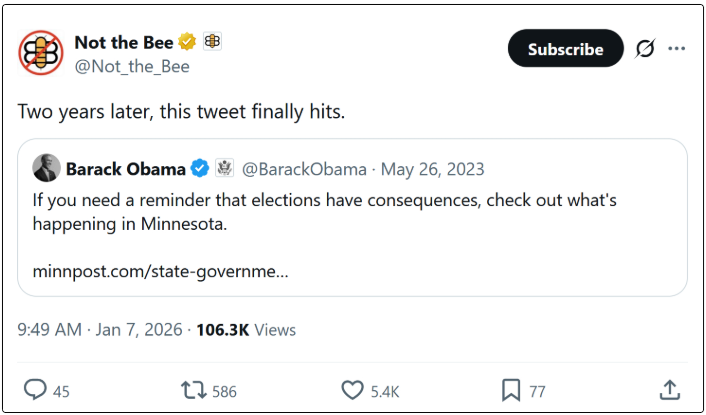
The usual suspects have been claiming on X that the Minnesota fraud scandal is no big deal and that it was racist to place Somalis at the centre of it. They lie. Some facts:
The fraud scandals in Minnesota are a very big deal, involving (so far) the theft of over $1 billion in taxpayer funds across multiple schemes, primarily from federal and state programmes meant for child nutrition, autism services and daycares during and after the COVID-19 pandemic.
Federal prosecutors have already charged almost 100 people. Dozens convicted or pleading guilty. Investigators suggest the total could exceed $9 billion in fraudulent claims.
It is already the largest pandemic-related fraud case in US history, with money siphoned off for personal luxuries like expensive cars and real estate, rather than the intended recipients — like low-income children.
The majority of those charged (around 85 out of 98 defendants in the core cases) are Somali-American. Why? Because the fraud often involved networks of Somali-owned “nonprofits” and businesses inflating claims or billing for nonexistent services.
Governor Tim Walz labeled the scandal being inflamed by “white supremacy” In fact, systemic fraud was enabled by his state’s lax controls. Walz now so discredited he won’t run for Governor again. His political career is over. How this bozo ever passed Kamala Harris’ vetting procedures to be her running mate is a mystery.
At PJ Media, Matt Margolis discusses the latest Nick Shirley video release:
Shirley’s new video dials things up to 11.
David Hoch, co-founder of Minnesotans for Responsible Government, joined him on the ground in Minneapolis, revealing an insane truth: this fraud hits hundreds of billions nationwide. Minnesota’s slice? At least $80 billion. Layers of shell companies obscure the cash trail, including 1,200 medical transport outfits in the area that do nothing while collecting taxpayer dollars.
Hoch swears by his evidence. “I have been to many of these transportation companies, and I’ve been time-stamping my photographs for a whole year at one facility in Minneapolis, and those vans in that parking lot had not moved one inch in an entire year. They’re all still sitting there.”
Hoch also revealed a widespread ballot-harvesting operation tied to Somali communities in Minnesota, claiming the scale of the activity is “way beyond anybody’s imagination,” adding that “the state doesn’t even know” and “the feds don’t even know”.
Shirley asked Hoch why a judge would allegedly defer to what he described as the “head of the Somali mafia”. Hoch responded that the influence stems from raw political power. He described the Somali community as a unified voting bloc that has effectively held Minnesota Democrats hostage. “What they say is if you do something to go against our community, we’re gonna vote for, and they all vote together, and there’s ballot harvesting, I’ve seen them do it, that, ‘We’re gonna vote for your opponent, unless you do what we tell you to do’.”
“And so it’s all purely for votes?” Shirley asked.
“Yes,” Hoch replied.
The conversation then turned to Cedar Riverside, a massive apartment complex in Minneapolis. Hoch said it was just one of many similar developments. “You’ve got 20 more just like this around the Twin Cities, and they’re all Somali,” he said. Hoch estimated “probably 100,000 or more people,” claiming they live rent-free and receive taxpayer-funded benefits. “They’re driving a vehicle that you paid for. They’re eating food that you paid for. Everything they do is, is something that you paid for,” he said.
Hoch also described how he claims the voting process works within the bloc. He alleged that a single individual collects ballots for large numbers of residents, with little oversight. “They’ll have one person go there and collect all the ballots and nobody tracks,” Hoch said. He added that apartments can claim inflated numbers of residents: “They could say they have nine people living in an apartment. They’re gonna send them nine ballots,” which are then gathered by a designated collector.
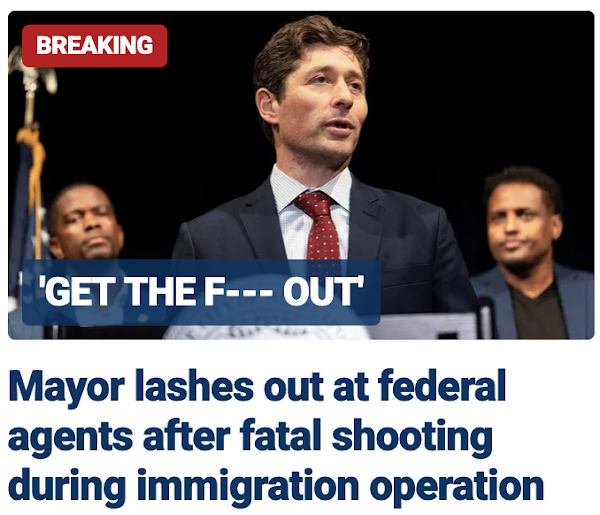
Later on Wednesday, an altercation between organized protesters and law enforcement resulted in the death of a woman after she tried to run down an ICE agent, who shot her in self-defence. The mayor of Minneapolis (Mogadishuapolis?) responded as you might expect:
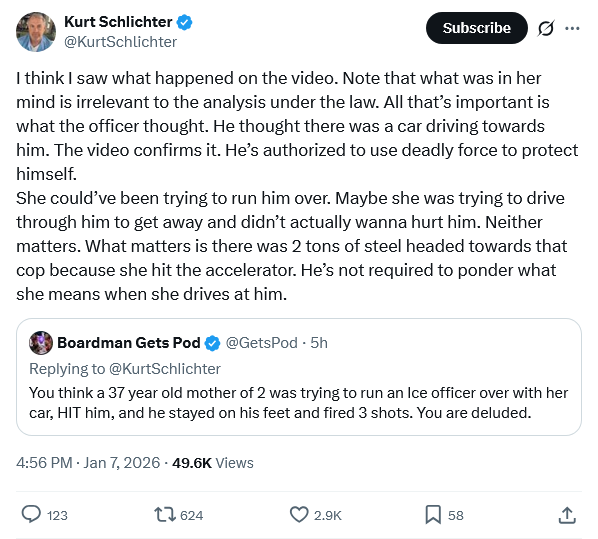
The debate over this incident breaks down on the usual partisan lines. On the social media site formerly known as Twitter, Kurt Schlichter summarizes the pro-law enforcement position:
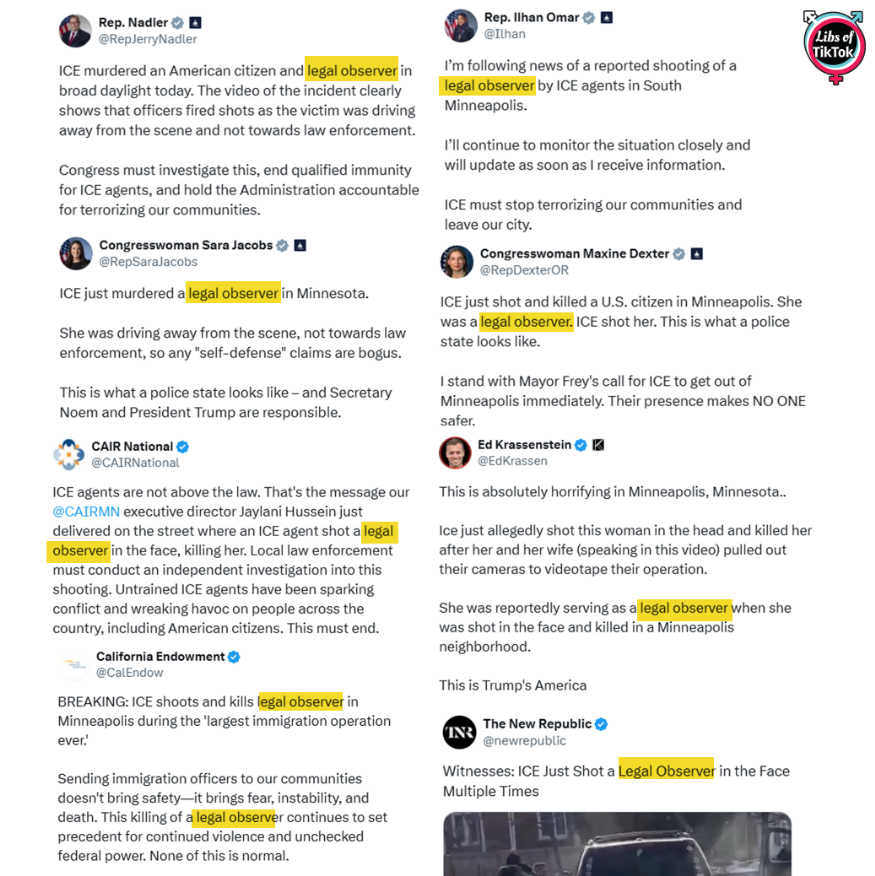
On the other hand, it’s the lockstep belief of the anti-Trump politicians and activists that the agent shot a “legal observer” in the performance of her peaceful, completely legal duties:
“Kidnapping the head of a sovereign state with whom you are not at war is also nuts”
On the social media site formerly known as Twitter, David Knight Legg responds to an Andrew Coyne post on the legality of the US operation to capture Nicolás Maduro in Venezuela:
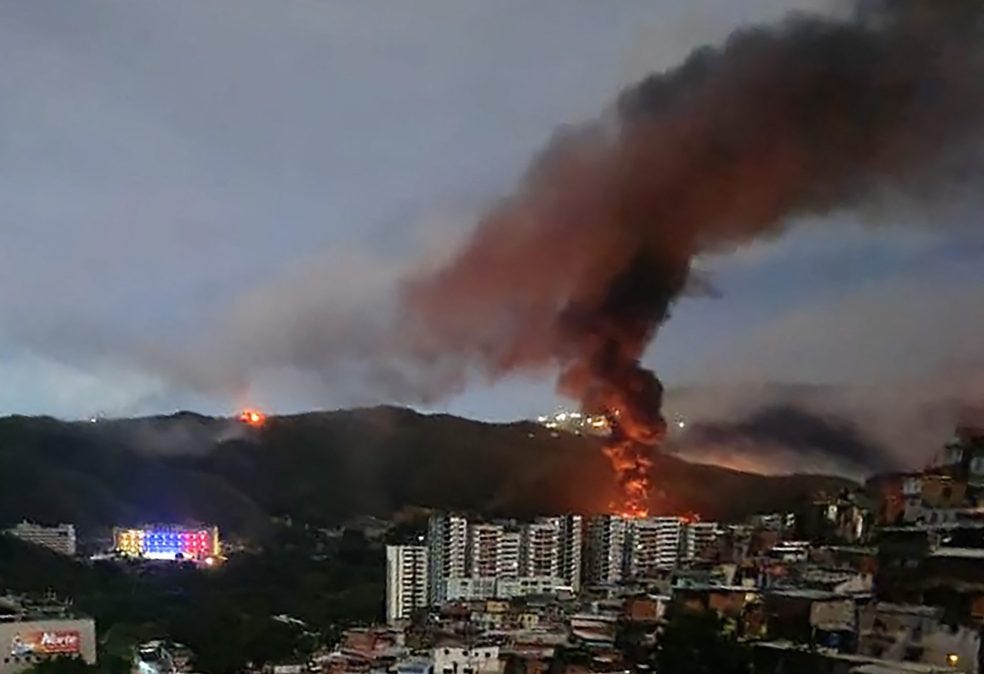
Image from CDR Salamander
Andrew Coyne @acoyne
Kidnapping the head of a sovereign state with whom you are not at war is also nuts, Jason. The two go together.Andrew @acoyne this isn’t accurate.
– Maduro was definitively not the elected President of Vanzuela. He was rejected as such by 50 nations incl the EU in 2024. He was a known narco-terrorist and cartel leader that used state capture and the army to run and enforce his drug and sanctions evasion empire.
– Biden put a $25million bounty on his head Jan 2025 for crimes against humanity and the USA cocaine trade, because destroying his nation for a decade, he fraudulently took power in 2024 and committed atrocities against his opponents after losing in a landslide so he could keep using state capture to run Venezuela — with the aid of terror groups and China Russia and Iran who protected him there and at the UN in exchange for oil, gold and a western hemisphere base of operations.
He was taken by the US to face trial just like Noriega in 1990 (on almost identical charges).
It may not suit your politics but bringing him to justice any other way had proven implausible. This is all well known.
Venezuelans around the world are celebrating wildly after two decades of socialist ruin and the worst humanitarian crisis in the western hemisphere creating 8 million refugees.
Honest question: what would you have done instead?
– status quo? let him stay in power with the help of Russia, Iran and China while actively torturing and murdering his opposition?
– more legal proceduralism at a UN Security Council where Russia and China protect him?
– bureaucratic inertia: letting people die and regional security deteriorate under the protection of another strongly worded reminder to abide by international law and stop the narco terrorism and atrocities?
There aren’t easy answers. It’s going to take a lot of work for Venezuela to come back from a deeply embedded Baathist-style state capture, but this is a critical first step for that nation.
If this is actually about Trump instead of the outcome, would you feel the same way if Biden instead of Trump had executed the same strategy to follow his bounty on Maduro?
The demise of Maduro is such an obviously good thing in so many ways it baffles me to see the debate revert to (often inaccurate) readings of legal minutiae with the underlying idea that it was better for him to be left in place …
A few days back, Daniel McCarthy suggested that the Venezuela operation reveals useful information on the “Don-roe Doctrine”:
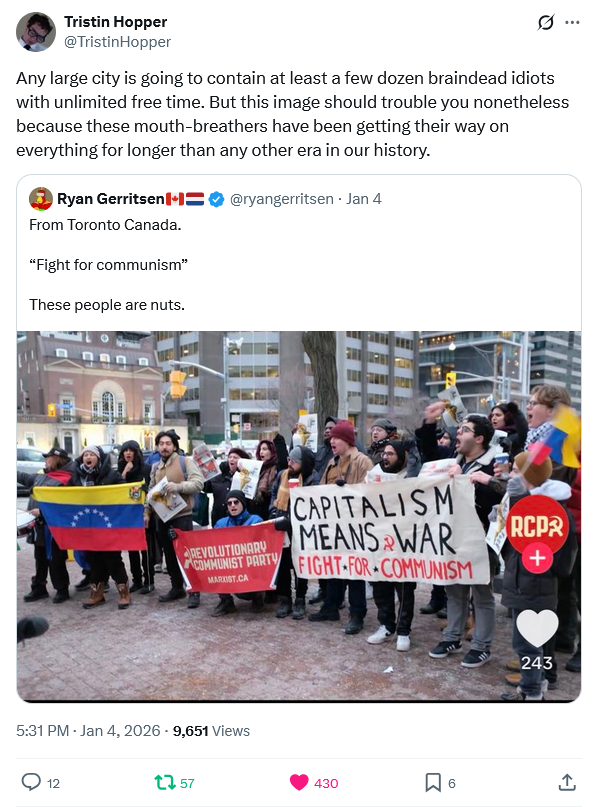
A small detachment of Canadian “semi-professional leftist protesters” swapped out their Palestinian flags for this photo op.
President Trump is a wager of “un-war”, which confounds his critics and some of his supporters alike. The capture of Venezuelan leader Nicolás Maduro over the weekend is a case in point. The usual semi-professional leftist protesters are hitting the streets of Europe and a few American cities to decry America’s latest war – but what kind of war lasts just two-and-a-half hours?
US troops didn’t invade en masse. A handful of special forces were dropped in, they killed el presidente‘s guards, nabbed their man and got out. Whatever one thinks about the justice of the whole thing, calling it a “war” is ridiculous. If that’s what this was, then Jimmy Carter waged a war with Iran in 1979 when he launched a doomed military mission to rescue US hostages. And the US must have been at war with Pakistan in 2011 when special forces raided Abbottabad and killed Osama bin Laden.
Critics of US foreign policy have long mocked the tendency of neoconservative hawks to frame every foreign tension as a replay of 1939. Such mockery is well deserved. Yet many of the same people who perceive the idiocy of treating every dictator as a new Adolf Hitler treat every US intervention, however small or brief, as a new Iraq War. Whatever else the Venezuelan operation might be, it isn’t that.
In fact, what Trump did in Venezuela isn’t even really “regime change”: the socialist regime that began under Hugo Chávez is still in power, only with a more pliable successor to Maduro now in charge. Former vice-president and now acting leader Delcy Rodríguez, despite initial remarks condemning the US action (and who would expect her to say anything different?), appears to be willing to de-escalate and cooperate with Washington. Trump’s own record, such as his intervention last summer in the Iran-Israel war, suggests he will want to de-escalate as well. He’s now made his point.
That doesn’t mean the situation isn’t perilous, of course. This may not be a war. There’s no ongoing fighting and Venezuela has continuity of government, albeit not the same president as a week ago. But even if Rodríguez and Trump both want a thaw in US-Venezuela relations, there are a multitude of scenarios that could lead to disaster. Hardliners or malcontents within the Venezuelan regime could stage a coup against Rodríguez. Or a popular revolt, with perfect justice on its side, could lead to bloody confrontations between the government and people. Trump seems to be inclined to minimise those risks by not pushing for speedy democratisation and liberalisation, but there may be some in his administration with less patience and more idealism.
January 7, 2026
“All of that operational brilliance was always there; it persisted through the Stupid Era”
I missed this Chris Bray piece when it was published a few days ago, but it’s still fully relevant. In it, he discusses the contrast between the faltering and visibly failing military operations like Operation Craven Bugout, sorry, I mean “Operation Allies Refuge”, in 2021 as the US and allied forces abandoned the Afghanistan mission leaving behind billions in military equipment and untold numbers of pro-western Afghans to the “mercy” of the Taliban and the recent brilliant military success in Venezuela:
For years, I’ve been shouting two related messages. First, “we’re in a contest of persistence between elite cosplayers and low-status producers”. Institutions that advance leaders on the basis of their ability to engage in au courant symbol-chanting are crushing the people in those institutions who do the work, and therefore hollowing out the institutions. Second, and so closely related you could just call it the same point in different words, “We’re healthy from the bottom up, and sick from the top down”. The “making stuff” people are mostly just fine; the “running stuff” people are mostly insane.
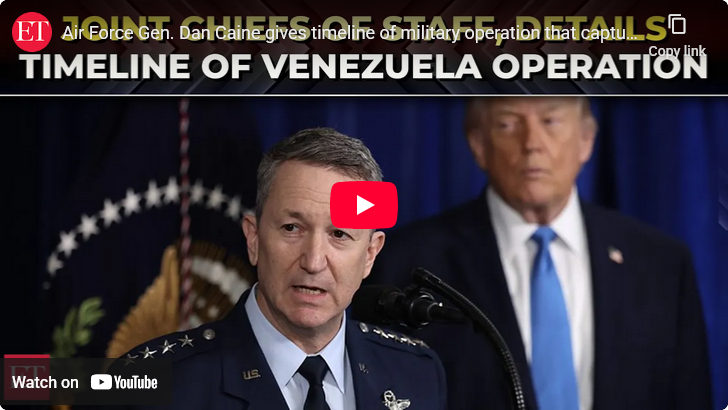
After years of dismal military failures, like the bafflingly inept withdrawal from Afghanistan after twenty years of ineffective warfare against the Taliban, the raid that captured Nicolás Maduro was operationally brilliant. It required perfection from everyone in a giant list of moving parts, executing a detailed plan with absolute precision. If you haven’t watched the briefing from Chairman of the Joint Chiefs of Staff Dan Caine, who was ritually denounced by the idiot media and the Democratic Party as an unqualified choice for the job, take some time to watch at least some of it. You aren’t used to seeing competence and clarity from an American institutional leader, so it’ll bring back some parts of your consciousness that may have gone to sleep for a while.
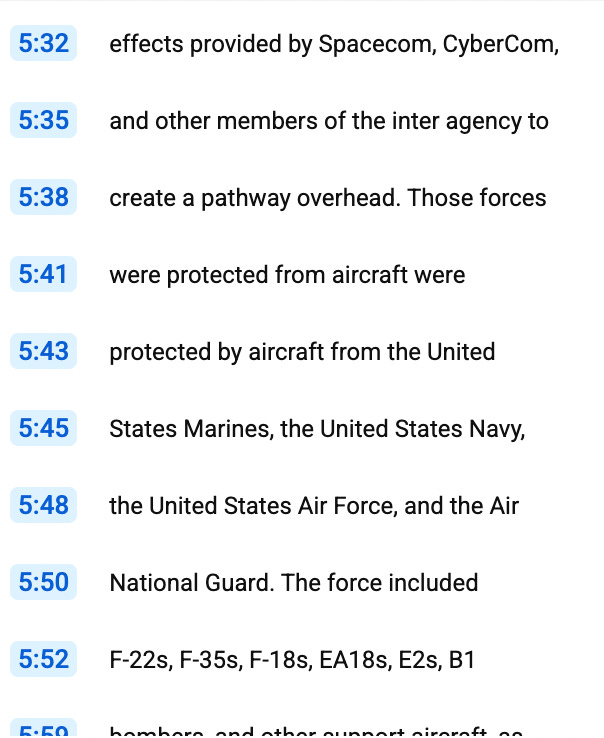
With 150 aircraft in the air, launching from something close to two dozen points of origin, every asset arrived in place and on time, while the lights went out below them. From the transcript:
The “pathway overhead” was that the US military switched off the Venezuelan military. They pressed the off switch on another nation’s command, control, and communications systems. Venezuela spent 2025 posturing at the US Navy, displaying their power as a warning against American aggression:
Similarly, “Experts had warned that Venezuela’s layered air-defence network could complicate US air operations”. Apparently not. At the designated moment, it all just went away.
I’ve talked for years about “recipe knowledge”, about the ability to know the steps that will produce a desired outcome. If I want to produce X result, I have to perform steps A, B, C, D, E, and F, in that order. If I skip Step C, Result X doesn’t occur, even though I’ve performed all the other steps.
We’ve just watched a military that apparently lacked the recipe knowledge to destroy the Taliban, or even to withdraw from a failed war in an orderly fashion and without leaving a bunch of weapons behind, demonstrate a shockingly high level of recipe knowledge. A failing institution isn’t a failing institution. Brilliant planning, flawless execution, ruthless competence.
There’s no way in hell that a single year of top-down intervention reversed years of hard decline. All of that operational brilliance was always there. It persisted through the Stupid Era.


On Substack Notes, John Carter commented on the article:
This, right here, is the meta-message of the Venezuelan raid. Competence collapse isn’t a purely military pathology, nor is it solely an American affliction. It applies to every institution in every Western country. We’ve been living with the frustrations and humiliations of this imposed decline for decades now.
With one decisive act, Trump has demonstrated that decline is a choice made by a small, false elite – and that if that elite is removed, decline can be reversed.
Removing the elite is the fix-everything switch in the presidency, the US military, and the Venezuelan government.
And now the whole world sees it.
A related post from ESR on the social media site formerly known as Twitter explores one of the more geographically distant ramifications of the US operation in Venezuela:
The Watcher On The Web @WatcherontheWeb
“ThIs Is GoInG tO cAuSe ChInA tO aTtAcK tAiWaN”
Yes retard, the country that just got shown all it’s calculations based on weapons systems which depended on being able to use RADARS to engage US aircraft/ships are essentially worthless and billions of dollars in investment and research have been wasted is going to feel VERY brave in launching an assault against a fortified island nation armed with US weapons, US fighters, backed up by the US navy and Japanese defense force …
I’m sure they are just giddy with excitement to try and pull that off. Practically chomping at the bit
This is an extremely important point that I’ve been thinking about ever since we got an unexpected audit of Venezuela’s air defenses. Russian SAM-300s and BUKs, Chinese anti-air radar, all proved completely worthless against U.S. gear and operators.
I guarantee you that if you are a Chinese military planner contemplating how to get an invasion army across 100 miles of the Straits of Taiwan, you are shitting your pants right about now. Because you have just learned that if you had tried to bust that move yesterday, your nice shiny new invasion fleet would have gotten absolutely gacked by U.S. airpower and missiles that you wouldn’t see coming BECAUSE YOUR FUCKING RADARS DON’T FUCKING WORK.
Also, the Soviet anti-air missile designs you cloned turn out to be about as useful as so many busted shopping carts.
Some of your guys are going to be saying “That’s impossible. The fix must have been in. Air defense must have had orders not to engage.” Which is an extremely cheering thought, but …
… isn’t that what the Americans would want you to believe? The only thing better than having complete technological dominance of an adversary is having complete technological dominance of an adversary who’s been conned into believing it isn’t true and walks blithely into getting utterly wrecked by it.
Yep. Before this went down I was figuring a very high probability that the Chinese make their move on Taiwan in 2027. Now? I guarantee you that their confidence in their previous risk assessments has evaporated. They no longer know what they’ll be facing, and there’s a significant possibility that mainland China’s domestic air defenses are worthless too.
Now I’m going to suggest that you juxtapose two phrases: “thermobaric bombs” and “Three Gorges Dam”. A China that’s naked from the air has the biggest glass jaw in human history.
Now I think there’s pretty good odds that the invasion of Taiwan will never happen at all.
Update, 8 January: Welcome, Instapundit readers! Please do have a look around at some of my other posts you may find of interest. I send out a daily summary of posts here through my Substack – https://substack.com/@nicholasrusson that you can subscribe to if you’d like to be informed of new posts in the future.
January 6, 2026
The “developing world” is not poor because the “rich countries” looted them
On the social media site formerly known as Twitter, Lauren Chen reacts to an emotive claim that the Third World is poor only because of the exploitation of their resources by the First World:
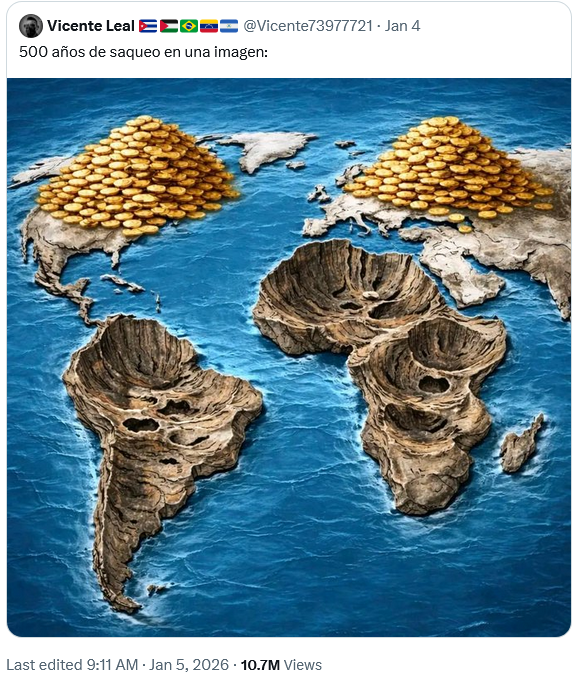
People often say that the developing world is poor because the Western world colonized them and stole their resources.
The truth, however, is that over the past century, the developing world has, for the most part, shown that they are completely incapable of harnessing their own resources. They are not poor because we stole from them. They are poor because they do not know how to run and administer their own countries, resources be damned.
Take Venezuela. The world’s largest oil reserves mean nothing if you have a corrupt communist as your leader. People will actually be starving and trying to eat zoo animals while you sit on trillions of dollars in resources!
Africa is another example. Europeans left behind farmland, trains, roads, and mines in Africa. What happened to it all?
It’s not that all of a sudden, the Africans started running things like anti-colonialist activists had envisioned at the time. No, no.
All the infrastructure fell into disrepair and/or was stripped down and looted. They were literally handed fully functioning, completed supply chains for resource extraction, and basically unlimited wealth, but they couldn’t manage the simple upkeep.
Now, the defense for Africa might be that “The Europeans didn’t teach the Africans how to manage any of this! It’s not the Africans’ fault they couldn’t run it independently! They were never trained!”
But my brother in Christ, the Europeans DID try to train locals for management! Obviously it would have been easier to have at least some locals in administration, rather than having to import an ENTIRE workforce, but efforts to find African talent were largely unsuccessful.
Don’t believe me? Just look at the different outcomes in Hong Kong and Singapore when compared to Africa. In East Asia, Europeans often did work with locals in administrative and management capacities. When colonialism ended, Hong Kong and Singapore were able to manage themselves. Not the case with Africa.
Now, none of this is to say that colonialism is good. People have the right to self-rule and self-determination. However, the idea that colonialism and resources extraction are responsible for the developing world’s ongoing poverty? That is quite simply a crock of shit.
Considering the Venezuelan operation at D+3
CDR Salamander has some (guarded) thoughts on the recent operation to extract Venezuelan dictator Nicolás Maduro, which was accomplished with no significant American casualties (although some reports say a large number of Cuban troops were killed or wounded on the other side):
Image from CDR Salamander
If you didn’t get a chance to listen to Sunday’s Midrats Podcast with Mark and me, give it a listen to hear a broader discussion with some additional detail thrown in. Today is going to be a bit different.
We are still just ~72-hours from the events, so there is an order of magnitude more of what we don’t know than we do, but some items are breaking out from the fog.
On yesterday’s podcast, I briefly mentioned a framework for discussion that I think is helpful to flesh out here — an addendum to my comments on the podcast, so to speak.
As we stand here the Monday after the events of Friday night/Saturday morning, what are some clear items of consideration at the Tactical, Operational, Strategic, and Political levels?
Let’s do Top-3s at D+3:
Tactical:
- No other military on the planet has the Joint/Combined Arms/Interagency capability to successfully execute this mission. None. This is a unique national capability that we should carefully nurture, steward, and improve on.
- The death of rotary wing (RW) aircraft has been greatly exaggerated. As I have written often over the last two decades, one has to examine closely the lessons of small and medium sized wars, as they will inform you what will be needed in the next large war. That is the gold standard … but you have to be careful. Some lessons look to have broader implications, but they may be muted or amplified by the location and venue you are looking at. Yes, flying large groups of RW in the Ukraine theater is a questionable proposition, but that is because they are Ukrainian and Russian RW being flown by Ukrainians and Russians. American RW aircraft have training, equipment, and capabilities that others do not have. It was not by luck that none of our RW operating deep in Venezuela were shot down. Make no mistake, without a diverse, robust, and numerous RW capabilities, the Maduro Raid would not have been possible.
- Unmanned systems are A tool, not THE tool. I agree, the use and utility of unmanned systems in the Russo-Ukrainian War has expanded at an astronomical rate, but in spite of what some may be trying to sell you, the future is not “All U_V All the Time“. Unmanned systems are like aircraft, submarines, and body armor — they get added to the tool box. The more diverse the toolbox, the more capable your military. That last comment refers to a lot more than unmanned systems.
Operational:
- Sovereign Bases Matter: While we have seen other friendly nations let us use their facilities, the reanimation of Roosevelt Roads and the general Guamification of Puerto Rico over the last few months is a wake-up call to everyone. Serious policy makers need to put their accountants in the back of the room where they belong. A global power rides along support structures few see and understand at peace until they are needed at war but gone. Having a wide variety of inefficient and underutilized bases and facilities scattered around is a feature, not a bug. The future is unknown and an impatient lover. Do not test, taunt, or take her for granted. Reactivate more bases. Play hard ball with the UK about Diego Garcia. Pray for peace.
- America Must be the Dominate Maritime & Aerospace Power in Order to be a Global Power: I don’t mind saying, “I told you so“. so I will happily say, I told you so. Yes, we need land power, but most of it should be light, expeditionary and exemplary. The balance of heavy maneuver forces should be based on US territory and the balance in the Reserve and National Guard. Everyone who went feet dry in Venezuela came back home because the U.S.A. dominated the air, electromagnetic spectrum, and the sea to such a degree that any challenge to that dominance was a death sentence to the challenger.
- Few Things are More Useful Than a Large Deck Amphib: Let any person who poo-poos the USMC demanding more amphibious ships, or worse, bleats out how they are obsolete, be tarred, feathered, and run out on a rail. All hail the USS Iwo Jima (LHD-7). IYKYK.
Alexander Brown comments on the raid at Without Diminishment:
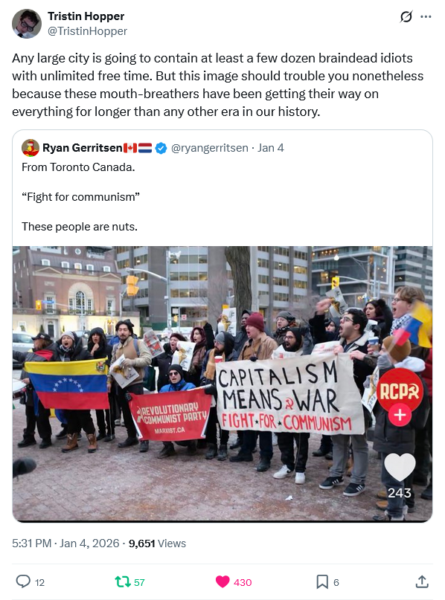
You can always find a cadre of pro-communist “fellow travellers” in any western nation … we just seem to have more of them than anyone else.
Let’s get the elephant in the room out of the way: American regime-change efforts, on occasion, tend to age like oxidized guacamole. The teenage version of this writer remembers well the empty sugar-high of “Shock and Awe”.
A powerful aphrodisiac gets released when Things Actually Happen. To ignore the impacts of tribalism and the potential for another misappropriation of neocon bloodlust would be to ignore another elephant. But enough on the family Elephantidae and the order Proboscidea.
We may be as cold as Minnesota, with its miniature Horn of Africa engulfed in a real “learing” not “learning” opportunity after years of runaway fraud, but as Canadians, we should surely be looking inward at our own failings on the home front, our lack of leadership in foreign affairs, the hate we allow to fester in our streets, and the cozy relationships we foster with the most dubious of allies. But of course, we’re not.
Nicolas Maduro, one of the world’s great monsters, was “black-bagged” and perp-walked along with his wife yesterday, following a Swiss-watch-precise Delta op that only our neighbours to the south are capable of.
Let us not stand on the false pretence of a violation of “international law”: Maduro’s tenure was defined by a series of widely condemned and fraudulent electoral processes designed to ensure his grip on power. His track record includes a 2018 presidential election, dismissed by the international community as neither free nor fair. He banned major opposition parties and jailed or exiled key opponents.
This pattern escalated during the 2024 presidential election, where, despite independent tallies showing a landslide victory for opposition candidate Edmundo González, the Maduro-controlled National Electoral Council declared Maduro the winner without the data to prove it. The 2024 process was further marred by the disqualification of popular leader María Corina Machado, the intimidation of voters by paramilitary “collectives”, and a brutal post-election crackdown, known as “Operation Tun Tun”, that resulted in over 2,000 arrests and dozens of deaths.
And yet, as Hugo Chávez’s mausoleum smoulders, hundreds of thousands continue to flood the streets to celebrate, and the experts of “experts say” journey down from ivory towers to shoot the wounded and feign retroactive understanding of an op that took most by surprise, perhaps nowhere has the oppositional-defiant kvetching been louder than inside Canada’s elite Liberal circles, so much so that you almost have to applaud the utter lack of self-awareness and the sheer selfishness of it all.
QotD: John Foster Dulles
Tevi Troy, Fight Club: Rivalries in the White House from Truman to Trump, 2020.
January 5, 2026
International law is more like International “law”
On the social media site formerly known as Twitter, Konstantin Kisin points out that calling it “International Law” gives it a semi-mythic quality that it absolutely does not deserve:
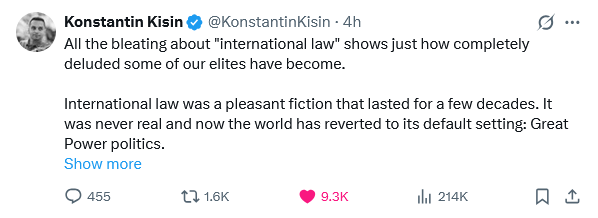
All the bleating about “international law” shows just how completely deluded some of our elites have become.
International law was a pleasant fiction that lasted for a few decades. It was never real and now the world has reverted to its default setting: Great Power politics.
This is why, as a strong Ukraine supporter, I have never talked about international law or called Putin’s attack an “illegal invasion”.
Laws are based on submission to an overarching authority backed by force. There is no such international authority and even if you view the UN as one, it does not have the ability to use force against those who violate “international law” other than against small countries with weak militaries.
When the US attacked Iraq, the UN did nothing.
When Russia invaded Ukraine, the UN did nothing.
If China invades Taiwan tomorrow, the UN will do nothing.If you cannot enforce a law, it’s not a law.
I do not support Ukraine because naughty Vlad broke the rules. I support Ukraine because it’s not in OUR interest in the West to have Russia marauding its way through friendly countries on the borders of Europe. It’s in our interest for us to be as strong as possible and for our adversaries to be as weak as possible.
President Trump is a realist and a pragmatist. He sees through the fictions other “leaders” cling to.
A good leader advances the national interests of his country. If more Western leaders did this, our civilisation would be in a much better place.
I commented on another post that,
For a lot of people (Canadian Liberals and American Democrats in particular), the invocation “international law” has a mesmerizing effect on their ability to reason [insert usual disclaimer that if they could foresee the results of their enlightened beliefs, they wouldn’t be progressives]. They seem to have a quasi-religious belief in the UN as if it were some kind of God-given supergovernment that is always right and must always be obeyed. “World opinion” might as well be the hand of God to them, so any time the legacy media can portray the US (and Trump in particular) as going against “world opinion” they want to get out the sackcloth and ashes … or sack a city and turn it into ashes, whichever comes first.
vittorio analyzes the default position of most progressives on the social media site formerly known as Twitter:
most political issues nowadays can be explained by understanding that american leftists dont have positions, they have oppositions.
their entire belief system is defined by negation of whatever the right supports. this is why portland chants “free maduro” while actual venezuelans celebrate in the streets. they’re not pro-venezuelan or pro democracies, or pro tyrant, or pro maduro, they’re simply anti-american-right.
they’ve outsourced their worldview to institutional narratives for so long that genuine self-reflection would require questioning everything. for them it’s much easier to just oppose. the beliefs arent coherent because they were never meant to be coherent. they only need to signal tribal membership, and leftist membership is gained by opposing the right.
trump does X? the left screams and cries because they wanted Y
trump does Y? the left screams and cries and riots because even if they said they wanted Y, what they meant is that X was the way to go
trump cures cancer? they’ll argue that the cancer cells are alive have a right of free determination
trump saves lives? they’ll protest because somehow those lives didn’t matter and should have been ended
no coherent word model. no logic. pure opposition
at some point you just have to stop engaging with it as if it’s a real political position. it’s not. it’s aesthetic opposition wearing the costume of ideology
As Severian at Founding Questions often remarks, progressives’ core belief is The Great Inversion: “whatever is, is wrong”.
Bingo Bobbins makes the case that “International law is fake and gay”:
Was this operation necessary? Was Maduro really a “narcoterrorist”? I admit that I haven’t really been following all the drama with Venezuela recently, but my intuition is that Maduro was probably accepting bribes to look the other way with regards to drug trafficking, rather than being directly involved. And sure, he was a socialist dictator but there’s plenty of those around. The US doesn’t go and topple dictators unless there is a perceived US interest in doing so.
What Maduro was actually doing was cozying up to China. In fact, he had just finished a meeting with some Chinese ambassadors hours before Delta Force snatched him up by the scruff. This was actually a warning to China not to mess around in our hemisphere. The Trump administration is re-establishing the Monroe Doctrine, or, as he recently called in a press conference, “The Donroe Doctrine“. As far as I can see, this is completely in keeping with my preferred Vitalist Foreign Policy.
You can agree or disagree with this show of force, but please don’t whine to me about “International Law”. International Law is fake and gay. I certainly don’t care that the Trump administration “targeted a political leader”. This is the complaint being leveled by many leftists in regard to the operation. Really, this is just because leftists are anti-American third-worldists, and they are filled with butthurt because “their guy” lost. But, let’s examine this “rule” of not being allowed to target a countries rulers, because it’s particularly ridiculous.
If you have a problem with a specific country, who do you really have a problem with? You have a problem with that country’s leaders, since they are the ones making the decisions. Why wouldn’t you target the leaders? The only reason is that all the leaders from all the countries got together and agreed that they wouldn’t target each other. They would rather resolve their differences by throwing cannon fodder at each other, while keeping themselves off the table. And sure, I understand why that is great for them, but not why it would be great for me (or you).
Of course, the CIA has been ignoring this “international law” for decades, but they’ve been doing it in a very effeminate way, skulking about the world, funding Color Revolutions and clandestinely arming insurgent groups in order to subvert existing regimes. The Donroe Doctrine is much better. Imagine if the Trump administration had tried to handle Maduro the way the Obama administration tried to handle Assad. Fund a decades long civil war, accidentally establish a caliphate, fight a war against said caliphate, facilitate the deaths of tens of thousands of Christians, all to have an even worse dictator eventually rise to power.

Update, 6 January: Welcome, Instapundit readers! Please do have a look around at some of my other posts you may find of interest. I send out a daily summary of posts here through my Substack – https://substack.com/@nicholasrusson that you can subscribe to if you’d like to be informed of new posts in the future.
January 4, 2026
Venezuela in the news
Tim Worstall explains that despite the usual suspects’ claims that “it’s all about the oil!”, it actually isn’t very much about the oil at all:
Trump taking — kidnapping, arresting, to taste — Maduro and his wife simply isn’t about the oil business. Please note, this also isn’t about whether it’s a good idea or not although I’ll admit to thinking that it’s way damn cool — getting in and out of hostile territory without, so far as we know right now, a single American casualty at all? Damn cool in that military sense.
This is about the shrieking we’re getting from the usual suspects — this is all about the oil! See! Ms. Raisin is one I’ve seen online already, there are those quoting that Counterpunch article with the idiot Michael Hudson and so on.
My point is solely and only about access to that oil.
So, travel back 10 to 15 years.
Venezuela’s Orinoco Belt oil is very “heavy”. Technically it is about viscosity but think about it as “thick”. It’s more like treacle than it is like a free flowing liquid. There are also issues with sulphur but leave that alone here. It is, in the technical parlance, “cheap shit”. So bad that it has to be mixed with much lighter (and usually “sweeter”, which means less sulphur) crude oil from different oil fields so you can pump it through a pipeline or get it into a tanker.
Venezuela used to have — still could have — fields of that light and sweet oil but they ran those fields — during and after Chavez — so badly that production fell over. So, they used to actually import US crude oil to then mix with that heavy crude so they could export. They also price petrol — gasoline — so low that they cannot possibly run refineries to make their own gasoline. So, they would import the US crude, mix it, export the blend to the US and then buy back the gasoline from those US Gulf Coast refineries. This was ridiculous, of course, but you know socialists with prices and economies.
It also meant that those US Gulf Coast refineries were adapted to use that Venezuela mix. You can change the mix a refinery uses but it’s potentially costly. The more the mix changes the more the cost rises. But the important thing to note is that the only refineries within cheap shipping distance that could use the Venezuela crude efficiently were those US Gulf Coast ones. Sure, they’d be pissed if they lost access to their supplies but they could be altered to work with other crude mixes. The reliance was much more of Venezuela upon the refineries than the refineries upon Venezuela — at least, the cost of adaptation to a change was lower for the refineries.
OK, so that was the old situation.
Over this past decade and a bit the US — under both Trump and Biden — has been saying, well, you know, we don’t think much of the Venezuelan Government. We also know the only money they get is from crude oil sales, so, if we refused to take that for those Gulf Coast refineries then we could screw with Maduro. Which is what happened — sanctions on Venezuelan oil exports which, most obviously, apply to people shipping into the US and so obeying US law.
Other people who do not, or don’t have to, obey US law haven’t, wholly, been abiding by those sanctions. OK. Maybe that’s all a good idea and maybe it isn’t — not my point here at all.
We should also note that the oil fields in Venezuela actually owned/managed by Chevron, a US company, have still been allowed to ship to the US and elsewhere under US law.
One more little fact. The US is now — as a result of fracking — a net oil exporter. This is also something done under Trump I, the lifting of the ban on crude oil exports. It can still be true that maybe buying in some Venezuelan oil — or Mexican, Canadian, whatever — meets either geographic or blend desires. We’d like some really heavy sludge, for example, or maybe Canadian oil works for Wyoming (not real examples, just ideas). But in terms of total oil production and usage the US produces more than it uses now. So any decision to import is about those marginal issues of location and blend, not urgent necessity for simple crude oil. Fracking works, d’ye see?
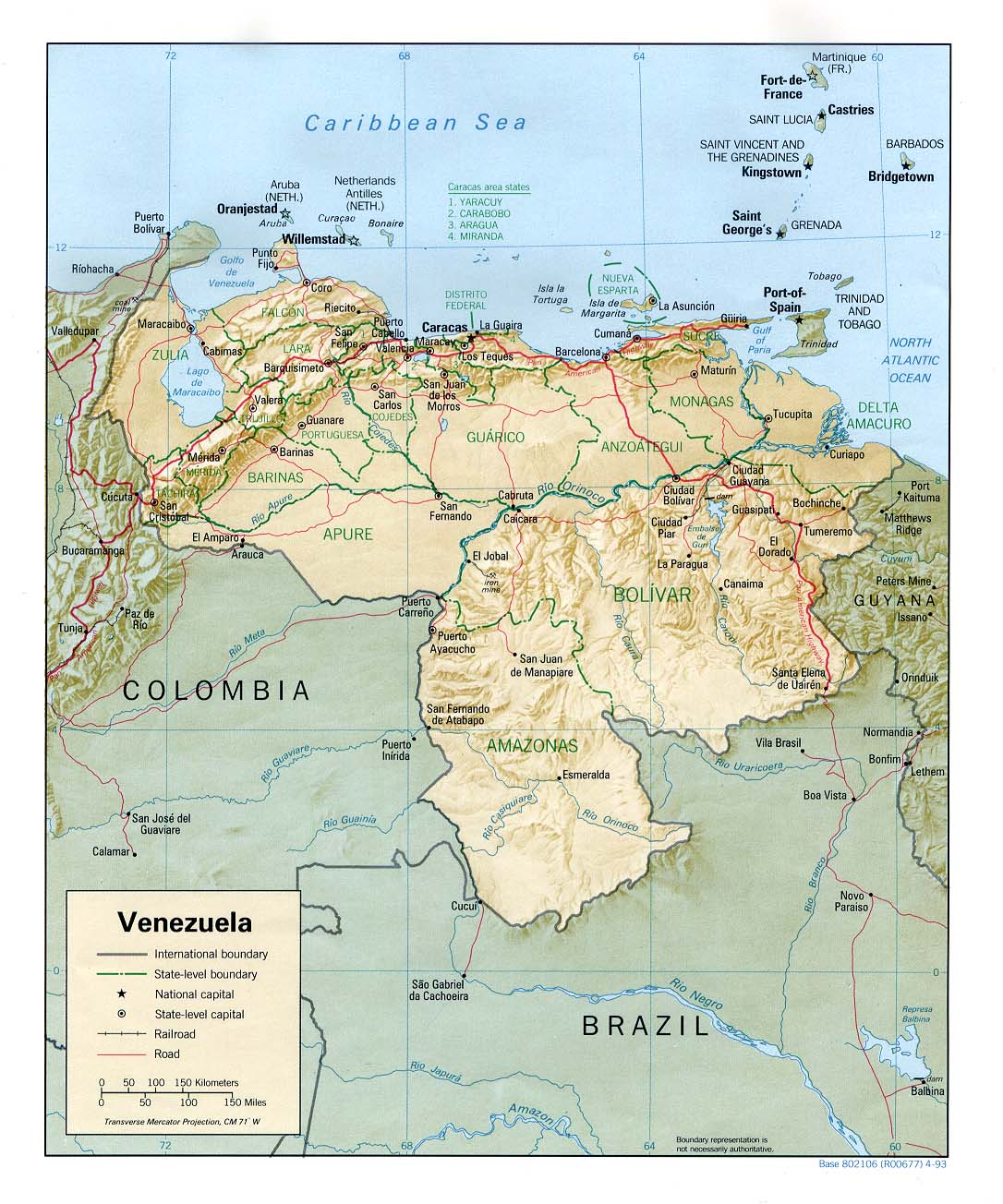
Shaded relief map of Venezuela, 1993 (via Wikimedia Commons)
On the other hand another bunch of the usual suspects are screaming about this as a violation of international law. ESR comments on the social media site formerly known as Twitter:
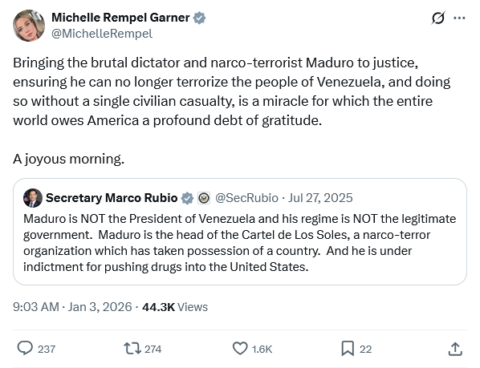
Since there’s a lot of screaming about the legality of black-bagging Nicolas Maduro going on, let’s talk about the game theory of international law.
Before I do that, though, I’m going to acknowledge that the Trump administration’s legal posture doesn’t even implicate international law significantly. Their theory is that Maduro stole an election, is not the legitimate head of state of Venezuela, and is a criminal drug-cartel leader; universal jurisdiction applies.
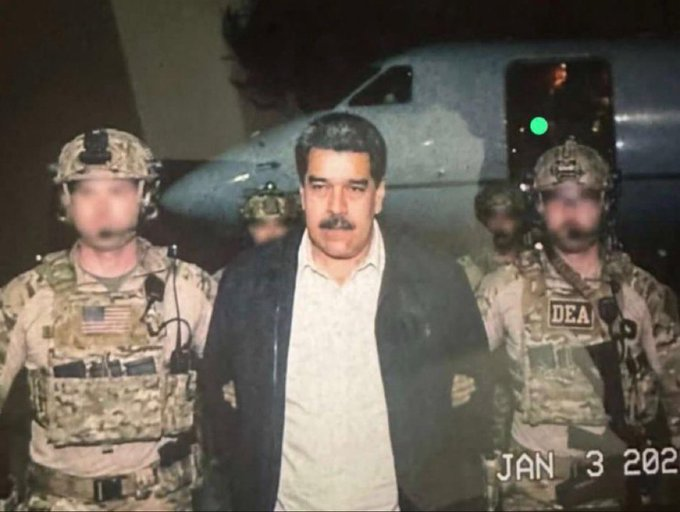
This is why a photograph of Maduro restrained by a soldier wearing a DEA patch was released.
I’m not here to state a position on whether that legal posture is valid; I want to instead outline a game theory of the “rules-based international order”, which people are complaining has been violated because the US black-bagged a head of state.
There are two different ways to establish a framework of governing law. Most people only understand one of them, which is the imposition of law by a ruler or coalition with force dominance. I’ll call this “unitary law”.
The other mechanism is mostly only understood by a handful of libertarians; it is law as a violence-minimizing equilibrium among a number of roughly equal agents playing an iterated Prisoner’s Dilemma game. In such settings, cooperation evolves naturally and doesn’t have to be handed down by a single ruler or coalition. I’ll call this “IPD law”.
“International law” is enforced by an uneasy combination of both mechanisms. This is more difficult to see than it should be because there’s also a lot of air and bullshit around “international law”, bullshit consisting mostly of wordcels trying to cast magic spells on people with guns.
The air and bullshit is why it’s common to say that international law is a mirage, or a fraud that only serves the interests of the strongest powers. This isn’t true: what is true is that if an international norm is not sustained by being a stable strategy in an IPD game, only force majeure by a dominant power or coalition can uphold it.
Here’s an example of a moral good that was established by unitary law of nations: the general abolition of chattel slavery, which happened because a dominant coalition of Western nations said “Fuck your sovereignty, we’re no longer tolerating this anywhere our militaries can reach.”
Here’s an example of a moral good that was accomplished by IPD law of nations: generally humane treatment of prisoners of war in armed conflicts. This didn’t develop because great powers unilaterally said “stop doing that”, it happened because even a great power at war with a minor one is exposed to effective tit-for-tat retaliation if it abuses POWs.
If you want to understand “international law”, you need to be able to disentangle three different things that claim to be international law: unitary law imposed by great powers, IPD law enforced by the threat of pain-inducing defections in an international tit-for-tat game, and wordcel bullshit.
The thing to bear in mind is just because there’s a lot of wordcel bullshit going around in “international law” doesn’t mean there isn’t a reality underneath.
British Prime Minister Keir Starmer rushes to distance himself from Trump’s action, for fear that someone might possibly mistake him for a vertebrate:

Leave it to the Babylon Bee to find the appropriate framing for a news story:
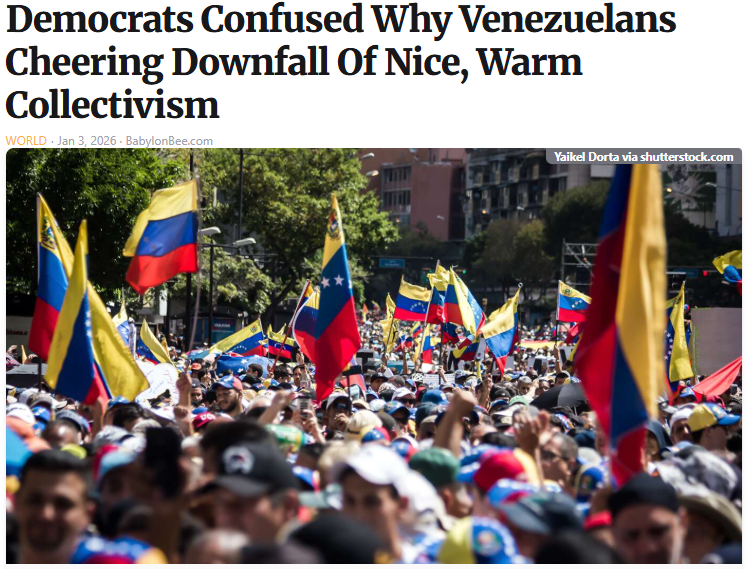
Update, 6 January: Welcome, Instapundit readers! Please do have a look around at some of my other posts you may find of interest. I send out a daily summary of posts here through my Substack – https://substack.com/@nicholasrusson that you can subscribe to if you’d like to be informed of new posts in the future.
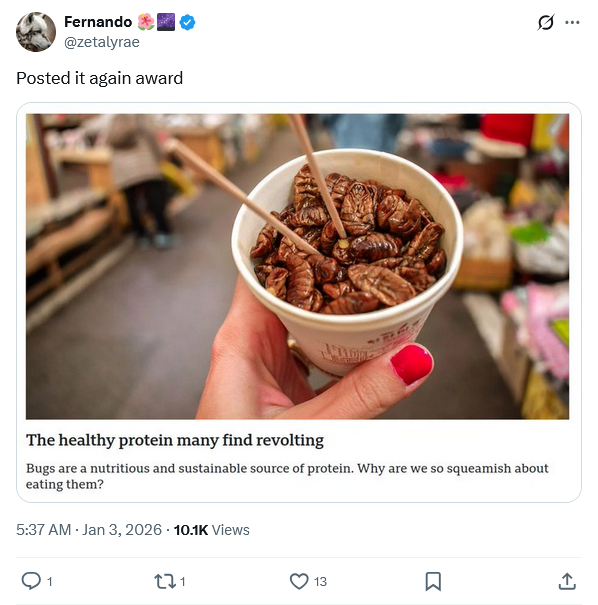
“You will eat the bugs, peasant!”
On the social media site formerly known as Twitter, ESR reacts to yet another “bugs are yummy, peons, you are going to eat them” post:
Contemplating this picture, I had a realization about the people who want you to eat bugs.
The fact that the bugs are disgusting to you is the whole point. Enlisting you as the principal enforcer of your oppression is the program. Fucking with your head is the actual goal, not just a tactic.
It doesn’t matter whether or not Western prejudice against eating insects is irrational. In an alternate world where we routinely eat insects, the people who want you to eat the bugs would find some other kind of disgusting garbage and play to make you eat it.
Because this isn’t sustainability or any of that bullshit. The degradation is the point.
However, even the powers-that-be can’t magically create economic conditions in which insect factories earn profits:

In the renewable frenzy of the early 2020s Ÿnsect raised €600 million to “Reinvent the food chain” and pioneer alternative foods that “respect the planet’s boundaries”. Some $200 million of their funding came from hapless taxpayers somewhere. But in record time, seemingly before it began, it has already gone. Bankrupted. And not because people don’t want to eat mealworms (which they don’t) but because there wasn’t much market in making animal feed either. It turns out that farm owners didn’t want to spend 2 to 10 times as much on “sustainable” cattle fodder. So the company shifted focus to high end pet food, where besotted owners have money to spare, but that crashed too.
h/t Tom Nelson
How reality crushed Ÿnsect, the French startup that had raised over $600M for insect farming
By Anna Heim, TechCrunchThe company’s demise is hardly a surprise, as Ÿnsect had been embattled for months. Still, there is plenty to unpack about how a startup can go bankrupt despite raising over $600 million, including from Downey Jr.’s FootPrint Coalition, taxpayers, and many others.
Ultimately, Ÿnsect failed to fulfill its ambition to “revolutionize the food chain” with insect-based protein. But don’t be too quick to attribute its failure to the “ick” factor that many Westerners feel about bugs. Human food was never its core focus.
It’s only money …
And revenue was the problem. According to publicly available data, Ÿnsect’s revenue from its main entity peaked at €17.8 million in 2021 (approximately $21 million) — a figure reportedly inflated by internal transfers between subsidiaries. By 2023, the company had racked up a net loss of €79.7 million ($94 million).
The vainglorious heady days of climate communism meant some bureaucrats thought it made sense to spend $200 million dollars feeding bugs to cows to try to change rainfall in 2100 AD.
January 3, 2026
America’s secret UBI programs
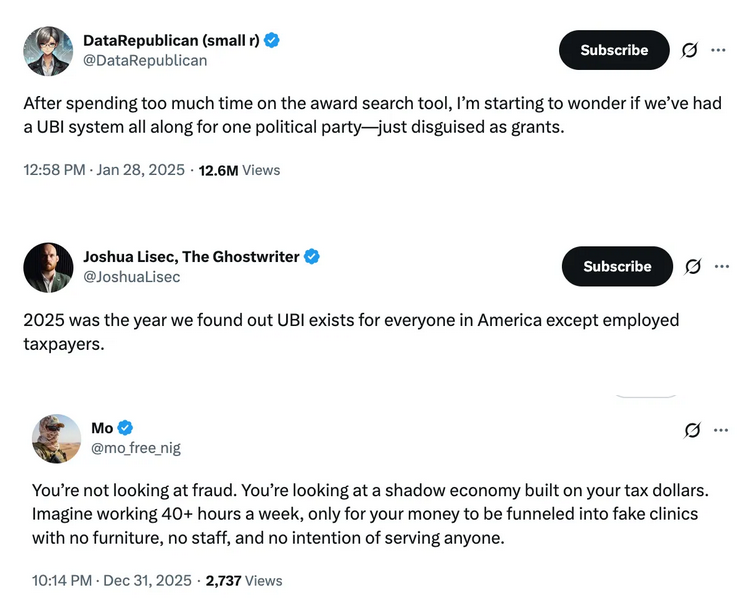
On his Substack, Glenn Reynolds puts the Somali daycare scandal into its proper perspective: it’s not old-fashioned graft but something far bigger and far more destructive to the pillars of western society:
The explosive unveiling of the wildly extensive Somali-run daycare scams in Minnesota has drawn attention to a huge shadow economy, and not just in Minnesota. America, it turns out, is full of people, companies, and organizations that basically live off of fraud. We’re not talking old-fashioned waste, like $600 hammers or $1200 toilet seats. We’re talking about entities whose sole reason for existence consists of being a conduit for taxpayer money to flow directly to the people controlling them, with some of the proceeds being diverted to politicians and political organizations.
People are noticing.
This reverses an old joke told by my Nigerian relatives. A Nigerian visits his rich relative in the United States and is awed by the penthouse apartment, the limo, the private jet and so forth. “How did you make so much money?” he asks. The relative points out the window. “See that bridge? 15%. See that shopping mall? 15%. See that train station? 15%.”
The visitor, inspired, returns home to Nigeria and becomes fabulously wealthy. His rich cousin from America visits and says “How did you make so much money so fast?”
“You see that bridge over there?”
“Nope,” responds the confused relative. The Nigerian cousin points at himself and says “One hundred percent!”
Well, this joke has now been turned around. Leaving aside that we don’t really even build train stations, bridges, or even shopping malls in this country anymore, now it’s America where people are pocketing one hundred percent and not even trying to actually deliver any goods or services. That the people doing this are mostly Africans only adds to the irony.
But what happened?
Well, several things. At base, people defraud the government for the same reason that dogs lick themselves — because they can. One of the things you find in these programs is that there are virtually no controls to ensure that the recipients of the money are legitimate, that the money is spent as promised — in essence, that the bridges get built. (Or, in the case of California, the high speed rail lines.) That lack of controls, of course, is no accident. The systems are designed to promote fraud and to make it hard to catch or punish.
Second, the culture is weaker. In a high trust society, people get angry when there is fraud and move to punish and ostracize the perpetrators. In a low-trust society, people expect it.
Older generations of politicians used to engage more in what George Washington “Boss” Plunkitt called “honest graft”. He defined honest graft as legally exploiting insider knowledge and opportunities from one’s position for personal financial gain, while also benefiting the public or party. A classic example he gave was learning about upcoming public projects (like a new park or bridge) and buying nearby land cheaply before the plans became public, then selling it at a profit to the city. He famously summarized it as: “I seen my opportunities and I took ’em,” comparing it to savvy stock trading on Wall Street. In contrast, dishonest graft involved outright illegal acts, such as blackmail, embezzlement, or extortion (e.g., shaking down gamblers or saloon keepers).
God knows what he would have said about simply taking money for nothing. Would his reaction have been horror? Or admiration?
Britain’s government – a modern-day Ship of Fools
On his Substack, Dr. Robert Lyman takes a break from discussing events in India and Burma during the Second World War to consider the current British government:
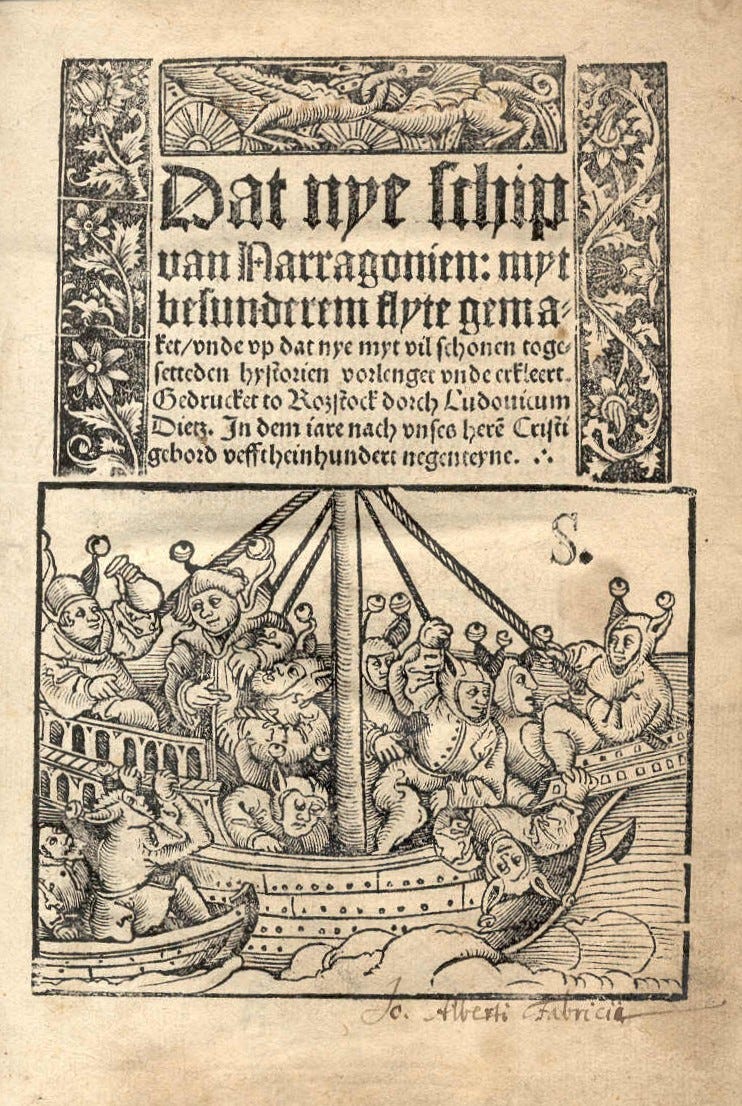
The 1519 title page of Sebastian Brant‘s 1494 satirical book Ship of Fools
I began life as a medievalist and often find myself instinctively going back to old texts when contemplating today’s problems. I have been forced to think much in recent days about the incompetence of our current governing class in respect of their understanding of defence and its value. More especially, their failure to understand how to use the military instruments of defence to uphold our national interest. The Ship of Fools, which first appeared in Plato’s Republic but was resurrected in Europe in the late 1400s as a metaphor for desperately poor leadership, is the perfect allegory for me. It tells a simple story that resonates with thoughtful people in every age who look on in wonderment at the idiots governing them. The story is of a ship with a crew who talk (and drink) a lot, but with their cloth ears make all the wrong decisions. The result is chaos. In the 1480s the ship in question was the Church of Rome, but the allegory is easily transportable to Britain in the early days of 2026. What on earth is going on in defence in the UK as we enter 2026? I can only surmise that in the UK at least, we are in a ship governed by fools.
I was going to start this piece by complaining that our government simply doesn’t understand Clausewitz, but I thought that this might be a little too obtuse for most politicians. But one of Clausewitz’s points about the use of military power is pertinent to our age. When Napoleon invaded Russia in 1812 he did so not because he had an existential hatred of Slavs, or of the Tsar. Indeed, Napoleon and Tsar Alexander I had a remarkably friendly relationship. He did it because the practice of friendly diplomacy between the two leaders had failed. Napoleon had attempted to persuade the Tsar to refuse the British trading rights in Russia’s ports. Alexander I had demurred, so Napoleon considered that the only thing left to him in his tool kit of levers to persuade Alexander to change his mind, was force. So, he marched on Moscow. We know the story and its outcome well, so I won’t rehearse it now. Using this as an example, Clausewitz was simply saying that in the hurly burly of diplomacy, war is one of the tools available to a national leader to persuade an opponent to change course. Hence, we get the oft misquoted Clausewitzian maxim that “War is the continuation of policy with other means”.
Clausewitz was correct, of course. Yet we in Britain have forgotten this, if politicians over the past three decades have really understood it. Since 1990 I am not sure we’ve had any politicians who’ve truly understood it, despite the fine words we get from successive Secretaries of State about the first priority of government being to protect its citizens, etc. This, without action to demonstrate any understanding of how to achieve the protection of our citizens, is merely St Paul’s clanging cymbal. Put frankly, we no longer have an Army, Navy or Air Force able seriously to achieve any form of influence on the European stage — let alone deter an enemy or fight a serious war — and the state of the Continuous At Sea Deterrent (CASD) is abysmal I’m told, though you wouldn’t know this from the hollow rhetoric regularly emanating from No 10. We are deluding ourselves if we think we can exercise real influence in Europe or anywhere else for that matter if we don’t have the practical means to do so.
The truth is that the cupboard is bare.
How have we got to where we are? The primary reason over the years has been the saving of money for politicians who have simply not valued investment in the hard practice of defence, unless it is in a shipyard in their constituency. The end of the Iron Curtain in 1989/90 meant, to many people in the corridors of power, that we no longer needed to bear the burden of spending 5% of GDP on defence.
But a second problem is only becoming clear to me. I hope I am wrong, but I can only conclude that we now have a government that actively hates the idea of defence, and while it will never admit it, is determined to remove it as one of its levers or instruments of power. I came across this in a meeting recently. Why do we need defence, the argument seemed to go, when we should be encouraging the international community to regulate itself by means of adherence to international laws and norms of behaviour? Should not our effort as a country be in building up these international systems and structures of law and governance (many based on the United Nations as an idea and a regulator) and rely on these to reduce the potentiality for war? Surely, building up arms simply makes war more likely, not less?
Update, 4 January: Welcome, Instapundit readers! Please do have a look around at some of my other posts you may find of interest. I send out a daily summary of posts here through my Substack – https://substack.com/@nicholasrusson that you can subscribe to if you’d like to be informed of new posts in the future.
January 2, 2026
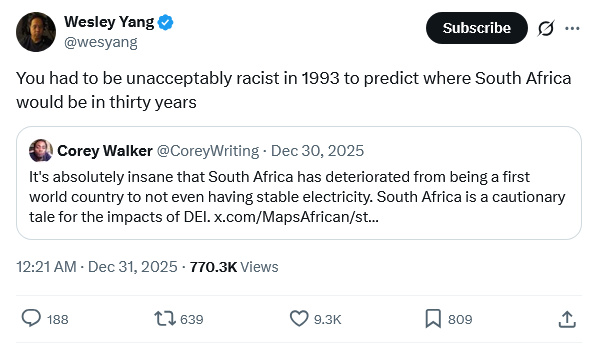
“You had to be unacceptably racist in 1993 to predict where South Africa would be in thirty years”
On the social media site formerly known as Twitter, Wesley Yang posted the comment in the headline. Will Tanner responded:
You did not, in fact. You just had to be paying attention
By 1993, South Africa was the only First World country left in Africa
America and the UN chased Belgium out of the Congo, and it collapsed into decades of civil war and famine
Mugabe destroyed Rhodesia after we aided the Soviets in helping him win. Angola and Mozambique became hells after Salazar died, the Carnation Revolution happened, and they were given up. Kenya and Sierre Leone all showed the hellish state of things that came with decolonization in the name of “democracy”
South Africa was the last man standing. It had a nuclear program. It had a space program. It had clean, reliable water and electricity. It had a thriving industrial sector. Crime was problematic, but not out of control
Now all of that was gone, for the same reason the Congo is a mess and Zimbabwe went from being the breadbasket of Africa to a famine-ridden mess: decolonization and equity
Anyone who paid attention could have predicted that. Maintaining First World life requires a First World mindset; that dies when handed over to race communists who are happy to backslide into the Stone Age if doing so means “equality” exists
And so South Africa went from First World to Third
And John Carter responded in turn:
When you stand back and look at this from ten thousand feet, a very dark pattern emerges.
In the aftermath of WWII, the newly established globalist institutions were used to give moral and financial support to decolonization movements, thereby chasing European countries out of what became the third world.
A governance structure that had successfully brought order, prosperity, and civilization to much of the planet was dismantled, leaving behind a chaotic mess of war and poverty.
Those same globalist organizations then embarked on a program of “foreign aid” that dramatically increased the size of that immiserated third world population (without actually improving conditions for them).
At the same time, their agents were busy at work within the governments of the former colonial powers, changing their immigration policies to allow immigration from more or less anywhere. Countries began adopting “multiculturalism” in the name of fighting “racism” … A newly developed postwar concept, which the media and education arms of the globalist project indoctrinated the youth to consider the worst of all possible sins.
Once the ideological and legal ground had been prepared in the former colonial powers, migration via legal and irregular pathways commenced, facilitated by — of course — the very same set of globalist NGOs that chased Europe out of the colonies.
Somehow, this new form of colonization is a good thing. Somehow, the European peoples enjoy none of the rights of “national self-determination” accorded to “indigenous” peoples which had been invoked to end colonialism.
As the populations of the third world were exploding thanks to the foreign aid being provided by globalist organizations, fertility in the first world fell off a cliff. The pill, abortion, feminism drawing women into universities and careers and therefore away from marriage and child-bearing, no-fault divorce destroying the family, and a gender war incited to new levels of bitter intensity every year which estranged the sexes, all served to reduce the white birth rate.
White fertility crashed just as the population bomb that had been set in the third world exploded, with the gates left open by carefully constructed legal frameworks that made immigration very easy and deportation very, very hard.
Update, 3 January: Welcome, Instapundit readers! Please do have a look around at some of my other posts you may find of interest. I send out a daily summary of posts here through my Substack – https://substack.com/@nicholasrusson that you can subscribe to if you’d like to be informed of new posts in the future.


