On Substack, Celina101 outlines the long and sordid history of official deliberate blindness to a widespread and horrific crime wave in Britain, all for fear that if they paid proper attention they’d be labelled as “racists”:
There are crimes so extreme that the mind instinctively rejects them, not because they are implausible, but because accepting them would require acknowledging a collapse of morality too large to comprehend. Child sexual abuse is one such crime.
Child sexual abuse does not arrive in a single form. It ranges from isolated abductions, to organised pornography networks, to violence carried out by parents or those entrusted with care. Every one of these crimes is horrific, and none should ever be minimised or ignored.
But there is one form of abuse that stands apart, not because it is worse in kind, but because it was allowed to flourish unchecked. The organised targeting of schoolgirls by groups of men who lingered outside schools, fast-food outlets, and transport hubs, grooming children into addiction, sexual exploitation, and prostitution, constituted a distinct and recognisable pattern of abuse.
This pattern was not hidden. It was not unknowable. And yet for longer than a quarter of a century, British authorities chose not to act. Despite the issue being raised at a national level as early as 2003, and despite its presence being well understood in certain towns since at least the late 1980s, it was deliberately sidelined, minimised, and left to metastasise.1
For decades, these gangs were allowed to congregate openly around school gates without consequence. What shielded them was not ignorance or lack of evidence, but an institutional terror of confronting anything that carried racial implications; the shade of their skin protected them.
By 2011, the long-standing silence surrounding the issue began to break. Once the initial barrier was breached, the extent of the abuse became increasingly difficult to suppress.2 Over the following years, British media outlets published a succession of detailed investigations that brought the scale of the crimes into public view.
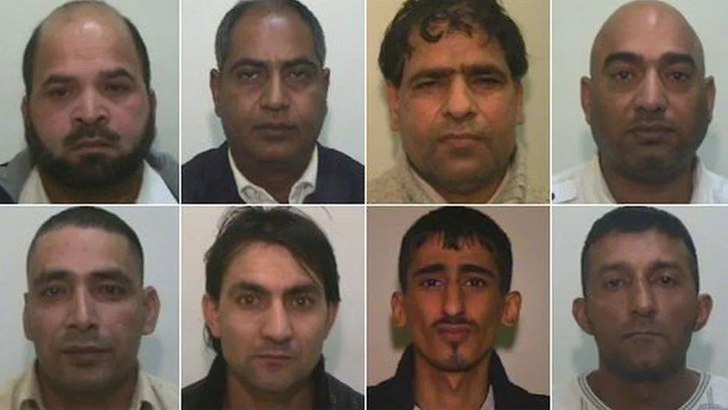
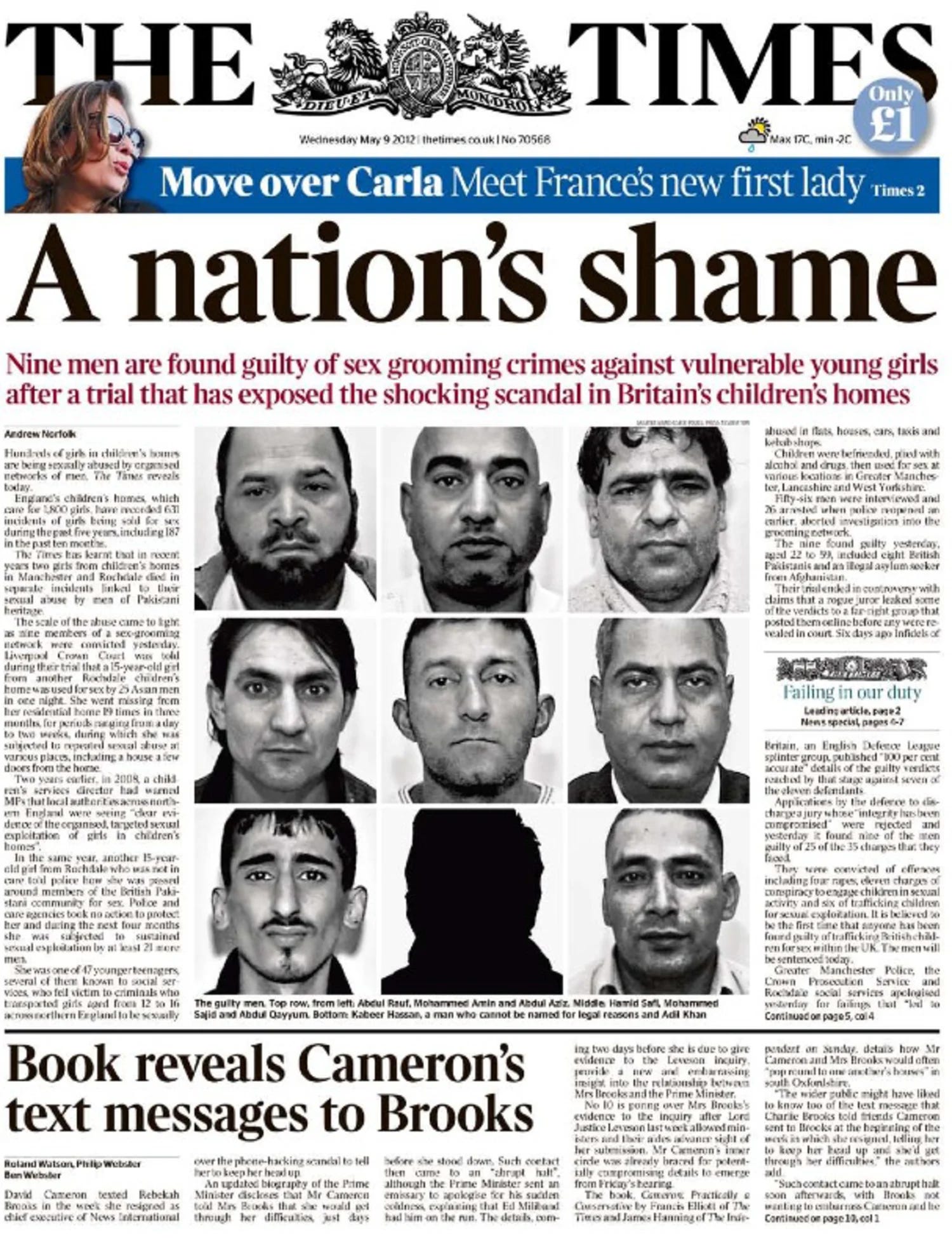
In September 2012, The Times published an extensive overview of the phenomenon.3 The paper reported that for more than a decade, organised groups of men had been able to groom, exploit, and traffic girls across multiple towns and cities in Britain, often operating with minimal interference from authorities.
Yet, event The Times underestimated the scale of this. By early 2015, senior police figures were publicly acknowledging the scale of the crisis. One officer spoke of “tens of thousands” of current victims of grooming gangs. A Member of Parliament, representing a constituency widely associated with the problem, went further, suggesting that the total number of victims nationwide, past and present, could reach as high as one million.4
These figures are almost impossible to comprehend. They refer to school-aged girls systematically identified, isolated, and exploited over many years. And yet, despite the magnitude of the harm, perpetrators were able to operate with remarkable impunity.
By the end of 2014, the Association of Chief Police Officers confirmed that the number of victims each year ran into the tens of thousands.5 Even on the most conservative interpretation, this would place the number of victims over a twenty-year period well into six figures. Against this backdrop, the number of successful convictions, under 200, stands as a staggering indictment of the system meant to protect the vulnerable and enforce the law.
There is no comparable serious crime in modern Britain where the disparity between victims and convictions is so extreme.
On the social media site formerly known as Twitter, John Michael Greer provides a quick thumbnail sketch of the Amelia story for folks who need to get caught up:
I’ve been watching the saga of Amelia from the far side of the Atlantic in a state of utter bemusement.
For those who don’t know the first act of the saga, the British government had some collection of flacks create a video game for British kids, which was designed to elicit “racist” (that is, patriotic and un-woke) statements from them — at which point the kids who fell for it would be reported to the police for, erm, reeducation. (I wish I was making this up.)
Amelia was a cartoon figure who was supposed to mouth allegedly racist slogans, and they gave her violet hair because they thought that would annoy right-wingers, who make jokes about women with dyed hair.
Ponder the immeasurable stupidity of the flacks who put nationalist and patriotic slogans in the mouth of the kind of cute female figure who would have most teenage boys reaching into their trousers on the spot. Of course these same teenage boys instantly hijacked her and turned her into a mascot, just as they did with Kek back in the day. Of course these same teenage boys, being far more computer-skilled than government flacks, started doing LLM-generated videos of Amelia speaking out in favor of nationalist and patriotic ideas.
Of course everybody in Britain who’s sick and tired of the Starmer government and its woke doctrines embraced Amelia as their latest heroine, not least because the Guardian‘s foam-flecked fury when she’s mentioned is so entertaining to watch …
And then, as with Kek, things got weird. We’re still in the early stages of the weirdening but it would not surprise me a bit to find that just as a cartoon frog ten years ago became the vessel through which an archaic Native American deity manifested and sent the US spinning down an uncharted path, a purple-haired waifu may just become another such vehicle.
Britain used to have quite a collection of war goddesses, back in Celtic times. I’m curious, not to mention apprehensive, to see just who’s taking this opportunity to stream back into manifestation.
The Agora was the political and economic heart of ancient Athens. This tour explores its long history and evocative ruins.
Chapters
0:00 Introduction
0:47 Bouleuterion
1:44 Tholos
2:22 Monument of the Eponymous Heroes
2:56 Temple of Hephaestus
5:28 The Hellenistic Agora
6:16 Stoa of Attalos
6:57 Augustus and the Agora
8:06 Odeon of Agrippa
9:26 Herulian Wall
10:56 Overview
Comments Off on The Agora of Athens | A Historical Tour
As usual when Popper addressed a meeting, his aim was to challenge and provoke thought, rather than simply endorsing the assumptions that he shared with his audience. […] It may help to start with a summary of the liberal principles that Popper spelled out in section 3. This will be helpful for a general readership (unlike the Mont Pelerin meeting) where there are likely to be many people who do not hold non-socialist liberal principles and some who are not be clear about what these principles are.
(1) The state is a necessary evil and its powers should be kept to the minimum that is necessary.
(2) A democracy is a state where the government can be changed without bloodshed.
(3) Democracy cannot confer benefits on people. “Democracy provides no more than a framework within which the citizens may act in a more or less organised and coherent way.”
(4) Democracy does not mean that the majority is right.
(5) Institutions need to be tempered and supported by traditions.
(6) There is no Liberal Utopia. There are always problems, conflicts of interests, choices to be made between the lesser of evils.
(7) Liberalism is evolutionary rather than revolutionary. It is about modifying or changing institutions and traditions rather than wholesale replacement of the existing order. The exception to this is when a tyranny is in place, that is a government that can only be changed by violence and bloodshed.
(8) The importance of the moral framework.
“Among the traditions that we must count as the most important is what we may call the ‘moral framework’ (corresponding to the institutional ‘legal framework’) of a society. This incorporates the society’s traditional sense of justice or fairness, or the degree of moral sensitivity that it has reached … Nothing is more dangerous than the destruction of this traditional framework. (Its destruction was consciously aimed at by Nazism.)”
Copernican draws some examples of life in a corrupt authoritarian society (the old Soviet Union) and compares them with similar situations in the western world today. Depressingly, we have been converging on how Soviets used to have to work the system just to get access to the people they had to get permission slips and permits from:
Corruption is one of the largest issues of our time. Particularly in places like Minnesota, but also nationally. For that reason, it’s necessary to understand corruption, what it is, and how to utilize its benefits. The United States exists in a political hybridization of Soviet Managerialism and Libertarian Corporatism. In both cases, corruption is a common feature of our society, but we don’t see it on the ground the same way that Mexican business owners do or Russian gangs.
Thus, I pose the following question: Are our societies so different that we cannot also benefit from corruption while our culture is ground to dust beneath it?
I recently saw a video from this YouTube channel that discusses Russia and the psychology of living in an oppressive state. A nation not of law, but of management, public policies, and mercurial Karens at every level. I’m not sure how it feels to be Western European (I get the impression the progenitor of the videos is now living in Western Europe), but I can say that, being an American, life seems similar to what’s described therein: Hope seems dangerous. Liberty seems like a time bomb until you step on the wrong bureaucrat’s toes, and your entire future and that of your family is held hostage by the proclivities of unaccountable bureaucrats that you’ve never spoken to1.
Meanwhile, at the top of government, billions of dollars are being laundered by corrupt politicians like Tim Walz, who will lie to your face. Import demographics that hate you. And if you dare defend yourselves, a lynch mob may well try to kill you. How do I get my hands on that money spigot that seems to be free-access for people who want to kill me?
Corruption, or lack thereof, is another one of those American Myths that needs to be deconstructed in the psyche of the population. To do that, we need to understand what corruption really is. Not at the national level of billions of laundered dollars for foreign pirates, but at the personal level. What is corruption for us stuck in the limbo of a faltering civilization?
When I was young, I witnessed corruption for the first time. I was a child, and I was just entering the primary school system in my home country of Russia. Like all things, there was government paperwork to fill out and submit. When we arrived at the office, an old woman sat behind a glass barrier to help people with their paperwork. My mother knocked on the glass to get her attention. The clerk ignored my mother. My mother knocked again and then took a chocolate bar out of her bag. She passed it through a window into the barrier to the clerk. The clerk looked up and took the chocolate bar, hiding it in a stack of forms. Then she asked, “How can I help?” and filed the papers so that I could attend school.
Corruption doesn’t have to solely give an advantage to those politicians and billionaires sitting atop the society. Corruption can act at every level, from top to bottom. The West exists in a system that is corrupt from the top down, while the Russians exist in a system that is corrupt from the bottom up. Corruption doesn’t need to take the form of extortion payments or threats of ending careers. Corruption can be small, personal, and in many ways more honest than managerial formalization.
Maybe a manager will find some problem with your paperwork, any paperwork you hand in. So to smooth over the process, you bring her a coffee or a chocolate bar. Maybe your academic advisor will help you make the right connections if you gift him a bottle of whiskey or schnapps for Christmas. Maybe you want a teacher to treat your child better at school, so you give her a cupcake or school supplies as a gift.
You don’t need police officers on the take to be advantaged by corruption.
Most people here on substack are underemployed. I am one of them for the time being. I can state with certainty that I have never gotten a job by applying for a job. Never once have I sent out a resume and heard back anything besides an automated “dear applicant, kindly go fuck yourself” from the HR manager. Maybe it’s a byproduct of being a White guy. Lord knows I have enough degrees to find work.
Rather, the only way I’ve ever found employment is through direct connection: I have a friend who has a friend who knows someone who needs an employee. I’m close to fitting the bill, so they’ll hire me. Sometimes they have to dip and duck around hiring-managers and HR to do it:
Here’s where we’re going to post the job. We’re legally required to leave the posting up for two weeks, but apply with these five keywords in your Resume. When I review the resumes submitted, I’ll be able to pick out yours.
It seems quite conspiratorial when you say it out loud, though that’s the way it has to be in more than a few companies. If they want to hire a White guy, there are hoops to jump through. The addition of “hiring policies” and “diversity” quotas has just added a few hoops, but did not limited one’s acrobatic ability.
Corruption is an individual or a small group of individuals acting in their own interests by ignoring or subverting legal or social rules of conduct.
If you have a friend you’d rather hire than some Indian with a slightly nicer resume? That’s corruption. When the boss hires his nephew, that’s corruption. When you give the DMV associate a chocolate bar, and she helps you with your paperwork instead of telling you to go fuck yourself, that’s corruption. When you hand the inspector of your 40-year-old truck a fifty so that he marks “passed” on your emissions inspection, that’s corruption.
On the social media site formerly known as Twitter, The Little Platoon responds to a lamestream media report on the Amelia phenomenon:
This story was quite funny enough before it got noticed by the rickety old goblin creatures of the mainstream media.
Amelia is not a “purple-haired AI goth girl”, she is a government-created videogame character designed to teach kids that “liking the national flag” and “attending protests where that flag might be seen” makes you a potential terrorist.
That really was the extent of it. The game she comes from is extremely non-specific about the content you’ve been radicalised by. At no point do you think, “yes, I can see why this was terrorist behaviour”.
The actual storyline is not a million miles away from Winston Smith and Julia in Nineteen Eighty-Four.
So the effect is: you have this totally normal opinion that most people have? You’ve been seduced by Amelia and now the Hijabi Hero (IRONY) at Prevent is going to send you to jail.
Amelia hasn’t been “hijacked by the far-right”, she’s just a textbook example of Death of the Author.
The government wanted to have her demonstrate the dangers of online radicalisation. But because this is the British government, they made it seem cool, justified, and you’ll probably get a hot goth girlfriend out of it.
The meme works because Amelia has perfectly normal, mainstream opinions.
She can say “I like pork sausages and dogs”, like roughly 98% of British people, and this will send a certain sort of person — the government, the Anti-Extremism Lead at Generic NGO — into a full-on panic attack.
It’s about the disconnect between the values of the government and those of the people they govern. The joke is that Amelia could ever be considered “Far Right”.
(Ironically, the interviewee in this clip is just as AI-coded as the actual AI clip they play. He’d probably require fewer tokens to generate.)
Meme coins remain extremely cringe, however.
At The Hungarian Conservative, Joakim Scheffer discusses the reaction of the caught-flat-footed mainstream media as their attempts to downplay Amelia’s impact serve to increase interest and attention:
British outlets The Guardian and LBC published strikingly similar articles about Amelia in recent days, both concluding that the purple-haired goth girl, who stands against mass migration and in favour of traditional British values and culture, is, in fact, racist and fuels hatred.
The Guardian introduces Amelia as a girl “who proudly carries a mini Union flag and appears to have a penchant for racism“, before lamenting the “plethora of increasingly sophisticated AI-generated iterations” of her, including “real-life” encounters between Amelia and movie characters, “accompanied by racist language and far-right messaging”.
Since her “birth”, Amelia has indeed become increasingly popular. From an average of around 500 posts a day when she was first introduced, the figure rose to roughly 10,000 daily posts starting on 15 January, when the meme broke through to international audiences. Amelia has since reached the highest levels of the right-wing internet ecosystem, even being reposted by Elon Musk himself.
Comments Off on “The meme works because Amelia has perfectly normal, mainstream opinions”
There’s a long-running argument over whether Heinlein’s book describes military service as the exclusive path to citizenship, or if “federal service” is a much broader basket of enfranchisement. While a close read of the book makes it unquestionably clear which is correct, it misses the greater point. Heinlein was writing about the role of civic virtue in the stability of a republic, his citizenship-through-service framing is the literary conceit for discussing that larger question.
For a more detailed examination of the nature of Federal Service, I recommend James Gifford’s essay on the subject: https://www.nitrosyncretic.com/rah/ft…
00:00 Intro
00:45 What is Federal Service?
02:18 An Exploration of Enfranchisement
03:13 Expanded Universe
05:38 But Why?
06:59 Starside R&D
09:07 “Unreasonable Facsimile”
10:54 Filtering Civic Virtue (more…)
Comments Off on Starship Troopers: Service Isn’t The Point
I’ve heard many people refer to the Americans with Disabilities Act as the worst piece of legislation in US history, and stories like this one make it easy to agree:
Los Angeles’s streets are in notoriously bad shape. Fewer than two-thirds are considered in a state of good repair, according to the city’s Department of Public Works. Broken sidewalks have spawned years of costly litigation, and Los Angeles pays out millions of dollars each year to drivers whose cars are damaged by potholes.
Many cities would see this situation as a mandate for change. And Los Angeles has indeed made a change: last summer, the city quietly stopped repaving its streets. Not slowed. Not fell behind. Stopped completely.
The Bureau of Street Services (StreetsLA) has not repaved a single street since last June, and the city’s latest budget practically zeros out repaving for next fiscal year. StreetLA crews are still doing some road repairs, fixing potholes and patching problem areas. But the most basic form of urban maintenance — full street resurfacing — has all but disappeared in America’s second-largest city.
Why has Los Angeles stopped repaving its streets? The answer, it turns out, has to do with federal disability rules that, paradoxically, have made fixing roads legally riskier than letting them fall apart. Though well-intentioned, L.A.’s shift shows how such policies can unintentionally worsen urban quality of life.
The clearest explanation of the city’s shift comes from L.A.–based housing and transportation advocate Oren Hadar. Digging through budget documents and engineering classifications, Hadar explained in an essay from late last year that the city didn’t necessarily abandon street work so much as reclassify it out of existence.
The city seems to have invented a new category of repair specifically designed to avoid triggering costly federal accessibility mandates. Instead of repaving streets, StreetsLA now performs what it calls “large asphalt repairs”. As Hadar explained, these repairs address localized damage — areas larger than a pothole but smaller than full resurfacing. Essentially, the city repaves only part of a street rather than the entire width, as shown below.
A “large asphalt repair” on L.A.’s Century Boulevard. Courtesy: StreetsLA on X
But, as Hadar wrote, “the thing about large asphalt repair is that it’s … not a real thing. It appears to be a term made up by the city some time in the last year.”
Why invent a new classification? The reason lies in federal disability law. Under regulations implementing the Americans with Disabilities Act, when a city alters a street, it must also bring associated pedestrian infrastructure into compliance. That means installing ADA-compliant curb ramps at every intersection along the way.
Repaving is considered an alteration that triggers these requirements. Maintenance activities, such as filling potholes or making minor repairs, are not. The city claims that large asphalt repairs are “pavement maintenance activity” and therefore do not require ADA upgrades.
That distinction carries enormous financial and logistical consequences. Hadar found that each curb ramp costs roughly $50,000, totaling about $200,000 per intersection. With roughly ten intersections per mile, curb ramps alone can add around $2 million per mile to the cost of repaving — a figure that often exceeds the cost of the asphalt itself. Design and construction typically take 9 to 12 months per ramp, and federal rules require the ramps to be completed by the time the street is resurfaced.
Update, 29 January: Welcome, Instapundit readers! Have a look around at some of my other posts you may find of interest. I send out a daily summary of posts here through my Substack – https://substack.com/@nicholasrusson that you can subscribe to if you’d like to be informed of new posts in the future.
On the social media site formerly known as Twitter, Eric Schwalm talks about the organized nature of the Minneapolis protests and points out how much work it takes to set up and run:
“No Kings, No ICE” protest on Hennepin Avenue in Minneapolis, Minnesota on 23 January, 2026. Photo by Myotus via Wikimedia Commons.
As a former Special Forces Warrant Officer with multiple rotations running counterinsurgency ops — both hunting insurgents and trying to separate them from sympathetic populations — I’ve seen organized resistance up close. From Anbar to Helmand, the pattern is familiar: spotters, cutouts, dead drops (or modern equivalents), disciplined comms, role specialization, and a willingness to absorb casualties while bleeding the stronger force slowly.
What’s unfolding in Minneapolis right now isn’t “protest”. It’s low-level insurgency infrastructure, built by people who’ve clearly studied the playbook.
Signal groups at 1,000-member cap per zone. Dedicated roles: mobile chasers, plate checkers logging vehicle data into shared databases, 24/7 dispatch nodes vectoring assets, SALUTE-style reporting (Size, Activity, Location, Unit, Time, Equipment) on suspected federal vehicles. Daily chat rotations and timed deletions to frustrate forensic recovery. Vetting processes for new joiners. Mutual aid from sympathetic locals (teachers providing cover, possible PD tip-offs on license plate lookups). Home-base coordination points. Rapid escalation from observation to physical obstruction — or worse.
This isn’t spontaneous outrage. This is C2 (command and control) with redundancy, OPSEC hygiene, and task organization that would make a SF team sergeant nod in recognition. Replace “ICE agents” with “occupying coalition forces” and the structure maps almost 1:1 to early-stage urban cells we hunted in the mid-2000s.
The most sobering part? It’s domestic. Funded, trained (somewhere), and directed by people who live in the same country they’re trying to paralyze law enforcement in. When your own citizens build and operate this level of parallel intelligence and rapid-response network against federal officers — complete with doxxing, vehicle pursuits, and harassment that’s already turned lethal — you’re no longer dealing with civil disobedience. You’re facing a distributed resistance that’s learned the lessons of successful insurgencies: stay below the kinetic threshold most of the time, force over-reaction when possible, maintain popular support through narrative, and never present a single center of gravity.
I spent years training partner forces to dismantle exactly this kind of apparatus. Now pieces of it are standing up in American cities, enabled by elements of local government and civil society. That should keep every thinking American awake at night.
Not because I want escalation. But because history shows these things don’t de-escalate on their own once the infrastructure exists and the cadre believe they’re winning the information war.
We either recognize what we’re actually looking at — or we pretend it’s still just “activism” until the structures harden and spread.
Your call, America. But from where I sit, this isn’t January 2026 politics anymore. It’s phase one of something we’ve spent decades trying to keep off our own soil.
On his Substack, Glenn Reynolds points out that the “protests” are serving to distract attention away from state and local officials’ role in enabling massive fraud rings in Minnesota which reportedly scored billions of federal dollars for phantom organizations:
This image depicts a similar action by the Trusts at the turn of the last century. (Library of Congress).
The squid was frightened, so we got the ink: Increasingly violent “protests”-cum-riots explicitly aimed at blocking ICE operations with the stated goal of forcing federal authorities out of Minnesota entirely, while generating maximum media attention.
These are not spontaneous uprisings of the aggrieved, but organized actions featuring out-of-state actors and organizations, detailed training programs for demonstrators, and large amounts of intentionally murky funding from organizations like Indivisible, George Soros’ Open Society Foundations and others.
They’re coordinating their anti-ICE operations — identifying, chasing and blocking agents to keep them from arresting illegal-immigrant criminals — through highly organized chat groups on Signal, a secure communications platform, Fox News reported.
And Minnesota government officials are proudly touting their involvement in this coordination.
Sen. Bernie Sanders made much of Lt. Gov. Peggy Flanagan’s role in a fundraising email this weekend, praising her for “playing a key role in mobilizing grassroots opposition to Trumpism”.
That’s making these often violent, deliberately obstructive demonstrations look less like a civil rights sit-in and more like a government-backed insurrection.
Tragically, this aggressive and confrontational strategy has produced martyrs who can now be exploited for political purposes.
“Two things can be true at the same time,” Fox News’ Asra Nomani posted Monday.
The death of Alex Pretti, the armed demonstrator who got into a fatal tussle with ICE agents Saturday, “is a real and devastating tragedy, and there are several investigations appropriately occurring into the circumstances behind his killing”.
But also, “A far-left organizing network put Pretti in harm’s way and then turned him into a martyr … to sow the perception of chaos in America”.
Whatever investigators determine about how Pretti’s death unfolded, the fact remains that a cynical and corrupt political machine has fostered for its own purposes a situation that’s dangerous for its own supporters, and for the political future of our nation.
Comments Off on Minneapolis – protest, insurrection, or massive distraction?
On the social media site formerly known as Twitter, A View From Yorkshire points out that the media coverage of the Amelia phenomenon often leaves the audience with the impression that Amelia was created by some far right extremists, which clearly isn’t true:
Let’s nuke the myth properly.
Amelia was not “created by the far-right”.
She was created by the British state, funded by taxpayers, in a government-approved anti-extremism game for teenagers.
Her crime?
Questioning mass migration.
Talking about British values.
Suggesting borders, culture and continuity might matter.
In other words: centre-right, mainstream opinions held by millions of normal people.
The media response?
SCREAMING, CRYING, THROWING UP:
“FAR-RIGHT!”
“RACISM!”
“DISINFORMATION!”
Even the game’s own creators admit the game does not say questioning mass migration is wrong — yet journalists still foam at the mouth like Pavlov’s interns because the spell didn’t work.
Here’s the truth they hate:
Amelia didn’t get radicalised.
She got recognised.
People saw a perfect accidental parody of how the establishment treats ordinary dissent:
If you question orthodoxy, you’re not wrong — you’re dangerous.
If you wave a Union Jack, you’re not patriotic — you’re extreme.
If you ask questions, you need monitoring.
So people did what the internet always does when power looks stupid:
They laughed.
They memed.
They stripped the moral panic naked.
Now we’re told there’s a “highly coordinated hate network” behind it all.
Sure. Or maybe — stay with me —
people are done being lectured by institutions that despise them.
A cartoon goth girl didn’t expose extremism.
She exposed how fragile the narrative really is.
If a meme breaks your ideology,
your ideology was already on life support.
The Amelia memes do seem to be getting under the skin of certain members of the government:
Amelia is a girl of many talents:
Epochalypse
Published 24 Jan 2026
An absolutely beautiful song covered by Amelia ❤️
A UK anti-extremism educational game called Pathways, faced significant public and media backlash.
The game, developed by SOUK in coordination with the Hull City Council and East Riding of Yorkshire Council, was designed to educate students about the dangers of online radicalization.
How the Game Backfired
Antagonist’s Popularity: The game’s primary antagonist, a teenage girl with purple hair named Amelia who held nationalist views, was intended as a cautionary figure. However, she was ironically embraced by some online communities and became a viral meme, with users finding her “goth baddie” design and character more interesting and relatable than the non-binary protagonist, Charlie.
Criticism of Content: The game was widely criticized by media outlets, including The Telegraph and The Spectator, as “clumsy” and “overtly manipulative”. Critics argued that the game effectively suppressed free speech by suggesting characters who questioned immigration policies should be reported under the UK government’s “Prevent” counter-terrorism strategy.
Portrayal of “Research”: The game’s narrative structure suggested that “researching” information online could be harmful, as it might lead to “intaking a lot of harmful, ideological messages”, which also drew criticism.
Ultimately, the attempt to create an effective anti-extremism tool had the opposite effect in many online circles, with its intended villain becoming an ironic symbol for anti-illegal immigration sentiment.
#amelia #pathways #memes #patriotism
Kimberly Steele disgrees with the characterization of Amelia as a “tulpa” (which I think I first saw advanced by John Carter at Postcards From Barsoom) and argues that she’s actually an “egregore” instead:
Amelia crossing paths with Harry Potter and the gang, very appropriate for this essay
In rides fantasy Amelia to the rescue, a digital Joan of Arc to galvanize the lumpen male proletariat into action against leftist groupthink oppression. Her flame burns hotter than the tradwife because she is not a deferential, docile, opinionless mirage waiting for her man to do all the the heavy lifting. Instead of modeling crusty tropes from the 1950s in a housedress, she mouths off to Mohammed in a miniskirt. She champions sensible norms that middle aged people like me took for granted back in the day. She is an advocate of schoolgirls being able to walk down the streets of Liverpool without being acid attacked or drug into fenced areas to be assaulted. She suggests Britain is for the British and that it should not be handed over to the same hordes that have been trying to overrun it since before the Middle Ages. She suggests that men on all sides rise up and outgrow Puer Aeternis — to the invaders, she insists that they cease their infantile dependence routines and go back and fight for their own country on their own soil. To the white native islanders, she suggests they grow a set and defend their nation while it still stands. Nothing that Amelia wants or espouses is extreme. She is a middle-of-the-road pundit who could run for office on a moderate platform (or what used to be considered moderate in my day before everything in the middle was categorized as far-right) and win. She’s not exactly Hitler, no matter what the leftie pearl clutchers claim.
If only she was real. Amelia has been called a tulpa, which is a Buddhist term for a thoughtform that is forced into existence and made to do tasks, much like a Jewish golem without the clay and awkwardness. I don’t think Amelia is a tulpa. She is nobody’s bitch and she was not created on purpose. Instead, Amelia is an egregore. Imagine your old school mascot was a giant, anthropomorphized tiger. Perhaps there was a person who dressed up as a big, striped cat for games every now and then. Now imagine that your mascot became extremely popular across the world and every sports team adopted him as their mascot too. Now imagine that your big tiger began appearing randomly in the nightly dreams of people who were very into sports, and then after a few years, non-sports fans. Tiger fan fiction was inspired by the egregore. Tons of giant tiger merch was sold both at games and in regular stores. Imagine if chick lit writers wrote ghastly bestiality porn about the giant tiger, and entire genres of tiger man erotica bubbled up online. You would begin to think perhaps there was consciousness behind the tiger man image, and if you did think such odd things, traditional occultists would take your side of the conspiracy theory.
An egregore is a shared image that gains its own consciousness. Any given novel’s character is essentially alive, gaining his/her/it’s own consciousness, ego, and world. […]
Amelia says what men cannot say, and it is good because she does it in a way that is unsquelchable and eternal. She is bad because she is yet another symptom of provisional living. On the plus side, she makes toxic liberal women super mad because unlike a real girl, they cannot tear her down or cast her out of the longhouse/take her ability to make a living away in order to force her compliance. She highlights all of their shortcomings without having to try, and that is why she will have much hate projected upon her. Their evil eyes gaze into the digital mirror. This force may be enough for them to completely self-destruct, given enough time and distance.
There are some men who see Amelia as some kind of savior. If you are one of them, let me assure you she is not going to save anyone any more than Pepe the Frog. If you want to save and be saved, please go outside. Be with the sky and the trees, and don’t feel you have to pick up a fishing pole, soccer ball, or a toolbox to be out there. When you do come back inside, instead of turning on the dopamine drip and immersing yourself in the antics of fantasy girlfriends or dreaming about invading Haiti, please use the internet to learn manly skills. My husband, whose father was largely absent before he divorced my husband’s mother when my husband was 12, taught himself nearly all of his considerable skills via books and the internet. If you are a visual learner, the internet holds a treasure trove of knowledge. For those would be warriors who are not currently serving or who will never serve in the armed forces, please go out and defend real girls on the streets from the monsters, creeps, and traffickers who make it impossible to feel safe as a female. Where are the men willing to watch the streets and to at least threaten various immigrant scum with retribution for their terrible behavior? Where are the volunteer neighborhood patrols that ensure women and children can walk to and from school without being harassed? In the stranger danger/Satanic Panic 80s, we had a thing called Neighborhood Watch where you would put a blue star in your window so any little kid who felt threatened could knock on the door and find a safe house. Where are the blue stars? Where are the boys with baseball bats? Go out there and defend your country. Do it for Amelia.
Update, 28 January: Welcome, Instapundit readers! Have a look around at some of my other posts you may find of interest. I send out a daily summary of posts here through my Substack – https://substack.com/@nicholasrusson that you can subscribe to if you’d like to be informed of new posts in the future.
Noah looks at the recently released American National Defence Strategy and identifies areas of interest (or concern) for Canada (edited for typos):
The 2026 National Defense Strategy is out, and with it we get a few references to Canada. While our mention is little, and when there is it is fairly mundane, there is a message. You either step up or get stepped over. [NR: This has always been true, but administrations in the past have been more coy about it than President Trump … who is the opposite of coy. On the other hand, the Canadian government has been quite blatant about giving mere lip service to shared US-Canadian defence interests and slacking off completely on any serious work to keep the Canadian Armed Forces in a state to be able to do what the government pretends to want.]
This policy was shadowdropped in the middle of the night, so I decided to quickly rush to get just about anything out about it. This isn’t a full analysis, but more a quick rundown with some personal thoughts for those who want the quick go of whats happening.
To start, here are the direct mentions of Canada:
We will engage in good faith with our neighbors, from Canada to our partners in Central and South America, but we will ensure that they respect and do their part to defend our shared interests. And where they do not, we will stand ready to take focused decisive action that concretely advances U.S. interests.
The policy continues:
Canada also has a vital role to play in helping defend North America against other threats, including by strengthening defenses against a missile, and undersea threats. In addition, U.S. partners throughout the Western Hemisphere can do far more to help combat illegal migration as well as to degrade narco-terrorists and prevent U.S. adversaries from controlling or otherwise exercising undue influence over key terrain, especially Greenland, the Gulf of America, and the Panama Canal.
The strategy itself is fairly domestic in focus, with repeated mention of the Western Hemisphere and borders as the key areas for which the United States should focus. It takes a backseat approach to the Indo-Pacific, favoring a collaborative approach to Chinese containment that focuses on “peace through strength”, instead of what the NDS refers to as “confrontation”.
In this regard, it is funny that despite criticisms today from President Trump regarding Canada’s trade deal with China, as well as criticism over an apparent lack of Canadian support for Golden Dome, the NDS further states that “President Trump seeks a stable peace, fair trade, and respectful relations with China.” [NR: I think Noah is being a bit naive here … Trump wants to deal with China as a normal trading partner, but China’s actions in so many ways show that China doesn’t want to reciprocate.]
The strategy further states that “Our goal in doing so is not to dominate China; nor is it to strangle or humiliate them. Rather, our goal is simple: To prevent anyone, including China, from being able to dominate us or our allies.”
On today’s Golden Dome comments, I wanna take note that Canada has been discussing participation fairly openly and trying to figure out in what ways we can align even without full participation. There is no indication the current government is against Golden Dome.
The RCAF has its own IAMD study underway in Canadian Shield. It is already fairly well aligned to what the Americans are doing. People will focus on space-based interceptors and such, but Golden Dome is far more extensive than that. There’s much we align on without joining.
Canada is also undertaking its own extensive modernization of both NORAD and space-related assets, both of which will significantly contribute to Continental Defence in a variety of different ways. That includes OTHR and F-35, yes, but is so much more extensive.
From autonomous vehicles in the Arctic to ground- and space-based optical capabilities, AEW&C aircraft, new satellite constellations for both communication and surveillance, domestic launch investments, and even establishing a VLF communication capability.
There is so much going on that can and will contribute to collective Continental Defence. Much more than I believe anyone truly knows about, even myself. We need to highlight and promote these investments if we want mentalities to change and people to recognize the effort.
Comments Off on The 2026 US National Defence Strategy
His most rabid fans liked to call him the God-Emperor, but Andrew Sullivan sees him much more as a modern King George III:
King George III in his Coronation robes. Oil painting by Allan Ramsay (1713-1784) circa 1761-1762. From the Royal Collection (RCIN 405307) via Wikimedia Commons.
It is where lies and truth are entirely interchangeable; where the rule of law has already been replaced by the rule of one man; where the Congress has abdicated its core responsibilities and become a Greek chorus; where national policy is merely the sum of the whims and delusions of one man; and where every constitutional check on arbitrary power, especially the Supreme Court, is AWOL. In that abyss, even an attempt to explain events through the usual rubric of covering a liberal democracy is absurd. Because that rubric is irrelevant.
And so the wheels spin.
The only honest way to describe what is in front of our noses is that we now live in an elected monarchy with a manic king whose mental faculties are slipping fast. After 250 years, we appear to have elected the modern equivalent of King George III, and are busy dismantling the constitution Americans built to constrain him.
The situation is not irrecoverable — the forms of democracy remain even if they are functionally dead. We have centuries of democratic practice to fall back on. But every moment the logic of the abyss holds, the possibility of returning to democracy attenuates. Tyranny corrupts everything and everyone — fast. David Brooks returns to the ancients today to understand where we are:
As the disease of tyranny progresses, citizens may eventually lose the habits of democracy — the art of persuasion and compromise, interpersonal trust, an intolerance for corruption, the spirit of freedom, the ethic of moderation. “It is easier to crush men’s spirits and their enthusiasm than to revive them,” Tacitus wrote. “Indeed, there comes over us an attachment to the very enforced inactivity, and the idleness hated at first is finally loved.”
Forty percent of the country still backs the tyrant. Forty percent watch this and cheer.
Let us briefly review what they are cheering. For the first time since the Second World War, the president of the United States declared last week that we no longer support the notion of national sovereignty or collective security, and reserve the right to invade and occupy other sovereign countries — even close allies — to extract their resources. Quite a Rubicon. His chief adviser declared international law a dead letter:
[W]e live in a world, in the real world … that is governed by strength, that is governed by force, that is governed by power. These are the iron laws of the world since the beginning of time.
To put it bluntly, this was the argument of King George III. It was the justification for the British Empire, and, more hideously, for the Nazi and Soviet occupations of Europe. It’s a rejection of the principle that literally created the United States.
And yet this mad king threw this founding principle away because he believes a) we deserve Greenland as reparations for World War II, b) because Russia and China would invade otherwise, c) because rare earths are there — even though they are buried under a mile of ice — and d) because he didn’t win the Nobel Prize. Insane.
This staggering concession to evil — which cannot be withdrawn — robs us of any case against Russia’s invasion of Ukraine or China’s threat to Taiwan. It legitimizes war by major powers for conquest everywhere. It endangers the entire system of collective security that has kept the peace for nearly 80 years. Why? And for what? Because the king was on a high.
On his Substack, Fergus Mason talks about the new Queen of English Resistance, Amelia:
Amelia, the new queen of the British right.
Independent journalism is a pretty grim business right now. Writing about the state of our poor broken country can be soul-destroying. Good news is thin on the ground; new calamities seem to arrive daily, either a fresh atrocity committed by an illegal immigrant or some new Labour assault on our freedom. So it’s nice when something a little more light-hearted comes along — even if it does make some serious points, too.
A couple of weeks ago the media started reporting a new online game funded by Prevent, the government’s (completely dysfunctional) department for diverting people away from extremism. Commissioned by Hull City Council and produced by “creative social enterprise” Shout Out UK, the game — called Pathways — is intended to “Encourage learning about the concept of extremism and radicalisation through the process of choice and safe exploration”.
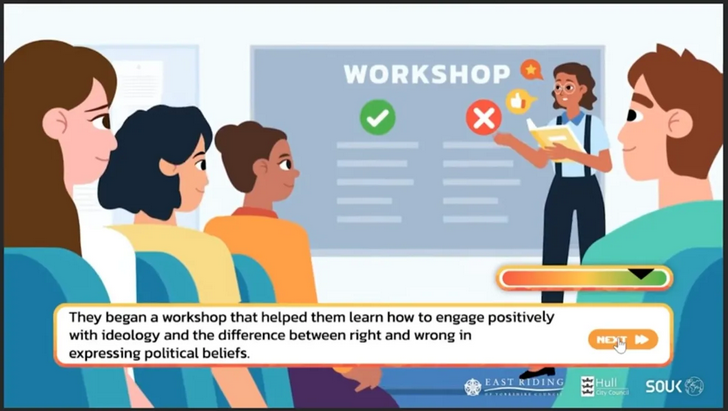
As games go, this is a spectacularly dull one. Players choose a character, from a very limited selection — there are two, one male and one female, but they’re both called Charlie and use they/them pronouns. They then have to navigate their character through a series of scenarios, answering multiple-choice questions. The idea is that if you give the “wrong” answers you’ll get referred to Prevent, but it soon becomes obvious that almost any answers will get you referred to Prevent. The constant theme is that there are approved views and ways of acting — which don’t, for example, include doing research to find out if something you saw on the internet is true or not — and that, if you deviate from this, the state will step in to “support” you. A lot of this support looks suspiciously like re-education:
[…]
Of course, if you know much about the online right, you’ll probably see the problem already. As one stunned Reddit user commented, “Wait, are you telling me they made the cute goth e-girl the ‘racist’? Do they understand how the internet works?”
Well, they certainly do now.
The Daily Telegraph published an article about Pathways on 9 January, bringing the game to public notice. That same day, X user Bovril-Gesellschaft posted “I think I’m in love with Amelia”. It seemed many other right-wingers were too, because within hours Amelia memes were appearing in large numbers. Mostly produced with AI, these depicted Amelia in a wide range of styles (probably reflecting their creators’ personal tastes), but all featured her purple hair and most stuck with the outfit of a pink dress and purple hoodie or cardigan the game depicted her in. Images ranged from cartoons in the style of the original game to photorealism. […]
There’s a lot to laugh about in this. For example, brightly coloured “danger hair” has generally been the hallmark of women on the far left. Amelia subverts this by giving our new heroine her distinctive purple bob. Will we see the pro-Hamas nuts and trans cultists abruptly return to natural hair colours to dissociate themselves from Amelia? That would be funny.
Returning to a topic I’ve been mocking all week on the socials, in The Line, Matt Gurney gently suggests to the Canadian government that it’s just not reasonable to expect Canadian civilians to wage some kind of fierce guerilla war against a feared American invasion while actively disarming Canadians who legally own guns:
A lot has happened, is the thing. A lot is still happening. And it all seems to be happening faster.
But it’s still worth slowing things down just a little bit when the news stories arrive in particularly baffling sequences. Consider just two you may have seen this week: Canada is thinking about fighting an insurgency in case the Americans invade us, and Canada is also working hard to disarm its civilian population. Can I just interject here a moment and suggest that these goals are at odds? That this might be a stupid way of doing things? That the Canadian federal right hand would be shocked and appalled to discover what the left hand was doing?
Let’s take a minute and set up the insurgency thing. It comes from an article published this week in The Globe and Mail. Canadian soldiers are not frantically digging trenches quite yet. The overall consensus is that a U.S. invasion of Canada is unlikely. But clearly, the current trajectory of U.S. geopolitics has shifted the prospect from “batshit crazy” to “it would be weird but we should probably think about it”. So the military is thinking about it — it’s now a contingency being considered, just like the military plans for natural disasters or less bizarre military scenarios, like a war requiring a mobilization or an attack by a terror group or hostile nation on Canadian soil.
And what is the military thinking? Allow me to quote from the Globe:
The two senior government officials said military planners are modelling a U.S. invasion from the south, expecting American forces to overcome Canada’s strategic positions on land and at sea within a week and possibly as quickly as two days.
Canada does not have the number of military personnel or the sophisticated equipment needed to fend off a conventional American attack, they said. So, the military envisions unconventional warfare in which small groups of irregular military or armed civilians would resort to ambushes, sabotage, drone warfare or hit-and-run tactics.
One of the officials said the model includes tactics used by the Afghan mujahedeen in their hit-and-run attacks on Russian soldiers during the 1979-1989 Soviet-Afghan War. These were the same tactics employed by the Taliban in their 20-year war against the U.S. and allied forces that included Canada. Many of the 158 Canadian soldiers killed in Afghanistan from 2001 to 2014 were struck by improvised explosive devices or IEDs.
Mmm. This yogurt is tasty.
Let me say three things here: first, I can confirm some of the Globe‘s reporting via my own sources. I know for a fact that members of the Canadian Armed Forces are talking, in a very conceptual, high-level way, about what an insurgency against an invader could and would look like in Canada. I do not know of any serious plans or preparations. But discussions? Absolutely. Second, the plan above, in very vague terms, is probably about correct, in terms of how the Canadian population could resist an invader. The actual shooting war would be over almost immediately — the U.S.’s military advantage would be overwhelming. I think two days is optimistic, frankly. I’m not sure it would take much more than two hours to smash any meaningful military resistance.
So, longer term insurgency against a larger and more advanced force would be the only real option, and in that kind of fight, we’d have some real advantages. We’d be a tougher nut to crack, in many ways, than either Iraq or Afghanistan.
But only if we don’t hobble ourselves first. And this brings us to the third point I’d like to make: did you notice the part about “armed civilians”? Because I sure did.
Civilians, sometimes augmented by experienced military personnel in technical and leadership roles, are always the backbone of an insurgency. They have to be. Insurgencies are hit-and-run affairs, and you can’t do that if you’re driving a tank back to a base. In order to be effective, the population must be armed, or somehow have the means to arm itself. Not to be cute, but the resistance being armed is a necessary precondition for a successful armed resistance.
And we are disarming ourselves.
For the record, Canada and the US have historically had plans to defend against one another even at times we’ve otherwise been very peaceful and friendly. About a year ago, Big Serge suggested updates to the old US “War Plan Red” scenario invasion of Canada:
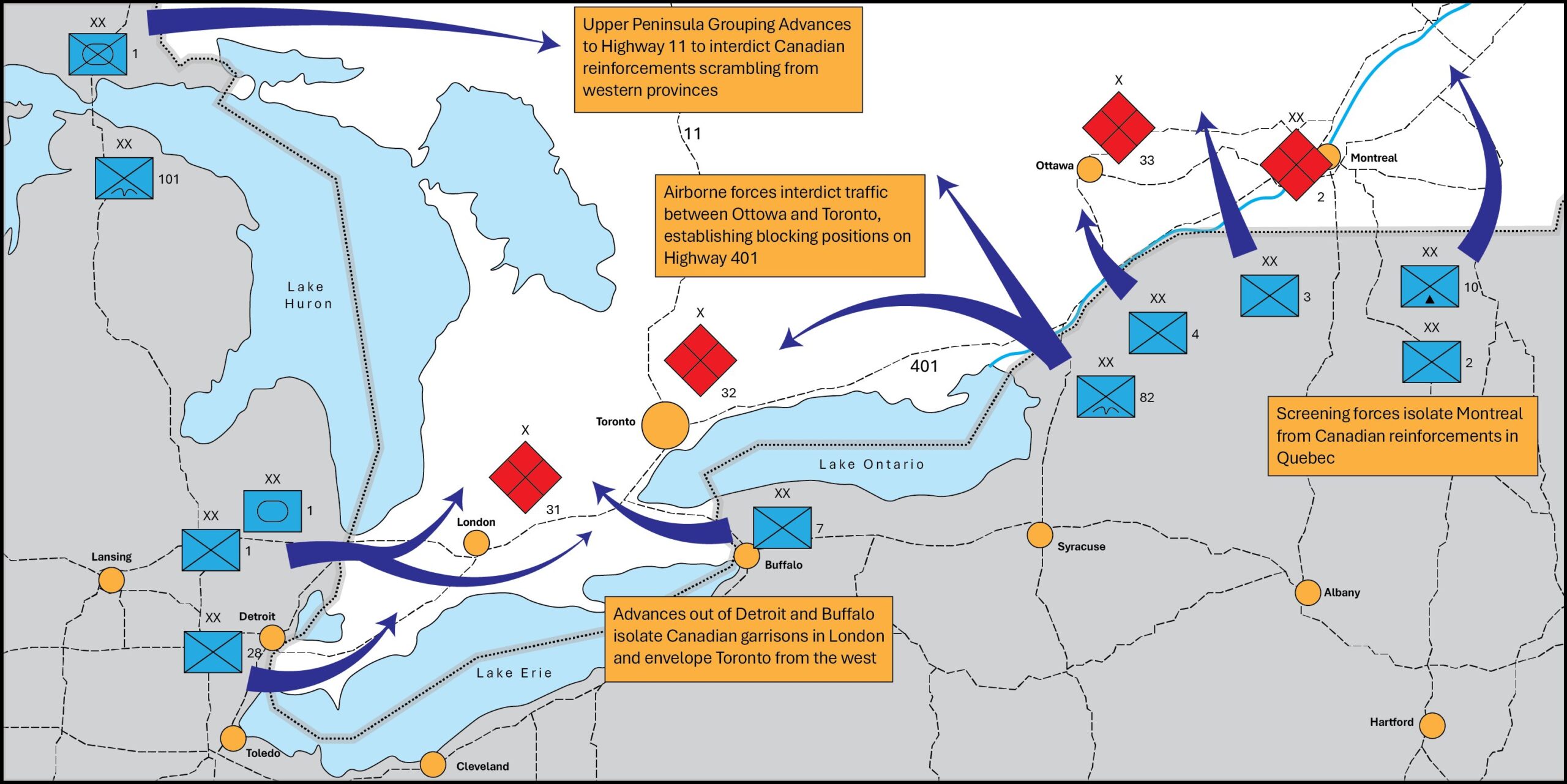
The country’s political and economic center of gravity is the urban corridor from Toronto to Montreal, but a significant share of the Canadian Army is dispersed, with large garrisons in Quebec, Halifax, and the western provinces. Only handful of brigades are garrisoned in the critical theater.
Manifest Destiny, 2025? Big Serge’s updated map for the old US War Plan Red for a military invasion of Canada.
The war will be won quickly and decisively, without massive destruction of Canadian cities, if American forces can establish blocking positions to isolate the urban corridor from peripheral Canadian garrisons. In this maneuver scheme, we utilize highly mobile elements including 1st Cavalry Division and airborne forces to block the highways into Toronto, while an eastern screening group isolates the urban centers from reinforcements scrambling in from Quebec.
Proving my near-Nostradamus-level ability to foresee the future, I remarked that “As to why Trump would want to invade a frozen failed state on the brink of bankruptcy, even Big Serge doesn’t have an answer”. Now, of course, the biggest risk to US security would come from Canadian “snowbirds” in Florida, Texas, and Arizona, who may be prone to driving their motor homes or golf carts to attack ICE and US Border Patrol facilities before the Bingo games start at 8.
When I first heard about California’s proposed “Billionaire Tax” I thought it was a joke — nobody could be that economically illiterate. But I was wrong and the state really does seem to want to make their state economy a new case study in economics courses of the future. J.D. Tuccille explains why the tax, if implemented, is likely to impact a lot more folks who don’t rank as plutocrats:
California’s potential adoption of a one-time 5 percent “billionaire tax” on the net worth of high-value individuals is already sending wealthy residents fleeing for the exits. By one estimate, at least a trillion dollars has moved beyond the reach of state officials. But a new analysis says the tax may be even more onerous than advertised. Californians may need to get used to the sight of moving vans leaving the state.
Give Us 5 Percent of Everything You Own
Sponsored by a chapter of the Service Employees International Union, the proposed billionaire tax is set to appear as an initiative on the California ballot in November. According to the summary approved by state Attorney General Rob Bonta, the measure “imposes one-time tax of up to 5% on taxpayers and trusts with covered assets valued over $1 billion; covered assets include businesses, securities, art, collectibles, and intellectual property, but exclude real property and some pensions and retirement accounts”. If passed, the tax would apply to people resident in California as of January 1, 2026 — a retroactive element bound to be challenged in court.
[…]
Five Percent Understates the Pain
“The 2026 Billionaire Tax Act, a California ballot initiative, would ostensibly impose a one-time tax of 5 percent on the net worth of the state’s billionaires,” notes Jared Walczak for the Tax Foundation. “Due, however, to aggressive design choices and possible drafting errors, the actual rate on taxpayers’ net worth could be dramatically higher. One particularly momentous policy choice has the potential to strip the founders of some of the world’s largest companies of their controlling interests and force them to sell off a significant portion of their shares.”
According to Walczak, there are many ways in which the initiative creates situations under which “tax liability would be vastly more than 5 percent of net worth”. He focuses on six of them: valuations based on voting interests; assessment rules that can overvalue privately held businesses; excessive underpayment penalties that encourage overvaluing privately held businesses; anti-avoidance rules that tax more than the amount of transfers; provisions on spousal assets and debt to relatives that would tax nonresidents’ assets; and deferrals that would tax wealth that no longer exists.
As an example, Walczak points to the initiative’s means for valuing voting shares that aren’t publicly traded. DoorDash founder Tony Xu owns 2.6 percent of the company but controls 57.6 percent of voting rights. The initiative specifies, “the percentage of the business entity owned by the taxpayer shall be presumed to be not less than the taxpayer’s percentage of the overall voting or other direct control rights.”
That means Xu could be taxed on his voting rights rather than his economic stake in the company. That turns a $2.41 billion ownership interest into a $4.17 billion tax liability. It could force the conversion of voting shares to common stock for sale (subject to capital gains tax), and loss of control of the company.
The other provisions examined by Walczak also impose potential tax liabilities far beyond the 5 percent claimed by the initiative’s sponsors.
Charles Fain Lehman explains that the proposed tax will end up making everyone in California worse off:
… If you pick up all of Google’s employees and put them in Texas — where some of California’s billionaires might look to relocate — then one might assume they would be just as productive.
That would be a reason for non-Californians to be relatively sanguine about the wealth tax’s effects. Yes, it will be bad for California fiscally. But the titans of technology and entertainment can just set up shop in a red state and continue their work unabated.
But what if cities themselves have some additive effect? What if there’s something special about Los Angeles or San Francisco per se? What if the specific concentration of human capital in a specific place yields more than the output you’d expect if you put that same capital in a different place?
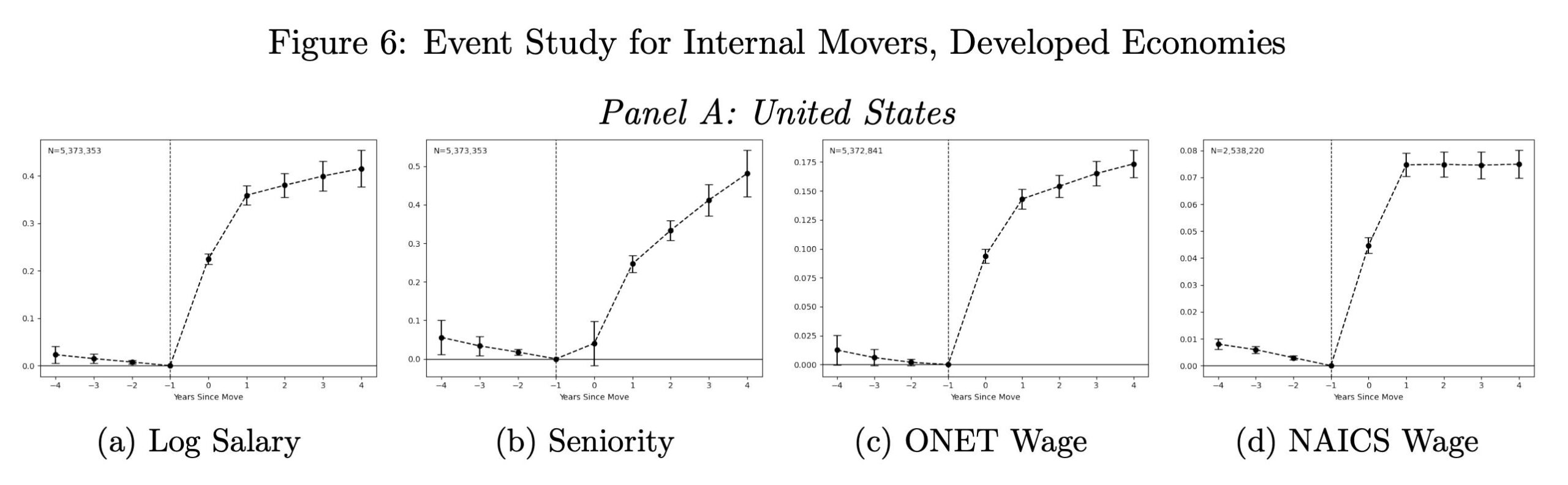
Source: Bhalothia et al, fig. 6.
As it turns out, that’s exactly what happens. Take recent research from economists at UC San Diego and Northwestern University. They use data on over 500 million LinkedIn users across 220,000 cities worldwide to ask how moving from one city to another affects an employee’s wages (a measure of their productivity). Because they observe the same people moving multiple times, they can disentangle the effects on wages of moving to a given city from the qualities of the people moving between cities.
The results are remarkable. The authors estimate that 93 percent of global wage variation is attributable to city effects, rather than to the qualities of workers themselves. That effect shrinks when you’re talking about movement within the developed world — someone moving from Bangalore to San Francisco gets a bigger wage bump than someone moving from Omaha to San Francisco, for example. But even looking at movers within their own developed country, cities explain something like 30 to 50 percent of the variance in wages.
In other words: it’s not just that people with better skills move to otherwise more desirable cities. Cities themselves make people worth more — meaning that they also increase total productivity and output, and therefore make the economy stronger.
How can it be that where you work is so important for how much you produce? The basic answer is what economists call agglomeration effects, the gains that come when firms cluster together. Agglomeration effects come, in general, from lowered barriers to exchange — of material goods, but also of ideas. Lots of start-up founders move to San Francisco because that’s where they can meet other start-up founders, and be on “the cutting edge” of what’s happening in their field. That’s only possible in a specific physical place.
Even if you put all the start-up founders in the same new part of Texas, moreover, they would still be worse off. Agglomeration economies come also from local culture and supportive industry infrastructure. Los Angeles as a city is built to support entertainers; San Francisco is built to support programmers. If you move those industries to Miami or Austin, neither city will be able to offer the same amenities — which is why both have struggled in their efforts to replace their Californian counterparts.
In other words: if California’s major industries leave California, they can’t be rebuilt somewhere else. Dismantle Silicon Valley, and you can’t just put it back together in Miami. We’ll still have technology companies, sure. But all else equal, they will be less productive than they would have been if they had stayed put. And we’ll all pay the price.