Quotulatiousness

September 5, 2025

End the “temporary” foreign worker scam!

Filed under: Bureaucracy, Business, Cancon, Government — Tags: , , , , — Nicholas @ 05:00

In the National Post, Chris Selley explains why Pierre Poilievre and the federal Conservatives should be hammering their demand to eliminate the much-abused temporary foreign worker program:

Youth unemployment stands at 14.6 per cent, according to Statistics Canada’s latest release. That’s the highest non-pandemic July figure since 2009 (15.9 per cent), at the nadir of the Great Recession. It makes nothing but good sense that Conservative Leader Pierre Poilievre would position himself, as he did on Wednesday, foursquare athwart bringing in any more temporary foreign workers to fill positions that certain employers swear blind they cannot fill with younger Canadians at any conceivable price.

“Why is (the government) shutting our own youth out of jobs and replacing them with low-wage temporary foreign workers from poor countries who are ultimately being exploited?” Poilievre asked, rhetorically, on Wednesday. By rights it ought to be a solid populist pitch to Canadians, and no-brainer policy besides.

Companies who use TFWs will insist it’s not about finding “cheaper” help, but about finding any help. Tim Hortons defended itself Wednesday noting that less than five per cent of its national workforce were TFWs — which seems like a very high number, right? It’s not just me? — and those hires tended to be clustered “in small towns and communities where local candidates are not available”.

But an odd sort of small town or community, surely, that can’t live without a Timmy’s, but that doesn’t have enough people to work at it. And it’s an odd sort of remedial program, surely, to bring in employees not from other parts of Canada but rather from halfway around the world. Especially since groups like the Canadian Federation of Independent Business (CFIB) swear blind they’re not after an hourly wage discount, just anyone who’s willing and able to fill the position. It was certainly a very odd kind of fishing resort, it struck me, that claimed this summer it couldn’t find any Canadian employees and needed the TFW program instead.

Didn’t kids used to flock en masse cross-country to take outdoorsy jobs every summer? Have I not read 150 tiresome baby-boomer op-eds on the topic?

The special pleading sometimes beggars belief. And unemployed young Canadians aren’t free to you and me, after all — whoever’s fault it is, if anyone’s, they’re an anchor on the economy. A Deloitte study commissioned by the King’s Trust Canada, published in November, estimated “that under the right conditions, overall real GDP could increase by $18.5 billion by 2034 — more than Canada’s entire arts, entertainment and recreation sector — and (Canada could) add an additional 228,000 jobs in the process” if “youth engagement in the workforce” significantly increased.

QotD: Hillary Clinton in the White House

Filed under: Government, Quotations, USA — Tags: , , , — Nicholas @ 01:00

As some of you know, I was the Air Force Military Aide for Bill Clinton, lived in the White House, traveled everywhere they traveled, and carried the “nuclear football”. As such, I was always in close proximity to both Bill and Hill.

Among the military who served in the White House and the professional White House staff, the Clinton administration was infamously known for its lack of professionalism and courtesy, though few ever spoke about it. But when it came to rudeness, it was Hillary Clinton who was the most feared person in the administration. She set the tone. From the very first day in my assignment.

When I first arrived to work in the White House, my predecessor warned me. “You can get away with pissing off Bill but if you make her mad, she’ll rip your heart out.” I heeded those words. I did make him mad a few times, but I never really pissed her off. I knew the ramifications. I learned very quickly that the administration’s day-to-day character, whether inside or outside of DC, depended solely on the presence or absence of Hillary. Her reputation preceded her. We used to say that when Hillary was gone, it was a frat party. When she was home, it was Schindler’s List.

In my first few days on the job, and remember I essentially lived there, I realized there were different rules for Hillary. She instructed the senior staff, including me, that she didn’t want to be forced to encounter us. We were instructed that “whenever Mrs. Clinton is moving through the halls, be as inconspicuous as possible”. She did not want to see “staff” and be forced to “interact” with anyone. No matter their position in the building. Many a time, I’d see mature, professional adults, working in the most important building in the world, scurrying into office doorways to escape Hillary’s line of sight. I’d hear whispering, “She’s coming, she’s coming!” I could be walking down a West Wing hallway, midday, busier than hell, people doing the administration’s work whether in the press office, medical unit, wherever. She’d walk in and they’d scatter. She was the Nazi schoolmarm and the rest of us were expected to hide as though we were kids in trouble. I wasn’t a kid, I was a professional officer and pilot. I said “I’m not doing that”.

There was also a period of time when she attempted to ban military uniforms in the White House. It was the reelection year of 1996, and she was trying to craft the narrative that the military was not a priority in the Clinton administration. As a military aide, carrying the football, and working closely with the Secret Service, I objected to that. It simply wasn’t a matter of her political agenda; it was national security. If the balloon went up, the Secret Service would need to find me as quickly as possible. Seconds matter. Finding the aide in military uniform made complete sense. Besides, what commander in chief wouldn’t want to advertise his leadership and command? She finally relented because the Secret Service weighed in.

The Clintons are corrupt beyond words. Hillary is evil, vindictive, and profane. Hillary is a bitch.

Buzz Patterson, Twitter, 2025-05-17.

September 4, 2025

They can’t catch actual criminals, but they are quite capable of arresting social media users

Filed under: Britain, Government, Law, Liberty, Media, Politics, Technology — Tags: , , , — Nicholas @ 04:00

Andrew Doyle hopes that the farcical performance by British police in sending five armed officers to arrest Graham Linehan as he stepped off the plane will be a tipping point:

How many more controversies will it take? The arrest of comedy writer Graham Linehan by five armed police officers as he landed at Heathrow Airport has become an international news story because it so self-evidently tyrannical. The stress of the ordeal raised his blood pressure to an alarming degree and he was rushed to hospital. With the help of the Free Speech Union, Graham is now suing the Metropolitan Police. You can donate to his crowdfunder here.

It is reassuring to see that some action is being taken against such chilling state overreach, but when will our politicians follow suit? Many of us have been warning about this ongoing assault on liberty for many years, and at every watershed moment we’ve been led to believe that something will be done. Then, inevitably, the “blob” is activated and swallows up any potential for progress in its viscous and undulating folds.

So when Sir Mark Rowley, head of the Metropolitan Police, complains that the police are acting on unclear laws, and that the responsibility for the maltreatment of the likes of Graham lies with those in power, he’s overlooking the impact of the activist middlemen. Let’s not forget that the Home Office has twice instructed the College of Policing to stop the recording of “non-crime hate incidents” (NCHIs) and has been ignored. Or that the chairman of the College of Policing, Lord Herbert, said the solution to the complaints about NCHIs might be to rename them. As though the public’s concerns about this brazen authoritarianism might be assuaged with a touch of rebranding.

Rowley’s buck-passing is likewise inadequate. He claimed that Graham’s arrest was necessary because officers “had reasonable grounds to believe an offence had been committed”, which is palpably untrue. He said: “I don’t believe we should be policing toxic culture wars debates and officers are currently in an impossible position”. He also made clear that police would continue to behave in this way “unless the law and guidance is changed or clarified”.

But this is precisely the problem. At present, a quango called the College of Policing trains officers in England and Wales. In my article for UnHerd about Graham’s arrest (which you can read here) I make the case that the College of Policing has become woefully unfit for purpose due to activist capture. For a long time, agitators within the system have reinterpreted and fudged the actual law in favour of what they would like it to be. This has led to some police acting in potentially criminal ways. Most egregiously, there is clear evidence of systemic bias against gender-critical individuals within the police force, and a reluctance to apply identical standards to trans activists who routinely post threats of death and rape and are rarely investigated for it.

In the wake of the Linehan arrest, Tom Knighton wonders why the US isn’t treating the UK as it would any other tyranny where free speech and other civil liberties are denied to the people on a whim or a suspicion:

The United States has a history of dealing with tyrannical governments, who oppose tyrannical governments we like even less. We worked with Saddam Hussein, for example, because he was at war with Iran.

But we never stopped pretending these weren’t tyrants.

So, it’s time we start treating the UK just the same.

The latest incident was a well-known comedian from the UK being arrested over a couple of jokes.

    Something odd happened before I even boarded the flight in Arizona. When I handed over my passport at the gate, the official told me I didn’t have a seat and had to be re-ticketed. At the time, I thought it was just the sort of innocent snafu that makes air travel such a joy. But in hindsight, it was clear I’d been flagged. Someone, somewhere, probably wearing unconvincing make-up and his sister/wife’s/mum’s underwear, had made a phone call.

    The moment I stepped off the plane at Heathrow, five armed police officers were waiting. Not one, not two—five. They escorted me to a private area and told me I was under arrest for three tweets. In a country where paedophiles escape sentencing, where knife crime is out of control, where women are assaulted and harassed every time they gather to speak, the state had mobilised five armed officers to arrest a comedy writer for this tweet (and no, I promise you, I am not making this up.

    … and then, a follow up to that one.

    When I first saw the cops, I actually laughed. I couldn’t help myself. “Don’t tell me! You’ve been sent by trans activists” The officers gave no reaction and this was the theme throughout most of the day. Among the rank-and-file, there was a sort of polite bafflement. Entirely professional and even kind, but most had absolutely no idea what any of this was about.

While the officers were kind, they still arrested him. They arrested him because he made some jokes. He spent time in a jail cell, was interviewed by detectives, and was treated like a criminal because he made some jokes.

They waited for him at the airport with five officers, something that would be a clear indication to others that he was truly dangerous, over some jokes.

The first one wasn’t a great joke, really, but that wasn’t the issue. This wasn’t that it wasn’t as funny as it should have been, but that it was made at all.

Net Zero targets and Britain’s ever-declining car industry

Filed under: Britain, Business, China, Environment, Government, USA — Tags: , , , , , — Nicholas @ 03:00

At the Foundation for Economic Education, Jake Scott charts the decline of the British auto manufacturing centres and the government’s allegiance to its Net Zero programs:

Custom image by FEE

Britain was once a giant of car manufacturing. In the 1950s, we were the second-largest producer in the world and the biggest exporter. Coventry, Birmingham, and Oxford built not just cars, but the reputation of an industrial nation; to this day, it is a source of great pride that Jaguar–Land Rover, a global automotive icon, still stands between Coventry and Birmingham. By the 1970s, we were producing more than 1.6 million vehicles a year.

Today? We have fallen back to 1950s levels. Last year, Britain built fewer than half our peak output—800,000 cars, and the lowest outside the pandemic since 1954. Half a year later, by mid-2025, production has slumped a further 12%. The country that once led the automotive revolution is now struggling to stay afloat, and fighting to remain relevant.

This is why the news that BMW will end car production at Oxford’s Mini plant, shifting work to China, is so damning, bringing this decline into sharp focus. The Mini is not only a classic British car; Alec Issigonis’s original design made it an international icon. For decades, the Mini has been the bridge between British design flair and foreign investment. Its departure leaves 1,500 jobs at risk at a time when the government is desperate to fuel growth and convince a wavering consumer market that there is no tension between industrial production and Net Zero goals.

It’s a bitter reminder that we in Britain have been here before: letting an industrial crown jewel slip away.

The usual explanations will be offered: global competition, exchange rates, supply chains. All true, in the midst of a global trade war that is heating up and damaging major British exports. But such a diagnosis is incomplete. The truth is that Britain’s car industry is being squeezed by a mix of geopolitical realignment and government missteps.

The car industry has become the frontline of a new trade war. Washington has already moved aggressively to shield its own firms: the Inflation Reduction Act offers vast subsidies for US-made EVs and batteries, an unapologetic attempt to onshore production, and something that became a flashpoint of tension in Trump’s negotiation with the EU in the latest trade deal. On the production side, the Act has poured billions into US manufacturing: investment in EV and battery plants hit around $11 billion per quarter in 2024.

Ripples have been sent across the world in the US’s wake: Europe, faced with a flood of cheap Chinese EVs, has imposed tariffs of up to 35% after an anti-subsidy investigation. Talks have even turned to a system of minimum import prices instead of tariffs. Unsurprisingly, China has threatened retaliation against European luxury marques, while experts warn the tariffs may slow the EU’s green transition by raising prices.

This is no longer a free market: cars are treated as strategic assets, the 21st-century equivalent of shipbuilding or steel. Whoever controls the supply chains, particularly for EV batteries and the mining of lithium, controls not only the future of the industry but an important lever of national power.

The results are visible. In July 2025, Tesla’s UK sales collapsed nearly 60%, while Chinese giant BYD’s deliveries quadrupled. Europe responded by talking up new tariffs. Britain did nothing. In this asymmetric contest, our market risks becoming a showroom for foreign producers — subsidizing both sides of the trade war without defending our own.

September 3, 2025

QotD: The distance between NHS PR and NHS reality

The uncritical national admiration, approaching worship, of the NHS has required the subliminal acceptance of a certain historiography: before the NHS, nothing; after it, everything. Before 1948, the poor received no treatment but were left to fend for themselves when they were sick, and more or less, to die. After 1948, the ever-solicitous state system looked tenderly after the health of the population from cradle to grave.

It wasn’t difficult to promote such historiography by using horror stories from the past, stories which were perfectly plausible because almost any conceivable system will give rise to such stories. If, per impossibile, a new system were to replace the NHS, it would not be difficult to justify it by reference to horror stories, whether or not the new system was better. A war of anecdotes, while always gratifying to the human mind, is not the way to decide important questions such as the superiority or inferiority of a system of health care. Only anecdotes that also illustrate statistical trends or truths are valuable in such a context.

The statistics are not favourable to the NHS, at least if one chooses reasonable standards of comparison, namely other European countries. The results are not disastrous, but they are not good either. The NHS has failed even in its egalitarian goal: the gap between the health of the richest and poorest in society has only grown under its dispensation. And yet the belief in its levelling effect persists.

The propaganda in favour of the NHS has been so successful that it now accords with the sentiments of the population, a triumph that no communist regime achieved despite herculean efforts at indoctrination. The triumph has been achieved without compulsion or violence and ought to be an interesting case for political scientists who study the successful inculcation of political mythology. Of course, the danger of such a study would be that it might induce doubt or cynicism about other political mythologies, and we all need such mythologies to live by.

Theodore Dalrymple, “Worshipping the NHS”, New English Review, 2020-05-07.

September 2, 2025

QotD: “Fixers” and “minders” for foreign visitors

Filed under: Bureaucracy, Cancon, China, Government, Quotations — Tags: , , — Nicholas @ 01:00

Old hands in some foreign places will remember that there are fixers and minders. Fixers are hired by e.g. corporations and news organizations and by embassies to help executives, reporters and senior officials (I was never senior enough ~ I think it was limited to Assistant Deputy Ministers, sometimes directors-general if they were heads of delegation) in strange places. Fixers were interpreters, guides and general helpers, sometimes even bodyguards. Minders did everything fixers did, usually (in my limited experience) better, but they were official; mine was assigned by the Chinese Ministry of Defence and I had no choice about her ~ thankfully she was pleasant and efficient. My minder had a seemingly magical ID card; she was able to move us to the front of almost every line and upgrade air and rail tickets (all at no charge), something that fixers could not do. Of course, she had other duties which included ensuring that I did NOT see or hear what I was not supposed to see or hear. It was just part of dealing with official China.

Ted Campbell, “A new front in Cold War 2.0”, Ted Campbell’s Point of View, 2020-06-26.

September 1, 2025

QotD: The Ivy League

Filed under: Bureaucracy, Education, Government, Humour, Quotations, USA — Tags: , , , — Nicholas @ 01:00

I’ve been around Ivy Leaguers, y’all, and everything you think is true about them IS true, in spades. The Ivy League is “elite”, all right, but it’s surely not because of the education.

The Ivies are now what they’ve pretty much always been — the equivalent of those Higher Party Academies in Moscow. They’re finishing schools for the Apparat. Oh sure, you can probably find a graduate of Ohio State or some such place at Quantico or Foggy Bottom … but I promise you, he hears about it every single day of his life. If they don’t actually teach classes called “How to be a Toady in the DOJ” and “Catching a Senator’s Farts” at Dartmouth, they might as well.

Take your Basic College Girl, make her unisex, crank her up way past eleven on meth and steroids, and that’s the typical Ivy League grad. And they all go directly into Government. Just in case you still cherished some vague hope we could vote our way out of this, remember that guys like Robert McNamara and McGeorge Bundy were the absolute best the Ivy League has produced in the modern era. The Democratic People’s Republic of Vietnam says hi!

Severian, “First Mailbag of the New Year”, Founding Questions, 2022-01-07.

Update, 2 September: Welcome, Instapundit readers! Please do have a look around at some of my other posts you may find of interest. I send out a daily summary of posts here through my Substackhttps://substack.com/@nicholasrusson that you can subscribe to if you’d like to be informed of new posts in the future.

August 31, 2025

Didn’t we once have “conflict of interest” rules for politicians?

Filed under: Business, Government, Media, Politics, USA — Tags: , , , , — Nicholas @ 03:00

It’s become a commonplace that politicians leave office vastly wealthier than they went in, far in excess of their official salaries. Once upon a time, even though it probably still happened, the fat cats managed to stay below the event horizon with their ill-gotten gains. Today, they no longer care if you find out that this or that senator has consistently beaten the market on their investments during their entire time in office. After all, what are you going to do about it, punks? Maybe something like this:

Paul and Nancy Pelosi, 16 February, 2022.
Detail of a photo by Amos Ben Gershom via Wikimedia Commons.

The original research was on how Senators seem to make 12% annually. That’s, erm, a lot.

Markets — something that always comes as a surprise to politicians — react:

    American lawmakers are so consistently successful that a flurry of new platforms and apps now compile filing data from US politicians as a key input in strategies for retail investors and even hedge funds.

    The number of people using these so-called “copy trading” strategies has exploded. Tens of thousands of Americans now follow and imitate trades made by members of Congress, and they are making millions of dollars in the process.

OK, what fun, eh?

Even more fun would be Megan McArdle’s suggestion, that the CongressThieves must announce that they intend to trade an hour before they do so that everyone else can front run them.

Because, you know, Ms. Pelosi:

    She beat every single hedge fund last year.

But there’s something even more fun:

    Dub launched in March 2024 as America’s first regulated brokerage to offer copy trading accounts to mimic politicians and star traders.

    “It’s been absolutely insane in terms of growth,” says Steven Wang, the founder and chief executive who dropped out of his freshman year at Harvard to build the platform. Today, it has 1.5 million users across America.

    Of the $100m or so invested across Dub, nearly $23m is in its Pelosi tracker account. Since its launch in early 2024, its paper gains are 172pc.

Stock prices do not move “because”. Interest rates change, profits go up, or down, or tariffs or … stock prices change because people buy and or sell more of them. That may be in reaction to those other things but the actual price movement is that buy and sell stuff.

Which means that if we copy Nancy’s trades — after she’s done them — then we’re making money for Nancy. Because we are piling in our weight of money into a position she already holds.

Which, when you think about it, is really pretty shitty. Sure, it’s nice to make money ourselves by trading upon that congressional information. But there is that very, very, heavy cost of making Ms. Pelosi even richer as a consequence.

August 30, 2025

Canada’s economy is going the wrong way

Filed under: Cancon, Economics, Government, Media, Politics, USA — Tags: , , , — Nicholas @ 03:00

The latest figures show the US economy growing by 3.3% while Canada’s shrank by 1.6% in the same period. It’s bad news for Canadians, except those like Prime Minister Mark Carney who have the bulk of their investments in the United States (91% for Carney, according to various sources). On X, Dan Knight explains what is happening:

Canada’s economy just shrank. That’s the headline. In the second quarter of 2025, real GDP fell 0.4%. On a per-person basis, it was the same. Canadians are poorer than they were three months ago. That’s not speculation. That’s Statistics Canada’s official number.

So, here’s what happened. The government and its media allies spent the spring bragging that the Canadian economy “grew” in the first quarter of 2025. Real GDP was up half a percent. Sounds good, right? But if you read the fine print, if you look at the numbers it wasn’t real growth at all. It was panic.

Exporters rushed to push product into the United States before tariffs came down. Automakers. Machinery producers. Parts suppliers. They all jammed as much across the border as they could, knowing the window was closing. That sugar high showed up in the Q1 GDP number. It made the economy look like it was humming along.

Then the tariffs hit. And in the second quarter, the bottom fell out. Exports collapsed down 7.5% overall. Passenger cars and light trucks? Down nearly 25%. Machinery and equipment? Down 18.5%. Travel services? Down 11%. The result: GDP fell 0.4%. On a per-capita basis, it was exactly the same. Canadians are literally poorer than they were three months ago.

This is the story you’re not hearing: Q1 wasn’t proof of a healthy economy. It was proof of a desperate one. Businesses scrambling to get ahead of trade barriers, because they knew Ottawa wasn’t going to stop them. Q1 was fake growth, and Q2 was the crash.

Meanwhile, households are spending more, saving less, and wages are barely moving up just 0.2%, the slowest since 2016 outside of COVID. Corporate profits are falling. Government revenues are down since the carbon tax was lifted. And Ottawa’s answer? Spend more. Borrow more. Pretend it’s all fine.

So the question is simple: if this is what “growth” looks like under Mark Carney’s Liberal government front-loaded exports, collapsing investment, rising debt what does the next quarter look like?

On her Substack, Melissa Lantsman says that the economic situation in Canada is discouraging investors from putting money into Canadian companies:

You don’t need to be a foreign investor to see that putting your money into Canada is not a winning move.

Recently, Statistics Canada reported “strong foreign divestment in Canadian shares” across many sectors, including energy, mining, and manufacturing. At the same time, Canadian buyers also moved their money stateside, purchasing $13.4 billion of foreign securities in just one month.

If this were a small, short-term blip, it would be easy to dismiss it as market noise or an aberration. But that’s not the case: Statistics Canada found four consecutive months of net divestment from the Canadian economy, adding up to $62 billion in lost capital.

And that’s not to mention that every year since 2015 has seen more Canadian investment going abroad than foreign investment coming here. For those keeping track, this is the fastest rate of divestment in Canada since the Great Recession.

What does this all mean?

From an investor’s point of view, there’s no sugar-coating it. Canada is, simply put, an unattractive place to invest hard-earned cash. People making financial decisions for the future don’t have confidence in the Canadian economy to make them money.

From a government’s point of view, it should mean alarm bells ringing left, right, and centre. Lower investment in Canada translates into lower productivity, fewer employment opportunities, less government revenue, and a weaker Canadian dollar, leaving us all worse off.

But why is this happening in the first place?

According to the C.D. Howe Institute, the culprits are familiar: high taxes, regulatory barriers, policy uncertainty, and anti-growth mindsets that penalize success and demonize the private sector.

Anyone who has been paying attention for the last ten years knows that’s exactly what’s been happening. Nothing says “Welcome to Canada” to investors quite like a hike in the capital gains tax at the last minute, chaos at the CRA, multi-year project approval processes, and the highest deficits on record.

And anyone serious about fixing the problem would do the exact opposite of what the last government did. But when your new government is the same as the old one, it’s hard to believe Canadians will get the bold economic transformation this country desperately needs.

August 28, 2025

No surprise at all – Liberals completely overshoot temporary foreign worker targets

Filed under: Business, Cancon, Government — Tags: , — Nicholas @ 03:00

In the National Post, Tristin Hopper confirms that the Mark Carney government, having promised to cap temporary foreign worker visas at 82,000 for the year, have already brought in over 100,000 TFWs in the first six months:

Despite promises from the Liberal government that they would be curbing the sky-high immigration rates of the Trudeau era, new data from Immigration, Refugees and Citizenship Canada shows that Canada is already on track to exceed its 2025 targets.

In the first seven months of 2025, Canada accepted 246,300 new permanent residents, according to data released last week by IRCC.

If this level of intake keeps up for the rest of the year, Canada is on track to bring in approximately 422,000 new permanent residents by year’s end.

[…]

And the missed targets are even more stark when it comes to categories of temporary migrants.

For the entirety of 2025, Canada was only supposed to approve 82,000 entries under the Temporary Foreign Worker Program.

Nevertheless, Government of Canada data shows that 105,195 Temporary Foreign Worker permits were awarded in just the first six months of 2025.

Temporary migration has been disproportionately responsible for the record-breaking population growth witnessed in Canada over the last four years. Since 2021, Canada’s population has grown from 38 million to 41.7 million. This represents an average annual increase of 900,000, which puts Canada well beyond the population growth rates of any other G7 country.

In late 2024, Statistics Canada estimated that the country was home to an unprecedented three million “non-permanent residents,” be they international students or temporary foreign workers.

Temporary migration is also the category on which Ottawa has promised to crack down hardest. Late in 2024, when then prime minister Justin Trudeau announced plans to “turn off the taps” on immigration, temporary migrants represented seven per cent of the overall Canadian population.

August 26, 2025

“One of the top tips for having a decent country is never, ever, allow the fuckwits to gain power”

If you need to drop someone off at London’s Gatwick Airport, you’ll find yourself facing a £7 charge for the privilege, no matter what day of the week or time of day you choose. Tim Worstall explains why:

“Gatwick Airport, North Terminal” by Martin Roell from Berlin, Germany is licensed under CC BY-SA 2.0 .

It’s sod all to do with congestion and everything to do with the tractor production statistics the fuckwits have imposed upon the airport.

    The conditions attached by the transport secretary included national landscape provisions as per the Levelling Up and Regeneration Act 2023, more consideration for sustainability in buildings design and additional pollution-related mitigation measures.

    The government said in its formal response to the Planning Inspectorate’s recommendations on the Gatwick DCO that it wanted more detail on how it would achieve its commitment of 54% of passengers arriving at the airport via rail within the first year of dual runway operations, which could be by the end of this decade.

The government has a target. That 54% of the arrivals at an airport — yes, an airport, where people get on jet planes — must be by public transport. Therefore the airport is charging for car drop offs in order to decrease the number of car drop offs. There is no more reason than that. Or, as up at the top, the reason there’s a £7 drop off charge at Gatwick Airport is because we are ruled by the fuckwits who have a target for public transport to an airport where people then get on jet planes.

    London Gatwick has also accepted a requirement to have 54% of passengers using public transport prior to bringing the Northern Runway into operation and has reiterated the need for third parties, including the Department for Transport, to support delivery of the necessary conditions and improvements required to meet this target. This would include, for example, reinstating the full Gatwick Express train service.

    Given the reliance on other parties to achieve this 54% target, should it not be achieved then London Gatwick has also proposed an alternative cars-on-the-road limit to be met before first use of the Northern Runway to address concerns about possible road congestion. Furthermore, if neither the 54% transport mode share or the cars-on-the-road limit are met, then use of the Northern Runway would be delayed until £350m of road improvements have been completed. This would make sure any additional road traffic flows can be accommodated and any congestion avoided.

It’s all fuckwit targets set by fuckwits.

Of course, there are those who think that fuckwit targets set by fuckwits are a good idea. For one of the problems of life is that there are always fuckwits:

    When we talk about airport expansion, we often focus on runways, terminals, and the physical infrastructure. But what about how people actually get to the airport?

    The journey begins long before passengers step foot in a terminal, and their choices about transport can have a significant impact on congestion, carbon emissions, and overall passenger experience.

    One of the conditions set for Gatwick’s expansion is a legally binding guarantee that 54% of passengers will travel by public transport, up from today’s 44%. On the surface, it sounds like a simple shift. But transport isn’t just about availability — it’s about behaviour, convenience, and incentives.

One of the top tips for having a decent country is never, ever, allow the fuckwits to gain power. But we have done so therefore there is this £7 charge for a drop off at Gatwick Airport. That’s it, there is no other reason. There are fuckwits buried in the belly of the British state and they’re making the rules now.

Table saws, technological patents, and rent-seeking

Tom Knighton, who I’ve “met” on my favourite woodworking forum, celebrates a small victory in the never-ending battle against the rent-seekers of the corporate world:

“SawStop” by Comfr is licensed under CC BY-SA 4.0 .

What does this have to do with rent-seeking?

Well, there’s a company called SawStop. They make really great table saws with a unique safety feature. They’re equipped with a brake and sensor that, when it detects moisture such as one might find in a human finger, it locks the saw and drops the blade down into the saw’s body.

It’s a really great bit of technology, and the saws happen to be really good saws, too, so the company has done well for itself.

However, it started out as a company seeking to license the technology, only no one wanted it at the time.

SawStop decided to try and press the United States government to mandate their technology on all new table saws, and the government was going to.

Was.

This video has a good rundown of the whole thing. (I’d embed it, but the channel doesn’t allow it for some reason.)

The short of it is that the rule that was being considered has now been tossed because it would specifically give SawStop a monopoly on table saw sales in the United States, legally. Yes, they were going to offer up a patent for the public domain, but it wouldn’t be enough to replicate the technology in and of itself.

Plus, at a time when woodworking isn’t the biggest hobby in the world, even if it had been enough, driving up the cost for a central piece of tooling that most consider essential for woodworkers ain’t the way to change that.

For example, Skil makes a jobsite saw that typically runs under $300. SawStop’s equivalent is around three times that much, and that’s a lot of money to spend on something you’re not sure you’ll even enjoy.

Especially since just being careful can prevent the need for the brake in the first place, to say nothing of the fact that if you cut wet wood, it’ll trigger the brake, which is a pain for a lot of people, especially building contractors whose lumber isn’t super dry to begin with.

Seeing the rug pulled out from under SawStop is great, but the real issue here is that it doesn’t happen often enough. Rent-seeking is all too common and all too often works.

August 25, 2025

QotD: The rise of the state … the rise of the egregore

You may have noticed that [Against the Grain author] James C. Scott is not a fan of the state. He tends to describe it as a sort of alien intrusion into the human world, an aggressive meme that’s colonized first our material environment and then our minds, imposing its demands for legibility in order to expropriate innocent peasants:

    Peasantries with long experience of on-the-ground statecraft have always understood that the state is a recording, registering, and measuring machine. So when a government surveyor arrives with a plane table, or census takers come with their clipboards and questionnaires to register households, the subjects understand that trouble in the form of conscription, forced labor, land seizures, head taxes, or new taxes on cropland cannot be far behind. They understand implicitly that behind the coercive machinery lie piles of paperwork: lists, documents, tax rolls, population registers, regulations, requisitions, orders — paperwork that is for the most part mystifying and beyond their ken. The firm identification in their minds between paper documents and the source of their oppression has meant that the first act of many peasant rebellions has been to burn down the local records office where these documents are housed. Grasping the fact that the state saw its land and subjects through record keeping, the peasantry implicitly assumed that blinding the state might end their woes. As an ancient Sumerian saying aptly puts it: “You can have a king and you can have a lord, but the man to fear is the tax collector”.

This “state as egregore” language recurs throughout the book. Scott writes that the state “arises by harnessing the late Neolithic grain and manpower module as a basis of control and appropriation”. It “battens itself” on the concentration of grain and manpower to “maximiz[e] the possibilities of appropriation, stratification, and inequality”, and with its birth “thousands of cultivators, artisans, traders, and laborers [are] … repurposed as subjects and … counted, taxed, conscripted, put to work, and subordinated to a new form of control”.1 But it’s vital to remember that this metaphor is just a metaphor: the state isn’t actually an alien brainworm or a memetic infohazard that will hijack your neocortex the moment you set eyes on a triumphal arch and force you to spend the rest of your life making lists of things and renaming roads with numbers;2 it’s just an institution that people have invented, because hierarchy and inequality are inescapable facts of life in a society of any scale and the state is a particularly effective bundle of social technologies to leverage those hierarchies. There’s a reason that, after states had their “pristine” invention at least three separate times, they’ve proliferated across every part of the world that can support them!

But more interesting than “are we better off with the state?” is to ask ourselves, as Ronald Blythe does in Akenfield, what has been lost. Here Scott offers some fascinating musings on the way not merely the state but the entire agriculturalist life-world limits us:

    We might … think of hunters and gatherers as having an entire library of almanacs: one for natural stands of cereals, subdivided into wheats, barleys and oats; one for forest nuts and fruits, subdivided into acorns, beechnuts, and various berries; one for fishing, subdivided by shellfish, eels, herring, and shad; and so on. … one might think of hunters and gatherers as attentive to the distinct metronome of a great diversity of natural rhythms. Farmers, especially fixed-field, cereal-grain farmers, are largely confined to a single food web, and their routines are geared to its particular tempo. … It is no exaggeration to say that hunting and foraging are, in terms of complexity, as different from cereal-grain farming as cereal-grain farming is, in turn, removed from repetitive work on a modern assembly line. Each step represents a substantial narrowing of focus and a simplification of tasks.

The Neolithic Revolution, he argues, was like the Industrial Revolution, a great boost to human productivity and social complexity but at the same time a de-skilling. The surface area of our contact with the world shrank from hundreds of plants and animals, used in different ways at different times of year, to a mere handful of domesticates whose biological clocks became the measure of our lives. Of course, the modern contact area is smaller still — dimensional lumber purchased from a store in place of felling and milling your own trees, natural gas at the turn of a knob with nary a need to build a fire — and is sometimes reduced all the way to your fingertip on a smooth glass screen. The ease and efficiency are undeniable, and I’m sure a forager or premodern farmer would kill for Home Depot and seamless pizza delivery (I certainly wouldn’t want to give them up). But there has been “a contraction of our species’ attention to and practical knowledge of the natural world” because that knowledge and attention is no longer necessary, and I think that Scott is right to suggest that there is something richer about a more extensive involvement with the world. That said, Scott’s case is somewhat overstated: after all, even hunter-gatherers have specialized craftsmen who engage deeply with particular materials at the expense of other endeavors, and farmers3 have a far more intimate relationship with their animals than a hunter does with his many different kinds of prey. Similarly, farmers may be on one particular bit of land but (especially in a preindustrial context) all that plowing and hedging and draining and spiling, not to mention the gathering of various woodland foodstuffs, can rival forager familiarity when it comes to their bit of landscape. (My new favorite poem is Kipling’s “The Land“, on just this idea.)

Scott closes the book with an elegy for the “late barbarians”, who had the best of both worlds: healthier and longer-lived than farmers, and with greater leisure, they were “not subordinated or domesticated to the hierarchical social order of sedentary agriculture and the state” but were still able to benefit tremendously from lucrative trade with those states. Unfortunately, much of that trade was in weaker non-state peoples whom they captured and sold as agricultural slaves, thereby “reinforc[ing] the state core at the expense of their fellow barbarians”, and much of the rest was in their own martial skills as mercenaries (which of course also served to protect and expand the influence of the state). It’s a salutary reminder for the aspiring modern barbarian: the best place to be is just outside the purview of the state, where you can reap its benefits4 without being under its control. But beware, because in a world of states even those “outside the map” must fill niches created by the state. It’s great to have a cushy work-from-home laptop job that lets you live somewhere nice, with trees and no screaming meth-heads on your subway commute, but more land comes under the plow every year, and your time, too, may come.

Jane Psmith, “REVIEW: Against the Grain, by James C. Scott”, Mr. and Mrs. Psmith’s Bookshelf, 2023-08-21.


  1. And of course Scott argues that the state is a parasite in the most literal way, since the word derives from the Greek παρά “beside” + σῖτος “grain.”
  2. Although this would be a pretty sweet novel, sort of a Tim Powers alt-history: anarcho-primitivist occultists go back in time to ancient Mesopotamia to destroy the me of kingship and render the state metaphysically impossible. Someone write this.
  3. Like Scott, in fact, who keeps sheep on 46 acres of Connecticut. There’s a funny little aside in the book where he complains about people using “sheeplike” in a derogatory sense, given that we’ve spent several millennia selectively breeding sheep to behave that way.
  4. Better yet, wait for the peasants to do the reaping then ride in on your shaggy little ponies and take it all. Uh, metaphorically.

August 23, 2025

“Trump … sees transshipment and nearshoring as sneaky workarounds”

Filed under: China, Economics, Government, Politics, USA — Tags: , , , — Nicholas @ 05:00

At the Foundation for Economic Education, Jake Scott explains Donald Trump’s latest anti-trade moves:

President Donald Trump’s executive order of July 31st, effective August 7th, has upended global trade dynamics in a single stroke. Slapping a 40% tariff on all “transshipped goods” — products rerouted through third countries to dodge US duties — this is merely the natural development of his evolving protectionist agenda.

Just a week after the order, the move is a clear shot at China’s sprawling manufacturing empire, which has long exploited methods like transshipment and “nearshoring” to skirt American tariffs in general, and Trump’s tariff policies in particular.

While applied globally, China stands to take the biggest hit (and likely already is), with its vast factory networks and knack for rerouting goods through Southeast Asia, Mexico, and beyond. This isn’t just a tariff hike; it’s a calculated escalation in Trump’s ongoing crusade to reshape US trade policy and the global economy in the United States’ favor. But ripple effects that bruise consumers are already visible — and this move is likely to strain relationships with key allies as well.

The new tariffs build on Trump’s first-term strategy — so extensive that it now has a Wikipedia entry — when he wielded America’s economic heft like a sledgehammer to renegotiate or smash trade deals he deemed unfair. Back then, Chinese firms sidestepped US tariffs by setting up shop in countries like Vietnam and Mexico, funneling goods through these hubs to mask their origins.

This nearshoring strategy buoyed many economies that had pre-existing arrangements with the United States or were treated more favorably than China, such as Canada and Latin American nations. It is also seen as a natural part of globalization: shipping parts from where they are constructed (like China), assembling them in developing nations (like Mexico), and then exporting to high-value markets (like the United States). Nearshoring has a long history, but the fragility of extended global supply chains was exposed in the Covid pandemic; since then, manufacturers have sought to mitigate their damage.

The US trade deficit with China (roughly $295 billion) has long been a sore point for Trump, who sees transshipment and nearshoring as sneaky workarounds. The 40% duty on these goods, layered atop existing tariffs, aims to plug this loophole. As Stephen Olson, a former US trade negotiator, noted in the New York Times, China will likely view this as a direct attempt to “box them in”, potentially souring already tense talks.

August 22, 2025

Resolved – This country’s youth will not fight to defend this country

Filed under: Cancon, Government, Military — Tags: , , — Nicholas @ 03:00

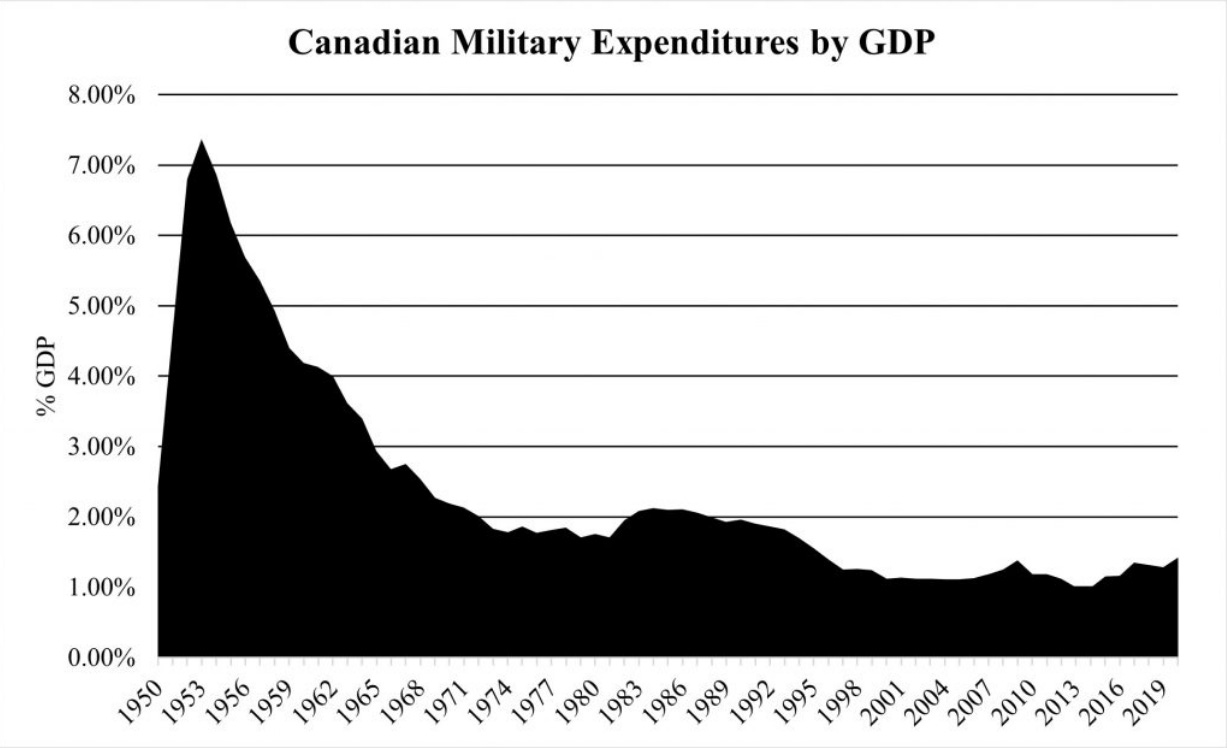
On Tuesday, John Robson discussed the results of a recent Angus Reid survey that, among other things, indicated that Canadians are at least as anti-military as they’ve been since the first Trudeau government:

Canadian soldiers set a perimeter position after disembarking a U.S. Navy landing craft during a simulated amphibious landing, 24 April 2009.
U.S. Coast Guard photo by Petty Officer Seth Johnson via Wikimedia Commons.

The National Post reports an Angus Reid survey finding that a significant majority of us favour compulsory voluntary service by the youth of today. Which might sound like a bracingly traditional Jordan Peterson clean-your-room, stand-up-straight, shoulders-back attitude until you read the fine print, which would risk making Peterson ill if he weren’t already. Because it turns out we want to conscript them to work in health care so we get stuff we didn’t pay for, not to defend the country because if ye break faith and so on.

According to the survey, 74 per cent of respondents want young people to have to give a year of their lives to bolstering our failing, structurally unsound socialized medical system. Respondents were also in favour of mandatory service in support of the environment (73 per cent), “youth services” (72 per cent), whatever it might be, and “civil protection” (70 per cent). But when it comes to (ugh) national defence, just 43 per cent supported it, with 44 per cent opposed.

Spending on comfort while barbarians undermine the city walls lacks prudence as well as dignity. As I observed in a long-ago graduate-school debate about American national security, it didn’t matter how wonderfully progressive the Dutch social welfare system was in 1940 when the Nazis came calling. And we too seem to have our priorities backward.

If I might confuse the government by discussing principles of political economy, there are good reasons why national defence is considered a binding duty on those able to contribute to it. First is the “free rider” problem that everyone benefits from successful protection of the community, especially, at least in a narrow and hedonistic sense, if you send some other chump to die for your freedom while you recline comfortably at home.

Second is the moral consideration that, as John Stuart Mill famously if uncharacteristically put it, “War is an ugly thing, but not the ugliest of things: the decayed and degraded state of moral and patriotic feeling which thinks that nothing is worth a war, is much worse”. Which comes from, yes, his “Principles of Political Economy”.

Mill was no warmonger. As he immediately continued, “When a people are used as mere human instruments for firing cannon or thrusting bayonets, in the service and for the selfish purposes of a master, such war degrades a people”.

But not all wars are like Russian President Vladimir Putin’s invasion of Ukraine, let alone Hamas’s attack on Israel. As the anything-but-bellicose Mill added, “A war to protect other human beings against tyrannical injustice; a war to give victory to their own ideas of right and good, and which is their own war, carried on for an honest purpose by their free choice — is often the means of their regeneration”.

« Newer PostsOlder Posts »

Powered by WordPress