
The Great War
Published on 25 Jun 2018The 369th Infantry Regiment from Harlem, New York was an all-black unit that served on the Western Front. But not under American command, but loaned tot he French Army.
June 26, 2018
Henry Johnson And The Harlem Hellfighters I WHO DID WHAT IN WW1?
Comments Off on Henry Johnson And The Harlem Hellfighters I WHO DID WHAT IN WW1?
June 19, 2018
Time to throw Mutti Merkel under the bus?
Sabine Beppler-Spahl thinks Angela Merkel’s time is running out:
Angela Merkel’s days may be numbered. ‘She will never recover from this crisis’, said an article in a German newspaper last week, about the rift within her government over immigration.
This latest crisis began after the interior minister, Horst Seehofer, announced that he wanted to introduce tougher rules for asylum seekers, including turning away those who have already been registered in another EU country. Merkel responded by saying that Europe needed a common solution to the refugee crisis, and that she would discuss it with French president Emmanuel Macron during his upcoming visit, and at the EU summit later this month. She blocked Seehofer from unveiling his immigration ‘master plan’, and he has insisted that a solution should be found by today. He has also threatened to sidestep Merkel and impose his plan regardless, leading to speculation about a government breakdown, and a confidence vote, little more than 100 days since the new ruling coalition, led by Merkel’s Christian Democratic Union (CDU), was formed.
[…]
Merkel’s decision to put the brakes on Seehofer’s ‘master plan’ reflects her evasive and anti-democratic style. No voter has yet been able to read this plan, let alone discuss it. Her concern about publishing it reflects the contempt in which she holds democratic debate. Meanwhile, her carefully prepared statements on the issue (mostly in the form of TV interviews with choice journalists or her own weekly podcast) rarely tell us very much at all. Despite opening Germany’s doors to refugees in 2015, she has never made a proper public case for the benefits of immigration. Her inability, or unwillingness, to explain her politics to the electorate has contributed to the narrow and technical way in which immigration is being discussed in Germany these days, with a focus on numbers and deportation practices.
Taking an issue to the ‘European level’ has become Merkel’s default solution to everything. ‘This is a European challenge that also needs a European solution’, she said in her latest podcast. Of course, a joint European solution would be preferable, but not if this means bypassing national electorates. Her original plan of imposing migrant quotas on other EU member states has failed completely. Excluding the public from the debate, and discussing politics behind closed doors, is simply not cutting it with voters. Whatever one thinks of Seehofer’s ‘master plan’, he is right that immigration needs to be discussed and decided upon at the democratic, national level.
Comments Off on Time to throw Mutti Merkel under the bus?
June 18, 2018
The Only German Submarine Attack On US Shore in WW1 I OUT OF THE ETHER
The Great War
Published on 16 Jun 2018Paul Hodos’ Book about U-Kreuzer: https://amzn.to/2JzXkIY
After a long time, we are back with our format Out Of The Ether and this week we tell you about the only time Germany directly attacked US mainland with a submarine.
Comments Off on The Only German Submarine Attack On US Shore in WW1 I OUT OF THE ETHER
June 17, 2018
June 15, 2018
The French Counter Attack At Matz I THE GREAT WAR Week 203
The Great War
Published on 14 Jun 2018The French have cracked the German radio code on the Western Front and use their advantage for a counterattack at Matz. The already hastily planed German attack during Operation Gneisenau is called off after just 4 days. Meanwhile Austria-Hungary plans another offensive in Italy and German and Ottoman forces fight each other in Georgia.
Comments Off on The French Counter Attack At Matz I THE GREAT WAR Week 203
QotD: Churchill on Montgomery
There was a brief firestorm in Britain when a photograph appeared in the press of Montgomery and Gen. Wilhelm Ritter von Thoma, the commander of the Afrika Korps and the highest-ranking German captured at Alamein. After his capture Thoma was brought to the Eighth Army command post, where Montgomery accorded him the respect of one honorable professional soldier to another. The two dined that night, and the photograph of the two generals led Brendan Bracken to send Churchill a memo criticizing Montgomery’s naïveté and noting that it created a bad impression with the public. Churchill merely commented: “I sympathize with Gen. von Thoma. Defeated, humiliated, in captivity, and,” after pausing for effect, “dinner with General Montgomery.”
Carlo d’Este, Warlord: A life of Winston Churchill at war, 1874-1945, 2008.
Comments Off on QotD: Churchill on Montgomery
June 12, 2018
G7 minus one
Justin Raimondo on the well-shared image of Angela Merkel and her associates apparently trying to browbeat Donald Trump at the G-7 meeting (this version from Raimondo’s article):
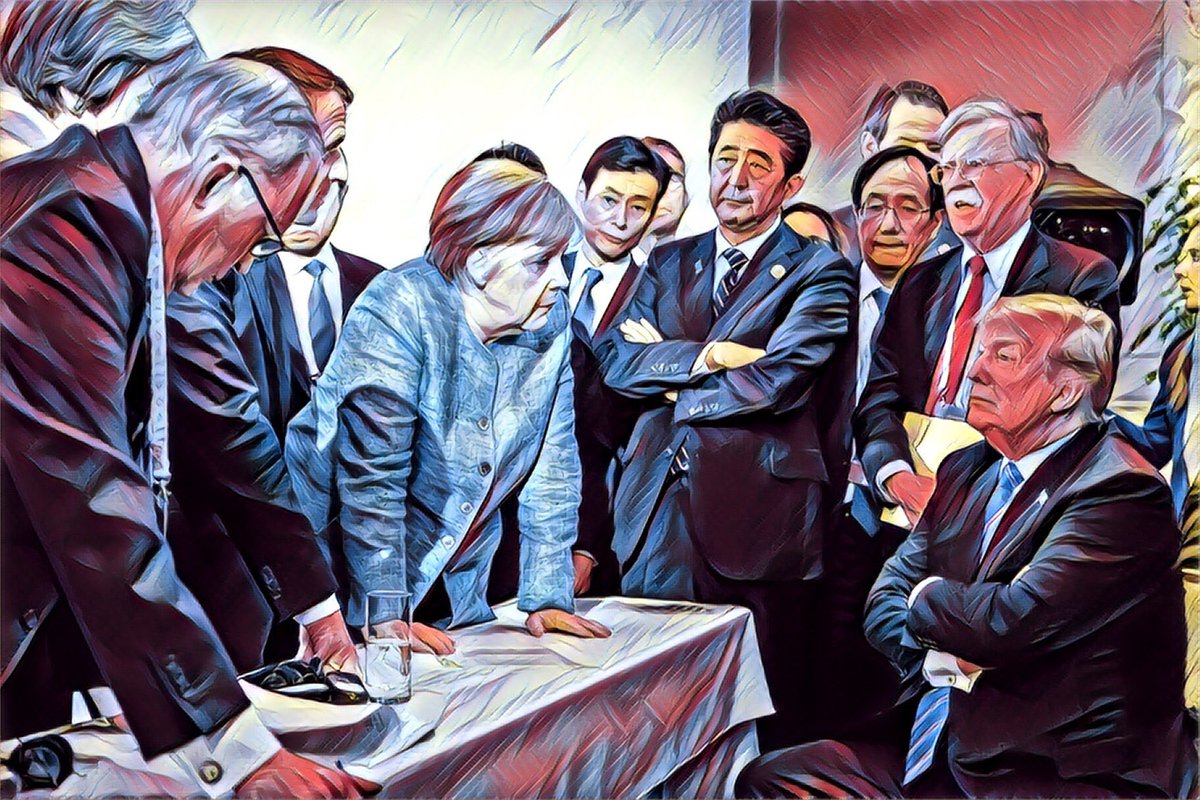
All the Very Serious People are tweeting and retweeting this “iconic” photo of Trump surrounded by the Euro-weenies, with Angela Merkel seeming to lecture the President while the rest of our faithless “allies” look on. It’s “America Alone” – the visual representation of the internationalist worldview: Trump’s policy of “America First” is “isolating” us, and, according to clueless leftists like Michael Moore, Merkel is now the “leader” of the “free world.”
This last is good news indeed, for if Merkel is the new leader of the “free world” then the stationing of 35,000 US troops in Germany – at a cost of billions annually – is no longer required and we can bring them home. This also means Germany, rather than the US, will be sending troops all over the world to fight “terrorism” – a move that is sure to cause consternation in certain regions with a history of German intervention, but hey, somebody has to do it!
The political class is screaming bloody murder over Trump’s performance at the G-7 meeting in Canada, where he reportedly spent most of the time detailing how much the US was paying for the defense of our vaunted “allies,” not to mention the high tariffs imposed on American goods. He then proposed a “free trade zone” in which member countries would drop all tariffs, subsidies, and other barriers to trade: the “allies” didn’t like that much, either. Nor did the alleged advocates of free trade here in the US give him any credit for ostensibly coming around to their point of view. Which reminds me of something Murray Rothbard said about this issue: “If authentic free trade ever looms on the policy horizon, there’ll be one sure way to tell. The government/media/big-business complex will oppose it tooth and nail.”
Of course the Euro-weenies don’t want real free trade: after all, they practically invented protectionism. What they want is a free ride, at Uncle Sam’s expense, and the reason they hate Trump is because they know the freebies are over. However, what really got the Usual Suspects frothing at the mouth was Trump’s insistence that Russia be readmitted to the G-8:
“I think it would be good for the world, I think it would be good for Russia, I think it would be good for the United States, I think it would be good for all of the countries in the G-7. I think having Russia back in would be a positive thing. We’re looking to have peace in the world. We’re not looking to play games.”
The “experts” went crazy when he said this: our “allies” are being insulted, they wailed, while our “enemies” are being “appeased.” It’s sedition! Russia! Russia! Russia!
Eric Boehm says that the White House’s justification for imposing tariffs on national security grounds may have been undermined through Trump’s tweets hitting back after what he clearly felt was Justin Trudeau’s hissy fit (although Trudeau didn’t exactly break new ground or say anything radically different in his comments):
The Trump administration has spent months trying to construct a rather flimsy argument that steel and aluminum imports from Canada and other close American allies constitute a national security threat. More than a handy way to drum up public support for trade barriers, the “national security” claim is a crucial bit of the legal rationale for letting the president impose tariffs on those goods without congressional approval.
Then, as he was departing this past weekend’s G7 summit, Trump took to Twitter to air some grievences with Canadian Prime Minister Justin Trudeau. In doing so, the president may have significantly kneecapped that legal argument.
PM Justin Trudeau of Canada acted so meek and mild during our @G7 meetings only to give a news conference after I left saying that, “US Tariffs were kind of insulting” and he “will not be pushed around.” Very dishonest & weak. Our Tariffs are in response to his of 270% on dairy!
— Donald J. Trump (@realDonaldTrump) June 9, 2018
The last sentence of Trump’s tweet is the one that really matters.
The White House slapped a 25 percent tariff on imported steel and a 10 percent tariff on imported aluminum by invoking Section 232 of the Trade Expansion Act of 1962, which gives the president legal authority to impose tariffs without congressional approval when it’s for the sake of national security. That line of argument, outlined by Commerce Secretary Wilbur Ross in a February report, says that America needs aluminum and steel to make weapons of war, and that protecting the domestic steel and aluminum industries is the only way to ensure the country will be able to defend itself if attacked.
That is pretty weak, as I (and others) have written before. But as long as Trump makes that claim — no matter how strained the logic might be — the law seems to be on his side. Invoke “national security” and the president can do what he wants with trade.
Except now Trump seems to have admitted that it’s not about national security at all. His tweet plainly states that “our Tariffs [sic] are in response to his of 270% on dairy!”
Chris Selley points out that up until this eruption, Canadian politicians were still carrying on as if nothing was really at stake (especially Conservative leader Andrew Scheer, who re-swore his allegiance to ultra-protectionist supply management at all costs, and damn actual free trade):
So utterly obsessed are Canadian politicians by the small differences between them that federal Conservative leader Andrew Scheer recently demanded Prime Minister Justin Trudeau explain what he meant when he suggested Canada might be “flexible” on the issue of supply management in the dairy industry, in the face of new demands from Washington. It’s preposterous: you can’t fit a processed cheese slice between the three major party’s total devotion to the dairy cartel.
Trudeau needs to explain what he meant when he said he was open to "flexibility" on that file when negotiating with the US, and what concessions he offered to them from Canada's dairy industry. https://t.co/GeCA4irhAY (2/2)
— Andrew Scheer (@AndrewScheer) June 8, 2018
Because, as we all know, what unites Canadians from coast-to-coast is our universally shared determination to pay significantly higher prices for dairy products, to ensure that Quebec farmers are not overly bothered by pesky competition from uppity foreigners who don’t even speak Joual…
Comments Off on G7 minus one
The Goeben & The Breslau – Two German Ships Under Ottoman Flag I THE GREAT WAR On The Road
The Great War
Published on 11 Jun 2018How SMS Goeben and SMS Breslau, two German warships in 1914 sailed under Ottoman flag and helped Enver Pasha to get the Ottoman Empire into World War 1.
Comments Off on The Goeben & The Breslau – Two German Ships Under Ottoman Flag I THE GREAT WAR On The Road
June 11, 2018
Feature History – Thirty Years’ War
Feature History
Published on 12 Nov 2016Hello and welcome to Feature History, featuring religious conflict, tragic war, and a really nifty collaboration with Jabzy.
3 Minute History – German Peasant’s War
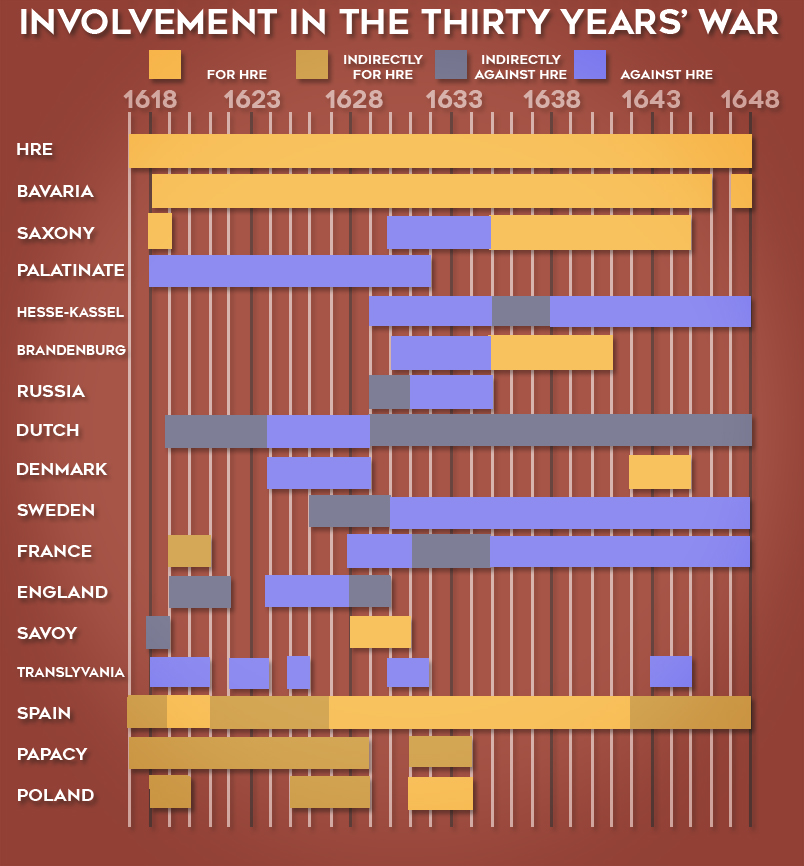
https://www.youtube.com/watch?v=zeQVAUmyLksInvolvement Chart
Comments Off on Feature History – Thirty Years’ War
June 9, 2018
D-Day – IV: The Atlantic Wall – Extra History
Extra Credits
Published on 29 Jun 2017The Germans had established a secure barrier against the Allied invasion of France – or so they believed, until the D-Day landings in Normandy caught them by surprise and the Atlantic Wall quickly fell apart.
Comments Off on D-Day – IV: The Atlantic Wall – Extra History
June 8, 2018
The Battle of Belleau Wood Begins I THE GREAT WAR Week 202
The Great War
Published on 7 Jun 2018The German Army is still threatening Paris and the situation for the Allies looks dire. Reluctantly, General Pershing agrees to put some of the American troops into action at Belleau Wood and Château-Thierry.
Comments Off on The Battle of Belleau Wood Begins I THE GREAT WAR Week 202
June 7, 2018
D-Day – II: The Secret War – Extra History
Extra Credits
Published on 13 Jun 2017The Germans expected the Allies to invade France to re-open the Western Front, but they did not know when or where the invasion would start – thanks largely to the operations of MI5, British intelligence services, who staged an elaborate deception called Operation Bodyguard designed to make the Germans think they would be invading Pas de Calais instead of their real target: Normandy.
Comments Off on D-Day – II: The Secret War – Extra History
June 6, 2018
D-Day – I: The Great Crusade – Extra History
Extra Credits
Published on 6 Jun 2017D-Day: June 6, 1944, the day when Allied forces stormed the beaches of Normandy to retake France from the Germans. They hoped to take the Germans by surprise, and their decision to brave rough weather to make their landings certainly accomplished that, but despite these small advantages, the American forces at Utah and Omaha Beach had to overcome monumental challenges to establish a successful beachhead.
Comments Off on D-Day – I: The Great Crusade – Extra History
June 1, 2018
50 Miles To Paris – Third Battle Of The Aisne I THE GREAT WAR Week 201
The Great War
Published on 31 May 2018The German spring offensive has lost some traction over the past few weeks but the Allies are still under pressure. With Operations Blücher and York, the Germans are getting within 50 miles of Paris again, just as they did in 1914.
Comments Off on 50 Miles To Paris – Third Battle Of The Aisne I THE GREAT WAR Week 201
May 31, 2018
Admiral David Beatty: “There seems to be something wrong with our bloody ships today”
One of the outcomes of the Battle of Jutland was that naval opinion finally crystalized over the notion of battle cruisers: the loss of three British battle cruisers during the battle (and near-loss of a fourth) proved to most that the design was flawed and that this class of ships should never have sailed into battle against real battleships. A recent post at Naval Gazing begs to differ on this judgement:
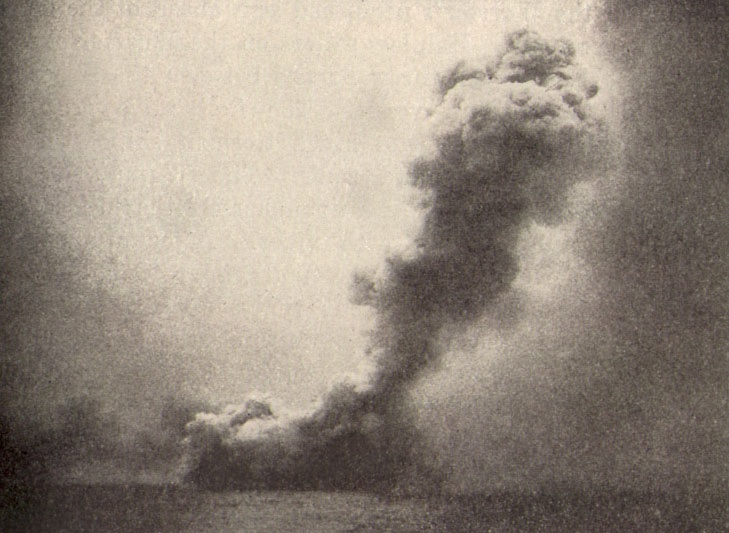
Explosion that sank HMS Queen Mary at the Battle of Jutland, 31 May 1916
Image via Wikimedia Commons.
David Beatty’s famous remark about the destruction of two of his ships by catastrophic magazine explosions during the Battle of Jutland sums up the traditional attitude towards one of the battle’s most famous aspects. Of the 3,326 men aboard the battlecruisers Indefatigable, Queen Mary, and Invincible, only 17 survived. It’s long been believed that the ships themselves were to blame, as they were built with only relatively light armor. Shells supposedly penetrated to the magazines and set them off. Recent research has revealed that this was not the case, and the ships were lost primarily due to defects in operation, not design.
The basic problem with the conventional theory is that no German shell penetrated deep enough into the surviving ships to have been able to set off a magazine if it had hit one. The magazines take up a minority of a battlecruiser’s deck, so if such hits were common, then at least a few of the surviving ships should have seen shells reach their machinery. Instead, German shells were found to detonate with 16-24′ of their first impact with the structure. At the 20° angle the shells were falling at at the time, this puts them no more than 8 feet below the upper deck upon detonation. The only case where shell fragments reached magazine was a hit on Barham at 1758 when fragments from a 12″ shell penetrated the deck over the 6″ magazine. Despite leaving a 12″x15″ hole in the 1″ deck, the fragments had no effect on the powder stored under it.
So is there a different potential cause, one that happened to a surviving ship? A survey of the damage to Beatty’s battlecrusiers reveals a promising candidate. A hit on a turret, such as the one suffered by HMS Lion, could cause a flash to propagate down into the magazine, which would then deflagrate in precisely the manner seen during the battle. A careful examination of Lion‘s damage shows that she came very close to suffering the same fate.
Turret explosions are hardly unknown aboard warships, either as a result of accident or enemy action, and a great deal of care goes into making sure that they don’t set off the magazines. Powder is stored in metal cans or tanks, and flashproof doors and other interlocks are used to make sure that fire does not reach the magazines. Unfortunately, the British had systematically undermined these protections in the search for rate of fire and ammunition capacity, and their magazine practices during the battle can only be described as suicidal.
After the Battle of Dogger Bank, Beatty decided that the reason he was unable to destroy the German battlecruisers was insufficient rate of fire. Not only would opening fire early and firing quickly lead to early hits, but it would also distract the German gunners. However, the British were not particularly confident in their long-range fire control, and began to stuff extra cordite into the handling rooms and other spaces that had been designed to provide flash protection. This was made much worse by a other changes intended to increase rate of fire. Normally, the cordite cases were kept sealed until just before the charges are sent to the gun, but the crews chose to open many of the cases early, take some cordite out of the cases before battle to make it easy to access, and even stored extra charges completely unprotected. In a final effort to make the turrets as dangerous as possible, the majority of the anti-flash safety doors were removed.
The only ship which strongly resisted this trend was Lion, and the efforts of her Gunner, Alexander Grant, deserve most of the credit. When Grant came aboard, he found the situation described above, and quickly reintroduced the traditional magazine safety regulations with the support of Lion‘s captain, Ernle Chatfield. He managed to train the magazine crews to the point where they could provide cordite to the guns faster than the guns could fire it, while observing full safety procedures.
Comments Off on Admiral David Beatty: “There seems to be something wrong with our bloody ships today”


