
It’s often called the “Hundred Days”, but even for people who stayed awake in their high school history classes, that’s often taken to refer to the last hurrah of Napoleon between his escape from Elba and his ultimate defeat at Waterloo. The WW1’s Hundred Days began with the Allied victory at the battle of Amiens and ended with the Armistice on 11 November, 1918. On Twitter, Engaging Strategy shared a series of tweets about this campaign and how little is generally remembered about it:
August 3, 2018
The obscure, almost-forgotten campaign that ended the First World War
Comments Off on The obscure, almost-forgotten campaign that ended the First World War
July 31, 2018
German Asia Corps In The Ottoman Empire During WW1 I THE GREAT WAR Special
The Great War
Published on 30 Jul 2018German-Ottoman military cooperation predated World War 1 by a few decades. But their alliance during the First World War meant that German (and Austrian) troops would actually fight in and with the Ottoman Empire.
Comments Off on German Asia Corps In The Ottoman Empire During WW1 I THE GREAT WAR Special
July 30, 2018
Pour Le Merite – Persia – Polish Legions I OUT OF THE TRENCHES
The Great War
Published on 28 Jul 2018Chair of Wisdom Time!
Comments Off on Pour Le Merite – Persia – Polish Legions I OUT OF THE TRENCHES
July 27, 2018
Ludendorff’s Last Swing I THE GREAT WAR Week 209
The Great War
Published on 26 Jul 2018All of Germany’s recent offensives have been building up to Operation Hagen: An offensive in Flanders that was to divide the Allies and drive the British off the continent. But this week German High Command realizes that they don’t have the manpower left to even start the offensive.
Comments Off on Ludendorff’s Last Swing I THE GREAT WAR Week 209
July 26, 2018
Forgotten History: The Capture of Fort Douaumont
Forgotten Weapons
Published on 26 Jun 2018http://www.patreon.com/ForgottenWeapons
Welcome to out first episode of Forgotten History! This will be an occasional series looking at interesting events and places in military history. We will begin with the capture of Fort Douaumont on February 25, 1916…
This video was made possible by Military History Tours, and it is the first of a bunch you will be seeing from their Spring 2018 tour of American WW1 battlefields in France. If you are interested in seeing places like this (or WW2, or Korea, or many others) firsthand yourself with a guided tour, check them out:
Comments Off on Forgotten History: The Capture of Fort Douaumont
July 25, 2018
Forgotten History: The Underground Hell of Fort Vaux
Forgotten Weapons
Published on 24 Jul 2018http://www.patreon.com/ForgottenWeapons
With the surprise capture of Fort Douaumont in February 1916, the French reinforced all the remaining forts around the city of Verdun, and would hold them all successfully for many months. In fact, the only other fort in the area to fall would be Fort Vaux, in June of 1916.
In the chaos of the early battle, orders had actually gone out to evacuate Vaux and destroy it, but these were countermanded, and the fort remained a major lynchpin of French defenses in the sector. Critically, before they could be removed, demolition charges set in the fort’s main gun turret were detonated by a massive German shell, destroying the weapon.
In May, German advances seriously threatened the fort, and a new commander was assigned – Major Sylvain Eugene Raynal. Upon arrival, he found the fort in a terrible condition – heavily damaged by German bombardments and hugely overcrowded with as many as 500 soldiers, most of them wounded and sheltering in the fort (it had been designed to garrison 150 men). Shelling had broken through the fort’s walls in several places, and unbeknownst to Raynal or his men, the water cistern had been damaged and was nearly empty despite its gauge reading substantial levels of water.
The climactic German assault began on June 1st 1916, and by the end of the day only 71 French soldiers remained in unwounded inside. On June 2nd, the cistern damage was discovered – at that point it held just 8 gallons of putrid dregs. Intense fighting would continue for nearly another week, without any relief forces or supplies able to reach the fort. On the 5th, a bit of water was collected from rain, but not much. A relief force attempted to reinforce the fort, but was virtually obliterated, with only 37 men reaching its walls.
The Germans would storm the fort on June 5th, and the most horrific of combat would rage for two days inside its tunnels and galleries. Raynal ordered barricades erected inside the fort, and the French forces fought from one to the next, with only a few dozen men remaining. The battle would include machine gun and hand grenades in these tight passageways, and eventually a German attempt to burn out the defenders with flamethrowers.
Finally on the morning of June 7th, the combination of casualties and a complete lack of water meant the end of the resistance. Raynal and his surviving men surrendered, and Germans soldiers finally occupied the fort they had spent months attempting to conquer. In recognition of his valiant defense, Raynal’s sword was returned to him by German Crown Prince Wilhelm.
The German occupation of the fort would last only a few months – by late October it was abandoned quietly, and a French scouting force would find it empty and retake it on November 2nd, 1916.
If you enjoy Forgotten Weapons, check out its sister channel, InRangeTV! http://www.youtube.com/InRangeTVShow
Comments Off on Forgotten History: The Underground Hell of Fort Vaux
July 20, 2018
2nd Battle Of The Marne – Turning Point On The Western Front I THE GREAT WAR Week 208
The Great War
Published on 19 Jul 2018The German Army launches an diversionary attack from the Rheims-Soisson salient and increases the pressure on Paris. But the Allies knew about the attack and for the first time, they effectively counter the German Stormtrooper tactics and even counter-attack along the line.
Comments Off on 2nd Battle Of The Marne – Turning Point On The Western Front I THE GREAT WAR Week 208
Tank Chats #33 Panzer III | The Tank Museum
The Tank Museum
Published on 11 Mar 2017The thirty-third Tank Chat, this time presented by Curator David Willey. Including a fascinating insight into pre-Second World War German tank production and how the Panzer III worked alongside its fellow Panzers.
To find out more, buy the new Haynes Panzer III tank manual. https://www.myonlinebooking.co.uk/tan…
The Panzer III was conceived in 1934 as the principle combat tank of the Panzer divisions. The Museum’s Panzer III went into action in the North African theatre of war and is believed to have been captured at the Battle of Alam Halfa.
Support the work of The Tank Museum on Patreon: ► https://www.patreon.com/tankmuseum
Or donate http://tankmuseum.org/support-us/donate
Comments Off on Tank Chats #33 Panzer III | The Tank Museum
July 15, 2018
More Info About Alsace-Lorraine in WW1 I OUT OF THE ETHER
The Great War
Published on 14 Jul 2018Markus and Indy give you some background on our recent special episode.
Comments Off on More Info About Alsace-Lorraine in WW1 I OUT OF THE ETHER
July 10, 2018
Mountain Combat In The Vosges – The Battle For Alsace-Lorraine I THE GREAT WAR Special
The Great War
Published on 9 Jul 2018The Battle for Alsace-Lorraine in the Vosges was unforgiving and brutal. Both the French and the German troops were fighting in extreme conditions for a extremely symbolic stretch of land.
Comments Off on Mountain Combat In The Vosges – The Battle For Alsace-Lorraine I THE GREAT WAR Special
Operation Husky with the “D-Day Dodgers”
On this day in 1943, the Allies invaded Sicily as their first step toward knocking Italy out of the war. It was the first major allied operation (other than the abortive Operation Jubilee in 1942) in which a major formation of the Canadian Army took part. The 1st Canadian Infantry Division under the command of Major General Guy Simonds was part of General Montgomery‘s Eighth Army, which landed on the southeast coast of the island.
The Canada History Project describes the Canadian participation in Operation Husky:
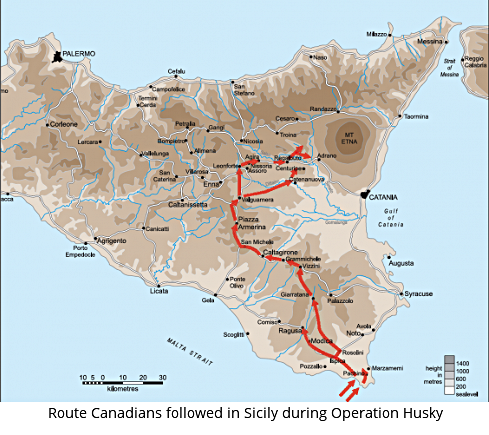
The men were young, of course, many just 18 to 24 years old. The roads were narrow dirt tracks switchbacking over steep, volcanic mountains. Temperatures hovered around 37 degrees, turning water bottles into hot water bottles, as one soldier put it. Three dry and dusty weeks into the campaign, there was a five-hour downpour, and all the troops relished the chance to shower off the dirt caked to their skin. By this time they were well into the middle of the island where their enemy was the fierce Hermann Goering division of the German army.
For six weeks, from July 10th to August 17th 1943, the Canadians, fighting as an independent unit for the first time, slogged through the interior of Sicily as part of Operation Husky, the first stage of taking back Europe from the Nazis after four years of war. Meanwhile, the Americans skirted the more level western coastline of the island and the British came up the east side, each competing with the other for glory.
American General Patton wrote in a letter, “This is a horse race in which the prestige of the US Army is at stake…we must take Messina before the British.”
That may be the way the generals saw it. For the soldiers, pushing through, village by village, mountaintop by mountaintop, it was no game.
Sicily, a rural mountainous island known for its orange groves and almond orchards, olives and the Mafia, sits strategically in the Mediterranean off the foot of Italy. The Canadian contingent was 25,000 strong. All men and materials were brought in by sea, making it the largest amphibious operation yet, though D-Day, a year later, would be bigger still.
In the first few days the Canadians passed through an area that is now a Unesco World Heritage site. Today tourists come to this southeast corner of Sicily to see the restored baroque architecture. But the young Canadian lads were eyeing the pillboxes, watching for snipers and lookouts. In the early days many Italian soldiers surrendered without too much resistance and the local people gave them grapes and oranges to quench their thirst in the scorching heat.
[…]
Operation Husky did succeed in gaining back the first European soil for the Allies. In the midst of it, Mussolini resigned and soon after Italy surrendered, another goal of the campaign. It started a second front forcing Hitler to back off his aggressive attack on our ally, Russia. And it provided a rehearsal for the larger amphibious landing on the beaches of Normandy, France in June of 1944. As well, it was the first time Canadians had fought as an independent unit. Their young commander was Guy Simonds. 1200 Canadians were wounded in Sicily and 562 died there. 490 of them are buried in the Canadian cemetery at Agira.
For their efforts, the soldiers fighting in Sicily and Italy became known as the “D-Day Dodgers”, a careless epithet supposedly delivered by Lady Astor, but embraced by the soldiers themselves who, with some sarcastic humour, turned it into the song, “We are the D-Day Dodgers, in sunny Italy…”
The Canadian part of the campaign from canadiansoldiers.com:
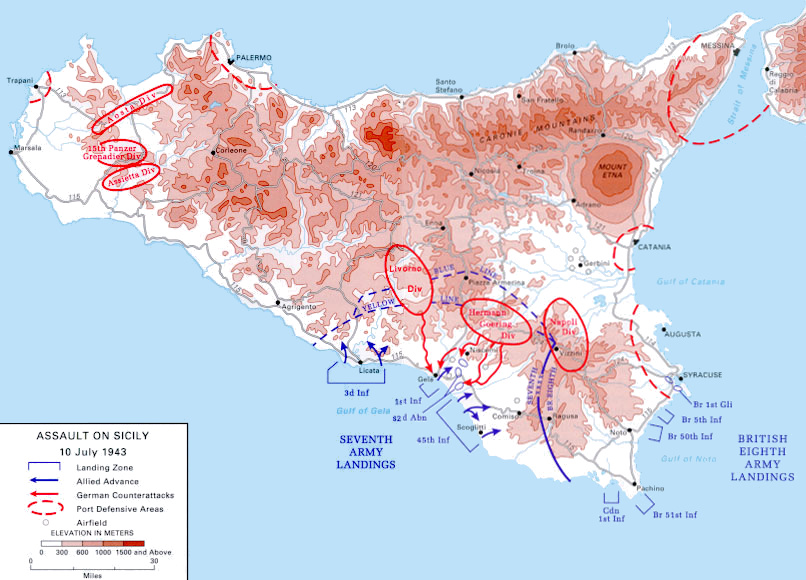
Sailing secretly at the end of June, the Division took its place on the left flank of General Bernard Montgomery’s famed Eighth Army for the Sicilian landings. The amphibious attack against Pachino peninsula was an unqualified success. The defenders were surprised and overrun with very few Allied casualties, and so began a controversial 38-day campaign. General Simonds’ troops advanced inland under difficulties:
The weather was extremely hot, the roads extremely dusty, and there was little transport; the troops were fresh from a temperate climate and a long voyage in crowded ships; and even though for a time there was scarcely any opposition, mere marching was a very exhausting experience under these conditions.
Continuing over the rocky terrain, they had their first fight with the Germans at Grammichele on 15 July. Three days later they captured Valguarnera. Both were rear-guard actions by a withdrawing enemy, and the first real tests came on the July 20 at Assoro and Leonforte. At the former, the 1st Brigade launched a surprise attack at night against an ancient Norman stronghold on the summit of a lofty peak. They seized and held their place in the face of fierce counter attacks, the records for the 15th Panzer Grenadier Division afterwards revealing generous tributes to the fieldcraft (Indianerkrieg) of the Canadians. Leonforte, an equally difficult situation, was captured by the 2nd Brigade after a bitter fight. These three days cost the Division about 275 casualties.
The advance then turned the east towards Adrano, at the base of Mount Etna. In their path stood Agira, “one of the most imposing of Sicily’s innumerable hill-towns,” and in the neighbouring hills the enemy put up a stubborn resistance. Both the 1st and 2nd Brigades were heavily engaged during the last week of July. The operations were, however, effectively supported by Canadian tanks and by the divisional artillery, reinforced by units of the Royal Artillery. General Simonds also had temporarily under his command the 231st British Infantry Brigade (the Malta Brigade), which threatened German communications from the south. After a bitter struggle Agira was captured on the 28th. Between Agira and Adrano the Hermann Goering Division made a stand at Regalbuto, using tanks as pillboxes in the debris of the town. While part of the 1st Division loosened the enemy’s grip on this town, the 3rd Brigade, temporarily under the command of the British 78th Infantry Division, assisted that formation in the Dittaino Valley.
American encircling operations in the western and northern districts of the island, combined with steady British pressure north of the Catania Plain, forced the enemy out of the defences based on Etna, and the campaign ended when the Allies entered Messina on 16-17 Aug. The 1st Division had performed all of its allotted tasks and had acquired valuable battle experience at a total cost of 2,155 casualties. The measure of the achievement was contained in General Montgomery’s statement: “I now consider you one of my veteran Divisions.”
The Division passed from XXX Corps to XIII Corps on 10 Aug, and moved to a concentration area in the rear on 11-13 Aug, relieved of operational responsibilities. Divisional headquarters moved to Francofonte. During the battle of Sicily they had travelled 120 miles, over largely rough and mountainous terrain.
Comments Off on Operation Husky with the “D-Day Dodgers”
July 6, 2018
The First Modern Battle – The Battle of Hamel I THE GREAT WAR Week 206
The Great War
Published on 5 Jul 2018Meet us at the Tank Museum: http://bit.ly/TankMuseumFanMeeting
The Battle of Hamel is considered as the first modern battle. Masterminded by Australian general John Monash, it included meticulous planning and integrated tanks, artillery, airplanes and infantry into one cohesive strategy.
Comments Off on The First Modern Battle – The Battle of Hamel I THE GREAT WAR Week 206
July 2, 2018
Mark Steyn on 49th Parallel
His annual Canada Day post this year featured a World War 2 British film about Canada intended for Americans:
The film stars, in order of billing, Leslie Howard, Laurence Olivier, Raymond Massey, Anton Walbrook, Eric Portman “and the music of Ralph Vaughan Williams”, which gets an above-the-title credit – as well it should. Vaughan Williams’ score is an integral part of the picture and, if not especially Canadian (save for a very short evocation of Calixa Lavallée’s “O Canada” right at the beginning), accompanies the country’s physical landscape beautifully, particularly in the opening travelogue, mostly shot by Freddie Young leaning out of a plane with a hand-held camera and edited back in England by David Lean. (Lean and Young, of course, subsequently worked together on Lawrence of Arabia, Doctor Zhivago and Ryan’s Daughter.) And, if you’re thinking that (with one exception) none of these participants seems terribly Canuck, well, if it’s any consolation, the English also get to play all the Nazis, too. The Canadians are largely relegated to small roles and extras – like the real seamen who play the survivors of the Canadian ship torpedoed in the Gulf of St Lawrence at the opening of the picture. “So,” pronounces the German U-boat commander, “the curtain rises on Canada.”
U-37 decides to flee to Hudson’s Bay to evade the RCAF and RCN patrols looking for it. Six Germans are put ashore to scout for supplies. But, even as they set foot on land, they hear the swoop of planes and look back to see Canadian bombers destroying their submarine. In order to lend verisimilitude to the scene, Michael Powell destroyed a real – or real-ish – sub, built for him in Halifax, Nova Scotia. The RCAF gave him two thousand-pound bombs to make it look good, and he put them on “U-37” and was cunning enough to neglect to tell the actors, lest it made them nervous. The sub was then towed to the Strait of Belle Isle between Labrador and Newfoundland to be blown sky high. That was Powell’s only mistake. Notwithstanding that he named the film after Canada’s southern border, the director’s grip on the country’s eastern border was a little hazier. He had forgotten that Newfoundland was not (yet) in Canada but was a British possession in its own right. So HM Customs impounded “U-37” and Powell had to go directly to the Governor to get it back.
Other than that, he and Pressburger didn’t put a foot wrong. The location footage was impressive in its day, and still striking in ours; Pressburger’s script is subtle and humane; and the episodic structure allows for plenty of variety. Following the loss of U-37, the six Germans are now beached in northern Canada and have to figure out a way to get to safe, neutral America. They make their way to a Hudson’s Bay trading post, where the factor (played by the great Scots actor Finlay Currie) is welcoming back an old friend who’s spent the last eleven months hunting in the wilds and so has no idea Canada is at war. Johnny is a French-Canadian trapper played by – who else? – Laurence Olivier. We first meet him in the bath tub singing “Alouette”, and, as often with Olivier, the attention to detail on the accent is so good that it becomes oddly intrusive: “Diss is one big country, but verra few pipple. Ever-wan know ever-body. You can’t make goosestep trew it widdout da police fine out,” he tells the senior German officer (Eric Portman).
The window shot Michael Powell uses to get the Nazis into the factor’s small cabin is cool and clinical and all the more chilling for it. The six Germans enter and announce that they’re now in control. When you’ve just come in off the tundra after eleven months and you want to have a soak in the tub and unwind, the Master Race showing up is a bit of a downer. “Okay, you are German. Why yell about it? I am Canadian,” says the Frenchie. “He is Canadian” – he points to the Scots factor – “and he is Canadian” – and to the smiling eskimo lad: French, English and Inuit all with the same unhyphenated label “Canadian”. That’s a lot simpler than the fractious diversity at Parliament Hill earlier today.
The Nazi lieutenant attempts to beguile his captives with a copy of Mein Kampf, but Trapper Johnny isn’t interested. “What’s the matter with Negroes?” he asks.
“They’re semi-apes,” explains the German. “One step above the Jews.” This is something of a remote concern at a Hudson’s Bay trading post. The Nazis seems as enraged by their prisoners’ geniality as by anything else. As they depart, one tears a portrait of the King and Queen off the wall and carves a swastika into the space.
Pressburger’s plot follows as you’d expect: There are six Germans, and soon there will be five, and then four, three, two… From Hudson’s Bay, they commandeer a seaplane that crashes near a Hutterite community in Manitoba, where a young pre-Mary Poppins Glynis Johns is sweetly trusting of them. They make their way to Indian Day in Banff National Park, for a rather Hitchcockian scene, and thence to a camp in the Rockies, where an arty pacifist (Leslie Howard) is discoursing on Thomas Mann. The tone is set by Olivier’s Frenchie coming in from the bush: He may not be interested in war, and nor is Glynis Johns or Leslie Howard. But war is interested in them. This was the purpose of the film, as the British Ministry of Information saw it: That’s why they wanted it set in Canada, rather than in, say, England, across the Channel from Occupied Europe. These trappers, Hutterites, and pacifists didn’t come looking for trouble. But, even five thousand miles from the fighting, trouble came looking for them – in big, empty, peaceable Canada. And the implicit message to America was: In the end, it will come for you, too. There is no 49th Parallel. Whichever side of it you’re on, it’s the same side.
Comments Off on Mark Steyn on 49th Parallel
June 30, 2018
Crown Prince Wilhelm – Front Line Visits – Trench Entertainment I OUT OF THE TRENCHES
The Great War
Published on 30 Jun 2018Chair of Wisdom Time!
Comments Off on Crown Prince Wilhelm – Front Line Visits – Trench Entertainment I OUT OF THE TRENCHES
June 29, 2018
The Run For The Baku Oil Fields I THE GREAT WAR Week 205
The Great War
Published on 28 Jun 2018While the Ottoman Army of Islam is marching on Baku and the Caspian Sea, multiple other players are trying to stake their claim of the Baku oil fields.
Comments Off on The Run For The Baku Oil Fields I THE GREAT WAR Week 205


