
OTD Military History
Published 7 Aug 2023The Battle of Amiens started on August 8 1918. It started the process that caused the final defeat of the German Army on the battlefield during World War 1. Many people falsely claimed that the German Army was not defeated on the battlefield but at home by groups that wished to see German fall. One person who helped to create this myth was German General Erich Ludendorff. He called August 8 “the black day of the German Army”.
See how this statement connects to the stab in the back myth connects to Amiens and the National Socialists in Germany.
(more…)
August 8, 2023
How the Battle of Amiens Influenced the “Stab in the Back” Myth
Comments Off on How the Battle of Amiens Influenced the “Stab in the Back” Myth
Holding the BBC to account for their climate change alarmism
Paul Homewood‘s updated accounting of the BBC’s coverage — and blatant falsehoods — of climate change news over the last twelve months:

The BBC’s coverage of climate change and related policy issues, such as energy policy, has long been of serious and widespread concern. There have been numerous instances of factual errors, bias and omission of alternative views to the BBC’s narrative. Our 2022 paper, Institutional Alarmism, provided many examples. Some led to formal complaints, later upheld by the BBC’s Executive Complaints Unit. However, many programmes and articles escaped such attention, though they were equally biased and misleading.
The purpose of this paper is to update that previous analysis with further instances of factual errors, misinformation, half truths, omissions and sheer bias. These either post-date the original report or were not included previously. However, the list is still by no means complete.
The case for the prosecution
The third most active hurricane season
In December 2021, BBC News reported that “The 2021 Atlantic hurricane season has now officially ended, and it’s been the third most active on record”. It was nothing of the sort. There were seven Atlantic hurricanes in 2021, and since 1851 there have been 32 years with a higher count. The article also made great play of the fact that all of the pre-determined names had been used up, implying that hurricanes are becoming more common. They failed to explain, however, that with satellite technology we are now able to spot hurricanes in mid-ocean that would have been missed before.Hurricanes: are they getting more violent?
Shortly after Hurricane Ian in September 2022, a BBC “Reality Check” claimed that “Hurricanes are among the most violent storms on Earth and there’s evidence they’re getting more powerful”. The video offered absolutely no data or evidence to back up this claim, which contradicted the official agencies. For instance, the US National Oceanic and Atmospheric Administration (NOAA) state in their latest review:
There is no strong evidence of century-scale increasing trends in U.S. landfalling hurricanes or major hurricanes. Similarly for Atlantic basin-wide hurricane frequency (after adjusting for observing capabilities), there is not strong evidence for an increase since the late 1800s in hurricanes, major hurricanes, or the proportion of hurricanes that reach major hurricane intensity.
The IPCC came to a similar conclusion about hurricanes globally in their latest Assessment Review. However, the BBC article failed to mention any of this.
Comments Off on Holding the BBC to account for their climate change alarmism
Up close with Royal Marines landing craft
Forces News
Published 12 Jul 2022Specialists in small craft operations and amphibious warfare, 47 Commando (Raiding Group) Royal Marines are preparing for overseas training in the Netherlands.
Briohny Williams met up with the marines and found out more about their landing craft.
(more…)
Comments Off on Up close with Royal Marines landing craft
QotD: The British imperial educational “system”
The history of “education”, of the university system, whatever you want to call it, is long and complicated and fascinating, but not really germane. Like all human institutions, “educational” ones grew organically around what were originally very different foundations, the way coral reefs form around shipwrecks. Oversimplifying for clarity: back in the day, “schools” were supposed to handle education […] while universities were for training. That being the case, very few who attended universities emerged with degrees — a man got what training he needed for his future career, and unless that future career was “senior churchman”, the full Bachelor of Arts route was pretty much pointless.
(At the risk of straying too far afield, let’s briefly note that “senior churchman” was a common, indeed almost traditional, career path for the spare sons of the aristocracy. Well into the 18th century, every titled parent’s goal was “an heir and a spare”, with the heir destined for the title and castle and the spare earmarked for the church … but not, of course, as some humble parish priest. It was pretty common for bishops or abbots, and sometimes even cardinals, to be ordained on the day they took over their bishoprics. See, for example, Cesare Borgia. Meanwhile the illiterate, superstitious, brutish parish priest was a figure of satire throughout the Middle Ages and Renaissance. A guy like Thomas Wolsey was hated, in no small part, precisely because he was a commoner who leveraged his formal education into a senior church gig, taking a bunch of plum positions away from the aristocracy’s spare sons in the process).
That being the case — that schools were for education, universities for training — the fascinating spectacle of some 18 year old fop fresh out of Eton being sent to govern the Punjab makes a lot more sense. His character, formed by his education (in our sense), was considered sufficient; he’d pick up such technical training as he needed on the job … or employ trained technicians to do it for him. So too, of course, with the army, and the more you know about the British Army before the 20th century, the more you’re amazed that they managed to win anything, much less an empire — the heir’s spare’s spare traditionally went into the army, buying his commission outright, which meant that quite senior commands could, and often did, go to snotnosed teenagers who didn’t know their left flank from their right.
Alas, governments back in the days were severely under-bureaucratized, meaning that the aristocracy lacked sufficient spares to fill all the technician roles the heirs required in a rapidly urbanizing, globalizing world… which meant that talented commoners had to be employed to fill the gaps. See e.g. Wolsey, above. The problem with that, though, is that you can’t have some dirty-arsed commoner, however skilled, wiping his nose on his sleeve while in the presence of His Lordship, so universities took on a socializing function. And so (again, grossly oversimplifying for clarity) the “bachelor of arts” was born, meaning “a technician with the social savvy to work closely with his betters”. A good example is Thomas Hobbes, whose official job title in the Earl of Devonshire’s household was “tutor”, but whose function was basically “intellectual technician” — he was a kind of man-of-all-work for anything white collar …
At that point, if there had been a “system” of any kind, what the system’s designers should’ve done is set up finishing schools. The “universities” of Oxford, Cambridge, etc. are made up of various “colleges” anyway, each with their own rules and traditions and house colors and all that Harry Potter shit. Their Lordships should’ve gotten together and endowed another college for the sole purpose of knocking manners into ambitious commoners on the make (Wolsey might actually have had something like this in mind with Cardinal College … alas).
But they didn’t, and so the professors at the traditional colleges were forced into a role for which they were not designed, and unqualified. That tends to happen a lot — have you noticed? It actually happened to them twice, once with the need for technicians-with-manners became apparent, and then again when the realization dawned — as it did by the 1700s, if not earlier — that some subjects, like chemistry, require not just technicians and technician-trainers, but researchers. Hard to blame the “system” for this, since of course there is no “system”, but also because such a thing would be ruinously expensive.
Hence by the time an actual system came into being — in Prussia, around 1800 — the professors awkwardly inhabited the three roles we started with. The Professor of Chemistry, say, was supposed to conduct research while training technicians-with-manners. As with the pre-machinegun British army, the astounding thing is that they managed to pull it off at all, much less to such consistently high quality. They were real men back then …
Severian, “Education Reform”, Rotten Chestnuts, 2020-11-17.
Comments Off on QotD: The British imperial educational “system”
August 6, 2023
The Warsaw Uprising Begins! – WW2 – Week 258 – August 5, 1944
World War Two
Published 5 Aug 2023As the Red Army closes in on Warsaw, the Polish Home Army in the city rises up against the German forces. Up in the north the Red Army takes Kaunas. The Allies take Florence in Italy this week, well, half of it, and in France break out of Normandy and into Brittany. The Allies also finally take Myitkyina in Burma after many weeks of siege, and in the Marianas take Tinian and nearly finish taking Guam. And in Finland the President resigns, which could have serious implications for Finland remaining in the war.
(more…)
Comments Off on The Warsaw Uprising Begins! – WW2 – Week 258 – August 5, 1944
August 5, 2023
The Anglo-Scottish “Debatable Lands”
In the visible portion of this post on the history of the Debatable Lands, Ed West considers the differences between national heartlands and the borders:
Border regions tend to be different, something I thought about during the summer before Brexit when we underwent a mammoth trip across five of those six countries (we never got around to Luxembourg, for which apologies). The journey from Alsace to Baden-Württemberg, or Liguria to Provence, brings home how nationality is often a matter of gradations and unnatural boundaries imposed on the whims of bureaucrats in distant capitals – often more alien than supposed foreigners across the border.
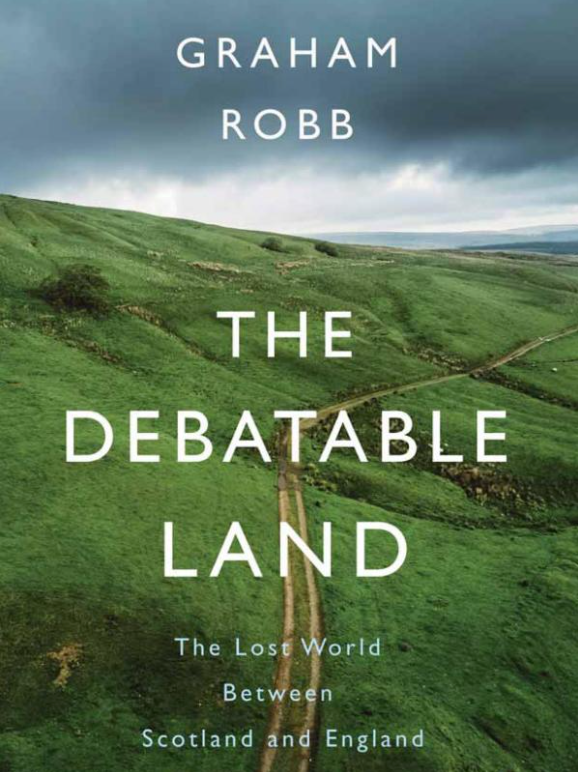
But once you leave that tunnel, things are different; there is no ambiguity between Calais and Dover, only ocean. You’re either in England or France. The same is not true of England’s northern frontier, Britain’s great zone of ambiguity, and in particular the area between Carlisle and Langholm which has historically been known as the “Debatable Land” – the subject of Graham Robb’s book.
Robb, an Anglo-Scot who mostly writes about France, moved back to this part of Britain in the 2010s, and describes it with his characteristic style of history, personal narrative and social commentary.
The border people are a unique subset of the English nation, being the last to undergo the pacification of government. Until the Union of Crowns in 1603, the region’s unusual position outside the orbit of either London and Edinburgh helped create a culture that was clannish and marked by violent feuds and cattle rustling.
Among the notorious Borderer clans were the Scotts, Burns and Irvines north of the border, and Fenwicks, Millburns, Charltons and Musgraves on the English side, while some could be found on both, among them the Halls, Nixons and Grahams. Many of these clans were outlaws and some were lawmen; others were both or either, depending on circumstances.
This proto-Wild West produced many characters, and among the famous border reivers of legend were men such as Archie Fire-the-Braes, Buggerback, Davy the Lady, Jok Pott the Bastard, Wynkyng Will, Nebless [noseless] Clem, Fingerless Well and Dog Dyntle [penis] Elliot.
“Debatable Land” most likely comes from batten, common land where livestock could be pastured, and it was this pastoral economy which shaped their psychology: the importance of honour, and a reputation for violence and revenge, as a deterrent against predators.
Violence was so common on the border that there sprung a tradition whereby truces were arranged in return for “blackmail”, a tribute to border chiefs, from the Middle English male, tribute; only in the nineteenth century did this come to mean any sort of extortion.
Another of the Borderers’ contributions to our language is “bereaved”, which is how you felt after the reivers had raided your land (it usually meant to have lost property rather than a loved one). Other local terms were less successful in spreading, such as “scumfishing”, which meant “surrounding a pele tower with a smouldering heap of damp straw and smoking out its inhabitants”, as Robb put it.
Border folk relied heavily on the protection of their clan, and so “for a reiver, the greatest disgrace was not excommunication but ostracism: if a man failed to keep his word, one of his gloves or a picture of his face was stuck on the end of a spear or a sword and paraded around at public meetings. This ‘bauchling’ was considered a punishment worse than death.”
Both the kings of England and Scotland regarded them as a nuisance. In 1525, the Archbishop of Glasgow excommunicated the reivers en masse; Parliamentary decrees issued by authorities in England and Scotland between 1537 and 1551 stated that “all Englishmen and Scottishmen are and shall be free to rob, burn, spoil, slay, murder and destroy, all and every such person and persons, their bodies, property, goods and livestock … without any redress to be made for same”.
In the 1580s the border area remained “verie ticklie and dangerous”. One adviser even urged Elizabeth I to build another Roman wall because he believed the “Romaynes” had built theirs to defend themselves “from the dayly and daungereous incurtyons of the valyaunte barbarous Scottyshe nation”.
Comments Off on The Anglo-Scottish “Debatable Lands”
August 3, 2023
Behind Japanese lines in Burma – SOE and Karen tribal guerillas in 1944/45
Bill Lyman outlines one of the significant factors assisting General Slim’s XIVth Army to recapture Burma from the Japanese during late 1944 and early 1945:
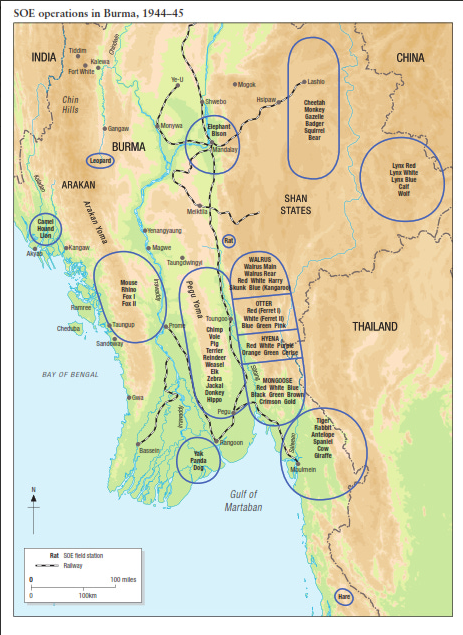
If Lieutenant General Sir Bill Slim (he had been knighted by General Archibald Wavell, the Viceroy, the previous October, at Imphal) had been asked in January 1945 to describe the situation in Burma at the onset of the next monsoon period in May, I do not believe that in his wildest imaginings he could have conceived that the whole of Burma would be about to fall into his hands. After all, his army wasn’t yet fully across the Chindwin. Nearly 800 miles of tough country with few roads lay before him, not least the entire Burma Area Army under a new commander, General Kimura. The Arakanese coastline needed to be captured too, to allow aircraft to use the vital airfields at Akyab as a stepping stone to Rangoon. Likewise, I’m not sure that he would have imagined that a primary reason for the success of his Army was the work of 12,000 native levies from the Karen Hills, under the leadership of SOE, whose guerrilla activities prevented the Japanese from reaching, reinforcing and defending the key town of Toungoo on the Sittang river. It was the loss of this town, more than any other, which handed Burma to Slim on a plate, and it was SOE and their native Karen guerrillas which made it all possible.
In January 1945 Slim was given operational responsibility for Force 136 (i.e. Special Operations Executive, or SOE). It had operated in front of 20 Indian Division along the Chindwin between 1943 and early 1944 and did sterling work reporting on Japanese activity facing 4 Corps. Persuaded that similar groups working among the Karens in Burma’s eastern hills – an area known as the Karenni States – could achieve significant support for a land offensive in Burma, Slim authorised an operation to the Karens. Its task was not merely to undertake intelligence missions watching the road and railways between Mandalay and Rangoon, but to determine whether they would fight. If the Karens were prepared to do so, SOE would be responsible for training and organising them as armed groups able to deliver battlefield intelligence directly in support of the advancing 14 Army. In fact, the resulting operation – Character – was so spectacularly successful that it far outweighed what had been achieved by Operation Thursday the previous year in terms of its impact on the course of military operations in pursuit of the strategy to defeat the Japanese in the whole of Burma. It has been strangely forgotten, or ignored, by most historians ever since, drowned out perhaps by the noise made by the drama and heroism of Thursday, the second Chindit expedition. Over the course of Slim’s advance in 1945 some 2,000 British, Indian and Burmese officers and soldiers, along with 1,430 tons of supplies, were dropped into Burma for the purposes of providing intelligence about the Japanese that would be useful for the fighting formations of 14 Army, as well as undertaking limited guerrilla operations. As Richard Duckett has observed, this found SOE operating not merely as intelligence gatherers in the traditional sense, but as Special Forces with a defined military mission as part of conventional operations linked directly to a military strategic outcome. For Operation Character specifically, about 110 British officers and NCOs and over 100 men of all Burmese ethnicities, dominated interestingly by Burmans mobilised as many as 12,000 Karens over an area of 7,000 square miles to the anti-Japanese cause. Some 3,000 weapons were dropped into the Karenni States. Operating in five distinct groups (“Walrus”, “Ferret”, “Otter”, “Mongoose” and “Hyena”) the Karen irregulars trained and led by Force 136, waited the moment when 14 Army instructed them to attack.
Between 30 March and 10 April 1945 14 Army drove hard for Rangoon after its victories at Mandalay and Meiktila, with Lt General Frank Messervy’s 4 Indian Corps in the van. Pyawbe saw the first battle of 14 Army’s drive to Rangoon, and it proved as decisive in 1945 as the Japanese attack on Prome had been in 1942. Otherwise strong Japanese defensive positions around the town with limited capability for counter attack meant that the Japanese were sitting targets for Allied tanks, artillery and airpower. Messervy’s plan was simple: to bypass the defended points that lay before Pyawbe, allowing them to be dealt with by subsequent attack from the air, and surround Pyawbe from all points of the compass by 17 Indian Division before squeezing it like a lemon with his tanks and artillery. With nowhere to go, and with no effective means to counter-attack, the Japanese were exterminated bunker by bunker by the Shermans of 255 Tank Brigade, now slick with the experience of battle gained at Meiktila. Infantry, armour and aircraft cleared General Honda’s primary blocking point before Toungoo with coordinated precision. This single battle, which killed over 1,000 Japanese, entirely removed Honda’s ability to prevent 4 Corps from exploiting the road to Toungoo. Messervy grasped the opportunity, leapfrogging 5 Indian Division (the vanguard of the advance comprising an armoured regiment and armoured reconnaissance group from 255 Tank Brigade) southwards, capturing Shwemyo on 16 April, Pyinmana on 19 April and Lewe on 21 April. Toungoo was the immediate target, attractive because it boasted three airfields, from where No 224 Group could provide air support to Operation Dracula, the planned amphibious attack against Rangoon. Messervy drove his armour on, reaching Toungoo, much to the surprise of the Japanese, the following day. After three days of fighting, supported by heavy attack from the air by B24 Liberators, the town and its airfields fell to Messervy. On the very day of its capture, 100 C47s and C46 Commando transports landed the air transportable elements of 17 Indian Division to join their armoured comrades. They now took the lead from 5 Indian Division, accompanied by 255 Tank Brigade, for whom rations in their supporting vehicles had had been substituted for petrol, pressing on via Pegu to Rangoon.
Comments Off on Behind Japanese lines in Burma – SOE and Karen tribal guerillas in 1944/45
Webley 1905
Forgotten Weapons
Published 12 Jun 2016William Whiting was an engineer who spent his entire adult career with the Webley company, and was responsible for all of their in-house self-loading pistol designs. This work initially focused on a behemoth of a pistol, the Model 1904 intended for military contracts. The gun proved insufficiently attractive to the British military though, leaving Webley with a large R&D outlay with nothing to show for it. The solution was to scale the system way down and look to the civilian market with a pocket automatic in .32ACP.
The first version of this commercial pocket pistol was this model 1905 design. It proved to be a popular concept, and the gun was revised to address a few shortcomings and opportunities for simplification. In its final version, the Model 1908 would prove to be Webley’s best-selling automatic pistol, and it is still a relatively easy gun to find today. However, its 1905 predecessor is far scarcer, and it is interesting to examine the changes made between the two models.
Comments Off on Webley 1905
August 2, 2023
Britain’s troubling rise in hospital visits due to dog bites
Ed West has a dog, but he admits he’s not really a “dog person”:

American Bully Breed Dog. Male. Name: X-Men.
Photo by Verygoodhustle via Wikimedia Commons.
Dog breeds have different natures, something that would seem self-obviously true and yet which today the leading authorities in the British dog world seem to be in denial about, in particular when it comes to one of the unspoken trends of recent years – the huge increase in dog attacks.
This spike in dog-bites-man violence has led to a 50 per cent increase in hospital admissions for dog bites over ten years, the biggest rise being among children under the age of 4. Overall the number of fatalities has gone from an average of 3.3 in the 2000s to 10 last year, while dog attacks have risen recently from 16,000 in 2018 to 22,000 in 2022, and hospitalisations have almost doubled from 4,699 in 2007 to 8,819 in 2021/22.
The underlying story behind this escalation of violence is that much of it is the work of just one breed – the American Bully. And as we enter the summer holidays, the peak period for dog attacks, it’s worth pondering why the experts in the dog world are in such denial about the issue.
Public awareness of the American Bully problem has grown in recent months, spurred by some especially horrific attacks, as well as a widely-read article by legal academic and YouTuber Lawrence Newport. Lawrence looked at the data on dog attacks and observed that “a notable pattern emerges. In 2021, 2 of the 4 UK fatalities were from a breed known as the American Bully XL. In 2022, 6 out of 10 were American Bullies. In 2023, so far all fatalities appear to have been American Bullies.”
American Bullies, Newport explains, “are a breed resulting from modern mixes of the American Pitbull Terrier. They are known for very high muscle mass, biting power, and impressive strength, and come in several variations. Those that are bred for the greatest strength, weight and size are known as a part of the American Bully XL variety.”
Pitbulls are banned in Britain for a good reason, and in the US are responsible for “60–70% of dog fatalities“; yet under the Dangerous Dogs Act 1991 “the American Bully XL is currently permitted”.
What is surprising, Newport writes, is that “if you argue these dogs are dangerous, you will get a flood of comments from people … saying it’s the owner’s fault, not the dog’s. You might even be thinking this yourself, right now. But this is wrong. Whilst many Brits would contend that ‘
GunsAmerican Bully XL’s don’t kill people, people do’, the reality is different.“Labradors retrieve. Pointers point. Cocker Spaniels will run through bushes, nose to the ground, looking as if they are tracking or hunting even when just playing – even when they have never been on a hunt of any kind. This is not controversial. Breeds have traits. We’ve bred them to have them.”
Pitbulls were created for bull-baiting, and when that was banned, they came to be bred to hunt down rats in a locked pen. “This required more speed, so they were interbred with terriers to make Pitbull Terriers. In addition to this, they began to be used for dog fighting: bred specifically to have aggression towards other dogs, and to be locked in a pit to fight (some are still used for this today). These were dogs likely kept in cages, away from humans, and bred for their capacity to earn money for their owners by winning fights. These were not dogs bred for loyalty to humans, these were dogs bred for indiscriminate, sustained and brutal violence contained within a pit.”
Comments Off on Britain’s troubling rise in hospital visits due to dog bites
August 1, 2023
Evil climate heretics deny the revealed holy truth of global BOILING!
Notorious heretic Brendan O’Neill preaches climate denial! Where are the Green Gestapo when you need them?
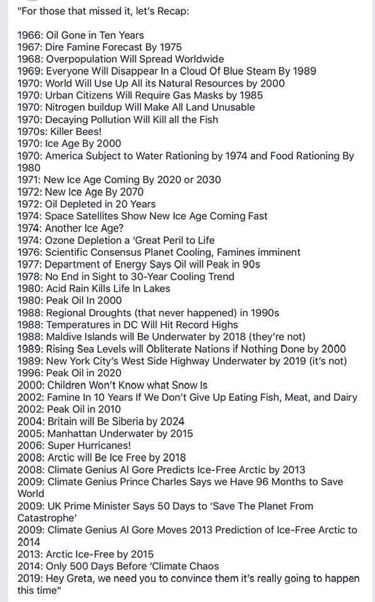
And just like that we’ve entered a new epoch. “The era of global warming has ended, the era of global boiling has arrived”, decreed UN chief António Guterres last week. It’s hard to know what’s worse: the hubris and arrogance of this globalist official who imagines he has the right to declare the start of an entire new age, or the servile compliance of the media elites who lapped up his deranged edict about the coming heat death of Earth. “Era of global boiling has arrived and it is terrifying”, said the front page of the Guardian, as if Guterres’s word was gospel, his every utterance a divine truth. We urgently need to throw the waters of reason on this delirious talk of a “boiling” planet.
Guterres issued his neo-papal bull about the boiling of our world in response to the heatwaves that have hit some countries over the past two weeks. “Climate change is here [and] it is terrifying”, he said. We see “families running from the flames [and] workers collapsing in scorching heat” and “it is just the beginning”, he said, doing his best impersonation of a 1st-century millenarian crackpot. In fact, forget “climate change”, he said. Forget “global warming”, too. What we’re witnessing is a boiling. It all brings to mind the Book of Job which warned that the serpent Leviathan would cause the seas to “boil like a cauldron”. Leviathan’s back, only we call him climate change now.
The obsequious speed with which the media turned Guterres’s commandment into frontpage news was extraordinary. They behaved less like reporters than like the slavish scribes of this secular god and his delusional visions. “World entering ‘era of global boiling'”, cried the Independent, and we “know who is responsible”. No prizes for guessing who that is. It’s you, me and the rest of our pesky species. It always is. “Planet is boiling”, one headline breezily declared, confirming that Guterres’s fearful phrase, his propagandistic line no doubt drawn up with the aid of spin doctors in some UN backroom, is already being christened as fact.
Almost instantly, media outlets started lecturing readers on how they might help to put a halt to the coming evaporation of our planet. SBS in Australia advised us to “Reduce meat intake”, “Stop driving cars” and “Cut down on flights”. In short, stop all the fun stuff; make sacrifices to appease nature’s angry gods. Even self-styled radicals made themselves mouthpieces of the UN’s medieval sermonising. Novara Media instantly embraced “global boiling” as an apt metaphor for the arsonist impact humanity has had on Earth. Scratch a Marxist these days, find a Malthusian.
Comments Off on Evil climate heretics deny the revealed holy truth of global BOILING!
Dire Straits – Tunnel Of Love (Rockpop In Concert, 19th Dec 1980)
Dire Straits
Published 28 Apr 2023Dire Straits performing ‘Tunnel Of Love’ at Rockpop in Concert on December 19th 1980.
Footage licensed from ZDF Enterprises. All rights reserved.
(more…)
Comments Off on Dire Straits – Tunnel Of Love (Rockpop In Concert, 19th Dec 1980)
July 31, 2023
The grim plight of the UK as global BOILING advances
Alexander McKibbin reports on the UK’s latest set of climate-related warnings from the Met Office:
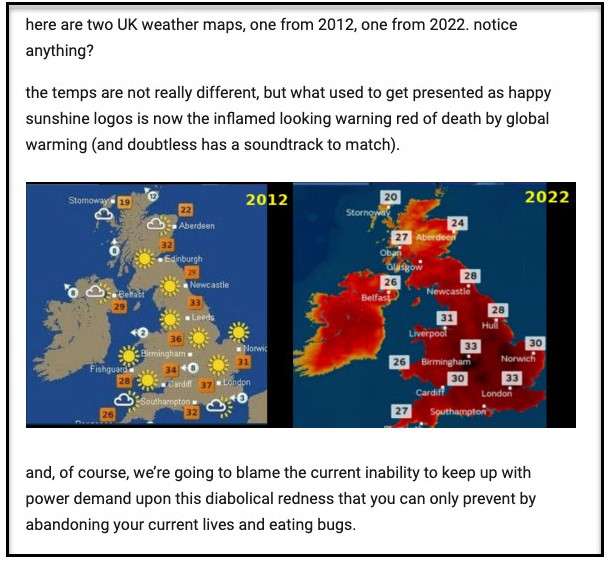
No one who has read and digested this authoritative and comprehensive report can fail to be apprehensive about the future. Harnessing the technological power of its powerful computer modelling system, the Met Office can produce a highly accurate forecast of how the changing climate will affect the UK. It is a truly dystopian projection and one which should ring alarm bells in the top echelons of Whitehall.
Below is a selection of areas highlighted as being at risk if we do not achieve Net Zero by 2030.
Berwick-upon-Tweed
This charming border town with castle ruins and cobbled streets will disappear in the next five years, according to the Met Office. The picturesque Royal Border, Berwick and Union Suspension bridges will all be drowned by an unstoppable and ever-rising River Tweed. Displaced residents will need to find alternative accommodation and it is likely that looting and scavenging will become commonplace.
Kent
Known for centuries as “The Garden of England”, this delightful county currently plays host to gentle hills, fertile farmland and fruit-filled orchards. Country estates such as Penshurst Place, Sissinghurst Castle and Hall Place Gardens are all well known for the scenic views they offer.
Sadly, this will all shortly vanish under burning heat exceeding 200 degrees Fahrenheit. The rivers Stour, Medway, Darent and Dour will slow to a trickle and finally dry up completely. Dust storms and dust bowls will be part and parcel of daily living, as will camels and occasional prickly pear cacti dotted across a barren and arid wasteland. Dartford, the Met Office confidently asserts, will be a never-ending vista of shape changing sand dunes.
Yorkshire
Known to inhabitants as “God’s Own County”, no one can deny the many charms of England’s largest county with a population twice the size of Wales.
Horse-racing is a major attraction and with nine courses to choose from including Thirsk, Wetherby, Redcar and Catterick, no wonder Yorkshire is a popular tourist destination. What a pity that all of these temples to equestrian prowess will be lost to an all-consuming glacier that will blanket the land. The report is not sure whether at 104ft high the scenic Ribblehead Viaduct will avoid being trapped in this icy embrace. It is suggested that refugees should make their way south to seek food and shelter.
Comments Off on The grim plight of the UK as global BOILING advances
July 30, 2023
“Give me Andrea Dworkin’s anti-fella fury over this matrician tripe any day of the week”
Brendan O’Neill clearly doesn’t think Caitlin Moran’s new book What About Men? is worth reading:

Men, I have bad news: Caitlin Moran is coming for us. She comes not to man-bash, not to holler: “All men are rapists!” It’s worse than that. She feels sorry for us. “I’m violently opposed to the branches of feminism that are permanently angry with men”, she writes at the very start of her very bad book. Instead she pities us. She frets over our toxic stoicism, our inability to be vulnerable, our unwillingness to be open about our fat bodies and small cocks. She wants to save us from all the “rules” about “what a man should be”. From all that “swagger” and “the stiff upper lip”. By the end I found myself pining for some good ol’ angry feminism. Give me Andrea Dworkin’s anti-fella fury over this matrician tripe any day of the week.
What About Men? is, I’m going to be blunt, rubbish. I knew it would be from the very first page where Moran says that “when it comes to the vag-based problems, I have the bantz”. Imagine using the word bantz unironically in 2023. What she means is that she’s done all the vagina stuff. She’s completed feminism. She’s known as “the Woman Woman”, she says, in an arrogant timbre that puts to shame those cocksure blokes who stalk her nightmares. She wrote the bestselling pop-feminist tome, How To Be a Woman (2011), which contained such gems of wisdom as “don’t shave your vagina” because it’s better to have a “big, hairy minge”, a “lovely furry moof”, “a marmoset sitting in [your] lap”, than a bald cooch. (Emmeline Pankhurst, I’m so sorry.) So now, naturally, she’s turning her attention to men. She’s discovered there is “a lot to say” about “men in the 21st-century”. Lucky us.
What she says about us is almost too daft for words. You realise by about page 22 that she’s never met a bloke from outside the media-luvvie, ageing rock-chick, “Glasto”-loving circle she famously inhabits. (I almost died of second-hand embarrassment when she said in How To Be a Woman that she lives an edgy existence, “like it’s 1969 all over again and my entire life is made of cheesecloth, sitars and hash”. Maam, you write a celebrity column for hundreds of thousands of pounds for The Times.)
Even her cultural references in What About Men? are off, as befits a woman who is essentially a square person’s idea of a cool person. She laments that young men are in “the grip of a fad” for super-skinny jeans. Jeans so tight they look “sprayed-on”. Jeans so tight that the poor lad’s balls end up “crushed against the crotch seam, in vivid detail”. Really? It’s not 2006. Bloc Party aren’t in the charts. I’m no follower of fashion but even I know most young men haven’t been wearing bollock-squashing jeans for a few years now. My nephews wear baggy jeans, à la Madchester. Pretty much the only time you see unyielding denim these days is on the portly thigh of a mid-life-crisis middle-class dad. The kind of men, dare I say it, that Ms Moran mixes with.
Her commentary on t-shirts is a dead giveaway, too. The only fashion flare the tragic male sex is allowed to enjoy is the tee, she says. Especially past the age of 40. You’ll see fortysomething fellas in “band t-shirts, slogan t-shirts, t-shirts with swearing on”, she says. Will you? Where? Again, only in the knowingly dishevelled privileged set Moran exists in. Every man in his forties I know always manages to put a shirt on. So desperate are emotionally repressed men to express themselves, says Moran, that some even buy t-shirts “from the back pages of Viz” that say things like “Breast Inspector” or “Fart Loading: Please Wait”. Not once in my life have I seen a man in a Viz tee. The problem here isn’t men – it’s Moran’s man-friends. She could have saved herself the trouble of this entire book by befriending some normal blokes.
That Moran’s pool of men is shallow is clear from the fact that all the men she talks to for the book seem to be as steeped as she is in chattering-class orthodoxy. She includes a transcript of long chats with male acquaintances and, honestly, reading it feels like being stuck in a lift with craft-beer wankers who do IT for the Guardian. At one point she informs her readers that her male friends are mostly “middle-aged, middle-class dads who know about wine, recycle, have views on thoughtful novels” and would probably “cry if they saw a dog struggling with a slight limp”. Writing a book about men from the perspective of men like that is like writing a book about women from the perspective of Princess Anne.
Comments Off on “Give me Andrea Dworkin’s anti-fella fury over this matrician tripe any day of the week”
Bradley Unleashes His Cobra – WW2 – Week 257 – July 29, 1944
World War Two
Published 29 Jul 2023Operation Cobra is the drop that finally opens the floodgates and the Allies make a breakthrough in Normandy; up in the Baltics the Soviets take Shaulyai, Dvinsk, and finally Narva, though their big prize this week is Lvov further south. This happens during the Poles’ Lvov Uprising, which ends badly for the Poles. Things also go badly for the Japanese on Guam, though, as their assault this week devastates their own troops.
(more…)
Comments Off on Bradley Unleashes His Cobra – WW2 – Week 257 – July 29, 1944
The Grave of the Man Who Never Was: Operation Mincemeat
Tom Scott
Published 7 Nov 2016In a cemetery in Huelva, in Spain, is the grave of Major William Martin, of the British Royal Marines. Or rather, it’s the grave of a man called Glyndwr Michael, who served his country during World War 2 in a very unexpected way … after his death.
(more…)
Comments Off on The Grave of the Man Who Never Was: Operation Mincemeat


